News & Tech · 8 min read
Bionic hands in plain words
Three kinds of prosthetic hand, how you tell each one what to do, and why water ratings and repairs matter as much as the number of grips.
Three families, one decision
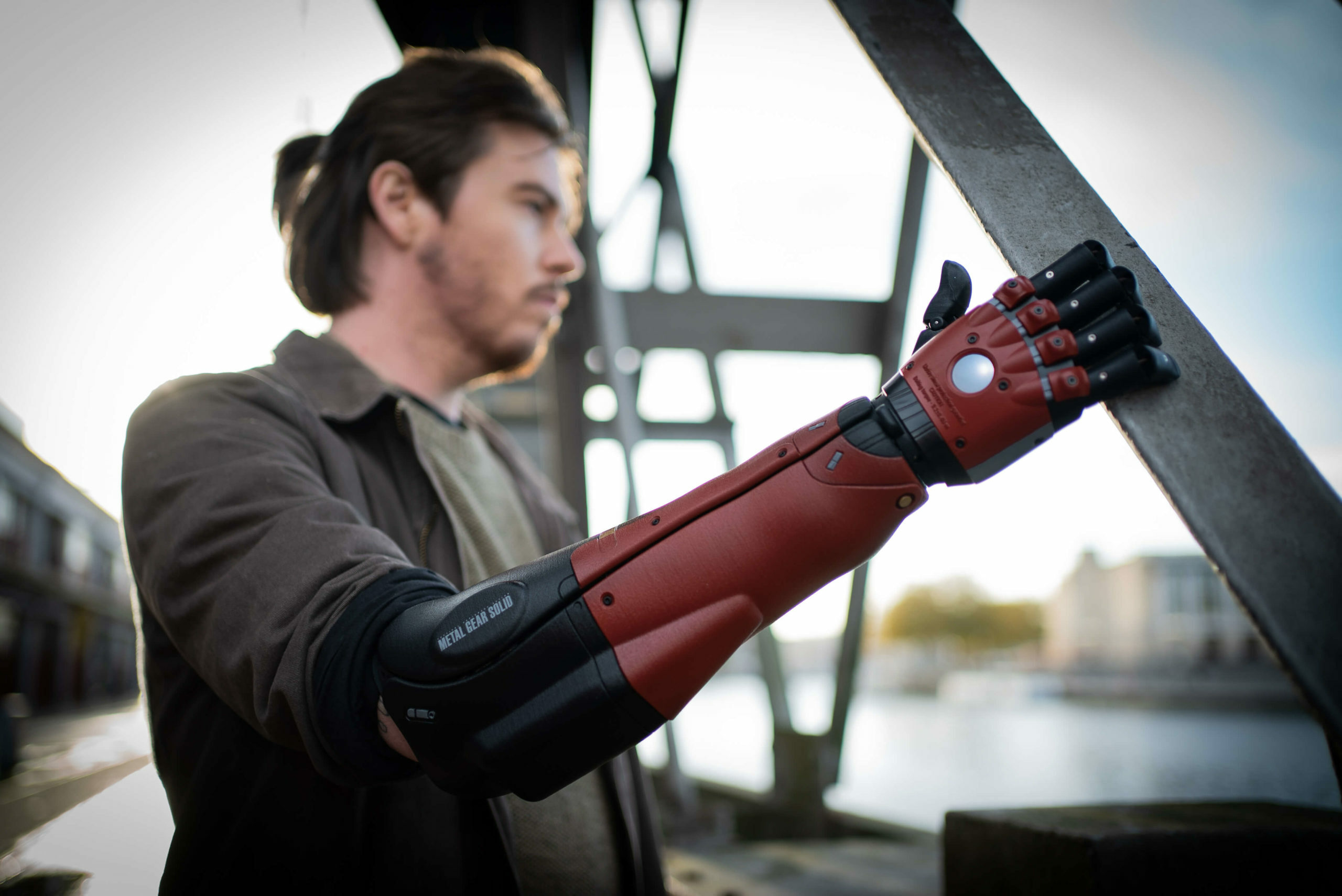
If you are choosing a prosthetic hand, you are choosing between three broad designs. A body-powered device is moved by your own shoulder through a cable. A myoelectric hand is moved by a motor that listens to your muscles. A multi-articulating hand is a myoelectric hand in which each finger moves, so it can form many shapes. People often call the last kind bionic.
None is simply better. They trade weight, toughness, feel, looks and cost against each other, and many people own more than one device for different jobs. The fitting is done by a prosthetist, who builds the socket, sets up the control system and advises on what suits your limb and your daily life. Use this article to learn the words and prepare your questions.
| Body-powered | Myoelectric (simple) | Multi-articulating | |
|---|---|---|---|
| Power source | Your shoulder and back, through a cable | Battery and motor | Battery and several motors |
| How you control it | Body movement pulls the cable | Muscle signals read by electrodes on the skin | Muscle signals, plus buttons, gestures or an app to change grip |
| Shapes it makes | Open and close | Open and close | Many grip patterns |
| Strong points | Light, durable, direct feel | No harness needed for the hand, natural look | Most hand-like, most versatile |
| Weak points | Harness, look, effort | Weight, cost, upkeep | Weight, cost, upkeep, learning time |
Body-powered: cable and harness
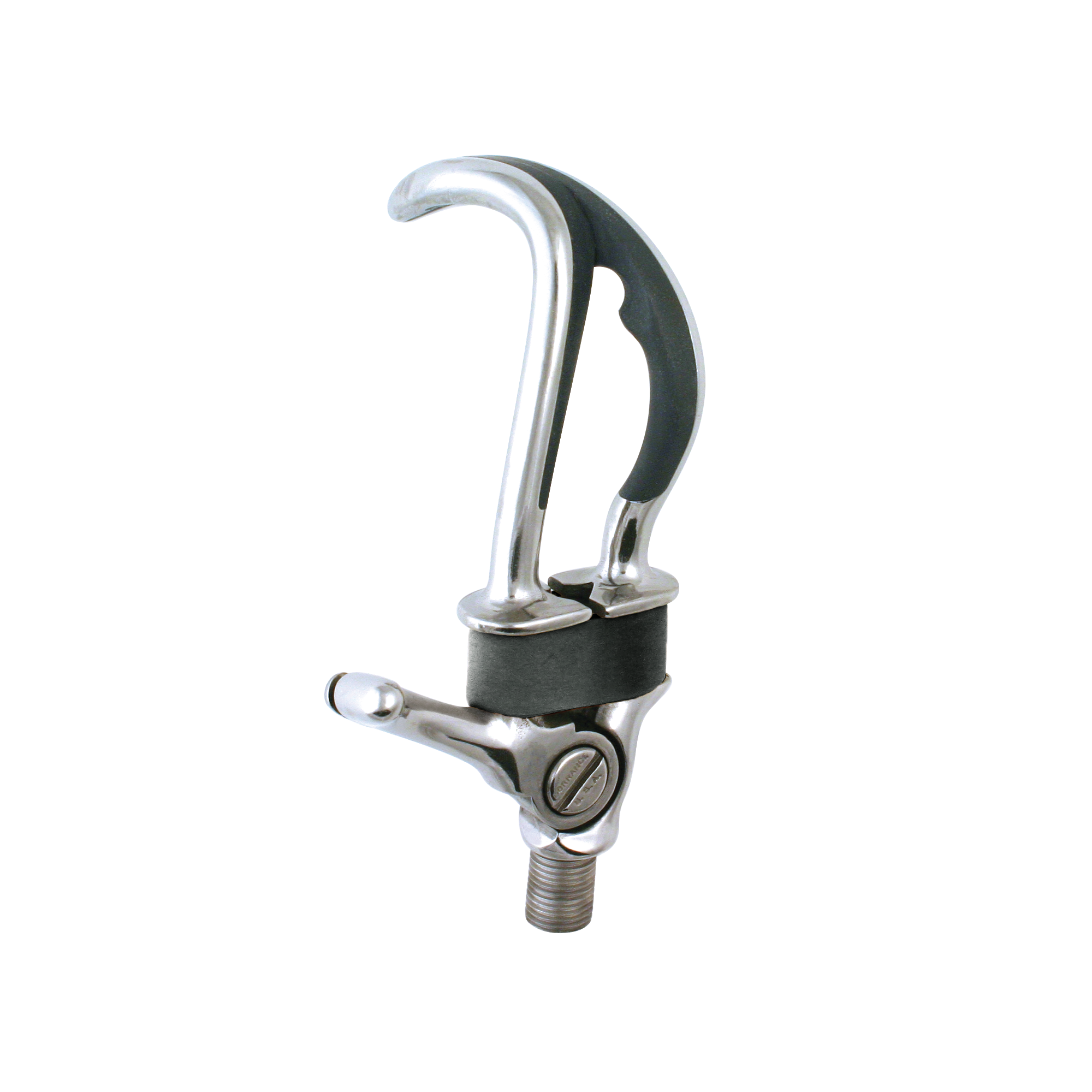
A body-powered arm has a harness that crosses the opposite shoulder and a cable that runs to a hook or hand, called the terminal device. When you move your shoulder or reach forward, the cable pulls and the device moves. There is no battery.
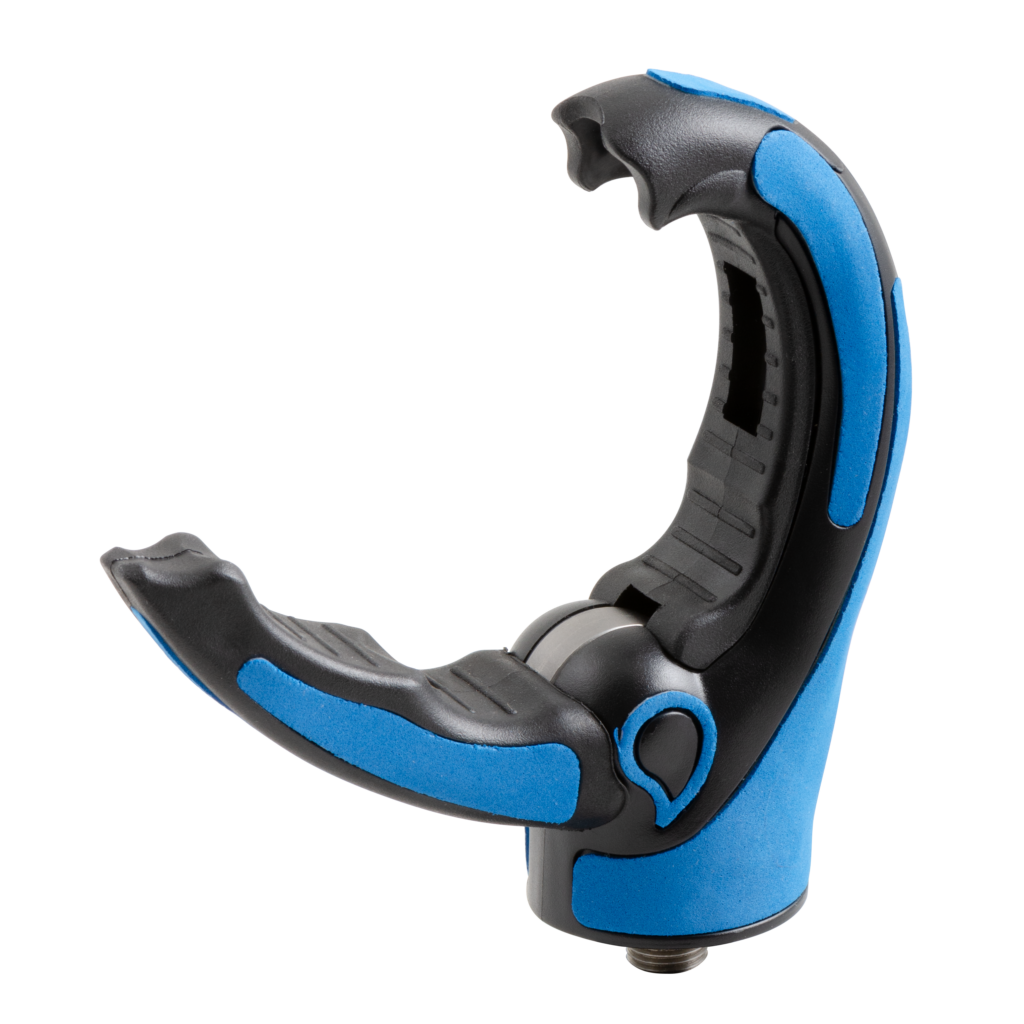
There are two ways it can work. A voluntary opening device is held shut by rubber bands or springs, and you pull to open it. The Hosmer 5X Hook in our catalog is of this kind. A voluntary closing device stays open until you pull, and the harder you pull, the harder it grips. The TRS Grip 5 Evolution Prehensor is an example. According to Wikipedia's article on prostheses, voluntary opening devices are limited to roughly 20 pounds of grip force by their bands, while voluntary closing devices can pass 100 pounds and give proportional control.
The cable is also a source of feel. You sense tension in your shoulder, so you know how hard you are holding something without looking. Powered hands mostly lack this.
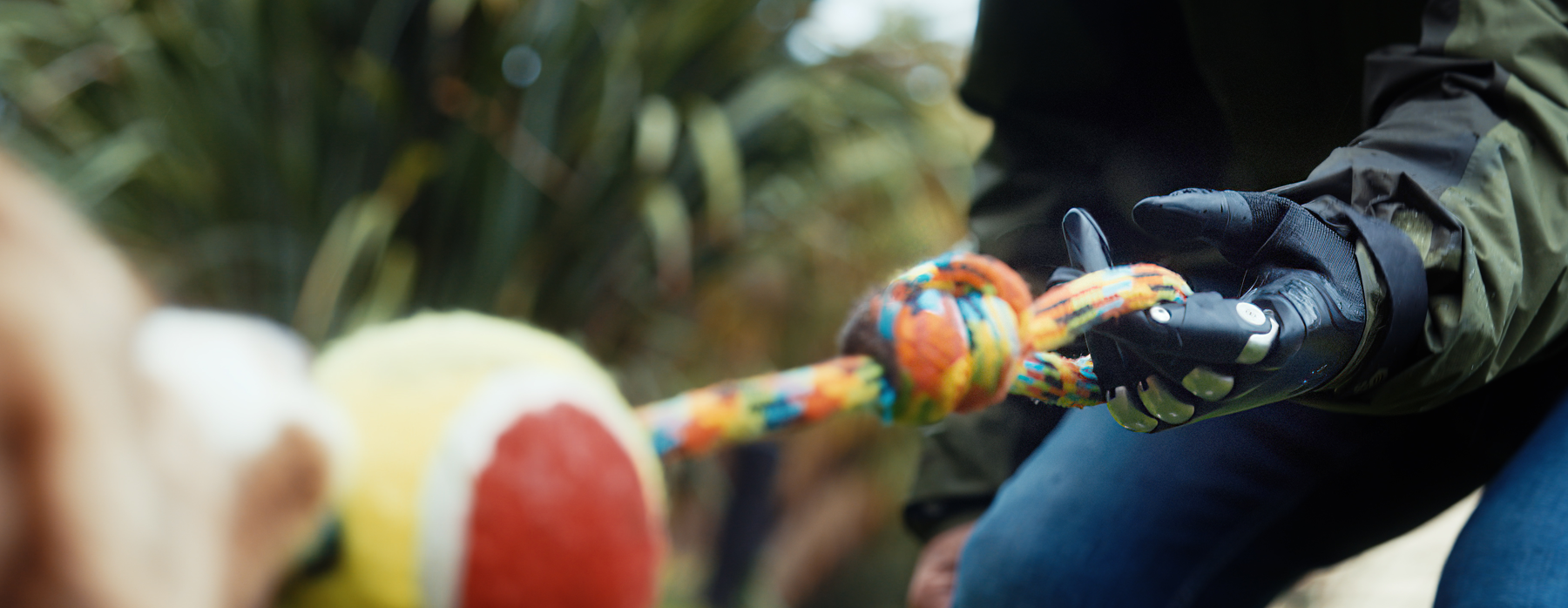
Body-powered devices are light. The same article says they weigh about one-half to one-third as much as myoelectric arms. They cope well with dirt and rough work, so some people keep one for rough jobs alongside a powered hand. The drawbacks are the harness, which some people find uncomfortable, and the look of a hook, which some people dislike and others prefer.
Myoelectric: muscles as switches
When a muscle tightens, it produces a tiny electrical signal. A myoelectric prosthesis has electrodes that rest on the skin inside the socket and pick up that signal. Electronics turn it into a command, and a motor moves the hand. Ottobock describes the signal as being in the microvolt range.
In the simplest set-up there are two electrodes on two muscles in the residual limb. Tighten one muscle and the hand opens. Tighten the other and it closes. Many hands are proportional, which means a gentle signal moves the fingers slowly and a strong one moves them fast. Open Bionics describes this as a way to adjust finger speed for delicate tasks.
Wikipedia lists the usual trade-offs against body-powered devices: higher cost, longer training, more maintenance, and no natural feedback to the user.
Multi-articulating hands and grip patterns
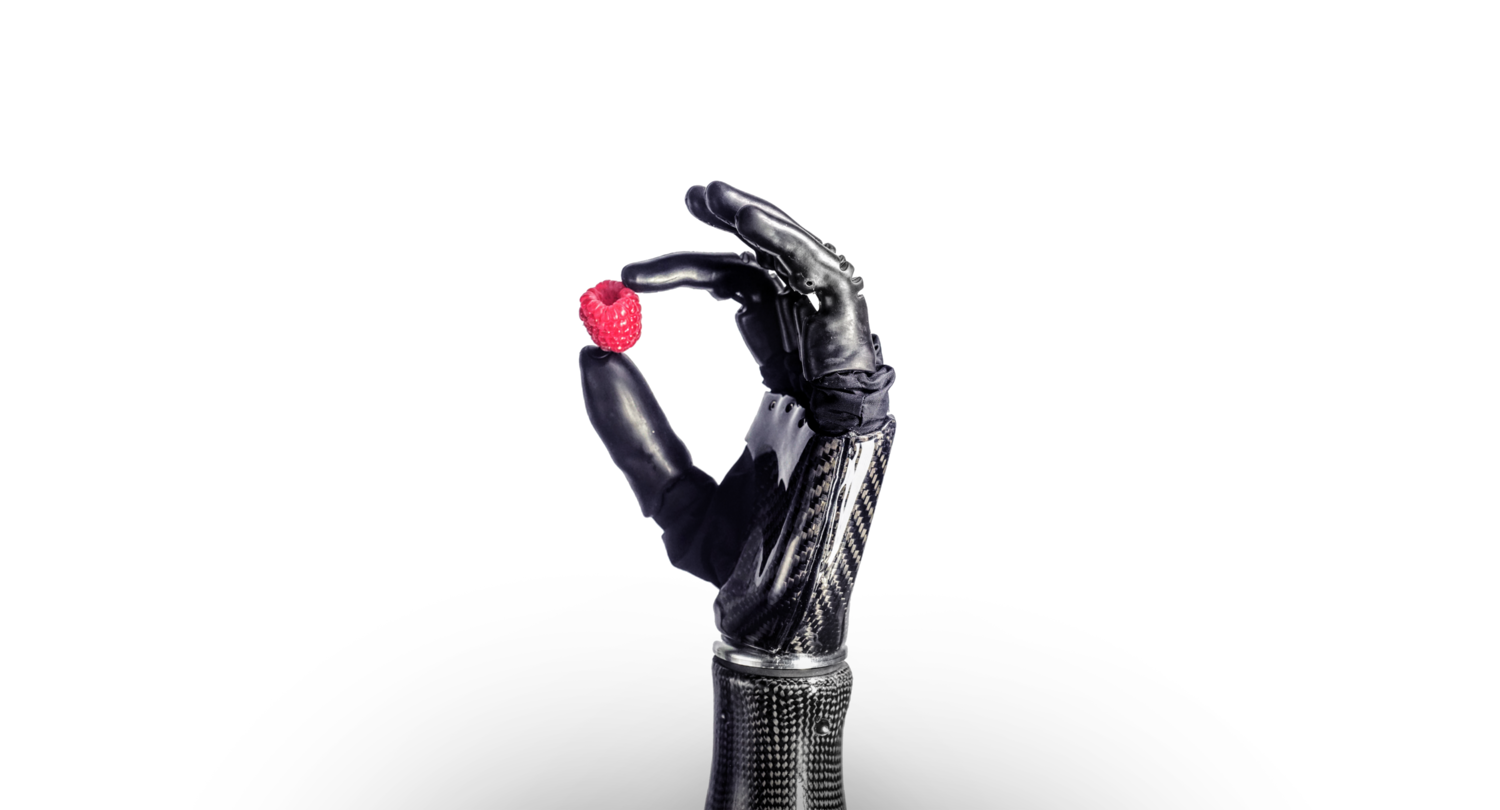
A multi-articulating hand has separate motors for its fingers. The first to reach the market was the i-Limb, which Wikipedia describes as the first commercially available hand prosthesis with five individually powered digits. Because the fingers move on their own, the hand can wrap around a bottle, pinch a coin or point one finger.
Each ready-made shape is called a grip pattern. Common ones include:
- Power grip: all fingers close around an object, such as a cup or a handle.
- Tripod or precision grip: thumb, index and middle finger meet to pick up small things.
- Key grip: the thumb presses on the side of the index finger, as when holding a card or turning a key.
- Hook: fingers curl and stay, for carrying a bag.
- Pointer: index finger out, for keyboards and buttons.
- Mouse and trigger grips for particular tools.
Makers compete on the number of grips. In our catalog the Open Bionics Hero Arm has 6, the Ottobock Michelangelo has 7 grip options, the Ottobock bebionic has 14, the TASKA CX has 20 and the PSYONIC Ability Hand lists 32. Read these numbers with care. Ottobock says the user and prosthetist select eight of the bebionic's 14 for use. PSYONIC says 19 of its 32 are pre-defined and available now. In daily life most of the work is done by a few grips, so ask which ones you would really use and how quickly you can reach them.
How you change grip
Opening and closing is the easy part. Telling the hand which shape to make is harder, because two muscle signals are not many. Makers use several methods, often together.
- Muscle triggers. A special signal, such as a quick double pulse or holding the open signal, steps to the next grip. TASKA calls these MyoTriggers.
- Buttons on the hand. The TASKA CX has a button panel, so you can pick a grip with your other hand.
- Thumb position. On some hands you move the thumb by hand to switch between groups of grips. The i-Limb has a manually rotatable thumb.
- Gestures and apps. Our catalog lists gesture control for the Össur i-Limb Quantum, and several hands are set up through a phone app.
- Pattern recognition. Systems such as Coapt Complete Control place a full array of electrode contacts around the limb. Software learns the pattern your muscles make when you intend a movement and matches it to a grip. Coapt says its system works with more than 800 combinations of upper-limb components.
Pattern recognition needs calibration and practice, and it is set up in the clinic. Whether your muscles give signals that are clear enough for any of these methods is something your prosthetist will test.
Feedback
Some newer hands try to return a little feel. The PSYONIC Ability Hand has pressure sensors in the fingers and sends a vibration to your arm when you grip. The Hero Arm uses vibrations, beeps and lights to tell you what it is doing. Ask to try this in person.
Durability, water and repairs
A hand that is in the workshop is no use to you. Look at toughness and service as closely as you look at grips.
Water and dust
Ratings vary far more than brochures suggest. Here is what makers and our catalog state for some current hands.
| Hand | Water statement |
|---|---|
| TASKA CX | IP67, fully submersible according to the maker |
| Vincent Systems VINCENTevolution4 | IP68, 1.5 m for 30 minutes |
| PSYONIC Ability Hand | IP64, described as spill and splash resistant |
| Ottobock bebionic | Not waterproof. A glove protects against moisture, dirt and dust, and showering is not recommended |
A rating applies to the hand. Ask separately about the wrist, the socket, the electrodes and the battery, because the weakest part sets the limit.
Knocks and loads
Hands get banged on door frames and dropped. TASKA describes a shock-absorbing knuckle block made for daily knocks, and PSYONIC says each finger can take a blunt impact without breaking. Carrying limits also differ: the TASKA CX is rated for a 25 kg carry load, and the Hero Arm lifts up to 8 kg.
Weight and battery
Weight sits at the end of your arm, so small differences matter over a day. The Hero Arm hand is 340 g, the TASKA CX starts at 430 g and the Ability Hand is 490 g. PSYONIC states a charge time of about one hour by USB-C and six to eight hours of use per charge. Ask what happens when the battery runs out during the day.
Repairs and running costs
Gloves tear, electrodes wear, and motors eventually need service. Price is hard to pin down, because hands are sold through clinics as part of a fitted arm. As one marker, Wikipedia reports that the LUKE Arm, a full powered arm, sold for about USD 100,000. Ask for a written quote and the terms of the warranty.
Questions for your prosthetist
- Which type suits my limb, my work and my hobbies, and why?
- Are my muscle signals good enough for myoelectric control? Can we test them?
- Can I try the hand, or a trainer version, before deciding?
- Which grips will be set up, and how will I switch between them?
- What is the water and dust rating of the whole arm, not only the hand?
- How heavy is the complete prosthesis with socket and battery?
- How long is the warranty, and how long do repairs take? Is there a loan hand?
- What do gloves, batteries and service cost each year?
- How much training will I get, and from whom?
- Would a second, body-powered device make sense for rough or wet jobs?
- What will my insurer or health service fund, and what would I pay?
Learning to use any prosthetic hand takes time and practice with an occupational therapist or prosthetist.
This article is general information, not medical advice. Devices of this kind are chosen and fitted with a clinician who knows you.
Common questions
Is a bionic hand as good as a natural hand?
No. It gives a set of useful grips and can make two-handed tasks easier, but it is slower than a natural hand and has little or no sense of touch.
Can I shower or swim with a bionic hand?
It depends on the model. Some are rated IP67 or IP68, while others, such as the bebionic, should not be worn in the shower. Check the whole arm, not only the hand.
How do I choose a grip?
By a muscle trigger, a button on the hand, moving the thumb, a gesture, an app or pattern recognition. Your prosthetist sets this up with you.
Can children use bionic hands?
Some are made for them. Open Bionics says the Hero Arm is for children aged 8 and above as well as adults. A prosthetist decides what fits a growing limb.
Who fits a prosthetic hand?
A prosthetist. They make the socket, place the electrodes or harness, and adjust the settings over several visits.
Sources
- Wikipedia: Prosthesis
- Wikipedia: Myoelectric prosthesis
- Ottobock: bebionic Hand EQD (8E70)
- TASKA Prosthetics: TASKA CX
- PSYONIC: Ability Hand
- Coapt: pattern recognition control
- Open Bionics: Hero Arm
Read on 5 October 2026. The wording of the article is our own.