Gear · 7 min read
Rigid vs folding frame
Rigid frames win on weight and push efficiency. Folding frames win on packing size. The gap is smaller than it used to be, so check real figures.
The short answer
If you push yourself all day and load your own chair into your own car, a rigid frame is usually the better tool. If the chair must go into many different cars, onto trains with narrow luggage space, or into a cupboard at night, a folding frame is usually easier to live with.
That rule has more exceptions than it used to. Modern folding chairs are much closer to rigid chairs in weight and stiffness than older ones. So compare real figures for the exact models you are considering.
Weight: where the difference comes from
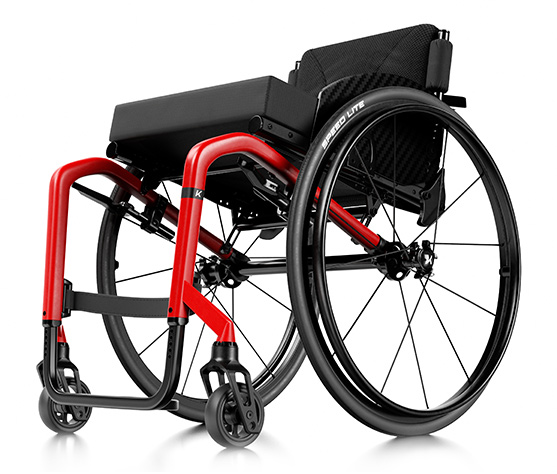
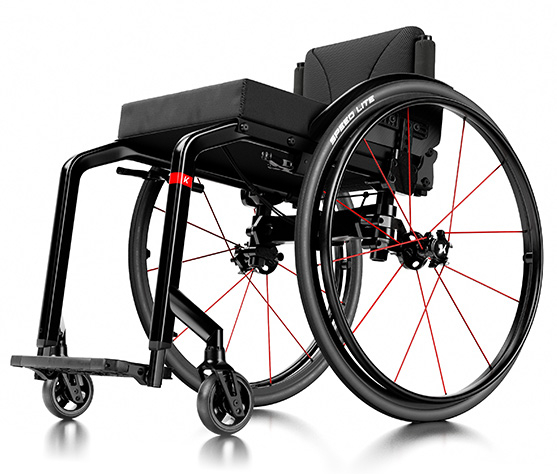
A folding chair needs a cross-brace under the seat, pivots, and a way to lock the frame open. A rigid chair has welded joints instead. Welds weigh less than hinges, so for the same material and maker the rigid chair is normally lighter.
Catalog figures from makers that sell both types show the pattern, and also its limits.
| Maker | Rigid model and listed weight | Folding model and listed weight |
|---|---|---|
| Quickie | Nitrum: 18.3 lb | Quickie 2: 25.4 lb |
| Küschall | K-Series: approx. 7.5 kg | Champion: approx. 8.8 kg. Champion SL: approx. 8.4 kg |
| Ottobock | Zenit: aluminium from 8.8 kg, carbon from 7.4 kg | Avantgarde 4 DS: 8.7 kg |
| Motion Composites | APEX C: transport weight 9.7 lb | Helio C2: transport weight 12 lb |
Two things stand out. First, the gap ranges from large (about 7 lb in the Quickie pair) to almost nothing (the Ottobock pair, where the folding chair is listed slightly lighter than the aluminium rigid one). Second, material and design matter as much as frame type. A carbon or titanium folding chair can weigh less than a basic aluminium rigid chair.
Read the weight figure carefully
Makers quote two numbers, and they mean different things.
- Total or chair weight is the chair ready to use in a stated size, often the lightest configuration.
- Transport weight is the heaviest single piece you lift into a car. For a rigid chair that is the frame without rear wheels. One maker states that its transport figure also leaves out armrests, cushion and anti-tippers.
For a rigid chair, transport weight is the number your shoulders feel at the car door. The Küschall K-Series is listed at about 4.8 kg transport weight and the Panthera S3 from 4.65 kg. For a folding chair, ask whether the transport figure is with or without rear wheels, because many people lift a folded chair with the wheels still on.
Always ask for both figures in your own seat size, with the options you plan to order. Wider seats, side guards, push handles and puncture-resistant tyres all add weight.
Transfer of energy
Pushing a wheelchair is not efficient. Research summaries report that only 2 to 14 percent of the force your arms apply ends up moving the chair. So small losses in the frame are worth caring about.
A rigid frame has no flex points in the middle. When you push, the frame does not twist, so more of the push goes into the wheels. A folding frame can flex a little at the cross-brace and pivots, and each small movement absorbs some energy.
Designers have worked on this. Some folding chairs use a locking mechanism that makes the frame behave like a rigid one when open. The Küschall Champion is described in the catalog as a folding chair with an open, rigid-style frame, and the Motion Composites Helio C2 as a carbon folding chair with a symmetrical cross-brace that aims for rigid-chair efficiency. These designs narrow the gap. Whether they close it for you is something to test on a demo chair, on a slope, and over rough ground.
Frame stiffness is only one part of efficiency. Tyre pressure and axle position also change how much effort each push takes, whatever the frame.
Durability and upkeep
More moving parts means more places for wear. Folding frames have several joints that can work loose over time. That does not make them fragile, but it does mean a regular check.
- Monthly: open and close the chair and check that the cross-brace moves freely and locks fully. Check nuts and bolts, and tighten without over-tightening.
- Every three months: put a little lubricating oil on the folding mechanism and exposed hinges, then wipe off the excess.
- Any time: if the chair starts to creak, pull to one side, or feel loose when you turn, have the frame checked.
Rigid frames need less of this, but they are not maintenance-free. Inspect the welds for cracks, check the folding back mechanism, and keep the quick-release axles clean so they lock every time.
A fully welded rigid frame has one long-term drawback. If the frame is built to your measurements with no adjustment, a change in your body or posture can mean a new frame. Adjustable rigid frames avoid that at the cost of a little weight.
Getting each type into a car
Rigid frame
A rigid chair does not fold in half, so it goes in as parts. Most have quick-release rear wheels and a backrest that folds down flat onto the seat.
- Transfer to the car seat.
- Take off the cushion and remove both rear wheels with the quick-release buttons.
- Fold the backrest down.
- Lift the frame into the car. It is now a compact, light piece.
- Stow the wheels where they cannot move in a sudden stop.
The result is three light pieces instead of one heavy one. That suits people who load the chair themselves from the driver's seat. It suits helpers less, because they need to know how the wheels come off and go back on. A wheel that is not locked on its axle is an accident risk, so always pull on each wheel after refitting it.
Folding frame
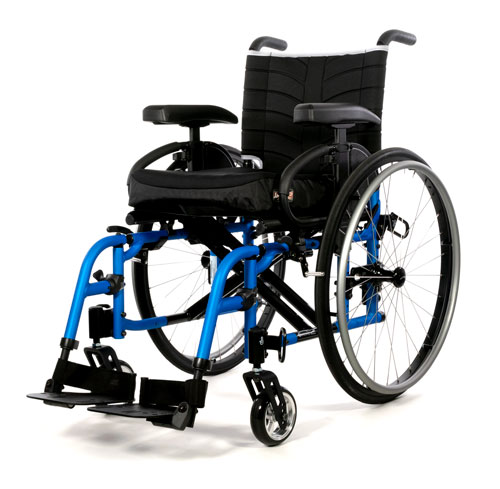
A folding chair closes side to side in one movement. Folded widths are small. The catalog lists the Küschall Compact at about 290 mm folded and the Champion SL at about 280 to 340 mm. Another maker quotes 27 cm for its folding active chairs.
A folded chair stands on its own wheels and can be rolled to the car, which is useful when someone else is loading it. It slides behind a front seat or stands upright in a boot. The lift is heavier unless you also take the wheels off.
What to check with your own car
- Measure the door opening and the space where the chair will go.
- Ask for the folded or stripped dimensions of the chair in your size.
- Try the full loading routine with a demo chair before you order.
- Ask how the chair should be secured in the vehicle.
Frame type and add-ons
If you plan to add a power device or a front wheel, check compatibility first. Clinical guidance lists rigid versus folding compatibility as a key question before buying any propulsion add-on.
- The catalog lists the SmartDrive MX2+ rear power unit as fitting rigid, folding and tilt chairs.
- The FreeWheel front attachment clamps to the footrest of rigid-frame chairs, and a separate adaptor is listed for folding chairs.
- Front power attachments need docking hardware on the front of the frame. Ask the dealer whether your frame, especially one with swing-away legrests, can take it.
Who each type suits
| A rigid frame tends to suit you if | A folding frame tends to suit you if |
|---|---|
| You push yourself most of the day | Someone else often pushes or loads the chair |
| You drive and load the chair yourself | You ride in many different cars or taxis |
| You have floor space to park the chair | Storage space at home, school or work is very tight |
| You want the lowest weight you can get | You need swing-away legrests for standing transfers |
| Your measurements are stable | You are growing or your needs are changing |
These are tendencies, not rules. A light folding chair with a stiff frame can suit a very active person who flies often. A rigid chair can suit a part-time user who values easy pushing over easy packing.
Decide with one week of your own life
Write down every time in a normal week that the chair has to be lifted, folded, stored or handed to someone else. Then ask of each moment which frame makes it easier.
- How many car transfers do I do in a day, and who lifts the chair?
- Where does the chair spend the night?
- Do I use buses, trains or planes, and what happens to the chair there?
- How far do I push on a normal day, and on what surfaces?
- Do I want a power add-on or front wheel later?
Take the answers to a clinician or dealer and ask to try one chair of each type in your size. Ten minutes of pushing and one car transfer in each will tell you more than any spec sheet.
This article is general information. Rules and prices differ by country and change, so confirm them before you buy or travel.
Common questions
Are rigid wheelchairs always lighter than folding ones?
Usually, when you compare the same maker and material, but not always. Some current folding chairs are listed at weights close to, or even below, aluminium rigid chairs.
What does transport weight mean?
It is the weight of the heaviest piece you lift, normally the frame without rear wheels. Ask the maker exactly which parts are left out of the figure.
Can a rigid wheelchair fit in a small car?
Often yes, because the rear wheels come off and the back folds down, leaving a compact frame. Test the loading routine with a demo chair in your own car before you order.
Do folding frames wear out faster?
They have more moving parts that can loosen, so they need more regular checks and lubrication. With that care a folding frame can give long service.
Sources
- Wikipedia: Wheelchair
- SCIRE Community: Manual Wheelchairs
- SCIRE Community: Wheelchair Maintenance
- Physiopedia: Wheelchair Maintenance
- SCIRE Community: Wheelchair Propulsion Assist Devices
- Motion Composites: APEX C specifications
- Ottobock: Avantgarde 4
- Küschall: Champion SL
Read on 5 October 2026. The wording of the article is our own.