Gear · 43 min read
Mobility scooters in 2026: sizes, prices and what 420 FDA reports show
Three sizes of mobility scooter, their listed prices and weights, and what two AI coders found in every FDA scooter report with text from 2016 to August 2026.
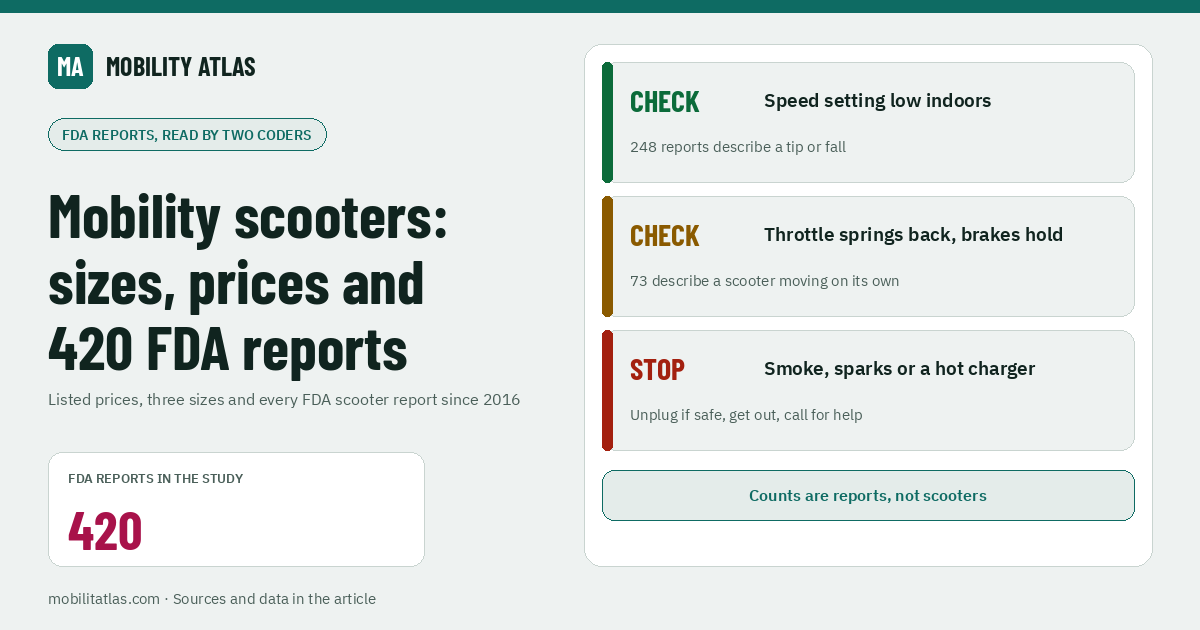
Stop and get help today if
Already have a scooter? Check these first. Buying one? Start at the short answer below.
- The scooter moves, speeds up or keeps going when you let go of the throttle lever, even once. Switch it off, take the key out, and call the dealer.
- You smell burning, see smoke or sparks, or the battery, the charger or a cable is hot, swollen or melted. Unplug it only if that is safe, move away, and call the fire service if there is smoke.
- The brakes do not hold on a slope, or the freewheel lever slips out of drive.
- The tiller, the handlebars or the tiller lock is loose, cracked or will not lock.
- A wheel wobbles, a nut is missing, or the seat moves on its post when you sit or turn.
- The scooter tipped over, even without anyone being hurt. Find out why before the next ride.
Most other things in this guide can wait a few days. These six cannot, because they are the patterns behind the most serious reports we read.
The short answer
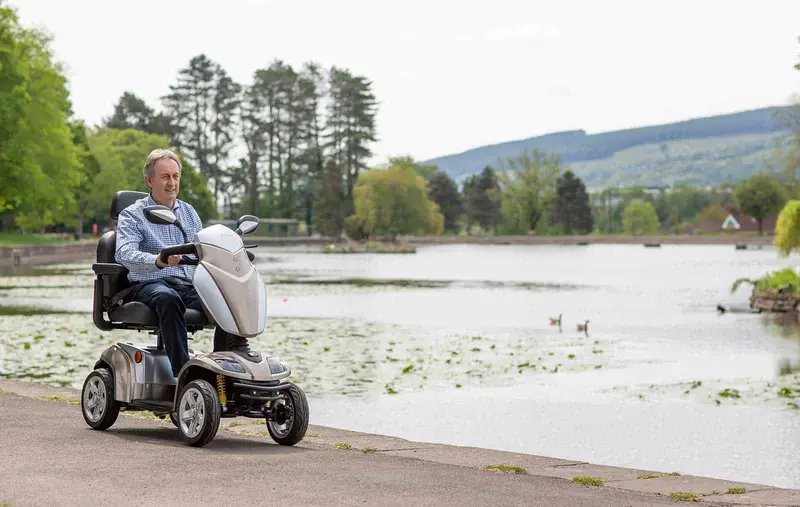
A mobility scooter is steered with a handlebar, called a tiller, and driven with a thumb or finger lever. It suits people who can sit upright without support, steer with both hands and get on and off by themselves, and who need help with distance rather than with sitting. If you need posture support, tilt or a joystick, you need a power wheelchair, and our electric wheelchair guide covers those.
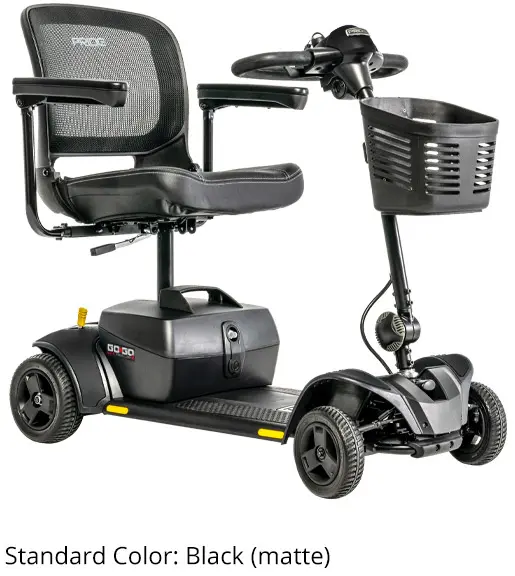
Scooters come in three sizes. Folding and travel scooters go in a car boot and are light enough to lift in pieces. Mid-size scooters are for daily trips around town. Heavy-duty scooters carry more weight, go further and cope with rougher ground, but they need a garage, a ramp or a van. The prices and specifications below come from makers' and retailers' pages as recorded in the Mobility Atlas catalog: 13 scooters, from a folding model listed at 16 kg to a heavy-duty one listed at 148 kg.
The safety part comes from something most buying guides never open: every report about mobility scooters that the US Food and Drug Administration (FDA) received from January 2016 to the end of August 2026 that has any text, 420 reports in all, each read by two independent AI coders working separately. The reports are dominated by falls and tip-overs: 248 describe the scooter tipping or the rider falling, and most of those name no broken part. Turning, slopes and reversing come up again and again. Next come scooters that moved when the rider did not mean them to, fires whose reports often mention a charger or a cable, and riders hit by cars.
None of this means a scooter is unsafe. It means the risks are specific, and most of them can be checked before you buy and in the first weeks of riding. The sections below show how.
How to read the evidence: every quote below names the report, recall or document it comes from, and every count comes from the coded table published on the data and method page. Prices are list prices as read on makers', dealers' and retailers' pages, never offers.
Three sizes of scooter, and who each one suits
| Size | Listed weight | Listed range | Best when |
|---|---|---|---|
| Folding or travel | 16 kg to 161 lb assembled | About 9 to 18 miles | You travel by car or plane and someone can lift it |
| Mid-size | About 82 to 110 kg | Up to 54 km | Daily trips on pavements and in shops |
| Heavy-duty | About 146 to 148 kg | Up to 37 miles | Longer distances, rougher ground, heavier riders |
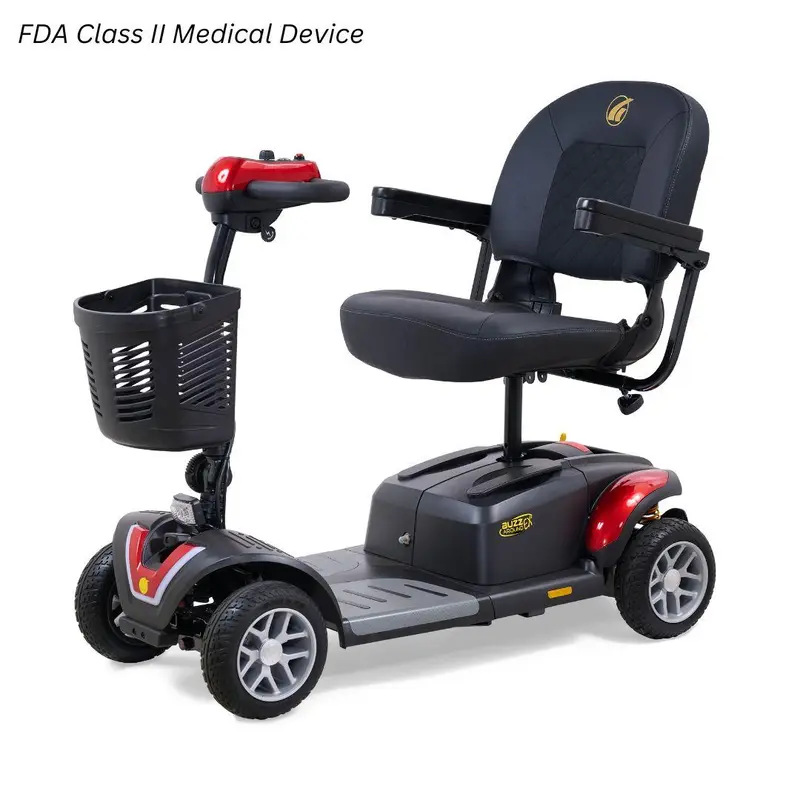
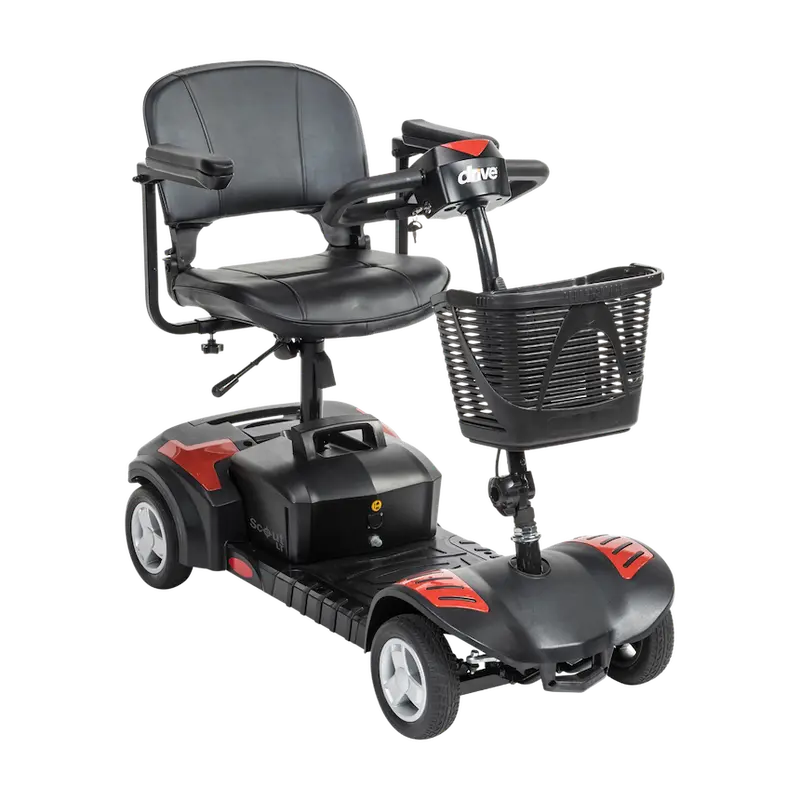
The weight ranges come from the scooters in our catalog. Makers weigh scooters differently: some give the weight with batteries, some the heaviest single piece. The Golden Buzzaround EX is listed at 161 lb assembled with a heaviest piece of 53 lb, and the Drive Scout at 100 lb in total with a heaviest piece of 38 lb. Ask which figure you are looking at.
Folding and travel scooters
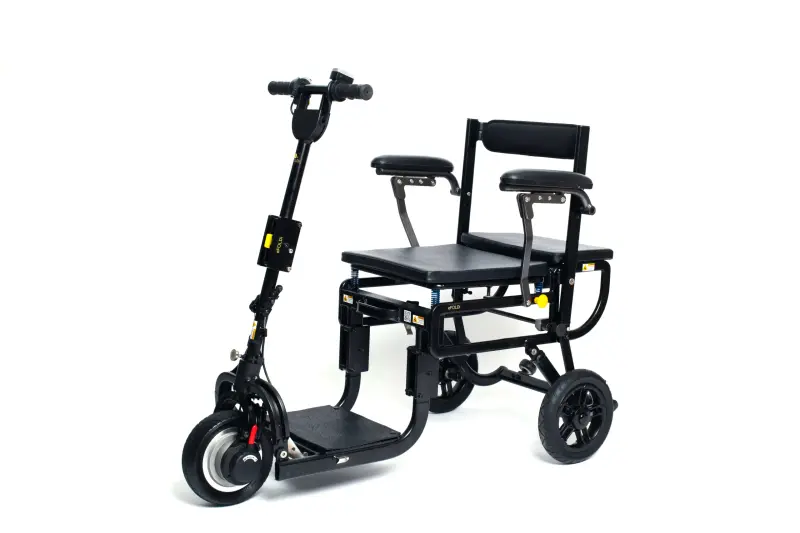
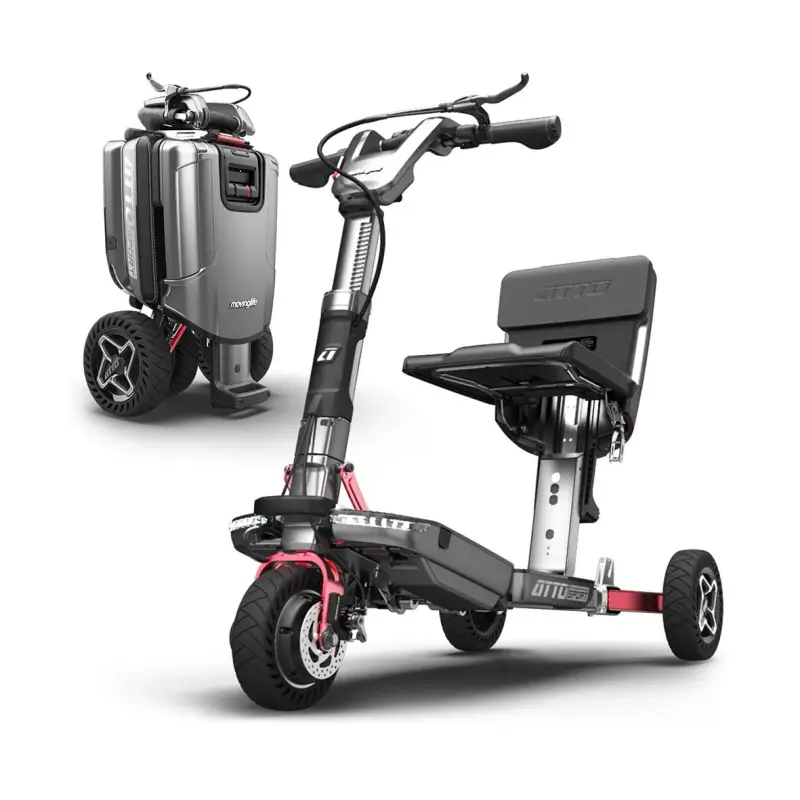
Travel scooters split into four or five pieces; folding scooters fold in one movement. The eFOLDi Lite is listed at 16 kg with its battery, the Moving Life ATTO at 29 kg with a heaviest part of 17 kg, and the ATTO Sport at 66 lb in two sections. They are the easiest to take on holiday, and some come with batteries their makers describe as airline approved. They are also the smallest, with small wheels and short range, so kerbs, gravel and slopes are harder for them.
Mid-size scooters
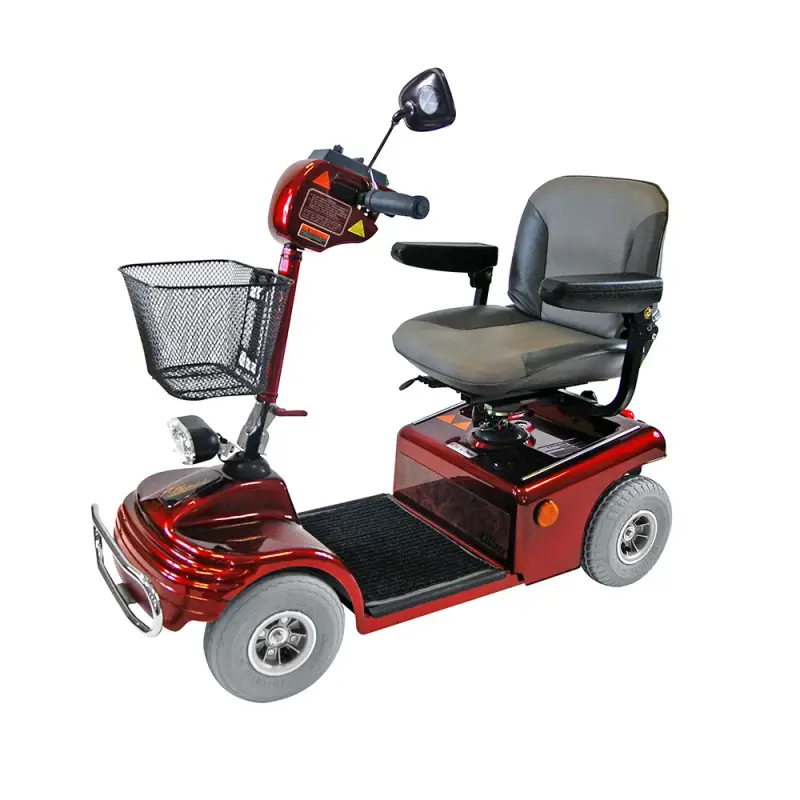
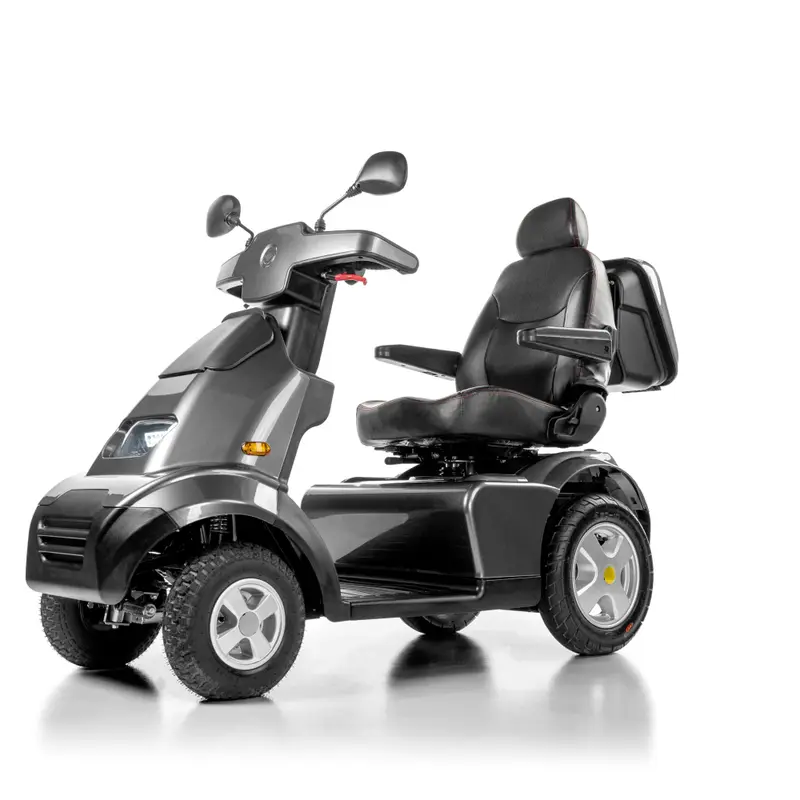
Mid-size scooters are the everyday shopping and town scooter. The Shoprider Sovereign 4 is listed at about 82 kg, 4 mph and up to 20 miles; the Invacare Orion Metro at 110 kg, 12 km/h and 54 km. They do not come apart for a car boot, so you need somewhere to keep and charge them.
Heavy-duty scooters
Heavy-duty scooters are larger, faster and carry more. The Afiscooter S4 is listed for a 500 lb rider with a 37 mile range; the TGA Breeze S4 for a 200 kg rider, 8 mph and gradients of 21 percent. The Sterling S700 is listed at 146 kg. These are road scooters in the UK sense, and in many places that brings rules about where you may drive them.
Three wheels or four
Should I get a 3-wheel or 4-wheel mobility scooter? Mobility Atlas read the FDA fall reports and the makers' specifications, and the answer is a trade between turning and stability. A three-wheel scooter has a single front wheel, so it turns in a tighter space and gives more legroom, which helps indoors and in shops. A four-wheel scooter has a wider footprint, which makes it steadier on slopes, kerbs and uneven paths. The FDA reports cannot compare the two, because few say how many wheels the scooter had. But turning comes up in 48 of the 248 fall reports and slopes, hills or driveways in 42, and a tight turn on a slope is where a narrow base is least forgiving. If you will ride mostly indoors and on flat paths, a three-wheel scooter may suit you; if you ride outdoors, on slopes or on rough ground, a four-wheel scooter is usually the safer choice. Try both on your own route before you buy.
Scooter or power wheelchair?
A scooter and a power wheelchair can look like two prices for the same thing, but they suit different bodies. A scooter asks more of the rider: you sit upright without support, steer with both arms, keep your balance on turns, and get on and off by yourself. A power wheelchair is driven with one hand or other controls, turns in its own length and can carry seating that supports your posture and protects your skin.
The FDA rule for scooters, 21 CFR 890.3800, describes the device as one "used for outside transportation", and that is still the best way to think about it: a scooter is for getting about outdoors and in shops, not for sitting all day. If you will sit for many hours, if your strength or balance changes during the day, or if turning and transfers are getting harder, ask an occupational therapist or physiotherapist whether a power wheelchair would be safer. That is a clinician's call, and a good one to make before you spend money.
Some people use both: a scooter for trips out, and a manual or power wheelchair at home. Others use a power add-on on a manual chair instead of a scooter; our power add-ons comparison covers those.
Six situations, and which route is yours
- My scooter took off, kept going or reversed when I did not mean it to. Stop using it and read the section on uncontrolled movement. Then route 2: a dealer check of the throttle and the speed setting.
- My scooter tipped over on a turn, a slope or a kerb. Read the falls section. Route 1: speed settings, technique and the route you use, then route 2 if something is loose.
- I smelled burning, or the charger or a cable got hot. Stop charging and read the fire section and our battery and charging guide.
- The scooter stops, slows or cuts out. Route 3: batteries, connections and charger first.
- The brakes, the tiller or a wheel feel wrong. Route 2 at the dealer, before the next ride.
- I want a scooter for travel. Read the section on folding scooters and on flying, and check the battery rules with the airline.
What a mobility scooter costs in 2026
Scooters are easier to price than power wheelchairs, because many are sold directly. The table shows prices listed on makers' and retailers' pages as recorded in the Mobility Atlas catalog, in the currency and country shown.
| Scooter | Size | Price as listed | Where |
|---|---|---|---|
| Drive Scout 4-Wheel | Travel | From USD 849 | US retailer |
| Shoprider Sovereign 4 | Mid-size | GBP 1,429 with VAT relief, GBP 1,714.80 with VAT | UK dealer |
| eFOLDi Lite | Folding | RRP GBP 2,699 | Maker site |
| Moving Life ATTO | Folding | GBP 3,114 with VAT | UK dealer |
| Kymco Agility | Mid-size | GBP 3,329 with VAT | Maker UK site |
| Moving Life ATTO Sport | Folding | USD 3,999 | Maker US site |
| Sterling S700 | Heavy-duty | From GBP 4,296 | Maker UK site |
| TGA Breeze S4 | Heavy-duty | GBP 5,195 before VAT, GBP 6,234 with VAT | UK dealer |
| Afiscooter S4 | Heavy-duty | USD 5,999 to 6,949 | US retailer |
How much does a mobility scooter cost? Mobility Atlas recorded listed prices for scooters on makers' and retailers' pages, and they run from USD 849 for the Drive Scout 4-Wheel, a basic travel scooter, to USD 6,949 for the top version of the heavy-duty Afiscooter S4. In the UK, a mid-size Shoprider Sovereign 4 was listed at GBP 1,429 with VAT relief for disabled buyers, and a heavy-duty TGA Breeze S4 at GBP 6,234 including VAT. Folding scooters cost more than their size suggests: the eFOLDi Lite was listed at GBP 2,699 and the Moving Life ATTO Sport at USD 3,999, because light frames and lithium batteries are expensive. Add the cost of a spare or larger battery, a cover, delivery and set-up, and check whether a health service or insurer will contribute before you buy. Prices change, so confirm them in your country.
Running costs matter too. Batteries wear out and need replacing every few years. Our battery and charging guide lists what replacement batteries and chargers cost as listed, from USD 44.99 for a small 12 Ah AGM battery.
Five routes, from the cheapest fix to a new scooter
Most problems in the reports are fixed somewhere on this ladder. Start at the top, and go lower only when the step above has been ruled out.
| Route | What it covers | Cost as listed |
|---|---|---|
| 1. Settings and technique | A lower speed setting, slower turns, a different route | Nothing |
| 2. Dealer check and adjustment | Throttle, brakes, freewheel, tiller lock, wheel nuts, seat | Ask the dealer for a quote |
| 3. Batteries and charger | Range loss, cutting out, charging faults | From USD 44.99 for a small AGM battery |
| 4. Parts | A wheel, a tiller part, a seat post or a controller | Battery box for a Go-Go with batteries from USD 291.99 |
| 5. A new scooter | When repairs cost more than the scooter is worth | From USD 849 |
Route 1 · Settings and technique
What it is: riding slower, especially when turning, reversing or on a slope. What the reports say: 133 reports describe a tip or fall with no failed part named, and 55 of them mention a turn, a slope, reversing or a kerb. The check that gets skipped: the speed dial. Many scooters have a dial that sets the top speed; set it low at home and in shops. Say this to the dealer: "Please set the speed and acceleration for indoor use and show me how to change it."
Route 2 · A dealer check
What it is: a service of the parts that keep you on the scooter. What the reports say: throttles that stuck, brakes that did not hold, tillers and seats that came loose, and wheels that came off. The check that gets skipped: a test of the throttle return spring and the brakes on a slope. Say this: "Please check that the scooter stops when I let go of the lever, and that the brakes hold on a slope."
Route 3 · Batteries and charger
What it is: replacing worn batteries, fixing a loose connection or replacing a faulty charger. What the reports say: scooters that cut out in traffic, and chargers and cables that overheated. The check that gets skipped: the battery connections and the charger lead. Say this: "Please test the batteries under load and check every connection."
Route 4 · Parts
What it is: replacing a broken or worn part. What the documents say: older recalls cover throttle springs, seat bases, battery cables and tires. The check that gets skipped: asking whether the part is the maker's own. Say this: "Is this the maker's part for my model, and is any recall outstanding?"
Route 5 · A new scooter
What it is: replacing an old scooter. The check that gets skipped: whether the new scooter fits your route and your storage, and whether you could try it first. A clinician or occupational therapist can help you decide whether a scooter still suits you or whether a power wheelchair would be safer.
Weight, range and speed: the numbers that decide daily life
| Scooter | Listed weight | Listed range | Listed speed | Listed rider weight |
|---|---|---|---|---|
| eFOLDi Lite | 16 kg | 10 miles | 4 mph | 120 kg |
| Moving Life ATTO | 29 kg | 12.5 miles | 4 mph | 120 kg |
| Drive Scout 4-Wheel | 100 lb | 9 miles | 4 mph | 300 lb |
| Shoprider Sovereign 4 | About 82 kg | 20 miles | 4 mph | 136 kg |
| Kymco Agility | 107 kg | 25 miles | 8 mph | 165 kg |
| Invacare Orion Metro | 110 kg | 54 km | 12 km/h | 136 kg |
| Sterling S700 | 146 kg | 45 km | 8 mph | 160 kg |
| TGA Breeze S4 | 148 kg | 20 miles | 8 mph | 200 kg |
| Afiscooter S4 | Not listed | 37 miles | 9.3 mph | 500 lb |
Read range as a best case. Makers measure range under test conditions, and cold weather, hills, a heavier rider and old batteries all shorten it. A safe habit is to plan regular trips at half the listed range until you know how your own scooter behaves.
Speed is a rule as well as a number. In the UK, gov.uk says a scooter is usually in class 2 "if it has a maximum speed of 4mph or less" and class 3 "if it has a maximum speed of 8mph". Class 3 scooters can also be used on the road and must be registered with the DVLA. A scooter is "not in a class" if it can go more than 8mph, is wider than 0.85 metres, or weighs more than 150kg, and then it may only be used on the road. Other countries have their own rules; check them before you buy a fast scooter.
How Mobility Atlas read 420 FDA reports
The FDA collects reports about problems with medical devices in a public database called MAUDE. Mobility scooters have their own product code, INI. The FDA rule 21 CFR 890.3800 names it a "motorized three-wheeled vehicle", but in practice the code holds three-wheel and four-wheel scooters alike. Makers must file reports about some events, and users, families and health workers can file them voluntarily.
We downloaded every INI report received from 1 January 2016 to the latest update on 10 October 2026, which runs to the end of August 2026: 418 reports, of which 416 carry text. We added 4 reports filed under the power wheelchair code since 2024 that name a scooter. That makes a pool of 420. Five turned out not to describe an event involving a scooter: a software app and a hospital bed filed under the wrong code, and three with no scooter event described. That leaves 415.
Before reading any report, we wrote a codebook: a list of categories and rules for what counts as each, with the order in which they apply. We fingerprinted it so that any later change would show. Two coders then read every report separately, without seeing each other's answers: what went wrong, and whether the report states an injury, a fall, or a collision with a vehicle. The coders were AI models working separately; the method page says so in full.
The two coders agreed on the main category for 96.7 percent of reports, a Cohen's kappa of 0.96, where 1 means perfect agreement and 0 means no better than chance. Agreement on falls was 99.5 percent (kappa 0.99) and on injuries 98.6 percent (kappa 0.963). Each of the 55 reports where they differed was decided under a written rule, and a final consistency pass changed 16 more. The rules, the codebook and the coded table are on the data and method page.
One limit matters above all. The FDA's MAUDE page says "MDR data is not intended to be used either to evaluate rates of adverse events" and that "The submission of an MDR itself does not necessarily demonstrate that the device caused or contributed to the adverse outcome or event." Every count below counts reports, not scooters, and not people.
What the reports show: the big picture
| What the report says went wrong | Reports | With a fall or tip | With an injury stated |
|---|---|---|---|
| Tip or fall, no failed part named | 133 | 131 | 45 |
| Uncontrolled movement | 73 | 40 | 20 |
| Fire, smoke, melting or sparks | 62 | 0 | 2 |
| Event with no scooter problem stated | 41 | 9 | 12 |
| Another part broke or came loose | 25 | 15 | 9 |
| Power loss or electrical fault | 21 | 11 | 1 |
| Brakes or rolling | 19 | 13 | 2 |
| Wheels | 17 | 13 | 7 |
| Steering or tiller | 14 | 11 | 4 |
| Problem alleged, cannot tell what | 10 | 5 | 6 |
Falls dominate: 248 of the 415 reports describe the rider falling or the scooter tipping, and 108 state an injury. Injury counts are lower than you might expect because our rule counts only reports that state harm or medical care, not those that describe an impact alone. 24 reports describe a rider struck by a car, a truck or another vehicle, and in 23 of them no scooter fault is alleged.
The number of reports has been fairly steady in recent years, between 25 and 41 a year from 2019 to 2025 (21 so far in 2026, to the end of August), after 76 in 2016. The reports come mostly from one maker: in the FDA record, 327 of the 415 list Pride Mobility as the manufacturer, 16 Invacare, and the rest a dozen other makers, some of them factories that build scooters sold under other brands. That reflects who sells most scooters and who files reports, not which scooters are safer. Many of Pride's reports say the maker could not duplicate the fault or had not seen the scooter.
| Manufacturer in the FDA record | Reports |
|---|---|
| Pride Mobility | 327 |
| Invacare | 16 |
| Wu's Tech | 14 |
| Lerado | 8 |
| FreeRider | 6 |
| Heartway | 5 |
| Merits | 4 |
| Prestige | 4 |
| Amigo | 3 |
| Golden Technologies | 2 |
| Drive Medical | 1 |
| Others or not stated | 25 |
The manufacturer in the FDA record is the company that filed or made the scooter, which is not always the brand on it. Several Drive scooters, for example, appear in reports filed by the factories that build them, and many Drive reports name Drive in the text.
Use this table to know whose service team and recall list to ask about, not to rank brands. Nobody publishes how many scooters each maker has on the road, and a maker that files carefully will look worse in a count like this.
Tips and falls: turns, slopes and reversing
The commonest story is a tip-over with no broken part. 133 reports fall in this group, and 131 of them describe the rider falling or the scooter going over. Some places come up again and again across the 248 fall reports.
| Word found in the fall reports | Reports |
|---|---|
| A turn or turning (not turning over or off) | 48 |
| A slope, hill, incline or driveway | 42 |
| A ramp | 24 |
| Reversing or backing up | 22 |
| A kerb (curb) | 14 |
| Grass, a lawn, gravel, a pothole or uneven ground | 12 |
| A store or shop | 8 |
These are keyword counts over the report text, defined by the word patterns published on the method page; a report can name more than one place, and different wording would give somewhat different counts. The pattern is clear all the same. One Drive report describes a rider who "attempted to turn left and the unit allegedly tipped over" in her kitchen. Pride reports describe riders backing up and turning on a patio or a sidewalk, turning onto a lawn, and going up or down a kerb. A scooter's centre of gravity is high and its wheelbase short, and a turn at speed, especially on a slope, can lift the inside wheels.
- Slow right down before every turn, and use the lowest speed setting indoors and in shops.
- Never turn on a slope or across a ramp. Go straight up and straight down.
- Approach kerbs straight on, at a right angle, and only kerbs your manual says the scooter can climb.
- Reverse slowly and look behind you. Many tips happened while backing up.
- Do not lean out to reach things. One report quotes a manual that says, "Do not stretch your body out on the scooter."
- Keep anti-tip wheels fitted, if your scooter has them, and check that they are not bent.
Getting on and off
Some falls happen not while riding but while getting on, getting off or reaching. A scooter's seat swivels so you can get on from the side, and it locks in a few positions. One user wrote that the swivel seat "started to fail when seat moved as I was about to transfer to it." In a casino, a rider getting on "grabbed the throttle" and alleges the scooter "shot forward", injuring another person.
- Switch off and take the key out before you get on or off. A scooter that is off cannot move if you knock the lever.
- Turn the seat to face you and check that it has locked before you sit or stand.
- Stand up only when the scooter is on level ground, with the brakes on.
- Do not use the tiller as a handle to pull yourself up unless your manual says it is designed for that.
- If transfers are getting harder, ask an occupational therapist about a different seat height or a grab rail.
When a scooter moves on its own
73 reports describe a scooter that moved when the rider did not mean it to: taking off, speeding up, continuing after the lever was released, or reversing. 40 of them describe a fall and 20 state an injury.
The throttle is the centre of it. A scooter's lever, sometimes called a wig-wag, should spring back to neutral when you let go, and the scooter should brake. 28 of the 73 reports name the throttle or the lever. One report says the rider alleges the throttle "got stuck and he went backwards falling off his porch"; the maker could not duplicate it. In another, the rider leaned on the scooter to keep their balance and "accidentally pushed drive lever", and the scooter accelerated forward. Some reports describe a scooter that "lurched forward" or "took off"; 12 use words like that. 13 mention reversing or backing up.
Many of these could not be confirmed. In 31 of the 73, the report says the fault could not be duplicated, the scooter worked properly, or it performed as designed. That does not mean nothing happened; it means a knocked lever, a speed dial set high or an intermittent fault is hard to find later.
There is history here. In 2005, a maker recalled two scooter models because "the throttle spring, located in the hand throttle assembly, can fracture, resulting in the scooter not stopping when the user releases the throttle." The recall record lists 8,213 devices.
- Turn the scooter off and take the key out before you get on or off, and before you lean on it.
- Keep the speed dial low indoors. It is easy to knock up, and one report says the dial was "too easy to turn".
- Test the lever every week: push it and let go. The scooter should stop smoothly and promptly.
- If the scooter moves by itself even once, stop using it and call the dealer. Write down what happened.
Fire, smoke and charging
62 reports describe fire, smoke, melting, burning or sparks. Two state an injury. The words in the reports show which parts they mention: 27 mention charging, 18 the charger, 25 the batteries and 14 wiring, a harness or a cable. Several describe a charger or its cable catching fire as it was plugged in. In one, the rider went "to plug in his charger on his scooter and it allegedly caught fire burning his carpet"; the maker found a lead on the charger's socket "dislodged from the PCB of the charger."
Other fire reports tell the same story about connections. A dealer reported that "the connectors for the battery meter are burned up". Another report describes a "burn mark on the controller". In a third, a technician plugged a scooter in to charge, heard the circuit breaker trip, and the battery box allegedly exploded; the maker found "unauthorized modifications" and possibly batteries assembled incorrectly. Heat builds up where a connection is loose or the wrong part is fitted, which is why the advice below starts with the maker's charger and properly fitted batteries.
Some fires followed changes to the scooter. One maker report, about a scooter that caught fire with batteries from another supplier, says the scooter was over 14 years old and had "been modified post production in the field."
- Charge with the maker's charger, on a hard floor, away from beds, curtains and anything that burns.
- Do not charge in a hallway or by the only way out of your home, and fit a smoke alarm where you charge.
- Look at the charger lead and the scooter's charging socket every week. Stop using a cracked, melted or hot one.
- Use batteries of the type and size your scooter's maker specifies, fitted by someone who knows how.
- If you smell burning, unplug only if it is safe, get out, and call the fire service.
Our battery and charging guide covers batteries, chargers and fires in detail, with what 176 battery-related FDA reports show.
When a scooter cuts out or slows down
21 reports describe a scooter that lost power, slowed down, stopped or behaved erratically without fire, and 11 of them describe a fall. The stories are ordinary and dangerous at the same time. A dealer says one scooter "slows down and stops randomly"; a rider says the scooter was "stopping and going, stopping and going". Several stopped halfway up a driveway or a ramp, where a stop can mean rolling back or tipping. One stopped as its rider crossed a road; the maker's report says the dealer had fitted "3rd party batteries" and the lock washers were missing on one battery, so the connection worked loose.
Loose battery connections come up more than once. In another report the scooter "beeped 8 times" and stopped, and the fire service had to help the rider home; the technician found the "battery wires were loose".
- Learn what your scooter's beeps and warning lights mean. The manual lists the codes.
- If the scooter cuts out even once, have the battery connections and the controller checked.
- Do not cross a road or climb a ramp with a low battery. Charge before every longer trip.
- Use the battery type the maker specifies, and have batteries fitted by someone who tightens every connection.
Brakes, steering, wheels and seats
Brakes and rolling
19 reports describe brakes that did not hold or a scooter that rolled, and 13 of them describe a fall. One report says a rider was going up a small hill "when the scooter started rolling backwards about 20-30 feet" and tipped as he turned to stop it. Scooters have a freewheel lever for pushing them by hand; if it slips out of drive, the brakes are off.
Steering and the tiller
14 reports concern steering, and 11 describe a fall. Some describe handlebars or a tiller that came off or would not lock; one alleges steering problems that made the rider hit a concrete pillar; the maker found a "sheared roll pin" and noted possible misuse. Check the tiller lock every time you adjust it.
Wheels
17 reports concern wheels. One report describes a wheel that "fell off of the swing arm"; another a front wheel that allegedly "came loose" after a kerb, though the maker found all wheels secure; a third a wheel that "locked up". 13 describe a fall. Look for wobble and loose nuts, and keep tyres at the pressure on the sidewall if they are pneumatic.
Seats and other parts
25 reports describe another part breaking or coming loose, most often the seat. One report says a rider fell when her seat "came loose from the seat plate"; another describes a seat lock that broke on a corner. 15 describe a fall. The seat swivels and lifts off for transport, and its locks wear. Older recalls covered seat bases with insufficient welding and a seat baseplate pin that broke in the field.
Roads, crossings and traffic
24 reports describe a rider struck by a car, a truck or another vehicle. In 23 of them no scooter fault is alleged. Several happened while crossing a road, one in the evening. Three of the seven death reports are collisions with vehicles.
- Use crossings, and cross where drivers can see you. Lights, reflectors and a tall flag help at dusk.
- Do not rely on drivers seeing a low scooter when they turn or reverse.
- Know your local rules. In the UK, gov.uk says class 2 and 3 scooters can be used on pavements and cycle tracks, but not on cycle lanes, and only class 3 scooters on the road.
Some collisions happen in places riders think of as safe: a crosswalk, a car park. A scooter rider sits lower than a driver's line of sight, especially behind a reversing truck or van. Make eye contact with drivers before you cross, and wait if you are not sure they have seen you.
The seven death reports, read with care
Seven reports are classed by the reporter as deaths. Each is a person, and we summarise them because readers ask. In most of them, no scooter fault is established.
- Three describe a rider struck by a vehicle: crossing a street into oncoming traffic, a collision with a motor vehicle, and a truck that reversed over a man in a crosswalk.
- One describes a scooter that caught fire with batteries from another supplier; the maker found the scooter was over 14 years old and had been modified.
- One describes a scooter that tumbled as the rider backed out of a lift that had stopped short of the floor.
- One describes a scooter that tipped over with the rider on it during a car ride home from hospital.
- One describes a rider who leaned on the scooter and accidentally pushed the drive lever; the maker found the scooter performed normally.
Read together, these point to traffic, transport and getting on and off, more than to failures of the scooter. A scooter should never be used as a seat in a moving car unless its maker says it can be, and it should be switched off whenever you lean on it or step off.
The recall file: what has been recalled
We read every FDA recall record for the scooter code INI: 22 in all. The newest began on 1 April 2021, when Merits recalled 189 scooters because the "seat baseplate pin has broken in the field." Before that, the recalls cover throttle springs, fuses, battery cables that overheated, controllers that could overheat, seat bases, seat lifts, a front-to-rear lock on a travel scooter, and plastic tires that "may shatter if the tire is over-inflated."
| Recall | Product | Problem, as the record states it | Started |
|---|---|---|---|
| Z-1505-2021 | Merits scooter | Seat baseplate pin broken in the field | 1 Apr 2021 |
| Z-1235-2014 | Golden Buzzaround XL | Front to rear lock can disengage | 21 Jan 2014 |
| Z-0774-2012 | Invacare Leo | Backrest can fail due to seat flexing | 7 Dec 2011 |
| Z-0036-2007 | Medline Strider Maxi 3 | Main battery cables can overheat | 20 Jul 2006 |
| Z-0521-06 | HMV 220 scooter | Throttle spring can fracture; scooter does not stop | 1 Nov 2005 |
Only one of the 22 is still listed as open. A recall does not always mean you must stop using a scooter; the FDA says a recall "sometimes means that the medical device needs to be checked, adjusted, or fixed." If you buy a used scooter, search the FDA recall database (or your national regulator, such as the MHRA in the UK) for its model, and ask the seller whether any recall work was done.
Rented and shop scooters
Not every scooter in the reports belonged to its rider. Several were rented, some at casino resorts, and one incident happened at a theme park; and some were the scooters shops lend to customers. One report says a woman rented a scooter that "had loose parts and was tilted" and drove it anyway "because she needed to get around"; it turned over. Another, from an attorney, says a rented scooter's "frame came apart". A third describes a rented scooter that "suddenly shut off half way up the incline and started to go backwards despite brake being turned on."
A rented scooter has had many riders and an unknown service history. Before you ride one, ask for a quick demonstration, check the brakes and the lever on a flat floor, turn the seat and make sure it locks, and set the speed low. If anything is loose or the scooter leans, ask for another one. Shop scooters are slow, but they share space with people on foot; one report describes a shopper pushed into a refrigerated case by a motorized shopping cart.
Lifts, cars and ramps
Scooters travel on car lifts, platform lifts and ramps, and those are places where the reports describe falls. One rider's scooter "fell off" a car lift; he kept using it, and later "the tiller came out completely making him lose control" (the maker later found the tiller worked as designed). Another report describes a rider going up a ramp into a drug store when the scooter "tilted to the side" and fell over. One death report describes a scooter that tipped over during a car ride with the rider sitting on it.
- Do not ride a scooter onto a lift or ramp that is narrower or steeper than your manual allows.
- Never sit on a scooter in a moving vehicle unless the maker says the scooter is designed and tested for that.
- After a fall from a lift or a knock, have the scooter checked before you ride it again, especially the tiller.
- On ramps, go straight up and straight down, slowly, and do not stop to turn halfway.
Storage, weather and winter
Scooters live in garages, sheds, hallways and basements, and storage affects both the batteries and fire safety. The battery maker MK Battery advises: "Always store your batteries fully charged." It also says that when storing a power wheelchair or scooter "for more than two weeks, charge the batteries and then disconnect them" and to "Avoid hot and cold extremes when storing."
Damp is the other risk. One maker report about a scooter that was found smoking in storage says the parts "were stored in a moist area or exposed to liquid." Keep the scooter dry, under a cover outdoors, and do not store it where water collects.
- Charge before storing, and charge again before the first ride after storage.
- Keep the scooter and its charger away from boilers, heaters and anything that burns.
- In winter, expect less range, and bring the batteries inside if the maker allows it.
- Do not leave the charger plugged in for weeks in an unattended shed or garage.
The first weeks with a new scooter
Several reports describe falls on the first day or in the first rides. One Drive report says a rider was turning in the driveway "the day he received it" when the scooter tilted. The first weeks are when habits form.
- Ask the seller to set the speed low and to show you the freewheel lever, the tiller lock, the seat locks and the charging routine.
- Practise in an empty car park: starting, stopping, turning slowly, reversing and a gentle slope.
- Learn the scooter's limits from the manual: the highest kerb, the steepest slope and the turning space.
- Ride your regular route with someone walking beside you before you ride it alone.
- Keep the manual, the serial number and the dealer's phone number together.
Scooters bought online
Many scooters are now sold online, some by brands with no local dealers and few spare parts. At least one report comes from someone who bought that way. Another rider wrote that a folding scooter's "motor is very weak" and "I feel very unsafe, especially on crosswalks". Another bought a scooter from an online marketplace and said it worked so slowly that "he had to push the device to go forward".
Online scooters are not all poor, but they leave you without the things that make a scooter safe over years: a test ride, a set-up, a service and spare parts. Before you buy online, check who will repair the scooter where you live, whether replacement batteries and chargers are available, what the return terms are if it does not suit your route, and whether the battery can be flown or shipped if you travel. Ask the seller for the maximum slope and kerb height in writing. If those answers are vague, the low price may cost more later.
Buying a used scooter
A used scooter can be good value, especially a travel scooter that was little used. It can also hide worn batteries, a loose tiller and a missed recall. Ask for the model and serial number and check it against the FDA recall database; ask the age of the batteries, which wear out; and test every function on a slope, including the brakes and the freewheel lever. Look at the charger and its lead for heat marks, and ask whether the scooter has been modified, because one fatal fire report concerned a scooter modified after it left the factory. If you can, have a dealer inspect it before you rely on it.
Can you keep using a scooter that has a problem?
Usually yes, if it drives, stops and steers normally and nothing in the stop list at the top applies. Stop the same day if the scooter moves by itself, does not stop when you let go, will not hold on a slope, smells of burning, or has a loose tiller, seat or wheel. You can usually keep riding and book a repair soon if the range has dropped, the battery gauge misreads, or a tyre is worn but holding air. If a problem comes back after a repair, treat it as a stop.
What a good service covers, checkpoint by checkpoint
- Throttle and lever: returns to neutral and the scooter stops smoothly.
- Brakes and freewheel: hold on a slope, and the lever locks firmly in drive.
- Batteries and charger: load test, connections, the charger lead and the charging socket.
- Tiller and tiller lock, handlebar grips and steering linkage.
- Wheels, nuts, tyres and anti-tip wheels.
- Seat, seat post, swivel and seat locks.
- Lights, horn and mirrors, and any recall for your model.
- A written note of what was checked and changed.
What the FDA data cannot tell you
- Reports are not rates. Nobody publishes how many scooters of each model are in use.
- Most falls at home never reach the FDA, and filing is voluntary for riders and families.
- Most reports are allegations, and many say the maker could not duplicate the fault.
- One maker filed most of the reports, which reflects its size and its filing, not its safety.
- None of the reports gives a repair cost, so prices here come from listings.
- The same event is sometimes filed twice, for example by the dealer and the maker, so a few counts may include a duplicate.
Read the numbers as a map of what to check, not as a ranking of brands.
How to choose, step by step
Are mobility scooters safe? Mobility Atlas read 420 FDA reports about scooters received since 2016, and they show where the risks are rather than how often things go wrong. The largest group describes a tip or a fall with no broken part, often during a turn, on a slope or while reversing, and many describe a scooter that moved when the rider did not mean it to, which the maker often could not confirm. Fires, often around a charger, a cable or the batteries, and riders hit by vehicles come next. A scooter suits people who can sit upright, steer with both hands and get on and off safely; if that is hard, a power wheelchair may be safer, and a clinician can help you decide. Choose a four-wheel model for slopes and rough ground, keep the speed low indoors, turn slowly, and charge with the maker's charger away from your way out.
- Decide whether a scooter suits you, with a clinician if you are unsure.
- List where you will ride: doors, ramps, kerbs, slopes, shops, buses.
- Choose the size: folding for the car, mid-size for town, heavy-duty for distance and rough ground.
- Try three scooters on your own route, including a turn on a slope and reversing.
- Check weight, range, rider weight, kerb height and turning space in the manual.
- Check recalls for the model, and ask who services it near you.
Mobility Atlas does not sell scooters from stock. If you send us an enquiry with your country and the models you are considering, we look for a supplier who can deliver where you live, and tell you what we found before anything is ordered.
Questions to take to a clinician
An occupational therapist or physiotherapist can look at how you sit, steer and transfer, and at your route, which no shop can do. These questions help make the visit useful.
- Can I sit upright and steer with both arms for the length of my usual trip, and on my worse days?
- Are transfers on and off a scooter safe for me, or would a power wheelchair or a different seat help?
- Would a three-wheel or a four-wheel scooter suit my balance and my route better?
- Do I need a cushion, armrests or a different seat height?
- If my condition is changing, how long is a scooter likely to suit me, and what should I watch for?
A clinician cannot choose the brand for you, but they can tell you which kind of device to look for, and that is the decision that matters most. If you are funded through Medicare or a health service, their assessment is usually part of the paperwork anyway.
Paying for it: Medicare, the NHS and buying yourself
United States: Medicare
Medicare's page on wheelchairs and scooters says "Part B covers power wheelchairs and scooters only when they're medically necessary," and that you need a face-to-face examination and a written prescription from a treating provider. After the Part B deductible you pay 20 percent of the Medicare-approved amount if the supplier accepts assignment. Use a supplier enrolled in Medicare.
England: the NHS
Scope, the disability charity, says plainly: "You are not likely to get a mobility scooter through the NHS." Scooters are usually bought privately, through a charity, or through schemes such as Motability for people who receive certain disability benefits; check what you qualify for.
Everywhere else
Many countries do not fund scooters at all, and many fund them only through disability or veterans' programs. Ask your clinician and local charities, and get any funding decision in writing before you order.
Flying and travelling with a scooter
Folding and travel scooters are made for trips, but the battery decides whether they fly. The FAA's PackSafe page says that for mobility devices with lithium ion batteries that are not protected by the device's design, the "battery size is limited to 300 watt hours (Wh)", and that "One spare battery not exceeding 300 Wh or two spare batteries not exceeding 160 Wh each may be carried in carry-on baggage." It also warns that individual airlines "may have more restrictive rules".
Check the battery's watt-hour rating on its label, carry the maker's battery information, and contact the airline before every trip. Our battery and charging guide explains battery types and labels, and our guide to flying with a power wheelchair covers the airport steps.
A monthly check you can do at home
- Push the lever and let go, at low speed. The scooter should stop smoothly.
- On a gentle slope, with someone beside you, check that the brakes hold when you stop.
- Check that the freewheel lever is locked in drive.
- Move the tiller and lock it; it must not move once locked. Check the handlebar grips.
- Rock each wheel and look for wobble, loose nuts and worn tyres.
- Turn the seat and lock it; it must not move on its post.
- Look along the charger lead and at the charging socket for cracks, melting or heat marks.
- Test the lights and the horn.
Write the date and what you found. If something has changed, call the dealer before it fails.
Three traps that cost people the most
Trap one is buying the fastest scooter. A higher top speed makes turns and slopes more dangerous, and in the UK a scooter over 8 mph is not in a class and may only be used on the road.
Trap two is choosing a three-wheel scooter for hilly or rough routes because it turns tightly. On slopes and kerbs, a wider four-wheel base is steadier.
Trap three is charging anywhere. Chargers and cables are where many fires start. Charge in a safe place, with the maker's charger, and never across your only way out.
Three composite scenarios
These are composite scenarios, not individual customers. Each one combines facts and ranges already given in this guide to show how the decision plays out.
Scenario one: a woman who walks a little wants a scooter for the shops and the car. Her son will lift it into the boot, so the weight of the heaviest piece matters more to them than the top speed. A travel scooter around 16 kg to 29 kg fits her boot. She sets the speed low, practises turning in a car park, and charges it in the kitchen, not the hallway.
Scenario two: a man with a hilly street and a gravel drive is choosing between a three-wheel and a four-wheel scooter. He tries both on his own slope, turning and reversing as he would at home, and chooses the four-wheel model, keeps the anti-tip wheels fitted, and goes up his drive straight on.
Scenario three: a heavier rider who travels long distances looks at heavy-duty scooters listed for riders up to 500 lb. She checks the class rules where she lives, buys lights and a flag, and books a service every year. Because her route crosses two busy roads, she plans it around the crossings and rides with the lights on even in daylight.
Questions to ask before you pay
- What is the weight of the heaviest piece, and does the price include batteries and a charger?
- What kerb height and slope is the scooter rated for in the manual?
- Is it three-wheel or four-wheel, and what is the turning space?
- What class is it, and where may I ride it where I live?
- Are there any recalls for this model, and has the work been done?
- Who services it near me, and is there a loan scooter during repairs?
What to carry on every trip
- A charged phone, and the number of someone who can come and help.
- The dealer's phone number and the scooter's model and serial number.
- The key, and a spare if you have one.
- Lights on at dusk, and a flag if you ride near traffic.
- A plan for the range: know how far you can go and come back, and turn back early if the gauge drops faster than usual.
- In winter or rain, a cover for the seat and controls, because water and electronics do not mix.
Your plan: 10 minutes, today, this week
In 10 minutes: run the stop list at the top, test the lever and the brakes, and look at the charger lead.
Today: set the speed low for indoor use, and search the FDA recall database for your model.
This week: book a service, practise turning and reversing in a safe place, and move your charging spot away from your way out.
Sources and documents
Reports: FDA MAUDE device reports under product code INI received from 1 January 2016, and under product code ITI since 1 January 2024 where they name a scooter, downloaded through openFDA on 10 October 2026. Recalls: all 22 FDA recall records for product code INI, downloaded through openFDA on the same day. Rules: 21 CFR 890.3800, Medicare's wheelchairs and scooters page, gov.uk on scooter classes, and the FAA's PackSafe page on mobility devices. Funding: Scope's guide to getting a wheelchair. Products: the Mobility Atlas catalog as checked against makers', dealers' and retailers' pages. Every source is linked in the list at the end of this page.
Related guides on Mobility Atlas: Electric wheelchairs: types, prices and FDA reports; Power wheelchair batteries and charging; Flying with a power wheelchair; Power add-ons compared.
Method in brief: we downloaded 418 INI reports (416 with text), added 4 power wheelchair reports that name a scooter, coded all 420 using a codebook written and fingerprinted before coding, with two independent coders (agreement on the main category 96.7 percent, kappa 0.96), decided all 55 disagreements under written rules, and counted the results by script. The two coders were AI language models working separately, each without access to the other's answers. Quotes from reports are shown in sentence case; the FDA publishes most of them in upper case. The codebook, the method and the coded table are on the data and method page under CC BY 4.0.
Prices checked October 2026 on makers', dealers' and retailers' pages listed in the Mobility Atlas catalog; prices change, so confirm them in your country. Documents checked October 2026: FDA reports, FDA recall records, MK Battery's charging guide, and the rules and funding pages listed below.
Had a scooter problem from this guide fixed, or been told something different by a dealer or maker? Send us a note through the enquiry form with the model and what happened; we use readers' notes when we update the guide.
This article is general information. Rules and prices differ by country and change, so confirm them before you buy or travel.
Common questions
How much does a mobility scooter cost?
Listed prices in our catalog run from USD 849 for the Drive Scout 4-Wheel travel scooter to USD 6,949 for the top version of the heavy-duty Afiscooter S4. Folding scooters with lithium batteries often cost several thousand. Confirm prices in your country.
Is a 3-wheel or 4-wheel mobility scooter better?
A three-wheel scooter turns more tightly and has more legroom; a four-wheel scooter is steadier on slopes, kerbs and rough ground. The FDA reports do not compare the two, but turning and slopes come up often in the fall reports, so four wheels are usually the steadier choice for outdoor and hilly routes.
Does Medicare pay for a mobility scooter?
Medicare Part B covers scooters only when they are medically necessary, after a face-to-face examination and a written prescription. You usually pay 20 percent of the approved amount after the deductible.
Can I get a mobility scooter on the NHS?
Scope says you are not likely to get a mobility scooter through the NHS. Most people buy privately or through schemes such as Motability if they qualify.
Can I take a mobility scooter on a plane?
Often, if its battery meets the rules. The FAA limits lithium ion batteries that are not protected by the device's design to 300 Wh, with limits on spares, and airlines may be stricter. Check with the airline before every trip.
Why do mobility scooters tip over?
In the FDA reports we read, about half of tips name no broken part, and many happened during a turn, on a slope, while reversing or at a kerb. Slowing down before turns, going straight up and down slopes and keeping anti-tip wheels fitted reduce the risk.
Sources
- FDA: About the MAUDE database and the limits of device reports
- openFDA: device adverse event endpoint (data used for this study)
- MK Battery: FAQs about proper HME battery charging
- openFDA: device recall endpoint, product code INI
- 21 CFR 890.3800: Motorized three-wheeled vehicle (eCFR)
- FDA: What is a medical device recall?
- Medicare: Wheelchairs and scooters
- GOV.UK: Classes of mobility scooter and powered wheelchair
- FAA PackSafe: Wheelchairs and mobility devices
- Scope: How to get a wheelchair (England and Wales)
Read on 10 October 2026. The wording of the article is our own.
Data and method for this guide: the codebook, the coded reports and the list of documents, free to reuse under CC BY 4.0.