How-to & Maintenance · 44 min read
Power wheelchair batteries and charging in 2026: types, prices and what 223 FDA reports show
Battery types, listed prices and charging rules for power chairs and scooters, and what two AI coders found in 223 FDA reports about batteries and charging.
Stop and get help today if
Something wrong with your batteries or charger right now? Check this list first. Planning a replacement? Start at the short answer below.
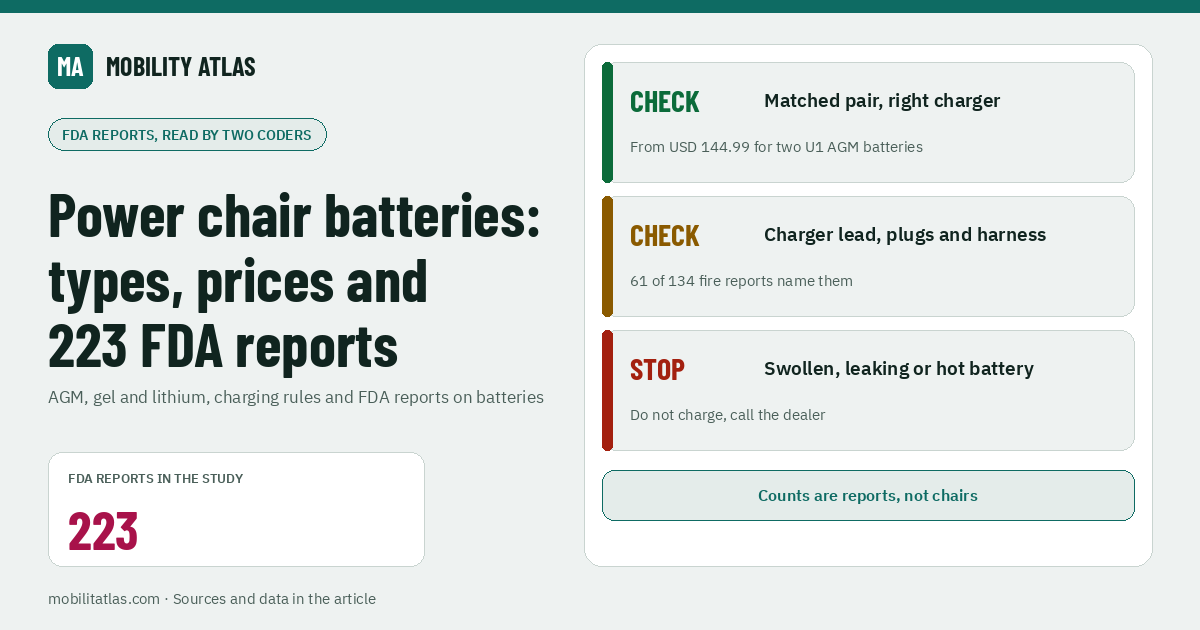
- You see smoke, flames or sparks, or smell burning from the chair, the scooter, the charger or the socket. Unplug only if that is safe, move away, and call the fire service.
- A battery, the battery box, the charger or a cable is hot to the touch, swollen, cracked or melted. Stop charging and do not drive.
- You hear hissing or a boiling sound, smell a sharp or rotten-egg smell, or see liquid, white powder or crust around a battery. Keep away from it, ventilate the room, and do not touch it with bare hands.
- A carbon monoxide or smoke alarm goes off near the chair while it charges.
- The chair stops dead while you drive, even once, and you were not told why. It may leave you stranded or throw you forward.
- The charger lead, the plug or the charging socket on the chair is cracked, loose, scorched or bent.
Most other things in this guide can wait a few days. These six cannot, because they are the patterns behind the most serious reports we read.
The short answer
Almost every power wheelchair and mobility scooter runs on rechargeable batteries, and most use two 12 V batteries joined to make a 24 V set. Most chairs still use sealed lead-acid batteries, either AGM or gel. A growing number of folding chairs, travel scooters and power add-ons use lithium batteries, which are lighter but need their own charger and come with flying rules.
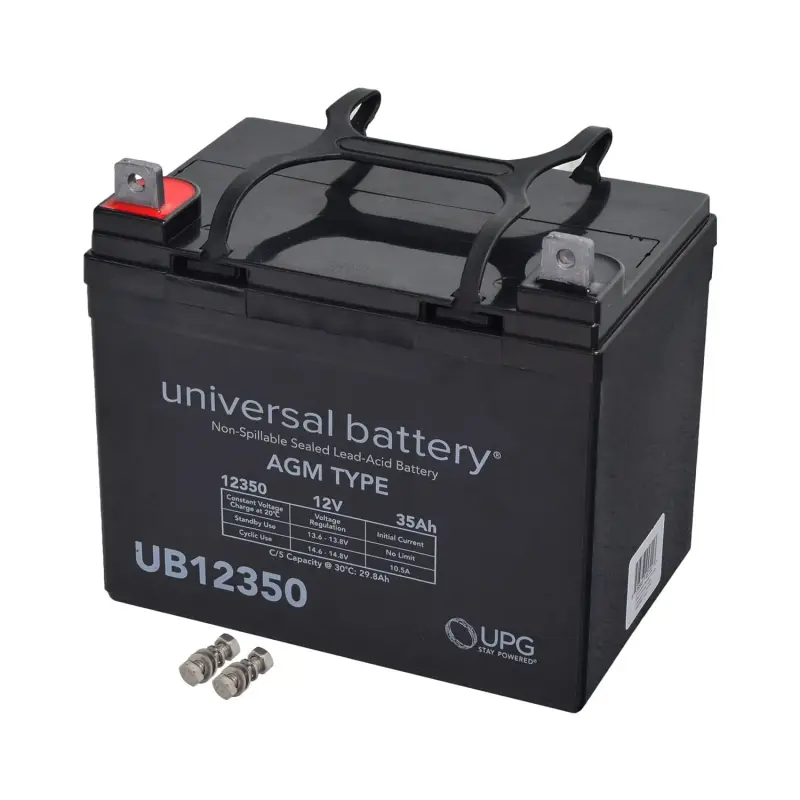
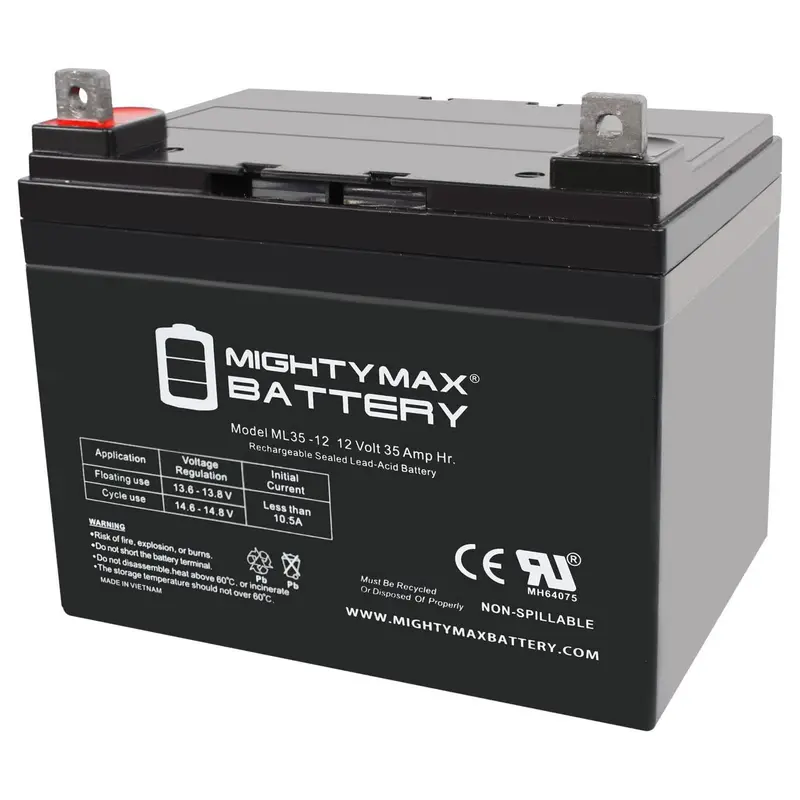
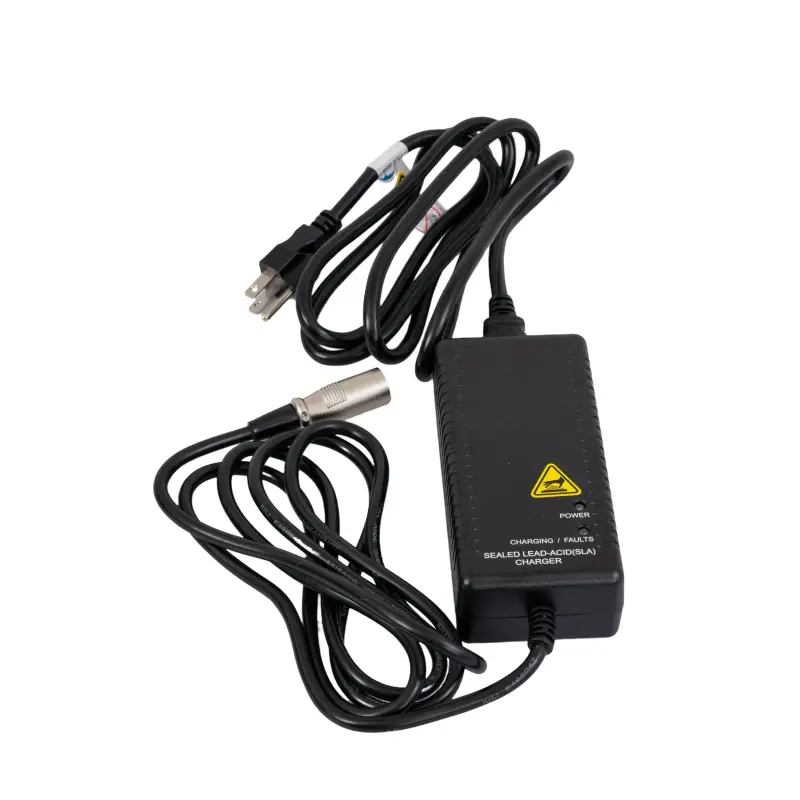
The batteries are the part you will replace most often, so prices matter. In the Mobility Atlas catalog, a single 12 V 35 Ah AGM battery of the common U1 size is listed from USD 74.99, and a pair from USD 144.99. Larger 22NF and group 24 batteries for bigger chairs run to USD 349.98 a pair and USD 425.95 each. A lithium battery in the U1 size is listed at USD 154.99, and a replacement 24 V charger from USD 59.99.
The safety part comes from something most battery guides never open: FDA reports about batteries, chargers and charging on power wheelchairs, scooters and power add-ons, 223 reports in all, each read by two independent AI coders working separately. Of the 220 that are about these devices, 176 describe a battery or charging problem. Fire, smoke or melting dominates: 134 of the 176. The words in those reports mention chargers, cables, harnesses and plugs at least as often as the batteries themselves. 33 of the fires were reported while the device was charging.
None of this means your batteries are dangerous. It means the risks are specific, and most of them sit in things you can look at: the charger, its lead, the plugs between the batteries and the chair, and where you charge. The sections below show how.
How to read the evidence: every quote below names the report, recall or document it comes from, and every count comes from the coded table published on the data and method page. Prices are the prices shown on makers', dealers' and retailers' pages in October 2026; two of them, the Interstate DCM0035 and the UPG 22NF pair, were sale prices at the time.
What kind of battery is in your chair
Open the battery box or look at the label on the battery itself. Three things on it decide what you can replace it with: the chemistry, the size and the voltage.
| Type | What it is | Typical listed weight (12 V, U1 size) | Watch out for |
|---|---|---|---|
| AGM sealed lead acid | Sealed, maintenance-free, the most common | About 23 to 25 lb | Weight; slow decline if left flat |
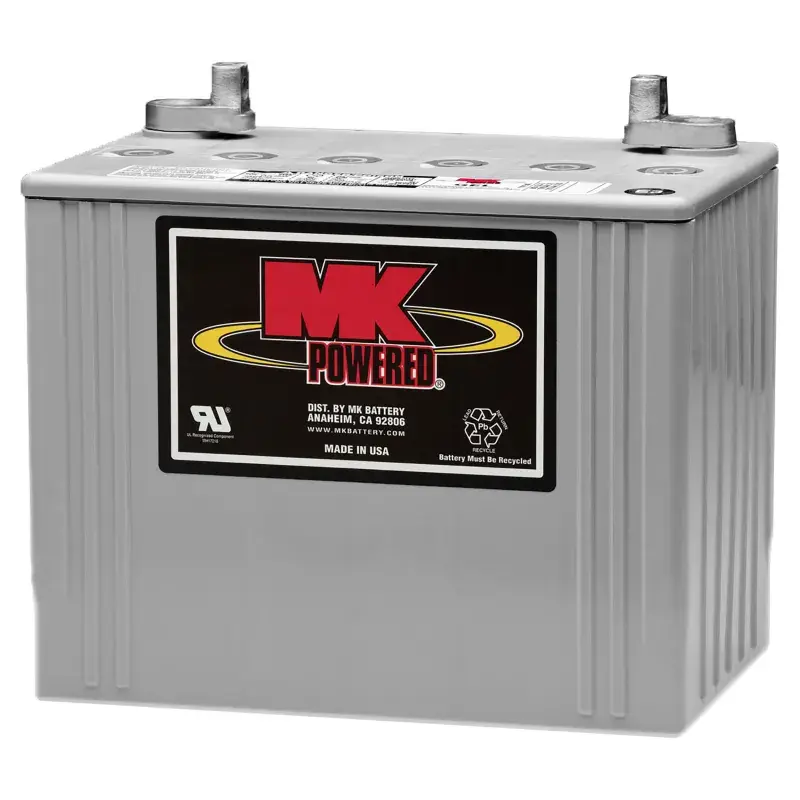
| Gel sealed lead acid | Sealed, maintenance-free, gel inside | No U1 gel listed; MK M22NF gel 37.5 lb | Needs a charger set for gel |
| Lithium iron phosphate (LiFePO4) | Lithium, with a built-in management circuit | About 10 lb | Needs a charger made for it; flying rules |
Sealed lead acid: AGM and gel
AGM and gel batteries are both sealed lead-acid batteries. You never add water to them, and they can be carried on their side. Most power chairs and scooters are delivered with one or the other. The UPG UB12350, a 12 V 35 Ah AGM battery in the U1 size, is listed at 25 lb; the Mighty Max ML35-12 at 23.15 lb; the Interstate DCM0035 at 22.9 lb. The gel MK M22NF is listed at 37.5 lb, and the MK M24 at 51.5 lb.
The two kinds need slightly different charging. The battery maker MK Battery says in its charging guide: "Never use an automotive or wet-type charger on sealed Gel or AGM batteries (this will damage your battery)." Many wheelchair chargers have a switch or setting for gel or AGM. If you change type, the setting has to change too.
Lithium batteries
Lithium batteries come in two forms. Some are drop-in replacements in the same case size as a lead-acid battery, such as the Mighty Max ML35-12LI, a 12 V 35 Ah lithium iron phosphate battery listed at 10 lb and 448 Wh. Others are packs built into a device: folding power chairs, travel scooters, and power add-ons such as the Alber e-fix, whose spare battery is listed at about USD 970. A lithium battery saves a lot of weight. It also needs a charger made for it, and the catalog entry for the Dakota Lithium U1 battery says to check charger and controller compatibility before fitting it to a chair.
Size and voltage
The size is a case code. U1 is the common size for mid-size power chairs and many scooters; 22NF and group 24 are larger batteries for bigger chairs and longer range; small 12 Ah batteries go in travel scooters. Two 12 V batteries are wired in series to give 24 V, which is why you almost always buy them in pairs. The UPG UB12550 pair is sold as a 24 V set of two 12 V 55 Ah batteries, listed at 41 lb each.
Replace both batteries of a pair at the same time, with the same make, type, size and age. Mixing an old battery with a new one makes the new one work harder and wear faster.
Six situations, and which route is yours
- Smoke, sparks, a burning smell or a hot part. Stop, read the stop list above, then the sections on fire and overheating. Route 4: a dealer check before the next charge.
- The range has dropped: the chair runs out sooner than it used to. Route 1 at home, then route 3 if the batteries are old.
- The chair stops while driving, then starts again. Read the section on power loss. Route 2: the dealer checks the plugs, the harness and the fuse.
- The charger lights do not come on, or it never says full. Route 1, then route 2 for the charger and the socket.
- A battery is swollen, leaking or cracked. Read the section on leaks and swelling. Route 3: new batteries fitted by the dealer.
- You want to fly, or to switch to lithium. Read the sections on lithium and on flying, and ask the airline and your chair's maker first.
What batteries and chargers cost in 2026
| Item | Size or rating | Listed price |
|---|---|---|
| Mighty Max ML35-12, AGM | 12 V 35 Ah, U1 | USD 74.99 each; USD 144.99 for two |
| UPG UB12350, AGM | 12 V 35 Ah, U1 | USD 79.99 each; USD 164.98 a pair |
| Interstate DCM0035, sealed lead acid | 12 V 35 Ah, U1 | USD 139.95 |
| UPG UB12120, AGM | 12 V 12 Ah, travel scooter size | USD 44.99 |
| MK M22NF, gel | 12 V 51 Ah, 22NF | USD 269.96 each |
| UPG UB12550 pair, AGM | Two 12 V 55 Ah, 22NF | USD 349.98 a pair |
| MK M24, gel | 12 V 73.6 Ah, group 24 | USD 425.95 each |
| Mighty Max ML35-12LI, LiFePO4 | 12 V 35 Ah, 448 Wh, U1 footprint | USD 154.99 |
| Dakota Lithium DL+ 12V 60Ah | 12.8 V 60 Ah, 720 Wh | USD 599.00 |
| Pride Go-Go battery box | 24 V, empty or with 12 Ah or 15 Ah batteries | USD 198.99 to USD 319.99 |
How much do power wheelchair batteries cost? Mobility Atlas checked listed prices on makers' and retailers' pages in October 2026, and the answer depends mostly on the battery size. For the common U1 size, a pair of 12 V 35 Ah AGM batteries is listed at USD 144.99 for a Mighty Max two-pack and USD 164.98 for a UPG pair, while a single Interstate battery of the same size is listed at USD 139.95. Bigger chairs that take 22NF or group 24 batteries cost more: a UPG 22NF pair is listed at USD 349.98, a single MK M22NF gel battery at USD 269.96 and a single MK M24 at USD 425.95, so a pair runs to several hundred dollars. A lithium U1 battery is listed at USD 154.99 each. Add fitting if a dealer does the work, and the disposal of the old batteries. If your chair is funded, ask the supplier whether replacement batteries are covered before you pay yourself.
Chargers
| Charger | Output | Made for | Listed price |
|---|---|---|---|
| UPG 24BC2000T-4 | 24 V, 2 A, XLR plug | Sealed lead acid, 7 Ah or more | USD 59.99 |
| Soneil 2404SX | 24 V, 2 A | Gel, AGM and wet lead acid | USD 76.95 |
| UPG 24BC5000T-4 | 24 V, 5 A, XLR plug | AGM or gel, 15 to 50 Ah | USD 89.99 |
| High Power HP8204B | 24 V, 4 A, XLR-style plug | Sealed lead acid, 18 Ah and above | USD 99.99 |
| Lester 24V 8A dual mode | 24 V, 8 A | 24 V power wheelchair sets | USD 179 (pre-owned unit) |
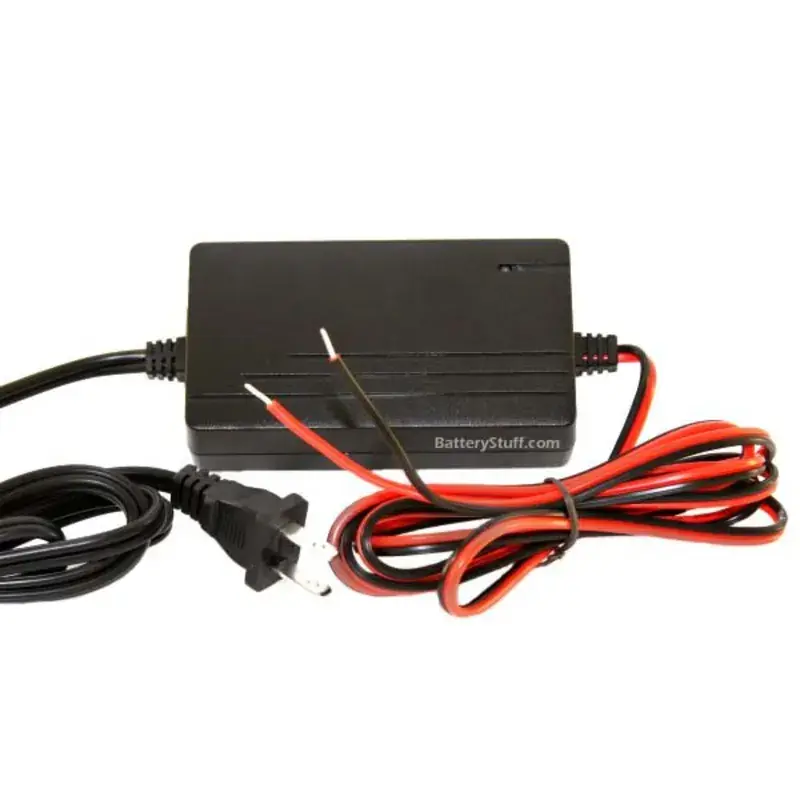
Read the charger label as carefully as the battery label. Each charger above is listed for a range of battery sizes and types, and a charger set for the wrong type, or sized for a different battery, is one of the patterns in the reports below. Most chargers plug into the chair through a three-pin XLR socket on the joystick or the tiller, and the same socket can take accessories such as the AlveyTech XLR adapter with USB-A and USB-C ports, listed at USD 29.99.
Five routes, from the cheapest fix to new batteries
Route 1: check the basics at home (free)
Many battery complaints are charging habits. Is the charger plugged in at the wall and switched on, and does its light change as it should? Is the chair switched off while it charges, if the manual says so? Has the chair been charged for long enough? MK Battery's charging guide tells daily users to charge for at least 8 hours a night and 12 hours a night at least once a week. If the range came back after a full charge, that may be all it was.
Route 2: a dealer check of plugs, harness, fuse and charger
If the chair cuts out, the gauge jumps, or the charger behaves oddly, the problem is often a connection rather than the batteries. A dealer can check the battery plugs, the harness that runs from the batteries to the controller, the fuse and the charger output. Several recalls below are about exactly these parts.
Route 3: new batteries of the type the maker specifies
When batteries no longer hold a charge, the fix is a matched pair of the type and size in the manual. Ask the dealer to fit them, or follow the maker's instructions to the letter if you do it yourself: battery boxes are heavy, and one report in our set describes a broken shoulder while removing a battery pack.
Route 4: stop and have it inspected
Smoke, sparks, a burning smell, heat, swelling or leaking are not things to fix at home. Stop using the chair and the charger, and have both inspected before the next charge.
Route 5: a change of battery type
Changing from lead acid to lithium, or between gel and AGM, is more than a swap. The charger, its setting and sometimes the controller have to match. Ask the chair's maker or a dealer who knows your model first, and get the answer in writing.
How to charge: what the battery maker says
The clearest charging rules we found come from a battery maker, MK Battery, whose batteries are fitted to many chairs and scooters. Its charging guide tells readers to check the owner's manual for their own equipment first, and then sets out simple rules.
- Use the maker's automatic charger or a comparable one for all routine charging.
- Never run the batteries completely flat.
- Daily users: charge every night, for at least 8 hours, and for 12 hours at least once a week.
- Occasional users: charge before an outing and always after active use.
- Do not top up the batteries with frequent short charges.
Can I charge my power wheelchair overnight? Mobility Atlas read the battery maker's guidance and the FDA reports side by side, and the answer is yes for most chairs, with conditions. MK Battery tells daily users to charge nightly, for at least 8 hours, and its guide says an automatic charger is the one to use for routine charging. That is the charger supplied with your chair or a comparable one set for your battery type. The FDA reports add the conditions. Of the 134 fire reports we read, 33 happened while the device was charging, and 61 of the 134 mention a charger, a cable, a plug or other wiring. So charge overnight with the right charger, on a hard floor, away from beds, curtains and anything that burns, with a smoke alarm in the room, and never across your only way out. Do not sleep in the chair while it charges unless your chair's maker says that is safe for your model.
Two habits make the biggest difference to how long batteries last. The first is never running them flat; one report describes a chair left for three months while its owner was away, after which the battery had "completely discharge" and "wouldn't charge at all", as the report says. The second is charging long enough. A short top-up every few hours never lets the charger finish its cycle.
How Mobility Atlas read 223 FDA reports
The FDA collects reports about problems with medical devices in a public database called MAUDE. Power wheelchairs have their own product code, ITI, and mobility scooters theirs, INI. Makers must file reports about some events, and users, families and health workers can file them voluntarily.
We built a pool of reports that mention a battery, a charger or charging, or fire, smoke, melting or sparks, from three sets. First, power wheelchair reports from 2019 to 2023 found by openFDA text search: 88 reports. Second, power wheelchair reports received since 1 January 2024, from the set we read for our electric wheelchair guide, whose text matched those words: 48 reports. Third, scooter reports since 1 January 2016 matched the same way: 87 reports. That makes a pool of 223. Three turned out to be about something else, leaving 220.
Before reading any report, we wrote a codebook: a list of categories and rules for what counts as each, with the order in which they apply. Fire comes first, then overheating, then damage to the battery, then charger faults, then wiring faults, then power loss blamed on the battery. We fingerprinted the codebook so that any later change would show. Two coders then read every report separately, without seeing each other's answers: what kind of device it was, what the battery or charging problem was, and whether the report states an injury, a charging event or a lithium battery. The coders were AI models working separately; the method page says so in full.
| What the coders recorded | Agreement | Cohen's kappa |
|---|---|---|
| Main category | 95.5 percent | 0.925 |
| Device type | 85.2 percent | 0.786 |
| Injury stated | 99.6 percent | 0.988 |
| Charging at the time | 100 percent | 1.0 |
| Lithium battery stated | 100 percent | 1.0 |
A kappa of 1 means perfect agreement and 0 means no better than chance. Each of the 44 reports where the coders differed was decided under a written rule, and a final consistency pass corrected 16 codes, for example a battery leak that began while the chair was plugged in, which both coders had missed. The rules, the codebook and the coded table are on the data and method page.
One limit matters above all. The FDA's MAUDE page says "MDR data is not intended to be used either to evaluate rates of adverse events" and that "The submission of an MDR itself does not necessarily demonstrate that the device caused or contributed to the adverse outcome or event." Every count below counts reports, not chairs, not batteries, and not people.
What the reports show: the big picture
| What the report says went wrong | Reports | While charging | With an injury stated |
|---|---|---|---|
| Fire, smoke, melting or explosion | 134 | 33 | 17 |
| Power loss blamed on the battery | 16 | 0 | 5 |
| Overheating, sparks or a burning smell, no fire | 11 | 4 | 3 |
| Battery leaking, swollen or damaged | 4 | 3 | 2 |
| Charger or charging fault | 4 | 1 | 0 |
| Wiring, plug or fuse fault | 4 | 0 | 0 |
| Battery problem alleged, cannot tell what | 3 | 0 | 2 |
Fire dominates: 134 of the 176 battery-related reports. That does not mean fires are the most common battery problem. It means they are the problem that gets reported, and our search looked for fire words directly: a flat battery is rarely sent to the FDA, a fire is far more likely to be. The other 44 reports in the pool mention a battery only in passing, for example to say it was charged before a fall, and we leave them out of the counts below.
By device, 65 of the 176 reports are about power wheelchairs, 51 about mobility scooters and 6 about power add-ons fitted to manual chairs. In 54 we cannot tell, because the report says only "unit" or names no model. 105 were filed under the power wheelchair code and 71 under the scooter code. 29 of the 176 state an injury. Only one states that the battery was lithium, and one more hints at it; reports seldom name the battery chemistry at all.
Fires: what the reports mention
134 reports describe fire, smoke, melting or an explosion: 48 on power wheelchairs, 41 on scooters and 45 where the device is not named. 17 state an injury, and 8 are classed as deaths, which we read separately below. 33 were charging at the time.
The words in the fire reports show which parts they mention. 34 mention a charger, 36 the batteries, and 42 wiring, a harness, a cable, a plug, a connector or a terminal. Several describe the charger catching fire as it was plugged in. In one, the rider went "to plug in his charger on his scooter and it allegedly caught fire burning his carpet"; the maker found a lead "dislodged from the PCB of the charger", as its report says.
Others start at a cable. In one report, a joystick cable was "loose and smoking at the connection to the joystick". The user plugged it back in and it caught fire, and someone who later tried to repair the cable at home burned his thumb. In another, a user charging a heart monitor from the chair's charging module reported smoke and heat "from the charging area and connected cable", and alleged a burn to the palm that needed hospital treatment; the maker found no visible burn marks or signs of overheating on the module or the hand, and the cable was not available to examine.
Some fires are not caused by the chair at all, or not clearly. 7 fire reports name cigarettes, a pipe, a lighter or oxygen as the cause or as a possible cause; one says the user "was lighting a lighter with an O2 tank mounted to back of chair", and another that a rider smoking a cigarette "bumped into a kerosene heater". Several others say the cause was unknown or still under investigation. One report first said a power chair caught fire while charging in a van from an extension cord; the maker's later report says "the device was not being charged as originally reported" and that the damage came from outside the chair. One scooter burned in a basement storeroom after its charger had been stolen; the owner wondered whether someone set the fire, and the maker's report says an insurance adjuster confirmed the scooter was not the cause. A maker reported a corridor fire in a retirement home "as a precaution without knowing exactly whether our product is causally involved", as its report says.
And 7 mention aftermarket parts, batteries from another supplier, or modifications. One maker found "an aftermarket jumper clamp in the battery compartment"; another wrote that "the cable routing is shown to be modified incorrectly". In a third report, a technician plugged a scooter in to charge, heard the circuit breaker trip, and the battery box exploded; the maker found unauthorized modifications and possibly batteries assembled incorrectly.
- Charge with the charger supplied with the chair, or one of the same rating that the maker approves.
- Charge on a hard floor, away from beds, curtains, paper and anything that burns, with a smoke alarm in the room.
- Do not charge in a hallway or across your only way out.
- Look at the charger lead, the plug and the chair's charging socket every week. Stop using any that is cracked, scorched, loose or hot.
- Do not smoke or use a flame near the chair, above all with oxygen fitted.
- Have batteries, harnesses and accessories fitted by someone who knows your model, and keep the receipts.
Harnesses, fuses and plugs
Between the batteries and the controller runs a battery harness: the cables, plugs, fuse and terminals that carry all the power the chair uses. It is easy to forget, and it comes up again and again in reports and recalls.
In one scooter report, a buyer traced repeated stalls to a plug from the batteries that kept coming loose, and wrote that "there was no locking position for the plug connection". Hitting a bump or a threshold was enough to cut the power. In another report a unit "beeped 8 times" and stopped working, and the fire department had to help the user home; a technician later found loose battery wires.
The recall file says the same. In 2022 Invacare recalled 133 TDX SP2 chairs because "the battery wiring harness on affected wheelchairs may become disconnected" after a jolt or impact, which "results in loss of power to the wheelchair", as the recall record says. Earlier recalls covered a fuse assembly that could short around the fuse, wires pinched by a seat back, harnesses caught under a motor bracket, and a charger harness with a short circuit that could cause "heat damage to the units with potential for fire".
- Once a month, with the chair switched off, look at the battery plugs and cables you can see. They should be firm, clean and undamaged.
- If the chair cuts out over bumps, tell the dealer that exact detail. It points at a connection.
- Never replace a fuse with a bigger one, and never bridge a fuse.
- Keep the cover on the battery connection block when the chair is taken apart for the car.
The last point comes from a report about a Merits mobility device, which the report calls both a power wheelchair and a scooter, taken apart for transport. The cover was left off the battery connection block, and when the owner lifted the scooter, "their metal watch band shorted across the two battery connector points", as the report says, burning the wrist.
Overheating, sparks and carbon monoxide alarms
11 reports describe heat, sparks or a burning smell without a fire, 4 of them while charging. Many of them describe warning signs before anything burned, which is what makes them useful to an owner.
In one, a scooter sparked when the charger was plugged in, and again a month later with a burning smell; the outlet sparked too, and the maker noted that other items had sparked at the same outlet. In another, the user of a power add-on found a burning smell after charging the wheels overnight and "a small hole in one of the wheel hub cover", as the report says. A third describes an add-on wheel "super-hot to the touch enough to burn fingers" that "smelt like burnt wire insulation".
Two reports describe a charger that was itself the problem. In one, a new chair's charger got very hot on its first charge because, the report says, "the charger's integrated cooling fan failed to activate", and the user measured the housing at 139.8°F (59.9°C). In another, the dealer found that the user was charging with an 8-amp charger "that was hot to touch", although the chair had been shipped with a 10-amp charger.
Two reports describe carbon monoxide alarms going off near batteries. In one, a power chair "was charging inside, and triggered the carbon monoxide detector", and the batteries were swollen. In the other, the fire department said the alarm was coming from the batteries, because the battery box was hot. A battery that is overcharged or failing can give off gas, and an alarm going off near a charging chair is a reason to stop, unplug if it is safe, ventilate and call for help.
Leaks, swelling and acid
4 reports describe battery damage: leaking, swelling, acid or a battery that hurt someone. They are few, but the harm in them is real.
In one, a strange odour came from the chair when the charger was plugged in, and the batteries started leaking; the maker found the returned batteries appeared to have vented. In another, used batteries had been fitted to a chair at a service call. The user later heard a "boiling" noise from them, found white dust on the chair, and alleged in a civil claim that acid dust caused serious burns. The maker's report says there was no evidence that the chair's control system malfunctioned; the user's own account says the batteries fitted were used.
A battery box is also heavy. One report describes a broken shoulder while removing a battery pack. Another, filed as a fire, describes a battery box that exploded on a workbench when it was flipped over, throwing pieces that hit the owner in the face, "cracking his front teeth", as the report says. The maker's evaluation found that the battery installation instructions had not been followed and that the product had been modified.
- Never fit used or second-hand batteries of unknown age.
- Do not lift a battery box alone if it is heavy for you, and lift it upright.
- If a battery is swollen, cracked or leaking, do not charge it. Wear gloves, keep it upright, and have a dealer or a battery recycler take it.
- Wash acid off skin at once with plenty of water and get medical advice for any burn.
- Take old batteries to a recycler or the dealer; do not put them in household waste.
When the battery dies on the move
16 reports blame a stop, a cut-out or a short range on the battery. 5 state an injury, most often a fall from the seat when the chair stopped suddenly. Others describe being stranded: one user "got stuck outside" and needed the fire department to get back in, though the maker found the batteries, from another supplier, held their charge normally; another was left "stranded in the heat", and the maker's records showed the battery never fell below half.
A battery gauge is not always right. A power add-on user wrote that the battery indicator "does not accurately reflect how much charge the device has", and that the device died after less than 5 minutes of use. A scooter rider concluded from his own research that a charger on the wrong setting had ruined his batteries, and later stopped "in the middle of a crosswalk" on the replacements.
- Learn your chair's real range on your own routes, and turn back early if the gauge drops faster than usual.
- Charge before every outing, and carry a phone and the number of someone who can come.
- Wear the positioning belt if one was prescribed: a sudden stop throws you forward.
- If the chair cuts out over bumps, have the connections checked before blaming the batteries.
Charger faults and the wrong charger
4 reports describe a charger or charging fault without heat or fire, and the pattern behind them recurs in other categories too: the wrong charger, the wrong setting, or no charger at all.
One chair bought online was delivered and assembled, and when it later stopped from loss of power the user found that it "did not ship with a rechargeable battery or compatible battery charger". A power add-on user reported that the charger for the device's control watch was marked for 1 A, with no warning in the documents, and that plugging it into a stronger USB charger seemed to damage the watch's lithium charging circuit.
- Use the charger supplied with the chair, or a replacement with the same voltage, the same plug and a rating approved for your battery type and size.
- Check the gel or AGM setting whenever batteries are changed.
- Do not use a car battery charger. MK Battery says never to use an automotive charger on gel or AGM batteries.
- Keep the charger off the floor where it can be kicked or wet, and let it breathe: do not cover it.
Lithium batteries and power add-ons
Lithium batteries are light and last many cycles, which is why folding chairs, travel scooters and power add-ons use them. Only one report in our set states that the battery was lithium, and it concerns a watch charger, not the main battery. One more fire report, blamed on a cigarette, says the user no longer wanted lithium. That is too little to say anything about the safety of lithium chairs either way. 6 reports concern power add-ons on manual chairs, including one wheel hub damaged by heat after an overnight charge and another wheel found too hot to touch while the user sat in church.
The practical rules come from the makers and the airlines. Use only the maker's lithium charger, never a lead-acid one. Do not fit a drop-in lithium battery to a chair built for lead acid without asking the chair's maker whether the charger and the controller suit it. Keep lithium packs out of heat and check the charging temperature range on your battery's label or listing before charging in the cold. Our power add-ons guide compares the devices themselves.
The eight death reports, read with care
Eight of the 176 battery-related reports are classed by the reporter as deaths, and all eight describe a fire. A ninth death report in the pool, about a man who became stuck while setting a fire in his back yard, describes no battery or charging problem. Each is a person, and we summarise them with care. In none of them does the report establish that the battery or charger caused the fire, and none states that the device was charging. In three, smoking comes up.
- One scooter caught fire with batteries from another supplier; the maker found that "the product is over 14 years old" and had been "modified post production in the field", as its report says.
- A user was seen on the ground, on fire, while the power chair also burned. The maker's report says it was told the user had gone outside to smoke a cigarette while using an oxygen tank, and that reports it received indicate the damage came from an outside source.
- A home caught fire and the user died; the cause was under investigation and the chair was held.
- A legal notice alleged that a power chair caught fire at home with the user in it; the maker said it could not inspect the chair, and that it had been told the fire was started deliberately.
- A provider reported that a power chair was on fire, with no further detail.
- Neighbours saw smoke from a flat; firefighters found that the chair had caught fire with the user in it. The maker wrote that it was not known whether the chair malfunctioned or the user was smoking.
- A user died after third-degree burns in a chair fire still under investigation by the fire marshal; the maker's report says a field incident report referred to an appearance of electrical malfunction in the chair but gave no detail.
- A law firm alleged that a power chair's battery or electronics started a fire at home. The maker's report says the fire department could not determine a cause and named two possible ones, the user's pipe smoking and the chair's battery or electronics.
Read together, these reports show how little a death report can tell. Several are legal claims, several are under investigation, and the cause is not settled in any of them. What they do show is that a fire with someone seated in a chair is the most dangerous case of all, because the person may not be able to get out quickly, and that smoking and oxygen near a chair are a danger of their own. A smoke alarm near where you sit and charge, no smoking or flames in the chair, above all with oxygen, and a plan for getting out matter more for power chair users than for most people.
The recall file: battery and charging recalls
We read every FDA recall record for power wheelchairs (71 records) and for mobility scooters (22 records) and picked out those about batteries, chargers, harnesses, fuses and cables. Most are older than the reports, but they name the parts that fail.
| Recall | Product | Problem, as the record states it | Started |
|---|---|---|---|
| Z-1130-2022 | Invacare TDX SP2 | Battery harness may disconnect; loss of power | 30 Mar 2022 |
| Z-2358-2015 | Invacare Pronto Air | Batteries may overheat during charging; leaking acid or swelling | 2 Feb 2015 |
| Z-1137-2015 | Invacare TDX, FDX and Storm | Pinched wires may smoke, spark or burn | 15 Jan 2015 |
| Z-1905-2012 | Invacare TDX SP, SR and SI | Post fuse assembly may short around the fuse | 6 Apr 2012 |
| Z-3211-2011 | Pride Victory 10 scooter | Fuses not made to specification | 22 Jun 2011 |
| Z-1941-2012 | Pride Victory 9 scooter | Harness connector may let water in | 26 Nov 2010 |
| Z-2618-2010 | Pride Jazzy Select XLR harness | Wires may be pinched under a motor bracket | 1 Feb 2010 |
| Z-1163-2007 | Quickie IQ displays | Display harness may separate and spark | 23 Apr 2007 |
| Z-0036-2007 | Medline Strider Maxi 3 scooter | Main battery cables may overheat | 20 Jul 2006 |
| Z-0682-03 | Invacare Tarsys seating | Charger harness short; potential for fire | 10 Mar 2003 |
| Z-0574-03 | Invacare Lynx and Panther scooters | Charger harness short; potential for fire | 10 Feb 2003 |
The Pronto Air recall describes batteries that "have the possibility to overheat during charging which could potentially result in leaking battery acid", in the words of the recall record. The newest, the TDX SP2 harness recall, is still listed as open. A recall does not always mean you must stop using a chair; the FDA says a recall "sometimes means that the medical device needs to be checked, adjusted, or fixed." If you own or buy one of these models, ask the dealer whether the recall work was done.
Can you keep using a chair with a battery problem?
It depends on the sign. A shorter range, a gauge that drops fast or a charger that takes longer than it used to usually means ageing batteries: you can keep using the chair on short, safe trips while you arrange new ones. Cutting out, especially over bumps, means a connection: keep trips short and near help until the dealer has looked at it. Smoke, sparks, a burning smell, heat, swelling, leaking or an alarm while charging mean stop: do not charge and do not drive until the chair and the charger have been inspected.
If you depend on the chair, ask the dealer for a loan chair while it is repaired, and ask for the visit in writing with what was checked.
What a good battery service covers
- Battery voltage at rest and under load, for each battery of the pair, and the battery date.
- Charger output, and the gel or AGM setting checked against the batteries fitted.
- The charging socket on the joystick or tiller, and the charger lead and plug.
- Battery terminals, plugs and the harness to the controller: tight, clean, not pinched or chafed.
- The main fuse or circuit breaker, and its rating against the manual.
- Battery box, straps and covers, including the cover on the connection block of a travel scooter or folding chair.
- Any recall on the model, and whether the work has been done.
- A written note of what was found and replaced.
What the FDA data cannot tell you
The reports cannot tell you how often batteries fail or catch fire, because nobody knows how many chairs and scooters are in use or how many problems go unreported. They cannot rank brands: one large maker files most of the scooter reports, and makers file differently. They cannot settle causes: many reports are allegations, many say the device was never evaluated, and some fires turned out to have nothing to do with the chair.
They also miss what does not get reported. Batteries that slowly lose range and are replaced at a service rarely reach the FDA. So this guide uses the reports to show patterns, the places where things go wrong, and uses makers' guidance and the recall file for what to do about them.
How long batteries last, and what wears them out
Battery makers rate their batteries in cycles, and how many you get depends on how deeply they are drained and how they are charged, stored and kept warm or cold. That is why two owners with the same chair can get very different lives from the same batteries. Rather than count years, watch for the signs that a set is near its end.
- The chair goes noticeably less far on a full charge than it did a few months ago.
- The gauge drops quickly at the start of a trip, or falls sharply on a slope and recovers on the flat.
- The charger finishes much sooner than it used to, or never shows full.
- The chair slows or cuts out on hills or kerbs that it used to manage.
The habits that wear batteries out are the ones in MK Battery's guide turned upside down: running them flat, leaving them discharged, short top-up charges that never let the charger finish, the wrong charger, and heat or frost. One report in our set shows how fast it can happen: a chair left for three months while its owner was away came back with a battery that would not charge. Writing the fitting date on the battery box tells you and the dealer how old a set is when the range starts to fall.
If you rely on the chair every day, plan the replacement before the batteries fail. A set ordered when the range first drops can be fitted at a time that suits you, rather than after the chair has stopped in the street.
Scooters, travel chairs and add-ons: what is different
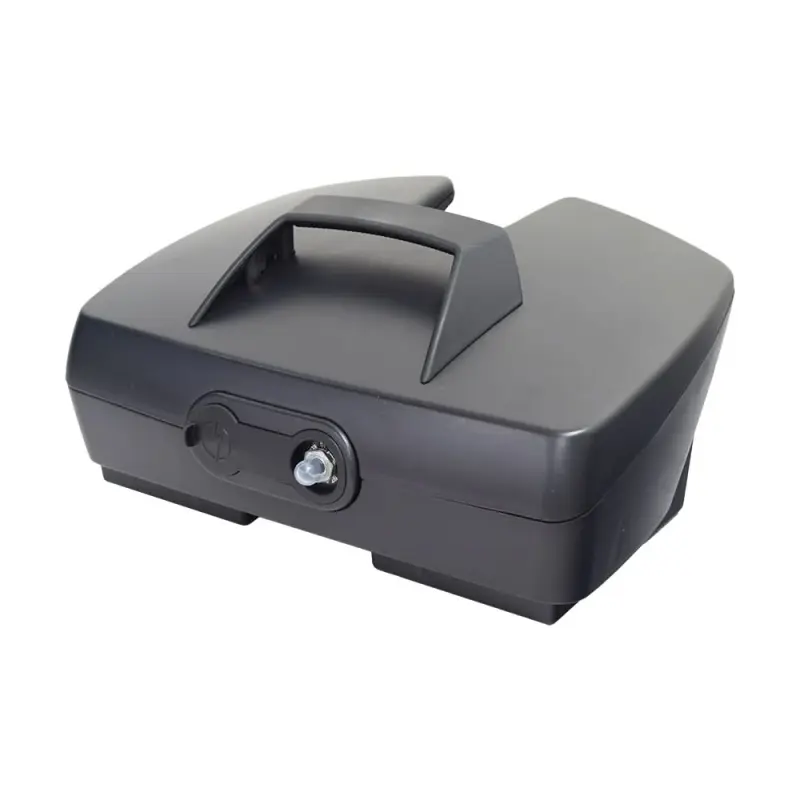
Mobility scooters use the same kinds of batteries as power chairs, but many keep them in a battery box you can lift out and charge indoors. The Pride Go-Go Elite Traveller box in our catalog is listed at USD 198.99 empty, USD 291.99 with two 12 Ah batteries and USD 319.99 with two 15 Ah batteries. A second box doubles the range for a day out, but it is one more heavy thing to lift; check its weight before you buy.
Travel scooters and folding power chairs often have a lithium pack that slides out. That makes the chair lighter to lift into a car and easier to charge, and it brings the flying rules in this guide into play. Keep the pack's contacts clean and covered when it is out of the chair, and never carry it loose in a bag with keys or coins.
Power add-ons for manual chairs, such as front attachments, rear drives and power-assist wheels, run on their own lithium packs and chargers. In our set, 6 reports concern add-ons, among them a wheel hub damaged by heat after an overnight charge, a wheel too hot to touch, and a battery gauge that showed full when the battery was nearly empty. Charge add-ons with their own charger only, and treat a hot wheel hub or a burning smell exactly as you would on a power chair. For the scooter side of this story, our mobility scooter guide reads every FDA scooter report since 2016.
Setting up a safe charging spot
Most charging happens at night, in the home, with nobody watching, so where you charge matters as much as what you charge with. Choose the spot once and make it right.
- A hard floor, not carpet, with nothing that burns within reach: no bedding, curtains, paper or clothes.
- A wall socket of its own. Avoid extension leads and multi-way adapters unless your chair's maker says they are fine, and never run a lead under a rug.
- Space around the charger so it can cool, and nothing resting on top of it.
- Away from the door you would use in a fire, and not in a hallway or on a stair.
- A working smoke alarm in the room, and ideally a carbon monoxide alarm too.
- Dry: no charging outside in rain or snow, and no charging in a damp garage or shed.
If you sleep in your chair, or must charge it in the room where you sleep, talk to your dealer and your local fire service about the safest arrangement for your home. Many fire services offer free home safety visits and can fit alarms.
Choosing replacement batteries, step by step
Which battery should I buy for my power wheelchair? Mobility Atlas compared the batteries in its catalog with the makers' charging rules, and the safest answer is the one your chair's manual names, in a matched pair. Start with the label on the old batteries: the chemistry (AGM, gel or lithium), the voltage, the capacity in Ah and the case size, such as U1, 22NF or group 24. Buy the same type and size, both at once, from a source you trust, and never used batteries. AGM and gel are both sealed and maintenance-free, but your charger must be set for the one you fit. A lithium battery of the same case size weighs much less, for example 10 lb against about 23 to 25 lb for a U1 AGM battery in our catalog, but it needs a lithium charger and the chair maker's agreement. If in doubt, ask your dealer or seating team before you order.
- Read the old batteries' labels and the manual. Write down type, voltage, Ah and case size.
- Check the charger label: voltage, current, plug and battery types it is made for.
- Choose a matched pair of the same type and size. Do not mix old and new, or two brands.
- Ask whether your funding covers replacement batteries before paying yourself.
- Have them fitted by the dealer, or follow the manual exactly, with the chair off and the fuse out if the manual says so.
- Set the charger for the battery type and give the new batteries a full charge before the first long trip.
- Take the old batteries to a recycler or back to the dealer.
- Write the fitting date on the battery box, so you know their age later.
If your chair is funded or rented
Before you pay for batteries yourself, find out who owns the chair. Medicare's page on wheelchairs and scooters explains that, depending on the equipment, you may need to rent it, you may be able to choose whether to rent or buy, and some items become your property after a certain number of rental payments. While a chair is rented, ask the supplier who is responsible for replacing worn batteries and who fits them, before anyone orders a set.
Outside the US, the same question applies to a chair on loan from a health service, a charity or a leasing scheme. The owner of the chair usually decides which batteries go in it and who fits them. If you change them yourself, you may lose the warranty or break the terms of the loan.
- Ask the supplier or the service, in writing, whether batteries are covered and how to request them.
- Keep the delivery note and the battery date, so you can show when the last set was fitted.
- If you are told to wait, ask what to do if the chair stops before the new set arrives, and whether a loan chair is available.
Flying with power chair batteries
The rules depend on the battery type. The FAA's PackSafe page on wheelchairs and mobility devices sets them out for flights from the US, under 49 CFR 175.10(a)(15) to (17).
- Non-spillable batteries (gel and AGM) may stay fitted if they are secure, protected from damage and the terminals are protected from short circuit. One spare is allowed, in strong rigid packaging.
- Lithium-ion batteries that the chair's design protects may stay fitted. If they have to be removed, each is limited to 300 Wh and goes in the cabin with its terminals protected.
- Spare lithium-ion batteries: one of up to 300 Wh or two of up to 160 Wh each, carried in the cabin, never in the hold.
- Lithium metal (non-rechargeable lithium) batteries are forbidden with these devices.
- The FAA page says airlines may have more restrictive rules, so ask the airline before every trip.
That 300 Wh limit matters when you choose a lithium battery. The Mighty Max ML35-12LI in our catalog is listed at 448 Wh, and the Dakota Lithium DL+ 60Ah at 720 Wh: both above the 300 Wh limit for a battery that has to be taken out. Our guide to flying with a power wheelchair covers booking, gate checks and damage.
Storage, heat and winter
MK Battery's guide sets out how to store lead-acid batteries. Store them fully charged, check them once a month and recharge as needed. If you store the chair for more than two weeks, charge the batteries, then disconnect them; before use, reconnect them and charge for 12 hours. Avoid hot and cold extremes.
Its guide says MK gel batteries can be stored down to -25°F without freezing as long as they are fully charged, but a frozen gel battery will not always recover. To try, MK says to bring it inside and let it sit at room temperature for two days until it reaches 60°F, charge it normally, and then check how far the chair goes.
- Before a hospital stay or a long trip, charge fully and ask someone to charge the chair while you are away, or disconnect the batteries as the maker says.
- Do not leave the chair or the charger in a hot car or in direct sun.
- Follow the maker's temperature limits before charging a lithium battery in the cold.
- Store and charge in a dry place: water in plugs and harnesses causes faults, as one scooter recall shows.
A monthly check you can do at home
- With the chair off, look at the charger lead, the plug and the chair's charging socket for cracks, scorch marks or looseness.
- Feel the charger and the battery box after charging. Warm is normal; too hot to hold is not.
- Look at the batteries if you can reach them: no swelling, cracks, leaks or white crust.
- Look at the plugs and cables you can see without tools: firm, clean, not pinched.
- Note how far the chair goes on a full charge, and compare with last month.
- Test the smoke alarm where you charge.
- Check that nothing that burns sits near the charging spot.
Three traps that cost people the most
Trap one is the cheapest replacement. Used batteries, a mixed pair or the wrong type save money once and cost more later; one of the most serious reports in our set began with second-hand batteries fitted at a service call.
Trap two is the wrong charger. A charger set for the wrong type, sized for a different battery or borrowed from a car can ruin batteries and overheat. Several reports describe exactly that.
Trap three is charging anywhere. Chargers, leads and plugs come up in many fire reports. Charge in a safe place, on a hard floor, with a smoke alarm, and never across your only way out.
Three composite scenarios
These are composite scenarios, not individual customers. Each one combines facts and ranges already given in this guide to show how the decision plays out.
Scenario one: a man's power chair runs out of range sooner every week. The batteries are four years old and a mixed pair after an earlier repair. He writes down the U1 size and AGM type from the label, buys a matched pair listed at USD 144.99, has the dealer fit them, sets the charger to AGM, and writes the date on the box.
Scenario two: a woman's scooter cuts out when she rides over a kerb drop, then starts again. She tells the dealer exactly that. The dealer finds a loose plug in the battery harness, checks the fuse, and asks the maker whether any recall applies to her model.
Scenario three: a couple want to fly with a folding power chair. Its lithium battery comes out, so they check the Wh figure on the label against the 300 Wh limit, call the airline before booking, and pack the battery in the cabin with its terminals covered.
Questions to ask before you pay
- What battery type, size and capacity does my chair's manual name, and do you supply that exact one?
- Are both batteries new, of the same make and date, and will you take the old ones?
- Is my charger right for these batteries, and will you check its setting and output?
- Are there any recalls on my chair, and has the work been done?
- Does my funding cover replacement batteries, and what does fitting cost?
- Is there a loan chair if the repair takes more than a day?
If something in your chair's set-up depends on your health, such as power seating you use for pressure relief or a ventilator powered from the chair, ask your clinician or seating specialist before changing batteries or the charging routine. A longer charge or a new battery type can change how the chair behaves.
Your plan: 10 minutes, today, this week
In 10 minutes: run the stop list at the top, look at the charger lead and plug, and feel the charger after charging.
Today: move the charging spot away from your way out and anything that burns, and test the smoke alarm there.
This week: read the battery labels and write them down, search the FDA recall database for your model, and book a service if the chair cuts out or the range has dropped.
Sources and documents
Reports: FDA MAUDE device reports under product code ITI received from 1 January 2019 and under product code INI received from 1 January 2016, as described in the method section, downloaded through openFDA on 10 October 2026. Recalls: all FDA recall records for product codes ITI and INI, downloaded through openFDA on the same day. Charging and storage: MK Battery's charging FAQ. Funding: Medicare's wheelchairs and scooters page. Flying: the FAA's PackSafe page on wheelchairs and mobility devices. Products: the Mobility Atlas catalog as checked against makers', dealers' and retailers' pages. Every source is linked in the list at the end of this page.
Related guides on Mobility Atlas: Electric wheelchairs: types, prices and FDA reports; Mobility scooters: sizes, prices and FDA reports; Flying with a power wheelchair; Power add-ons compared.
Method in brief: we coded the 223 reports in the pool using a codebook written and fingerprinted before coding, with two independent coders (agreement on the main category 95.5 percent, kappa 0.925), decided all 44 disagreements under written rules, corrected 16 codes in a consistency pass, and counted the results by script. The two coders were AI language models working separately, each without access to the other's answers. Quotes from reports are shown in sentence case; the FDA publishes most of them in upper case. The codebook, the method and the coded table are on the data and method page under CC BY 4.0.
Prices checked October 2026 on makers', dealers' and retailers' pages listed in the Mobility Atlas catalog; prices change, so confirm them in your country. Documents checked October 2026: FDA reports, FDA recall records, MK Battery's charging guide and the FAA PackSafe page.
Had a battery or charger problem from this guide fixed, or been told something different by a dealer or maker? Send us a note through the enquiry form with the model and what happened; we use readers' notes when we update the guide.
This article is general information. Rules and prices differ by country and change, so confirm them before you buy or travel.
Common questions
How long should I charge my power wheelchair?
MK Battery tells daily users to charge every night for at least 8 hours, and for 12 hours at least once a week. Occasional users should charge before an outing and after use. Never run the batteries completely flat.
How much do power wheelchair batteries cost?
In our catalog, a pair of 12 V 35 Ah U1 AGM batteries is listed from USD 144.99. Larger 22NF and group 24 batteries cost more: USD 349.98 for a UPG 22NF pair and USD 425.95 each for an MK M24. A lithium U1 battery is listed at USD 154.99.
Can I use a lithium battery in my power wheelchair?
Only with the chair maker's agreement and a charger made for lithium. A drop-in lithium battery of the same case size is much lighter, but the charger and sometimes the controller must suit it.
Can I take my power wheelchair batteries on a plane?
Often, if they meet the rules. Under the FAA's PackSafe guidance, non-spillable batteries may stay fitted if protected; a lithium-ion battery that has to be removed is limited to 300 Wh and goes in the cabin. Airlines may be stricter, so ask before every trip.
Why does my power wheelchair keep cutting out?
Often a connection: a loose battery plug, a harness or a fuse, especially if it cuts out over bumps. Ageing batteries can also do it. Have a dealer check the plugs, harness, fuse and charger before replacing the batteries.
Is it safe to charge a power wheelchair overnight?
For most chairs, yes, with the right charger. Charge on a hard floor, away from anything that burns and from your way out, with a smoke alarm nearby. Stop if anything gets hot, smells of burning or an alarm goes off.
Sources
- FDA: About the MAUDE database and the limits of device reports
- openFDA: device adverse event endpoint (data used for this study)
- openFDA: device recall endpoint, product codes ITI and INI
- FDA: What is a medical device recall?
- MK Battery: FAQs about proper HME battery charging
- FAA PackSafe: Wheelchairs and mobility devices
- 49 CFR 175.10: Exceptions for passengers, crewmembers and air operators (eCFR)
- FDA recall database (search by product or product code)
- Medicare: Wheelchairs and scooters
- Mighty Max: ML35-12LI U1 lithium replacement battery
Read on 10 October 2026. The wording of the article is our own.
Data and method for this guide: the codebook, the coded reports and the list of documents, free to reuse under CC BY 4.0.