Gear · 8 min read
Power add-ons compared: front, rear and wheels
Front attachments give speed and distance, rear units give light help, power wheels boost each push. Here is how they differ and what to check.
Start with the problem you want solved
A power add-on keeps your manual chair and adds a motor. There are three main layouts, and each solves a different problem.
- You want to cover long distances outdoors, keep up with bikes, or get over rough ground: look at front attachments.
- You want light help on hills and long corridors, and a chair that still fits everywhere: look at rear drive units.
- You want every push to go further, with less load on your shoulders, and you want to keep pushing: look at power-assist wheels.
Research on these devices is still limited, so a trial on your own routes matters more than any brochure.
Three ways to add a motor to a manual chair
Front attachments
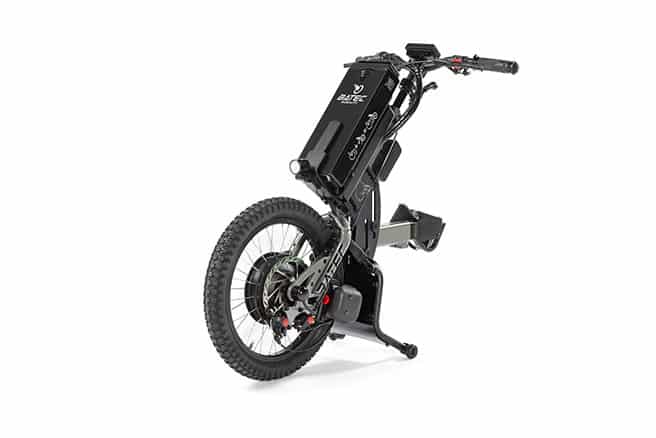
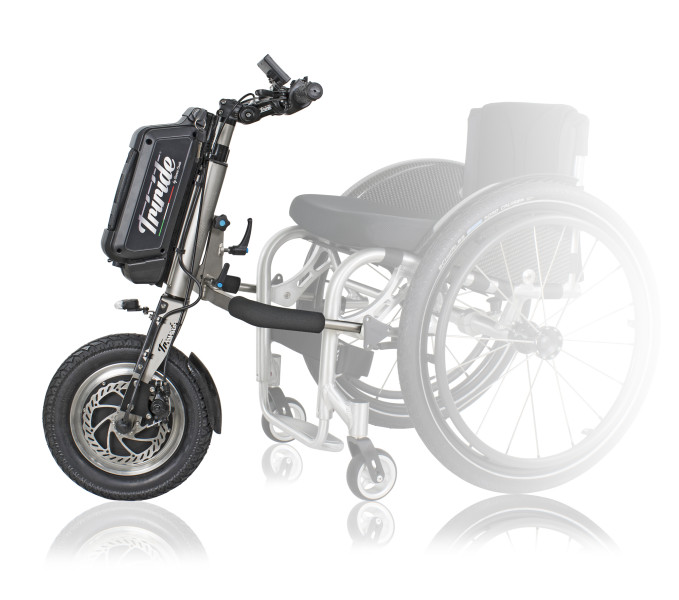
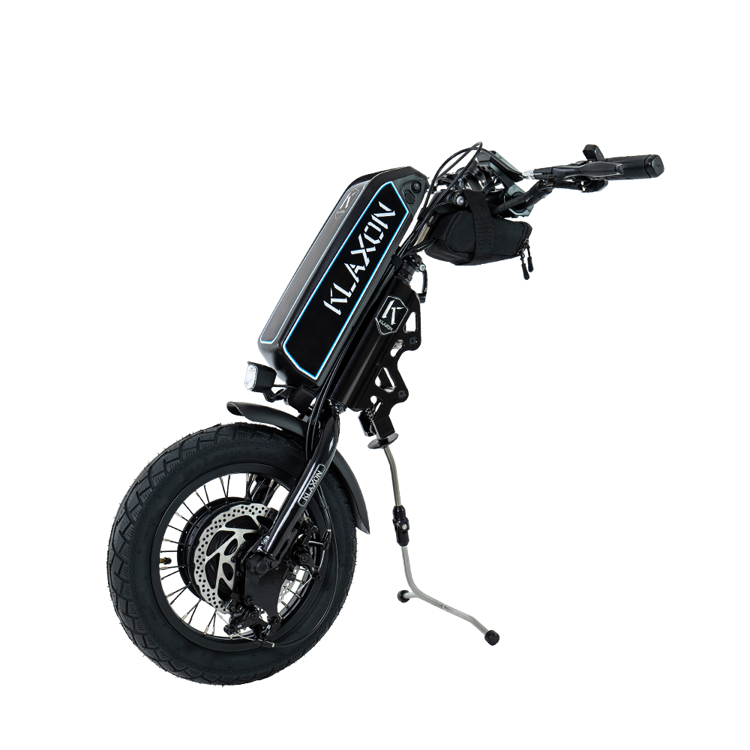
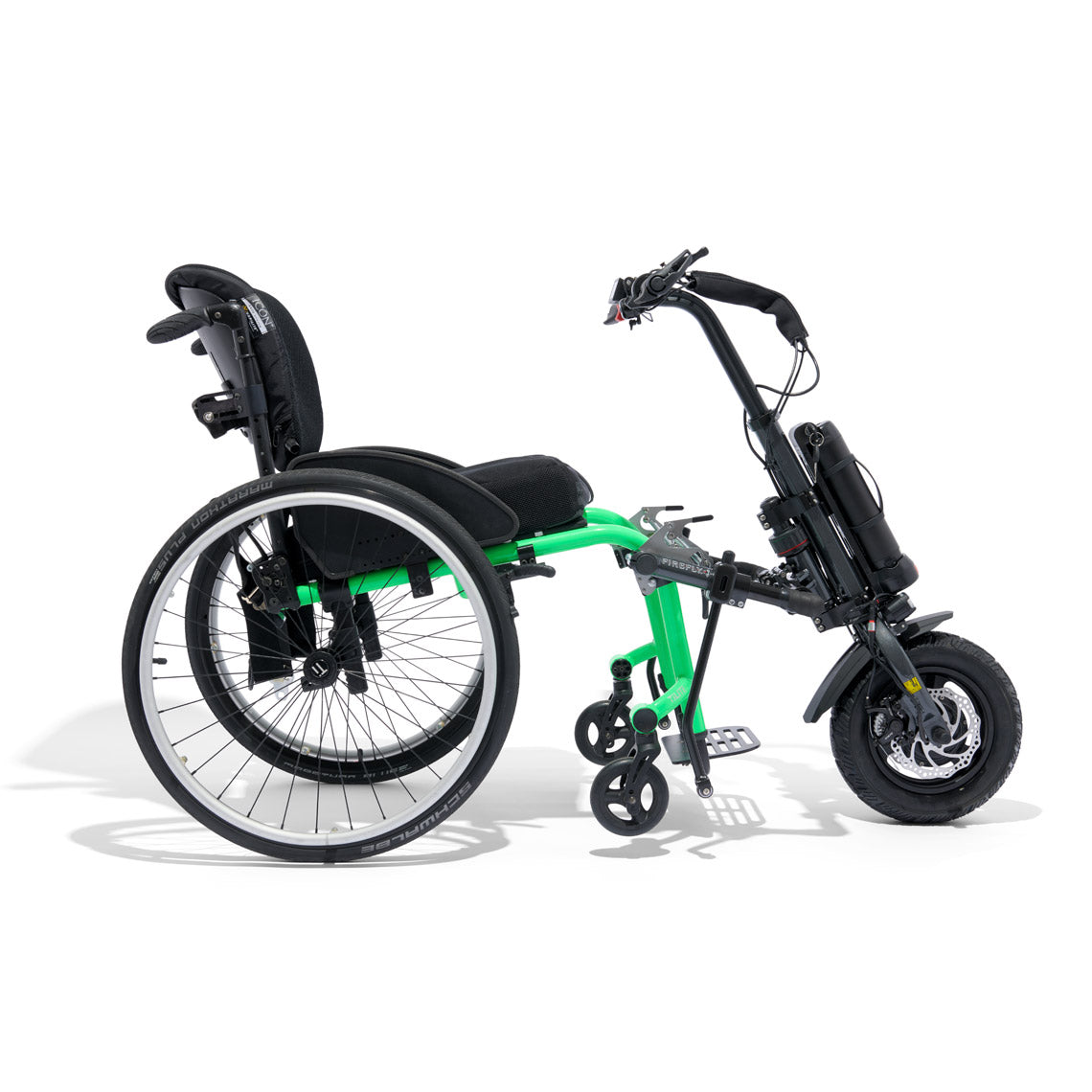
A front attachment clamps to the front of the frame and usually lifts the front casters off the ground. Your chair becomes a three-wheeler that you steer with handlebars and drive with a throttle. You do not push.
Catalog examples: the Batec Electric 2 has an 18 in wheel, a top speed of 25 km/h and a listed range of 21.5 km, and weighs 15.9 kg without its battery. The Klaxon Klick Power is listed at 20 km/h and 10.4 kg without battery, with battery options for 12, 25 or 50 km. The Triride Special Compact has a 12 in wheel, weighs 11 kg and is listed with a range of up to 50 km. The Rio Mobility Firefly 2.5 reaches 12 mph with a range of about 12 to 15 miles.
Rear drive units
A rear unit is a single small powered wheel that sits under the chair, behind the seat. It pushes while you steer with the handrims. You still slow down and stop with your hands.
Catalog examples: the Permobil SmartDrive MX2+ weighs 5.7 kg, reaches 5.5 mph and is listed with a 12.3 mile range. It is started and stopped with a wrist-worn controller or a switch. The Alber SMOOV one weighs 7.2 kg, reaches 6.2 mph and is listed with a 12.4 mile range, managed through a phone app.
Power-assist wheels
These replace your rear wheels. Sensors in the handrim feel each push, and motors in the hubs add force in proportion. The motors also help with braking and turning. You keep your normal pushing movement.
Catalog examples: the Alber e-motion M25 is listed at 5.3 mph, a range of 15.5 miles or more, and 7.8 kg per wheel. The Yamaha JWX-2 is listed with a range of 18 km on its Ni-MH battery or 27 km on Li-ion, and weighs 17.5 to 17.9 kg with battery.
Side by side
| Question | Front attachment | Rear drive unit | Power-assist wheels |
|---|---|---|---|
| Do you still push? | No, you use a throttle | No, but you steer and brake with the rims | Yes, each push is boosted |
| Listed top speeds in the catalog | About 20 to 25 km/h | About 5.5 to 6.2 mph | About 5.3 mph |
| Weight you handle | About 10 to 16 kg without battery | About 6 to 7 kg | About 8 kg per wheel on one model |
| Effect on chair size | Adds a lot of length | Almost none | Little change in length |
| Best at | Distance, speed, rough ground | Hills and long flat stretches | Daily pushing with less strain |
| Main drawback | Hard to use indoors | Needs quick reactions | Heavy chair when power is off |
The drawbacks deserve detail.
- Front attachments add considerable length, so indoor turning suffers. Clinical guidance also notes less forward stability and possible side-to-side stability problems at higher speeds, with more tipping risk on steep ground and in sudden turns.
- Rear units need good reaction time, and there is a learning curve. You must still grip the handrims to slow down, so they are a poor match for hands that cannot brake reliably.
- Power-assist wheels add a lot of weight. That is very noticeable when the power is off and when you lift the wheels into a car. The handrims contain sensors, so they are easier to damage.
All three types change the forces on the chair. Guidance lists frame damage, reduced stability and harder impacts at higher speed as general risks. Ask whether your frame is approved for the add-on you want.
Range and speed: how to read the numbers
Range figures are measured under set conditions. One front-attachment maker states that its ranges come from flat ground at 10 km/h with a 75 kg user. Another says range depends on rider weight, speed, terrain, temperature and headwind. Hills, cold weather, soft ground and higher speed all shorten the distance you will get.
- Ask which test conditions the range figure is based on.
- Plan your regular routes at well under the listed range.
- Ask whether a second or larger battery is available, and what it weighs.
Top speed is a separate question from legal speed. Rules for powered mobility devices on pavements, cycle paths and roads differ by country, and sometimes by city. A device that can do 25 km/h may be limited by law to less where you live. Check local rules before you buy, and ask the dealer whether the speed can be limited in the settings.
Airline rules to check
Almost all power add-ons use lithium-ion batteries. Aviation rules for batteries in mobility aids are based on the watt-hour (Wh) rating printed on the battery. Two regulators give a clear picture of the usual limits.
- The UK Civil Aviation Authority says there is no watt-hour limit when the battery stays installed in the mobility aid. If the battery has to be removed, it must not exceed 300 Wh.
- The US Federal Aviation Administration gives the same 300 Wh figure for a battery that is removed from a mobility device, and says removed batteries travel in the cabin only.
- Both allow spares: one spare of up to 300 Wh, or two spares of up to 160 Wh each, carried in the cabin.
- If the battery stays installed and is protected by the design of the device, the FAA says the device is checked in and you must tell the airline where the battery is.
Now compare that with real products. One front-attachment maker lists battery options of 140 Wh, 280 Wh and 528 Wh. The two smaller packs are under the 300 Wh figure for a removed battery. The largest is not, so whether it can fly depends on whether the airline accepts it installed. Buy the battery size with your travel plans in mind.
IATA guidance for airlines says passengers should give the battery type, the watt-hour rating, whether the battery must be removed, and the weight and dimensions of the mobility aid as it will travel. Airlines may ask for photos. Some makers publish a battery air transport certificate, and one power-wheel maker's app can discharge the batteries for air travel.
These are general rules. Each airline sets its own conditions and can be stricter, and an airline may not treat every add-on as a mobility aid. Contact every airline on your route well before you travel, get the answer in writing, and carry the battery documents with you.
What it takes to attach and remove each one
Front attachment
There is a one-time job first: docking hardware is fitted to the front of your frame. One maker describes this as about an hour of work. After that, makers describe linking and unlinking as a single click or a few seconds. The unit itself is the heavy part. Ask how you would get 10 to 16 kg plus a battery into your car.
Rear drive unit
A small bracket is fixed to the bar under the seat, with different hardware for rigid and folding frames. The unit latches onto the bracket and comes off in seconds. The catalog lists the SmartDrive MX2+ as fitting 22 to 26 in wheels on rigid, folding and tilt chairs.
Power-assist wheels
A small bracket goes on each side of the chair. The power wheels then go on and off with quick-release axles, like normal wheels. You can keep your manual wheels and swap them in. The work is in the lifting, because each power wheel is far heavier than a standard wheel.
Try it before you buy
- Attach and remove the device yourself, three times in a row, without help.
- Load it into your own car.
- Do a transfer with it fitted. Guidance lists the effect on transfers as a key point to check.
- Push the chair with the power off.
- Ride your hardest regular slope, up and down.
Questions for the dealer
- Is my exact chair model and seat width on the compatibility list?
- What hardware stays on my chair, and how much weight does it add?
- What is the battery's watt-hour rating, and is there an air transport certificate?
- What is the maximum user weight, and does it include the chair?
- Who services it in my country, and how long do repairs take?
- Does fitting it affect my chair's warranty?
If shoulder pain, limited hand function or balance problems are part of your reason for buying, involve your therapist. They can help match the control method to what your hands and trunk can do safely.
This article is general information. Rules and prices differ by country and change, so confirm them before you buy or travel.
Common questions
Which power add-on is lightest?
Rear drive units. The two listed in the catalog weigh 5.7 kg and 7.2 kg, against roughly 10 to 16 kg without battery for the front attachments listed.
Can I take a power add-on on a plane?
Often yes, but it depends on the battery's watt-hour rating and on the airline. Regulators commonly use a 300 Wh limit for a battery that must be removed, so check the rating and get the airline's approval in advance.
Do power-assist wheels mean I stop pushing?
No. They sense each push on the handrim and add motor force to it, so you keep pushing with less effort.
Will a front attachment work indoors?
It adds a lot of length to the chair, which makes turning in rooms and lifts difficult. Plan to unlink it at the door.
Sources
- SCIRE Community: Wheelchair Propulsion Assist Devices
- FAA PackSafe: Airline Passengers and Batteries
- UK Civil Aviation Authority: Items that are allowed in baggage
- IATA: Guidance on the Transport of Mobility Aids
- Etac: Klaxon Klick Power
- Wheelfreedom: Permobil SmartDrive MX2+
- Alber USA: e-motion
- Rio Mobility: Firefly 2.5 Electric Attachment
Read on 5 October 2026. The wording of the article is our own.