Gear · 48 min read
Electric wheelchairs in 2026: types, prices and what 1,296 FDA reports show
Four kinds of electric wheelchair, their listed prices and weights, and what we found when two AI coders read every FDA report on powered wheelchairs since 2024.
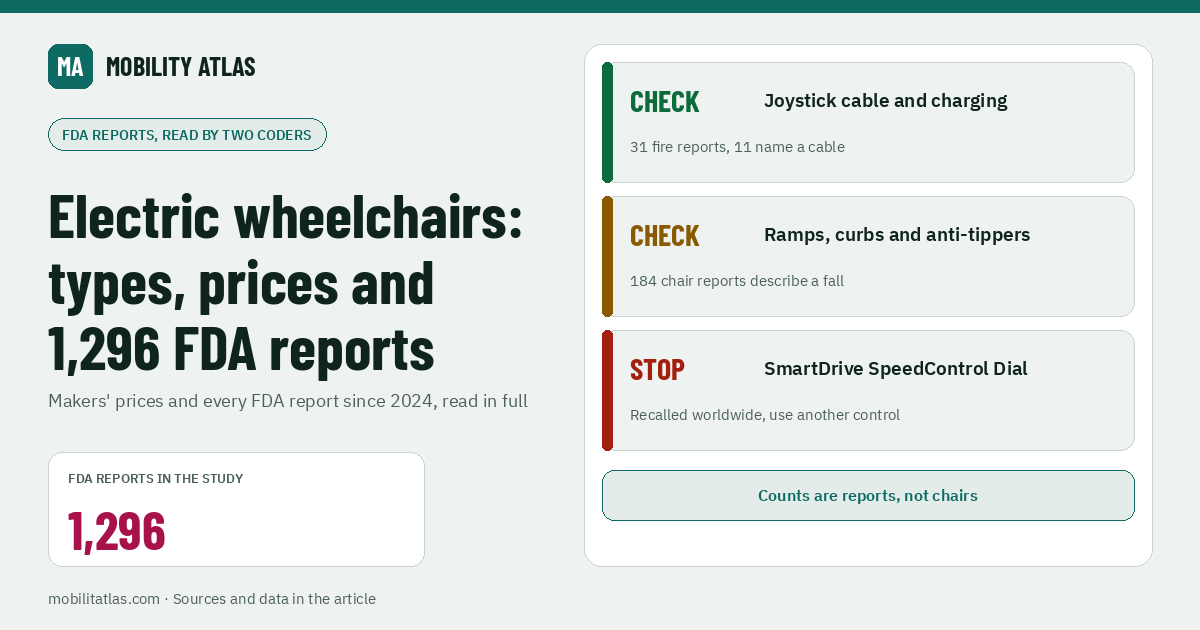
Stop and get help today if
Already have a chair? Check these first. Buying one? Start at the short answer below.
- The chair, or a SmartDrive, moves when you did not tell it to, even once. Switch it off and call the dealer.
- You use a SmartDrive with the SpeedControl Dial. The dial is recalled worldwide; switch to buttons, or the watch app kept updated.
- You smell burning, see smoke or sparks, or a battery is swollen, cracked or hot. Unplug it if safe, move away and call the fire service if there is smoke. The same goes for a joystick, charger or battery cable that is crushed, cut or kinked: stop charging and call the dealer.
- Tilt, recline or the seat lift moved by itself, or trapped a part of your body.
- The brakes do not hold on a slope, or a freewheel lever slips out of drive.
- An armrest, caster or the frame is cracked or loose. Do not lean on it or transfer with it.
Most other things in this guide can wait a few days. These six cannot, because they are the patterns behind the most serious reports we read.
The short answer
An electric wheelchair is not one product. It is four: a full power wheelchair driven with a joystick, a folding travel power chair, a mobility scooter steered with handlebars, and a power add-on that turns a manual wheelchair into a powered one. They differ in weight and in price by a factor of more than forty from the lightest to the heaviest, so the first decision is which of the four you need, not which brand.
This guide gives you that decision first, then the numbers behind it. The prices and weights come from makers', dealers' and retailers' pages as recorded in the Mobility Atlas catalog on 5 October 2026: 33 power wheelchairs, 13 mobility scooters and 16 power add-ons. The safety part comes from something most buying guides never open: every report about powered wheelchairs that the US Food and Drug Administration (FDA) received from January 2024 to late August 2026, the latest data available on 10 October 2026, 1,296 reports in all, plus the FDA recall records for the same product code.
Two independent AI coders read each of the 1,267 reports that carry any text, separately and without seeing each other's work. What they found is not what the advertising suggests. The single biggest group of reports, 897, concerns one power add-on, the SmartDrive, and almost all of them describe the motor running when the user wanted it to stop. Among full power chairs and other powered devices, the reports are about tipping on ramps and curbs, broken casters and armrests, fires that often start at a damaged cable or while charging, and power seating that moved on its own.
None of that means a power chair is unsafe. It means the risks are specific and mostly checkable before you buy and during the first weeks of use. By the end of this guide you will know which of five routes fits you, what each costs as listed in 2026, which recalls apply to your brand, and the checks that catch the problems behind the most serious reports. Mobility Atlas was started by a wheelchair user, and the coded reports and the method are published with this article so that anyone can check our counts.
Four kinds of electric wheelchair, and who each one suits
Start here, because every later question (price, weight, funding, airline travel) has a different answer for each kind. The table uses the categories of the Mobility Atlas catalog, which follow the way the makers themselves sell these products.
| Kind | How you drive it | Typical weight as listed | Best when |
|---|---|---|---|
| Power wheelchair | Joystick or other control | Mostly about 70 to 135 kg; up to 230 kg | You use it all day, indoors and out |
| Folding travel power chair | Joystick, folds for the car | Mostly about 18 to 35 kg; up to 54.4 kg | You travel and someone lifts it |
| Mobility scooter | Handlebar tiller | About 16 to 155 kg | You can sit upright and transfer |
| Power add-on | Fits your manual wheelchair | About 4.5 to 21 kg | You already push a manual chair |
The weights in that table summarise the figures listed for the models in our catalog: most models fall in the first range, and a few heavier ones reach the second. Makers do not weigh their chairs the same way. Some list the chair with batteries, some without, some without the seat, so treat any single figure as a starting point and ask which parts are included.
Full power wheelchairs
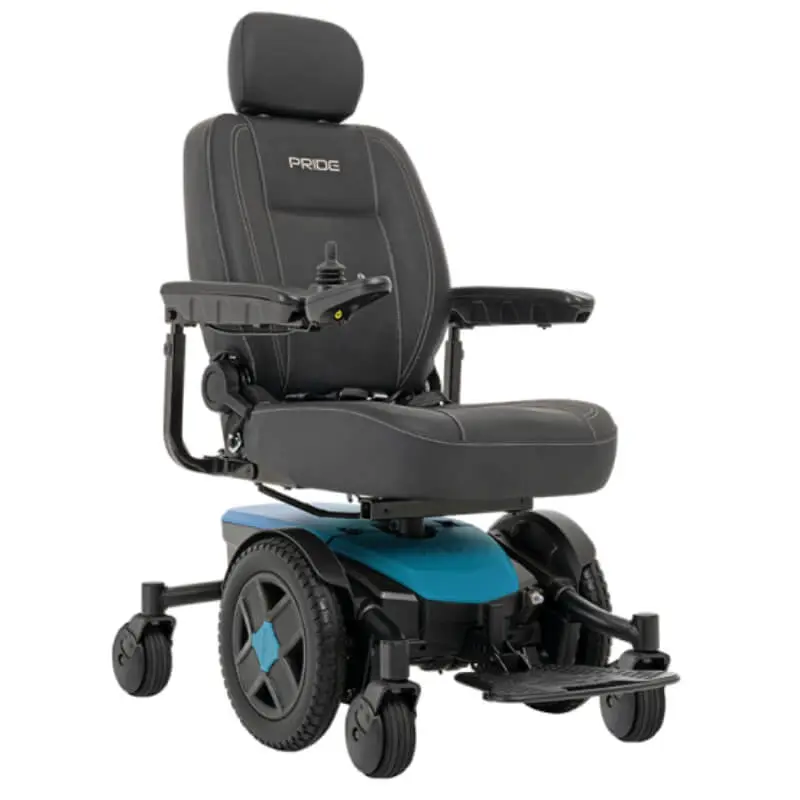
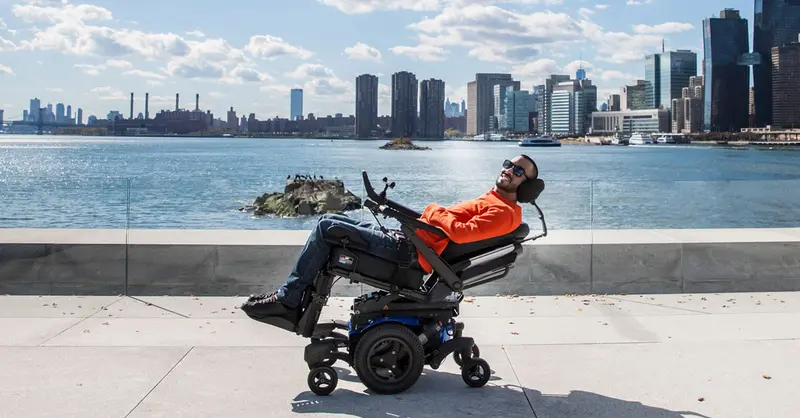
A full power wheelchair is the base for people who drive all day. It carries its own batteries and motors and can carry power seating: tilt, recline, a seat that rises, legrests that lift, and in some models a standing function. The catalog lists 33 power wheelchairs. The everyday models weigh around 70 to 135 kg as listed (the Jazzy EVO 613 at 72.8 kg, the MEYRA iCHAIR MC3 at 108 kg, the Quickie Q700 M at 133.4 kg). Standing chairs such as the LEVO C3 and the Karma EVO Altus are listed at 185 kg, and tracked all-terrain chairs at 224.5 to 230 kg. A chair of that size needs a ramp, a lift or a van, and a home with room to turn.
Rear-, mid- and front-wheel drive handle differently outdoors, indoors and over small obstacles; choose by a test drive on the surfaces you actually use.
Folding travel power chairs
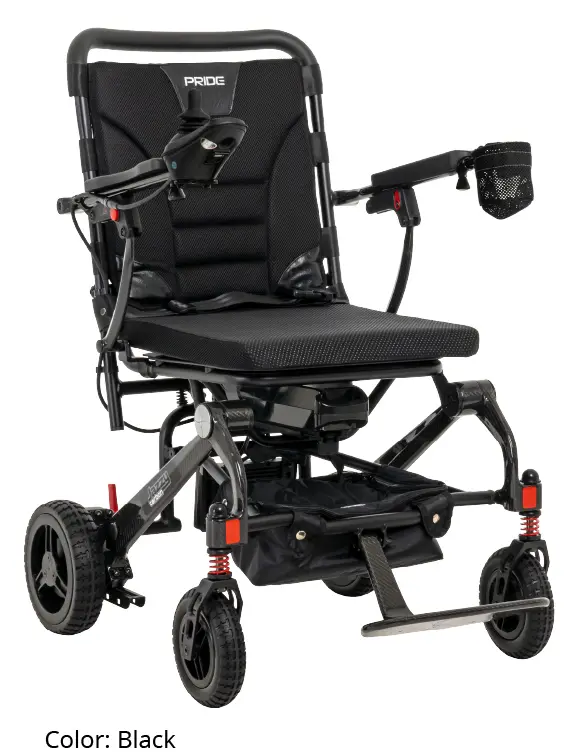
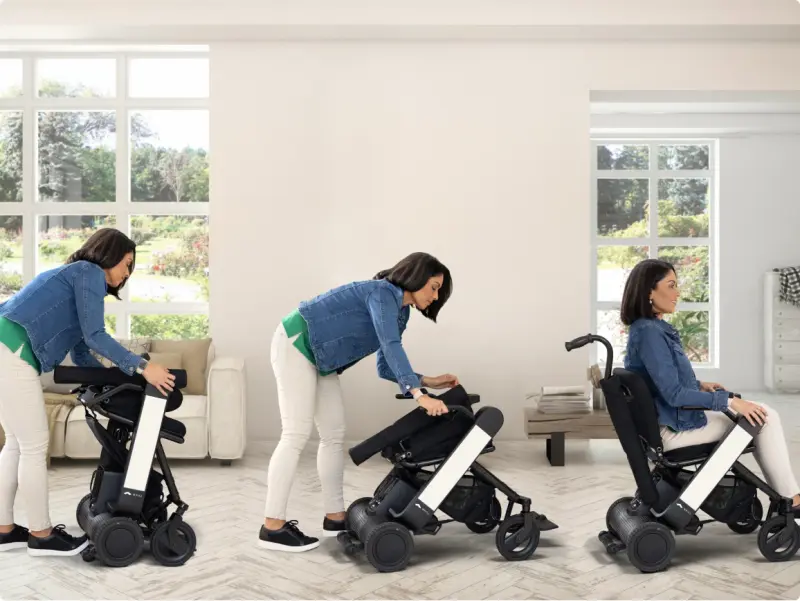
Folding power chairs trade range, comfort and seating options for weight. The Jazzy Carbon is listed at 17.7 kg, the WHILL Model F at 26.7 kg and the Karma eFlexx at 35 kg. They suit people who travel, who live where a full chair cannot go, or who use a power chair part of the time. They rarely offer power seating, and the range is shorter: the catalog lists 20 km for the WHILL Model F and 10 km for the eFlexx.
Mobility scooters
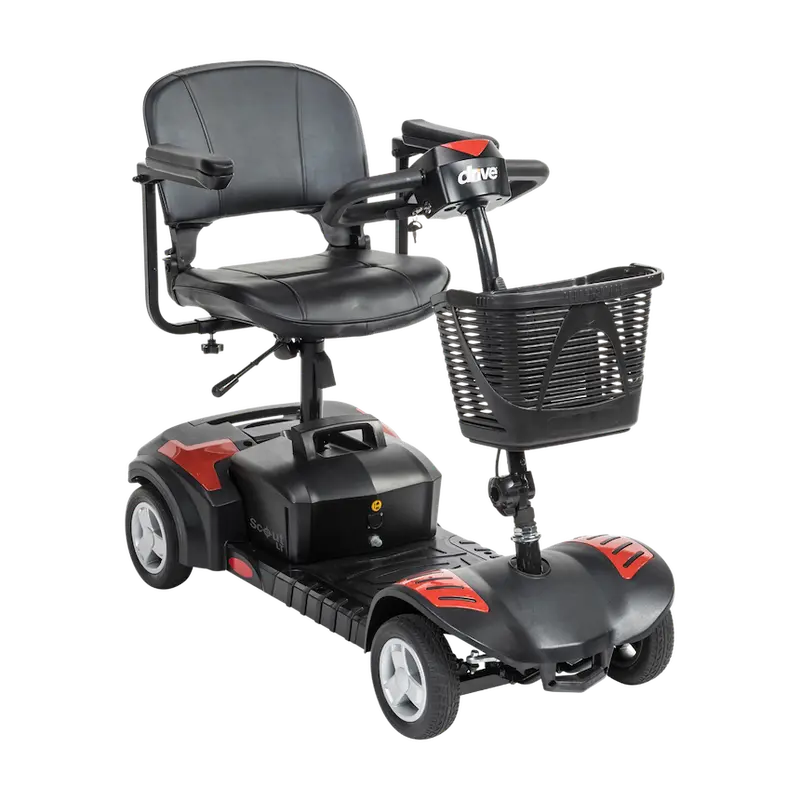
A scooter is steered with a handlebar called a tiller, so you need enough strength and balance in your upper body to sit upright and steer with both hands. Scooters cannot carry the seating support that many full-time power chair users need. The catalog lists 13 scooters, from the folding eFOLDi Lite at 16 kg to heavy-duty models such as the Afiscooter S4 at 155.1 kg. In England, the charity Scope notes that you are not likely to get a mobility scooter through the NHS, so a scooter is usually a private purchase.
Power add-ons
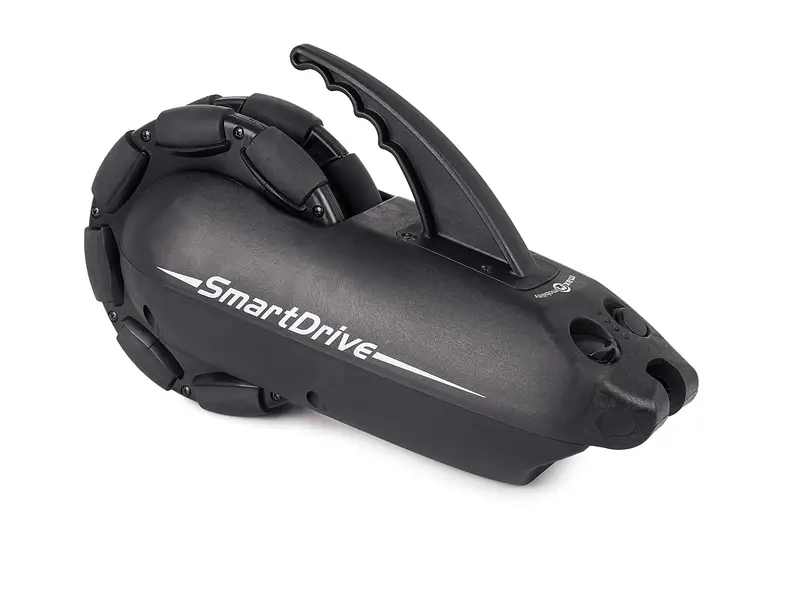
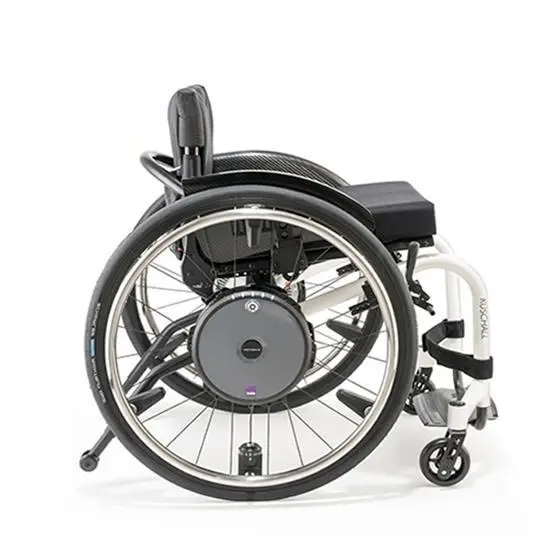
If you already push a manual wheelchair, an add-on can give you power without changing the chair you sit in; our power add-ons comparison goes into the types. If a manual chair may be enough, see our guide to lightweight and transport wheelchairs. There are three common types: a small drive wheel that pushes from behind (SmartDrive MX2+ at 5.7 kg, Alber SMOOV one at 7.2 kg, Empulse R20 at 4.5 kg as listed), wheels with motors in the hubs (Alber e-motion M25 at 15.6 kg for the pair, 7.8 kg per wheel), and a powered front wheel that clips on and lifts your casters (Batec Electric 2 at 15.9 kg, Rio Mobility Firefly 2.5). The catalog lists 16 add-ons. They keep the chair light for the car, but they put a motor under controls you operate with one hand, a watch or a button, which matters for the FDA findings below.
Six situations, and which route is yours
Most people arrive at this question from one of six places. Find yours, then read the route it points to in the next sections.
- You push a manual wheelchair well, but hills, distance or your shoulders wear you out. Look at a power add-on (Route 3), and choose a control other than the recalled dial.
- You walk a little, sit upright without support and want to go further outdoors. A scooter bought outright may be enough (Route 2).
- You travel often, the chair must go in a car boot or on a plane, and someone else may lift it. Look at a folding power chair (Route 4).
- You sit in the chair most of the day, need tilt or pressure care, or your condition is changing. Start with an assessment and funding (Route 1), which usually leads to a full power chair (Route 5).
- Nothing is funded where you live and money is tight. Consider a used chair checked by a dealer (Route 2), and read the safety sections before you buy.
- You already own a power chair and something is wrong with it. Go straight to the safety sections and the recall file, then the checkpoint list for the dealer.
What an electric wheelchair costs in 2026
Prices for power mobility are hard to compare because many makers do not publish them. Chairs are often sold through dealers, configured to the user, and paid for partly by insurers or health services. Of the 62 powered products in our catalog, 27 had a price on a maker or retailer page when we checked them. These are list prices as read, in the currency and country shown, not offers.
| Product | Kind | Price as listed | Where |
|---|---|---|---|
| Drive Scout 4-Wheel | Scooter | From USD 849 | US retailer SpinLife |
| Rio Mobility Firefly 2.5 | Add-on | USD 2,649 | Maker site |
| Permobil Explorer Mini | Child's power chair | GBP 2,600 ex VAT | UK dealer |
| Jazzy Carbon | Folding power chair | USD 3,581 MSRP | Maker site |
| Moving Life ATTO Sport | Folding scooter | USD 3,999 | Maker US site |
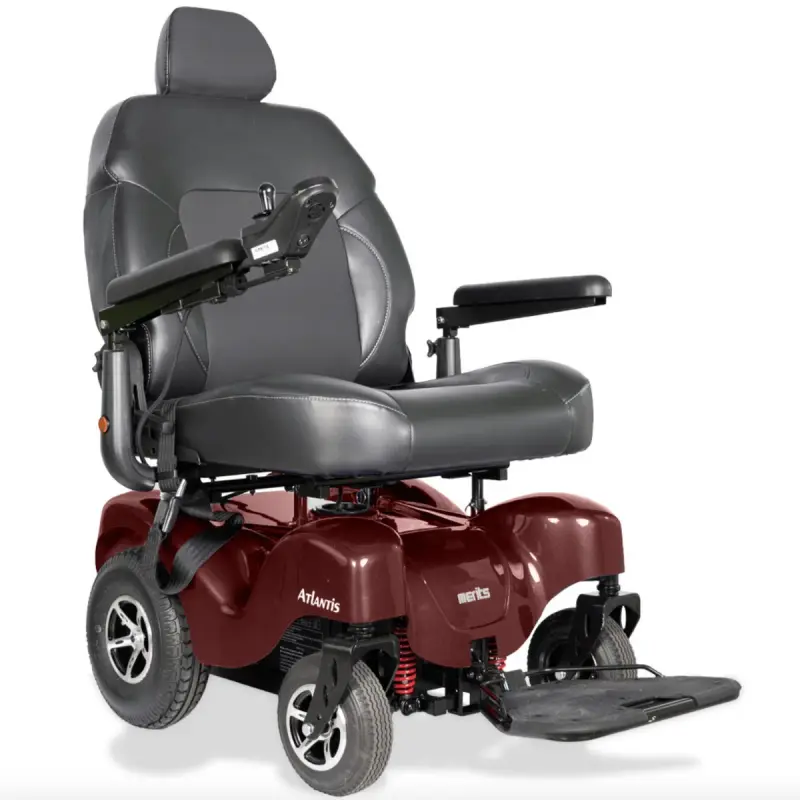
| Merits Atlantis P710 | Bariatric power chair | USD 4,910 | US retailer |
| SmartDrive MX2+ | Add-on | GBP 5,785.20 inc VAT | UK dealer |
| Afiscooter S4 | Heavy-duty scooter | USD 5,999 to 6,949 | US retailer |
| DIETZ SANGO Advanced | Rehab power chair | GBP 7,199 ex VAT | UK dealer |
| Quickie Q500 R Sedeo Pro | Rehab power chair | From GBP 7,250 | Maker UK site |
| Caterwil GTS5 | Stair-climbing chair | USD 15,045 base | Maker site |
| Trackchair AXIS 30 | Tracked chair | USD 19,400 plus shipping | Maker site |
| Scewo BRO | Stair-climbing chair | From EUR 35,150 | Maker site |
| Scewo GO with stair climber | Stair-climbing chair | From EUR 37,700 | Maker site |
Three patterns are worth knowing. First, the cheapest products are scooters and folding chairs bought outright; the Drive Scout is listed from USD 849. Second, rehab power chairs with configurable seating start in the thousands of pounds before options; the Quickie Q500 R is listed from GBP 7,250 in the UK, and power seating, special controls and larger batteries are added on top. Third, chairs that climb stairs or run on tracks are a separate market, from USD 15,045 for the Caterwil GTS5 base model to EUR 37,700 for the Scewo GO with its stair climber.
A power add-on is not automatically the cheap option. The SmartDrive MX2+ was listed at GBP 5,785.20 including VAT by a UK dealer, and the Alber e-motion M25 at GBP 5,599 before VAT by the same dealer, which is more than some folding power chairs.
Prices change by country, dealer, VAT relief and funding. In the UK, VAT relief for disabled people can change the price you pay, and in the US the price a supplier accepts from Medicare is set by Medicare. Confirm the price in your country before you decide, and ask whether it includes batteries, the charger, delivery and set-up.
Five routes to a powered chair, cheapest first
This is the price ladder from the bottom up, using the listed prices in this guide. Get assessed first in every case, then try the routes near the top before paying for those near the bottom, unless your clinician says you need a full power chair.
| Route | What it is | Price as listed or paid |
|---|---|---|
| 1 | A chair funded by Medicare, the NHS or an insurer after an assessment | Medicare: 20 percent of the approved amount after the deductible; NHS assessments are free |
| 2 | A scooter or a used power chair bought outright | Scooters from USD 849 |
| 3 | A power add-on for the manual chair you already use | USD 2,649 to GBP 6,718.80 inc VAT |
| 4 | A folding travel power chair | Jazzy Carbon USD 3,581 MSRP, 17.7 kg without battery |
| 5 | A full rehab power chair with power seating | From GBP 7,250 before options; stair-climbing chairs USD 15,045 to EUR 37,700 |
Route 1 · Funded after an assessment
What it is: a health service or insurer pays most of the cost after a clinician assesses you. What the documents say: Medicare covers a power chair "only when" it is medically necessary, after a face-to-face exam and a written prescription; Scope says NHS wheelchair assessments are free. The reports do not say how chairs were funded; the seating and the set-up still matter. The check that gets skipped: asking the assessor about a personal wheelchair budget or an upgrade before the order is placed. A clinician decides the seating, the controls and whether you need power at all. At the assessment, say this: "Please write down what you are recommending and why, and tell me what the budget would cover if I want a different model."
Route 2 · A scooter or a used chair bought outright
What it is: the cheapest powered option, without a prescription. What the documents say: in the US a powered wheelchair is a Class II medical device under 21 CFR 890.3860, so buy from a seller who can give the serial number and recall history where you live. What the reports say: falls on ramps and curbs, and damaged joystick cables, appear across many chairs. The check that gets skipped: the serial number against the recall file, the age of the batteries, and the joystick cable. A clinician should still look at how you sit if you will use it for hours. To the seller, say this: "Give me the serial number and the battery date, and let me test every function, including the seat."
Route 3 · A power add-on
What it is: a motor that clips onto your manual chair, from 4.5 kg. What the documents say: the SmartDrive's dial is recalled and withdrawn; the maker says the device can still be used with switch buttons or a watch app. What the reports say: 897 add-on reports describe a motor that kept running. The check that gets skipped: practising an emergency stop with your hands on the rims before you go near traffic. A therapist decides whether your hand function and balance suit an add-on. At the dealer, say this: "Which control comes with this, and has every recall and software update been done?"
Route 4 · A folding travel power chair
What it is: a chair from about 17.7 kg that folds into a car boot. What the documents say: battery rules differ by airline, so confirm them before every trip. What the reports say: two near-identical reports describe a joystick cable pinched at the folding point. The check that gets skipped: looking at that cable every time you fold the chair, and asking where spare parts come from. A clinician decides whether you can sit in it for long without pressure risk. At the dealer, say this: "Who repairs this model near me, and how long does a repair take?"
Route 5 · A full rehab power chair
What it is: a chair built around your body, with power seating and specialised controls. What the documents say: recent recalls for these chairs are mostly firmware, updated by the dealer or over the air. What the reports say: tips on ramps, broken armrests and casters, and seating that moved on its own. The check that gets skipped: the slope limit in the manual against your own ramp, and the firmware level. The seating specialist decides tilt, recline and the cushion. At the dealer, say this: "Please print the firmware level before and after the service, and show me the slope limit in the manual."
Weight, range and speed: the numbers that decide daily life
Weight decides whether the chair goes in your car and who has to lift it. Range decides whether you get home. Top speed matters less than people think: most indoor driving is slow, and a higher speed setting is mainly useful on long pavements. The table shows figures as listed by the makers for a spread of models in our catalog.
| Model | Kind | Weight as listed | Range as listed | Max user |
|---|---|---|---|---|
| Jazzy Carbon | Folding power chair | 17.7 kg | Not listed | 136.1 kg |
| WHILL Model F | Folding power chair | 26.7 kg | 20 km | 115 kg |
| Jazzy EVO 613 | Power chair | 72.8 kg | 23 km | 136.1 kg |
| MEYRA iCHAIR MC3 | Power chair | 108 kg | 35 km | 160 kg |
| Quickie Q700 M | Power chair | 133.4 kg | 29 km | 136.1 kg |
| Merits Atlantis P710 | Bariatric power chair | 137.9 kg | 51 km | 272.2 kg |
| eFOLDi Lite | Folding scooter | 16 kg | 16 km | 120 kg |
| Drive Scout 4-Wheel | Travel scooter | 45.4 kg | 14 km | 136.1 kg |
| Invacare Orion Metro | Mid-size scooter | 110 kg | 54 km | 136 kg |
| SmartDrive MX2+ | Add-on | 5.7 kg | 20 km | 150 kg |
| Alber e-motion M25 | Add-on wheels | 15.6 kg | 25 km | 150 kg |
Read range figures as a best case. Makers measure range under test conditions, and cold weather, hills, a heavier user, power seating and aging batteries all shorten it. A safe habit is to plan your regular trips at half the listed range until you know how your own chair behaves.
The maximum user weight is not a comfort figure. It is the load the maker has tested the chair to carry. If you are close to the limit, ask the dealer about the heavy-duty version, because the frame, motors and casters are different. The bariatric Merits Atlantis P710 is listed for 272.2 kg.
If you fly, weight and battery type matter most; see our guide to flying with a power wheelchair, and confirm battery rules with the airline before every trip.
How Mobility Atlas read 1,296 FDA reports
The FDA collects reports about problems with medical devices in a public database called MAUDE. Manufacturers must file reports about some events, and users, families and health workers can file them voluntarily. Powered wheelchairs, including power add-ons, are filed under product code ITI. On 10 October 2026 we downloaded every ITI report the FDA received from 1 January 2024 onward: 146 received in 2024, 651 in 2025 and 499 in 2026 up to the latest update, 1,296 in all. Of these, 29 carry no text at all and cannot be read, which leaves 1,267.
Before anyone read a report, we wrote a codebook: the categories each report would be sorted into, and the order in which they apply. We dated and fingerprinted the codebook so that any later change would show. Then two readers, working separately, coded every report: what kind of device it was, what the report says went wrong, whether an injury or a fall is stated, and whether the report was filed as part of a look back at old complaints. The readers were AI models working in separate sessions, each seeing only the codebook and its share of the reports.
The two readers agreed on the main category for 98.5 percent of reports, a Cohen's kappa of 0.965, where 1 means perfect agreement. Because hundreds of the SmartDrive reports use the same wording, we also measured agreement on the 371 reports not branded SmartDrive alone: 95.1 percent, kappa 0.943. Every one of the 66 reports where the readers differed was read in full and decided under a written rule, and 50 more codes were corrected in a consistency pass. The rules, the codebook and the full table of codes are published with this article under a Creative Commons licence, on the data and method page.
What do FDA reports say goes wrong with electric wheelchairs? Mobility Atlas read every FDA report on powered wheelchairs received from January 2024 to late August 2026 (the latest available on 10 October 2026), 1,296 reports, and coded the 1,267 that carry text with two independent readers. Most of them, 919, are about power add-ons for manual chairs, and 897 of those concern the SmartDrive, almost all describing a motor that kept running or started on its own. For full power chairs and other powered devices, 348 reports, the commonest stories are tipping or falling with no fault named (80), broken parts such as casters, forks and armrests (59), uncontrolled movement (54), and fire or smoke (30). A report is a claim, not a finding, and the counts cannot be read as failure rates, because nobody knows how many chairs are in use. They do show where to look when you choose and check a chair.
One more limit matters. The FDA itself warns that report data is not a measure of risk. Its MAUDE page says "MDR data is not intended to be used either to evaluate rates of adverse events" and that "The submission of an MDR itself does not necessarily demonstrate that the device caused or contributed to the adverse outcome or event." Every count below counts reports, not chairs, and not people.
What the reports show: the big picture
The first finding is about who files. Of the 1,267 readable reports, 919 concern a power add-on, 263 a power wheelchair named as such, 83 a powered device whose type the report does not say (most of them filed by Pride Mobility, which makes both chairs and scooters), and 2 a scooter. Scooters have their own FDA product code, so they are mostly outside this set.
| What the report says went wrong | All 1,267 | Add-ons (919) | Chairs and other (348) |
|---|---|---|---|
| Uncontrolled movement | 951 | 897 | 54 |
| Tip or fall, no fault named | 87 | 7 | 80 |
| A part broke or came loose | 67 | 8 | 59 |
| Event with no device problem stated | 63 | 2 | 61 |
| Power loss or electrical fault | 32 | 3 | 29 |
| Fire, smoke, melting or sparks | 31 | 1 | 30 |
| Problem alleged, cannot tell what | 16 | 1 | 15 |
| Power seating moved or trapped | 13 | 0 | 13 |
| Brakes or rolling away | 7 | 0 | 7 |
Injuries are stated in 223 of the 1,267 reports, and a fall or tip-over in 230. The pattern is very different for the two groups. Among the 919 add-on reports, 74 state an injury. Among the 348 chair and other reports, 149 state an injury and 184 describe the user falling out or the device tipping. Eleven reports are classed by the reporter as deaths; we describe them below with care, because each is a person, and most of them say the device was not at fault or give no cause.
The second finding is about timing. Reports about add-ons jumped from 30 received in 2024 to 531 in 2025 and 358 in 2026 so far, while reports about chairs and other devices stayed level at 116, 120 and 112. The jump is not a sign that more add-ons broke in 2025. Of the 919 add-on reports, 607 say they were filed as part of a retrospective review of past complaints, which the maker says came from improvements to its complaint handling and adverse event reporting, under its corrective action CAPA 25-008. Report counts follow the maker's paperwork as much as events in the world.
Maker by maker: who the reports are about
We grouped the 1,267 coded reports by the maker or brand named in them. This shows whose products appear, not whose products are worse: no maker publishes how many chairs it has in use, and some makers file differently from others. Pride Mobility makes chairs and scooters, and many of its reports do not say which.
| Maker or group | Reports | Most common problem | With a fall | Recalls in this guide |
|---|---|---|---|---|
| Power add-ons (mostly SmartDrive) | 919 | Uncontrolled movement, 897 | 46 | Z-1116-2025, Z-2538-2025, Z-2004-2023 |
| Pride Mobility (Jazzy, Quantum and others) | 216 | Tip or fall with no fault named, 63 | 127 | Z-2841-2026 (Quantum) |
| Permobil power chairs | 56 | Power loss or electrical fault, 14 | 26 | Z-2795-2026, Z-2805-2026 |
| Invacare | 23 | Uncontrolled movement, 7 | 10 | Z-0445-2022, Z-1130-2022 |
| Sunrise Medical (Quickie) | 22 | Event with no chair problem stated, 10 | 6 | None in our list |
| Hoveround | 9 | Event with no device problem stated, 5 | 4 | None in our list |
Two things stand out. Pride's reports are mostly falls, and 204 of its 216 say the maker had not yet been able to examine the device. Permobil's are fewer but often state an injury, 46 of 56. WHILL has a Class I recall in the file, for a Bluetooth weakness, but no reports in our set. Use this table to know which recalls and which questions apply to your brand, not to rank brands.
The SmartDrive speed dial: how a recall shows up in the data
The SmartDrive MX2+ is a small motor unit that clips under a manual wheelchair and pushes it from behind. The user starts and stops it with a control: a wired SpeedControl Dial, wired switch buttons, or an app on a compatible smartwatch. Of the 897 reports where an add-on moved when the user did not want it to, 793 name the speed control dial, 39 a watch, and 32 the switch control.
The typical report is short. One received in January 2026 says that when the user turned the dial back to stand-by "the motor would not disengage and continued to run." Others describe the chair rolling into a wall, a curb or a street, or the user being thrown forward. Of the 897 add-on movement reports, 61 state an injury and 36 a fall.
The FDA recall records explain why. The FDA classed the first speed dial recall, Z-1116-2025, started by Max Mobility on 20 December 2024, as Class I, the FDA's most serious class, which it defines as "a reasonable chance that a product will cause serious health problems or death." The recall record gives the reason as a "faulty circuit board in speed control remote." The company's notice, posted by the FDA in April 2025, lists the effects, including "Continued drive: The Speed Control Dial does not fully stop the drive unit when rotated to the zero position." It says the company had received 781 complaints and five serious injuries by 27 March 2025.
In August 2025 the company widened the action to every dial ever sold. The recall record Z-2538-2025, also Class I, covers all dials distributed from 25 April 2022 to 8 July 2025, and the three entries for the dial models list 49,636 units between them. Permobil's press release says the dial is no longer an available control option and that "the SmartDrive MX2+ Power Assist Device is not impacted by this recall and can still be used with alternative control options," meaning the switch buttons or a watch app. One maker narrative in the reports, under its investigation CAPA 25-007, says that if the connection between dial and motor is lost for a moment "an involuntary activation of the drive motor could occur."
The watch control has its own history. Recall Z-2004-2023, from May 2023, says that when several processes run on the watch, the app "may fail unexpectedly" and the motor "continues to run and the user may not be able to stop the device using tap gestures." The fix was a software update, and the two watch entries list 25,101 units.
What this means for you: if you use a SmartDrive, do not use a SpeedControl Dial at all, keep the app and watch software up to date, and practise stopping with your hands on the push rims before you use it near traffic. If you buy a used SmartDrive, ask what control comes with it, and do not accept a dial. The first point is the maker's own instruction in the recall notices; the rest is our advice, and your dealer or therapist can help you choose the replacement control.
Tips, falls and ramps
Among full power chairs and other powered devices, the commonest story is a fall. 184 of the 348 reports describe the user falling out or the device tipping, and in 79 of them the report names no device fault at all. These are the events that a better habit or a better set-up might have prevented, and they cluster in a few places.
| Place named in the 184 fall reports | Reports |
|---|---|
| A ramp | 23 |
| A slope, hill or incline | 17 |
| A curb | 15 |
| A van or a bus | 12 |
| During a transfer | 11 |
| A platform or vehicle lift | 6 |
| Stairs or a step | 3 |
A report can name more than one place, so the rows overlap. Ramps stand out. Several reports describe a chair going off the side of a home ramp, sliding backwards on a van ramp, or tipping forward on a portable ramp. Two of the eleven death reports involve a power chair going over stairs or off a lift platform, and two describe a chair tipping on a ramp.
The practical lessons are plain. Ramps need edges that stop a wheel going over and a slope the chair is rated for; the owner's manual gives the slope limit for your model. Drive straight up and down a slope, not across it. Keep anti-tippers fitted and adjusted, because several reports mention anti-tippers that were raised, removed or set wrong. Seat functions change the centre of gravity: Permobil's recall Z-2795-2026 says firmware on some M3 Corpus chairs "lacks a speed restriction to maintain stability when the seat lift exceeds 50 mm," which is exactly the kind of limit a chair should enforce.
Vehicles are the other theme. 18 of the 348 chair reports describe the user being hit by a car or another vehicle, several while crossing a road. Lights, reflectors and a flag are cheap, and a route with a crossing point is worth a longer trip.
Fire, smoke and charging
Thirty-one reports describe fire, smoke, melting or sparks. Seven of them state an injury. The reports are usually brief, and in many the maker had not yet examined the chair, so they cannot tell us how often fires happen. They do show where fires start.
Nine of the 31 mention charging, and 11 name the joystick, a cable, a wire harness or wiring. One Pride report describes waking at night to sparks at the joystick while the chair was charging; the maker's narrative says the thermal damage was caused by "elevated resistance from charging with a damaged joystick cable." Two near-identical reports, possibly the same event, describe a joystick cable pinched in the spring coils at the folding point of a folding chair; the maker says the cable had been re-routed when the joystick was moved to the other side, so have the dealer check the routing after any such change. A Quickie report quotes the owner's manual: "The wire harness from the CTRL+5 should not be loose or in the way of the seat functions."
That gives you a short charging routine. Look at the joystick cable and the harness whenever you fold or adjust the chair, and stop using a cable that is crushed, cut or kinked. Charge with the maker's charger, on a hard surface, away from anything that burns, and not on an outdoor socket in wet or freezing weather (one report describes a chair catching fire on an outdoor outlet in winter). Do not sleep in a chair that is charging, and fit a smoke alarm where it charges. If you smell burning or see smoke, unplug it if you safely can, get away from it and call the fire service.
Batteries need the same care. One report describes second-hand batteries leaking acid, and another a battery bursting after the chair hit a pothole. Buy batteries of the type the maker specifies, from a source you trust, and replace a cracked or swollen battery at once.
Power seating, sudden stops and brakes
Thirteen reports concern power seating: tilt, recline, a seat elevator or power legrests that moved on their own, failed, or trapped a body part. Twelve of them state an injury. Two reports, which appear to describe the same event, allege that a joystick executed an uncommanded recline that caused a fatal back injury. The maker had not examined the chair when the report was filed. Seating that moves you is part of your posture and pressure care, so any unexpected movement is a reason to stop using that function and call the dealer the same day.
Sudden stops cause injuries too. Thirty-two reports describe an electrical fault or power loss, and some describe the user being thrown forward when the chair stopped. Pride's 2026 recall of Quantum chairs with Q-Logic controls, Z-2841-2026 and twelve related entries, says that if a reminder pop-up appears while driving, "the wheelchair may perform an unexpected park brake stop, which may result in fall or injury." The fix is a software update at the dealer. A positioning belt does not stop a sudden stop, but it can stop you being thrown out of the seat; ask your seating specialist whether you should use one.
Seven reports describe brakes that did not hold or a chair that rolled. Power chairs have a freewheel lever that releases the motor brakes so the chair can be pushed. In one report the lever slipped into freewheel when the chair went over a bump in the street. Check that the levers lock firmly in drive, and never leave the chair in freewheel on a slope.
When a power chair moves on its own
Uncommanded movement is not only a SmartDrive problem. Fifty-four reports about full power chairs and other powered devices describe the chair moving when the user did not mean it to: lurching forward, spinning, reversing through a doorway, or speeding up on a low setting. Thirty of them describe a fall and 24 state an injury, which makes it one of the more harmful kinds of report outside the add-on group.
The stories fall into a few kinds. Sixteen name the joystick, either a controller that the user says acted on its own or a joystick that was knocked. Eight happened on a ramp or at a van, where one report describes a chair that "lurched to the left" on an accessible van ramp and went off the side. Five describe the chair moving during a transfer, the moment when the user is half in and half out of the seat. In one, the chair moved as the user tried to get in, "causing him to fall," and then rolled back over his hand. Two describe clothing catching the joystick: a sleeve as the user reached for something, and a nightgown as she got off the chair.
Most of these reports are allegations that the maker had not yet examined. Some chairs will have had a fault, and some events will have been a knocked joystick or a setting that was too fast for the room. For the user the lesson is the same either way, and it costs nothing.
- Switch the chair off, not just to a low speed, before every transfer and before you reach for something on the floor or a shelf.
- Ask the dealer about a joystick guard or a different joystick top if your sleeves, a blanket or a bag can touch the control.
- Ask for an indoor speed profile with gentle acceleration, and use it at home. Most controllers can store several profiles.
- Approach ramps, lifts and van doors in the slowest profile, straight on, and stop before the edge to line up.
- If the chair moves by itself even once, stop using it, switch it off, and call the dealer. Write down what happened, the time and the speed setting; the dealer can often read the controller's error log.
Broken parts: armrests, casters and footplates
Fifty-nine reports about full power chairs and other powered devices describe a part that broke or came loose. What matters is what happened next: 37 of them describe a fall or tip, and 18 state an injury. The parts are ordinary, which is why they are easy to overlook.
| Part named | Reports | With a fall or tip |
|---|---|---|
| Armrest, its bolt, pin or bracket | 16 | 14 |
| Caster, fork or front wheel | 12 | 10 |
| Footplate or legrest | 14 | 5 |
Armrests stand out because people use them as handles. In 7 of the 16 armrest reports the armrest gave way while the user was transferring or leaning on it. One report describes a user leaning on the armrest when "it allegedly gave way and she fell to the floor." Another describes an armrest that had cracked without the user noticing, so that "it would not support his weight" when he stood up. Several name a sheared bolt or a broken pin in the flip-back mechanism.
Casters are the small swivelling wheels, and when one fails the chair drops on that corner. One user writes that the left front wheel and caster "came off the chair entirely" as he turned toward a curb cut, and the chair tipped onto the pavement. Another report describes a caster that "caved in" as the chair left a garage.
None of these parts is expensive to check. Wiggle each armrest firmly before you lean on it, look at the bolts and pins where it hinges, and ask the dealer to replace a cracked armrest pad or bracket rather than taping it. Spin each caster and look for cracks, flat spots and play in the fork. Check that footplates lock in place. If you transfer by pushing on one armrest every day, tell the dealer, because that armrest carries more load than the maker may expect, and a transfer board or a grab rail may suit you better. An occupational therapist can advise on the transfer itself.
The eleven death reports, read with care
Eleven reports are classed by the reporter as deaths. Each one is a person, and each was reported by a family member, a lawyer or a company, sometimes long after the event. We summarise them here because readers ask, and because the pattern is useful: in most of them no device fault is established.
- Two describe a user struck by a vehicle on the road: one crossing a street at night, one driving in the roadway where there was no sidewalk. The makers found no device problem.
- Two describe a chair going down stairs: one driven forward off the end of a stair platform lift while the user was lining it up, and one that went down two steps at the exit of a doctor's office that the user had not noticed.
- Two describe a chair tipping on a ramp: one going up a ramp into the user's home, and one tipping forward on a portable ramp, where a lawsuit alleges that the anti-tippers were missing.
- One describes a user who fell out of the chair; his wife told the maker it was not due to the chair.
- One alleges that a power chair caught fire at home. The maker's narrative says the local fire department could not determine the cause.
- Two, which appear to describe the same event, allege that a joystick caused an uncommanded recline and a fatal back injury. The device had not been examined.
- One, based on an attorney's allegation, says only that injuries were alleged.
Read together, these reports point to the same places as the injury reports: roads, stairs and lifts, and ramps. They do not show that any brand is more dangerous than another, and they cannot, because nobody knows how many chairs of each brand are in use. If you are grieving someone who died after an accident in a wheelchair and want to report it, the FDA accepts voluntary reports through its MedWatch program, from patients and families as well as from health workers.
The recall file: which recalls are still open
A recall does not always mean you must stop using a product. The FDA says a recall "sometimes means that the medical device needs to be checked, adjusted, or fixed." It does mean you should find out whether your chair is affected. These are the recalls for powered wheelchairs and add-ons that we read in full. All ten were still listed as open in the FDA's records on 10 October 2026, which means not every product has been corrected yet, not that yours has not.
| Recall | Product | Problem, as the record states it | Started | Status |
|---|---|---|---|---|
| Z-1116-2025 (Class I) | SmartDrive SpeedControl Dial | Faulty circuit board, loss of control | 20 Dec 2024 | Open |
| Z-2538-2025 (Class I) | All SpeedControl Dials | Faulty connection, loss of control | 12 Aug 2025 | Open |
| Z-2004-2023 and Z-2005-2023 | SmartDrive watch app (PushTracker E2 and E3) | App may fail, motor keeps running | 10 May 2023 | Open |
| Z-2841-2026 and 12 more | Quantum chairs, Q-Logic | Unexpected park brake stop | 25 Jun 2026 | Open |
| Z-2805-2026 | Permobil M5 Corpus | Firmware missing drive inhibit logic | 19 Jun 2025 | Open |
| Z-2795-2026 | Permobil M3 Corpus HD | No speed limit above 50 mm lift | 29 Feb 2024 | Open |
| Z-1826-2026 (Class I) and Z-1827-2026 | WHILL Model C2 and F | Bluetooth cyber weakness | 29 Dec 2025 | Open |
| Z-0445-2022 and 2 more | Invacare TDX SP2, AVIVA FX, AVIVA Storm RX with LiNX Gyro | Firmware 6.1.2 can brake harder than programmed | 12 Nov 2021 | Open |
| Z-1130-2022 | Invacare TDX SP2 | Battery harness can disconnect, loss of power | 30 Mar 2022 | Open |
| Z-1504-2021 | Merits power wheelchair | Seat baseplate pin broken | 1 Apr 2021 | Open |
Several of these were reported to the FDA long after the company acted. The two Permobil records say plainly "This recall is being reported retroactively" or "has been reported retroactively", and were posted in July 2026 for actions that began in 2024 and 2025. Software is now a large part of the story: six of the ten entries above are fixed by updating firmware or an app, by the dealer or over the air.
To check your own chair, find the model name and serial number on the label, search the FDA recall database (or your national regulator, such as the MHRA in the UK) for the product name, and ask your dealer whether any updates are outstanding. If you are buying, ask the seller to confirm in writing that every recall and software update has been done.
Can you keep using a chair that has a problem?
Stop using it, or the function involved, the same day if any point in the box at the top of this guide applies. Those are the problems behind many of the injury reports and some of the most serious ones, and they can repeat without warning.
You can usually keep using the chair carefully, and book a service soon, if the range is shorter than it was, a noise has changed, an error code clears when you switch off and on, or a cushion or cover is worn. Write down what happened and when. If the same error comes back, or a problem gets worse, treat it as a stop. Never disable a speed limit, an anti-tipper or a seat-lift lockout to get through a day: those limits are there because of the falls described above.
What a good service visit covers, checkpoint by checkpoint
- Recalls and firmware, checked by serial number, with the version printed before and after.
- The controller's error log, read and explained to you.
- Batteries and charger: age, condition and connections.
- The joystick cable and the wiring harness, along their whole length.
- Brakes and freewheel levers, tested on a slope.
- Casters, armrests, footplates and anti-tippers: tightness, cracks and height.
- Power seating through its full range, and the speed limit with the seat raised.
- A written record of everything checked, changed and found, given to you.
If a visit skips a checkpoint, ask why. A dealer who prints the firmware level and the error log is doing the job properly.
Common parts, as listed by retailers in the Mobility Atlas catalog, for the part alone with no fitting. Fit only parts the maker specifies for your model, and leave electrical work to the dealer.
| Part | Price as listed |
|---|---|
| Pride Go-Go scooter freewheel lever and cap | USD 3.17 |
| PG Drives joystick knob | USD 4.99 |
| Dynamic Controls 1.5 m joystick bus cable | USD 29.99 |
| Pair of 12V 35Ah AGM batteries | USD 164.98 |
| Pair of 12V 55Ah 22NF batteries | USD 349.98 |
| Drive motor for a Jazzy Elite 14, per side | USD 449.99 |
What the FDA data cannot tell you
- Reports are not rates. Nobody publishes how many chairs of each model are in use.
- Many events are never reported, and filing is voluntary for users and families.
- Counts follow paperwork: 607 add-on reports came from a review of old complaints.
- Most stories are allegations the maker had not yet examined; we counted what each report says.
- Two death reports appear to describe one event; 29 reports had no text and could not be coded.
- Money is almost never mentioned: one of the 1,267 readable reports gives a figure, an owner who wrote that a chair had "cost me out-of-pocket $2500 to $3000" since it was bought.
Read the numbers as a map of risks to check, not as a league table of brands.
How to choose, step by step
Is a folding electric wheelchair a good idea? Mobility Atlas compared the folding and travel models in its catalog with full power chairs, and the answer depends on how you will use it. Folding chairs such as the Jazzy Carbon (17.7 kg as listed) and the WHILL Model F (26.7 kg) go in a car boot and are easier to fly with, but they carry fewer seating options and less range than a full chair such as the Jazzy EVO 613 (72.8 kg, 23 km listed). In the FDA reports we read, two near-identical reports describe a joystick cable pinched at the folding point, so folding brings its own check. If you sit in the chair most of the day, need tilt or pressure management, or drive long distances, a full power chair is usually the safer fit. If you travel often and transfer easily, a folding chair can be the right second chair or even the only one.
- Get assessed. A seating specialist, occupational therapist or physiotherapist should assess posture, pressure risk, how you transfer and how you control the chair. This is a clinician's decision, and in many health systems it is also the route to funding.
- List where you will drive and measure yourself. Measure door widths, the turning space in your bathroom and kitchen, the slope of your ramp, and the space in your car or van.
- Shortlist three models and test drive them on your own surfaces: carpet, a ramp, a curb, gravel if you live with it.
- Check the numbers that matter for you: weight as used (with batteries), range, maximum user weight, seat width and depth, and the slope limit in the manual.
Mobility Atlas does not sell chairs from stock. If you send us an enquiry with your shortlist, your country and your measurements, we look for the model and a supplier who can deliver it where you live, and tell you what we found before anything is ordered.
Paying for it: Medicare, the NHS and buying yourself
How you pay changes what you can get, so look into funding before you fall in love with a model. Rules differ by country, region and insurer; confirm them with your own health service or insurer before you buy.
United States: Medicare
Medicare's page on wheelchairs and scooters says "Part B covers power wheelchairs and scooters only when they're medically necessary," and that you need a face-to-face examination and a written prescription from a treating provider. After the Part B deductible you pay 20 percent of the Medicare-approved amount if the supplier accepts assignment. Some power wheelchairs need prior authorization, which your equipment supplier usually requests for you. Use a supplier enrolled in Medicare, and ask before you order whether they accept assignment, because a supplier that does not can charge you more.
England: the NHS
In England, NHS wheelchair services assess you and may provide a power chair. The charity Scope explains that the NHS does not usually give an electric wheelchair to people who "can walk, even if only a little" or who can use a manual wheelchair by themselves, and that you need to be able to store and charge it safely. NHS England says that since 2 December 2019 people who use wheelchair services and whose posture and mobility needs affect their wider health and social care needs have a legal right to a personal wheelchair budget, which can help pay towards a chair the service would not otherwise provide. Wales, Scotland and Northern Ireland run their own services.
Everywhere else
Many countries fund power chairs through public health insurance, disability programs, accident insurers or veterans' services, and many do not. Where nothing is funded, people buy privately, often a folding chair or a scooter because they cost less. Ask your clinician what local programs exist, ask charities that work with wheelchair users in your country, and get any funding decision in writing before you order.
A monthly check you can do at home
Several patterns in the FDA reports, loose armrests, worn casters, damaged joystick cables, raised anti-tippers, levers left in freewheel, are things an owner can spot before they cause a fall. A dealer service once or twice a year does not replace a quick look of your own. This routine takes about ten minutes, and a family member or carer can do it with you.
- Switch the chair off. Grip each armrest and push it firmly in every direction. Nothing should move, crack or click. Look at the bolts and pins at the hinge.
- Lift each front corner slightly, or ask someone to, and spin the casters. Look for cracks, flat spots, wobble in the fork and hair or thread wound round the axle.
- Check the tyres. Pneumatic tyres need the pressure printed on the tyre wall; a soft tyre makes the chair pull to one side and shortens the range.
- Check that the anti-tippers are fitted, at the height the manual gives, and that nothing is bent.
- Follow the joystick cable and the wiring from the controller to the base. Look for crushing, cuts, kinks and places where the cable rubs on the frame or the seat mechanism.
- Engage and release the freewheel levers. They should lock firmly in drive, and the chair should not roll on a slight slope when it is switched off.
- Look at the battery boxes and the charger lead. Swollen, leaking or hot batteries and a damaged charger lead are reasons to stop and call the dealer.
- Run each power seating function through its full range with nobody in the way, and listen for new noises.
- Test the lights and the horn, and wipe the reflectors.
Write the date and anything you found in a notebook or on your phone. If something has changed since last month, tell the dealer. That record also helps if you ever need a repair under warranty, or want to file a report with the maker or the FDA.
Three traps that cost people the most
Trap one is buying on top speed and range. The listed figures are best-case numbers, and neither tells you whether the chair fits your body, your home or your car. People who buy the fastest chair in the listing often find it does not fit through their bathroom door.
Trap two is skipping the seating assessment (see choosing a pressure-relief cushion). A chair that does not support your posture or manage pressure can cause harm over months, and a few reports we read describe sliding forward, pain and pressure sores blamed on a seat that did not suit the user. An assessment by a seating specialist helps prevent this, and a clinician, not a salesperson, should decide it.
Trap three is ignoring software and recalls. Six of the ten recalls in the recall table are fixed by software. A chair that has never been updated may still carry a known fault. Ask the dealer, check the FDA database, and keep a record of every update and service.
Three composite scenarios
These are composite scenarios, not individual customers. Each one combines facts and ranges already given in this guide to show how the decision plays out.
Scenario one: a manual wheelchair user who pushes well on the flat but struggles with hills looks at a rear push add-on. It weighs 5.7 kg as listed and keeps the chair light for the car. Because the SpeedControl Dial was recalled and withdrawn, the user chooses switch buttons, and practises stopping with hands on the rims.
Scenario two: a full-time power chair user needs tilt and a seat elevator. The assessment points to a rehab chair listed from GBP 7,250 before options. The user asks the dealer to confirm that the firmware is current, checks the slope of the home ramp against the manual, and keeps anti-tippers fitted after a service.
Scenario three: a person who walks short distances wants a chair for travel. A folding power chair at 17.7 kg or a folding scooter at 16 kg fits the car. Before buying, the person checks the battery rules with the airline, confirms that a local dealer can repair the model, and inspects the joystick cable at the folding point every time the chair is folded.
Questions to ask before you pay
Which electric wheelchair should I buy? Mobility Atlas cannot name one model for everyone, because the right chair depends on how you sit, transfer and travel, and that is a decision for you and your clinician. What we can say from the makers' pages and the FDA records is how to narrow it down. Decide first between a full power chair, a folding chair, a scooter and an add-on. Then test drive three models on your own surfaces, and check weight with batteries, range, maximum user weight and seat size. Ask the dealer for the slope limit, the recall and software history of the exact model, how repairs are handled near you, and whether a loan chair is available during repairs. Compare total cost, including batteries, charger, delivery and set-up, and settle funding before you order. If the model you want is hard to find where you live, send Mobility Atlas an enquiry and we will look for a supplier.
- What does the price include: batteries, charger, delivery, set-up and the first service?
- What is the weight with batteries, and which parts come off for lifting?
- What slope and curb height is the chair rated for in the manual?
- Are there any recalls or software updates for this model, and have they been done?
- Who repairs it near me, how long do repairs take, and is there a loan chair?
- What does the warranty cover for frame, electronics and batteries, and for how long?
Your plan: 10 minutes, today, this week
10 minutes: write down the model and serial number from the label; look along the joystick cable; push each armrest; spin each caster (tire and caster care); check that the anti-tippers are on.
Today: search the FDA recall database for your model; if you use a SmartDrive dial, stop using it; put a smoke alarm where the chair charges; set the chair to its slowest profile indoors.
This week: book a service and ask for the firmware level and the error log; measure your ramp against the slope limit in the manual; if you are choosing a chair, book an assessment before you shortlist models.
Sources and documents
Reports: FDA MAUDE device reports under product code ITI (Wheelchair, Powered) received from 1 January 2024, downloaded through openFDA on 10 October 2026. Recalls: FDA medical device recall records for product code ITI, read on the FDA recall database on 10 October 2026, and the company notices posted by the FDA and by Permobil. Rules: 21 CFR 890.3860, Medicare's wheelchairs and scooters page, NHS England's page on personal wheelchair budgets and Scope's guide to getting a wheelchair. Products: the Mobility Atlas catalog as checked against makers', dealers' and retailers' pages on 5 October 2026. Every source is linked in the list at the end of this page.
Related guides on Mobility Atlas: Power wheelchair batteries and charging; Mobility scooters: sizes, prices and FDA reports; Power add-ons compared; Flying with a power wheelchair; How to measure yourself for a wheelchair; Choosing a pressure-relief cushion; Tire and caster care in 15 minutes; and Lightweight, transport and travel wheelchairs.
Had a problem from this guide fixed, or been told something different by a dealer or maker? Send us a note through the enquiry form with the model and what happened; we use readers' notes when we update the guide.
Method in brief: we downloaded all 1,296 reports, coded the 1,267 with text using a codebook written and fingerprinted before coding, with two independent readers (agreement on the main category 98.5 percent, kappa 0.965), decided all 66 disagreements under written rules, and counted the results by script. The two coders were AI language models working separately, each without access to the other's answers, and the method file says so in full. Quotes from reports are shown in sentence case; the FDA publishes most of them in upper case. The codebook, the method and the coded table are published on the data and method page under CC BY 4.0.
Prices checked October 2026 on makers' and retailers' pages as listed in the Mobility Atlas catalog; prices change, so confirm them in your country. Documents checked October 2026: FDA reports, FDA recall records, company recall notices and the funding pages listed below.
This article is general information. Rules and prices differ by country and change, so confirm them before you buy or travel.
Common questions
How much does an electric wheelchair cost?
Listed prices in our catalog run from USD 849 for a basic travel scooter and USD 3,581 for the Jazzy Carbon folding chair to over GBP 7,000 for rehab power chairs and USD 15,045 or more for stair-climbing models. Prices vary by country, dealer and funding, so confirm them locally.
Is a power add-on cheaper than a power wheelchair?
Not always. The SmartDrive MX2+ was listed at GBP 5,785.20 including VAT by a UK dealer, more than some folding power chairs. Add-ons suit people who already use a manual chair well.
Was the SmartDrive recalled?
The SpeedControl Dial used with the SmartDrive MX2+ was recalled, and in August 2025 the recall was widened to every dial sold. Permobil says the SmartDrive itself can still be used with switch buttons or a watch app.
Does Medicare pay for a power wheelchair?
Medicare Part B covers power wheelchairs and scooters only when they are medically necessary, after a face-to-face exam and a written prescription. You usually pay 20 percent of the approved amount after the deductible.
Can I get an electric wheelchair from the NHS?
In England, your local NHS wheelchair service decides after an assessment. Scope says the NHS does not usually give an electric wheelchair to people who can walk a little or can use a manual chair by themselves.
Are electric wheelchairs safe?
Most problems in the FDA reports we read cluster around ramps and curbs, damaged cables and charging, recalled controls and power seating. A seating assessment, checking recalls and careful charging reduce those risks.
Sources
- FDA: About the MAUDE database and the limits of device reports
- openFDA: device adverse event endpoint (data used for this study)
- FDA recall Z-1116-2025: SmartDrive MX2+ SpeedControl Dial (Class I)
- FDA recall Z-2538-2025: all SmartDrive SpeedControl Dials (Class I)
- FDA: Max Mobility / Permobil expands recall of SmartDrive Speed Control Dial (company announcement)
- Permobil: worldwide expanded recall and removal of all SpeedControl Dials
- FDA recall Z-2004-2023: SmartDrive PushTracker E2 watch app
- FDA recall Z-2841-2026: Quantum Rehab chairs with Q-Logic controls
- FDA recall Z-2805-2026: Permobil M5 Corpus firmware
- FDA recall Z-2795-2026: Permobil M3 Corpus HD firmware
- FDA recall Z-1826-2026: WHILL Model C2 (Class I)
- FDA recall Z-1504-2021: Merits power wheelchair seat baseplate pin
- FDA: What is a medical device recall?
- 21 CFR 890.3860: Powered wheelchair (eCFR)
- Medicare: Wheelchairs and scooters
- NHS England: Personal wheelchair budgets
- Scope: How to get a wheelchair (England and Wales)
Read on 10 October 2026. The wording of the article is our own.
Data and method for this guide: the codebook, the coded reports and the list of documents, free to reuse under CC BY 4.0.