Travel · 8 min read
Flying with a power wheelchair
Know your battery type, tell the airline early, strip off the fragile parts, and inspect the chair before you leave the arrival gate.
Start with three facts about your chair
Before you book, write down three things: what kind of battery your chair has, how heavy the chair is, and how big it is when made as small as possible. Almost every question an airline asks comes back to these. With them in hand you can find out quickly whether a given flight can take your chair, and what the crew must do to load it.
Rules for batteries come from international dangerous goods regulations, but each airline applies them in its own way, and some are stricter than others. Everything below is drawn from IATA guidance and from airline and government pages. Confirm the details with your own airline before every trip, because policies change.
Battery types and airline paperwork
IATA, the airline industry body, publishes a guidance document on battery-powered mobility aids. The current version reflects the 2026 edition of its Dangerous Goods Regulations. It sorts batteries into groups, and each group is handled differently.
| Battery type | What IATA guidance and airlines say |
|---|---|
| Non-spillable (gel, AGM, sealed lead-acid) | Usually stays in the chair, which travels in the hold. IATA allows one spare of this type, carried in the hold in strong, rigid packaging. |
| Spillable (old wet cell) | Must stay upright through loading and flight. If the chair cannot protect it, the battery has to come out. Some airlines refuse these: easyJet says it does not carry them. |
| Lithium-ion | Must be of a type tested to the UN 38.3 standard. If the battery is removed, IATA sets a total limit of 300 Wh, and removed or spare lithium batteries go in the cabin, protected from damage. |
Airlines word the lithium rule in slightly different ways. easyJet says there is no watt-hour limit when the lithium battery is permanently attached to the chair. If it is removable, the limit is 300 Wh, or 160 Wh each if the chair uses two, and the battery travels in the cabin. Delta says lithium-ion batteries have no restrictions on its flights, while spillable batteries need special handling and a phone call at least 48 hours ahead. Do not assume one airline's rule applies on another.
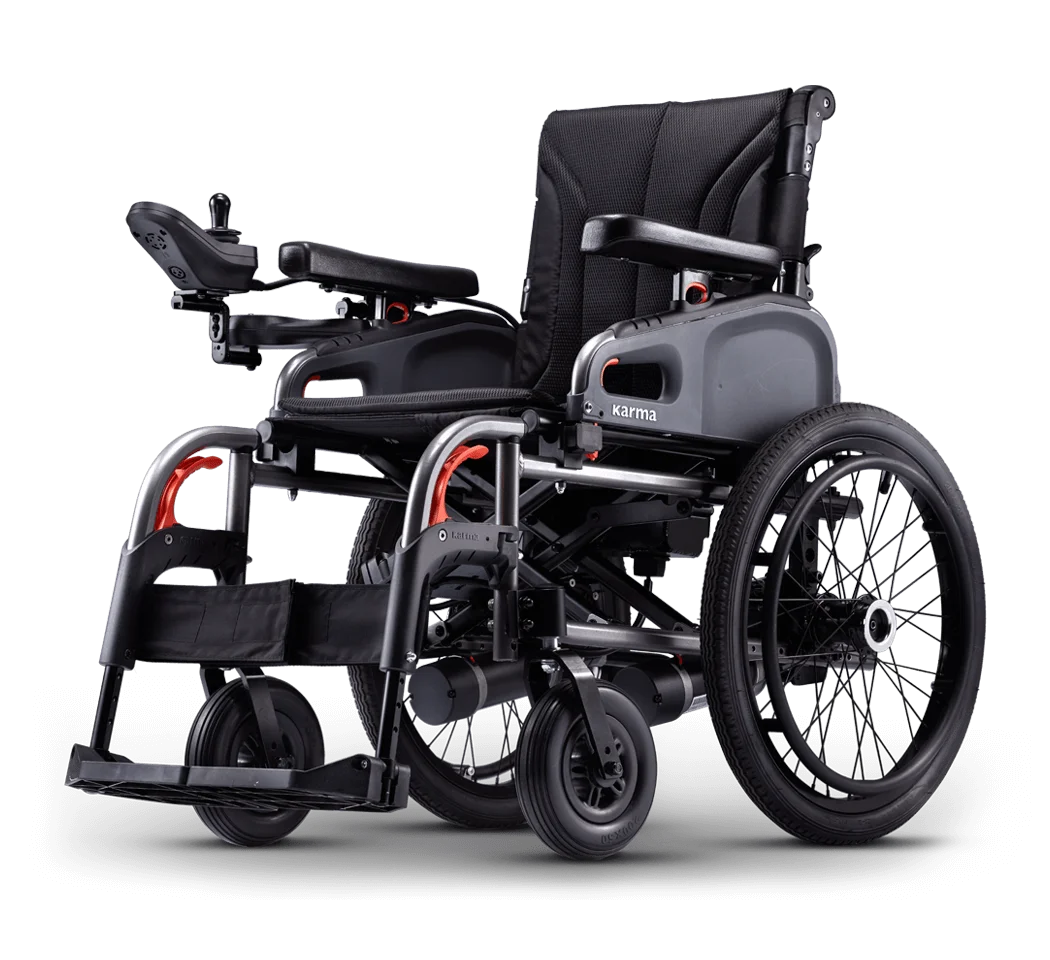
This matters when you choose a chair or a replacement battery. A folding travel chair such as the Karma eFlexx in our catalog is listed with a UN38.3 battery, which is the test airlines ask about. A large lithium pack sold as an upgrade for a full-size chair can be well over 300 Wh, so ask the airline in writing how they would handle it before you buy.
How to find your watt-hours
Look for a figure in Wh on the battery label or in the manual. If you only see volts and amp-hours, multiply them: a 24 V, 10 Ah battery is 240 Wh. If you cannot find either, ask the dealer or maker for the battery data sheet. IATA suggests getting documents from the manufacturer, and airline staff often ask to see them.
What to send the airline
IATA strongly recommends getting approval in advance. easyJet asks for at least 48 hours notice, and Delta recommends 48 hours for battery-powered devices. IATA's guidance lists the information airlines need. Put it on one page:
- Maker and model of the chair.
- Battery type and watt-hour rating, and how many batteries.
- Weight of the chair, and its length, width and height. Give the height with the backrest folded if it folds.
- Which parts come off.
- How to remove the battery, if it is meant to be removed.
- How to cut the power so the chair cannot switch on by accident.
- How to put the chair into freewheel so it can be pushed.
Size and weight can decide the matter. easyJet says a mobility aid must fit through a cargo door 1.70 m wide and 1.22 m high, and anything over 60 kg needs approval in advance. Many full-size power chairs are far heavier than that. The Ottobock Juvo in our catalog has an empty weight of 120 kg, and standing chairs such as the LEVO C3 are listed at 185 kg. Chairs like these can fly, but only on aircraft that can take them, so ask early. IATA notes that an airline may refuse carriage if the requirements cannot be met.
Protecting the joystick and loose parts
Your chair will be handled by people who have never seen it. Make their job easy and take the fragile parts out of the picture.
Take off what comes off
Delta advises passengers to detach all removable parts when checking the chair at the gate and carry them on board. It names the joystick, seat cushion, headrest, armrests and footrests. Bring a bag for them. Your cushion should travel with you in any case, because you may want to sit on it during the flight. Whether that suits your skin and posture is a question for your seating specialist.
If your joystick does not unplug, protect it. Swing it inward if the mount allows, pad it with foam or bubble wrap, and tape a note on it. Do the same for any display, switch box or head array.
Isolate the power
Airlines must make sure the chair cannot power up in the hold. IATA lists accepted ways: switch the chair off and remove the key, remove the joystick module, or separate the power cable plugs or connectors. Exposed battery terminals have to be insulated. Learn which method applies to your chair and practise it at home. If it needs a tool, pack the tool in your cabin bag.
Label the chair
The US Department of Transportation advises attaching clear assembly and disassembly instructions to the chair before you go to the airport. Keep it to one laminated page with photos:
- Where the freewheel levers are and which way to move them.
- How the power is isolated, and that the battery stays in the chair if that is the case.
- Where to lift and where not to lift. Mark armrests and the joystick as no-lift points.
- Whether the backrest folds, and how.
- That the chair must stay upright, if the maker says so. Delta tells passengers to ask the manufacturer whether the device may be stored on its side.
- Your name, mobile number and flight number.
Take photos of the chair from all sides at the airport, with the time shown. If something is damaged later, you will have proof of its condition.
What to do at the gate
In the United States, the Department of Transportation says you do not have to check a wheelchair until you are at the gate. It also asks users of battery-powered chairs to arrive one hour before the normal check-in time. Elsewhere, ask the airline whether you can stay in your own chair to the aircraft door. Many allow it, but not all airports do.
- At check-in, confirm that the booking shows your chair, its battery type and its weight.
- At the gate, ask to speak to the person who will load the chair. Show them the freewheel levers and the power isolation.
- Remove the loose parts and put them in your bag. Put the chair in freewheel only when the handler is ready, and IATA's guidance expects it to be in freewheel before loading.
- Get a gate tag or receipt for the chair and keep it.
- Before the door closes, ask the crew to confirm that the chair has been loaded.
On arrival
US rules require airlines to return an assistive device as close as possible to the aircraft door, unless you ask to collect it at baggage claim. Ask for this at the gate before departure, and again before landing. If you can, stay in your seat until your own chair is at the door.
Before you drive away, refit the parts, switch on, and test the drive, the brakes and every seat function. Look at the joystick, the casters and the frame.
If the chair is damaged
Report it before you leave the airport and get a written reference number. Take photos. Ask what the airline will provide while your chair is out of use.
What you are owed depends on the route and the law that applies. For domestic US flights, the Department of Transportation says US carriers must fully compensate passengers for loss of or damage to wheelchairs, without the usual baggage liability limits. Delta states that you have the right to file a claim, receive a loaner device, and choose your preferred vendor for repair or replacement. On international routes other rules and limits can apply, so check your travel insurance and ask whether it covers the full value of your chair.
A short timeline
- When booking: tell the airline you travel with a power chair and send your one-page data sheet.
- At least 48 hours before: confirm approval in writing and ask about the aircraft type.
- The day before: charge the chair, pack the tool and bag, print two copies of the handling sheet.
- At the airport: arrive early, photograph the chair, brief the handler.
- On arrival: inspect, test, and report any problem at once.
This article is general information. Rules and prices differ by country and change, so confirm them before you buy or travel.
Common questions
Do I have to remove the battery from my power chair?
Not always. Non-spillable batteries and attached lithium batteries usually stay in the chair with the power isolated, but the airline decides, so confirm for your flight.
Can I bring a spare lithium battery?
IATA guidance allows spare lithium batteries for mobility aids in the cabin up to a total of 300 Wh, protected from damage. Your airline may be stricter, so ask first.
How early should I tell the airline?
As early as you can. easyJet requires at least 48 hours and Delta recommends 48 hours for battery-powered chairs.
Will I be charged for the chair?
easyJet says it carries up to two mobility aids free of charge. Other airlines set their own policy, so check before you book.
Can an airline refuse my chair?
Yes, if it does not fit the aircraft or the battery rules cannot be met. That is why early written approval matters.
Sources
- IATA: Dangerous Goods Regulations guidance (battery-powered mobility aids)
- IATA: Battery-Powered Wheelchair and Mobility Aid Guidance Document (PDF)
- US Department of Transportation: Wheelchairs and other assistive devices
- US Department of Transportation: Passengers with disabilities
- Delta Air Lines: Wheelchair services
- easyJet: Special assistance
Read on 5 October 2026. The wording of the article is our own.