Gear · 49 min read
Lightweight, transport and travel wheelchairs in 2026: weights, prices and what 1,457 FDA reports show
How to choose between a lightweight wheelchair, a transport chair and a travel chair, with listed prices and weights, and what two AI coders found in FDA reports from 2023 to August 2026.
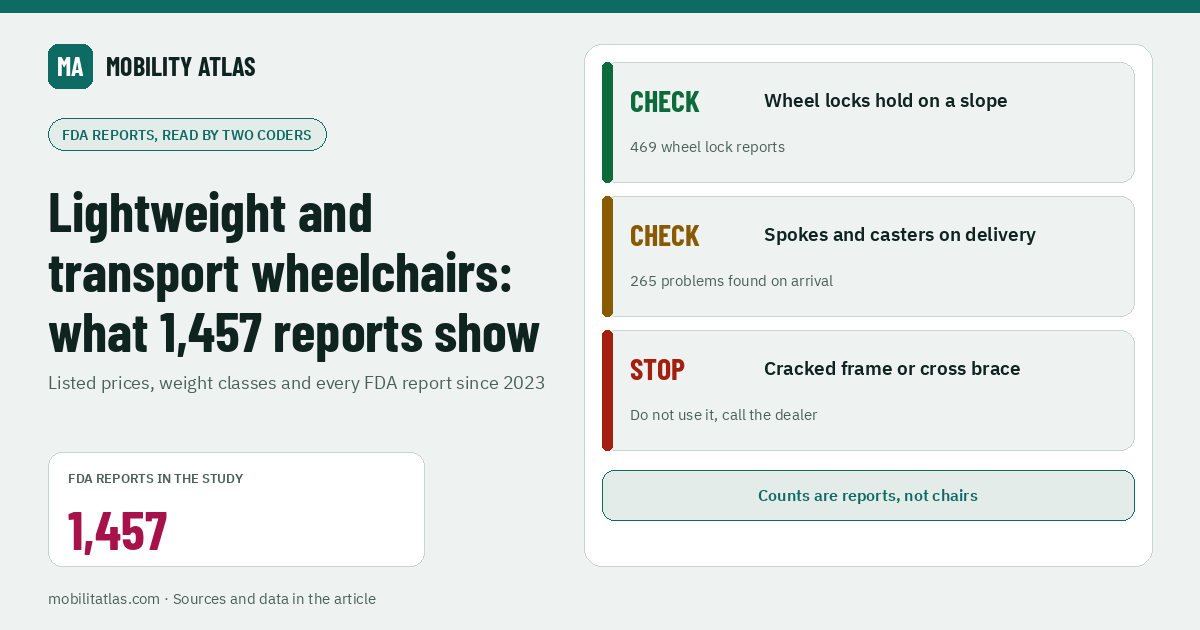
Stop and check before the next transfer if
Already have a chair? Check these first. Buying one? Start at the short answer below.
- A wheel lock does not hold when you push the chair on a slight slope, or a lock bolt is loose or missing.
- A spoke is cracked, a wheel wobbles, or a quick-release wheel pulls out without pressing the button.
- A caster, its fork or the nut on top of its housing is loose, bent or cracked.
- The frame, a weld or the cross brace is cracked or bent, or the chair will not lock open.
- An armrest, footrest or push handle moves, turns or slides when you lean on it.
- The chair has just arrived and you have not checked it yet.
Most of these appear in the fall and injury reports we read, and all of them can make a transfer unsafe. Fix it or have it fixed before anyone transfers in or out of the chair.
The short answer
A light manual wheelchair is the chair most people buy first, often in a hurry, after a hospital stay or a fall, or for a parent who can no longer walk far. There are three kinds that get confused: a lightweight wheelchair you can push yourself, a transport chair with four small wheels that someone else pushes, and a folding travel chair built to go in a car boot or on a plane. The cheapest of them cost less than a pair of good shoes; the dearest cost as much as a used car. The difference is not only weight.
This guide gives you the decision first, then the numbers. The weights and prices come from makers' pages and a large US retailer's listings, read on 10 October 2026, and from the Mobility Atlas catalog. The safety part comes from every report about mechanical wheelchairs that the US Food and Drug Administration (FDA) received from January 2023 to the end of August 2026 that has any text: 1,460 reports, of which 1,457 describe a problem with a chair. Two independent AI coders read each one separately, without seeing each other's work.
The reports say three things clearly. First, the commonest failures are ordinary parts: wheel locks (the parking brakes), rear wheels and their spokes, footrests and other attached parts, and frames that bend or crack. Second, 1,039 of the 1,457 reports concern chairs from one company, Medline, almost all of them filed by Medline itself in 2026, many as part of a review of old complaints, and they describe broken parts far more often than injuries. Third, the reports from every other maker are fewer but much more serious: 418 reports, with 139 stating an injury and 103 a fall.
None of this means a light wheelchair is unsafe. It means a few checks, at delivery and then once a month, catch much of what goes wrong. The sections below show them.
Three kinds of light manual wheelchair, and who each one suits
Start here, because the price, the funding route and the safety checks all differ by kind. The words are used loosely in shops, so look at the wheels, not the name.
| Kind | Who pushes | Rear wheels | Typical weight as listed | Best when |
|---|---|---|---|---|
| Lightweight folding wheelchair | You, or a helper | Large, with push rims | Mostly about 20 to 36 lbs; a few lighter | You can push yourself some of the time |
| Transport chair | A helper only | Small, about the size of the front wheels | Mostly about 13 to 25 lbs; heavy-duty models more | Short trips with a companion |
| Active or ultralight chair | You | Large, often quick-release | Under 30 lbs; transport weight from about 4.7 kg | You push all day, every day |
| Folding travel chair | You or a helper | Large or small, often removable | About 13 to 22 lbs | Car boots, planes, holidays |
The weight ranges are the ranges of figures listed in the retailer and maker pages we read for this guide. Makers weigh chairs in different ways. Some list the chair without footrests, some without wheels (often called the transport weight), and some with everything on. A chair listed at 15 lbs without wheels and footrests can weigh close to twice that ready to use. Ask which parts are included.
Lightweight folding wheelchairs
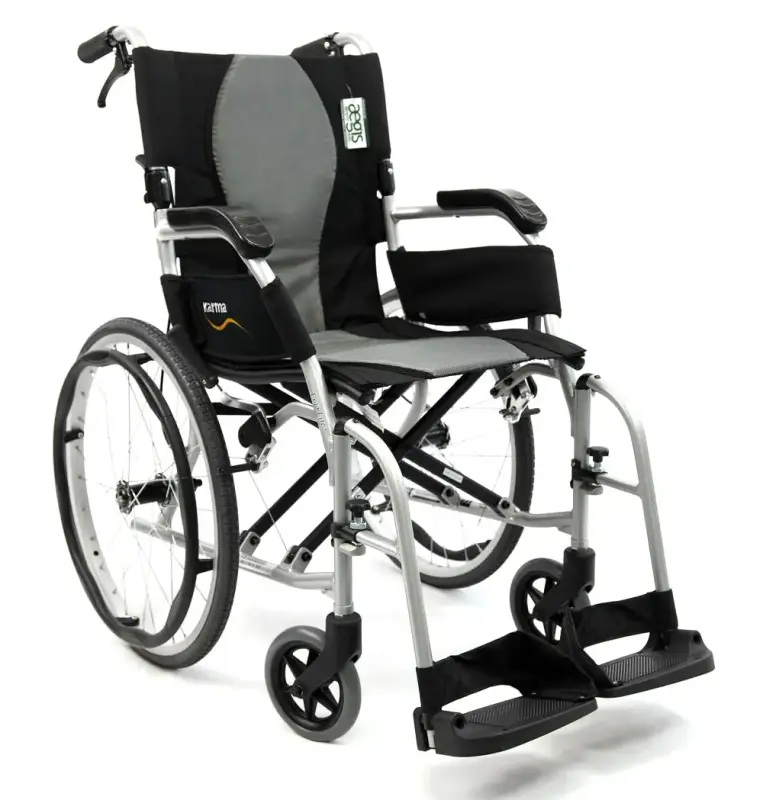
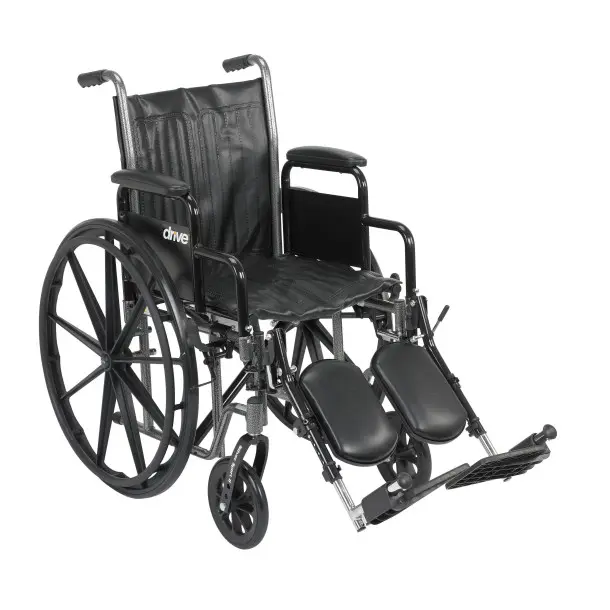
This is the everyday chair of hospitals, care homes and most first-time users. It has large rear wheels with push rims, so the user can move it, and push handles, so a helper can. Standard steel chairs such as the Drive Silver Sport 2 are listed at 40 to 42 lbs; lighter models such as the Medline Excel K4 at 33.5 lbs and the Karman Ergo Flight at 19.8 lbs without footrests. Every pound matters to the person who lifts it into the car, often a partner or an adult child.
Transport chairs
A transport chair has four small wheels, so the person sitting in it cannot push it. It is lighter and narrower than a wheelchair, and it folds small. Most of the listings we read run from 13 lbs for the lightest to about 25 lbs for steel models; heavy-duty transport chairs weigh more. It suits short trips with a companion: a hospital visit, a shopping centre, an airport. It suits less well anyone who wants to move on their own, or anyone who sits in it for hours, because the seat and back are usually thin.
Active and ultralight chairs
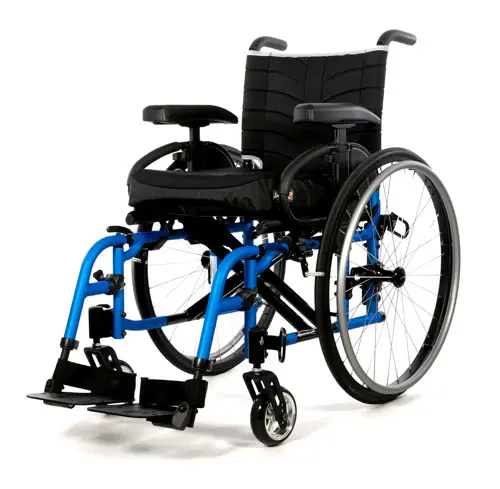
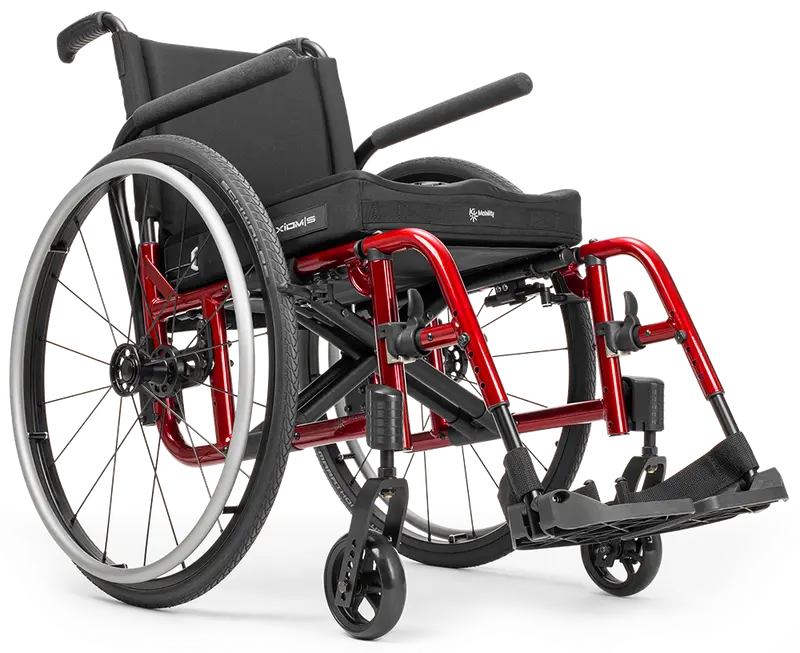
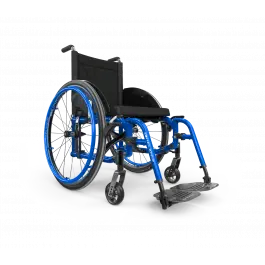
Active chairs are built for people who push themselves all day. They are set up to the user's body, the rear axle can be moved to make pushing easier, and the frames are aluminium, titanium or carbon. The Quickie Nitrum is listed at 18.3 lbs (10.8 lbs transport weight), the TiLite Z at a transport weight of 11.3 lbs, and the Küschall Champion at about 8.8 kg (6.3 kg transport). These are usually ordered through a seating assessment, not bought from a website.
Folding travel chairs
Travel chairs are a marketing group more than a design. Some are very light folding wheelchairs, some are transport chairs with a carry bag. What matters for travel is the folded size, whether the wheels come off without tools, and whether the chair is strong enough to survive baggage handling. We come back to air travel below.
Six situations, and which route is yours
- You need a chair for a few weeks after an operation or an injury. Borrow or hire first (Route 1).
- You will use a chair long term and may qualify for help. Ask for an assessment and funding (Route 2).
- A parent or partner walks a little but not far, and someone will always push. A transport chair may be enough (Route 3).
- The user wants to move around the house alone, even slowly. Choose a lightweight wheelchair with large rear wheels (Route 4).
- The user pushes all day, works, studies or travels alone. A fitted active chair is the tool for that (Route 5).
- You already have a chair and something is loose, cracked or slipping. Read the box at the top, then the checkpoint list for the dealer.
What the weight classes mean
In the US, Medicare sorts adult manual wheelchairs into classes by weight, and many shops use the same codes, so you will see "K1", "K3" or "K4" in product names. The definitions come from the Medicare policy article for manual wheelchair bases. They are useful even outside the US, because they are the clearest public definitions of what "lightweight" means.
| Code | Name | Chair weight | Other conditions |
|---|---|---|---|
| K0001 | Standard wheelchair | Greater than 36 lbs | Seat height 19 inches or greater; weight capacity 250 pounds or less |
| K0002 | Standard hemi (low seat) | Greater than 36 lbs | Seat height less than 19 inches |
| K0003 | Lightweight wheelchair | 34 to 36 lbs | Weight capacity 250 pounds or less |
| K0004 | High strength, lightweight | Less than 34 lbs | Lifetime warranty on side frames and crossbraces |
| K0005 | Ultralightweight | Less than 30 lbs | Adjustable rear axle position; lifetime warranty on side frames and crossbraces |
| K0006 | Heavy duty | Any | Weight capacity greater than 250 pounds |
| K0007 | Extra heavy duty | Any | Weight capacity greater than 300 pounds |
Two details are easy to miss. The policy says weight means "the weight of the wheelchair itself in pounds without the front rigging", that is, without footrests, so the chair you lift will be heavier. And the lifetime warranty on side frames and crossbraces is part of the definition of the K0004 and K0005 classes. If a chair is sold as a K4 or ultralight and the warranty on the frame is a year, ask why.
Transport chairs have their own codes, E1037 to E1039. A combination of a rollator (a wheeled walker with a seat) and a transport chair has the code E0150. Medicare's policy article says that from 1 October 2026 such a combination device "has been determined to meet the definition of DME", that is, durable medical equipment, after a year in which it was not covered. That change is new this month, so ask your supplier how it applies to you.
What a light wheelchair costs in 2026
Manual wheelchairs are easier to price than power chairs, because many are sold online at a listed price. The table shows prices listed by one large US retailer, 1800wheelchair.com, on 10 October 2026, with the weights it lists. These are one retailer's prices on one day, not offers from Mobility Atlas, and they change often.
| Chair | Kind | Weight as listed | Price as listed |
|---|---|---|---|
| Pro Heal 19" Astra Steel Transport Chair | Steel transport chair | 25.5 lbs | USD 139.98 |
| Medline Ultralight Transport Chair | Transport chair | 15 lbs | USD 182 |
| Drive Aluminum Transport Wheelchair | Transport chair | 19 lbs | USD 211 |
| ProBasics K1 Manual Wheelchair | Standard steel wheelchair | 41 to 43 lbs | USD 220 |
| Drive Silver Sport 2 Dual Axle Wheelchair | Standard steel wheelchair | 40 to 42 lbs | USD 232 |
| Fly-Lite Transport Chair | Transport chair | 16.2 or 18.9 lbs | USD 257 |
| Excel K4 Lightweight Wheelchair | Lightweight wheelchair | 33.5 lbs | USD 267 |
| Feather Transport Travel Wheelchair | Transport chair | 13 lbs | USD 319 |
| Karman LT-980 Ultralight K4 | Lightweight wheelchair | 24 lbs without footrests | USD 425 |
| Invacare Tracer SX5 | Lightweight wheelchair | 33.75 lbs | USD 457 |
| Karman Ergo Flight | Lightweight wheelchair | 19.8 lbs without footrests | USD 783 |
| Quickie 2 Foldable | Folding active chair | 25.4 lbs | USD 1,963 |
| TiLite Aero X | Rigid ultralight chair | 18.4 lbs | USD 2,671 |
| TiLite 2GX | Folding titanium chair | 16 lbs | USD 4,353 |
Three patterns stand out. First, the cheapest chairs are heavy: steel standard wheelchairs are listed around USD 220 to 232 and weigh more than 40 lbs. Second, the light transport chairs are cheap too, from USD 182 for a 15 lb chair, because a transport chair is a simpler object. Third, the price of a self-propelled chair climbs steeply as it gets lighter and more adjustable: from USD 267 for a 33.5 lb K4 chair to USD 1,963 for the Quickie 2 and USD 4,353 for the titanium TiLite 2GX.
Prices outside this table follow the same shape. The Mobility Atlas catalog lists the Ki Mobility Rogue 2 from about USD 2,011 at a US retailer's sale price (list USD 2,873) and the carbon Motion Composites Helio C2 from about USD 3,752 (list USD 4,690). Active chairs in the UK and Europe are usually priced by the dealer after a fitting. A chair priced through a fitting is not necessarily dearer in the end, because the cushion, the back and the setting of the axle are part of the job.
Add the extras before you compare. A pressure-relieving cushion, a better back, anti-tippers, a carry bag and delivery can change the total by a lot, and a cushion in particular is a clinical choice, not an accessory.
Five routes to a light chair, cheapest first
This is the price ladder from the bottom up, using the prices in this guide. Start at the top unless your clinician says you need a fitted chair.
| Route | What it is | Price as listed or paid |
|---|---|---|
| 1 | Borrow or hire a chair for a short time | Hire charges vary; in the UK the British Red Cross hires manual wheelchairs |
| 2 | A chair funded by Medicare, the NHS or an insurer after an assessment | NHS assessments are free; Medicare covers the class you qualify for, and you usually pay 20% after the Part B deductible |
| 3 | A transport chair bought outright | USD 139.98 to USD 319 in our table |
| 4 | A lightweight self-propelled wheelchair | USD 267 to USD 783 in our table |
| 5 | A fitted active chair | USD 1,524 to USD 4,353 on the same retailer's pages |
Route 1 · Borrow or hire
What it is: a chair for weeks, not years. What the sources say: in the UK, Scope says the British Red Cross "has a range of manual wheelchairs to hire." The check that gets skipped: the wheel locks and the footrests of a chair that many people have used. At pick-up, say this: "Please show me that both wheel locks hold and the footrests lock before I take it."
Route 2 · Funded after an assessment
What it is: a health service or insurer pays after a clinician assesses the user. What the documents say: Medicare pays by weight class and needs documented reasons for an ultralight or transport chair; NHS wheelchair services assess for free and may offer a personal wheelchair budget. The clinician decides seat size, cushion and class. At the assessment, say this: "What class or model are you recommending, and why, and what would a budget cover if I want a lighter chair?"
Route 3 · A transport chair bought outright
What it is: the lightest and cheapest chair, pushed by a helper. What the reports say: one describes a chair tipping backwards as the user sat down, another a transport chair frame that broke so that the user fell and hit her head. The check that gets skipped: the wheel locks at every stop. To the seller, say this: "What is the weight with footrests, the weight capacity, and will you replace it if it arrives damaged?"
Route 4 · A lightweight wheelchair
What it is: a folding chair the user can push. What the documents say: Medicare's lightweight class is 34 to 36 lbs and the high-strength lightweight class under 34 lbs, with a lifetime frame warranty. What the reports say: wheel locks, wheels and spokes, and attached parts such as footrests fail most. The check that gets skipped: the frame warranty and the delivery check. To the seller, say this: "How long is the warranty on the frame and the cross brace, in writing?"
Route 5 · A fitted active chair
What it is: a chair set up to the user's body, with an adjustable axle. What the reports say: active chairs appear in serious caster, cross brace and anti-tipper failures, some on chairs eight or more years old. The seating specialist decides the set-up and the cushion. At the fitting, say this: "Please book a check after the first weeks, and show me how to check the caster nuts and wheel locks myself."
Weight, seat width and weight capacity: the numbers that decide daily life
Weight decides who can lift the chair into the car. Seat width decides whether the user fits, and whether the chair fits through the bathroom door. Weight capacity is the load the maker rates the chair to carry, and it is not a comfort figure.
- Chair weight. Ask for the weight with wheels and footrests on, and the weight of the heaviest piece you will lift. Quick-release wheels can make a 22 lb chair a 15 lb lift.
- Seat width. A seat that is too wide makes pushing harder and lets the user lean; too narrow causes pressure on the hips. Measure the user seated, across the widest point (how to measure), and ask a therapist to check.
- Overall width. The chair is wider than its seat by the wheels and push rims. Measure your narrowest door.
- Weight capacity. Medicare's standard classes are defined as carrying 250 pounds or less, heavy-duty chairs more than 250 pounds and extra heavy-duty more than 300; many chairs sold today are rated higher. Choose a capacity above the user's weight plus anything carried on the chair.
- Seat height. Lower seats help people who push with their feet; higher seats help with transfers and tables.
- Folded size. For a car, measure the boot opening, not only the floor.
The transport chairs in our table carry 250 or 300 lbs as listed, and the lightest folding chairs often carry less, so check the capacity before you choose on weight alone.
Transport chair or lightweight wheelchair?
Should I buy a transport chair or a lightweight wheelchair? Mobility Atlas compared the two kinds in the listings and in the FDA reports, and the answer depends on who will move the chair. A transport chair is lighter, cheaper and smaller folded: the Medline Ultralight Transport Chair is listed at 15 lbs for USD 182, against 33.5 lbs and USD 267 for an Excel K4 lightweight wheelchair. But the person sitting in a transport chair cannot move it, so they depend on a companion for every metre. If the user can push even part of the time, a lightweight wheelchair keeps that independence, and it is usually more comfortable for long sitting. The FDA reports add one more point: one transport chair report describes the chair tipping backwards as the user sat down. Use the wheel locks for every transfer, and choose the wheelchair if the user will sit in it for hours or wants to move alone.
Medicare draws the same line. Its policy article says that if documentation for a transport chair is requested, it must explain "why the beneficiary is unable to make use of a standard manual wheelchair" and show that there is a caregiver "who is available, willing, and able to provide assistance with the wheelchair." In other words, a transport chair is for someone who has a helper and cannot use a chair on their own.
How Mobility Atlas read 1,460 FDA reports
The FDA collects reports about problems with medical devices in a public database called MAUDE. Manufacturers must file reports about some events, and users, families and health workers can file them voluntarily. Manual wheelchairs have the product code IOR, "Wheelchair, Mechanical", which the FDA rule 21 CFR 890.3850 defines as "a manually operated device with wheels that is intended for medical purposes to provide mobility to persons restricted to a sitting position." That code covers lightweight, standard, active and many transport chairs.
We downloaded every IOR report received from 1 January 2023 to the latest update on 10 October 2026, which runs to the end of August 2026. That is 3,501 reports: 441 for 2023 to 2025, and 3,060 for 2026. Of the 2026 reports, 2,041 carry no text at all, so nobody can tell what they describe; we counted them but could not code them. The pool is the 1,460 reports that carry text, and 1,457 of them describe a problem or event involving a chair.
Before reading any report, we wrote a codebook: a list of categories and rules for what counts as each, with the order in which they apply. The codebook was fingerprinted with a hash and the time was recorded, so that any change after we saw the data would show. Two AI coders then read every report separately, without seeing each other's answers: what kind of chair, what went wrong, and whether the report states an injury, a fall, a problem found on arrival, or a filing from a review of old complaints.
The two readers agreed on the main category for 97.6 percent of reports, a Cohen's kappa of 0.968, where 1 means perfect agreement and 0 means no better than chance. Agreement on injuries was 99.9 percent (kappa 0.997) and on falls 99.9 percent (kappa 0.992). Each of the 72 reports where the readers differed was decided under written rules, and a final consistency pass changed 3 more. The codebook, the method and the coded table are published on the data and method page.
One limit matters above all. The FDA's MAUDE page says "MDR data is not intended to be used either to evaluate rates of adverse events" and that "The submission of an MDR itself does not necessarily demonstrate that the device caused or contributed to the adverse outcome or event." Every count below counts reports, not chairs, and not people.
Two very different sets of reports
The first finding is about who files. Of the 1,457 reports, 1,039 concern chairs made or sold by Medline, a large US supplier of hospital and home equipment, and 418 concern every other maker together. We grouped reports by the brand and maker named in them; about a dozen short reports that name no brand may belong to Medline too, which does not change the picture. The two groups read like two different databases.
| What the report says went wrong | All 1,457 | Medline (1,039) | All other makers (418) |
|---|---|---|---|
| Wheel locks or brakes | 469 | 218 | 251 |
| Wheels, spokes, casters, tyres | 443 | 403 | 40 |
| Other attached parts (footrests, armrests, handles) | 241 | 211 | 30 |
| Frame or folding mechanism | 209 | 182 | 27 |
| Problem alleged, cannot tell what | 40 | 22 | 18 |
| Tip or fall, no failed part named | 28 | 3 | 25 |
| Event with no chair problem stated | 27 | 0 | 27 |
The Medline reports are short and nearly identical in form. A customer complaint is quoted, often about a part that arrived broken or wore out, followed by the sentence "In an abundance of caution, this is a reportable event," or a close variant; the phrase "abundance of caution" appears in 963 of them. 716 say they were filed as part of "retrospective review activities, which include review of historical data", and 677 were received in August 2026 alone. Only 28 state an injury and 30 a fall. 260 describe a problem found when the chair arrived.
The reports from other makers are a different kind of document. They are more often written after something happened to a person: 139 of the 418 state an injury and 103 describe a fall. Many come from dealers, lawyers or families, and many from active chair makers such as Sunrise Medical (the maker of Quickie), Permobil (TiLite) and Invacare.
So the volume of Medline reports is not evidence that Medline chairs are worse. It shows that one company reviewed its old complaints and filed them in bulk, carefully. What the Medline reports are good for is a picture of which parts of a low-cost chair fail in ordinary use and in delivery. What the other reports are good for is a picture of how people get hurt.
Wheel locks: the commonest failure
Wheel locks are the levers beside the seat that press on the rear tyres to stop the chair rolling. They are the single biggest category, with 469 reports. In the reports, 128 describe a lock that was loose, 80 a lock that would not engage or lock, and about two dozen a chair that rolled or moved with the lock on.
Among the other makers, the wheel lock reports are dominated by one pattern: 196 reports about Quickie chairs from Sunrise Medical, mostly filed by dealers, describing a wheel lock that came loose or a bolt that fell out. In one, a dealer says that when the user "went to engage the wheel lock, it just came apart." Only one of the 196 states an injury, and it shows the risk: a wheel lock "did not hold and the end user fell out of the wheelchair" after she had lost a bolt from the lock some time before. Sunrise's narrative in these reports points to maintenance: "all owner manuals contain information regarding maintenance schedules for manual and power wheelchairs."
The Medline wheel lock reports are different again. 37 of them, mostly from 2023 and 2024, are notifications passed on by another company about chairs with "reduced brake force", a lock that presses but does not hold.
Wheel locks are adjusted, not just fitted. They work by pressing on the tyre, so a tyre that wears or loses pressure moves away from the lock and it grips less. The fix is usually a few minutes with a spanner. Check them every month: push the chair firmly with both locks on. It should not move. If a bolt is loose, tighten it or take the chair to the dealer before you use it for transfers.
Wheels, spokes and casters
Wheels are the second category, with 443 reports, almost all from Medline (403). The rear wheel is named in 153 and spokes in 86. On many low-cost chairs the rear wheels are moulded in one piece with plastic spokes, and the reports describe those spokes arriving cracked or breaking in use. One customer said "the back wheel arrived with a broken spoke"; another that a chair was "received with fractured spokes". 70 wheel reports mention a crack, and dozens a wheel or part that came off or fell off.
The other makers' wheel reports are fewer, 40, but 25 of them describe a fall. Casters, the small front wheels, are the weak point. One report says a nut "for the caster housing fell out" while an active user crossed a threshold; in another the caster "came off of the chair during propulsion" and the user fell. A caretaker described pushing a man when "the front fork and wheel broke and the chair tipped." In a Drive report, a provider said "the wheel broke off and the end user fell," and the user was taken to hospital.
The checks are simple. When the chair arrives, look at every spoke of a moulded wheel for cracks, and refuse a chair that arrives with one. Every month (tire and caster care), spin each caster, look for wobble in the fork, and check that the nut at the top of the caster housing is tight. Quick-release axles should click home and not pull out without pressing the button. Pneumatic tyres need the pressure on the tyre wall.
Frames, cross braces and folding
The frame is the skeleton of the chair. On a folding chair, the cross brace under the seat is the hinge that lets it fold, and it carries the user's weight. 209 reports describe a frame or folding problem: 83 mention a part that broke, 51 one that bent, 48 a weld and 29 the folding itself.
Most frame reports, 182, are Medline complaints such as a chair that would no longer fold or a weld that cracked. The other makers' 27 frame reports include some serious falls. In one, an eight-year-old Küschall Champion was in use "when the crossbrace broke and the consumer fell," and the user needed surgery. In another, a daughter reported that the frame of a transport chair "broke and [the end user] fell and hit her head."
This is where the Medicare definitions earn their place. High-strength lightweight and ultralight chairs carry a lifetime warranty on side frames and crossbraces. Whatever chair you buy, ask how long the frame warranty runs, look at the cross brace and welds when you fold the chair, and stop using a chair with a crack in the frame. A cracked frame is not a part you can tape.
Footrests, armrests and push handles
241 reports describe another attached part failing: footrests and legrests in about 100, armrests in about 44 and handles in about 20, by a keyword count. Footrests swing away for transfers and lock back in place; when the lock wears, the footrest drops or swings while the user's feet are on it. Armrests are used as handles by people standing up, and push handles carry a helper's weight on kerbs.
The other makers' 30 reports of this kind include 24 with an injury: anti-tippers that broke, backrests that gave way, cuts from footrests and sharp edges, and falls during transfers. The lesson is the same one our electric wheelchair guide found for power chairs: anything that people lean on needs to be checked as if it were part of the frame. Grip each armrest and push it in every direction. Swing each footrest out and back and make sure it locks. If a push handle turns or slides, tighten it before the next kerb.
Arriving broken: what to check on delivery
265 reports describe a problem found when the chair arrived or was first opened, almost all of them Medline (260). Wheels are the commonest, in 172 of the arrival reports, then the frame in 47 and other parts in 31. These are chairs bought by people who needed them that day, often for someone just home from hospital.
One Medline report, which the reporter classed as a death, in fact describes a chair that "came in a box already assembled", whose "assembly is loose and wobbly making it unstable and unsafe for use", and says no serious injury was reported. We counted it as filed, but it shows how much a delivery check matters.
- Open the box with the delivery driver still there if you can, and photograph any damage to the box.
- Unfold the chair fully and check that it locks open. Push down on the seat; nothing should creak or shift.
- Look at every spoke of the rear wheels and the forks of both casters. Refuse a chair with a crack.
- Fit the wheels and push them in and out; quick-release axles should click and hold.
- Test both wheel locks with someone sitting in the chair, on a slight slope.
- Fit the footrests and check that they lock. Check the armrests and push handles.
- Read the manual's weight capacity and the warranty, and keep the receipt and serial number together.
If anything fails, do not use the chair for a transfer. Ask the seller for a replacement, and tell the maker. You can also report it to the FDA through MedWatch, which accepts reports from patients and families.
Falls and injuries: where they happen
Across all 1,457 reports, 167 state an injury and 133 a fall. Among the reports that describe a fall, 17 mention a transfer, 17 a tip or fall backwards and 17 forwards, and 5 a ramp. Transfers come up again and again: getting in, getting out, moving to a car seat, a bed or a toilet. That is when the chair must not move and the parts people push on must not give way.
Backward tips are the other theme. A Drive report describes a woman who held the armrests to sit in a transport chair, and "when she sat down the chair tipped over backwards and hit the back of her head on the pavement." One of the death reports describes a care home resident whose wheelchair tipped backwards during a hoist transfer. Anti-tippers, the small tubes at the back that stop a chair going over, are optional on many chairs and are often removed for travel or to get up kerbs. A TiLite recall from 2018 concerned anti-tip tubes that "potentially fail in certain situations and the wheelchairs can tip backwards."
- Put both wheel locks on before every transfer, and check them monthly.
- Ask a therapist whether you should use anti-tippers, and refit them after travel.
- Sit right back in a transport chair rather than perching on the front edge, and have the helper hold the handles.
- Do not stand on the footplates; swing them out of the way for transfers.
- Going down a kerb, a helper should take the chair down backwards, rear wheels first, unless the chair's manual says otherwise, and swing anti-tippers out of the way first if the manual says to.
The five death reports, read with care
Five reports are classed by the reporter as deaths. Each one is a person. We summarise them because readers ask and because they show where the risks sit; in most of them, no chair fault is established.
- One describes anti-tips that broke, so that the user hit their head, with a death the following morning. The maker says it could not confirm the chair model or details.
- One describes a care home resident in France whose chair tipped backwards while two staff moved the resident with a hoist, and who died the day after. The maker filed it in the US because a similar chair is sold here.
- Two, which appear to describe the same event, come from a lawyer's letter alleging that a user slid down in a wheelchair and a lap belt tightened around her neck. The distributor says the attorney's own information shows the belt was made by another company and not supplied by the distributor.
- One, as described above, is a Medline delivery complaint that reports no serious injury.
The belt reports are a reminder that positioning belts must be the right type, fitted and adjusted by someone trained, and never used to hold a person who is sliding out of the chair. A seating specialist or occupational therapist can advise on the belt and the cushion together.
Transport chairs in the reports
12 reports are coded as transport chairs: 6 say so in the text and 6 only in the product name, because most reports do not name the kind of chair. The 6 that say so are worth reading because they show the particular risks of a chair that someone else pushes.
Two describe the user going over. In the Drive report quoted above, a woman sat down holding the armrests and the chair tipped backwards. In another, a mother reported that her son "turned over" in a transport chair, without saying how. Transport chairs have small rear wheels set close to the seat, so leaning back hard or sitting down heavily can tip the chair backwards, and perching on the front edge can tip it forwards.
Others describe parts failing in use. In one, the frame of a transport chair "broke and [the end user] fell and hit her head." In another, the spokes of a transport chair's front wheel broke as it was pushed up a hill, about a week after it arrived. Helpers get hurt too: in a report about a Drive wheelchair, an attorney alleged that a rear wheel "fell off while in use," and the wife who was pushing "fell and broke her leg which required surgery." The helper is part of the system. A transport chair needs a helper who can hold it on a slope, who knows to use the wheel locks for every stop, and whose own footing is safe.
- Before every trip, check that both rear wheels are tight and the wheel locks hold.
- Ask the user to sit right back in the seat, and use the seat belt if one is fitted and the user is comfortable with it.
- Stop on slopes only with the wheel locks on, and never leave the chair facing downhill.
Recalls: why there are almost none
We read every FDA recall record for the IOR code: 40 in all. The newest began on 24 September 2021, when Permobil's TiSport recalled TiLite Aero Z and ZRA chairs whose transit tie-downs might not be set up the right way for use as a seat in a vehicle. Before that come recalls of anti-tip tubes, backrest brackets, armrests and caster hardware, mostly on active and tilt chairs, and three from 2008 on Medline bariatric chairs, where users could pinch fingers. There has been no new recall in the code since 2021.
| Recall | Product | Problem, as the record states it | Started | Quantity |
|---|---|---|---|---|
| Z-0264-2022 | TiLite Aero Z and ZRA | Tie-downs may not be set up right for use as a vehicle seat | 24 Sep 2021 | 5,373 |
| Z-2294-2019 | TiLite X-Short anti-tip tubes | Tubes may fail and the chair can tip backwards | 11 Sep 2018 | 1,452 wheelchairs |
| Z-2290-2016 | Quickie Q7 | Backrest bracket can fatigue and fracture | 1 Jul 2016 | 12,142 in the US |
| Z-1025-2016 | Karma Flexx | Wrong size screws on the caster fork brackets | 27 Jan 2016 | 35 |
| Z-0216-2015 | Transport Chair and Rollator in 1 | Wheel assembly failing | 10 Oct 2014 | 129 |
The pattern in these older recalls matches the reports: anti-tippers, backrest brackets, caster hardware and wheels. The parts that fail are the parts that carry a person's weight at an angle or take the shock of a kerb. If you own an older active chair of a model named in a recall, ask the dealer whether the fix was done, and check the parts named in the record at your next monthly check. The FDA recall database can be searched by product name, and the records give the model numbers affected.
If you use a wheelchair as a seat in a car, bus or van, the TiLite record is a useful reminder that a chair must be set up and secured for that use. Ask the maker whether your chair is tested and fitted for transit, use the tie-down points it names, and do not sit in a chair in a vehicle unless the driver knows how to secure it.
The long gap since 2021 means the absence of a recall tells you little about a chair. The FDA rule places mechanical wheelchairs in device Class I, its lowest risk class (not to be confused with a Class I recall, the most serious kind). For a light wheelchair, your own checks and the warranty tell you more than the recall list.
Can you keep using a chair that has a problem?
Not for transfers, if any point in the box at the top of this guide applies. Most of those failures appear in the fall reports, and a transfer is when they happen. Take the chair to the dealer empty, or ask for a home visit.
You can usually keep using the chair and book a repair soon if the upholstery is worn but intact or a tyre is soft (pump it and check the locks again). A loose push handle grip is a stop for kerbs and tipping until it is fixed. If a problem comes back after a repair, treat it as a stop.
What a good dealer check covers, checkpoint by checkpoint
- Wheel locks: adjusted to the tyre, bolts tight, tested on a slope with the user seated.
- Rear wheels: spokes, rims, bearings and quick-release axles.
- Casters: forks, housing nuts, bearings and wobble.
- Frame: cross brace, welds, seat rails and the folding latch.
- Footrests, armrests and push handles: locks and fixings.
- Anti-tippers: fitted, at the right height, not bent.
- Seat, back and cushion: still the right fit for the user.
- A written note of what was checked and changed.
Parts prices, as listed by makers and retailers in the Mobility Atlas catalog, for the part alone, so you can judge a repair quote. Check that a part fits your model, and have a dealer fit wheel locks, axles and anti-tippers:
| Part | Price as listed |
|---|---|
| Caster bearing kit | From USD 10.00 per kit |
| Kenda K1079P tyre | USD 20.95 each |
| Drive Medical anti-tippers | USD 16 to 86 per pair |
| Quick-release axle | USD 28.50 each |
| Out-Front composite wheel locks | USD 45.45 on sale, USD 57 regular |
| AGOG composite casters | USD 49.99 per pair |
| Invacare elevating legrests | USD 59 per pair |
| Spinergy wire wheels | USD 365 per pair |
What the FDA data cannot tell you
- Reports are not rates. Nobody publishes how many chairs of each model are in use.
- 2,041 of the 3,060 reports received in 2026 carry no text and cannot be read.
- Counts follow paperwork: 757 of the 1,457 reports came from reviews of historical complaints.
- Most reports are allegations; we counted what each report says.
- 1,040 reports do not say what kind of chair it was, and only 6 say in the text that it was a transport chair.
- None of the reports gives a repair cost, so the prices in this guide come from listings, not from users.
Read the numbers as a map of what to check, not as a ranking of brands.
Active chairs: when paying more is worth it
For someone who will push their own chair every day, the difference between a USD 267 lightweight chair and a fitted active chair is not luxury. An active chair is lighter to push, can be set up so the rear axle sits under the user's shoulders, and is built to last years of daily use. Medicare's ultralight class also requires an adjustable rear axle position and a lifetime warranty on side frames and crossbraces.
European active and lightweight chairs are listed by weight in kilograms. The Mobility Atlas catalog lists the Invacare Action 3 NG Light at 13.0 kg (7.1 kg transport weight), the Ottobock Avantgarde 4 DS at 8.7 kg, the Küschall Champion folding chair at about 8.8 kg and the Panthera S3 rigid chair at 8.2 to 8.8 kg in total, with a transport weight from 4.65 kg. Some of the lightest chairs carry less: the Champion is listed for a maximum user of 120 kg and the Panthera S3 for 100 kg in its standard version.
Rigid or folding is the next choice (rigid vs folding frame, and choosing your first active chair). A rigid frame has no cross brace, so it is lighter and stiffer and wastes less of each push, and the back usually folds down for the car. A folding frame packs into a narrower space and suits people who share the car with others or travel on trains. The reports do not settle the question: frame failures occur in both.
An active chair should be ordered with a seating assessment. The person who sets it up will look at the seat angle, the back height, the cushion and the axle, and these change how the chair handles. Expect to go back after a few weeks for adjustments. A chair that is set up once and never checked again loses much of what you paid for.
Cushions, backs and sitting for long periods
The seat of most low-cost wheelchairs and transport chairs is a fabric sling. It sags over time and tilts the hips, and it does little to spread pressure. For a chair used for an hour on a trip that may be fine. For a chair used most of the day, the cushion matters more than the frame, because the user sits on it for many hours.
Choosing a cushion is a clinical decision (see choosing a pressure-relief cushion). Someone who cannot feel pressure, cannot shift their weight, or has had a pressure injury before needs an assessment by an occupational therapist, a physiotherapist or a seating specialist, who will choose a cushion and check it with the user sitting on it. A solid seat insert under a cushion can stop a sling seat from sagging, and a firmer back can help posture. Ask before you buy, and include the cushion in the price you compare.
Used, hired and borrowed chairs
Many first chairs are borrowed. In England and Wales, Scope points to the Red Cross for short-term hire, and local services and charities in many places lend chairs too. A borrowed chair is often the right answer while you find out what you need.
A used chair can also be a good buy, especially an active chair that cost thousands new. The reports suggest what to inspect: the wheel locks and their bolts, the caster housings and forks, every spoke, the cross brace and welds, the footrest locks and the armrests. Ask the age of the chair; two of the serious frame and caster failures we read involved chairs about eight and almost ten years old. Have a dealer look at an active chair before you rely on it, because the setup that suited the last owner may not suit you.
Travelling with a manual wheelchair
A light chair is often bought for a trip. In the US, airline rules for wheelchairs are set by the Department of Transportation in 14 CFR Part 382. Section 382.123 says an airline must let a passenger who uses a wheelchair and boards early stow it in the cabin's priority stowage area "with priority over other items brought onto the aircraft by other passengers." If the chair does not fit assembled but will fit "if wheels or other components can be removed without the use of tools," the airline must remove them and stow it there.
That makes quick-release wheels and a compact fold worth paying for if you fly. Most chairs will still travel in the hold, so take off cushions, bags and anything loose, label the chair with your name and the way to fold it, and photograph it before you hand it over.
The Department of Transportation adopted a wider rule on wheelchairs in air travel. In a notice published on 30 September 2025, it said it would delay enforcing four parts of that rule, those on "airline liability for mishandled wheelchairs, refresher training frequency, pre-departure notifications, and fare difference reimbursements", while it considers changes. The notice says the rest of the rule is not affected. Rules outside the US differ; check with the airline before every trip.
Folding, lifting and the car
For many families the real test of a light chair is the car boot, several times a week. The weight on the label is rarely the weight you lift, and the way you lift matters as much as the number.
- Take the chair apart before you lift it: cushion out, footrests off, and the rear wheels off if they are quick-release. Each piece is then a lighter, safer lift.
- Fold the chair fully and engage any folding latch, so it cannot spring open as you lift.
- Lift with the chair close to your body, bend your knees, and lift by the frame, not by the wheels, armrests or footrests, which can come away.
- Measure the boot opening and the space behind the seats before you buy, with the chair folded as the maker describes.
- If the person lifting has a bad back or is older, choose the chair around them. A lighter transport chair or a chair with quick-release wheels may be worth more than any feature.
When you unfold the chair again, check that the cross brace has opened fully and the seat sits flat before anyone sits in it. Several of the frame reports describe chairs that would not fold or unfold properly, and a half-open chair can collapse during a transfer.
A short guide for the person pushing
A companion pushing a wheelchair or transport chair is doing a physical job, and the reports show that helpers can be hurt too. A few habits protect both people.
- Tell the user before you move, turn or stop. A sudden start can tip someone forward.
- Use the wheel locks every time you stop, even for a moment, and always before the user stands or sits.
- Go up a kerb forwards: tip the chair back onto its rear wheels, roll the front casters onto the kerb, then lift the rear wheels up. Come down backwards, rear wheels first, holding the chair close.
- On a slope, keep both hands on the handles and walk at the user's pace. Going down a steep slope, walk backwards downhill with the chair close to you, uphill of you.
- Check push handles before each trip. A handle that turns or slides off is a fall for both of you.
- Ask the user how they like to be pushed. Speed, bumps and turns feel very different from the seat.
If pushing hurts your back or shoulders, say so to the user's therapist. A lighter chair, larger rear wheels, or a power add-on for the helper may make daily trips possible again.
Paying for it: Medicare, the NHS and buying yourself
United States: Medicare
Medicare covers manual wheelchairs as durable medical equipment when the user meets its coverage criteria, set out in the manual wheelchair policy. The weight class decides what you get: a standard or lightweight chair for most people, a high-strength lightweight or ultralight chair when the paperwork shows why it is needed. For an ultralight K0005 chair, the policy asks for a description of the user's routine activities and "the features of the K0005 base which are needed compared to the K0004 base." For a transport chair it asks why the user cannot use a standard wheelchair and who will push. The policy also says that a manual wheelchair used only outside the home "will be denied as noncovered", so tell the supplier how you will use it.
England: the NHS
In England, local NHS wheelchair services assess people and provide chairs. Scope, the disability charity, says that "NHS wheelchair assessments are free," usually after a referral from your GP or another health worker, and that "each NHS wheelchair service is different." If you want a chair the service does not provide, ask about a personal wheelchair budget, which NHS England says is a legal right for people whose posture and mobility needs affect their wider health and social care needs. For short-term needs, Scope points to the British Red Cross, which "has a range of manual wheelchairs to hire."
Everywhere else
Many countries fund manual wheelchairs through public health insurance, and many do not. Where nothing is funded, a light transport or folding chair bought outright is often the first chair, and a fitted active chair comes later. Ask your clinician about local programs and charities, and get any funding decision in writing before you order.
How to choose, step by step
How do I choose a lightweight wheelchair? Mobility Atlas would start with the person, not the catalog. Decide first who will move the chair: the user, a helper, or both. If only a helper, a transport chair may be enough; if the user will push, choose a wheelchair with large rear wheels. Then ask for an assessment by an occupational therapist or physiotherapist, who will measure seat width and depth and check posture and pressure risk. That matters most for anyone who will sit for hours. Next, compare weight as you will lift it, with wheels and footrests on, and check the weight capacity, the folded size and the frame warranty. The FDA reports point to the parts to test before you pay: wheel locks, caster forks, spokes, footrest locks and the cross brace. Finally, buy from a seller who will take the chair back if it arrives damaged or does not fit. If the model you want is hard to find, send Mobility Atlas an enquiry.
- Decide who pushes. Use the kinds table above.
- Get assessed if the user will sit for long periods or push themselves. This is a clinician's job.
- Measure the user, your narrowest door, and your car boot.
- Shortlist three chairs and compare weight with wheels and footrests, capacity, seat size and frame warranty.
- Try them if you can: fold them, lift them, push them over a threshold.
- Check the chair on delivery with the list above, before the first transfer.
- Book a check with the dealer after the first months, when bolts settle.
Mobility Atlas does not sell chairs from stock. If you send us an enquiry with the user's measurements, your country and your budget, we look for the model and a supplier who can deliver it where you live, and tell you what we found before anything is ordered.
A monthly check you can do at home
Most of the failures in the reports, loose wheel locks, loose caster nuts, cracked spokes, worn footrest locks, a cross brace that has started to crack, are often visible before they cause a fall. This takes about ten minutes, and a family member can do it.
- With someone in the chair on a slight slope, put both wheel locks on and push. The chair must not move.
- Tip the chair back slightly and spin each caster. Look for wobble, cracks and hair wound round the axle, and check the nut on top of the housing.
- Look at every spoke of the rear wheels and at the push rims.
- Check tyre pressure on pneumatic tyres, because soft tyres make wheel locks slip.
- Press the quick-release buttons and check that each wheel clicks home and does not pull out.
- Push each armrest firmly and swing each footrest out and back until it locks.
- Fold and unfold the chair and look at the cross brace, the welds and the seat rails.
- Check the anti-tippers, if fitted, and the push handles.
Write the date and what you found. If a part has changed since last month, call the dealer before it breaks.
Three traps that cost people the most
Trap one is buying on weight alone. The lightest chair in a listing may carry less weight, fold less securely or have a short frame warranty. Weight matters, but so do capacity, seat size and the warranty on the frame.
Trap two is using a transport chair as an everyday chair. It is light because it is simple. A person who sits in it all day cannot move on their own and often sits on a thin sling seat. If the user will sit for hours, ask a therapist about a wheelchair and a proper cushion.
Trap three is skipping the delivery check. 265 of the reports we read describe a problem found on arrival, and the first use is often a transfer. Ten minutes before the first use is the cheapest safety step in this guide.
Three composite scenarios
These are composite scenarios, not individual customers. Each one combines facts and ranges already given in this guide to show how the decision plays out.
Scenario one: an adult daughter needs a chair for her father's hospital appointments; he walks a few steps but not across a car park. A transport chair at 15 lbs and about USD 182 fits her car and her back. She checks the wheel locks and spokes on delivery, and he sits right back in the seat before she pushes.
Scenario two: a man home after a stroke wants to move round the house himself with one arm and one foot. A therapist recommends a lower seat and a lightweight wheelchair rather than a transport chair. The family compares a 33.5 lb K4 chair with lighter models, checks the frame warranty, and learns to check the wheel locks every month.
Scenario three: a full-time wheelchair user who pushes all day replaces a worn chair. A seating assessment points to an active chair with an adjustable axle. The quote is in the thousands, so the user asks about funding first, and chooses quick-release wheels that let the chair fit the plane cabin's stowage space when it is available.
Questions to ask before you pay
How much does a wheelchair cost in 2026? Mobility Atlas read one large US retailer's listings on 10 October 2026, and the range is wide. Standard wheelchairs were listed from about USD 215 to 232, with a steel transport chair at USD 139.98 and a 15 lb one for USD 182. Lightweight self-propelled chairs in our table ran from USD 267 for a 33.5 lb K4 chair to USD 783 for the 19.8 lb Karman Ergo Flight. Active chairs on the same pages started from USD 1,524 for the Quickie QXI and the titanium TiLite 2GX was listed at USD 4,353. These are one retailer's prices on one day. Add a cushion, delivery and any options, and check whether your insurer or health service will pay before you buy, because a funded chair comes with an assessment and a fitting that an online purchase does not.
- What is the weight with wheels and footrests on, and the weight of the heaviest piece I will lift?
- What is the weight capacity, and what is the warranty on the frame and cross brace?
- Do the wheels come off without tools, and what is the folded size?
- Will you replace the chair if it arrives with a cracked wheel or a bent caster?
- Who adjusts the wheel locks and tightens the bolts after the first months?
- Does the price include footrests, a cushion and delivery?
Your plan: 10 minutes, today, this week
10 minutes: test both wheel locks on a slope with someone in the chair; look at every spoke; spin the casters; push the armrests and swing the footrests.
Today: fix or report anything from the box at the top; if the chair is new, do the delivery check before the first transfer; find the serial number and the warranty.
This week: if the user will sit for hours or push themselves, book an assessment; if the chair is older, book a dealer check; if you are buying, compare weight with footrests, capacity and frame warranty, not weight alone.
Sources and documents
Reports: FDA MAUDE device reports under product code IOR (Wheelchair, Mechanical) received from 1 January 2023, downloaded through openFDA on 10 October 2026. Recalls: all 40 FDA recall records for product code IOR, downloaded through openFDA on the same day. Rules: 21 CFR 890.3850, the Medicare policy article A52497 on manual wheelchair bases, 14 CFR 382.123 and the Department of Transportation's notice of 30 September 2025. Funding: Scope's guide to getting a wheelchair and NHS England's page on personal wheelchair budgets. Prices: 1800wheelchair.com category pages and the Mobility Atlas catalog. Every source is linked in the list at the end of this page.
Related guides on Mobility Atlas: How to measure yourself for a wheelchair; Rigid vs folding frame; How to choose your first active wheelchair; Tire and caster care in 15 minutes; Choosing a pressure-relief cushion; and Electric wheelchairs: types, prices and FDA reports.
Had a chair problem from this guide fixed, or been told something different by a seller or maker? Send us a note through the enquiry form with the model and what happened; we use readers' notes when we update the guide.
Method in brief: we downloaded all 3,501 reports, coded the 1,460 with text using a codebook written and fingerprinted before coding, with two independent readers (agreement on the main category 97.6 percent, kappa 0.968), decided all 72 disagreements under written rules, and counted the results by script. The two coders were AI language models working separately, each without access to the other's answers, and the method file says so in full. Quotes from reports are shown in sentence case; the FDA publishes most of them in upper case. The codebook, the method and the coded table are published on the data and method page under CC BY 4.0.
Prices checked October 2026 on 1800wheelchair.com and on makers' and retailers' pages listed in the Mobility Atlas catalog; prices change, so confirm them in your country. Documents checked October 2026: FDA reports, FDA recall records, Medicare's policy article, the airline rules and the funding pages listed below.
This article is general information. Rules and prices differ by country and change, so confirm them before you buy or travel.
Common questions
What is the difference between a transport chair and a wheelchair?
A transport chair has four small wheels and must be pushed by a helper. A wheelchair has large rear wheels with push rims, so the user can move it. Transport chairs are lighter and cheaper but do not let the user move alone.
How much does a lightweight wheelchair weigh?
Medicare's definitions put a lightweight K0003 chair at 34 to 36 lbs, a high-strength lightweight K0004 under 34 lbs and an ultralightweight K0005 under 30 lbs, measured without footrests. Most transport chairs in the listings we read weighed 13 to 25.5 lbs; heavy-duty models weigh more.
How much does a transport chair cost?
On 10 October 2026 one large US retailer listed transport chairs from USD 139.98 for a steel model and USD 182 for a 15 lb model, up to several hundred dollars for padded or ergonomic models.
Does Medicare pay for a transport chair?
It can, when the chair is medically necessary. Medicare's policy asks why the user cannot use a standard wheelchair and whether a caregiver is available to push. From 1 October 2026 a combined rollator and transport chair counts as durable medical equipment.
Can I take a folding wheelchair on a plane?
In the US, airlines must let a wheelchair user who boards early stow the chair in the cabin's priority space if it fits, removing wheels without tools if that makes it fit. Otherwise it travels in the hold. Check with the airline before you fly.
What breaks most often on a manual wheelchair?
In the 1,457 FDA reports we read, wheel locks were the commonest problem, then rear wheels and spokes, footrests and armrests, and frames. Many problems were found on delivery, so check the chair before the first use.
Sources
- FDA: About the MAUDE database and the limits of device reports
- openFDA: device adverse event endpoint (data used for this study)
- openFDA: device recall endpoint, product code IOR
- 21 CFR 890.3850: Mechanical wheelchair (eCFR)
- CMS Medicare Coverage Database: Manual Wheelchair Bases, Policy Article A52497
- 14 CFR 382.123: priority cabin stowage for wheelchairs (eCFR)
- US DOT: Ensuring Safe Accommodations for Air Travelers With Disabilities Using Wheelchairs, notice of enforcement discretion (2025-18980)
- Scope: How to get a wheelchair (England and Wales)
- NHS England: Personal wheelchair budgets
- 1800wheelchair.com: Transport chairs (prices as listed 10 October 2026)
- 1800wheelchair.com: Lightweight wheelchairs (prices as listed 10 October 2026)
- 1800wheelchair.com: Standard wheelchairs (prices as listed 10 October 2026)
Read on 10 October 2026. The wording of the article is our own.
Data and method for this guide: the codebook, the coded reports and the list of documents, free to reuse under CC BY 4.0.