Grab bars in 2026: fixed, fold-down, suction, tub rails and toilet rails compared, with ADA heights, prices and who pays
Fixed, fold-down and suction grab bars, clamp-on tub rails and toilet safety rails: how each is held, ADA numbers as a reference, listed prices and who pays.
Contents
- The short answer
- Five kinds of grab bar, side by side
- Which grab bar goes where
- Fixed bars: studs, screws and the anchors a maker allows
- Weight ratings: what 500, 300 and 250 lb mean
- Fold-down bars
- Suction bars: balance assist only
- Clamp-on tub rails
- Toilet safety rails and frames
- The ADA numbers, as a reference for a home
- Toilet bars in the Standards
- Tub and shower bars in the Standards
- Horizontal, vertical or diagonal?
- Walls: studs, tile, fiberglass and backing
- Hiring someone to fit grab bars
- What grab bars cost in 2026
- Fitting costs: the number no document gives
- Does Medicare cover grab bars?
- Medicare Advantage: an extra benefit a plan may offer
- Other ways to pay: the VA, USDA, tax rules and local programs
- Recalls: what the CPSC file shows
- Checks the makers ask for
- Three traps
- Three composite scenarios
- Questions for the therapist and the plan
- Your plan: 10 minutes, today, this week
- How we compared
- Sources and documents
- Common questions
- Sources
The short answer
A grab bar is only as strong as the thing that holds it. The five common kinds are held in very different ways. A fixed bar is screwed through the wall into wood studs; Moen's sheet allows nothing else, and Drive's manual allows toggle bolts only in addition to at least two wood screws into the studs in each flange. A fold-down bar is screwed to the wall, into wood backing or studs, Moen's sheet says, and swings up out of the way. A suction bar is held by suction cups on a smooth surface, and its makers sell it as a balance aid, not to hold your body weight. A clamp-on tub rail grips the side wall of a bathtub. A toilet safety rail or frame attaches to the toilet or stands on the floor around it. Only the first two are fixed to the building.
On US retailer and maker pages read between 19 and 23 October 2026, fixed wall bars were listed from $16.28 (a 24-inch exposed-screw bar at a Lowe's store the site set to Anchorage, Alaska) to $334.36 (a 42-inch angled Moen bar on Moen's own site). Suction bars ran from $17.99 to $35, clamp-on tub rails from $56 to $63, single toilet frames and rails from $59 to $71, and fold-down bars from $212.29 (Moen) to $557 (a bariatric double fold-up support on 1800wheelchair). None of the pages we read gives a price for fitting a bar.
Medicare's national equipment list, NCD 280.1, says of grab bars: "Deny - self-help device; not primarily medical in nature." The medicare.gov pages we read do not list grab bars at all. Some Medicare Advantage plans may offer bathroom safety devices as an extra benefit, and IRS Publication 502 lets the cost count as a medical expense in some cases.
The 2010 ADA Standards set grab bars 33 to 36 inches above the floor and 1 1/2 inches from the wall, strong enough for a force of 250 pounds. They are written for buildings the ADA covers, and they carry their own exceptions for residential dwelling units; for a privately owned home, Mobility Atlas uses them as a reference. Ask your local building department whether any rule applies to your home.
Mobility Atlas earns a fee or margin when you order through us; the comparison below uses only the makers' published documents, two retailers' listed prices, our own catalog, and the federal documents named in each section, all read in October 2026. Where a bar should go for you, at what height, and whether you should lean your weight on it, is for an occupational or physical therapist who has watched you move to judge. This guide explains the options and what to ask, and stops there.
Five kinds of grab bar, side by side
Shops use many names: grab bar, safety bar, assist bar, support rail, tub rail, toilet rail, toilet frame. This guide sorts them by the one thing that matters most, how each is held. The cells give what the documents we read say; the sections below give the detail and the source of each number.
| Type | How it is held | Example rating, as printed | Listed price (USD) |
|---|---|---|---|
| Fixed wall bar | Screws into wood studs | Moen 500 lb; Drive 250 lb | 16.28 to 334.36 |
| Fold-down (flip-up) bar | Screws into wood backing or studs | Moen R8962FD 300 lb | 212.29 to 557 |
| Suction bar | Suction cups on a smooth, non-porous surface | Drive: balance assist only | 17.99 to 35 |
| Clamp-on tub rail | Clamps on the tub wall (Drive 12036: 3 to 7 in) | Drive 12036: 300 lb | 56 to 63 |
| Toilet safety rail or frame | Attached to the toilet, or free-standing | Drive RTL12087: 300 lbs | 59 to 71 |
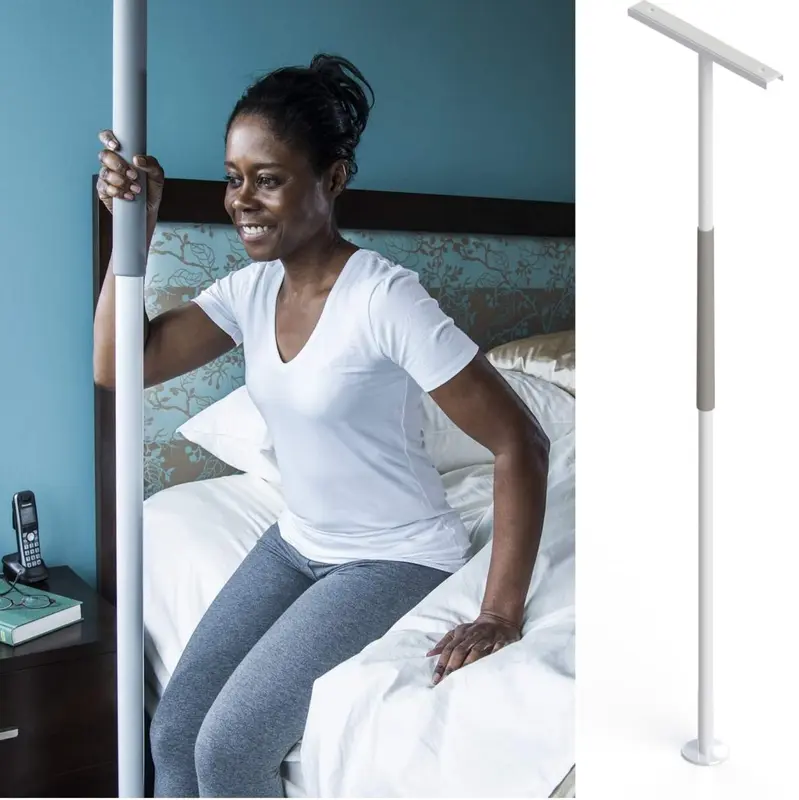
Two more kinds are sold. A floor-to-ceiling pole, such as the HealthCraft SuperPole in our catalog, is held by pressure between floor and ceiling; our catalog lists it at 300 lb (bariatric 450 lb) for ceilings of 93 to 99 inches, or up to 120 inches with an extender, with no US price. 1800wheelchair also listed a Handi-Grip Portable Grab Bar at $229 on 23 October 2026, described only as a "Portable grab bar" with "Telescoping size adjustment," the listing says; ask either maker what surfaces it may bear against.
The ratings are the makers' or listings' own figures. We did not test any bar. A rating tells you what the maker says the product will carry when it is installed as the maker's sheet describes; it says nothing about your wall, your tub or your toilet. The price ranges are the lowest and highest single-bar listings we read in each group; they are not averages.
Which grab bar goes where
Which grab bar goes where in a bathroom, and how is each kind held? Mobility Atlas read the makers' sheets, the 2010 ADA Standards and two federal fall-prevention pages in October 2026. The National Institute on Aging page advises grab bars "near toilets and on both the inside and outside of your tub and shower." For bars that take weight, the documents point to bars fixed to the building: Moen says its screws "MUST be mounted into a wood stud," and Drive's manual warns that at least two wood screws in each flange must reach the studs. A fold-down bar needs wood backing or studs, Moen's sheet says, and swings up out of the way. A suction bar is for balance: Drive's manual says "Not for body weight leverage." A clamp-on tub rail grips the tub wall; Drive's 12036 fits walls 3 to 7 inches wide. An occupational or physical therapist should judge the exact places for you.
At the toilet
The ADA Standards put one bar on the side wall nearest the toilet and one on the rear wall. If there is no wall beside the toilet, or the side must stay clear for a transfer, two other kinds are sold: a fold-down bar, which Moen's sheet says needs wood backing or studs, or a toilet safety rail or frame, which Drive's pages describe as fitted without tools. Which suits your transfer is for the therapist to judge. MedlinePlus, the National Library of Medicine's consumer health site, says you will need "another to help you stand from a sitting position."
At the bathtub
The ADA layout for a tub uses bars on the back wall, the control end and, without a permanent seat, the head end. A clamp-on tub rail is a different tool: it gives a handhold right at the edge where you step over, without drilling. MedlinePlus says you need "one to help you get in and out of the tub." If you sit to bathe, the seat or transfer bench is covered in the Mobility Atlas guide to shower chairs and tub transfer benches.
In a walk-in or roll-in shower
The ADA Standards set different layouts for a 36 by 36 inch transfer shower and for roll-in showers; we give them below as a reference. Shower sizes and thresholds are covered in the Mobility Atlas guide to walk-in tubs and roll-in showers.
Outside the bathroom
The National Institute on Aging page also suggests "installing a grab bar near the front door to provide balance while you are locking or unlocking the door," and handrails on both sides of any stairs. IRS Publication 502 lists "Adding handrails or grab bars anywhere (whether or not in bathrooms)" among improvements that can count as medical expenses, so the place does not have to be the bathroom.
Fixed bars: studs, screws and the anchors a maker allows
A fixed bar is a tube with a flange at each end, screwed through the wall into the frame of the building. It is the kind the ADA Standards describe, the kind Drive's suction bar page points to when a bar must take weight (quoted in the suction section below), and the kind MedlinePlus means when it says bars should be "secured vertically or horizontally to the wall."
What Moen's sheet requires
Moen's instruction sheet for its Home Care grab bars says plainly that "screws MUST be mounted into a wood stud for secure installation," and that "BOTH ends of the grab bar MUST be positioned over a wood stud." Its SecureMount flange "features multiple slots for screws, allowing secure connection with three screws into the wood stud at any angle," the sheet says, where conventional flanges "often only allow for one or two screw connections to the stud." Each flange takes three screws, two above the bar and one below. The sheet lists a stud finder, a level, a drill and a 1/8 inch bit among the tools, and notes that studs "are usually 16 in. apart." The sheet names no wall anchor of any kind.
What Drive's manual allows
Drive's manual for its chrome grab bars says that "Wood screws must go through the wall board or tile and attach to wood wall studs for solid support," and that "For plastic tub and shower enclosures, drill through wall and mount grab bar to wall studs." It does allow a choice for each flange, wood screws or toggle bolts, which are not included. But it also carries a warning: "At least two wood screws in each flange must be attached to wall studs or grab bar may pull out and serious injury could result." In our reading, the manual leaves toggle bolts as an extra fixing, not a replacement for the studs. If your contractor plans to use anchors, ask them to show you the line in the maker's own sheet that allows it.
Length, flange and projection
A bar's name gives its nominal length, not its overall length. Moen's spec sheet lists its 24-inch Ultima bar at 27 inches overall and its 16-inch bar at 19 inches, with a flange 3 1/8 inches across and a projection of 2 3/4 inches from the wall. Drive's page puts its knurled bar 1 1/2 inches from the wall, the ADA spacing, while its rotating-flange version sits 3 inches out. The length decides whether both flanges can land on studs. In our reading, listing names such as "concealed screw" or "exposed screw" describe how the screws look, not what they go into; check the instruction sheet for that.
Weight ratings: what 500, 300 and 250 lb mean
Every bar we read carries a number, and the numbers differ. They are the makers' or listings' claims, as printed, and they are not the same kind of number as the ADA's.
| Product | Rating as printed | Where printed |
|---|---|---|
| Moen Home Care grab bars | 500 lb. weight pull capacity | Moen instruction sheet |
| Moen R8962FD flip-up bar | supports up to 300 lbs. | Moen product page |
| Drive chrome knurled bar | Supports up to 250lbs | Drive product page |
| Comfort Grip Grab Bar | Supports users up to 419 lbs. | 1800wheelchair listing |
| Bariatric Double Fold-Up Support | Supports up to 440 lb. | 1800wheelchair listing |
| Project Source, KOHLER bars | 500-lb Weight Capacity | Lowe's listing names |
| KOHLER Cardale 9-in bar | 300-lb Weight Capacity | Lowe's listing name |
| Drive clamp-on tub rail 12036 | Weight Capacity 300 lb | Drive product page |
Moen's sheet says its 500 lb figure "exceeds ADA requirements," and its warning reads "FOR USE ONLY BY PERSONS WEIGHING LESS THAN 500 POUNDS." The flip-up bar's sheet gives "300 lb. weight pull capacity" and the same warning at 300 pounds. Both say "Consult a healthcare professional for advice and instructions specific to your needs before use."
The ADA figure is different. Section 609.8 of the 2010 Standards says "Allowable stresses shall not be exceeded for materials used when a vertical or horizontal force of 250 pounds (1112 N) is applied at any point on the grab bar, fastener, mounting device, or supporting structure." That is a requirement on the whole chain, down to the wall behind, not a label on a box. A bar rated at 500 lb on studs is a different thing from the same bar held by drywall alone.
Lowe's category page says the same in plain words: "It's important to ensure the installed bar can support the full weight of the user, which sometimes means modifying your bathroom walls to add additional structural material." Ask the contractor what the bar will be fixed into, and ask the maker whether its rating applies to that fixing. A user heavier than a bar's rating needs a bar, and a fixing, rated for them; a bariatric model is one route.
Fold-down bars
A fold-down bar, also sold as a flip-up bar or fold-up support, is a fixed bar hinged at the wall. It folds up against the wall to leave the side of the toilet clear ("Will swing against a wall for clearance," one listing says), and folds down when you need a handhold. It is screwed to a wall and swings out of the way, so it can give a handhold where there is no side wall close enough. The sheets we read do not say which wall; where it goes for you is for the therapist and the contractor to settle.
Moen's 30-inch flip-up bar
Moen's R8962FD is a 30-inch stainless bar with a 1.25-inch diameter that "supports up to 300 lbs." and "includes paper holder," the product page says; it was listed at $212.29 and shown out of stock on 22 October 2026. The instruction sheet says the "product requires wood backing/studs" and uses hex wood screws in 1/4 inch pilot holes. A separate bracket, screwed to the wall, holds the bar in the raised position; the sheet uses the bar itself, with the bracket placed 20 inches from the wall plate, to mark where that bracket goes. The warning sets the limit at persons "WEIGHING LESS THAN 300 POUNDS" and adds: "Check grab bar periodically after installation to be sure all screws are secure."
Other fold-up supports
1800wheelchair listed three other fold-up supports on 23 October 2026: the ARC Fixed Leg Fold-up Support at $459, which "Will swing against a wall for clearance"; a Fold-up Support without Leg at $508; and a Bariatric Double Fold-Up Support Bar at $557, listed as supporting "up to 440 lb." with an "Adjustable leg allows height variance to suit user." Only the bariatric model's card gives a rating. The listings do not say how the leg changes the load or the fitting; ask the maker for the fitting sheet before you buy.
In our reading, a fold-down bar works as a long lever on its wall plate: weight on the far end pulls on the screws at the wall. Moen's sheet says only that the product "requires wood backing/studs"; ask the contractor to confirm what is behind the wall before choosing the spot. Whether you need the side clear, and on which side of the toilet the bar should be, is a question for the therapist who knows how you transfer.
Suction bars: balance assist only
A suction bar is a handle on rubber suction cups, each with a lever that creates the vacuum. It needs no drill and can be moved, the listings say. Drive and the MHI listing are clear about what it is for. Drive's product page for its 12-inch and rotating suction bars says: "CAUTION: Grab Bar is to be used as a balance assist only. It is not intended to support body weight, and body weight should not be applied to grab bar." Its owner's manual says it more briefly: "Grab bar is to be used as a balance assist only. Not for body weight leverage."
The same page points to the alternative: "If a device is required to bear any body weight, or is used for leverage, it is recommended that a traditional, permanently mounted grab bar be installed." The MHI Safe-er-grip listing on Lowe's says the bar is "to be used only to assist and help balance a persons body, not to stand full body weight," and its specifications read "ADA Compliant: No."
Where a suction bar can hold
- Drive's manual says the pads "adhere to any smooth, pore-tight surface without drilling," and that the discs should sit at least half an inch away from all joints, so no disc covers a grout line.
- The MHI listing says the bar is "not on painted surfaces such as drywall," and that tiles must be at least 4 by 4 inches so the cups miss the grout, because grout "will allow air to move under the suction cup thereby releasing its hold."
- Drive's cups have indicators that change "from RED to GREEN when a safe and secure hold is achieved," the manual says, and "If the required suction power has not been achieved, the rail should not be used."
Testing it every time
Drive's manual asks you to "test the holding grip on each surface, each time you apply the suction pad to prevent accidents," and, before each use, to check that both indicators are green; the product page adds that if the bar "can be moved or feels at all loose," you flip up the latches and reattach it. Rubber ages: the manual says never to leave the discs in sunlight for long "otherwise they will quickly lose their elasticity," and to replace cups that show damage. Drive's limited lifetime warranty "does not extend to non-durable components, such as rubber accessories." The MHI bar carries a 1-year limited warranty, its Lowe's listing says.
Drive's 12-inch suction bar weighs 0.5 lb and its 19.75-inch rotating bar 1.0 lb, its specifications say. On 23 October 2026 they were listed at $30 and $35 on 1800wheelchair; MHI suction bars ran from $17.99 to $27.98 at the Lowe's store set to Anchorage.
Clamp-on tub rails
A clamp-on tub rail is a steel handle on a bracket that clamps over the side wall of a bathtub. You turn a knob to tighten the clamp, with rubber pads where it touches the tub. It gives a handhold right where you step over the rim, needs no drilling, and comes off when you move. Its limits come from the tub: the clamp must fit the tub wall, and the tub must take the squeeze.
What Drive's pages say
Drive's clamp-on tub rail, item 12036, is white powder-coated steel with a "Stainless steel locking mechanism and non-wearing rubber pads," a width that adjusts from 3 to 7 inches, tool-free fitting and a weight capacity of 300 lb, its page says. An adjustable version, RTL12036-ADJ, adds a height adjustment of 14.5 to 17 inches. Drive's AquaSense steel bath safety rail, item 785-350, fits tub walls between 3 and 7 inches wide, adjusts its height with a push pin and offers "solid support up to 300 lbs."
The page says the rail "Fits most tubs (Tighten carefully when using with Fiberglass tubs)." The manual is sharper: "Please use extreme care when installing on fiberglass tub. DO NOT OVERTIGHTEN as the clamp may crack the fiberglass." It also asks you to clean and dry the tub first, because "Contact surfaces must be dry and free of soapy residue to assure secure installation," and to test the rail by pulling it "forward, back and side to side."
It loosens: retighten it
Drive's manual says "Safety Rail often requires retightening from time to time. Check periodically before use and retighten as needed." Put the check into the routine: a firm pull in each direction before the bath.
1800wheelchair listed the Sure-Safe Bathtub Rail at $56, the Drive Bath Shower Tub Grab Rail at $59 (16.5 inches high, an adjustable 3 to 6.25 inch fit, weight capacity 300 lbs.) and a Clamp-On Bath Tub Rail at $63 on 23 October 2026. Measure your tub wall before you order, and ask the therapist whether a rail will get in the way of a tub transfer bench if you use one.
Toilet safety rails and frames
A toilet safety rail or frame gives you two armrests beside the toilet to push on as you sit and stand. Some attach to the toilet; others stand on the floor around it. Neither needs a wall, so they suit toilets with no wall beside them and homes where you cannot drill.
| Product | Fit, as printed | Capacity, as printed | Listed price |
|---|---|---|---|
| Drive Toilet Safety Rail RTL12087 | 16.5 to 19.5 in between handles | 300 lbs | Maker shows no price |
| Drive free-standing rail RTL12079 | 21 in between arms; 26.5 in wide | 300 lb | Maker shows no price |
| Drive frame with padded armrests | Height and width adjustable | 300 lbs. | $59 (1800wheelchair) |
| Adjustable Toilet Safety Rail | Not stated on the card | Not stated | $66 (1800wheelchair) |
| VersaFrame adjustable height | Arm height 28 to 32 in | Not stated | $71 (1800wheelchair) |
Drive's page says its toilet safety rail "Allows individuals to safely sit or stand," has "Easy, tool-free assembly and installation" and padded handles, and weighs 10.5 lbs. The free-standing version uses "Easy, tool-free assembly using wing nuts," "Fits standard and elongated toilets" and comes with a magazine rack. A 1800wheelchair listing at $187 for a Toilet Safety Frame is for a "case of 4 pieces," so it is not a single-frame price.
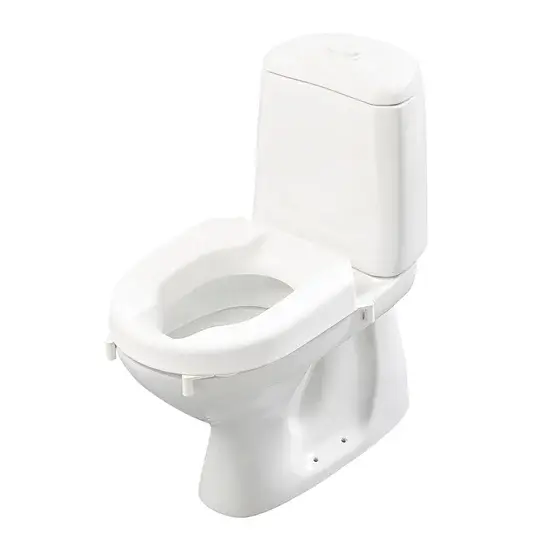
Measure the space beside the toilet before you buy. A free-standing rail 26.5 inches wide needs that much floor around the bowl, and ask the therapist whether a frame will be in the way of how you transfer. Raised toilet seats, toilet frames in depth, drop-arm commodes and what the FDA's reports show about them are in the Mobility Atlas guide to bedside commodes, raised toilet seats and toilet frames; we do not repeat it here.
The ADA numbers, as a reference for a home
How high should a grab bar be, and what do the ADA numbers mean at home? Mobility Atlas read sections 604 and 607 to 610 of the 2010 ADA Standards in October 2026. Section 609 puts grab bars horizontal, 33 to 36 inches above the finish floor, with 1 1/2 inches between bar and wall. A round bar is 1 1/4 to 2 inches across, and bars "shall not rotate within their fittings." Under 609.8, the bar and everything holding it must take a 250 pound force. At the toilet, the side bar is at least 42 inches long and the rear bar at least 36. These Standards are written for facilities the ADA covers. For dwelling units they let bars be left out if walls are reinforced for them, and allow toilet seats 15 to 19 inches high. For a privately owned home, we use them as a reference; we did not read any rule that applies them to one.
| Item | 2010 ADA Standards | Section |
|---|---|---|
| Height | 33 to 36 in to top of gripping surface | 609.4 |
| Position | Horizontal | 609.4 |
| Round bar diameter | 1 1/4 to 2 in | 609.2.1 |
| Non-round bar | 2 in max across; 4 to 4.8 in around | 609.2.2 |
| Space to wall | 1 1/2 in | 609.3 |
| Space to objects above | 12 in min | 609.3 |
| Rotation | Must not rotate in fittings | 609.6 |
| Strength | 250 lb force, bar to wall structure | 609.8 |
| Children's toilets | 18 to 27 in high | 609.4, 604.9 |
Drive's manual makes the same point about where these rules come from: "The ADA & CSA provide guidelines for public accommodations and commercial facilities." It then offers "some additional tips to consider when installing a grab bar in your own personal residence," such as keeping objects above the bar at least 12 inches away. A label that says "ADA compliant" describes the bar; whether an installed bar meets the Standards depends on where it is and what holds it.
A person who is shorter or taller, transfers from one side only, or stands with help may need bars elsewhere. Use the numbers to brief a contractor and to ask good questions, and let the therapist set the heights for you.
Toilet bars in the Standards
Section 604 of the 2010 ADA Standards sets out the toilet, which it calls the water closet. These are the figures, as a reference.
- Location: the toilet's centerline is 16 to 18 inches from the side wall, with a wall to the rear and one side (604.2).
- Clear space: 60 inches from the side wall and 56 inches from the rear wall (604.3.1).
- Seat height: 17 to 19 inches to the top of the seat; "In residential dwelling units, the height of water closets shall be permitted to be 15 inches (380 mm) minimum and 19 inches (485 mm) maximum," the Standards say (604.4).
- Side wall bar: 42 inches long minimum, 12 inches maximum from the rear wall, extending 54 inches minimum from the rear wall (604.5.1).
- Rear wall bar: 36 inches long minimum, extending 12 inches on one side of the toilet's centerline and 24 inches on the other; 24 inches centered where a recessed fixture leaves no room (604.5.2).
- Toilet paper: the dispenser "shall not be located behind grab bars," 7 to 9 inches in front of the toilet (604.7), the Standards say.
For dwelling units, section 604.5 says, in an exception that matters for anyone remodeling: "In residential dwelling units, grab bars shall not be required to be installed in toilet or bathrooms provided that reinforcement has been installed in walls and located so as to permit the installation of grab bars complying with 604.5." The Access Board's advisory adds that "Reinforcement must be sufficient to permit the installation of rear and side wall grab bars that fully meet all accessibility requirements including, but not limited to, required length, installation height, and structural strength." That is the idea to borrow for a home: if the walls are open, put solid backing where the bars may one day go.
The Standards also give advisory figures for children's toilets: grab bars 18 to 20 inches high for ages 3 and 4, 20 to 25 inches for ages 5 to 8, and 25 to 27 inches for ages 9 to 12. In an ambulatory toilet stall, 35 to 37 inches wide, they call for a side bar on both sides.
Tub and shower bars in the Standards
Bathtubs (607.4)
For a tub with a permanent seat at the head end, the Standards put two bars on the back wall, one at the usual 33 to 36 inches and one 8 to 10 inches above the rim, each within 15 inches of the head end wall and 12 inches of the control end wall, plus a bar at least 24 inches long on the control end wall at the front edge of the tub. For a tub without a permanent seat, the two back wall bars are each at least 24 inches long and within 24 inches of the head end; the control end bar is the same; and a bar at least 12 inches long goes on the head end wall at the front edge.
Transfer showers (608.3.1)
In a 36 by 36 inch transfer shower, "grab bars shall be provided across the control wall and back wall to a point 18 inches (455 mm) from the control wall," the Standards say.
Roll-in showers (608.3.2 and 608.3.3)
In a standard roll-in shower with a seat, bars go on the back wall and the side wall opposite the seat, and "Grab bars shall not be provided above the seat." Without a seat, bars go on three walls. In an alternate roll-in shower, bars go on the back wall and the side wall farthest from the entry, and not above the seat. In both types, bars are within 6 inches of the adjacent walls. Where several bars are used, "required horizontal grab bars shall be installed at the same height above the finish floor." If an adjustable-height shower head on a vertical bar is used, that bar must be installed "so as not to obstruct the use of grab bars," the Standards say.
The same dwelling-unit exception appears for tubs (607.4) and showers (608.3): bars are not required if reinforcement has been installed so they can be added. For shower sizes, thresholds and seats, see the Mobility Atlas guide to walk-in tubs and roll-in showers.
Horizontal, vertical or diagonal?
The documents do not agree, and it is worth knowing why. The ADA Standards say grab bars "shall be installed in a horizontal position." MedlinePlus says grab bars "should be secured vertically or horizontally to the wall, not diagonally." Moen's sheet offers horizontal, vertical and diagonal fitting, and says "Diagonal/angled installation is possible only with grab bars 24 in. or longer." Drive's knurled bar "Mounts vertically or horizontally."
Each is answering a different question. The Standards describe one layout for facilities the ADA covers. The MedlinePlus page gives general advice for adults at home. Moen's sheet says what its flange can be fixed to safely. None of them knows how you move. Ask the therapist to watch you use the bathroom, and to write down the angle and height of each bar.
Angled and L-shaped bars are sold too: Moen listed 90 degree 36-inch and 42-inch designer bars at $227.08 and $334.36 on 22 October 2026, and 1800wheelchair an ARC 90° Angled Comfort Grip Grab Bar at $275 on 23 October. An L-shaped bar gives a horizontal and a vertical grip in one piece; ask whether both ends can land on studs in your wall.
Walls: studs, tile, fiberglass and backing
For a fixed bar, the documents put the load on what is behind the wall. These are the points the documents we read raise, and the questions they leave for your contractor.
- Wood studs. Both Moen and Drive fix their bars to wood studs. Moen's Home Care sheet names only wood studs, and its flip-up sheet wood backing or studs; Drive's manual allows toggle bolts in a flange only alongside at least two wood screws into studs.
- Tile. Drive's manual says to "Use masonry bit to drill through tile or grout," and to caulk around the flanges "to prevent moisture from seeping in"; Moen's sheet offers silicone caulk on the back of the decorative cover "to guard against water penetration."
- Plastic or fiberglass tub and shower surrounds. Drive's manual says to "drill through wall and mount grab bar to wall studs," not into the plastic alone.
- Reinforcement. The ADA's dwelling-unit exception rests on walls with reinforcement that can carry bars of full length, height and strength. In a remodel, ask for that backing while the wall is open.
- Anything else. None of the sheets we read covers metal studs, masonry, concrete or hollow walls without studs. If your walls are any of these, ask the maker, in writing, what fixing it approves for its rating.
Towel bars are not grab bars. MedlinePlus says: "Do not use towel racks as grab bars. They can't support your weight." One of the two CPSC recalls we found, described later, involved a combined towel and grab bar that could break when the towel bar was used for support.
Lowe's category page advises: "When in doubt, consult a qualified professional to ensure that your grab bars are installed to code." Local building codes are not in the documents we read; ask your local building department what, if anything, applies to grab bars in a private home.
Hiring someone to fit grab bars
Fitting a fixed or fold-down bar means finding the frame behind a finished wall and drilling through tile without cracking it. You may want a contractor or handyman for the job; the Medicare Advantage manual lets a plan include installation in a bathroom safety benefit, as described below. The maker's sheet is the instruction for the job, so give it to whoever does the work.
What to ask the contractor
- What will each flange be screwed into: wood stud, added backing, or something else?
- Will you follow the maker's instruction sheet, and does it allow the fixing you plan?
- How many screws go into the stud at each end, and how long are they?
- How will you drill tile or a fiberglass surround without cracking it, and will you seal the flanges?
- At what height, measured from the finished floor to the top of the bar, will you set it?
- Will you add backing in other places while the wall is open, for bars I may need later?
- Are there pipes or wires behind the spot, and how will you check?
- What does your quote include, and do you guarantee the work?
- Will you pull on each bar in front of me when it is done?
None of the documents we read gives a labor price for fitting a grab bar, so we give none. Ask for a written quote that lists each bar, its model, the fixing and the height. Moen gives a help line on its sheets for questions about fitting its bars, 1-800-289-6636 for Home Care bars and 1-800-882-0116 for the flip-up bar. If you rent, get the owner's written consent before anyone drills; the VA's HISA page, for example, asks renters for "A signed and notarized statement from the owner." The suction bar, tub rail and toilet frame sections above cover options that need no drilling.
Mobility Atlas can help you find a product: send us an enquiry with the bars your therapist has suggested and the size of your bathroom, and ask us to find it or request a quote for you.
What grab bars cost in 2026
These are listed prices read between 19 and 23 October 2026: Moen on 22 October, Lowe's and 1800wheelchair's grab bar page on 23 October, and 1800wheelchair's toilet accessories page on 19 October. They are for the bar or rail alone. Prices differ by country, store, dealer and funding, so treat them as a range to check, not a quote.
Fixed wall bars
| Bar | Length | Listed price (USD) | Where |
|---|---|---|---|
| Project Source exposed screw, stainless | 24 in | 16.28 | Lowe's, Anchorage store |
| Drive White Powder Coated Grab Bar | Not stated | 25 | 1800wheelchair |
| Project Source concealed screw, stainless | 18 in | 32.98 | Lowe's, Anchorage store |
| Project Source concealed screw, stainless | 24 or 36 in | 38.98 | Lowe's, Anchorage store |
| Graham-Field Chrome Grab Rail | Not stated | 45 | 1800wheelchair |
| Project Source concealed peened | 24, 36, 42 in | 52.98 to 63.98 | Lowe's, Anchorage store |
| allen + roth Townley | 24 in | 60.98 to 65.98 | Lowe's, Anchorage store |
| Drive Chrome Knurled Grab Bar | 12 to 32 in | 65.90 | 1800wheelchair |
| KOHLER Cardale or Ealing | 16 or 24 in | 65.98 to 74.98 | Lowe's, Anchorage store |
| Moen Home Care LR8724D3GCH | 24 in | 70.40 (regular 80.25) | Moen, 22 Oct |
| ARC Flat End or Cranked | Not stated | 71 | 1800wheelchair |
| Comfort Grip Grab Bar | 12 to 42 in | 94 | 1800wheelchair |
| Moen Align YG0442BN | 42 in | 219.88 | Moen, 22 Oct |
| Moen 90 degree YG8836CH, YG8842CH | 36 or 42 in | 227.08 to 334.36 | Moen, 22 Oct |
Short assist bars are sold too: Lowe's listed a 9-inch KOHLER Cardale at $54.98 and a 9-inch allen + roth assist bar at $28.98, both with "300-lb Weight Capacity" in the listing name. A 9-inch bar is shorter than any bar the ADA Standards describe, so ask the therapist what it is for before you buy one.
Fold-down, suction, tub and toilet rails
| Product | Type | Listed price (USD) | Where |
|---|---|---|---|
| MHI suction bars (Safe-er-grip and other), 12 or 16 in | Suction | 17.99 to 27.98 | Lowe's, Anchorage store |
| Drive Suction Cup Grab Bar, 12 in | Suction | 30 | 1800wheelchair |
| Drive rotating suction bar | Suction | 35 | 1800wheelchair |
| Sure-Safe Bathtub Rail | Clamp-on tub rail | 56 | 1800wheelchair |
| Drive Bath Shower Tub Grab Rail | Clamp-on tub rail | 59 | 1800wheelchair |
| Clamp-On Bath Tub Rail | Clamp-on tub rail | 63 | 1800wheelchair |
| Drive Toilet Safety Frame, padded | Toilet frame | 59 | 1800wheelchair |
| Adjustable Toilet Safety Rail | Toilet rail | 66 | 1800wheelchair |
| VersaFrame adjustable height | Toilet frame | 71 | 1800wheelchair |
| Moen R8962FD, 30 in | Fold-down | 212.29 | Moen, 22 Oct |
| ARC Fixed Leg Fold-up Support | Fold-down | 459 | 1800wheelchair |
| Fold-up Support without Leg | Fold-down | 508 | 1800wheelchair |
| Bariatric Double Fold-Up Support Bar | Fold-down | 557 | 1800wheelchair |
The Moen prices are those shown on moen.com; for LR8724D3GCH the page showed a "Sale price" of $70.40 and a regular price of $80.25. Lowe's showed 299 results in its grab bar category; we list the first rows of the grid and the carousels on the same page, and left out items the page marked as unavailable. 1800wheelchair's category showed 19 results. In this set, the lowest-priced fixed bar was one store's 24-inch exposed-screw bar at $16.28; the same brand's 24-inch concealed-screw bar was $38.98.
Fitting costs: the number no document gives
The work is finding the studs, drilling tile, adding backing if a stud is not where the bar must go, and sealing the flanges. None of the twenty-one documents we read publishes a labor price for that work, and we give none.
The makers' sheets, described above, show what the work involves. Lowe's category page warns that fitting bars "can sometimes be challenging" and may mean modifying walls.
Ask two contractors for a written quote for the same list of bars, at the same heights, with the fixing named for each. If funding is involved, ask for an itemized estimate from the start: the VA's HISA benefit, for example, asks for "A written itemized estimate of costs for labor, materials, permits, and inspections," its page says. If a Medicare Advantage plan offers a bathroom safety benefit, ask whether installation is included; the manual describes "providing and installing" safety devices as part of what a plan may offer.
Does Medicare cover grab bars?
Does Medicare cover grab bars, tub rails or toilet safety rails? Mobility Atlas read medicare.gov's equipment pages, Medicare's national equipment list, the Benefit Policy Manual and the Medicare Advantage manual in October 2026. The medicare.gov pages we read do not list grab bars at all, as covered or not covered. The CMS rule is in NCD 280.1, which reads, for grab bars: "Deny - self-help device; not primarily medical in nature." The Benefit Policy Manual counts "self-help devices (such as safety grab bars)" as nonmedical. The same list denies raised toilet seats and bathtub seats, and the rows we read name no tub rail or toilet frame. Medicare Advantage plans "may choose to offer" bathroom safety devices that Original Medicare does not cover, the manual says, sometimes with an in-home inspection. Outside Medicare, IRS Publication 502 lets grab bars count as a medical expense in some cases (see below), and VA and USDA programs may help. Rules differ by plan; ask in writing before you buy.
What the national list says, row by row
| Item on NCD 280.1 | Coverage as written |
|---|---|
| Grab Bars | Deny: self-help device; not primarily medical |
| Raised Toilet Seats | Deny: convenience item; hygienic equipment |
| Toilet Seats | Deny: not medical equipment |
| Bathtub Seats | Deny: comfort or convenience; hygienic |
| Bathtub Lifts | Deny: convenience item |
| Commodes | "Covered if patient is confined to bed or room" (as CMS states it) |
The Benefit Policy Manual, chapter 15, section 110.1, explains the reasoning. Durable medical equipment must be "primarily and customarily used to serve a medical purpose," among other tests, and the manual says that "self-help devices (such as safety grab bars)" are "considered nonmedical in nature." The list has no row for clamp-on tub rails or toilet safety frames in the parts we read; a supplier who says Medicare will pay for one should show you the rule in writing.
What medicare.gov says, and does not say
Medicare.gov's page on durable medical equipment lists what Medicare-covered equipment "includes, but isn't limited to," from canes and commode chairs to walkers and wheelchairs. Grab bars are not on it. A search of medicare.gov for "grab bars" on 23 October 2026 returned four pages, none of which says whether grab bars are covered, and a word search of the Medicare and You 2027 handbook found no mention of grab bars. The CMS documents above are where the rule is written.
Drive's product pages print HCPCS billing codes, E0241 for its suction and chrome bars and E0246 for its tub rail. A billing code on a maker's page is not a coverage decision. Ask the plan, in writing, before you assume a code means it will pay. Commodes, which Medicare does cover in narrow cases, are explained in the Mobility Atlas guide to bedside commodes.
Medicare Advantage: an extra benefit a plan may offer
Medicare Advantage plans can offer benefits that Original Medicare does not. The Medicare Managed Care Manual, chapter 4 (revision 121, issued April 2016), lists "Bathroom Safety Devices" among the supplemental benefits a plan may offer. It says "MA plans may choose to offer, as a supplemental benefit, provision of specific non-Medicare-covered safety devices to prevent injuries in the bathroom." In addition to "providing and installing appropriate safety devices," the benefit "may include an in-home bathroom safety inspection conducted by a qualified health professional."
The same section describes an "In-Home Safety Assessment" that "should be performed by an occupational therapist or other qualified health provider." Its focus is "the beneficiary's risk for falls or injuries and identification of how falls may be prevented," and the devices installed should be "determined to be necessary by the occupational therapist or other qualified health provider" who did the assessment, and "approved by the beneficiary," the manual says. The manual limits this assessment to enrollees who do not qualify for one under Original Medicare's home health benefit. The assessment may also cover "minor modification of some home hazards outside of the bathroom," such as removing loose rugs.
The manual's list is "intended to be illustrative, not exhaustive," and it does not name grab bars, tub rails or toilet frames. The section we read sets no dollar limit. Whether your plan offers the benefit, which devices it includes, and whether a contractor or the plan fits them, is in your plan's own documents.
- Does my plan include bathroom safety devices this year, and which ones?
- Is there a dollar limit or a list of approved suppliers?
- Does the plan send someone to assess the bathroom first, and who?
- Does the plan install the bars, and into what kind of fixing?
- Can you confirm all of this in writing before I order?
Other ways to pay: the VA, USDA, tax rules and local programs
VA Home Improvements and Structural Alterations (HISA)
The VA's HISA benefit pays for medically necessary changes to a veteran's or servicemember's primary residence, including "Use of essential lavatory and sanitary facilities (e.g. roll in showers)," the VA's page says. The lifetime amount is $6,800 for a service-connected disability, for some disabilities treated as service-connected, or for a non-service-connected disability when the person has a service-connected rating of at least 50 percent, and $2,000 for other disabilities. The page does not name grab bars. It excludes "removable equipment or appliances such as portable ramps." In our reading, clamp-on rails and suction bars may fall under that exclusion, so ask your local Prosthetic and Sensory Aids Service whether fixed bars, and which work, can be part of a HISA project before you plan any bathroom work.
An application needs a prescription written or approved by a VA physician, VA Form 10-0103, an itemized estimate, and "A color photograph of the unimproved area," the page says. Renters need "A signed and notarized statement from the owner authorizing the improvement or structural alteration." The VA may inspect the site.
USDA Section 504 home repair loans and grants
USDA Rural Development's Section 504 program lends to low and very-low-income homeowners in eligible rural areas who live in the home and cannot get affordable credit elsewhere, to "repair, improve or modernize their homes," and gives grants to homeowners aged 62 or older with very low income "to remove health and safety hazards," the program page says. Loans go up to $40,000, fixed at 1 percent over 20 years; grants up to $10,000, a lifetime limit; the two can be combined up to $50,000. Grants must be repaid if the property is sold in less than 3 years. The page does not mention grab bars, accessibility or disability; ask a USDA home loan specialist whether bathroom safety work counts for you.
IRS: grab bars as a medical expense
IRS Publication 502 says you can include in medical expenses amounts you pay "for special equipment installed in a home or for improvements if their main purpose is medical care." Among improvements that usually do not raise the value of a home, and so can count in full, it lists "Installing railings, support bars, or other modifications to bathrooms" and "Adding handrails or grab bars anywhere (whether or not in bathrooms)." It adds that "Only reasonable costs to accommodate a home to your disabled condition are considered medical care," not extra costs "for architectural or aesthetic reasons." You can deduct only the part of medical expenses that is more than 7.5 percent of adjusted gross income, and only if you itemize on Schedule A (Publication 502 for 2025). Ask a tax adviser.
Local programs and charities
The National Institute on Aging page says many state and local governments have home modification programs to help older people prevent falls, and suggests the Eldercare Locator, 800-677-1116, to find your local Area Agency on Aging. We did not read their documents or any Medicaid or state program rules, so we give no figures. The Mobility Atlas guides to walk-in tubs and roll-in showers and wheelchair ramps cover HISA and other home modification funding in more depth.
Recalls: what the CPSC file shows
We searched the U.S. Consumer Product Safety Commission's recall records on 23 October 2026 under many names, from grab bar and tub rail to toilet safety and suction. Two recalls involve bathroom grab bars. We found no CPSC recall for clamp-on tub rails, bath rails, toilet safety rails or suction grab bars, and a search of FDA device recalls for grab bars, tub rails, bath rails and toilet safety rails returned no matches.
Signature Hardware Pickens Flip Up Towel Grab Bars, 5 May 2021
The recall covers about 330 units, plus about 5 sold in Canada, of a product with "a straight bar designed for hanging towels and a curved grab bar designed for bodily support," the recall says. The hazard, as written: "The product can break, if the towel bar is used to provide bodily support, posing fall and injury hazards." Signature Hardware had received 13 reports of the towel bar and grab bar detaching or partially detaching from each other, including two reports of falls. The bars were sold online from May 2012 through October 2020 for about $140. The remedy: stop using the product and contact Signature Hardware for "a full refund or a free replacement grab bar."
Mansfield Plumbing bathtubs with acrylic grab bars, 23 August 2012
The recall covers about 100 acrylic bathtubs, whirlpools and air massage bathtubs whose acrylic grab bars "are affixed to the interior of the tubs about shoulder height from a seated position," the recall says. The hazard: "The grab bars used on the products can loosen and break, posing a fall hazard to consumers." The firm had received 11 reports of grab bars breaking, including one fall with an injury. The tubs were sold from May 2011 through July 2011 for between $1,800 and $5,000; the remedy was a free grab bar repair kit from Mansfield.
Two recalls do not show how often bars fail. Check your bar's maker and model on the CPSC's recall site, and report a bar that breaks or pulls out of the wall to the CPSC. Problems with toilet safety frames and rails, and how to report them to the FDA, are covered in the guide to bedside commodes and toilet frames.
Checks the makers ask for
Most makers we read ask you to check their product, not just once at fitting. These are their own instructions, gathered in one place.
| Product | Check, as the maker puts it | When, as the maker puts it |
|---|---|---|
| Fixed bar (Drive) | Check periodically for tightness | Periodically |
| Flip-up bar (Moen) | Be sure all screws are secure | Periodically after installation |
| Suction bar (Drive) | Test the firm hold; both indicators green | Before each use |
| Clamp-on tub rail (Drive) | Retighten as needed | Periodically before use |
| Suction cups (Drive) | Check for deterioration; replace if damaged | Not stated |
| Toilet rail or frame (Drive) | No check given on the pages we read | Not stated |
Drive's manual for its chrome bar adds: "Never use grab bar if any looseness is detected as it could result in personal injury." Moen's sheets say to contact Moen at once "if any components are missing or damaged," and "Do not modify this product in any way." If a fixed bar moves, stop using it and call the person who fitted it; if a suction bar's indicator shows red, the seal is not airtight, Drive's page says, and the manual says the rail "should not be used" until the required suction is reached.
Look at the wall too. Drive caulks its flanges to keep moisture out; we suggest calling the fitter if tile or grout around a flange cracks.
For toilet rails and frames, the Drive pages we read give no check interval. The guide to bedside commodes and toilet frames covers what FDA reports describe for frames and rails that came loose.
Three traps
Trap one: leaning your weight on a suction bar. A suction bar is easy to fit, costs little, and looks like a grab bar. Its maker calls it something else. Drive's manual calls it a balance assist only, as quoted in the suction section above, and the MHI listing says the same in its own words. If you push up on a bar to stand, or pull on it to step out of a tub, the documents point to a fixed bar screwed into the frame.
Trap two: trusting a towel bar or a decorative bar. MedlinePlus warns against using towel racks as grab bars, as quoted in the section on walls above, and the 2021 Signature Hardware recall, described above, involved a combined towel and grab bar that could break when the towel bar was used for support. Use a bar sold as a grab bar, with a printed rating, fitted to the maker's sheet.
Trap three: reading "ADA compliant" as a promise about your wall. Most fixed bars we read at Lowe's were sold as "ADA Compliant," and Moen says its bars meet or exceed applicable ADA requirements. That describes the bar. The ADA's 250 pound strength requirement in section 609.8 covers the bar, the fastener, the mounting device and the supporting structure, which is your wall. A bar sold as compliant but held by drywall alone would not be what 609.8 describes.
Three composite scenarios
These are composite scenarios, not individual customers. Each one combines facts and ranges already given in this guide to show how the decision plays out.
Scenario one: a wheelchair user who transfers sideways to the toilet has a wall on the left and open space on the right, where the chair parks. The occupational therapist suggests a fixed bar on the side wall and a fold-down bar on the right, so the transfer side stays clear. They compare Moen's 30-inch flip-up bar, listed at $212.29 and rated by Moen at 300 lb, with other fold-up supports listed at $459 to $557 (only the $557 bariatric model's listing gives a rating, 440 lb). The contractor confirms wood backing behind the toilet before quoting, and they ask a tax adviser about IRS Publication 502.
Scenario two: an older adult who walks with a cane rents an apartment with a tub and a shower over it, and the owner will not allow drilling. The physical therapist suggests a clamp-on tub rail for stepping over the rim and a toilet safety rail. They measure the tub wall and check the fit range printed for the rail they choose: Drive's 12036 page gives 3 to 7 inches, while the $59 Drive rail on 1800wheelchair is listed at 3 to 6.25 inches, and the $56 and $63 rails' cards give no range. The therapist adds a suction bar for balance at the shower controls, and they test its indicators before every use, as Drive's manual asks.
Scenario three: a veteran with a service-connected disability is remodeling the bathroom. They ask their Medicare Advantage plan whether bathroom safety devices are included this year, and the VA's Prosthetic and Sensory Aids Service whether HISA, with its $6,800 lifetime amount, can fund the work. The contractor adds backing in the walls while they are open, as the ADA's dwelling-unit exception describes, so bars can be added later at 33 to 36 inches or wherever the therapist sets them.
Questions for the therapist and the plan
For the occupational or physical therapist
- Where should each bar go for me, at what height, and at what angle?
- Which side of the toilet should stay clear for my transfer, and do I need a fold-down bar there?
- Should I lean my weight on this bar, or only use it for balance?
- Would a clamp-on tub rail or a toilet frame work for me, or get in the way?
- How might my needs change, and where should the contractor add backing for later?
- Can you write down the heights and positions for the contractor?
MedlinePlus says that if you are not sure what changes you need, you can "ask your health care provider for a referral to an occupational or physical therapist," who "can visit your bathroom and make safety recommendations." The National Institute on Aging page says that after a fall, a doctor might suggest an occupational therapist, physical therapist or nurse visit your home.
For the plan or funder
- Are grab bars, tub rails or toilet frames covered, and under which benefit?
- Is there an in-home assessment first, and who does it?
- Is installation included, and by whom?
- Can you confirm the answer in writing before I buy?
Your plan: 10 minutes, today, this week
In 10 minutes: standing steady, with someone beside you if your balance is uncertain, check each bar and rail you use with a firm pull, without putting your weight on it. Stop using anything that moves, and stop using any towel bar for support.
Today: measure the tub wall, the space beside the toilet and the height of the toilet seat. Look up the maker and model of any bar you already have on the CPSC's recall site.
This week: ask your doctor for a referral to an occupational or physical therapist for a bathroom visit, call your plan about bathroom safety benefits, and ask two contractors for written quotes that name each bar, its height and its fixing.
How we compared
We read twenty-one saved documents between 15 and 23 October 2026, the relevant parts in full: the 2010 ADA Standards sections on toilets, tubs, showers and grab bars; Moen's pages, spec sheet and instruction sheets; Drive Medical's product pages and owner's manuals; the National Institute on Aging and MedlinePlus pages; medicare.gov and the CMS manuals; IRS Publication 502; the USDA Section 504 and VA HISA pages; the CPSC recall records; and the listed prices on 1800wheelchair's and Lowe's category pages.
We also read six rows of our own catalog. We did not test any bar, rail or frame, pull on one, or fit one to a wall. Every rating in this guide is the maker's or the listing's own figure, as printed.
Three sources need a word of caution. The Lowe's prices are those shown for the store the site chose for our browser, Anchorage, Alaska, on 23 October 2026; the page showed prices for that store only, and prices may differ by store and by day. Moen's prices were read on moen.com on 22 October 2026; the two Moen product pages we read (LR8724D3GCH and R8962FD) showed those bars as out of stock, and the other Moen prices are from the same page's recommended products, with no stock status recorded. Drive's own pages show no prices ("SIGN IN TO VIEW PRICE"), so Drive prices here are 1800wheelchair's listings.
The guide is written for the United States. Building rules, funding and prices differ in the UK, the EU and elsewhere; confirm with your local authority, funder or contractor before you buy.
Sources and documents
The documents are those named in the section on how we compared, above; every one is linked in the list at the end of this page.
Related guides on Mobility Atlas: Shower chairs and tub transfer benches; Bedside commodes, raised toilet seats and toilet frames; Walk-in tubs and roll-in showers; Wheelchair ramps.
Method in brief: the section on how we compared, above, lists what we read and how; where a bar should go for a person belongs to an occupational or physical therapist.
Prices checked October 2026 on Moen's, 1800wheelchair's and Lowe's pages (the Lowe's store set to Anchorage, Alaska); our catalog gives no price for the rows named here; prices change and differ by store, dealer, country and funding, so confirm them in a written quote. Documents checked October 2026: the ADA Standards, the makers' sheets and manuals, the NIA and MedlinePlus pages, the Medicare and CMS documents, the IRS, USDA and VA pages, and the CPSC recall records.
This article is general information. Rules and prices differ by country and change, so confirm them before you buy or travel.
Common questions
How high should grab bars be?
The 2010 ADA Standards put grab bars horizontal, 33 to 36 inches above the finish floor measured to the top of the gripping surface, and 1 1/2 inches from the wall. They are written for facilities the ADA covers; for a privately owned home, Mobility Atlas uses them as a reference, and an occupational or physical therapist can set heights that fit how you move. Ask your local building department whether any rule applies to your home.
Are suction grab bars safe to lean on?
Their makers say not. Drive's manual says its suction bar is "to be used as a balance assist only. Not for body weight leverage," and its page recommends a permanently mounted bar if any body weight is needed. Check that both indicators show green before every use, and fit them only on smooth, non-porous surfaces, never on painted drywall; on tile, every cup must clear the grout lines.
Does Medicare cover grab bars?
Original Medicare does not. CMS's national equipment list, NCD 280.1, reads for grab bars: "Deny - self-help device; not primarily medical in nature." The medicare.gov pages we read do not list them. CMS's Medicare Advantage manual says plans may choose to offer bathroom safety devices as a supplemental benefit; ask your plan in writing whether yours does.
How much do grab bars cost?
On US pages read in October 2026, fixed bars were listed from $16.28 at one Lowe's store (Anchorage, Alaska) to $334.36 on Moen's site, suction bars $17.99 to $35, clamp-on tub rails $56 to $63 and fold-down bars $212.29 to $557. Prices differ by country, store, dealer and funding, and no source we read prices the fitting.
Can I install a grab bar without a stud?
The makers' sheets we read say no for bars that take weight. Moen says its screws must be mounted into a wood stud. Drive allows toggle bolts in a flange only with at least two wood screws in that flange reaching the studs. For other walls, ask the maker in writing what fixing it approves.
What is the difference between a tub rail and a grab bar?
A fixed grab bar is screwed to the wall. A clamp-on tub rail clamps onto the side wall of a bathtub with no drilling. Drive's 12036 fits tub walls 3 to 7 inches wide and is rated at 300 lb, but the $59 Drive rail we found listed fits 3 to 6.25 inches, so check the range printed for the rail you buy. Drive says the rail needs retightening from time to time and warns not to overtighten it on a fiberglass tub.
Sources
- U.S. Access Board: 2010 ADA Standards, 604 Water Closets and Toilet Compartments
- U.S. Access Board: 2010 ADA Standards, 607 Bathtubs, 608 Shower Compartments, 609 Grab Bars, 610 Seats
- Moen: Home Care 24 inch Designer Grab Bar LR8724D3GCH (prices read 22 October 2026)
- Moen: Ultima grab bar technical specification SPC12283D
- Moen: Home Care grab bar installation instructions INS10840
- Moen: Stainless 30 inch Flip Up Grab Bar R8962FD (price read 22 October 2026)
- Moen: Flip Up Grab Bar instructions INS10309A
- Drive Medical: Suction Cup Grab Bars
- Drive Medical: Rotating Suction-Cup Grab Bar (page and owner's manual)
- Drive Medical: Chrome Knurled Grab Bar (page and owner's manual)
- Drive Medical: Chrome Knurled Grab Bar with Rotating Flange
- Drive Medical: Clamp-On Tub Rail (page and owner's manual)
- Drive Medical: AquaSense Steel Bath Safety Rail
- Drive Medical: Toilet Safety Rail
- Drive Medical: Free-standing Toilet Safety Rail
- National Institute on Aging: Preventing Falls at Home, Room by Room
- MedlinePlus: Bathroom safety for adults
- Medicare.gov: Durable medical equipment (DME) coverage
- Medicare.gov: Medicare and You 2027 handbook
- CMS: NCD 280.1, Durable Medical Equipment Reference List
- CMS: Medicare Benefit Policy Manual, chapter 15, section 110.1
- CMS: Medicare National Coverage Determinations Manual, chapter 1, part 4, section 280.1
- CMS: Medicare Managed Care Manual, chapter 4, Benefits and Beneficiary Protections
- IRS: Publication 502, Medical and Dental Expenses
- USDA Rural Development: Single Family Housing Repair Loans and Grants (Section 504)
- VA: Home Improvements and Structural Alterations (HISA)
- 1800wheelchair: Bathroom grab bars (prices read 23 October 2026)
- 1800wheelchair: Toilet accessories and safety frames (prices read 19 October 2026)
- Lowe's: Bathroom grab bars, store set to Anchorage, AK (prices read 23 October 2026)
- Lowe's: MHI Safe-er-grip 16 inch suction cup grab bar S10255
- CPSC: Signature Hardware recalls towel grab bars (2021)
- CPSC: Mansfield Plumbing recalls bathtubs with grab bars (2012)
- CPSC: recall records search service (SaferProducts.gov)
- HealthCraft: SuperPole (catalog row HL-006)
Read on 23 October 2026. The wording of the article is our own.