Bedside commodes, raised toilet seats and toilet frames: who needs which, Medicare, and what 327 FDA reports show
Which toilet aid fits whom, how to set height and capacity, what Medicare pays, and what two AI coders found in 327 FDA reports that mention a commode or a toilet.
Contents
- Stop and check before the next use
- The short answer
- Six toilet aids: what is what
- Which aid fits whom
- Bedside and 3-in-1 commodes
- Drop-arm commodes for sideways transfers
- Bariatric commodes: weight and width
- Raised toilet seats
- Toilet safety frames and rails
- Commodes on wheels
- Choosing the height
- Choosing capacity, width and depth
- What toilet aids cost in 2026
- Does Medicare cover a bedside commode?
- Setting up a commode, step by step
- Fitting a raised seat or a toilet frame
- By the bed at night
- Cleaning, liners and the bucket
- Transfers: what the therapist decides
- Travel and visiting
- Seat lifts, bidet seats and poles
- How Mobility Atlas read 327 FDA reports
- What the reports show: the big picture
- What these reports cannot tell you
- Bedside commodes: legs that bend or give way
- Frames, welds and backrests that break
- Damaged out of the box
- Seats, buckets and lids that come loose
- Drop arms that give way
- Raised toilet seats that come off the toilet
- Toilet safety frames and rails in the reports
- Commodes on wheels in the reports
- Pinches, cuts and falls with no fault
- What the makers found
- When the reports arrived
- The recall file
- A weekly check
- When to report a problem to the FDA
- Three traps
- Three composite scenarios
- Questions for the therapist and the supplier
- Your plan: 10 minutes, today, this week
- Sources and documents
- Common questions
- Sources
Stop and check before the next use
Someone already uses a commode, a raised toilet seat or a toilet frame at home? Check these five things first. Choosing one? Start at the short answer below.
- Every leg of the commode clicks into the same hole, the push buttons stick out fully through the holes, and the frame does not rock when you press down on each corner. In the FDA reports we read, legs that bent, slid in or came off are among the commonest problems.
- A raised toilet seat does not move when you push it sideways and backwards with both hands. If it shifts, tighten the clamp or bracket as the maker's sheet shows, and do not use it until it stays put.
- The arms of a drop-arm commode or a toilet frame lock in place and do not wobble. Never lean on an arm that is not locked.
- There are no cracks at the welds, no bent tubes, and no sharp edges or screw ends near the seat, where skin can catch.
- The weight printed on the label is above the user's weight. Check the label itself, not the box or the page you bought it from.
If any of these fails, stop using the aid and call the supplier or maker today. The reports we read include falls, broken bones and head injuries after a leg gave way or a seat came off the toilet.
The short answer
Six kinds of toilet aid cover most needs. A bedside commode is a chair with a toilet seat and a bucket that stands next to the bed. A 3-in-1 commode is the same frame, made so it can also stand over the toilet as a raised seat with arms, or in the shower as a seat. A drop-arm commode has arms that swing down so a person can slide across from a bed or wheelchair. A bariatric commode is wider and rated for more weight. A raised toilet seat clamps onto the toilet bowl and adds a few inches. A toilet safety frame gives two arms to push up from, around the toilet. Commodes on wheels, mostly shower commode chairs, are covered in our shower chair guide.
On one large US retailer's pages read in October 2026, a basic steel folding commode was listed at USD 82, a bedside commode at USD 210, drop-arm and heavy-duty commodes from USD 215 to USD 296, raised toilet seats from USD 56 to USD 204, and toilet safety frames and rails from USD 59 to USD 187 (the dearest sold as a case of 4). Medicare can pay for a commode when the person's condition keeps them in one room, or on a floor or in a home without a toilet, under a narrow rule set out below. It does not pay for raised toilet seats or grab bars, and not for a commode used over the toilet as a raised seat.
Mobility Atlas earns a fee or margin when you order through us; this guide uses only Medicare's coverage rules, the makers' and retailers' published pages, FDA reports and recall records, MedlinePlus and our own catalog, read in October 2026. Which aid suits a person, at what height, and how they should transfer onto it, is for an occupational or physical therapist to decide. This guide explains the options and what to ask, and stops there.
Six toilet aids: what is what
| Aid | Where it goes | What it does | Listed price, one US retailer (USD) |
|---|---|---|---|
| Bedside commode | Next to the bed | Seat, lid and bucket, so the person need not walk to the bathroom | 82 to 210 |
| 3-in-1 commode | By the bed, over the toilet or in the shower | One frame used three ways; over the toilet it acts as a raised seat with arms | Drive's 3-in-1 page shows no price |
| Drop-arm commode | Next to the bed or wheelchair | Arms swing down for a sideways slide or slide board transfer | 215 to 296 |
| Bariatric commode | Next to the bed or over the toilet | Rated 500 to 1,000 lb on the pages read; seat width varies, so check it | 215 to 296 |
| Raised toilet seat | Clamped onto the toilet bowl | Adds height, with or without arms | 56 to 204 |
| Toilet safety frame or rail | Around or fixed to the toilet | Two arms to push up from and lower onto | 59 to 187 |
The ranges are listed prices on 1800wheelchair's commode, raised toilet seat and toilet accessory pages in October 2026. Drive Medical's own pages show no prices. Two other items sit close to these: a commode on wheels, which the person can be pushed in to the toilet or the shower, and a lifting toilet seat, which raises the person. Both are covered further down.
Which aid fits whom
Which toilet aid fits which person? Mobility Atlas read Medicare's commode rules, the makers' specification pages, MedlinePlus and 327 FDA reports in October 2026, and the choice comes down to two questions: can the person get to the toilet, and how do they get on and off a seat. If they can walk to the toilet but struggle to sit down or stand up, a raised toilet seat or a toilet safety frame is the usual starting point, and a therapist can confirm which; MedlinePlus says raising the toilet seat height can help prevent falls. If they cannot get to the toilet safely, especially at night, a bedside commode brings the toilet to them. If they transfer sideways from a bed or wheelchair, a drop-arm commode lets them slide across. A heavier person needs a bariatric commode rated above their weight. A commode on wheels suits someone who is pushed to the toilet or shower. An occupational therapist can match the aid to the transfer.
- Walks to the toilet, finds low seats hard: raised toilet seat, with arms if the person pushes up from them.
- Walks to the toilet, needs something to hold on both sides: toilet safety frame, or a raised seat with arms.
- Cannot get to the toilet in time, or not safely at night: bedside commode, often a 3-in-1 that can later go over the toilet.
- Moves from a bed or wheelchair by sliding sideways: often a drop-arm commode; the therapist sets the height for the transfer.
- Weighs close to or over the usual 350 to 400 lb ratings of standard commodes: bariatric commode, checked for width as well as weight.
- Is pushed by a carer to the toilet or shower: a commode on wheels or shower commode chair; see the shower chair guide.
Bedside and 3-in-1 commodes
A standard bedside commode is a steel or aluminum frame on four height-adjustable legs, with a plastic seat, a lid, armrests, a removable backrest on many models, and a bucket with a lid. Drive Medical's pages show the pattern. Its folding steel commode is rated for 350 lb, weighs 13 lb, has a seat 13.75 inches wide and 16.25 inches deep, and comes with a "7.5 qt commode bucket with carry handle, cover and splash shield," the page says. Its 3-in-1 folding commode is also rated for 350 lb and weighs 15 lb.
The 3-in-1 idea is that one frame does three jobs. By the bed, it is a commode with a bucket. Over the toilet, with the bucket out and the splash guard in, it is a raised seat with arms. In the shower, it can serve as a seat. Two cautions come with it. Over the toilet, the legs must straddle the bowl and stand level on the bathroom floor. And Medicare treats a commode used over the toilet as a raised toilet seat, which it does not cover; more on that below.
Most bedside commodes adjust in steps: a spring push button on each leg clicks into one of a row of holes. That is simple and light, and it is also where trouble starts if one button sits in a different hole or does not pass right through. Folding frames add hinges and cross bars that must lock before anyone sits. Read the assembly sheet, keep it, and check each button with a fingertip after every height change.
Drop-arm commodes for sideways transfers
A drop-arm commode lets one or both arms swing down out of the way, so a person can slide sideways from a bed, wheelchair or slide board onto the seat without lifting over an armrest. Drive's drop-arm steel commode page lists a seat 15.25 by 16.75 inches, a height adjustment of 19 to 23 inches, 19 inches between the arms, a weight of 21 lb and the HCPCS code E0165, Medicare's code for a commode chair with detachable arms. It shows no weight capacity row, so ask for the label figure before you order.
Medicare's commode rule covers detachable arms only where they are needed to help the person transfer, or where the body needs extra width. That makes the transfer the deciding question, and it is one for the therapist. What families can check is the arm lock: the arm should drop with a deliberate press or lift, and should click firmly into place when raised. An arm that rises without clicking, jams, or drops when leaned on is a reason to stop using the commode.
Bariatric commodes: weight and width
Bariatric commodes are built stronger, and some are wider. Drive's bariatric folding commode is rated for 650 lb but has a seat 13.75 inches wide, the same as its standard folding commode; it adjusts from 15.5 to 22 inches, has 29.25 inches between the legs and a 12 qt bucket, and weighs 19 lb. Its deluxe bariatric drop-arm commode is rated for 1000 lbs, has a seat 23.25 inches wide, adjusts from 17.5 to 22 inches, and has 26 inches between the legs. On 1800wheelchair's commode page in October 2026, a Nova heavy-duty drop-arm commode with an extra-wide seat was listed at USD 215 for 500 lb, and a Drive bariatric drop-arm commode chair at USD 296 for 1000 lb.
Medicare's coding article defines an extra wide or heavy duty commode chair, code E0168, as one at least 23 inches wide that can support 300 pounds or more, and the commode rule covers it only for a person who weighs 300 pounds or more. Width matters as well as the rating: the person should sit without pressing against the arms. Measure across the hips while seated, and add room.
Raised toilet seats
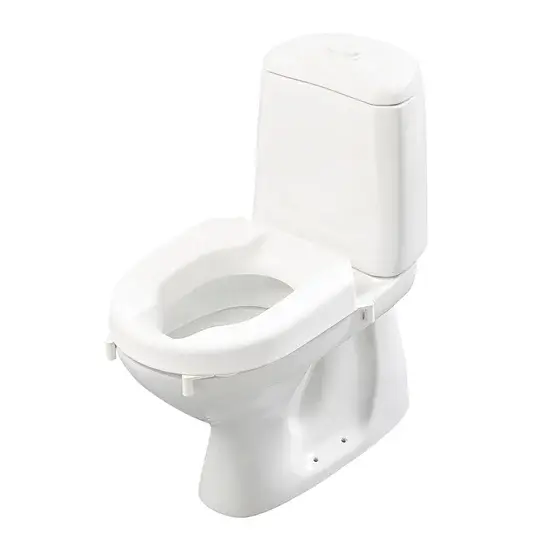
A raised toilet seat sits on the toilet bowl and adds height. Some simply rest in the bowl; most lock on with a clamp, dial or brackets that grip the inside of the bowl. Some have arms. On 1800wheelchair's raised toilet seat page in October 2026, a Drive seat with lock and lid for standard toilets was listed at USD 56 for 400 lb; a clamp-on seat with padded arms that raises the seat by 4.5 inches at USD 65; a Lumex locking seat with removable armrests that adds 4 inches at USD 85; Drive's PreserveTech universal seat with 2, 4 or 6 inch options and pivoting arms at USD 90 for 350 lb; and a heavy-duty elevated seat at USD 204 for up to 600 lb.
Drive's own page for its premium raised toilet seat with removable arms lists a weight capacity of 300 lb, a height of 3.5 inches, arms 19.75 inches apart, and a weight of 3.5 lb, and says "Two models accommodate MOST standard and elongated toilets." That last point matters. Toilets come in round (standard) and elongated bowls, and a seat made for one may not grip the other. Our catalog lists the Etac Hi-Loo with brackets, a removable raised seat with rubber-covered adjustable brackets in heights of 6 cm or 10 cm, for a maximum user of 150 kg; the catalog shows no price for it.
A raised seat is only as safe as its grip on the bowl. Fit it exactly as the sheet shows, with the clamp or brackets inside the bowl rim, tighten it, then push it hard from side to side and front to back before anyone sits. Check it again regularly, and after every cleaning, as the maker's sheet says. MedlinePlus says: "Always urinate sitting down and don't get up suddenly after urinating."
Toilet safety frames and rails
A toilet safety frame gives two armrests around the toilet to push up from and lower down onto. Some stand on four legs; others bolt to the toilet with brackets under the seat hinges. On 1800wheelchair's toilet accessory page in October 2026, a Drive toilet safety frame with padded armrests was listed at USD 59 for 300 lb, with "Secure bracket attachment system," the listing says; an adjustable toilet safety rail at USD 66; the VersaFrame, whose arm height adjusts from 28 to 32 inches, at USD 71; and a toilet safety frame sold in a case of 4 at USD 187.
Two things decide whether a frame is safe: how it is fixed, and how its arms are set. A frame clamped to the toilet depends on the toilet's bolts and on the brackets being tight; a free-standing frame depends on all four feet touching the floor and on the push buttons in each leg. Set both arms to the same height, with every button through its hole, and check that the frame does not twist when you push down hard on one arm. Etac recalled its Supporter toilet armrest in 2015, a recall closed in 2017, after reports of the fixing nuts "coming loose and causing the Supporter to become unsteady," the recall record says.
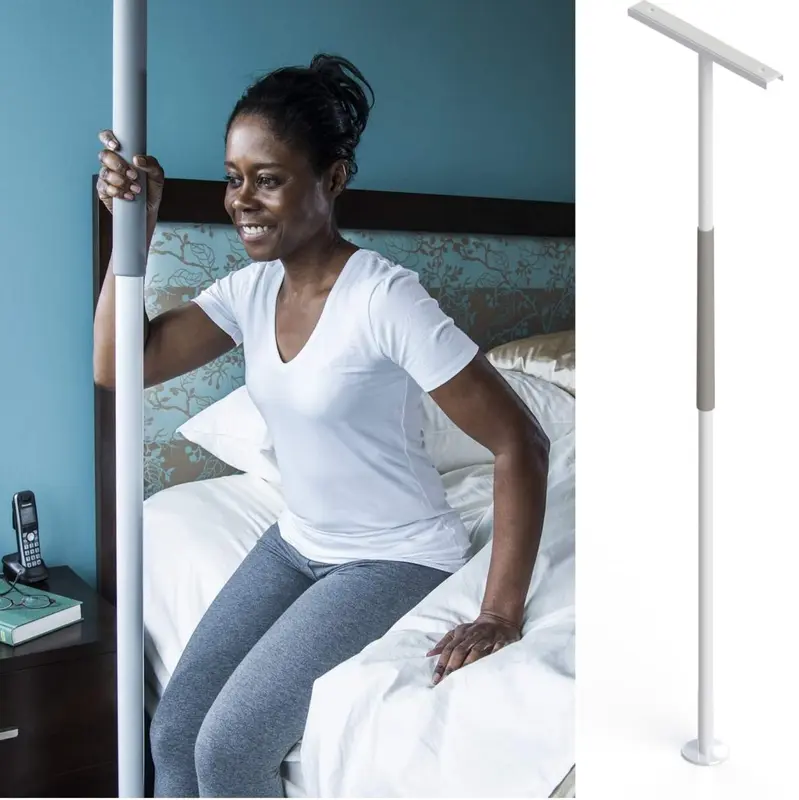
Grab bars fixed to the wall are an alternative where the wall allows it. MedlinePlus says grab bars "should be secured vertically or horizontally to the wall, not diagonally," and warns: "Do not use towel racks as grab bars." A floor-to-ceiling pole is another option: our catalog lists HealthCraft's SuperPole, held by a jackscrew and rated for 300 lb (bariatric 450 lb), for ceilings of 93 to 99 inches.
Commodes on wheels
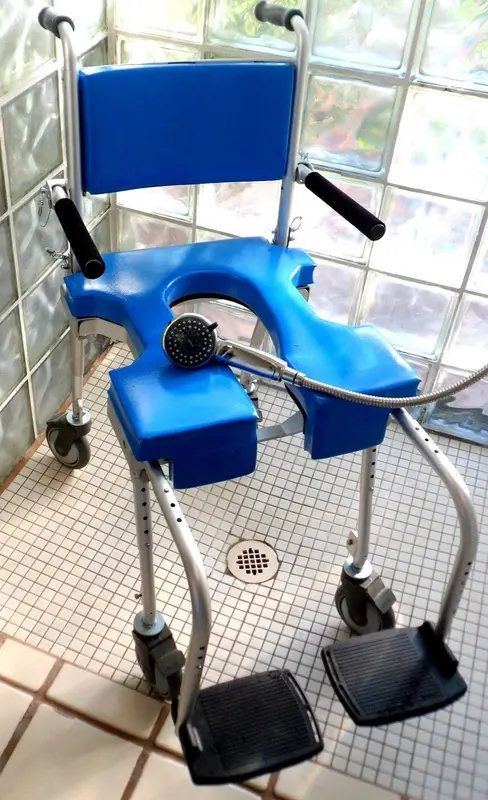
A commode on wheels, also sold as a shower commode chair or a commode transport chair, has casters and a seat opening. The person transfers onto it once and is pushed over the toilet or into a roll-in shower. On 1800wheelchair's commode page in October 2026, a Drive upholstered drop-arm wheeled commode was listed at USD 250 for 350 lb, and a Nova drop-arm transport chair commode at USD 247 for 250 lb. Rolling shower commodes, tilt models, their prices and their recalls are covered in our shower chair guide, so this guide does not repeat them.
What matters for any wheeled commode: every caster lock must hold before anyone sits or stands, the footrests fold away for transfers, and the chair must clear the toilet bowl and the bathroom door. Our catalog also lists a folding travel version, the GO-Anywhere Commode 'N Shower Chair, covered under travel below.
Choosing the height
Height is one of the settings that most decides whether a toilet aid works. Too low, and the person drops the last few inches and struggles to stand. Too high, and their feet do not rest flat, which makes them less steady on the seat. The right height depends on the person's hips, knees and transfer, so ask the therapist to set it, then measure and write it down.
- Measure the height of the toilet bowl rim from the floor, and the height of the seat the person finds easy to rise from, such as a favourite chair or the bed.
- For a raised toilet seat, subtract to see how many inches are needed. The seats read for this guide add from 2 to 6 inches; the Etac Hi-Loo comes in 6 cm or 10 cm.
- For a commode, check the seat-to-floor range on the maker's page: 19 to 23 inches on Drive's drop-arm steel commode, 15.5 to 22 inches on its bariatric folding commode, 17.5 to 22 inches on its deluxe bariatric drop-arm.
- For a commode over the toilet, the seat must sit above the bowl rim with the bucket out and the splash guard in, and the legs must stand level on both sides of the bowl.
- For a drop-arm commode used for sideways transfers, the therapist sets the seat height for the transfer.
- Set all four legs to the same hole, press down on each corner, and check nothing rocks.
One retailer's buying guide says most toilet seats are 14 to 17 inches high and that the best raised seats give a lift of 3 to 6 inches. That is the retailer's claim, not a measurement of your toilet: measure your own.
Choosing capacity, width and depth
Pick an aid rated above the user's weight, with room to spare, and read the rating on the label and the maker's page. The commodes and seats read for this guide were rated from 250 lb to 1000 lb: most standard commodes 350 lb, most raised seats 300 to 400 lb, bariatric commodes 500 to 1,000 lb. A drop-arm commode page that shows no capacity row is a reason to ask, not to assume.
- Seat width: standard commode seats on Drive's pages are 13.5 to 15.25 inches wide. Drive's 650 lb bariatric folding commode also has a 13.75 inch seat; its deluxe bariatric drop-arm seat is 23.25 inches.
- Width between the arms: 19 inches on Drive's drop-arm steel commode, 19.75 inches on its raised seat with removable arms. The person should sit without pressing on the arms.
- Width between the legs, for a commode over the toilet: 29.25 inches on Drive's bariatric folding commode and 26 inches on its deluxe bariatric drop-arm. Measure across your toilet bowl and the space beside it.
- Weight of the aid: 13 to 21 lb for the commodes on Drive's pages, 3.5 lb for its raised seat. A carer may need to move it every day.
What toilet aids cost in 2026
These are listed prices on 1800wheelchair's pages in October 2026, with the capacity the listing gives. Prices change and differ by seller; ask for a quote.
| Product (as listed) | Listed price (USD) | Weight capacity |
|---|---|---|
| Drive Steel Folding Frame Commode | 82 | 350 lb |
| Medline Bedside Commode With Microban Antimicrobial Technology | 210 | 400 lb |
| Nova Heavy Duty Commode with Drop-Arm & Extra Wide Seat | 215 | 500 lb |
| Nova Drop-Arm Transport Chair Commode (wheels) | 247 | 250 lb |
| Drive Upholstered Drop Arm Wheeled Commode | 250 | 350 lb |
| Drive Bariatric Drop Arm Commode Chair | 296 | 1000 lb |
| Drive Raised Toilet Seat with Lock and Lid for Standard Seat | 56 | 400 lb |
| Clamp-On Raised Toilet Seat with Padded Arms | 65 | Not listed |
| Lumex Locking Raised Toilet Seat w/ Removable Armrests | 85 | Not listed |
| Drive PreserveTech Universal Raised Toilet Seat | 90 | 350 lb |
| Heavy Duty Elevated Toilet Seat | 204 | Up to 600 lb |
| Drive Toilet Safety Frame with Padded Armrests | 59 | 300 lb |
| VersaFrame Adjustable Height Toilet Safety Frame | 71 | Not listed |
| Medline Commode Liner with Absorbent Pad | 18 | Accessory |
Medicare says for some equipment "You may need to rent the equipment," and for others you buy. A commode is a small purchase for many families; if Medicare is paying, the supplier will say which applies.
Does Medicare cover a bedside commode?
Does Medicare cover a bedside commode? Mobility Atlas read Medicare's commode rule (L33736), its policy article (A52461) and the national equipment list in October 2026, and the answer is yes, but narrowly. The commode rule covers a commode when the person is "physically incapable of utilizing regular toilet facilities": their condition keeps them in a single room, or on one level of the home with no toilet, or in a home with no toilet facilities. An extra wide or heavy duty commode needs a weight of 300 pounds or more; detachable arms need a transfer or width reason. A raised toilet seat is not covered, and neither is a commode used over the toilet as a raised seat, nor grab bars, toilet seat lifts or bidet seats. A written order from the doctor must reach the supplier before the supplier bills Medicare. After the Part B deductible you usually pay 20 percent of the approved amount, if the supplier is enrolled and accepts assignment.
The national list puts it in one line: commodes are "Covered if patient is confined to bed or room," and it explains that the accessibility of bathroom facilities "generally would not be a factor." In plain words, a hard walk to the bathroom is not enough on its own; the person's condition must keep them in the room, or keep them on a floor or in a home that has no toilet. For a commode with a seat lift, the rule adds the seat lift criteria and says a person who can walk "would rarely meet the coverage criterion for a commode"; if they can walk from the bed to the bathroom, the supplier may not mark the seat-lift commode claim as meeting the criteria.
The coding article also explains what happens with a 3-in-1. A commode "used as a raised toilet seat by positioning it over the toilet is also noncovered," the article says, and the supplier must mark the claim to show it. If you need the commode by the bed and later over the toilet, tell the doctor and the supplier how it will be used. Medicare Advantage plans, Medicaid, the VA and other plans set their own rules; confirm with your plan before you buy.
Setting up a commode, step by step
- Unpack it on a clear floor and check every part against the sheet before assembly: legs, buttons, wing nuts, backrest, seat, lid, bucket and splash guard. If a part is missing, bent or cracked, stop and call the seller.
- Fit each leg extension, then push each spring button until it shows fully through the hole. Use the same hole on all four legs unless the therapist says otherwise.
- Fit the seat and lid so every clip is home, and tighten any wing nuts by hand as the sheet shows. A seat that lifts or slides on the frame is not ready to use.
- Stand the commode on a level, dry floor, press down on each corner, and push the backrest and each arm. Nothing should move.
- For a drop-arm commode, lower and raise each arm a few times and check it locks every time.
- Place it where the person will reach it from the bed, against the bed or a wall so it cannot slide back, with a non-slip mat if the floor is smooth.
Keep the assembly sheet with the commode, and write the leg setting on it. Anyone who moves or cleans the commode should be able to put it back the same way.
Fitting a raised seat or a toilet frame
- Check the bowl shape, round or elongated, against the seat's sheet before you buy.
- Take off the toilet's own seat if the sheet says so; some raised seats sit on the bowl, some on top of the seat.
- Fit the clamp, dial or brackets inside the bowl rim exactly where the sheet shows, and tighten fully.
- Push the seat hard from side to side and front to back, then sit on it with a helper standing by.
- For arms, push each arm button fully home and lean on each arm in turn: it must not move or tilt the seat.
- For a toilet frame, set both arms to the same height, tighten the toilet brackets or check all four feet touch the floor, and push down hard on each arm.
Check the fit again after cleaning, after anyone moves it, and once a week. A seat that worked yesterday can be loose today, and a raised seat that shifts is one of the problems FDA reports describe most often with injury.
By the bed at night
Much commode use happens at night, when the person is sleepy, the light is low and nobody may be watching. Set the room up for that.
- Put the commode on the side of the bed the person gets out on, close enough to reach without walking, and turn it as the therapist showed for the transfer.
- Leave a low light on, or a motion light, so the edge of the commode is visible.
- Keep toilet paper, wipes and a call button within reach of the seat, so nobody has to stand up mid-way.
- Put the bucket in fully, with its lid on when not in use; a bucket that sits loose can tip or leave a gap.
- If a carer helps, agree how the person calls for help and how long the carer stays.
MedlinePlus advises against getting up suddenly after urinating. Sit for a moment before standing and stand up slowly, as the therapist showed. If the person has fallen before at night, ask the doctor or therapist whether the bedside setup should change. Our guide to home hospital beds covers bed height and rails, which matter for the same transfer.
Cleaning, liners and the bucket
Empty and rinse the bucket after each use, or use liners: 1800wheelchair listed Medline commode liners with an absorbent pad at USD 18 in October 2026. Clean the seat, lid and arms with what the maker's sheet allows, and dry the frame, because steel commodes can rust, especially at welds and leg holes, if left wet. When cleaning, check the frame for cracks, bent tubes and lost buttons. Use only the cleaners the sheet lists, and dry the push buttons and holes so they do not seize.
Transfers: what the therapist decides
Getting on and off a commode or toilet is a transfer, and how a person transfers is a clinical decision. A physical or occupational therapist can watch the person get up from a chair and sit on a toilet, and decide whether they should stand and turn, slide sideways, use a slide board, or need a carer or a hoist. That choice sets the aid: arms that stay up or swing down, the height, and whether a helper is needed. MedlinePlus says that if you are not sure what changes the bathroom needs, ask your health care provider for a referral to an occupational or physical therapist, who can visit and make recommendations.
If the person is lifted by a carer, our patient lift guide covers hoists and toileting slings. If they walk to the bathroom with a frame, see the walker and rollator guide.
Travel and visiting
Hotels and family homes rarely have the right toilet height or a frame. A folding commode packs flat; Drive says its folding steel commode "Easily opens and folds for storage and transportation." For people who need a wheeled chair, our catalog lists the GO-Anywhere Commode 'N Shower Chair: a collapsible rolling commode and shower chair of 24 lb, rated for 250 lb, that packs to 22 x 21 x 10 in, listed around USD 1,495 at the maker's shop (reduced from USD 2,195; our catalog, checked October 2026). A clamp-on raised seat travels too, if the toilet at the other end has a bowl it can grip.
Seat lifts, bidet seats and poles
Some people need more than height. A lifting commode or toilet seat lift raises the person toward standing. On 1800wheelchair's pages in October 2026, the Uplift Commode Assist was listed at USD 250, and the ArGo electric toilet seat lift at USD 1,399.99, rated for 440 lbs. Medicare's coding article says toilet seat lift mechanisms are "not primarily medical in nature" and does not cover them; a commode with a seat lift is covered only when the person meets both the commode and the seat lift criteria. Our lift chair guide explains the seat lift rule.
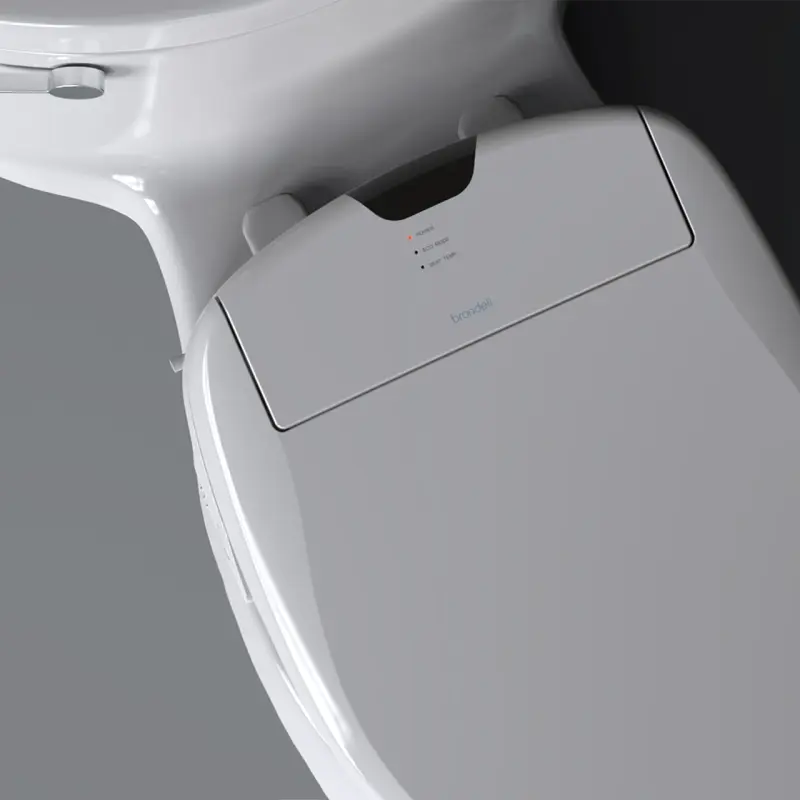
For people who find wiping hard, a bidet seat washes and dries. Our catalog lists the Brondell Swash 1400 around USD 479.99 to 499.99 at the maker's shop, a sale price reduced from USD 549.99 to 579.99 (our catalog, checked October 2026); its page gives no user weight limit. Medicare's article says bidets and bidet toilet seats "are non-covered because they are not primarily medical in nature." MedlinePlus mentions a portable bidet as an option. For standing up and sitting down, a floor-to-ceiling pole such as the SuperPole gives a fixed handhold beside the toilet without drilling.
How Mobility Atlas read 327 FDA reports
The FDA collects reports about medical devices in a database called MAUDE. Makers, importers and user facilities such as hospitals and nursing homes are "mandatory reporters"; patients, families and clinicians can report voluntarily. There is no FDA product code for a bedside commode or a raised toilet seat as such. These aids are listed mainly under ILS (Adaptor, Hygiene), with others under INB (Attachment, Commode, Wheelchair), IKX (Aid, Transfer), INN (Chair, Adjustable, Mechanical) and INM (Chair, With Casters), all Class I. We read every report with text under those five codes whose text names a commode or a toilet, received from 1 January 2017 to the latest openFDA update read on 19 October 2026: 327 reports. 278 were filed under ILS.
Before reading a single report, we wrote a codebook and fingerprinted it with a time stamp. It records the device (bedside or 3-in-1 commode, commode on wheels, raised toilet seat, toilet safety frame, bath seat, or another device), the first thing the report says went wrong (a leg, an attachment, a break, an arm, a wheel, the bucket, skin contact, a fall with no fault, or unclear), flags for injury, fall and a cause put down to the user or a third party, and what the maker found. The codebook names bent legs but has no code for other bent parts, so a written rule sends a bent arm that gave way to the arm code and any other bent part to the break code.
Two independent coders then read every report separately, without seeing each other's answers. The coders were AI language models working separately; the method page says exactly how. They agreed on the device in 98.5 percent of reports (kappa 0.974), on the problem in 95.7 percent (kappa 0.948) and on what the maker found in 97.2 percent (kappa 0.953); kappa is a standard measure of agreement beyond chance, and these values are very high. We settled the 28 reports where they differed under 14 written rules, then ran a consistency pass that changed 15 agreed codes that broke those rules, and counted the results by script. Where we give a count from a word search, it runs over the description of the event, not over the maker's later follow-up notes.
What the reports show: the big picture
What goes wrong with commodes, raised toilet seats and toilet frames? Mobility Atlas had two independent AI coders read 327 FDA reports from 2017 to October 2026, and the answer is mostly simple metal and plastic parts that hold a person's weight. 94 reports describe a frame, weld, backrest, arm or bracket that broke, cracked or bent, and 68 a leg that bent, collapsed, slid in, came off or would not lock. 64 describe a seat, raised seat, clamp or frame that came off or shifted, many of them raised toilet seats sliding on the bowl, and those carry the most injuries: 35 of the 64 describe one. 24 describe an arm or rail that gave way, and 28 a fall with no fault named. Of all 327, 128 describe an injury and 120 a fall; none was filed as a death. By a word search, 24 mention a fracture and 34 the head. The pattern points to a few checks: legs, buttons, clamps and arms.
| What went wrong first | Reports | With injury | With a fall | Maker confirmed a fault |
|---|---|---|---|---|
| Frame, weld, backrest, arm or bracket broke, cracked or bent | 94 | 27 | 29 | 40 |
| Leg bent, collapsed, came off or would not lock | 68 | 15 | 17 | 40 |
| Seat, raised seat, clamp or frame came off or shifted | 64 | 35 | 32 | 8 |
| Fall or tip with no fault named | 28 | 22 | 24 | 0 |
| Arm, drop arm, rail or back gave way | 24 | 11 | 12 | 5 |
| Problem alleged, no part named | 14 | 2 | 1 | 1 |
| Pinch, cut or skin injury from the device | 12 | 12 | 0 | 0 |
| Wheel, caster or brake | 12 | 4 | 5 | 4 |
| Bucket, pan, splash guard or lid | 7 | 0 | 0 | 1 |
| Event with nothing failed | 4 | 0 | 0 | 0 |
| Device in the report | Reports | With injury | With a fall | Commonest problems |
|---|---|---|---|---|
| Bedside or 3-in-1 commode (drop-arm and bariatric included) | 197 | 42 | 38 | Break 66, leg 59, seat or part came off 22, arm 14 |
| Raised toilet seat | 56 | 40 | 35 | Came off or shifted 28, break 13, fall with no fault 5 |
| Commode or shower chair on wheels | 37 | 26 | 23 | Fall or tip with no fault 10, wheel or brake 9, break 8 |
| Toilet safety frame or rail | 19 | 10 | 12 | Came off or loose 7, arm gave way 5, break 4 |
| Another device (lifts, slings, other) | 10 | 6 | 7 | Not counted in this guide |
| Bath or shower seat | 8 | 4 | 5 | Leg 7 |
The two tables tell different stories. Most bedside commode reports are malfunctions found before anyone was hurt; most raised toilet seat reports describe a fall and an injury. 111 reports were filed with the event type "Injury", 215 as "Malfunction" and 1 as "Other"; our injury flag is higher than the filed type because we read the text.
What these reports cannot tell you
The reports are a record of what people and companies chose to tell the FDA, not a count of every commode problem. The FDA says its device reports are not intended "to evaluate rates of adverse events," and that a report "does not necessarily demonstrate that the device caused or contributed to the adverse outcome or event." Most families who find a wobbly commode call the shop, not the FDA. Report counts depend on how much each maker sells and how it files, and the reports show neither, so the numbers say nothing about which brand or type is safer.
The count also moves with filing. 183 of the 327 reports arrived in 2026, and 177 of those name Medline as the maker, 155 of them received in August and September 2026; Medline is named as the maker in 196 reports across the whole period. 149 of Medline's 2026 reports say they were submitted "as part of retrospective review activities," which they say include a review of historical data. Many are short notes from hospitals, suppliers and families about commodes that arrived bent or would not assemble. They show a real pattern worth checking for, but they are one maker's filing batch, not a sudden change in all commodes, and not a verdict on Medline's products against anyone else's. Some events were also filed more than once: at least two reports repeat another report word for word.
Bedside commodes: legs that bend or give way
Legs are the bedside commode's weak point in the reports. 59 of the 197 bedside commode reports start with a leg that bent, buckled, slid in, broke, came off or would not lock, and 11 of them describe an injury. In one, the leg fell because, the report says, "the pin was not protruding all the way through the hole"; the reporter thought the wheelchair was hitting the button during transfers. The maker could not reproduce the fault on the returned commode. Another report says simply: "Leg bent while pt sitting on bedside commode." A 2026 report says a commode "collapsed inward while the patient was using the commode," and that the metal buttons securing the front bar to the legs did not hold.
Weight is not always the explanation. One hospital report notes "weight limit of commode 350 pounds, pt's weight 273 pounds" after the front legs bent; another says the person weighed approximately 230 pounds on a commode "certified for up to 250 pounds." A third reporter wrote: "The patient is 325 lbs. and this is how the commode bowed out." By a word search, 12 of the bedside commode reports mention weight or a bariatric commode. Three family reports, near-copies of one another, say "the front right leg on the commode is longer than the left leg" after a fall with a head wound.
- After every height change, check each button shows fully through its hole, on all four legs.
- Stand in front of the commode and look: all four rubber feet on the floor, the seat level.
- Replace a commode with a bent leg; do not straighten it and carry on.
- Choose a capacity well above the person's weight, and a wider frame if they sit against the arms.
Frames, welds and backrests that break
66 bedside commode reports start with a break: a frame tube, weld, bracket, backrest or armrest that cracked, snapped or bent. Most describe no injury, but not all. One report describes a person who leaned back and "the back support broke"; another a metal bar on the bottom frame that "broke off, causing pt to fall through." One maker was told "the center bars supporting the bucket broke free," and another that "the weld on the unit broke off," with a fall in which the user hit their head and knee. A report from 2025 says "the detent broke while in use," and the user fell forward and hit their head.
The backrest is a frequent spot. Many 2026 reports describe a bent slot or holster where the backrest bar fits, so the backrest would not go in or would not hold. That is easy to miss on a commode used without its back, and it is worth a look whenever the back is fitted.
Damaged out of the box
A striking share of the 2026 filing batch describes commodes that were bent or broken when they came out of the box. One report says "frame is bent, it came out of the box this way." Another says "when they opened the box the welding part is coming apart." A third reported "two cases of commodes that were damaged on the inside with bent legs/frames. The packaging was intact but the product was damaged." By our rules, a maker's finding of damage from shipping or packaging still counts as a fault found, because the commode the person received was faulty.
- Unpack the commode before the day it is needed, not at bedtime on the day of discharge.
- Lay out the parts and compare them with the sheet; look along each leg and the frame for bends.
- Check the welds where the cross bars meet the legs, and the backrest slot, for cracks or chipped paint.
- If anything is bent, cracked or missing, do not use it; photograph it and ask the seller for a replacement.
Seats, buckets and lids that come loose
22 bedside commode reports start with a seat, bucket support or bar that came off or shifted, and 5 describe an injury. One person sat close to the front edge and "the seat popped off the back of the frame and she fell," the report says, with a hairline fracture. Another report describes a drop-arm commode seat that "pops off when performing slide board transfers." In 2026, reports describe seats that slide when the user leans, a seat that pops up when the bucket is removed, lids and seats that pop off during assembly, and, in one, a reporter who believed "one wingnut was missing on both commodes" after a collapse; from photos, the maker saw a bent backrest bar and a missing wing nut, and said too much force seemed to have been applied to the backrest, quoting its manual: "Ensure all screws, nuts and/or bolts are tight at all times."
Bucket problems appear in 7 reports, none with an injury: buckets that warped, cracked or fell out. Separately, two hospital reports, counted under pinches and cuts, describe a bucket handle that left a gap under the seat, so that the seat "pinched the patient's thigh," the report says, leaving a mild skin tear. Fit the bucket fully home, check it sits flat, and check the seat clips after every bucket change.
Drop arms that give way
24 reports start with an arm, drop arm, rail or backrest that moved, swung or released when it should have held; 14 of them are bedside commodes. One report says the commode's arm locks "did not lock-up," and the user fell and broke a leg. In another, the user reached for the arm of the commode and "the arm collapsed causing her to fall." A 2026 reporter wrote that a drop arm "was stuck very tightly and then when I put most of my weight on it fell without warning." Medline confirmed the arm could jam, found both arms locked properly when tested, and put the jam down to excessive force when locking them.
Drop arms are there for transfers, and a transfer puts a sideways load on the arm. Test each arm before every transfer, and call the supplier as soon as it starts to stick or rises without a firm click.
Raised toilet seats that come off the toilet
Raised toilet seat reports, like those on commodes on wheels, mostly describe an injury: 40 of the 56 raised seat reports describe one, and 35 a fall. 28 start with the seat coming off, sliding or tipping on the bowl, and 21 of those describe an injury. By a word search of the raised seat reports, 11 mention the head and 6 a fracture. One report says "the toilet seat fell out from under her," and the user hit their head. Another describes seat clamps that "gave out during use," with bleeding in the brain. Others describe a seat that "slid from the commode" as the user got up, and a riser that "slid to the side" while the user was wiping.
Fitting is part of the story. One report says the seat "was installed improperly. The clamp was tightened in the incorrect location." Another describes a seat fitted with a part on the outside of the bowl that belonged inside. Seven raised seat reports put the cause down to the user or a third party, and the maker confirmed a fault in only 2; in 46 the maker said nothing either way, usually because the seat was never returned. The lesson is the same either way: a raised seat that can move on the bowl is not safe to sit on.
13 raised seat reports start with a break, such as an arm or riser that snapped. Three describe a toileting seat held on the toilet by a mounting bar, one end of which broke, the reports say, and the user fell. In one, the maker concluded the seat hooks had probably not been fully engaged in the bar; in another, the reporter was not sure what happened. Three more describe a cut or pinch from the locking mechanism at the front of the seat; one user "cut her leg on the locking mechanism," a report says.
Toilet safety frames and rails in the reports
19 reports concern a toilet safety frame or rail; 10 describe an injury and 12 a fall. 7 start with a frame or rail that came loose or slipped off, 5 with an arm that bent, wobbled or released, and 4 with a break. One user stood up with their weight on the handles and "the plastic screws broke." Another report says "the right arm pin came out" and the user fell into the bath tub. A family wrote that "the front bars slipped out from the edge and she fell."
In one report the maker examined a returned frame and found the armrests assembled to the wrong elbows, an assembly error that turned the front elbows the wrong way. Four frame reports put the cause down to the user or a third party. Assemble a frame exactly as the sheet shows, and check both arms are matched and locked before the first use.
Commodes on wheels in the reports
37 reports concern a commode or shower chair on wheels; 26 describe an injury and 23 a fall, and by a word search 6 mention a fracture. The commonest first event is a tip or fall with no fault named (10), often while the person leaned forward or back, then wheels, casters and brakes (9) and breaks (8). One report says "the left front caster fell off," and the user fell and cracked a femur; the maker noted the chair was 4.5 years old, past its stated 3-year expected life; another that "the wheel fell off." In one, a commode with its brakes on "started to slide out from under" the person as they sat on it after a transfer; one caster brake was later found not to engage. 12 of the 37 put the cause down to the user or a third party, more than any other device group. Our shower chair guide covers choosing and checking these chairs.
Pinches, cuts and falls with no fault
12 reports describe a pinch, cut or other skin injury from the device with nothing failing. A hospital report quotes a patient: "Something is sharp and it cut me." Another found dried blood beside a screw protruding under the seat. Run a hand under the seat rim, around the bucket and along the locking parts of a raised seat, and cover or report anything sharp.
28 reports describe a fall or tip with no part said to fail; 22 describe an injury. Some are leans: a dealer said "the user leaned forward and tipped the commode over." Some are reaches: one person fell getting up while a relative left their side "to obtain toilet paper," the report says. Keep everything the person needs within reach of the seat, and agree when a helper stays close.
What the makers found
The maker found or confirmed a fault in 99 reports, found none or named an outside cause in 42, and said nothing either way in 186, usually because no sample or photo was returned. Among bedside commodes the maker confirmed a fault in 85 of 197, mostly from photos of bent legs and frames in the 2026 batch. Among raised toilet seats it was 2 of 56. Across the set, 33 reports say or suggest that the user or a third party caused or contributed to the event: wrong assembly or fitting, leaning on the arms, a weight over the limit, or a missing part not fitted.
A "no fault found" from the maker does not mean nothing happened, and a confirmed fault does not mean every unit is faulty. Read both as what one maker concluded about one device.
When the reports arrived
| Year | Reports | Maker named most often (reports) |
|---|---|---|
| 2017 | 19 | Medline (3); 8 name no maker |
| 2018 | 13 | Rifton, Aid-Pro, Medline (2 each) |
| 2019 | 27 | Medline (6) |
| 2020 | 18 | Medline, Compass Health (3 each) |
| 2021 | 13 | Combo (3) |
| 2022 | 12 | Combo (3) |
| 2023 | 13 | Ningbo South (3) |
| 2024 | 13 | Four makers (2 each) |
| 2025 | 16 | Com-Da Healthcare (3) |
| 2026 (to October) | 183 | Medline (177) |
Reports arrived at between 12 and 27 a year from 2017 to 2025, then jumped in 2026 when one maker filed a large batch; most of Medline's 2026 reports say they came from a retrospective review. Read the table as a record of reporting, not of risk. A single maker that starts forwarding every complaint can move a year's total more than any change in the products themselves.
The recall file
We read the FDA recall records for the same five product codes as openFDA showed them in October 2026: 72 in all, of which 7 name a commode or a toilet. No record in these codes mentioned a raised toilet seat or a 3-in-1 bedside commode. Three of the seven concern toilet aids this guide covers:
- Etac Supporter toilet armrest, 2015, 25 units, closed in 2017: the two nuts fixing it to the toilet could come loose, the recall says, making it unsteady.
- Uplift CA200 lifting commode chair (Uplift Commode Assist), 2011, one lot (1C0101), 219 chairs, recall closed in 2012: the plastic seat "may interfere with the unit's normal locking mechanism," the recall says.
- R82 Heron toilet and bath chair, opened 2017 and still open in the record, 687 units: a "Replacement campaign on all units that have a gas spring head in aluminum," the record says.
The other four concern shower commode chairs on wheels, from Invacare's Aquatec, Altimate's ActiveAid and Raz Design, and are described in our shower chair guide. Check your model against the FDA recall database, and ask the supplier whether any correction was done.
A weekly check
| When | Check | If it fails |
|---|---|---|
| Before each use | Commode does not rock; raised seat does not move on the bowl | Do not use until fixed |
| After any height change | Every leg button fully through the same hole | Reset; replace a button that will not lock |
| Weekly | Clamp or brackets of a raised seat tight; frame arms locked | Tighten as the sheet shows |
| Weekly | Welds, backrest slot, arms: cracks, bends, chipped paint | Stop using; call the supplier |
| Weekly | Rubber feet present and not split | Replace the feet |
| Monthly | Sharp edges, screw ends, rust near the seat | Cover or replace; report a cut |
| When weight or transfers change | Capacity, width and type still right | Ask the therapist |
When to report a problem to the FDA
Anyone can report a problem with a medical device to the FDA through MedWatch. An FDA-posted recall notice gives the routes: "Online: By completing and submitting the report online at https://www.accessdata.fda.gov/scripts/medwatch," or by downloading the form or calling 800-332-1088 to request one, then mailing it or faxing it to 800-332-0178. Report falls, injuries, legs or frames that gave way, and raised seats that came off. Tell the supplier and the maker too; makers are among the mandatory reporters.
Keep the commode or seat and any broken parts, photograph the label, the damage and how it was fitted, and write down what happened while it is fresh. Many reports in our set end with the maker unable to check anything because the device or a photo was never sent back.
Three traps
Trap one: buying a 3-in-1 for Medicare to pay and then using it over the toilet as a raised seat. Medicare's article says a commode used that way is treated as a raised toilet seat and is not covered. Tell the doctor and the supplier how the commode will be used.
Trap two: trusting a raised seat because it felt firm on the first day. In the reports, seats, raised seats and frames that came off or shifted carry more injuries than any other problem group. Push it hard before every use, and check it again after every cleaning.
Trap three: setting the legs once and forgetting them. Leg buttons that sit in different holes, or do not pass right through, are behind many of the leg reports. Check every button after any height change, cleaning or move.
Three composite scenarios
These are composite scenarios, not individual customers. Each one combines facts and ranges already given in this guide to show how the decision plays out.
Scenario one: a person comes home from hospital unable to leave the bedroom, and the only toilet is downstairs. The doctor writes an order and the supplier provides a bedside commode under Medicare's rule. The family unpacks it the day it arrives, checks each leg button and the welds, sets it level beside the bed, and leaves a light and toilet paper within reach.
Scenario two: a person who walks to the bathroom finds the toilet too low after a knee operation. The therapist suggests a raised seat with arms. The family checks the bowl shape, picks a seat with arms listed between USD 65 and USD 90 in October 2026, confirms with the seller that it fits an elongated bowl, pays for it themselves because Medicare's list denies raised toilet seats, and pushes it hard before each use.
Scenario three: a heavier wheelchair user transfers sideways with a slide board. The therapist recommends a bariatric drop-arm commode. The family looks at one rated for 1000 lb, 23.25 inches wide, adjusting from 17.5 to 22 inches, and asks the doctor whether Medicare's rule for an extra wide commode, for a person of 300 pounds or more, and for detachable arms, applies.
Questions for the therapist and the supplier
For the occupational or physical therapist
- Which aid suits how I get on and off the toilet now?
- What seat height should it be set at, and how do I measure it?
- Do I need arms that stay up, arms that drop, or a frame?
- Should a carer help, and how should they stand?
- Is a commode by the bed safer at night than walking to the bathroom?
For the supplier or seller
- What is the weight capacity on the label, and what is the seat and leg width?
- Will it fit my toilet? Here are my measurements and the bowl shape.
- Who assembles it, and will you check the leg buttons and arms on delivery?
- Can I get replacement feet, buttons, wing nuts and buckets?
- Has this model been recalled, and is there a return period if it arrives damaged?
- Does Medicare or my plan pay for it as I will use it?
If you would like help finding a model or a price, send us an enquiry with your measurements and the therapist's advice, and ask us to find it; we will request a quote from a dealer.
Your plan: 10 minutes, today, this week
In 10 minutes: press down on each corner of the commode, check every leg button, and push the raised seat or frame hard from side to side.
Today: measure the toilet and the seat height the person rises from easily, and look up the model in the FDA recall database.
This week: ask the doctor for a referral to an occupational or physical therapist for a bathroom visit, and ask your plan what it covers before you buy.
Sources and documents
Reports: every FDA MAUDE device report with text under product codes ILS, INB, IKX, INN and INM that names a commode or a toilet, received from 1 January 2017 to the latest openFDA update read on 19 October 2026, downloaded through openFDA. Recalls: FDA recall records for those codes. Funding: Medicare's commode rule L33736, policy article A52461, the national equipment list and Medicare's equipment page. Product facts: Drive Medical's product pages, 1800wheelchair's listings and our catalog rows. Safety advice: MedlinePlus. Every source is linked in the list at the end of this page.
Related guides on Mobility Atlas: Shower chairs and transfer benches; Patient lifts; Home hospital beds.
Method in brief: we coded the 327 reports in the pool using a codebook written and fingerprinted before coding, with two independent coders (agreement on the problem 95.7 percent, kappa 0.948), settled the 28 reports where they differed under written rules, changed 15 more in a consistency pass, and counted the results by script. The two coders were AI language models working separately, each without access to the other's answers. Quotes from reports are shown in sentence case; the FDA publishes many of them in upper case. The codebook, the rules, the method and the coded table are on the data and method page under CC BY 4.0.
Prices checked October 2026 on 1800wheelchair's pages and in our catalog; prices change and differ by seller, so confirm them before you order. Documents checked October 2026: FDA reports, recall and classification records, Medicare's commode rule, article, list and page, Drive Medical's pages, and MedlinePlus.
Has a commode, raised toilet seat or toilet frame let you down, or worked well? Send us a note through the enquiry form with the model and what happened; we use readers' notes when we update the guide.
This article is general information. Rules and prices differ by country and change, so confirm them before you buy or travel.
Common questions
What is a 3-in-1 commode?
A commode frame made to be used three ways: by the bed with its bucket, over the toilet as a raised seat with arms, or in the shower as a seat. Drive's 3-in-1 folding commode, for example, is rated for 350 lb and weighs 15 lb. Medicare does not cover a commode provided for use over the toilet as a raised seat.
Does Medicare cover a bedside commode?
Yes, when the person is physically unable to use regular toilet facilities: their condition keeps them in one room, or on one level of the home with no toilet, or in a home with no toilet. A written order from the doctor must reach the supplier before the supplier bills Medicare. You usually pay 20 percent after the Part B deductible, if the supplier accepts assignment. Raised toilet seats and grab bars are not covered.
What is the difference between a raised toilet seat and a toilet safety frame?
A raised toilet seat sits on the toilet bowl and adds height, usually 2 to 6 inches on the seats we read, with or without arms. A toilet safety frame adds two arms around the toilet to push up from, without changing the height. Some people use both; a therapist can say which helps.
What is a drop-arm commode for?
Its arms swing down so a person can slide sideways from a bed or wheelchair onto the seat, often with a slide board. Medicare's rule covers detachable arms when they are needed for transfers or when the person needs extra width. Test the arm lock before every transfer.
How much weight can a bedside commode hold?
Standard commodes on the pages we read were rated for 350 to 400 lb; bariatric models from 500 lb to 1000 lb. Read the label, choose a rating well above the user's weight, and check the width as well: Medicare's extra wide code is for a commode at least 23 inches wide that supports 300 pounds or more.
Why do raised toilet seats fall off?
In the FDA reports we read, raised seats came off, slid or tipped on the bowl when clamps or brackets were loose, fitted in the wrong place, or did not suit the bowl shape. Fit the seat exactly as the sheet shows, push it hard from side to side before each use, and check it again regularly and after every cleaning.
Sources
- CMS: LCD L33736, Commodes
- CMS: Commodes policy article A52461
- CMS: NCD 280.1, Durable Medical Equipment Reference List
- Medicare: Durable medical equipment coverage
- openFDA: device adverse event endpoint (data used for this study)
- FDA: About the MAUDE database and the limits of device reports
- openFDA: device recall endpoint, product codes ILS, IKX, INB, INN, INM
- openFDA: device classification database
- eCFR: 21 CFR 890.3100, Mechanical chair
- eCFR: 21 CFR 890.5050, Daily activity assist device
- eCFR: 21 CFR 890.3920, Wheelchair component
- FDA: posted recall notice showing how to report to MedWatch
- MedlinePlus: Bathroom safety for adults
- Drive Medical: folding steel commode, maker specifications
- Drive Medical: 3-in-1 folding commode, maker specifications
- Drive Medical: drop arm steel commode, maker specifications
- Drive Medical: bariatric folding commode, maker specifications
- Drive Medical: deluxe bariatric drop-arm commode, maker specifications
- Drive Medical: premium raised toilet seat with removable arms, maker specifications
- 1800wheelchair: commodes for bedside and bathroom (prices read October 2026)
- 1800wheelchair: raised toilet seats (prices read 19 October 2026)
- 1800wheelchair: toilet accessories and safety frames (prices read 19 October 2026)
- Etac: Hi-Loo raised toilet seat with brackets (catalog row HL-004)
- HealthCraft: SuperPole (catalog row HL-006)
- Brondell: Swash 1400 bidet toilet seat (catalog row HL-005)
- GO! Mobility Solutions: GO-Anywhere Commode 'N Shower Chair (catalog row HL-024)
Read on 19 October 2026. The wording of the article is our own.
Data and method for this guide: the codebook, the coded reports and the list of documents, free to reuse under CC BY 4.0.