Walk-in tub, transfer tub, walk-in shower or roll-in shower: which fits a wheelchair user, and what each costs
Walk-in tub, transfer tub, low-threshold or roll-in shower: step-in heights, doors, waiting in a wet tub, scalds, ADA sizes, published prices and funding.
Contents
- The short answer
- Four ways to bathe, side by side
- Which one fits how you move
- Walk-in tub or walk-in shower: the trade-offs
- Doors: inward, outward and the transfer door
- Step-in height: the inches that decide
- Filling, draining and waiting in a wet tub
- Hot water, scalds and the water heater
- Space, plumbing and electricity
- The ADA dimensions, as a benchmark for a home
- Roll-in shower details: seats, grab bars and controls
- Roll-in shower pans: ADA and residential
- How we compared
- What walk-in tubs cost in 2026
- What roll-in and low-threshold showers cost
- Warranties: what they cover and what they leave out
- Is a walk-in tub a medical device?
- Does Medicare pay for a walk-in tub or roll-in shower?
- Other ways to pay: the VA, USDA and tax rules
- Keeping the tub: bath lifts and transfer benches
- Chairs for a roll-in shower
- Grab bars, poles and the rest of the room
- Getting quotes without pressure
- Renting, apartments and moving home
- Three traps
- Three composite scenarios
- Questions for the therapist, the installer and the plan
- Your plan: 10 minutes, today, this week
- Sources and documents
- Common questions
- Sources
The short answer
If you use a wheelchair and cannot stand or step, the documents we read point to a roll-in shower: a curbless shower you enter sitting on a rolling shower commode chair, or that you roll into and then transfer to a folding seat. The 2010 ADA Standards cap the threshold of a roll-in shower at half an inch. A walk-in tub, by contrast, still has a step-in, which Kohler's page puts at 3 inches on average for its own bath and "3 to 7 inches" across the market, varying by brand, and a door that stays closed until the water drains; Kohler says the water's pressure holds its inward door shut during a soak.
A transfer tub is the walk-in tub built for wheelchair users who want to soak. Its wide door swings outward and leaves no tub wall beside the seat, so a person can slide across from the chair. Ella's Bubbles says its Transfer32 lets a bather "slide onto the seat from a wheelchair or walker while seated." A walk-in shower with a low lip is designed for someone who can cross it and sit on a seat inside; the ADA's version is the 36 by 36 inch transfer type shower with a threshold of half an inch. A standard walk-in tub with an inward door is designed for someone who can step a few inches, stand while the door is closed, and sit through the fill and the drain.
On the pages we read on 19 October 2026, Kohler's price guide, which estimates the whole walk-in tub market rather than Kohler's own prices, puts a walk-in tub alone at $2,000 to $20,000 and a finished job, tub plus accessories plus installation, at $5,500 to $33,000 or more. Ella's Bubbles lists the Transfer32 at $4,709 to $9,025, tub only. A roll-in shower pan from Freedom Showers was on sale at $928, pan only, and for one Lowe's store, 30 by 60 inch shower bases sold as ADA or roll-in ran from $786 (threshold not stated), with SWAN bases with 1.25 to 1.38 inch thresholds at $799.59 and $849.56. No document we read publishes what it costs to install a shower; ask for itemized quotes.
Mobility Atlas earns a fee or margin when you order through us; the comparison below uses only the makers' published documents, one retailer's listed prices, our own catalog, and the federal documents named in each section, all read in October 2026. We say what each product does well and quote its terms as they stand. Whether you can step in, slide across, or need to be moved by a carer is a question for an occupational therapist who has seen you transfer; this guide explains the options and what to ask, and stops there.
Four ways to bathe, side by side
The names overlap in shops and ads. A walk-in shower can mean anything from a stall with a 5-inch curb to a fully level floor, and the name walk-in tub covers both a soaking tub with a small inward door and a transfer tub with a door as wide as the seat. This guide uses four working types. The cells give what the documents we read say; the sections below give the detail and the source of each number.
| Option | How you get in | Door or threshold | Published unit price (USD) | Wait in water |
|---|---|---|---|---|
| Walk-in tub, inward door | Step 3 to 7 in, sit | Inward door, 17 1/4 in (Kohler) | 2,000 to 20,000 (Kohler market guide) | Fill and drain |
| Transfer tub, outward door | Slide from chair to seat | 36 in L-shaped door (Ella) | 4,709 to 9,025 (Ella list) | Fill and drain |
| Low-threshold walk-in shower | Step a low lip, sit | 1.25 to 1.38 in (SWAN at Lowe's) | 799.59 to 849.56 (SWAN at Lowe's) | None |
| Roll-in curbless shower | Roll in on a shower chair | 1/2 in max (ADA) | 928 to 1,162 (Freedom pans, sale) | None |
Read the price column with care. The walk-in tub figures are for the tub alone: Kohler's market estimate adds $2,500 to $8,000 or more for installation and $1,000 to $5,000 or more for accessories such as walls and grab bars. The shower figures are for the pan or base alone, without walls, valve, seat, grab bars, tile or labor. The Lowe's prices are search results for one store on one day. None of the four is a finished price.
The table cannot show the room you have: a tub replaces a tub in the same alcove, while a roll-in shower needs a floor that slopes to a drain and room in front of the entry to turn and approach.
Which one fits how you move
Which is better for a wheelchair user, a walk-in tub or a roll-in shower? Mobility Atlas read the 2010 ADA Standards and three makers' pages in October 2026, and they point one way for a person who cannot stand or step. A roll-in shower has no curb to cross: the ADA Standards cap its threshold at half an inch, and a wheelchair user rolls in on a shower commode chair or transfers to a folding seat inside. A walk-in tub still has a step-in, which Kohler's page puts at 3 inches for its own bath and 3 to 7 inches across the market, and a door that must stay closed until the water drains. A transfer tub with a wide outward door, such as the Ella Transfer32, is built for sliding across from a wheelchair to the seat. Which of these fits how you transfer, and whether a wet transfer is safe for you, is for an occupational therapist to judge.
| How you move today | Options the documents describe | Ask the therapist |
|---|---|---|
| Cannot stand; moved by a carer or lift | Roll-in shower, shower commode chair | Lift, sling, tilt chair? |
| Transfers sideways from a wheelchair | Roll-in shower; transfer tub | Wet transfer safe alone? |
| Walks with an aid; steps a low lip | Transfer type shower with seat | Lip height, seat, bars |
| Walks; can step 3 to 7 in and stand | Walk-in tub with inward door | Standing at the door? |
The table is a map of what each design is made for, not an assessment. People change: a person who steps into a walk-in tub this year may use a wheelchair in five years. Freedom Showers describes its roll-in pans as letting "wheelchair and walker users" roll right in, and a roll-in shower has no step for anyone; a walk-in tub works only for people who can manage its step and its door. If needs are likely to change, say so to the therapist and the installer before anything is ordered.
If you cannot transfer at all without a carer, or a carer moves you with a hoist, the bathroom has to fit the carer as well: room to stand beside the chair, and a shower large enough for two people. Freedom Showers notes that some jurisdictions require a 60 by 36 inch inside dimension "so that caregivers can assist easily," its page says. The Mobility Atlas guide to patient lifts and slings covers the lifting side.
Walk-in tub or walk-in shower: the trade-offs
People compare walk-in tubs with walk-in showers because both promise an easier bathroom. They solve different problems. A walk-in tub lets you sit in deep water without climbing over a tub wall. A walk-in or roll-in shower lets you wash without stepping over anything at all, and without waiting for water to come and go. The table sets out the trade-offs the documents describe.
| Question | Walk-in or transfer tub | Low-threshold or roll-in shower |
|---|---|---|
| Step at the entry | About 3 to 7 in | 1/2 in max (ADA roll-in) |
| Wheelchair entry | Transfer to seat only | Roll in on a shower chair |
| Waiting while wet | Yes: fill and drain | No |
| Water per bath | 45 to 65 gal (Ella, occupied) | Not stated in sources |
| Water heater | 50 gal standard (Kohler) | Not stated in sources |
| Electrical work | Dedicated GFCI line (Ella) | Not stated in sources |
| Soaking and jets | Yes, if chosen | No |
| Space needed | A 60 in tub alcove | 60 x 30 in min. (ADA roll-in) |
The shower column says not stated where none of the shower documents we read gives a figure. That does not mean a shower needs nothing: a mixing valve, a hand shower and the plumbing to a floor drain all cost money and labor. It means the shower makers we read do not publish those numbers, so you have to ask.
The deciding questions are short. Can you get into a tub at all, even with a 3-inch step? Can you sit, wet, while the tub fills and drains? Do you want to soak, or only to wash? And will the same answer hold in five years? If the first two answers are no, a walk-in tub is the wrong tool however good it is.
Doors: inward, outward and the transfer door
The door is what makes a walk-in tub different from a bath, and the door type decides who can use it. There are two kinds in the documents we read.
Inward-swinging doors
Kohler's Walk-In Bath has an "extra-wide, inward-swinging door" 17 1/4 inches wide, with left- and right-sided options and "Indented handrail on top for added grip," its page says. Kohler explains why it opens inward: the water's pressure against the door "prevents it from opening during your soak." The Ella Standard 30 by 52 inch tub has an inward swing S-shape acrylic door, and the Total Care in Bathing tub on Lowe's has a "Right inward door swing, faucet and drain on right," its listing says.
An inward door needs no space in front of the tub to open, which helps in a small bathroom. But the door swings into the space where you step, so you have to stand or move clear of it while you open and close it. For a person who cannot stand, that is the problem: at 17 1/4 inches, Kohler's door is about half the width of Ella's 36-inch transfer door, and you have to move clear of it as it swings.
Outward-swinging transfer doors
The Ella Transfer32 has a 36-inch wide L-shaped door that swings outward and opens 172 degrees. Ella's support article says the opening "leaves no sidewall beside the seat, so a wheelchair user slides straight across from the chair." The seat is 24 inches wide. The door has a "two-latch gear and shaft lock" that Ella says gives a tight, leak-proof seal.
An outward door needs room in front of the tub: the spec drawing calls out a 20-inch door swing clearance, and the article says the door "allows toilet clearance of up to 21 inches in height," which matters if the toilet sits beside the tub. Ella also notes that the drains sit on the opposite side of the tub from the door, and asks buyers to "confirm your house drain location and the clearance in front of the tub with your installer before you order."
Kohler's price guide, an estimate for the whole market, lists "Wheelchair accessible" and "Slide-in access" tubs in its specialty group, priced at $2,500 to $15,000 for tubs alone, and marks them with three and four dollar signs, the most in that group. It does not name models.
Step-in height: the inches that decide
The step-in, or threshold, is the height you lift your foot over to get into a walk-in tub. Makers publish it because it is the number buyers ask about first, and the numbers differ more than the ads suggest.
| Tub | Step-in as published | Source |
|---|---|---|
| Kohler Walk-In Bath | 3 in (average; may vary) | Kohler dimensions page |
| Ella Transfer32 | About 4 to 4 1/2 in | Ella support article |
| Total Care in Bathing 2852 | 4 1/2 in and 4 in, both printed | Lowe's listing |
| Market range | 3 to 7 in; varies by brand | Kohler market guide |
Kohler says its 3-inch step is "one of the lowest walk-in thresholds on the market today" and that "Many competitors have a threshold more than twice as high at 7 inches." It also says the height "may vary slightly depending on your home's bathroom layout." The Lowe's listing for the Total Care in Bathing 2852 says both "only a 4-1/2 inch entry height" and "extra low 4-inch entry" in the same overview; ask the seller which is right for the tub you are buying.
For a person who walks, an inch matters. For a person who cannot lift a foot at all, no step-in is low enough to walk over. A transfer tub lets you slide onto the seat, but the legs still have to cross its 4 to 4 1/2 inch threshold; a bath lift or a tub transfer bench (below) also needs the legs brought over the tub wall; a roll-in shower has no step. The therapist can say which of these you can manage. Measure your own step against a block of the right height, with the therapist, before you trust a number on a page.
Filling, draining and waiting in a wet tub
This is the trade-off buyers hear about last. Because the door is part of the tub wall, it has to be closed and sealed before the water goes in, and it must stay closed until the water is out; Kohler says the water's pressure holds its inward door shut during a soak. So you get in dry, sit, close the door, and wait while the tub fills; at the end, you sit and wait while it drains, wet, before you can open the door and get out.
How long is the wait? Kohler publishes no times: its page says only that its baths are designed for fast filling and draining and that "fill and drain times may vary depending on the water pipe capacity and flow rate of your home's plumbing system." Ella publishes more. The Transfer32 holds 107 gallons unoccupied and 45 to 65 gallons with a bather in it, and its faucet is "rated up to 18 GPM at 60 PSI in ideal in-home plumbing." At that rate, by our arithmetic, the occupied fill takes two to four minutes, and filling the empty tub about six; real plumbing may be slower.
For draining, Ella's dual drain page says its two-drain system lets the tub "drain in approximate 80 to 120 seconds depending on water volume, bather's body size, and house drain conditions." The same page's comparison chart gives 5 to 15 minutes for a conventional 1 1/2 inch drain and 1 to 2 minutes for a pump-assisted drain, and for Ella's own system "50 seconds to few min" depending on tub size and house drain. Those are the maker's figures for its own design against others, not measurements we made.
Kohler's own answer to the cold wait is a heated backrest: "While you wait for your bath to drain, use the Bask heated backrest to stay warm, then step out with ease," its page says. Ella's price list shows a heated seat and back at $598, printed as "Heated Seat & Back Include ($598)"; ask whether it is included or extra. Ask the maker for the fill and drain times of the exact model on your plumbing, and ask the therapist whether sitting wet for those minutes is safe for you.
Hot water, scalds and the water heater
A walk-in tub uses a lot of hot water at once. Kohler's dimensions page says its 31 1/2-inch deep bath "is designed for a standard 50-gallon water heater; however, the age and condition of the water heater may affect performance." Its questions page says that "Depending on your geographic location, a 40, 50, or 75 gallon water heater can be sufficient," and that the dealer checks the heater at the in-home quote. Kohler's price guide, which describes the market as a whole, says that "Most manufacturers recommend that you have a new 50+ gallon water tank," which "could cost up to $3,000."
The risk to watch is heat, not only volume. The Consumer Product Safety Commission's leaflet on tap water scalds says "The majority of injuries and deaths involving tap water scalds are to the elderly and children under the age of five," and urges all users "to lower their water heaters to 120 degrees Fahrenheit." It gives the times: most adults suffer third-degree burns after two seconds in 150 degree water, burns also occur after six seconds at 140 degrees or thirty seconds at 130 degrees, and "Even if the temperature is 120 degrees, a five minute exposure could result in third-degree burns."
A bather in a walk-in tub sits in the water while it fills and cannot step out until it drains. If the hot water runs out partway, Kohler's guide says most manufacturers recommend a tank of 50 gallons or more. Separately, the ADA Standards cap the water a spray unit delivers in the facilities they cover; the standard says spray units "shall deliver water that is 120°F (49°C) maximum." Ella's warranty names a thermostatic control valve, which it covers for one year; ask any maker what limits the water temperature at the faucet, and check it yourself.
- Check the hot water at the tap with a thermometer; the CPSC leaflet says to do it "first thing in the morning or at least two hours after water use."
- Turn the water heater down if the reading is above 120°F; the CPSC says some electric companies adjust the thermostat "at no-charge."
- Test the bath water with your hand or a thermometer before you sit, and again before you add hot water.
- If you have reduced feeling in your legs, ask the therapist how to check water temperature safely.
Space, plumbing and electricity
Most walk-in tubs are sized to replace a standard bathtub. Kohler's page says its bath is "Designed to fit seamlessly within a standard bathtub size," from 52 to 60 inches long and 28 to 32 inches wide, with an exterior frame of 52 by 28 by 39 inches. The Ella Transfer32 is 32 by 52 by 40 inches and ships with an 8-inch extension panel "so the tub finishes inside a standard 60 inch alcove." The Total Care in Bathing 2852 is 52 by 28 by 41 inches and comes with a filler piece to fit a 60-inch space.
Getting the tub into the room is its own question. The Transfer32 weighs 215 pounds net and 373 pounds as shipped, in a box 35 by 55 by 50 inches. The Total Care in Bathing listing says its 28-inch model was made "more narrow to easily fit through most doorways." Measure every door and turn between the delivery truck and the bathroom.
Tubs with jets need power. Ella says every package "requires dedicated GFCI-protected 115/120 V, 60 Hz lines, and a package with several pumps will need more than one 20 amp circuit." Kohler's bath has 10 hydrotherapy jets and 17 air jets, and its market price guide counts plumbing and electrical work in the $2,500 to $8,000 or more for installation. Ask the maker what your model and its options need before the electrician quotes.
A roll-in shower needs different work. The floor must slope to the drain and the entry must be almost level with the bathroom floor. Freedom Showers says its pans are "Pre-leveled and pre-sloped so you can install it directly on the subfloor." The SWAN base sold at Lowe's "Can be recessed for flush mounting or can be used with a ramp," its listing says, with the ramp sold separately. Whether your floor can be recessed, and what your local code requires, are questions for the installer and the local building department.
The ADA dimensions, as a benchmark for a home
The 2010 ADA Standards, published by the U.S. Access Board, set dimensions for bathtubs and showers in facilities covered by the ADA, and the sections we read include some rules for "residential dwelling units"; a building official can tell you whether any part applies to your home. They are the most detailed public numbers for an accessible bathroom we found, and the shower pan maker we read sells pans built to them. Use them as a benchmark, and ask your local building department what, if anything, applies to your home.
| Item | ADA 2010 figure | Section |
|---|---|---|
| Roll-in shower, standard | 30 in wide x 60 in deep min. | 608.2.2 |
| Roll-in entry, standard | 60 in wide min. | 608.2.2 |
| Roll-in shower, alternate | 36 in wide x 60 in deep min. | 608.2.3 |
| Transfer type shower | 36 x 36 in, 36 in entry | 608.2.1 |
| Clear space, roll-in | 30 x 60 in beside open face | 608.2.2.1 |
| Clear space, transfer | 36 x 48 in from control wall | 608.2.1 |
| Roll-in threshold | 1/2 in max. | 608.7 |
| Transfer threshold | 1/2 in; 2 in in some existing | 608.7 |
| Shower or tub seat height | 17 to 19 in above floor | 610.2, 610.3 |
| Hand shower hose | 59 in min. | 607.6, 608.6 |
| Water temperature | 120°F (49°C) max. | 607.6, 608.6 |
| Clear space in front of a tub | 30 in wide min., tub length | 607.2 |
| Grab bar strength | 250 lb force | 609.8 |
The Access Board adds an advisory note to the standard, which says: "Shower stalls that are 60 inches (1525 mm) wide and have no curb may increase the usability of a bathroom because the shower area provides additional maneuvering space." That is the design most people mean by a roll-in shower.
Three details are easy to miss. The 2-inch threshold for transfer showers is an exception for existing facilities "where provision of a ½ inch (13 mm) high threshold would disturb the structural reinforcement of the floor slab," the standard says. Seat heights are measured "above the bathroom finish floor," not from the bottom of a tub. And the controls must be usable "with one hand" without "tight grasping, pinching, or twisting of the wrist," with a force of 5 pounds at most.
Roll-in shower details: seats, grab bars and controls
The ADA Standards say where things go in each kind of shower, and the logic is worth copying at home even where no rule requires it.
Seats
In a standard roll-in shower, a seat, where one is provided, "shall be a folding type, shall be installed on the side wall adjacent to the controls," and reaches to within 3 inches of the entry. In a transfer type shower a seat is required, folding or not, except, in residential dwelling units, where walls are reinforced for one. A rectangular seat's front edge sits 15 to 16 inches from the seat wall. Seats and their fixings must take a force of 250 pounds at any point.
Grab bars
In a roll-in shower with a seat, grab bars go on the back wall and the side wall opposite the seat, and "Grab bars shall not be provided above the seat," the standard says. Without a seat, they go on three walls. In a transfer shower, they run across the control wall and the back wall to a point 18 inches from the control wall. Bars are mounted 33 to 36 inches above the floor, 1 1/2 inches from the wall, with a round diameter of 1 1/4 to 2 inches.
Controls and the hand shower
In a standard roll-in shower, controls sit above the grab bar and no higher than 48 inches above the floor; with a seat, on the back wall within 27 inches of the seat wall. In a transfer shower, they go on the side wall opposite the seat, 38 to 48 inches above the shower floor. Both kinds need a hand shower on a hose at least 59 inches long (some facilities may use a fixed head at 48 inches instead; residential dwelling units may not), usable as a fixed head too, with "an on/off control with a non-positive shut-off."
One rule is worth copying in any home renovation. In residential dwelling units it covers, the standard allows grab bars to be left out "provided that reinforcement has been installed in walls and located so as to permit the installation of grab bars." Even if you need no bars today, ask the builder to put reinforcement in the walls while they are open. For the seat or chair you will use in the shower, see the Mobility Atlas guide to shower chairs and tub transfer benches.
Roll-in shower pans: ADA and residential
A roll-in shower usually starts with a pan or base: a molded, pre-sloped floor with the drain built in, which the walls and tile are built around. Freedom Showers, a maker of accessible shower pans, sells two families.
Its ADA pans are "designed for commercial and public projects that require code-compliant bathing access," the maker says. The APC6332BFPANC roll-in pan measures 63 by 32 1/2 inches outside in its listing title (63 by 32 inches on its product page) and 60 by 30 inches inside, the ADA minimum for a standard roll-in shower, with a center drain, fiberglass construction and a 30-year warranty. Its page lists a 3/4-inch "barrier-free threshold," more than the ADA's 1/2 inch; the maker's category page says its beveled thresholds "meet entry requirements when installed correctly with bathroom flooring," so ask the installer what the finished height above your floor will be. Its ADA transfer base, APC3837BFPANRRF, measures 38 1/2 by 37 1/4 inches for the 36 by 36 inch transfer shower.
Its residential barrier-free pans are made for homes and are not built to the ADA dimensions. The APX6032BFPC Freedom INSPIRE is 60 by 32 inches outside, 57 by 26 5/8 inches of clear floor inside, with a 7/8-inch beveled threshold "for wheelchair access" and a Lifetime Limited Warranty, and the listing says plainly "NOT ADA COMPLIANT." The maker explains that barrier-free pans "give you more freedom to design your dream bathroom." The range includes a 50 1/2 by 50 1/8 inch pan sold as "VA Compliant" and a 60 by 61 inch pan.
The choice between the two is about space and use, not a label. A home pan that is not ADA compliant may still suit you. Compare its inside dimensions with the benchmark table above, and with the chair you will use, before you buy. A 57 by 26 5/8 inch interior is smaller than the ADA's 60 by 30 inch roll-in minimum.
Water stays in a curbless shower because the floor slopes to the drain; there is no curb to hold it. Freedom's page lists water retention add-ons, among them a "5 foot Collapsible Water Retainer" and a caregiver package with a half-height curtain. Ask the installer how water will be kept in the shower and off the bathroom floor.
How we compared
We read fourteen saved documents on 18 and 19 October 2026, the relevant parts in full: the 2010 ADA Standards sections on bathtubs, shower compartments, grab bars and seats from the U.S. Access Board; Kohler's Walk-In Bath pages on dimensions, the step, the door, the drain, the warranty, its questions page and its price guide; Ella's Bubbles pages and support articles for the Transfer32 and Standard tubs, its drain page and its warranty article; Freedom Showers' ADA and barrier-free shower pan pages; Lowe's search results for walk-in tubs and ADA shower bases; the CPSC leaflet on tap water scalds; the FDA regulation for immersion hydrobaths and the FDA's registration and listing data under it; Medicare's national equipment list and the Medicare Advantage benefits manual; the VA's HISA page; the USDA Section 504 home repair page; the IRS rules on home improvements for medical care; and the FDA's recall records for shower and commode chairs.
We also read seven rows of our own catalog, which has no walk-in tub or shower pan. We did not test tubs or showers, sit in them, or time a fill. Where we give a figure that is not printed on a page, we computed it from the page's own numbers and say so in the sentence.
Two sources need a word of caution. Kohler's price guide describes the walk-in tub market in general; it is not a Kohler price list, and Kohler says it quotes "one exact price" at an in-home appointment. The Lowe's prices are search results shown for the store our browser selected on 19 October 2026, during a promotion; they may differ by store and by day. Home Depot's category page refused our browser, so we read no Home Depot prices.
The guide is written for the United States. Building rules, funding and prices differ in the UK, the EU and elsewhere; confirm with your local authority, funder or installer before you buy.
What walk-in tubs cost in 2026
How much does a walk-in tub cost compared with a roll-in shower? Mobility Atlas read the makers' and a retailer's published prices on 19 October 2026. Kohler's price guide, which describes the market rather than Kohler's own prices, puts a walk-in tub alone at $2,000 to $20,000, installation at $2,500 to $8,000 or more, and a finished job at $5,500 to $33,000 or more, and says a new water heater could cost up to $3,000. Ella's Bubbles lists its Transfer32 wheelchair transfer tub at $4,709 to $9,025, tub only. Lowe's showed walk-in tubs from $2,441.86 to $4,476.74 for one store. For showers, Freedom Showers listed ADA roll-in pans at sale prices of $928 to $1,162, and one Lowe's store showed 30 by 60 inch bases from $786 (threshold not stated) and SWAN bases with 1.25 to 1.38 inch lips at $799.59 and $849.56. None of these documents gives an installation price for a shower, so ask each installer for a written, itemized quote.
Kohler's price guide, an estimate for the whole market, as published
| Line in the guide | Cost as published (USD) | What it covers |
|---|---|---|
| Basic walk-in bath | 2,000 to 5,000 | Tub only, no extra features |
| Hydromassage walk-in tub | 5,000 to 10,000 | Tub only, whirlpool or air jets |
| Specialty walk-in bath | 2,500 to 15,000 | Tub only; incl. wheelchair access |
| Premium walk-in tub | 7,000 to 20,000 | Tub only |
| Accessories | 1,000 to 5,000+ | Walls, grab bars, shower option |
| Installation | 2,500 to 8,000+ | Plumbing, electrical |
| Total | 5,500 to 33,000+ | Tub, accessories, installation |
| New water tank | Up to 3,000 | 50+ gallon, if needed |
| Removing the old tub | 250 to 700 | Some companies charge extra |
Kohler says that with its own bath "you're quoted one exact price that includes everything from the custom options you select to removal of your old tub or shower and installation of your new walk-in tub." It publishes no Kohler price: its pages give a phone number for "prices, complete cost and warranty details," and the dealer prices the job at a home visit.
Prices on makers' and a retailer's pages
| Tub | Door | Listed price (USD) | Where and what |
|---|---|---|---|
| Ella Transfer32, 32 x 52 in | 36 in outward L-door | 4,709 to 9,025 | Maker's list, tub only |
| Ella Standard, 30 x 52 in | Inward S-shape door | 3,950 to 4,548 | Maker's list, tub only |
| Total Care in Bathing 2852-RH, soaking | Inward (listing) | 2,441.86 | Lowe's, one store |
| Total Care in Bathing, whirlpool + air | Not stated | 3,255.81 to 4,476.74 | Lowe's, one store |
Ella's Transfer32 range depends on the therapy option chosen, from soaking only to air, hydro and microbubble jets; Ella's page shows a heated seat and back at $598; ask whether it is included or extra. The Lowe's walk-in tub search returned 12 results, and the ones shown were all one brand, Total Care in Bathing, at the prices displayed for the store our browser had selected. All of these are tub-only prices: installation, walls, electrical work and any new water heater are extra.
Prices differ by country, dealer, funding and any tax relief, and walk-in tubs are often priced at a home visit. Get at least two written quotes that list the tub model, the options, removal, plumbing, electrical work, walls, the water heater check and the permit, so that you compare the same job.
What roll-in and low-threshold showers cost
Shower makers publish prices for the pan or base, and for the kits that go with it, but not for the work. These are the prices we read on 19 October 2026.
| Pan or base | Size (in) | Threshold | Price (USD) |
|---|---|---|---|
| Freedom APC6332BFPANC, ADA roll-in | 63 x 32 1/2 (title); 63 x 32 (page) | 3/4 in | 928 (list 1,482) |
| Freedom APC6236BFPANC, ADA roll-in | 62 x 36 | Not stated | 1,054 (list 1,600) |
| Freedom APC6440BFPANC, ADA roll-in | 64 x 40 | Not stated | 1,105 (list 1,700) |
| Freedom APF6234LDPANSS, trench drain | 61 7/8 x 33 | Not stated | 1,162 (list 1,499) |
| Freedom APC3837BFPANRRF, ADA transfer | 38 1/2 x 37 1/4 | Not stated | 823 (list 1,438) |
| Freedom APX6032BFPC, residential | 60 x 32 | 7/8 in | 924 (list 1,536) |
| Freedom APF6060BFPAN, residential | 60 x 61 | Not stated | 1,446 (list 2,076) |
| SWAN SB03060LM, at Lowe's | 30 x 60 | 1.38 in | 799.59 |
| Tile Redi, at Lowe's | 30 x 60 | Not stated | 786.00 |
In the table, Freedom's first figure is the "Now" sale price and the figure in brackets the struck-through list price shown on the maker's site; the pan comes without walls, seat, valve or installation. Lowe's prices are for one store. For comparison, the same Lowe's search showed standard shower bases with 2.75 to 5 inch curbs from $255.55 to $319: a level entry costs more than a curb, before any of the floor work. The SWAN 30 by 60 inch bases, with 1.25 and 1.38 inch lips, are not the ADA's 36 by 36 inch transfer shower: the listing for SB03060LM says its base "Meets ADA accessibility requirements for use in existing bathing facilities" and "Does NOT meet those requirements for new construction."
The pan is only the start. Freedom sells, for its ADA roll-in pan, an ADA/ANSI accessory package at $507, a mixing valve and hand shower kit at $795, an L-shaped seat at $388 and a 5-foot water retainer at $148. By our arithmetic, the pan with those four add-ons comes to $2,766 at the sale prices, still before walls, tile, plumbing and labor. For the residential INSPIRE pan, a safety package of three grab bars and a folding seat costs $522 to $566, a valve and hand shower $477 and a standard curtain package $264; the pan with the lower-priced package and those two comes to $2,187 by our arithmetic. Lowe's also listed a Transolid 32 by 60 inch shower kit with base, walls and drain at $1,551.57.
None of the documents we read publishes what it costs to remove a tub, cut or level the floor for a curbless entry, move a drain, and tile a roll-in shower. Those are the big numbers. Ask installers for an itemized quote, and ask whether the floor can be recessed so the entry is level, or whether a ramp is needed instead.
Warranties: what they cover and what they leave out
Every maker we read offers a long warranty, and each one has conditions that matter more than the word "lifetime." Read the terms before you sign.
| Product | Term as published | Conditions that stand out |
|---|---|---|
| Kohler Walk-In Bath | Lifetime Limited | Original owner; Kohler dealer must install |
| Ella's Bubbles tubs | Lifetime limited, parts | No labor; valve 1 year; no water damage |
| Total Care in Bathing (Lowe's) | Lifetime on door seal, shell | Listing text only |
| Freedom ADA pans | 30 years | Most Freedom pans |
| Freedom INSPIRE pan | Lifetime Limited | Listing text only |
Kohler's page says its bath is warranted against defects "for as long as the original consumer owns his or her home," provided the bath is installed by a dealer Kohler has authorized, and only in the United States and Canada. The warranty names the door seal, the hydrotherapy systems and the faucet and hand shower.
Ella's warranty article says the shell, frame, door, door seal, finish, motors, pumps, controls and faucet are covered for life, but "It is a parts warranty: verified replacement parts ship at no charge, while labor is not included." The thermostatic control valve "carries a 1-year limited warranty," the warranty applies "to the original owner at the original installation address," and "Water damage to structures or property is not covered for any reason."
Those last words matter for a tub whose door holds back the water. Ask the installer what their own workmanship warranty covers, for how long, and who pays if the door seal leaks into the floor below. A warranty that covers parts but not labor still leaves you paying someone to fit them.
Is a walk-in tub a medical device?
In the United States, some baths are medical devices. The FDA's regulation 21 CFR 890.5100 covers an "immersion hydrobath," a device "intended for medical purposes that consists of water agitators and that may include a tub to be filled with water," used in hydrotherapy. It is Class II, and when it is a hydromassage bath it is exempt from the 510(k) premarket notification, within limits.
We searched the FDA's registration and listing data for devices under that regulation on 19 October 2026. It returned 17 listings. The baths among them are listed by Arjo and Penner Patient Care under the product code named "Bath, Hydro-Massage"; the rest are fluidotherapy units and items such as facial airbrushes and bath brushes, as the listing data shows them. Searches for the name "walk in tub", and for one well-known walk-in tub brand, returned no matches. On that reading, we found no walk-in tub sold for homes listed with the FDA as a medical device under this regulation.
That matters in two ways. First, we found no FDA device record to check a home walk-in tub against, and words like "therapy" on a tub's page are the maker's description, not an FDA finding. Second, it bears on funding: programs that pay for medical equipment have their own lists and rules, and a tub that is not listed as a device may fall outside them. The next sections say what Medicare's documents and the other programs actually say.
Does Medicare pay for a walk-in tub or roll-in shower?
Does Medicare pay for a walk-in tub or a roll-in shower? Mobility Atlas read Medicare's national equipment list, NCD 280.1, and the Medicare Advantage benefits manual in October 2026, and found no Medicare document that names walk-in tubs. The national list denies bathtub seats as a "comfort or convenience item; hygienic equipment," and denies bathtub lifts and grab bars as not primarily medical in nature. It covers whirlpool bath equipment at home only for a homebound patient with a condition for which the bath "can be expected to provide substantial therapeutic benefit justifying its cost," with every claim referred to medical staff, and it does not say whether a jetted walk-in tub counts. Medicare Advantage plans "may choose to offer" bathroom safety devices that Original Medicare does not cover, the manual says, and the benefit may include an in-home bathroom safety inspection by a qualified health professional; it does not name tubs or showers. Ask your plan in writing.
What the national list says, row by row
| Item on NCD 280.1 | Coverage as written |
|---|---|
| Bathtub Lifts | Deny: convenience item |
| Bathtub Seats | Deny: comfort or convenience; hygienic |
| Grab Bars | Deny: self-help device |
| Raised Toilet Seats | Deny: convenience; hygienic |
| Whirlpool Bath Equipment | At home only if homebound, with conditions |
| Commodes | Covered if "confined to bed or room" |
The list has no row for walk-in tubs, showers or bathroom remodeling. We found no page on medicare.gov about walk-in tubs, and we make no claim about one. A supplier or installer who says Medicare will pay should show you the rule in writing.
Medicare Advantage supplemental benefits
The Medicare Managed Care Manual, chapter 4 (revision 121, issued April 2016), lists "Bathroom Safety Devices" among the supplemental benefits a Medicare Advantage plan may offer. It says plans "may choose to offer, as a supplemental benefit, provision of specific non-Medicare-covered safety devices to prevent injuries in the bathroom," with the devices provided and installed, and says the benefit "may include an in-home bathroom safety inspection conducted by a qualified health professional." Separately, the manual lists an "In-Home Safety Assessment" benefit, which it says "should be performed by an occupational therapist or other qualified health provider," focused on "the beneficiary's risk for falls or injuries," with devices "approved by the beneficiary."
The manual's list is "intended to be illustrative, not exhaustive," and a search of the chapter for walk-in, tub, structural, home modification and grab bar found none of those words. Whether your plan offers this benefit, and what it covers, is in your plan's own documents. Ask the plan for the benefit in writing, with the dollar limit and the list of devices.
Other ways to pay: the VA, USDA and tax rules
VA Home Improvements and Structural Alterations (HISA)
The VA's HISA benefit pays for medically necessary changes to a veteran's or servicemember's primary residence, including "Use of essential lavatory and sanitary facilities (e.g. roll in showers)," the VA's page says. The lifetime amount is $6,800 for a service-connected disability, for certain disabilities treated as service-connected, or for a non-service-connected disability when the person has a service-connected rating of at least 50 percent, and $2,000 for other disabilities. HISA "will not pay for" a "Spa, hot tub, or Jacuzzi," and the page lists "purchase or installation of spa/ hot tubs/ Jacuzzi type tubs" among exclusions. The page does not mention walk-in tubs; ask your local Prosthetic and Sensory Aids Service before you plan one.
The application needs a prescription written or approved by a VA physician with the diagnosis and medical justification, VA Form 10-0103, and, the page says, "A written itemized estimate of costs for labor, materials, permits, and inspections," and a color photograph of the area before the work. Renters need a signed and notarized statement from the owner. The VA may inspect the site.
USDA Section 504 home repair loans and grants
USDA Rural Development's Section 504 program lends to low and very-low-income homeowners in eligible rural areas who live in the home and cannot get affordable credit elsewhere, to "repair, improve or modernize" their homes, and gives grants to homeowners aged 62 or older with very low income "to remove health and safety hazards," the program page says. Loans go up to $40,000 at a fixed 1 percent over 20 years; grants up to $10,000, a lifetime limit; the two can be combined up to $50,000. Grants must be repaid if the property is sold in less than 3 years. The page does not mention accessibility or disability; ask a USDA home loan specialist in your area whether a bathroom change counts for you.
IRS: home improvements as medical expenses
IRS Publication 502 says you can include in medical expenses amounts you pay "for special equipment installed in a home or for improvements if their main purpose is medical care." If an improvement raises the value of the home, only the cost above that increase counts. It lists "Installing railings, support bars, or other modifications to bathrooms" among improvements that usually do not add value, and says "Only reasonable costs to accommodate a home to your disabled condition are considered medical care," not costs for "architectural or aesthetic reasons." If you itemize on Schedule A, you can deduct only the part of medical expenses that is more than 7.5 percent of adjusted gross income (Publication 502 for 2025). Ask a tax adviser how this applies to your project.
Other routes exist through Medicaid waivers, state and local programs and charities, but we did not read their documents for this guide, so we give no figures. Ask your local Area Agency on Aging or Center for Independent Living what operates where you live.
Keeping the tub: bath lifts and transfer benches
Not everyone needs to remove the bathtub. If what stops you is getting down into the water and up again, a bath lift may be enough. Our catalog lists the Aquatec Orca NG, a battery-powered lift that lowers the user into the tub, with a maximum user weight of 140 kg (XL 170 kg), a seat height range of 60 to 420 mm and a backrest that reclines up to 40 degrees. Our catalog row has no US price. Medicare's national list denies bathtub lifts as a convenience item, so plan to pay yourself or ask a Medicare Advantage plan.
If the problem is stepping over the tub wall, a tub transfer bench lets you sit outside the tub and slide across. Our shower chair guide lists bench prices far below a walk-in tub; a bench keeps the bath for the rest of the household, and can be taken away. The Mobility Atlas guide to shower chairs and tub transfer benches compares benches, their listed prices and their recalls; we do not repeat it here.
Neither a lift nor a bench helps a person who cannot transfer at all, and neither gives a wheelchair user the roll-in access of a curbless shower. They suit people who can sit and slide, who rent, or who want to try a cheaper change first. An occupational therapist can watch you use one before you buy.
Chairs for a roll-in shower
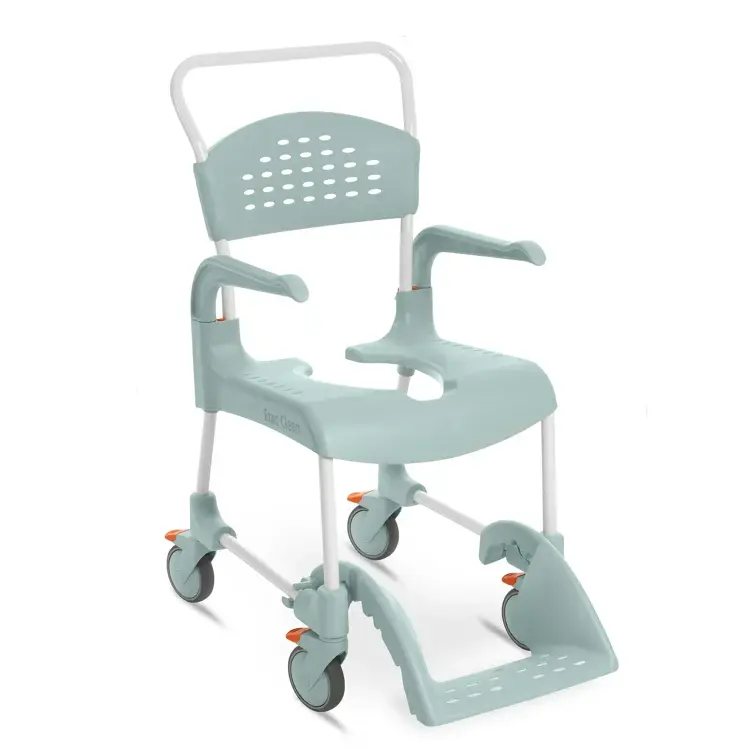
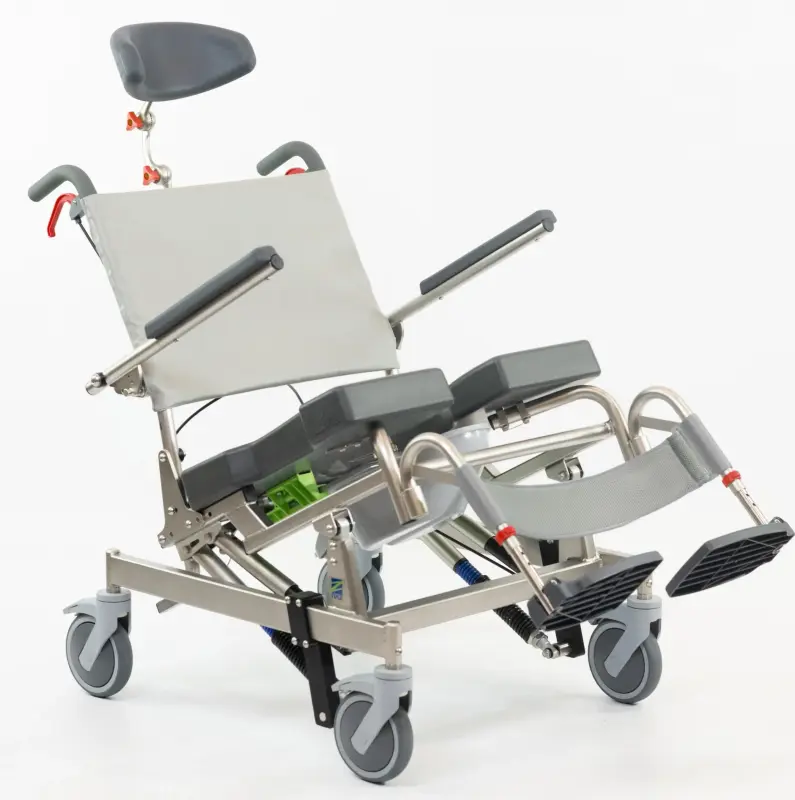
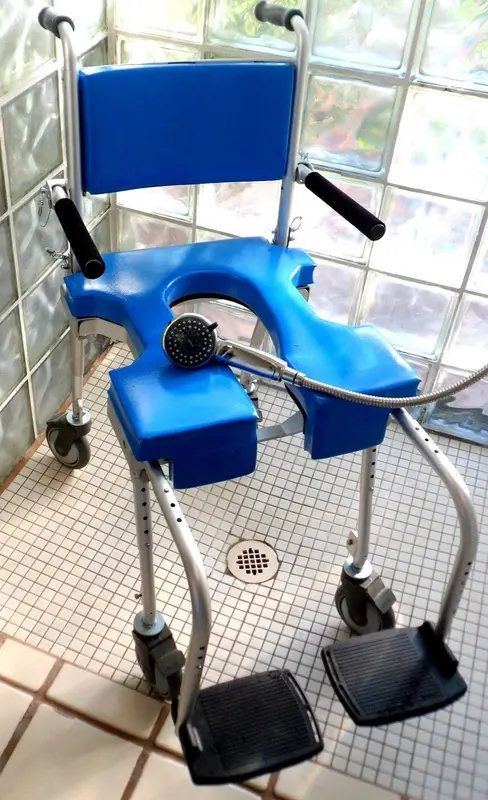
A roll-in shower is half the answer; the other half is what you sit on. Many wheelchair users do not take their everyday wheelchair into the water; they transfer once to a rolling shower commode chair, which goes over the toilet and into the shower, or onto a folding wall seat.
| Chair (catalog row) | Key specs from our catalog | Price in our catalog |
|---|---|---|
| Etac Clean (HL-002) | Max user 287 lb; seat 17.25 to 21.75 in | No price |
| Raz-AT600 tilt (HL-001) | 605 lb; 25 degree tilt; seat 23 or 26 in wide | No price |
| GO-Anywhere, travel (HL-024) | 250 lb; 24 lb chair; 18 in max width | Around USD 1,495 (reduced) |
The figures are from our catalog, checked October 2026. The GO-Anywhere price is the maker's reduced price and may revert to USD 2,195. Seat height matters with the ADA benchmark in mind: the Standards put shower seats at 17 to 19 inches above the floor, and the Etac Clean comes in three seat heights. Measure the chair's width against the shower entry and its height against the toilet. The Raz-AT600 is among the Raz chairs named in open FDA recall Z-1498-2026 (initiated 5 January 2026, 66 units), whose reason reads: "Due to a modification by a vendor and may be reinstalled without properly engaging the outside rear seat brackets that are used to keep the seat in place." Ask the dealer whether your chair is included.
The full comparison of shower commode chairs, tilt models and their recalls is in the Mobility Atlas guide to shower chairs and tub transfer benches, and commodes for the bedside are covered in the guide to bedside commodes. A tilt chair is a seating therapist's decision.
Grab bars, poles and the rest of the room
A new tub or shower is not the whole bathroom. The ADA Standards' grab bar rules are a useful home benchmark: bars 33 to 36 inches above the floor, 1 1/2 inches from the wall, strong enough for a force of 250 pounds at any point, and not rotating in their fittings. For a bathtub, the Standards also set a lower bar 8 to 10 inches above the rim on the back wall, a bar at least 24 inches long on the control end, and, without a permanent seat, a bar at least 12 inches long at the head end.
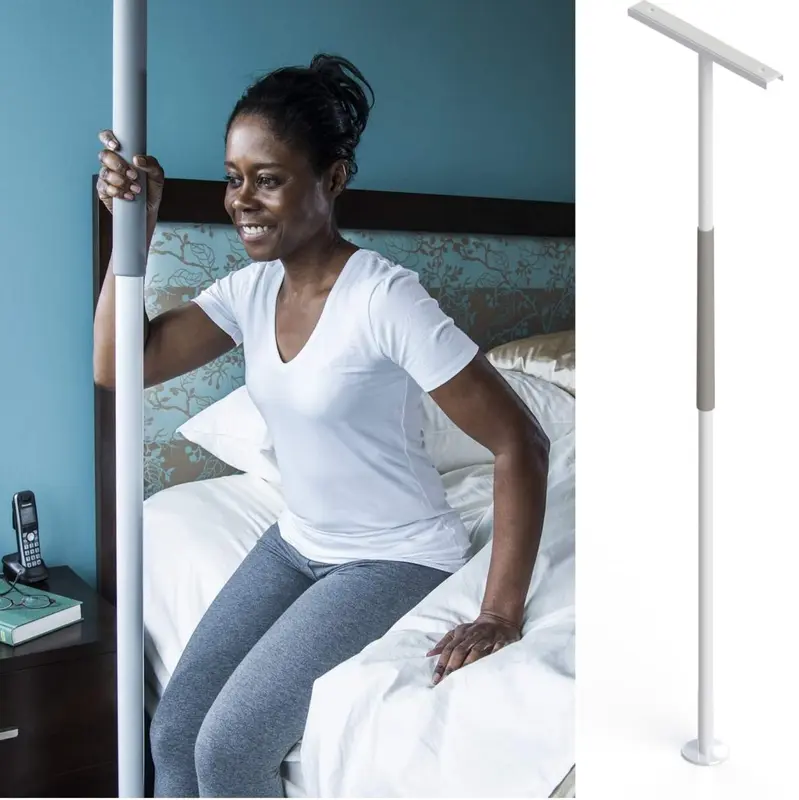
Where a wall cannot take a bar, a floor-to-ceiling pole is one option. Our catalog lists the HealthCraft SuperPole, rated for 300 lb (450 lb bariatric), held by a jackscrew without drilling, for ceilings of 93 to 99 inches. Medicare's national list says grab bars are a "self-help device" and denies them, but IRS Publication 502 names "Adding handrails or grab bars anywhere (whether or not in bathrooms)" among improvements that can count as medical expenses.
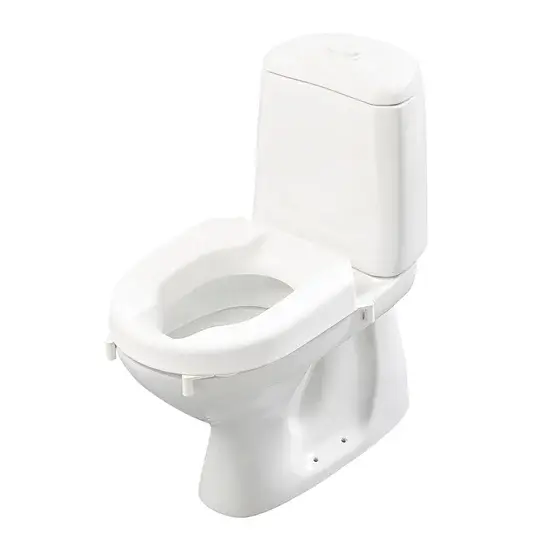
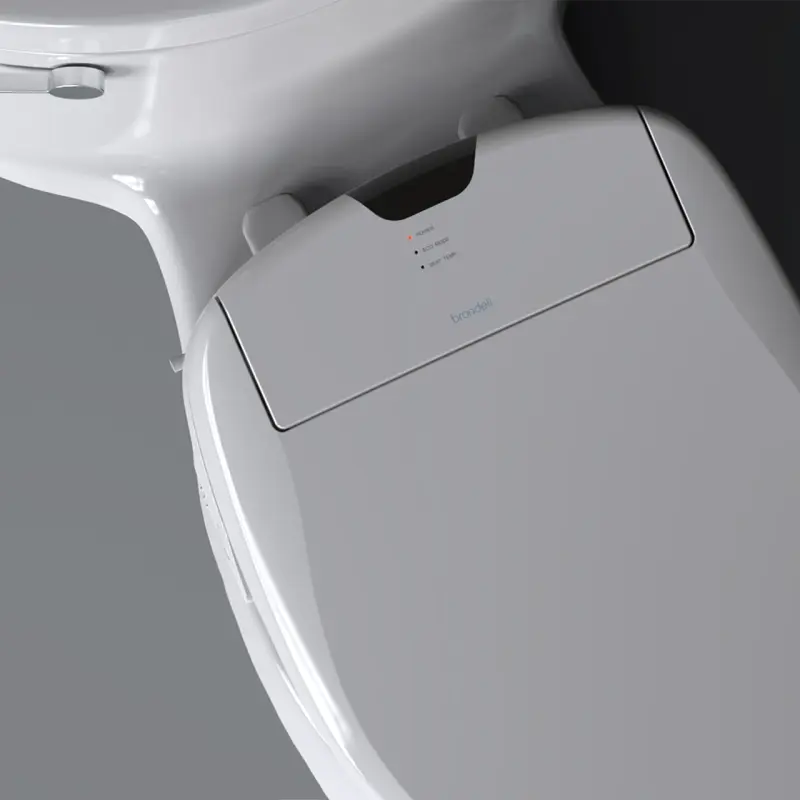
The toilet and the route to the shower count too. A raised toilet seat such as the Etac Hi-Loo in our catalog (6 or 10 cm, max user 150 kg) can match the toilet to a chair, and a bidet seat such as the Brondell Swash 1400 (around USD 479.99 to 499.99 on the maker's shop, a reduced price) is listed in our catalog for people with limited reach or hand function. Clear space beside the toilet, a door wide enough for the chair, and a light switch within reach finish the job. If the bathroom has a step at its door, the Mobility Atlas guide to wheelchair ramps covers threshold ramps.
Getting quotes without pressure
Walk-in tubs are often sold at an in-home appointment. Kohler says its dealer reviews "the age, condition, and volume of your water heater" at the in-home quote appointment and quotes one exact price. Ella publishes list prices online for the tub alone. Shower pan makers publish pan prices and leave the work to your installer.
- Have the occupational therapist's advice in writing before any sales visit, with the type of bathing they suggest and the measurements that matter to you.
- Ask for a written quote that names the tub or pan model, the door side, the threshold height, every option, and each part of the work: removal, plumbing, electrical, walls, floor, permit, water heater.
- Ask the fill and drain times for that model on your plumbing, and the water heater size it needs.
- Ask what the maker's warranty and the installer's workmanship warranty cover, and who pays for labor and water damage.
- Get a second quote for the same job, and a quote for the alternative: a roll-in shower if you were sold a tub, or a tub if you were sold a shower.
- Do not sign on the day. Take the quote home, show it to the therapist, and check any funding first.
If you would like help, send us an enquiry with your measurements, the therapist's advice and the quotes you have, and ask us to find a maker or installer to quote; we will request a quote for you.
Renting, apartments and moving home
A walk-in tub or a roll-in shower is a permanent change to a building. If you rent, ask the owner for written permission; for HISA, the VA requires a signed and notarized statement from the owner. IRS Publication 502 has an example of a renter who, "On the doctor's advice," installs "a bathroom with a shower stall on the first floor" of a rented house; because the landlord paid nothing and did not lower the rent, the renter "can include the entire amount you paid as medical expenses."
Warranties also stay with a person and a place. Kohler's runs while the original owner owns the home, and Ella's applies to the original owner at the original installation address and is not transferable. If you may move, a removable option such as a bath lift, a transfer bench or a travel shower chair may serve better for now.
Three traps
Trap one: trusting an "ADA" label. The Lowe's listing for the Total Care in Bathing 2852 walk-in tub says "ADA Compliant" and "17-Inch ADA compliant seat." The ADA bathtub sections we read set a seat height of 17 to 19 inches "above the bathroom finish floor," clearances and grab bars, and they say nothing about doors in a tub. On the other side, Freedom's residential pan says "NOT ADA COMPLIANT" and may still suit a home. The label tells you little; the dimensions, the threshold and the seat height measured from your floor tell you what you need.
Trap two: comparing a tub price with a finished price. A tub at $2,441.86 at one Lowe's store, or $4,709 on Ella's site (both 19 October 2026), is not what a walk-in tub costs installed. Kohler's market estimate adds $2,500 to $8,000 or more for installation, $1,000 to $5,000 or more for accessories, up to $3,000 for a new water tank and $250 to $700 to remove the old tub. For showers, the documents give no installation price at all. Compare written quotes for the whole job, not the box.
Trap three: assuming Medicare will pay. Medicare's national list denies bathtub seats, bathtub lifts and grab bars, and no Medicare document we read names walk-in tubs or roll-in showers. A Medicare Advantage plan may offer bathroom safety devices as an extra benefit, but the manual leaves the details to each plan. Ask the plan, in writing, before you sign a contract.
Three composite scenarios
These are composite scenarios, not individual customers. Each one combines facts and ranges already given in this guide to show how the decision plays out.
Scenario one: a full-time wheelchair user with strong arms owns an apartment with a tub and a shower over it, and transfers sideways. The occupational therapist suggests a roll-in shower and a rolling shower commode chair. They compare a Freedom ADA roll-in pan, 60 by 30 inches inside, at $928 on sale, and the residential INSPIRE at $924, and choose the ADA pan for the larger floor. With the accessory package, valve kit, seat and water retainer, the parts come to $2,766 before walls and labor. Because the pan is 63 inches long outside, they ask whether the 60-inch tub alcove must be widened. They ask two installers for itemized quotes, ask that the walls be reinforced for grab bars, and ask what the finished threshold will be above the tiles. They choose an Etac Clean at a seat height that matches the toilet, and ask a tax adviser about IRS Publication 502.
Scenario two: a part-time wheelchair user who loves to soak can slide across a level seat with a board, and the therapist agrees after watching. They look at the Ella Transfer32, listed at $4,709 to $9,025 for the tub alone, with its 36-inch outward door that needs 20 inches of swing clearance. They check the water heater against the 50+ gallon tank that Kohler's guide says most makers recommend, and ask Ella what the Transfer32 needs, because the tub takes 45 to 65 gallons with a bather in it, and ask the electrician for the dedicated GFCI line Ella requires. They set the water heater to 120°F, as the CPSC urges, and plan for the wait while the tub fills and drains, which Ella puts at 80 to 120 seconds for its drain.
Scenario three: a veteran with a service-connected disability uses a rollator and is starting to use a wheelchair outdoors. The VA's HISA page names roll-in showers as an example of what it funds, up to the $6,800 lifetime amount for a service-connected disability, and excludes spa and Jacuzzi type tubs. The veteran's VA physician writes the prescription; they send VA Form 10-0103, an itemized estimate and a color photograph of the bathroom, and choose a roll-in shower that will still work if they use the wheelchair indoors later.
Questions for the therapist, the installer and the plan
For the occupational therapist
- Which way of bathing fits how I transfer now, and how I may transfer in five years?
- Can I make a wet transfer into a tub seat safely, alone or with help?
- Can I sit through a tub's fill and drain, wet, without getting cold or faint?
- What threshold can I manage, if any, and should I use a shower chair or a wall seat?
- Where should grab bars go for me, and at what height?
- Do I need a tilt shower chair, a hoist, or a carer's space in the shower?
For the installer or maker
- What is the threshold or step-in height above my finished bathroom floor?
- Which way does the door swing, how wide is it, and how much space does it need in front?
- How long does this tub take to fill and drain on my plumbing?
- Is my water heater big enough, and what limits the water temperature at the faucet?
- What electrical circuits does this tub need, and are they in the quote?
- Can the floor be recessed for a level shower entry, and how will water be kept in?
- What does the maker's warranty cover, and what does your own workmanship warranty cover?
- Do I need a permit, and will you get it?
For the plan or funder
- Does my plan cover bathroom safety devices or home modifications, and up to what amount?
- Does it need an in-home assessment first, and by whom?
- Can you confirm in writing what is and is not covered before I sign a contract?
Your plan: 10 minutes, today, this week
In 10 minutes: measure the height of the tub wall or shower curb you cross now, and the width of the bathroom door. Check the hot water at the tap with a thermometer.
Today: measure the bathtub or shower alcove, the clear floor in front of it, and the space beside the toilet. Write down how you get in now and what is hard.
This week: ask your doctor for a referral to an occupational therapist for a bathroom visit, call your plan or the VA about funding, and ask for written quotes for both a tub and a roll-in shower.
Sources and documents
The documents are those named in the section on how we compared; every one is linked in the list at the end of this page.
Related guides on Mobility Atlas: Shower chairs and tub transfer benches; Wheelchair ramps; Patient lifts and slings; Bedside commodes; Lift chairs.
Method in brief: how we compared. We read each saved document in full for the parts that concern bathtubs, showers, their prices, warranties and funding, copied numbers and terms as printed, and quoted them only where the words are in the saved text. Where two figures on one page disagree, we give both. Computed figures, such as the cost of a pan with its add-ons and the fill time at the faucet's rated flow, are our arithmetic from the page's numbers. We did not test any tub or shower, and we did not read state, Medicaid or local program documents. Clinical choices about transfers and seating belong to an occupational therapist.
Prices checked October 2026 on Kohler's, Ella's Bubbles', Freedom Showers' and Lowe's pages and in our catalog; prices change and differ by store, dealer, country and funding, so confirm them in a written quote. Documents checked October 2026: the ADA Standards, the CPSC leaflet, the FDA regulation and listing data, Medicare's list and manual, and the VA, USDA and IRS pages.
This article is general information. Rules and prices differ by country and change, so confirm them before you buy or travel.
Common questions
What is the difference between a walk-in tub and a walk-in shower?
A walk-in tub is a deep bathtub with a door in its side and a seat inside: you step a few inches, sit, close the door and wait for it to fill. A walk-in shower has no tub wall; with a low threshold or none, you step or roll in and wash without waiting for water. A roll-in shower is the curbless kind a wheelchair user can enter on a shower chair.
Can a wheelchair user use a walk-in tub?
Only by transferring to the seat. A transfer tub, such as Ella's Transfer32 with a 36-inch outward door, is built for sliding across from a wheelchair. No walk-in tub lets you roll in. Whether you can make that transfer safely, wet, is for an occupational therapist to judge.
How much does a walk-in tub cost installed?
Kohler's price guide, which describes the market, puts a walk-in tub alone at $2,000 to $20,000 and a finished job at $5,500 to $33,000 or more, plus up to $3,000 if a new water heater is needed. Prices differ by dealer, country and funding; get written, itemized quotes.
What size is an ADA roll-in shower?
The 2010 ADA Standards set a standard roll-in shower at 30 inches wide by 60 inches deep minimum inside, with a 60-inch entry and a threshold of 1/2 inch at most. An alternate roll-in type is 36 by 60 inches. For a home these are a benchmark; ask your local building department what applies.
Does Medicare cover a walk-in tub?
No Medicare document we read names walk-in tubs. Medicare's national list denies bathtub seats, bathtub lifts and grab bars. Medicare Advantage plans may offer bathroom safety devices as a supplemental benefit; ask your plan in writing. Rules and prices differ by plan and state.
How long does a walk-in tub take to drain?
It depends on the drain and your plumbing. Ella's Bubbles says its dual-drain tubs drain in about 80 to 120 seconds, and its chart gives 5 to 15 minutes for a conventional 1 1/2 inch drain. Kohler publishes no time. You sit in the tub until it has drained.
Sources
- U.S. Access Board: 2010 ADA Standards, 607 Bathtubs, 608 Shower Compartments, 609 Grab Bars, 610 Seats
- Kohler Walk-In Bath: dimensions, step, door, drain, warranty and FAQs
- Kohler Walk-In Bath: walk-in tub price guide (read 19 October 2026)
- Ella's Bubbles: Transfer32 walk-in tub (prices read 19 October 2026)
- Ella's Bubbles: Standard 30 x 52 walk-in tub (prices read 19 October 2026)
- Ella's Bubbles: Dual Drain Technology
- Ella's Bubbles: Lifetime Limited Warranty coverage
- Freedom Showers: ADA roll-in shower pans (prices read 19 October 2026)
- Freedom Showers: barrier-free residential shower pans (prices read 19 October 2026)
- Lowe's: search results for walk-in tubs, one store (read 19 October 2026)
- Lowe's: search results for ADA compliant shower bases, one store (read 19 October 2026)
- Lowe's: search results for ADA roll-in showers, one store (read 19 October 2026)
- Kohler Walk-In Bath: low step entry
- Kohler Walk-In Bath: extra-wide door
- Kohler Walk-In Bath: fast drain
- Kohler Walk-In Bath: warranty
- Kohler Walk-In Bath: frequently asked questions
- Ella's Bubbles: Transfer32 wheelchair transfer tub overview (support article)
- Ella's Bubbles: Transfer32 walk-in tub profile (support article)
- Freedom Showers: APC6332BFPANC ADA roll-in shower pan
- Freedom Showers: APX6032BFPC Freedom INSPIRE accessible shower pan
- CPSC: Avoiding tap water scalds, safety guide page
- openFDA: device recall records for shower, bath and commode products (Raz Design, 2026)
- CPSC: Avoiding Tap Water Scalds, Publication 5098
- eCFR: 21 CFR 890.5100, Immersion hydrobath
- openFDA: device registration and listing, regulation 890.5100
- CMS: NCD 280.1, Durable Medical Equipment Reference List
- CMS: Medicare Managed Care Manual, chapter 4, Benefits and Beneficiary Protections
- VA: Home Improvements and Structural Alterations (HISA)
- USDA Rural Development: Single Family Housing Repair Loans and Grants (Section 504)
- IRS: Publication 502, Medical and Dental Expenses
- Etac: Etac Clean mobile shower commode (catalog row HL-002)
- Raz Design: Raz-AT600 shower commode chair (catalog row HL-001)
- GO! Mobility Solutions: GO-Anywhere Commode 'N Shower Chair (catalog row HL-024)
- Dhcare (UK dealer): Aquatec Orca NG bath lift (catalog row HL-003)
- HealthCraft: SuperPole (catalog row HL-006)
- Etac: Hi-Loo raised toilet seat with brackets (catalog row HL-004)
- Brondell: Swash 1400 bidet toilet seat (catalog row HL-005)
Read on 19 October 2026. The wording of the article is our own.