Shower chairs and tub transfer benches: how to choose, what they cost, what can go wrong
Stools, chairs with backs, tub transfer benches, sliding benches and rolling or tilt shower commodes: fit, capacity, prices, Medicare and recalls.
Contents
- Stop and check before the next shower
- The short answer
- Six kinds of shower seat, side by side
- Which seat for which bathroom
- Start with the transfer, not the chair
- Measure the bathroom and the seat height
- Weight capacity: read it twice
- Back, arms, cut-out and swivel
- Rust, materials and wall-mounted seats
- Folding, storage and sharing the bathroom
- Tub transfer benches in detail
- Sliding transfer benches and tub slider systems
- Rolling shower commode chairs
- Tilt-in-space and reclining shower commodes
- Bariatric and children's seats
- The rest of the bathroom: lifts, toilet seats, poles and hygiene aids
- What shower seats cost in 2026
- Does Medicare pay for a shower chair?
- Other ways to pay
- How the FDA classes shower chairs and benches
- What the FDA recall records show
- What the recalls mean for buyers
- CPSC recalls: shower seats sold as furniture
- Checking a seat for recalls and reporting a problem
- Grab bars, mats and water: what MedlinePlus advises
- Setting up the seat, and a monthly check
- Three traps
- Three composite scenarios
- Questions for the therapist and the dealer
- Your plan: 10 minutes, today, this week
- Sources and documents
- Common questions
- Sources
Stop and check before the next shower
Someone already uses a shower seat or bench at home? Check these five things first. Choosing one? Start at the short answer below.
- The seat rocks, a leg is shorter than the others, or a rubber foot is split or missing. Stop using it until the legs are set at the same height and the feet are replaced.
- You can see rust, a crack or a loose bolt on the frame, a bracket or a wall fixing. Corroded hardware is behind two of the consumer recalls described in this guide.
- The user weighs close to, or more than, the capacity printed on the seat or in the manual. Check the label, not the box you remember.
- A towel rail is being used as a grab bar. MedlinePlus says: "Do not use towel racks as grab bars. They can't support your weight."
- A rolling shower commode chair moves when the brakes are on. Check every caster lock before the person sits.
Then check the model against the recall lists: the FDA's device recall database for medical shower chairs and commodes, and the CPSC's list for seats sold as bathroom furniture. These are US lists; outside the US, ask the seller or maker which national regulator's recall list covers the seat. The recall sections below explain how.
The short answer
A shower seat lets you wash sitting down instead of standing on a wet floor. Which kind you need depends on two things more than any other: the bathroom (a tub with a shower over it, a walk-in shower with a lip, or a roll-in shower with no lip at all) and how you get onto the seat (stepping in, sliding across from a wheelchair, or being moved by a carer). A plain stool or a chair with a back suits someone who can step into the shower and stand for a moment. A tub transfer bench straddles the side of the bath so you sit down outside the tub and shuffle across. A sliding transfer bench carries you over the tub wall on a seat that moves along a rail. A rolling shower commode chair is a wheeled chair with a toilet opening that you sit in once and wheel into a roll-in shower or over the toilet. A tilt shower commode does the same, and tips back for a person who cannot hold their trunk upright.
On two large US retailers' pages read on 18 October 2026, plain shower stools, seats and chairs were listed from USD 53 to USD 250.75, with a corner seat at USD 340.08, tub transfer benches from USD 127 to USD 329.25, sliding transfer benches from USD 230 to USD 535 and a tub slider system at USD 2,057, manual rolling shower commode chairs on 1800wheelchair mostly from USD 329.95 to USD 2,388 with a powered model at USD 5,353.34, and tilt models from USD 720 to USD 2,610. Medicare's national equipment list names "Bathtub Seats" and denies them as "comfort or convenience" items, while commodes can be covered in narrow cases. The details, and what the recall records show, are below.
Mobility Atlas earns a fee or margin when you order through us; the comparison below uses only the makers' published spec pages, two retailers' listed prices, our own catalog, and FDA, CPSC, Medicare and MedlinePlus documents, read in October 2026. We name what each product does well and quote the documents as they stand. The choice of seat for a person who cannot stand, cannot sit unsupported or transfers with help belongs with an occupational or physical therapist; this guide explains the options and what to ask, and stops there.
Six kinds of shower seat, side by side
The names overlap from shop to shop: "bath seat", "shower chair" and "bath bench" are often the same thing. This guide uses six working types. The prices are listed prices from 1800wheelchair and AliMed read on 18 October 2026, and the capacities are as each listing states them. The cells give the span of the listings we read, with examples beyond it in brackets; the sections below list the products. Where a listing does not say whether a seat has a back, we count it as a stool or seat.
| Type | Bathroom | How you get on | Listed prices (USD) | Listed capacities |
|---|---|---|---|---|
| Shower stool or seat, back not stated | Walk-in or tub | Step in, sit down | 53 to 250.75 (corner seat 340.08) | 300 to 600 lb |
| Shower chair with back | Walk-in or tub | Step in, sit down | 92 to 184 | 300 to 500 lb |
| Tub transfer bench | Tub with shower | Sit outside, shuffle in | 127 to 329.25 | 400 to 600 lb |
| Sliding transfer bench | Tub with shower | Seat slides on a rail | 230 to 535 (slider system 2,057) | 300 to 450 lb |
| Rolling shower commode | Roll-in, toilet | Transfer once, then roll | 329.95 to 2,388 (powered 5,353.34) | 220 to 440 lb |
| Tilt or reclining commode | Roll-in, toilet | Carer tilts and rolls | 682.31 to 2,610 | 300 to 400 lb (Raz-AT600: 605 lb) |
Two things the table does not show matter just as much. Seat height: most benches and chairs adjust in steps of about half an inch to an inch over a range of four to seven inches, and the right height is the one that matches the surface you transfer from. And the weight of the seat itself: a folding bath bench can weigh 4.4 lb, a sliding transfer bench 16 lb, a rolling shower commode chair 18.5 to 53 lb, and a tub slider system 77.5 lb or more. A chair that lives in the shower can be heavy; one that must be put away after every wash cannot.
Which seat for which bathroom
Which shower seat fits which bathroom? Mobility Atlas read the spec pages of Drive Medical and the category pages of two large retailers in October 2026, and the answer starts with the floor of your shower. In a bathtub with a shower over it, a stool or chair inside the tub still means stepping over the tub wall; a tub transfer bench avoids that: two of its legs stand outside the tub, so you sit down outside and slide across rather than stepping over, as 1800wheelchair's page describes. In a walk-in shower with a low lip, a chair with a back and arms, or a swivel seat, is the usual choice for someone who can step; a therapist can confirm. In a roll-in shower with no lip, a rolling shower commode chair lets a wheelchair user transfer once and roll in. Tilt models add support for people who cannot sit upright alone; a therapist decides whether one is needed.
Bathtub with a shower over it
This is the hardest bathroom for anyone who cannot step high. The tub wall is the obstacle. A seat inside the tub helps with the washing but not with the getting in. A tub transfer bench helps with both: you back up to the part of the bench outside the tub, sit, lift or swing your legs over, and slide along to the middle. 1800wheelchair's page says these benches "bridge over the bathtub wall," with "two sets of legs inside the tub while the other two legs outside the tub." The same page gives a rule of thumb that a standard tub is about 23 inches wide and 55 inches long, but measure yours: tubs differ, and Drive's Splash Defense bench lists the exact tub sizes it fits.
Walk-in shower with a lip or step
Here the question is whether you can step over the lip safely and stand long enough to turn and sit. If you can, a shower chair with a back, with arms if you push up from them, fits most stalls. 1800wheelchair's page notes that standard showers can be as small as 32 by 32 inches, which leaves little room: check the seat's footprint, not just its seat width, and that the door or curtain still closes. A swivel seat helps if turning on wet feet is the hard part. A corner seat saves floor space; AliMed lists one at USD 340.08.
Roll-in shower with no lip
A level-entry shower opens the way to a rolling shower commode chair: one transfer from the wheelchair or bed to the shower chair, then the chair goes over the toilet and into the shower without another transfer. The shower floor must slope gently enough for the chair's casters and brakes, the doorway must be wide enough for the chair, and the toilet must be the right height for the chair to roll over it. If your bathroom has a lip or step today, the Mobility Atlas guide to wheelchair ramps covers home access, and an occupational therapist can say whether a small threshold change would do.
Start with the transfer, not the chair
How you get from standing or from the wheelchair onto the seat decides more than any feature of the seat. A person who walks with a cane or a rollator and can step into a stall has a different problem from a person who transfers sideways from a wheelchair, and both differ from a person a carer moves with a lift. Before you look at prices, write down how the transfer happens now, which side is stronger, who helps, and whether that will still be true in a year.
- Stepping in and sitting: a stool, a chair with a back, or a swivel seat. Grab bars do much of the work.
- Sitting outside the tub and shuffling across: a tub transfer bench, set to the height of the wheelchair seat or of the surface you stand up from.
- Sliding transfer with a board or sideways shuffle from a wheelchair: a tub transfer bench with a padded seat, a sliding transfer bench, or a rolling shower commode chair in a roll-in shower.
- Transfer with a carer's help or a hoist: a rolling shower commode chair or a tilt model, often with a lift. The Mobility Atlas patient lift guide covers lifts and bathing slings.
- Walking aid users: the walker and rollator guide explains why a walker should stay out of the shower unless its maker says it is made for wet use.
Transfer technique is a clinical matter. MedlinePlus, the US National Library of Medicine's health site, says that if you are not sure what changes you need in your bathroom, "ask your health care provider for a referral to an occupational or physical therapist," and that "The therapist can visit your bathroom and make safety recommendations." That home visit is worth more than any buying guide, this one included.
Measure the bathroom and the seat height
A seat that does not fit the room wobbles, or goes back to the shop. Measure before you shop, with the person who will use it if possible.
- Tub: inside width at the bottom, width at the top, the height of the tub wall from the floor, and the thickness of the tub edge. Drive's Splash Defense transfer bench, for example, lists that it fits tubs with a maximum height of 15.5 inches, a minimum bottom width of 18.5 inches, a minimum top width of 23 inches and a maximum edge width of 5.5 inches.
- Floor outside the tub: how far the bathroom floor runs from the tub to the toilet or vanity, because a transfer bench's outer legs and seat need that space. Drive's three-piece transfer bench seat is 26 inches wide.
- Shower stall: inside width and depth, the height of any lip, and the width of the door or opening.
- Seat height: the height of the wheelchair seat or bed the person transfers from, and the height at which their feet rest flat on the shower floor with knees at about a right angle. A therapist can say which matters more.
- Toilet: the height of the bowl rim from the floor and the space around it, if a commode chair is to roll over it.
- Doorways and turns: the narrowest point on the route from bedroom to shower, for any wheeled chair.
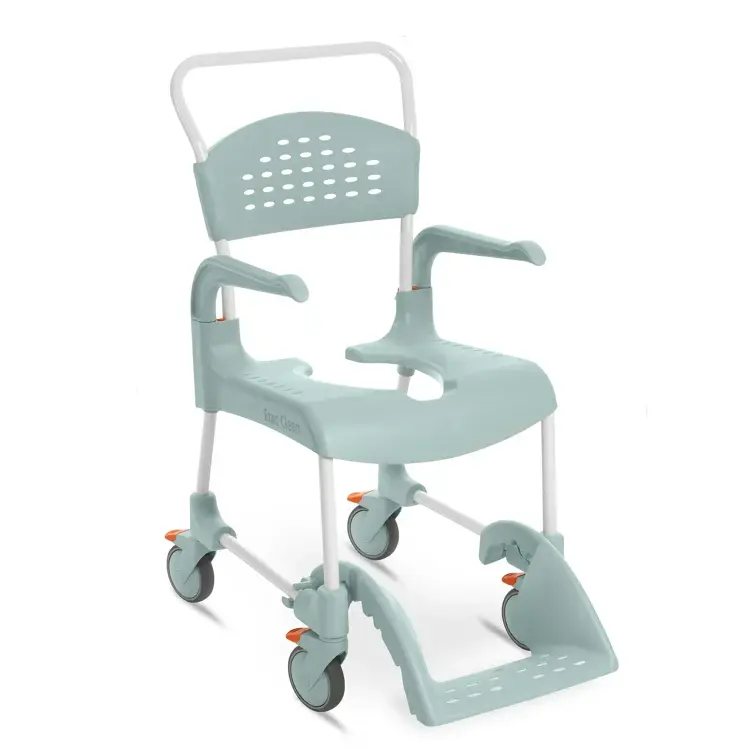
Then compare with the seat. Drive's transfer tub bench adjusts from 17.5 to 22.5 inches, its folding universal sliding transfer bench from 21 to 25 inches, and its AquaSense transfer bench from 18 to 22 inches in 0.47-inch steps. Drive's AquaSense bath seat with backrest adjusts from 14 to 21 inches; the Carex compact shower stool from 16 to 21 inches. Rolling shower commode chairs come in fixed heights or narrow ranges: Drive's aluminum rehab shower commode chair with rear-locking casters lists a seat-to-floor height of 20 to 22 inches, and our catalog lists the Etac Clean in seat heights of 17.25, 19.5 or 21.75 inches.
Weight capacity: read it twice
Every listing gives a weight capacity, and it is the one number that must be right. The listings read for this guide range from 60 lb (the smallest size of Drive's Otter children's bathing system on AliMed) to 1000 lb (Drive's bariatric drop arm commode chair on 1800wheelchair). Most adult stools, chairs and benches are rated for 250 to 400 lb; bariatric benches and chairs for 500 to 600 lb.
Read the number in two places, the maker's page and the seller's, because they do not always agree. 1800wheelchair's card for the ShowerBuddy Roll-In Shower Chair with Tilt shows a weight capacity of 350 lb while its own card text says "Weight capacity: up to 300 lbs." Drive's own spec table for the PreserveTech 360 swivel bath chair reads "Weight Capacity 8.80 lb," an obvious data-entry slip, while the same page's description says the frame "supports up to 350lbs." The Etac Clean is listed at 285 lb on 1800wheelchair and at 287 lb in our catalog, taken from Etac's page, a small difference that is probably rounding, but still a reason to read the label. When numbers differ, use the lower one and ask the maker.
Two details hide in the small print. Some capacities assume the weight is spread evenly: the bariatric bath seat on 1800wheelchair is listed at a "Maximum Weight Capacity 600 lb - EVENLY DISTRIBUTED." A person who drops onto the edge of a bench, or pushes up hard on one arm, does not load it evenly. And a capacity is for the person plus anything else on the seat. If the user is close to the limit, step up a class; bariatric transfer benches on the retailer pages are listed at 500 to 600 lb, and the Raz-AT600 tilt shower commode in our catalog at 605 lb.
Back, arms, cut-out and swivel
After the type and the capacity come the parts that decide whether the seat is comfortable and safe for this person.
- Back: a backrest helps anyone who tires sitting, or who leans back to wash their feet. A stool without one is lighter and fits a narrow stall, but it gives nothing to lean on. Drive's AquaSense bath seats come with and without backrests.
- Arms: arms help you push up to stand and give a feeling of security; they also get in the way of a sideways transfer. Some benches have a padded arm on one side only, or arms that flip up. Drive's premium series shower chair with back and arms has a seat 21.75 inches wide.
- Cut-out or commode opening: a gap in the seat lets you wash the groin and buttocks without standing, and lets a rolling chair go over the toilet. Drive's padded transfer bench with a commode opening is listed at USD 181 on 1800wheelchair; Drive's combination padded transfer bench and commode is rated for 400 lb.
- Swivel: a seat that turns lets you sit facing out of the tub and turn to face the taps. Drive's PreserveTech 360 swivel bath chair is listed at USD 158 on 1800wheelchair and at USD 143 on AliMed.
- Seat belt: Drive's folding universal sliding transfer bench "Comes with seat belt for added safety," its page says. Ask the therapist whether a belt is right for this person.
People who sit for long periods, or have reduced feeling, should ask the therapist or seating clinic about the seat surface as well. A hard plastic seat with drainage holes is easy to clean; whether it is right for someone at risk of pressure injury is a clinician's call, and the Mobility Atlas wheelchair cushion guide explains why time and surface matter.
Rust, materials and wall-mounted seats
A shower seat lives in water, soap and cleaning products, and half of the consumer recalls read for this guide come down to metal that corroded or wood that broke. Read what the frame is made of.
- Aluminum: light and resistant to rust. Drive's AquaSense transfer bench page says its "rust-resistant aluminum frame supports up to 250 lbs," and the PreserveTech chair's page uses the same words with 350 lb.
- Stainless steel: heavier and very durable. Our catalog lists the Raz-AT600 as a stainless-steel tilt shower commode chair.
- Plastic or resin seats with drainage holes: 1800wheelchair's category page says most models have "drainage holes on the seat and legs to prevent the chair itself from retaining water."
- Teak and other wood: popular in home stores. Several teak shower benches, stools and wall seats have been recalled by the CPSC because the wood broke or the hardware corroded; see the recall section.
- Wall-mounted folding seats: they save space, but they depend on the wall, the brackets and the fixings. Two CPSC recalls describe wall-mounted teak seats whose hardware could corrode, and an FDA recall describes a wall-mounted medical shower seat whose wall bracket cracked or broke.
Whatever the material, check the frame, the feet, the bolts and any brackets every month for rust, cracks, loose fixings and split or missing rubber tips.
Folding, storage and sharing the bathroom
If other people use the same bathroom, the seat will be moved every day. A light folding seat is easier to put away and easier to put back wrongly. 1800wheelchair lists a foldable bath bench at 4.4 lb, and Drive's folding universal sliding transfer bench, which its page says "Folds flat for transport and storage," at 16 lb. Drive's padded transfer bench weighs 11.75 lb and its transfer tub bench 13.6 lb; check that whoever sets it up can lift that much in and out of a tub.
Every time a bench comes out, the legs must go back at the same height on both sides, the pins must click fully home, and the outside legs must stand flat on the bathroom floor. If more than one person sets it up, put a strip of tape on each leg at the right hole.
Tub transfer benches in detail
A tub transfer bench is the commonest answer for a bathtub, and the cheapest that removes the step over the tub wall. It is a long seat on four legs: two inside the tub and two on the bathroom floor. You sit on the outer end, lift your legs over the wall, and slide along to the middle. Ask whether the back can be fitted on either side, so the bench suits a tub with taps at the left or the right.
| Bench (maker or seller) | Listed price (USD) | Capacity | Seat size or weight |
|---|---|---|---|
| Drive three-piece transfer bench (1800wheelchair) | 127 | 400 lb | Maker: seat 26 in wide; 12.48 lb |
| Drive Splash Defense with curtain guard (1800wheelchair) | 127 | 400 lb | Seat width 28 in; 14 lb |
| Carex Universal Transfer Bench (AliMed) | 132.75 | 400 lb | Not listed |
| Drive padded seat bench with commode opening (1800wheelchair) | 181 | 400 lb | Not listed |
| Drive Transfer Tub Bench (AliMed) | 199.50 | 400 lb | Maker: seat 26 in wide; 13.6 lb |
| Lumex bariatric transfer bench (1800wheelchair) | 266 | 600 lb | Not listed |
| Drive Padded Transfer Bench (AliMed) | 293.25 | 400 lb | Maker: seat 24 x 16 in; 11.75 lb |
| Imperial Collection transfer bench (1800wheelchair) | 299 | 400 lb | Not listed |
| Drive Bariatric Transfer Bench (AliMed) | 329.25 | 500 lb | Maker: seat 26.5 x 16.5 in; 14 lb |
What each does well: the cheapest plain benches carry 400 lb, and the Splash Defense adjusts in half-inch steps and is built around the curtain problem, with a guard so water stays in the tub; padded benches have a padded seat; bariatric benches carry 500 to 600 lb. Drive's padded bench uses an "A-frame construction" and "Dual Column" extension legs, its page says.
The weak points are the same for all of them. The curtain has to tuck between the bench and the tub, so water runs onto the floor unless you use a split curtain or a guard. The outer legs stand on the bathroom floor, which gets wet. And a bench set at a different height inside and outside the tub tilts the seat. Use a handheld shower head, a non-slip mat outside the tub, and check both sets of legs each time.
Sliding transfer benches and tub slider systems
A sliding transfer bench puts the seat on a rail that spans the tub wall. You sit on the seat outside the tub, and the seat slides across, with you on it, so you do not have to shuffle your body over a fixed surface. Some also swivel, so you can turn to face the taps. They are meant for people who find shuffling across a fixed seat hard, and for carers who help with the move. Which kind suits a person is for their therapist to decide.
| Sliding bench (seller) | Listed price (USD) | Capacity | Notes (listing or maker) |
|---|---|---|---|
| Drive folding universal sliding transfer bench (1800wheelchair) | 230 | 300 lb | Height 21 to 25 in; folds; 16 lb |
| Gateway Premium sliding bench with swivel seat (1800wheelchair) | 269 | 300 lb | Seat width 13 in |
| Sliding-Rotating Transfer Bench (AliMed) | 373.50 | 450 lb | Not listed |
| Carousel sliding bench with swivel seat (1800wheelchair) | 393 | Not listed | Not listed |
| Snap-n-Save heavy-duty sliding bench (AliMed) | 509.75 | 400 lb | Not listed |
| ShowerGlyde SG1, SG2 or SG3 (1800wheelchair) | 535 | 330 lb | 23.2 to 26.5 lb |
| Raz Trakz Tub Slider System (1800wheelchair) | 2,057 | 350 lb | 77.5 or 95 lb; seat width 18 in |
Drive's page for its sliding bench says the seat "slides left and right along frame for easy entry into and out of tub," that the seat height adjusts in half-inch steps, and that it "Folds flat for transport and storage." The Raz Trakz system sits in a different class: at 77.5 or 95 lb it is much heavier than a bench and is not moved after every wash, and its listed price is several times that of a plain sliding bench.
Two cautions. A seat that moves is a seat that can move when you do not want it to: ask how it locks, and practise with a carer before the first real wash. And the rail across the tub wall needs room on the bathroom floor, often more than a fixed bench. Measure from the tub to the toilet or vanity.
Rolling shower commode chairs
A rolling shower commode chair, also sold as a shower commode or shower wheelchair, is a wheeled chair made to get wet, with a seat that has a toilet opening. You transfer onto it once, then wheel or are wheeled over the toilet, into a roll-in shower, and back. 1800wheelchair's page says these chairs "usually come with a seat opening, enabling users to attend to toileting needs while seated," and adds: "transferring the chair into the shower will likely require assistance from a caregiver." Some chairs have large rear wheels so the user can propel themselves.
| Chair (seller) | Listed price (USD) | Capacity | Chair weight, seat width |
|---|---|---|---|
| Nova deluxe shower chair and commode (1800wheelchair) | 329.95 | 250 lb | 18.5 lb; 16 in |
| MedaCure rolling shower commode chair (1800wheelchair) | 372 | 265 lb | 40 lb; 18 in |
| Drive aluminum shower chair and commode (AliMed) | 475.50 | 300 lb | Not listed |
| Healthline aluminum shower commode chair (1800wheelchair) | 633 | 286 to 440 lb | 28.4 to 32.3 lb; 18 to 22 in |
| Aquatec Ocean Ergo (1800wheelchair) | 957 | 330 or 400 lb | 37.5 to 53 lb; 19 in |
| Etac Clean (1800wheelchair) | 969.99 | 285 lb | 30 lb; 18 in |
| Drive aluminum rehab shower commode, model not stated by the seller (1800wheelchair) | 981 | 275 lb | 41 lb; 18 in |
| Etac Swift Mobil-2 (1800wheelchair) | 1,413 | 352.74 lb | 36.5 lb; 21.1 in |
| Etac Clean 24 in self-propelling (1800wheelchair) | 2,249.99 | 286.60 lb | 44 lb; 19 in |
| Raz-SP self-propel (1800wheelchair) | 2,350 | 407 lb | 47 or 49 lb; 18 in |
Our catalog holds the Etac Clean shower commode (HL-002). Its row lists a maximum user weight of 287 lb, seat heights of 17.25, 19.5 or 21.75 inches, and a chair weight of 29.8, 30.8 or 32 lb by height. The row describes an open back and a footrest that folds under, and holds no price; 1800wheelchair lists it at USD 969.99. What it does well, by its documents: a slim chair at about 30 lb, in three fixed heights to match a toilet.
The Raz-SP is one of the five Raz models in the open 2026 FDA recall record about seat brackets (see the recall section); ask the dealer whether a particular chair is affected. 1800wheelchair's card for the Etac Alto powered shower commode chair lists a weight capacity of 160 lb, a figure that looks inconsistent with the other chairs in this class; ask the seller to confirm it before relying on it.
What to check on any rolling chair: that the seat height clears your toilet bowl with the pan or bucket removed; that the casters lock, all four or the rear two as the maker says; that the footrests fold out of the way for the transfer; that the chair fits through the bathroom door and turns in the room; and that the floor of the shower lets it roll in without tipping forward. Drive's aluminum rehab shower commode chair with "Four Rear-Locking Casters," as its page names it (item NRS185007), lists a seat-to-floor height of 20 to 22 inches and weighs 35.25 lb.
Tilt-in-space and reclining shower commodes
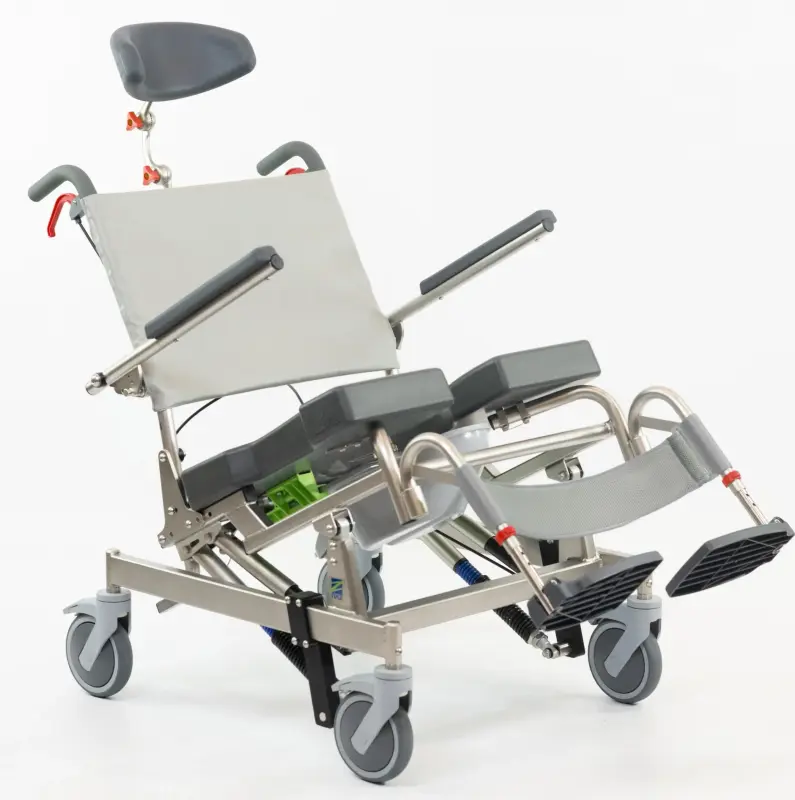
A tilt-in-space shower commode tips the whole seat and back together, so the person's weight shifts back without sliding forward. A reclining chair lowers the back only. Both are for people who cannot hold themselves upright on a plain chair, who tire, or who need a carer to wash them; a seating or occupational therapist should decide which one, and how far it should tilt or recline.
| Chair (seller) | Listed price (USD) | Capacity | Notes |
|---|---|---|---|
| Healthline reclining shower commode chair (AliMed) | 682.31 | 300 lb | Reclining |
| Healthline bariatric reclining shower commode chair (AliMed) | 1,007.30 | 400 lb | Reclining |
| Drive tilting aluminum rehab shower chair commode (1800wheelchair) | 720 | 300 lb | Tilt; 45 lb; seat 20 in |
| Laguna professional reclining shower chair (1800wheelchair) | 760 | Not listed | Reclining |
| Healthline aluminum tilt shower commode (1800wheelchair) | 939 | 300 or 325 lb | 36 or 38 lb |
| ShowerBuddy roll-in chair with tilt (1800wheelchair) | 1,865.75 | 350 lb on card, 300 lb in card text; use 300 | 45 lb; seat 15 in |
| Aquatec Ergo VIP tilt-in-space (1800wheelchair) | 2,071 | 330 lb | 51.8 lb; seat 18.7 in |
| Etac Swift Mobil Tilt-2 (1800wheelchair) | 2,610 | 352 lb | 45 lb; seat 19.5 in |
Our catalog holds the Raz-AT600 (HL-001), a bariatric stainless-steel tilt shower commode chair from Raz Design. Its row lists a capacity of 605 lb, a 25 degree tilt, seats 23 or 26 inches wide by 18 inches deep, 6 inch locking casters and a spring tilt system that helps the carer with the weight. It is built for bariatric users who need a carer to help with showering and toileting. The catalog row has no price. The Raz-AT600 is also named in an open FDA recall record from January 2026 about the seat brackets (66 chairs; the record names a vendor modification and gives the root cause as use error), covered in the recall section; ask the dealer whether a particular chair is affected.
Tilt chairs are heavier, longer and harder to steer than upright ones, and the carer has to work around them in a wet room. Check that the tilt lever is reachable and locks, that the chair still clears the toilet when upright, and that the bathroom has room to tilt it. Ask the seating clinic about the seat and back pads, because people may sit in these chairs for longer than a quick shower.
Bariatric and children's seats
Heavier users need more than a higher number on the label. Bariatric benches and chairs are wider, so measure the tub and the stall again. On the pages read for this guide, bariatric options included a deluxe heavy duty bath bench at USD 106 for 500 lb and a bariatric bath seat at USD 113 for 600 lb on 1800wheelchair; Drive's deluxe bariatric shower chair at USD 184 for 500 lb on AliMed; the Lumex bariatric transfer bench at USD 266 for 600 lb (1800wheelchair); a Healthline bariatric reclining shower commode chair at USD 1,007.30 for 400 lb (AliMed); Healthline bariatric shower commode chairs with vacuum seats at USD 626.81 for 500 lb and USD 807.74 for 600 lb (AliMed listings; the saved listing does not say whether they roll, so ask); and, for commodes, the Drive bariatric drop arm commode chair at USD 296 for 1000 lb (1800wheelchair) and the Big John commode chair at USD 429.50 for 800 lb (AliMed). Drive's deluxe bariatric shower chair with cross-frame brace has a seat 20 inches wide and weighs 6 to 7.5 lb.
Children need seats made for their size and support. AliMed lists Drive's Otter pediatric bathing system at USD 349 to USD 469 by size, with capacities of 60, 130 and 175 lb. An FDA recall record from 2020, still listed as open, covers Leckey's Firefly Splashy bath seat for children aged 1 to 8 together with a floor sitter and a portable seat from the same range, because the firm "received reports of a number of broken latches on the floorsitter." A pediatric therapist should choose a child's bath seat.
The rest of the bathroom: lifts, toilet seats, poles and hygiene aids
A shower seat is rarely the only change. Our catalog lists several items that often go with one; the figures in each row are what the page our catalog cites (the maker's, or for the Orca NG a UK dealer's) showed when we checked it.
| Catalog item | What it is | Our catalog, checked October 2026 |
|---|---|---|
| Aquatec Orca NG (HL-003) | Battery bath lift | Max user 140 kg (XL 170 kg); seat 60 to 420 mm |
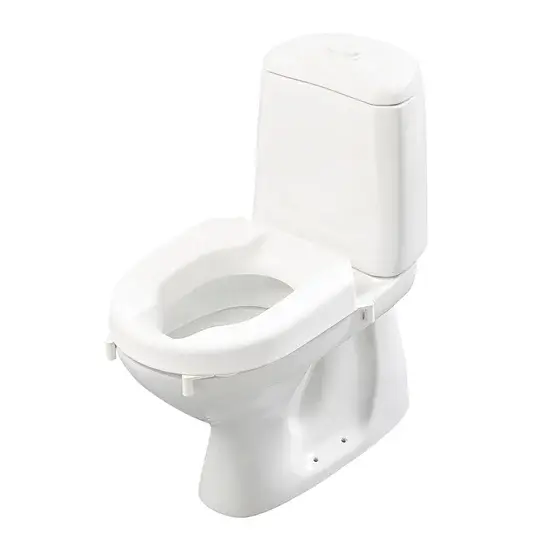
| Etac Hi-Loo (HL-004) | Raised toilet seat | 6 cm or 10 cm; max user 150 kg |
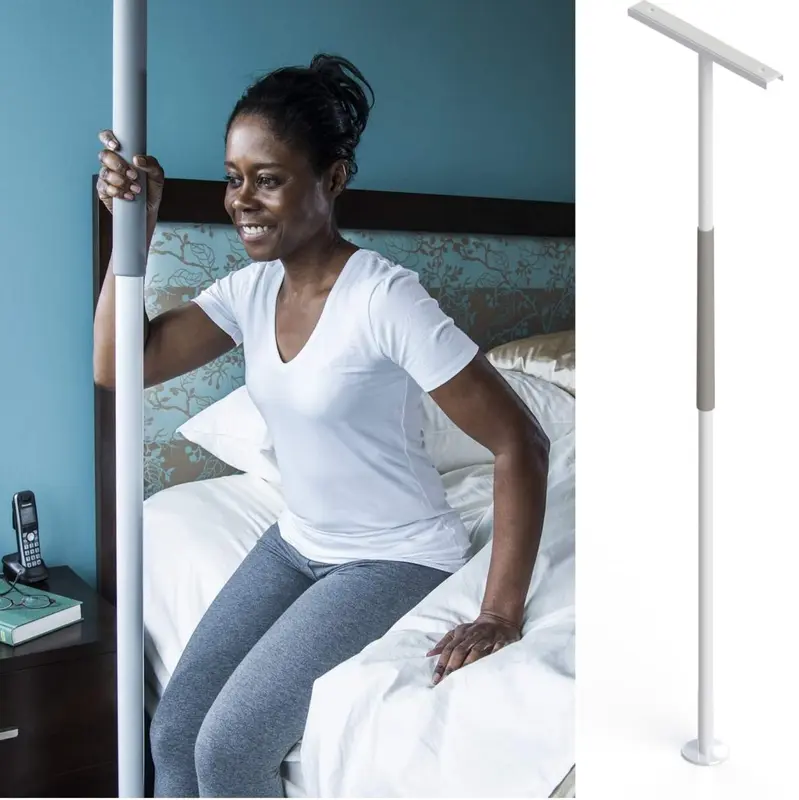
| HealthCraft SuperPole (HL-006) | Floor-to-ceiling pole | 300 lb (bariatric 450 lb) |
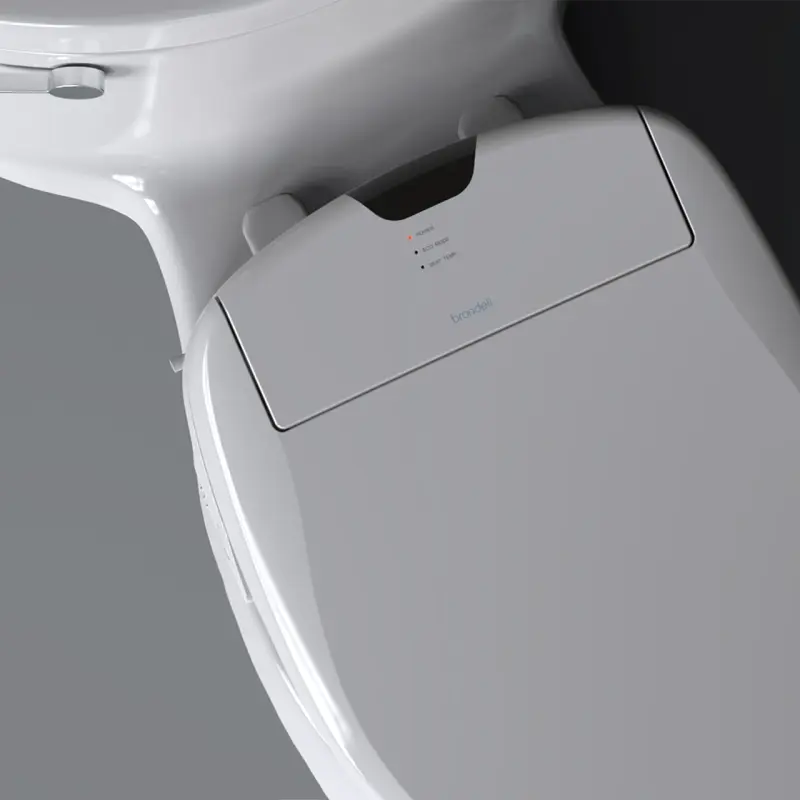
| Brondell Swash 1400 (HL-005) | Bidet toilet seat | Around USD 479.99 to 499.99 |
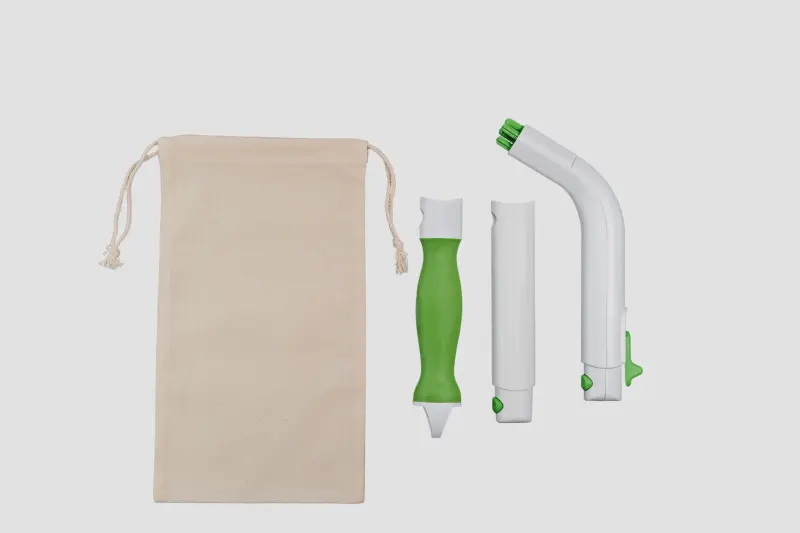
| FreedomWand (HL-019) | Hygiene reach aid | Around USD 54.99 to 69.99 kits |
A bath lift such as the Orca NG lowers the person down into the water and raises them again, with an optional backrest that reclines up to 40 degrees, for people who want a real bath rather than a shower. Medicare's equipment list says "Bathtub Lifts" are denied as a "convenience item." The patient lift guide covers lifts in more depth.
A raised toilet seat, a transfer pole beside the tub or toilet, a bidet seat that washes without reaching, and a long-handled hygiene wand all solve parts of the same problem. MedlinePlus says that "Raising the toilet seat height can help prevent falls," and its page describes a portable bidet that "sprays warm water to clean, then warm air to dry." The catalog prices for the Swash 1400 and the FreedomWand are the makers' shop prices as our catalog recorded them in October 2026; the Swash price was a sale price that may go back up. The SuperPole row lists a ceiling height of 93 to 99 inches, or up to 120 inches with an extender; check your ceiling before you ask about one.
What shower seats cost in 2026
These are listed prices on two US retailers' sites, 1800wheelchair and AliMed, read on 18 October 2026. Drive Medical's own pages show no prices to the public. Prices differ by seller, by country, by insurance and by sales tax, and change often; use them to know the range, then ask for a quote.
| Seat | Seller | Listed price (USD) | Capacity |
|---|---|---|---|
| Drive bathroom safety shower tub bench chair | 1800wheelchair | 53 | 300 lb |
| Foldable bath bench | 1800wheelchair | 66 | 300 lb |
| Carex Universal Bath Seat | AliMed | 66.50 to 91.25 | 400 lb |
| Drive swivel seat shower stool | 1800wheelchair | 76 | 300 lb |
| Drive shower chair with folding back | 1800wheelchair | 92 | 300 lb |
| Karman shower chair with non slip legs | 1800wheelchair | 95 | 300 lb |
| Knock down bath bench with back and padded arms | 1800wheelchair | 102 | 350 lb |
| Karman shower chair with back | 1800wheelchair | 120 | 300 lb |
| Shower Stool | AliMed | 123.83 | 300 lb |
| Deluxe padded bath seat | 1800wheelchair | 132 | 300 lb |
| Drive PreserveTech 360 swivel bath chair | AliMed / 1800wheelchair | 143 / 158 | 350 lb |
| Shower Bench | AliMed | 170.75 to 178 | 300 lb |
| ETAC Swift Shower Chair | AliMed | 250.75 | 350 lb |
| Corner Shower Seat | AliMed | 340.08 | 300 lb |
Our catalog holds no price for the Etac Clean, the Raz-AT600 or the Orca NG: the Raz page shows none, and the pages our catalog used for the other two showed none when checked; ask us to find one and we will request a quote from a dealer. Prices differ by country, dealer, funding and any sales tax relief, so confirm the final price before you order.
Does Medicare pay for a shower chair?
Does Medicare pay for a shower chair, a bath bench or a tub transfer bench? Mobility Atlas read Medicare's national coverage determination 280.1, the Durable Medical Equipment Reference List, and Medicare's own equipment page in October 2026. The list names "Bathtub Seats" and denies them as a "comfort or convenience item; hygienic equipment; not primarily medical in nature." It does not name shower stools, shower chairs or transfer benches separately; whether a particular seat counts as a bathtub seat is for the plan or a Medicare-enrolled supplier to confirm. The list also denies "Bathtub Lifts," "Grab Bars," "Raised Toilet Seats" and "Toilet Seats," and bidet toilet seats fall under toilet seats. Commodes are different: the list says they are "Covered if patient is confined to bed or room," under a narrow definition set out below. Medicare's equipment page lists commode chairs among covered equipment. Whether a particular shower commode chair qualifies is a question for the doctor and supplier.
The list defines "room confined" narrowly. It says the term means "leaving the room is medically contraindicated," and that "The accessibility of bathroom facilities generally would not be a factor in this determination." A home with no toilet facilities "may be equated to room confinement," the list says, and "payment may also be made" if the person's condition keeps them to one floor of the home and there is no bathroom on that floor. Medicare's equipment page says Part B covers medically necessary equipment "if your doctor or other health care provider orders it for use in your home," that after the Part B deductible you pay 20 percent of the Medicare-approved amount "(if your supplier accepts assignment)," and that Medicare pays only for items from suppliers enrolled in Medicare. The documents read for this guide say nothing more specific about rolling shower commode chairs, so ask the doctor and a Medicare-enrolled supplier before you assume either way.
Some maker and seller pages show a HCPCS code, the code suppliers use to bill: Drive's transfer tub bench page shows E0247 and its PreserveTech swivel chair page E0240, and AliMed's page for Drive's deluxe bariatric shower chair says "Suggested code: E0245." A code on a product page is not a promise of payment; the reference list denies "Bathtub Seats" without reference to any code, so ask the supplier how they would bill a particular seat.
Other ways to pay
Medicare Advantage plans, Medicaid, the VA, state programs and private insurance set their own rules, and the documents read for this guide do not cover them. Ask the plan in writing whether it covers a bath seat, a transfer bench or a shower commode chair, what it needs from the doctor or therapist, and which suppliers it uses. Confirm with the plan before you buy.
How the FDA classes shower chairs and benches
Shower seats sold as medical equipment are medical devices in US law, but there is no FDA product code called "shower chair". The FDA's product classification database has no code named "shower chair", "bath chair", "bath bench" or "transfer bench"; instead, makers list these items mainly under the four codes with the most such listings below, plus INB, the wheelchair commode attachment, and a few under other codes such as FPO (wheeled stretchers, which include shower trolleys). The five codes in the table are all in Class I, the lowest-risk class.
| FDA product code | Device name | Regulation | Listings for shower, bathtub or bench names |
|---|---|---|---|
| ILS | Adaptor, Hygiene | 21 CFR 890.5050 | 119 |
| IKX | Aid, Transfer | 21 CFR 890.5050 | 17 |
| INM | Chair, With Casters | 21 CFR 890.3100 | 12 |
| INN | Chair, Adjustable, Mechanical | 21 CFR 890.3100 | 8 |
| INB | Attachment, Commode, Wheelchair | 21 CFR 890.3920 | 4 |
The counts in the last column are FDA registration and listing records whose product names include shower, bathtub, transfer bench or bath bench, as openFDA showed them in October 2026 (data last updated 5 October 2026). They count listings, not products sold. Examples include an Invacare folding shower chair with back and Etac's Swift shower listed as hygiene adaptors, and a shower commode chair listed as a chair with casters.
The regulation for mechanical chairs, 21 CFR 890.3100, names as an example "a chair with casters used by a person to move from one place to another while sitting," places it in Class I, and says it is exempt from premarket notification, the 510(k), subject to limits. In practice that means most shower chairs and benches reach the market without an FDA review of their design before sale. Makers must still register, list the device and follow the FDA's general controls, and recalls of these devices appear in the FDA's recall database.
Some seats sold in home stores are not listed as medical devices at all. Teak benches, plastic stools and wall-mounted folding seats sold as bathroom furniture fall under the US Consumer Product Safety Commission, the CPSC, which runs its own recall list.
What the FDA recall records show
What do recalls show about shower chairs, benches and shower commodes? Mobility Atlas read the FDA recall records that openFDA returned for shower, bathtub, transfer bench, bath bench, bath seat, tub bench and commode products in October 2026, 20 relevant records in all, and six CPSC recalls of shower seats, stools and a tub safety bar. The pattern is plain: most recalls are about a part that holds weight. FDA records describe seats that "may not meet specifications for weight load," plastic that could not hold bracket bolts, a caster that could come off, backrest fixings that could come loose, a wall bracket that cracked, and seat brackets that could be refitted wrongly. The CPSC recalls describe teak benches and stools that broke or collapsed, and wall seats whose hardware corroded. Recalls do not say how often seats fail. They do show what to check: the legs, the bolts, the brackets, the casters and the capacity label.
The table lists the FDA records by date, with the reason in the record's own words where it is short. Most are closed ("Terminated" in the FDA record); two are still open. Quantities are as each firm reported them.
| Recalled product (firm) | Started | What the record says | Units |
|---|---|---|---|
| Raz-AT, Raz-ART, Raz-AT600, Raz-SP, Raz-AP shower commodes (Raz Design) | Jan 2026, open | Seat may be refitted without the rear seat brackets engaged | 66 |
| ActiveAid 922 shower/commode chair (Altimate Medical) | Nov 2022 | Frame could not be secured by its strap when folded | 1 |
| Firefly Splashy bath seat and two other seats (Leckey) | Feb 2020, open | Broken latches on the floorsitter | 1,241 |
| Concerto shower trolley safety catches (ArjoHuntleigh Polska) | Aug 2019 | Safety catch could break; side support could open | 669 |
| Concerto Basic shower trolley (Arjo) | Dec 2015 | Bolts to the hydraulic piston could loosen | 1,596 |
| Etac Relax wall-mounted shower seat (Etac) | Jul 2015 | Wall bracket cracked or broke | 13 |
| Aquatec fixed backrest for Ocean commodes (Invacare) | Jun 2014 | Backrest could detach under uneven load | 465 |
| Aquatec Ocean VIP tilt shower commodes (Invacare) | Aug 2013 | Backrest cushion fixings could unlatch | 538 US, 3317 total |
| Etac Swift Mobil shower chairs (Etac) | May 2013 | Chair could lose a caster | 7,200 internationally |
| Invacare I-Fit shower chair (Invacare) | Aug 2012 | Recalled on return, quality and adverse event data | 21,168 |
| Norco folding shower bench (North Coast Medical) | Mar 2012 | Bracket bolts not held above 150 lb | 370 |
| Uplift CA200 lifting commode chair (Uplift Technologies) | Jun 2011 | Seat could interfere with the lock | 219 |
| Bath Safe shower seats and transfer bench, seven records (Nutech) | Jul 2009 | May not meet weight load specifications | 3,627 total |
| Bath Helper and Shower Helper lifts (Sisus) | Jun 2007 | Poor welding could make the device fail | About 100 |
What the recalls mean for buyers
Weight load and plastic parts
Seven FDA records from 2009 cover Nutech's Bath Safe shower seats, with and without backs and arms, its rotating and non-rotating shower seats, and its adjustable transfer bench; the reason given for all of them is that the chair "may not meet specifications for weight load," and the firm reported 3,627 units in total. In 2012 North Coast Medical recalled 370 Norco folding shower benches labelled to support up to 200 lb because, the record says, "there was not enough plastic support material to retain bracket bolts when subjected to a force greater than 150 lbs." A capacity on a label is only as good as the parts behind it: buy from a maker who publishes a spec sheet and a manual, and keep them.
Casters, backrests and seat brackets on shower commodes
Rolling shower commodes appear in several records. Etac's 2013 field correction of the Swift Mobil chairs, 7,200 internationally, says that if the chair "loses a caster and thus becomes instantly unstable," there is a risk of harm. Two Invacare records from 2013 and 2014 concern the Aquatec Ocean family: snap-on fixtures of the backrest cushion that did not withstand the required pull-out force "when the product is used in a reclined position and or tilted position," and a fixed backrest that "withstands a load of only 250 newtons at uneven load." The 2026 Raz Design record, still open, covers 66 chairs across five Raz models including the Raz-AT600 in our catalog. Its reason reads: "Due to a modification by a vendor and may be reinstalled without properly engaging the outside rear seat brackets that are used to keep the seat in place." The FDA record gives the root cause as "Use error".
Fairness matters here. A recall shows that a maker found a problem and acted on it, and the Etac, Invacare and Raz records describe corrections to specific units or parts, not a judgement on every chair the firm makes. The records do not say how many chairs failed in use. If you own or are offered one of the models named, give the dealer the serial number and ask whether that chair was part of the recall and whether the correction was done.
Wall seats, shower trolleys and children's seats
Etac recalled 13 Relax wall-mounted shower seats in 2015 after reports that "the wall bracket has cracked or broken." Arjo's two records on Concerto shower trolleys, made for care settings and home care, describe bolts that could loosen and safety catches that could break, which the 2019 record says "may lead to a potential risk of a patient fall." And the 2020 Leckey record, still open, covers children's seats with broken latches. The common thread is again the part that holds the person: a bracket, a bolt, a latch.
CPSC recalls: shower seats sold as furniture
Searches of the CPSC recall database by title found recalls of shower benches, shower stools and wall-mounted shower seats, and one of a tub safety bar; searches for bath chair, bath bench, transfer bench and commode found none. These products were sold in home stores, by plumbing suppliers and online, not by medical suppliers.
| Recall (date) | Product | Hazard in the recall | Reports |
|---|---|---|---|
| Steamist (Jan 2024) | Wall-mounted teak tilt-up seat | Bracket and rods can corrode and break | 62 breaking, 4 injuries |
| Liberty Hardware (Sep 2024) | Multi-Grip tub safety bar | Grip pads can come loose on tapered tubs | Fourteen, one fall |
| Ivena, sold at Costco (Sep 2021) | 20 in teak shower bench | Bench can collapse | 81 incidents, 4 injuries |
| Target (May 2021) | Room Essentials shower stool | Can tip or be slippery | 12 falls |
| Signature Hardware (Dec 2018) | Wall-mounted teak seat | Aluminum hardware can corrode | 194 breaking, 23 injuries |
| Hammacher Schlemmer (Jun 2013) | Teak shower stool | Wood seat can break | 11, no injuries |
The numbers are large because these were popular products: about 70,000 Ivena benches in the US, about 58,500 Target stools, about 174,500 tub safety bars. The Ivena recall says the four injuries "included a fractured tailbone, persistent head and body aches and bruising." The Signature Hardware recall lists "three reports of lacerations for which consumers received stitches and one report of lumbar fractures." The Target stool was 18 inches tall with "a three-legged aluminum frame," the recall says, and could "become unstable or slippery while in use."
Two lessons carry over to any seat. Metal hardware in a wet room corrodes, and a wall-mounted seat is only as strong as its brackets, its rods and the wall behind them. And a seat bought as furniture may not carry a capacity rating, a manual or a maker who answers a question about it. If the person needs the seat to be safe, rather than just pleasant, buy one that states its capacity.
Checking a seat for recalls and reporting a problem
- Find the model or catalog number on the label under the seat or on a leg, and the serial or lot number. Take a photo of the label.
- Search the FDA's device recall database for the maker and model, and the CPSC's recall list if the seat was sold as bathroom furniture.
- If the model is named, contact the maker or the dealer with the serial number and ask whether that unit is included and what the correction is. Follow the recall's instructions: several CPSC recalls tell consumers to stop using the seat immediately.
If a seat breaks, tips, or a person is hurt, report it. For a medical device in the US, anyone can report to the FDA's MedWatch program. An FDA-posted recall notice gives the routes: "Online: By completing and submitting the report online at https://www.accessdata.fda.gov/scripts/medwatch," or by downloading the form, or by calling 800-332-1088 to request one, then mailing it or faxing it to 800-332-0178. Tell the maker and the seller too. Keep the seat and any broken parts, photograph the label and the damage, and write down what happened while it is fresh.
Reports go into the FDA's MAUDE database, which anyone can search. The FDA warns that these reports cannot be used "to evaluate rates of adverse events" or to compare adverse event rates across devices, and that a report "does not necessarily demonstrate that the device caused or contributed to the adverse outcome or event." They are still how the FDA hears about problems, and a clear report with a model number helps.
Grab bars, mats and water: what MedlinePlus advises
A shower seat works best as one part of a safer bathroom. MedlinePlus, from the US National Library of Medicine, says "The bathroom is a place in the home where falls most often happen," and advises, among other steps, to "Sit on a bath chair or bench when taking a shower." Its other advice for the bath and shower:
- Put non-slip suction mats or rubber silicone decals in the bottom of the tub, and a non-skid mat outside it.
- Fit a single-lever tap that mixes hot and cold water.
- Set the water heater to no more than 120 degrees F (49 degrees C) to prevent burns.
- Keep the floor outside the tub or shower dry.
- Fit grab bars "secured vertically or horizontally to the wall, not diagonally," MedlinePlus says, and expect to need two: one to get in and out of the tub, and one to stand from sitting.
- Remove floor coverings and anything that blocks the entry.
Our note: hot water matters more for a person who sits in the shower and cannot move away quickly, or who has reduced feeling in the legs.
Medicare's national list denies grab bars as a "self-help device." If you pay for them yourself, have them fitted as the maker's instructions say, so they hold a person's full weight. A tub-clamp safety bar is a different item: the Liberty Hardware recall describes grip pads that "can become dislodged after installation on tubs with tapered side walls," so check the tub shape against the maker's instructions.
Setting up the seat, and a monthly check
- Assemble the seat as the manual says and keep the manual. Push every height pin until it clicks through both holes.
- Set all legs to the same height, or for a transfer bench the inside and outside legs so the seat is level on your tub and floor.
- Put the seat on a clean, dry tub or shower floor, press down on each corner, and check it does not rock.
- Fit the back on the side you need, away from the taps, and the curtain or guard so water stays in the tub.
- Fit a handheld shower within reach of the seat, and a non-slip mat outside the tub.
- For a rolling chair, lock the casters, fold the footrests up, and check the chair clears the toilet and the shower entry before the first use with someone sitting in it.
| When | Check | If it fails |
|---|---|---|
| Before each use | Seat level, legs locked, casters locked | Do not use until fixed |
| Weekly | Rubber feet and caster wheels | Replace worn feet or casters |
| Monthly | Rust, cracks, loose bolts, bracket fixings | Stop using; call the maker or dealer |
| Monthly | Padding and seat for splits that hold water | Replace the pad or seat |
| When weight or needs change | Capacity and type still right | Ask the therapist |
| Twice a year | Model against the recall lists | Follow the recall |
Three traps
Trap one: assuming Medicare will pay. Medicare's national reference list names "Bathtub Seats" and denies them as a comfort or convenience item, and it denies grab bars and raised toilet seats in similar words. It does not name shower stools or transfer benches separately; whether a seat counts as a bathtub seat is for the plan or supplier to confirm. A HCPCS code printed on a product page does not change that. Commodes are a separate case with a narrow rule, and the documents read for this guide do not settle how a rolling shower commode chair is treated. Ask before you buy, in writing if you can.
Trap two: trusting one number on one page. In the listings read for this guide, the same chair's capacity appeared as 350 lb and 300 lb on one retailer's page, a maker's spec table showed a capacity of 8.80 lb for a chair its own text rated at 350 lb, and the Etac Clean showed 285 lb on a retailer's page and 287 lb in our catalog taken from Etac, a small difference that is probably rounding, but still a reason to read the label. When a person is near the limit, check the label on the chair and the manual, and use the lower number.
Trap three: buying a medical job as furniture. A teak bench, a three-legged stool or a wall-mounted folding seat may look sturdier than a plastic shower chair, and several were recalled by the CPSC after they broke, collapsed or their hardware corroded. If the person relies on the seat to stay upright, or uses it for transfers, choose one sold with a stated weight capacity, a manual and a maker you can reach, and check its metal parts every month.
Three composite scenarios
These are composite scenarios, not individual customers. Each one combines facts and ranges already given in this guide to show how the decision plays out.
Scenario one: a person who walks with a rollator lives in a flat with a bathtub and a shower over it, and has started to wobble stepping over the tub wall. The occupational therapist suggests a tub transfer bench rather than a seat inside the tub. The family measures the tub and the floor beside it, chooses a 400 lb bench listed between USD 127 and USD 199.50, sets the seat to the height of the person's chair, fits a handheld shower and a split curtain, and pays for the bench and two grab bars themselves, because Medicare's list denies "Bathtub Seats" and grab bars.
Scenario two: a full-time wheelchair user with good arms has a roll-in shower and a toilet nearby. They transfer sideways from their wheelchair to a rolling shower commode chair, use it over the toilet, then roll into the shower. They compare chairs listed on 1800wheelchair, mostly from USD 329.95 to USD 2,388, and look closely at the Etac Clean, whose catalog row lists seat heights of 17.25, 19.5 or 21.75 inches and a maximum user weight of 287 lb, measuring their toilet to pick the height. They choose a self-propelling model only after trying one, because on 1800wheelchair's listings the self-propelling Etac Clean weighs 44 lb against 30 lb for the standard one.
Scenario three: a carer helps a heavier person who cannot sit upright for long. The seating therapist recommends a tilt shower commode. The family looks at the Raz-AT600, rated for 605 lb with a 25 degree tilt, asks the dealer for a quote because no price is published, and asks whether the chair offered is one of the 66 covered by the 2026 FDA recall record about the seat brackets. They check that the bathroom door and turning space fit a seat 23 or 26 inches wide before anyone orders.
Questions for the therapist and the dealer
For the occupational or physical therapist
- Which kind of seat suits how I transfer now, and how I may transfer in a year?
- What seat height should it be set at, and why?
- Do I need a back, arms, a cut-out or a swivel?
- Do I need a tilt or recline, and how far?
- Is the seat surface right for my skin and how long I will sit on it?
- Where should the grab bars go, and is a transfer pole an option?
- Should a carer help, and should they be trained for this transfer?
For the dealer or seller
- What is the weight capacity on the label and in the manual, and do they match the listing?
- Will it fit my tub or shower? Here are my measurements.
- What is the frame made of, and what parts can rust?
- Can I get replacement feet, casters, pads and pins, and how long do they take?
- Has this model, or any part of it, been recalled, and was the correction done on this unit?
- Is there a trial or return period if it does not fit?
- Will you deliver, assemble and set the height, or show us how?
If you would like help finding a model or a price, send us an enquiry with your measurements and the therapist's advice, and ask us to find it; we will request a quote from a dealer.
Your plan: 10 minutes, today, this week
In 10 minutes: press down on each corner of the seat you use now, check the feet and the pins, and look for rust on the frame and any brackets.
Today: find the model number and check it against the recall lists. Measure the tub or shower, the toilet and the door.
This week: ask the doctor for a referral to an occupational or physical therapist for a bathroom visit, and ask your plan what, if anything, it covers before you buy.
Sources and documents
Related guides on Mobility Atlas: Patient lifts and slings; Walkers and rollators; Wheelchair ramps.
Method in brief: how we compared. We read every product on the first page of each retailer category and every product in the AliMed collections, and copied names, listed prices and capacities as the pages gave them, leaving out accessories and parts. We read Drive Medical's specification tables for each product in three categories. We read every FDA recall record that a search of openFDA returned for shower, bathtub, transfer bench, bath bench, bath seat, tub bench and commode products, leaving out five unrelated records, and every CPSC recall found by title for shower seats, stools and benches. We did not read FDA adverse event reports for this guide, so it gives no report counts. Recall records show what firms corrected, not how often seats fail. Product facts come only from the makers' pages, the retailers' listings and our catalog rows, and where they disagree we say so.
Prices checked October 2026 on 1800wheelchair's and AliMed's pages and in our catalog; prices change and differ by seller and country, so confirm them before you order. Documents checked October 2026: FDA classification, registration and recall records, CPSC recalls, Medicare's coverage list and page, MedlinePlus, and the FDA's MAUDE and MedWatch pages.
Has a shower seat, bench or shower commode let you down, or worked well? Send us a note through the enquiry form with the model and what happened; we use readers' notes when we update the guide.
This article is general information. Rules and prices differ by country and change, so confirm them before you buy or travel.
Common questions
What is the difference between a shower chair and a tub transfer bench?
A shower chair or stool stands inside the tub or shower, so you still step in. A tub transfer bench straddles the tub wall, with two legs inside and two outside, so you sit down outside the tub and slide across. Benches are made for people who cannot step over the tub wall safely; a therapist can say which fits.
How much does a shower chair cost?
On two US retailers' sites in October 2026, stools, seats and chairs were listed from USD 53 to USD 250.75 (a corner seat at USD 340.08), tub transfer benches from USD 127 to USD 329.25, and manual rolling shower commode chairs on 1800wheelchair mostly from USD 329.95 to USD 2,388. Prices differ by seller, country and funding; ask for a quote.
Does Medicare cover a shower chair or bath bench?
Medicare's national equipment list names "Bathtub Seats" and denies them as a comfort or convenience item, and it also denies grab bars and raised toilet seats; whether a particular shower seat counts as a bathtub seat is for the plan or supplier to confirm. The list says commodes are "Covered if patient is confined to bed or room," which it defines narrowly; see the Medicare section. Medicare Advantage and other plans set their own rules; ask them.
What weight capacity do I need?
Choose a seat rated above the user's weight, and read the rating on both the maker's page and the label, because listings sometimes disagree. Standard seats on the pages we read were rated 250 to 400 lb; bariatric benches and chairs 500 to 600 lb, and some commodes more.
What is a shower commode chair?
A wheeled chair made to get wet, with a toilet opening in the seat. You transfer onto it once, then roll it over the toilet and into a roll-in shower. Tilt models tip back for people who cannot sit upright alone. A therapist should help choose one.
Are wall-mounted shower seats safe?
They depend on their brackets, fixings and the wall. Two CPSC recalls describe wall-mounted teak seats whose hardware could corrode and break, and an FDA recall a medical wall seat whose bracket cracked. Have one fitted properly, and check the brackets and fixings for rust every month.
Sources
- 1800wheelchair: shower chairs and seats, bath benches (prices read 18 October 2026)
- 1800wheelchair: shower and bath transfer benches (prices read 18 October 2026)
- 1800wheelchair: bathroom transport wheelchairs, shower and commode chairs (prices read 18 October 2026)
- 1800wheelchair: commodes for bedside and bathroom (prices read 18 October 2026)
- AliMed: shower chairs collection (prices read 18 October 2026)
- AliMed: bath chairs collection (prices read 18 October 2026)
- AliMed: commodes collection (prices read 18 October 2026)
- Drive Medical: transfer benches, maker specifications
- Drive Medical: bath benches and stools, maker specifications
- Drive Medical: specialty commodes (shower commode chairs), maker specifications
- Raz Design: Raz-AT600 shower commode chair (catalog row HL-001)
- Etac: Etac Clean mobile shower commode (catalog row HL-002)
- Dhcare (UK dealer): Aquatec Orca NG bath lift (catalog row HL-003)
- Etac: Hi-Loo raised toilet seat with brackets (catalog row HL-004)
- Brondell: Swash 1400 bidet toilet seat (catalog row HL-005)
- HealthCraft: SuperPole (catalog row HL-006)
- FreedomWand: personal hygiene wand (catalog row HL-019)
- openFDA: device classification database
- openFDA: device registration and listing
- eCFR: 21 CFR 890.3100, Mechanical chair
- eCFR: 21 CFR 890.3920, Wheelchair component
- eCFR: 21 CFR 890.5050, Daily activity assist device
- openFDA: device recall endpoint (shower, bath, bench and commode recalls)
- CPSC: recalls database (shower seats, stools, benches)
- CPSC: Steamist wall-mounted tilt-up bath and shower seats recall, 2024
- CPSC: Ivena teak shower benches sold at Costco recall, 2021
- CPSC: Target Room Essentials shower stools recall, 2021
- CPSC: Signature Hardware wall-mounted shower seats recall, 2018
- CPSC: Hammacher Schlemmer teak shower stools recall, 2013
- CPSC: Liberty Hardware Multi-Grip tub safety bars recall, 2024
- MedlinePlus: Bathroom safety for adults
- CMS: NCD 280.1, Durable Medical Equipment Reference List
- Medicare: Durable medical equipment coverage
- FDA: About the MAUDE database and the limits of device reports
- openFDA: device adverse event endpoint
- FDA: posted recall notice showing how to report to MedWatch
Read on 18 October 2026. The wording of the article is our own.