Knee scooters in 2026: knee scooter vs crutches, fit, rental, Medicare and what 252 FDA reports show
Knee scooter or crutches, fitting the pad and handle, steerable models, rental and purchase prices, Medicare code E0118, and what two AI coders found in 252 FDA reports.
Contents
- Stop and check before the next ride
- The short answer
- Knee scooter, knee walker, knee crutch: the names
- When a knee scooter beats crutches, and when it does not
- Weight-bearing: the decision is your surgeon's
- The parts of a knee scooter, named
- Steerable or not: what the difference means
- Fitting: knee pad height and handle height
- Five models compared
- What knee scooters cost to buy in 2026
- Knee scooter rental: what one shop charges
- Buy or rent: how to decide
- Does Medicare cover a knee scooter?
- Does insurance cover a knee scooter? Private plans, FSA and HSA
- A hands-free crutch instead
- Getting on, getting off and standing still
- Turning, backing up and doorways
- Outdoors: cracks, slopes, grass and gravel
- Stairs and steps
- At home: bathroom, kitchen and floors
- Clothes, wheels and hands
- A new scooter out of the box
- Folding, cars and transport
- Hospitals, clinics and MRI scans
- Tall and heavy users
- How Mobility Atlas read 252 FDA reports
- What these reports cannot tell you
- What the reports show: the big picture
- Two kinds of year: before 2026 and the 2026 filing
- Steering columns and handlebars
- Brakes
- Wheels, tires and axles
- The knee pad and its post
- Frames, folding joints and height locks
- Tips and falls with nothing broken
- Injuries in the reports
- Reports about other devices
- What the makers found
- When the reports arrived
- Who files these reports
- The recall file
- Mistakes the reports repeat
- A two-minute check, and a weekly one
- Used, borrowed and rented scooters
- When to report a knee scooter problem to the FDA
- Three composite scenarios
- Questions to ask the surgeon or physical therapist
- Questions to ask before you rent or buy
- Your plan: 10 minutes, today, this week
- Sources and documents
- Common questions
- Sources
Stop and check before the next ride
Using a knee scooter right now? Look at five things before you ride again. Still deciding between a knee scooter and crutches? The short answer is in the next section.
- The steering column. Stand in front of the scooter, hold the front wheels still between your feet and try to turn the handlebar. If the bar turns while the wheels stay put, or the column wobbles where it meets the frame, stop. Steering column and handlebar problems, often a loose or missing bolt, are the largest group in the FDA reports we read.
- The brakes. Squeeze each lever while you push the scooter forward: the rear wheels should stop. Then set the parking lock and push again. If a lever is cracked, a cable is frayed or the lock will not hold, do not rely on it.
- The wheels. Lift each end and spin each wheel. It should run true, not wobble, and the nut or bolt in the middle should be tight. On air tires, look for a soft or flat tire.
- The knee pad. Press down hard on the pad and try to twist it. It should not move, tilt or creak, and the knob or pin under it should be fully home.
- The route. Cracks, slopes and changes of floor, such as backing onto heavy carpet, going backwards from tile to carpet or hitting a raised threshold, are where several of the reported falls began. Keep rugs and wet floors out of the way too, as general precautions.
These checks follow the parts named most often in the 242 knee scooter reports among the 252 FDA reports Mobility Atlas read for this guide: the steering column and handlebar, the brakes, the wheels and the knee pad. If the scooter is rented, call the supplier about anything loose or broken before you ride.
The short answer
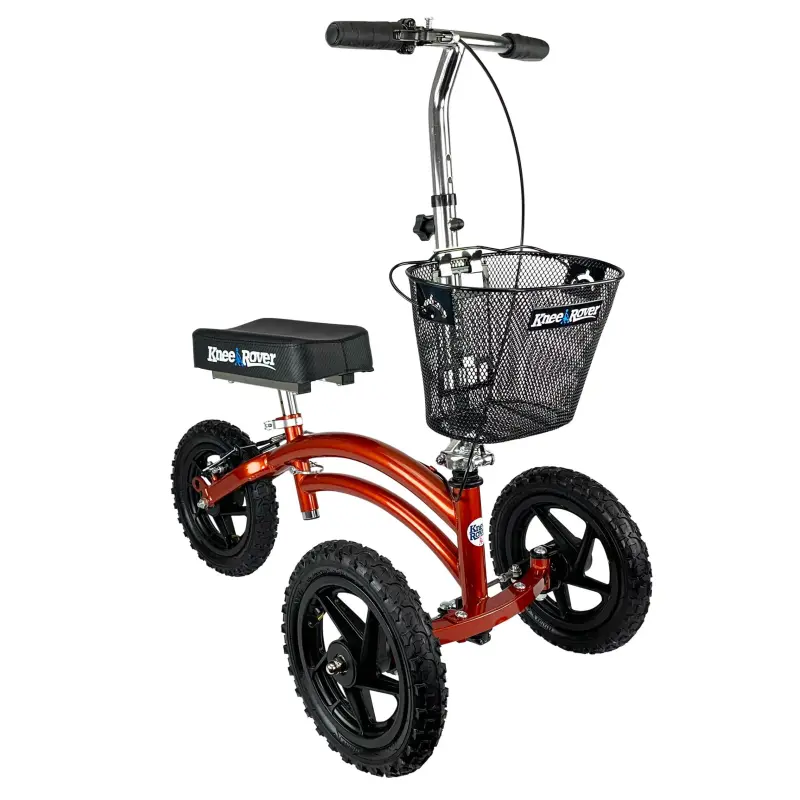
A knee scooter, also sold as a knee walker, knee rover or knee rollator, is a small wheeled frame with a padded platform. You kneel the injured leg on the pad, hold the handlebar, and push with the other foot. Makers sell it for people recovering from foot and ankle injuries or surgery who must keep weight off one foot. Drive Medical's page names "foot surgery, breaks, sprains, amputation and ulcers of the foot." Whether you may put any weight on the foot, and whether a knee scooter is safe for you, are decisions for your surgeon or physical therapist.
On one large US retailer's site in October 2026, knee walkers were listed from USD 160 to 470, with weight capacities from 250 to 400 lb. One Dallas-Fort Worth rental shop listed USD 40 a week or USD 100 for 28 days, and that is one local example, not a national price. Medicare's coding article describes code E0118, a crutch substitute, in words that fit a knee scooter; code E0118 is not among the crutch codes that Medicare's crutch coverage rule lists as covered. More on what that means below.
The safety part comes from 252 FDA reports that name a knee scooter or knee walker, read by two independent AI coders. In the 242 about a scooter, the commonest complaint is the steering column or handlebar (59 reports), then brakes (54), wheels (41), the knee pad (30) and the frame (27). Counts are reports, not rates.
Mobility Atlas earns a fee or margin when you order through us; this guide uses only Medicare's coverage documents, the makers' and retailers' published pages, MedlinePlus, FDA reports and recall records, and our own catalog, read in October 2026. Choosing between a knee scooter, crutches, a knee crutch or a wheelchair, and deciding how much weight the foot may take, belongs to your clinician: the surgeon and the physical therapist. This guide explains the options and what to ask, and stops there.
Knee scooter, knee walker, knee crutch: the names
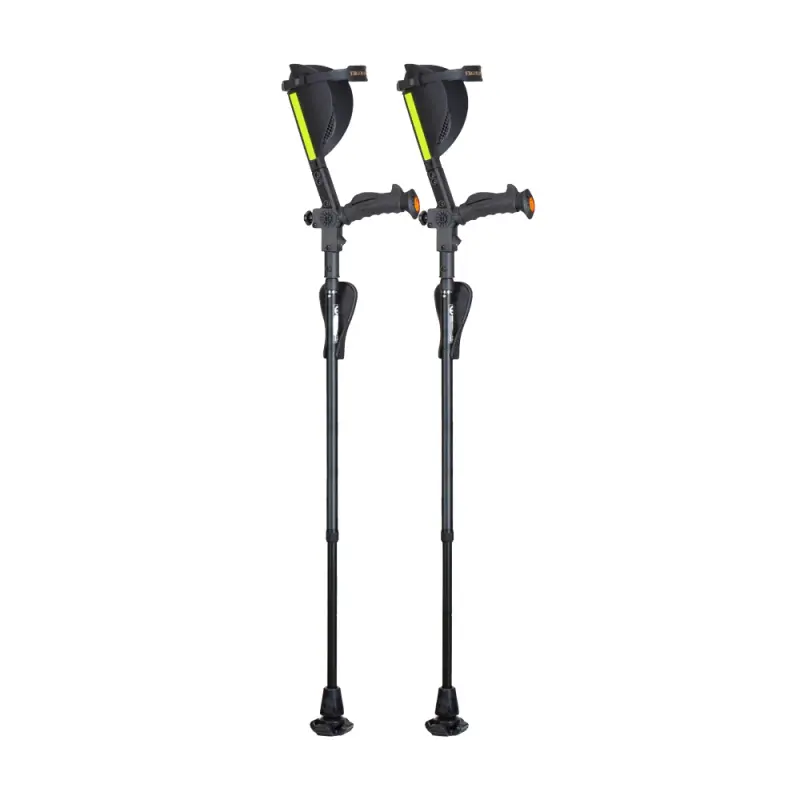
The names overlap. Makers, retailers and the FDA reports use knee scooter, knee walker, knee rover, knee rollator and knee cruiser for the same kind of four-wheeled or three-wheeled frame with a knee platform and a handlebar. A knee crutch, also sold as a hands-free crutch, is a different device: it straps to the lower leg, and you walk on it instead of rolling.
Medicare's description of one code fits both. Its canes and crutches policy article, which never uses the word knee, describes code E0118 as "a crutch substitute which can be either a device strapped to the lower leg with a platform or a device with wheels and a platform the beneficiary propels with their sound limb." The first half of that sentence fits a knee crutch; the second half fits a knee scooter. Drive Medical's page for its Economy Folding Knee Walker shows the same code, E0118, and the iWALK maker gives its hands-free crutch the code E0118-NU.
| Device | What it is | How you move |
|---|---|---|
| Knee scooter or knee walker | Wheeled frame, knee pad, handlebar, hand brakes | Kneel on the pad and push with the other foot |
| Hands-free or knee crutch | Platform strapped to the lower leg | Walk on it, hands free |
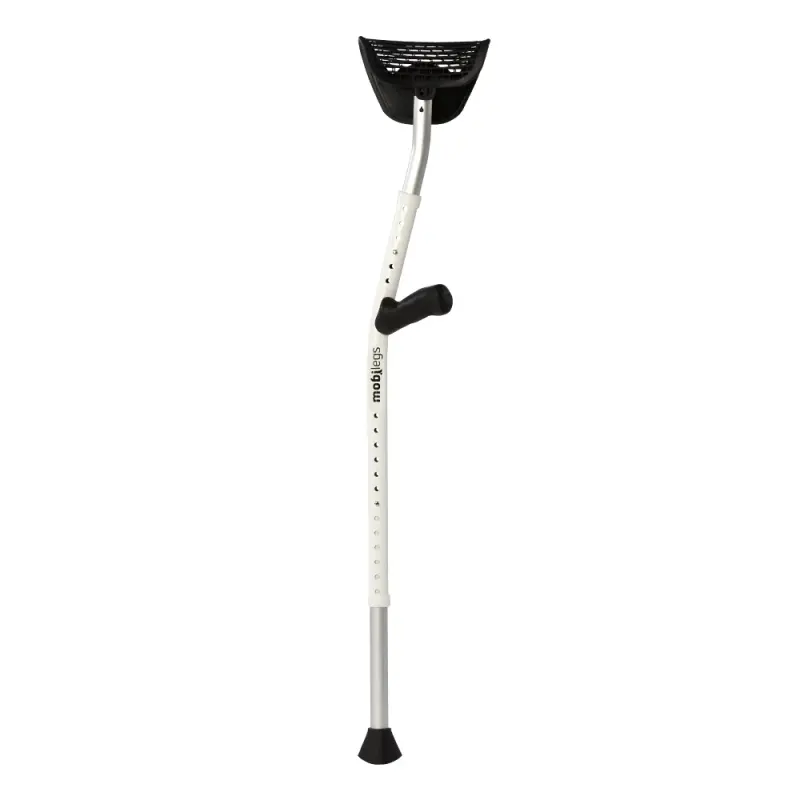
| Underarm or forearm crutches | Two crutches, tips on the floor | Swing through, weight on hands and the other leg |
| Walker | Frame lifted or rolled in front of you | Step with support on both hands |
Crutches have their own guide: the crutches guide covers underarm and forearm crutches, fit and the FDA reports about them. Walkers and rollators are covered in the walker and rollator guide.
When a knee scooter beats crutches, and when it does not
When is a knee scooter better than crutches? Mobility Atlas read the makers' pages, MedlinePlus and 252 FDA reports in October 2026, and the honest answer is that it depends on the injury, the home and the person, and the surgeon or physical therapist decides. Makers and sellers make the case for the scooter: Carex calls its model a "much more stable and comfortable alternative to crutches," and a rental shop calls a knee walker "faster and more comfortable than crutches." Those are sellers' claims, not test results. A scooter keeps your hands on the bars and lets you rest the leg, and it can carry a basket. It also rolls only on smooth, level ground, cannot climb a step, and has bolts, brakes and wheels that can fail. MedlinePlus says crutches "may be a good choice" after a leg injury or surgery if you only need a little help with balance and stability. Ask which one your surgeon recommends for your injury and your stairs.
Points that favour a knee scooter
- Your arms, shoulders or hands tire quickly or hurt on crutches.
- You live on one level, with smooth floors and few thresholds.
- You need to stand at a counter or sink and use both hands for short spells, with the parking brake on.
- You must carry things: a basket or bag on the scooter keeps your hands free for the bars.
Points that favour crutches or another aid
- Stairs you must climb every day. MedlinePlus explains how to climb stairs on crutches; a wheeled scooter cannot do it.
- Gravel, grass, cobbles, steep driveways or broken pavement on your daily route.
- Poor balance or weakness. MedlinePlus says to "Talk to your health care provider" if you have a lot of pain, weakness or problems with balance, because a walker may be a better option than crutches; ask the same question about a scooter.
- A knee or thigh problem on the injured side that makes kneeling on a pad painful.
- A long recovery where a wheelchair for distance, and a scooter or crutches at home, may make more sense.
Some people use two aids, a scooter on the flat and crutches for steps; settle that with the therapist before the surgery.
Weight-bearing: the decision is your surgeon's
How much weight the injured foot may take decides which aid suits you. MedlinePlus describes four levels used after leg surgery: non weight-bearing ("keep your weak leg off the ground"), touch-down or toe-touch, partial weight-bearing, and weight-bearing as tolerated. It says: "Your provider will talk to you about how much weight you should put on your weak leg."
Knee scooters are sold for the first of those. On Drive's site, the Roscoe Knee Rollator page says it is for "patients who cannot put weight on their foot or ankle." On a scooter, the foot hangs behind you, and the reports show what happens when it does not stay there: in several, the user put the operated foot down to catch a fall, or the leg slid off the pad and the foot hit the floor. If your surgeon has said the foot must not touch the ground, ask what to do if you lose balance, and practise getting on and off with the therapist.
The instructions change as healing goes on; ask at each visit whether you should still be using the scooter.
The parts of a knee scooter, named
Knowing the names helps when you call a supplier or read a manual. These are the words the makers and the FDA reports use.
| Part | What it does | What the reports say goes wrong |
|---|---|---|
| Tiller or steering column | The upright tube from the front wheels to the handlebar; it turns to steer and usually folds | Bolts back out, the column wobbles or spins, a weld or stop tab breaks |
| Handlebar and height knob | Grips, brake levers and a knob or pin that sets the bar height | The knob is short or missing, the bar telescopes down, grips come off |
| Hand brakes and parking lock | Levers with cables to drums or shoes on the rear wheels, and a button that locks them | Lever snaps, cable breaks, lock will not hold, brake stays on |
| Knee pad and post | The padded platform and the post or bar under it, with a height knob or pin | Post or bar snaps, pad tilts or turns, weld under the pad breaks |
| Frame and fold | The base that joins front and rear wheels, with a folding joint or latch | Bent frame, broken weld or hinge, latch that does not lock |
| Wheels and axles | Solid or air-filled wheels, usually two at the front and two at the back | Wheel comes off, bolt snaps, tire blows out, wheel locks |
Baskets, stability wheels and shock absorbers are extras; the parts above carry your weight and steer you.
Steerable or not: what the difference means
On a steerable knee scooter the handlebar turns the front wheels, like a bicycle. Drive's page for its Steerable Knee Walker says the "Knee walker can be steered for increased maneuverability," and its Economy Folding Knee Walker page says a "tight turning radius allows for maneuverability in narrow spaces such as hallways and doorways." Every knee walker we found on the retailer's and maker's pages in October 2026 was either named steerable or described turning handlebars, or did not say. We found no model listed as non-steerable, so this guide cannot quote a price for one.
Steering comes at a price in parts. A steerable column turns on a joint held by bolts, a clamp and usually a stop that keeps the bar from turning too far, and that joint is where the largest group of FDA reports points. Reports describe handlebars that spun all the way round, bars that turned one way while the wheels went another, and a stop tab that broke off. One 2008 report compares two models: the reporter's replacement had a handlebar that "is part of the frame and very steady," the reporter wrote.
Whatever the design, the bar and the wheels must point the same way and stay that way; if they do not, ask the supplier to fix it.
Fitting: knee pad height and handle height
A knee scooter has two heights to set: the knee pad and the handlebar. The maker pages we read give the ranges, not a fitting method, and none of them explains how high each should be for a given person. Ask the physical therapist or the supplier to set both with you, in the shoe you will wear on the other foot, and to watch you ride before you leave.
- Knee pad. The pad carries the shin and knee of the injured leg. It must sit level and tight on its post, with the knob or pin fully engaged, and be turned for the correct leg if the pad is offset. Drive's Nitro page lists an "Offset, reversible knee pad for left or right leg use."
- Handlebar. Ask the therapist where the bar should sit for you, and check that every knob, pin or clamp that holds it is fully home. One report describes a handle that "telescoped down" when a patient leaned on it, though the therapist had found it locked.
- Both legs. Check that the pushing foot reaches the floor comfortably and that the injured foot hangs clear behind the pad, not touching the floor or the rear frame.
- Your height and weight. Check both against the maker's ranges before you rent or buy; the section on tall and heavy users below explains why.
If the scooter still feels tippy, too low or too high after it has been set, say so before a fall, not after.
Five models compared
These are the specifications the makers publish, read in October 2026, plus one model from the Mobility Atlas catalog. Ranges are the makers' own. Maker pages show no prices; listed prices follow in the next section.
| Model | Handle height | Knee pad height | Weight capacity | Scooter weight | Wheels |
|---|---|---|---|---|---|
| Drive Steerable Knee Walker (796) | 31.5 to 40.25 in | 16.75 to 20.5 in | 350 lb | 21 lb | 7.5 in |
| Drive Nitro Glide Knee Walker (791BL, 791RD) | 30 to 39 in | 17 to 23 in | 350 lb | 23 lb | Not stated |
| Drive Economy Folding Knee Walker (RTL799) | 31.5 to 41 in | 16.75 to 23.25 in | 350 lb | 19.5 lb | 8 in |
| Carex Economy Knee Walker | 31.75 to 40 in | 16 to 22.5 in | 250 lb | Not stated | 7.5 in |
| All Terrain KneeRover Steerable (catalog WT-008) | 34 to 41 in | Not stated | 350 lb | 26.3 lb | Three wheels, 12 in air-filled |
The KneeRover row comes from our catalog: a three-wheel steerable knee walker with 12-inch air-filled tires, for users 5 ft 6 in to 6 ft 6 in, with a rear brake, listed on the maker's shop at a sale price of USD 327.99, regular price USD 399, when our catalog was checked. The Nitro Glide is the model in the 2024 recall described below: check the serial number before you use one.
The three Drive models carry 350 lb and the Carex 250 lb; on the retailer's list, heavy-duty models reach 400 lb. A heavier scooter is harder to lift into a car.
What knee scooters cost to buy in 2026
These are listed prices on one large US retailer's knee walker page in October 2026, with the weight capacity it shows. They are list prices, not offers, and they change.
| Model | Listed price (USD) | Weight capacity |
|---|---|---|
| Drive Steerable Folding Knee Walker | 160 | 350 lb |
| Roscoe Economy Knee Scooter | 164 | 250 lb |
| iWALK3.0 Hands Free Knee Crutch | 196 | 275 lb |
| Drive Dual Pad Steerable Knee Walker with Basket | 215 | 350 lb |
| Drive Nitro Glide Knee Walker | 232 | 350 lb |
| Roscoe Knee Scooter | 270 | 350 lb |
| Nova Knee Walker | 399.95 | 300 lb |
| Nova Heavy Duty Knee Walker | 400 | 400 lb |
| Nova Heavy Duty Tall Knee Walker | 470 | 400 lb |
Our catalog records the All Terrain KneeRover on the maker's shop at a sale price of USD 327.99, with a regular price of USD 399. The iWALK maker's own home page showed a new iWALK at USD 179 in October 2026. If you want us to find a particular model or a heavy-duty one, send an enquiry and ask us to find it.
Knee scooter rental: what one shop charges
Many people rent, because most need the scooter for weeks, not years. We read one local rental page, from Hieline Medical in the Dallas-Fort Worth area, in October 2026. It is one example, not a national price; rental prices and terms differ by city and supplier.
| Item | Listed rental price (USD) | Notes on the page |
|---|---|---|
| Standard knee walker | 40 a week, 100 for 28 days | 300 lb capacity |
| Heavy duty knee walker | 40 a week, 100 for 28 days | 400 lb capacity, wider knee platform |
| Front basket | 5 a week, 10 a month | Standard model only |
| Foam knee pad cover | 5 a week, 10 a month | Extra cushion on the pad |
| Same-day rush delivery | 75 | When the schedule allows |
The page says the minimum term is one week, delivery is usually next day, and "No prescription required, rent directly without a doctor’s order." It also says the walkers fit users from 5 ft 1 in to 6 ft 6 in on the same frame. Ask any rental shop the same questions: the minimum term, what happens if you need it longer, who fixes a loose bolt or a broken brake, and whether you get a replacement the same day.
Buy or rent: how to decide
Compare the rental price with the purchase price for the time your surgeon expects you to need it. At the one shop above, a 28-day rental is listed at USD 100, below the cheapest knee walker on the retailer's list (USD 160); a second month would take the rental past that price. Your recovery time is a question for your surgeon, not for this guide.
- Rent if the time is short or uncertain, if you want someone else to service it, or if you need a heavy-duty model only for a while.
- Buy if the time is long, if you expect another operation on the same or the other foot, or if no rental shop near you delivers.
- Either way, check the scooter on arrival, and ask whether a rented unit has been inspected. One report describes a rented unit that "had been previously rented 9 other times for a total usage of 279 days" before its seat post snapped, the report says.
- Keep the receipt, the model and serial number, and the manual. You will need them for a recall, a repair or an insurance claim.
Does Medicare cover a knee scooter?
Does Medicare cover a knee scooter or knee walker? Mobility Atlas read Medicare's canes and crutches coverage rule, its policy article and its walker policy in October 2026, and the answer is not a simple yes. Policy article A52459 describes code E0118 as a crutch substitute, including "a device with wheels and a platform the beneficiary propels with their sound limb"; it does not use the word knee, but Drive lists its Economy Folding Knee Walker under E0118. The coverage rule, LCD L33733, lists the canes and crutches it covers: canes E0100 and E0105 and crutches E0110, E0111, E0112, E0113, E0114 and E0116, when its criteria are met. E0118 is not among those covered crutch codes. Ask the supplier, before you order, whether they will bill Medicare for E0118 and what you will owe if the claim is denied, and get the answer in writing. Medicare Advantage plans and state Medicaid programs have their own approval and supplier rules; confirm with the plan.
Medicare's walker policy article does not mention knee walkers at all. The canes and crutches article also says some items need a face-to-face encounter and a written order before delivery, and that, for items on Medicare's list, a claim for an item delivered before that order is received will be denied. Whatever the plan, ask your doctor's office for a written order before the scooter arrives.
Does insurance cover a knee scooter? Private plans, FSA and HSA
Private plans differ, and we read no private insurer's policy for this guide. The only maker document we read on insurance is for the iWALK hands-free crutch, not a knee scooter. Its page says many private insurers have reimbursed the iWALK, that "Medicare and Medicaid do not reimburse the iWALK crutch," and that the iWALK and its parts are FSA and HSA approved items when bought on its site. Its steps are a fair checklist for any plan: ask the insurer whether it reimburses the item and how much, in and out of network; get a prescription; and, if the insurer asks, a letter of medical necessity from your doctor.
One FDA report from 2008 shows the other side: the reporter bought a cheaper scooter online because "my insurance would not cover one," the report says, and it broke within days. Price and coverage matter, but so does what you get for the money.
A hands-free crutch instead
A hands-free crutch, or knee crutch, straps to the bent leg and lets you walk with both hands free. It is not for everyone. The iWALK maker's own qualifications ask whether, before your injury, you could walk up and down stairs at a normal pace without a handrail, and: "Can you balance on your uninjured foot for at least 15 seconds." The injury must be to one leg, below the knee, and the other leg must be fully functional. The page says the iWALK supports up to 275 lb, fits thigh circumferences from 15.5 to 28 inches, and that adaptation can take from 1 hour to 1 day.
The maker's banner says "BETTER THAN CRUTCHES & KNEE SCOOTERS." That is a maker's claim. Whether a knee crutch, a scooter or ordinary crutches suits your injury, your balance and your home is for the surgeon or physical therapist; ask them to watch you try it.
Getting on, getting off and standing still
Several reported falls happened while getting on, turning in place or stopping, not at speed. One report says a user got out of bed and "mounted knee walker expecting it to move forward"; it did not, and the user fell. Another describes a scooter that "rolled out from under" a user turning to face a mirror in the bathroom; the maker found nothing wrong with the scooter. A third says a scooter rolled backward with the hand brake applied as the user tried to get into their home.
- Set the parking lock before you get on or off, and check it holds by pushing the scooter.
- Stand on the good foot, hold the handlebar, and place the injured leg on the pad. Do the reverse to get off.
- Release the lock only when you are balanced and ready to push.
- At a counter or sink, set the lock again. Drive's Economy page describes a "Push-button parking brake incorporated into handbrake for when you need to rest safely."
- Practise with the therapist or supplier before you go home, and ask them to watch you get off onto a chair, the toilet and the bed.
Turning, backing up and doorways
Turning and backing up are where the scooter's narrow base and a single pushing foot meet. Reports describe a user who flipped over the handlebar while turning left in a kitchen, a user who tipped while rolling backward, and front wheels that "locked up" on the third attempt to back onto very heavy carpet. Changes of floor, from tile to carpet or over a raised threshold, come up in several reports.
- Turn slowly and wide; do not pivot sharply at speed.
- Back up only a short way, on a hard floor, and look behind you.
- Cross thresholds and floor changes straight on, slowly, never at an angle.
- Use a doorway where it is widest; some scooters, like Drive's Nitro, have front axles that widen or narrow to change the turning radius.
- If the scooter catches, stop and reset rather than pushing harder.
Outdoors: cracks, slopes, grass and gravel
Small wheels stop dead at a crack or a stone, and the rider keeps going. One report says a scooter "was unable to overcome the small elevation change" of a crack in a parking lot and the user flipped. Another says a tall user "has gone over the handle bars with the momentum of movement" after hitting rocks or joints in the concrete. A maker's report quotes its own manual: "the user manual states to not operate on uneven surfaces, travel over large cracks or fissures."
- Plan the route: smooth pavements, ramps with a gentle slope, kerb cuts.
- Go slowly on any slope and keep a hand on the brakes going down.
- Avoid gravel, cobbles, grass and wet leaves unless your scooter is made for them.
- Larger and air-filled wheels roll over more, as all-terrain models are sold to do, but they are heavier and air tires can go flat.
- In the dark, rain or snow, use another aid or stay in.
Stairs and steps
A knee scooter cannot climb a step. If there are steps at the door or stairs inside, plan before the operation: where the scooter lives on each floor, who carries it, and what you use on the stairs themselves. MedlinePlus describes two ways for crutch users: sitting down and scooting up or down "one step at a time," or, when you are ready, climbing on crutches with someone to support you at first. Ask the therapist which applies to you, and practise before you need it.
Never try to ride a scooter down a step or a curb. Carry it, or have someone carry it, and get back on at the bottom with the parking lock set.
At home: bathroom, kitchen and floors
The home is where many reported falls happened: bathrooms, kitchens and the route between bed and toilet. The advice MedlinePlus gives crutch users fits a scooter too: "Make sure any loose rugs, rug corners that stick up, or cords are secured to the ground," remove clutter, and keep floors clean and dry.
- Clear a straight path from the bed to the toilet and the kitchen, and light it at night.
- Take up loose rugs and bath mats, or tape them down.
- Set the parking lock at the sink, the toilet and the counter.
- Do not ride into a wet shower area; one report describes a bar under the pad that bent as a user left the shower.
- Keep a phone within reach of the places you stop.
Clothes, wheels and hands
Two reports describe a pant leg caught in a wheel: in one the scooter stopped dead, in the other it tilted and nearly flipped. One describes a nut with a "sharp bolt protruding" from the centre of a back wheel that cut a user's ankle as the user pushed with the good leg. Another describes a hand sliced on the handlebar and brake lock in a fall.
- Wear trousers that are close-fitting at the ankle, or roll them up.
- Look for sharp bolt ends at the wheel hubs and cover or report them.
- Wear a shoe with a non-slip sole on the pushing foot; MedlinePlus advises rubber or non-skid soles for crutch users.
- Keep fingers clear of the folding joint when you fold or unfold the scooter.
A new scooter out of the box
Many scooters arrive in a box and are assembled at home. Reports from 2026 describe scooters that arrived with a broken brake lever, a shattered front wheel, warped wheels, a missing handle knob, and a packing zip tie "tightened to the brake line" that cut it, the report says. Others describe handlebars and wheels that were not aligned out of the box.
- Read the manual before you start, and keep it.
- Check every part against the parts list; ask for a replacement for anything missing or damaged.
- Cut packing ties carefully, away from the brake cables.
- Fit the steering column and tighten the bolts as the manual says, then check that the bar and wheels point the same way.
- Test both brakes, the parking lock, the fold lock and both height settings before anyone rides it.
- If you are not sure, ask the supplier to assemble and check it. One report describes a tiller "installed backwards."
Folding, cars and transport
Many knee scooters fold, often at the steering column, so they fit in a car. That fold is a joint, and joints loosen. One 2026 report says "the car vibrations caused all the screws to came out of the unit" while the scooter was in a car trunk; the maker confirmed a detached clamp but put it down to mishandling. Another says a user who tightened the tiller bolts at a relative's home saw the tiller bend forward and separate later that night.
- After every car trip, check the fold lock and the steering bolts before you ride.
- Lift with your arms and the good leg, or have someone lift for you; the scooters in the table that list a weight run from 19.5 to 26.3 lb.
- Lay the scooter so the brake cables are not crushed.
- Take the scooter's model and serial number with you, in case it needs a repair away from home.
Hospitals, clinics and MRI scans
Take the scooter to appointments, but not into an MRI room. One FDA report describes a patient allowed into an MRI suite with a "ferromagnetic knee scooter"; the report says the scooter was pulled to the magnet along with the patient and the patient's thumb was pinched. Tell the MRI staff you use a scooter and leave it outside the scan room.
If you carry an infusion pump or other medical equipment, ask the nurse how to carry it safely; one report describes two infusion pumps that fell off a knee scooter and broke their tubing.
Tall and heavy users
Check the maker's height and weight ranges before you rent or buy. The models we read list weight capacities from 250 to 400 lb, and the handle ranges top out between 39 and 41 inches. Two reports describe tall users who went over the handlebar or whose scooter slid from under them; the makers' notes record a handle height of "3 feet" in one and "3.0875 feet" in the other.
If you are near the top of a scooter's height or weight range, ask for a heavy-duty or tall model, and ask the therapist to watch you ride it. The rental shop above lists a heavy duty knee walker rated for 400 lb with a wider knee platform; the retailer lists a Nova Heavy Duty Tall Knee Walker at USD 470.
How Mobility Atlas read 252 FDA reports
The FDA collects reports about medical devices in a database called MAUDE. Makers, importers and user facilities such as hospitals are mandatory reporters; others, including patients and clinicians, can file voluntary reports. Knee scooter reports are filed under several product codes, so we did not start from a code. We took every report, under any product code, whose event text contains "knee scooter", "knee scooters", "knee walker", "knee walkers" or "kneewalker" (hyphenated forms included), read through openFDA on 19 October 2026. That gave 252 reports, received from 26 March 2008 to 28 September 2026. 227 of the knee scooter reports were filed under product code ITJ, the code the knee walker recall records also carry; the rest were scattered across other codes.
Before coding a single report, we wrote a codebook and fingerprinted it with a time stamp. It records the device; the first thing the report says went wrong, from a fixed list in order of precedence (steering column, brake, wheel, knee pad, frame, a tip or fall with no fault, a fault with no part named, or none of these); whether an injury, a fall, or a cause traced to the user or a third party is stated; and what the maker found.
Two independent coders then read every report separately, without seeing each other's answers. The coders were AI language models working separately. They agreed on what went wrong in 94.0 percent of reports, a kappa of 0.929, which is very high agreement; kappa is a standard measure of agreement beyond chance. They agreed on the maker's finding in 95.2 percent (kappa 0.900), on falls in 99.2 percent (kappa 0.984), on a cause traced to the user in 99.2 percent (kappa 0.937), and on the device and the injury flag in every report. We settled the 31 reports where they differed under ten written rules, K1 to K10, and a consistency pass under the same rules changed 17 more; the other 204 kept the codes both coders gave. The counts were made by script.
One rule differs from our earlier studies, and it matters for the makers' findings. In this study, when the maker, a dealer or an inspection confirmed the reported fault or found a broken, bent or missing part, we counted it as a confirmed fault even when the maker then named an outside cause, such as shipping damage or mishandling. In our earlier studies, a confirmed fault with an outside cause was counted with the outside causes. Ten reports turned out to be about another device, which leaves 242 about a knee scooter. Word-search counts in this guide run over the description of the event, not the maker's later follow-up notes. Five reports repeat another report's text. Reports whose text says only walker or scooter are not in the set: we know of four whose brand name names a knee walker or knee scooter but whose text does not, among them report 21873249, a 2025 report about a Drive Nitro knee walker.
What these reports cannot tell you
The reports are what people and companies chose to tell the FDA, not a count of every scooter that broke. The FDA says plainly that "MDR data is not intended to be used either to evaluate rates of adverse events," and that a report "does not necessarily demonstrate that the device caused or contributed to the adverse outcome or event." Nobody knows how many knee scooters are in use, so no count here is a rate, and none says which brand or design is safer.
The mix of reports also depends on who files. Some years are dominated by one maker forwarding every complaint it receives; some reports arrive years later through an attorney's letter or a lawsuit, with few details. Many of the 2026 reports are short complaint notes about a scooter that arrived damaged or would not brake, filed by one company.
What the reports show: the big picture
What goes wrong with knee scooters? Mobility Atlas had two independent AI coders read 252 FDA reports that name a knee scooter or knee walker, received from 2008 to September 2026, and in the 242 about a scooter the commonest complaint is the steering column or handlebar: 59 reports describe it coming loose, spinning, turning away from the wheels or breaking, and 34 of them a fall. Brakes come next with 54 reports, most of them recent complaints with no injury, then wheels, tires and axles (41), the knee pad and its post (30), and the frame, fold or height locks (27). 16 describe a tip or fall with no part said to have failed, and every one of those describes an injury. Across the 242, 111 describe an injury and 113 a fall, and none was filed as a death. Counts are reports, not rates: they show what people reported, not how often scooters fail.
| What went wrong first | Reports | With injury | With a fall | Fault confirmed |
|---|---|---|---|---|
| Steering column or handlebar | 59 | 31 | 34 | 14 |
| Brakes | 54 | 8 | 8 | 21 |
| Wheels, tires or axles | 41 | 16 | 18 | 11 |
| Knee pad, its post or the bar under it | 30 | 19 | 18 | 5 |
| Frame, fold or height lock | 27 | 9 | 13 | 6 |
| Tip or fall, no fault named | 16 | 16 | 16 | 0 |
| Fault alleged, no part named | 10 | 7 | 6 | 0 |
| Other event, nothing failed | 5 | 5 | 0 | 0 |
Fault confirmed means the maker, a dealer or an inspection confirmed the fault or found a broken, bent or missing part, on the scooter or on photos of it, whatever cause the maker then named. Most reports say nothing either way; in many, the scooter was never returned.
Two kinds of year: before 2026 and the 2026 filing
The 242 reports split in two. 87 arrived in 2026, and Medline filed 82 of them. They are mostly short complaint reviews of a scooter that arrived damaged, would not brake, or came loose, and only 7 describe an injury and 10 a fall. The 155 earlier reports, from 2008 to 2025, are a different mix: most describe a fall, and most an injury.
| What went wrong first | Before 2026 | 2026 |
|---|---|---|
| Steering column or handlebar | 40 | 19 |
| Brakes | 11 | 43 |
| Wheels, tires or axles | 27 | 14 |
| Knee pad, its post or the bar under it | 26 | 4 |
| Frame, fold or height lock | 21 | 6 |
| Tip or fall, no fault named | 16 | 0 |
| Fault alleged, no part named | 9 | 1 |
| Other event, nothing failed | 5 | 0 |
| With an injury | 104 | 7 |
| With a fall | 103 | 10 |
So the brake count is mostly one company's 2026 filing, and the injury reports are mostly older: before 2026 the steering column comes first, then wheels, the knee pad and the frame. The split was counted by script from the coded table and the report dates, and it reflects a change in who was filing; the reports cannot show whether scooters themselves changed.
Steering columns and handlebars
59 reports start with the steering column, the tiller or the handlebar, and 31 of them describe an injury. The failures are mechanical and specific. Bolts back out: "the bolt and screw holding the handle bar had fell out," the user's family found after the user was thrown to a tile floor. A stop that limits how far the column turns breaks: one report says "the welded piece on the steering column, stop tab, that prevents it from turning too far broke off during use." Another says the "tiller spins 360 degrees while in use," and the user fell three times. In another report the customer said the "failure appears to involve the bolt that prevents the handlebars from turning completely around."
Others describe the bar and the wheels pointing different ways. One user wrote: "handles go one way, front wheels go the other way." A report from a parking lot says a wheel caught in a crack and "the handle bar kept turning causing the claimant to fall." In the 2026 reports, new scooters arrive with the same problem: one customer wrote "if the handle bar is straight the wheels are off," and another that "the steering tiller moves too much," the reports say. The maker put the first of those down to shipping damage.
Height adjustment fails too. In one report a physical therapist found a handle locked in place that "still telescoped down" when the patient leaned on it, and the patient lost balance. In another, the user's spouse said "the knob that secures the handlebar height is too short." The maker found a fault in 14 of the 59.
Brakes
54 reports start with the brakes. 43 of them came in 2026, and most of those are complaints with no fall: a lever that snapped, a brake line that broke, a parking lock that would not hold, or brakes so tight the wheels would not turn. One customer said "the buttons that lock the brakes are no longer holding and not locking"; another that the brake "would slow the unit down but would not lock in place." One wrote that "the brakes are impossible to use with one hand," the report says. The maker confirmed a fault in 21, the most of any group.
The older brake reports are fewer but more serious. One describes a fall and a broken wrist after a scooter "rolled backward with the hand brake applied" as the user tried to get into their home. Another says a "right hand brake snapped" in a park and the user fell and re-injured an Achilles tendon. A 2026 report about a KneeRover PRO all-terrain scooter, a different model name from the one in our catalog, calls the scooter "well made" but says "the brake doesn't work," the buyer wrote, and it "just melts the plastic wheel."
- Test both levers and the parking lock before every ride, on a slight slope if you can.
- Look along each cable for fraying, kinks and cuts, and at each lever for cracks.
- If a brake rubs all the time, the wheel will be hard to push and the shoe may wear; ask the supplier to adjust it.
- If you cannot squeeze or lock a lever with one hand, say so; the scooter may not suit your grip.
Wheels, tires and axles
41 reports start with a wheel, a tire or an axle, and 18 of them describe a fall. Wheels came off, front casters snapped, bolts sheared, and tires blew out. One report says "the back wheel suddenly came off," sending the user head first over the front. A 2010 report says that without two broken bolts "the wheels are free to swing away." A dealer in 2011 reported that "out of the past 8 walkers, 5 of them have failed," four of them at the wheels, a statement filed as several reports, and that the shop kept patients to 250 lb instead of the 300 lb limit.
Other wheel reports are about what the wheel meets. One says the "wheels locked when the device encountered a small object on the ground," and the user went over the handlebar. Air tires bring their own problem: in 2026, three reports by a word search describe a flat or blown tire, one after the scooter was used "for only one day," the report says. Spin each wheel before you ride, check the nuts at the hubs, and keep air tires at the pressure the manual gives.
The knee pad and its post
30 reports start with the knee pad, the post under it, or the bar or beam that carries it, and 19 describe an injury. Here the injury is often to the leg the scooter was meant to protect. One report says the welds under the knee rest broke, "my knee slid off and my foot that recently had surgery hit the floor." Another says a seat post snapped and cut the user's thigh, and a 2026 report describes seven stitches after a seat post broke.
Some reports describe a pad that moved before it broke. In one, the "knee rest pad turned as though the height adjustment knob had loosened," though the knob was tight. A 2008 reporter described pads that were slick, "letting the leg encased in a surgical cast fall off." A rental unit taken out of storage had "the mounting post collapsed" when a sales representative knelt on it. One maker wrote that a design change "under PC#297" had addressed the seat post on its model, the report says. Press and twist the pad before each ride; it should not move at all.
Frames, folding joints and height locks
27 reports start with the frame, the folding joint or a lock whose part the report does not identify, and 13 describe a fall. Several describe a scooter that collapsed under the user. One rented scooter collapsed under a user after foot surgery; a relative found it "missing the knob that secures the device in a locked position," the report says, and the maker wrote that "the unit should not have been rented without the proper maintenance and checks." A 2026 customer said "the back hinge snapped on them"; the maker found a missing tiller locking bolt, not a broken hinge. Another said that "the casting of the frame broke when the patient attempted to lower the handle," the reports say.
A scooter can rock: one 2026 customer reported a bent frame because a rear wheel "does not touch the ground unless" the user put full weight on it. The maker's report says no bends were seen, but it confirmed the wheel did not touch and concluded that "the defect with the right rear wheel is likely due to a bent frame." Put a new or rented scooter on a flat floor and press on each corner. If it rocks, or the fold lock does not click fully home, do not ride it.
Tips and falls with nothing broken
16 reports describe a tip or fall where nobody says a part failed, and all 16 describe an injury. They read like a list of the situations in the guide above: a pant leg caught in a front wheel, a scooter that hit a small crack and "was unable to overcome the small elevation change," a user rolling backward who tipped, a turn in a kitchen, uneven cobblestones on a campus, a user who mounted the scooter "expecting it to move forward." One spouse said the user "had been unsteady on the unit prior to event and never felt comfortable using it," the report says, before a fall that broke a thigh bone.
These are the reports a two-minute check cannot prevent. They are why the choice of aid and the training belong to the therapist, and why a user who does not feel safe on the scooter deserves an answer before the next ride.
Injuries in the reports
111 of the 242 knee scooter reports describe an injury. By a word search of the event descriptions, 20 mention a fracture, 19 of them in injury reports; 8 use words for re-injury, a surgical site, an incision or surgical hardware; and 6 use the word head. Reported injuries include a broken wrist, a broken jaw, broken ribs, a broken hip and thigh, a broken kneecap, torn ankle ligaments and ruptured Achilles tendons. Several describe a second operation on the foot or ankle the scooter was meant to protect.
By the same word search, 16 mention a slope, ramp, hill, incline or driveway, 14 of them with an injury, and none describes stairs or a step (the word search for step finds only a user who had to step down on the injured foot); none mentions a curb. The event type the filer chose was injury in 85 reports, malfunction in 120, other in 6, and not stated in 31.
Reports about other devices
Ten reports named a knee scooter but were about another device. They are not counted above, but some carry a lesson. In one, an MRI technologist let a patient into the scan room with a "ferromagnetic knee scooter"; in two copies of another, a patient's infusion pumps fell off a knee scooter and the tubing broke. In a third, a crutch split at its height adjustment while the user moved "from a knee walker to a recliner," the report says. The others concern implants, a bone plate, a drug pump and a nerve stimulator in people who also used a scooter.
What the makers found
In the 242 knee scooter reports, the maker, a dealer or an inspection confirmed a fault or found a broken, bent or missing part in 57; found no fault or named an outside cause without confirming a fault in 20; and said nothing either way in 165. Many scooters were never returned, and most reports do not say. In 13 reports, the report traces the event to the user or a third party, as the cause or the maker's conclusion.
The outside causes named include shipping damage, a scooter assembled wrong, and wear on a rental unit. One maker's report says an inspection found a tiller that "had been installed backwards." Another concluded that the incident was caused by "customer abuse/lack of maintenance" on a heavily worn rental unit. Where a fault was confirmed and an outside cause named, this study still counts the fault as confirmed.
When the reports arrived
| Year | Knee scooter reports | Maker named most often |
|---|---|---|
| 2008 to 2010 | 8 | Several makers, a few each |
| 2011 | 20 | Kenstone Metal, 14 |
| 2012 | 15 | Kenstone Metal, 8 |
| 2013 to 2014 | 14 | Kenstone Metal and Lin Kou, 5 each |
| 2015 | 20 | Garden City, 10 |
| 2016 to 2019 | 46 | Several makers |
| 2020 to 2025 | 32 | Several makers |
| 2026 (to September) | 87 | Medline, 82 |
The peaks match filers, not products. 2011 and 2012 are mostly reports naming Kenstone Metal as the maker; the 2011 ones carry Invacare's report numbers, and the 2012 recall shows Invacare distributing Kenstone-made walkers. 2015 has 10 reports naming Garden City, and 2026 is Medline's own filing. No year shows that scooters got worse; each shows who was looking and who was filing.
Who files these reports
Medline is named as the maker in 91 reports, more than any other, followed by HL (Shenzhen) (28), Kenstone Metal (27), Lin Kou Medical Industrial (19), and Garden City and Taicang Jingquan (10 each). In 18 the maker is given as unknown, and in 8 no maker is stated. These are the makers the reports name, not always the companies that filed: the 2011 Kenstone reports carry Invacare's report numbers. Medline is named most often because it filed a large batch of complaint reviews in 2026. That is a filing pattern, not a ranking: report counts depend on how much each company sells and how it files, and the reports show neither.
The recall file
We searched the FDA's recall records for knee walkers and knee scooters and found three records from two recalls, all under product code ITJ. In 2012, Invacare recalled 1,640 knee walkers made by Kenstone Metal (Kunshan): testing "revealed that the rod supporting the knee pad was not made to specifications," the recall says, and the rod "may break or bend causing the walker to collapse." That recall was terminated in 2013. Several reports from 2011 to 2014 describe the bar under a knee pad breaking, the part the recall names, but the recall record gives no model number, so we cannot say whether those reports concern recalled units.
In 2024, Medical Depot (Drive DeVilbiss Healthcare) recalled the Nitro Glide Knee Walker, models 791BL (875 units) and 791RD (667 units), with serial numbers beginning 21S. The recall says "The tiller separates from the base/front caster assembly," and that a user may fall and be injured. The record was still open when we read it. No report in our set names the Nitro Glide. Outside the set, because its text says only walker, a 2025 report from Drive DeVilbiss Healthcare names a Nitro knee walker, model 791RD, one of the recalled models: the user said a wheel "fell off," the report says, and was "diagnosed with a detached ligament" in the calf "that requires surgery." It gives no serial number, so we cannot say whether that unit was in the recall. If you have one, check the serial number; the recall letter gives a website, recallrtr.com/kneewalker, and a phone line, (877) 206-1171, for returns and replacements. The search found no recall record naming KneeRover, iWALK or Roscoe.
Mistakes the reports repeat
- Riding without checking that the steering bolts are tight and the bar and wheels line up.
- Tightening or loosening bolts by hand on the way, instead of having the supplier fix the scooter.
- Getting on or off without the parking lock set.
- Backing up, turning sharply or crossing a floor change at speed.
- Riding over cracks, stones, cobbles or slopes on small wheels.
- Riding a scooter that arrived damaged, misaligned or missing a knob.
- Taking a scooter into an MRI room.
A two-minute check, and a weekly one
| When | Check | If it fails |
|---|---|---|
| Before each ride | Hold the front wheels, turn the bar: bar and wheels move together | Do not ride; call the supplier |
| Before each ride | Squeeze both brakes and set the parking lock, then push | Do not ride until it is fixed |
| Before each ride | Press and twist the knee pad | Tighten the knob as the manual says, or call |
| Daily | Spin each wheel and look at the hub nuts | Call the supplier |
| Weekly | Cables, levers and grips for cracks and fraying | Replace before the next ride |
| Weekly | Scooter on a flat floor: does it rock? | Check for a bent frame |
| After every car trip | Fold lock and steering bolts | Retighten as the manual says, or call |
| On delivery | Every part on the list, alignment, both brakes | Ask for a replacement the same day |
Used, borrowed and rented scooters
Knee scooters pass from person to person, and the reports show what can come with them. One user's handlebar sheared off on a scooter from a loaner closet. A rented unit was "extensively worn," the maker wrote, with its locking knob missing. A buyer lent a scooter to a friend's parent, and "the bolt backed out," the report says, and the user fell.
- Ask a rental shop when the scooter was last inspected and what was checked.
- Look up the model and serial number against the recall records, especially a Drive Nitro Glide.
- Do the full check in the table above before the first ride, not after it.
- Ask for the manual, or download it from the maker.
When to report a knee scooter problem to the FDA
Anyone can report a problem with a medical device to the FDA through MedWatch: online at accessdata.fda.gov/scripts/medwatch, or on a form you can request by calling 800-332-1088 and send by mail or by fax to 800-332-0178. Report a fall or injury, a part that broke or came off, brakes that failed, and a scooter that arrived damaged in a way that could hurt someone. Tell the supplier and the maker too; makers are mandatory reporters.
Keep the scooter and any broken parts, photograph the label with the model and serial number, and write down what happened while it is fresh. Many reports in our set say the maker could not investigate because the scooter was never returned.
Three composite scenarios
These are composite scenarios, not individual customers. Each one combines facts and ranges already given in this guide to show how the decision plays out.
Scenario one: after foot surgery, a person who must keep weight off the foot lives on one floor with smooth floors. The surgeon agrees a knee scooter suits them. They rent one at USD 40 a week, have the supplier set the pad and handle heights, and do the two-minute check each morning.
Scenario two: a person with stairs at the front door and a bedroom upstairs asks the therapist before surgery. The plan is crutches on the stairs, practised in advance, and a scooter downstairs, with the parking lock set at the sink.
Scenario three: a family buys a Drive Nitro Glide second-hand. They check the serial number, find it begins with 21S, and contact the recall line before anyone rides it.
Questions to ask the surgeon or physical therapist
- How much weight may the foot take, and for how long?
- Is a knee scooter, a knee crutch, crutches or a wheelchair best for my injury and my home?
- What should I do if I lose balance: may the foot touch the ground?
- Can you set the knee pad and handle heights and watch me ride, get on and get off?
- How do I manage the stairs at home?
- When should I stop using the scooter?
Questions to ask before you rent or buy
- What is the weight capacity, and the handle and knee pad height range?
- Is it steerable, and how does the steering column lock?
- Will you assemble it and check the brakes, bolts and alignment before delivery?
- What does rental cost per week and per month, and who fixes it if something breaks?
- Will you bill Medicare or my insurer, under which code, and what will I owe if the claim is denied?
- Is this model or serial number under any recall?
Your plan: 10 minutes, today, this week
In 10 minutes: do the two-minute check on the steering column, brakes, wheels and knee pad, and clear one path at home.
Today: ask the supplier or therapist to check the pad and handle heights with you on the scooter, and look up the model and serial number for recalls.
This week: plan the stairs and the car with the therapist, take up loose rugs, and settle with the supplier and insurer who pays.
Sources and documents
Reports: every FDA MAUDE device report, under any product code, whose text names a knee scooter or knee walker, read through openFDA on 19 October 2026. Recalls: the FDA recall records for knee walkers and knee scooters, read through openFDA. Funding: Medicare's canes and crutches coverage rule and policy article and its walker policy article. Products and prices: Drive Medical's product pages, the iWALK maker's pages, one retailer's knee walker page, one local rental page, and our own catalog. Safety advice: MedlinePlus on using crutches. Every source is linked in the list at the end of this page.
Related guides on Mobility Atlas: Crutches; Walkers and rollators; Walking canes; Lightweight wheelchairs, if a longer recovery calls for one.
Method in brief: two independent coders, AI language models working separately, coded all 252 reports under a codebook fingerprinted before coding (agreement on what went wrong 94.0 percent, kappa 0.929); written rules settled 31 reports and a consistency pass changed 17. Quotes from reports are shown in sentence case; the FDA publishes many of them in upper case. The codebook, the rules, the method and the coded table are on the data and method page under CC BY 4.0.
Prices checked October 2026 on one retailer's knee walker page, one rental shop's page and the iWALK maker's page; the KneeRover price is from our catalog check, whose date the catalog does not record; prices change, so confirm them with your supplier. Documents checked October 2026: FDA reports and recall records, the Medicare coverage rule and policy articles, the makers' pages and MedlinePlus.
Has a knee scooter let you down, or carried you well through a recovery? Send us a note through the enquiry form with the model and what happened; we use readers' notes when we update the guide. If you want help finding a heavy-duty or all-terrain model, ask us to find it.
This article is general information. Rules and prices differ by country and change, so confirm them before you buy or travel.
Common questions
Is a knee scooter better than crutches?
It depends on the injury, your balance and your home, and the surgeon or physical therapist decides. A scooter keeps your hands on the bars and suits smooth, level floors; crutches can climb stairs. Makers and sellers call scooters more comfortable than crutches, but those are sellers' claims, not test results.
How much does it cost to rent a knee scooter?
One Dallas-Fort Worth shop listed USD 40 a week or USD 100 for 28 days in October 2026, with a one-week minimum. That is one local example; prices differ by city. To buy, one large US retailer listed knee walkers from USD 160 to 470.
Does insurance cover a knee scooter?
Medicare's canes and crutches policy article describes code E0118, a crutch substitute, as including 'a device with wheels and a platform the beneficiary propels with their sound limb', which fits a knee scooter; E0118 is not among the covered crutch codes in Medicare's crutch rule, LCD L33733. Private plans differ. Ask the supplier and the plan before you order, and get the answer in writing.
How should a knee scooter be fitted?
The knee pad and the handlebar both adjust; maker pages list the ranges but not a fitting method. Ask the physical therapist or supplier to set both heights with you on the scooter, check every knob and pin is fully home, and watch you ride, get on and get off.
Steerable or non-steerable knee scooter?
Every model we found on the retailer's and maker's pages was sold as steerable or did not say. Steering helps in hallways and doorways, but the steering column is where the most FDA reports point, so check every day that the bar and wheels move together.
Can you use a knee scooter on stairs?
No. A wheeled scooter cannot climb a step; carry it, and plan the stairs with your therapist. MedlinePlus describes sitting and scooting up or down one step at a time, or climbing on crutches with help at first.
Sources
- CMS: Policy Article A52459, Canes and Crutches (code E0118)
- CMS: LCD L33733, Canes and Crutches
- CMS: Policy Article A52503, Walkers
- openFDA: device recall records for knee walkers and knee scooters
- openFDA: device adverse event endpoint (data used for this study)
- FDA: About the MAUDE database and the limits of device reports
- Drive Medical: Steerable Knee Walker, product page
- Drive Medical: Nitro Glide Knee Walker, product page
- Drive Medical: Economy Folding Knee Walker, product page (HCPCS E0118)
- Drive Medical: Roscoe Knee Rollator, product page
- Drive Medical: Carex Economy Knee Scooter, product page
- iWALKFree: Can I use the iWALK crutch? (qualifications)
- iWALKFree: iWALK crutch health coverage information
- Hieline Medical: knee walker rental, Dallas-Fort Worth (one local example, read October 2026)
- 1800wheelchair.com category pages, including Knee Walkers & Knee Scooters (9 results), read 16 October 2026
- MedlinePlus: Using crutches
- FDA MedWatch reporting details, as given in an FDA recall notice (read October 2026)
- FDA MedWatch: report a problem with a medical device
Read on 19 October 2026. The wording of the article is our own.
Data and method for this guide: the codebook, the coded reports and the list of documents, free to reuse under CC BY 4.0.