Walkers and rollators in 2026: types, prices, Medicare and what 1,163 FDA reports show
Types, prices and Medicare rules for walkers and rollators, and what two AI coders found in 1,163 FDA reports about seats, wheels, frames and brakes.
Contents
- Stop and check before the next walk
- The short answer
- Walker, rollator or knee walker: which kind
- Three wheels or four, and upright rollators
- The parts of a rollator, named
- Rollator brakes: loops, push-down and one-hand
- What walkers and rollators cost in 2026
- Does Medicare pay for a walker or rollator?
- Standing up, sitting down and turning
- Helping someone who walks with a walker
- Walking indoors and outdoors
- Making the home safer for a walker
- Carrying things
- A new walker out of the box
- Buying a walker as a gift or online
- One weak hand, a stroke, or a hemi walker
- After a hip or knee replacement
- Instead of a knee walker
- Weight limits and bariatric walkers
- Folding, cars and storage
- Repairs and replacement parts
- Looking after a walker, month by month
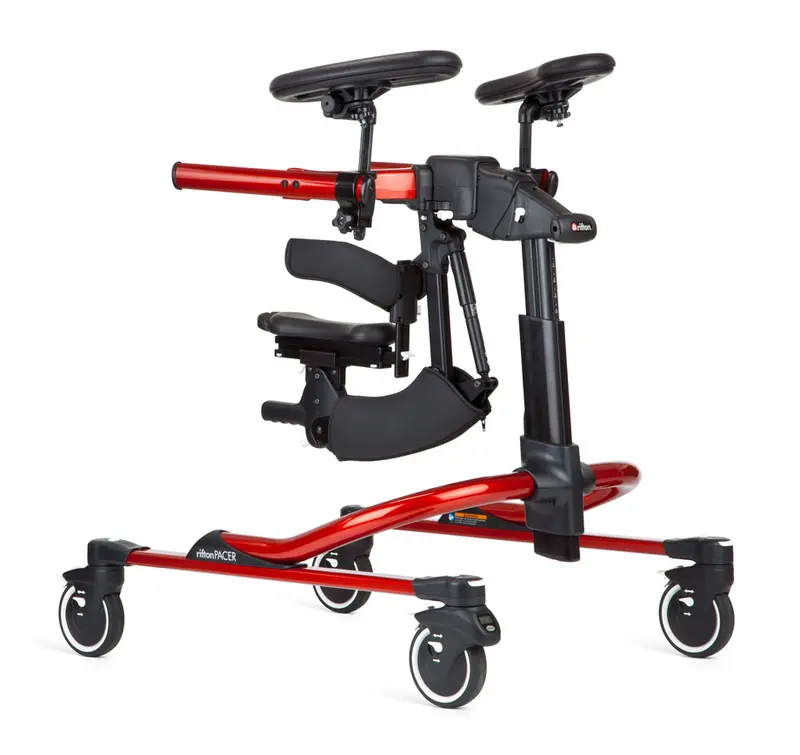
- Children's and specialist walkers
- When a walker is no longer enough
- How Mobility Atlas read 1,163 FDA reports
- What these reports cannot tell you
- What the reports show: the big picture
- Head injuries and broken hips
- What the makers found
- Mistakes the reports repeat
- The seat: where the most falls begin
- Being pushed on a rollator seat
- Wheels, forks and casters
- Frames, legs, welds and folding locks
- Brakes that do not hold
- Cut or pinched by the walker
- Handles and grips
- Knee walkers
- Falls with no failure: curbs, doorways and stairs
- The death reports, read with care
- The 2026 Medline batch
- Who files these reports
- The recall file
- A two-minute check before you go out
- Used, borrowed and handed-down walkers
- Finding the model number and checking recalls
- When to report a walker problem to the FDA
- Keeping a record when something goes wrong
- Three composite scenarios
- Questions to ask before you buy
- Questions to ask the physiotherapist
- Your plan: 10 minutes, today, this week
- Sources and documents
- Common questions
- Sources
Stop and check before the next walk
Using a walker or rollator today? Run through this list first. Choosing one? Start at the short answer below.
- A wheel wobbles, rubs, squeaks, sits crooked or has play at the fork. Stop using it until it is fixed: loose and broken wheels are among the commonest failures in the reports we read.
- The rollator rolls when the brakes are locked, or one brake holds and the other does not. Drive's rollator manual says "If the wheels turn while brakes are locked, please take unit back to dealer for adjustment."
- The seat, the bar under it or the backrest is cracked, bent, loose or creaks when you sit. Do not sit on it.
- Someone pushes you while you sit on the rollator seat, as if it were a wheelchair. Stop: the same manual says "Do not have anyone push you while you are seated on the Rollator."
- A leg, a weld, a height button or the folding lock is cracked, bent or does not click fully into place.
- A brake lever, cable or bracket sticks out where your leg brushes it.
Most other problems in this guide can wait for a repair or a replacement part. These six cannot, because they are the patterns behind most of the falls and injuries in the reports we read.
The short answer
A walker supports some of your weight while you walk; a rollator is a walker on three or four wheels with hand brakes and, usually, a seat. The FDA's rule describes a mechanical walker as a device "to provide moderate weight support while walking." It is one of the cheapest pieces of equipment in this series: on one large retailer's site, standard folding walkers are listed from USD 49 and four-wheel rollators from USD 100. Medicare Part B covers a walker when it is needed at home and the person can use it safely.
The safety part comes from something most buying guides never open: 1,163 FDA reports filed under the walker product code since 2019, read by two independent AI coders working separately. In the 857 reports outside one maker's 2026 batch, the commonest pattern is not a person tripping. It is a part that gave way: a wheel or fork (176 reports), a frame, leg or weld (171), brakes that did not hold (114), or the seat, often while someone was sitting on it (179). Most of those reports describe a fall, and most describe an injury.
None of this means walkers are unsafe; millions of people use them every day. It means the failures that hurt people are few and specific, and a two-minute check finds many of them before they give way.
How to read the evidence: every quote below names the report, recall or document it comes from, and every count comes from the coded table or from word searches of the report texts, both published on the data and method page. Prices are list prices as read on a retailer's pages, never offers.
Walker, rollator or knee walker: which kind
| Kind | What it is | Suits | Reports in our pool |
|---|---|---|---|
| Standard or folding walker | A frame with four legs and rubber tips, lifted with each step | Most support; slow walking indoors | part of 83 |
| Front-wheeled walker | Two front wheels, back legs with tips or glides | Smoother walking with less lifting | part of 83 |
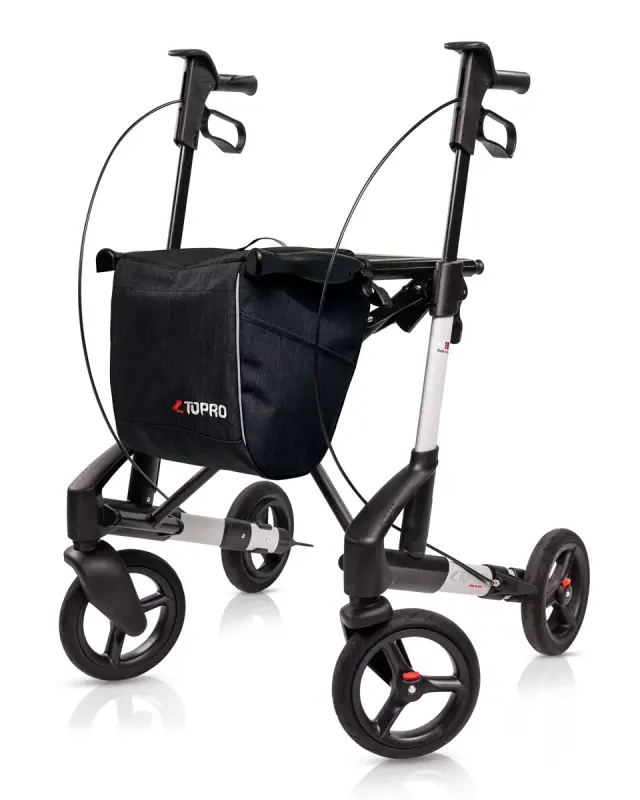
| Rollator (three or four wheels) | Wheels on every leg, hand brakes, usually a seat | People who walk further and need rests | 820 |
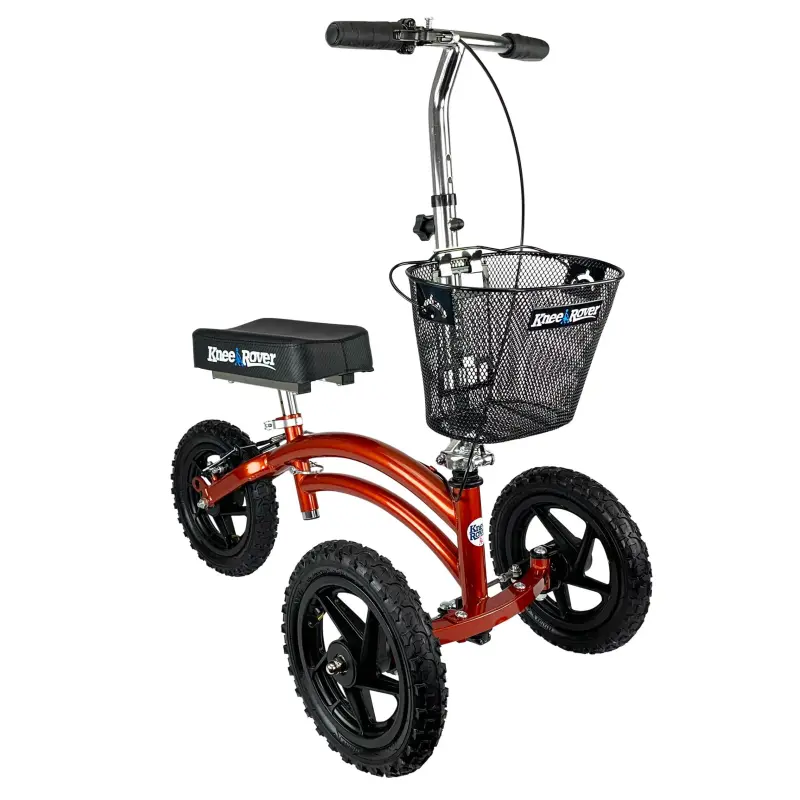
| Knee walker | A knee pad on a wheeled frame for one injured leg | Short-term use after foot or ankle injury | 58 |
| Other (gait trainer, child, upright or bariatric walker) | Specialist frames | Specific clinical needs | 22 |
| Not stated | The report says only walker | 174 |
The counts are reports, not sales, and say nothing about which kind is safer. Rollators dominate the reports; that may reflect how many are sold and how many parts they have, and the counts cannot say which. The first two rows share one count because many reports do not say whether the walker had wheels.
Which one to choose
A standard walker gives the most stability, because you lift it and set it down on four points with each step. A front-wheeled walker is easier to move but still asks you to lean on it. A rollator moves freely and lets you rest on the seat, but it can roll away from you if you lean on it without the brakes on, and it needs hands strong enough to squeeze the brakes. The FDA rule's description fits all of them: a device "used by disabled persons who lack strength, good balance, or endurance." A physiotherapist or occupational therapist can tell you which suits your balance and grip, and should set its height.
The height
A walker set too high or too low changes your posture and can tip you forwards or backwards. Most have height buttons on each leg or handle; rollators list a handle height range in their specifications. Ask the therapist to set it while you stand in the shoes you usually wear, and check after any adjustment that every button has clicked fully through its hole.
Three wheels or four, and upright rollators
Rollators come with three or four wheels. The retailer whose prices we use puts the trade-off plainly: "As compared to 3 wheel alternatives, 4 wheel rollators provide a wider, more stable base," while a three-wheel model may suit someone who needs "to navigate narrow hallways or doorways." If your balance is poor, the wider base matters more than the narrow turn.
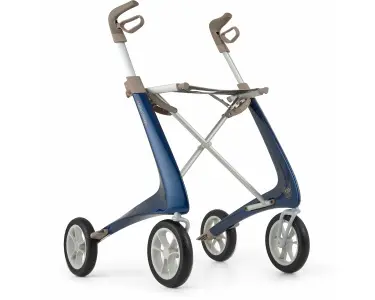
Upright rollators have taller forearm supports so the user stands straighter, and some people find them easier on the back and wrists. They are taller and often heavier, and the forearm supports change how you stand up and sit down. Try one with a therapist before buying; in our price list the Drive Elevate upright rollator is USD 279 and the Nuvio One mobility walker USD 750.
The parts of a rollator, named
| Part | What it does | What goes wrong in the reports |
|---|---|---|
| Frame, legs and cross brace | Carry your weight; the brace holds the sides apart | Cracked welds, snapped legs, bent tubes, collapse |
| Folding mechanism and lock | Lets the rollator fold for the car | A lock that does not engage, folding under load |
| Height buttons and knobs | Set the handle height | Buttons not fully through the hole, stripped threads |
| Wheels, forks and casters | Carry the frame and let it turn | Wheels coming off, forks unscrewing, broken spokes, wobble |
| Hand brakes and cables | Slow the rollator and lock it to sit | Brakes that do not hold, broken levers, loose cables |
| Seat, seat bar and backrest | A place to rest | Cracking, bowing, collapsing, a backrest that lifts out |
| Handles and grips | Where you hold and steer | Handles that slip, turn or break |
Standard walkers have fewer parts: the frame, the legs, the height buttons, the folding release, and either rubber tips or wheels and glides. That is why, in the reports, their problems are mostly frames and legs (45 of the 74 reports about walkers without hand brakes, outside the Medline sample).
Rollator brakes: loops, push-down and one-hand
Most rollators use loop brakes: squeeze the lever up towards the handle to slow down, and push it down until it clicks to lock the wheels for parking or sitting. Some heavy-duty and hemi designs use brakes that work from one side or one hand, and some walkers for people who cannot squeeze use push-down brakes that hold when the user leans on the frame. Each type needs a different habit, and a person who switches from one to another may reach for the wrong movement at the wrong moment.
When choosing, try the brakes with the hands that will use them, ideally late in the day when grip is weakest. If squeezing hard or pushing the levers down into the parking position is a struggle, say so: the therapist or supplier can suggest another design, or adjust the levers closer to the handle.
What walkers and rollators cost in 2026
| Type | Examples from one retailer | Listed price |
|---|---|---|
| Standard folding walker | Deluxe bariatric foldable walker to ProBasics economy two-button folding steel walker | USD 49 to USD 143 |
| Front-wheeled walker | Drive two-button folding walker with 5 in wheels | USD 69 |
| Four-wheel rollator, basic | ProBasics economy steel rollator to Drive rollator with 7.5 in wheels | USD 100 to USD 144 |
| Four-wheel rollator, lighter or larger | Go-Lite Oversized, Drive Clever-Lite, Drive Nitro Sprint, Triumph Escape HD | USD 200 to USD 599.95 |
| Rollator and transport chair in one | Drive Nitro Duet | USD 434 |
| Upright or premium rollators | Drive Elevate, byACRE Carbon Overland | USD 279 to USD 840 |
| Knee walker | Drive steerable folding knee walker to Nova heavy duty tall knee walker | USD 160 to USD 470 |
How much does a walker or rollator cost? Mobility Atlas checked one large retailer's listed prices in October 2026, and the answer depends mostly on wheels, weight and extras. On 1800wheelchair's site, standard folding walkers run from USD 49 for a deluxe bariatric foldable walker to USD 143, and a Drive two-button folding walker with 5 inch wheels is listed at USD 69. Basic four-wheel rollators start at USD 100 for a ProBasics economy steel model, with the Drive rollator with 8 inch wheels at USD 114. Lighter, larger or heavy-duty rollators run from USD 200 (an oversized model rated for 500 lb) to USD 599.95, and a rollator that converts into a transport chair, the Drive Nitro Duet, is USD 434. Knee walkers run from USD 160 to USD 470. Medicare Part B can cover a walker when you need it at home, which usually leaves you paying 20 percent of the approved amount after the deductible, so ask about coverage before you buy.
These are list prices from one retailer and are examples, not a market survey. Check the weight capacity, the handle height range and the seat height against your own measurements, and ask what the warranty covers.
Does Medicare pay for a walker or rollator?
Does Medicare pay for a walker or rollator? Mobility Atlas read the Medicare coverage rules in October 2026, and the answer is usually yes when the walker is needed at home. The local coverage determination for walkers says a standard walker is covered when the person "has a mobility limitation that significantly impairs his/her ability to participate in one or more mobility-related activities of daily living (MRADL) in the home," is "able to safely use the walker," and when the problem "can be sufficiently resolved with use of a walker." Heavy-duty walkers are covered for people who "weigh more than 300 pounds." A walker with several brakes and wheel resistance is covered for people who cannot use a standard walker because of a severe neurologic disorder or restricted use of one hand. Medicare's equipment page says that after the Part B deductible "you pay 20% of the Medicare-approved amount," when the supplier accepts assignment, meaning it takes Medicare's approved amount as full payment.
What Medicare does not pay for
- A walker with an enclosed frame: the rule says its medical necessity "has not been established."
- A heavy-duty walker if you weigh 300 pounds or less, or a multi-brake walker for weight alone; the rule denies these as not reasonable and necessary.
- Leg extensions, unless you are 6 feet tall or more.
A doctor or other provider must order the walker. Medicare Advantage plans and Medicaid have their own rules; ask your plan which suppliers it uses before you buy.
Standing up, sitting down and turning
The moments of change are the riskiest: standing up from a chair, sitting down, turning around, and stepping through a doorway. Many reports describe a fall at exactly those moments, often when the walker moved and the person did not, or the other way round.
- To stand, push up from the chair arms, not from the walker. A walker, and above all a rollator, can tip or roll if you pull on it.
- Once standing, take a moment to find your balance before you move off.
- To sit, back up until you feel the chair against the back of both legs, reach back for the arms, and lower yourself.
- To turn, take small steps and turn the walker with you; do not twist your body while your feet stay still.
- With a rollator, lock both brakes before standing up or sitting down, and before letting go to reach for something.
These are general steps. A physiotherapist will teach the ones that suit your body, your walker and your home, and it is worth asking for a session after any fall or hospital stay.
Helping someone who walks with a walker
Family members and carers often walk beside a walker user, and their instinct is to help by holding the walker or the person's arm. Both can upset the balance the person has found. Physiotherapists usually teach carers to stand slightly behind and to the weaker side, close enough to steady the person by the hips or a gait belt if they sway, and to let the user move the walker.
- Do not pull or steer the walker while the person is holding it.
- Do not push a rollator with the person sitting on it, even for a few steps.
- Check the brakes are locked before the person sits or stands, and that the chair or bed is close.
- If the person starts to fall, guide them down rather than trying to hold them up, and protect their head.
Ask for a carer session with the physiotherapist. It takes half an hour and makes every walk safer for both of you.
Walking indoors and outdoors
Indoors, small wheels and glides work well on smooth floors but catch on thick carpet, rugs and raised thresholds. Outdoors, small wheels drop into cracks and stop dead at curbs, which throws the user forward. Several reports in our set describe exactly that: a front wheel caught on an edge or a crack, and a fall.
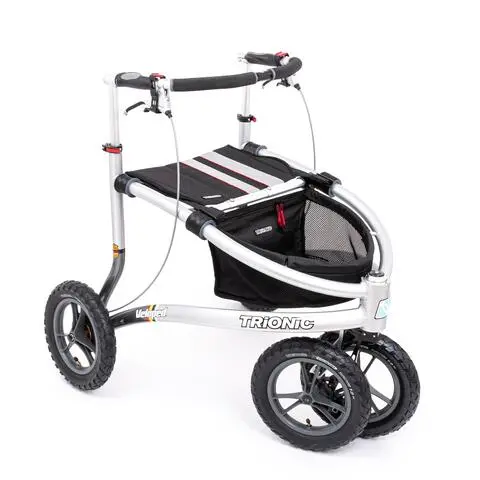
- For outdoor use, larger wheels roll over cracks and gravel more easily; rollators in our price list come with 6, 7.5 and 8 inch wheels.
- Keep the walker close to you as you go; a walker pushed far ahead tips you forward.
- Approach curbs and thresholds straight on and slowly, and lift or tip the walker over as you were taught.
- In rain, snow or ice, wet rubber and metal slip. Shorter trips, and help, are safer.
Making the home safer for a walker
Many falls in the reports happened at home, in a bathroom, a kitchen or a bedroom doorway. A few changes help the walker do its job.
- Remove loose rugs and tape down rug edges and cables.
- Clear a path at least as wide as the walker through the rooms you use most.
- Raise or remove high thresholds, or fit small threshold ramps.
- Put the things you use daily at waist height so you do not reach while standing at the walker.
- In the bathroom, use grab bars and a shower chair rather than leaning on the walker, which is not built to be wet and slippery.
- Light the route from bed to bathroom at night.
An occupational therapist can visit the home and point out the risks you no longer notice, and can suggest equipment that the walker cannot replace.
Carrying things
Baskets, trays and bags make a walker more useful, and they also change its balance. A heavy bag hung on one handle pulls the walker sideways; a full basket on the front makes it tip forward more easily.
- Use the basket or bag made for your walker, mounted where the maker intended.
- Keep loads light and central, below the seat if the rollator has room there.
- Do not lean on a loaded walker more than on an empty one, and never stand on its frame to reach.
A new walker out of the box
A walker bought online usually arrives folded, sometimes in parts. A few reports describe a walker that arrived with a part missing, or one assembled with its legs and wheels the wrong way round.
- Unpack it in good light and lay the parts out. Check them against the manual's list.
- Look along every tube and weld for dents and cracks, and spin every wheel.
- Assemble it exactly as the manual shows, with the maker's bolts and washers.
- Set the height, check every button is through its hole, and test the brakes before the first walk.
- If anything is bent, cracked or missing, do not use it: ask for a replacement.
If you cannot assemble it confidently, ask the supplier or a therapist to do it. A walker that is put together wrong can fail in the same way as one that was made wrong.
Buying a walker as a gift or online
Walkers are often bought for someone else, by a son, a daughter or a friend, and chosen by price or colour. The reports suggest three questions matter more: does it fit the person's height and weight, can their hands work the brakes, and will they use it the way it was designed? A rollator chosen for a person who needs to lean heavily may roll away from them; a standard walker chosen for someone who walks far may be left at home.
If you can, involve the person and their physiotherapist before buying, and keep the receipt. A walker that does not suit is better returned than used.
One weak hand, a stroke, or a hemi walker
Standard walkers and rollators assume two good hands. After a stroke, or with arthritis or weakness in one hand, other designs may suit better: a hemi walker used on one side, or a rollator with brakes that can be worked with one hand. Medicare's rule covers a heavy-duty walker with "multiple braking system" and variable wheel resistance for people unable to use a standard walker because of a severe neurologic disorder or restricted use of one hand.
These designs need careful set-up and training. Ask the stroke team, physiotherapist or occupational therapist, and do not adapt a standard walker yourself.
After a hip or knee replacement
Many people meet their first walker in hospital, the day after a hip or knee replacement. The ward usually starts with a front-wheeled walker, because it rolls forward smoothly while still letting the person lean on it, and moves on to a cane or crutches as strength returns. The walker sent home is often the same one.
- Ask the ward physiotherapist to set the height before you leave, and to watch you get in and out of a chair, the bed and the car with it.
- Follow the surgeon's rules on how much weight to put through the new joint; the walker is there to take the rest.
- Do not switch to a rollator early because it feels easier. A rollator rolls away from a person who leans hard on it, which is what a sore new joint makes you do.
- Keep the walker beside the bed at night, with a light on the way to the bathroom.
When the team says you no longer need it, ask whether it should go back to the supplier. A walker left in a hallway for years and brought out after the next fall may no longer be the right height, type or condition.
Instead of a knee walker
Knee walkers suit some people recovering from foot or ankle surgery, but not everyone. A hands-free knee crutch is another option for people with good balance; the retailer's list includes the iWALK3.0 at USD 196, rated for 275 lb. Crutches, a standard walker with the injured foot held off the ground, or a wheelchair for longer distances may be safer for someone who is unsteady. Ask the surgeon's team which they recommend for your injury and your home.
Weight limits and bariatric walkers
Every walker has a weight capacity, and the reports include frames and seats that failed under load. In our price list, most rollators are rated for 300 lb, with heavier-duty models rated for 350, 450 or 500 lb, and a deluxe bariatric foldable walker for 500 lb. Medicare's rule covers heavy-duty walkers for people who "weigh more than 300 pounds."
The rating is for the person using the walker. Sitting puts all of your weight on the seat and its bar at once, so stay well within the rating. If your weight has changed, check the label; if there is no label, ask the supplier before you sit.
Folding, cars and storage
Most walkers fold, and the folding mechanism is one of the parts that fails. A walker that folds while you lean on it gives no warning. Each time you open it, look and listen for the lock and push down on the frame before putting weight on it. When folding, keep fingers clear of the hinges; the reports include cuts and pinches from the folding parts.
Lifting a rollator into a car is hard on the back and the hands. Lighter rollators exist, but they often have a lower weight rating or smaller wheels. Store the walker indoors where it will not be knocked over or rusted, and keep the brakes and folding lock clean and dry.
Repairs and replacement parts
Walkers are cheap enough that many people replace rather than repair them, but tips, glides, tyres, brake parts and seats can often be replaced. Use the maker's parts, or parts the supplier says fit your model. A wheel or fork from another model may look the same and sit differently, which is the kind of problem several recalls describe.
- Rubber tips and glides: replace when the tread is smooth or worn through.
- Tyres and wheels: replace when worn, cracked or out of round.
- Brakes: have the dealer adjust them, or replace the shoes, when the rollator rolls with the brakes locked.
- Seats and backrests: replace when cracked, bowed or loose, before you sit again.
If the frame, a weld or a fork is cracked or bent, replace the walker. If it is under warranty or covered by a recall, ask the supplier first.
Looking after a walker, month by month
A walker has few parts, and most of them can be checked without tools. A short routine, done on the same day each month, catches the slow changes that people stop noticing: a tyre wearing flat, a brake drifting out of adjustment, a grip working loose.
| How often | What to check | What to do if it fails |
|---|---|---|
| Before each outing | Brakes hold, folding lock clicked, wheels turn freely | Do not go out on it until it is fixed |
| Every week | Tips, glides and tyres for wear; grips for splits or movement | Replace the worn part |
| Every month | Every button through its hole; bolts and rivets tight; seat and backrest firm | Tighten only as the manual shows, or ask the supplier |
| Every month | Tubes, welds and the fork for cracks, dents and rust | Stop using it and replace the walker |
| After a fall or a knock | Everything above, plus whether the frame still sits level | Have it checked before using it again |
Wipe the frame with a damp cloth and dry it, keep hair, thread and grit out of the wheels, and keep the walker out of the shower unless the maker says it is made for wet use. Write the date of each check in a notebook or on your phone; it helps if you ever need to show a supplier when a problem began.
Children's and specialist walkers
A few reports and recalls concern children's walkers, gait trainers and upright walkers. These are usually set up by a therapist for one person, with supports and harnesses that need regular checks. In 2021 James Leckey Design recalled 2,719 MyWay walkers because, as the recall notice says, "the casters detached from the rear legs of the walker" after weld failures. Ask the therapist who prescribed the walker to check it at every review, and to show parents and carers what to look for.
When a walker is no longer enough
A walker is the right aid only while a person can stand, balance with support, and walk the distances they need. Signs that it may be time for something else include frequent near-falls, sitting on the rollator seat more than walking, needing to be pushed on it, or avoiding going out. Medicare's rule asks that the walker can sufficiently resolve the problem; when it cannot, ask about a wheelchair or another aid, which Medicare covers under its own rules.
Many people use both: a walker for short distances at home and exercise, and a wheelchair or transport chair for longer trips. That is not a step back. It keeps the walking you still do safer.
How Mobility Atlas read 1,163 FDA reports
The FDA collects reports about medical devices in a database called MAUDE. Makers must report deaths, serious injuries and some malfunctions; patients, families and clinicians can report voluntarily. Walkers and rollators are filed under product code ITJ ("Walker, Mechanical") and a related code for PVC walkers.
In 2026 one maker, Medline, filed more than 4,000 walker reports with a description, most of them in a retrospective review of older complaints. Reading all of them was not possible, so we built the pool in three parts: every report with a description received from January 2019 to December 2025 (786); every report with a description received in 2026 from any other maker (77); and a systematic sample of 300 of the 4,124 Medline reports with a description filed in 2026, taken as 50 consecutive reports at six evenly spaced points in the FDA's list. That is 1,163 reports. We keep the Medline sample separate in the counts below, because it is a sample of one maker's batch, not of all walkers.
Before reading a single report, we wrote a codebook: eleven categories for what went wrong, in a fixed order of precedence (brakes, seat, wheel, frame or folding, handle, tips, pinch or cut, fall with no failure, assembly, no device problem, unclear), plus flags for injury and fall and what the maker found. The codebook was fingerprinted with a time stamp before coding began, so any later change to it would show. One rule matters for reading the results: a fall while sitting on the seat counts under seat, even when a wheel or leg broke at the same time.
Two independent coders then read every report separately, without seeing each other's answers. The coders were AI language models working separately; the method page says exactly how. They agreed on the main category in 94.8 percent of reports, a kappa of 0.937; kappa is a standard measure of agreement beyond chance, and this is very high agreement. We settled the 155 reports where they differed on any field (61 of them on the main category) under written rules, drawn up after the disagreements were listed and applied to all of them, and counted the results by script. Where we give a count from a word search, it runs over the description of the event, not over the maker's later follow-up notes. Six reports turned out not to be about a walker, which leaves 1,157.
The FDA warns that these reports cannot show how often a problem happens or prove that a device caused it. They show which kinds of events happen and how they unfold.
What these reports cannot tell you
The reports are a record of what people and companies chose to tell the FDA, not a count of every walker problem. Makers must report, but patients, families and clinicians only may, and most never do. The number of reports therefore says little about how common a failure is, and nothing about which brand is safer: a maker that sells more walkers, or that searches its own complaint files more thoroughly, files more reports.
Some reports were written long after the event, as part of a maker's review of its old complaints. Some were drawn from a consumer review website, with no way to contact the person. Many say the walker was never returned or examined, so the account is the user's or a relative's alone. Some describe the same event filed twice, and a few, read closely, are about something other than a walker.
What the reports do show well is the shape of an accident: which part gave way, what the person was doing, and what followed. Read that way, the same few patterns repeat across years, makers and models, and those patterns are what this guide turns into checks.
What the reports show: the big picture
| What went wrong | Reports (outside the Medline sample) | With injury | With a fall |
|---|---|---|---|
| Seat, seat bar or backrest, or a fall while sitting | 179 | 160 | 170 |
| Wheel, fork, caster or axle | 176 | 149 | 147 |
| Frame, leg, weld, height button or folding lock | 171 | 137 | 128 |
| Brakes | 114 | 97 | 96 |
| Fall with no failure named | 79 | 74 | 77 |
| Cut or pinched by the walker | 56 | 56 | 15 |
| Handle or grip | 40 | 31 | 29 |
| Unclear | 30 | 23 | 17 |
| No device problem stated | 8 | 6 | 0 |
| Assembly or damaged on arrival | 3 | 0 | 0 |
| Rubber tips | 1 | 1 | 1 |
Why do people fall with walkers and rollators? Mobility Atlas sorted 857 FDA reports about walkers and rollators filed from 2019 to 2026, leaving aside a sample from one maker's 2026 batch, and the answer is mostly a part that gave way, not a trip. The largest groups are the seat, often failing while someone sat on it (179 reports, 170 with a fall), a wheel, fork or caster that broke, loosened or came off (176), and a frame, leg, weld or folding lock that snapped or collapsed (171). Brakes that did not hold account for 114 more. Falls with no failure named, such as catching a wheel on a curb or a doorway, make up 79. Most of these reports describe an injury, and a word search finds a fracture or broken bone named in 161 of the 857. The lesson is that checking the wheels, the brakes, the frame and the seat regularly does more than any feature when you buy.
In total, 734 of the 857 reports describe an injury and 680 a fall. By a word search, 185 mention the head, 50 the hip, and 246 a hospital, an emergency room or surgery. 623 are about rollators.
Head injuries and broken hips
The injuries in these reports are serious more often than the word walker suggests. In the 857 reports outside the Medline sample, a word search finds the head mentioned in 185, a fracture or broken bone in 161, the hip in 50, and a hospital, an emergency room or surgery in 246. A fall from standing height onto a hard floor is enough to break a hip or cause a head injury in an older person, and a fall backwards off a rollator seat can also be enough, especially if the head strikes the floor or a tub.
Two things follow. First, the checks in this guide are worth the time, because the failure that leads to a fall is often visible days or weeks before. Second, if you fall and hit your head, or cannot bear weight on a leg, call for medical help rather than trying to get up and carry on, especially if you take blood thinners. Ask your physician or physiotherapist about a fall plan: how to get up safely, and who to call.
What the makers found
For most reports, the maker never examined the walker. In 729 of the 857 reports outside the Medline sample, the report says the device was not returned or evaluated, or says nothing about a finding. Makers confirmed a fault in 61 and found no fault, or put the cause outside the device, in 67. Many walkers are thrown away after a fall, lost, or kept by a family or an attorney.
If a walker fails, keep it and the broken part, and offer them to the maker. A walker that is examined can lead to a recall that protects other people; one that is thrown away cannot.
Mistakes the reports repeat
- Sitting on a rollator seat with the brakes off or only one brake on.
- Being pushed on a rollator seat like a wheelchair, often over thresholds or carpet.
- Carrying on with a wobbling wheel or a creaking seat until it gives way.
- Using a walker on stairs, or to step up a curb without the technique a therapist teaches.
- Leaning on a walker that is not fully opened and locked.
- Walking behind the rollator rather than inside the frame, where the brake parts meet the shins.
None of these needs special equipment to avoid. Most of them need someone to point them out once, which is why a session with a physiotherapist pays off.
The seat: where the most falls begin
179 reports are about the seat, the bar under it or the backrest, or about a fall while sitting on the seat. 170 describe a fall. By a word search, 120 of them mention sitting. The pattern is the same again and again: a person sat down to rest, and something gave way beneath them. One report says "while sitting on the rollator the left front wheel broke and the end user fell and hit her head." Another says the "seat cracked and collapsed." In a death report, a daughter said that when her father sat down "the back left leg snapped just below the weld by the cross bar."
A rollator seat is a place to rest briefly, on level ground, with both brakes locked. Drive's manual says to "Always lock loop locks before sitting and do not use seat when unit is on an incline or uneven ground." Before you sit, check that the rollator is fully open and its folding bar is locked down; the same manual asks you to make sure "the folding bar under seat is locked in the down position."
Recalls about seats
Invacare recalled 586 Dolomite Gloss rollators in 2023 because, as the recall notice says, the plastic eyelets of the seat's folding mechanism could break, after which "in a worst-case crossbar also breaks and the Rollator can collapse." Nova recalled Monarch rollators in 2024 because the backrest could lift out of its holder when a user shifted from a slouched to an upright seated position.
Being pushed on a rollator seat
A rollator is not a wheelchair, even though many people use it as one. Reading the seat reports, at least 16 describe someone being pushed or moved while seated, or the rollator used as a transport chair. One death report describes a carer "transporting the patient by having her sit on the seat" of a rollator, pulling her backward across carpeting; the rollator got stuck, she fell backward and died days later of a skull fracture.
Drive's manual is direct about this: "Do not have anyone push you while you are seated on the Rollator." If you need to be pushed, use a wheelchair or a transport chair. Combination rollator and transport chairs exist, such as the Drive Nitro Duet at USD 434 on the retailer's list, but use them only in chair mode, set up exactly as their own manual says.
Wheels, forks and casters
176 reports describe a wheel, fork, caster, axle or bearing that broke, loosened, wobbled, jammed or came off. 149 describe an injury. By a word search, 65 mention a hospital, an emergency room or surgery. Reports are often short: one Medline report says only "Wheel broke off." One describes a wheel that was seen wobbling and kept in use until it buckled.
The recall file has more on wheels than on anything else: by a word search of the reasons, 20 of the 29 walker recall records name a wheel, a caster, a fork, a hub or an axle. The newest is from August 2026, when Medline recalled bariatric steel rollators because "The front fork stem bolt/wheel assembly may disconnect from the rollator frame tubing." Nova recalled 10,898 Star 8 rollators in 2019 because the front fork could unscrew itself from the leg, and Compass Health recalled 3,734 Voyager rollators in 2022 because a "Wheel spoke may crack causing the wheel to separate from the axle."
What to check
- Spin each wheel. It should turn freely, run straight and stop without wobbling.
- Grip each front fork and try to move it up, down and sideways. There should be no play.
- Look for cracks in spokes and hubs, especially on plastic wheels.
- Tighten nothing yourself unless the manual shows how; a dealer can check the fork bolts.
- Drive's manual says to "Replace tires when significantly worn or damaged."
Frames, legs, welds and folding locks
171 reports describe a frame, a leg, a weld, a cross brace, a height button or pin, or the folding lock that broke, bent, collapsed or released. 137 describe an injury and 128 a fall. One report says a man was walking from his bathroom when "the left rear leg snapped." By a word search, 12 mention a weld and 12 stairs, a step or a curb.
Standard walkers fail here more than anywhere else: 45 of the 74 reports about walkers without hand brakes outside the Medline sample are frame or leg failures. A height button that is not fully through its hole lets a leg telescope down under load, so the walker drops on one side.
- Check every height button is fully out through its hole, on every leg.
- Look along each tube and weld for cracks, bends or rust, especially near the wheels and the cross brace.
- Open the walker fully and make sure the folding lock clicks. Push down on it before you lean on it.
- Stop using any walker that has been dropped hard, run into a curb or bent, until it is checked.
Brakes that do not hold
114 reports describe brakes that failed, did not hold, did not release, or a brake cable or lever that broke or came loose. 96 describe a fall. One report says a woman went to sit, "the devices left side brake did not hold and she lost her balance and fell to the floor." In another, a voluntary report says an inspection found that "when the brakes were engaged, the wheels were able to roll freely," and put it down to a lack of maintenance and normal wear. One death report says only that the rollator, "with the brakes locked, slid out from under her in the bathroom."
Rollator brakes work by pressing a shoe against the rear wheels, and they drift out of adjustment as the shoe and tyre wear. Drive's manual says to "Test the loop locks before operating the Rollator." By a word search, 10 of these reports mention the brake cable.
- Squeeze both brakes while pushing the rollator forward. It should stop.
- Push both levers down into the parking position and push hard. Neither rear wheel should turn.
- If a wheel turns, or one side holds and the other does not, stop using the rollator and take it back to the dealer for adjustment, as Drive's manual says.
- Check the cables for fraying and the levers for cracks.
Cut or pinched by the walker
56 reports describe a person cut, scraped or pinched by the walker with no other failure named, and all 56 describe an injury. By a word search, 25 of them mention the brake and 37 a cut, a laceration or stitches. The commonest story is a leg cut on the brake lever or bracket that sticks out beside the rear wheel. One report says a woman "cut her left leg on the brake assembly while walking behind the rollator" and needed stitches. Another says "the brake cut the end user requiring stitches."
Thin skin on the shins tears easily, and many walker users take blood thinners. Walk inside the frame rather than behind it, as the therapist shows you, and ask the dealer whether a guard or a different rollator would keep the brake parts away from your legs. Fold and unfold the walker with your fingers clear of the hinges.
Handles and grips
40 reports describe a handle or grip that broke, slipped, turned or came loose. One says simply that the "handlebar collapsed" as the person walked out of her bedroom. Another describes a handle that broke as the user was trying to stand, followed by a hip fracture. Handle heights are set with a knob or a button; make sure it is tight and fully engaged each time, and replace split or loose grips.
Knee walkers
55 reports outside the Medline sample are about knee walkers, the wheeled frames people use for a few weeks after foot or ankle surgery. Their failures are spread across handles and steering (11 reports), wheels (10) and frames (8), and several describe a front wheel stopping at a crack or an edge. One attorney's letter says the front wheels "was stuck at the edge, resulting in a trip and fall to the ground."
In 2024 the Drive Nitro Glide knee walker was recalled by Medical Depot Inc.; the recall notice says "The tiller separates from the base/front caster assembly." Knee walkers are fast, narrow and high, and the user has one leg on a pad. Use them on smooth floors, slow down for thresholds and curbs, and never use one on stairs. If balance is a problem, ask the surgeon or physiotherapist about a different aid.
Falls with no failure: curbs, doorways and stairs
79 reports describe a fall where nothing on the walker is said to have failed. 74 describe an injury. People caught a wheel on a doorway, a rug or a curb, lost their balance turning, or tried to use the walker on stairs. By a word search, 5 of these 79 mention stairs, a step or a curb.
Walkers and rollators are made for level ground. Lift a standard walker up a curb only as a therapist has shown you, approach thresholds straight on, and never use a walker on stairs. If your home has steps, ask the therapist about a second walker for upstairs, a rail, or another aid.
The death reports, read with care
11 reports outside the Medline sample are filed as deaths. Read closely, they are a mixed group. At least one describes only a finger caught in the folding mechanism and stitches, with no death in the text. Others describe a fall after a wheel or the cross-frame failed, a rollator that slid with its brakes locked, a rollator that tipped over a transition strip, and a woman found with her head under her rollator and her sweater caught on it.
These are death reports, not proof of cause, and several reached the maker through attorneys, some long after the event. But they point to the same checks as the rest of this guide: wheels, brakes, the frame and the seat, and no being pushed on the seat.
The 2026 Medline batch
In 2026 Medline filed 4,124 walker reports that carry a description. We read a sample of 300 of them. They are different from the rest of the pool. Most are malfunction reports with no injury: only 30 of the 300 describe an injury and 34 a fall. Most describe events from 2023 to 2025, and by a word search 233 mention a retrospective review.
The failures named are the same parts: wheels and forks (89 of 300), frames and legs (82), brakes (66) and seats (31). One says the rollator brakes "did not engage" and that it was "sliding even with the brakes engaged." In 101 of the 300 Medline confirmed a fault, far more often than makers did in the rest of the pool, because many of these units were returned or photographed.
So the 2026 jump in walker reports says nothing about walkers getting worse in 2026. It reflects one maker's review of its own complaint files.
Who files these reports
Outside the Medline sample, Drive filed or is named in 372 reports and Medline in 221. Compass Health appears in 31, Roscoe in 17, Invacare and Nova in 8 each, and 200 name another maker or none. Drive and Medline sell very large numbers of walkers and file detailed reports, many from customers' calls. That makes them more visible in the data, not less safe, and we do not rank brands for that reason.
Many walkers are sold under a store or distributor's name and made in factories that also make other brands. When you look for recalls, search for the importer named on the label as well as the brand.
The recall file
We downloaded all 29 FDA recall records for walkers going back to 2006. 12 were still listed as open in October 2026.
| Recall | Started | What | Why |
|---|---|---|---|
| Z-0086-2027 and Z-0087-2027 | 2026 | Medline bariatric steel rollators | Front fork stem bolt and wheel may disconnect |
| Z-0129-2025 to Z-0131-2025 | 2024 | Nova Monarch rollators | Backrest may lift out of its holder |
| Z-2354-2024 and Z-2355-2024 | 2024 | Drive Nitro Glide knee walkers | Tiller may separate from the base |
| Z-0231-2024 | 2023 | Breg folding walkers with wheels, 11,193 units | Misaligned wheels |
| Z-2445-2023 | 2023 | Invacare Dolomite Gloss rollators, 586 units | Seat eyelets and crossbar may break |
| Z-0510-2022 | 2022 | Compass Health Voyager rollators, 3,734 units | Wheel spoke may crack |
| Z-0654-2021 | 2019 | Nova Star 8 rollators, 10,898 units | Front fork may unscrew from the leg |
To check your walker, search the FDA recall database for the brand and the importer on the label, or ask the supplier. Older recalls matter too: walkers last for years and change hands without the paperwork.
A two-minute check before you go out
- Open the walker fully and check the folding lock has clicked.
- Check every height button is fully out, and the handle knobs are tight.
- Spin each wheel and wiggle each fork. No wobble, no play, no rubbing.
- Test both brakes: squeeze while pushing, then park and push hard.
- Press down on the seat with your hands before you trust it with your weight.
- Look for anything sharp sticking out near your legs.
Do this before you go out, and in full every week. If the brakes, a wheel, the frame, the folding lock or a height button fails, stop using the walker until it is fixed; if the seat fails, do not sit on it.
Used, borrowed and handed-down walkers
Walkers are often borrowed, handed down or bought second hand, and many of the reports involve walkers of unknown age. A used walker can be a good choice if it is checked first.
- Check the model against the FDA recall database before you use it.
- Replace worn tips and tyres, and get the brakes adjusted.
- Look for cracks at welds and wheel forks, and for bent legs.
- Make sure it fits your height and weight; a walker set for someone else may not.
Finding the model number and checking recalls
Every walker and rollator should carry a label with the maker's name, the model, often a serial or lot number, and the weight rating. It is usually on a leg, under the seat or inside the frame. Take a photo of it on the day the walker arrives, because labels fade and peel.
With the model number you can check for recalls. The FDA's medical device recall database can be searched by maker, product name or product code; walkers sit under the code ITJ. The maker's own website and the supplier who sold the walker should also know about recalls. The FDA says a recall does not always mean you must stop using a device; it may mean a repair, an adjustment, a new part or a warning. Read what the notice asks you to do, and if it is unclear, stop using the walker and call the number on it.
If you registered the walker with the maker or bought it from a medical supplier, you may be contacted directly. If it was a gift, a hand-me-down or an online purchase, nobody may know you have it, and the label photo is how you find out.
When to report a walker problem to the FDA
If a walker or rollator caused or nearly caused an injury, report it. Tell the supplier and the maker: makers must investigate and, for serious events, report to the FDA. You can also report it yourself through MedWatch, online at fda.gov/medwatch. Keep the walker and any broken part, photograph them, and write down the brand, model, the importer on the label and what happened.
Keeping a record when something goes wrong
Keep the receipt or supplier's paperwork, the brand, model and importer name from the label, and a note of the date you first used the walker. When something fails, write down the date, what happened and where, and photograph the part. A short record helps the supplier fix the problem, helps you with a warranty or recall claim, and makes any report to the maker or the FDA much more useful.
Three composite scenarios
These are composite scenarios, not individual customers. Each one combines facts and ranges already given in this guide to show how the decision plays out.
Scenario one: a woman with arthritis in both hands finds rollator brakes hard to squeeze. Her physiotherapist suggests a front-wheeled walker instead, and Medicare covers it after her doctor orders it; after the Part B deductible she pays 20 percent of the approved amount, because the supplier accepts assignment.
Scenario two: a man notices his rollator's front wheel wobbling. He stops using it, finds his model in a fork recall, and the supplier replaces the fork.
Scenario three: a daughter pushes her mother on the rollator seat to the car each week. After reading the maker's manual, she buys a transport chair for those trips and keeps the rollator for walking.
Questions to ask before you buy
- Which kind suits my balance, grip and home: a standard walker, a front-wheeled walker or a rollator?
- What is the weight capacity, and the handle height range?
- Are the brakes easy for my hands to use, and how are they adjusted?
- Will Medicare or my plan cover it, and does the supplier accept assignment?
- Does any recall apply to this model?
- Who repairs it, and where do I get wheels, tips and brake parts?
A walker should be chosen and set up with a physiotherapist or occupational therapist, especially after a fall, a stroke or surgery. Ask your physician for a referral if no one has assessed your walking.
Questions to ask the physiotherapist
- Which kind of walker suits my balance, strength and the distances I walk?
- What height should the handles be, and can you set it?
- How should I stand up, sit down, turn and go through doors with it?
- Is it safe for me to sit on a rollator seat, and when?
- How do I manage curbs, slopes and the step into my home?
- What should I do if I fall, and how do I get up?
A session or two with a physiotherapist costs little compared with a fall. Ask your physician for a referral if you have fallen or feel unsteady, and ask your plan what therapy it covers.
Your plan: 10 minutes, today, this week
In 10 minutes: run the two-minute check above and test both brakes.
Today: look up your walker's brand and importer in the FDA recall database, and stop being pushed on the seat if anyone does that.
This week: ask the supplier to fix anything that failed the check, and ask a therapist to check the height.
Sources and documents
Reports: FDA MAUDE device reports under product codes ITJ and NXE with a description: all received from January 2019 to December 2025, all received in 2026 from makers other than Medline, and a systematic sample of 300 of Medline's 2026 reports, downloaded through openFDA. Recalls: all 29 FDA recall records for walkers, downloaded through openFDA. Rules: 21 CFR 890.3825. Use and care: Drive's rollator user manual. Funding: the Medicare local coverage determination for walkers and Medicare's equipment page. Prices: 1800wheelchair's category pages. Every source is linked in the list at the end of this page.
Related guides on Mobility Atlas: Home hospital beds and bed rails; Lightweight and transport wheelchairs; Stairlifts and wheelchair platform lifts.
Method in brief: we coded the 1,163 reports in the pool using a codebook written and fingerprinted before coding, with two independent coders (agreement on the main category 94.8 percent, kappa 0.937), settled the 155 reports where they differed on any field (61 on the main category) under written rules, and counted the results by script. The two coders were AI language models working separately, each without access to the other's answers. Quotes from reports are shown in sentence case; the FDA publishes most of them in upper case. The codebook, the method and the coded table are on the data and method page under CC BY 4.0.
Prices checked October 2026 on 1800wheelchair's pages; prices change, so confirm them with your supplier. Documents checked October 2026: FDA reports and recall records, the federal rule, Drive's manual and the Medicare pages.
Has a walker or rollator let you down, or been fixed well? Send us a note through the enquiry form with the model and what happened; we use readers' notes when we update the guide.
This article is general information. Rules and prices differ by country and change, so confirm them before you buy or travel.
Common questions
How much does a rollator cost?
On one large retailer's site in October 2026, basic four-wheel rollators start at USD 100, a Drive rollator with 8 inch wheels is USD 114, and lighter or heavy-duty models run to about USD 600. Standard folding walkers start at USD 49.
Does Medicare cover a rollator?
Medicare Part B covers walkers, including wheeled ones, when a mobility limitation affects daily activities at home, you can use the walker safely, and a walker solves the problem. You usually pay 20 percent of the approved amount after the deductible.
Is it safe to sit on a rollator seat?
Only to rest briefly, on level ground, with both brakes locked and the frame fully opened. In our data the seat group is the largest source of falls, many while someone sat on it. Never let anyone push you while seated.
How do I check rollator brakes?
Squeeze both brakes while pushing forward; the rollator should stop. Then lock both and push hard; neither rear wheel should turn. Drive's manual says to take it back to the dealer if the wheels turn while the brakes are locked.
What should I do if my walker wheel wobbles?
Stop using it and have it checked. Loose and broken wheels and forks are among the commonest failures in the reports we read, and several recalls involve forks that unscrew or wheels that separate.
Walker or rollator: which is safer?
Neither is safer for everyone. A standard walker gives more support; a rollator moves more easily but needs good grip and brakes. A physiotherapist can assess your balance and recommend one.
Sources
- FDA: About the MAUDE database and the limits of device reports
- openFDA: device adverse event endpoint (data used for this study)
- openFDA: device recall endpoint, product codes ITJ and NXE
- eCFR: 21 CFR 890.3825 Mechanical walker
- CMS: Local coverage determination L33791, Walkers
- FDA: What is a medical device recall?
- Medicare: Durable medical equipment coverage
- Drive Medical: rollator user manual RTL10261 (PDF)
- 1800wheelchair: 4-wheel rollators (prices read October 2026)
- 1800wheelchair: standard walkers (prices read October 2026)
- 1800wheelchair: 2-wheel walkers (prices read October 2026)
- 1800wheelchair: knee walkers (prices read October 2026)
Read on 16 October 2026. The wording of the article is our own.
Data and method for this guide: the codebook, the coded reports and the list of documents, free to reuse under CC BY 4.0.