Stair-climbing and all-terrain wheelchairs in 2026: iBOT, tracked and off-road chairs, prices, funding and what 81 FDA reports show
iBOT, Scewo, tracked Trackchairs and lever-drive GRIT chairs: prices, funding, and what two AI coders found in 81 FDA reports on stair-climbing chairs.
Contents
- Stop and check before the next climb
- The short answer
- Four families of chair, side by side
- How a stair-climbing chair climbs
- The iBOT PMD in numbers
- The six iBOT modes, in plain words
- Who the iBOT suits, and who it may not
- Training: what to expect
- Is your staircase right for a stair-climbing chair?
- Scewo BRO and GO, and the Caterwil GTS5
- Attendant stair climbers for a manual chair
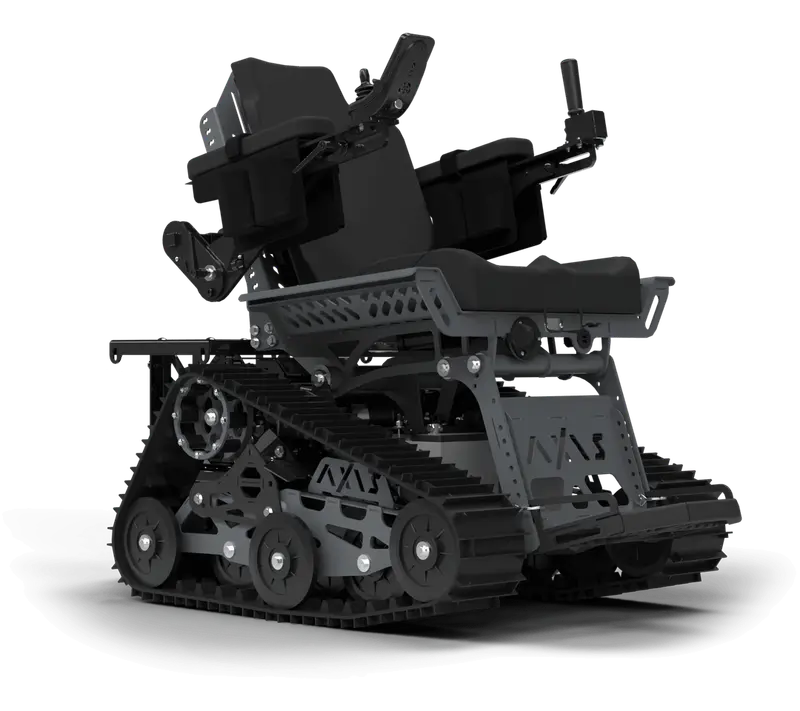
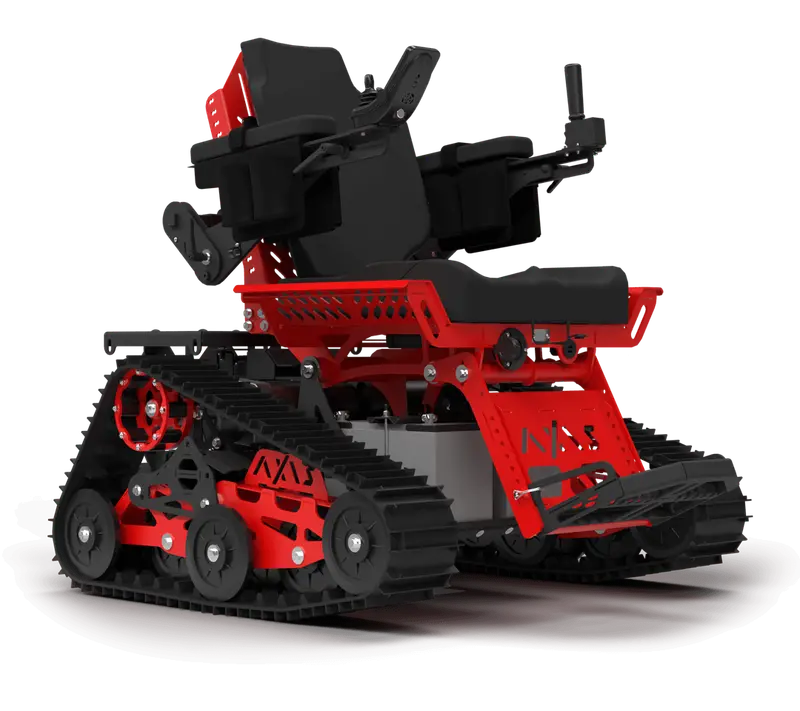
- Tracked all-terrain chairs: the Trackchair line
- Other off-road power chairs
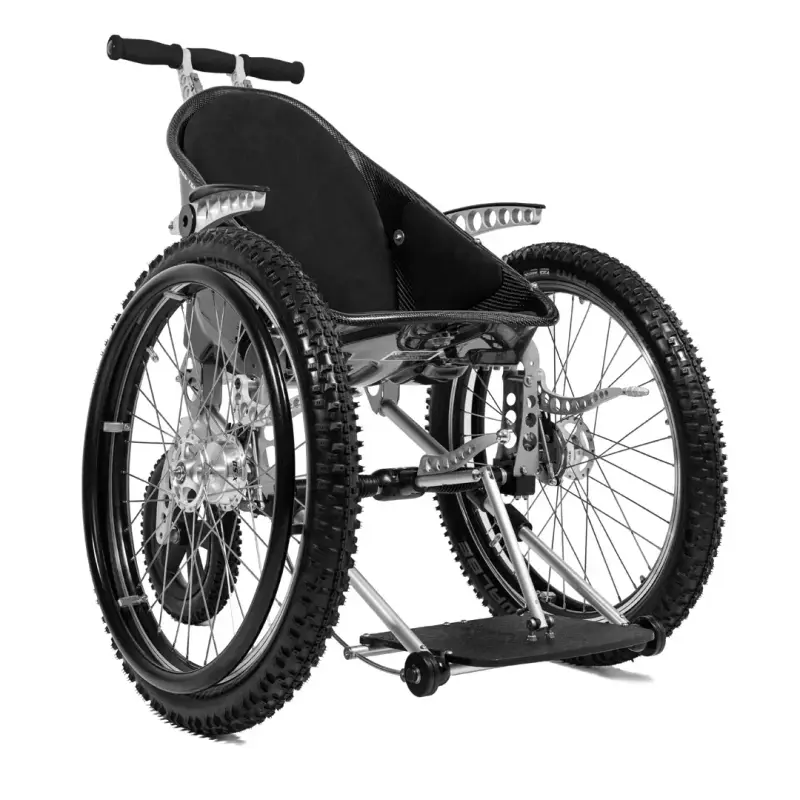
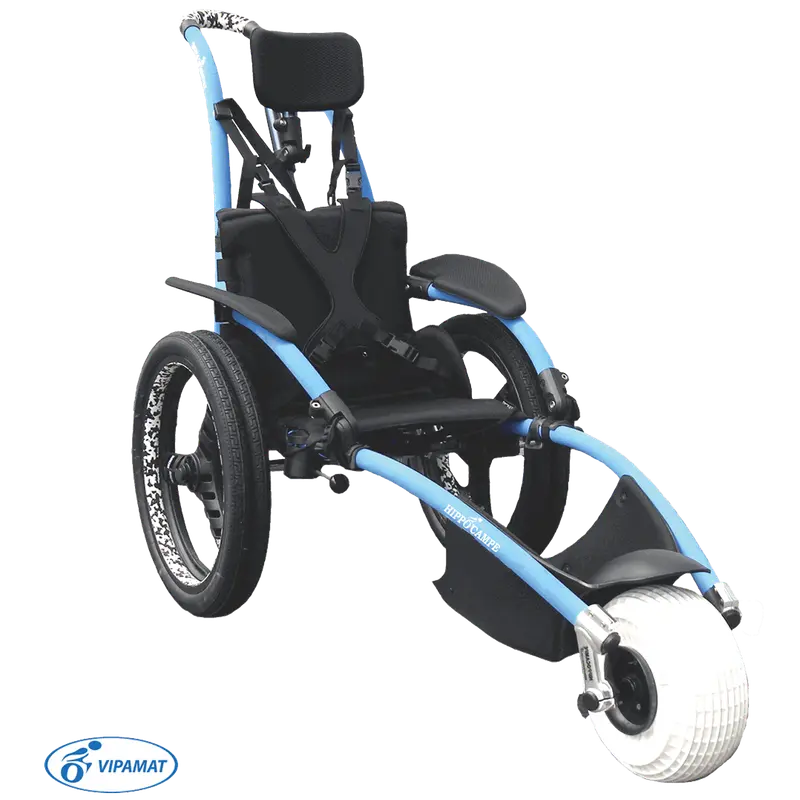
- Manual all-terrain chairs
- Which chairs climb stairs or handle rough ground?
- What these chairs cost in 2026
- Who pays for a stair-climbing or off-road chair?
- Other ways to pay, and what to ask
- Transport, docking and getting it into a car
- Range, batteries and weather
- Choosing between stairs, terrain and something else
- How Mobility Atlas read the FDA reports
- What the 81 reports show: the big picture
- What these reports cannot tell you
- Falls on the stairs
- The cluster safety lock, explained
- The assistant on the stairs
- The lap belt
- Balance mode, curbs and slippery ground
- When the reports say the chair did something on its own
- Feet, footplates and fit
- Batteries and chargers
- Struck by vehicles
- Three reports about another stair product
- What the makers found
- When the reports arrived
- All-terrain chairs: the FDA data say almost nothing
- The recall file
- How the FDA classes stair-climbing wheelchairs
- What the FDA reports add up to
- Habits the reports point to
- A check before every stair climb
- When to report a problem to the FDA
- Three composite scenarios
- Questions to ask before you choose
- Your plan: 10 minutes, today, this week
- Sources and documents
- Common questions
- Sources
Stop and check before the next climb
Someone already uses an iBOT or another stair-climbing chair at home? Check these first. Choosing a chair for stairs or rough ground? Start at the short answer below.
- The lap belt is fastened before every stair climb. Several stair reports we read say the person who came out of the chair was not wearing it; one 2022 report says the user "was not wearing the provided lap belt at the time of the event as advised in accompanying device labeling."
- The assistant's handle is fully fitted and latched. One 2022 report describes a handle that had been taken off for a small car, was not refitted with all its parts, and "came detached" during an assisted climb.
- The handrail is solid all the way down. A 2026 report describes a PVC railing whose cap came off in the user's hand on the second step, and a fall down the stairs that followed.
- Nobody uses the forced power off in Balance or Stair mode. The iBOT manual, as a Mobius report quotes it, warns that "operating the forced power off when in balance or stair mode can cause the device to fall over."
- The chair's software is up to date. In April 2025 Mobius Mobility recalled iBOT PMDs running software version 01.05.24 for a "software issue that could potentially lead to the device tipping over from Balance Mode," the FDA recall record says. Ask Mobius whether your chair was updated.
After a weight change, ask the maker to check and reset the chair before using it: the iBOT 4000 labelling, as a 2009 report quotes it, said "never to operate the product if you have gained or lost more than 20lbs." After a long break from stairs, or with a new assistant, book a refresher with the maker first.
The short answer
Two very different kinds of chair hide behind searches for a stair climbing wheelchair and an all terrain wheelchair. A stair-climbing chair carries its user up and down a flight of ordinary indoor or outdoor stairs. An all-terrain, tracked or off-road chair is sold for grass, sand, mud, snow, gravel and trails, not as a stair climber. A few machines do some of both. None of them replaces a ramp, a lift or a home that works at ground level, and all of the powered ones are heavy, costly and need training.
Stair climbing: the iBOT, today sold by Mobius Mobility as the iBOT PMD, is the chair behind almost every FDA report on stair-climbing wheelchairs (78 of 81 name an iBOT, 55 of them the earlier iBOT 3000 and 4000 and 23 the iBOT PMD); it climbs stairs on two pairs of wheels that rotate over each other while the user or a trained assistant controls the pitch. Mobius publishes no price and names Medicare and the VA as funding routes. In Europe, the Scewo BRO is listed in our catalog (checked October 2026) from around EUR 35,150, and the Scewo GO from around EUR 37,700 with its stair-climbing module. The Caterwil GTS5, a chair that drops onto tracks for stairs, is listed at around USD 15,045 for the base model. Attendant-operated stair climbers that attach to a manual chair are another route; our stairlift and platform lift guide touches on them.
Rough ground: tracked Trackchair models are listed by their maker from USD 13,775 to USD 27,585, plus shipping. Four-wheel-drive power chairs such as Magic Mobility's Extreme X8 and XT4 have no price in our catalog. Lever-driven manual chairs cost far less: the GRIT Freedom Chair 3.0 is listed at USD 2,995 on the maker's shop.
The FDA side is thin but telling. We read every FDA report with a description filed under the stair-climbing wheelchair product code: 81 reports from 2004 to September 2026, 78 of them about the iBOT. More of them describe a fall during a stair climb than any other single situation: 23 of the 81, usually going down, and the maker's logs usually blame lost pitch control rather than a fault; others describe falls in Balance or 4-Wheel mode on curbs, wet ground and obstacles. For all-terrain chairs, the wheelchair reports we had already read hold just one.
Mobility Atlas earns a fee or margin when you order through us; this guide uses only the makers' published pages, our own catalog, and FDA documents and reports read in October 2026, and quotes them as they stand. Whether a person can use a stair-climbing or off-road chair safely is a decision for their physician, physical or occupational therapist and seating specialist; this guide explains the options and what to ask, and stops there.
Four families of chair, side by side
| Family | What it does | Examples | Listed price |
|---|---|---|---|
| Powered stair-climbing chair | Climbs flights of stairs with the user seated; also an everyday power chair | iBOT PMD, Scewo BRO, Scewo GO with stair module, Caterwil GTS5 | iBOT not published; others around EUR 35,150 to 37,700 or USD 15,045 (our catalog) |
| Attendant stair climber | A battery unit a helper attaches to a manual chair to take it up or down stairs | Alber scalamobil S35 | Not published (our catalog) |
| Tracked or 4x4 off-road power chair | Crosses mud, sand, snow and trails; not sold for stairs | Trackchair ST, HAWK, AXIS; TrackMaster; Magic Mobility X8, XT4 | USD 13,775 to 27,585 for Trackchair (maker); others by quote |
| Manual all-terrain chair | Pushed by levers or by hand on big wheels over rough ground | GRIT Freedom Chair, Mountain Trike, Trekinetic K2, Hippocampe | USD 2,995 to 4,395 for GRIT (maker); others vary |
Prices are list prices on the makers' sites or guide prices from our catalog, checked October 2026. They are not offers, and delivery, seating, options and training can add a lot.
How a stair-climbing chair climbs
The iBOT climbs on two pairs of drive wheels mounted on rotating arms, which the reports call "clusters". On the stairs, one pair rests on a step while the other rotates over it to the next. The chair does not do this by itself. The Mobius FAQ page says "the ibot PMD does not climb stairs on its own" and that the user or a trained assistant "climbs stairs by shifting the chair's center of gravity in the direction you want to go." Going down, the user leans back or the assistant holds the chair back to slow each rotation. A solo user controls the pitch by holding the handrail.
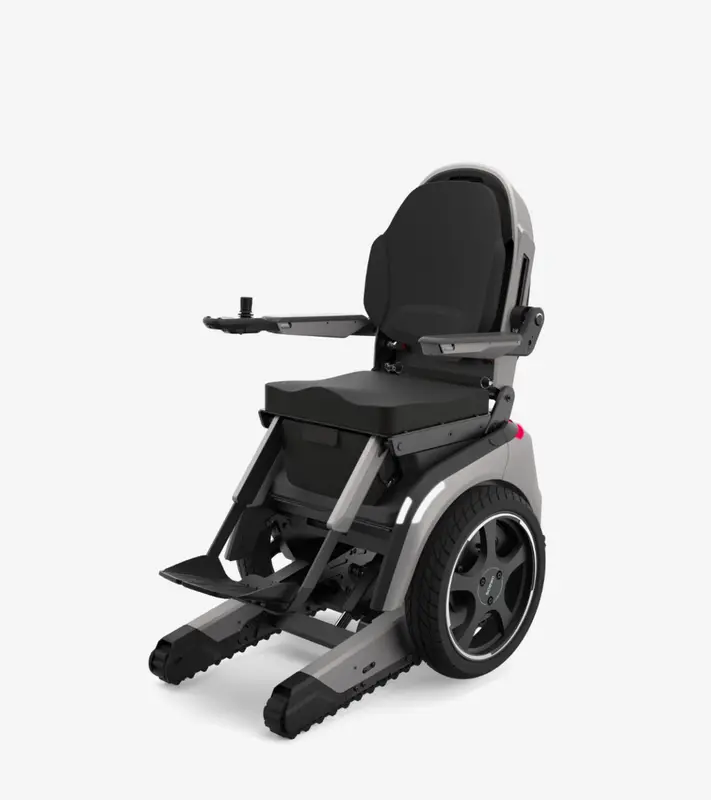
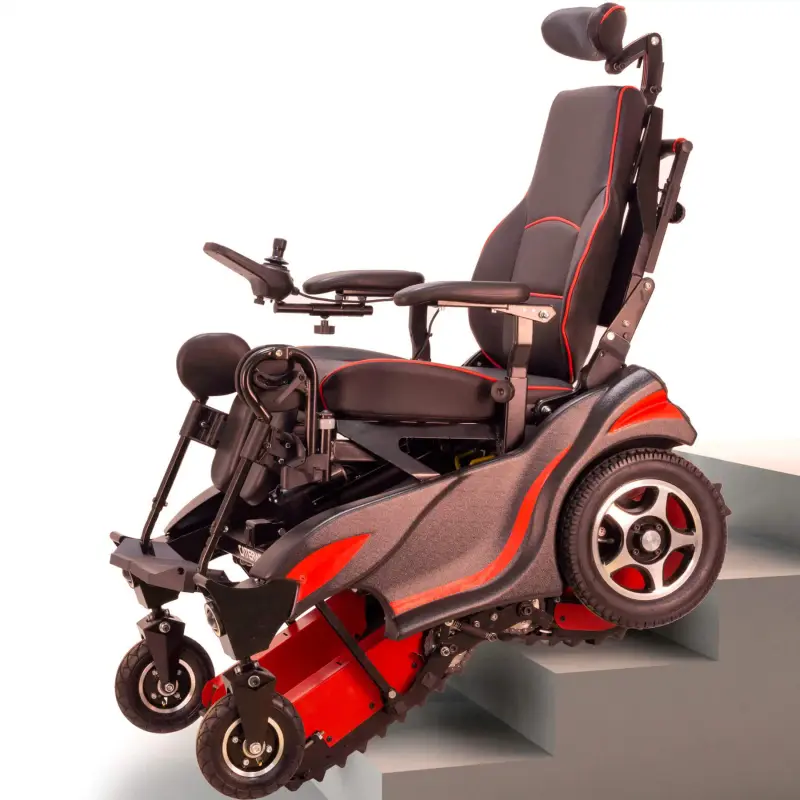
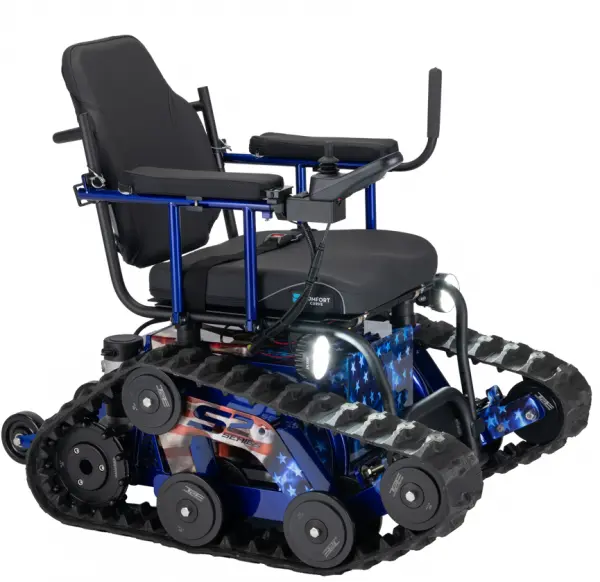
Other designs use tracks. Our catalog describes the Scewo BRO as a self-balancing two-wheel chair with built-in rubber tracks that carry it up and down stairs, the Scewo GO as a six-wheel chair to which a stair-climbing module can be added at purchase or later, and the Caterwil GTS5 as a chair that drives on wheels and switches to four tracks with gyroscopic levelling for stairs. We have read no FDA reports about these three; the FDA product code for stair-climbing wheelchairs holds iBOT reports and three reports on another product.
The iBOT PMD in numbers
These figures are from Mobius Mobility's "Learn More" page with its technical specifications, read on 18 October 2026. The chair has six modes; the table gives the ones the maker lists figures for.
| Spec | Standard | 4-Wheel | Balance |
|---|---|---|---|
| Seat-to-floor height | 18.7 in | 25.4 to 30.4 in | 30.5 to 35.8 in |
| Driving range | 14 mi | 13 mi | 18 mi |
| Max obstacle height | 1.5 in | 6 in | 1.5 in |
| Max slope | 10 degrees | 12 degrees | 8 degrees |
| Max speed | 6.8 mph | 5 mph | 3.5 mph |
| Ground clearance | 2.5 in (1.7 in with docking) | 3.7 in | 9.5 in |
| Turning radius | 35.5 in | 27.5 in | 27.5 in |
Weight capacity is 50 to 300 lb. The powerbase is 25 in wide and 31.5 in long. Remote mode lets the empty chair climb up to a 20-degree slope for loading into a vehicle. The page says range "will be reduced when driving on slopes, rough ground, or frequently climbing curbs."
Two figures on Mobius's own pages do not agree. The specification table gives a 6 in maximum obstacle in 4-Wheel mode, and the product page says the chair can "climb curbs up to six inches", but the same page also speaks of obstacles "up to five inches tall". The specification table gives the powerbase weight as 178 lb, without the seat, while the clinicians' page gives about 175 lb. Ask Mobius which figure applies to the configuration being quoted.
The six iBOT modes, in plain words
| Mode | What it is for |
|---|---|
| Standard | Everyday driving, with the seat at 18.7 in |
| 4-Wheel | Rough ground and curbs; all four drive wheels on the ground, seat raised |
| Balance | The chair rises onto two wheels and balances, with the seat at 30.5 to 35.8 in |
| Stair | Climbing and descending stairs alone with a handrail, or with a trained assistant |
| Remote | Moving the empty chair, including up a slope of up to 20 degrees into a vehicle |
| Docking | Used with the EZ Lock docking hardware; seat at 18.7 in |
The clinicians' page says the seat in 4-Wheel mode can be raised to 10 in above the lowest seat-to-floor height, and in Balance to 18 in above it, and that in 4-Wheel and Balance modes the chair keeps its seat angle automatically, which Mobius calls Terrain Following. Balance and 4-Wheel modes are the ones the reports link to falls away from stairs: Balance mode on wet or loose surfaces and obstacles, 4-Wheel mode on curbs taken at an angle and slippery steps, as the study half of this guide shows.
Who the iBOT suits, and who it may not
Mobius says the iBOT is a prescription device: "See your physician and receive a prescription for an ibot PMD," its FAQ page says. It is driven with a standard joystick, and the FAQ says users are "not required to use balance or trunk control to move the device"; Mobius does not currently offer specialty controls. Training is required for all users, and the maker says "training is required by the FDA."
Mobius's clinician FAQ lists situations where the chair "may not be a good match, and further conversation may be necessary." They include a weight outside 50 to 300 lb, a "risk of seizure or loss of consciousness", and a "risk of fracture while driving over rough terrain or while experiencing jarring forces related to ibot PMD transitions." The FDA rule for this kind of device asks makers to give clinicians labelling that includes "identification of patients who can effectively operate the device."
These are exactly the questions for the physician and therapist, not for a sales call. Bone health, sitting balance, hand function on a rail, the ability to lean back on cue, and whether a helper will always be there for stairs all shape the answer. Mobius says Stair mode can be used alone or with a trained assistant, depending on the user's ability; with an assistant, the assistant carries much of the risk, as the reports show.
Training: what to expect
Mobius's FAQ says training "usually takes 1-2 days". It covers the modes, the warnings, and the stair technique for the user and for any assistant. A 2023 Mobius report mentions a "certificate training program" for the user and the assistant, and an assistant who had passed the maker's assisted stair training. Several reports describe trained assistants who still lost control on the stairs, and one 2007 report describes an assistant who was never trained: it says it was "subsequently confirmed with the user that the individual assisting her was not trained in the device's assisted stair climbing function."
- Ask who trains the user, who trains each assistant, and whether a new helper can be trained later.
- Ask how often to practise on the stairs at home. Mobius wrote in a 2025 report that "we recommend using the stair climbing feature regularly to keep a level of familiarity in controlling the device on the stairs."
- Ask for a refresher after a long break, after weight change, and after any fall.
Rentals are not offered. "Unfortunately, no. This is a prescription medical device that requires fitting and training, so rentals are not an option," the FAQ says of renting a chair for a trip.
Is your staircase right for a stair-climbing chair?
Every chair has limits on step height, stair angle and landing space, and the reports show what happens outside them. For the older iBOT 4000, a 2007 report says the step height in stair function "is labeled for 5-8 inches," and describes a forward fall on a step of 9 to 10 inches. Our catalog lists the Caterwil GTS5 for stairs up to 20 cm high and 40 degrees, and the Alber scalamobil with a climbing-height extension for steps up to 25 cm. Ask the maker for the current limits in writing and measure your own stairs against them.
- Step height and depth on every step, not just one; old stairs vary.
- A handrail that is solid along the whole flight and that the user can grip; one Mobius report says the user manual and training manual "instruct to grasp the handrail with one hand underneath (palm facing up) and one hand above (palm facing down)" and called the fall user error on a railing that could not be gripped that way.
- Landings at the top and bottom long enough to stop, turn and start; several reports describe falls on the last step or onto a landing, and one into a door at the foot of the stairs.
- Wet, icy, carpeted or worn outdoor steps, which change grip and timing.
- Whether a turn or winder in the stairs lets the chair stay straight; a 2007 report describes a chair that went forward and hit the wall where the stair turned.
Scewo BRO and GO, and the Caterwil GTS5
| Chair | Stair system | Speed and range | Max user | Guide price (our catalog) |
|---|---|---|---|---|
| Scewo BRO | Built-in stair-climbing tracks | Up to 10 km/h; max. 35 km | 120 kg | From around EUR 35,150 / CHF 35,500 |
| Scewo GO | Optional stair-climber module | Up to 12 km/h (depending on local rules); max. 49 km | 136 kg | Around EUR 18,500 without, EUR 37,700 with the module |
| Caterwil GTS5 | Four tracks with gyroscopic levelling | 8 km/h on wheels, 0.8 km/h on tracks; 25 km | 115 kg | Around USD 15,045 base model |
Our catalog gives the Scewo BRO a 50 mm obstacle height and the GO 75 mm, with dynamic seat tilt on the GO. The Caterwil weighs 98 kg with batteries and offers range options of 40 or 50 km. We did not find these chairs in the FDA reports we read. Ask any seller what approvals the chair has in your country, who services it there, and who trains you and your helpers.
Attendant stair climbers for a manual chair
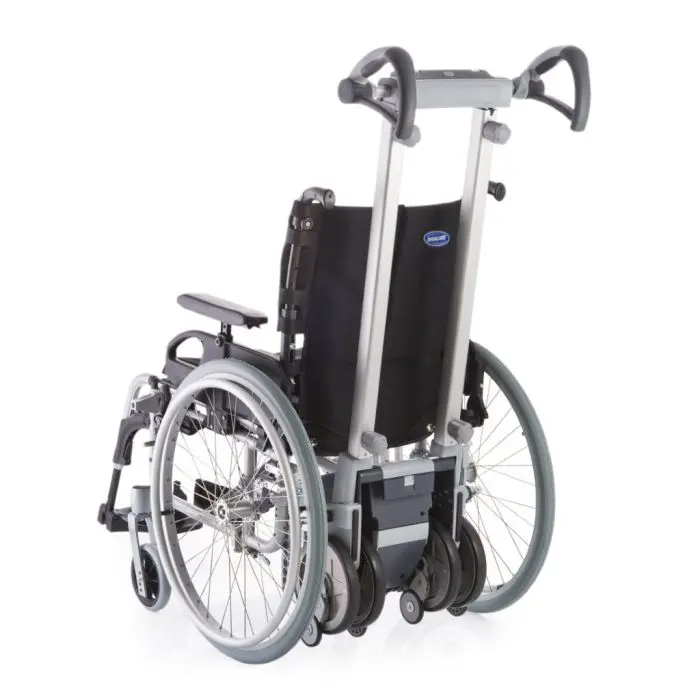
If the user already has a manual wheelchair and always has a helper, an attendant stair climber may do the job; our catalog has no price for it, so ask the dealer for a quote. Our catalog lists the Alber scalamobil S35, a battery unit that attaches to many manual wheelchairs and that a trained helper steers up or down the stairs: maximum person weight 140 kg, 180 kg in total, a climbing unit of 17.9 kg, up to 300 steps per charge and 6 to 18 steps a minute. Ask the dealer whether it fits your chair.
Stairlifts and platform lifts are covered in detail, with their own FDA reports, in our stairlift and platform lift guide, which also touches on attendant climbers. For a single step or a short rise, a ramp may beat any machine; see our wheelchair ramp guide.
Tracked all-terrain chairs: the Trackchair line
Trackchair, made in Marshall, Minnesota, calls its product "the ultimate all-terrain wheelchair" on its home page. Its chairs run on tracks instead of wheels. These are the list prices on the maker's site on 18 October 2026; each model page adds "Plus shipping and delivery charges."
| Model | List price (USD) | Label on the maker's site |
|---|---|---|
| Trackchair ST | 13,775 | Adult / full size |
| Trackchair NT | 13,885 | Narrow width |
| Trackchair STS | 15,975 | Built-in suspension |
| Trackchair EAGLE | 18,825 | FDA cleared #K181908 |
| Trackchair HAWK | 18,825 | FDA cleared #K202728 |
| Trackchair AXIS 40 | 19,400 | Improved performance |
| Trackchair AXIS 30 | 19,400 | Narrow width |
| Trackstander NR | 19,925 | Youth / small stature |
| Trackstander TR | 19,985 | Adult / full size |
| Trackstander FALCON | 27,585 | FDA cleared #K163451 |
| Spec | ST | HAWK | AXIS 40 |
|---|---|---|---|
| Chair weight (estimated) | 400 lb | 400 lb | 495 lb |
| Weight capacity | 300 lb | 250 lb | 350 lb |
| Seat height | 23 in | 23 in | 26 in |
| Ground clearance | 3.5 in | 3.5 in | 4.75 in |
| Speed (approximate) | 3 mph | 3 mph | 4 mph |
| Range | Up to 7 miles | Up to 7 miles | Up to 7 miles |
| Warranty | 1 year parts and labor; 3 years welding and track | Same | Same |
Options are priced on the same site: an attendant control at USD 645 (USD 750 with a mount on the AXIS), a snow plow kit for the ST at USD 1,100, a carrier at USD 900 and an LED headlight at USD 245. The maker's page describes a "tilt on the fly" seat that "lets users actively shift their center of gravity when ascending or descending terrain." Our catalog notes that the AXIS pages give 4 mph in the specification table and 5 mph elsewhere, and lists the AXIS 30 at 507 lb. Ask which figure is current.
Other off-road power chairs
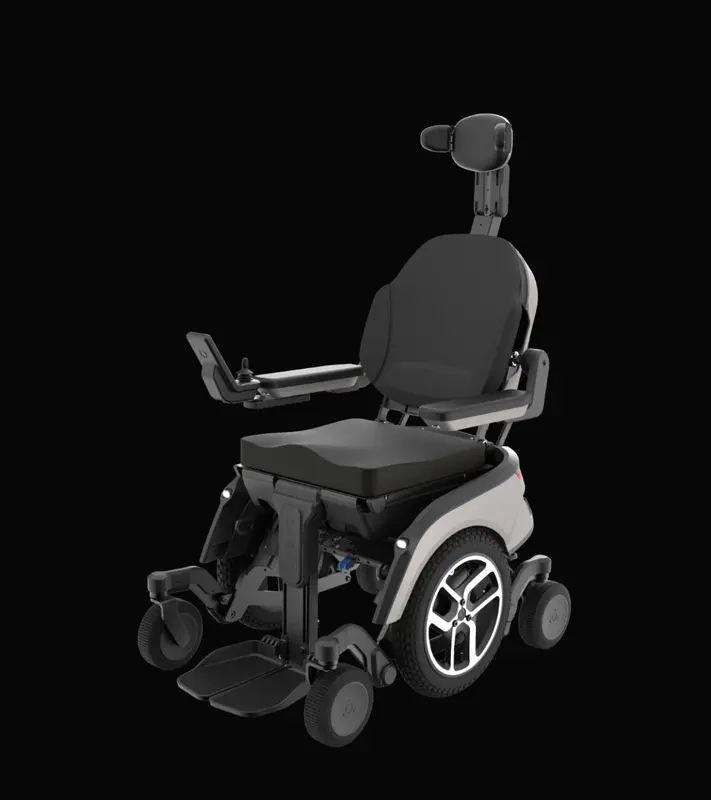
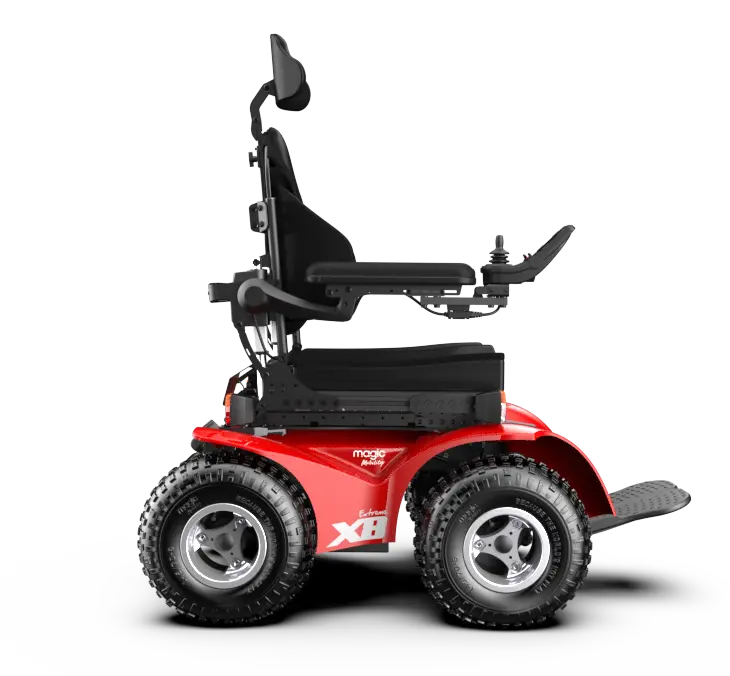
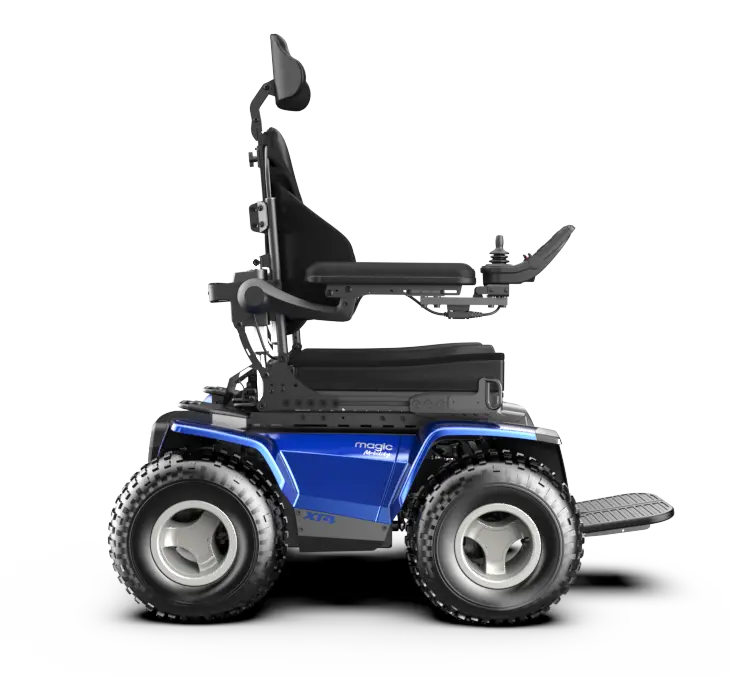
Our catalog lists two more kinds of powered off-road chair. TrackMaster Mobility's Series 1 and Series 2 are tracked chairs with dual 3.2 hp motors, 9 km/h (5.5 mph), a range of 10 miles or more, a maximum user of 136 kg and a base of up to 150 kg; the Series 1 has 4.5 in tracks for doorways and the Series 2 6.5 in tracks for open ground. Magic Mobility's Extreme X8 and XT4 are four-wheel-drive chairs on wheels, each with four 700 W motors, 10 km/h and 182 kg capacity (160 kg with powered seating), the X8 with an articulating frame and the XT4 with powered steering and suspension. None of the three has a price in our catalog; dealers quote them.
Neither is sold as a stair climber, and our sources give no curb height for any of them; ask the maker in writing what curb a model manages. Ask any dealer for a test on the ground you actually use: a farm track, a beach, a wet field.
Manual all-terrain chairs
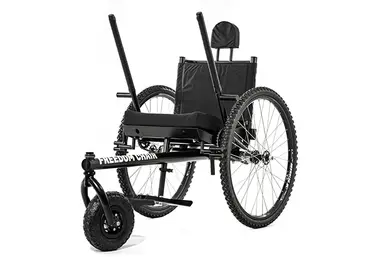
Lever-driven and big-wheel manual chairs are the lighter, cheaper end of the off-road market. The GRIT Freedom Chair 3.0 is listed at USD 2,995 on the maker's shop, the Spartan at USD 3,895 and the Pro at USD 4,395. The 3.0 weighs 46 lb assembled, its heaviest part when taken apart is 25 lb, and its weight limit is 300 lb; it rides on 26 in mountain bike wheels with a 9 in pneumatic front wheel. GRIT's page says "Engaging the levers is significantly easier than pushing the push-rims of a standard wheelchair."
One number needs care. GRIT's Pro page prints "Weight Limit: 250 lbs / 136 kg", but 250 lb is about 113 kg; 136 kg is the metric figure for the 300 lb limit of the other models. GRIT's specifications page confirms the Pro limit is 250 lb. Use 250 lb for the Pro.
| Chair | Drive | Key figures (our catalog or maker) | Guide price |
|---|---|---|---|
| GRIT Freedom Chair 3.0 | Push levers, bicycle drivetrain | 46 lb; 300 lb limit; seat 16, 18 or 20 in | USD 2,995 (maker) |
| GRIT Freedom Chair Pro | Push levers | 52 lb; 250 lb limit | USD 4,395 (maker) |
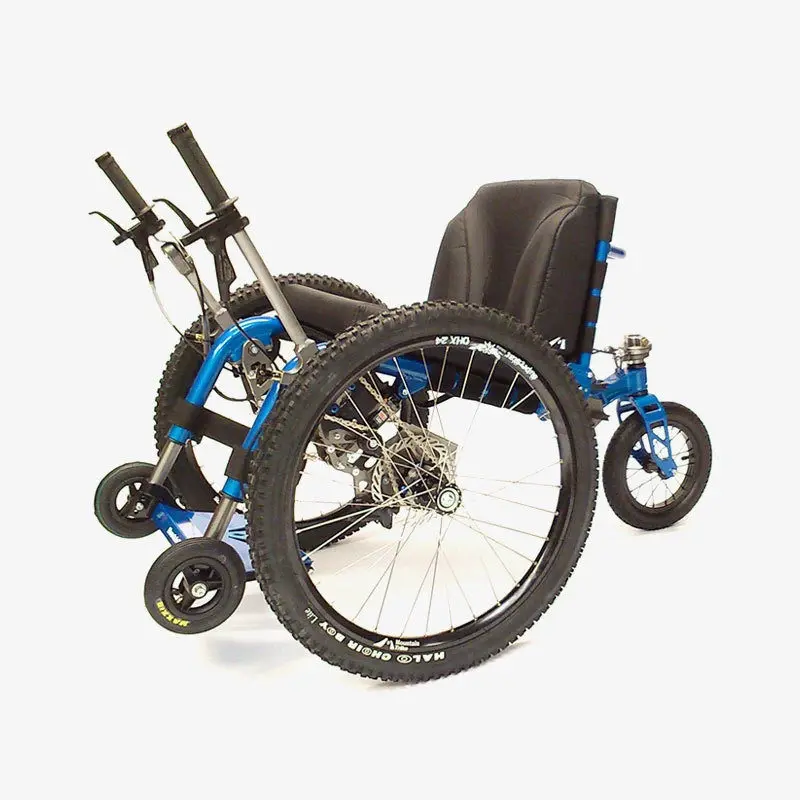
| Mountain Trike | Hand levers | A UK hire retailer gives 100 kg; the maker's page gives no figure | No price in our catalog |
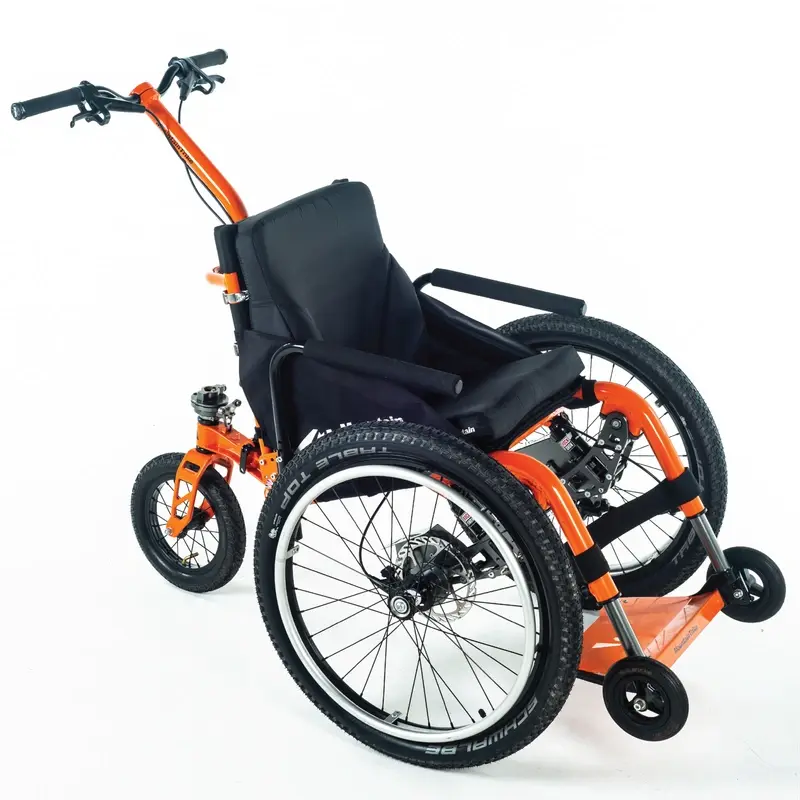
| Mountain Trike MT Push | Pushed by a companion | Folds into a cube | No price in our catalog |
| Trekinetic K2 MK3 | Large front drive wheels, gas suspension | 15 kg; max user 114 kg; 85 mm clearance | Around GBP 5,750 to 5,950 |
| Vipamat Hippocampe | Beach and all-terrain, pushed or self-propelled | 37 lb; 286 lb (US retailer figures) | Around USD 4,550 base (US retailer) |
A manual off-road chair asks for arm and shoulder strength, or a companion. Ask the therapist how it fits with the user's shoulders and skin before buying, and test it on a slope.
Which chairs climb stairs or handle rough ground?
Which wheelchairs can climb stairs or cross rough ground, and what do they cost? Mobility Atlas read the makers' pages, our own catalog and the FDA files in October 2026. For stairs, the iBOT PMD from Mobius Mobility climbs flights with the user leaning or a trained assistant holding the chair back; Mobius publishes no price. In our catalog, the Scewo BRO is listed from around EUR 35,150, the Scewo GO from around EUR 37,700 with its stair module, and the Caterwil GTS5 at around USD 15,045. Attendant climbers such as the Alber scalamobil fit a manual chair and need a helper. For rough ground, Trackchair's tracked models are listed from USD 13,775 to USD 27,585 plus shipping, Magic Mobility's 4x4 chairs are priced by dealers, and the GRIT Freedom Chair, a lever-driven manual chair, starts at USD 2,995. Tracked and 4x4 chairs are sold for rough ground, not as stair climbers. The choice belongs with the user's physician and therapist.
What these chairs cost in 2026
| Chair | Type | Price as listed | Where the price comes from |
|---|---|---|---|
| iBOT PMD | Stair-climbing power chair | Not published | Mobius: quotes follow a clinical evaluation |
| Caterwil GTS5 | Stair-climbing on tracks | Around USD 15,045 base | Our catalog (maker site) |
| Scewo GO | Power chair, stair module optional | Around EUR 18,500; EUR 37,700 with stairs | Our catalog (maker site) |
| Scewo BRO | Self-balancing, stair-climbing | From around EUR 35,150 | Our catalog (maker site) |
| Trackchair ST to FALCON | Tracked off-road | USD 13,775 to 27,585 plus shipping | Maker site |
| GRIT Freedom Chair | Lever-drive manual | USD 2,995 to 4,395 | Maker site |
| Vipamat Hippocampe | Beach and all-terrain manual | Around USD 4,550 base | Our catalog (US retailer) |
| Trekinetic K2 MK3 | All-terrain manual | Around GBP 5,750 to 5,950 | Our catalog (maker site) |
Asked whether the cost is lower for a client who will not use Stair mode, the Mobius FAQ says "quoting will be adjusted according to the clinical evaluation," so the price of an iBOT depends on what is prescribed. For every chair, ask for a written quote that names the seating, the controls, the batteries, delivery, set-up, training for the user and helpers, and servicing. If you would like us to find a model or ask for a quote, send us an enquiry with the user's measurements, the stairs or ground you need to cross, and your country.
Who pays for a stair-climbing or off-road chair?
Who pays for an iBOT or another stair-climbing wheelchair in the US? Mobility Atlas read the makers' pages in October 2026, and only Mobius Mobility says anything specific about funding. Its funding page says the chair "is coded for Medicare and Mobius Mobility is a Medicare Participating Provider," and that Mobius can bill Medicare for eligible people. That is the maker's statement; we found no Medicare document in our sources that names the iBOT, so confirm coverage with Medicare or your plan before you order. For veterans, the Mobius FAQ says the cost "is completely covered by the VA for qualified veterans under Federal Supply Schedule contract #36F79721D0202." Both start with a physician's prescription and a clinical evaluation. We found no funding information on the Trackchair, GRIT, Scewo or Caterwil pages we read. Private insurers, Medicaid and state programs set their own rules; ask each in writing. Outside the US, ask your national health service, insurer or disability program.
Other ways to pay, and what to ask
- Ask the physician or therapist to document why stairs or rough ground matter for the person's daily life: a home with steps, a job, a farm, school, community access.
- Ask whether the funder pays for training for the user and for each assistant, and for repairs.
- Ask the maker whether a lower-cost configuration exists; Mobius says quotes follow the clinical evaluation.
- Keep every quote, letter and refusal in writing, with the date.
Rules differ by country, insurer and program. Confirm with the funder before you order, and do not take a seller's word for what a public program will pay.
Transport, docking and getting it into a car
Powered stair-climbing and off-road chairs are heavy. Mobius gives a powerbase weight of 178 lb on its specification page, not counting the seat, and about 175 lb on its clinicians' page. Remote mode lets the empty iBOT climb up to a 20-degree slope onto portable ramps into a vehicle. For riding in a vehicle, the specification page lists a 4-point tie down and EZ Lock docking. Trackchairs weigh around 400 to 507 lb by the maker's figures, and the maker sells a carrier for USD 900. A GRIT Freedom Chair comes apart into pieces of 25 lb or less.
One Mobius report describes a user whose chair slid off a wet, muddy wheelchair lift on a pickup truck: "The lift was wet and the chair slid off of it," the user told the maker. If the chair travels on a lift or a ramp, keep the platform clean and dry and follow the lift maker's instructions.
Range, batteries and weather
Ranges quoted by makers are for good conditions. Mobius lists 14 miles in Standard, 13 in 4-Wheel and 18 in Balance, and says range "will be reduced when driving on slopes, rough ground, or frequently climbing curbs." Trackchair lists up to 7 miles on two 12 V batteries.
On weather, Mobius says the chair's "sealed electronics, batteries, and motors mean your travels don't need to stop just because of a little rain or standing water." Its manual, as Mobius quotes it in a report, also warns "never transition into, or drive in balance mode on wet, uneven, unstable or slippery surfaces." Wet grass, rain on a step and mud appear again and again in the reports. For charging and battery care, see our power wheelchair battery guide.
Choosing between stairs, terrain and something else
| Your main barrier | Options to discuss | Ask first |
|---|---|---|
| A flight of stairs at home, used every day | Stairlift or platform lift; stair-climbing chair | Can the user climb solo, or will a helper always be there? |
| A few steps at the entrance | Ramp; platform lift; attendant climber | What is the rise, and is there room for a ramp? |
| Curbs and broken pavement | A power chair with good curb climbing; iBOT 4-Wheel mode | What curb height does the chair manage, in writing? |
| Fields, trails, beaches, snow | Tracked or 4x4 power chair; lever-drive manual chair | Where will it be stored and charged, and how will it travel? |
| Stairs in other people's buildings | Stair-climbing chair; attendant climber | Who helps, and are they trained? |
Many people end up with two solutions: a lift or ramp at home, and a chair for the outdoors. Our electric wheelchair guide covers everyday power chairs. A seating assessment by a therapist or seating specialist always comes first.
How Mobility Atlas read the FDA reports
The FDA collects reports about medical devices in a database called MAUDE. Makers, importers and user facilities such as hospitals are "mandatory reporters"; patients, families and clinicians can report voluntarily. Stair-climbing wheelchairs have their own product code, IMK ("Wheelchair, Stair Climbing"). We read every report with a description filed under IMK, at any date up to the latest openFDA update read on 18 October 2026, as part of a study that also covered powered exoskeletons and powered arm prostheses: 161 reports in all. All-terrain chairs have no code of their own, so we added every report already read for our earlier studies of manual wheelchairs (2019 to 2026) and power wheelchairs (2024 to 2026) whose text names an all-terrain, off-road, beach, tracked or trail chair.
Before reading a single report, we wrote a codebook: the device; what went wrong first, from a fixed list in order of precedence (a fall or tip with a device fault alleged, battery or power, control or software, motor or drive, structure, skin or fit, use or training with no fault alleged, a problem not described, no device problem); flags for injury and for a fall; the setting; and what the maker found. The codebook was fingerprinted with a time stamp before coding began.
Two independent coders then read every report separately, without seeing each other's answers. The coders were AI language models working separately; the method page says exactly how. They agreed on the device in 99.4 percent of reports (kappa 0.990), on what went wrong in 88.8 percent (kappa 0.859), on injury in 100 percent, on a fall in 98.8 percent (kappa 0.974), on the setting in 90.1 percent (kappa 0.843) and on the maker's finding in 97.5 percent (kappa 0.954). Kappa is a standard measure of agreement beyond chance, and these are high. We settled the 40 reports where they differed under written rules, then ran a consistency pass that changed 18 more whose agreed codes broke one of those rules, and counted the results by script. Where we give a count from a word search, it runs over the description of the event, not over the maker's later follow-up notes. One more IMK report, a Mobius Mobility injury report received in September 2026, had no description and could not be coded. 81 reports are about a stair-climbing chair and one about an all-terrain chair.
What the 81 reports show: the big picture
All 81 stair-climbing reports were filed under IMK between April 2004 and September 2026. 55 name Independence Technology, the maker of the earlier iBOT 3000 and 4000, and 23 name Mobius Mobility, the maker of today's iBOT PMD; 3 name a different stair product. 71 describe an injury and 56 a fall, and none was filed as a death. The table sorts the reports by what went wrong first, as the report tells it.
| What went wrong first | Reports | With injury | With a fall |
|---|---|---|---|
| Fall or injury in use, no device fault alleged | 46 | 43 | 38 |
| Fall or tip with a device fault alleged | 17 | 16 | 17 |
| Control, joystick or unexpected movement | 4 | 4 | 0 |
| Skin or fit | 4 | 4 | 0 |
| No device problem described (struck by a vehicle) | 4 | 4 | 1 |
| Battery, charger or power | 3 | 0 | 0 |
| Motor, drive or track | 2 | 0 | 0 |
| Structure | 1 | 0 | 0 |
By a word search of the event descriptions, 27 reports use the word stair (one only in a product name), 24 of them with an injury; 18 mention balance, 9 a skin injury such as a bruise, abrasion or pressure sore, 8 a tip, 4 a therapist or clinician, 4 a curb and 3 a battery. A word search for "fractur" finds 13, but it misses the many reports that say a bone was "broken", so the true number of broken bones is higher. The reports were filed as "Other" in 46 reports, "Injury" in 27 and "Malfunction" in 7, with one not stated. 71 place the event at home or in the community, one in a clinic, and 9 are unclear.
What these reports cannot tell you
The FDA's own page on the database says "MDR data is not intended to be used either to evaluate rates of adverse events," nor to compare devices or track changes over time. A report is what a maker, user or clinician chose to tell the FDA. It does not show how many chairs are in use, how many stair climbs go well, or whether a chair is safer than a stairlift or a carried transfer. The FDA page adds that the submission of a report "does not necessarily demonstrate that the device caused or contributed to the adverse outcome or event."
The iBOT reports have a feature that most device reports lack: the chair keeps electronic logs, and the maker's follow-up often quotes them. That makes the maker's view of each event unusually detailed, but it is still the maker's view. Where a user and the logs disagree, we say so.
Falls on the stairs
More of the reports describe a fall during a stair climb than any other single situation. Reading all 81, we count 23 that describe a fall during a stair climb, solo or assisted, and 22 of them describe an injury; by a word search, 21 of the 23 describe going down. Two more describe the chair pitching forward on the stairs without the user falling. Many describe the last step or two, often with a forward fall. A user's child reported that the user was going down to a basement alone with a handrail when "the user's grip on the handrail slipped, and the device and user fell forward." In a 2012 report, a user who could not lean back properly because of an arm injury said "the chair moved out from underneath him and proceeded to descend the stairs on its own"; the user held on to the railing and was not hurt. In 2026, two Mobius reports describe solo users who fell while descending: one when a railing cap came off in the user's hand, the other after the user slid forward in the seat.
The fractures in these reports are not small: a broken femur, broken ribs, a fractured knee cap, a broken knee needing surgery. Several users found out about a fracture only later. A 2026 report says the user at first did not think they were injured, which the report puts down to their existing paralysis, and was diagnosed with a fractured femur and three fractured ribs after seeking care about an hour later.
The cluster safety lock, explained
Many stair reports mention a "cluster safety lock". Mobius explains it in a 2025 report: "A cluster safety lock is when the device stops cluster rotation upon detection of loss of pitch control by the user or assistant during stair climbing or descending." It is meant to stop the chair in a risky moment so the user or assistant can correct the lean. The same report goes on: "If the pitch is not corrected in a timely manner the device can fall forward."
An Independence Technology report from 2006 describes the trained response: "to wait and allow the device to return to a neutral position on the stairs." The maker's logs in a 2007 report show the cluster rotation reaching "as high as 219 degrees per second" when a user did not lean back enough going down, before the chair pitched forward. In most of the stair reports, the maker's conclusion is that the lock did its job and the pitch was not corrected in time. Either way, on the stairs the chair depends on the person controlling the lean, every step.
The assistant on the stairs
Assisted climbs put the helper at risk too. In a 2025 report, an iBOT tipped forward after three stairs, and the assistant "went over the top of the wheelchair and landed on her shoulder and head"; the assistant was hospitalized with broken ribs, a broken clavicle, two fractured vertebrae and a concussion. In 2023 a user started Stair mode on level ground and had their spouse pull back, hoping to even out tire wear; the chair fell backward onto the spouse, who broke a pelvis. Mobius wrote that "the device does not balance itself during stair climbing," quoting its manual.
Several assisted falls happened with trained assistants: one 2007 report says the user was "using a trained assistant", and a 2022 report says the assistant had passed Mobius's assisted stair training. Other reports describe a family member with a sore back after a chair fell on them on a single porch step, a mother and user who both hit a wall where the stairs turned, and a therapist who hurt a hand during training. One assistant told the maker "she probably just lost focus for a minute and didn't push down on the assist handle to slow the rotation," as the 2007 report puts it. A 2025 report describes an assisted descent after six months without using Stair mode.
The lap belt
Many of the stair and curb reports say the person came out of the chair, and several add a line such as "the user was not wearing the provided lap belt," a phrase that recurs across the Independence Technology reports from 2006 onward. In a 2007 report a user fell out of the chair and down the stairs, and the maker's notes say "it is believed that this contributed to falling from the device." A 2026 report says the user appears either not to have been wearing a lap belt "or was wearing it very loosely," which, Mobius wrote, likely contributed to the user sliding forward.
The belt is not a cure-all. One user developed a pressure sore under a lap belt that was too tight; another report describes a user who was belted and still broke an ankle on the last step. Fit the belt with the therapist so it holds the pelvis without pressing on the skin, and wear it on every climb and every curb.
Balance mode, curbs and slippery ground
Away from stairs, many falls in the reports happen in Balance or 4-Wheel mode on uneven or slippery ground. By a word search, 18 reports mention balance and 4 a curb. Users describe a chair that slipped on wet grass, a wet step or mud, a loose rug, a curb taken at an angle, or a wheel caught on something on a cruise ship. One user reported that, climbing a curb in 4-Wheel function onto slick grass, "one tire grabbed and the other tire slipped," and the chair spun and fell sideways; the maker noted that its labelling calls "slipper/wet obstacles" unacceptable surfaces for 4-Wheel function, as the report spells it.
In 2024 a user drove over loose artificial turf carpet on a ramp in Balance mode; the wheels slipped, the chair made "a rapid auto transition to maintain stability and prevent more serious issues," and the user had a compression fracture of a vertebra. Mobius noted that, per the manual, "the ibot should not be used on any loose floor coverings, including loose rugs." Two 2021 reports describe users who used the forced power off in Balance mode, one by confusing it with the normal power-off request; both chairs tipped over, one user broke a toe and the other sprained both ankles.
Two Mobius reports from 2024 and 2025 describe tip-overs going off a curb in 4-Wheel mode, one with the user distracted by a car, the other carrying a glass. All four curb reports involved 4-Wheel mode; in three the chair tipped over, and in the fourth the chair stopped suddenly after going down a wet curb and threw the user, who was not wearing the lap belt. The manual, as the 2024 report quotes it, says: "approach obstacles straight on at slow, steady speed." The iBOT 4000 labelling, quoted in a 2009 report, warned "never to operate the product if you have gained or lost more than 20lbs," because the chair is set to the user's center of gravity.
When the reports say the chair did something on its own
17 reports allege that the chair did something by itself and the user fell or the chair tipped: 16 describe an injury and all 17 a fall. Users describe a chair that kept rotating down the stairs, locked up on the second step, lurched, stopped suddenly, rolled down steps, auto-transitioned out of Balance mode, or shut down. A 2012 letter from a user says the chair "began to beep" in Balance mode and fell over backward within seconds; the technician who downloaded the data found "no indication what caused the failure," the user wrote. Others name a part: a sheared armrest screw, an assist handle that slid out, a broken front light caught in the moving parts.
In most of these, the maker's logs led it to a different cause, such as lost pitch control or an outside obstacle. In two it confirmed the reported failure. One is a sheared armrest screw found on a service visit; the caller was told two bolts should hold the armrest. The other is a 2025 Mobius report: a user leaning on the armrest heard a click, the chair moved as if to change mode and fell backward. The user said they did not intentionally command a mode change; Mobius wrote that "the data shows the commands were received" and that the user may have pressed the shortcuts with an elbow by accident. Mobius's investigation also "found a software issue in the recently-released software version running on this device," the report says: if a seat adjustment is commanded in a short window during a self-test, "two self-tests will interfere with each other, leading to a tip-over." The report names no software version.
Four more reports describe a joystick or control that moved the chair unexpectedly without the user falling, all with an injury: two joysticks that stuck, a chair that "moved without user input" during a demonstration and ran into a nearby wheelchair, causing a bystander to fall, and a chair that lurched backward into a therapist during training.
Feet, footplates and fit
A small group of reports describes injuries to the feet and legs while driving, not climbing. Several users' feet slipped off the footplate and the chair ran over them: one user's "foot slipped off the footplate," and the user's therapist later found the ankle broken; another user ran over their own foot for the second time. Mobius reports describe users who had changed their thigh supports or leg rests after delivery.
Four reports were coded as skin or fit: a lap belt that caused a pressure sore, sores on the seat bones after a legrest upgrade that the maker later linked to a damaged adjustment linkage, a rash on the arms reported by a user with a latex allergy (the user did not blame the chair, and the maker says the armrests contain no latex), and footrests a user said let a foot slip between the pedals and break the leg. By a word search, 9 reports mention a skin injury such as a bruise, abrasion or pressure sore. Seating, footplates, leg straps and belts are a job for the seating specialist; ask for a review after any change of parts or any fall.
Batteries and chargers
Three reports describe battery or charger problems, none with an injury: smoke "coming from the joystick" after six to seven hours on charge, a charger port with a blackened pin, and a charger that made a "popping sound" overnight followed by a burning smell. In two the maker confirmed the charger fault. In 2010 Independence Technology recalled iBOT 4000 battery packs because "a thermal breaker in the battery pack has the potential to open due to overheating and disable one third of the cells," the recall record says.
Unplug a charger that pops, smokes or smells hot, and call the maker before using it again.
Struck by vehicles
Four reports describe no fault in the chair at all: in each, the user was hit by a car or truck. One user was crossing a street, one a parking lot and one a crosswalk; the fourth report, passed on by a clinician, gives no circumstances. All four describe an injury. In a 2025 report, a semi-truck pushed a user about 15 feet into an intersection; "the device did not tip over, and the user remained in the seat," the report says.
Three reports about another stair product
Three IMK reports, filed by Stryker in 2009 and 2011, name Stryker's Stair Pro stair chair, model 6250 or 6252: a hand-carried stair chair, not a personal wheelchair and not the iBOT. One says the backrest of the stair chair was cracked, one that the chair "would not grip on bare wood floors," and one that a tread did not work to specification. None alleges an injury. They show that the IMK code is not only the iBOT, but they are too few to say anything more.
What the makers found
In 59 of the 81 reports the maker found no fault or named an outside cause, in 5 it confirmed a fault or the reported failure of a part, and in 17 it evaluated nothing or drew no conclusion. The 5 are two battery chargers, a damaged legrest adjustment linkage, a sheared armrest screw and the 2025 software issue.
The causes the makers name most often are lost pitch control on the stairs, a slippery or loose surface, an obstacle, taking a curb at an angle or too fast, a forced power off, changed seating parts, and, in single reports, an untrained assistant and one out of practice. These are the maker's readings of its own logs.
When the reports arrived
| Years | Reports | Who filed |
|---|---|---|
| 2004 to 2006 | 11 | Independence Technology (iBOT 3000 and 4000) |
| 2007 to 2009 | 31 | Independence Technology; 2 Stryker Stair Pro reports in 2009 |
| 2010 to 2014 | 16 | Independence Technology; 1 Stryker Stair Pro report in 2011; 1 voluntary report from a user in 2012 |
| 2015 to 2020 | 0 | None in the code |
| 2021 to 2024 | 11 | Mobius Mobility (iBOT PMD) |
| 2025 | 10 | Mobius Mobility |
| 2026 (to September) | 2 | Mobius Mobility, plus one 2026 Mobius report without a description |
The busiest single years were 2008 with 12 reports, 2009 with 11 and 2025 with 10. Nothing was filed under IMK from 2015 to 2020, and the reports resume with Mobius Mobility in 2021. Read the table as a record of who was selling and filing, not of risk: a gap in reports is not a gap in accidents, and the 10 reports of 2025 are one maker's filings.
All-terrain chairs: the FDA data say almost nothing
For tracked, off-road and all-terrain chairs, the reports we read say almost nothing. We did not search the whole FDA database for them: we searched the manual wheelchair reports (code IOR, 2019 to 2026) and power wheelchair reports (code ITI, 2024 to 2026) already read for our earlier studies. Under our rules, a report counted only if the chair was built or fitted for off-road, beach or all-terrain use, or ran on tracks; an ordinary manual chair ridden on gravel did not. One report, from 2020, qualified. A user of a manual chair with a freewheel attachment fitted to the footrest for off-road riding, which the maker called aftermarket and unapproved, said the bolt holding the footrest broke and the fall broke a leg. The maker found the chair had met its specifications and wrote that the user said "stand up on my footrest to reach higher heights," quoting its manual's warning to "check all clamps, screws, nuts and bolts that secure the footrest to the wheelchair frame."
One report cannot show anything about how tracked or 4x4 chairs behave. Our search covered only the manual and power wheelchair codes and years we had already read, and Trackchair's three FDA-cleared models carry clearance numbers we did not pull reports for. The absence of reports is not evidence of safety. The checks that matter on rough ground are the ones the maker's manual lists for your chair.
The recall file
We read all FDA recall records for code IMK in the openFDA file: four, all iBOT.
| Recall | Started | Product | Reason, as the record states it | Quantity |
|---|---|---|---|---|
| Z-1383-04 | July 2004 | iBOT 3000 | May tip over due to malfunction in power base | 81 chairs |
| Z-0022-05 | August 2004 | iBOT 3000 | Rocks and debris can enter the wheel cluster housing through a damaged wheel cap | 81 chairs |
| Z-1775-2010 | February 2010 | iBOT 4000 battery pack | Thermal breaker may open from overheating and disable a third of the cells | 192 devices |
| Z-1965-2025 | April 2025 | iBOT PMD, software 01.05.24 | Software issue that could lead to tipping over from Balance Mode | 442 units |
The first three are terminated; the 2025 recall was still listed as "Open, Classified" when we read it. The 2004 records describe the iBOT 3000 as a "Class III restricted medical device." If you own an iBOT PMD, ask Mobius Mobility in writing which software version your chair runs and whether the correction was done.
How the FDA classes stair-climbing wheelchairs
Since April 2014, stair-climbing wheelchairs are Class II devices with special controls under 21 CFR 890.3890. The rule says such a device "is intended to climb stairs," and the special controls require, among other things, fatigue and impact testing, stability on slopes forward, backward and sideways, a "demonstration of the ability of the device to safely ascend and descend obstacles (i.e., stairs, curb)," software validation, battery safety and usability studies in the intended use environment with user training.
The rule also says what the labelling must hold, which gives buyers a checklist. Patient labelling must describe prohibited environments, preventive maintenance, weight limits, width and clearance, and "a detailed summary of the device-related adverse events and how to report any complications." Clinician labelling must add who can operate the device and how to fit it. openFDA's classification record for IMK lists the 510(k) clearances K243442, K210920 and K172601 and the premarket approvals P020033 and P900050; the record does not name the holders. Ask to see the labelling before you decide.
What the FDA reports add up to
What do FDA reports show about stair-climbing wheelchairs? Mobility Atlas had two independent AI coders read all 81 FDA reports with a description filed under the stair-climbing wheelchair code from 2004 to September 2026, 78 of them about the iBOT. 71 describe an injury and 56 a fall; none was filed as a death. 46 describe a fall or injury in use with no device fault alleged, many of them stair descents where the user or assistant lost control of the chair's lean and it pitched forward. Reading them, 23 describe a fall during a stair climb. 17 allege the chair did something on its own; the maker confirmed the failure in two, one a 2025 software issue that led to a tip-over. Many falls involved a missing lap belt or lost control of the lean, including by trained assistants, and assistants were injured too. Reports are not rates, and among the wheelchair reports we had already read, only one concerns an all-terrain chair.
Habits the reports point to
- Fasten the lap belt for every climb, curb and slope.
- Avoid wet grass, loose rugs, mud and slippery surfaces where you can. The manual, as reports quote it, warns against Balance mode on "wet, uneven, unstable or slippery surfaces," says the iBOT "should not be used on any loose floor coverings, including loose rugs," and says to "be aware of the surfaces to avoid wet, icy or slippery surfaces." Ask Mobius which mode, if any, it allows on the ground you use.
- Take curbs straight on and slowly, with both hands free.
- Never start Stair mode on level ground, and never use the forced power off in Balance or Stair mode.
- Test the handrail before a solo climb on stairs you do not know.
- Practise stairs regularly with the same assistant, and retrain after a long break.
- Tell the maker about weight change, new seating parts or a fall, and let them check the chair.
- On rough ground in any chair, check bolts, footrests and tracks before the ride, and carry a phone.
A check before every stair climb
| Check | Why | If it fails |
|---|---|---|
| Lap belt on and snug | Several falls describe a user thrown from the chair | Do not climb |
| Assist handle latched | A handle that is not latched can slide out | Refit it fully before the climb |
| Handrail firm along the whole flight | Solo climbs rely on the rail | Use an assistant or another route |
| Steps dry, even and within the chair's limit | Wet and over-height steps appear in falls | Wait, dry them, or avoid |
| Clear landing at the bottom | Falls cluster on the last step | Clear it, or do not descend |
| User and assistant rested and focused | Lost focus appears in the reports | Wait |
| No warning icon or service code on the screen | A chair with a code may limit its modes | Call the maker first |
When to report a problem to the FDA
In the US, anyone can report a problem with a medical device to the FDA through MedWatch: online at https://www.accessdata.fda.gov/scripts/medwatch, or by calling 800-332-1088 for a form to mail or fax to 800-332-0178, as an FDA recall notice explains. Report falls and injuries, a chair that moved or shut down by itself, smoke or heat from a charger, and parts that broke. Tell the maker too; makers are "mandatory reporters" to the FDA, and for chairs with logs, the sooner the maker reads the data, the more it shows. One 2007 report notes that the file was retrieved a month late, and only a single alarm was left. Outside the US, report to your national medicines and devices regulator and tell the maker.
Keep the chair as it is if you can, photograph the scene and the screen, and write down what happened, which mode the chair was in, and who was helping.
Three composite scenarios
These are composite scenarios, not individual customers. Each one combines facts and ranges already given in this guide to show how the decision plays out.
Scenario one: a power chair user whose home has a flight of stairs asks about an iBOT. The physician writes a prescription and the therapist checks the clinician FAQ points: weight within 50 to 300 lb, no seizure risk, bone health. They measure every step against the limits Mobius gives in writing, replace a loose handrail, and train the user's partner as the assistant. They agree to practise the stairs every week and to fasten the belt every time.
Scenario two: a user who lives on a farm compares a Trackchair ST at USD 13,775 plus shipping with a GRIT Freedom Chair 3.0 at USD 2,995. The therapist is worried about the user's shoulders on long lever rides. They choose the tracked chair for the fields, add the USD 900 carrier for the truck, and keep the everyday power chair for the house.
Scenario three: a family in a building with stairs and no lift looks at stair-climbing chairs and at an attendant climber for the user's manual chair. The user weighs well under the 140 kg limit of the Alber scalamobil, a family member can train as the helper, and the user does not need to climb alone. They ask the dealer for a trial and read our stairlift guide before deciding.
Questions to ask before you choose
- For the physician and therapist: can I control the chair's lean on stairs alone, or do I need an assistant every time? Is my bone health safe for jolts, curbs and transitions?
- What step height, stair angle, landing length and curb height does this chair manage, in writing?
- Who trains me and each assistant, how long does it take, and what does a refresher cost?
- What weight change or seating change means the chair must be reset?
- Which software version does the chair run, and how are updates and recalls handled?
- What does the quote include: seating, batteries, delivery, training, servicing?
- Who services the chair where I live, and how fast?
Choose with the physician, physical or occupational therapist and seating specialist who know the user's body, home and routes. They decide whether a stair-climbing or off-road chair is safe for this person; a seller cannot.
Your plan: 10 minutes, today, this week
In 10 minutes: if you own an iBOT, check the lap belt and the assist handle latch, and ask Mobius which software version the chair runs.
Today: walk your stairs and routes, and note step heights, the handrail, landings, curbs and slippery spots.
This week: book a refresher for the user and every assistant, and ask the maker or dealer the questions above in writing.
Sources and documents
Reports, recalls and classification records come from openFDA; rules from 21 CFR 890.3890; specifications, prices and funding statements from the makers' pages and our own catalog. Every source is linked in the list at the end of this page.
Related guides on Mobility Atlas: Stairlifts and platform lifts; Electric wheelchairs; Power wheelchair batteries; Wheelchair ramps; Exoskeletons.
Method in brief: we coded the 161 reports in the pool using a codebook written and fingerprinted before coding, with two independent coders (agreement on what went wrong 88.8 percent, kappa 0.859; on the device 99.4 percent, kappa 0.990), settled the 40 reports where they differed under written rules, changed 18 more in a consistency pass, and counted the results by script. The two coders were AI language models working separately, each without access to the other's answers. MAUDE reports are filed by makers and, voluntarily, by users and clinicians; they can be late, incomplete or duplicated, and they are not rates. Quotes from reports are shown in sentence case; the FDA publishes most of them in upper case. The codebook, the method and the coded table are on the data and method page under CC BY 4.0.
Prices checked October 2026 on the makers' sites (Trackchair, GRIT) and in our catalog; prices change, so confirm them with the seller. Documents checked October 2026: FDA reports, recall records and classification records, the federal rule, and the makers' pages.
Use a stair-climbing or off-road chair, or decided against one? Send us a note through the enquiry form with the model and what happened; we use readers' notes when we update the guide.
This article is general information. Rules and prices differ by country and change, so confirm them before you buy or travel.
Common questions
How much does an iBOT wheelchair cost?
Mobius Mobility publishes no price. Its FAQ says the quote is adjusted according to the clinical evaluation, for example a lower cost if the client will not use Stair mode. Ask for a written quote that includes seating, training and servicing.
Does Medicare pay for the iBOT?
Mobius Mobility's funding page says the iBOT PMD is coded for Medicare, that Mobius is a Medicare Participating Provider and can bill Medicare for eligible people. That is the maker's statement; confirm coverage with Medicare or your plan before ordering.
Does the VA pay for a stair-climbing wheelchair?
Mobius says the iBOT PMD is completely covered by the VA for qualified veterans under Federal Supply Schedule contract 36F79721D0202, and that demo chairs are at select VA spinal cord injury centers. Ask your VA clinic.
Can a tracked or all-terrain wheelchair climb stairs?
The tracked and 4x4 chairs in this guide are sold for rough ground, not as stair climbers; ask the maker in writing what curb height a model manages. Stair-climbing chairs such as the iBOT, Scewo BRO, Scewo GO with its module and Caterwil GTS5 are a separate group.
How much does a Trackchair cost?
Trackchair's site listed models from USD 13,775 for the ST to USD 27,585 for the Trackstander FALCON in October 2026, plus shipping and delivery. Options such as an attendant control or a carrier cost extra.
Is a stair-climbing wheelchair safe?
FDA reports cannot give a rate. Of 81 reports on stair-climbing chairs, more describe a fall during a stair climb than any other single situation (23), when the user or assistant lost control of the lean, sometimes without a lap belt. Training, practice, a firm handrail and the belt matter; a clinician decides whether it suits the person.
Sources
- eCFR: 21 CFR 890.3890, Stair-climbing wheelchair
- openFDA: device classification record, product code IMK
- FDA: About the MAUDE database and the limits of device reports
- openFDA: device adverse event endpoint (data used for this study)
- openFDA: device recall records including product code IMK
- Mobius Mobility: iBOT PMD technical specifications
- Mobius Mobility: iBOT PMD FAQ
- Mobius Mobility: funding (Medicare and VA statements)
- Mobius Mobility: for clinicians
- Trackchair: models and list prices (read October 2026)
- GRIT: Freedom Chair 3.0 (price read October 2026)
- GRIT: Freedom Chair specifications
- Scewo: prices
- Caterwil: GTS5 stair-climbing wheelchair
- FDA: SmartDrive recall notice, with how to report to MedWatch
Read on 18 October 2026. The wording of the article is our own.
Data and method for this guide: the codebook, the coded reports and the list of documents, free to reuse under CC BY 4.0.