Patient lifts and slings in 2026: types, prices, Medicare and what 955 FDA reports show
Types, prices and Medicare rules for patient lifts and slings, and what two AI coders found in 955 FDA reports about sling falls, bars and drops.
Contents
- Stop and check before the next transfer
- The short answer
- The parts of a patient lift, named
- Five kinds of lift, and who each one suits
- Floor lift or ceiling lift: how to choose
- Bathing and toileting with a lift
- What patient lifts and slings cost in 2026
- Does Medicare pay for a patient lift?
- Choosing a sling: type, size and the match to the lift
- Reading a sling label
- Training every carer
- A transfer step by step: bed to wheelchair with a floor lift
- Weight limits and bariatric lifts
- When a full lift may not be needed
- How Mobility Atlas read 957 FDA reports
- What the reports show: the big picture
- Slings: where the most falls begin
- Hanger bars, hooks and latches
- When the lift lowers or drops by itself
- Tipping: the base, the legs and the casters
- Other parts that broke: casters, tracks, bolts and masts
- Electrical faults and the 2026 wave of reports
- Falls with no failure: the person, the sling and the move
- After a fall: getting someone up from the floor
- Pinched or struck: the bar and the boom
- The death reports, read with care
- Home or care home: what the data can and cannot tell you
- Who files these reports, and when
- The recall file: slings, straps, bars and bolts
- Battery, charging and the hand control
- A ceiling lift at home: what to ask
- Service, inspection and a used lift
- When to report a lift problem to the FDA
- Keeping a record when something goes wrong
- Three composite scenarios
- Questions to ask before you buy or rent
- Your plan: 10 minutes, today, this week
- Sources and documents
- Common questions
- Sources
Stop and check before the next transfer
Using a lift today? Run through this list first. Planning to buy or rent one? Start at the short answer below.
- A sling strap, loop, clip or seam is frayed, torn, cut, faded by bleach or stiff. Take that sling out of use today. The FDA-hosted safety guide says plainly: "DO NOT USE sling with any signs of wear."
- A clip or loop did not seat fully on the hanger bar, or came off during a lift, even once and even with no fall. Report it to whoever supplied the lift and check every attachment point before the next transfer.
- The sling is from a different maker than the lift, or nobody can say which lifts it was made for. Ask the lift's maker or supplier before you use it again.
- The lift lowered by itself, jerked, or would not stop when you let go of the button. Stop using it and call the supplier before the next transfer.
- The base legs will not open fully, a caster wobbles, or the lift has leaned or tipped. Stop using it and call the supplier before the next transfer.
- The emergency stop or emergency lowering does not work, or nobody in the home knows where it is. Stop using the lift and call the supplier before the next transfer.
Anything else that looks or sounds wrong, such as a crack, a wobble, a creak or a loose bolt, means calling the supplier before the next lift. These six need action before anyone is lifted, because they are the patterns we saw again and again in the falls, injuries and death reports.
The short answer
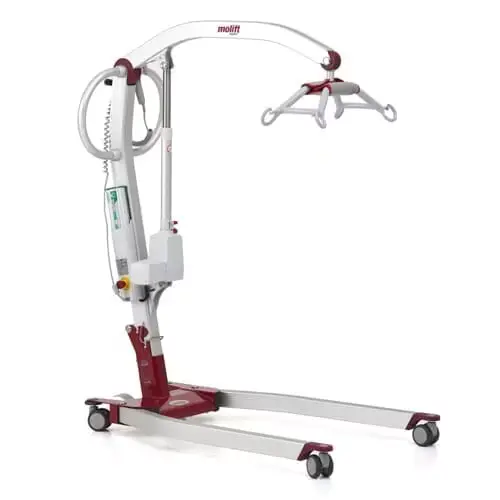
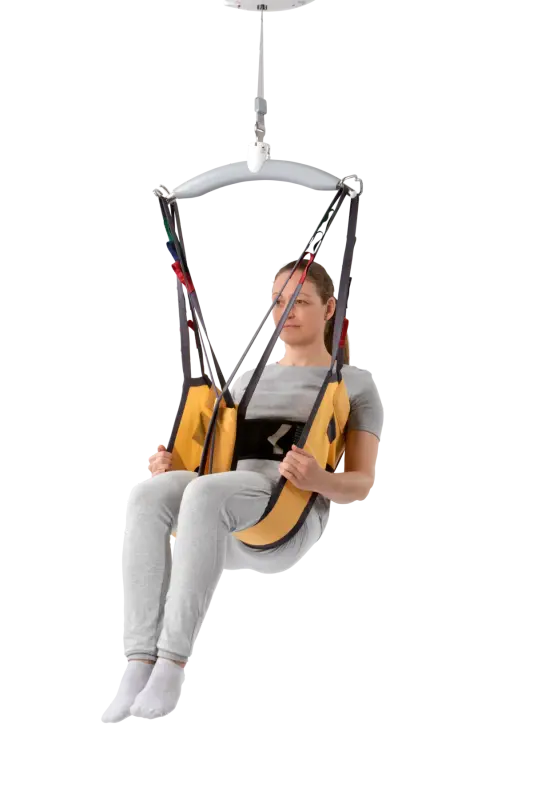
A patient lift, also called a hoist or a Hoyer lift after one of the first makers, moves a person between a bed, a chair, a wheelchair, a commode or a bath when they cannot stand to transfer, or cannot do it safely. The FDA page on patient lifts describes the parts: "a mast (the vertical bar that fits into the base), a boom (a bar that extends over the patient), a spreader bar (which hangs from the boom), a sling (attached to the spreader bar, designed to hold the patient), and a number of clips or latches (which secure the sling)." Most of the danger sits in the last three.
Prices start lower than many families expect. On Invacare's own web store a manual hydraulic lift is listed at USD 671, an electric lift at USD 2,466 and a sit-to-stand lift at USD 1,311, with slings from USD 95 to USD 164. Medicare Part B can cover a lift when transfers between bed and a chair, wheelchair or commode are needed and, without a lift, the person would be confined to bed, and a sling as part of it.
The safety part comes from something most buying guides never open: every FDA report filed under the two patient lift product codes from January 2025 to August 2026 that carries a description, 957 reports in all, each read by two independent AI coders working separately. 955 of them describe an event with a lift or a bath lift. The sling is the part named in the most fall reports: 161 reports are about a sling, a strap, a loop or a clip, and 115 of those describe the person falling or being dropped. Most of the slings involved were not found to be faulty: the maker found no device fault, or put the cause outside the device, in 91 of the 161.
None of this means lifts are unsafe. The FDA page says lifts bring "reduced risk of injury to patients and caregivers when properly used." It means the dangerous moments are few and specific, and many of them can be checked in a minute before the person leaves the bed.
How to read the evidence: every quote below names the report, recall or document it comes from, and every count comes from the coded table published on the data and method page. Prices are list prices as read on makers' and retailers' pages, never offers.
The parts of a patient lift, named
| Part | What it does | What goes wrong in the reports |
|---|---|---|
| Base and legs | Carries the lift; the legs open wide for stability | Legs that will not open or lock, casters that come loose, tipping |
| Mast | The upright that holds the boom | Cracks, loose bolts, bending |
| Boom | The arm that reaches over the person | Pivot bolts working loose, the boom striking the person |
| Actuator or hydraulic pump | Raises and lowers the boom | Lowering by itself, sudden drops, no lift |
| Spreader bar (also called hanger bar or sling bar) | Hangs from the boom; the sling attaches to it | Breaking, hooks snapping, latches opening |
| Sling | Holds the person | Straps tearing, loops or clips coming off, the person sliding out |
| Clips, loops and latches | Join the sling to the bar | Not fully seated, detaching mid-lift |
| Hand control, battery and emergency lowering | Run an electric lift and get the person down if it fails | No movement, buttons that stick, emergency lowering that does not work |
Hydraulic or electric
Manual lifts are worked with a pump handle and a release valve. The FDA page says "the manual models are operated using hydraulics" while "the powered models generally require the use of a rechargeable battery." A hydraulic lift costs less and has no battery to fail, but it needs a strong carer and a steady release. An electric lift is easier on the carer's back and gives a smoother ride; it needs charging and an emergency lowering function that everyone knows how to use.
How the FDA classes them
The FDA puts lifts in two groups. A lift that runs from mains power falls under 21 CFR 880.5500 and is Class II, which the rule describes as an "electrically powered device either fixed or mobile used to lift and transport patients." A "hydraulic, battery, or mechanically powered" lift falls under 21 CFR 880.5510 and is Class I, the lowest risk class. Most battery-powered electric lifts, like hydraulic ones, fall under 880.5510. Both groups are exempt from premarket notification, with limited exceptions, so a new lift can usually reach the market without an FDA premarket review of its design. That is one reason the maker's instructions and your own checks carry so much weight.
Five kinds of lift, and who each one suits
| Kind | How it works | Suits | Reports in our set |
|---|---|---|---|
| Floor or mobile lift | A wheeled base, a mast, a boom and a sling | Most homes; moving between rooms | 566 |
| Ceiling or overhead track lift | A motor travels on a fixed track; the sling hangs below | Daily transfers in one or two rooms; less floor space | 215 |
| Sit-to-stand lift | The person holds on and bears some weight; a belt or sling supports the back | People who can bear weight and sit up | 77 |
| Bath or shower lift, bath chair | Lowers into a bath or rolls into a shower | Bathing; often in care homes | 39 |
| Other or not stated | Portable or folding lifts, pool hoists, or the report does not say | Travel, pools | 58 |
The counts in the last column are reports, not sales, and say nothing about which kind is safer. Floor lifts are probably the most widely used kind, so they are also the commonest in the reports.
Floor lifts
A floor lift is the usual first lift at home. It rolls on four casters, the legs open to go around a chair, and it can be moved between rooms, though not easily over thick carpet or thresholds. The Mobility Atlas catalog lists a portable example, the Molift Smart 150, which splits into two parts of about 28 lb each for travel.
Ceiling lifts
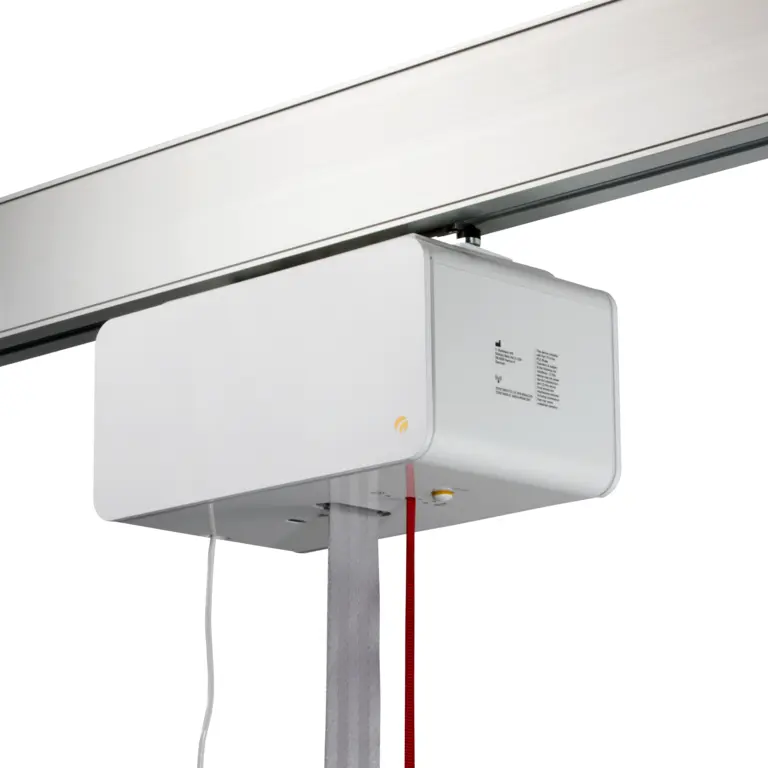
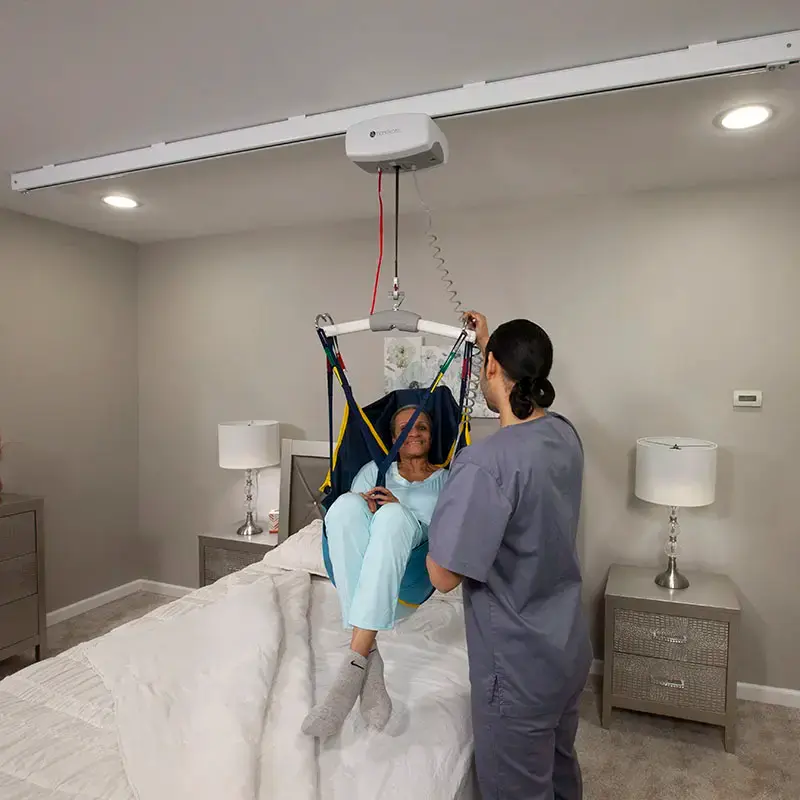
A ceiling lift runs on a track fixed to the ceiling or on a free-standing frame. It takes no floor space and needs less pushing, which is why care homes use them. In the reports, ceiling lifts most often appear with a part that broke or came loose (56 reports), an electrical fault (54) or the lift lowering by itself (34). The catalog lists the Guldmann GH3 and the Savaria C-450, a fixed ceiling lift with emergency power lowering.
Sit-to-stand lifts
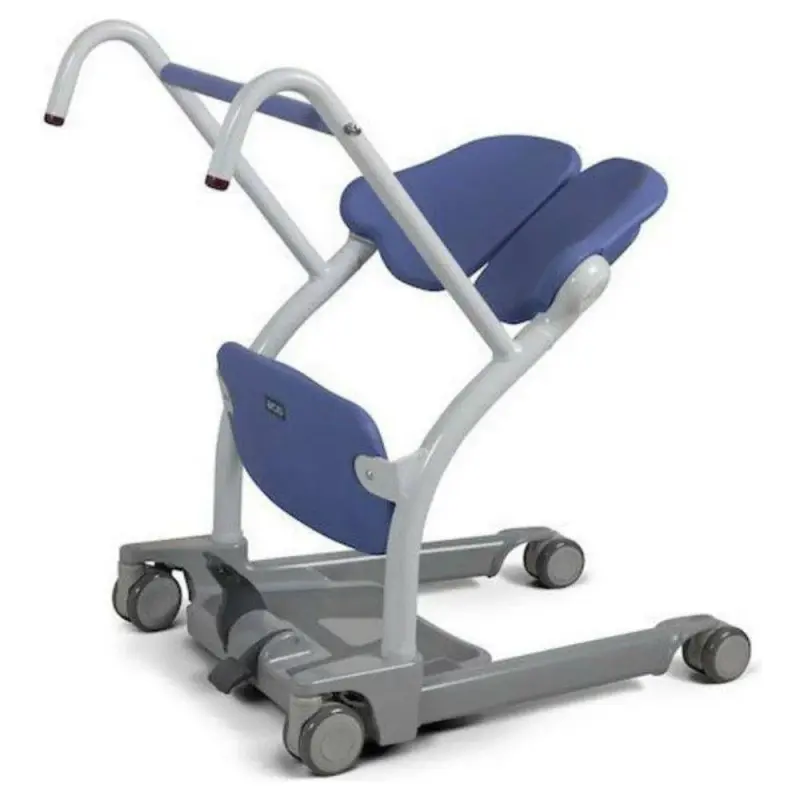
A sit-to-stand lift, or stand aid, works only for someone who can hold on, bear some weight through the legs and follow instructions. In the reports these lifts most often appear with a fall but no device failure named (25 of 77). The catalog's Arjo Sara Stedy is a non-powered version with a safe working load of 182 kg (400 lb).
Bath lifts and bath chairs
Bath lifts and shower trolleys appear in fewer reports, mostly with a broken part (19 of 39) or a fall without a failure (11). Medicare treats them differently, as the funding section explains.
Floor lift or ceiling lift: how to choose
| Question | Floor lift | Ceiling lift |
|---|---|---|
| Space | Needs floor space to turn and room under the bed for the legs | Takes no floor space; needs a ceiling or frame that can carry the load |
| Rooms | Rolls between rooms, though not easily over carpet or thresholds | Covers the rooms the track reaches |
| Effort for the carer | Pushing and steering a loaded lift | Little pushing; the motor or a light pull moves the person |
| Building work | None | A track fixed to joists or a frame; installation is in Medicare's payment for the lift, structural work is not covered |
| Travel | Folding models exist | Stays in the home; portable frames exist |
| Listed price | From USD 671 for a hydraulic model on Invacare's store | Higher; depends on the track and installation |
Most families start with a floor lift because it needs no building work and Medicare covers it under the same test as other lifts. A ceiling lift makes sense when transfers happen many times a day in the same room, when the carer's back is the limit, or when there is no space to turn a floor lift. Ask the therapist to look at the actual rooms, the bed height and the door widths before you decide.
Bathing and toileting with a lift
Bathing is where lifts and slings meet water, soap and wet floors, and where funding is thinnest. Medicare does not pay for bath or toilet lifts, so many families use a mesh or bathing sling with an ordinary floor or ceiling lift instead. Wet slings and bathing slings need the same check before every use as any other sling.
In our data, the 39 reports about bath lifts, bath chairs and shower trolleys most often describe a broken part (19) or a fall with no failure named (11). In one event, filed twice and reported as a death, a carer lifted a bath chair's armrest after bathing and the resident slipped to the floor and broke a hip; the report says no safety belt was used. The resident died weeks later, and the report says the link to the fall is undetermined. Use the chair's belt every time. A toileting sling leaves more of the body free, which also means less support: it suits people who can hold their trunk upright, not those who cannot.
Dry the person and the sling before moving, keep the move short, and never leave the person hanging while you fetch something. If bathing is the hardest transfer of the day, tell the therapist; there may be a better sling, a bath board, or a shower chair that removes the lift from that step.
What patient lifts and slings cost in 2026
| Item | Example | Listed price |
|---|---|---|
| Manual hydraulic lift | Invacare 9805P, 450 lb capacity | USD 671 |
| Sit-to-stand lift, hydraulic | Invacare Get-U-Up GHS350, 350 lb | USD 1,311 |
| Electric floor lift | Invacare Reliant, manual low base, 450 lb | USD 2,466 |
| Standard sling | Invacare standard sling, mesh or solid polyester | USD 95 to USD 108 |
| Full body sling | Invacare Reliant full body sling, mesh or solid | from USD 121 |
| Divided leg sling with head support | Invacare Reliant, 450 lb | USD 164 |
| Toileting or stand-assist sling | Invacare Reliant toileting or standing slings | USD 141 to USD 159 |
| Replacement sling straps | Invacare polypropylene straps, two-pack | USD 53 |
How much does a patient lift cost? Mobility Atlas checked the maker's own web store in October 2026, and the answer depends mostly on how the lift is powered. Invacare lists its 9805P manual hydraulic lift, rated for 450 lb, at USD 671. Its Get-U-Up hydraulic sit-to-stand lift is listed at USD 1,311, and its Reliant electric lift with a manual low base at USD 2,466. A sling is extra unless the lift comes with one: Invacare's own slings run from USD 95 for a standard mesh sling to USD 164 for a divided leg sling with head support, and a pair of replacement straps is USD 53. We found no listed price for an installed ceiling lift to quote; the track and fitting add to the cost. Before paying, check whether Medicare or another funder will cover the lift, because a covered lift from a supplier who accepts assignment usually leaves you paying 20 percent of the Medicare-approved amount after the Part B deductible.
These are list prices from one maker's store and are examples, not a market survey. Other makers' lifts, dealer prices, rental and used lifts will differ. A sling must also match the lift, which limits how far you can shop around for it, as the sling section explains.
Does Medicare pay for a patient lift?
Does Medicare pay for a patient lift? Mobility Atlas read the Medicare coverage rules in October 2026, and the answer is often yes, under a specific test. The local coverage determination for patient lifts says a lift "is covered if transfer between bed and a chair, wheelchair, or commode is required and, without the use of a lift, the beneficiary would be bed confined." That test applies to hydraulic and electric floor lifts and to lifts on ceiling tracks or a floor-to-ceiling pole. A sling is part of the lift: the policy article says a sling is included in the lift's allowance when both are supplied together, and a replacement sling is covered for a covered lift. Medicare's equipment page says that after the Part B deductible "you pay 20% of the Medicare-approved amount" when the supplier accepts assignment. A doctor or other provider must order it, and some equipment codes need a written order and a face-to-face visit before delivery, so ask the supplier first.
A supplier that accepts assignment agrees to take Medicare's approved amount as full payment, so you owe only the deductible and the 20 percent.
What Medicare does not pay for
- Bath and toilet lifts. The policy article says a lift for a toilet or tub (code E0625) "is non-covered; not primarily medical in nature." The national equipment list says the same of bathtub lifts.
- Building work. The policy article says "Home modifications are noncovered by Medicare." For a ceiling lift, it says "No separate payment is made for installation," because "All costs associated with installation are included in the payment for the device." Structural work to take the track counts as a home modification and is yours to pay. A ceiling or pole lift used only in a bathroom counts as a bath lift and is not covered.
- Lifts for people who do not meet the test above: Medicare denies them as not reasonable and necessary.
Multi-position transfer systems
A few devices let a person be moved lying flat and then tilted into a chair position. The coverage rule says Medicare covers them only when the basic lift test is met and the person "requires supine positioning for transfers," and adds that, for some of these systems, once one is covered, payment stops for other mobility equipment such as a wheelchair. Ask your clinician and supplier how that would affect you before choosing one.
Other funders
Medicaid programmes, Medicare Advantage plans, private insurers and veterans' programmes have their own rules. Most will want a prescription and a note from a physician, physiotherapist or occupational therapist explaining why a lift is needed. Keep a copy of every document; you may need it again when the sling wears out.
Choosing a sling: type, size and the match to the lift
The FDA page puts it simply: "No sling is suitable for use with all patient lifts." It says a sling "must be approved for use by the patient lift manufacturer" and must match the lift and the person's weight. Makers say the same. The Hoyer sling manual from Joerns says "Hoyer slings and lifters are not designed to be interchangeable with other manufacturer's products." The reason is the attachment: some lifts use loops over hooks, others use clips that snap onto a bar, and a loop or clip made for one bar may sit badly on another.
| Sling type | Used for | Watch for |
|---|---|---|
| Full body | Transfers for someone with little trunk control | Correct size; head support if needed |
| Divided leg (U-sling) | Quick transfers to and from a chair; easy to put on and remove in sitting | Leg pieces crossed or not, as the maker says; the person sliding through |
| Toileting or access | Toileting and dressing | Less support; not for people who cannot hold their trunk |
| Stand-assist or standing | Sit-to-stand lifts | The person must bear weight and hold on |
| Mesh or bathing | Showering and bathing | Check before every use, wet or dry |
| Disposable or single-patient | Hospitals, infection control | Not for repeated washing |
Size
A sling that is too large lets the person slide through the leg openings; one that is too small digs in and may not close properly. Most makers size by weight and by a measurement such as the distance from the base of the spine to the top of the head. Use the maker's sizing chart and ask the therapist who assessed the person to check the fit at the first lift.
Washing and lifespan
Slings wear with every wash. The Hoyer manual says "Slings can suffer damage during washing and drying and should be checked carefully before each use." It gives a maximum water temperature of 185 degrees Fahrenheit, says not to use bleach, and says "Bleached, torn, cut, frayed or broken slings are unsafe and must be discarded and replaced." It gives no fixed lifespan, saying that "The expected service life of a Hoyer sling will vary dependent on use." Write the date the sling was first used on its label, and look at it before every lift.
Reading a sling label
Every sling should carry a sewn-in label. It is the quickest way to answer the three questions that matter most before a lift: is this sling made for this lift, is it the right size for this person, and is it still fit to use.
- The maker and model, and the lifts or bars it is approved for. If the label names a different maker from your lift, ask before using it.
- The size, often shown by a letter and a colour-coded binding or loops.
- The safe working load. The lowest rating of the lift, the bar and the sling is the real limit.
- The washing instructions, including the maximum temperature.
- A space for the date of first use or a serial number. If there is none, write the date on a tag.
If the label is missing, faded or unreadable, treat the sling as unknown. Ask the supplier to identify it, and do not use it until they have. A sling with no label cannot be matched to the lift, and a mismatch is one of the patterns behind the falls in this guide.
Training every carer
The first item on the FDA's list of best practices is to "Receive training and understand how to operate the lift." At home, the person who was shown the lift by the supplier is often not the only person who uses it. Relatives, agency carers and night staff change, and each one needs to see the lift and the sling used on this person, not a demonstration on a colleague.
Ask the supplier or therapist for a short written sheet for your lift: which sling, which size, how it attaches, where the emergency lowering is, and the phone number for faults. Keep it with the lift. A new carer should watch one transfer and then do one under supervision before working alone.
A transfer step by step: bed to wheelchair with a floor lift
Every lift has its own instructions, and the therapist who sets up the lift should show each carer the moves on the person they will lift. The order below is the usual one for a floor lift and a full body sling; use it as a checklist to compare with your manual, not instead of it.
- Tell the person what you are about to do, and check they are calm and comfortable. The FDA's best practices say to make sure the person "is not restless or agitated."
- Put the wheelchair where the lift will end up, take off or swing away the armrest and footrests on that side if they are in the way, and lock its brakes. The FDA's list says to "Lock the wheels on any device that will receive the patient such as a wheelchair, stretcher, bed, or chair."
- Roll the person to one side, place the folded sling under them with its centre along the spine, roll them back and pull the sling through. Check that it is straight and that the head end is at the head.
- Bring the lift in with the legs open, under the bed if there is room, and lower the bar until you can reach the attachment points without stretching the straps.
- Attach the straps in the order the sling's instructions give. Check every clip or loop.
- Raise the person just clear of the bed and stop. Look at every attachment point and at how the person sits in the sling. If anything looks wrong, lower them and start again.
- Move slowly with the legs still open, steering by the mast handle, not by the person or the sling. Keep the person low and facing the mast.
- Position the person over the seat, lower them slowly while guiding the hips back into the chair, then detach the straps in the order the instructions give and remove the lift.
Taking the sling out from under a seated person is often the hardest part, and a sling left in the chair can cause pressure problems for some people. Ask the therapist whether this sling is meant to stay in place or come out, and how.
Weight limits and bariatric lifts
Every lift, every sling and every hanger bar has its own safe working load, and the lowest of them sets the limit. The FDA's best practices say to "Make sure that the weight limitations for the lift and sling are not exceeded." Invacare's 9805P and its Reliant electric lift are both listed for 450 lb, and its Get-U-Up sit-to-stand lift for 350 lb. The Hoyer Quickfit sizing table gives 500 lb for every size of that sling, but the lowest rating of the lift, the bar and the sling still sets the limit.
Bariatric lifts are built for heavier people. For Medicare, the policy article says "Heavy duty and bariatric lifts are included in the codes for patient lifts," so the same coverage test applies. Check that the sling and the bar are rated for the person too, not only the lift.
A 2024 recall shows why ratings matter. Raye's Inc. recalled 1,149 of its SW Bari Lift and Transfer units after an engineering review found that "The device cannot physically perform at maximum documented weight specifications when a factor of safety of two times the maximum load is applied." The recall was still open in our download.
When a full lift may not be needed
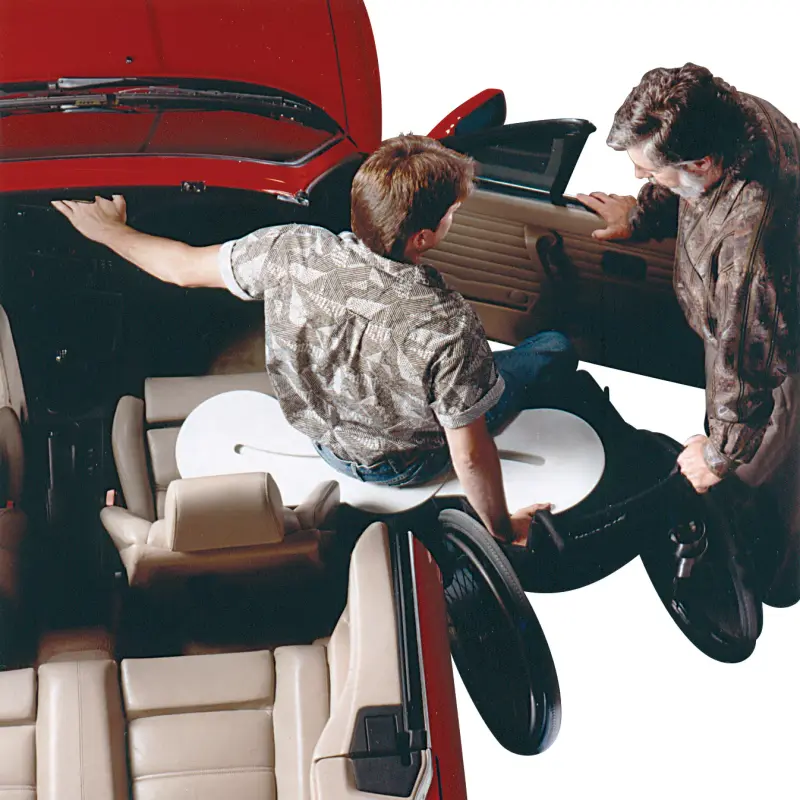
A lift is not the only way to transfer. People who can sit up and use their arms often move with a transfer board; people who can bear weight may manage with a stand aid. These options cost less and can keep a person more active, but only if they are safe for that person. The Mobility Atlas catalog lists the BeasyTrans transfer system, a board with a rotating seat rated for 400 lb, at USD 414.50 from one retailer, and the Arjo Sara Stedy non-powered stand aid.
Medicare's coverage test points the same way: a lift is covered when the person would otherwise be confined to bed. If a physiotherapist or occupational therapist thinks a simpler aid is safe, try it with them first. If the person's strength changes, ask for a new assessment rather than pushing on with an aid that no longer fits.
How Mobility Atlas read 957 FDA reports
The FDA collects reports about medical devices in a database called MAUDE. Makers must report deaths, serious injuries and some malfunctions; hospitals and nursing homes must report deaths to the FDA and serious injuries to the maker, and carers and users can report voluntarily. We downloaded every report filed under the two patient lift product codes, FSA (lifts without mains power) and FNG (mains-powered lifts), received from 1 January 2025 to the end of August 2026: 1,909 reports. Of these, 957 carry a description of what happened, and all 957 went into the study.
Before reading a single report, we wrote a codebook: ten categories for what went wrong, in a fixed order of precedence (sling, hanger bar, tipping, dropping, other structural failure, electrical and controls, contact injury, fall with no failure, no device problem, unclear), plus flags for injury and fall, the setting, and what the maker found. The codebook was fingerprinted with a time stamp before coding began, so any later change to it would show.
Two independent coders then read every report separately, without seeing each other's answers. The coders were AI language models working separately; the method page says exactly how. They agreed on the main category in 95.8 percent of reports, a kappa of 0.949; kappa is a standard measure of agreement beyond chance, and this is very high agreement. We settled the 142 reports where the coders differed on any field (40 of them on the main category) under written rules, drawn up after the disagreements were listed, changed 4 codes in a consistency pass, and counted the results by script. Two reports turned out not to be about a lift at all, which leaves 955.
The FDA warns that these reports cannot show how often a problem happens or prove that a device caused it. They are a record of what was reported, by whom, and in what words. We use them to show which kinds of events happen and how they unfold, not to rank brands.
What the reports show: the big picture
| What went wrong | Reports | With injury | With a fall |
|---|---|---|---|
| Electrical faults and controls | 296 | 14 | 4 |
| Sling, strap, loop or clip | 161 | 93 | 115 |
| Another part broke or came loose | 156 | 30 | 28 |
| Hanger bar, hook or latch | 80 | 26 | 36 |
| Fall with no failure named | 71 | 57 | 63 |
| Tipping, base or wheels | 67 | 27 | 14 |
| Lowered or dropped by itself | 66 | 14 | 31 |
| Unclear | 23 | 7 | 10 |
| No device problem stated | 19 | 15 | 3 |
| Pinched or struck, no failure | 16 | 14 | 0 |
Why do people fall from patient lifts? Mobility Atlas sorted 955 FDA reports from January 2025 to August 2026, and the answer in about half the fall reports is the sling and how it is attached, not the motor. Of 304 reports that describe the person falling or being dropped, 115 are about a sling, a strap, a loop or a clip, and 36 more about the hanger bar, a hook or a latch that holds the sling. Another 63 describe a fall with no failure named at all: the person slid out of a sling, leaned too far, or slipped through the leg openings. Lifts that lowered by themselves account for 31 falls, and tipping lifts for 14. Electrical faults are the largest group of reports, 296, yet only 4 of them describe a fall. The lesson is that the minute spent checking the sling, its size and every attachment point is the check most closely tied to the falls in these reports.
In total, 297 reports describe an injury and 304 describe a fall. Where the setting is stated, almost all are care settings: 382 reports name a hospital, a care home or care staff, and only 13 name a private home. The other 560 do not say. That matters for reading everything below, and the section on home use explains why.
Slings: where the most falls begin
Slings appear in 161 reports, and 115 of them describe a fall, more falls than any other group. The pattern repeats: a clip or loop was not fully attached, came off mid-lift, or a strap tore. By a word search, 84 of the 161 mention a clip or a loop. One report from a care facility to Arjo says "the right upper sling clip detached, causing the patient to fall to the floor." Another, to Medline, says "the sling loop came unhooked from the lift, the patient fell." A report about a ceiling lift describes a resident who "slid out of the sling and descended to the floor" after a foot clip came off.
The wrong sling for the lift
By a word search, 20 of the sling reports name a sling from another maker, or one not approved for that lift. In one Baxter report, a care home said the family had supplied "a third-party sling, that was purchased from Amazon," which "did not have the correct fittings"; the patient fell about three feet to the floor and went to hospital. The makers often reach the same conclusion: in 91 of the 161 sling reports the maker found no device fault or put the cause outside the device, such as a wrong sling, loops not attached, or a sling past its life. That is a finding about use, not a reason to relax: each of those reports is a person who fell.
A minute before every lift
- Check the label: is this sling made for this lift, and is it the right size for this person?
- Look along every strap, loop and seam for fraying, cuts, thin patches or bleach marks.
- Attach the straps in the order the sling's instructions give.
- Raise the person just clear of the bed and stop. Check that every clip or loop is fully seated and the sling sits evenly.
- Only then lift and move. Keep the move short and low.
- With a full body or divided leg sling, do not dress, undress or wash the person while they hang in it; shifting their weight can unload a clip or loop. Toileting slings and stand aids are made for this, but follow the manual and keep a second person nearby if it says so.
If you are the person being lifted, you can run this check yourself or ask your carer to say each step aloud. You will often feel a loose clip or a sling of the wrong size before anyone sees it.
The FDA's best practices add: "Keep all clips, latches, and hanger bars securely fastened during operation" and "Position the patient's arms inside the sling straps."
Hanger bars, hooks and latches
The hanger bar, also called the spreader bar or sling bar, carries the whole weight of the person through two or four points. In 80 reports this bar, a hook on it, or the latch joining it to the lift broke, opened or detached. 36 of them describe a fall. In 31 of the 80 the maker found a fault, more often than for slings. One Baxter report says "the sling bar broke and the patient sustained a hematoma on the back of their head."
A latch that looks closed
The recall file shows why a bar can fail without warning. In May 2025 Baxter recalled the Q-Link 13, a quick-release coupling used on several Liko and Viking lifts, because it "could allow for an improper attachment (false latching)" so that a bar "may initially bear weight but can loosen from the Q-link resulting in a detachment and drop." The recall covers 9,899 couplings and remained open in our download, and a linked recall covers 9,839 LikoScale scale parts with the same coupling. Smaller recalls covered hanger bars with loosening screws and broken hooks on Molift sling bars.
What to do: attach the bar exactly as the maker's instructions show, and check that the latch is fully closed. A hook that holds at first can still come loose later, so a firm tug is not proof. If your lift uses a quick-release coupling, ask the supplier whether any recall applies and whether it has been fixed.
When the lift lowers or drops by itself
In 66 reports the lift lowered, dropped or descended without being told to, or faster than it should. Almost half, 31, describe a fall, some onto a bed, a chair or a toilet, others to the floor. One report describes a ceiling lift strap that "suddenly dropped" while holding the person above a toilet. Another describes a floor lift "moving downward while transferring patient."
The newest recall in our file is about exactly this. In March 2026 Arjo recalled a batch of its Tenor mobile lifts because an actuator part "may not meet the required mechanical strength," which in the worst case could mean "rapid and uncontrolled downward movement of the lifting arm." The recall covers 119 lifts.
On any lift, hydraulic or electric, unplanned lowering or movement is a reason to stop using it until a technician has checked it. Keep the person low during the move, so that if the lift does drop, the drop is short.
Tipping: the base, the legs and the casters
A floor lift is stable when its legs are open wide and the load is centred. In 67 reports the lift tipped, nearly tipped, or its base, legs or wheels gave way; 14 describe a fall. Reports describe legs collapsing while being closed under a bed, a leg that "broke at the foot part," and a lift that tipped during a side entry.
The FDA's best practices say to "Keep the base (legs) of the patient lift in the maximum open position." The FDA-hosted safety guide adds that "Base legs are usually more stable in full open position." Close the legs only to pass through a door or under a bed, and open them again before lifting.
The Invacare caster recall
Casters matter more than they look. In 2018 Invacare recalled 73,703 of its 9805 and 9805P hydraulic lifts because the bolt holding a caster to the base could work loose. The recall notice says that "Failure does not occur right away but happens over time if the lift is not properly maintained." That recall is closed, but the lesson stands: check the caster bolts on any floor lift, new or used.
Other parts that broke: casters, tracks, bolts and masts
156 reports describe another part that broke, cracked, bent or came loose: a caster, the mast, the boom, a ceiling track, a strap housing, a bath chair seat or a stand aid's support. 28 of them describe a fall and 30 an injury. In 58 the maker found a fault, more than in any other group except electrical faults.
By a word search of these reports, 28 mention a track or rail, 21 a caster or wheel, 19 a bolt, screw, nut or pin, and 12 the mast or boom. The recall file has the same parts: Med-Mizer recalled two lift models because the nut holding the boom could work loose, and Hill-Rom recalled Liko mobile lifts over a missing bushing "causing wear and potential for patient falling."
Most of these failures give warning: a wobble, a creak, play in a joint, a caster that does not swivel. The weekly check in the service section is aimed at them.
Electrical faults and the 2026 wave of reports
Electrical faults and controls make up the largest group, 296 reports, but most describe a lift that would not raise, lower or move, a hand control or control box that failed, or a battery or charger problem. Only 14 describe an injury and 4 a fall. By a word search, 58 mention a battery, and 54 mention the emergency stop or emergency lowering.
Why one maker dominates this group
285 of the 955 reports were filed by Medline, and 191 of those are electrical. 210 of Medline's reports arrived in July and August 2026 alone, and most describe events from 2023 to 2025. Their texts explain why: a long note attached to 188 Medline reports says the report "is being submitted as part of retrospective review activities." In other words, Medline reviewed its historical records and filed reports on older events over July and August 2026.
So the jump in reports in mid-2026 says nothing about lifts suddenly getting worse. It also means counts by maker tell you more about who files reports, and how, than about whose lifts are safer. We do not rank brands in this guide for that reason.
Emergency lowering
Every electric lift should have a way to lower the person if the power fails. The FDA-hosted guide says "If power fails, use the emergency release to lower patient manually." Find it on your lift before you need it, try it with nobody in the sling, and make sure every carer in the home knows where it is.
Falls with no failure: the person, the sling and the move
71 reports describe a fall where nothing on the lift is said to have failed. 57 of them describe an injury. The person slid through the leg openings, leaned out of the sling, or slipped down through a standing belt. One report says the resident "leaned to the left side and slipped out of the sling" while two staff were with them.
Some of these reports describe a sling that was too large or felt loose, and others a person who leaned or moved suddenly. The FDA's best practices include "Make sure that the patient is not restless or agitated." If the person you care for has changed since their sling was chosen, such as weight loss, new weakness or confusion, ask for a new assessment by an occupational therapist or physiotherapist before you carry on.
After a fall: getting someone up from the floor
Many floor lifts can lift a person from the floor, which is one reason families buy them. But a person who has just fallen may be hurt. If they hit their head, have new pain, cannot move a limb, or seem confused, do not lift them: keep them warm and call for medical help.
If they are unhurt and the lift's manual allows a floor lift, the usual approach is to bring the lift to the person's head with the legs open, fit the sling as they lie, attach it, and raise them slowly to a chair or bed. Ask the therapist to show you this with your lift and sling before you need it. Afterwards, write down what happened and, if the lift or sling played any part, report it as described below.
Pinched or struck: the bar and the boom
16 reports describe a person pinched, struck or scraped by the lift with no failure named, and 14 of them an injury. The spreader bar hangs at head height while the sling is attached, and a bar that swings or is lowered too far can hit the face or chest. One death report describes a nurse who lowered the spreader bar with a powered function and "allegedly stopped too late, causing the spreader bar to press against the patient's abdomen" after surgery.
Lower the bar slowly and watch it, not the hand control, as it comes down. Keep a hand on the bar while you attach the sling, and keep fingers clear of the hooks and the legs as they open and close.
The death reports, read with care
41 reports are filed as deaths. Read closely, they describe about 27 separate events, because makers often file two reports for one event, for example one for each device involved. A few reports filed as injuries also mention a death; we count only reports filed as deaths. 39 of the 41 come from care settings and none names a private home. 35 describe a fall.
The pattern matches the rest of the data. Most of the death reports describe a fall from a sling or out of the lift: a clip or loop that came off, a loop not attached, or a person who slid through the sling. One report says "one of the sling loops (top left) was not attached to the ceiling lift during the transfer." Another describes a resident who "slid through the leg opening of a loop sling" and later died. A few describe a hanger bar or a coupling that gave way.
These are death reports, not proof of cause, and several say the link between the fall and the death was not confirmed. But they show which checks matter most: the sling's attachment points, its size, and a pause just after lift-off to look before moving.
Home or care home: what the data can and cannot tell you
Only 13 reports name a private home. That does not mean home use is safer. Care homes and hospitals have staff trained to report incidents, and makers' service teams visit them. A family carer whose relative slides out of a sling at home rarely knows the FDA database exists.
What carries over to home use is the pattern: slings, attachment points, bases and emergency lowering. What is different at home is that there is often one carer, no service contract and no one checking the sling's age. Those are things you can change.
One carer or two?
The FDA-hosted safety guide says "Most lifts require two or more caregivers to safely operate lift and handle patient." Many lifts are used at home by one carer, and makers' instructions differ, so read yours. 22 reports in our set mention two caregivers or two staff. At least one death report describes a carer working alone at the time. Lift alone only if your lift's manual allows it for this move and the therapist has agreed. If not, wait for a second person. Falls happened even with two staff present: one death report describes two staff operating a lift when a sling clip came off.
Who files these reports, and when
Three makers filed most of the reports: Arjo 297, Medline 285 and Baxter, which owns Liko and Hillrom lifts, 261. Reports naming the Hoyer brand number 37, though a few use "Hoyer" as a general word for a lift; Drive appears in 10, and 65 name another maker or none. Big makers with large service networks in hospitals and care homes file more reports, so these counts are not a ranking.
Makers or their representatives are named as a source in most reports. Care facilities are named in 195 and a consumer in only 6. 244 are marked as foreign reports, about events outside the United States, which makers also file when a similar device is sold in the US.
The number of reports per month was steady through 2025, then rose to 128 in July 2026 and 126 in August 2026, the effect of the retrospective filing described above. At least 67 reports repeat the opening text of another report in the set, usually because one event was filed twice.
The recall file: slings, straps, bars and bolts
We downloaded all 164 FDA recall records for patient lifts under the two product codes, going back to 2003. 30 were still open in our download. By a word search of the recall reasons, 45 name a sling, a strap, a loop or a clip, and 56 name a hook, a latch, a bar or a coupling.
| Recall | Year | What | Why |
|---|---|---|---|
| Z-1811-2026 | 2026 | Arjo Tenor mobile lifts, 119 units | Actuator part may not hold the load; the arm could drop |
| Z-1137-2026 to Z-1139-2026 | 2025 | Rifton TRAM and E-Pacer | Body support strap may fray |
| Z-1308-2026 to Z-1311-2026 | 2025 | Molift Mover lifts and sling bars | Bolt mounting the lifting bar may deform or break |
| Z-2031-2025 | 2025 | Hillrom Q-Link 13 coupling, 9,899 units | False latching of the sling bar hook |
| Z-1486-2024 | 2024 | Human Care Altair and Roomer lifts | Hanger bar may come loose |
| Z-0245-2023 | 2022 | Tollos lifting strap for Cirrus and Pinnacle ceiling lifts | Strap broke while lifting a patient |
| Z-0549-2019 | 2018 | Invacare 9805 and 9805P, 73,703 units | Caster bolt may loosen; the lift could tilt |
To check your lift, search the FDA recall database for the maker and model, or ask your supplier for a list of recalls and field notices for your lift and sling bar. A recall can stay open for years, and many lifts change hands without the paperwork.
Battery, charging and the hand control
Most electric floor and ceiling lifts run from a battery that charges on the lift or in a separate charger. The FDA-hosted guide says "For electric lifts, make sure batteries are always charged." A lift that stops part way leaves the person hanging, which is why the emergency lowering matters.
- Charge the lift every day it is used, unless the maker says otherwise.
- Replace the battery when it no longer holds a charge through a normal day; ask the supplier for the right part.
- Keep the hand control cable away from the base wheels and the bed frame.
- If a button sticks, the lift moves after you let go, or the display shows a fault, stop and call the supplier.
A ceiling lift at home: what to ask
A ceiling lift needs a track fixed to joists or a frame, and sometimes a hole between rooms for the track to pass. Medicare's policy article says installation is included in the payment for the lift, with no separate payment, and that home modifications such as structural work are not covered, so get a written quote for any building work before you agree.
- Who will check that the ceiling can carry the load, and in writing?
- What is the rated load of the lift, the track and the strap, and does it suit the person's weight?
- How is the lift charged, and how does emergency lowering work?
- Who services it, how often, and what does a service cost?
- Which slings are approved for this lift?
Service, inspection and a used lift
The FDA's best practices say to "Create and follow a maintenance safety inspection checklist to detect worn or damaged parts that need immediate replacement." Makers set service intervals in their manuals; ask your supplier for yours and keep the record. A used lift can save a lot of money, but buy one only with its manual, the serial number checked against recalls, and a service by a technician before first use.
| When | What to check |
|---|---|
| Before every lift | Sling label, size and wear; every clip, loop and latch; base legs open; brakes on the receiving chair or bed |
| Weekly | Casters and their bolts; mast and boom for cracks; hand control and cable; battery charge |
| Monthly | Emergency stop and emergency lowering with nobody in the sling; slings for fading, stiffness or thin patches |
| Yearly or as the maker says | A service by a trained technician, with a written record |
When to report a lift problem to the FDA
If a lift or sling caused or nearly caused an injury, or failed in a way that could hurt someone, report it. Tell the supplier and the maker first: makers must investigate and, for serious events, report to the FDA. You can also report it yourself to the FDA through MedWatch, which takes reports from patients, carers and health professionals. Very few of the reports we read came from families at home, so a report from you adds something the data lacks.
- Keep the sling, the bar and any broken part; do not throw them away or send them back without a receipt.
- Write down the lift's maker, model and serial number, and the sling's maker, type, size and label date.
- Note what happened step by step, who was there, and any injury and treatment.
- Take photographs of the lift, the sling and the attachment points.
Keeping a record when something goes wrong
A short record helps the supplier fix the problem and helps you if you need a replacement paid for. Keep one page per lift: the date it arrived, the serial number, the slings in use with their first-use dates, every service and every fault. If the lift was funded, keep the order, the delivery note and the supplier's contact details with it. When a carer changes, the record shows them what has already happened.
Three composite scenarios
These are composite scenarios, not individual customers. Each one combines facts and ranges already given in this guide to show how the decision plays out.
Scenario one: a man caring for his wife at home needs a lift after her stroke. Her physician writes that without a lift she would be confined to bed. A Medicare supplier provides a hydraulic floor lift and a full body sling, and the couple pay 20 percent of the approved amount. The therapist checks the sling size at the first lift.
Scenario two: a daughter notices a sling loop is fraying at the stitching. She takes the sling out of use and orders a replacement made for that lift, listed from USD 121, instead of a cheaper one from another maker.
Scenario three: a family buys a used electric lift. Before using it, they search the FDA recall database, find their model is covered by an old caster recall, and have a technician check and fix the casters and test the emergency lowering.
Questions to ask before you buy or rent
- Is this lift right for the person's weight, height and ability to sit up and bear weight?
- Which slings are approved for this lift, and in what sizes?
- Will Medicare or my insurer cover it, and does the supplier accept assignment?
- How does emergency lowering work, and who will show us?
- Do any recalls or field notices apply to this lift or its sling bar?
- Who services it, how often, and what does that cost?
A lift is part of a care plan, not only a purchase. Ask an occupational therapist, a physiotherapist or the person's physician to assess the transfer, choose the sling type and size, and show every carer how to use it before the first lift at home.
Your plan: 10 minutes, today, this week
In 10 minutes: read the stop list at the top, look over the sling you use most, and find the emergency lowering on your lift.
Today: check that every sling in the home is made for your lift and the right size, and write the date of first use on each label.
This week: search the FDA recall database for your lift and sling bar, and book a service if the lift has not had one in the last year.
Sources and documents
Reports: FDA MAUDE device reports under product codes FSA and FNG received from 1 January 2025 to the end of August 2026, downloaded through openFDA. Recalls: all 164 FDA recall records for those codes, downloaded through openFDA. Safety guidance: the FDA patient lift page and the FDA-hosted Patient Lifts Safety Guide. Sling care: the Hoyer Quickfit sling user manual from Joerns. Rules: 21 CFR 880.5500 and 880.5510. Funding: the Medicare local coverage determination and policy article for patient lifts, the national equipment reference list and Medicare's equipment page. Prices: Invacare's web store. Every source is linked in the list at the end of this page.
Related guides on Mobility Atlas: Stairlifts and wheelchair platform lifts; Wheelchair cushions: types, prices and FDA reports; Electric wheelchairs: types, prices and FDA reports.
Method in brief: we coded the 957 reports in the pool using a codebook written and fingerprinted before coding, with two independent coders (agreement on the main category 95.8 percent, kappa 0.949), settled the 142 reports where they differed on any field (40 on the main category) under written rules, changed 4 codes in a consistency pass, and counted the results by script. The two coders were AI language models working separately, each without access to the other's answers. Quotes from reports are shown in sentence case; the FDA publishes most of them in upper case. The codebook, the method and the coded table are on the data and method page under CC BY 4.0.
Prices checked October 2026 on Invacare's web store; prices change, so confirm them with your supplier. Documents checked October 2026: FDA reports and recall records, the FDA patient lift page and safety guide, the Hoyer sling manual, the federal rules and the Medicare pages.
Have you used a lift at home, or been told something different by a supplier or therapist? Send us a note through the enquiry form with the lift, the sling and what happened; we use readers' notes when we update the guide.
This article is general information. Rules and prices differ by country and change, so confirm them before you buy or travel.
Common questions
How much does a patient lift cost?
On Invacare's own store in October 2026, a manual hydraulic lift is listed at USD 671, a hydraulic sit-to-stand lift at USD 1,311 and an electric lift at USD 2,466. Slings are listed from USD 95 to USD 164. We found no listed price for an installed ceiling lift; the track and fitting add to the cost.
Does Medicare cover a Hoyer lift?
Often. Medicare covers a patient lift when transfers between bed and chair are needed and, without a lift, the person would be confined to bed. You usually pay 20 percent of the approved amount after the Part B deductible. Bath lifts and home modifications are not covered.
Can I use any sling with my patient lift?
No. The FDA says no sling suits all patient lifts and a sling must be approved by the lift's maker. Clips and loops made for one bar may not seat properly on another, and in our data a word search found 20 sling reports that mention a sling from another maker or one not approved.
How often should a lift sling be replaced?
The Hoyer sling manual gives no fixed lifespan; it says service life varies with use. Check your own sling's instructions. Check the sling before every lift and take it out of use at any sign of wear. That manual says bleached, torn, cut, frayed or broken slings are unsafe and must be replaced.
Is it safe to use a patient lift with one caregiver?
It depends on the lift, the person and the move. The FDA-hosted safety guide says most lifts need two or more caregivers. Read your lift's manual, and ask the therapist who assessed the transfer whether one person can do it safely.
What should I do if my patient lift will not lower?
Use the emergency lowering, which every electric lift should have; find and test it before you need it. Then stop using the lift and call the supplier. If a lift lowers or moves by itself, take it out of use until a technician has checked it.
Sources
- FDA: Patient lifts, description and best practices
- FDA: Patient Lifts Safety Guide (PDF)
- FDA: About the MAUDE database and the limits of device reports
- openFDA: device adverse event endpoint (data used for this study)
- openFDA: device recall endpoint, product codes FSA and FNG
- eCFR: 21 CFR 880.5500 AC-powered patient lift
- eCFR: 21 CFR 880.5510 Non-AC-powered patient lift
- CMS: Local coverage determination L33799, Patient Lifts
- CMS: Patient Lifts policy article A52516
- CMS: National coverage determination 280.1, durable medical equipment reference list
- Medicare: Durable medical equipment coverage
- Joerns Healthcare: Hoyer Quickfit sling user manual (PDF)
- ShopINVACARE: patient lifts (prices read October 2026)
- ShopINVACARE: slings (prices read October 2026)
Read on 16 October 2026. The wording of the article is our own.
Data and method for this guide: the codebook, the coded reports and the list of documents, free to reuse under CC BY 4.0.