Transfer boards in 2026: wooden, plastic, bariatric and Beasy boards, gait belts, discs, prices and Medicare E0705
Which transfer board or low-tech aid fits which transfer: types, lengths and weight ratings, gait belts and discs, listed prices, and what Medicare allows under E0705.
Contents
- The short answer
- How we compared
- The types side by side
- Wooden boards: straight and with cut-out handles
- Plastic boards
- Bariatric and heavy-duty boards
- Boards with a rotating seat disc: the Beasy family
- Length, width and the gap: reading the numbers
- Gait belts and transfer belts
- Where the buckle goes: it depends on the belt
- Pivot discs and swivel cushions
- What the published guidance says about a board transfer
- Who a board suits: what StatPearls, MedlinePlus and MSKTC say
- Caregivers' backs: what NIOSH says
- What transfer boards cost, seller by seller
- Who pays: Medicare and code E0705
- The October 2026 fee schedule, as printed
- Medicare's general rules, and what the supplier needs
- How the FDA classifies transfer aids
- Recalls: belts, not boards
- Cars, bathrooms and commodes: where other guides take over
- Care, cleaning and checks
- Three traps
- Three composite scenarios
- What to ask the therapist, the supplier and the seller
- Sources and documents
- Common questions
- Sources
The short answer
Which transfer board fits which transfer, and what does it cost? Mobility Atlas read the makers' pages, three retailers' and one distributor's listings, the Medicare fee schedule and three published guides on 22 and 23 October 2026. A plain wooden board, 24 to 36 inches long, bridges a short gap between a wheelchair and a bed, car seat or commode; standard wooden boards listed from 22.99 dollars at Walmart to 116.50 at AliMed. Cut-out handles help you grip and move the board. A flexible plastic board has a slick top. Bariatric and heavy-duty boards were rated at 600 and 650 lb on Drive's and AliMed's pages. A Beasy board carries you on a rotating seat disc instead of sliding your skin, and listed at 410.00 to 445.75 dollars. A gait belt gives a helper a hold; pivot discs and swivel cushions turn you. Medicare code E0705 is an inexpensive and routinely purchased item. Which aid is safe for you is your physical or occupational therapist's call.
| Aid | What it is for | Listed price we found (USD) |
|---|---|---|
| Wooden board, straight | Slide across a short gap | 22.99 to 68.00 |
| Wooden board, cut-out handles | Grip, place and lift the board | 29.99 to 116.50 |
| Plastic board (polyethylene) | Slick top, flexible | 87.25 and 98.50 |
| Bariatric or heavy-duty board | Higher printed rating | 60.00 to 292.38 |
| Beasy rotating-seat board | Seat disc glides on a track | 410.00 to 445.75 |
| Gait or transfer belt | A hold point for a helper | 12 to 81 |
| Pivot disc | Turn while standing | 64.99 to 190.25 |
| Swivel seat cushion | Turn while seated | 45.99 |
Prices are US listings read on 23 October 2026; the sections below name the seller and the printed rating for each.
Mobility Atlas earns a fee or margin when you order through us; the comparison below uses only the makers' published documents, the retailers' published listings, our own catalog, the CMS and FDA records and the published guides named in each section. If you want us to find a board of a certain length or rating, send an enquiry with the gap you need to bridge, the heights of the two seats, your weight, and where you live, and ask us to find it.
How we compared
On 22 and 23 October 2026 we read sixteen saved files, in full or in the sections stated. From government and health bodies: the CMS transmittal that set the payment category for code E0705 and, in the same file, our search of the Medicare Coverage Database (both 22 October); the October 2026 DMEPOS fee schedule rows for E0705 (23 October); Medicare.gov's page on durable medical equipment, re-read on 23 October; the FDA's classification records for product codes IKX and FMR with their federal regulations, and the FDA recall records for transfer aids (22 October); the CPSC recall search (23 October); the MSKTC factsheet "Safe Transfer Technique," the StatPearls chapter "Patient Care Transfer Techniques" on the NIH bookshelf, the MedlinePlus page "Moving a patient from bed to a wheelchair," and the NIOSH page on safe patient handling with a NIOSH record of a 2007 article on manual lifting (all 23 October).
From makers and sellers: Drive Medical's pages for two wooden boards; Vive Health's pages for its wooden board, transfer disc, two belts and a swivel cushion; the Posey gait and transfer belt instructions from TIDI Products; Performance Health's page for the three Beasy boards; and the transfer-aid listings of AliMed, Walmart and 1800wheelchair. We also read one row of our own catalog for the BeasyTrans board (WT-018), and rows for a stand aid, a mobile hoist and a car turning seat that sit beside this guide. Catalog prices are guide prices, written as "around", checked October 2026.
Four limits matter. First, the prices are one day's listings at three retailers, one distributor and one maker's own shop; a sale price or a sold-out flag can change the next morning. Second, the weight ratings are the makers' printed figures, and some listings print no rating at all. Third, the Beasy maker's own site did not load for us, so its boards are described from the Performance Health page, which carries the maker's text, and from two retailers. Fourth, we did not try, measure or load any product. The guide is written for the United States; elsewhere, confirm with your local supplier or funder.
The types side by side
| Board | Type | Length x width (in) | Rating (lb) | Seller, price (USD) |
|---|---|---|---|---|
| DMI board, pine plywood | Wood, straight | 24 x 8 | 440 | Walmart, 22.99 |
| DMI slide board | Wood, 2 cut-outs | 30 x 8 | 440 | Walmart, 29.99 |
| Vive Wooden Transfer Board | Wood, cut-outs | 24 x 8; 30 (spec 7.5 wide); 36 x 12 | 400 | Vive, 41.99 to 62.99 |
| Drive RTL6045 | Birch, cut-outs | 30 | 440 | Drive: sign in |
| AliMed Maple, no slots | Maple, straight | 24 x 8 | 300 | AliMed, 68.00 |
| AliMed Maple, with slots | Maple, hand slots | 24 or 30 x 8 | 300 | AliMed, 98.50 / 116.50 |
| SafetySure board | Polyethylene | 23 or 30 x 12-1/2 | 300 | AliMed, 87.25 / 98.50 |
| Drive RTL7047 bariatric | Birch, 2 cut-outs | 35 x 8 | 600 | Drive: sign in |
| Therafin Heavy-Duty | Birch, 2 hand holes | 32 x 10 | 650 | AliMed, 292.38 |
| BeasyTrans (S-shape) | Rotating seat | 40 | 400 | AliMed 414.50; PH 445.00 |
| BeasyGlyder (crescent) | Rotating seat | 32 | 400 | AliMed 410.00; PH 427.68 |
| Beasy II (shortest) | Rotating seat | 27-1/2 or 28 | 400 | AliMed 445.75; PH 416.34 |
The table copies each page's own figures. PH is Performance Health, the US distributor whose page carries the Beasy maker's descriptions. Drive Medical shows no price to the public: both of its board pages say "SIGN IN TO VIEW PRICE," and Walmart lists a Lifestyle Essentials board with the same item number as Drive's RTL6045 at 41.25 dollars. The Vive board page sells three sizes, but its specification block describes only the 30-inch board, as 7.5 inches wide. The Beasy II length differs by seller: 28 inches on the Performance Health page and 27-1/2 inches on AliMed's. Where a seller printed no rating, we left it out of the table rather than guess.
Three things decide which row is worth a closer look: the gap and the height difference you need to bridge, the rating against your weight, and whether your hands can grip a flat edge or need a cut-out. The sections that follow take each type in turn.
Wooden boards: straight and with cut-out handles
Most boards are a flat piece of hardwood or plywood, sealed so you can slide on it, with tapered ends. Drive Medical's two pages say its boards are "Made of sturdy Baltic birch with a clear lacquer finish" with "Ends tapered, corners rounded." Vive's page says its board is "Sealed and coated to prevent cracks and chipping and to make it easy for patient to slide on." AliMed's maple board, the page says, is 3/4 inch thick at the center and tapers to 1/2 inch at the edges.
Straight boards
A straight board has no holes. It is the plainest and usually the cheapest. On Walmart's wooden board page on 23 October 2026, a DMI board of southern yellow pine plywood, 8 by 24 inches and rated at 440 lb in its listing name, was 22.99 dollars, with other sizes up to 49.99. AliMed listed its maple board without slots, 8 by 24 inches and rated at 300 lb, at 68.00 dollars. FabLife listed a hardwood board with no handgrips, 8 by 30 inches, at 33.87 dollars on Walmart's page; its listing prints no rating.
Boards with cut-out handles or hand slots
A cut-out is a hand-sized hole near each end. It gives a helper or the user something to hold while placing or removing the board, and some users grip it during the slide. Drive's bariatric board page says its two cut-out handles "provide additional maneuverability." Vive says the cut-out handles on each end "are rounded and sealed to protect hands and clothing." Vive listed its board at 41.99 dollars for 24 by 8 inches, 43.99 for 30 inches (sold as 30 by 8; the spec block says 7.5 wide) and 62.99 for 36 by 12 inches, each below a struck-through "compare at" price. AliMed listed its maple board with slots at 98.50 dollars for 24 inches and 116.50 for 30 inches. Drive's 30-inch RTL6045, with cut-out handles, is rated at 440 lb and carries a limited 6-month warranty.
Some boards are notched rather than slotted. Walmart's page listed SafetySure double-notched wooden boards, 24 and 29 inches, at 48.25 to 55.00 dollars, a board with a center hand slot at 49.99, and FabLife boards with one or two handgrips at 38.17 and 38.71. None of those listing names prints a weight rating.
Wood has two practical limits. Vive's page says the board may be wiped with a towel and "It is not recommended to immerse the board in water," and its care line says "Keep dry." Drive's warranty is 6 months. If you need a board in a wet room, ask the seller whether the maker allows it, since none of the board pages we read says so, and see the guide to shower chairs and tub transfer benches, which covers bathing seats on their own.
Plastic boards
Plastic boards trade the stiffness of wood for a flexible board with a slick top. The one we found with full specifications is the SafetySure Transfer Board on AliMed's page; SafetySure is the brand that Walmart's listings name as Mobility Transfer Systems (MTS), though the Walmart page we read listed only its wooden boards. AliMed's page says the board "bridges the gap between two transfer points" and that "The upper side of the board is slick to allow the patient to slide easily." It is made of "Flexible plastic," polyethylene, 12-1/2 inches wide, in two lengths, 23 and 30 inches, rated at 300 lb, with a 2-year warranty.
AliMed listed the 23-inch board at 87.25 dollars and the 30-inch board at 98.50 on 23 October 2026. That is more than most wooden boards of the same length on the same day, and the warranty is longer: 2 years against Drive's 6 months. The board is also wider than the 8-inch wooden boards, which gives more surface to sit on.
AliMed's page also carries a California Proposition 65 warning. In AliMed's words, the product "can expose you to chemicals including DI(2-ETHYLHEXYL) PHTHALATE (DEHP)." That is a California labeling requirement printed on the seller's page, not a recall or a finding about injuries; if it matters to you, ask the seller what the board is made of before you order.
Bariatric and heavy-duty boards
A bariatric board is built and rated for a heavier user. The two with a printed rating in our files are both birch. Drive's RTL7047 Bariatric Transfer Board with Hand Holes is 35 by 8 inches with two cut-out handles, and its page prints a "Weight Capacity 600 lbs" and a limited 6-month warranty; Drive shows no public price. The Therafin Heavy-Duty Transfer Board, on AliMed's page, is 10 by 32 inches, 4.6 lb, with two hand holes, and the page says it is "stress-tested to hold up to 650 lbs." AliMed listed it at 292.38 dollars.
Two more bariatric boards appeared on Walmart's page: the MTS SafetySure Bariatric Transfer Board at 60.00 dollars for 24 inches and 62.00 for 30 inches. Their listing names print no weight rating, so we cannot tell you what they are rated for. Ask the seller for the maker's rating in writing before you buy a board sold as bariatric.
Reading a rating
- The ratings in this guide run from 300 lb (the SafetySure plastic board and the AliMed maple board) through 400 lb (Vive and the Beasy boards) and 440 lb (Drive's RTL6045 and the DMI boards) to 600 lb (Drive's RTL7047) and 650 lb (Therafin). In kilograms that is about 136, 181, 200, 272 and 295.
- A rating is the maker's figure for the board. AliMed says its maple board is "Stress-tested to 300 lbs." The pages do not say how a board was loaded, at what span, or with what safety margin.
- Every part of the setup has its own figure. A board rated at 600 lb does not make a 350 lb transfer disc, a 300 lb swivel cushion or the chair and bed it sits on any stronger.
- No listing we read gave a rating for the gap the board may span. Vive's instruction, below, is the closest thing to a span rule in our files.
If your weight is close to a rating, tell your therapist and the supplier. They may suggest a heavier board, a different transfer, or a lift. The patient lift guide covers mobile and ceiling hoists and their slings for people who cannot transfer with a board.
Boards with a rotating seat disc: the Beasy family
A Beasy board works differently from a plain board. Instead of sliding your skin across the wood, you sit on a round seat that glides along a track on the board. Performance Health's page says each board has "a safe and comfortable disc that supports the user's weight as it glides on the board's track during transfer." AliMed's page says "The seat moves easily across the base of the system, not the user's skin," and that the circular seat "rotates 360 degrees." The boards are made of fiberglass, the Performance Health page says, and each is rated at 400 lb.
Three shapes for three kinds of transfer, in the sellers' words
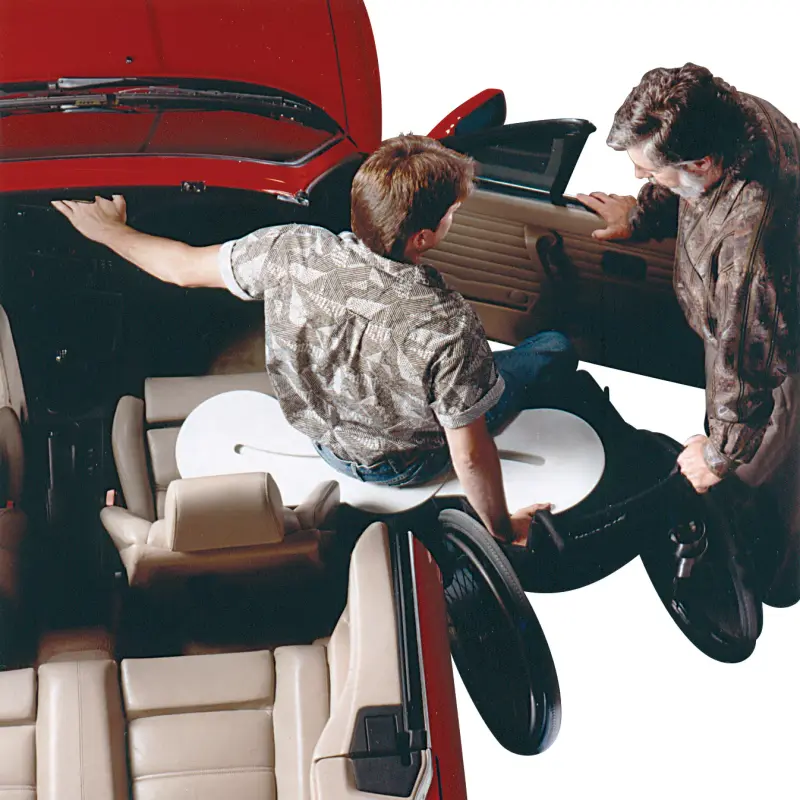
- BeasyTrans, the S-shaped original. Performance Health says it "is specifically designed for automobile transfers" and can also help in and out of bed or for boosting or repositioning in bed. It is the longest, at 40 inches.
- BeasyGlyder, crescent-shaped. Performance Health says the curved shape "is also ideal for wheelchairs without removable arms or when the wheel is an obstacle." AliMed says much the same.
- Beasy II, the shortest. Performance Health calls it "perfect for small areas, especially bathroom transfers"; AliMed says it is best for small areas, "including bathroom or car transfers and boosting patients into bed."
The sellers' figures do not match
The three sellers print different sizes, weights and prices for the same boards. We give each seller's own figure with its name, as read on 23 October 2026, and do not choose between them.
| Model | Performance Health | AliMed | 1800wheelchair |
|---|---|---|---|
| BeasyTrans | 40 x 12 in, 6.5 lb, 445.00 | 40 in, seat 12 in, 6.5 lb, 414.50 | 7.5 lb, 269, sold out |
| BeasyGlyder | 32 x 10 in, 4.5 lb, 427.68 | 32 in, seat 10 in, 4.75 lb, 410.00 | No weight, 269, sold out |
| Beasy II | 28 x 12 in, 4.5 lb, 416.34 | 27-1/2 in, seat 12 in, 4.5 lb, 445.75 | 5 lb, 269, sold out |
| Rating, all three | Up to 400 lb | 400 lb | 400 lb |
Two differences stand out. Performance Health prints a width for each board, such as 12 inches, where AliMed prints the seat diameter, such as 12 inches; they may be the same figure described two ways, or not. And the order of prices is reversed: Performance Health's dearest board is the BeasyTrans and its cheapest the Beasy II, while AliMed's dearest is the Beasy II. 1800wheelchair showed all three at 269 dollars each, marked sold out, so that price was not one you could order at. Our catalog lists the BeasyTrans at around USD 414.50 at AliMed, checked October 2026, with a length of 40 inches, 6.5 lb and a 400 lb rating.
The cheapest Beasy listing, 410.00 dollars, was more than nine times Vive's 43.99-dollar 30-inch board and about three and a half times AliMed's 116.50-dollar maple board with slots on the same day. What you get for that, in the sellers' words, is a seat that moves instead of your skin and a disc that turns you. The pages do not report a study comparing them.
Length, width and the gap: reading the numbers
Length is the number most listings lead with: 23, 24, 27-1/2, 28, 29, 30, 32, 35, 36 and 40 inches appear in the pages we read. In centimeters, 24 inches is about 61, 30 about 76, 36 about 91 and 40 about 102. A longer board spans a wider gap and leaves more board on each seat; a shorter one is easier to carry and to place in a small bathroom or a car door.
Vive's page gives the clearest rule in our files. "Just place at least ⅓ of the board on the surface you are transferring from and at least ⅓ of the board on the surface you are transferring to," its instructions say. That is Vive's instruction for its own board; the other makers' pages we read give no such rule. StatPearls says, more generally, that "The slide board should extend the distance between the bed and the wheelchair."
Width varies from 7.5 inches (Vive's 30-inch board, as its spec block prints it) and 8 inches (the AliMed maple, DMI and Drive bariatric boards) to 10 inches (Therafin), 12 inches (the larger Vive board, and the Beasy figures) and 12-1/2 inches (SafetySure). Thickness is printed for a few: Vive's board is 0.75 inch; AliMed's maple board tapers from 3/4 to 1/2 inch, and Therafin's from 5/8 to 7/16 inch. Board weight matters if you carry it in the car: Vive lists a shipping weight of 2.6 lb for its 30-inch board, and Therafin's page prints 4.6 lb.
Measure before you choose
- The gap between the two seats once the wheelchair is as close as it can go, with the armrest removed or swung away.
- The height of each seat, with the cushion on the chair. MSKTC says transferring downhill is easier and, at modest height, safer than transferring uphill.
- Whether the wheel or a fixed armrest is in the way. That is the case the BeasyGlyder's sellers describe.
- Where the board will live between transfers: in the chair's bag, in the car, beside the bed.
The home hospital bed guide covers beds whose height can be set to match the chair, and the wheelchair cushion guide covers cushions, whose height changes the step.
Gait belts and transfer belts
A gait belt is a strong strap that goes around the waist so a helper has something secure to hold. The Posey instructions from TIDI Products give the intended use as "Provides caregivers with a secure hold point to assist patients/residents during supervised walking and transfers." Makers use the names loosely: Posey's transfer belt has six handles sewn on, while Vive's Transfer Belt has none and its Gait Belt with Handles has six. StatPearls lists a transfer belt among the things a helper uses with a slide board, and the MedlinePlus page uses a gait belt for a stand-and-pivot transfer.
Sizes and ratings, as printed
| Belt | Length (in) | Fits waist (in) | Rating | Price (USD) |
|---|---|---|---|---|
| Posey 6556S cotton, metal buckle | 54 | 28 to 49 | Not printed | Not printed |
| Posey 6556 cotton, metal buckle | 66 | 45 to 61 | Not printed | Not printed |
| Posey 6556L cotton, metal buckle | 78 | 57 to 73 | Not printed | Not printed |
| Posey 6528Q quick-release | 52 | 28 to 50 | Not printed | Not printed |
| Posey 6537Q six handles | 54 | 28 to 52 | Not printed | Not printed |
| Vive Transfer Belt, 2 in cotton | 54 / 60 / 72 | Up to 72 | 500 lb | 13.99 |
| Vive Gait Belt with Handles | 55, 4 in wide | 27 to 51 | Not printed | 17.89 |
| 1800wheelchair Gait Transfer Belt | 2 in webbing | Not printed | Not printed | 12 |
| Bestcare Handi Belt | Not printed | Not printed | Not printed | 70 |
The Posey instructions print no weight rating and no price; Posey lists twelve SKUs from 52 to 78 inches long, some sold by the case of 50. Vive's cotton belt is rated "up to 500 lbs" on its page and closes with a metal quick-release buckle "with locking teeth to prevent slipping during movement." Its gait belt with handles has four vertical and two horizontal padded handles and a 4-inch nylon belt. The open-ended Bestcare Handi Move with two handles was 81 dollars on 1800wheelchair's page.
What the Posey instructions say about use
- Fit: "You should be able to slip your open hand (flat) between the belt and the patient," the metal-buckle instructions say.
- Grip: "ALWAYS grasp the transfer belt from underneath," the instructions say.
- Never a seat belt: the warning says "NEVER use a Gait or Transfer Belt as a seat belt or to position a person in a chair or vehicle." The belts "are not designed for seat positioning or to withstand the force of a crash."
- Not a restraint: "This product is not intended for use as a restraint," the instructions say.
- A clinical decision first for some people: the precautions say a clinical assessment and decision are required with an ostomy, colostomy, G-tube, hernia, post-surgery incisions, or tubes and lines that the belt could press or rub.
- Remove after each use, and inspect before each use for broken stitches, frayed material or a buckle that does not hold.
Where the buckle goes: it depends on the belt
The instructions differ on where the buckle should sit, depending on the belt, and we report each as written without choosing. The Posey instructions from TIDI Products, for the quick-release gait belt, say: "Turn the buckle around to the patient's back." Their warning gives the reason: "The quick-release gait belt buckle version should be positioned to the patient's back so that the patient can not release the buckle during transfer." It adds that release of the buckle during transfer "may result in injury."
For a different Posey product, the transfer belt with six handles, the same instructions say to "Center the belt around the patient's waist with the quick-release buckle in the center front." So even within one maker's sheet, the answer depends on which belt you have.
Vive answers the question on the page for its Gait Belt with Handles, a 4-inch nylon belt with six handles. Asked whether the clasp goes in the back or the front, that page says: "The metal clasp should be in the front, similar to a regular belt." Vive's page for its cotton Transfer Belt with a quick-release buckle, the closer match to Posey's quick-release gait belt, gives no buckle position in the text we saved from it.
These are the makers' instructions for their own belts, and the answer depends on the belt. Follow the instructions printed for the belt you own, and ask the physical or occupational therapist who trains you and your helper which position they want for your transfer. If the belt came without instructions, ask the seller for them before you use it.
Pivot discs and swivel cushions
Several low-tech aids turn a person rather than bridge a gap. They suit different transfers, and Vive says plainly where its disc should not be used.
Pivot discs (standing)
A pivot or transfer disc is a flat, rotating plate on the floor. The SafetySure Pivot Disc, AliMed's page says, "is designed for use by patients who can stand but cannot readily move their legs," and "It is recommended that the practitioner use a SafetySure Transfer Belt or Sling to provide additional support." It comes 15 or 18 inches wide, is rated at 400 lb and was listed at 150.00 and 190.25 dollars. Vive's Transfer Disc is 15.75 inches across and 0.89 inch high, with steel bearings, rated at 350 lb, at 64.99 dollars.
Vive's page sets three limits in its own answers. It is "not recommended for use on wet or slippery surfaces." It is "not recommended for use on a chair." And "it is always necessary for the caregiver to anchor the transfer disc with their foot," Vive's page says. Whether a disc or a board fits your transfer is your therapist's call.
Swivel seat cushions (seated)
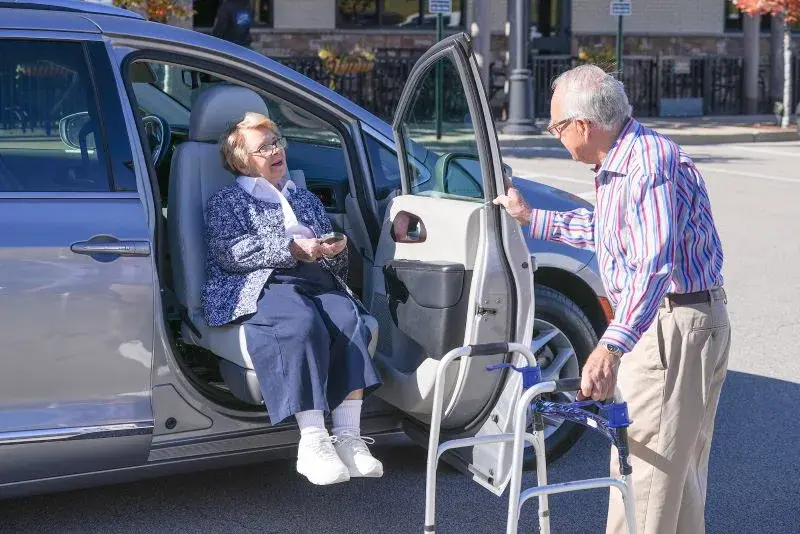
Vive's Gel Swivel Seat Cushion is 15.3 by 15.3 inches and 1.7 inches thick, weighs 3.45 lb, is rated at 300 lb and was 45.99 dollars. Vive's page lists its use as a "360° Rotating Cushion to assist in getting in and out of a car, or standing from most chairs." Vive points to it as the option for chairs, where it says its disc should not be used. For a car, a fitted turning seat is a different, installed product: our catalog lists the BraunAbility Turny Evo from around USD 12,599 installed, checked October 2026, and the wheelchair van guide covers it.
What the published guidance says about a board transfer
What does the published guidance say about using a transfer board? Mobility Atlas read three guides on 23 October 2026: MSKTC's factsheet on safe transfers, a StatPearls chapter and a MedlinePlus page. MSKTC says that transferring in and out of a wheelchair puts more stress on the arms and shoulders than anything else done regularly, and that everyone needs individual training with a physical therapist. It suggests small steps or a board when a transfer cannot be done in one smooth movement with the arms close to the body, and warns that sliding can damage skin. StatPearls says a board can help people with paraplegia, a lower-limb amputation or weak or unsteady legs, and names groups it says would not benefit. MedlinePlus describes a stand-pivot transfer with a gait belt, not a board. MSKTC suggests a lift for anyone who cannot transfer safely, and MedlinePlus says a helper needs one if the person cannot use at least one leg.
MSKTC: train with a therapist, and protect the shoulders
The MSKTC factsheet, developed by Michael L. Boninger, MD, with the Model Systems Knowledge Translation Center, opens with the shoulders: "Transferring in and out of your wheelchair puts higher stress on your arms and shoulders than anything else you do on a regular basis." It then says: "Work with a physical therapist to learn the best transfer technique for you and your body." Technique changes over time, too. "Your transfer technique may need to be readjusted as years go by," MSKTC says, and if problems appear or your living situation or activities change, "go back to your therapist for advice."
On boards in particular, MSKTC says that if you cannot transfer in one smooth movement while keeping your arms close to your body, "move in several small steps and/or use a transfer board." It warns: "Be careful sliding across the transfer board because the motion can damage your skin." Its remedy is simple and in its own words: "Use a pad or towel on the board when bare skin may come in contact with the board during the transfer." MSKTC also advises keeping the number of transfers to a minimum and alternating the leading arm and the direction. The factsheet calls its steps "general steps" and asks you to work with your therapist to fine-tune them; so do we.
StatPearls: the board in a clinical setting
StatPearls, a chapter by Rachel Bergman and Orlando De Jesus last updated on 17 October 2022, is a clinical reference chapter. It says that "After becoming familiar with it, clinicians and patients preferred the slide board technique for comfort and safety." It lists a transfer belt, a wheelchair close to the bed with the brakes on, the armrest removed and the footrests swung away, and a board placed under the buttock and leg. One safety point is worth repeating for anyone handling a board: "Fingers should not be under the board to avoid pinching the fingers," the chapter says. It also suggests a plastic bag over the seat when clothing sticks to a car seat or bed.
MedlinePlus: a pivot turn, and a lift if needed
The MedlinePlus page, reviewed on 19 October 2025, is for a helper and does not use a board. "The technique below assumes the person can stand on at least one leg," the page says, and "If the person cannot use at least one leg, you will need to use a lift to transfer them." It says the person "should not wrap their arms around your head or neck." If the person starts to fall, the page says to lower them to the nearest flat surface, and "Contact the person's health care provider if they fall."
None of these pages is a lesson you can learn from text. Each one points back to training in person. This guide reports what they say so that you know what to ask; your physical or occupational therapist decides the technique and whether a board is safe for you.
Who a board suits: what StatPearls, MedlinePlus and MSKTC say
StatPearls is the only one of the three guides that names groups. "A sliding transfer board can benefit patients with paraplegia, lower-extremity amputation, and decreased balance or strength in the lower extremities," the chapter says. It also says "A realistic goal for paraplegic patients is to become independent with transfers using a slide transfer board," and that occupational therapy in a nursing home or rehabilitation center should include practicing transfers under various conditions.
The same chapter names three cases where it says a board is not the answer. In its words: "A patient with quadriplegia would not have the postural support or upper extremity strength to use a slide transfer board." "A patient with a stand pivot transfer would not need a slide transfer board." And "A patient who cannot follow commands does not benefit from a slide transfer board." These are StatPearls' own general statements, made in a clinical reference.
For a helper, StatPearls says a one-person assist may be done if the person "can bear weight on both lower extremities and predictably take small steps." If not, "a 2-person transfer or a mechanical lift may be necessary," the chapter says. MedlinePlus sets its own, simpler line: a lift if the person cannot use at least one leg. MSKTC, writing for wheelchair users themselves, says: "If you are unable to perform a transfer safely or are at risk for developing arm pain, you should strongly consider using one of the many kinds of patient lifts available."
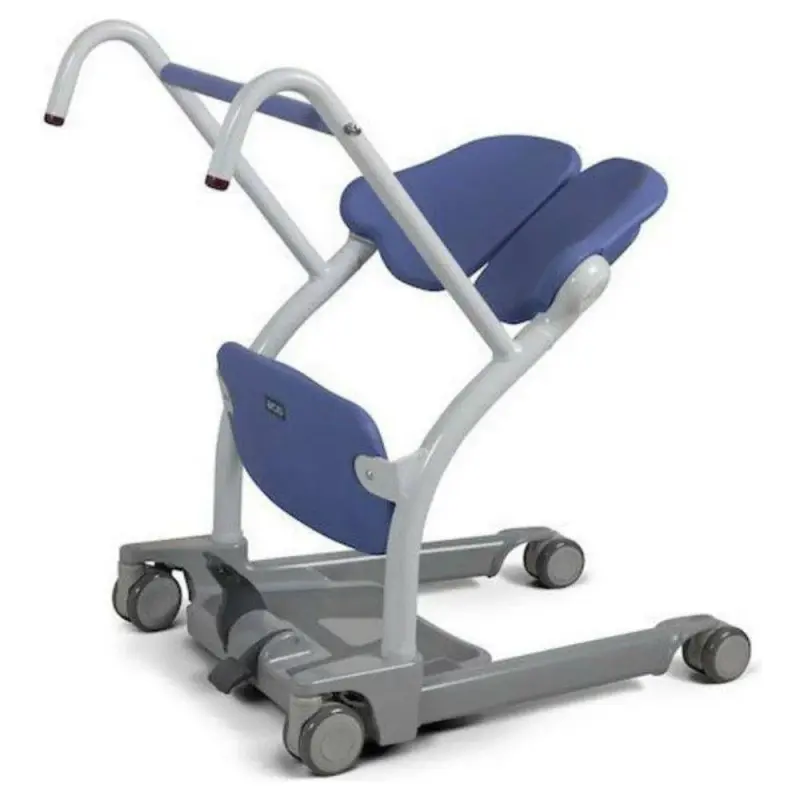
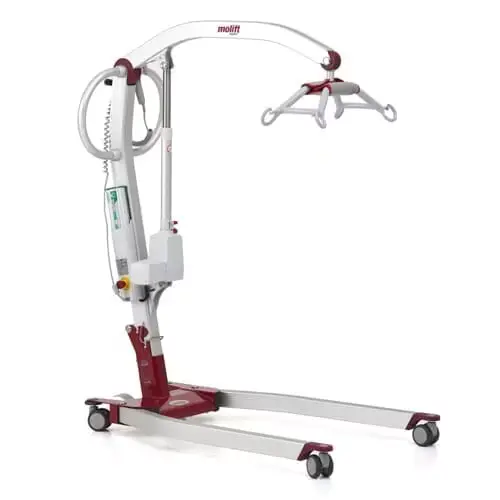
So the board sits in the middle of a range. At one end are people who stand and pivot, perhaps with a gait belt or a disc. At the other are people who need a hoist, covered in the patient lift guide, such as the Etac Molift Smart 150 mobile hoist in our catalog (no price or weight capacity listed). Between them are people who slide on a board, and the Arjo Sara Stedy stand aid in our catalog (rated at 400 lb, no price listed), which the catalog describes as for people who can pull to stand but need help transferring, with one caregiver.
Caregivers' backs: what NIOSH says
Helpers' backs matter too. NIOSH, the federal institute for workplace safety, says on its safe patient handling page, dated 9 May 2024: "The single greatest WMSD risk factor for healthcare workers is patient handling." WMSD stands for work-related musculoskeletal disorder. The page asks employers to provide "easily accessible assistive lifting devices" and to train workers on them.
An article by T. R. Waters, published in 2007 and described by NIOSH on CDC's site, puts a number on it. NIOSH's description says the Revised NIOSH Lifting Equation "yields a recommended 35-lb. maximum weight limit for use in patient-handling tasks," for a cooperative patient, and "When weight to be lifted exceeds this limit, assistive devices should be used." That figure was worked out for healthcare workers, and the NIOSH page does not name boards or belts.
StatPearls says gait belts, walking belts and multi-person teams "may reduce the burden" on providers who routinely do transfers. If a family member helps you every day, ask the therapist to train them too, and to say when it is time to add a lift.
What transfer boards cost, seller by seller
The prices in this guide are what each seller listed on 23 October 2026, in US dollars as listed. They are listings, not quotes, and Vive showed a struck-through "compare at" price above each board price that day. Walmart is a marketplace, and many items on its page are sold by third-party sellers; one DMI listing on its page was marked sponsored.
Within one type, the spread is wide. Among 30-inch wooden boards with cut-outs or slots, the DMI board was 29.99 dollars at Walmart, Vive's 43.99, the Lifestyle Essentials board (Drive's RTL6045 item number) 41.25 and AliMed's maple board 116.50. The same Beasy model also differed by seller: Performance Health's BeasyTrans was 30.50 dollars dearer than AliMed's, its BeasyGlyder 17.68 dearer, and its Beasy II 29.41 cheaper. Those are our sums on the listed prices.
Commode and wheelchair boards
Walmart's wooden board page also listed boards sold for commodes and wheelchairs, whose listing names print no weight rating: a Wheelchair to Commode Transfer Board at 60.00 dollars, a SafetySure Commode Transfer Board at 65.20, and SafetySure wooden wheelchair boards, 16 by 16 and 18 by 16 inches, from 43.10 to 52.00 and at 44.99. For commodes themselves, see the bedside commode guide.
Prices differ by country, by seller, by sales tax and by funding, and the prices here are United States listings. One DMI listing name on Walmart includes "FSA / HSA"; whether your own flexible spending or health savings account will pay is your plan's decision, so ask the plan before you order.
Who pays: Medicare and code E0705
Does Medicare pay for a transfer board? Mobility Atlas read the CMS transmittal and searched the Medicare Coverage Database on 22 October 2026, and read the October 2026 fee schedule and Medicare.gov's equipment page on 23 October. Medicare's billing code for a board is E0705, "Transfer Board or Device, Any Type, Each," added in 2006 and classed by CMS as inexpensive and routinely purchased. On its main new-purchase row, the October 2026 fee schedule allows 53.40 to 61.46 dollars in non-rural areas of the 48 contiguous states and DC, and up to 70.86 in rural areas; a second row with the KU modifier is higher. Our search found no coverage determination or article that names E0705. Medicare.gov's general equipment rules are these: Part B covers medically necessary equipment that your doctor or other provider orders for use in your home, from a supplier enrolled in Medicare. After the Part B deductible, you pay 20 percent of the approved amount if the supplier accepts assignment.
CMS Transmittal 928, dated 28 April 2006, says: "Code E0705 (Transfer Board or Device, Any Type, Each) was added to the HCPCS effective January 1, 2006." The same transmittal says "the payment category for E0705 is revised to CWF category 04, inexpensive and routinely purchased," and that the fee amounts for an earlier code, E0972, were carried across to E0705.
Our search found no coverage policy that names the code
The Medicare Coverage Database is where CMS publishes national coverage determinations, the local coverage determinations (LCDs) of its contractors, and their billing and coding articles. On 22 October 2026 we searched the Medicare Coverage Database for E0705, across all document types, all states and all contractors, and it returned "Total Results: 0": no LCD, no national coverage determination, and no billing and coding article. A second search by code in the billing and coding articles also returned none. That means we found no item-specific checklist to quote. It does not tell you whether a claim for your board will be paid; ask the supplier before you order.
The October 2026 fee schedule, as printed
The DMEPOS fee schedule is the table of amounts Medicare allows for each equipment code, state by state, with separate figures for non-rural (NR) and rural (R) areas. CMS publishes updated files during the year; this is the October 2026 file. We copied the six E0705 rows from the October 2026 file, DME26-D. The figures below are the lowest and highest amounts printed across the 48 contiguous states and Washington, DC, with Alaska, Hawaii, Puerto Rico and the US Virgin Islands shown separately, as the file groups them under the banner "Non-continental areas."
| E0705 row | Non-rural (USD) | Rural (USD) | AK / HI / PR / VI, non-rural column (USD) |
|---|---|---|---|
| NU, new purchase | 53.40 to 61.46 | 64.97 to 70.86 | 98.97 / 71.23 / 75.28 / 69.07 |
| RR, rental per month | 5.34 to 6.15 | 6.55 to 7.15 | 9.90 / 7.11 / 8.63 / 7.00 |
| UE, used purchase | 40.05 to 46.10 | 48.14 to 52.46 | 74.23 / 53.43 / 56.45 / 52.46 |
The file has three more rows, each with a second modifier, KU, and a printed ceiling and floor: for a new purchase, a ceiling of 78.58 and a floor of 66.79; for monthly rental, 7.99 and 6.79; for a used purchase, 57.53 and 48.90. The file's legend calls KU only a second modifier, and the KU rows carry no separate rural figures. Your supplier knows which row applies to your claim; ask them.
What the figures mean for you
- They are allowed amounts, not shop prices, and a retailer's price is not tied to them. Medicare.gov says to make sure your doctors and suppliers "are enrolled in Medicare and will accept assignment."
- Your share is 20 percent after the Part B deductible "if your supplier accepts assignment," Medicare.gov says; a supplier that does not participate or will not accept assignment may charge you more, the page adds. On the main row's non-rural new-purchase range, 20 percent is 10.68 to 12.29 dollars; at the top rural figure, 70.86, it is 14.17. These are our sums; the deductible itself is not in the files we read, so check it on Medicare.gov.
- Set against the shelf, the allowed amount is above most plain wooden boards' listed prices and well below a Beasy board. Vive's 30-inch board listed at 43.99 dollars, 17.47 below the highest non-rural amount on the main new-purchase row; the Beasy boards listed at 410.00 to 445.75.
- Rental exists in the schedule, at 5.34 to 6.15 dollars a month non-rural. Medicare.gov says that, depending on the item, you may need to rent, may need to buy, or may be able to choose; ask the supplier which they offer.
Drive Medical's two board pages have a HCPCS field, and on both it is blank. Ask the supplier, before you order, whether they bill the board you want as E0705, whether they accept assignment, and what you will pay.
Medicare's general rules, and what the supplier needs
Medicare.gov defines durable medical equipment as equipment that is durable, "Used for a medical reason," typically only useful to someone who is sick or injured, "Used in your home," and "Expected to last at least 3 years." On costs, the page says that if a DME supplier "doesn't participate in Medicare or won't accept assignment, you may be charged more," and that for rented equipment you should make sure the supplier will accept assignment for all rental months.
These rules are federal Medicare rules. Other plans and funders, and health systems outside the United States, set their own; confirm with yours before you buy. A board bought at a retailer that is not an enrolled supplier is outside Medicare, whatever it costs.
Gait belts, pivot discs and swivel cushions are a separate question. The fee schedule rows we saved are for E0705 only, and the code's wording, which the CMS transmittal says is "Transfer Board or Device, Any Type," does not list them by name. Ask the supplier how, or whether, they would bill an item that is not a board.
How the FDA classifies transfer aids
In the United States, transfer aids are medical devices, and the FDA sorts them by product code. Two codes are relevant here, and the FDA's openFDA classification records, last updated on 12 October 2026, give them as follows.
| Product code | FDA device name | Class | Regulation number |
|---|---|---|---|
| IKX | Aid, Transfer | 1 | 890.5050 |
| FMR | Device, Transfer, Patient, Manual | 1 | 880.6785 |
Regulation 890.5050, under physical medicine, is the "Daily activity assist device." The regulation's text says it is "a modified adaptor or utensil (e.g., a dressing, grooming, recreational activity, transfer, eating, or homemaking aid) that is intended for medical purposes to assist a patient to perform a specific function." It is Class I, general controls, and exempt from premarket notification, subject to the limits the regulation names.
Regulation 880.6785, under general hospital devices, is the "Manual patient transfer device," which the regulation describes as "a wheeled stretcher and a mechanism on which a patient can be placed so that the patient can be transferred with minimal disturbance in a horizontal position to the stretcher." That is a stretcher system, not a sitting board. It too is Class I and exempt from premarket notification.
For a buyer, the practical meaning is that both codes are Class I under general controls and, under the current regulations, exempt from premarket notification within the limits the regulations name. The openFDA classification records still list 510(k) numbers under both codes, 18 under IKX and 5 under FMR, so "exempt" describes the rule today; it does not mean that no product under these codes ever went through premarket notification. Six of the seven belt recall records in the next section were filed under IKX; the seventh, Kinsman's, under IKZ. The openFDA site adds its own caution: "Do not rely on openFDA to make decisions regarding medical care."
Recalls: belts, not boards
We found no FDA recall for a transfer board. A search of the FDA recall records in our database for "transfer board," "slide board," "sliding board" and "beasy" returned no records, and the live openFDA recall search on 22 October 2026 returned "No matches found" for those terms and for "transfer belt." The Consumer Product Safety Commission's recall search on 23 October 2026 found no recall for a transfer board, slide board, gait or transfer belt or swivel seat cushion either.
Gait and transfer belts are a different story. Of the 20 recall records filed under product code IKX in our database, six concern gait or transfer belts, and a seventh belt record, under product code IKZ, came from the live search. All are copied here with their numbers exactly as the FDA stores them.
| Recall | Firm, product | Reason (shortened; full wording below) | Quantity | Status |
|---|---|---|---|---|
| Z-0598-2009, Z-0599-2009 | AliMed gait belt, 54 and 70 in | Misassembled gait (transfer aid) belt. | 993 units total | Terminated |
| Z-1613-2015 | Handicare ReTurn belt, wipeable | Heat-welded seam on the strap tore | 64 | Terminated |
| Z-0163-2018, Z-0164-2018 | Medline Transfer/Gait Belt, plastic | Belt strap may slip through the buckle | 1,428 units total | Terminated |
| Z-0055-2021 | Medline Quick Release Gait Belt, 60 | Buckle may break | 13,500 units | Open, Classified |
| Z-0161-2022 | Kinsman Easi-Care Gait Belt, metal buckle | May fail below labeled 600lbs | 13,123 units | Terminated |
The reasons, quoted from the records: Medline's 2017 recall says "The locking mechanism on the belt may fail to secure/hold the strap when in locked position potentially allowing the belt strap to slip through the buckle." Its 2020 recall says "The buckle on the Gait Belt may break due to degradation of the material due to exposure to gamma radiation"; it went to Illinois and Michigan only. Handicare's record says "Complaints were received that the heat-welded seam on the wipeable belt's strap tore when force was applied." The Kinsman record says "The belt may fail at lower loads than the labeled 600lbs." AliMed's root cause is given as "Employee error."
One more IKX record concerns a transfer aid rather than a belt, Handicare's ReTurn 7500 (Z-0303-2017): a wing handle used from April 2009 to May 2011 could slide apart after repeated tightening, according to the record; 29 units and 47 spare wing handles were involved. The other IKX records are shower seats, a transfer bench, overhead bars, grab handles and bed side rails, which belong to other guides.
A recall record shows that a firm took action on certain lots; it is not a measure of how often belts fail, and the openFDA site says its results are unvalidated. The practical lesson matches the Posey instructions: inspect the buckle and the stitching before every use, and check the FDA recall database or the maker if you own one of the belts named.
Cars, bathrooms and commodes: where other guides take over
A board is used in many places, and several of them have their own equipment and their own guide on Mobility Atlas. Turning seats, hoists for the chair and adapted vans are in the wheelchair van guide. Tub transfer benches and bathing seats are in the shower chair guide. Beds whose height can be set, and hoists for when a board is no longer safe, are in the home hospital bed guide and the patient lift guide.
Care, cleaning and checks
- Wooden boards: wipe with a towel or dry cloth and keep dry; Vive's page says "It is not recommended to immerse the board in water." Check for cracks, splinters and a rough finish before each use; a damaged surface is a skin risk.
- Plastic boards: AliMed's page calls the SafetySure board flexible. Check that it still lies flat and has no cracks, and ask the seller for cleaning instructions; the page we read gives none.
- Belts: the Posey instructions say "Always inspect before each use" for broken stitches, frayed material or a cracked buckle, and "NEVER use soiled or damaged products." They warn that in washing, "metal buckles could bend and quick-release buckles could crack or break," and that cotton may shrink "up to 5%" over the product's life.
- Discs: Vive says its disc suits flat floors, "including hardwood, tile and low-pile carpet," and must be anchored by the caregiver's foot.
The Posey sheet says "When not in use, the caregiver can wear the belt for immediate access as needed," but also to remove it from the person after each use. If anything about a board or belt changes, such as a crack, a loose buckle or a new pain in your shoulders, stop using it and talk to the seller and your therapist.
Three traps
Trap one: buying a board before anyone has watched you transfer. MSKTC says everyone needs individualized transfer training with a physical therapist, and StatPearls names groups it says a board would not benefit. A board of the wrong length, or the wrong aid altogether, can add strain or skin damage instead of saving it. Ask your physical or occupational therapist first, and take the measurements from the length section with you.
Trap two: trusting a rating that is not printed, or reading one figure as the whole system. Many marketplace listings print no weight rating, and the Beasy sellers print different weights and sizes for the same boards.
Trap three: using a gait belt as something it is not. The Posey instructions say never to use a gait or transfer belt as a seat belt or to position a person in a chair or vehicle, and that it is not a restraint. The instructions also differ on where the buckle goes, depending on the belt; check the buckle position with your therapist (see above), inspect the belt before each use, and check the recall records if it is one of the belts named in this guide.
Three composite scenarios
These are composite scenarios, not individual customers. Each one combines facts and ranges already given in this guide to show how the decision plays out.
Scenario one: a manual wheelchair user with paraplegia, home from rehabilitation, transfers with a board to bed and to the car. The physical therapist suggests a 30-inch wooden board with cut-outs. Listings that day run from 29.99 dollars at Walmart to 116.50 at AliMed. The user follows MSKTC's advice to use a pad or towel when bare skin may touch the board, and agrees to go back to the therapist if problems appear or routines change, as MSKTC advises.
Scenario two: an adult child helps a parent who can stand on one leg from bed to wheelchair. MedlinePlus describes a pivot transfer with a gait belt for that case, so the therapist trains them both and suggests a belt rather than a board. Belts listed from 12 to 17.89 dollars at 1800wheelchair and Vive. The Posey and Vive instructions place the buckle differently for different belts, so they ask the therapist which position to use, and check the belt for frayed stitches before each use.
Scenario three: a person who weighs about 500 lb is moving from bed to a power chair with a helper. The occupational therapist reviews the ratings: 600 lb for Drive's RTL7047 and 650 lb for the Therafin board at 292.38 dollars, but Vive's disc is rated at 350 lb and its swivel cushion at 300. On the main new-purchase row of the October 2026 fee schedule, Medicare allows no more than 70.86 dollars for an E0705 board in the contiguous states and DC (a second row with the KU modifier goes up to 78.58), so they ask an enrolled supplier what they would bill and whether they accept assignment. The therapist also discusses a lift as a backup.
What to ask the therapist, the supplier and the seller
Your physical or occupational therapist
- Is a board transfer safe for me, or should I use a pivot transfer, a stand aid or a lift?
- Which length, width and shape suit my gap, my seat heights and my chair's armrests?
- Do I need cut-outs, a plastic board or a rotating-seat board for my hands, skin or shoulders?
- Should my helper use a gait belt, and where should its buckle sit for my transfer?
- When should we review my technique again?
The Medicare supplier
- Are you enrolled in Medicare, and do you accept assignment?
- Will you bill this board as E0705, and what will my share be?
- Can I buy, or do you only rent? What is the monthly rental?
- What does the order from my doctor need to say?
The retailer or maker
- What is the maker's weight rating, in writing, and how was it tested?
- What is the exact length, width and thickness, and the board's own weight?
- What is the warranty, and what are the cleaning and inspection instructions?
- For a belt: what are the waist sizes, and is this lot named in any recall?
Bring the gap and seat heights you measured, your weight, and the therapist's note to every conversation. If you would like help finding a board of a certain length or rating, send an enquiry and we will compare the options against the makers' published figures.
Sources and documents
Government and health bodies: CMS, the Medicare Coverage Database, Medicare.gov (read 23 October 2026), the FDA's classification and recall records, the CPSC recall search, MSKTC, StatPearls, MedlinePlus and NIOSH. Makers and sellers: Drive Medical, Vive Health, TIDI Products (Posey), Performance Health (BeasyTrans), AliMed, Walmart and 1800wheelchair. Every source is linked in the list at the end of this page.
Related guides on Mobility Atlas: Patient lifts; Shower chairs and tub transfer benches; Wheelchair vans; Home hospital beds; Wheelchair cushions; Bedside commodes.
Method in brief: we read each saved page in full or in the sections named, copied every figure as printed, and computed only simple sums, ranges, percentages and unit conversions, which are shown in the text and kept in a facts file. Fee-schedule ranges are the lowest and highest figures in the E0705 rows of the October 2026 file. Prices are one day's listings at the sellers named, on 23 October 2026. Catalog prices are guide prices from our own catalog, checked October 2026. We did not test any product, and nothing here replaces training and an assessment by a physical or occupational therapist.
Prices checked October 2026 on the Vive, AliMed, Performance Health, Walmart, 1800wheelchair and Drive Medical pages and in our catalog; prices change often, so confirm them with the seller. Documents checked October 2026: the CMS transmittal and fee schedule, the Medicare Coverage Database, Medicare.gov, the FDA classification and recall records, the CPSC recall search, MSKTC, StatPearls, MedlinePlus, NIOSH and the makers' pages and instructions.
Do you use a transfer board, a Beasy board or a gait belt every day? Send us a note through the enquiry form with what you use and how it works for you; we use readers' notes when we update the guide.
This article is general information. Rules and prices differ by country and change, so confirm them before you buy or travel.
Common questions
How much does a transfer board cost?
On 23 October 2026, standard wooden boards listed from 22.99 dollars (a 24-inch DMI board on Walmart) to 116.50 (AliMed's 30-inch maple board with slots). AliMed's SafetySure plastic boards were 87.25 and 98.50, the Therafin heavy-duty board 292.38, and the Beasy rotating-seat boards 410.00 to 445.75 at AliMed and Performance Health. Prices differ by country, seller, tax and funding.
Does Medicare cover a transfer board?
A transfer board is billed under code E0705, which CMS classes as inexpensive and routinely purchased. The October 2026 fee schedule allows 53.40 to 61.46 dollars on its main new-purchase row in non-rural areas of the contiguous states and up to 70.86 in rural areas. Our search of the Medicare Coverage Database on 22 October 2026 found no coverage policy or article that names the code. Medicare.gov's general equipment rules are: medically necessary equipment, ordered by your doctor or other provider for use in your home, from a supplier enrolled in Medicare; you pay 20 percent of the approved amount after the Part B deductible if the supplier accepts assignment. Ask the supplier whether your board qualifies.
What length of transfer board do I need?
It depends on the gap and the two seat heights, which your therapist can measure with you. For its own board, Vive's instructions say to place at least a third of the board on each surface; the other makers' pages we read give no such rule. Boards in this guide run from 23 to 40 inches.
What is a Beasy board?
A transfer board with a round seat that glides along a track and rotates 360 degrees, so the seat moves instead of your skin, in AliMed's words. There are three shapes: the S-shaped BeasyTrans for cars, the crescent BeasyGlyder for chairs whose arm does not come off, and the short Beasy II for small spaces. Each is rated at 400 lb.
Should the gait belt buckle be in the front or the back?
It depends on the belt, and the instructions differ. The Posey instructions say to turn a quick-release gait belt's buckle to the patient's back so the patient cannot release it, but to center the buckle of its six-handle transfer belt in front. Vive's page for its Gait Belt with Handles says the clasp goes in the front, like a regular belt. Follow your own belt's instructions and ask your therapist.
Who does the published guidance say a board does not suit?
StatPearls says a person with quadriplegia would not have the postural support or arm strength, a person who can stand and pivot would not need one, and a person who cannot follow commands does not benefit. Those are general statements: your therapist assesses you. MSKTC suggests a lift for anyone who cannot transfer safely or is at risk of arm pain; MedlinePlus says a helper needs a lift if the person cannot use at least one leg.
Sources
- CMS: Transmittal 928, CR 5017, July 2006 DMEPOS fee schedule update (E0705 payment category)
- CMS: DMEPOS fee schedule, October 2026 (DME26-D)
- CMS: Medicare Coverage Database, search for E0705 (read 22 October 2026)
- Medicare: Durable medical equipment (DME) coverage
- openFDA: device classification records, product codes IKX and FMR
- eCFR: 21 CFR 890.5050, Daily activity assist device
- eCFR: 21 CFR 880.6785, Manual patient transfer device
- openFDA: device recall endpoint (gait and transfer belt recalls)
- CPSC: SaferProducts.gov recalls API
- MSKTC: Safe Transfer Technique (SCI factsheet)
- StatPearls (NCBI Bookshelf): Patient Care Transfer Techniques
- MedlinePlus: Moving a patient from bed to a wheelchair
- CDC NIOSH: About Safe Patient Handling and Mobility
- CDC Stacks: When Is It Safe to Manually Lift a Patient (Waters, 2007)
- Performance Health: BeasyTrans Easy Transfer System (prices read 23 October 2026)
- Drive Medical: Bariatric transfer board with hand holes, RTL7047
- Drive Medical: Transfer board, RTL6045
- Vive Health: Wooden transfer board
- Vive Health: Transfer disc
- Vive Health: Transfer belt
- Vive Health: Gait belt with handles
- Vive Health: Gel swivel seat cushion
- TIDI Products: Posey gait and transfer belt application instructions, M6219 Rev E
- AliMed: Transfer boards and aids (prices read 23 October 2026; catalog row WT-018)
- Walmart: Wooden transfer boards (listings read 23 October 2026)
- 1800wheelchair: Safe patient handling, transfer aids (listings read 23 October 2026)
Read on 23 October 2026. The wording of the article is our own.