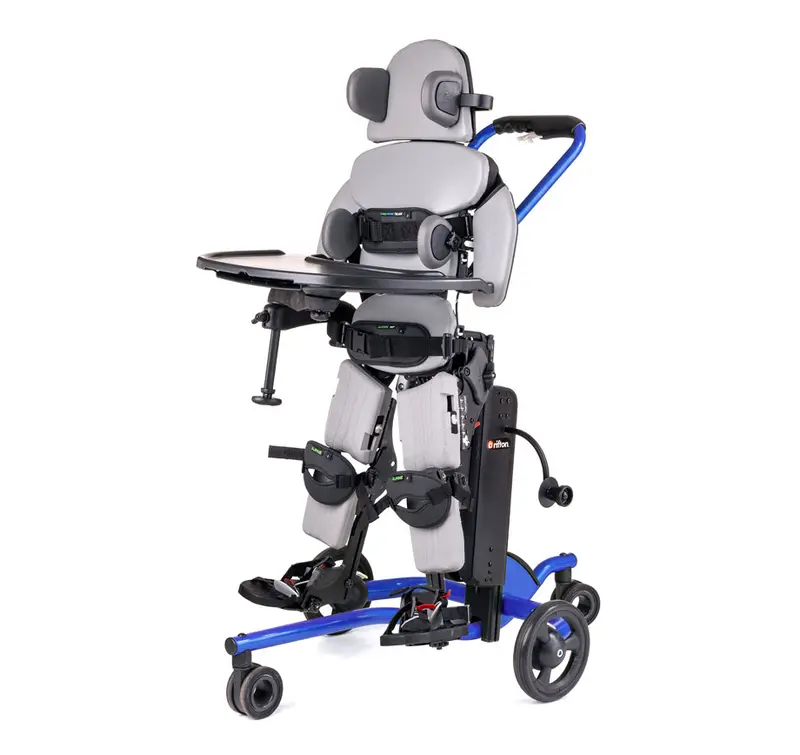
Standing wheelchairs and standers in 2026: types, listed prices, Medicare, Medicaid and VA, and what 113 FDA reports show
Standing wheelchairs, EasyStand and Rifton standers, prices as listed, Medicare's E2301 refusal, Illinois Medicaid and the VA, and what two AI coders found in 113 FDA reports.
Contents
- Stop and check before the next stand
- The short answer
- Standing wheelchair, stander or standing frame: what is what
- How each type brings the user upright
- Power standing wheelchairs: what the makers print
- Manual standing wheelchairs
- Standers and standing frames: sizes and weight limits
- What standing equipment costs as listed
- Does Medicare cover a standing wheelchair?
- Medicaid: Illinois as one example
- The VA, makers' funding guides and buying used
- What the makers' contraindications say
- What the manuals require: warnings and who fits
- Standing wheelchair, stander or both: space and transfers
- What 113 FDA reports on standing devices show
- What these reports cannot tell you
- Standers that would not lower
- Casters, bolts and frames that broke
- Straps, supports and the StrapStand seat strap
- Pinched, caught, and carers and dealer staff hurt
- Children and standers
- When the chest bar was missing or came loose: four Corpus VS reports
- Seats that rose without a command
- Fractures found later, knee blocks and footplates
- A loaner chair over its weight limit
- Deaths and reports about other devices
- The recall file
- How Mobility Atlas read 113 FDA reports
- Three composite scenarios
- Questions to ask before you buy
- Your plan: 10 minutes, today, this week
- Sources and documents
- Common questions
- Sources
Stop and check before the next stand
Someone at home already stands in a standing wheelchair or a stander? Check these first. Choosing one, or asking who pays? Start at the short answer below.
- The chest support and the knee support are on and fastened before the user goes up. Permobil's Corpus VS manual says: "Always use this chest support when you use the standing function." It says the same of the knee support.
- The chair or frame is on level ground with the brakes or casters locked. Permobil's manual says "Only use the standing function on level ground," and Altimate's manual says its standers are "designed for indoor use on level surfaces only."
- In a stander, someone who knows the device is there. Altimate's manual says its standers "must be used with a qualified adult attendant present," and a child is never left alone in one. For a standing wheelchair, follow the manual and the therapist's plan on supervision; LEVO's manual asks for an attendant when a user has strong or sudden spasms.
- Everyone knows how to bring the user down if the lift will not lower: the emergency release, the handle position, and the phone number of the dealer.
- Fingers, toes and feet are clear of the moving parts and the gaps under the frame when it moves.
Adjusting the knee support, the footplates and the standing sequence is a job for the therapist or the dealer's technician, not a home repair.
The short answer
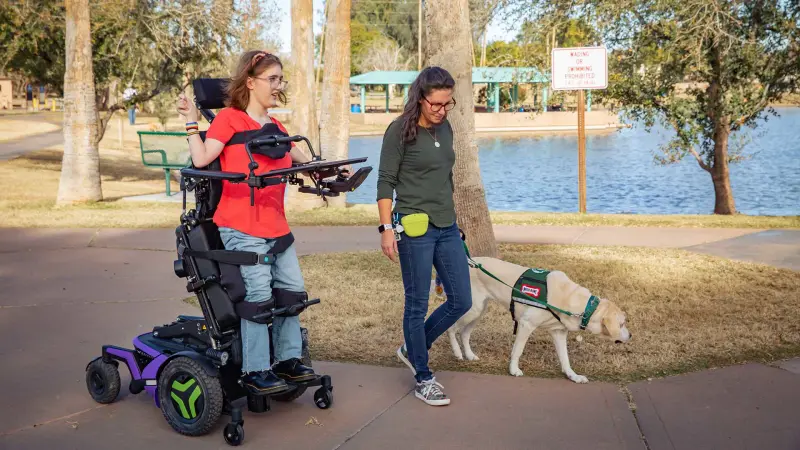
What is the difference between a standing wheelchair and a stander? A standing wheelchair is a wheelchair first: the user sits in it and drives or pushes it like any chair, and a power or manual mechanism raises the seat and the user to standing, held by knee supports and a chest support. A stander, or standing frame, holds a person upright but is not their wheelchair: they transfer into it, or are lifted in, and stand for a set time at home, school or therapy. Standers come as prone, supine, sit-to-stand, multi-position and mobile models. Mobility Atlas read the makers' pages and manuals, Medicare, Illinois Medicaid and VA rules, retailer prices and 113 FDA reports in October 2026. Medicare's policy article calls a power standing feature non-covered, and the listed prices we read run from USD 640.81 for a standing box to USD 14,870 for one power standing wheelchair.
Who pays depends on the route. Medicare's rules refuse the standing feature in plain words. Medicaid decides by state; Illinois, our one example, covers standing frames for some people after a trial, but not powered standing devices. The VA's rule does not name standing devices at all.
Mobility Atlas earns a fee or margin when you order through us; this guide uses only the makers' published pages and manuals, FDA recall records, Medicare's coverage rules, one state's Medicaid criteria, the VA's regulation, RESNA's public pages, two retailers' listed prices, FDA reports and our own catalog, read in October 2026. Whether standing is right for a particular person, how long and how often, and with which contraindications, belongs with their physician, physical therapist or occupational therapist. This guide explains the devices, the paperwork and what to ask, and stops there.
Standing wheelchair, stander or standing frame: what is what
| Type | What it does | Examples in this guide | Code a supplier may use |
|---|---|---|---|
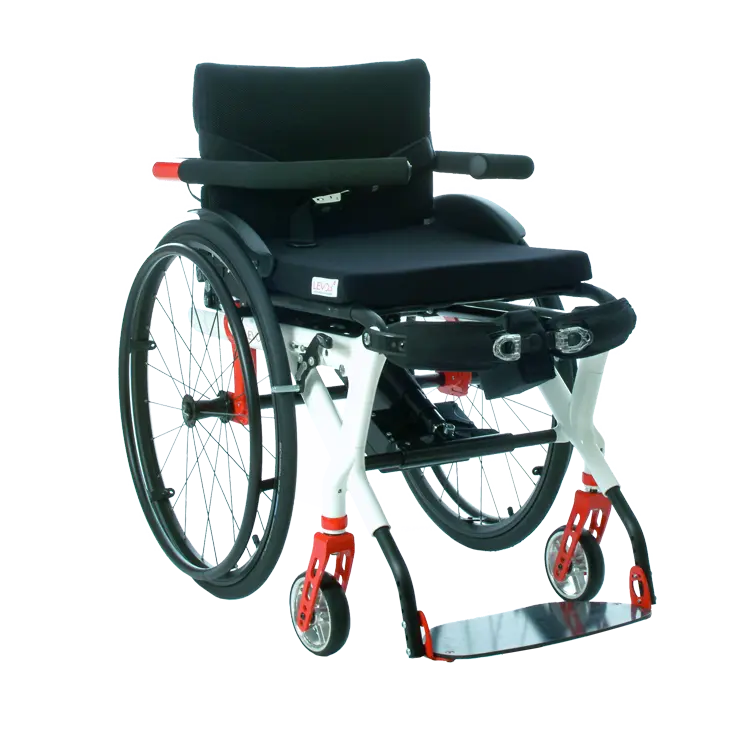
| Power standing wheelchair | Power chair whose seat raises the user to standing; some drive while standing | Permobil F5 and M Corpus VS, LEVO C3 and Combi, Karman XO-505 | E2301 for the power standing system |
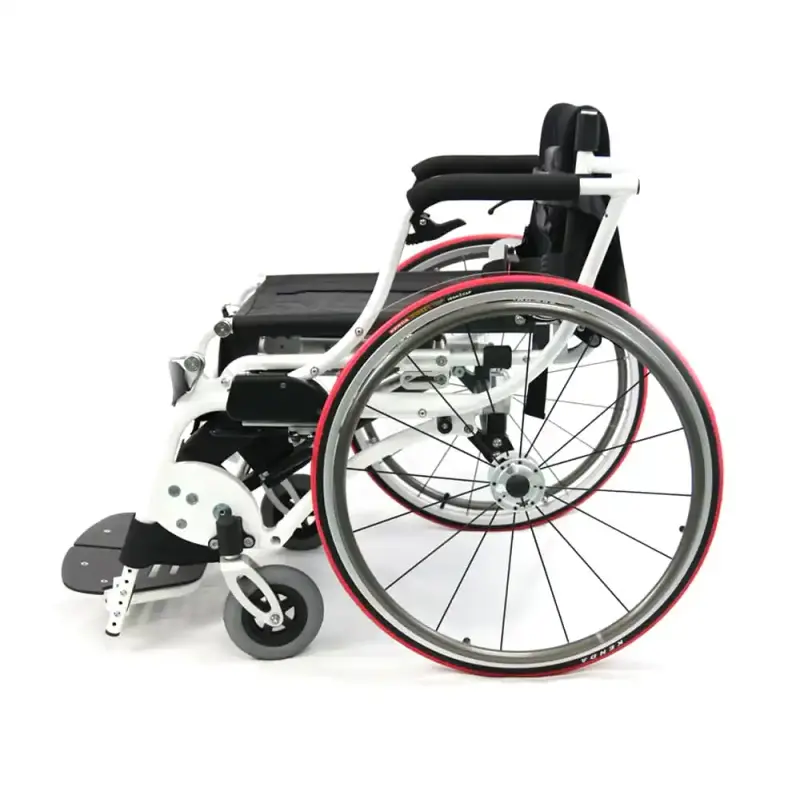
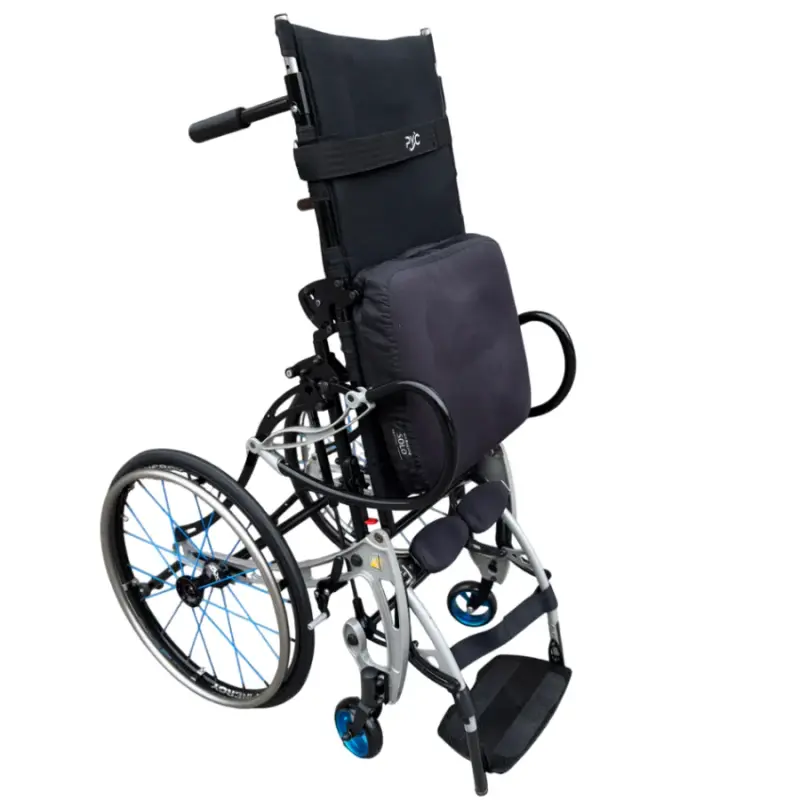
| Manual standing wheelchair | Self-propelled chair with a lever, gas-spring or electric stand mechanism | LEVO LAE and Summit EL, LifeStand Helium, Karman XO-55 | E2230 for a manual standing system |
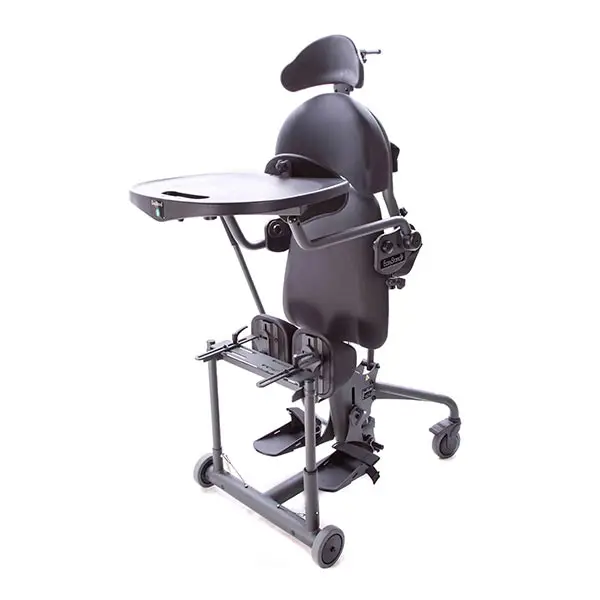
| Sit-to-stand stander | User sits on its seat and is raised by a pump handle or a powered lift | EasyStand Evolv and Bantam | E0637 |
| Prone or supine stander | Board that tilts from lying to upright; prone faces forward, supine lies on the back | Rifton Stander, Gazelle PS | E0638 (one position) |
| Multi-position stander | Can be set up prone or supine, or both | Rifton Stander multi-position, EasyStand Bantam with the supine option | E0641 |
| Mobile or dynamic stander | Has big wheels the user pushes while standing | Rabbit Mobile Stander, Rifton dynamic stander | E0642 |
| Non-transfer stander | A sling under the seat lifts the user straight from a wheelchair | EasyStand StrapStand | Ask the supplier |
| Active stander | Moves the arms and legs in a walking-type pattern while standing | EasyStand Glider | No code on the maker's page |
The E0637 to E0642 wording is from the Illinois Medicaid criteria, and EasyStand's own pages list E0637 for the Evolv and Bantam; E2301 and E2230 are from Medicare's wheelchair options article. A supplier or funder may code a given device differently, so ask which code they will bill.
How each type brings the user upright
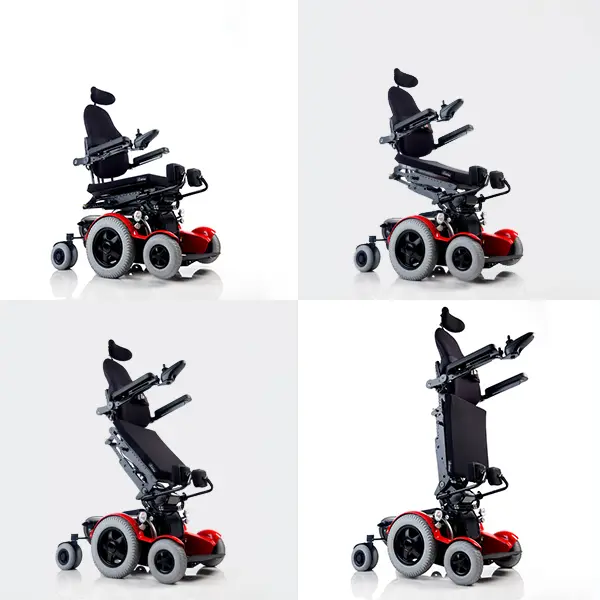
A sit-to-stand stander starts as a seat. Altimate's manual says its Bantam line "has a manual lift that is intended to assist individuals who have difficulty rising from a seated to a standing position"; the product pages list a gas spring lift on the smaller Bantams and a manual hydraulic lift on the Medium, and the Evolv page says the user can stand with the manual hydraulic actuator or the optional push-button Pow'r Up Lift. The user, or a carer, transfers onto the seat with the stander locked and the knee pads and footplates set, then pumps the handle or presses the button.
A prone or supine stander starts flat or tilted. Rifton's manual says its body support "can be adjusted from horizontal to completely vertical (90°)," and the Rifton Stander "can be configured for prone or supine standing." Altimate's Zing frames, its manual says, can be adjusted "from the prone or supine position to increase tolerance to an upright standing position." Which position suits a person is the therapist's choice.
A standing wheelchair does the same work inside the chair. Permobil says the F5 Corpus VS offers "programmable standing sequences using supine, semi-reclined, or sit-to-stand techniques." LEVO's LAE manual says the user stands "using 2 ratcheting hand bars" and a gas spring.
Power standing wheelchairs: what the makers print
The F5 Corpus VS is the power standing chair named most often in the FDA reports we read, so we read both its product page and its user manual. They do not agree on two numbers. The table prints both, each with its source.
| F5 Corpus VS | Permobil product page | Permobil user manual (model version 3) |
|---|---|---|
| Maximum user weight | 300 lb | 136 kg (300 lb); can vary with configuration |
| Driving range | 20 mi | Theoretical 29 km (18.0 mi) Group 3, 30 km (18.5 mi) Group 4 |
| Weight with batteries | 432 (no unit printed) | 206 kg (454 lb) |
| Maximum speed | 5.8 mph Group 3, 7.5 mph Group 4 | 9.3 km/h (5.8 mph), 12 km/h (7.5 mph) |
| Seat elevation and tilt | Up to 14 in ActiveHeight; up to 45° forward tilt | Not in the excerpt we read |
| Seat width and depth | 17 to 23 in wide, 14 to 22 in deep | Users above 110 kg (240 lb) need a seat depth of 445 mm or more |
| Expected service life | Not in the excerpt we read | Five years |
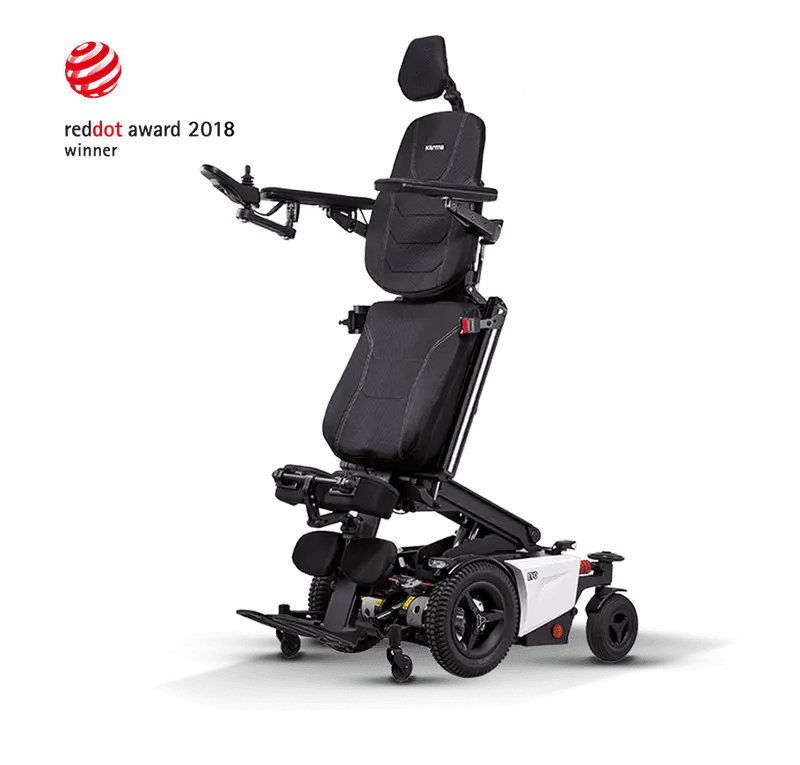
LEVO, a Swiss maker, prints its power chairs' figures on its own pages. The C3 is a four-wheel-drive power standing chair with a user weight up to 140 kg, range "up to 25 km, optional up to 35 km," a maximum safe slope of 10° and tilt in space of 0 to 35°. The mid-wheel Combi takes users up to 120 kg and stands "between sitting and 85° standing." On 1800wheelchair.com in October 2026 the Karman XO-505, a mid-wheel power standing chair with power recline and power elevating leg rests, was listed at USD 14,870, with a 250 lb weight capacity and "Medicare HCPCS Code N/A" on the page.
Manual standing wheelchairs
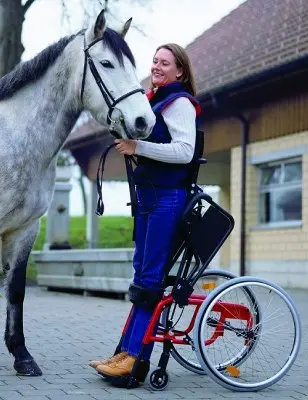
A manual standing wheelchair is pushed like any manual chair, and the user stands with a lever, hand bars, a gas spring or a small electric actuator. LEVO's LAE is the clearest case of two sources disagreeing: its web page says "Complete standing position up to 85°," and its user manual says the mechanism "will take you to all seat angles and standing positions up to 86°." Both are LEVO's own documents. The LAE takes users up to 120 kg, with seat widths of 350 to 480 mm in the manual.
LEVO's Summit EL drives by hand and stands by an electric actuator; LEVO's page gives a weight "of just 21 kg," a capacity of up to 125 kg and standing "up to 86°." Our catalog, checked October 2026, lists the LEVO LAE at around USD 4,995 at a US retailer, the Karman XO-55 Horizon at USD 4,850 on the maker's site with a 250 lb capacity, and a refurbished LifeStand Helium LSA at GBP 2,395 on a UK reseller listing, roughly USD 3,100, with a maximum user of 100 kg.
The LAE manual gives 25 to 27 kg against 206 kg for the Corpus VS with batteries, and says that, regarding visual and cognitive capability, the "physician, therapist or dealer must decide whether the LEVO LAE can be used by the user."
Standers and standing frames: sizes and weight limits
Standers are sized by the user's height and weight, and a frame that is too small or too big will not hold the knees, hips and chest where they need to be. These are Altimate's figures for its EasyStand line, from its manual and product pages.
| EasyStand model | Height range | Weight limit | Lift |
|---|---|---|---|
| Bantam Extra Small | 28 to 40 in | 50 lb | Gas spring |
| Bantam Small | 36 to 54 in | 100 lb | Gas spring |
| Bantam Medium | 4 ft to 5 ft 6 in | 200 lb | Manual hydraulic |
| Evolv Medium | 4 ft to 5 ft 6 in | 200 lb | Hydraulic or Pow'r Up Lift |
| Evolv Large | 5 ft to 6 ft 2 in | 280 lb | Hydraulic or Pow'r Up Lift |
| Evolv XT | 6 ft to 6 ft 10 in | 350 lb | Hydraulic or Pow'r Up Lift |
| Glider Medium and Large | 4 ft to 6 ft 2 in | 200 and 280 lb | Active stander |
| StrapStand | 5 ft to 6 ft 5 in | 350 lb | Sling lift |
Rifton's Stander comes in three sizes: Size 1 for users 28 to 42 in tall up to 75 lb, Size 2 for 38 to 53 in up to 100 lb, and Size 3 for 48 to 65 in up to 185 lb. The Evolv Medium weighs 101 lb as a basic unit, and its mobile version 135 lb, so a stander is not something to carry from room to room.
What standing equipment costs as listed
These are listed prices in US dollars, read in October 2026 on two retailers' pages and in our own catalog. The makers we read print no prices: Permobil, Altimate, LEVO and Rifton all send buyers to configure or quote. Prices change, and a funder may pay its own set rate, so treat this as a starting point for a quote.
| Product | Listed price (USD) | Where we read it |
|---|---|---|
| Bailey tip resistant standing box | From 640.81 | Rehabmart |
| Snug Seat Toucan stander | 990 | 1800wheelchair |
| R82 Gazelle PS prone and supine stander | From 1,442.70; 4,160 | Rehabmart; 1800wheelchair |
| Rabbit mobile stander for children | 1,755 | 1800wheelchair |
| EasyStand StrapStand | From 2,548.89; package from 4,761.14 | Rehabmart |
| EasyStand Evolv Medium | 2,999 | 1800wheelchair |
| EasyStand Evolv with order form | From 3,785.12; package from 5,542.05 | Rehabmart |
| EasyStand Glider | System from 3,834.07; package from 9,958.43 | Rehabmart |
| LifeStand Helium LSA manual standing chair | Roughly 3,100 (GBP 2,395) | Our catalog, UK reseller (refurbished unit) |
| Karman XO-55 Horizon manual standing chair | 4,850 | Our catalog, maker site |
| LEVO LAE manual standing chair | Around 4,995 | Our catalog, US retailer |
| Karman XO-505 power standing chair | 14,870 | 1800wheelchair |
Read the "from" prices with care: Rehabmart's listing prints a starting price, and the same product can appear as a base unit, an order-form version and a package. Ask for a written quote for the exact size and supports the therapist specifies.
Does Medicare cover a standing wheelchair?
Does Medicare cover a standing wheelchair? Mobility Atlas read Medicare's wheelchair coverage documents in October 2026, and the wording is plain. Policy article A52504 says "A power standing feature (E2301) is non-covered because it is not primarily medical in nature," and a manual standing system for a manual wheelchair (E2230) is non-covered, with "no benefit category." The power mobility rule L33789 denies a Group 2 single power option chair when it is only provided to accommodate a power standing feature. Medicare's equipment list marks standing tables "Deny - convenience item." Power seat elevation is different: since May 2023 it can be covered on complex rehabilitative power wheelchairs under NCD 280.16. CMS said in its 2023 decision memo that it will consider standing equipment in a separate future analysis. Confirm with the supplier and your plan before you order.
The same article says that if an electrical connection device (E2310 or E2311) is there only to run a power standing feature, "it will be denied as non-covered." Medicaid, the VA and private insurers set their own rules, and a Medicare Advantage plan may have its own approval steps, so ask each one in writing.
Seat elevation is not standing
NCD 280.16 says power seat elevation "raises and lowers users while they remain in the seated position." It can be covered on complex rehabilitative power wheelchairs when a specialty evaluation by a physical therapist, occupational therapist or similar practitioner confirms the person can use it safely at home, and the person transfers or reaches from the chair in the ways the rule lists. CMS says the evidence for it "is distinct from that of power wheelchair standing equipment," and RESNA's public post of March 2024 says the request to reconsider standing equipment "is still pending at CMS." NCD 280.16 is still the only version on CMS's page in October 2026, and the files we read show no national coverage decision for standing systems. Our tilt-in-space wheelchair guide covers tilt, recline and Medicare's power seating rules; the electric wheelchair guide covers the power bases.
Standing frames: what the files do not show
Medicare's equipment reference list, NCD 280.1, has one row for standing devices: "Standing Tables", marked "Deny - convenience item; not primarily medical in nature." It has no row named stander or standing frame, and the Medicare documents we read set out no criteria for the standing frame codes E0637, E0638, E0641 or E0642, so we cannot tell you how a Medicare contractor treats a stander. Ask the supplier which code they would bill, whether Medicare has paid it for them before, and to tell you in writing what you would pay if Medicare refuses. NCD 280.1 also says equipment must be "appropriate for use in a patient's home," which matters for a stander used only at school or work.
RESNA's position paper: what we could and could not read
RESNA, the professional body for rehabilitation engineering and assistive technology, lists a March 2023 paper with the Clinician Task Force, "Application of Supported Standing Devices: Current State of the Literature"; its March 2024 post calls it an update of the 2013 paper on wheelchair standing devices, and "available for free to the community," but the listing page says "A RESNA account (member or nonmember) is required in order to access all RESNA Position Papers." We could not open the paper without an account, so we do not quote or summarise its clinical sections. The post says the use of supported standing devices is "well established" and "should no longer be considered experimental or a convenience," and that "Timely action on standing systems remains RESNA's top priority in 2024." That is RESNA's advocacy for coverage, quoted as such.
Medicaid: Illinois as one example
Medicaid is run by each state, and each state sets its own rules for standing devices. We read one: the Illinois Department of Healthcare and Family Services' Standing Device Coverage Criteria, a four-page document dated by its file name to September 2020. It is an example of how one state handles these codes, not a rule for other states, so ask your own state's Medicaid program or managed care plan for its written criteria.
Illinois covers the four standing frame codes, E0637 to E0642, with prior approval, when all its criteria are met: among them, being unable to stand independently because of, among other causes, a neuromuscular disease, a central nervous system injury or a congenital disorder; standing device training completed; a carer if needed; a home that will take the device; and an expected improvement in at least one listed area. The document also says "The patient is not at risk for fracture due to positional change achieved by the stander."
Three lines in the Illinois document matter most to anyone shopping. It says "Powered standing devices will not be approved." Powered mobility added to a stander is "considered a convenience feature and not medically necessary." And active standers with a glider attachment are "considered similar to other types of exercise equipment that are not covered by this Department." Requests for children two and a half years old or younger go through the Early Intervention program.
What Illinois asks for on paper
- A face-to-face assessment by the treating practitioner no more than 6 months before the request.
- An inventory of the mobility equipment already in the home, and a summary of standing programs at home or school.
- The document asks for "A current specialty evaluation not older than 120 days," by a licensed physical or occupational therapist, covering diagnosis, prognosis, strength, range of motion, tone, sensation, balance and function.
- Therapy notes from a trial period showing, in the document's words, "progressive use and tolerance," with a standing plan.
- An explanation of the cheaper options considered and why they were rejected.
- The relationship between the evaluator and the equipment supplier, stated in the evaluation.
The criteria also say "Duplicate items are considered a convenience and will not be covered," which matters if a child has a stander at school and the family asks for one at home, and that a replacement is considered only if the criteria are still met and, in the document's words, "the standing device is out of warranty, reasonable wear and tear render the device nonfunctioning, it cannot be repaired, or it is more cost effective to replace it versus repairing it."
The VA, makers' funding guides and buying used
For veterans, the VA's rule on medical equipment is 38 CFR 17.3230. It says the VA will provide eligible veterans with listed items, among them home medical equipment, home exercise equipment and mobility aids, if the VA decides they are needed, "serve as a direct and active component of the veteran's medical treatment and rehabilitation, and do not solely support the comfort or convenience of the veteran." The definitions in 17.3210 say "Mobility aids include but are not limited to manual and motorized wheelchairs, canes, walkers, and equipment to assist a veteran to reach for or grasp items." Neither section names a standing wheelchair, a stander or a standing frame, and we found no VA page that does. So the VA decides under its general rule; ask the VA clinician who manages the veteran's care how to request one.
Makers publish help for the paperwork. Altimate's EasyStand pages offer a sample letter of medical necessity, a funding guide, a range of motion chart and a "Standing Log". Permobil publishes a Funding Justification Guide for the F5 Corpus VS that lists the base codes K0861 and K0884 and E2301 for the power standing system, with arguments a clinician may adapt. It is the maker's own text, not a payer's policy, and the guide itself says it "does not guarantee funding from any source."
Families also buy privately or second hand. One FDA report says that "being there were no funding sources available for a new stander," a family bought a used Glider. Check a used device's size, manual, age and recall status, and ask the therapist to check the fit before the first stand.
What the makers' contraindications say
Altimate, Permobil and LEVO list reasons not to stand, and the lists overlap; the Rifton manual pages we read give warnings but no contraindication list. These are their words, not ours, and they are questions for the physician or therapist, not a test you can do at home.
| Source | What it lists |
|---|---|
| Altimate (EasyStand) manual | Severe contractures or range of motion issues; severe osteoporosis or brittle bone disease; postural orthostatic hypotension; dislocated joints |
| Permobil Corpus VS manual | Reduced bone density; poor circulation; severe mobility limitations or severe contractures |
| LEVO LAE manual | Contractures, orthostatic hypotension, osteoporosis or other conditions; supervision for strong or sudden spasms |
| Illinois Medicaid criteria (a payer) | Orthostatic intolerance; impaired skeletal structure such as osteogenesis imperfecta or osteoporosis; impaired range of motion or severe contractures; hip subluxation |
Permobil's manual says: "Should the bones already be very weak it is not recommended to stand. This could lead to fractures." It says that with heart or circulatory disease "standing should only occur under medical supervision." Altimate's manual says: "Do not use without consulting your physician and receiving protocol for a standing program." Illinois adds that some contraindications "may change over time with interventions." Which of these applies is the physician's and therapist's decision.
What the manuals require: warnings and who fits
- Level ground. LEVO's manual says the LAE "must be located on flat and level surfaces with the brakes engaged," and Permobil's says the same of the standing function.
- Supports first. LEVO's manual says "before attempting to stand, that the knee support and the chest strap are properly positioned." Altimate's says to have the support and alignment options in place before the user stands.
- No moving while standing in a stander. Altimate's manual says "It is not recommended to transport the unit with a user in the standing position," and "Extreme movements laterally or front to back may cause the unit to tip."
- No adjusting with the user up. Altimate's manual says "Do not make adjustments to Altimate Medical Standing Products while a user is standing in the equipment."
- Pinch points. LEVO's manual says "Please take care to avoid any pinching or squeezing of the client or attendant."
Every manual we read puts a professional between the buyer and the first stand. Altimate's says its products "shall be prescribed by a qualified physician or occupational/physical therapist." Rifton's says "A qualified professional must assess the appropriateness and safety of all equipment for each user" and that a qualified medical professional must do the initial set-up. LEVO's says "All stand-up wheelchairs need to be professionally fitted." Permobil's says "All adjustments of the knee support must be made by an authorized service technician."
In practice that means an assessment by a physical or occupational therapist, a trial in the actual device, a written standing plan (how long, how often, which supports, which angle), training for every carer, and a fitting by the dealer's technician.
Standing wheelchair, stander or both: space and transfers
A standing wheelchair lets the user stand where they are, at a counter or a workbench, without a transfer. A stander needs a transfer, or a lift, every time, and takes floor space. Its listed price is not always lower: stander listings we read started at USD 640.81 to 9,958.43, against about USD 3,100 (a refurbished unit) to 4,995 for the manual standing chairs in our catalog and USD 14,870 for one power standing chair, and Rehabmart listed EasyStand Evolv packages from USD 5,542.05 and Glider packages from USD 9,958.43. Among its criteria, Illinois covers a stander for a patient who "requires use of a wheelchair as a means of mobility that does not have a standing feature."
Measure before you choose. An EasyStand Evolv's base takes about 26.5 by 33.5 in at its widest points, and the mobile Evolv about 28.5 by 36 in with its pushrims. A Rifton Size 3 base is 43 in long and 29 in wide. A Corpus VS standing takes 1260 mm of length and 790 mm of width, Permobil's manual says, and the chair is 1920 mm tall in the standing position. Altimate says its standers are for people "able to transfer independently or with assistance from a caregiver and/or lifting device." If the transfer is the hard part, ask the therapist about a non-transfer stander, a standing wheelchair or a lift, and see our transfer board guide.
Other devices can look similar and do different jobs. A sit-to-stand patient lift and a standing sling help a carer move someone, and are covered in our patient lift guide. A powered exoskeleton is a walking device, covered in our exoskeleton guide. A power seat elevator raises the user while seated. Ask the therapist which of these meets the goal.
What 113 FDA reports on standing devices show
What do FDA reports show about standing wheelchairs and standers? Mobility Atlas had two independent AI coders read 113 FDA reports in October 2026: 54 about standers or standing frames, 41 about standing wheelchairs and 18 about other devices. In the stander reports, the commonest problems are a stand mechanism that would not lower or moved wrongly (10) and a frame, weld or bolt that broke (10), then straps and supports (9) and casters (8). 45 of the 54 describe an event while the user was standing or being raised or lowered. In the standing wheelchair reports, 39 of 41 describe an injury, and by a word search of the whole report, 25 mention a fracture. Four Permobil Corpus VS reports describe fractures of both tibias after a stand with the chest bar missing, half-fastened or come loose. Reports are not rates: they show what was filed, not which device is safer.
Standers and standing frames: 54 reports
| What the report says went wrong first | Reports | With an injury | With a fall | Maker confirmed a fault |
|---|---|---|---|---|
| Stand mechanism: would not lower, or moved by itself | 10 | 6 | 0 | 3 |
| Structure: frame, weld, bracket, bolt, tray or back broke | 10 | 5 | 6 | 6 |
| Supports and straps: knee, chest, seat strap or belt | 9 | 4 | 2 | 6 |
| Casters, wheels or brakes; for a chair, driving | 8 | 3 | 2 | 6 |
| Body event with no fault: fracture, skin or pressure injury, seizure | 7 | 7 | 0 | 0 |
| Pinched, caught or trapped by the mechanism or frame | 5 | 5 | 0 | 0 |
| Fall or tip with no part said to fail | 3 | 3 | 3 | 0 |
| Event described, nothing failed and nothing else fits | 2 | 2 | 0 | 0 |
| All | 54 | 35 | 13 | 21 |
Standing wheelchairs: 41 reports
| What the report says went wrong first | Reports | With an injury | With a fall | Maker confirmed a fault |
|---|---|---|---|---|
| Fall or tip with no part said to fail | 9 | 9 | 9 | 0 |
| Stand mechanism: would not lower, or moved by itself | 6 | 5 | 5 | 1 |
| Body event with no fault: fracture, skin or pressure injury, seizure | 6 | 6 | 0 | 0 |
| Casters, wheels or brakes; for a chair, driving | 5 | 5 | 5 | 1 |
| Event described, nothing failed and nothing else fits | 4 | 4 | 0 | 0 |
| Electrical or controls | 3 | 3 | 0 | 0 |
| Supports and straps: knee, chest, seat strap or belt | 3 | 3 | 2 | 1 |
| Structure: frame, weld, bracket, bolt, tray or back broke | 3 | 2 | 2 | 3 |
| Pinched, caught or trapped by the mechanism or frame | 1 | 1 | 0 | 0 |
| Problem alleged, kind not named | 1 | 1 | 0 | 0 |
| All | 41 | 39 | 23 | 6 |
An injury is counted only when the report states harm, pain or medical care, so 19 of the 54 stander reports have none: many describe a frame that would not lower, or a strap that tore and the user fell back into their wheelchair unhurt. 16 of the 41 standing wheelchair reports describe an event while standing, being raised or lowered.
The other 25 are not coded as happening while the user stood: most describe an event while the user sat, drove or transferred, such as a chair that stopped suddenly, veered or drove into a wall, and two a fracture whose timing is unknown. Most of these are not about standing; our electric wheelchair guide and power wheelchair repair guide cover driving controls and servicing.
What these reports cannot tell you
The reports are a record of what makers, users, families and facilities chose to tell the FDA, not a count of every problem. The FDA says its device reports are not intended "to evaluate rates of adverse events" or "to compare adverse event occurrence rates across devices," and that "The submission of an MDR itself does not necessarily demonstrate that the device caused or contributed to the adverse outcome or event."
Two makers dominate the filings. Altimate Medical, the maker of EasyStand, is named as the maker in 40 of the 54 stander reports, and Permobil in 31 of the 41 standing wheelchair reports; 30 of those 41 name a Corpus VS chair. Rifton is named in 10 stander reports and The Standing Company, maker of the Superstand, in 5 standing wheelchair reports. That is a filing pattern: it can reflect how many devices each sells and how each passes on what it hears, and it says nothing about which stander or chair is safer.
| Received | Stander reports | Standing wheelchair reports |
|---|---|---|
| 1996 to 2008 | 7 | 2 |
| 2009 to 2012 | 14 | 1 |
| 2013 to 2016 | 17 | 4 |
| 2017 to 2020 | 8 | 3 |
| 2021 to 2023 | 7 | 15 |
| 2024 to 2026 | 1 | 16 |
The two kinds of report arrived at different times: 37 of the 54 stander reports were received before 2016, most of them from Altimate, and 34 of the 41 standing wheelchair reports from 2018 on, almost all from Permobil. That shows who was filing, not that standers got safer or standing chairs worse. The makers' findings differ too. In the stander reports the maker found or confirmed a fault, or replaced a failed part, in 21, found no fault or an outside cause in 15, and said nothing either way in 18; in the standing wheelchair reports, a fault in 6, no fault in 28, nothing in 7. The report or the maker blamed the user or a third party in 21 of each: straps not fastened, a chest bar not fitted, a frame not inspected, a knee block over-tightened, a user left alone. A maker's conclusion is the maker's view, written after a claim.
Standers that would not lower
10 stander reports describe the stand mechanism; in 9 of them, by a word search of the event description, the frame would not descend or lower, or came down wrongly. One user, the report says, "was in the standing frame for approximately one hour before help arrived," after the user and their carer called 911; the maker traced it to a back angle that had been moved out of adjustment. In another, from Sweden, staff could not lower an Evolv Large and, the report says, "The staff trying to find an emergency lowering, but there is none"; it took about 10 minutes, and Altimate found no fault in the returned frame. In an older report, staff "ended up manually disassembling the product in order to get the pt out of the stander."
Fainting appears in these reports, not among the body events. In a report translated from another language, a user "gets a drop in blood pressure" when the frame would not lower; "the patient stands for a total of about 30 minutes in total against 15 minutes according to the prescription." In another, after 10 to 15 minutes trying to lower a new stander, "the client passed out while in the standing frame." Signs to watch for, and what to do, are for the physician and therapist to set out in the standing plan.
The maker's answer in several reports is the same: with the manual hydraulic lift, weight has to be on the seat. A carer, one report says, "was not aware that weight needed to be on the seat for the unit to descend." On a Pow'r Up Lift unit, the mechanical emergency release "has a faster descent to the seated position than the normal lowering feature," a report says, and one user reported pain after it dropped them quickly. Ask the dealer to show every carer how to lower the frame, and practise the emergency release with no one in it. If the frame sticks once, stop using it and call the dealer.
Casters, bolts and frames that broke
By a word search of the whole report, 8 stander reports mention a caster, and most describe a caster that broke off or a stem that snapped. The maker's explanation repeats: a caster "not threaded all the way into the base" puts the load on the stem alone. 10 more reports describe a frame, weld, bracket, bolt or tray that broke. One says two bolts holding the centre of a dynamic stander were missing, and the reporter "thinks they worked loose and were then vacuumed up." Another, from 2001, says a stander "folded up, dropping pt to back and head on the cement" while staff pushed a student outside.
Age runs through these reports. By a word search, 6 stander reports refer to the device's expected, estimated or design life. One maker wrote that a mobile stander was "almost 20 years old, long past the design life of 5 years." For several broken parts, the maker said cracks "would likely have been visible" before the failure and quoted its manual: "Inspect this product and accessories regularly for loose or missing screws, metal fatigue, cracks, broken welds."
Straps, supports and the StrapStand seat strap
9 stander reports describe a strap or support that slipped, tore or released. Several concern the EasyStand StrapStand, which lifts the user in a sling-like seat strap: 10 reports in all name a StrapStand. In three of them, the report says, the strap "tore away from the padded seat body." After the first reports, Altimate tested 70 straps at 1.5 times the maximum user weight and found three that tore, which it put down to "inconsistent manufacturing processes at the supplier," and it added an inspection on receiving the part.
The reports also show why the wheelchair behind the user matters. In two StrapStand reports the user "fell back into his chair" or wheelchair when the strap failed, and was not hurt. In another, staff could not fit the wheelchair between the legs of the frame, three people placed the user by hand, and the user fell back "with buttocks in the sling and back of head hitting the floor," the report says. Altimate's instructions, it says, are to keep the wheelchair in position so it is available when the user sits back down.
Pinched, caught, and carers and dealer staff hurt
5 stander reports and 1 standing wheelchair report describe a body part caught by the mechanism or frame. A child's elbow was wedged between the tray and the frame; a resident's toe was caught under a panel that lifted when staff moved the brake lever; a patient's big toe was caught when a bariatric standing frame was lowered onto it. In one active stander, a parent lowered their child and found that the child's finger "had gotten in between the gap where the seat separates on the glider" and was broken. These match the manuals' cautions: keep fingers out of adjustment slots and moving parts, and check the feet and hands before the frame moves.
In at least 4 reports the person hurt was not the user. A carer's waist was hurt catching a user when the pump linkage bolts of a StrapStand came out; a sales representative cut a finger adjusting a seat; a dealer's employee needed stitches after a thumb was pinched "between the hip bracket and the hip guide knob" while setting up an empty frame; and an attendant driving a Corpus VS with the attendant control "became squeezed between the wheelchair and the elevator wall," and the report describes a tibia fracture.
Children and standers
Many standers are made for children, and the smallest sizes are small: the EasyStand Bantam Extra Small fits users 28 to 40 in tall up to 50 lb, and Rifton's Size 1 users 28 to 42 in tall up to 75 lb. Altimate's Zing Portable Size 1 is indicated for most individuals up to 36 lb, its manual says. Ask how far the frame adjusts as a child grows.
The supervision rules are strict. Altimate's manual says "Never leave a child unattended in the equipment," and to keep the equipment "out of the reach of children (other than patient), pets and pests." Rifton's manual asks for adult supervision "at all times." Some children use one stander at school and need another at home, as one FDA report describes. The pediatric wheelchair guide covers children's seating and funding.
What the reports say about children
By a word search of the event descriptions, 13 stander reports contain child, son, daughter, student or kid; read one by one, 11 of them are about a child or a student in the stander (one names an adult user's son and one a company called Atlas KidTech), and 7 of those 11 describe an injury. Three name a prone stander, all from the 1990s: a child's elbow wedged between the tray and the frame; a child who undid a strap and fell backwards, hitting their head on a cement floor; and a Velcro restraint a child pulled open. Later reports describe a dynamic stander missing two bolts whose upright fell back (2012); a caster that broke with a teacher present, after which "the teacher saw this and helped the child in the unit lay on the floor" (2015); and a lateral support that broke while carers raised a child, after which the child had a sprained ankle (2023). These are reports, not a measure of how often children are hurt.
When the chest bar was missing or came loose: four Corpus VS reports
Four reports on the Permobil F5 Corpus VS describe a similar sequence: the chest bar was missing, half-fastened or came off, the upper body was not held, and the user fell forward while standing; three of them say the knee block held the legs. In one, witness accounts say "the end-user's caregiver forgot to install the chest bar and pelvic positioning belt," and the user started a stand alone; the report says the carer "was new and was unfamiliar with the standing wheelchair," and describes fractures to both tibias.
In the second, the user told Permobil "the chest bar was inserted into one of the receivers, but the opposing side was not secured," and it rotated away when they leaned on it; the report describes fractures of both tibias and fibulas. In the third, carers found the user fallen forward in full standing; "the incorporated chest bar was not in place, and there was no positioning belt," the report says, and the user had fractures of both tibias and fibulas. The provider then "removed the stand function from the seating menu in the joystick" and moved the control to the back for an attendant.
In the fourth, during a trial of a demonstration chair in France, a chest bar bracket came off because "both bolts that hold it to the armrests unthread and fell out," the report says; the user fractured both tibias. Permobil named "improper/lack of maintenance" as the cause. The manual's rule on the chest support is quoted at the top of this guide. These reports describe what happened; whether and how a person should stand is for their clinician.
Seats that rose without a command
6 standing wheelchair reports describe a seat, leg rest or stand mechanism that moved when the user did not mean it to, or a stand sequence set up wrong. In a Superstand, a user leaned to pick up keys and "fell out of his chair when the wheelchair rose up as he shifted his weight off the seat because he didn't bring it down to the locked position." The maker then updated its safe operating rules on the safety lock. In a LifeStand Helium, the seat "went into a stand position" as a user shifted back after a transfer, and the report describes fractures of both femurs; Permobil asked whether the user had been told to engage the safety locks.
In a Permobil C500, the chair tipped forward as the user stood the day after a dealer replaced a control module, because, the report says, "the technician failed to reprogram the stand sequence in the new master module." The user was not injured. If a standing chair is serviced, ask the technician to test the stand sequence with you before you use it.
Fractures found later, knee blocks and footplates
Several standing wheelchair reports describe a fracture linked to standing, with no part said to have failed. In one, nursing staff found a tibia fracture with no record of when it happened, and the facility named the stand function as a possible cause "since the fracture is at the level of the knee support." In another, a user's mother said carers "had over tightened the knee support blocks," and the representative found very little clearance at the knee block when standing. In a third, the footplates had been set so that "their weight was shifted to the heels as opposed to the flat of the foot," and the user reported fractures of both heels; Permobil blamed the delivery setup.
Two reports link a fracture to a trial or evaluation of a standing chair, one of them with the family, the dealer's assistive technology professional and a home health physical therapist present, where "it remains unclear to all parties present as to the root cause." Two more describe a pressure injury below the knee: one from a loosened bolt on a knee pad, one, the report says, "a stage 2 pressure injury to their right shin just below the patella" from the knee block over time. Among standers, the body events with no fault are skin tears and scratches from the frame, a torn toenail, fractures and a seizure: one user, left briefly unattended, "was found in a folded over position in the standing frame" with a fractured tibia.
By a word search of the whole report, including the maker's notes, 12 of the 16 standing wheelchair reports about an event while standing mention a fracture. The reports do not show how fractures happen. Knee block position and footplate angle are fitting decisions for the therapist and the dealer's technician.
A loaner chair over its weight limit
One of the newest reports in the set, received in July 2026, describes an F5 Corpus VS lent to a user while their own chair was being serviced. Permobil's narrative says it was a demonstration chair "provided to the end-user without Permobil's knowledge," that the user reported weighing 380 lbs, and that "the maximum recommended weight for the F5 Corpus VS is 330 lbs." Permobil's product page and manual give 300 lb. The report says the chair "was not adjusted or fitted to meet their physical dimensions," and the positioning belt was too short to go around the user.
The user reported that the chair "became tippy" in the community and they fell out; the report says "the injury was too severe to mend which required amputation of the left leg." Permobil found no malfunction and named the cause as a device inadequate for the user, improperly fitted, with "access to use of a standing feature without any training or prior authorization from their physician." If you are lent a chair, ask for its weight limit in writing and a fitting.
Deaths and reports about other devices
Two reports in the pool were filed as deaths; neither gives an account of how the device was involved, and only one is about a standing device. That one, about a Redman power standing chair, passes on an attorney's complaint and court papers "stating that the pt's power standing wheelchair caused her death," with no detail of what happened. The other is about a "Stander security pole," a bed device whose maker uses the brand name Stander; the report says "Unsure if contributed to death." A third report, on a "Stander" bed rail, describes a resident trapped between their bed and the rail for hours, who later died. Both Stander brand reports are other devices, and none of the 54 stander reports was filed as a death.
In all, 18 reports matched our search but are about something else, and we leave them out of every count about standers and standing chairs. Six concern implanted or infusion pumps, where standing or a stander is mentioned only in passing, or "stander" is a typing slip; two the REX and Ekso exoskeletons; one a standing support sling for a patient lift; one a stair lift; two the Stander brand bed rail and security pole; two ordinary wheelchairs; and four surgical or hospital items where "stander" is a misspelling of "standard." Our exoskeleton guide and patient lift guide cover those devices.
The recall file
We read every FDA recall record with product code IPL (stand-up wheelchair) or the word stander in its description, plus the EasyStand Bantam recall: two records. In October 2022 Altimate recalled 14 EasyStand Bantam Small and Extra Small standers with the non-supine option, the record says, because some "may have been manufactured with a component that affects the operation of the leg assembly bracket to maintain the standers non-supine position." The record shows it terminated in August 2023.
The other covers about 119 Power Superstand standing wheelchairs from The Standing Company: the flexible wand holding the joystick "may fracture if it is bent repeatedly and /or beyond 90 degrees," and a redesigned part was offered at no charge, the recall says. It was posted in February 2014; the record stores its start date as "0013-05-16", an apparent typing error. Check your model against the FDA recall database before you buy second hand.
How Mobility Atlas read 113 FDA reports
The FDA collects reports about medical devices in a database called MAUDE. Makers, importers and user facilities are "mandatory reporters"; others can file voluntary reports. On 22 October 2026 we read, through openFDA, every report with a description filed under product code IPL (Wheelchair, Standup; 21 CFR 890.3900), plus every report under any code whose text contains stander, standers, standing frame, EasyStand, standing wheelchair, stand-up wheelchair or standup wheelchair. Reports matched only by the word "bystander" (also written "by stander" or "by-stander") were dropped, and five IPL reports with no text were left out. That gave 113 reports under 20 product codes, received from November 1996 to August 2026.
Before reading a single report, we wrote a codebook: the kind of device (standing wheelchair, stander or standing frame, another device), what the report says went wrong first, flags for injury, a fall, standing at the time and a user or third-party cause, and what the maker found. The codebook was fingerprinted with a time stamp before coding began.
Two independent coders then read every report separately, without seeing each other's answers. The coders were AI language models working separately; the method page says exactly how. They agreed on the kind of device in 98.2 percent of reports (kappa 0.971; kappa is a standard measure of agreement beyond chance), on the problem in 95.6 percent (kappa 0.95), on injury in 97.3 percent (kappa 0.928) and on standing in 98.2 percent (kappa 0.964). They agreed least on what the maker found, 83.2 percent (kappa 0.728). We settled the 33 reports where they differed on any field under 13 written rules, decided from the full report text, and a consistency pass changed the codes of 13 more. Counts were made by script.
Where we give a count from a word search, we say whether it runs over the description of the event or the whole report with the maker's notes; the patterns are on the method page. No report text in the pool is an exact copy of another. Quotes from reports are shown in sentence case; the FDA publishes most of them in upper case.
Three composite scenarios
These are composite scenarios, not individual customers. Each one combines facts and ranges already given in this guide to show how the decision plays out.
Scenario one: a teenager with cerebral palsy in Illinois cannot stand without support. After a trial in a sit-to-stand stander, the physical therapist writes a standing plan and an evaluation within 120 days, and the family asks for an E0637 stander with prior approval. They do not ask for a powered model, because Illinois says powered standing devices will not be approved, and they get a written quote; one retailer listed an Evolv Medium at USD 2,999 in October 2026.
Scenario two: an adult who uses a power chair wants an F5 Corpus VS. The supplier explains that Medicare treats the power standing system, E2301, as non-covered, and gives a written quote for that part. Before the first stand the dealer fits the knee support, the therapist checks the footplate angle, and every carer practises fastening the chest support on both sides.
Scenario three: a school's StrapStand is used by several students. At the weekly check a carer finds loose stitching on the seat strap, takes the frame out of use and orders a replacement strap, and the staff keep each student's wheelchair behind them while they stand.
Questions to ask before you buy
- Is standing right for this person now, and which contraindications did the therapist check?
- Prone, supine, sit-to-stand or a standing wheelchair: which, and why, and with what standing plan?
- Which code will you bill, and has this payer paid it before for you?
- What are the weight limit and height range, and does this size fit the user now and next year?
- Who fits the knee support, chest support and footplates, and who trains the carers?
- How is the user lowered if the lift fails, and where is the emergency release?
- What is the expected service life, and what does the warranty cover?
- Is this model, or a part of it, under any recall?
- Can we trial the exact model before ordering?
Ask the physician, physical therapist or occupational therapist whether standing suits the person at all, and which device. If no one has assessed the person, ask the physician for a referral.
Your plan: 10 minutes, today, this week
In 10 minutes: run the five checks at the top of this guide, and put a phone within reach of the standing device.
Today: find out how to lower the frame or chair if it sticks, and where the emergency release is. Never leave a user alone in a stander, even for a minute; with a standing wheelchair, follow the supervision the therapist and the manual set.
This week: check that bolts, knobs and clamps are tight, casters are threaded fully into the base, and straps, stitching and pads are whole; Altimate's manual says to inspect its standers "at least weekly" and to pay "particular attention for loose hardware." Check that the knee block and footplates are where the therapist set them. Find the model, serial number and age: Altimate gives an expected service life of 5 years "under normal use conditions," and Permobil's manual gives the Corpus VS five years. Look the model up in the FDA recall database, and ask the therapist for the written standing plan.
On warranty, Altimate covers steel frames for 5 years, the hydraulic actuator and gas spring for 2 years, and upholstery, pads and other parts for 90 days; Rifton says it will replace a product that "breaks or fails in service during the first year" free of charge. If something goes wrong, anyone can report it to the FDA through MedWatch; tell the dealer and the maker too, since makers are among the "mandatory reporters" the FDA names.
Sources and documents
Reports and recalls: FDA MAUDE reports and recall records read through openFDA on 22 October 2026. Rules: Medicare's A52504, L33789, NCD 280.16 and its decision memo, and NCD 280.1; the Illinois Medicaid criteria; 38 CFR 17.3230 and 17.3210. Makers: Permobil, Altimate (EasyStand), LEVO and Rifton pages and manuals. RESNA's public pages. Prices: Rehabmart, 1800wheelchair and the Mobility Atlas catalog. Every source is linked in the list at the end of this page. The codebook, the rules, the method and the coded table are on the data and method page under CC BY 4.0. Prices checked October 2026 on Rehabmart's and 1800wheelchair's pages and in our catalog; prices change, so confirm them with your supplier. Documents checked October 2026: FDA reports and recall records, the Medicare rules, the Illinois criteria, the VA regulation, RESNA's pages and the makers' pages and manuals.
Related guides on Mobility Atlas: Electric wheelchairs; Tilt-in-space wheelchairs; Pediatric wheelchairs; Exoskeletons; Patient lifts; Transfer boards.
Has a standing chair or stander let you down, or worked well for years? Send us a note through the enquiry form with the model and what happened; we use readers' notes when we update the guide. If you want us to find a stander or standing chair in a particular size, ask us through the same form.
This article is general information. Rules and prices differ by country and change, so confirm them before you buy or travel.
Common questions
What is the difference between a standing frame and a standing wheelchair?
A standing wheelchair is the user's own wheelchair, with a power or manual mechanism that raises them to standing inside it. A standing frame, or stander, is a separate frame the user transfers into to stand for a set time; it comes as prone, supine, sit-to-stand, multi-position and mobile models.
Does Medicare cover a standing wheelchair?
Not the standing part. Medicare's policy article A52504 says a power standing feature (E2301) is non-covered because it is not primarily medical in nature, and a manual standing system (E2230) has no benefit category. Since May 2023, power seat elevation, which keeps the user seated, can be covered on complex rehabilitative power chairs when a specialty evaluation and the rule's transfer or reach criteria are met.
How much does a standing wheelchair or stander cost?
In October 2026 one retailer listed the Karman XO-505 power standing chair at USD 14,870, and our catalog lists manual standing chairs at around USD 3,100 (a refurbished unit) to 4,995. Standers were listed from USD 640.81 for a standing box and USD 990 for a child's stander, and EasyStand frames at one retailer from USD 2,548.89 to 9,958.43 as starting prices, depending on model and package. Makers print no prices.
Will Medicaid pay for a stander?
It depends on the state. Illinois covers standing frames (E0637 to E0642) with prior approval, a therapist's evaluation and a trial, but says powered standing devices will not be approved and active gliders count as exercise equipment. Ask your state's Medicaid program for its written criteria.
Who should not use a standing frame?
Altimate, Permobil and LEVO list reasons such as severe osteoporosis or brittle bone disease, severe contractures, orthostatic hypotension, dislocated joints and poor circulation. Whether any applies to a person is for their physician and therapist to decide before the first stand.
What is an EasyStand?
EasyStand is Altimate Medical's line of standers: the Evolv and Bantam sit-to-stand frames, the Glider active stander and the StrapStand. The Evolv comes in sizes for users up to 200, 280 and 350 lb, and the Bantam Extra Small for users 28 to 40 in tall up to 50 lb.
Sources
- CMS: Policy Article A52504, Wheelchair Options/Accessories (power standing E2301, manual standing E2230)
- CMS: LCD L33789, Power Mobility Devices
- CMS: NCD 280.16, Seat Elevation Equipment (Power Operated) on Power Wheelchairs
- CMS: Decision memo CAG-00461N, Seat Elevation Systems as an Accessory to Power Wheelchairs
- CMS: NCD 280.1, Durable Medical Equipment Reference List
- Illinois HFS: Standing Device Coverage Criteria (state Medicaid)
- eCFR: 38 CFR 17.3230, VA authorized items and services
- eCFR: 38 CFR 17.3210, VA definitions
- RESNA: Position papers listing (account required)
- RESNA: Calls for Action on Standing Systems in Power Wheelchairs (March 2024)
- Permobil: F5 Corpus VS product page
- Permobil: F5 Corpus VS user manual, model version 3
- Permobil: F5 Corpus VS Funding Justification Guide
- Altimate Medical: EasyStand and Zing Instructions For Use
- EasyStand: Evolv Medium product page and specifications
- LEVO: LAE manual standing wheelchair
- LEVO: LAE user manual
- Rifton: Multi-position Stander
- Rifton: Stander Size 2 and 3 product manual
- Rehabmart: standing frames (prices read October 2026)
- 1800wheelchair: Karman XO-505 power standing wheelchair (price read October 2026)
- 1800wheelchair: pediatric standers (prices read October 2026)
- openFDA: device recall records (IPL and EasyStand Bantam)
- FDA: About the MAUDE database and the limits of device reports
- openFDA: device adverse event endpoint (data used for this study)
- FDA MedWatch: report a problem with a medical device
Read on 23 October 2026. The wording of the article is our own.
Data and method for this guide: the codebook, the coded reports and the list of documents, free to reuse under CC BY 4.0.