Pediatric wheelchairs in 2026: manual chairs, toddler power chairs, adaptive strollers and activity chairs, the prices and who pays
Zippie Zone, Explorer Mini, Convaid Rodeo and Rifton Activity Chair compared, with listed prices, FDA recalls, and Medicaid EPSDT, IDEA and charity funding.
Contents
- The short answer
- How we compared
- Four kinds of equipment side by side
- Pediatric manual wheelchairs: what the makers print
- Built to grow: depth, width and new parts
- Weight, wheel access and independence
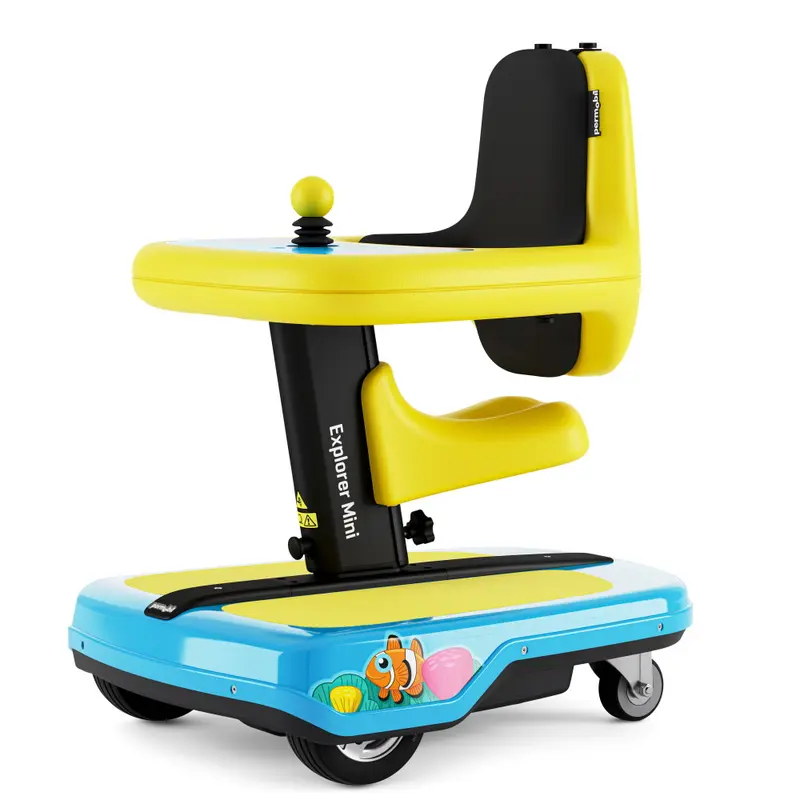
- Power for very young children: the Explorer Mini
- The Explorer Mini warnings, in Permobil's words
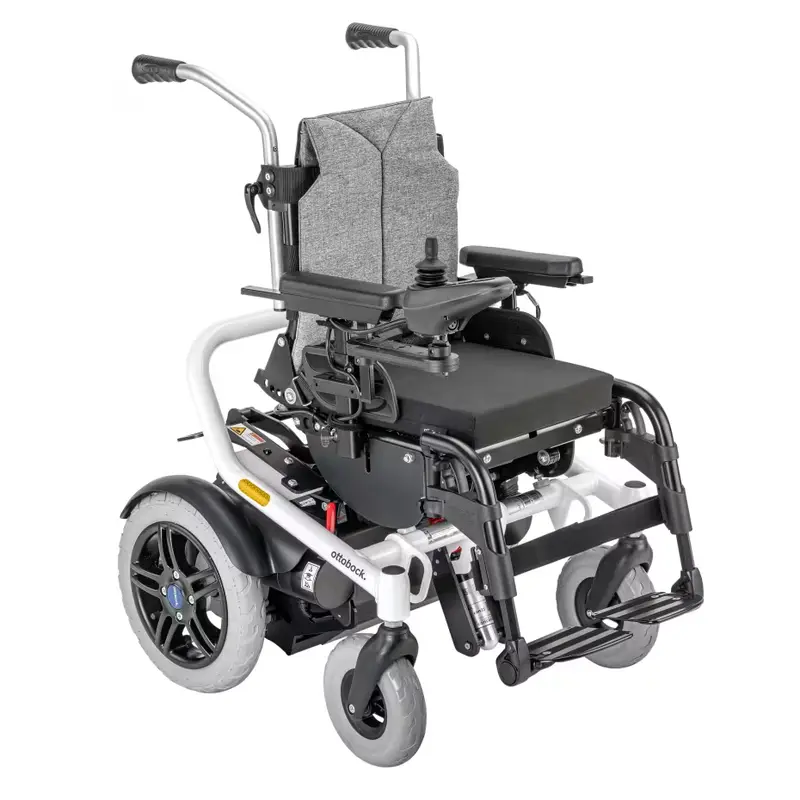
- Bigger children's power chairs in our catalog
- Adaptive strollers and tilt-in-space push chairs
- Is an adaptive stroller a wheelchair? What the FDA says
- Activity and classroom chairs: the Rifton Activity Chair
- Activity chair safety, in Rifton's words
- Riding in a vehicle: transit models and WC19
- Supervision: what the makers say
- Using an adaptive stroller safely
- What children's mobility equipment costs as listed
- Strollers and push chairs on one retailer's page
- Options, shipping and codes: reading a price list
- Who pays for a child's wheelchair or stroller?
- Medicaid EPSDT: what the benefit covers
- Does Medicaid EPSDT have to cover a child's wheelchair?
- EPSDT: prior authorization, soft limits and appeals
- School and IDEA: what counts as assistive technology
- Can the school buy the equipment, and can it come home?
- Birth to three: IDEA Part C and the IFSP
- Private insurance: what we could and could not read
- UnitedHealthcare Children's Foundation grants
- Variety's Freedom Program
- Putting the routes together
- The recall file: what the FDA records show
- The Zippie Voyage seat-detach recall
- Other recalls: belts, buckles, tilt and manuals
- Second-hand and loaned equipment
- Three traps
- Three composite scenarios
- What to ask the therapist, the school, the dealer and the funder
- Sources and documents
- Common questions
- Sources
The short answer
What is the difference between a pediatric wheelchair, a power chair for a toddler, an adaptive stroller and an activity chair? Mobility Atlas read the makers' pages, manuals and price lists, the FDA's classification and recall records, and the federal Medicaid and school rules in October 2026. A pediatric manual wheelchair, such as the Zippie Zone, is a light frame built for the child to push; Sunrise prints 14 pounds and 3 inches of depth growth in the frame. A toddler power device, such as the Permobil Explorer Mini, is for ages 12 to 36 months, with a top speed of 1.5 mph, and needs an adult present. An adaptive stroller, such as the Convaid Rodeo, is pushed by an adult and tilts from 5 to 45 degrees. An activity chair, such as the Rifton Activity Chair, is classroom or home seating on casters, and Rifton says not to use it as a transport chair in vehicles. Listed prices we read ran from 699.95 to 7,770 dollars.
| Type | Who moves it | Example we read | Price as printed (USD) |
|---|---|---|---|
| Pediatric manual wheelchair | The child, by the wheels | Sunrise Zippie Zone | Not printed |
| Power chair, very young child | The child, by joystick | Permobil Explorer Mini | 2,944.00 order form |
| Adaptive stroller, tilt push chair | An adult pushes | Convaid Rodeo | 2,745 list; 2,470.50 sale |
| Activity or classroom chair | An adult rolls it | Rifton Activity Chair | Not printed |
Who pays depends on the child's coverage and setting. Medicaid's EPSDT benefit covers medically necessary equipment for children under 21, decided case by case. A school must provide assistive technology the IEP Team finds the child needs to receive a free appropriate public education. Private health plans set their own rules, and we read none. Charities such as the UnitedHealthcare Children's Foundation and Variety can help with what is left. The child's physical or occupational therapist, the seating clinic and the physician decide what the child needs; this guide explains the options and the paperwork.
Mobility Atlas earns a fee or margin when you order through us; the comparison below uses only the makers' published documents, one retailer's published prices, the federal agencies' and charities' own pages, and our own catalog. If you want us to find a chair, price a model your therapist has named, or put together the quote a funder asks for, send an enquiry with the model, your state and your funding route, and ask us to find it.
How we compared
We read and saved fourteen sets of documents: the federal rules, the FDA pages and the recall records on 22 October 2026, and the makers' pages, the retailer's page and the charities' pages on 23 October 2026. They are the makers' pages, manuals, price list and order form for the Zippie Zone, the Explorer Mini, the Convaid Rodeo and the Rifton Activity Chair; Adaptivemall's special needs stroller category; Medicaid.gov's EPSDT page and the CMS guide for states (June 2014); the IDEA rules at 34 CFR 300.5, 300.6 and 300.105 and the Department of Education's January 2024 paper on assistive technology; the FDA's LBE classification page, 21 CFR 890.3850 and the FDA recall records; and the UHCCF and Variety pages.
We also read the pediatric rows of our own catalog: eight children's manual and tilt chairs (MW-040 to MW-047), three children's power chairs (PW-020 to PW-022) and the Rifton Stander (WT-012). Catalog prices are guide prices, written as "around", from our catalog, checked October 2026.
Four limits matter. First, we did not sit a child in, push or measure any chair; every figure is the maker's, the seller's or the agency's. Second, Rifton and Sunrise print no price. Third, we read no private insurer's policy, so this guide states no private plan rule. Fourth, the rules here are federal US rules; states run Medicaid and school districts run IEPs, so confirm with your plan or school before you count on any route.
Four kinds of equipment side by side
One row per product we read, with the same columns. Not printed means the page we read did not print it.
| Product | Kind | Size or age as printed | Weight | User limit |
|---|---|---|---|---|
| Sunrise Zippie Zone | Rigid manual chair | Seat width 8 to 16 in | 14 lb | 165 lb |
| Permobil Explorer Mini | Power, joystick | 12 to 36 months; to 39 in | 52 (unit not printed) | 35 lb |
| Convaid Rodeo RD10 to RD16 | Tilt push chair | Seat width 10 to 16 in | 29 to 39 lb | 75 to 170 lb |
| Rifton Activity Chair, small | Activity chair | User height 28 to 48 in | Not printed | 75 lb |
| Rifton Activity Chair, medium | Activity chair | User height 40 to 56 in | Not printed | 150 lb |
| Rifton Activity Chair, large | Activity chair | User height 50 to 74 in | Not printed | 250 lb |
The table shows why these products are not substitutes. The Zone is the lightest of the chairs with a printed weight, and it is built for the child to push; Sunrise says it "provides the greatest wheel access for independent mobility." The Explorer Mini has a motor and a joystick but a 35 pound limit, so it is a first powered device for a toddler, not a chair a child grows into for years. The Rodeo weighs two to almost three times as much as the Zone, depending on size, and its user's guide says it is "an attendant-propelled device": an adult moves it. The Rifton chair carries a user of up to 250 pounds in its large size, but it is seating for an activity, not a way to get around.
Many children use more than one. A child may self-propel a manual chair at school, ride in a tilt stroller on a long day out, and sit in an activity chair at the table to eat. Which mix suits a child is a question for the therapist and the seating clinic.
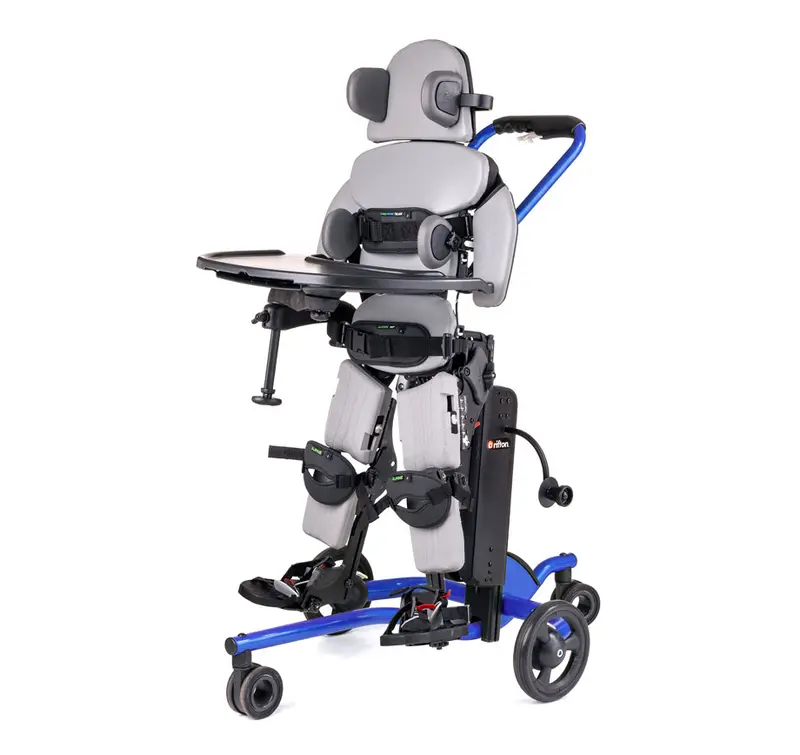
Standing frames, such as the Rifton Stander in our catalog, are a fifth category, covered in the Mobility Atlas guide to standing wheelchairs.
Pediatric manual wheelchairs: what the makers print
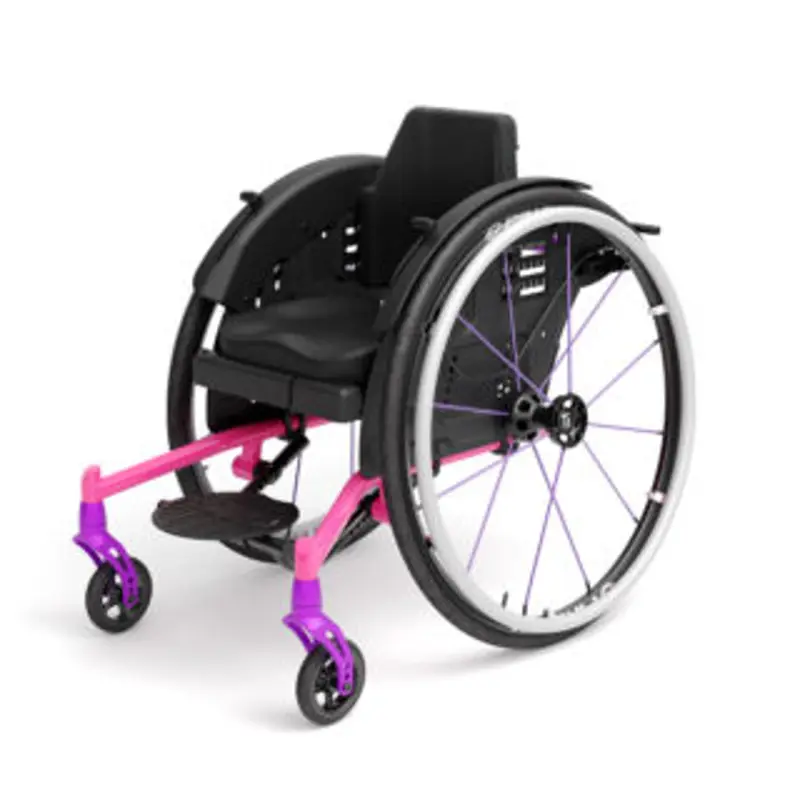
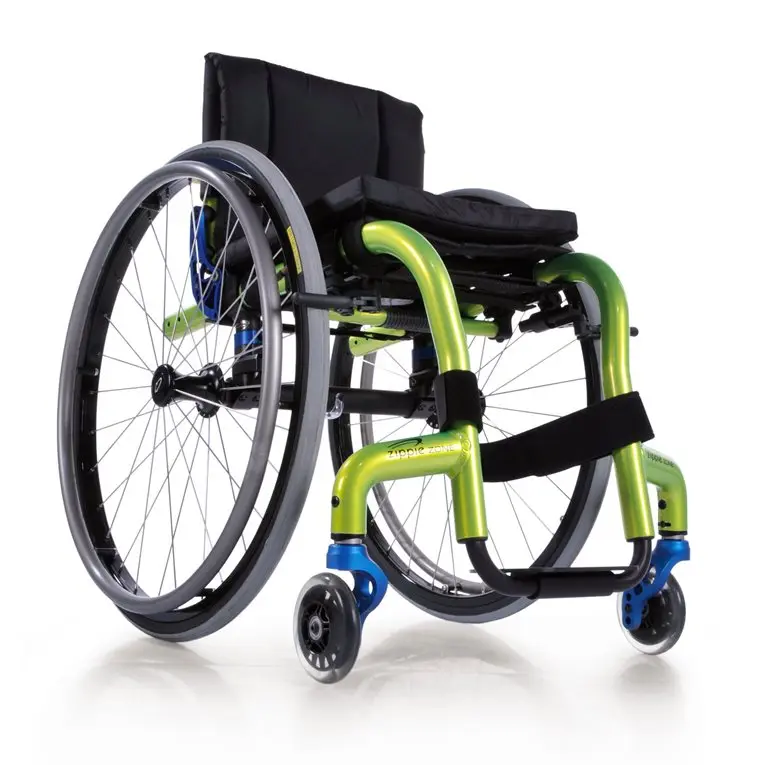
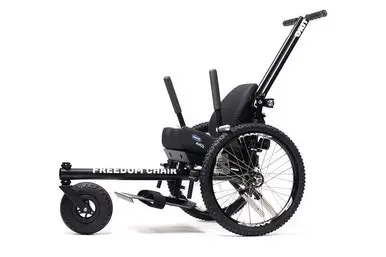
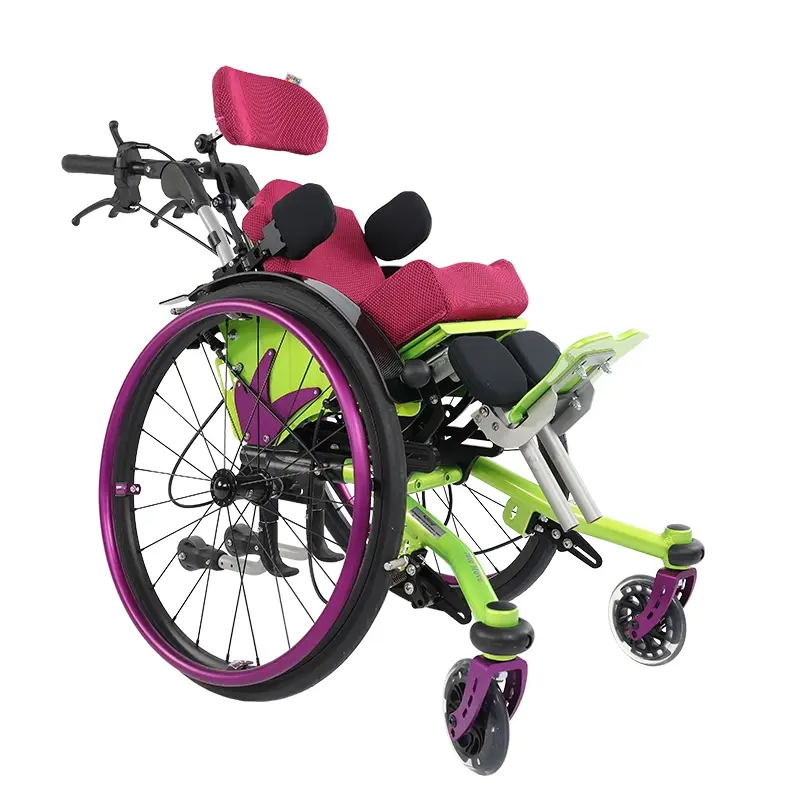
A pediatric manual wheelchair is a small, light frame built for a child to push. The Zippie Zone page calls it "an innovative, ultra lightweight, and option-rich pediatric rigid frame wheelchair" and says it is "perfect for active kids and teens." Sunrise prints a seat width of 8 to 16 inches, a seat depth of 9 to 18 inches, a front and rear seat height of 14 to 19 inches, camber of 0, 3 or 6 degrees, a 165 pound user limit and a product weight of 14 pounds. The frame is 7000 series aluminum. The page lists HCPCS codes E1235 and E1237 and the model number EIRZ1.
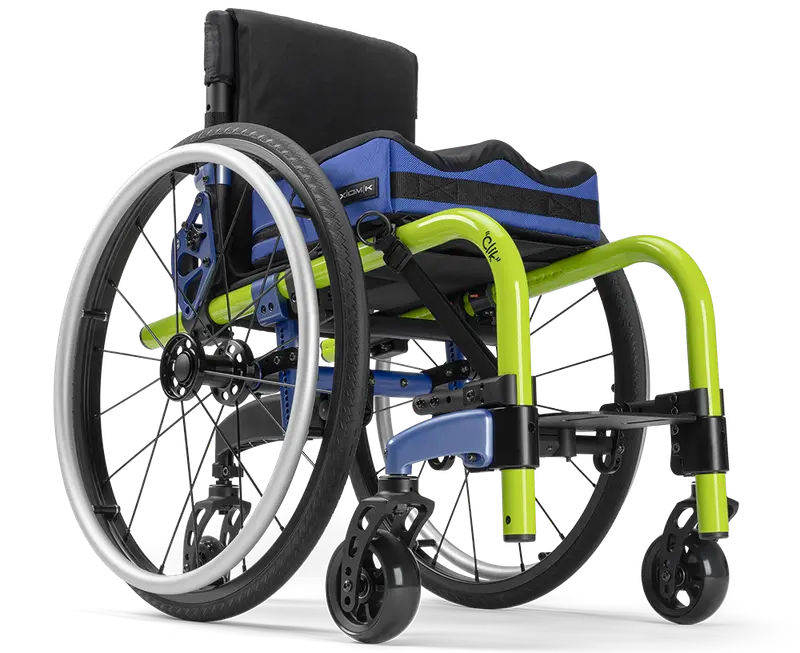
Our catalog holds seven more children's manual and tilt chairs. The TiLite Pilot grows from 8 by 9 inches to 14 by 15 inches, with a capacity of 120 pounds (95 pounds in transit), and is listed for children from about age 2. The Ki Mobility Little Wave Clik XP weighs 12.5 pounds, with a 165 pound capacity, and is listed from around 1,977 dollars as a US retailer's sale price, against a list price of 2,824. The Ottobock BRAVO Racer is from 9 kg, with a 60 kg user limit. The GRIT Junior is a lever-drive all-terrain chair listed at 4,995 dollars on its maker's site; for sport and off-road chairs, see sports wheelchairs. Our catalog was checked October 2026; its prices are guide prices.
Adult chairs are covered in the Mobility Atlas guide to lightweight wheelchairs.
Built to grow: depth, width and new parts
Children grow, and makers design for it. The Zone page says the chair has 3 inches of depth growth "built right into the frame" and 2 more inches "built into the sling upholstery." To widen the frame, Sunrise says, "simply replace a few parts, instead of the whole wheelchair frame." Convaid says the Rodeo has "up to 5 inches of seat depth growth," and each Rodeo size covers a 5 inch depth range, from 7 to 12 inches on the RD10 to 13 to 18 inches on the RD16. Rifton's Activity Chair page tells you to "choose the model that allows for growth," and its manual says the chair "allows for growth, can be used by multiple users."
Growth can still mean new parts, as Sunrise's width change shows. Ask the dealer which growth steps are included, which are parts you buy later, and which need a technician. Ask your funder whether growth parts count as a repair, a new item or neither. And ask the therapist how often the fit will be checked: a chair that was right last spring can be too small by the next school year. For adjustments and repairs, see the Mobility Atlas guide to manual wheelchair repair.
Convaid's user's guide says it plainly: "Do not use chair after occupant has outgrown it."
Weight, wheel access and independence
For a child pushing their own chair, every pound counts. Sunrise says that "when it comes to pediatric mobility, every pound holds more weight," and our catalog lists the Little Wave Clik XP at 12.5 pounds.
Weight is only part of it. The child has to reach the wheels. Sunrise says every inch of the Zone "was designed to give kids the best possible wheel access for efficient propulsion," with an inset backrest, a flip-up angle-adjustable footrest and a hub lock on the seat rail so that kids can "access the wheel locks without interference during propulsion."
How much a child can push, for how long, and in which setup is the therapist's call. The seat height, the center of gravity (the Zone allows 2.5 inches of adjustment) and any anti-tip tubes are set at the fitting, by the therapist and the dealer.
Power for very young children: the Explorer Mini
Permobil's Explorer Mini is a small powered device for toddlers. Permobil's page calls it "a regulatory cleared powered mobility solution that facilitates self-initiated movement and early exploration for young children," aged 12 to 36 months, with mobility impairments. The user manual's indications say it is "a pediatric powered wheelchair" for children weighing up to 16 kg (35 lb) and up to 100 cm (39 inches) tall, between 12 and 36 months, who can operate a joystick hand control, for use "indoor and outdoor on dry, firm, flat surfaces."
The page lists a driving range of 3 miles, a base 19 inches wide and 25 inches long, a ground clearance of 1 inch, a seat-to-floor height of 12.1 to 21.7 inches, and a weight of 52 pounds with batteries. The page prints the width, length and weight without units; we read them as inches and pounds, which matches the 24 kg a UK dealer lists in our catalog. The order form lists a front-wheel drive base with joystick, tray table, back support, removable seat, batteries and charger, and a top speed of 1.5 mph.
The Explorer Mini is a prescription device. The manual says, "This device is designed to be used only by individuals to whom it was prescribed by a healthcare provider." The page lists a six month limited product warranty; we did not open the warranty document, so ask the dealer for its terms.
The Explorer Mini warnings, in Permobil's words
Permobil's user manual lists the rules plainly, and they are the rules a family lives with day to day.
- Supervision: "The Explorer Mini must only be used when an adult is present and continuously monitors the child," the manual says.
- Where to drive: it "must not be driven on public streets, roads, stairs or escalators," the manual says.
- Backing up: the manual warns that if the child drives backward into something at backrest height, such as a table or a bed, the Explorer Mini "can become less stable and tip forward or sideways."
- Head height: the manual says "Driving into obstacles at head level can cause injuries."
- Adjusting: "Do not adjust the settings while the child is in the Explorer Mini," the manual says, and it warns of a pinch risk when you adjust the height.
- Charging: the manual says to "only use chargers with a max 1.5 A charging current" and that batteries "must not be charged outdoors, in a bathroom or a wet room."
The manual also says "an adult or healthcare provider must decide which driving position is the most adequate one for the child." For a child who will move on to a full power chair, see the Mobility Atlas guide to power wheelchair batteries for battery, charging and range questions.
Bigger children's power chairs in our catalog
If a child outgrows a toddler device and the care team recommends continued powered mobility, the next size up is a children's power wheelchair. We did not read maker documents for these for this guide, so we give only what our catalog rows hold, checked October 2026, and no US prices, because none of the three rows carries a US dollar price; PW-020 has only a UK price and a rough conversion.
| Chair | What our catalog lists | User limit |
|---|---|---|
| Zippie Q300 M Mini Kids | Mid-wheel drive; seat width 280 to 400 mm | 75 kg |
| Ottobock Skippi | Top speed 7.2 km/h; turning radius 680 mm | 50 kg |
| Permobil Explorer Mini | Toddler device, ages 12 to 36 months | 16 kg |
Our catalog row for the Explorer Mini, from a UK dealer, lists it at GBP 2,600 before VAT; its speed and range differ slightly from Permobil's US figures, which we use.
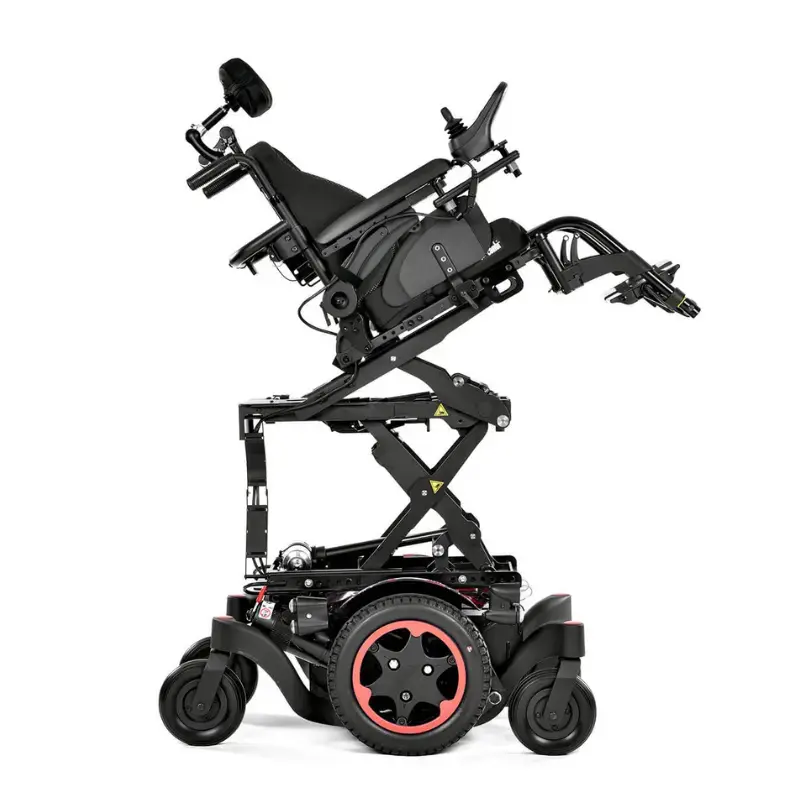
For adult and older-child power chairs, drive types and controls, see the Mobility Atlas guide to electric wheelchairs. Whether a child is ready to drive, and with which control, is for the therapist and the seating clinic to assess.
Adaptive strollers and tilt-in-space push chairs
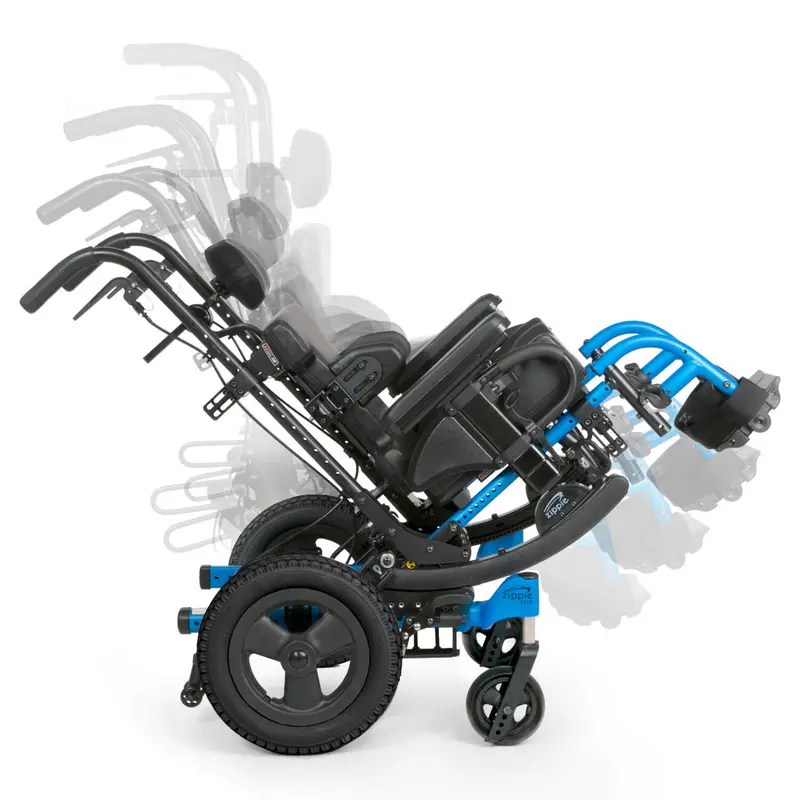
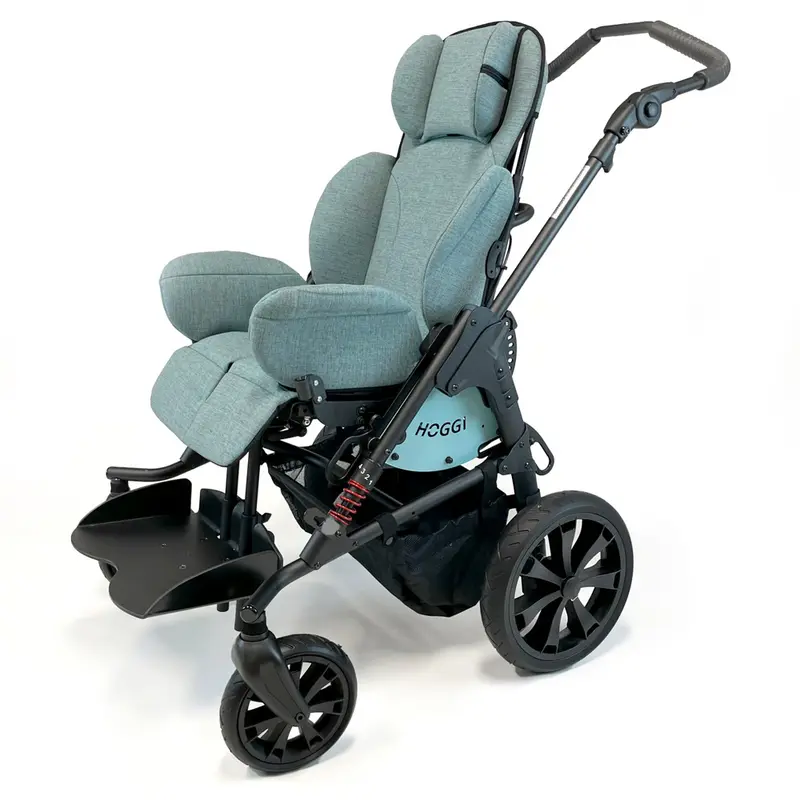
An adaptive stroller, also sold as a special needs stroller or push chair, is a seat on wheels that an adult pushes, with more support than a baby stroller. The Convaid Rodeo is one: Etac, whose site Convaid's old address now points to, calls it a "tilt-in-space wheelchair" designed "for children with limited mobility." The user's guide says the Rodeo "is an attendant-propelled device."
The Rodeo comes in four seat widths: 10, 12, 14 and 16 inches. The seat tilts from 5 to 45 degrees, and an option reclines the back to 90 or 110 degrees. The chairs weigh 29, 33, 37 and 39 pounds and carry 75, 75, 100 and 170 pounds.
The retailer we read, Adaptivemall, listed 19 strollers and push chairs on the first two pages of its category, from makers including Convaid, Firefly, Special Tomato, Leggero, Thomashilfen and Adaptive Star. Some have a fixed seat angle, such as the Convaid Cruiser at a fixed 30 degree tilt or the EZ Rider at an upright 10 degree seat angle, as Convaid describes them; others, such as the Rodeo, tilt. Tilt is a clinical feature, and the Mobility Atlas guide to tilt-in-space wheelchairs covers it.
Is an adaptive stroller a wheelchair? What the FDA says
For the FDA, yes: it sits under the same regulation. The FDA's product classification page lists product code LBE, Stroller, Adaptive, under regulation number 890.3850, whose description is "Mechanical wheelchair." The page lists it as device class 1, with a 510(k) submission type.
The regulation, 21 CFR 890.3850, says a mechanical wheelchair "is a manually operated device with wheels that is intended for medical purposes," and classes it as Class I (general controls).
Why it matters to a family: in FDA terms an adaptive stroller is a medical device, not a baby product. It comes with a manual, a weight limit and warnings, and makers print billing codes for it (Convaid's Rodeo list prints HCPCS E1232 and E1161). Funders decide for themselves what they cover: the UnitedHealthcare Children's Foundation, for one, excludes "Strollers or wagons (unless a medical adaptive stroller)," its grant page says. The adaptive strollers in our recall file, such as the Zippie Voyage and the Kimba Plus, appear in the FDA's medical device recall database.
Activity and classroom chairs: the Rifton Activity Chair
An activity chair is positioning seating for the table, the classroom or therapy, on a base with casters. Rifton's manual calls the Activity Chair "a Class 1 medical device" that "is intended to provide comfortable seating with adjustable support for people with disabilities in the classroom or at home." Rifton's page names feeding, speech therapy and active learning as uses.
Rifton sells it in three sizes, each with a standard base or a hi/lo base that raises and lowers the seat with a foot pump.
| Model | User height (in) | Tilt in space | Max load |
|---|---|---|---|
| R820 small, standard | 32 to 48 (28 to 38 mini kit) | 15 fwd, 15 back | 75 lb |
| R830 small, hi/lo | 28 to 48 (28 to 32 mini kit) | 15 fwd, 25 back | 75 lb |
| R840 medium, standard | 40 to 56 | 15 fwd, 15 back | 150 lb |
| R850 medium, hi/lo | 40 to 56 | 15 fwd, 25 back | 150 lb |
| R860 large, standard | 50 to 74 | 15 fwd, 15 back | 250 lb |
| R870 large, hi/lo | 50 to 74 | 15 fwd, 25 back | 250 lb |
The page lists tool-free adjustments made with the child in the chair, a spring option and a universal device mount. On the hi/lo bases the seat sits 10 to 25 inches above the floor on the R830, 12 to 23 on the R850 and 16 to 24 on the R870. Rifton prints no price: its model pages are titled Get a Quote.
Activity chair safety, in Rifton's words
Rifton's product manual opens with safety messages. They are worth reading before the chair arrives.
- Supervision: "This product is intended for use by clients of unreliable judgment. Adult supervision is required at all times," the manual says.
- Assessment: "A qualified professional must assess the appropriateness and safety of all equipment for each user," the manual says.
- Vehicles: "Do not use this product as a transport chair in vehicles," the manual says.
- Where to use it: the manual says not to use it "on rough and uneven terrain, around swimming pools, or near stairways."
- Belts: the manual says to "always use seatbelt or pelvic harness" when the tray, chest straps, thigh belt, mini trunk support or butterfly harness are in use, to prevent falls, strangulation and head entrapment.
- Checks: the manual says to inspect the chair regularly "for loose or missing screws, metal fatigue, cracks, broken welds," and to remove it from use when anything makes it unsafe.
The tilt warning matters at home, where siblings are near: "To prevent pinching or crushing, keep hands and limbs away from moving parts when adjusting chair," the manual says.
Riding in a vehicle: transit models and WC19
Not every child's seat may be used as a seat in a moving vehicle, and the makers say which can. Convaid sells a Rodeo Transit model. Its price list says the transit option "includes four manufacturer installed black wheelchair transportation anchors," and that the Rodeo Transit "has been crash tested and conforms to RESNA WC19 and ISO 7176-19:2022 standards." The Zippie Zone page lists Transit: Yes.
One product is clear in the other direction: Rifton's manual says, "Do not use this product as a transport chair in vehicles." For the Explorer Mini, Permobil prints no transit rating on the pages we read; its manual's warning that it "must not be driven on public streets, roads, stairs or escalators" is about driving, not riding, so ask Permobil before any vehicle use.
Transit features must be ordered and set up right. One FDA recall record, from 2012, concerns a single Zippie TS chair that "was shipped with transit brackets for use a seat in a motor vehicle, however the chair was not configured with a back tested seat for motor vehicle use," the recall says. Ask the dealer in writing whether the exact configuration, with its back, seat and options, is transit tested. For tie-downs, school buses and vans, see the Mobility Atlas guide to wheelchair vans.
Supervision: what the makers say
Three of the four makers whose documents we read tell families, in their manuals, not to leave the child alone in the equipment; the Zippie Zone product page we read does not mention supervision, so check its manual.
| Product | Maker's words on supervision |
|---|---|
| Rifton Activity Chair | Adult supervision required at all times |
| Convaid Rodeo | Never leave occupant unattended |
| Permobil Explorer Mini | Adult present, continuously monitors |
| Zippie Zone | Not on the product page we read |
The recall records show why. A 2008 recall of a toddler chair hip strap says that "if a child were left unattended in spite of the warnings on the product and in the manual, a defective hip strap could loosen," which could let the child slip down in the chair and create a choking hazard, the record says. Supervision recurs in all three manuals we read, and belts in Rifton's and Convaid's.
Using an adaptive stroller safely
Convaid's user's guide has a list of cautions for the Rodeo; your own chair's manual will have its version. In Convaid's words:
- "The wheelchair is not suitable for jogging, running, skating or similar activities," the guide says; swiveling front wheels can wobble at speed, cause a sudden stop and tip the chair.
- "Use the wheelchair only at regular walking speed," the guide says, and never let go of the push handle while pushing.
- "Always apply the wheel locks before letting go of the chair," the guide says, and "Do not leave the user unattended even when he/she is strapped in and the wheel locks are engaged."
- "The seat belt should be used at all times," the guide says, but "Do not strap the user too tight. Straps should not interfere with breathing or circulation."
- "Do not use the footplates for weight support during exit and entry of the chair," the guide says.
- The guide lists tire pressures of 36 psi front and 30 psi rear, and says not to use the chair without them.
The guide gives the Rodeo's durability as five years with proper care and maintenance. A jogging stroller is a separate product: Adaptivemall listed a Special Tomato Jogger. Use each product only for what its own manual allows.
What children's mobility equipment costs as listed
These are prices printed by the makers and one retailer, read on 23 October 2026, and guide prices from our catalog, checked October 2026, in US dollars unless marked, before options, shipping and tax. Prices differ by state, dealer, funding route and tax, so treat the table as a starting point, not a quote.
| Product | Price | Where we read it |
|---|---|---|
| Convaid Rodeo, RD10 to RD16 | 2,745 | Convaid list, read 23 October 2026 |
| Convaid Rodeo Transit | 2,967 | Convaid list, read 23 October 2026 |
| Convaid Rodeo Tilt Stroller | 2,470.50 sale | Adaptivemall, 23 October 2026 |
| Permobil Explorer Mini | 2,944.00 | Order form dated August 2025 |
| Explorer Mini, UK | GBP 2,600 before VAT | Catalog PW-020, UK dealer |
| Ki Mobility Little Wave Clik XP | Around 1,977; list 2,824 | Catalog MW-041 |
| GRIT Junior | 4,995 | Catalog MW-044, maker site |
| Sunrise Zippie Zone | Not printed | Dealer login only |
| Rifton Activity Chair | Not printed | Get a Quote pages |
The Rodeo shows why two numbers for one product are both true. Convaid's own retail price list, effective 1/5/2026, lists every standard Rodeo size at 2,745 dollars. Adaptivemall's category page listed the Convaid Rodeo Tilt Stroller at a sale price of 2,470.50 dollars on 23 October 2026, 274.50 less. One is the maker's list price, the other one seller's sale price; we did not compare what each includes. Ask any seller for a written quote for the exact configuration.
The Explorer Mini price, 2,944.00 dollars, is printed on Permobil's order form for the US, dated August 2025, which we read on 23 October 2026. The form is addressed to dealers, and it says "all specifications and prices are subject to change without notice." Ask a dealer for the current figure.
Strollers and push chairs on one retailer's page
These are the 19 strollers and push chairs on the first two pages of Adaptivemall's special needs stroller category, read on 23 October 2026, as base prices; where the page showed a regular and a sale price, we give both.
| Stroller or push chair | Price as listed (USD) |
|---|---|
| Special Tomato EIO Push Chair | 699.95 sale |
| Special Tomato Jogger | 799.95 sale |
| Firefly WeGo Pushchair | 899.00 sale |
| Adaptive Star Axiom Improv | 2,004.99 regular; 1,666.99 sale |
| Adaptive Star Axiom Lassen | 2,077.99 regular; 1,713.99 sale |
| Adaptive Star Axiom Phoenix | 2,152.99 regular; 1,798.99 sale |
| Convaid Coaster Scout | 1,840.50 sale |
| Convaid EZ Rider | 1,863.00 sale |
| Convaid Cruiser | 1,886.40 sale |
| Adaptive Star Axiom Endeavour | 2,674.99 regular; 2,204.99 sale |
| Leggero Reach | 2,393.80 sale |
| Convaid Rodeo Tilt | 2,470.50 sale |
| Thomashilfen Swifty | 2,674.00 regular; 2,540.30 sale |
| Convaid Cruiser Scout | 2,636.10 sale |
| Leggero Dyno | 3,038.75 sale |
| Leggero Trak | 3,490.80 sale |
| Thomashilfen EASyS Advantage | 4,902.95 sale |
| Thomashilfen EASyS Modular S | 5,499.00 regular; 5,224.05 sale |
| Thomashilfen tRide | 7,770.00 regular; 7,381.50 sale |
A compact fixed-angle push chair, such as the Convaid Coaster Scout, and a 7,770 dollar Thomashilfen tRide sit in the same category on the page. Compare like with like: the seat size, tilt, recline, weight limit, transit rating and what supports come in the base price.
Options, shipping and codes: reading a price list
A base price is rarely the final price. Convaid's Rodeo price list prints its options with their own prices and HCPCS codes. A few of them, as printed:
| Rodeo option | Price (USD) | Code as printed |
|---|---|---|
| Recline option | 513 | E1225 |
| Height adjustable flip-up armrests | 254 | E0973 |
| Attendant hand brakes | 262 | Not printed |
| Rear anti-tip tubes | 128 | E0971 |
| Transit anchor brackets | 223 | E1022 |
| Headrest extension | 144 | E0966 |
| H-harness with padded covers | 109 | E0960 |
| 3-point pelvic belt | 54 | E0978 |
| Padded headwings | 271 | E0955 |
| Full torso support vest | 293 | K0108 |
| Support cushion, general use | 267 | E2601 |
Standard domestic shipping is 40 dollars, and prices are "ex works Torrance, California," the list says. So a standard Rodeo with the recline option and shipping comes to 3,298 dollars at list. The transit model alone lists 222 dollars above the standard one. The recline option carries a footnote mark on the list, so ask Convaid or the dealer which options can be ordered on the Rodeo Transit, and whether it is still transit tested with them.
HCPCS codes are billing codes, and Convaid's list says providers are responsible for using the right ones when submitting claims. The Rodeo list prints HCPCS E1232 and E1161 for the chair. Both Convaid and Permobil warn that a code is no promise of payment. Convaid's list says, "Proper use of HCPCS codes does not insure coverage or payment. Contact the appropriate payer for coverage information." The supplier and the payer decide which codes apply.
Who pays for a child's wheelchair or stroller?
Who pays for a wheelchair, adaptive stroller or activity chair for a child in the US? Mobility Atlas read the federal Medicaid and IDEA rules and two charities' pages in October 2026: there are four main routes. Medicaid's EPSDT benefit covers children under 21 enrolled in Medicaid, including medical equipment, when the state finds it medically necessary to "correct or ameliorate" the child's condition, decided case by case. A school must provide assistive technology if the child's IEP Team finds it is needed for a free appropriate public education, and home use of school-purchased devices is decided case by case by the IEP Team. Private plans set their own rules; we read none, so ask yours. Charities can help with what is left: the UnitedHealthcare Children's Foundation prints income limits and a 5,000 dollar limit per 12 months, and Variety's Freedom Program may cover manual and powered wheelchairs through local chapters. If your child is enrolled, ask your Medicaid plan how it applies EPSDT.
| Route | Who it is for, as printed | Who decides |
|---|---|---|
| Medicaid EPSDT | Enrolled children under age 21 | The state, case by case |
| IDEA Part B, the IEP | Children with disabilities, ages 3 through 21 | The IEP Team |
| IDEA Part C, the IFSP | Birth to age 3 | The IFSP Team, with a parent |
| Private health plan | Depends on the plan | The plan; we read no policy |
| UHCCF grant | Age 16 or younger, commercial insurance | UHCCF's Regional Boards |
| Variety Freedom Program | Not printed on the national page | Local chapter |
These routes can overlap, and no document we read sets the order in which to ask.
Medicaid EPSDT: what the benefit covers
EPSDT stands for Early and Periodic Screening, Diagnostic and Treatment. Medicaid.gov says the benefit "provides comprehensive and preventive health care services for children under age 21 who are enrolled in Medicaid." The T, for treatment, is the part that covers equipment. The page says, "States are required to furnish all 1905(a) Medicaid coverable, appropriate, and medically necessary services needed to correct and ameliorate health conditions, based on certain federal guidelines."
The CMS guide for states, from June 2014, spells out the scope. It says EPSDT entitles enrolled children to any treatment that fits a Medicaid category in section 1905(a) if it is necessary to "correct or ameliorate" defects and physical and mental illnesses or conditions. The guide lists "home health services, including medical equipment, supplies, and appliances" among them, and physical and occupational therapies too.
Two points in the guide matter most for equipment. First, the item does not have to be in the state's adult plan. The guide says that if equipment "determined to be medically necessary for a child is not listed as covered (for adults) in a State Medicaid Plan, the state will nonetheless need to provide it to the child," as long as it falls within the 1905(a) categories. Second, it does not have to cure anything. The guide says, "A service need not cure a condition in order to be covered under EPSDT," because services that maintain or improve the child's condition "ameliorate" it, and it names "decubitus cushions, bed rails and augmentative communication devices" as less common examples of durable medical equipment.
Does Medicaid EPSDT have to cover a child's wheelchair?
Does Medicaid have to pay for a wheelchair for a child under EPSDT? Mobility Atlas read the Medicaid.gov EPSDT page and the CMS guide for states in October 2026. If equipment is medically necessary for that child and fits a Medicaid category, the state must cover it, but the state decides case by case. The CMS guide says the determination "must be made on a case-by-case basis, taking into account the particular needs of the child," and that the state should consider "the child's long-term needs, not just what is required to address the immediate situation." It says "flat limits or hard limits based on a monetary cap or budgetary constraints are not consistent with EPSDT requirements," and that "A state may not deny medically necessary treatment to a child based on cost alone." A state may still require prior authorization and weigh equally effective cheaper options. Families can appeal a denial at a state fair hearing. States run Medicaid; ask your plan.
If the treating provider and the state disagree, the CMS guide says "the state is responsible for making a decision, for the individual child, based on the evidence," so the therapist's and physician's written assessment matters.
EPSDT: prior authorization, soft limits and appeals
States may use utilization controls. The CMS guide says a state may set tentative limits and "require prior authorization for coverage of medically necessary services above those limits," but that "Prior authorization must be conducted on a case-by-case basis, evaluating each child's needs individually" and "may not delay delivery of needed treatment services." A soft limit can be passed if the child's case shows more is needed; a hard limit cannot be applied to children, the guide says, using physical therapy visits as its example.
On cost, the guide says a state "may consider the relative cost effectiveness of alternatives as part of the prior authorization process," and may cover the less expensive option only "as long as the less expensive service is equally effective and actually available." It adds, "The child's quality of life must also be considered."
If the state says no, the guide says the decision "may be appealed by the child (or the child's family) under the state's Medicaid fair hearing procedures." Ask the plan for the denial in writing, with the reason, and ask how long you have to appeal. Keep copies of the therapist's assessment, the physician's prescription, the quote and every letter. If your child's Medicaid runs through a managed care plan, note that the guide says medical necessity may be weighed by "the managed care entity as delegated by the state," so ask the plan how it decides and what its own appeal steps are.
School and IDEA: what counts as assistive technology
The Individuals with Disabilities Education Act (IDEA) gives children with disabilities a right to a free appropriate public education, which the regulations shorten to FAPE. Its regulations define what a school must consider. At 34 CFR 300.5, an assistive technology device "means any item, piece of equipment, or product system, whether acquired commercially off the shelf, modified, or customized, that is used to increase, maintain, or improve the functional capabilities of a child with a disability." The rule says the term excludes surgically implanted devices.
At 34 CFR 300.6, an assistive technology service "means any service that directly assists a child with a disability in the selection, acquisition, or use of an assistive technology device." The rule says that includes evaluating the child's needs, buying or leasing the device, and "Selecting, designing, fitting, customizing, adapting, applying, maintaining, repairing, or replacing assistive technology devices," plus training for the child, the family and staff.
At 34 CFR 300.105, each public agency "must ensure that assistive technology devices or assistive technology services, or both" are made available to a child with a disability if required as part of the child's special education, related services or supplementary aids and services, the rule says. A wheelchair, a stroller or an activity chair can fall within that definition. Whether it does for your child is the IEP Team's decision.
Can the school buy the equipment, and can it come home?
The Department of Education's January 2024 paper on assistive technology answers several common beliefs. It says, "Each time an IEP Team develops, reviews, or revises a child's IEP, the IEP Team must consider whether the child requires AT devices and services." When the team finds them needed for FAPE, the local educational agency (LEA) "is responsible for providing and maintaining the AT device," the paper says, and "The IEP Team has discretion in determining the type of AT device and service that the child needs to receive meaningful educational benefit."
On money, the paper says IEP Teams "must provide and fully fund the AT devices and services if the IEP Team determines they are necessary to provide FAPE for the child." The paper also says AT devices and services "must be funded by the LEA," and that AT written into the IEP must be provided "at no cost to the child." If team members lack knowledge about AT options, the paper says "they must engage other individuals who are knowledgeable about AT options in the decision-making process." The CMS guide adds that "Medicaid covered services included in the IEP may be provided in, and reimbursed to, schools."
On home use, the rule at 34 CFR 300.105(b) says: "On a case-by-case basis, the use of school-purchased assistive technology devices in a child's home or in other settings is required if the child's IEP Team determines that the child needs access to those devices in order to receive FAPE." The 2024 paper adds that AT "could be utilized during nonacademic and extracurricular activities" including transportation and athletics. None of this promises a result: the IEP Team decides. For AT written into the IEP, if the school and the parent cannot agree on using the child's own device, the paper says "the LEA must make an appropriate AT device available for the child." Rifton offers a Letter of Educational Necessity for the Activity Chair among its downloads, alongside a Letter of Medical Necessity.
Birth to three: IDEA Part C and the IFSP
For babies and toddlers, IDEA works differently. The CMS EPSDT guide says Part C "covers early intervention services" for children from birth to age 3, provided under an Individualized Family Service Plan (IFSP). The Department of Education's 2024 paper says that if an IFSP Team, "in collaboration with a parent," determines an AT device or service is required to meet the developmental needs of an infant or toddler with a disability, "then the AT device or service must be provided to the infant, toddler or family members at no cost." It must be written into the IFSP and reviewed with it.
That matters for the youngest products in this guide. The Explorer Mini is for children 12 to 36 months, so its age range falls within the Part C band of birth to age 3. Whether it, or another device, belongs in a toddler's plan is the IFSP Team's decision, with the family and the child's therapists. Ask your early intervention coordinator how your state handles AT under Part C and how it works alongside Medicaid.
The age bands differ at the top too. A footnote in the CMS guide says that "EPSDT covers children only through age 20 (up to the 21st birthday), the IDEA covers children through age 21 (up to the 22nd birthday)."
Private insurance: what we could and could not read
We read no private insurer's policy, so we state no private plan rule. Ask your plan for its durable medical equipment policy in writing: which items need prior authorization, which suppliers are in network, and what share you pay.
The documents we did read touch on insurance in three ways. Convaid's price list says, "Contact the appropriate payer for coverage information." Permobil's order form says use of the codes "does not ensure coverage" for the item. And the UnitedHealthcare Children's Foundation asks for "a copy of the explanation of benefits (EOB) from your primary medical insurance carrier," its grant page says, showing how the plan processed the charges, including the patient responsibility amount.
A child with both private insurance and Medicaid may have Medicaid as a second payer; the UHCCF page itself says "Secondary insurance through Medicaid or CHIP is acceptable." Ask both plans which pays first. We read nothing on CHIP's own rules.
UnitedHealthcare Children's Foundation grants
The UnitedHealthcare Children's Foundation (UHCCF) prints its rules in full. Its grant page says, "The child must be 16 years of age or younger at the time of the application." The family's Adjusted Gross Income, from line 11 of the current year's IRS Form 1040, must not exceed these limits, as printed:
| Family size | Maximum Adjusted Gross Income (USD) |
|---|---|
| 2 | 65,000 or less |
| 3 | 100,000 or less |
| 4 | 135,000 or less |
| 5 or more | 170,000 or less |
The child must have a Social Security number. "The child must have primary insurance coverage by a commercial health plan, either through an employer or individually purchased," the page says, with Medicaid or CHIP accepted as secondary insurance. The commercial coverage must stay in place through the whole application and grant; if it lapses, the page says, the grant is closed. Equipment must be prescribed by an M.D., a D.O., or an Au.D. for hearing conditions, and bought in the United States, excluding the U.S. Virgin Islands, Puerto Rico and other territories.
On amounts, the page says, "The amount awarded to an individual within a 12-month period is limited to $5,000. Awards to any one individual are limited to a lifetime maximum of $10,000." The grant can reach back only 90 days: costs from more than 90 days before UHCCF finds the application complete are not considered, the page says, and the grant expires one year after Board approval. Strollers and wagons are excluded "unless a medical adaptive stroller," and so are warranty or service plans, the page says. An application that is not approved must wait 12 months to reapply unless the condition and request have significantly changed.
Variety's Freedom Program
Variety of the United States, The Children's Charity, runs a Freedom Program. Its page says the program "delivers vital life-changing equipment and services for mobility, independence and social inclusion to individual children and children's organizations." It says Freedom grants may cover "Manual and powered wheelchairs," adaptive bicycles and trikes, hoists and lifts, modified vehicle access, standing and walking aids such as gait trainers and standing frames, positioning systems, and specialized car seating, among other items.
Variety prints no grant amounts, no income limits and no eligibility criteria on its national pages. Its grants page says, "To find out if you qualify to receive help from Variety - The Children's Charity, please find your local chapter and contact the chapter directly." It lists 22 chapters, from Buffalo and Western New York to Wisconsin. If none covers your area, the page asks you to email the national office with the child's name, age and diagnosis, your city and state, the equipment and its estimated cost, and your annual household income.
So with Variety, the first step is a call or email to the nearest chapter, with a written quote in hand.
Putting the routes together
No document we read sets one order for all families, and we promise no outcome. These steps follow from what the documents say each route needs.
- Get the assessment. The child's physical or occupational therapist, the seating clinic and the physician decide what the child needs and write it down. Most routes ask for it: UHCCF needs a prescription from an M.D. or D.O., and Medicaid weighs the treating provider's view. For school, the evaluation of the child's needs is itself an assistive technology service under IDEA, so ask the IEP Team who will do it.
- Ask your Medicaid plan, if the child is enrolled, how it handles EPSDT equipment requests and prior authorization.
- If the child is in school or early intervention, ask the IEP or IFSP Team to consider the equipment at the next meeting and, for an IEP, whether it is needed at home to receive FAPE.
- If the child has commercial insurance, ask the plan for its equipment policy and keep the explanation of benefits.
- For what is left, check UHCCF's age, income and insurance rules, and call your local Variety chapter.
- Keep one folder: the assessment, the prescription, the quote, every letter, every denial and every appeal date.
The recall file: what the FDA records show
We read 16 FDA recall records that concern children's strollers, chairs, seating and related products, pulled from our local copy of the FDA recall data. A search for product code LBE, Stroller, Adaptive, found no records in our local table, so these were found by text search for makers and models. No record we found names Rifton or the Activity Chair; one, Z-0318-2009, is from Community Products, LLC, the firm name we searched for Rifton, and concerns a toddler chair hip strap. A recall record means the firm corrected or removed a product; it does not show how often a problem happens.
| Recall | Product | Problem, in short | Quantity as stored |
|---|---|---|---|
| Z-2157-2021 | Zippie Voyage stroller | Seating system detached | 9,865 devices |
| Z-2158-2021 | Zippie Voyage stroller | Seating system detached | 4,741 device |
| Z-0453-2014 | Zippie Voyage EIZ14 | Plastic latch may deform | 316 US, 29 international |
| Z-1019-2015 | Zippie Zone EIRZ1 | Height adjustable handle | 3 |
| Z-2466-2015 | Zippie IRIS EIZ5A | Dynamic backrest may break | 64 total wheelchairs, both models |
| Z-1103-2012 | Zippie TS | Transit brackets, untested back | 1 chair |
| Z-0467-2022 | Ki Mobility Little Wave Tyke | Wrong instructions for use | 33 units shipped with affected manuals |
| Z-0137-2008 | Freedom Designs TriPod | Anti-tipper may break | 41 units |
| Z-0181-04 | Otto Bock Kimba Plus | Tilt mechanism | Not stored |
| Z-0318-2009 | Toddler chair hip strap | Buckle threaded upside down | Potentially 147 units |
| Z-2040-2009 | Leckey pelvic harness belts | Buckles may break | 226 belts |
| Z-1683-2020 | Firefly floorsitter and seats | Broken latches | 1,241 units |
| Z-1687-2021 | Leckey MyWay walker | Weld failure, casters off | 2,719 walkers |
| Z-1315-2019 | R82 Wombat Living | Back-to-seat joint breakage | 68 units |
| Z-1858-2020 | R82 Mustang chest support | Plug can come loose | 2230 units |
| Z-0503-2015 | Snug Seat Crocodile walker | Handle bolts could break | 726 units |
Quantities keep the records' own numbers and units, shortened in two rows. Two records, for the Leckey MyWay walker and the Firefly seats, were still open in our copy; the others were terminated. Check your model and serial number with the maker and on the FDA's recall database.
The Zippie Voyage seat-detach recall
The largest records in the file concern the Zippie Voyage, an early intervention stroller from Sunrise Medical. Two recall records, Z-2157-2021 and Z-2158-2021, were initiated on 8 July 2021 and terminated on 28 March 2025. Each record gives the reason in the same words: "The seating system unexpectedly detached, which resulted in the seating system falling to the ground, causing injury." The root cause is stored as Device Design. The quantities are stored as "9,865 devices" and "4,741 device"; the two records belong to the same recall event (event number 88257), and the file does not say whether the two quantities overlap.
The records describe the Voyage as a stroller "for a child or small adult not to exceed 75 pounds." Distribution was worldwide, across the US and more than twenty countries outside it, the records say.
An earlier Voyage recall, Z-0453-2014, concerned model EIZ14. It was initiated on 11 November 2013 and terminated on 18 March 2014. The record says, "There is a remote possibility for the plastic latch to deform over the lifetime of use," and that if the seat became dislodged from the base, "when not using the positioning strap, there is a risk that the occupant could slide out of the seat and sustain injury." It covered 316 units in the US and 29 international.
If you have a Voyage, especially a second-hand one, ask Sunrise Medical or your dealer whether yours was corrected, and use the positioning strap.
Other recalls: belts, buckles, tilt and manuals
Several records concern belts and straps, the parts the manuals we read tell you to use. The 2008 toddler chair hip strap recall from Community Products, LLC says some straps were assembled "by threading the buckle on the strap upside down," the recall record says. A 2009 recall of Leckey 4-Point Pelvic Harness Belts says "The plastic buckles on the hip belts of the 4-Point Pelvic Harness may break," and lists 226 belts. Check belts and buckles at every use.
Others concern parts that hold the child up: the Kimba Plus record says the tilt mechanism might not work properly, "allowing the child to fall out if the seat belt is not fastened."
And one is about paper. The Little Wave Tyke record says its "Instructions for Use provided with the device contained information intended for use of a mechanical wheelchair, not a chair with casters." It covered 33 units. A manual that does not match the product is a reason to call the maker.
Second-hand and loaned equipment
Children outgrow equipment, so families may borrow, buy used or pass chairs on. The documents we read give four reasons to check carefully.
- Growth limits: Convaid says not to use the chair after the child has outgrown it, and every product here has a weight limit, from 35 pounds on the Explorer Mini to 250 pounds on the large Rifton chair.
- Recalls: look up the model and serial number with the maker and on the FDA's recall database; the two Zippie Voyage records from 2021 list 9,865 and 4,741 devices.
- Manuals: ask for the manual, or download it. The Little Wave Tyke recall shows that even a new chair can ship with the wrong one.
- Wear: Rifton's manual says to inspect for "loose or missing screws, metal fatigue, cracks, broken welds, missing attachments, general instability or other signs of excessive wear," and Convaid gives the Rodeo a durability of five years with proper care.
A used chair also has to fit. Ask the therapist to check it before the child uses it, just as with a new one. And ask your funder, before you rely on a used chair, whether it will pay to refit or adjust a chair it did not buy. For short-term needs, see the Mobility Atlas guide to wheelchair rental.
Three traps
Trap one: treating a stroller, an activity chair and a wheelchair as interchangeable. They are not. The Rodeo is attendant-propelled, and the Activity Chair is seating, not transport. The Zone is built for a child to push. Pick the type with the therapist first, then the model.
Trap two: reading one price as the price; the Rodeo alone has two (see the price table). Options, shipping and transit features add more: a standard Rodeo with the recline option and shipping lists at 3,298, and the transit model costs 222 more before options. Rifton and Sunrise print no price at all. Get a written quote for the exact configuration.
Trap three: assuming a funder's answer before you ask. EPSDT has no hard monetary caps, but the state still decides medical necessity case by case and may require prior authorization. A school must fund AT the IEP Team finds necessary for FAPE, but the IEP Team decides, including about home use. UHCCF has an age limit, income limits and a 5,000 dollar limit per 12 months. Ask each route in writing.
Three composite scenarios
These are composite scenarios, not individual customers. Each one combines facts and ranges already given in this guide to show how the decision plays out.
Scenario one: a two-year-old enrolled in Medicaid is assessed by a physical therapist, who recommends a trial of the Explorer Mini. The family asks the Medicaid plan about EPSDT and prior authorization, and the early intervention team whether it belongs in the IFSP.
Scenario two: for a seven-year-old with commercial insurance, the seating clinic recommends a tilt push chair for long days out, and the child's physician prescribes it. The family's AGI is within the UHCCF limit for a family of four, so they apply to UHCCF with the explanation of benefits once the insurer has processed the claim, making sure UHCCF has the complete application within 90 days of the purchase.
Scenario three: a teacher and an occupational therapist ask the IEP Team to consider an activity chair for a student who needs support to sit at the table. The team agrees it is needed for FAPE, and the parents ask whether it is also needed at home to receive FAPE.
What to ask the therapist, the school, the dealer and the funder
The physical or occupational therapist and the seating clinic
- Which kind of equipment does my child need: a manual chair, a power device, a stroller, an activity chair, or more than one?
- Which seat size, supports, tilt and belts do you recommend, and why?
- How often will you check the fit as my child grows?
- Will you write the assessment and the letter of medical necessity?
The school or early intervention team
- Will the IEP or IFSP Team consider this equipment at the next meeting?
- If the team finds it necessary, who buys and maintains it?
- Does my child need it at home or on the bus to receive FAPE?
The dealer
- What is the total: base, options, shipping and tax, in writing?
- Is this exact configuration transit tested, to WC19 or ISO 7176-19?
- Is this model, or any part of it, under a recall?
The funder
- Is this item covered, and does it need prior authorization?
- What do you need from the therapist and the physician?
- If you say no, how do I appeal, and by when?
If you want help comparing a quote or finding a model your therapist has named, send an enquiry and we will check it against the makers' published figures.
Sources and documents
Every document we read is listed with its link at the end of this page.
Related guides on Mobility Atlas: Lightweight wheelchairs; Wheelchair cushions; Standing wheelchairs; Tilt-in-space wheelchairs; Wheelchair vans.
Method in brief: we read each saved document in full, took every figure for the four products we compared from the maker's own page, manual, price list or order form, and other models' figures from our catalog rows, every price from a dated price list, order form or listing, and every rule from the agency's own text, and quoted them word for word. We did not test any product. Computed figures, such as price differences and totals, were worked out by script from the printed numbers. The recall records were found by text search of our local copy of the FDA recall data; a recall is not a measure of how often a problem happens. Our catalog rows count as a source only for the fields they hold.
Prices checked October 2026 on Convaid's price list, Permobil's order form, Adaptivemall's category page and our catalog; prices change, so confirm them with your supplier. Documents checked October 2026: the makers' pages and manuals, the FDA classification and recall records, the Medicaid and IDEA rules and guidance, and the charities' pages.
Has a chair, stroller or funding route worked for your child, or let you down? Send us a note through the enquiry form with the model and what happened; we use readers' notes when we update the guide.
This article is general information. Rules and prices differ by country and change, so confirm them before you buy or travel.
Common questions
How much does a pediatric wheelchair or adaptive stroller cost?
On the documents we read on 23 October 2026, Convaid listed its Rodeo tilt push chair at 2,745 dollars and its transit model at 2,967; Adaptivemall listed the Rodeo at a 2,470.50 sale price and other strollers from 699.95 (sale) to 7,770 dollars (regular price). Permobil's August 2025 order form lists the Explorer Mini at 2,944.00. Rifton and Sunrise print no price. Prices differ by state, dealer, funding route and tax, so get a written quote.
Does Medicaid pay for a child's wheelchair?
Under the EPSDT benefit, a state must cover equipment that fits a Medicaid category and is medically necessary to correct or ameliorate an enrolled child's condition, for children under 21. The state decides medical necessity case by case, may require prior authorization, but may not set hard monetary caps or deny necessary treatment on cost alone, the CMS guide says. Ask your Medicaid plan how it applies EPSDT.
Will the school pay for my child's wheelchair or activity chair?
Under IDEA, the school must provide and fund assistive technology the IEP Team finds necessary for a free appropriate public education. The IEP Team decides the type of device, and decides case by case whether school-purchased devices are needed at home. For children under 3, the IFSP Team decides under IDEA Part C.
What is the difference between an adaptive stroller and a wheelchair?
An adaptive stroller is pushed by an adult; a manual wheelchair is usually pushed by the child. In US regulation, the FDA lists the adaptive stroller code LBE under 21 CFR 890.3850, mechanical wheelchair, as a class 1 device. Makers print medical billing codes for adaptive strollers, and UHCCF's grant page excludes strollers "unless a medical adaptive stroller"; ask your own funder how it classes the item.
Can a child ride in an adaptive stroller in a car or bus?
Only if the maker says the model is built and tested for it. Convaid says its Rodeo Transit is crash tested and conforms to RESNA WC19 and ISO 7176-19:2022. Rifton says not to use the Activity Chair as a transport chair in vehicles. Ask the dealer to confirm your exact configuration in writing.
Which charities help pay for children's wheelchairs?
The UnitedHealthcare Children's Foundation funds children 16 or younger with commercial insurance, within income limits by family size, up to 5,000 dollars per 12 months and 10,000 for life. Variety's Freedom Program may cover manual and powered wheelchairs, but prints no amounts or criteria nationally; contact your local chapter.
Sources
- Medicaid.gov: Early and Periodic Screening, Diagnostic, and Treatment (EPSDT)
- CMS: EPSDT, A Guide for States: Coverage in the Medicaid Benefit for Children and Adolescents (June 2014)
- eCFR: 34 CFR 300.5, Assistive technology device
- eCFR: 34 CFR 300.6, Assistive technology service
- eCFR: 34 CFR 300.105, Assistive technology
- U.S. Department of Education: Myths and Facts Surrounding Assistive Technology Devices and Services (January 2024)
- FDA: Product classification, LBE Stroller, Adaptive
- eCFR: 21 CFR 890.3850, Mechanical wheelchair
- FDA: Medical device recalls database (records Z-2157-2021, Z-2158-2021, Z-0453-2014 and others)
- Sunrise Medical: Zippie Zone children's rigid wheelchair
- Permobil: Explorer Mini
- Permobil: Explorer Mini US order form (August 2025)
- Permobil: Explorer Mini user manual (edition 10)
- Etac: Convaid Rodeo
- Etac: Convaid Rodeo Tilt retail price list (effective 1/5/2026)
- Etac: Convaid Rodeo user's guide
- Rifton: Activity Chair
- Rifton: Activity Chair product manual
- Adaptivemall: Special needs strollers (prices read October 2026)
- UnitedHealthcare Children's Foundation: Apply for a grant
- Variety of the United States: Freedom Program
- Variety of the United States: Grants
Read on 23 October 2026. The wording of the article is our own.