Wheelchair vans in 2026: side-entry or rear-entry, lifts, hand controls, what they cost and who helps pay
How to get from a wheelchair into a car: van conversions, lifts, turning seats and hand controls, with listed prices and the VA, rebate and state funding rules.
Contents
- The short answer
- How we compared
- Ways in, side by side
- Start with a driver rehabilitation evaluation
- Side-entry or rear-entry: what changes
- Door height, ramp width, floor length: the numbers to check
- In-floor or fold-out ramp, power or manual
- Ramp angle, kneeling and curbs
- Driving from the wheelchair or from the car seat
- Locking the chair down: tie-downs and docking
- Platform lifts: what the federal standard requires
- Lifts for your scooter or chair: hitch, hybrid and hoist
- Turning seats and boot hoists
- Hand controls: push-pull, push-rock, twist and ring
- What a new wheelchair van costs
- Used wheelchair vans: one dealer's listings on one day
- Renting a wheelchair van
- Payload, parking and the base vehicle
- Choosing a mobility dealer: NHTSA registration and NMEDA QAP
- Who pays: the funding map
- The VA automobile allowance and adaptive-equipment grants
- Maker rebates on adaptive equipment
- State vocational rehabilitation and other help
- Licensing, training and insurance while the work is done
- Maintenance, backups and warranties
- Three traps
- Three composite scenarios
- What to ask the dealer, the evaluator and the funder
- Sources and documents
- Common questions
- Sources
The short answer
How do you get from a wheelchair into a car? Mobility Atlas read the NHTSA, VA, federal lift standard, maker, dealer and NMEDA pages on 19 October 2026, and they point to six options. A converted minivan with a lowered floor and a ramp at the side door lets a wheelchair user roll in and drive or ride from the chair. A rear-entry conversion puts the ramp at the back and keeps the original front seats, so the user rides behind them. A platform lift raises the chair and rider on a level platform and, if made since April 2005, must meet the federal standard FMVSS No. 403. If you can transfer, a turning seat swings the car seat out and lowers it, and a hoist or hitch lift carries the empty chair or scooter. Hand controls let you brake and accelerate by hand. Which of these fits you is decided in a driving evaluation by a driver rehabilitation specialist, before you buy, as NHTSA advises.
| Way in | What it does | Published price we found (USD) |
|---|---|---|
| Side-entry ramp minivan | Roll in at the side; drive or ride | New 69,349 to 104,389 (one dealer) |
| Rear-entry ramp minivan | Roll in at the back; ride | New 72,428; used from 21,991 |
| Platform lift | Level platform raises chair and rider | None in the pages we read |
| Turning seat (Turny Evo) | Seat swings out and lowers | From around 12,599 installed |
| Hoist or hitch lift | Carries the empty chair or scooter | Harmar publishes no prices |
| Hand controls | Brake and accelerate by hand | Under 1,000 (NHTSA, undated) |
The van prices are listings on the MobilityWorks site, one national dealer, read on 19 October 2026, and they change daily. The turning seat price is the dealer United Access's starting price as our catalog records it, checked October 2026. The hand control figure is NHTSA's own general figure, not a quote for a product, and NHTSA's page is undated. The sections below give the source for every number.
Mobility Atlas earns a fee or margin when you order through us; the comparison below uses only the makers' published documents, the dealers' published listings and rates, our own catalog, NMEDA's pages and the government pages named in each section. If you want us to find a used van, price a conversion or locate a lift for your car, send an enquiry with your chair's width, length and weight, whether you will drive or ride, and where you live, and ask us to find it.
How we compared
On 19 October 2026 we read and saved, in full or in the sections stated, ten sets of documents: NHTSA's page on adapted vehicles, with all its tabs; the federal motor vehicle safety standards for platform lifts, FMVSS No. 403 and No. 404, in the electronic Code of Federal Regulations; the VA's page on the automobile allowance and adaptive equipment and its page of current allowance rates; four BraunAbility pages on dimensions, pricing, how a conversion is built and rentals; two Vantage Mobility International (VMI) pages for its side-entry Northstar and its rear-entry Toyota Sienna; four Harmar pages on vehicle lifts for scooters and chairs; the United Access and MobilityWorks pages on hand controls; the MobilityWorks national inventory, sorted by price; the United Access rental rates; and three pages from NMEDA, the National Mobility Equipment Dealers Association.
We also read seven rows of our own catalog: the BraunAbility Chrysler Pacifica Power Infloor (RV-005), the Veigel Classic II hand control (RV-006), the Kempf DARIOS accelerator ring (RV-007), the Q'STRAINT docking kit (RV-008), the Turny Evo turning seat (RV-009), the Carolift 100 boot hoist (RV-010) and the Q'Straint QRT-360 retractor (AC-355). Catalog prices are guide prices, written as "around", checked October 2026.
Three limits matter. First, the van listings are a snapshot of one dealer on one day; a van listed on 19 October may be sold the next morning. Second, the rental rates are that dealer's rates, and it says they "will vary slightly depending upon location." Third, we did not drive, test or measure any vehicle. Where a number is not printed on a page, such as a ramp slope worked out from an angle, we computed it and show the sum. The guide is written for the United States: rules, funding and prices in the UK, the EU and elsewhere are different, so confirm with your local licensing office, funder or dealer before you buy.
We could not use two sources we planned to read. The maker websites we tried for Sure Grip hand controls now host unrelated sites, so the Sure Grip descriptions come from a dealer page, United Access, a dealer whose rental fleet is BraunAbility vans. Bruno's vehicle lift page returned an error, so the scooter lifts in this guide are Harmar's. Neither absence says anything about those products.
Ways in, side by side
| Option | Example we read | Who drives | Door or platform |
|---|---|---|---|
| Side-entry, power in-floor | BraunAbility Pacifica | User from chair, or rides | 55 in high, 33.5 in wide |
| Side-entry, power fold-out | BraunAbility Pacifica | User from chair, or rides | 53 in high, 32.375 in wide |
| Side-entry, in-floor, FWD or AWD | VMI Northstar Sienna | Interchangeable front seats (VMI) | 56.06 in high, 29.3 in wide |
| Rear-entry, manual fold-out | VMI Sienna Hybrid | Someone else | 57 in high, 41 in wide |
| Platform lift | FMVSS No. 403 | Depends on vehicle | Set by the lift maker |
| Transfer and stow | Turny Evo, Carolift 100 | User from car seat, driver or passenger | Car's own door |
The table reads the makers' own figures. The column on who drives shows what the conversion's layout allows, not what a given person can do: whether you can drive at all, and with which controls, is the driver rehabilitation specialist's decision. In a BraunAbility side-entry conversion, the company's page says that in most models the driver and front passenger seats are on raised platforms and are "easily removable by the vehicle owner." VMI's Northstar page lists interchangeable front seats but does not say whether a wheelchair user can drive from the chair; ask the dealer. In BraunAbility's rear-entry conversion, "the front row seats remain original and are not able to be removed," BraunAbility's page says.
Hand controls sit beside these, since they fit many ordinary cars as well as vans, and NHTSA lists smaller aids, such as a swivel seat or a seat-back cushion for a better view of the road. A hitch-mounted lift on the back of a car moves the device, not the person. Each has its own section below.
Start with a driver rehabilitation evaluation
NHTSA's advice comes before any price: "consulting with a driver rehabilitation specialist before you buy" lets you learn what equipment you need now or may need later, avoid paying for equipment you do not need, and learn about financial help, the agency's page says. NMEDA's getting-started page also puts the evaluation before the purchase, as its second step, after a first talk with an accredited dealer.
A driver rehabilitation specialist carries out the evaluation. NHTSA lists what a complete evaluation includes: vision screening; muscle strength, flexibility and range of motion; coordination and reaction time; judgment and decision-making; and the ability to drive with adaptive equipment. NMEDA says a Certified Driver Rehabilitation Specialist (CDRS) will assess "your motor skills, strength, coordination, perception, and cognitive skills" and that you will be given "a written prescription."
After the evaluation, NHTSA says you should receive a report with recommendations on driving requirements or restrictions, a complete list of recommended vehicle modifications, and a recommendation for on-the-road training. The specialist also looks ahead: NHTSA says they consider future needs and "the repetitive stress an adaptive aid may place on a particular muscle group." That is the reason this guide does not tell you which control or entry to choose: the decision belongs to the specialist and, for anything about your body, your physician or occupational therapist.
Finding a specialist and paying for the evaluation
- NHTSA names two lists of qualified specialists: the Association for Driver Rehabilitation Specialists (ADED) and the American Occupational Therapy Association (AOTA). NMEDA points to ADED at aded.net.
- Vocational rehabilitation agencies and workers' compensation agencies may help with the cost of an evaluation, NHTSA says.
- Health insurance may pay part or all of it; NHTSA suggests asking whether you need a doctor's prescription or other papers first.
- NHTSA also suggests that seniors ask whether the specialist offers a discount.
Passengers are evaluated too. NHTSA says specialists can advise on seating, on a passenger's ability to enter and exit, on which modified vehicle to buy, and on "appropriate wheelchair lifts or other equipment" for the vehicle. If a family member will drive and the wheelchair user will ride, the evaluation still helps choose the entry, the securement and the seat position.
Side-entry or rear-entry: what changes
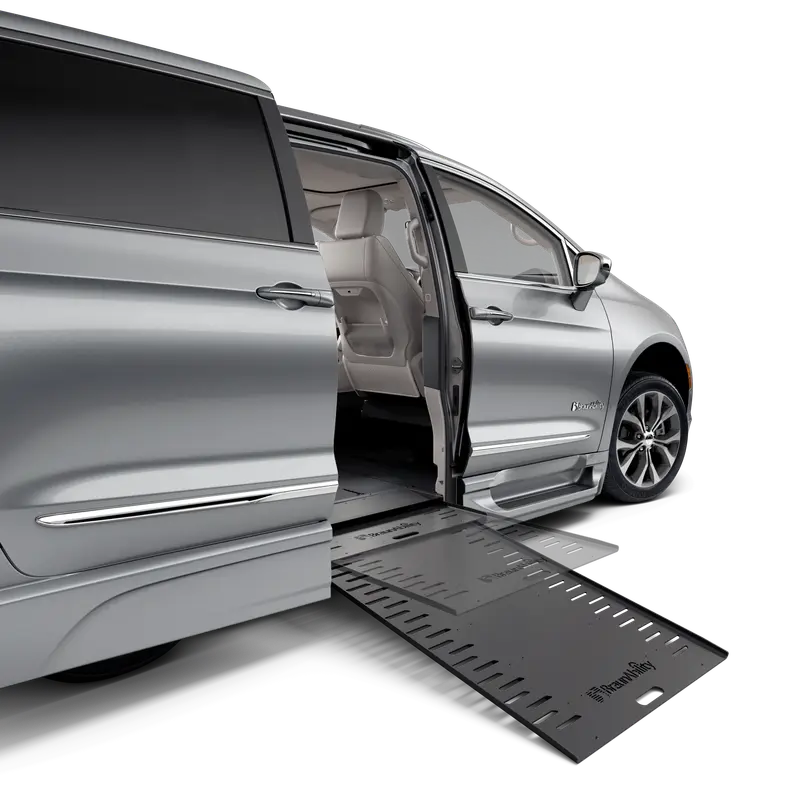
Both kinds start the same way. BraunAbility's page on how a conversion is built says the seats and interior panels are removed, the floor is lowered, and a ramp is installed "either in the rear or the passenger slide door area." In a side-entry conversion the rear bench is put back, and in most BraunAbility models the front seats sit on raised platforms and can be removed. In a rear-entry conversion, the page says, "only the back portion of the vehicle has a lowered floor."
What side-entry gives you
- The wheelchair user can sit in the front row, as driver or passenger, because in most BraunAbility side-entry models the front seats can be removed (VMI's Northstar lists interchangeable front seats); ask the dealer about the model you are looking at. Whether you can drive from your chair depends on the evaluation and on securement such as a docking system.
- VMI says its Northstar has "INTERCHANGEABLE FRONT SEATS," so two people can take turns at the wheel.
- You need space at the side to unfold the ramp. NMEDA's page asks "How much parking space is available at your home for a ramp or lift to deploy?"
What rear-entry gives you
- Wider doors on the van we read: VMI's rear-entry Sienna lists a 41-inch door opening and a 39.5-inch ramp, against 29.3 inches and 30 inches on its side-entry Northstar.
- No need for a wide side space. VMI's page pitches rear entry as freedom from being "parked in" or waiting for an accessible space.
- The front seats, center console and hybrid battery stay factory original, VMI says, so the wheelchair user rides behind the front row.
- You need space behind the van instead, for the ramp to fold out.
Which one should you choose? NMEDA's page lists the chair's dimensions and features, whether you will drive or ride, and whether you want a transfer seat or to drive from the chair. Those, it says, must be evaluated before you can determine "whether you are best suited for a side- or rear-entry vehicle." Parking at home, how often you go out, your usual destinations and the number of wheelchair users in the household then shape the type of vehicle and equipment, the page says.
Door height, ramp width, floor length: the numbers to check
BraunAbility and VMI publish dimension tables. The figures below are copied from their pages, in inches, for the model years each page names: 2021 to 2026 for the Pacifica, 2023 to 2026 for the BraunAbility Sienna Hybrid and Odyssey, 2025 to 2026 for the Traverse, and the current VMI Siennas. Compare them with your own chair and your seated height, measured with the cushion, headrest and anything else that travels with you.
| Conversion | Door height | Door width | Ramp width | Ramp angle |
|---|---|---|---|---|
| Pacifica Power Foldout | 53 | 32.375 | 30.125 | 9.1 deg |
| Pacifica Power Foldout XT | 57 | 32.375 | 30.125 | 8.6 deg |
| Pacifica Power Infloor | 55 | 33.5 | 32.25 | 9.9 deg |
| Pacifica Manual Rear-Entry | 56 | 34.5 | 34 | 10 deg |
| Sienna Hybrid Power Foldout (Braun) | 56 | 31 | 29.25 | 9 deg |
| Sienna Hybrid Power Infloor (Braun) | 54 | 31 | 30.3 | 9.5 deg |
| Odyssey Power Infloor (Braun) | 54.5 | 30.5 | 30.5 | 9.2 deg |
| Traverse SUV Power Infloor (Braun) | 54.5 | 30.5 | 30.5 | 10 deg |
| Northstar Sienna, side (VMI) | 56.06 | 29.3 | 30 | 8.8 deg kneeled |
| Sienna Hybrid rear (VMI) | 57 | 41 | 39.5 | 9.5 deg |
Door height is the one seated users bump into. The Pacifica Power Foldout XT is listed 4 inches taller at the door than the standard Power Foldout, 57 against 53 inches. Interior headroom matters once you are inside: VMI lists 58.75 inches at the front of the Northstar, with a sunroof, and 58.8 inches at the centre of its rear-entry van.
Floor length matters most for longer chairs and for turning inside. BraunAbility lists 98.5 inches of usable floor in the Pacifica side-entry versions and 98 in the rear-entry; the Odyssey 92.5; the Sienna Hybrid 89 to 89.25; the Traverse 90.25. VMI lists 86 inches overall in both its Siennas and 56 inches behind the front seats in the Northstar. The two makers may not measure the same way, so ask the dealer to show where each figure is taken.
Width at the mid-row matters if a passenger seat stays beside the wheelchair. VMI's rear-entry Sienna lists 30 inches of floor width with one mid-row seat fitted and 23.6 inches with two, and VMI says that, depending on the seats chosen, the van can carry up to six passengers with one wheelchair user, "or five passengers with two wheelchair users."
In-floor or fold-out ramp, power or manual
BraunAbility's conversion page says its ramps are "available as either a foldout or infloor option on most models of vehicle." Ask the dealer to show you how each kind opens and where it sits when stowed. BraunAbility's rental page lists Pacificas with a power fold-out, a power in-floor, a manual rear-entry fold-out and a manual side-entry fold-out ramp.
- Power ramps open with a button or key fob. United Access says its rental vans have fully powered side-entry conversions "activated effortlessly with a key fob."
- Manual ramps are opened by hand. VMI says its rear-entry ramp is spring-assisted, with two latches that keep it in place while driving.
- Ask what happens when the power fails. VMI says its Sure Deploy system gives a second control inside the van while there is battery power, and "a separate manual crank" when there is not.
Ramp capacity is printed on some pages. VMI lists 1,000 lb for both its side-entry and rear-entry Siennas, and our catalog row for the BraunAbility Pacifica Power Infloor lists 1,000 lb too. Add the chair, the user and anything carried on the chair before you compare. The guide to electric wheelchairs covers chair weights and how they are listed.
Ramp angle, kneeling and curbs
Van ramps are short, so they are steep compared with a building ramp. The angles on the makers' pages run from 8.6 degrees, the Pacifica Power Foldout XT, to 12.5 degrees, BraunAbility's CompanionVan and manual fold-out Voyager. In rise-to-run terms, which is how building ramps are described, 8.6 degrees is about 1 in 6.6 and 12.5 degrees about 1 in 4.5. The US building standard for ramps, the ADA's 1:12, works out at about 4.8 degrees; our wheelchair ramp guide explains that rule.
Kneeling makes the angle gentler. VMI's Northstar lists a ramp angle of 8.8 degrees with its PowerKneel suspension lowering and 12 degrees without it, about 1 in 6.5 against 1 in 4.7. VMI says the kneel can be switched off when parking against a tall curb, so that the ramp "deploys onto even tall curbs," as the page puts it.
Whether you can climb a given ramp angle on your own, or need a helper or a power chair, is not something a dimension table can tell you. Ask the driver rehabilitation specialist first, then try the ramp with your own chair at the dealer, in both directions, with someone standing by. Check your chair's manual for the steepest slope the maker allows.
Driving from the wheelchair or from the car seat
There are three ways to sit at the wheel. You can drive from your wheelchair, locked to the floor where the driver's seat was. You can transfer from the wheelchair to the driver's seat; NMEDA's list asks whether you want a transfer seat, so ask the dealer what kinds they fit. Or, in a car rather than a van, you can transfer into the car seat and stow the chair. NMEDA's page puts this question near the top of its list: "Do you want a transfer seat or will you be driving while in your wheelchair or another mobility device?"
How you transfer, and whether transferring is safe for you, is for the occupational therapist or physical therapist and the driver rehabilitation specialist to work out with you. This guide describes the equipment and stops there. Things that change the answer include your seated height in the chair, which sets the door height you need; your sitting balance; and whether you can reach the steering wheel and pedals or hand controls from the chair.
NHTSA gives one rule about seating position for every driver: keep 10 inches between your breast bone and the steering wheel, because it contains the driver's airbag, while still reaching the pedals and seeing above the wheel. It also lists seat adjusters that raise the seat so the driver's line of sight is 3 inches above the steering wheel among the features to look for. How this applies when you drive from a wheelchair is for the driver rehabilitation specialist to check; it is one reason the floor drop and the door height matter.
Locking the chair down: tie-downs and docking
A wheelchair in a moving vehicle has to be held to the floor. United Access says its rental vans come with tie-down straps for wheelchairs and seat belts for passengers, and that most can carry one wheelchair or scooter with standard tie-downs. There are two main systems.
Four-point tie-down retractors
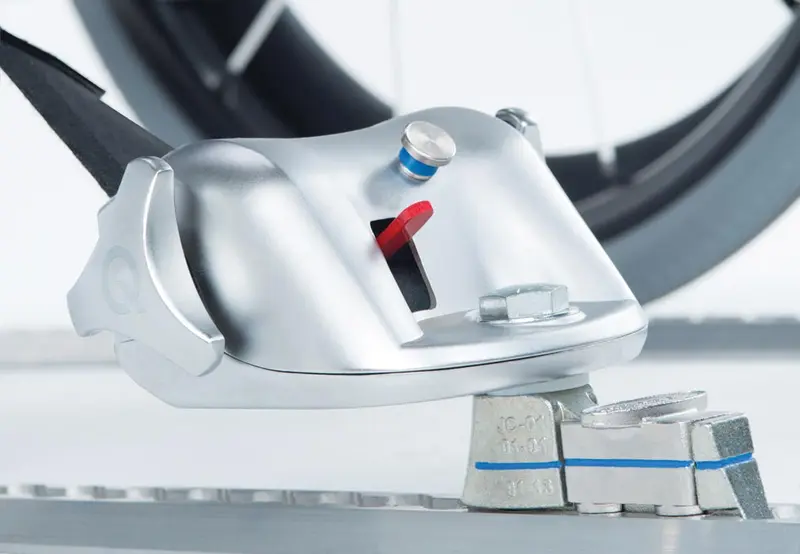
Four straps hook to the chair frame and reel into retractors fixed to the floor. Our catalog row for the Q'Straint QRT-360 Heavy Duty retractor (AC-355) describes it as self-tensioning and self-locking, for four-point securement, crash tested at 30 mph and 20 g, meeting WC18 and ISO 10542-1 among other standards and compatible with WC19 chairs. It fits L-Track or Slide 'N Click floor fittings and carries a 5-year limited warranty, although the row notes that the asterisk beside the warranty has no footnote on the maker's page, and that the page gives no wheelchair weight capacity. No price is listed. Harmar uses Q'Straint retractors on some of its hitch lifts too.
Docking systems
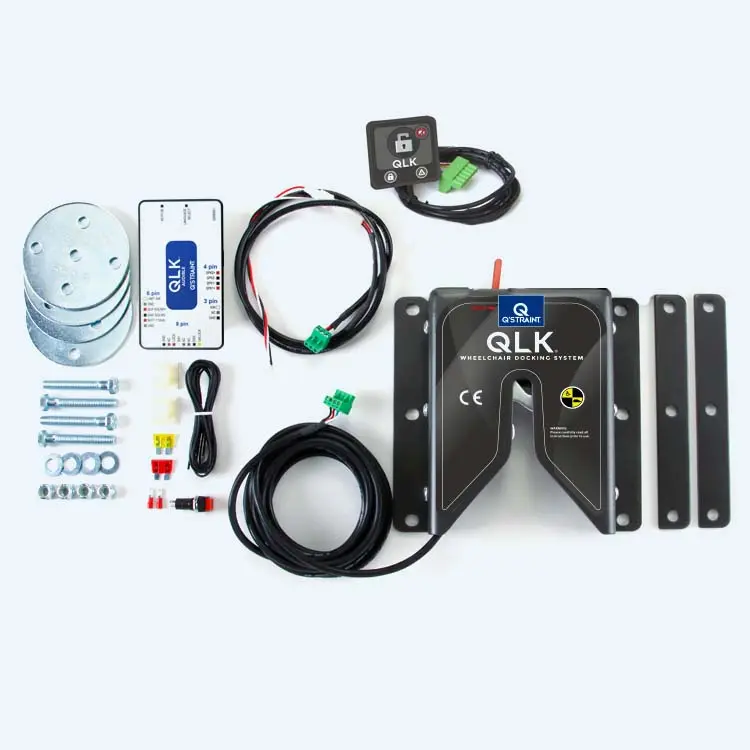
A docking system locks the chair to a base on the floor without straps, so a user can drive in and lock without help. Our catalog row RV-008 is the Q'STRAINT docking system kit Q04S170, described as an automatic electronic docking station that locks a wheelchair to the vehicle floor; the kit includes a base mount, a dash control and an electronic control module. The maker's page gives no weight rating and no price, the row notes. Ask the dealer what, if anything, has to be fitted to your chair for it to dock, and whether that changes how the chair folds or handles.
Which system you use, and where in the van, is part of the dealer's and the evaluator's work. If you drive from your chair, the securement must hold you at the wheel; if you ride, it decides where you sit and how a carer reaches the straps.
Platform lifts: what the federal standard requires
A platform lift is a different device from a ramp. The federal standard FMVSS No. 403 defines it as "a level change device" used to help people with limited mobility enter or leave a vehicle, "excluding a ramp." The minivan conversions whose pages we read use ramps. If a van you look at has a lift, these rules apply to it: FMVSS No. 403 covers lifts made on and after April 1, 2005, and FMVSS No. 404 covers vehicles fitted with them, made on and after July 1, 2005.
| Requirement | Private use lift | Public use lift |
|---|---|---|
| Label | DOT-Private Use Lift | DOT-Public Use Lift |
| Standard test load | Rated load or 400 lb, if greater | 600 lb |
| Threshold warning | Visual or audible, one exception | Visual and audible |
| Inner roll stop | Or a warning to back on | Required |
| Handrails | Not required | Required, both sides |
| Fatigue test | 4,400 cycles | 15,600 cycles |
A lift fitted to a private van can be certified as a private use lift. Lifts for buses, school buses and multipurpose passenger vehicles with a gross vehicle weight rating over 10,000 lb, other than motor homes, must be public use lifts, the standard says. Every lift must hold three times its standard test load without breaking and four times without the platform, structure or lifting mechanism failing. For a private lift rated at 400 lb, that is 1,200 lb and 1,600 lb.
Safety features every lift must have
- A manual backup mode that can deploy the lift, lower a loaded platform, raise an empty one and stow it if the power fails or the lift malfunctions.
- Interlocks: the vehicle cannot move unless the lift is stowed, and the lift cannot be deployed until the vehicle is in park, or in neutral with the parking brake or service brakes applied by some means other than the operator depressing the brake pedal. Interlocks do not apply in manual backup mode.
- A platform speed of no more than 6 inches per second, up or down or sideways, between ground and floor level.
- A wheelchair retention device at the edge used for loading from the ground, and edge guards along the sides; guards that move with the platform must be at least 1.5 inches high.
- A platform surface that keeps a friction coefficient of at least 0.65 when wet.
- An operations counter that records each complete up and down cycle.
- Operating instructions, including the backup procedure, fixed beside the controls, as FMVSS No. 404 says.
For a private use lift, the owner's manual insert must state the platform space, the maker's rated load, and whether a wheelchair user must back onto the platform from the ground because there is no inner roll stop. Read that insert before the first use. A lift certified to FMVSS No. 403 has a counter that shows its cycle count, which is worth asking the seller about; a lift made before April 2005 may have none.
Lifts for your scooter or chair: hitch, hybrid and hoist
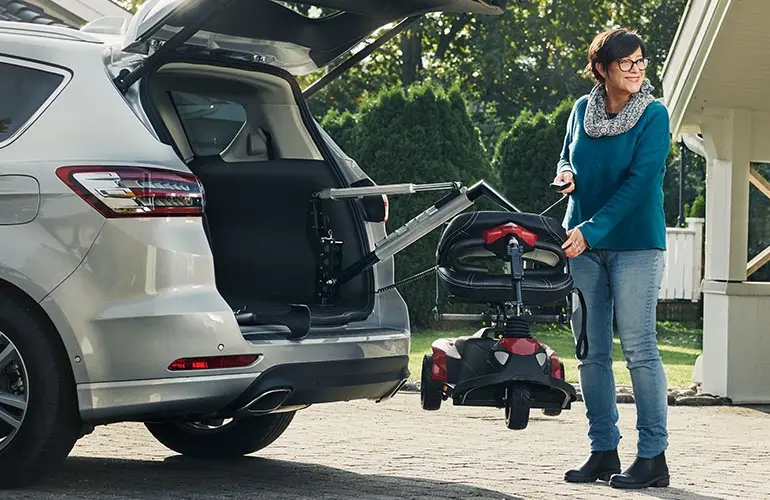
Many people search for a wheelchair lift for car or a scooter lift for car when what they need is a way to carry the device, not the person. If you can walk a few steps or transfer into the car seat, a lift that stores the scooter or power chair can be enough; whether it is, is for you and your occupational therapist or driver rehabilitation specialist to decide. Harmar's pages describe three kinds; Harmar publishes no prices and sells through dealers.
| Kind | Where the device rides | Harmar's figures |
|---|---|---|
| Hitch-mounted | Outside, on a platform at the back | AL100 350 lb; AL100HD 400 lb |
| Hybrid | Inside the cargo area, on a platform | AL600 350 lb; AL690 275 lb |
| Hoist | Inside, lifted on an arm | Devices from 200 to 450 lb |
Hitch-mounted lifts
A hitch lift carries the scooter or chair on the outside rear of the car, so the cargo area stays free. Harmar says the user gets off, guides the device onto the platform, secures it, and raises it with a switch, which is why it calls hitch lifts "easier" to use. Its AL100 is rated for scooters up to 350 lb and the AL100HD up to 400 lb; the installed weights are 83 and 84 lb; the platform is 26 by 39 inches, with a cradle that extends to 46; the AL100 needs a class II hitch or greater and the HD class III. Harmar's page says to "confirm your car's compatibility with your Harmar dealer." Some hitch models use four Q'Straint retractors.
Hybrid and hoist lifts
A hybrid lift sits inside the cargo area: the device is strapped to a platform and lifted in by remote. A hoist lift hooks onto the chair or scooter and swings it in on an arm, without a platform. Both stay inside, so they keep the backup camera clear, Harmar says, and the hybrid adds no extra inches at the rear. Hoists range from 200 to 450 lb capacity, and some fit pickups. Hybrid and hoist lifts "generally require little-to-no modifications," the page says, but may need drilling to bolt them in.
Power comes from the car battery, sometimes with a separate battery for the lift, Harmar says. Ask the dealer whether your car's payload and hitch rating can carry the lift plus the device; the mobility scooter guide covers scooter weights and folding, and the guide to lightweight wheelchairs covers chairs you can lift by hand.
Turning seats and boot hoists
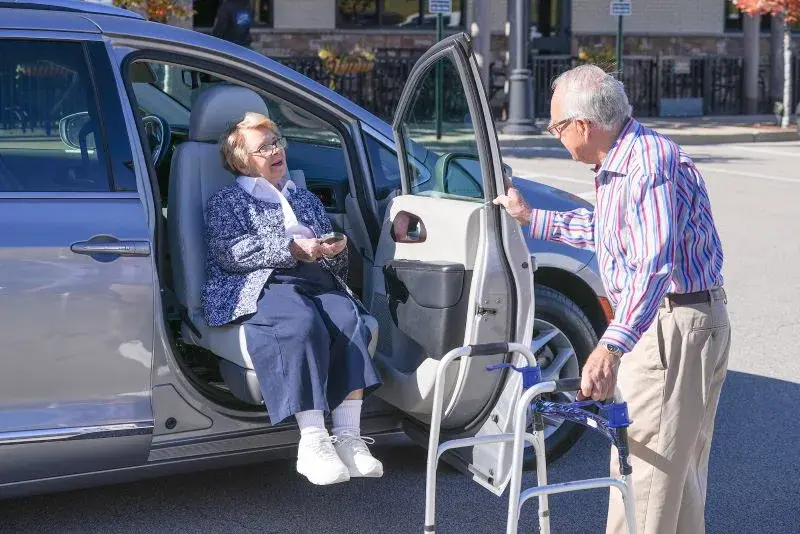
For people who can transfer but find a higher car hard to get into, a turning seat replaces the car's own seat with one that swings out of the door and lowers. Our catalog row RV-009 is the Turny Evo, listed under BraunAbility (Autoadapt): a powered seat lift with a six-way programmable path, worked by remote or smartphone app, with a manual backup, that the row says fits more than 200 vehicle models. The US dealer United Access lists it from around USD 12,599 installed, before tax, our catalog records. The dealer's page gives no user weight limit, the row notes, so ask for it in writing.
The chair still has to go somewhere. Our catalog row RV-010 is the Carolift 100, also from BraunAbility's Autoadapt range: a powered boot hoist with a four-button hand control, rated at 80 or 100 kg, which is about 176 or 220 lb, with a detachable part of about 10 kg, about 22 lb, and crash tested, the row says. No price is published. NHTSA's page lists simpler aids at the other end of the scale: swivel seats for easier access, and a special seat-back cushion for a better view of the road "for as little as $50."
Whether a transfer is right for you, and which kind, is a question for your occupational therapist and the driver rehabilitation specialist. A turning seat or hoist that suits you today may not suit you after a change in strength or a new chair, which is the "future equipment needs" NHTSA asks evaluators to consider.
Hand controls: push-pull, push-rock, twist and ring
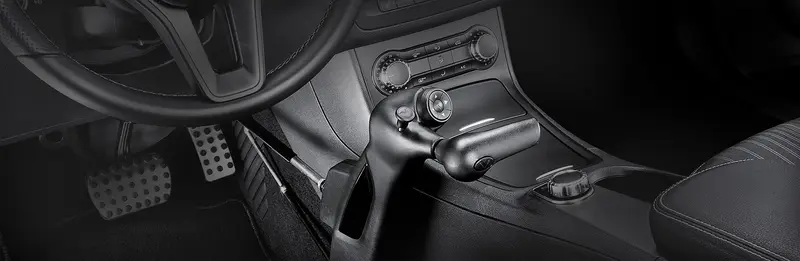
Hand controls let a driver brake and accelerate without the foot pedals. NHTSA says more complex equipment "such as hand controls, can be purchased for under $1,000," and that some drivers need them "to safely operate a vehicle." None of the hand control pages we read publishes a price. The four main movements on the Sure Grip page are these.
| Style | What the Sure Grip page says |
|---|---|
| Push/rock | Upright: ease back to go, push to brake |
| Push/pull | Pivot near the handle; shorter stroke |
| Push/right angle | Only the handle pivots; body stays still |
| Push/twist | Motorcycle-style twist; extra handle |
Only the push/rock description spells out both movements: the driver "eases the handle back to accelerate and pushes forward to brake," the page says. MPS, another maker named on the MobilityWorks page, describes its push/rock control the same way. For the other styles, ask the dealer and the specialist to show you each one in a car. Sure Grip makes left-hand and right-hand versions, and three optional handles for the push/rock style: a Tri-Pin handle for drivers "with minimal gripping strength and/or reduced wrist stability," a V-Grip for moderate grip, and a Stubby knob that needs less finger grip. United Access says AutoLock, an accelerator lock-out, comes standard on all Sure Grip controls.
Our catalog holds two more designs. The Veigel Classic II (RV-006), from Germany, is a mechanical hand control where turning the handle accelerates and pushing it forward brakes; the row lists a lockable brake and a handle that folds away and can be removed. The Kempf DARIOS (RV-007) is an electronic accelerator ring on the steering wheel with a hand brake lever, so both hands stay on the wheel; the row lists a ring travel of about three-quarters of an inch, a speed-sensitive response, the airbag retained and a lifetime warranty. Neither maker's page shows a price.
Training and installation
MobilityWorks, a dealer, says driving with push-pull hand controls "should only be done by those who have had sufficient training by a Certified Driver Rehabilitation Specialist (CDRS)," and that "we cannot ship hand controls to you for at-home installations." The style, the side and the handle are part of the specialist's prescription, not a catalog choice. NHTSA says all states require a valid learner's permit or license for an on-the-road evaluation, that you cannot be refused the chance to apply because of age or disability, and that a license with restrictions may be issued based on the equipment you need.
What a new wheelchair van costs
How much does a wheelchair van cost? Mobility Atlas read BraunAbility's pricing page, one dealer's national listings and one dealer's rental rates on 19 October 2026. BraunAbility's sample 2026 Chrysler Pacifica came to an MSRP of USD 88,685: 47,935 for the van and 40,750 for the conversion, so the conversion was about 46 percent of the total. Our catalog lists the 2027 Pacifica with a power in-floor side-entry conversion from around USD 87,590. On the MobilityWorks site, priced new minivans ran from 69,349 to 104,389 dollars, and used vans started at 18,990 for a 2002 van with 51,605 miles. NHTSA's undated page puts a new vehicle with adaptive equipment at 20,000 to 80,000 dollars, and hand controls under 1,000. The dealer United Access rents vans at 150 dollars a day, falling to 110 a day for a month. Prices change daily and differ by dealer, state, country and funding.
BraunAbility's pricing page explains how a price is built. The listed price has two parts: the MSRP of the base vehicle, "exclusive of tax, title, license, and applicable fees," and the MSRP of the conversion, which covers the ramp, the interior changes and the accessibility features. In its sample, the conversion, at 40,750 dollars, cost about 85 percent of the van it was fitted to.
| Price as published | USD | Source and date |
|---|---|---|
| 2026 Pacifica Select Safety, base MSRP | 47,935 | BraunAbility sample, read 19 Oct |
| BraunAbility Power XT conversion MSRP | 40,750 | BraunAbility sample, read 19 Oct |
| Total modified vehicle MSRP | 88,685 | BraunAbility sample, read 19 Oct |
| 2027 Pacifica Power Infloor, from | Around 87,590 | Our catalog, Oct 2026 |
| New 2027 Pacifica Select, side fold-out | 69,349 | MobilityWorks, 19 Oct |
| New 2027 Pacifica LX, rear fold-out | 72,428 | MobilityWorks, 19 Oct |
| New 2026 Sienna AWD XSE, side in-floor | 104,389 | MobilityWorks, 19 Oct |
| New 2025 Ram ProMaster, full-size | 133,990 | MobilityWorks, 19 Oct |
NHTSA's page gives no date for its range of 20,000 to 80,000 dollars. Two priced new minivans above, at 69,349 and 72,428 dollars, fall inside it; BraunAbility's sample, our catalog's starting price and the dearest listings are above its upper end. Many new vans on the MobilityWorks site show no price at all, only "Get Our Best Price," so the priced listings are not the whole picture. The full-size Ram ProMaster at 133,990 dollars was the highest priced listing we saw; the listing names a side-entry automatic conversion by Tempest but does not say whether it uses a ramp or a lift. VMI publishes no prices on the two pages we read; its rear-entry page calls the van "Affordable, reliable, safety tested and approved."
Prices differ by country, by dealer, by state taxes and by funding, and the van prices here are United States listings in US dollars. Taxes, title and fees come on top of an MSRP. A dealer's quote should list the base vehicle, the conversion, every piece of adaptive equipment and the installation as separate lines, which is also what funders such as the VA ask for.
Used wheelchair vans: one dealer's listings on one day
If you are searching for wheelchair vans for sale near me, MobilityWorks, a national dealer, is one place to see what the used market looks like. MobilityWorks calls itself "the largest provider of late-model and pre-owned wheelchair vans" in the United States, with over 90 locations. On 19 October 2026 its national page showed 1,090 vans in the view sorted by price and 1,125 in the default view; its filters counted 573 used, 436 new and 116 listed as new or used. This is one dealer on one day. Other dealers, private sellers and other regions will look different.
| Selected listings, by price | Price (USD) | Miles | Entry |
|---|---|---|---|
| 2002 Ford Econoline E-150 XLT | 18,990 | 51,605 | Side, automatic fold-out |
| 2007 Chrysler Town and Country | 18,991 | 150,445 | Side, automatic fold-out |
| 2017 Dodge Grand Caravan SE | 20,990 | 156,894 | Side, manual fold-out |
| 2006 Chrysler Town and Country | 21,991 | 75,539 | Rear, manual fold-out |
| 2014 Honda Odyssey EX-L | 28,990 | 196,955 | Side, automatic in-floor |
| 2020 Toyota Sienna LE | 57,990 | 49,820 | Side, automatic in-floor |
| 2019 Honda Odyssey EX-L | 60,991 | 53,600 | Side, automatic in-floor |
| 2024 Chrysler Pacifica Touring L | 74,990 | 16,019 | Side, automatic in-floor |
The cheapest vans are old or have high mileage. The 60th cheapest listing was a 2011 Dodge Grand Caravan at 31,990 dollars with 48,466 miles. Late-model used minivans we saw ran from 57,990 dollars in the default view to 96,990 dollars at the end of the price-sorted list. At the top, a used 2024 Chevrolet Suburban with a side-entry conversion was listed at 121,990.
What to check on a used van
- The conversion maker and type, and the van's model year. The listings name BraunAbility, Vantage Mobility, Driverge, FR Conversions and others, and fold-out or in-floor, manual or automatic.
- Your chair against the door height, ramp width and floor length for that model year, using the maker's dimension table for that year.
- The FMVSS modification label. NHTSA says registered dealers must list any safety standards affected by their work on a label next to the original label, "often found inside the driver's door."
- Recalls and service history for the van and the conversion, and the ramp's manual backup.
- Whether your adaptive equipment can move to a later vehicle. NHTSA's page suggests asking the dealer "Can the equipment be transferred to a new vehicle in the future?"
MobilityWorks says it offers a return within 5 days under one of its purchase programs, financing, a lease, and service. Read the "Important Disclosures" the price footnotes point to before you sign. A used van still needs the evaluation first: a cheaper van with the wrong entry, a door too low for your seated height, or no room for your hand controls is not cheaper.
Renting a wheelchair van
Renting suits a trip, a visit, a hospital stay or a trial before buying. United Access, a dealer whose rental fleet is BraunAbility vans, publishes its rates. BraunAbility's own rental page publishes none and says local dealers "may offer special daily, weekend, weekly, or extended rental rates," some with delivery to airports.
| United Access rate | Per day (USD) | Applies to | Example (USD) |
|---|---|---|---|
| Daily | 150 | 1 to 6 days | 3 days 450; 6 days 900 |
| Weekly | 130 | 7 to 28 days | 7 days 910; 28 days 3,640 |
| Monthly | 110 | 29 to 30 days | 30 days 3,300 |
| Military, 10 percent off | 135 / 117 / 99 | Every rental | 7 days 819 |
The examples are our sums from the published daily rates. Note that 7 days at the weekly rate, 910 dollars, costs 10 dollars more than 6 days at the daily rate. The rates include 200 miles a day, training on the van, 24/7 emergency service and retractable tie-downs; extra miles are 25 cents a mile, so 100 miles over adds 25 dollars. Tax and delivery are extra. A van returned with less fuel carries a 75-dollar refueling charge, and a poorly cleaned van a 100-dollar clean-up charge, the page says. United Access says rates "will vary slightly depending upon location."
- The driver must be at least 21, hold a valid US driver's license, and show the required collision and comprehensive insurance; payment is due at pickup.
- There are no one-way rentals, no full-size vans, and no driving into Mexico.
- The dealer recommends booking at least 2 weeks ahead, earlier for summer and holidays.
- Veterans, active-duty military, National Guard and Reserve and their families get 10 percent off every rental.
- "Currently, Medicare does not cover the cost of a wheelchair van rental," the United Access page says.
Rent-to-own exists too. BraunAbility says many dealers have programs that "will apply your rental fees to the purchase price of your wheelchair van." Ask in writing how much of each rental payment counts, and for how long. A rental is also a way to live with a layout for a week before you commit: United Access rents side-entry vans, and BraunAbility's rental page lists a rear-entry Pacifica at some dealers.
Payload, parking and the base vehicle
The van under the conversion still matters. NHTSA's page lists questions to ask before you buy or adapt a vehicle: whether it has the cargo capacity, in pounds, for the equipment; whether there will be room for family once it is modified; whether there is parking space at home and at work for loading a wheelchair; and what other options you need. "Although the purchase or lease of a vehicle is your responsibility," the page says, the dealer and the driver rehabilitation specialist can check that it can be modified for you.
Payload is printed on VMI's pages. Its side-entry Northstar lists an average payload of 921 lb with front-wheel drive and 839 lb with all-wheel drive; its rear-entry Sienna lists 1,349 lb with two 16-inch mid-row seats and no spare tire, 428 lb more than the front-wheel-drive Northstar. A power chair, its user, passengers and luggage all count. Ground clearance is listed at 5.6 inches for the Northstar and 6.7 for the rear-entry Sienna, and the maximum floor drop at 15 inches and 20.7 inches.
NHTSA also lists ordinary features worth asking about in any new vehicle: high or extra-wide doors, adjustable pedals, large door handles, oversized knobs, support handles for getting in and out, and a dashboard ignition rather than one on the steering column. It suggests checking crash test and rollover ratings for the base model. VMI says its Northstar is "THE ONLY AWD WHEELCHAIR ACCESSIBLE VAN," a claim made on its own page; if all-wheel drive matters where you live, ask each dealer what they offer.
Choosing a mobility dealer: NHTSA registration and NMEDA QAP
NHTSA's page is plain about why the dealer matters: "Even a half-inch change in the lowering of a van floor can affect a driver's ability to use equipment or to have an unobstructed view of the road." It asks you to check that the dealer is registered with NHTSA as a vehicle modifier, which allows the dealer to modify federally required safety equipment, and NHTSA keeps a searchable database of registered modifiers.
Registered modifiers must give you a written statement of the work and list any Federal Motor Vehicle Safety Standards affected on a label next to the original one, NHTSA says. NMEDA runs the Quality Assurance Program, which it calls "the only accreditation for mobility equipment installers in the industry." Its rules bind accredited dealers, a separate set binds manufacturers, and a Compliance Review Program performs independent safety reviews of conversions and equipment, the NMEDA page says. Some states require dealers bidding on vocational rehabilitation work to be QAP members, NHTSA notes, so check before you choose a dealer if a state agency is paying.
NHTSA's questions for a dealer
- Is the dealer registered with NHTSA, and a member of NMEDA's Quality Assurance Program?
- What training has the staff had, and do they work with qualified driver rehabilitation specialists?
- What warranty covers the work, and does the dealer service and maintain the equipment afterwards?
- Are replacement parts stocked?
- How much will the modification cost, are third-party payments accepted, and how long will it take?
- Can the equipment be moved to a new vehicle later, and will existing safety features need to change?
NMEDA adds a warning about buying online straight from a manufacturer: know "how and where your vehicle and/or adaptive equipment will be serviced after the sale." You will also need to be available for fittings while the work is done, NHTSA says, or you may have to go back for adjustments.
Who pays: the funding map
Who pays for a wheelchair van or adaptive equipment? Mobility Atlas read the VA, NHTSA and NMEDA pages on 19 October 2026, and the answer is usually several sources, not one. For a veteran with a qualifying service-connected disability, the VA may pay an automobile allowance of up to $27,908.90 from 1 October 2026, once, to the seller, and in some situations adaptive-equipment grants; it must approve the claim before you buy. Most major vehicle makers offer a rebate on adaptive equipment, usually up to 1,000 dollars on a vehicle less than one year old, NHTSA says; NMEDA lists programs of up to 2,500. NHTSA also points to state vocational rehabilitation, workers' compensation for job injuries, car insurance when a crash caused the need, sales tax waivers in some states, and possible tax deductions. Get each funder's promise in writing before you buy, NHTSA advises. Medicare does not cover van rentals, one rental dealer says.
| Source of help | What the page says | Where to start |
|---|---|---|
| VA automobile allowance | May pay up to $27,908.90, to seller | VA Form 21-4502 or online |
| VA adaptive-equipment grant | Lift, seats, brakes, steering | VA Form 10-1394 |
| Maker rebates | Usually up to 1,000; some 2,500 | The maker's mobility program |
| State vocational rehabilitation | Part or all of modification | Your state agency |
| Workers' compensation | Job-related injury | Your claim handler |
| Auto insurance | Need caused by a vehicle crash | Your insurer |
| Nonprofits | Local programs | State disability office |
| State sales tax waiver | Some states, with a prescription | Your state revenue office |
If a third party is paying, NHTSA says, find out "if there are any limitations or restrictions on what is covered," and "Always get a written statement on what a funding agency will pay before making your purchase." Each program has its own order of steps, and several want an itemized invoice from the dealer.
The VA automobile allowance and adaptive-equipment grants
The VA's page offers two kinds of help. The automobile allowance is a payment toward a specially equipped vehicle: from 1 October 2026, "we may pay up to $27,908.90," the rates page says, as a one-time payment made directly to the seller. "In some situations," the VA says, adaptive-equipment grants may pay to change a vehicle "so it has features like power steering, brakes, seats, windows, or lift equipment." Vehicles covered by the allowance include cars, vans, motor homes, commercial trucks and farm machines, the VA says.
Who is eligible
You need a service-connected disability, or one treated as service connected under 38 U.S.C. 1151, that includes at least one of these: loss, or permanent loss of use, of one or both feet; of one or both hands; permanent decreased vision in both eyes as the page defines it; a severe burn injury; or ALS. Ankylosis in one or both knees or hips qualifies you only for an adaptive-equipment grant. A second allowance is possible if you bought a vehicle with the allowance 30 years ago or more, or a natural disaster destroyed it through no fault of yours and insurance did not pay for the loss.
The order of steps matters
- File a disability compensation claim first if you have not already, the VA says.
- For the allowance, apply online or with VA Form 21-4502; for an adaptive-equipment grant, take VA Form 10-1394 to the prosthetic representative at your local VA medical center.
- Wait for approval. "Can I buy a vehicle or adaptive equipment first, then file my claim? No," the page says.
- Before you buy, make sure the seller agrees to send the VA the completed claim form and an itemized invoice.
Set against the BraunAbility sample of 88,685 dollars, the full allowance would leave 60,776.10 dollars before taxes, fees and any other help; against our catalog's starting price of around 87,590, it would leave 59,681.10. These are our sums on published prices, not quotes. The grant can pay you or the equipment seller, the VA says. Its benefits line is 800-827-1000.
Maker rebates on adaptive equipment
Most major vehicle makers, NHTSA says, offer rebates on adaptive equipment, "usually up to $1,000, provided you purchase a vehicle less than one year old." NMEDA lists the programs of its member manufacturers, and its getting-started page tells buyers to download the right forms from the maker's website before the purchase, because "The step-by-step process may differ from company to company."
| Program, as NMEDA lists it | Up to (USD) | Notes from the program text |
|---|---|---|
| Toyota Mobility | 1,000 | New Toyota, bought or leased |
| Honda Mobility Program | 1,000 | Original retail customer |
| Stellantis Driveability | 1,000 | Purchase of adaptive equipment |
| Ford Mobility Program | 1,000 | New Ford or Lincoln |
| Nissan, Mazda, Subaru, VW | 1,000 each | Mazda names lifts and hand controls |
| Hyundai Mobility Program | 1,000 (flat) | Toward adaptive equipment |
| Audi Mobility Program | 1,500 | New or CPO Audi |
| BMW and Mini | 2,500 each | One-time reimbursement |
| GM and Lexus | Not in what we read | Ask the program |
Toyota's program text, as NMEDA quotes it, covers "any aftermarket adaptive equipment or conversion, for drivers and/or passengers," on an eligible new Toyota, bought or leased. Mazda's names "wheelchair or other lift equipment, and hand or other driving controls." NMEDA members, NHTSA says, are familiar with these rebates and can help you apply. Ask the dealer which program covers the base vehicle you choose, and whether it combines with other funding; the pages we read do not say.
State vocational rehabilitation and other help
NHTSA's first pointer is the state: "contact your State's Department of Vocational Rehabilitation or another agency that provides vocational services." Those agencies may also help pay for the driving evaluation, NHTSA says, and state vocational rehabilitation departments and workers' compensation will pay for driver education and training "under certain circumstances."
- Some states name the dealer you must use if you want reimbursement, and some require bidding dealers to be NMEDA QAP members, NHTSA says.
- Nonprofits run mostly local programs; NHTSA suggests asking the state office for people with disabilities.
- Auto insurance may cover equipment if a crash caused the need, and workers' compensation "typically covers" it after a job-related injury.
- Some states waive sales tax on adaptive devices with a doctor's prescription, and the cost of equipment "may be tax deductible," NHTSA says; ask a qualified tax adviser.
- NMEDA's page reminds buyers that "There are rebates, grants, loans, and other financial aids available," and that a budget should include insurance, fuel and yearly maintenance.
These rules differ by state, and outside the United States the system is different again. Ask your state agency for its written rules before you choose a dealer or sign anything. The guide to power wheelchair batteries covers the chair side of the budget.
Licensing, training and insurance while the work is done
NHTSA's training advice is direct: both new and experienced drivers need training on new adaptive equipment, and "literature and off-road instruction aren't enough." It asks drivers to get on-the-road training with a driver rehabilitation specialist who knows adaptive technology, and to bring a family member or friend who can drive the vehicle to training sessions, so someone else can drive it in an emergency. NMEDA says it "may require a few training sessions with your CDRS" to drive a modified vehicle safely.
Two practical points are easy to miss. First, NHTSA says you will need insurance on the vehicle while it is being modified, "even though it will be off the road during this period." Second, the license itself may change: a license with restrictions may be issued based on the equipment you need. Ask your state licensing office what the restriction will say and whether you need a road test in the adapted vehicle.
Maintenance, backups and warranties
A converted van is a car with extra machinery. NHTSA says adaptive equipment "may need special attention or more frequent check-ups than your vehicle alone," and lists basic checks for any vehicle: tire pressure at least monthly and before long trips, oil and fluids, lights, clean windows and headlights, and a check on a service lift at least once a year for road damage.
- Know the manual backup. VMI's Sure Deploy gives a second ramp control while there is battery power and a manual crank when there is not. Every platform lift under FMVSS No. 403 must have a manual backup mode.
- Read the warranty for the conversion as well as the van. VMI offers what it calls "the industry's longest rust-through warranty: 7 years with unlimited miles" on its new conversions; ask every maker for its terms in writing.
- Check the tie-downs or docking at every service. The QRT-360 row in our catalog lists a 5-year limited warranty.
- If you think there is a safety problem with a modified vehicle or its equipment, NHTSA asks you to file a vehicle safety complaint at nhtsa.gov.
NHTSA's own crash work is worth knowing about: the agency says it funded a wheelchair study on safety issues for drivers and passengers traveling in a wheelchair, and conducted crash tests of wheelchair-seated drivers. That is one more reason the securement and the seating position are set by professionals, not improvised.
Three traps
Trap one: buying the van before the evaluation. NHTSA and NMEDA both put the driver rehabilitation specialist before the purchase, and the VA will not pay for a vehicle or equipment bought before it approves the claim. A van bought first can turn out to have a door too low for your seated height, a ramp too narrow for your chair, or a front seat layout that cannot take the controls you are prescribed.
Trap two: reading one dealer's listing as the market. The prices in this guide are one national dealer's listings and one dealer's rental rates on 19 October 2026. Many new vans show no price at all. Of the five cheapest used vans, four were model years 2002 to 2008, and the fifth, a 2017, had 156,894 miles. Get two or three quotes, each with the conversion and the equipment listed separately.
Trap three: assuming the funders stack up on their own. The VA pays the allowance to the seller directly and needs the seller's claim form and itemized invoice; maker rebates want their own forms within the maker's rules; state agencies may name the dealer you must use. NHTSA's advice is to get a written statement from each funder before you buy. Do that first, then sign.
Three composite scenarios
These are composite scenarios, not individual customers. Each one combines facts and ranges already given in this guide to show how the decision plays out.
Scenario one: a manual wheelchair user who can transfer wants to drive a new sedan. The driver rehabilitation specialist prescribes push/rock hand controls with a V-Grip handle and suggests a boot hoist. The dealer, registered with NHTSA and in NMEDA's program, installs the controls, which NHTSA says can cost under 1,000 dollars, and applies for the maker's rebate on the new car. Training is on the road, with a friend along who can drive.
Scenario two: a veteran with permanent loss of use of both feet, service connected, uses a power chair and wants to drive from it. The VA approves the automobile allowance and an adaptive-equipment grant before anything is bought. The evaluator confirms a side-entry minivan with removable front seats and a docking system; the family checks the door height and floor length against the chair, and the dealer sends the VA the claim form and an itemized invoice.
Scenario three: a family needs to take a parent who uses a wheelchair to a wedding three states away. They rent a side-entry van from United Access for 6 days at 150 dollars a day, 900 dollars before tax, book 2 weeks ahead, plan the route around the 200 miles a day included, and use the trip to learn whether a side-entry layout suits them before buying.
What to ask the dealer, the evaluator and the funder
The driver rehabilitation specialist
- Can I drive, and with which controls, entry and seating? Please put it in a written prescription.
- Should I drive from my chair or transfer, and what may change in the next few years?
- Which minimum door height, ramp width and floor length does my chair need?
- How many on-the-road training sessions will I need, and who pays for them?
The dealer
- Are you registered with NHTSA as a modifier and accredited under NMEDA's Quality Assurance Program?
- Can you itemize the base vehicle, the conversion, each piece of equipment and installation?
- What is the ramp's or lift's rated load, and how does the manual backup work?
- What warranties cover the conversion, the ramp and the equipment, and who services them near me?
- Can I rent or try this layout before I buy, and does any rental count toward the price?
The funder
- What will you pay, in writing, and what must happen before purchase?
- Do you require a particular dealer, a QAP dealer, or a prescription from a specialist or physician?
- Can this be combined with the maker's rebate or other help?
Bring your chair's measurements, the specialist's report and the funder's letters to every visit. If you would like a second set of eyes on a quote or a used van listing, send an enquiry and we will compare it with the makers' published figures.
Sources and documents
Government: NHTSA's page on adapted vehicles, all tabs; FMVSS No. 403 and No. 404 in the electronic Code of Federal Regulations, read on 19 October 2026 in the version dated 1 October 2026; the VA's automobile allowance and adaptive-equipment page and its current rates page. Industry: NMEDA's Quality Assurance Program, getting-started and rebate pages. Makers: BraunAbility's dimension guide, pricing, conversion and rental pages; VMI's Northstar and rear-entry Sienna pages; Harmar's hitch, hybrid and hoist lift pages. Dealers: United Access's Sure Grip and rental pages; MobilityWorks's hand control page and national inventory. Every source is linked in the list at the end of this page.
Related guides on Mobility Atlas: Wheelchair ramps; Mobility scooters; Electric wheelchairs.
Method in brief: we read each saved page in full or in the sections named, copied every figure as printed, and computed only simple sums, differences and conversions, which are shown in the text and kept in a facts file. Dealer listings are a dated snapshot of one dealer, MobilityWorks, on 19 October 2026; rental rates are one dealer's, United Access's. Catalog prices are guide prices from our own catalog, checked October 2026. We did not test vehicles or equipment, and nothing here replaces a driving evaluation by a driver rehabilitation specialist.
Prices checked October 2026 on the BraunAbility, MobilityWorks and United Access pages and in our catalog; prices change daily, so confirm them with the dealer. Documents checked October 2026: NHTSA's page, FMVSS No. 403 and No. 404, the VA pages, the NMEDA pages and the makers' pages.
Have you bought, rented or converted a van, or fitted hand controls or a lift? Send us a note through the enquiry form with what you chose and how it went; we use readers' notes when we update the guide.
This article is general information. Rules and prices differ by country and change, so confirm them before you buy or travel.
Common questions
How much does a wheelchair van cost?
BraunAbility's sample 2026 Chrysler Pacifica came to an MSRP of USD 88,685, of which 40,750 was the conversion. On MobilityWorks's national listings on 19 October 2026, priced new minivans ran from 69,349 to 104,389 and used vans started at 18,990. NHTSA's undated page puts a new adapted vehicle at 20,000 to 80,000; several of the dated prices above are higher than that. Prices differ by country, dealer, state taxes and funding.
Side-entry or rear-entry: which is better?
Neither in general. Side-entry lets the wheelchair user drive or ride in the front row, because in most BraunAbility side-entry models the front seats can be removed (VMI's Northstar lists interchangeable front seats; ask the dealer about the model you are looking at), but needs space beside the van. Rear-entry keeps the original front seats, so the user rides behind them, and needs space behind the van instead; VMI's rear-entry Sienna lists a 41-inch door. A driver rehabilitation specialist and your parking decide.
Does the VA pay for a wheelchair van?
For veterans with a qualifying service-connected disability, the VA may pay an automobile allowance of up to $27,908.90 from 1 October 2026, once, directly to the seller, and in some situations adaptive-equipment grants can pay for things like lift equipment. You must file and be approved before you buy, and the seller must send the claim form and an itemized invoice.
How much does it cost to rent a wheelchair van?
United Access published 150 dollars a day for 1 to 6 days, 130 a day for 7 to 28 days and 110 a day for 29 to 30 days, with 200 miles a day included and 10 percent off for veterans and military families. Rates vary by location and exclude tax; the dealer says Medicare does not cover wheelchair van rentals.
Do I need a prescription for hand controls?
NMEDA says the driver rehabilitation specialist's evaluation ends with a written prescription for your equipment, and MobilityWorks says hand controls should be used only after training by a Certified Driver Rehabilitation Specialist and will not ship them for home installation. NHTSA's undated page says hand controls can cost under 1,000 dollars.
What is a scooter lift for a car?
A device that carries the empty scooter or power chair. A hitch-mounted lift carries it outside on the back of the car; hybrid and hoist lifts lift it into the cargo area. Harmar's AL100 is rated for scooters up to 350 lb and needs a class II hitch or greater. Harmar sells through dealers and publishes no prices.
Sources
- NHTSA: Adapted vehicles (adapting your vehicle, evaluating needs, dealers, training, maintenance)
- NHTSA: Search for registered vehicle modifiers
- eCFR: 49 CFR 571.403, FMVSS No. 403, Platform lift systems for motor vehicles
- eCFR: 49 CFR 571.404, FMVSS No. 404, Platform lift installations in motor vehicles
- VA: Automobile allowance and adaptive equipment
- VA: Current special benefit allowance rates (automobile allowance from 1 October 2026)
- ADED: Association for Driver Rehabilitation Specialists
- NMEDA: Quality Assurance Program
- NMEDA: Getting started
- NMEDA: Mobility rebate programs
- BraunAbility: Wheelchair accessible vehicle dimension guide
- BraunAbility: Understanding the cost of wheelchair accessible vehicles
- BraunAbility: What is a van conversion
- BraunAbility: Wheelchair van rentals
- BraunAbility: Chrysler Pacifica side-entry power infloor ramp (catalog row RV-005)
- VMI: Northstar Toyota Sienna, side entry, power in-floor ramp
- VMI: Rear entry Toyota Sienna Hybrid, manual fold-out ramp
- Harmar: Hitch-mounted lifts
- Harmar: AL100 and AL100HD universal scooter hitch-mount lift
- Harmar: Hybrid lifts
- Harmar: Hoist lifts
- United Access: Sure Grip hand controls (dealer page)
- MobilityWorks: Mechanical hand controls (dealer page)
- MobilityWorks: Wheelchair vans for sale nationwide (listings read 19 October 2026)
- United Access: Wheelchair accessible van rentals (rates read 19 October 2026)
- United Access: BraunAbility Turny Evo seat (catalog row RV-009)
- BraunAbility Europe: Carolift 100 (catalog row RV-010)
- Veigel: Classic II hand control (catalog row RV-006)
- Kempf: DARIOS hand controls (catalog row RV-007)
- Q'STRAINT: Docking system kit Q04S170 (catalog row RV-008)
- Q'Straint: QRT-360 heavy duty retractor (catalog row AC-355)
Read on 19 October 2026. The wording of the article is our own.