Wheelchair seat replacement in 2026: seat and back upholstery, solid inserts, armrest pads, sizes, part numbers and prices
Replacing wheelchair seat and back upholstery and arm pads: how makers size it, Medline, Karman, Ki and Quickie part numbers, universal slings, US prices and care.
Contents
- The short answer
- How we read the documents, and our interest
- Sling, insert, pan or cushion: four ways a seat is built
- How makers print upholstery sizes
- Screw holes, rails and hardware
- Nylon or vinyl: what the documents say about each
- Medline upholstery part numbers by chair
- Karman upholstery part numbers, from a 2012 catalog
- Quickie and Top End: upholstery ordered by serial number
- Ki Mobility: back upholstery and seat pans on the order form
- Drive and Invacare: where to find the numbers
- Tension-adjustable backs: what they are and what they cost
- Universal versus model-specific upholstery
- Solid seat inserts and seat pans
- Armrest pads: replacement by length and screw spacing
- What replacement upholstery costs at US sellers
- Fire and flammability labels, as printed
- Cleaning and checking upholstery, as the manuals print it
- Fitting new upholstery: what the manual says about the job
- Warranty and returns: upholstery is a wear item
- Medicare and the upholstery codes
- When a cushion or back support is the better fix
- Ordering upholstery through Mobility Atlas
- Three traps
- Three composite scenarios
- Questions to ask the seller, dealer or therapist
- Sources and documents
- Common questions
- Sources
The short answer
In this guide, a wheelchair seat replacement means new seat upholstery: the fabric or vinyl sling that is usually screwed to the two seat rails of a folding manual or transport chair. Back upholstery, the sling between the back posts, wears out the same way, and so do the pads on top of the armrests. This guide covers wheelchair upholstery replacement for seats, backs and arm pads, plus the solid inserts and seat pans that some people fit instead of a new sling. It goes deeper on this one job than our general wheelchair parts guide, which gives upholstery a single section, and it does not repeat the part tables in our Invacare and Drive Medical parts guides: for those two makers, use those guides for the numbers.
What decides which wheelchair seat replacement fits your chair? Mobility Atlas read the makers' parts catalogs, manuals and order forms for Medline, Invacare, Karman and Ki Mobility, Sunrise's Quickie Nitrum manual, Drive's site search and manuals, plus seller pages at 1800wheelchair, Sportaid and Walmart, on 12 November 2026, with some manuals and Medicare documents read on 9 November. Three points run through them. First, upholstery is sold by chair: the maker's model, the seat width and the seat depth, written width first, such as 18 x 16 inches. Second, the screw holes must line up with the holes in your seat rails or back posts, and Invacare's catalogs note that after 10/11/16 an extra hole was added to the rear corners of the seat upholstery, which "accommodates all wheelchairs manufactured before 10/12/16 as well"
. Third, the serial number settles doubts: Invacare's Tracer SX5 manual says "ALWAYS provide the wheelchair serial number to assist in ordering the correct replacement parts."
On price, the spread is wide. On Walmart's first results pages for "wheelchair seat replacement"
and "wheelchair back upholstery"
, the 14 tiles whose title says upholstery ran from $16.49 (a padded Oxford cloth back that in our reading is a cover) to $85.04; 1800wheelchair listed Invacare-fit seat upholstery at $95; Sportaid listed Quickie seat upholstery at $70.50 and Quickie back upholstery at $105.00 to $278.00. Ki Mobility's Rogue2 order form lists a tension-adjustable back at $374 and an aluminum solid seat pan at $277. Mobility Atlas earns a fee or margin when you order through us; the comparison below uses only the makers' and sellers' published documents, read on the dates given.
One boundary before the detail. A sling seat is also a seating surface. If the person in the chair sits for long hours, has had a pressure injury, or uses a pressure-relief cushion, ask their seating clinician or occupational therapist before changing the seat type, the tension or the material. This guide explains the parts and what the documents say about them; it does not choose seating for anyone.
How we read the documents, and our interest
Our method was the same for every page. We opened it in a browser, saved the text with the address and the date, and wrote only from those saved copies. For PDF catalogs and manuals we extracted the text in the browser and kept the pages we used. Where a figure in this guide is a sum, a range or a count, a script computed it from the saved text, and the rule it used is stated next to the figure. We did not use review sites, forums or search-engine summaries as sources.
We read the makers' parts catalogs, manuals and order forms for Medline, Karman, Invacare, Ki Mobility and Drive, Sportaid's Quickie and Top End pages, 1800wheelchair's and Walmart's listings, ISO's catalog pages on resistance to ignition, the National Library of Medicine's HCPCS search, and Medicare's documents. Pages saved for this guide were read on 12 November 2026; some manuals and the Medicare documents were read on 9 November 2026 for earlier guides and reused. The full list, with the date for each group, is in the Sources and documents section at the end. Medline's parts guide is a 68-page PDF, of which we kept 12 pages.
What we did not do: we did not buy, fit or test any upholstery, and we asked no maker or seller a question. Two seller searches were stopped by a browser security check (1800wheelchair's site search and Vitality Medical's search), so we did not use them. Where two documents give different figures for the same product we give both.
Sling, insert, pan or cushion: four ways a seat is built
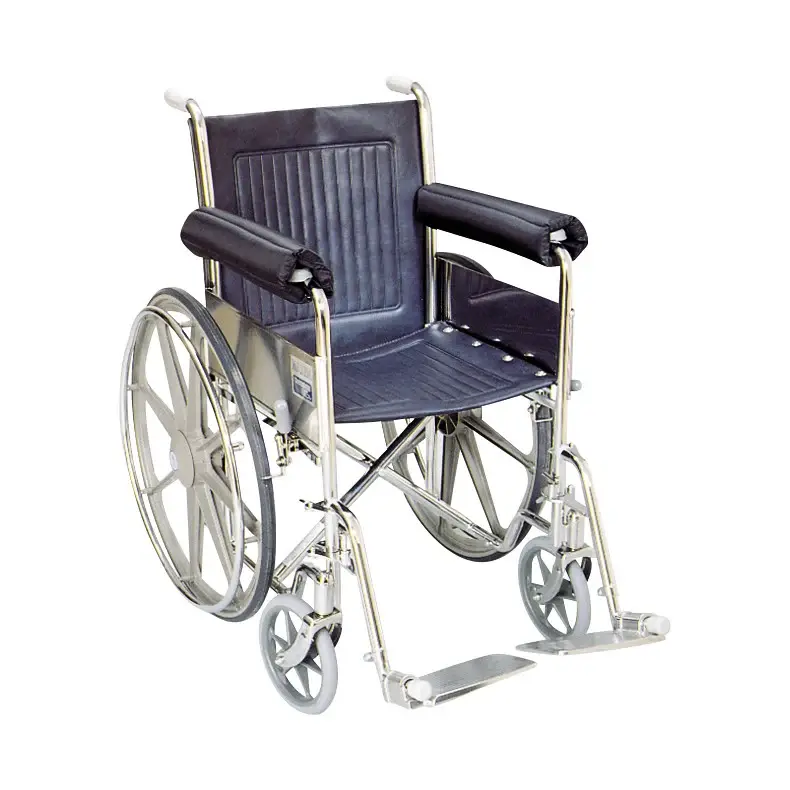
Before ordering, name what you have. The folding manual wheelchairs and transport chairs in this guide have a sling seat: a piece of nylon or vinyl screwed along both edges to the seat rails. When the chair folds, the sling folds in the middle. Invacare's Tracer SX5 manual shows this in its folding steps: "With both hands, grasp the middle of the seat upholstery at the front and back edge and lift up."
The back on these chairs is a second sling, screwed to the two back posts (Invacare calls them back canes).
The federal code list used for Medicare billing names the same parts. The National Library of Medicine's HCPCS search, read on 12 November 2026, describes E0981 as "Wheelchair accessory, seat upholstery, replacement only, each"
and E0982 as "Wheelchair accessory, back upholstery, replacement only, each."
It describes E0992 as "Manual wheelchair accessory, solid seat insert"
and E2231 as a "solid seat support base (replaces sling seat), includes any type mounting hardware."
E2231's description says it "replaces sling seat"; E0992's says only "solid seat insert". In our reading, an insert sits on the sling, while a solid seat base replaces it.
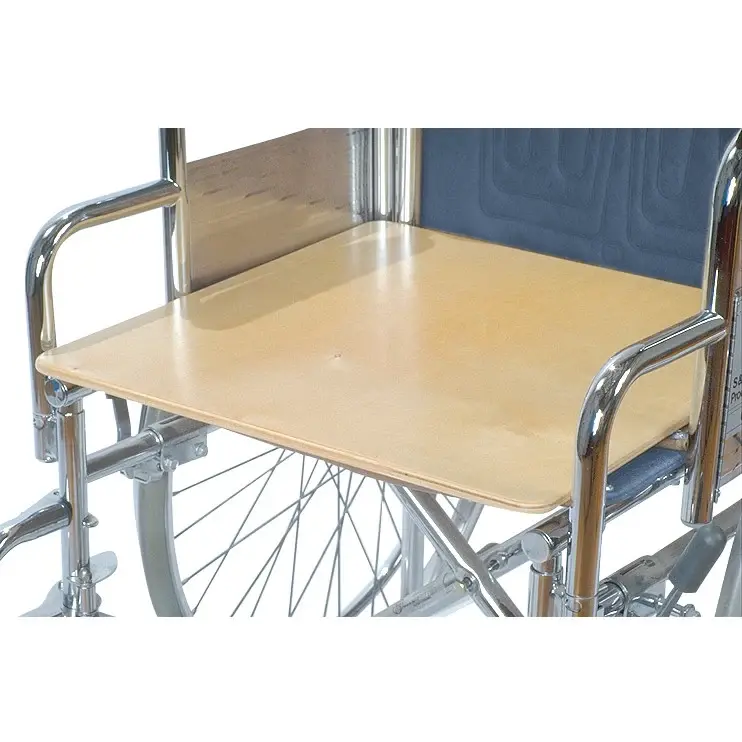
A solid seat insert is a flat board, such as Skil-Care's vinyl-covered wooden platform, that lies on the sling and gives a cushion a level base. Skil-Care's Walmart listing says it "converts any hammock surface to a level surface."
A solid seat pan or base is a rigid panel, such as Ki's aluminum pan, which E2231's description says "replaces sling seat". Ki Mobility's Rogue2 order form offers a choice under "Seat Option": "Standard Seat Sling" or "Aluminum Solid Seat Pan (E2231)"
. A drop seat is a pan that hangs below the rails to lower the seat; our catalog lists two, Therafin's Drop Seat Insert (AC-273) and JAY's Adjustable Drop Seat (AC-275), both of which our catalog rows say need further parts or a cushion.
The fourth option is a cushion, which sits on any of the three. A new cushion does not repair a torn or stretched sling, but a sound sling with a worn cushion needs a cushion, not upholstery. Our wheelchair cushion guide covers that choice. Power wheelchair seats are outside this guide.
How makers print upholstery sizes
How do you measure a wheelchair seat for replacement upholstery? Mobility Atlas read how Invacare, Medline, Karman and the sellers label their upholstery, and the convention is width first, then depth, in inches. Invacare's Tracer SX5 catalog heads its seat table "Width x Depth" and runs from 14 x 16 to 22 x 18; its back tables use chair width by back height. Medline's parts guide lists its seat upholstery by width, such as WCAA0032, an 18 inch nylon seat upholstery for the Guardian K1, without a depth. In our view, measure three things. Seat width: the distance between the two seat rails, center to center, or read it from the chair's label or invoice. Seat depth: the length of the old sling from front edge to back edge along the rail. Hole pattern: count the screw holes on one side and measure each gap from the front. Then compare all three with the maker's table, and give the seller your serial.
Depth works the same way. Invacare's Tracer IV catalog lists 18 and 20 inch deep seats and says that 18 inch deep chairs "have six mounting holes" and 20 inch deep chairs "have seven mounting holes."
So depth changes the number of screws, not only the length of the fabric. Some Medline chairs have seat depth extenders: the Guardian K1 page of Medline's guide lists an 18 inch nylon seat depth extender as WCAA0060 and the 20 inch version as WCAA0061, and the K4 Lightweight page lists WCA806922EXT as a seat depth extension for the 18 inch seat only. If a chair has been set deeper than it left the factory, the upholstery must match the new depth, which Invacare's manual states in its service pages (see the section on fitting below).
Back upholstery adds a third figure, back height. Invacare's 9000XT Recliner page lists back upholstery for a 23 inch back height in widths from 14 to 22 inches. Karman's 2012 catalog writes back sizes as two figures, such as UB1818B, "Vinyl back 18x18 black E&J comp"
, and UB2418, "Back 24 x 18 for KN924W"; in our reading the first figure is the width, as on Invacare's tables. Sportaid's Quickie back page asks for three things beyond the model: the upholstery type, whether the back folds, and whether the chair has push handles.
On the sellers' pages, Walmart's tiles read "16x16", "18x16", "20x16" and "22x18" for seats, and "16x18" and "20x18" for backs, matching the width by depth or width by height convention. One Walmart back listing gives its size two ways, "17 x 17 Inches / 43 x 43 cm", and is an Oxford cloth padded back; in our reading it is a cover that sits over a chair's back rather than a screw-on sling.
Screw holes, rails and hardware
The hole pattern is where a near miss turns into a part that will not fit. 1800wheelchair's pages for its Invacare-fit seat upholstery print the hole spacing "From Front to Back" as 2, 3-5/8, 3-5/8, 4-3/4 and 2 inches. Those 5 figures add up to 16 inches by our arithmetic, the same as the 16 inch depth the page lists for every size. The page does not say whether the first and last figures are distances from the edges of the fabric; in our reading they are, so a seat of this pattern has four holes per side. Measure your rail and compare before you order.
Patterns change over time: Invacare's catalog pages say that after 10/11/16 an extra hole was added to the rear corners of the seat upholstery, and that the newer upholstery "accommodates all wheelchairs manufactured before 10/12/16 as well"
, which our Invacare parts guide explains.
Hardware can be a separate line. Medline's guide lists an "Upholstery Hardware Set" as WCAA0035 on the Guardian K1 page and as WCA806975 on the basic steel transport chair (MDS808200), Excel 2000 and K4 Lightweight pages. Invacare's 9000XT Recliner page lists back hardware as 1035975-NLA, a package of 18 screws with washers marked NLA (no longer available), and notes that "Hardware is not sold individually."
Sportaid's Quickie seat page warns that "attachment rails and screws are not included"
, while its Top End seat page says the upholstery "Comes with seat rails." Ask which applies before you pay.
The so-called universal seats deal with holes in their own way. The Walmart listing for a 16 x 16 inch vinyl seat sold by Wheelchairparts.net says it "comes with 2 sets of mounting holes to fit on several wheelchairs like Invacare, Drive, Medline & E&J,"
and asks buyers to "measure your current seat and make sure it matches the size and hole mouting [sic] hole pattern."
The LumiJourney nylon seat lists "screws, one pair of metal plate"
as included. Two sets of holes means two patterns, not every pattern; the measuring step stays with you.
Nylon or vinyl: what the documents say about each
The replacement slings in the documents we read come in nylon or vinyl, with one Karman line in polyester and some seller listings in Oxford cloth, and the makers' tables list nylon and vinyl side by side. Medline's Guardian K1 page lists 12 seat and back upholstery numbers: 6 nylon and 6 vinyl, in 16, 18 and 20 inch widths. The 18 inch pair, for example, is WCAA0031 (back, nylon) and WCAA0032 (seat, nylon), against WCAA0025 (back, vinyl) and WCAA0026 (seat, vinyl). The model numbers on the same page carry the choice: Medline's guide describes K1186N22S as an 18 inch wide seat in nylon and K1186V22S as an 18 inch wide seat in vinyl. In our reading, the N or V in those model numbers shows which upholstery the chair left the factory with.
Invacare prints colors as codes, listed in our Invacare parts guide; 1800wheelchair's SKU for its Tracer SX5 seat ends in U67, the code Invacare's Tracer SX5 catalog gives for black vinyl.
Karman's 2012 catalog names two materials and one coating. Its E&J-compatible backs and seats are vinyl, such as US1816B, "Vinyl seat black E&J compatible"
. One is listed as polyester: US1816LT, "18x16 seat polyester for KM8020". And its removable S-105/115 backs and seats are listed under the heading "Anti-Bacterial Upholstery For Manual Wheelchairs"
with "AEGIS Coating"; that is Karman's description, and the catalog gives no test behind it. Karman's LT-1000HB literature sheet, linked from its LT-1000 page and read on 9 November 2026, lists "High-grade flame retardant, breathable nylon upholstery"
.
What the documents do not give is a head-to-head test of nylon against vinyl. None of the pages we read prints a tear strength, a wear test or a weight figure for one material against the other. The makers' own words: Skil-Care says the vinyl cover of its seat board "Wipes clean for easy care"
, and Karman's LT-1000HB sheet calls that chair's nylon "breathable". In our view, that is the usual trade-off, and the choice is worth a word with the therapist where skin health is a concern.
Medline upholstery part numbers by chair
Medline's parts guide, with a 2026 copyright line on its back page, covers eight transport chair groups and fourteen wheelchair groups by its contents page, from the Guardian K1 to the Excel 2000, K4 Lightweight and Hybrid 2. It says it is "designed to help you quickly identify and order the right replacement parts"
. A caution on our copy: in the extracted text, the dots that show which model each part fits do not line up with the model columns, so below we tie each part number only to the description in its own row and the page it is on.
| Page of Medline's guide | Part number | Description as printed |
|---|---|---|
| Guardian K1 | WCAA0030 / WCAA0032 / WCAA0034 | Seat upholstery, nylon, 16 / 18 / 20 in |
| Guardian K1 | WCAA0029 / WCAA0031 / WCAA0033 | Back upholstery, nylon, 16 / 18 / 20 in |
| Guardian K1 | WCAA0024 / WCAA0026 / WCAA0028 | Seat upholstery, vinyl, 16 / 18 / 20 in |
| Guardian K1 | WCAA0023 / WCAA0025 / WCAA0027 | Back upholstery, vinyl, 16 / 18 / 20 in |
| Guardian K1 | WCAA0035 | Upholstery hardware set (kit) |
| Excel 2000 | WCA806920BLK / WCA806925BLK | Seat / back upholstery, vinyl, black, 18 in |
| Excel 2000 | WCA806920NS / WCA806927BLKS | Seat and back set, vinyl: navy 16 in / black 20 in |
| K4 Lightweight | WCA806921K4S / 922K4S / 927K4S | Seat and back set, nylon, 16 / 18 / 20 in |
| K4 Lightweight | WCA806926K4 / WCA806928K4 | Seat / back upholstery, nylon, 22 in |
| Basic steel transport, MDS808200 | WCA808921 | Seat upholstery, nylon, 19 in |
| Basic steel transport, MDS808200B / BN | WCA200BSU / WCA200BBU (19 in), WCA200BNSU / WCA200BNBU (17 in) | Seat / back upholstery, nylon |
| Basic steel transport, padded seat, MDS808200BP / BNP | WCA200BPSU / WCA200BPBU (19 in), WCA200BNPSU / WCA200BNPBU (17 in) | Seat / back upholstery, nylon |
Three notes from the same pages. The basic steel transport chair page says "MDS808200KD , MDS808200WAT : No replacement parts available"
, so those two item numbers have no parts in this guide. The same page lists two pairs of models, MDS808200B (19 inch seat) and MDS808200BN (17 inch), and the padded-seat MDS808200BP (19 inch) and MDS808200BNP (17 inch), each with its own nylon seat and back upholstery numbers; match the number to the model. And Medline numbers its arm pads on the same pages, which the arm pad section below lists.
Medline's guide ends with a contact for product or parts questions, its DME Support line, rather than a price list. We found one Medline upholstery number on a seller page: Walmart listed "Medline Wheelchair Upholstery Set Bariatric Extra Wide Wheelchair Compatible WCA806925NVYS"
at $85.04 on 12 November 2026. The Excel 2000 page of Medline's guide lists WCA806925BLK as an 18 inch black vinyl back; the NVYS version is not on the pages we kept, so we cannot say from Medline's own document which chair it fits. Ask the seller to confirm against your model number.
Karman upholstery part numbers, from a 2012 catalog
Karman's parts catalog on its own site is old: its cover reads "Part Catalog 2012" and the file sits in a folder dated January 2013. We use it because it is the parts list Karman publishes, but treat every number as something to confirm with Karman or a dealer before ordering. The catalog says so itself on its upholstery table: "All upholstery may only fit certain models, ask ahead for measurements"
.
That table page lists 41 upholstery part lines, backs starting UB and seats starting US. They fall into three groups. Model-specific pieces name a Karman chair: UB-S115 and US-S115 are the "Removable upper back" and "Removable upper seat" for the S-105 and S-115, UB-S305 and US-S305 for the S-305, UB2018 and US2018 for the KN920W, and US1616LT is "Seat 16x16 for T-2700N". Upgraded pieces carry APT in the number, such as US-2218APT, "Upgraded 22x18 vinyl seat airport"
. And 12 lines are listed as fitting chairs of another maker, E&J, such as UB1818B, "Vinyl back 18x18 black E&J comp"
, in black or blue (some lines say dark blue) and with or without a pocket.
Karman's current manuals add the care side. The KM-5000 (MVP 502) manual, read on 9 November 2026, lists among its dos: "DO tie-up the upholstery or replace which with a new one when it becomes loose."
Its upholstery section says to clean with "warm water and a mild soap"
and that "Upholstery cleaner/foam can also be used, but avoid other cleaning solvents."
The parts diagram in the same manual names "Back Upholstery" and "Seat Upholstery" as separate parts.
Quickie and Top End: upholstery ordered by serial number
Sportaid's Quickie pages ask for the make, model and serial number rather than a size; its Top End seat page asks only for the upholstery type and shipping. Sportaid's pages, read on 12 November 2026, show how that works for a buyer. Its Quickie Seat Upholstery page (stock number 9803) lists a cost of $70.50 for a "Standard Seat Sling" and adds $55.00 for "Tension Adjustable", which makes $125.50 by our arithmetic. It requires "Make/Model & Serial Number (We cannot proceed without this information)"
.
Sportaid's Quickie Wheelchair Back Upholstery page lists a cost of $105.00 to $278.00, for "Standard Fold - Over" or "Tension Adjustable" backs, folding or non-folding, with or without push handles. Its note is the clearest statement we found of why the serial number matters: "Orders placed without a wheelchair serial number cannot be guaranteed."
It adds that in the event of an error the buyer pays return shipping and "the 25% restock fee imposed by Quickie,"
and says "Do not order by picture." The page says the serial number and chair type "will dictate the type & price of your upholstery."
Sportaid's Top End Wheelchair Seat Upholstery page (stock number ISEATUPH-J) lists $119.00 for a "Standard Sling" and adds $50.00 for "Tension Adjustable by Strap"
, or $169.00 by our arithmetic. It says the upholstery "Comes with seat rails" and lists ground shipping in the continental US at $35.00. The Quickie pages offer shipping at $15 or $30 and say international or expedited orders get a quote.
Sportaid's Quickie seat page goes further than a fit note: it says "The only replacement seat upholstery that sould [sic] be used with your Quickie Wheelchair is the Quickie Seat Upholstery."
That is the seller's statement. Separately, Sunrise's Quickie Nitrum manual, read on 9 November 2026, lists "Tires and tubes, upholstery, pads, and push-handle grips"
among the things it does not warrant, and says "This warranty applies in the USA only."
Ki Mobility: back upholstery and seat pans on the order form
Ki Mobility prints its options on order forms, which is where its upholstery choices are easiest to read. The Rogue2 US order form, effective 8/17/2026 and read on 12 November 2026, lists four back upholstery options, each with a price printed on the form: "Padded Velcro Adjustable with Standard Cover"
at no charge, the same with an "Air Mesh Breathable Cover"
at $81, "Tension Adjustable with Standard Cover (E2611)"
at $374 and "Tension Adjustable with Air Mesh Breathable Cover (E2611)"
at $416. Omit is printed as ($10). The form says back upholstery is "Available only with Height Adjustable Back Posts."
For the seat, the same form offers "Standard Seat Sling" at no charge or "Aluminum Solid Seat Pan (E2231)"
at $277. Ki's Catalyst 5 order form, read on 9 November 2026, lists a "Removable Aluminum Seat Pan E2231"
at $312 and notes that its seating system cross braces are "Not available with Seat Sling."
These are prices printed on Ki's order form for a new chair, which says "Pricing and specifications subject to change without notice"
; they are not prices for a replacement part bought later.
The codes in brackets are Ki's coding, not a promise of payment. The form says so itself: "HCPCS Codes provided are based on code verification by the PDAC or our interpretation of the code definitions,"
and "Proper use of HCPCS Codes does not ensure coverage or payment."
E2611, as the National Library of Medicine's search describes it, is a "General use wheelchair back cushion, width less than 22 inches, any height, including any type mounting hardware"
, which in our reading is why a tension-adjustable back is coded as a back cushion rather than as upholstery.
Ki's Rogue2 manual lists upholstery among wear items its warranty does not cover. In our reading, a worn Ki sling or back is then a part you pay for; ask a Ki dealer or Ki (the order form prints its phone number) for the part, with the chair's serial number. If you want to move from a sling to a pan or from a padded back to a tension-adjustable one, ask the dealer whether the change needs other parts, such as different back posts, which the form ties to the back upholstery.
Drive and Invacare: where to find the numbers
Drive Medical and Invacare publish detailed upholstery numbers, and both have their own guides on this site. In short, as our Drive guide sets out from Drive's diagrams: Drive prints upholstery on its parts diagrams by seat width and by the letters at the start of the serial number, and some sizes are marked no longer available; Invacare prints seat tables by width and depth in the model parts catalogs we read, with separate columns for nylon and vinyl. The detail, with the tables, is in our Drive Medical wheelchair parts guide and our Invacare wheelchair parts guide.
Two things we found on 12 November 2026 add to those guides. First, Drive's site search for "upholstery" returned 147 results. The first page of 18 lists "Seat Upholstery, for KR16E"
as 90136 and "Back Upholstery, for KR16E"
as 90134, a K1/K2 16 inch seat upholstery as X1WCIM01, and items titled only by size with hardware, such as X1WCT4IM01 and X1WCT4IM02. A result title is not a fit list; open the item and check which chair it names, or ask Drive's parts line with your serial.
Second, a seller's number may not match the maker's catalog. 1800wheelchair's page "Seat Upholstery (Tracer SX5)"
lists Sku 8881091623U67 at $95, in four sizes, and its Tracer EX2 page lists Sku 8881091623. In the seat table of Invacare's Tracer SX5 family catalog (form 02-016), the 18 x 16 inch row reads 8881127525, 8881127525 and 1127533, and the number 8881091623 does not appear on the catalog pages that were saved. The seller's number may be an older or bulk number for the same part; we cannot tell from the documents. Ask the seller to confirm in writing that it is the Invacare part for your chair's serial.
1800wheelchair's EX2 page says it is "To Fit Invacare Tracer EX2, Theradyne A, Evermed, Medline"
; that is the seller's list, not Invacare's. Invacare's manual, under a DANGER heading, says "Use of incorrect or improper replacement (service) parts may cause death, serious injury, or damage"
and "Replacement parts MUST match original Invacare parts."
Tension-adjustable backs: what they are and what they cost
A plain back sling is one piece of fabric screwed to the back posts, and in our view it sags with use, much as Skil-Care describes a sagging seat as a "hammock surface". A tension-adjustable back is built so its tension can be changed: Invacare's parts list, below, splits it into an anchor, an adjuster and a cover. The documents we read treat it as a seating option, priced and coded apart from plain upholstery.
The prices as printed: Ki's Rogue2 order form lists $374 with a standard cover and $416 with an air mesh cover, a difference of $42 by our arithmetic. Sportaid's Quickie back upholstery page lists tension-adjustable among its types at a cost range of $105.00 to $278.00, with the exact price set by the serial number and chair type. Sportaid's Quickie seat page adds $55.00 for a tension-adjustable seat, and its Top End seat page adds $50.00 for "Tension Adjustable by Strap"
.
Invacare's 9000 series catalog shows how a tension back is built as parts. Its page "Back Upholstery - Adjustable Tension"
lists, for 8 chair widths from 14 to 22 inches, a back anchor, a back adjuster, a back cover and a whole back assembly. The back anchor, 1037720-NLA, is marked NLA (no longer available) in all 8 rows, and the complete back assembly is marked NLA for the 17, 18 and 19 inch widths. In our reading, an owner of a 9000 with a tension back in one of those widths may be able to replace the cover or adjuster but not the whole assembly from this catalog; ask Invacare's parts line what it offers instead.
The warranty wording differs from plain upholstery. Sunrise's Quickie Nitrum manual gives the "Backrest Tension Adjustable (3DX, Ballistic, EXO, and EXO PRO)"
its own clause: Sunrise says it is free from defects, "provided normal use", "for a period of twelve months from the date of purchase"
, and then that "This warranty does not apply to puncture, tears or burns."
In the same manual, plain upholstery is listed among the things Sunrise does not warrant.
In our view, setting the straps is a seating adjustment: a seating clinician or the person who set up the chair should set them the first time and show the user or carer how to check them.
Universal versus model-specific upholstery
Is universal wheelchair upholstery a safe substitute for the maker's part? Mobility Atlas read the makers' and sellers' own wording on fit, and in our reading the answer depends on whether the hole pattern and size match, which you, the seller or the maker's dealer (with your serial number) can check. The makers lean toward their own parts: Invacare's Tracer SX5 manual, under a DANGER heading, says "Replacement parts MUST match original Invacare parts,"
and Sportaid says only Quickie seat upholstery should be used on a Quickie. The universal listings claim less than their titles. The Walmart listing for a 16 x 16 inch universal vinyl seat says it comes with two sets of mounting holes and asks buyers to measure the size and hole pattern. Karman's 2012 catalog calls some of its own backs and seats "E&J compatible" while saying upholstery "may only fit certain models"
. In our view, measure first.
On Walmart's first results pages, 7 of the 14 upholstery tiles had "Universal" in the title, and 5 of those read like this one: "16x16 Universal SEAT Vinyl Upholstery For Wheelchairs. Fits on Invacare, Drive, E&J & Medline". A maker name in a title is not a model; Invacare alone prints different seat tables for the Tracer SX5 family and the Tracer IV. Other tiles named one maker only, such as "22x18 Vinyl SEAT Upholstery For Invacare Wheelchairs. 5 Mounting Screws", which in our reading is a hint about the hole count to check.
All 3 Walmart product pages we opened print "Has written warranty: No" in their specifications, and the LumiJourney page adds Walmart's general note that warranty terms on items sold by third party Marketplace sellers "may differ". The LumiJourney nylon seat calls itself suitable "for most standard 18-inch wheelchairs & transport chairs"
, which is a claim we cannot check from its page, because the page prints no hole spacing.
Universal upholstery has a place: a chair whose maker no longer lists the part, or a second-hand chair with no serial label. Then measure the width between the rails, the depth of the old sling and every gap between holes, and ask the seller for the hole spacing in writing if the listing does not print it. On a chair still under warranty, a non-original sling can affect the warranty; the Invacare and Karman documents in the warranty section below say so.
Solid seat inserts and seat pans
When a sling has sagged, some people put a board on it rather than replacing it, sold as a seat board, solid seat insert or solid seat platform. In our reading of the code descriptions above, an insert (E0992) sits on the sling, and E2231's description says a base "replaces sling seat".
The Skil-Care Solid Seat Platform on Walmart, sold and shipped by Skil-Care at $39.99 on 12 November 2026, is an insert. Its listing says it is a "water proof covered wooden platform"
that "levels a sagging wheelchair seat"
and "Provides a firm foundation for any wheelchair cushion"
, and it says "Wheelchair cushion required"
. The listing prints two different figures for the same item. Its title gives 18 inches wide by 16 inches deep by 0.5 inch high, while its size line reads "18 x 20 in." and its fit line says wheelchairs from 18 to 20 inches. It gives the weight as "3.2 lbs" in the description and "18 lb" in the specifications. In our view, plan on the heavier weight, confirm the board's width and depth with Skil-Care in writing before ordering, and lift the board out before folding the chair.
Our catalog lists three more inserts and pans, with facts taken from the makers' or sellers' pages when the rows were made: AliMed's Wheelchair Board (AC-274), a wood board 3/8 inch high in sizes from 18 x 16 to 22 x 18 inches; ADI's Carbon Fiber Solid Seat Base (AC-272), which our row records as a flat carbon fiber base with a 200 lb weight limit and a 12-month limited warranty; and Therafin's Drop Seat Insert (AC-273), half-inch birch with 16 T-nuts, whose drop hooks and rail hardware are sold separately. A Walmart tile from Rehabilitation Advantage calls itself a solid wheelchair seat insert of 20 x 16 inches with a firm foam base, at $44.99 (the tile prints no item number).
A pan bolted to the rails is a bigger change. Ki's order forms price an aluminum pan at $277 on the Rogue2 and $312 on the Catalyst 5, as options on a new chair. In our reading, a fixed pan would stop a folding chair from folding; Ki's Catalyst 5 order form page names its pan a "Removable Aluminum Seat Pan"
. A pan or drop seat also changes seat height and how the cushion sits.
In our view, an insert or a pan is a seating decision, not a repair. A board under a pressure-relief cushion can change how that cushion works, and a lower or higher seat changes transfers and reach to the wheels. Ask the therapist or seating clinician who prescribed the cushion before adding either; our wheelchair cushion guide explains what they will look at.
Armrest pads: replacement by length and screw spacing
Wheelchair armrest replacement can mean the pad, not the whole arm. The pad is a padded top screwed to the armrest frame, and it comes in two common lengths: desk length, shorter so the chair can pull up to a table, and full length. Medline prints desk or full length, Karman prints sizes, and some seller listings print the screw spacing, which in our view decides the fit.
Medline's guide lists its pads by length and material. On the Guardian K1 page: WCAA0011, "Armrest Pad, Desk Length, Vinyl"
, and WCAA0013, "Armrest Pad, Full Length, Vinyl"
. On the Excel 2000 page: WCA806915BLK for a desk length black vinyl pad, WCA806910BLK for full length in black and WCA806910NVY in navy. On the K4 Lightweight page: WCA806915NYL for desk length and WCA806910NYL for full length. Some Medline arm assemblies include the pad, such as WCA806968K4, "Arm Assembly , Desk Length, Swing-Back with Pad"
, while the Excel 2000's WCA806960 is listed "No Armpads".
Karman's 2012 catalog prints sizes and makes a broad fit claim. It says "All armrests will fit most wheelchairs"
and lists AP22B, a black upholstered full arm pad of 13 3/4 by 2 1/4 inches, and AP23B, a black desk arm pad of 10 1/4 by 2 1/8 inches, with dark blue versions and a gray plastic full length pad, AP21. By our arithmetic those lengths are about 349 mm and 260 mm. The catalog's information page calls AP22B and AP23B "universal".
Drive's pads are in our Drive Medical wheelchair parts guide. 1800wheelchair's Invacare upholstery pages showed related tiles for a "Desk Length Armrest Pad" at $59, a "Full Length Armrest Pad Thick-Style"
at $66 and "Invacare Arm Pad Screws (pack of 50)"
at $60; we did not open those pages, so we cannot say which chairs they fit.
On Walmart's first results page for "wheelchair armrest pads replacement"
, which reported 202 results, 39 unique tiles were wheelchair arm pads or arm covers, at first printed prices from $5.99 to $39.95. The rule: titles naming armrest pads, arm pads, arm cushions or armrest covers for a wheelchair, with walker pads, side supports, seat cushions, upholstery kits, a multi-cushion tailbone set and pads sold for office and gaming chairs left out; a 13 inch universal padded waterfall pair at $45.50 was also left out because its title does not name an arm pad. Two kinds were mixed together. Screw-on replacement pads print a length or a hole spacing, such as a universal desk length pair listed at 9-1/8 inches, or pads with "10cm / 3.9 inches Hole Spacing"; strap-on covers wrap over an existing pad. 8 of the tiles named Drive, Invacare or Medline in the title; one Drive-titled tile printed STDSDSKNB, the number Drive's Viper Plus GT parts diagram gives for a desk arm pad.
In our view, to order a screw-on pad, measure its length and the distance between its screw holes, center to center. In our view, replace a split pad rather than covering it with a strap-on cover.
What replacement upholstery costs at US sellers
Prices below are as printed on the date we read each page, in US dollars, with the seller's label where it had one. Prices differ by seller, by sale and by funding; a dealer's price for an original part, quoted against your serial number, can differ from all of these. Tiles on a search page are listings, some by marketplace sellers, not the makers' own pages.
| Seller, date read | What the listing says | Price as printed |
|---|---|---|
| 1800wheelchair, 12 Nov 2026 | Seat Upholstery (Tracer SX5), Sku 8881091623U67 | $95 |
| 1800wheelchair, 12 Nov 2026 | Seat Upholstery (Tracer EX2), Sku 8881091623 | $95 |
| Sportaid, 12 Nov 2026 | Quickie Seat Upholstery, standard sling | Cost: $70.50 |
| Sportaid, 12 Nov 2026 | Quickie back upholstery, by serial | Cost: $105.00 to $278.00 |
| Sportaid, 12 Nov 2026 | Top End seat upholstery, with rails | Cost: $119.00 |
| Walmart, 12 Nov 2026 | Universal vinyl seat, 16 x 16 (Wheelchairparts.net) | Current price is $38.50 |
| Walmart, 12 Nov 2026 | LumiJourney nylon seat, 18 x 16 | Current price is $21.49 |
| Walmart, 12 Nov 2026 | Medline upholstery set WCA806925NVYS (tile) | $85.04 |
| Walmart, 12 Nov 2026 | Skil-Care solid seat platform (insert) | Current price is $39.99 |
| Ki order form, eff. 8/17/2026 | Rogue2 tension back / aluminum seat pan | $374 / $277 (new chair option) |
Across Walmart's first results page for "wheelchair seat replacement"
(104 results reported) and for "wheelchair back upholstery"
(9 results reported), the tiles whose title contains the word "upholstery" numbered 14 unique titles, at first printed prices from $16.49 to $85.04. Of those, 10 titles said vinyl, from $38.50 to $59.95, and 3 said nylon or Oxford cloth, from $16.49 to $21.49. The lowest, at $16.49, was a padded Oxford cloth back that in our reading is a cover (the tile prints no item number); the highest was the Medline set. Where a tile showed a "Now" and a "Was" price, we used the Now price.
The seat search shows how mixed the results are. Of its 66 unique tile titles, 51 contain cushion, or pad or pads as a whole word, rather than upholstery: gel and foam cushions, car seat cushions and Oxford cloth seat pads (the LumiJourney "Seat Cushion Replacement" tile below is among them). Some replacement seats do not use the word upholstery, such as a LumiJourney "PVC Vinyl with Hardware, Fits K1/K2"
tile at $34.99 and a "Seat Only For Drive Wheelchair 18"
tile at $32.00; they are not in the 14. On that first page, the search mostly returned cushions, so read each title for the word upholstery or seat replacement, a size and a hole or screw count before comparing prices.
Sportaid's $35.00 Top End shipping makes $154.00 for a standard Top End seat delivered in the continental US by our arithmetic; return rules are in the warranty section below.
Fire and flammability labels, as printed
Invacare's Tracer SX5 manual puts the fire risk as a DANGER notice: "Lighted cigarettes dropped onto an upholstered seating system can cause a fire resulting in death, serious injury, or damage."
It continues that "Wheelchair occupants are at particular risk of death or serious injury from these fires and resulting fumes because they may not have the ability to move away from the wheelchair,"
and it says "DO NOT smoke while using this wheelchair."
Its general warnings add: "Avoid storing or using the wheelchair near open flame or combustible products."
What the labels and pages print about fire resistance varies. Karman's LT-1000HB literature sheet lists "High-grade flame retardant, breathable nylon upholstery"
. Pride's Go Chair page, a power chair read on 9 November 2026, lists among its testing standards "Cal 117 Flammability Test Compliance for Seating Foam and Fabric Components"
. Medline's parts guide and Karman's parts catalog print no flammability standard on the pages we kept. None of the 3 Walmart product pages we opened prints a flammability standard or a flame test; all 3 print a Proposition 65 (P65Warnings) warning, which is a chemical warning, not a fire rating.
ISO publishes standards on resistance to ignition of postural support devices; its pages do not say whether a sling seat counts as one, and ISO 16840-10 says it "does not apply to resistance to ignition of structural parts of a wheelchair"
. ISO's catalog page for ISO 7176-16:2012 says it "specifies requirements and test methods to assess the resistance to ignition by match flame equivalent of all postural support devices that are supplied to be part of a wheelchair or its seating system."
That standard is marked withdrawn and replaced by ISO 16840-10. ISO's page for the 2021 edition of ISO 16840-10, itself now withdrawn with a 2026 edition published, says its tests use a "smouldering cigarette equivalent"
and that "The tests measure only the resistance to ignition of the items tested, and not the ignitability of the complete wheelchair."
It also says the document "does not cover changes in resistance to ignition as a result of regular washing or use"
.
In our reading, a fire test result belongs to the material that was tested, so a replacement sling from another supplier needs its own answer: ask the seller in writing which flammability test it passed, and keep the reply. In our view, follow Invacare's line whatever the upholstery: do not smoke while using the chair, and keep it away from heaters and open flames.
Cleaning and checking upholstery, as the manuals print it
The three manuals whose care pages we saved (Invacare, Medline, Karman) agree on mild soap and water, and they differ in the detail. Invacare's Tracer SX5 manual lists "Clean upholstery and armrests with mild soap and water"
in its safety inspection checklist, and under the heading "Damage from Bleach" says "Clean upholstery with mild soap and water or spray disinfectant using a sponge. DO NOT use bleach or wash in a washing machine."
Medline's Guardian guide says "Clean the upholstery with a mild soap solution, rinse and wipe dry."
Karman's KM-5000 manual says to use "warm water and a mild soap"
and to "avoid other cleaning solvents."
The same manuals separate the hand grips from the upholstery. Invacare warns that soap or ammonia on the grips "will result in the hand grips sliding off the cane assembly"
, and Medline says to clean grips "with water only". In our view, clean the upholstery and the grips as two jobs, and dry both before the chair is used.
Checking matters as much as cleaning. Medline's guide lists, under upholstery, "Inspect for any rips, tears or worn spots and replace as necessary,"
and warns that torn or worn upholstery could result in a fall. Karman's manual says to tie up or replace upholstery "when it becomes loose." Invacare's manual includes a caution about transfers: "When transferring, position yourself as far back as possible in the seat. This will help prevent damaged upholstery and the possibility of the wheelchair tipping forward."
It also says, in its folding steps, "DO NOT allow upholstery to hang between the cross braces."
Invacare's safety inspection checklist adds "Inspect the seat and back for rips and sagging"
and "Inspect the seat and back for loose or broken hardware"
, and Medline's says "Inspect the upholstery screws and assure that all are present and tight."
In our view, replace a sling that has started to tear at a hole rather than patching it. Our manual wheelchair repair guide covers the wider check.
Fitting new upholstery: what the manual says about the job
Replacing a seat sling is a repair that Invacare's user manual describes step by step. Invacare's Tracer SX5 manual, section 9.4, "Replacing Seat Upholstery"
, has three steps: remove the mounting screws and washers that hold the old seat upholstery to the crossbraces, remove the old upholstery, and "Install new seat upholstery by reversing STEPS 1-2."
For the back on a standard frame, section 9.5 says to remove the eight mounting screws and washers that hold the old back upholstery to the back canes, check the position of the seat positioning strap if one is used, and "Securely tighten the new back upholstery to the back canes with the phillips screws and washers."
The recliner frame is harder. Section 9.6 of the same manual says one side of the spreader bar must be disengaged, that the chair "MUST be partially folded" to reach the bottom two screws, and that twelve mounting screws hold the back upholstery to the back canes. The headrest upholstery is held by six screws of its own. If your chair is a recliner, read the maker's steps before you start, or have a technician do it.
Changing the size is not a repair. Section 9.7, "Adjusting Seat Depth", warns that seat depth, caster and rear wheel position, anti-tippers and the user's condition "directly relate to the stability of the wheelchair"
and that "These adjustments MUST be performed by a qualified technician."
It adds that "If adjusting the seat depth of the wheelchair, the seat upholstery MUST be changed as well."
Section 9.8 says that "When adjusting the seat width of the wheelchair, the back and seat upholstery MUST be changed."
In our reading, section 9.4 does not reserve a like-for-like sling to a technician, while the manual also says "a qualified technician must perform all procedures specifically indicated in the manual"
; a change of size is one of those. Karman's KM-5000 manual says anything that requires tools "should be done by your authorized Karma service provider"
and that "Unauthorized repairs, upgrades and add-ons will negate your warranty"
; Invacare's warranty excludes products modified "through the use of unauthorized parts or attachments"
or repaired without its consent.
In our view, match the old and new slings hole for hole before removing anything, and if a screw spins in its hole, stop and call a technician. Nobody should sit in the chair until every screw is back.
Warranty and returns: upholstery is a wear item
In the documents we read, Invacare's Tracer SX5 manual and Medline's Guardian user guide warrant upholstery against defects for 13 months and one year but exclude normal wear and tear; Ki's Rogue2 manual, Sunrise's Quickie Nitrum manual and Karman's KM-5000 manual and user guide do not warrant upholstery. Each term below belongs only to the document that prints it.
- Invacare, Tracer SX5 manual (part no. 1110550): it warrants
"the upholstered materials (seat, back and armrests of the arm assembly)"
for thirteen (13) months from purchase, against defects in materials and workmanship, and lists all upholstery items among normal wear and tear items. It applies to products "purchased new and unused", needs a copy of the seller's invoice,"does not include any labor or shipping charges incurred in replacement part installation or repair"
, and is not transferable to a later owner. - Medline, Guardian user guide (PIC-00270): it warrants
"the parts and upholstery on the wheelchair to be free from defect in materials and workmanship for a period of one (1) year from date of purchase by the original purchaser"
, and says the warranty does not cover normal wear and tear. - Ki Mobility, Rogue2 manual: it does not warrant
"Wear items: Upholstery, tires, armrest pads, tubes, armrests and push-handle grips."
- Sunrise Medical, Quickie Nitrum manual: it does not warrant
"Tires and tubes, upholstery, pads, and push-handle grips"
; its clause for the"Backrest Tension Adjustable (3DX, Ballistic, EXO, and EXO PRO)"
runs twelve months and"does not apply to puncture, tears or burns"
; the manual says"This warranty applies in the USA only."
- Karman, KM-5000 (MVP 502) manual and the user guide linked from the LT-1000 page:
"Arm pads and upholsteries are not covered by warranty."
Seller return terms can be stricter than the maker's warranty. Both of 1800wheelchair's upholstery pages print a return policy that says "All sales are considered final"
and "We do not offer returns, refunds, or exchanges on this product,"
for "Safety and/or Hygienic reasons."
The exceptions are a defective or damaged item or the wrong item, and the seller says its customer service "must be notified within 5 days of receipt"
. Sportaid's Quickie back page warns of return shipping and "the 25% restock fee imposed by Quickie"
if an order without a serial number turns out wrong. Walmart's product pages listed free returns for the items we opened.
In our view, the order of checks is: is the chair still inside the maker's upholstery warranty period, counted from the purchase date on the invoice; if not, which seller will take the part back if the holes do not line up; and only then, which price is lower. A $20 saving is lost if the part cannot be returned.
Medicare and the upholstery codes
In the US, Medicare treats upholstery in two ways, and the codes explain which. When a wheelchair is first supplied, its upholstery is part of the chair. The CMS policy article A52504, Wheelchair Options/Accessories, in the version in effect when we read it on 9 November 2026 (revision effective 10/01/2025; CMS lists a future revision effective 12/20/2026, which we did not read for upholstery), has a table of codes that are included in the payment for a base; it says "A Column II code is included in the allowance for the corresponding Column I code when provided at the same time."
The row for manual wheelchair bases lists E0981 and E0982, the seat and back upholstery codes, in Column II. The row for transport chairs says "All options and accessories except E0990, K0195"
. In our reading, a supplier cannot bill new upholstery separately with a new chair. For transport chairs, the same article says "If a rollabout chair or transport chair are covered, medically necessary replacement items are covered"
and "A replacement accessory for a rollabout or transport chair is billed using code E1399."
Later, in our reading, is when the "replacement only" code descriptions apply. Medicare's booklet on durable medical equipment, read on 9 November 2026, says that if you own Medicare-covered equipment, "Medicare may also cover repairs and replacement parts,"
paying 80% of the approved amount for repairs while "You pay the other 20%," and that "Your costs may be higher if the supplier doesn't accept assignment."
It separates owned from rented equipment: "If you own your equipment, the supplier who sold it to you isn't required to repair it,"
while "If you rent equipment, your supplier must maintain and repair the equipment."
Medicare.gov's wheelchair page says that after you meet the Part B deductible, you pay 20% of the Medicare-approved amount "if your supplier accepts assignment"
.
In our reading, a worn sling on a chair Medicare paid for may be a covered replacement part, through a Medicare-enrolled supplier; ask the supplier what records the claim needs. We did not read a Medicare rule that sets how often upholstery may be replaced, and we do not say that any claim will be paid. If you have Medicare Advantage, Medicaid or VA coverage, ask the plan in writing how it handles replacement upholstery; we did not read their rules. Medicare.gov says Medicare will only pay for DME items from suppliers enrolled in Medicare; in our reading, if you buy upholstery yourself from a retail seller that is not enrolled, you pay the seller's price. Our wheelchair parts guide covers Medicare and parts more generally.
A code on a maker's order form, such as Ki's E2611 and E2231, is that maker's coding. Ask the supplier which code they would bill, and whether the plan has approved it, before work starts.
When a cushion or back support is the better fix
Not every sagging seat needs new upholstery. In our view, three questions sort it. Is the sling torn, split at a screw hole or stretched so that it hangs low when no one sits in it? Then it needs replacing. Is the sling sound, but the person sinks or slides, or feels the rails through it? Then the problem may be the cushion, or the lack of one. Is the back sling sound, but the person slumps or leans? Then a tension-adjustable back or a solid back support may be the question, and that is a seating question.
Invacare's Tracer SX5 manual names seat and back upholstery and seat and back cushions as different wear items, though its table groups them under one heading, "UPHOLSTERY AND SEATING". The Skil-Care insert says a "Wheelchair cushion required"
. Ki codes its tension back as a back cushion, E2611, not as upholstery. In our view, a new sling under a worn-out cushion will not help much, and a new cushion does not fix a torn sling: Medline's guide warns that "Torn or worn upholstery may not support the user's weight and could result in a fall"
.
Pressure care is the clinician's decision. If the person in the chair has, or has had, a pressure injury, or sits for most of the day, ask their occupational therapist, physical therapist or seating clinician before changing the seat surface, adding a board, or moving from a sling to a pan. Our wheelchair cushion guide explains the kinds of cushion and what a seating review covers; we do not repeat it here.
In our view, one check helps: with the chair empty, lay a straight edge across the seat rails and measure the gap down to the sling, and note it with the date. A gap that grows between checks is a stretching sling.
Ordering upholstery through Mobility Atlas
Mobility Atlas can find and quote the upholstery, seat pan or arm pad for your chair, including parts that are not listed on our pages. Send an enquiry or a part request through our wheelchair parts and accessories page; we reply with a written quote that includes delivery to your country, and nothing is charged before you accept it.
- The maker and model as printed on the chair, and the item or model number from the invoice if you have it.
- The full serial number, letters and digits, with a photo of the label.
- The seat width and depth, and for a back the width and back height, measured as described above.
- The number of screw holes on each side and the gap between each, in inches or millimeters.
- Nylon or vinyl, and the color, and whether you want the same as before.
- Whether the old upholstery came with rails, a pocket or straps, and photos of both sides.
- For arm pads: desk or full length, the pad's length and the distance between its screw holes.
- Your country and city, so the quote includes delivery.
If the maker lists the part as no longer available, say so in your request.
Three traps
Trap one: ordering by width alone. A seat listed as 18 inch can be 16, 18 or 20 inches deep, with a different number of mounting holes depending on the maker and the depth. Measure depth and holes as well as width, and give the serial.
Trap two: trusting the word universal. The Walmart universal seat we opened offers two hole patterns and asks you to measure; Karman's own catalog says its upholstery "may only fit certain models"
. In our view, a sling whose holes miss by a fraction loads the screws at an angle. If the listing prints no hole spacing, ask before you buy.
Trap three: a seller's part number that does not match the maker's. 1800wheelchair's Tracer SX5 seat uses a number that does not appear on the Invacare catalog pages saved for this guide, and the seller does not take returns on upholstery except for damaged or wrong items. Ask the seller to confirm in writing that the part is the maker's part for your serial, and keep that message. In our reading, that written confirmation is your best evidence if the part turns out to be the wrong item.
Three composite scenarios
These are composite scenarios, not individual customers. Each uses only the documents for the chair it describes.
Scenario one: a Medline Guardian K1 with an 18 inch nylon seat. The model label reads K1186N22S, which Medline's guide describes as an 18 inch wide seat in nylon. The seat has a tear at a rear screw hole. Medline's guide lists WCAA0032 as the 18 inch nylon seat upholstery and WCAA0035 as the upholstery hardware set. Medline's user guide says to inspect for rips and tears and replace as necessary, and warns that worn upholstery could result in a fall, so the family stops using the chair until the new seat is fitted. Medline's warranty on parts and upholstery runs one year from purchase for the original purchaser and excludes normal wear and tear, so on this older chair the seat is a purchase.
Scenario two: an Invacare Tracer SX5, 18 x 16 inches, black vinyl. The owner sees 1800wheelchair's Tracer SX5 seat at $95 and notices that its number, 8881091623U67, differs from the 18 x 16 row in Invacare's catalog. Because 1800wheelchair takes no returns on upholstery except for damaged or wrong items, the owner asks the seller to confirm the part against the chair's serial in writing first. Invacare's manual gives the job: remove the mounting screws and washers, take off the old seat and reverse the steps, cleaning afterwards with mild soap and water, never bleach.
Scenario three: a Ki Rogue2 user whose padded back has stretched. Ki's order form shows a tension-adjustable back at $374 with a standard cover or $416 with air mesh as new-chair options, coded E2611, and says back upholstery is available only with height adjustable back posts. Ki's manual lists upholstery as a wear item. The user asks their seating clinician whether a tension back is right, and asks the Ki dealer for a quote that names the parts needed for their serial and whether the back posts fit.
Questions to ask the seller, dealer or therapist
Ask the seller or dealer
- Is this the maker's part for my chair's full serial number, and will you confirm that in writing?
- What size is it, width by depth, and what is the hole spacing from front to back?
- Does it come with screws, washers, rails or plates, and which?
- Is it nylon, vinyl or another material, and what color code?
- Which flammability test, if any, has this upholstery passed, and can you send the document?
- If it does not fit, can I return it, who pays shipping, and is there a restocking fee?
- If the maker lists the part as no longer available, what substitute do you offer, and who says it fits?
Ask the therapist or seating clinician
- Is like-for-like upholstery right, or should the seat or back change type?
- Would a solid insert, a seat pan or a tension-adjustable back help, and how would it change my cushion and seat height?
- Should a technician fit it, and should the chair be checked after the change?
Sources and documents
Prices checked November 2026. Documents checked November 2026. Exact read dates: the pages and PDFs saved for this guide were read on 12 November 2026; pages reused from earlier guides keep their own read dates, given below.
Read 12 November 2026: Medline's parts guide; Karman's Part Catalog 2012; Invacare's Tracer SX5 manual (service pages) and catalog 95-137 (back upholstery pages); Ki's Rogue2 order form; Drive's site search; Drive's Viper Plus GT, Blue Streak and Sentra EC Heavy-Duty pages and Cruiser III parts diagram (read for a sibling guide); the 1800wheelchair, Sportaid and Walmart pages listed below; the ISO catalog pages and the NLM HCPCS search. Reused from a sibling guide, same date: Invacare catalogs 02-016, Tracer IV and 95-137 (other pages).
Read 9 November 2026 and reused: Invacare's Tracer SX5 manual (warranty, safety and inspection pages); Medline's Guardian user guide; Karman's KM-5000 manual and LT-1000 page, literature sheet and user guide; Pride's Go Chair testing page; Ki's Rogue2 manual and Catalyst 5 order form; Sunrise's Quickie Nitrum manual; Drive's Viper Plus GT manual and Sentra document; CMS article A52504 (version in effect that day); Medicare booklet 11045; Medicare.gov's wheelchair page. Our catalog rows AC-272 to AC-275 were used for non-price facts only.
This article is general information. Rules and prices differ by country and change, so confirm them before you buy or travel.
Common questions
How do I know what size wheelchair seat upholstery to buy?
Find the chair's seat width and depth on its label, invoice or model number, then measure the old sling's depth and the gaps between its screw holes from front to back. Invacare prints sizes width first, such as 18 x 16 inches. Compare all three with the maker's parts table for your model, and give the seller the full serial number, because hole counts differ by depth and model (Invacare's Tracer IV catalog ties six holes to 18 inch deep seats and seven to 20 inch ones).
Is nylon or vinyl wheelchair upholstery better?
The documents we read list both side by side without a test of one against the other. Medline's Guardian K1 page lists 6 nylon and 6 vinyl upholstery numbers in the same widths, and Invacare lists nylon in black and vinyl in several colors. Skil-Care's listing says its vinyl cover wipes clean, and Karman's LT-1000HB literature sheet calls that chair's nylon breathable. Where skin health is a concern, ask the therapist which suits the person.
Can I replace wheelchair seat upholstery myself?
In our reading, Invacare's Tracer SX5 manual does not reserve a like-for-like seat to a technician, though it says a qualified technician must perform all procedures the manual specifically indicates. Invacare's Tracer SX5 manual has three steps for the seat: remove the mounting screws and washers, remove the old upholstery, and reverse the steps with the new one. Changing seat depth or width is different: the same manual says those adjustments must be done by a qualified technician, and the upholstery must be changed with them. Karman's KM-5000 manual says unauthorized repairs or parts "will negate your warranty"
, and Invacare's warranty excludes products modified with unauthorized parts or repaired without its consent. On Invacare's recliner, the chair must be partly folded to reach the bottom two back screws.
Does universal wheelchair upholstery fit any chair?
No. The universal listings we read fit some chairs: the Walmart universal vinyl seat comes with two sets of mounting holes and asks buyers to measure the size and hole pattern. Karman's catalog says its upholstery may only fit certain models. Measure your rails and holes, compare them with the listing, and ask for the hole spacing in writing if the page does not print it.
How much does wheelchair seat replacement cost?
On 12 November 2026, upholstery titles on Walmart's first results pages ran from $16.49 (a padded back cover) to $85.04; 1800wheelchair listed Invacare-fit seats at $95 with free shipping; Sportaid listed Quickie seat upholstery at $70.50 and Top End seat upholstery with rails at $119.00, before shipping. Prices differ by country, seller, sale and funding, and Medicare may cover a replacement part on a chair you own through an enrolled supplier.
How do I replace a wheelchair armrest pad?
Note whether the arm is desk or full length, measure the old pad's length and the distance between its screw holes, and match those to the maker's part. Medline lists desk and full length pads by number, such as WCAA0011 and WCAA0013 for the Guardian K1, and Karman's catalog prints pad sizes. Strap-on covers wrap over a pad but do not replace a split one.
Sources
- Medline: Transport Chair, Wheelchair, Homecare Bed Parts Guide (PDF hosted by Vitality Medical, read 12 November 2026)
- Medline: Standard Manual Wheelchairs user guide, K1 to K4 Guardian, PIC-00270 (read 9 November 2026)
- Karman Healthcare: Part Catalog 2012 (PDF)
- Karman Healthcare: KM-5000 (MVP 502) manual (read 9 November 2026)
- Karman Healthcare: LT-1000 transport wheelchair (read 9 November 2026)
- Karman Healthcare: LT-1000HB literature sheet (read 9 November 2026)
- Karman Healthcare: Wheelchair user guide and safety tips (read 9 November 2026)
- Invacare: Tracer SX5 Wheelchair User Manual, part no. 1110550
- Invacare: parts catalog 02-016, Tracer EX2, EXI, SX5, SX5 Recliner
- Invacare: parts catalog 95-137, 9000SL, 9000XT, 9000XDT, 9000XT Recliner
- Ki Mobility: Rogue2 US order form, effective 8/17/2026
- Ki Mobility: Rogue2 owner's manual (read 9 November 2026)
- Ki Mobility: Catalyst 5 US order form (read 9 November 2026)
- Sunrise Medical: Quickie Nitrum owner's manual (read 9 November 2026)
- Pride Mobility: Go Chair testing standards and warranty (read 9 November 2026)
- Drive Medical: site search for upholstery, first results page
- Drive Medical: Viper Plus GT wheelchair page with parts diagram (read 12 November 2026)
- Drive Medical: Blue Streak wheelchair page and parts diagram (read 12 November 2026)
- Drive Medical: Cruiser III parts diagram (read 12 November 2026)
- Drive Medical: Bariatric Sentra EC Heavy-Duty wheelchair page and parts diagram (read 12 November 2026)
- Drive Medical: Viper Plus GT owner's manual (read 9 November 2026)
- 1800wheelchair: Replacement wheelchair upholstery category (prices read 12 November 2026)
- 1800wheelchair: Seat Upholstery (Tracer SX5), with return policy
- 1800wheelchair: Seat Upholstery (Tracer EX2), with return policy
- Sportaid: Quickie Seat Upholstery
- Sportaid: Quickie Wheelchair Back Upholstery
- Sportaid: Top End Wheelchair Seat Upholstery
- Walmart: search results for wheelchair seat replacement, first page (prices read 12 November 2026)
- Walmart: search results for wheelchair back upholstery, first page
- Walmart: search results for wheelchair armrest pads replacement, first page
- Walmart: 16x16 Universal SEAT Vinyl Upholstery (Wheelchairparts.net)
- Walmart: LumiJourney 18 x 16 nylon seat upholstery
- Walmart: Skil-Care Solid Seat Platform 703082
- ISO: ISO 7176-16:2012, Wheelchairs, Part 16: Resistance to ignition of postural support devices
- ISO: ISO 16840-10:2021, Wheelchair seating, Part 10: Resistance to ignition of postural support devices
- National Library of Medicine: HCPCS search for upholstery (E0981, E0982), E2231, E0992, E2611 and E0994
- CMS: Article A52504, Wheelchair Options/Accessories policy article, version in effect 9 November 2026
- Medicare: Medicare Coverage of Durable Medical Equipment & Other Devices, booklet 11045 (read 9 November 2026)
- Medicare.gov: Wheelchairs and scooters (read 9 November 2026)
Read on . The wording of the article is our own.