Power wheelchair charger guide 2026: mobility scooter charger types, amps, plugs, lights, part numbers, prices and warranty
How to choose a power wheelchair or mobility scooter charger: chemistry, amps, plugs, charging times and light codes as manuals print them, part numbers and US prices.
Contents
- The short answer
- How we checked
- Start with the label on your old charger
- Lead-acid and lithium chargers are not interchangeable
- Amp ratings from 1.5 to 10 amps: what the number means
- Pride chargers by model, as Pride's pages print them
- Charger part numbers by maker, as the pages print them
- Plugs and sockets: XLR and the others
- Off-board and on-board chargers
- How long to charge, and when, manual by manual
- Plugging in: the order differs by document
- Charger lights: what each printed code means
- When the charger will not start or never finishes
- Safety lines from the manuals, quoted
- USB adapters and what else the charging socket may take
- What replacement chargers cost: two US sellers
- Warranty: the charger's own terms and the chair's
- Medicare and other payers
- Recalls that name a charger
- Three traps
- Three composite scenarios
- What to ask before you order
- Sources and documents
- Common questions
- Sources
The short answer
A power wheelchair charger or a mobility scooter charger has to match four things: the battery chemistry (sealed lead-acid AGM or gel, or lithium), the voltage, the amp rating your chair or scooter maker names for your battery size, and the plug on the chair. If you are looking for an electric wheelchair charger replacement, start with the label on the old charger and the specifications page or manual of your model, not with the plug alone. Many chargers use the same three-pin XLR plug, yet the charger manuals we read print different charging voltages, battery types and battery sizes for each one.
The makers say this plainly. Pride Mobility's charger article says "Using an incorrect charger could create a dangerous situation."
Its Jazzy EVO 614 Series owner's manual says "You must recharge your power chair's batteries with the supplied offboard battery charger."
Golden Technologies' LiteRider Envy manual says "The use of any other charger on this power chair will void the warranty."
and adds "Using the wrong charger may also be a hazard."
Permobil's M3 Corpus user manual says "Only use a Permobil charger intended for use with your wheelchair."
Prices vary widely. On 13 November 2026, Monster Scooter Parts (US) listed 88 chargers in its mobility battery charger collection by our count, 50 of them marked available, from $22.49 to $572.65. SpinLife (US) listed 12 battery chargers on the same day, from $108 to $319.
This guide covers chargers only. Which power chair or scooter suits your body, your seating and your transfers is a question for your physician, physical therapist or occupational therapist, and battery sizes and fire reports are covered in our power wheelchair batteries guide.
Mobility Atlas earns a fee or margin when you order through us; the guide below uses only the makers' own manuals, specification pages and warranty terms, the charger makers' manuals, sellers' own pages, and government records, each read on the date we give.
Mobility Atlas can find and quote a replacement charger for you, including chargers and charging parts that are not listed on our pages. The process: you send an enquiry or a part request, we reply with a written quote that includes delivery to your country, and nothing is charged before you accept it. Joysticks, controllers and other power chair electronics are on our power wheelchair controls and motors page, and the chargers we list are on our wheelchair batteries and chargers page.
How we checked
On 13 November 2026 we saved, as text, the Monster Scooter Parts product list for its mobility collection "Battery Chargers" (the collection page printed a count of 137; the store's product data returned 134 products, which we counted), four of its charger pages, the whole SpinLife "Battery Chargers" category (12 items; the page prints "Viewing 1-12 of 12") and three SpinLife charger pages. We also read a 46-page "Battery Charger Manual" compilation holding the manuals of 13 chargers, among them the Universal Power Group (UPG) 2, 3.5, 5 and 8 amp lead-acid chargers and the UPG lithium charger with Pride part number ELE2008644; Invacare's 5 A charger manual (a European document, 1654663-A, 2019); Permobil's VR2-A control panel manual (US English, edition 4, 2024) and its VoltPro charger page; Pride's XLR USB charger sheet and three Pride Mobility Experience articles; and the openFDA recall records that name a charger for powered wheelchairs and scooters.
We reused documents read for neighboring guides, each with its own date. On 9 November 2026: 20 Pride specification pages, Pride's Jazzy EVO 614 Series and Jazzy Ultra Light manuals, two Pride warranty inserts, Drive's Scout manual, Permobil's M3 Corpus manual and one-year warranty, CMS LCD L33792 and the Medicare booklet on equipment. On 12 November 2026: Pride's charger article, Pride's Travel Scooter Series owner's manual, 4 more Pride specification pages, the Monster Scooter Parts 2 amp Go-Go charger page and warranty policy, and SpinLife's return policy. On 13 November 2026, besides the new files: Golden's Buzzaround XL and LiteRider Envy owner's manuals.
Our method for prices: every range is computed by script over every price line on the pages we saved, and when we leave lines out we name the rule. For Monster Scooter Parts we count a product as a charger when its title contains the word "Charger" and does not name a charging port or socket, a connector, a power cord or other cord, an adapter, a harness, a docking station or an extension kit as the item; that rule keeps 88 of the 134 products and leaves out 46. The kept chargers include one automobile charger and jump starter (84039) and one electric-bike charger. A price is the figure the store prints before any coupon code, in US dollars, on the read date. We do not report "was" prices from that store because we did not check how its pages display them. Fitment, meaning which models a part fits, is only what a page prints, with the page named; we never infer that a charger fits a model the page does not list.
Start with the label on your old charger
The label is the best record of what your chair or scooter was built to use. In our view, write down, or photograph, five things: the maker's part number, the voltage, the amp rating, the battery types it names (AGM, gel or lithium), and the plug. Then find your model name and serial number on the chair or scooter.
Pride's charger article (posted December 27, 2021, read 12 November 2026) asks owners to have three things ready when they call a dealer: the model name, the serial number and the charger type. Seller pages ask for the label too. The Monster Scooter Parts page for Pride charger ELE2000091 opens with "Confirm your current charger label reads ELE2000091 before ordering"
and adds "Pride and Quantum have used several different chargers over the years."
Its page for the lithium charger ELE2008644 says "Confirm that your old charger reads ELE2008644 or 24BC3500L-1."
If the old charger is lost, the model's own documents are the next record. Pride's specification pages print a charger line for each model (see the table further down). Drive Medical's Scout owner's manual prints "BATTERY CHARGER 2A". Golden's Buzzaround XL manual says only "Off-board" in its charger row. In our view, when a model document gives no amp rating, the dealer or the maker's customer service, with your serial number, is the place to get it in writing before you order.
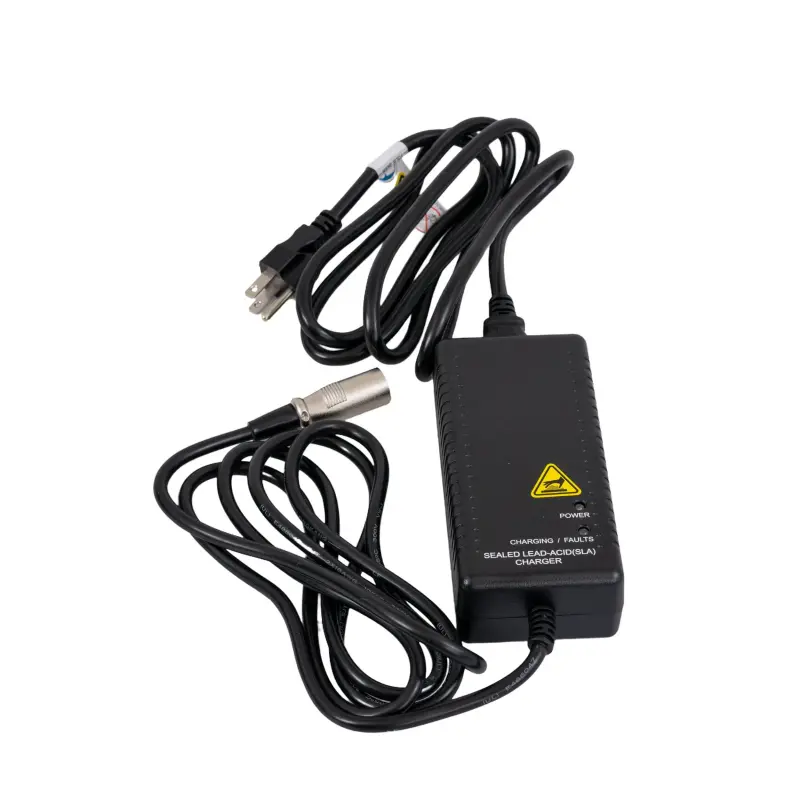
Which charger does a power wheelchair or mobility scooter need? The one its maker names for your model and battery: same chemistry (AGM, gel or lithium), same voltage, the amp rating printed for your battery size, and the same plug. Mobility Atlas read Pride's specification pages, owner's manuals from Pride, Golden, Drive and Permobil, and charger manuals including Invacare's and UPG's; they agree on the principle while differing on details. Pride's pages print ratings from 2 to 8 amps across the 23 models in our table, some with two ratings for two battery sizes. Lithium chargers in the manuals we read are made for lithium only, and the lead-acid ones for lead-acid only. Pride's Travel Scooter manual recommends "use of the charger supplied as original equipment with your product only."
In our view, read the old charger's label, match the part number where you can, and ask the maker or a dealer, with your serial number, before you buy a different rating.
Lead-acid and lithium chargers are not interchangeable
The Pride manuals we read describe two 12 volt sealed batteries for their lead-acid models, and the Pride pages in the table below print lithium packs for several travel chairs and scooters. Each chemistry has its own charger, and the charger manuals say so in their first lines.
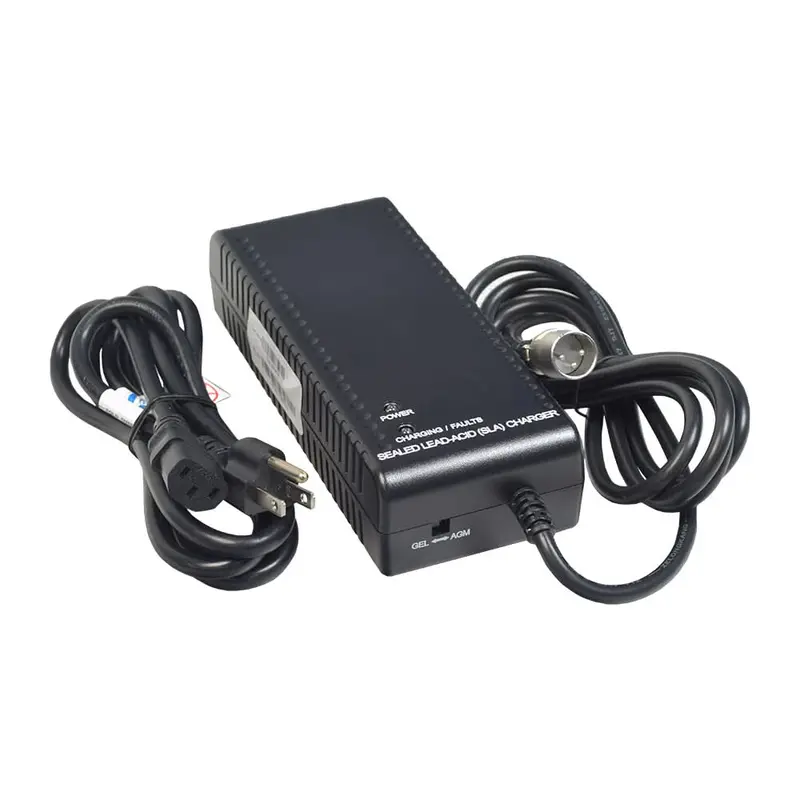
The UPG lead-acid manuals for the 3.5, 5 and 8 amp chargers each say "CAUTION: To reduce the risk of injury, charge only AGM or GEL Sealed Lead-Acid batteries."
They add a switch step: "Check battery-type selection switch to match your batteries - AGM or GEL."
The 3.5 and 5 amp manuals say the default setting is AGM. The UPG 2 amp manual says "charge only 24V, 7-18AH lead acid rechargeable batteries with the charger."
The Battery Maximizer instructions in the same compilation say "CAUTION: For use with LEAD-ACID batteries only"
, and Invacare's 5 A manual says "Only use the charger for gel or AGM batteries (16-60 Ah)."
The lithium manuals turn this around. UPG's manual for the 24BC3500L-1 (Pride part ELE2008644) says "CAUTION: To reduce the risk of injury, charge only Lithium batteries."
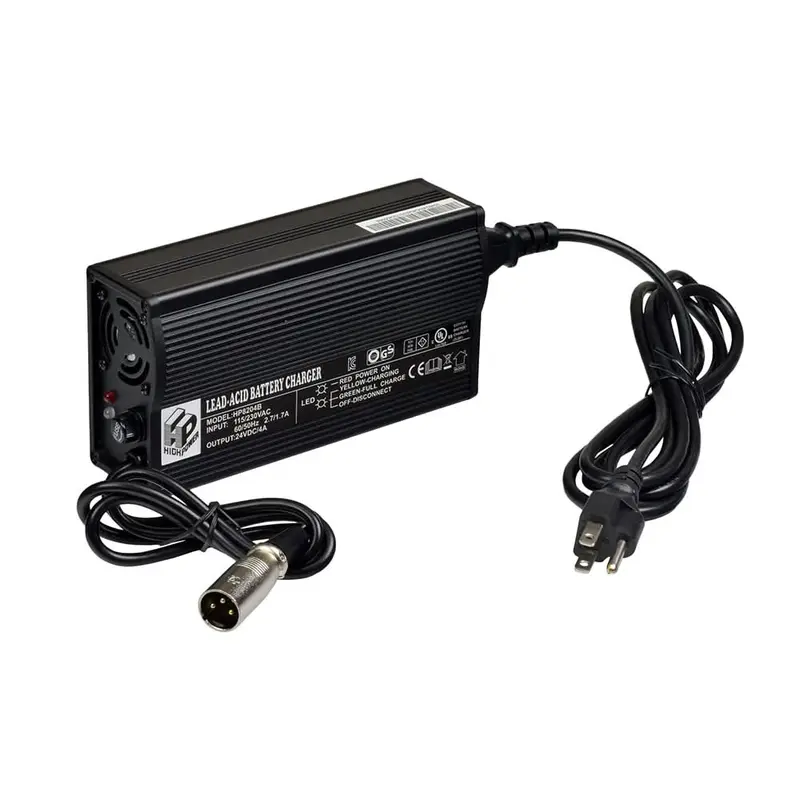
The High Power HP0060W instructions say "Use the charger only with 24V lithium batteries."
The iRide charger instructions (HP1202L3) say "Use the charger only with 36V (Vmax:42V) lithium batteries."
The Metco NL07C-25HT sheet (listed for the Go-Go Folding Scooter on the compilation's contents page, which names no compiler) says "NL07C charger is designed for use only with METCO battery packs."
The Monster Scooter Parts page for ELE2008644 says "This charger is designed for lithium batteries and will not work with any other kind."
The voltages show why "24 volt" on a label is not enough. The UPG 5 amp lead-acid manual prints a fast-charge output of 29.6 V for AGM and 28.6 V for gel. The UPG lithium manual prints 28.8 V. The Metco sheet prints 29.05 V and the LS-018C20 sheet 29.4 V; the contents page prints 29.2 V for the Metco charger, while the sheet itself prints 29.05 V. In our reading, two chargers sold as "24 volt" can end a charge at different voltages, and only the one made for your battery stops at the right one.
Permobil goes further. Its VoltPro page says the charger "delivers a unique charging profile that modulates voltage and current to completely and efficiently charge Permobil batteries"
, and its M3 Corpus manual tells owners to use only a Permobil charger intended for their wheelchair. Pride's July 2021 article "What kind of charger does a mobility scooter use?"
says "Currently, Pride Mobility lithium-powered scooters use off-board chargers."
One Pride page needs care. The Jazzy EVO 613 Li specification page prints two battery options, "(2) 12 volt, U-1 or (1) 25V Lithium-iron phosphate", and one charger line, "3.5A, off-board". The Monster Scooter Parts page for the lithium-only charger ELE2008644 lists "Jazzy EVO 613Li (Lithium Version)"
. In our reading, the specification page alone does not tell you which charger the lead-acid version uses; ask Pride or your provider with the serial number before you order.
Amp ratings from 1.5 to 10 amps: what the number means
The amp rating is how much current the charger pushes in its main stage. Pride's July 2021 article puts it simply: "The higher the amps, the faster the charge."
The same article says "Pride Mobility scooters use chargers that range from 2 to 8 amps."
On the Monster Scooter Parts list, the 24 volt chargers print ratings from 1.5 to 10 amps.
Faster is not the whole story, because each charger is made for a band of battery sizes. Every charger document in the table below prints one, and, in our reading, a big charger on a small battery is outside it too. The UPG troubleshooting table lists "Charger is too small for batteries"
as one cause of a fault light at the end of a charge.
| Charger | Rating | Battery size printed | Where printed |
|---|---|---|---|
| UPG 24BC2000T | 2 A | 7 to 18 Ah, lead-acid | UPG manual |
| UPG 24BC3500T-4 | 3.5 A | 12 to 35 Ah, AGM or gel | UPG manual |
| UPG 24BC5000T-4 | 5 A | 18 to 50 Ah, AGM or gel | UPG manual |
| UPG 24BC8000T-4 | 8 A | 24 to 85 Ah, AGM or gel | UPG manual |
| UPG 24BC3500L-1 (ELE2008644) | 3.5 A | 8 to 35 Ah, lithium | UPG manual |
| Invacare 4C24050A | 5 A | 16 to 60 Ah, gel or AGM | Invacare manual |
| 4C24080A | 8 A | 26 to 75 Ah, lead-acid | Instruction sheet |
| ACI245000 | 5 A | 18 to 55 Ah, lead-acid | ACI manual |
| MK Battery LS24/3.5A-08 | 3.5 A | 12 to 18 Ah | SpinLife tile |
| MK Battery LS24/5A-08 | 5 A | 22 to 45 Ah | SpinLife tile |
| MK Battery LS24/8A-08 | 8 A | 45 to 80 Ah | SpinLife tile |
The band moves from document to document for the same charger, and when that happens we plan on the narrower one. For the UPG 24BC5000T-4, the UPG manual suggests 18 to 50 Ah, the Monster Scooter Parts page says "batteries of 17 Ah or larger"
, and our own catalog row (copied from a seller page earlier) gives 15 to 50 Ah. For the UPG 24BC8000T-4, the manual suggests 24 to 85 Ah, while the seller page says it is "sized for batteries of 17Ah and larger"
. In our view, plan on the manual's band until UPG or the chair maker confirms another in writing.
Pride's own lines show the amps following the battery. Its Victory 10 3-Wheel and 4-Wheel specification pages print "Off-board, 3A (U1); Off-board, 5A(40AH)"
: one charger for the standard U1 batteries and a bigger one for the optional 40 Ah batteries. In our view, a different amp rating is a change to the chair's charging system, and the chair maker or a dealer should approve it for your battery size first.
Pride chargers by model, as Pride's pages print them
Pride's specification pages print a charger line for each model. The table copies that line, and the battery line where the page prints one, for 14 power chairs and 9 scooters, exactly as printed (a dash means the page we saved printed no such line). The last column is the date we read the page.
| Model | Charger line as printed | Battery line as printed | Read |
|---|---|---|---|
| Go Chair | 2 amp, off-board | 20 Ah Battery Pack | 9 November |
| Jazzy 600 ES | 5A, off-board | 12 volt, NF-22 | 9 November |
| Jazzy Air 2 | 5 amp, off-board | 12 volt, U-1 | 9 November |
| Jazzy Elite 14 | 5A, off-board | 12 volt, NF-22 | 9 November |
| Jazzy Elite ES | 3.5A, off-board | 12 volt, U-1 | 9 November |
| Jazzy Elite HD | 5A, off-board | 12 volt, NF-22 | 9 November |
| Jazzy EVO 613 Li | 3.5A, off-board | (2) 12 volt, U-1 or (1) 25V Lithium-iron phosphate | 9 November |
| Jazzy EVO 614 | 5-amp, off-board | (2) NF-22 | 9 November |
| Jazzy EVO 614 HD | 5-amp, off-board | (2) NF-22 | 9 November |
| Jazzy 1450 | 8A, off-board | 12 volt, Group 24 | 9 November |
| Jazzy Carbon | Off-board, 2-amp lithium-ion | 24V 12AH (288WH) | 9 November |
| Jazzy Carbon 27 | 2 Amp | Lithium battery box | 9 November |
| Jazzy Carbon 27X | 3.5 Amp | 24V 10Ah | 9 November |
| Jazzy Carbon HD | 2 Amp | Lithium battery box | 9 November |
| Go Go Elite Traveller 3-Wheel | Off-board 2A | (2) 12 AH or optional (2) 18AH | 9 November |
| Go Go Ultra X Gen 3 | 2-amp off-board | (Two) 12 Ah | 9 November |
| Go Go Sport 4-Wheel | Off-board, 2A | (2) 18AH | 12 November |
| Go Go Endurance Li | 3.5A , off-board lithium charger | 8Ah* Lithium (pack) ; 16Ah MAXX* Lithium (pack) | 9 November |
| Go Go Carbon | 24V, 2A | 24V, 12Ah lithium battery | 9 November |
| Victory 10 3-Wheel | Off-board, 3A (U1); Off-board, 5A(40AH) | (2) U1 (standard); (2) 40AH (optional) | 9 November |
| Revo 2.0 4-Wheel | Off-board, 3.5A | (2) U1 | 12 November |
| Maxima 4-Wheel | Off-board, 5A | Gel, 58Ah, NF-22 | 12 November |
| Pursuit 2 | 8 amp off-board charger | 25 volt, 50Ah lithium ion | 12 November |
Three rows need a note. The Victory 10 pages print 3 A for U1 batteries, and Pride's charger article also lists the Victory 10 3-Wheel at "3 amp, off-board (U-1)". Yet the SpinLife page for Pride's 3.5 amp charger ELE1803400 lists "Victory 10 Series (SC610/SC710)"
among the compatible models, and the charger compilation holds a Battery Maximizer manual headed "ELECHG1016 3 Amp off-board (Victory 10)"
. Two ratings for one model: plan on Pride's 3 A line until Pride confirms the 3.5 A charger for your serial number in writing.
The Jazzy Carbon 27 and Carbon HD pages print "2 Amp", while the Carbon 27X page prints "3.5 Amp". The Monster Scooter Parts page for ELE2008644 warns that it "is not the 2 amp Carbon 27 / Carbon HD charger (ELE2506208)"
. Similar names, different chargers.
The Pursuit 2 page prints a "25 volt, 50Ah lithium ion" battery and an "8 amp off-board charger". Monster Scooter Parts lists a 36 volt, 8 amp charger, ELE141312, for the Pride Pursuit Sport, a different model. Neither seller list we saved for this guide names the Pursuit 2 in a charger title, but a Monster Scooter Parts search results page read on 12 November 2026 shows a tile "ELE2300934 - 24 Volt 8 Amp Lithium-Ion Battery Charger with 3-Pin XLR Connector for the Pride Pursuit 2 (S7132) - UPG 24BC8000L-1"
at $233.98 (struck price $274.07). That is a search tile, not a product page; confirm with Pride or your provider using the serial number. Other Go Go parts are in our Go Go scooter parts guide.
Charger part numbers by maker, as the pages print them
A maker's part number ties the charger to the models a page lists. The tables copy part numbers, ratings and model names as printed. "MSP" is Monster Scooter Parts; "page" is a product page, "title" a product name in the store's list, and "tile" a SpinLife category tile. A model missing from a row means the page did not name it, not that the charger cannot fit; the maker should confirm.
Pride Mobility
| Part number | Rating as printed | Models the page names | Where printed |
|---|---|---|---|
| ELE2008644 (UPG 24BC3500L-1) | 24 V 3.5 A lithium | Endurance Li, i-Go, Carbon 27X, Ultra Light, EVO 613Li, Passport | MSP page |
| ELEASMB6293 / ELECHG1025 | 24 V 5 A, AGM/gel | Jazzy 600 ES, Elite 14, Elite HD, J6; Celebrity X; Victory Sport; Shoprider XLR Plus | MSP page |
| ELE2000091 (CTE) | 24 V 8 A, low inhibit | Jazzy 1450, Quantum 4Front, Outback, Q1450, Q6 Edge 3 Stretto, Rival | MSP page |
| ELE2400671 | 24 V 10 A, low inhibit | Quantum Outback | MSP title |
| ELE1803400 | 3.5 A off-board | Victory 9, 9.2, 10, 10.2, 10 LX, Sport; Jazzy Air; Select 6; Select Elite; two discontinued Jazzy models | SpinLife page |
| ELE1803474 | 5-Amp Offboard | No models on the tile | SpinLife tile |
| ELE2301737 | 24 V 3.5 A, magnetic | Victory Platinum, Elite Traveller 2 Platinum, Gen 3 Platinum | MSP title |
| ELE1610376 | 29.4 V 2.5 A lithium | Go-Go Folding Scooter S19 | MSP title |
| ELE2001075 | 36 V 1.5 A lithium | Go-Go iRide and iRide 2 | MSP title |
The SpinLife page for ELE1803400 says "This charge is replacing Model# ELEASMB5713."
The Monster Scooter Parts page for the 5 amp charger says it "replaces Pride chargers ELEASMB6293 and ELECHG1025"
and names the UPG model 24BC5000T-4. The ELE2000091 page says the Outback "can use either this 8 amp charger or the 10 amp ELE2400671"
, and that the 10 amp one is "currently unavailable from Pride / Quantum with no restock date"
.
Golden Technologies
| Part number | Rating as printed | Models the title names | Where printed |
|---|---|---|---|
| MBE-0036 (PowerFirst PF24035SL) | 24 V 3.5 A | Buzzaround, Companion, LiteRider, Alante Sport, Compass | MSP title |
| MBE-121A-CHG2A-STD | 24 V 2 A | Buzzaround XL 3-Wheel (GB121A) | MSP title |
| MBE-BZ7-CHG15 | 1.5 A | Buzzaround LT and some Buzzaround XL codes | MSP title |
| MBE-CHG50A-STD | 5.0 A | Companion I and II | MSP title |
| MBE-CHG80A-STD | 8.0 A | Avenger (GA541) | MSP title |
| MBE-0028 | 24 V 2 A lithium | Buzzaround CarryOn GB120, GB220, GP130 | MSP title |
| MBE-0129 | 24 V 2 A, magnetic | Buzzaround XL+ 4-Wheel (GB152) | MSP title |
| MBE-Charger | 24V, 3.5 Amp | LiteRider and Buzzaround series | SpinLife tile |
The SpinLife page tile for MBE-Charger names it a "3.5 Amp Charging Cable" but says "24V, 3.5 Amp, off-board charger" in its bullet points. The Golden rows come from seller titles, because goldentech.com did not open in the browser on 13 November 2026.
Invacare
| Part number | Rating as printed | Models the page names | Where printed |
|---|---|---|---|
| 1123249 | 24V 8AMP | Pronto M51, M61, M71, M91; Nutron R51, R51LXP | SpinLife page |
| 1121089 | 3 Amp, off board | Pronto M41 (serial ranges printed), P9000 XDT | SpinLife tile |
| 1144797 | 24 V 2 A on-board | Lynx L-3 and L-4 | MSP and SpinLife |
| 1148830 | 24V 5AMP | Leo (SpinLife tile) | SpinLife tile |
| 1118923 | 24 V 3 A on-board | Pronto M50, M51, M61; M71 Jr. | MSP titles |
| 1123526 | 24 V 5 A on-board, square plug | Pronto M91 and M94 | MSP title |
| 1123102 | 24 V 5 A on-board, round plug | Pronto M91 | MSP title |
| 1106483 | 24 V 3 A on-board, XLR | Pronto M50, M51, M71 | MSP title |
Monster Scooter Parts also sells the UPG 24BC8000T-4 under the vendor name Invacare, and its page says "Invacare supplies this same charger as original equipment on a number of its power chairs."
Note the two plug styles on the Pronto M91 on-board chargers: one store title names a "Square Plug", the other a "Round Plug".
Drive Medical
| Part number | Rating as printed | Models the page names | Where printed |
|---|---|---|---|
| LRA402210 | 24V 5AMP | Odyssey (named in the overview) | SpinLife page |
| LRM302111 | Not on the tile | Phoenix 3 and 4, Spitfire EX 3 and 4 | SpinLife tile |
| FLEX-27 | 24 V 2 A lithium | ZooMe Flex and Auto-Flex | MSP title |
We saved no Drive Medical page that lists chargers, so the Drive rows come from seller pages; the Scout manual pages we saved give no charger part number.
Permobil
Permobil's US page for its battery and VoltPro charger prints no part number or amp rating in its text, and the page's VoltPro user manual tile carried no link we could follow, so we did not read that manual. Neither seller list we saved names Permobil in any title (0 titles at Monster Scooter Parts, 0 tiles at SpinLife). For a Permobil chair, the M3 Corpus manual says "Only use a Permobil charger intended for use with your wheelchair."
In our view, order it through a Permobil dealer with your serial number.
Plugs and sockets: XLR and the others
Pride's manuals describe a three-pin XLR charging socket, and Golden's LiteRider Envy manual labels an "XLR Charger Port". Pride's Travel Scooter manual says "The end of the 3-pin charger power cord plugs into this receptacle"
and refers owners to its figures to find "the appropriate XLR charging port"
. The Jazzy EVO 614 manual says to "Plug the off-board charger into the off-board charger/programming socket on the controller."
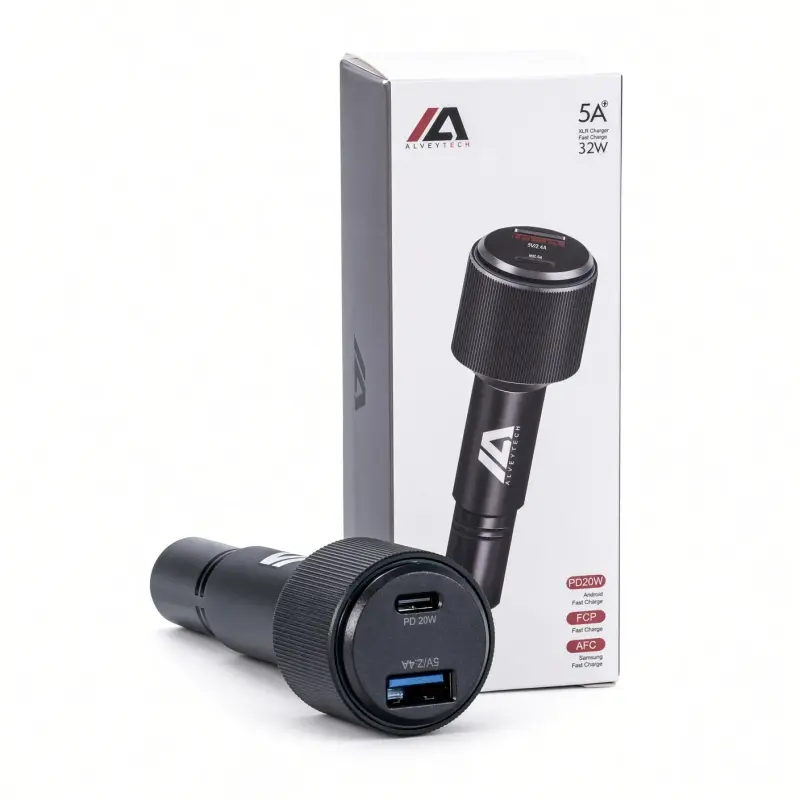
Of the 88 chargers on the Monster Scooter Parts list, 39 name XLR in the title, 3 a magnetic connector, 1 a coaxial plug, 1 a 3-prong plug and 2 a square or round plug; the other 42 name no plug in the title, so read the product page or ask.
The three pins are not wired the same way on every charger. UPG's lithium manual prints "PIN 1 - 24VDC PIN 2 - Ground PIN 3 - Inhibit"
. The Metco lithium sheet prints "Pin 1-Positive; Pin 2-Negative; Pin 3-Negative"
and warns "Do not swap their connections which may cause serious hazards."
The LS-018C20 sheet says "3-pin connector" in its specification, leaves pin 3 unnamed, and then speaks of "The 4-pin connector of the output cable"
in its checks, so that sheet contradicts itself; in our view, treat that plug as the maker's part and do not rewire it.
On some chargers the third pin carries the inhibit signal that stops the chair driving while the charger is connected. The Battery Maximizer manual for the Victory 10 charger says "The inhibitor pin of output connector will be low level for inhibit function when AC voltage applies to this charger."
The ELE2000091 page says "The low inhibit feature keeps the chair from driving while the charger is connected."
The chair manuals describe the result: Pride's Travel Scooter manual says "The Travel Scooter will not run and the battery condition meter will not operate while the batteries are charging (when the battery pack is being charged on the Travel Scooter)"
, Golden's Buzzaround XL manual says "Your scooter will not move while the charger remains connected"
, and Permobil's M3 manual says "It is not possible to drive the wheelchair while it charges."
In our view, a charger that fits the socket but lets the chair drive while plugged in is the wrong charger or a fault, and a question for the provider before the next charge.
Some sockets need care going in. Golden's LiteRider Envy manual says "Failure to align pins before inserting the plug in the correct orientation may damage the joystick and render your wheelchair non-operational."
Magnetic connectors are a separate family, such as Pride's Charge360 chargers for Platinum models.
On the wall side, the EVO 614 manual says "Removal of grounding prong can create electrical hazard."
The Monster Scooter Parts collection also holds 46 products that are not chargers by our rule: charging ports, sockets, power cords, adapters and harnesses. In our view, a worn socket or cord is a cheaper fix than a charger, and a check for the provider when the charger lights look normal but the chair does not charge.
Off-board and on-board chargers
Pride's article "What is an offboard charger?"
(posted April 4, 2022) explains the difference: "On-board chargers are housed entirely within the device."
An off-board charger, it says, has "a block between two cords [...] one that plugs into a wall outlet and the other that plugs into the mobility device."
The article adds: "Pride Mobility uses off-board chargers for our Jazzy power wheelchairs and mobility scooters."
On the seller list, 18 of the 26 on-board titles name particular models and 8 name only a brand or a range; the list page shows titles such as "Pride Mobility Scooters" or "Jazzy Power Chairs". Of the 88 chargers on the Monster Scooter Parts list, 26 name "On-Board" in the title, and 8 of those were marked available. Their titles name, among others, Jazzy 1103, 1113, 1133 and 1143 chairs, Pride Dynamo, Celebrity XL, Legend, Sidekick and Sundancer scooters, Invacare Pronto chairs and Lynx scooters, and Shoprider, Rascal, PaceSaver and Amigo models. The store's titles for the 26 on-board units run from $99.80 to $572.65.
Several travel models charge the battery pack on or off the scooter. Pride's Travel Scooter manual says "With some models, the battery pack can be charged on or off the Travel Scooter."
Golden's Buzzaround XL manual says to plug the charger "into the charger port on the battery pack or on the side of the console"
. In our view, the replacement plug has to fit the socket you use.
How long to charge, and when, manual by manual
The chair and scooter manuals print charging times, and they differ. The table copies six of them.
| Document | New batteries | After daily use | Infrequent use or storage |
|---|---|---|---|
| Pride Travel Scooter Series manual | At least 8 to 14 hours before first use, then break-in over four or five charges | 8 to 14 hours, plus 4 hours after the charger shows complete | At least once a week for at least 24 hours |
| Pride Jazzy EVO 614 Series manual | Full charge before first use, then 8 to 14 hours | 8 to 14 hours, plus 4 hours after complete | At least once a week for at least 24 hours |
| Golden Buzzaround XL manual | 12 hours | 6 to 8 hours after each use; overnight | Over a week: full charge, then remove the pack |
| Golden LiteRider Envy manual | 12 hours | 6 to 8 hours; full in about 8 hours | Over a week: full charge, then disconnect the batteries from the chair |
| Drive Scout manual | 8 to 12 hours, twice | Leave on charge until next use | Once a week for 10 to 14 hours |
| Permobil M3 Corpus manual | Not in the pages we saved | As often as possible | Long storage: charge every month |
Both Pride manuals add a monthly line: the EVO 614 manual says "Pride recommends charging your batteries for at least 48 continuous hours once per month to improve battery performance and battery life."
SpinLife's page for Drive's LRA402210 says charging is complete "within 8-10 hours".
The charger manuals add their own clocks. The UPG 5 and 8 amp manuals say "COMPLETE battery charge is NOT achieved until battery has charged 15 hours."
The UPG 3.5, 5 and 8 amp manuals say the charger "automatically cuts off after 20 hours of continuous operation"
and restarts on its own, and their fault table lists a "12 hour charge timed out" code. Invacare's 5 A charger lists "Automatic cut off when reaching 12 hours constantly charging"
.
On leaving the charger connected, the documents disagree. The UPG lead-acid manuals (2, 3.5, 5 and 8 amp) say the float stage "allows the charger to remain connected to the batteries during periods of non-use"
; the UPG lithium manual prints a two-stage cycle and no such line. Invacare's 5 A manual says "In order to extend the service life of the charger, you should not leave the mobility device connected to it for prolonged periods."
In our view, follow the manual of the charger you own, and where it is silent, the chair maker's manual.
Both Pride manuals set a limit for a charge that does not finish. The Travel Scooter manual says "If the LED does not indicate that charging is complete within 24 hours, unplug the charger from the outlet and contact your Provider."
The Battery Maximizer manuals say "If the charge LED remains red for more than 24 hours, unplug charger from AC power and check the batteries."
How long should a mobility scooter or power chair take to charge? As long as its own manual says, and the manuals Mobility Atlas read give different figures. Pride's Travel Scooter and Jazzy EVO 614 manuals say 8 to 14 hours after daily use, plus 4 more hours after the charger shows complete, and at least 24 hours once a week if the chair is used once a week or less. Golden's Buzzaround XL and LiteRider Envy manuals say 6 to 8 hours after each use, and 12 hours for new batteries. Drive's Scout manual says to leave a daily scooter on charge until the next day and to charge an idle one once a week for 10 to 14 hours. Charger manuals add limits: UPG's 5 and 8 amp manuals say a complete charge takes 15 hours, and Pride says to unplug and call the provider if the charger has not shown complete within 24 hours.
Plugging in: the order differs by document
- Pride Jazzy EVO 614 manual: turn the controller off with the freewheel levers engaged, plug the charger into the socket on the controller, then into the outlet. When charged,
"unplug the off-board charger from the electrical outlet and then from the controller."
- Permobil M3 Corpus manual:
"Always connect the charger to the wheelchair first before you connect the charger to the wall."
- Golden LiteRider Envy manual: turn the joystick off;
"The charger should not be plugged into the electrical outlet or powered up at this point in the process"
, then plug into the joystick, then the wall. - Drive Scout manual:
"Plug the charger into the scooter, and then into the electrical outlet."
- UPG lead-acid manuals: connect the DC output cable to the receptacle, plug the cord into the charger, then into the wall; when done, the manuals say
"Unplug the charger from the wall, then the battery receptacle."
- Invacare 5 A manual: connect the charger to the chair's charging socket, then the power cord.
- Metco sheet and LS-018C20 sheet:
"Connect charger first to AC power before connecting the battery to the charger."
- 4C24080A sheet: "Plug in the power cord." then
"Connect the battery charger to the battery."
The Metco, LS-018C20 and 4C24080A sheets put the wall connection first, the reverse of the other documents in this list; each is that charger maker's instruction for that charger. In our view, if your chair's manual says the opposite, ask the chair maker which to follow. Two other lines matter. Pride's Jazzy Ultra Light manual says "Pride strongly recommends you do not charge your battery while in freewheel mode."
And the EVO 614 manual says Pride "recommends that you do not charge the batteries while the power chair is occupied."
Charger lights: what each printed code means
Chargers report through one or two lights, and the same color means different things on different chargers. The table copies the meanings from the charger manuals we read. Pride's manuals send owners to the charger's own manual "for a complete explanation of these indicators"
, and Drive's Scout manual says "In most cases your charger will show a red or orange light when charging, and a green light when fully charged."
| Charger (manual) | Lights and meanings as printed |
|---|---|
| UPG 24BC2000T (2 A) | POWER red: power on; POWER green: charging a battery; CHARGING red on: fast charge, off: float charge |
| UPG 24BC3500T-4, 5000T-4, 8000T-4 | POWER red: power on; CHARGING red steady: fast charge; green flashing: float; green steady: finished; red flashing: fault |
| UPG 24BC3500L-1 lithium (ELE2008644) | Red on: bulk or absorption; green solid: full; red blinking at 2 Hz: 12-hour timeout; red blink codes for faults |
| Battery Maximizer EA1065-P | Power green, Charge red: fast charging; both green: fully charged; Power red, Charge off: error |
| High Power HP0060W | Red: power on, no battery; orange: charging; green: fully charged |
| High Power HP1202L3 (iRide) | Blue: power on; red: charging; green: fully charged |
| Invacare 4C24050A (5 A) | Green flashes: waiting for battery; orange flashes: pre-charge; orange: charging; green and orange flashes: 85 %; green: full; red flashes: defect |
| 4C24080A (8 A) | Green flash: power on; orange flash: pre-charge; orange: charging; green and orange flash: charged 80%; green: full; red flash: defect |
The UPG 3.5, 5 and 8 amp manuals print a fault table for the red light: off means "No batteries - Voltage < 9V"
; continuous flashing means a "12 hour charge timed out"; one flash every 3 seconds means "Battery voltage < 14V"; two flashes, "Batteries are connected in reverse polarity"
; three flashes, "Overvoltage from batteries"
; four flashes, "Overcurrent from charger". The lithium UPG manual uses the same blink pattern, with low battery voltage given as 9 to 14 V.
Two examples show why the table matters. A flashing green light means float charge, a full battery being held, on the UPG 3.5, 5 and 8 amp chargers, and "Waiting for connection to battery"
on the Invacare 5 A charger. A red light means power on for the High Power HP0060W and on the POWER light of the UPG lead-acid chargers, but a steady red CHARGING light means fast charge on the UPG 3.5, 5 and 8 amp chargers, and red means charging on the UPG lithium and High Power iRide chargers. In our view, read your own charger's manual before deciding that a light means a fault.
When the charger will not start or never finishes
The charger documents in the table print a minimum battery voltage below which the charger will not start. The thresholds differ, and so do the documents for the same charger.
| Charger | Will not start below | Document |
|---|---|---|
| UPG 24BC3500T-4, 5000T-4, 8000T-4 | 14 V | UPG manuals |
| UPG 24BC5000T-4 | 18 volts | MSP 5 amp page |
| UPG 24BC8000T-4 | 9 volts | MSP 8 amp page |
| Go-Go 2 A charger (both versions on the page) | 16 volts | MSP 2 amp page |
| Battery Maximizer EA1065-P | 9VDC | Battery Maximizer manual |
| Battery Maximizer EA24030-9C | 5VDC | Battery Maximizer manual |
| ACI245000 | 10 VDC | ACI manual |
For the 5 amp UPG charger, the manual says the charger will not engage under 14 V while the seller page says it "will not operate if the battery has less than 18 volts"
; for the 8 amp, the seller page says 9 volts. The figures differ; in our view the practical point is the same either way: a pack that has run down far enough will not wake a correct charger. Pride's EVO 614 manual says "Your power chair's charger will not operate after the batteries have been discharged to nearly zero voltage. If this happens, call your authorized Pride Provider for assistance."
Invacare's 5 A manual says "Do not use the charger for totally discharged batteries or when the batteries are faulty."
In our view, do not work around it. Pride's Travel Scooter manual says "Any charging method resulting in batteries being charged individually is especially prohibited"
, and the UPG manuals say "Never use the charger as a DC power source for any electrical equipment."
Before you buy a new charger, the manuals list cheaper causes. Pride's Travel Scooter manual, for batteries that will not charge: "Ensure that the fuse on the battery pack is in working condition"
and "Ensure both ends of the charger power cord are inserted fully."
Permobil's M3 manual lists two causes for "The wheelchair cannot be charged"
: the main circuit breaker is off, or the charging circuit breaker has tripped, in which case "Wait five minutes. The charging circuit breaker will automatically reset."
Golden's Buzzaround XL manual, in its remedies for a tripping main circuit breaker, says to have the dealer load test the batteries and "If the batteries are good, the charger may be the problem."
The Invacare 5 A manual says what the lights mean for the battery: "If the CHARGING LED does not change from orange to green: [...] The battery cannot be charged correctly. It may be faulty. Stop charging and contact your provider."
When the batteries, not the charger, are the problem, our power wheelchair repair guide and mobility scooter repair guide explain who repairs what.
Safety lines from the manuals, quoted
Extension cords and outlets
Pride's Jazzy EVO 614, Jazzy Ultra Light and Travel Scooter manuals each say "Never use an extension cord to plug in your battery charger. Plug the charger directly into a properly wired standard electrical outlet."
The UPG 2 amp manual, under "AC CORD AND PLUG REQUIREMENTS"
, specifies the power cord itself: "Min. 1.8m (6 feet). Max. 6.1 m (20 feet) including output cord"
, Type SJT, 18 AWG; Invacare's 5 A manual specifies a cord of "minimum 1.8 m, maximum 3 m long"
. Neither manual mentions extension cords. In our reading, Pride's line is about the wall side; we found no Pride line on extending the cord between charger and chair, and in our view that is a question for the chair maker before you buy an extension lead for it.
Ventilation and heat
Pride's EVO 614 manual says "Explosive gases may be generated while charging the batteries. Keep the power chair and battery charger away from sources of ignition such as flames or sparks and provide adequate ventilation when charging the batteries."
The UPG manuals say "The battery must be placed in a well-ventilated area during charging."
Permobil's M3 manual says "Charge the batteries in a well-ventilated, dry room."
Invacare's 5 A manual says "Use the charger in a well ventilated room."
On heat, Pride's manuals say "Be aware that the battery charger case may become hot during charging. Avoid skin contact and do not place on surfaces that may be affected by heat."
Golden's Buzzaround XL and LiteRider Envy manuals each print, as a WARNING, "Charger surface can become HOT."
(the Buzzaround XL warranty page adds that "Heat coming from the battery charger does not constitute a defect."
) Pride's June 2026 article on summer heat lists "Avoid covering the charger during operation"
.
Outdoors, water and cold
The UPG manuals say "For indoor use only. Do not expose charger to rain, snow or excessive moisture."
Pride's manuals say "If your battery charger has not been tested and approved for outdoor use, then do not expose it to adverse or extreme weather conditions. If the battery charger is exposed to adverse or extreme weather conditions, then it must be allowed to adjust to the difference in environmental conditions before use indoors."
The Battery Maximizer manuals say "For indoor use only", and Invacare's 5 A manual says to "install in a temperature- and humidity-controlled indoor area"
. The Monster Scooter Parts page for the 2 amp Go-Go charger says both versions are "UL listed for dry location use only"
. On cold, the UPG manuals say "Never charge a frozen battery"
, and Pride's EVO 614 manual says "A cold or frozen battery should be warmed for several days prior to recharging."
Damage, opening and children
Pride's Travel Scooter manual says "Inspect the battery charger, wiring, and connectors for damage before each use. Contact your authorized Provider if damage is found."
Pride's manuals also say "Do not attempt to open the battery charger case."
Pride's EVO 614 manual says "Do not allow unsupervised children to play near the power chair while the batteries are charging."
In our view, a charger that smells hot, sparks, or has a cracked case or cord goes out of use until the provider has seen it; the fire reports in our power wheelchair batteries guide show why.
USB adapters and what else the charging socket may take
Monster Scooter Parts lists adapters that plug into the XLR charging socket and give USB power for a phone (two titles in its charger collection). Pride makes its own: its XLR USB charger sheet says "Both models have 3-pin, XLR ports. Compatible with both scooters and power chairs."
The same sheet adds in its footnote: "XLR USB Chargers will not fit the charging ports of all units. Please check with your local provider for compatibility"
. It also says "Built-in protection ensures the XLR charger pauses when the mobility unit's battery power is low."
Permobil's VR2-A control panel manual takes the opposite line for that panel: "This socket should only be used for charging or locking the wheelchair. Do not connect any type of programming cable into this socket. This socket should not be used as a power supply for any other electrical device."
It explains: "Connecting other electrical devices may damage the control system or affect the wheelchair's EMC (electromagnetic compatibility) performance."
And it says "Use only the supplied battery charger"
.
So one maker sells a socket adapter and another forbids anything but the charger in its socket. In our view, the manual for your control panel decides; if it is silent, ask the provider first.
What replacement chargers cost: two US sellers
Prices below are as printed on 13 November 2026, in US dollars, before tax, shipping and any coupon code. Prices differ by country, seller and funding route; in our view, check the wall plug and input voltage before you order for use outside the US.
Monster Scooter Parts
By our rule, the store's mobility charger collection held 88 chargers: 74 rated at 24 volts (72 titles say 24 volts; two print 29.4 volts, a lithium charging voltage, one of them adding "(24 Volt)"), 4 at 36 volts, 3 at 12 volts and 7 with no voltage in the title. 50 were marked available and 38 were not. Across all 88, prices ran from $16.14 (a 12 volt charger for vehicle lifts, not available) to $572.65 (Invacare's on-board charger 1123102 for the Pronto M91). Among the available ones, the range was $22.49 (a 24 volt, 1.5 amp XLR charger from AlveyTech) to $572.65.
The table groups the 24 volt chargers by the amp rating in the title, with the price range of those marked available. It mixes off-board, on-board, lead-acid and lithium chargers, so read it as a spread, not a price for your model. The 3 amp row includes one title for a Ni-MH electric bike charger, and the 7 amp row is a reconditioned on-board unit.
| Rating in title | Listings | Marked available | Price range, available |
|---|---|---|---|
| 1.5 A | 5 | 1 | $22.49 |
| 2 A | 16 | 12 | $35.99 to $156 |
| 2.5 A | 2 | 2 | $146.29 to $185.95 |
| 3 A | 8 | 2 | $357.49 |
| 3.5 A | 7 | 5 | $69.99 to $148.99 |
| 4 A | 12 | 5 | $99.99 to $244.44 |
| 5 A | 12 | 9 | $89.99 to $572.65 |
| 6 A | 1 | 0 | none marked available |
| 7 A | 1 | 0 | none marked available |
| 8 A | 9 | 7 | $126.99 to $243.50 |
| 10 A | 1 | 0 | none marked available |
All 11 lithium chargers by title (8 of them available) ran from $84.99 to $185.95. The same UPG 24BC5000T-4 was $89.99 both under its own title and under the Pride part numbers ELEASMB6293 and ELECHG1025, while Pride's CTE 8 amp ELE2000091 was $243.50 against $126.99 for the available UPG 8 amp chargers. Those are different chargers, and the low inhibit feature is one difference the ELE2000091 page names.
SpinLife
SpinLife's Battery Chargers category held 12 items from five brands, from $108 (MK Battery 24v 3.5amp Charger) to $319 (Drive Medical's 5 amp charger LRA402210). 8 of the 12 tiles print two prices. We checked the page markup on the MK 3.5 amp tile and on the Invacare 1123249 product page, and in both the higher price is struck through; we did not check the other tiles. The table gives the second price as the price and the first in its own column.
| Brand | Model No. | Tile name | Price | First of two prices |
|---|---|---|---|---|
| Pride | ELE1803400 | 3.5 Amp Offboard Charger for Pride Mobility Scooters | $155 | - |
| MK Battery | LS24/3.5A-08 | 24v 3.5amp Charger | $108 | $132 |
| Golden Technologies | MBE-Charger | 3.5 Amp Charging Cable for Golden Technologies Scooters and Power Chairs | $134 | - |
| MK Battery | LS24/5A-08 | 24v 5amp Charger | $148 | $176 |
| Drive Medical | LRA402210 | 5 amp Battery Charger | $319 | - |
| Pride | ELE1803474 | 5-Amp Offboard Charger | $196 | - |
| MK Battery | LS24/8A-08 | 24v 8amp Charger | $208 | $248 |
| Invacare | 1123249 | Pronto/Nutron Series Battery Charger | $280 | $300 |
| Invacare | 1121089 | Charger, Battery, 3 Amp, Off Board | $310 | $332 |
| Invacare | 1144797 | Lynx L-3 and L-4 Battery Charger | $125 | $137 |
| Invacare | 1148830 | Leo Battery Charger | $205 | $218 |
| Drive Medical | LRM302111 | Phoenix, Spitfire, Geo & Cobalt Battery Charger | $171 | $191 |
One part number appears at both sellers: Invacare's Lynx L-3 and L-4 charger 1144797 was $123.99 at Monster Scooter Parts and $125 at SpinLife (the tile also prints $137). The number 1148830 also appears on both lists, on SpinLife's Leo charger page tile at $205 and in a Monster Scooter Parts title for a 5.0 amp portable XLR charger at $323.82; that title does not name Invacare or the Leo, so we do not treat the two as the same item.
What does a replacement power wheelchair or scooter charger cost? On the US seller pages Mobility Atlas read on 13 November 2026, from $22.49 to $572.65 for chargers marked available. Monster Scooter Parts listed 88 chargers, 50 marked available, from $22.49 for a generic 24 volt, 1.5 amp XLR charger to $572.65 for an Invacare on-board charger. UPG's own-title XLR chargers sat lower: the 2 amp at $58.94, the 3.5 amp at $69.99, the 5 amp at $89.99 and the 8 amp at $126.99. SpinLife listed 12 chargers from $108 to $319. Some maker part numbers cost more than generic chargers of the same rating, such as Pride's 8 amp ELE2000091 at $243.50. The price that matters is the one for the charger your maker names for your model and battery, which the cheapest line may not be.
Warranty: the charger's own terms and the chair's
Two warranties can apply to a charger: the one that comes with the replacement charger, and the chair or scooter warranty if the original charger fails early. Each term below belongs only to the document named.
Replacement chargers
The UPG 3.5, 5 and 8 amp and lithium manuals in the compilation say UPG "warrants your unit to be free from defects in material and workmanship for a period of 1 year from the date of sale to the original user or purchaser. This warranty is non-transferable."
They send owners back to the seller: "Please contact your retailer or place of purchase for warranty service and instructions."
The 2 amp manual in the compilation prints no warranty.
The seller's terms can be shorter, and they can disagree with each other. The Monster Scooter Parts warranty policy (read 12 November 2026) gives chargers made by Universal Power Group 1 year, chargers from AlveyTech, High Power, Pihsiang and others, and any battery charger designated as OEM, 60 days (the ELE2008644 page calls that charger "Original Equipment Manufacturer (OEM)"
), and chargers designated Standard 30 days. It adds: "Failure to use the proper battery charger for the application will void any and all warranties."
Its product pages print their own line: "This item has a 1 year warranty"
on the UPG 5 and 8 amp pages, but "This item has a 30 day warranty"
on the ELE2008644 page, although that page names UPG as the maker, and on the ELE2000091 page. In our view, ask the seller to confirm the warranty for your exact item in writing before you pay.
SpinLife prints a block on each product page: "30 Day Warranty" on the Pride ELE1803400 and Drive LRA402210 pages, and "Lifetime Limited Warranty"
on the Invacare 1123249 page. The pages we saved do not say what the lifetime line covers; ask before relying on it. SpinLife's return policy (read 12 November 2026) lists "Parts" among products subject to a "20%-25% restocking fee".
The chair or scooter warranty
Pride's US scooter warranty insert (Rev H, July 2024) covers, for two years, "Electronic Assemblies including"
"Chargers". Pride's standard power chair insert (INFINFB2782, Rev K, July 2024) lists "Charger Assembly" under its 13-month limited warranty. Both inserts say "Any warranty claims for electronic assemblies may become void if damage results from the use of parts/accessories that are not Pride original parts and are not purchased through an authorized Pride provider"
.
Drive's Scout manual lists "Charger" among the parts under its 14 Months warranty, to the original purchaser. Golden's Buzzaround XL manual lists "Battery Charger" among the electronic assemblies covered "For the period of two years from the date of purchase"
(the GR575, it says, for one year), and adds that "Heat coming from the battery charger does not constitute a defect."
Golden's LiteRider Envy manual says the use of any other charger "will void the warranty". Permobil's one-year warranty document covers spare parts "for a period of 90-days". General warranty clauses are compared in our Pride Jazzy parts guide and mobility scooter repair guide.
Medicare and other payers
In the US, CMS's LCD L33792 (Wheelchair Options/Accessories, version 43, revision effective 10/01/2025, read 9 November 2026) says "A single mode battery charger (E2366) is appropriate for charging a sealed lead acid battery. If a dual mode battery charger (E2367) is provided as a replacement, it will be denied as not reasonable and necessary."
That version prints a revision ending date of 12/19/2026, and we did not read what replaces it. Medicare.gov says "After you meet the Part B deductible, you pay 20% of the Medicare-approved amount (if your supplier accepts assignment)."
Who handles the repair depends on ownership. Medicare's equipment booklet says "If you own your equipment, the supplier who sold it to you isn't required to repair it"
and "If you rent equipment, your supplier must maintain and repair the equipment"
. We did not read Medicaid, VA or Medicare Advantage rules for chargers; ask the plan. Our guide to wheelchair repair near me covers suppliers and repairs in more depth.
Recalls that name a charger
We searched FDA's recall records through openFDA for the word "charger" in the product description or the reason for recall, under the product codes for powered wheelchairs (ITI) and motorized three-wheeled scooters (INI). The search, on records last updated 2026-11-12, returned 2 records, and we read both.
| Record | Firm | Product as described | Reason (shortened; full text below) | Status |
|---|---|---|---|---|
| 25495, initiated 2003-02-10 | Invacare Corp | Lynx and Panther scooters, 5,029 scooters | Short circuit within the charger harness | Terminated |
| 25721, initiated 2003-03-10 | Invacare Corp | Tarsys 1st Generation Seating System, 20,956 units | Short circuit within the charger harness | Terminated |
Both records give the same reason: "A short circuit within the charger harness may cause heat damage to the units with potential for fire."
A word search finds only the records that use the word, so this is not a full list of charging-related recalls. FDA reports on batteries and charging are in our power wheelchair batteries guide.
Three traps
Trap one is matching the plug and nothing else. XLR plugs sit on 2 amp and 8 amp chargers and on lead-acid and lithium chargers, and the third pin is not wired the same way on every three-pin charger. The UPG lithium manual wires pin 3 as "Inhibit"; the Metco sheet wires pin 3 as a second negative. A plug that fits proves only that the plug fits.
Trap two is trusting a fit list for a model it does not name. The Monster Scooter Parts page for the 5 amp charger with Pride part numbers lists the Jazzy 600 ES, Elite 14, Elite HD and J6, and adds a general claim that it "fits many other power chairs and scooters with batteries of 17 Ah or larger and an off-board female XLR charging socket"
; it does not name the EVO 614, although Pride's EVO 614 page also prints a "5-amp, off-board" charger, and a seller's general claim is not the maker's fitment. In our view, ask Pride or the seller in writing, with the serial number.
Trap three is a warranty that cancels itself. Golden's LiteRider Envy manual says another charger "will void the warranty"; Pride's inserts say claims for electronic assemblies "may become void" with parts that are not Pride original parts; and the seller's policy voids its own warranty if the charger is not "the proper battery charger for the application"
. In our view, a cheaper generic charger can cost more if the chair is still under its maker's warranty.
Three composite scenarios
These are composite scenarios, not individual customers. Each uses only the documents for that model.
Scenario one: an owner of a Jazzy EVO 614 finds the charger never shows that charging is complete. Pride's page for the EVO 614 prints a 5-amp off-board charger. The EVO 614 manual says to unplug and call the authorized Pride Provider if the LED does not show complete within 24 hours, and its charging steps plug the charger into the off-board charger/programming socket with the controller off. The provider finds the charger at fault. The chair is 10 months old, inside the 13-month term that Pride's standard power insert gives the "Charger Assembly", so the owner asks the provider for a warranty replacement before buying the $89.99 seller charger, whose page does not list the EVO 614 anyway.
Scenario two: an owner of a Go Go Endurance Li loses the charger on a trip. Pride's page prints a "3.5A , off-board lithium charger". The Monster Scooter Parts page for ELE2008644 lists the Endurance Li (S54LXLIT), prints $125.81 and a 30 day warranty, and says the charger "will not work with any other kind"
of battery. The owner confirms the old label read ELE2008644, orders that part, and keeps the UPG lithium manual's light code in mind: red on while charging, green solid when full.
Scenario three: an owner of an Invacare Lynx L-4 scooter needs a charger. The Monster Scooter Parts title for 1144797 calls it a "24 Volt 2.0 Amp On-Board Battery Charger for the Invacare Lynx L-3 and Lynx L-4", at $123.99; SpinLife lists the same number at $125 (its tile also prints $137) and says the light turns green when the batteries are full. In our view, an on-board unit is one to have a provider fit. Looking up the model, they also find FDA recall 25495 from 2003 on the charger harness of Lynx scooters, terminated; they ask the provider to check that the harness on their scooter is not an affected one.
What to ask before you order
Ask the chair or scooter maker, or your provider
- Which charger part number is approved for my model and serial number, and for the battery I have now (type and amp-hours)?
- Does my chair need a charger with an inhibit pin, and does this charger have one?
- If I change battery size or chemistry, which charger rating do you approve?
- Is my chair still under the maker's warranty for the charger, and will a non-original charger affect a claim?
- May I plug a USB adapter or anything else into the charging socket?
Ask the seller
- Is this the maker's part number, or a replacement with the same rating? Which models does the maker list for it?
- What warranty applies to this exact item, from whom, and for how long? Is it transferable?
- What plug is on the wall side, and is the input voltage right for my country?
- Is there a restocking fee if the charger turns out to be the wrong one?
Mobility Atlas can find and quote a replacement charger for you, including chargers and charging parts that are not listed on our pages. The process: you send an enquiry or a part request, we reply with a written quote that includes delivery to your country, and nothing is charged before you accept it. It helps to include the model, the serial number and a photo of the old charger's label in the enquiry.
Sources and documents
How we checked: each page or PDF was saved as text with its read date, and counts and prices were computed by script. The charger compilation is hosted on a store file server and does not name who compiled it; each manual inside it names its own maker except the 4C24080A sheet, which names none, and we credit each line to that maker. We did not read Golden's website, the VoltPro manual or a Drive charger page.
Prices checked November 2026: Monster Scooter Parts and SpinLife (US), 13 November 2026; the Monster Scooter Parts 2 amp Go-Go charger page, warranty policy and Pursuit 2 search tile, 12 November 2026.
Documents checked November 2026: Pride specification pages and owner's manuals, 9 and 12 November 2026; Pride Mobility Experience articles, 12 and 13 November 2026; Golden manuals, 13 November 2026; Drive Scout manual, 9 November 2026; Invacare 5 A charger manual and the charger compilation, 13 November 2026; Permobil M3 Corpus manual and warranty, 9 November 2026, VR2-A manual and VoltPro page, 13 November 2026; CMS and Medicare documents, 9 November 2026; openFDA, 13 November 2026.
This article is general information. Rules and prices differ by country and change, so confirm them before you buy or travel.
Common questions
Can I use any 24 volt charger on my power wheelchair or scooter?
No. The charger manuals we read each name a battery chemistry, and the UPG, Invacare, ACI and 4C24080A manuals also print a band of battery sizes, and the chair manuals tell owners to use the supplied charger: Pride's say "Do not use an automotive-type battery charger"
, and Permobil's says to use only a Permobil charger intended for the wheelchair. Two "24 volt" chargers can end a charge at different voltages and wire the third pin differently. In our view, match the maker's part number, or ask the maker with your serial number.
Can I charge a lithium battery with my old lead-acid charger?
Not with the chargers we read. UPG's 3.5, 5 and 8 amp manuals say to charge only AGM or gel sealed lead-acid batteries, and UPG's lithium charger manual says to charge only lithium batteries. If you change battery chemistry, in our view, ask the chair maker which charger it approves.
Is a higher-amp charger faster, and can I use an 8 amp charger instead of a 5 amp one?
Pride's 2021 article says "The higher the amps, the faster the charge"
, but the UPG manuals print a band of battery sizes for each charger, such as 18 to 50 Ah for UPG's 5 amp charger and 24 to 85 Ah for its 8 amp charger. Pride's Victory 10 pages print a 3 A charger for U1 batteries and a 5 A charger for 40 Ah batteries. In our view, change the rating only with the chair maker's approval for your battery size.
How long should a power wheelchair charger take?
As long as your own manual says. Pride's manuals say 8 to 14 hours after daily use plus 4 hours after the charger shows complete; Golden's say 6 to 8 hours; Drive's Scout manual says to leave a daily scooter on charge until the next day. Pride's manuals say to unplug and contact the provider if the charger has not shown complete within 24 hours.
Why is my charger light red or flashing?
It depends on the charger. On UPG's 3.5, 5 and 8 amp chargers a steady red charge light means fast charging and a flashing red light a fault, with the number of flashes giving the cause, such as reverse polarity or low battery voltage. On Invacare's 5 A charger, red flashes mean a defect. Read the manual of your own charger, and call the provider if the code points to the batteries or the charger.
Does Medicare pay for a replacement charger, and do prices differ by seller?
In the US, CMS LCD L33792 says a single mode charger (E2366) "is appropriate for charging a sealed lead acid battery"
and denies a dual mode charger (E2367) given as a replacement; after the Part B deductible you pay 20% of the Medicare-approved amount if the supplier accepts assignment. Prices differ by country, seller and funding: on 13 November 2026 the same Invacare 1144797 charger was $123.99 at one US seller and $125 at another. For Medicaid, VA or private plans, ask the plan.
Sources
- Monster Scooter Parts (US): mobility scooter Battery Chargers collection, product list (read 13 November 2026)
- Monster Scooter Parts (US): 24 V 5.0 A XLR charger, Pride ELEASMB6293 / ELECHG1025 (read 13 November 2026)
- Monster Scooter Parts (US): 24 V 3.5 A lithium charger ELE2008644 (read 13 November 2026)
- Monster Scooter Parts (US): 24 V 8.0 A charger with low inhibit ELE2000091 (read 13 November 2026)
- Monster Scooter Parts (US): UPG 24BC8000T-4 8 A charger (read 13 November 2026)
- Monster Scooter Parts (US): 24 V 2.0 A charger for Go-Go scooters (read 12 November 2026)
- Monster Scooter Parts (US): search results for pride pursuit, first page (read 12 November 2026)
- Monster Scooter Parts: Warranty Policy (read 12 November 2026)
- SpinLife (US): Battery Chargers category (read 13 November 2026)
- SpinLife (US): Pride 3.5 Amp Offboard Charger ELE1803400 (read 13 November 2026)
- SpinLife (US): Drive Medical 5 amp Battery Charger LRA402210 (read 13 November 2026)
- SpinLife (US): Invacare Pronto/Nutron Series Battery Charger 1123249 (read 13 November 2026)
- SpinLife: Return Policy (read 12 November 2026)
- Battery Charger Manual, compilation 0003780-020322: UPG, Battery Maximizer, High Power, Metco, ACI and other charger manuals (read 13 November 2026)
- Invacare: Lead Acid Battery Charger user manual, 5 A charger, 1654663-A (2019) (read 13 November 2026)
- Pride Mobility Experience: What Type of Charger Does my Pride Scooter Need?, December 27, 2021 (read 12 November 2026)
- Pride Mobility Experience: What kind of charger does a mobility scooter use?, July 21, 2021 (read 13 November 2026)
- Pride Mobility Experience: What is an offboard charger?, April 4, 2022 (read 13 November 2026)
- Pride Mobility Experience: How to Protect Your Mobility Scooter or Power Wheelchair Battery from Overheating, June 24, 2026 (read 13 November 2026)
- Pride Mobility: XLR USB Chargers sell sheet (read 13 November 2026)
- Pride Mobility: Jazzy EVO 614 Series owner's manual, INFMANU5238 Rev B (read 9 November 2026)
- Pride Mobility: Jazzy Ultra Light owner's manual, INFMANU5449 Rev B (read 9 November 2026)
- Pride Mobility: Travel Scooter Series owner's manual, INFMANU4392 Rev R (read 12 November 2026)
- Pride Mobility: Jazzy EVO 613 Li specifications (read 9 November 2026)
- Pride Mobility: Jazzy EVO 614 specifications (read 9 November 2026)
- Pride Mobility: Jazzy 1450 specifications (read 9 November 2026)
- Pride Mobility: Jazzy Carbon 27X specifications (read 9 November 2026)
- Pride Mobility: Victory 10 3-Wheel specifications (read 9 November 2026)
- Pride Mobility: Go Go Endurance Li specifications (read 9 November 2026)
- Pride Mobility: Pursuit 2 specifications (read 12 November 2026)
- Pride Mobility: US scooter warranty insert, Rev H, July 2024 (read 9 November 2026)
- Pride Mobility: standard power warranty insert INFINFB2782, Rev K, July 2024 (read 9 November 2026)
- Golden Technologies: Buzzaround XL Series owner's manual, RevE_032316 (read 13 November 2026)
- Golden Technologies: LiteRider Envy (GP162) owner's manual, LiNX controller (read 13 November 2026)
- Drive Medical: Scout owner's manual, REV5.9.1.15 (read 9 November 2026)
- Permobil: M3 Corpus user manual, American English, edition 6 (read 9 November 2026)
- Permobil: VR2-A user manual, American English, edition 4, 2024 (read 13 November 2026)
- Permobil: Permobil Battery and Permobil VoltPro Charger (read 13 November 2026)
- Permobil: One year limited product warranty (read 9 November 2026)
- CMS: LCD L33792 Wheelchair Options/Accessories, version 43 (read 9 November 2026)
- Medicare.gov: Wheelchairs and scooters (read 9 November 2026)
- Medicare: Medicare Coverage of Durable Medical Equipment and Other Devices, booklet 11045 (read 9 November 2026)
- openFDA: device recall records with "charger", product codes ITI and INI (read 13 November 2026)
Read on . The wording of the article is our own.