Wheelchair bag guide 2026: backpacks, armrest, under-seat and scooter bags compared, with sizes, loads, tipping warnings, materials and prices
Where a wheelchair bag can sit, what sizes and loads makers print, what chair manuals say about weight behind the backrest, what FDA reports describe, and what bags cost.
Contents
- The short answer
- How we compared, and what we read
- Five places a bag can ride on a wheelchair
- Backpacks for the backrest and push handles
- What chair makers print about weight behind the backrest
- Weight limits: the bag's rating and the chair's rating
- Side and armrest bags
- Under-seat bags and shelves
- Crutch and cane holders on bags and chairs
- Power chair and scooter bags
- Sizes and capacity as printed
- How wheelchair bags mount, and what to check
- Materials, waterproofing and visibility: what makers claim
- Bags in a car, van or bus
- What wheelchair bags cost in 2026
- Warranty, returns and guarantees
- Does Medicare pay for a wheelchair bag?
- What FDA reports say about backpacks on wheelchairs
- What these reports cannot tell you
- Three traps
- Three composite scenarios
- What to ask the dealer, the seller and the therapist
- Sources and documents
- Common questions
- Sources
The short answer
A wheelchair bag is any bag made to ride on the chair itself rather than on your lap or your shoulder. The bags we read sit in five places: across the backrest or push handles, on an armrest or side, under the seat, at the front of the frame, and, on a scooter, on the tiller or in the basket. Where a bag sits matters more than its color or its price, because the place decides what you can reach while seated and how the weight changes the chair's balance. A heavy backpack behind the backrest is the case that chair makers write about most.
Three facts frame the choice. First, most bag pages do not print a load: of the 36 bag pages we read on 12 November 2026, only 5 print a weight the bag can carry, and the figures run from 5 to 25 pounds. Second, the chair's own manual is where the limits are. Medline's manual for its Guardian wheelchairs says, in its section on ramps: "Backpacks or other gear on the back of the wheelchair will cause it to tip backward more easily."
RGK's AllCourt manual counts the "combined weight of rider and items carried"
against the chair's 250 pound limit. Third, the price range is narrow: on the pages of three US sellers read on 12 November 2026, the 29 bag lines we kept were listed from 19.99 to 110 dollars.
Mobility Atlas earns a fee or margin when you order through us; the comparison below uses only the makers' published pages, manuals and mounting tags, seller pages, a CMS coverage rule and FDA records, each with the date we read it. How much weight a particular chair can carry behind the backrest, whether a user needs anti-tip tubes, and how a chair should be set up are questions for the chair's maker, the dealer and a clinician, usually an occupational therapist, a physical therapist or a seating specialist. This guide explains the bag types, what the documents say and what to ask, and stops there.
Our broader wheelchair accessories guide covers bags in brief alongside cup holders, trays, gloves, covers and belts, and our wheelchair cup holder guide goes into drink holders. This guide goes further on bags alone: where each type mounts, the sizes and loads printed, the materials claimed, the warnings in chair manuals about weight behind the backrest, the FDA reports that mention a backpack, and what the bags cost.
How we compared, and what we read
On 12 November 2026 we read and saved the maker pages for 20 Diestco bags and 5 Diestco cane and crutch holders, plus the mounting instruction tags Diestco links for its Monster Bag, Deluxe Seatback bag and scooter crutch holder. The same day we read Vive Health's pages for its Wheelchair Bag, Wheelchair Bag XL, Advanced Wheelchair Bag, Wheelchair Bag Standard and Mobility Side Bag; Drive Medical's page for its Mobility Bags; Pride Mobility's Jazzy accessory pages for its saddlebag, rear basket and cane and crutch holder; and the list of options on Sunrise Medical's manual wheelchair accessories page.
For prices we read three US sellers on 12 November 2026: 1800wheelchair's Bags and Totes category and ten of its product pages, SpinLife's Pouches and Holders category, and Vive Health's own store. For safety we read the user manuals that chair makers publish, saved on 9 November 2026: Medline's manual for its Guardian manual wheelchairs, RGK's AllCourt manual, Karman's KM-5000 manual, Drive's Viper Plus GT manual and Silver Sport 2 page and manual, Invacare's Tracer SX5 manual, Ki Mobility's Rogue 2 XP manual pages, and Permobil's M3 Corpus manual; and, on 12 November 2026, two pages of Pride's Travel Scooter Series manual. For rules we read Medicare's LCD L33792 on wheelchair options and accessories (read 9 November 2026). For records we searched openFDA's device adverse event file and recall file on 12 November 2026.
We did not test any bag. We did not weigh bags, fill them or hang them on chairs. Every size, load, material and price below is what a page or manual prints, with the page named. Where two documents give different figures for the same product, we give both and say which one to plan on. Rules are US rules unless we name another country.
Five places a bag can ride on a wheelchair
Shops sort bags by brand and price. We sort them by where they mount, because that decides what the bag does to the chair and what you can reach while seated. The first three columns use only what the pages we read print; the reach column is our view.
| Place | How it is held | Examples we read | Reach while seated |
|---|---|---|---|
| Backrest or push handles | Straps or buckles over handles or the backrest | Vive Wheelchair Bag; Diestco Monster; Karman CP4 | Hard without twisting |
| Armrest or side | Sleeve, straps or hook-and-loop on the armrest | Diestco saddles; Pride Saddlebag; Vive Side Bag | Easy |
| Under the seat | On the frame (Diestco names no method) or a clip on the sling | Diestco glove boxes and Cargo Shelf; Bodypoint | Possible, often low |
| Front of the frame | Buckles around the front frame | Diestco Down-in-Front | Easy |
| Scooter tiller or basket | Straps on tiller handles; liner in basket | Diestco tiller bags, Soft Basket, Basket Liner | Easy |
Which wheelchair bag should I buy? Mobility Atlas read the pages of Diestco, Vive Health, Drive, Pride, Bodypoint, Karman and others, and the manuals of eight chair and scooter makers, on 9 and 12 November 2026, and no document ranks bags by test. The choice starts with where you need things. A bag on the armrest or at the front keeps a phone, keys and medicine in reach; Diestco says its Armrest Pocket's smaller size lets it work on manual chairs "without wheel interference."
A bag on the backrest holds more but is behind you: Vive's main Wheelchair Bag is 19 by 14 inches and, its page says, "holds up to 10 pounds." Weight on the back is the part chair makers warn about. Medline's manual says a backpack will "re-distribute weight," and RGK's counts items carried against its 250 pound limit. In our view, keep daily items at the side, keep the back bag light, and check your own chair's manual before you fill it.
Two other things are sold as wheelchair bags and are outside this guide. Travel bags hold a whole folded chair for a car or a plane; 1800wheelchair lists five of them. And some bags hold a single item, such as an oxygen cylinder or a urine drainage bag; our accessories guide covers oxygen holders.
Backpacks for the backrest and push handles
The largest bags sit behind the user. They hang from the push handles, or strap around the backrest itself, and most can come off and be carried like an ordinary bag. The pages we read describe three ways of holding on.
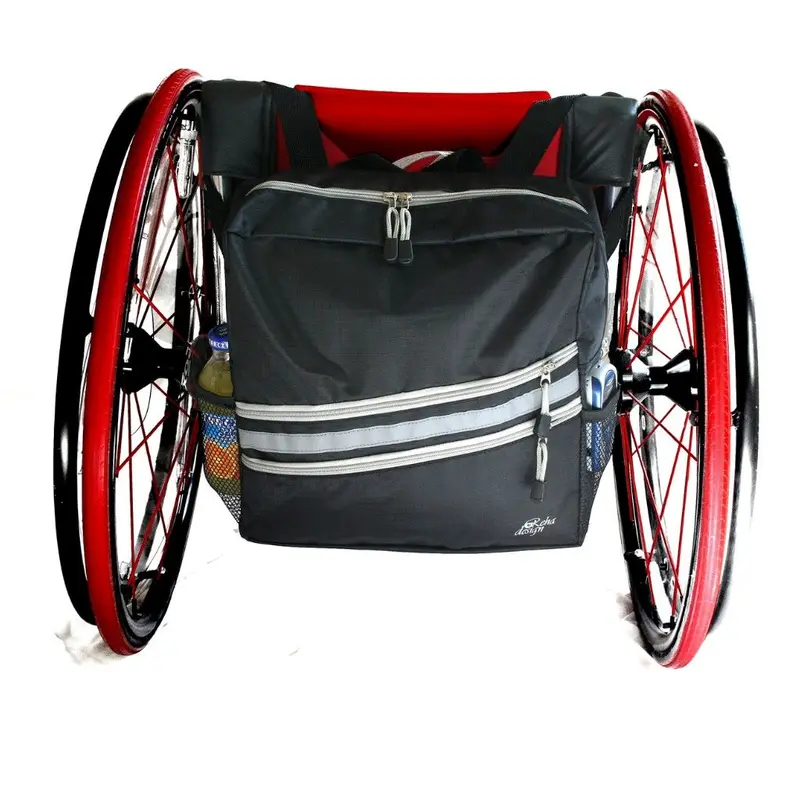
Straps over the push handles. Vive's Wheelchair Bag uses two adjustable buckle straps. Its FAQ explains: "First, buckle each strap around the base of each wheelchair handle or on opposite sides of the push bar. Tighten the straps for a secure fit that minimizes swinging and sagging."
The page says the straps "can stay in place when folding the wheelchair,"
that the bag fits handles 26 inches apart, and that it works on chairs with a single support bar. Karman's Back Carry Pouch (CP4), on 1800wheelchair's page, "loops over wheelchair push canes,"
is "about 15.5 by 4.5 by 15 inches,"
and closes with a Velcro flap. Vive's Wheelchair Bag Standard uses "adjustable hang straps" that, its FAQ says, "attach across the back handles of most wheelchairs and transport chairs."
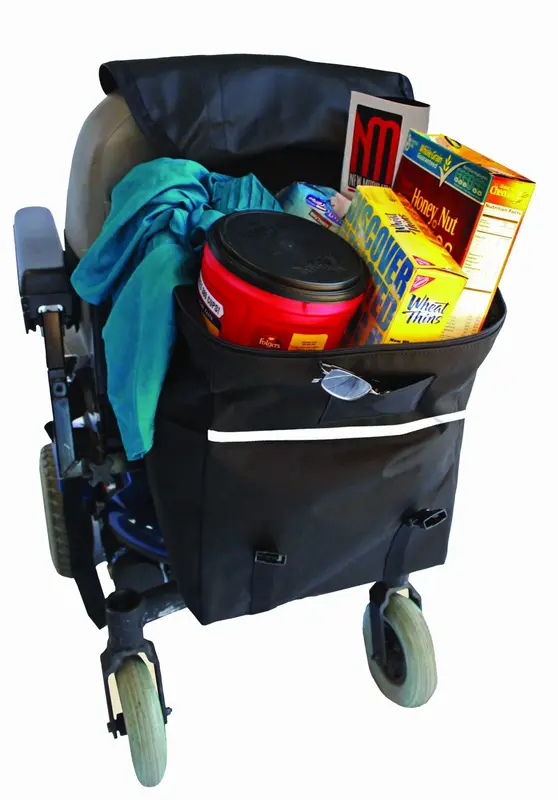
Feather's Ultimate Wheelchair Backpack, sold by 1800wheelchair, "hangs on an 18 inch or 20 inch wheelchair, whether the chair is manual, power, or a transport chair."
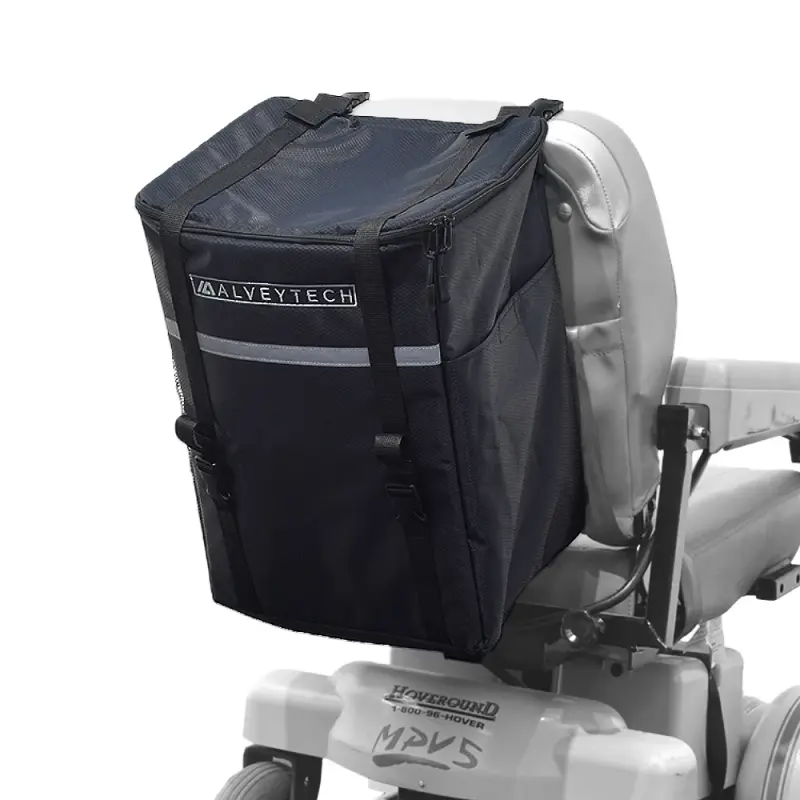
A strap around the backrest itself. Diestco's seatback bags are held by one long hook-and-loop strap that passes through the gap between the seat and the backrest. The mounting tag for the Monster Bag gives five steps: remove the strap from the metal loop, "Pass the strap through the opening between the seat and the seatback,"
re-insert it through the loop, pull it down tight and fasten it, and cut any extra strap once the bag is mounted. The same steps are printed on the tags for the Deluxe Seatback bag and the scooter crutch holder. Diestco's pages say the seatback bags fit seatbacks from 7 to 24 inches tall; its Mini Monster page says 6 to 24 inches.
Hooks or fixed hardware. None of the Vive or Diestco pages we read offers hooks, but one FDA report describes them on a power chair. An FDA report from 2022 describes "backpack hooks mounted on to the back rest"
of a Permobil F3 power chair; we come back to that report below.
Some chairs come with storage built in, and some makers sell their own bags as options. Drive's page for its Silver Sport 2 wheelchair lists a "Carry pocket on backrest" among its features. Sunrise Medical's US options page lists a QUICKIE Backpack, a ZIPPIE Backpack and a QUICKIE Seat Pouch among its miscellaneous options, with no sizes or prices printed. On SpinLife's page, Motion Composites' Newton Backpack has "Adjustable straps slip over the wheelchair handles"
and is called "Weather resistant."
What backpacks do well, by their pages: they hold the most, many come off with a shoulder strap, and one, Vive's Standard bag, "Folds flat when empty," its page says. What their pages do not say: none of the backrest bags we read prints a limit for the chair, and among them only Vive's two print a load for the bag itself. That gap is the subject of the next section.
What chair makers print about weight behind the backrest
Bag pages talk about pockets. Chair manuals talk about balance. We read the manuals of eight chair and scooter makers; five warn about weight on the chair, in different words. Medline and RGK link a backpack to the chair's balance, and Medline says gear on the back makes a backward tip easier on ramps. Each warning below belongs to the manual that prints it, for the chairs it covers.
Medline's user guide for its K1, K2, K3 and K4 Guardian chairs and Guardian Recliner (PIC-00270, read 9 November 2026) explains the center of gravity in plain terms and then says: "Addition of accessories such as a backpack will also re-distribute weight. Loss of proper balance may cause the chair to tip over."
In its section on ramps it adds: "Backpacks or other gear on the back of the wheelchair will cause it to tip backward more easily."
The same guide advises the seat belt "to help maintain stability"
and says anti-tip devices, "especially when maneuvering on ramps or inclines, will also enhance safety."
RGK's AllCourt owner's manual (930491 Rev. E, from Sunrise Medical) lists what affects the center of balance, including "The use of a backpack or other options and the amount of added weight."
It sets a hard limit: "NEVER exceed the weight limit of 250 pounds (113.4 kilograms) for combined weight of rider and items carried."
And it warns that changes to a chair "may increase the risk of a tip-over UNLESS you make other changes as well,"
recommending anti-tip tubes until you adapt.
Karman's KM-5000 manual (its cover reads MVP 502 series) has two lines in its list of things not to do: "DO NOT hang anything heavy on the back of the chair that could cause the chair to become unstable, particularly when negotiating inclines,"
and "DO NOT hang anything on the back joint that could cause the backrest folding suddenly and may cause injury."
The second line matters on chairs with a folding backrest: a load hung on the hinge can fold it.
Permobil's M3 Corpus power chair manual (model version 3) says: "never hang excessive weights on the wheelchair. If you do, the wheelchair can become less stable and injure you."
Drive's Viper Plus GT manual does not name bags, but says: "Do not lean over or apply weight to the top of wheelchair back. This can cause wheelchair to tip over."
Can a wheelchair bag make the chair tip backward? Mobility Atlas read the user manuals of Medline, RGK, Karman, Permobil and Drive on 9 November 2026, and four of the five warn about weight hung on the chair or carried by it. Medline's Guardian guide says, in its ramps section, "Backpacks or other gear on the back of the wheelchair will cause it to tip backward more easily."
Karman's KM-5000 manual says not to hang "anything heavy on the back of the chair,"
particularly on inclines. RGK counts items carried in its 250 pound limit. None of these manuals gives a pound figure for a bag. A 2008 FDA report describes a manual chair that "FLIPPED BACKWARDS" on a flat school corridor; the maker's narrative says the backpack accessories were "TOO HEAVY." In our view, keep the back bag light and ask the dealer and a therapist whether anti-tip tubes or a set-up change are needed.
Pride's wording reached us through an FDA report rather than a manual we read. That 2008 report, filed about a Pride Lifestream XF manual chair, quotes an owner's manual: "CARRYING HEAVY BAGGAGE OR TYING HEAVY BAGGAGE TO YOUR WHEELCHAIR MAY AFFECT THE CENTER OF GRAVITY, RESULTING IN A TIP OR FALL."
We did not read that manual itself.
What this means depends on the chair, and the same bag can behave differently on two chairs; that is our reading of the manuals, not a test. The set-up of a chair, including the axle position and any anti-tip tubes, is a decision for the user with the dealer and a clinician; RGK's manual says to consult "your doctor, nurse or therapist"
about axle and caster position.
Weight limits: the bag's rating and the chair's rating
Two different limits apply to a loaded bag, and the pages we read rarely put them side by side. The first is what the bag itself can carry before a strap, seam or buckle gives way. The second is what the chair can carry, including the user and everything on it, and where on the chair that weight can safely go.
Bag ratings, as printed. Of the 36 bag pages we read, 5 print a load: Vive's Wheelchair Bag "holds up to 10 pounds," Vive's Mobility Side Bag is "designed to hold up to ten pounds,"
and Vive's Standard bag "holds up to 25 pounds." 1800wheelchair's page for Drive's Universal Mobility Tote (RTL10254) prints "Weight Capacity 5 lbs., 20 lbs."
without saying which figure goes with which part of the bag. Drive's own page for its medium Mobility Bag (RTL10254BFL) prints "Weight Capacity" 9 lb in its specifications. The two documents differ, so plan on the lower figure, 5 pounds, until Drive confirms in writing which applies. None of Diestco's 20 bag pages prints a load. Vive's XL page answers "How much can this bag hold?"
with a list of items, not a weight.
Notice what the Vive ratings imply. The Standard bag is rated at 25 pounds; the larger main Wheelchair Bag at 10 pounds. A higher bag rating is not permission to load the chair more. The bag rating says the fabric will hold; it says nothing about the chair.
Chair ratings. RGK's AllCourt manual sets 250 pounds "for combined weight of rider and items carried."
Ki Mobility's Rogue 2 XP manual, for a chair used as a seat in a motor vehicle, says: "The rider and all items carried must not weigh more than 275 lbs (125 kg)."
Invacare's Tracer SX5 manual gives a weight limitation of 250 lbs for seat widths of 14 to 18 inches and 300 lbs for 20 to 22 inches, and Drive's Viper Plus GT manual prints "WEIGHT CAPACITY: 300 LBS"; neither says whether carried items count, so ask the maker. In our reading, a user close to their chair's limit has little room for a full bag, even when the bag's own rating allows it. As one example by our arithmetic, a full 25 pound Standard bag is 10 percent of RGK's 250 pound combined limit.
Where the weight sits matters as much as how much. In our view, a bag on the armrest or under the seat keeps weight between the wheels; a bag on the push handles puts it behind the backrest, where Medline says it makes a backward tip easier on ramps and Karman says heavy items can make the chair unstable, particularly on inclines. In our view, when two figures differ, such as the two figures on the Drive tote's seller page and Drive's own 9 pound figure, plan on the lower one until the maker confirms in writing which applies to your bag.
Side and armrest bags
Armrest bags are the bags you can reach without twisting. They hang on the outside or inside of the armrest, or slide over it, and most are small. Diestco makes the widest range among the pages we read.
Diestco's Standard Saddle is a single-pocket bag that "mounts to any armrest," can sit inside or outside, and "Fits armrest from 1″ round tubing to deluxe scooter armrest,"
its page says; it is about 10 by 8 by 3 inches. The Deluxe Saddle is the same size with side pockets and a zippered inner pocket. The Large Saddle, 9 by 12 by 3 inches, is described as "A mid-size armrest bag that won't interfere with mid-wheel drive tires."
The X-Large Saddle, 12 by 16 by 2 inches, is "ideal for scooter users who need to carry a lot."
The Armrest Pocket, 11 by 5 by 3 inches, is the one Diestco says suits manual chairs: "Smaller size allows it to work on manual wheelchairs without wheel interference."
Diestco's Front Bag is a different shape, a "basketball-sized" bag, 7 inches high and 12 inches across, that "Mounts to the end of an armrest"
and detaches "with the push of a button."
Pride's Saddlebag for Jazzy power chairs uses a sleeve: it lets you "slide it onto the armrest"
on the left or right, then adjust with Velcro straps. Pride's page says it is made of Neoprene and comes small, about 9.5 by 5.25 by 5 inches, or large, about 11.75 by 8 by 7 inches, and carries Pride's note: "Not all accessories are available for all products. Please speak with your Provider for details and availability."
Vive's Mobility Side Bag is 11.8 by 8.6 inches, with three straps: two attach to the armrest, and the FAQ says to attach the bottom strap "to any vertical support to prevent swinging and sliding."
Its page rates it at ten pounds. Karman's Universal Carry Pouch (CP2), on 1800wheelchair's page, is a small pouch of about 7 by 2.5 by 5 inches that "Velcro-straps to a wheelchair armrest."
The HandyPockets Side Pocket is 11.25 inches wide and 14 inches tall; its page says it hangs down about 10 inches, with 4 inches above the zipper that "lays across the arm of the chair/scooter,"
and a padded arm rest on top. Bodypoint's Mobility Bag can go either way: a detachable clip "slides on to the seat sling or side guard,"
or Velcro-style tabs attach it to an armrest or the seat sling.
The catch with side bags on a manual chair is the wheel. In our view, a bag that hangs outside the armrest can rub the tire or the hand as it pushes, and Diestco's Armrest Pocket and Large Saddle pages both mention interference with a wheel or tire. In our view, measure the gap between the armrest and the wheel before you buy, and ask for the bag's depth as well as its width. On a power chair, Diestco's Large Saddle page names mid-wheel drive tires; check the drive wheel position on your own chair.
Price, as listed on 1800wheelchair on 12 November 2026, ran from 20 dollars for Karman's small pouch to 70 dollars for a Diestco saddle bag. Vive listed its Mobility Side Bag at 19.99 dollars on its own store.
Under-seat bags and shelves
In our view, under the seat is the one place on most chairs where a bag sits between the wheels and below the user. The pages we read offer three kinds of under-seat storage: a closed box or pouch, an open shelf, and a bag that clips to the seat sling.
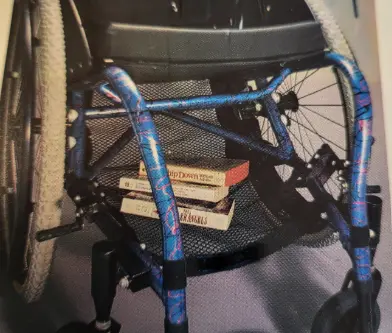
Diestco's two Glove Boxes attach "under the seat of your wheelchair or scooter,"
are "Ideal for storing your personal items out of sight,"
and close with hook and loop. The Large Glove Box is about 12 by 5 by 9 inches and the Small Glove Box about 9 by 5 by 3 inches. Diestco's Cargo Shelf "Mounts to the frame underneath your wheelchair seat,"
is about 15 inches wide and 16 inches deep, has a front zippered pocket, and has a "Pocketed backstop" that, the page says, "keeps things from sliding out the back."
Our catalog, from Sportaid's page, lists the Sportaid Catch All (SPB-190) for chairs with seat widths of 14 to 17 inches and horizontal frame tubing; we did not read that page for this guide.
Bodypoint's Mobility Bag, sold by 1800wheelchair, is the clip-on kind. Its "detachable seat clip slides on to the seat sling or side guard,"
and the page says the same clip "keeps bag snug under or next to seat or frame"
and fits a vehicle seat pocket. The bag has two large zippered compartments with "Reversed zipper pulls to select a pocket by touch"
and a bright orange lining.
Under-seat storage has two limits that the pages do not spell out. First, in our reading, a folding chair folds through the space under the seat; a shelf or box fixed to the cross-brace may have to come off before the chair folds. Second, the space is hard to reach for many users. In our view, an under-seat bag suits things you need once a day, such as a rain cover, spare gloves or a charger, more than things you need every few minutes.
On scooters, under-seat storage can be built in. Pride's Travel Scooter Series manual describes an under-seat storage bin, fitted on some models, that swings out on a latch, and warns: "Ensure both under-seat storage bins are latched prior to operating your travel scooter."
Diestco's Down-in-Front bag is not under the seat but just in front of it. Its page says it is "A single pocket bag that mounts around the front of your wheelchair frame,"
about 11 by 6 by 3 inches, which comes off "very quickly with detachable male/female buckles."
Diestco calls it a "Great bag for chairs with no armrests."
1800wheelchair's tile names it an underseat bag.
Crutch and cane holders on bags and chairs
Many users who walk short distances carry a cane or crutches on the chair. The pages we read offer fabric holders that strap to the chair the way a bag does, and fixed carriers that bolt on. Choosing the cane or crutches themselves is covered in our guides to crutches and walking canes.
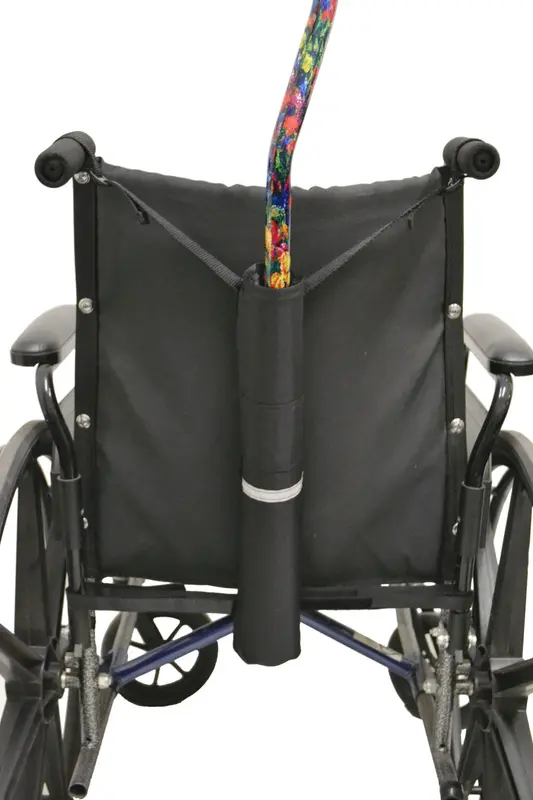
Diestco's page says its Cane Holder for Wheelchairs "Mounts with adjustable straps that loop around push handles,"
is about 3 inches wide and 17 inches tall, and is made of what Diestco calls "weather-resistant polyester."
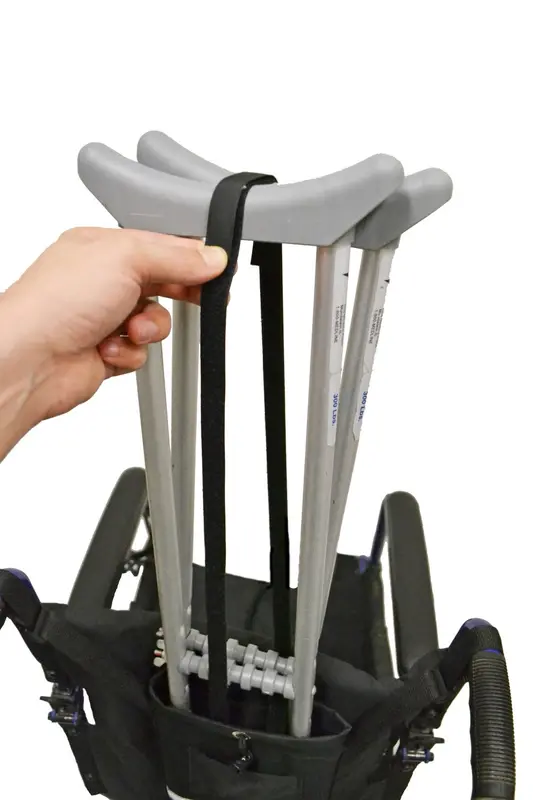
Its Crutch Holder for Wheelchairs "Carries forearm and underarm style crutches,"
mounts the same way, and is about 8 inches wide and 25 inches tall. For scooters and power chairs, Diestco sells a vertical cane holder and a crutch holder that mount "onto the seatback with a hook and loop strap."
Diestco also sells a horizontal cane holder that "Securely attaches to an armrest."
Diestco's two documents for the scooter crutch holder differ. The product page says it fits seatbacks from 6 to 24 inches high. The mounting tag linked from the same page says it fits seatbacks 7 to 24 inches tall. Plan on 7 inches as the shortest seatback until Diestco confirms otherwise. The tag also says the holder mounts to the back of a scooter or power chair with a 2 inch hook and loop strap.
Invacare's Tracer SX5 manual shows a fixed crutch and cane carrier: a clamp and base on the step tube, and a strap fixed at the back upholstery screw. Its warnings are worth reading even for fabric holders: "Check base weekly to ensure proper placement."
"Strap MUST be securely fastened while carrying items."
"NEVER insert or remove items while wheelchair is moving."
The manual also says to make sure the load does not interfere "with folding the wheelchair, the rear wheels, or the swing-back arms."
Pride's Jazzy page sells a power chair cane and crutch holder that is "easy to mount onto your power chair,"
with "All hardware is included,"
and the same note that not all accessories are available for all products.
In our view, a crutch holder on the push handles adds a long item behind the chair, which can catch on doorways and adds weight high on the back. A holder at the side or a fixed carrier low on the frame keeps the load lower. Which is right depends on the chair and how the user transfers; ask the dealer what your chair's maker offers for your frame, and the therapist how a holder affects transfers.
Power chair and scooter bags
Power chairs and scooters have different mounting points: a seatback with no push handles, wide armrests, a tiller on a scooter, and often a front or rear basket. The pages we read show bags for each, and Pride's scooter manual limits where they may hang.
Seatback bags. Diestco says its seatback bags fit "your scooter or wheelchair seatback,"
and 1800wheelchair's page for the Monster Bag says it fits "ranging from the travel scooters to the high-back powerchairs."
Vive says its Wheelchair Bag XL attaches to "most wheelchairs, mobility scooters, and similar devices"
with "reinforced buckle straps."
Drive's page says its Mobility Bags attach to "walkers, rolling walkers, power chairs, wheelchairs, transport chairs and scooters"
with "Dual attachment options: back strap attachment with secure clip or adjustable hanging straps."
Armrest bags. Pride's Saddlebag is sold for Jazzy power chairs. Diestco's Large Saddle page names mid-wheel drive tires, and its X-Large Saddle page names scooter users.
Tiller bags and baskets. Diestco's Standard Tiller Bag "attaches to scooter tiller handles,"
can be "mounted either in front of or behind the tiller,"
and has "a hook and loop leash to prevent unwanted swinging."
Its Deluxe Tiller Bag mounts the same way. Its Soft Basket "is the same cubic inches as a wire basket,"
Diestco says, with a zippered top, and its Basket Liner fits "inside your basket so smaller items don't slip through."
Here two documents point in different directions, and you should read both before you hang anything on a tiller. Pride's Travel Scooter Series manual lists four things that "can adversely affect steering and stability,"
and one of them is "Hanging any article from the tiller."
Diestco's tiller bags are made to hang from tiller handles. These are different makers' documents for different products, and Pride's warning is for its own Travel Scooter Series; but if your scooter's manual carries a warning like Pride's, it applies to a tiller bag too. In our reading, a basket liner inside the basket the scooter came with avoids the conflict; ask the scooter's maker or dealer before fitting a tiller bag.
Power chairs add one more point: electronics on the back. An FDA report from 2019 describes a fire on the back of a power chair that carried a user's backpack; the seating maker's narrative says the backpack "was not a Motion Concepts supplied accessory"
and "was likely not manufactured from a fire-retardant material,"
and says its findings point to an external ignition source as the most likely cause. Another report, from 2026, concerns a Permobil F5 Corpus driven by an attendant control mounted on the backrest, with a backpack on the backrest at the time; Permobil says it could not reach a determination of the cause. In our view, keep bags clear of controllers, attendant controls, cables and battery boxes, and ask the dealer where a bag can go on your chair.
More on choosing the chair or scooter itself is in our guides to the Jazzy power chairs and travel mobility scooters.
Sizes and capacity as printed
The table lists a selection of the bags we read that print a size, with the load where one is printed. Sizes are as each page prints them, in inches; we did not measure. Pages print the three numbers in different orders, so read each page for which number is height. Diestco codes are from its page addresses.
| Bag | Mount | Size as printed (in) | Load as printed |
|---|---|---|---|
| Diestco Monster Bag (B1113) | Seatback | 13 x 18 x 10 | Not printed |
| Diestco Mini Monster | Seatback | 12W x 8H x 12D | Not printed |
| Diestco Deluxe Seatback (B1121) | Seatback | 14 x 16 x 4 | Not printed |
| Diestco Mid-Range (B1117) | Seatback | 12 x 13 x 3 | Not printed |
| Diestco Standard Seatback (B1111) | Seatback | 12 x 12 x 3 | Not printed |
| Diestco Side Access (B1112) | Seatback | 12 x 13 x 4 | Not printed |
| Vive Wheelchair Bag (LVA1006) | Push handles | 19 x 14 | 10 lb |
| Vive Wheelchair Bag Standard (LVA3098) | Push handles | 18.7 x 13.8 | 25 lb |
| Vive Advanced (LVA3100) | Straps | 15 x 14 x 5 | Not printed |
| Vive Wheelchair Bag XL (LVA3104) | Straps | 17 x 16 x 8 | Not printed |
| Feather Ultimate Wheelchair Backpack | Push handles | 16 W x 13 H x 6 D | Not printed |
| Karman Back Carry Pouch (CP4) | Push handles | 15.5 x 4.5 x 15 | Not printed |
| Drive Mobility Bag / Universal Mobility Tote (RTL10254) | Clip or straps | 11 L x 11 W x 3 D (Drive) | 9 lb (Drive page); 5 lbs., 20 lbs. (seller) |
| Diestco Standard Saddle (B2111) | Armrest | 10 x 8 x 3 | Not printed |
| Diestco Large Saddle (B2125) | Armrest | 9 x 12 x 3 | Not printed |
| Diestco X-Large Saddle (B2131) | Armrest | 12 x 16 x 2 | Not printed |
| Diestco Armrest Pocket (B2113) | Armrest | 11 x 5 x 3 | Not printed |
| Pride Saddlebag, small / large | Armrest sleeve | 9.5 x 5.25 x 5 / 11.75 x 8 x 7 | Not printed |
| Vive Mobility Side Bag | Armrest | 11.8 x 8.6 | 10 lb |
| Karman Universal Carry Pouch (CP2) | Armrest | 7 x 2.5 x 5 | Not printed |
| Diestco Large Glove Box (B3223) | Under seat | 12 x 5 x 9 | Not printed |
| Diestco Small Glove Box (B3213) | Under seat | 9 x 5 x 3 | Not printed |
| Diestco Cargo Shelf (B3312) | Under seat | 15 W x 16 D | Not printed |
| Diestco Down-in-Front (B3311) | Front frame | 11 x 6 x 3 | Not printed |
| Diestco Soft Basket (B4231) | Scooter tiller | 12 x 11 x 8 | Not printed |
| Diestco Standard Tiller Bag (B4211) | Scooter tiller | 10 x 6 x 3 | Not printed |
To compare volume, we multiplied the three printed dimensions where a page gives three; these are our multiplications, not maker figures. Diestco's Monster Bag comes to 2,340 cubic inches, about 5.4 times its Standard Seatback's 432. Vive's XL comes to 2,176, Feather's backpack to 1,248, Vive's Advanced to 1,050 and Diestco's Deluxe Seatback to 896. Among under-seat bags, Diestco's Large Glove Box comes to 540 cubic inches. A bigger bag can hold more weight behind the chair; volume is not a load rating, and the warnings in the chair manuals apply to what is inside.
Three figures disagree between documents. Diestco's page and mounting tag say the Monster Bag fits seatbacks 7 to 24 inches tall; 1800wheelchair's page says 7 to 21 inches, a difference of 3 inches by our subtraction. Plan on the narrower range, 7 to 21 inches, until Diestco confirms. Diestco's page calls the Monster Bag's fabric "water-resistant nylon"; its own mounting tag and 1800wheelchair's page say "water resistant polyester."
And Vive's Wheelchair Bag page says it "is available in 15 color and pattern options,"
while the specification on the same page lists 4 colors. In each case, ask the seller what will ship.
One more pricing trap sits in the Standard bag's listing. On 12 November 2026 Vive's page for the Wheelchair Bag Standard showed 1,299.99 dollars, the price of a 120 pack; the store's data for the same page listed a 1 pack at 9.99 dollars marked as not available. By our division, the 120 pack works out at 10.83 dollars a bag.
How wheelchair bags mount, and what to check
Bags hold on in five ways in the pages we read. Each has a typical weak point, and the cheap checks below are our own suggestions, not maker instructions, unless a maker is named.
| Mount | Examples | What the page says | What to check |
|---|---|---|---|
| Buckle straps around handles | Vive Wheelchair Bag, XL, Advanced | Wheelchair Bag FAQ: tighten to minimize swinging | Buckles closed, straps not twisted |
| Loops over push handles | Karman CP4, Diestco holders | Loops over push canes or handles | Loops cannot lift off over grips |
| One strap through the seat gap | Diestco seatback bags | Pass strap between seat and seatback | Strap tight; not rubbing the wheel |
| Sleeve or hook-and-loop on armrest | Pride Saddlebag, Diestco saddles | Pride: slide on, Velcro; Diestco: straps around | Clear of the wheel and your hand |
| Clip or fixed hardware | Bodypoint clip; Invacare carrier; hooks | Clip slides on sling or side guard | Hardware tight; load on both hooks |
In our view, straps over push handles are the most familiar mount and the most visible to an attendant. Vive's FAQ notes one detail for transport chairs: because each strap is buckled rather than slid on, "the straps easily adjust to accommodate handbrakes."
Its FAQ also says the bag can be lifted while folding the chair. On chairs with push handles that fold or drop, ask whether a bag strap stops the handle from moving.
Diestco's strap through the seat gap holds the bag to the backrest itself, not the handles, so it works on power chairs and scooters with no handles. Its tags all say to check that the strap "is not twisted" and to "Pull strap down tightly." Diestco's tag also prints a phone number for help with mounting, (800)795-2392.
Hooks and fixed hardware carry more weight but put it on two small points. The 2022 FDA report about a Permobil F3 says one of two aluminum backpack hooks broke "just below where it protrudes from the mounting plate,"
and that photos suggested the backpack "was only being held by 1 hook at a time as opposed to evenly distributing the weight."
The report adds that the remaining hook was "DISTENDED AND BENT," which, it says, would indicate excessive weight or impact damage. Permobil, the report says, recommended replacing the hooks and gave "instruction provided of the need to evenly distribute the weight by using both hooks."
In our view, if your chair has hooks, hang the bag on both, and ask the dealer what the hooks are rated for.
Two checks apply to every mount, in our view. Before each trip, pull the bag by hand to see that it does not slide or lift off. And after anyone folds, cleans or transports the chair, check the bag again, since that is when straps and loops are moved.
Materials, waterproofing and visibility: what makers claim
Every material and weather claim below is a maker or seller claim, quoted from its page. We did not test any bag in rain. The words matter: "waterproof," "water-resistant" and "weather-resistant" are not the same claim, and one maker uses more than one on the same page.
Vive's main Wheelchair Bag page says the bag is "waterproof nylon," and its FAQ adds that the material keeps items "dry when properly closed"; the bag closes with "a strong fastener," not a zipper, its FAQ says. Vive's Advanced bag page is more careful: "While not fully waterproof, it offers strong resistance to moisture during regular use."
Vive's Mobility Side Bag FAQ says plainly: "No, the bag is not waterproof, however, the mobility side bag is made with water-resistant polyester material."
Vive's XL page calls its fabric "water-resistant" and lists it as 70% polyester and 30% LDPE foam; the Advanced bag lists 60% polyester, 20% PVC and 20% LDPE.
Diestco's pages use "water-resistant nylon" for most bags (the Mini Monster says water-resistant polyester) and "weather-resistant nylon" for the Deluxe and Large saddles, the Front Bag and the Soft Basket, and "weather-resistant polyester"
for its cane and crutch holders. Drive's page says its Mobility Bags are "Treated with water resistant technology."
Karman's pouches are listed as "Waterproof" on 1800wheelchair's pages. HandyPockets is "water-resistant marine grade canvas,"
and the Granny Jo Walker/Wheelchair Bag is "100% cotton-duck fabric," on 1800wheelchair's pages.
Visibility claims are also maker claims. Diestco's pages say most of its bags carry reflective tape for visibility at 300 yards; its Monster Bag tag words it as "reflective safety tape, visible up to 300 yards."
Vive's Advanced and XL bags have a reflective strip, and 1800wheelchair's own Reflective Tote Bag has reflective trim. A reflective strip on the back of the chair is seen by drivers behind you; in our view, it is not a substitute for lights after dark.
Care differs too. Vive says its Wheelchair Bag machine washes cold and air dries, the Standard bag is machine washable, and the Side Bag is "Do not machine wash," spot clean only. Bodypoint's bag is "Machine wash, delicate cycle, air dry."
Drive says to "Spot clean with wet cloth."
Read the care line before you buy a bag for a user who spills.
Power chairs add a fire question. The 2019 FDA report quoted above says the seating maker's accessories meet "RESNA WC-1:2009, SECTION 16- RESISTANCE TO IGNITION OF UPHOLSTERED PARTS"
and that the user's own backpack was likely not fire-retardant. None of the bag pages we read makes a fire-resistance claim; if it matters for your chair, ask the seller in writing.
Bags in a car, van or bus
Bags that stay on the chair in a moving vehicle become loose objects in a crash. Ki Mobility's Rogue 2 XP manual says, for a chair used as a seat in a motor vehicle: "Backpacks and pouches should be removed and secured separately in the motor vehicle. In the event of an accident these items can become dangerous projectiles, which may injure or kill you or other occupants of the motor vehicle."
The same page says the rider and all items carried must not weigh more than 275 lbs (125 kg).
Permobil's M3 Corpus manual recommends that "whenever feasible, you transfer to a vehicle seat"
and that the unoccupied chair "should be stored in a cargo area or secured in the vehicle during travel."
In our view, the safe habit is the same on any chair: before the chair is tied down or lifted into a vehicle, take the bags off and secure them separately, as Ki's manual says, for example in the trunk or held by a vehicle restraint. A bag left loose on the floor is not secured. Whether a chair may be used as a seat in a vehicle at all is set by its maker's transit rating; our transport wheelchair guide and manual wheelchair guide explain what to look for.
What wheelchair bags cost in 2026
We kept every bag line printed on the pages of three US sellers on 12 November 2026 that is a bag carried on the chair: 21 on 1800wheelchair's Bags and Totes pages, 4 on Vive Health's store and 4 on SpinLife's Pouches and Holders page. Across all 29 lines, listed prices ran from 19.99 dollars to 110 dollars: 15 were under 50 dollars, 12 from 50 to 100 dollars, and 2 over 100 dollars.
| Bag, as listed | Seller (US) | Price as printed (USD) | Type |
|---|---|---|---|
| Vive Mobility Side Bag | Vive | 19.99 (original 24.99) | Armrest |
| 1800Wheelchair Reflective Tote Bag | 1800wheelchair | 19.99 | Not stated on tile |
| Karman Universal Carry Pouch | 1800wheelchair | 20 | Armrest |
| Vive Wheelchair Bag | Vive | 24.99 (original 29.99) | Push handles |
| HandyPockets Side Pocket | 1800wheelchair | As low as 24.99 | Armrest |
| Karman Back Carry Pouch | 1800wheelchair | 29 | Push handles |
| Drive Universal Mobility Tote | 1800wheelchair | As low as 33 | Clip or straps |
| Vive Advanced Wheelchair Bag | Vive | 34.99 | Back |
| Vive Wheelchair Bag XL | Vive | 44.99 | Back |
| M-Edge Mobility and Wheelchair Bags | SpinLife | Starting at 45 | Not stated on tile |
| Diestco Down-in-Front Underseat Bag | 1800wheelchair | 45 | Front frame |
| Diestco Wheelchair Armrest Pocket | 1800wheelchair | 49 | Armrest |
| Diestco Standard Seatback | 1800wheelchair | 55 | Seatback |
| Diestco Wheelchair Small Glove Box | 1800wheelchair | 58 | Under seat |
| Diestco Mid-Range Seatback | 1800wheelchair | 74 | Seatback |
| Bodypoint Mobility Bag | 1800wheelchair | 87 | Seat clip or armrest |
| Diestco Deluxe Seatback | 1800wheelchair | 88 | Seatback |
| The Ultimate Wheelchair Backpack | 1800wheelchair | 89 | Push handles |
| Diestco Monster Seatback Bag | 1800wheelchair | 95 | Seatback |
| Motion Composites Newton Backpack | SpinLife | 104 (struck 130) | Push handles |
| Rolko Wheelchair Bag | SpinLife | 110 (struck 120) | Push handles |
The table shows a selection; the range above covers every kept line. On 1800wheelchair we left out 10 of the 31 tiles: 5 travel bags that hold a whole folded chair (listed from 79 to 145 dollars), 2 covers, a poncho, a drainage bag holder and a bag for storing footrests. On SpinLife we left out 6 of the 10 tiles: a cup holder, a phone mount, a mounting kit, a blanket, an oxygen tank bag, and a Motion Composites Seat Pouch whose tile says to wear it "around your waist or on your shoulder"
and prints no chair mount. On Vive we left out the Standard bag, whose page showed only a 120 pack price on the day. Where a tile printed two prices, the table gives the current price and names the other: Vive prints an "Original price," and on SpinLife the first price is struck through on the page.
How much does a wheelchair bag cost? Mobility Atlas read the bag listings of three US sellers, 1800wheelchair, Vive Health and SpinLife, on 12 November 2026, and kept 29 lines for bags that ride on the chair. They were listed from 19.99 dollars, for Vive's Mobility Side Bag and 1800wheelchair's Reflective Tote, to 110 dollars, for a Rolko Wheelchair Bag on SpinLife; 15 of the 29 were under 50 dollars. Small armrest pouches sit at the low end. Diestco's seatback bags on 1800wheelchair ran from 55 dollars for the Standard to 95 dollars for the Monster, a gap of 40 dollars that buys size, not a printed load. Travel bags that hold a whole chair cost more and are a different product. Prices change and differ by seller, tax and shipping, so ask for the total delivered price before you order.
Shipping and tax change the sum, and shipping terms differ by seller and order. Prices differ by country, seller, tax and funding. Drive's own page for its Mobility Bags shows "SIGN IN TO VIEW PRICE," so Drive's own price is not public there.
Warranty, returns and guarantees
Bags are cheap next to a chair, but returns matter because a bag may not fit your armrest, handles or seatback until it arrives. Each term below belongs to the page that prints it.
Diestco's policies page (read 12 November 2026) says: "The Manufacturer's Warranty on all products is valid for the duration of 6 months after purchase of the product,"
and that the product "will either be repaired or replaced at the discretion of DIESTCO MFG CORP."
For returns to Diestco, the product must reach it "within 10 days following the date of delivery"
and be "unused, in its original packaging,"
with a Return Authorization Number obtained by phone first. Diestco's page says refunds exclude the original delivery charges and the cost of returning the product, and that no restocking fee is charged.
Vive's pages use the word guarantee rather than warranty. The Wheelchair Bag and Mobility Side Bag pages list a "60 day guarantee" among what is included. The XL, Advanced and Standard bag FAQs each say the bag is backed by a one-year Vive guarantee. We did not read the terms behind either guarantee, so ask Vive what each one covers.
1800wheelchair's returns tab, read on its Bodypoint page, offers "a 30-day refund with a 10% to 30% restocking fee for most items."
Its list of items with the restocking fee includes "Wheelchair accessories (bags, ramps & attachments)."
It says items must be "in new, unused condition, and in the original box and packaging,"
that return shipping costs are the customer's, and that Karman products have 14 days rather than 30.
Pride's accessory pages print no warranty for the saddlebag or basket; they print the note that not all accessories are available for all products and send buyers to their provider. Ask the dealer which warranty applies to an accessory sold with a chair, and who holds it.
Does Medicare pay for a wheelchair bag?
Does Medicare pay for a wheelchair bag? The short answer from the documents we read is that it does not name one. Medicare's rule for wheelchair accessories is LCD L33792 (version 43), Wheelchair Options/Accessories; we read the version in effect on 9 November 2026, revision effective for services on or after 1 October 2025, which prints a revision ending date of 19 December 2026. It says: "Options and accessories for wheelchairs are covered if the beneficiary has a wheelchair that meets Medicare coverage criteria and the option/accessory itself is medically necessary."
It goes on to list criteria for specific items, such as a safety belt or pelvic strap (E0978) and an anti-rollback device (E0974). The Coverage Indications section we saved does not name a bag, pouch or backpack.
Seller pages sometimes print a code. 1800wheelchair's product pages for Karman's Back Carry Pouch and Universal Carry Pouch each read "Medicare HCPCS Code E1399."
In our reading, that is the seller's coding, not a statement that Medicare covers the pouch; under the rule above, an accessory still needs a covered chair and a medical need. Expect to pay for a bag yourself, and ask the supplier in writing before assuming otherwise.
We read no Medicare Advantage plan's terms, no state Medicaid rules and no VA terms for bags. If another payer or plan helps with your equipment, ask the plan what it covers before you buy.
What FDA reports say about backpacks on wheelchairs
By a word search of openFDA's device adverse event file (MAUDE) for the word "backpack" in the report text, limited to reports whose device generic name contains wheelchair, scooter or vehicle, we found 8 reports, received from 2008 to 2026 (data last updated 4 November 2026). We read every one. 5 are filed under the powered wheelchair code ITI and 3 under the manual wheelchair code IOR. As filed, 5 are typed Injury, 2 Malfunction and 1 Other. A search of openFDA's recall file for wheelchair products described with the words bag, backpack or pouch returned no matches.
| Year received | Chair, as filed | What the report says, in short |
|---|---|---|
| 2008 | Pride Lifestream XF, manual | Chair flipped backward on a flat corridor; maker says backpack too heavy |
| 2010 | Invacare TDX SR, power | Fire under the seat; backpack taken off during the fire |
| 2013 | Quickie Q7, manual | Frame cracked as the user reached for a backpack |
| 2015 | Invamex, model code TRSX5, manual | Backpack of about 20 to 30 lb said to sag the back upholstery |
| 2015 | Pride Q6 Edge 2.0, power | Backpack bars pinned the user's mother's arm against a wall |
| 2019 | Motion Concepts seating, power | Fire on the back of the chair; backpack likely not fire-retardant |
| 2022 | Permobil F3, power | Backpack hook broke; bag fell and pulled a feeding tube |
| 2026 | Permobil F5 Corpus, power | Chair said to move by itself; backpack on the backrest |
The 2008 report is the one that matches the chair manuals' warnings. A reporter said a family member was propelling their own manual chair with two accessories attached, which the report text calls "A BACKUP AND AN UNDERSEAT ORGANIZER"
and the maker's narrative calls backpack accessories, "WHEN THE WHEELCHAIR FLIPPED BACKWARDS CAUSING HER TO HIT HER HEAD ON THE FLOOR."
The user was evaluated in a hospital emergency room, and the report says examination showed no serious injury. The maker's narrative says its specialist "INSTALLED ANTI-TIPS AND RE-ADJUSTED THE CENTER OF GRAVITY ON THE CHAIR,"
that the accessories were not made by Pride, and that the user "WILL CARRY HER LAPTOP AND BOOKS AN ALTERNATE WAY."
The 2022 Permobil report shows a different risk: the hardware. It says one of two aluminum backpack hooks on the backrest broke as the user came to a quick stop, the backpack holding two enteral feeding pumps fell, and the feeding tube was pulled from the user's stoma, "REQUIRING MEDICAL INTERVENTION TO RESOLVE."
Permobil, the report says, had "NO RECORDED HISTORY OF THIS TYPE OF FAILURE MODE."
In our view, when medical equipment rides in a bag on the chair, ask the clinician who manages it how it should be carried.
The other reports name a backpack as part of the scene rather than the cause. A 2013 Sunrise report says a Quickie Q7 frame cracked near the backrest bracket "WHILE THE END USER REACHED AROUND TO GRAB HIS BACKPACK,"
with no injuries reported. A 2015 report filed by Invamex, about a manual chair with model code TRSX5, is mainly about a tire, and adds that the user said a backpack weighing "ABOUT 20-30 LBS" was "CAUSING THE BACK UPHOLSTERY TO SAG."
A 2015 Pride report says "THE BACKPACK BARS HIT HIS MOTHER'S ARM AND PINNED IT AGAINST THE WALL"
during a turn; Pride's narrative calls it "USER ERROR." Two reports describe fires: in 2010 the family "DETACHED MY BACKPACK AND VENTILATOR FROM THE BACK OF THE CHAIR"
during a fire under the seat, and in 2019 the seating maker named an external ignition source as the most likely cause. The 2026 Permobil report says the cause of the movement could not be determined.
What these reports cannot tell you
The FDA is plain about the limits of MAUDE. Its page about the database says that "this passive surveillance system has limitations,"
including under-reporting of events, and that "MDR data is not intended to be used either to evaluate rates of adverse events"
or to compare event rates across devices. A report is what someone told a maker or the FDA; the FDA says "The submission of an MDR itself does not necessarily demonstrate that the device caused or contributed to the adverse outcome or event."
So the 8 reports cannot tell you how often bags tip chairs, which bag is safer or which chair is better. A word search finds only reports that use the word "backpack"; reports that say "bag," "pouch" or "purse," or that never name what was hung on the chair, are not in this set. 7 of the 8 carry a company's report number and one is a voluntary report from a user. What the reports do show is the kinds of events that have been reported: a backward tip with a loaded back, a hook that broke where, the maker says, photos suggested a one-sided load and the other hook was bent, and bags that sat near electronics or between a chair and a wall.
Our wheelchair parts guide explains anti-tip tubes and other parts a dealer may fit after a set-up change; whether a user needs them is for the dealer and a clinician to decide.
Three traps
Trap one: reading the bag's load as the chair's load. Vive's Standard bag "holds up to 25 pounds," its page says; that is a statement about the bag. RGK's AllCourt manual counts "items carried" against the chair's 250 pound limit, and Medline's says gear on the back makes a backward tip easier on ramps. Check the chair's manual and ask the dealer before you fill a bag behind the backrest.
Trap two: hanging a bag where the chair's maker says not to. Pride's Travel Scooter Series manual names "Hanging any article from the tiller"
among things that can affect steering and stability, while tiller bags are sold for exactly that place. Karman's KM-5000 manual says not to hang anything on the back joint. Read your own chair's manual for where a bag may go, and keep bags off controllers and battery boxes.
Trap three: assuming a bag that does not fit can go back free. 1800wheelchair's returns tab, read on its Bodypoint product page, lists bags among accessories with "a 10% to 30% restocking fee,"
and return shipping is the buyer's cost; Diestco takes returns within 10 days of delivery, unused, with an authorization number. Measure the handle spacing, armrest and seatback height first, and keep the packaging until the bag is fitted.
Three composite scenarios
These are composite scenarios, not individual customers. Each uses only the documents of the products it names and the warnings quoted above.
Scenario one: a manual wheelchair user who pushes themselves wants a phone, keys and a wallet in reach without twisting round. They look at Diestco's Armrest Pocket, about 11 by 5 by 3 inches, which Diestco says works on manual chairs "without wheel interference,"
listed at 49 dollars on 1800wheelchair. Before buying, they measure the gap between the armrest and the wheel. Heavier things, such as a laptop, go in a bag carried on the lap or under the seat, not on the push handles, because Medline's manual, for one, warns that gear on the back makes a backward tip easier on ramps, and they check their own chair's manual.
Scenario two: a Jazzy power chair user wants to carry groceries home. Pride's page says its rear basket "is better for storing larger items, such as groceries"
and that its saddlebags suit smaller personal items. They choose the small Pride Saddlebag, about 9.5 by 5.25 by 5 inches, for daily items, and for groceries ask their provider whether the rear basket fits their model, since Pride's note says not all accessories are available for all products. They ask the provider what load the basket and the chair can take behind the seat, because Pride's page prints none.
Scenario three: a family pushes a relative in a transport chair with handbrakes on the push handles. They pick Vive's Wheelchair Bag, 19 by 14 inches, listed at 24.99 dollars on Vive's store, because its FAQ says the buckled straps "easily adjust to accommodate handbrakes"
and it "holds up to 10 pounds." They keep it under that weight, check the straps before each trip, and take the bag off before the chair goes into the car.
What to ask the dealer, the seller and the therapist
Ask the chair dealer or maker
- Does my chair's manual set a limit for weight on the push handles, backrest or hooks?
- Does my set-up need anti-tip tubes, or a change of axle position, if I carry a bag on the back?
- Where on this chair can a bag go without touching the wheels, the controller, cables or the battery box?
- Does the maker sell its own backpack, pouch or cane holder for this frame, and what is its part number?
Ask the seller
- What are the bag's outside dimensions, and which number is the height?
- Does the page print a load for the bag, and does it match the label?
- Which material and colors will ship, if the page lists more than one?
- What are the return window, restocking fee and return shipping cost?
Ask the therapist or clinician
- Can I reach and use a side, front or back bag safely from my seated position?
- Would weight on the back of my chair change my balance or how I transfer?
- How should medical equipment such as a pump, oxygen or a ventilator be carried on my chair?
Mobility Atlas can find and quote the bag you choose, including bags, holders and replacement straps that are not listed on our pages. Send an enquiry or a part request with the bag name, the maker's part number if you have it, and your chair's make and model; we reply with a written quote that includes delivery to your country, and nothing is charged before you accept it. Bags, holders and other day-to-day add-ons are on our everyday wheelchair accessories page.
Sources and documents
Maker documents read 12 November 2026: Diestco's product pages for its seatback, armrest, under-seat, front and tiller bags, basket liner and cane and crutch holders, and its mounting tags for the Monster Bag, Deluxe Seatback bag and scooter crutch holder; Diestco's policies page; Vive Health's pages for its Wheelchair Bag, Wheelchair Bag XL, Advanced Wheelchair Bag, Wheelchair Bag Standard (with the store's variant data) and Mobility Side Bag; Drive Medical's Mobility Bags page; Pride Mobility's Jazzy accessory pages for the saddlebag, rear basket and cane and crutch holder; two pages of Pride's Travel Scooter Series manual; and Sunrise Medical's manual wheelchair options page.
Chair manuals and pages read 9 November 2026: Medline's Standard Manual Wheelchairs user guide (Guardian chairs, PIC-00270), RGK's AllCourt owner's manual (930491 Rev. E), Karman's KM-5000 manual, Drive's Viper Plus GT manual and Silver Sport 2 page and manual, Invacare's Tracer SX5 user manual, Ki Mobility's Rogue 2 XP manual pages and Permobil's M3 Corpus user manual (model version 3). Seller pages read 12 November 2026: 1800wheelchair's Bags and Totes category and ten product pages, SpinLife's Pouches and Holders category, and Vive Health's store. Rules and records: LCD L33792 (read 9 November 2026), the FDA's page about the MAUDE database (read 9 November 2026), and openFDA's device adverse event and recall files (searched 12 November 2026). Our catalog was used for non-price facts only.
Related guides on Mobility Atlas: Wheelchair accessories; Manual wheelchairs; Transport wheelchairs; Jazzy power chairs; Travel mobility scooters; Wheelchair parts; Crutches; Walking canes.
Method in brief: how we read and checked. We copied each page, manual and record as text on the date given above and took every size, load, material claim, price, warranty term, rule and quote from those copies; quotes and numbers are checked by script against them, and every sum, range, volume and count is computed by script. For prices we kept every bag line printed on the pages named and listed every exclusion. For FDA reports we read every report the word search returned. We did not test or weigh any bag.
Prices checked November 2026 on 1800wheelchair, SpinLife and Vive Health, all on 12 November 2026; prices change, so confirm them with the seller. Documents checked November 2026: maker pages and tags on 12 November 2026, chair manuals and LCD L33792 on 9 November 2026, and the openFDA files on 12 November 2026.
This article is general information. Rules and prices differ by country and change, so confirm them before you buy or travel.
Common questions
What is the best type of wheelchair bag?
No document we read ranks bag types by test. Choose by place: an armrest or front bag keeps a phone, keys and medicine in reach; an under-seat bag holds things you need less often; a backpack on the push handles holds the most but sits behind you, where chair makers such as Medline and Karman warn about weight. Keep the back bag light and check your chair's manual.
How much weight can I put in a wheelchair bag?
Few pages say. Vive rates its Wheelchair Bag and Mobility Side Bag at 10 pounds and its Standard bag at 25 pounds; Drive's page prints 9 pounds for its Mobility Bag, while a seller page prints "5 lbs., 20 lbs."; Diestco's pages print no load. The chair matters more: RGK counts items carried in its 250 pound limit, and Medline says gear on the back makes a backward tip easier. Ask the dealer.
Can a backpack make a wheelchair tip over?
Chair makers say it can make a backward tip more likely. Medline's Guardian guide says, on ramps and inclines, "Backpacks or other gear on the back of the wheelchair will cause it to tip backward more easily,"
and Karman says not to hang anything heavy on the back, especially on inclines. A 2008 FDA report describes a manual chair that flipped backward; the maker's narrative says the backpack accessories were "TOO HEAVY." Ask about anti-tip tubes.
Are wheelchair bags waterproof?
Check the exact word. Vive calls its main Wheelchair Bag waterproof nylon, says its Advanced bag is "not fully waterproof," and says its Side Bag is not waterproof but water-resistant. Diestco uses water-resistant or weather-resistant; Karman's pouches are listed as waterproof by a seller. These are maker or seller claims; none of the pages we read reports a test.
Does Medicare cover a wheelchair bag?
The documents we read do not name one. Medicare's rule L33792 covers accessories only with a covered wheelchair and a medical need, and its coverage section names no bag, pouch or backpack. A seller page printing code E1399 is the seller's coding, not coverage. Expect to pay yourself; prices differ by seller and country, so ask for the delivered total.
Should I take the bag off in a car or van?
Yes. Ki Mobility's Rogue 2 XP manual says that when the chair is used as a seat in a motor vehicle, backpacks and pouches "should be removed and secured separately in the motor vehicle"
because they "can become dangerous projectiles"
in an accident. Permobil recommends transferring to a vehicle seat when feasible. In our view, take bags off and secure them separately, for example in the trunk, before the chair is tied down.
Sources
- Diestco: Monster Bag (B1113), product page
- Diestco: Monster Bag mounting instruction tag (PDF)
- Diestco: seatback bags category
- Diestco: armrest bags category
- Diestco: underseat bags category
- Diestco: tiller bags category
- Diestco: Crutch Holder for Wheelchairs
- Diestco: Crutch Holder for Scooters/Powerchairs and its mounting tag
- Diestco: Policies (returns and warranty)
- Vive Health: Wheelchair Bag
- Vive Health: Wheelchair Bag XL
- Vive Health: Advanced Wheelchair Bag
- Vive Health: Wheelchair Bag Standard
- Vive Health: Mobility Side Bag
- Drive Medical: Mobility Bags (RTL10254), page and Specifications tab
- Pride Mobility: Jazzy Saddlebag
- Pride Mobility: Jazzy Rear Basket
- Pride Mobility: Jazzy Cane Crutch Holder
- Pride Mobility: Travel Scooter Series owner's manual (US/Canada)
- Sunrise Medical: Manual Wheelchair Options & Accessories
- Medline: Standard Manual Wheelchairs user guide, Guardian (PIC-00270), as hosted by Vitality Medical
- RGK (Sunrise Medical): AllCourt owner's manual 930491 Rev. E
- Karman Healthcare: KM-5000 manual
- Permobil: M3 Corpus user manual, model version 3 (US)
- Ki Mobility: Rogue 2 XP owner's manual
- Invacare: Tracer SX5 user manual 1110550
- Drive Medical: Viper Plus GT owner's manual (PDF)
- Drive Medical: Silver Sport 2 wheelchair
- 1800wheelchair: Bags & Totes category
- 1800wheelchair: Bodypoint Mobility Bag (with returns policy)
- 1800wheelchair: Karman Back Carry Pouch
- 1800wheelchair: The Ultimate Wheelchair Backpack
- 1800wheelchair: Drive Universal Mobility Tote
- 1800wheelchair: Diestco Monster Seatback Bag
- SpinLife: Pouches and Holders
- CMS: LCD L33792 Wheelchair Options/Accessories
- FDA: About the MAUDE database
- openFDA: device adverse event reports, word search "backpack"
- openFDA: device recalls, bag, backpack or pouch
Read on . The wording of the article is our own.