Manual wheelchair guide 2026: standard, hemi, lightweight, ultralight, heavy duty and transport chairs, what a wheelchair costs, Medicare, VA and NHS
Every manual wheelchair class Medicare defines, what each costs at two US sellers, the October 2026 fee schedule, the coverage rule in full, VA and NHS routes.
Contents
- The short answer
- How we compared
- Manual wheelchair types at a glance
- Six situations, and which class usually fits
- Standard wheelchair (K0001): the heavy, simple chair
- Standard hemi (low seat) wheelchair (K0002)
- Lightweight wheelchair (K0003)
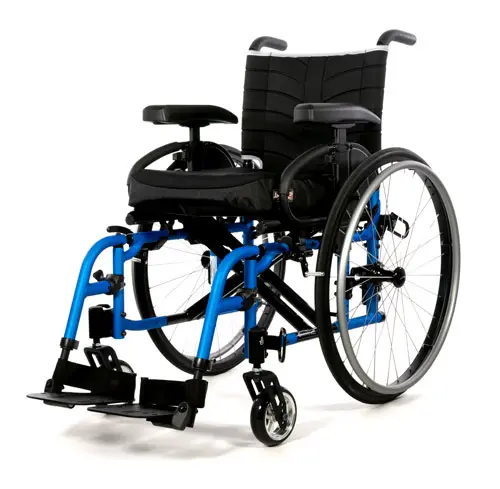
- High strength lightweight (K0004) and ultralightweight (K0005)
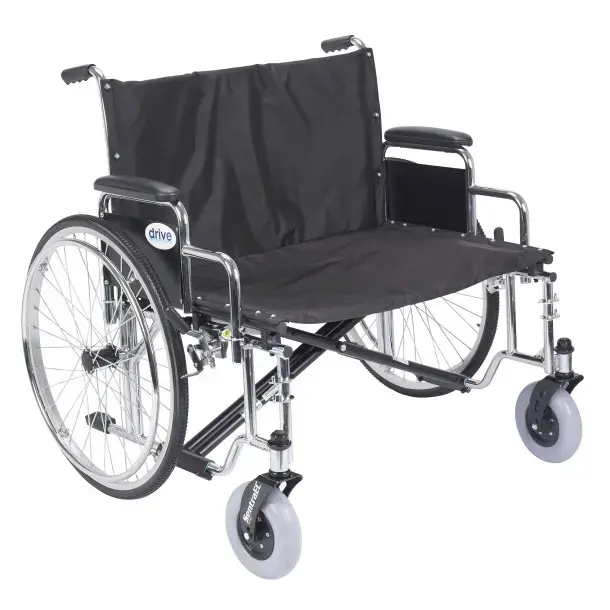
- Heavy duty (K0006) and extra heavy duty (K0007) wheelchairs
- Transport chairs and the walker-transport combination
- Tilt in space, custom and "other" manual wheelchairs
- Pediatric manual wheelchairs
- What every Medicare wheelchair base includes
- How much does a wheelchair cost? Seller prices by category
- What sits behind the cheapest and dearest lines
- Options that change the price
- What Medicare pays: the October 2026 fee schedule
- Does Medicare cover a manual wheelchair? The general rule in full
- The extra test for each class, side by side
- The paperwork: orders, home assessment and modifiers
- One chair at a time, backups, repairs and assignment
- Sizing basics: seat width, depth and height
- Safety lines from the manuals
- Warranty: what the documents print
- FDA classification and the recall file
- Veterans: what the VA rule says
- England: NHS wheelchair services and personal wheelchair budgets
- Where to buy a manual wheelchair
- Three traps
- Three composite scenarios
- What to ask the therapist and the supplier
- Sources and documents
- Common questions
- Sources
The short answer
A manual wheelchair is a wheelchair moved by a person, not a motor: the user pushes the rims of the big rear wheels, or a helper pushes from behind. In the US the name "standard wheelchair" has a fixed meaning. Medicare's policy article for manual wheelchair bases (A52497, revision effective 1 October 2026) defines the standard wheelchair, code K0001, as a chair weighing "Greater than 36 lbs." with a seat height of "19 inches or greater" and a weight capacity of "250 pounds or less". Eight more K codes cover lower, lighter, stronger, custom and other chairs, and three E codes cover transport chairs that a helper pushes.
How much does a wheelchair cost? On the first results pages we read on 9 November 2026, 1800wheelchair (US) listed standard weight wheelchairs from $215 to $799.99, transport chairs from $139.98 to $889, and rigid ultralight chairs from $1,564 to $4,833 once two powered items are taken out. SpinLife (US) listed its standard lightweight chairs from $168 to $1,756. Medicare's October 2026 fee schedule lists rental (RR) amounts for most classes, for example a K0001 rental (RR) amount of $25.23 to $31.07, a monthly figure in our reading, in the columns headed NR (non-rural, in our reading) for the contiguous states.
Choose the class by who will push, how long the chair is used each day and what the home allows, then size it with a therapist. Medicare covers a manual wheelchair for use in the home when its rule (LCD L33788) is met; the ultralight class also needs full-time use or individual fitting that a K0001 to K0004 chair cannot give, a specialty evaluation, and a supplier with a RESNA-certified Assistive Technology Professional who is directly involved, in person, in choosing the chair. The fit, the seat size and the class are for the physician, physical therapist or occupational therapist to decide with you.
Mobility Atlas earns a fee or margin when you order through us; the comparison below uses only CMS and Medicare files, the makers' published pages and manuals, and two US sellers' pages, each read on 9 November 2026.
How we compared
On 9 November 2026 we copied, as text, the CMS policy article A52497 and the coverage rule L33788 for manual wheelchair bases (both "Currently in Effect" from 1 October 2026 on the CMS database), the October 2026 DMEPOS fee schedule file and the October 2026 HCPCS code file from CMS, Medicare.gov's wheelchairs and scooters page, the eCFR sections on mechanical wheelchairs (21 CFR 890.3850) and on VA prosthetic and rehabilitative items (38 CFR 17.3220 and 17.3230), NHS England's pages on personal wheelchair budgets, two Drive Medical product pages with their owner's manuals, and the openFDA recall records filed under the mechanical wheelchair product code since 2021.
For prices we read 8 category pages at two large US sellers: 5 at 1800wheelchair and 3 at SpinLife. Our ranges are computed by script over every price line printed on the first results page of each category (134 lines in all), and we name each line we left out. We did not test any chair. Where two documents give different figures we print both. Advice of our own starts with the words In our view, and our reading of a rule starts with In our reading.
Manual wheelchair types at a glance
Medicare's codes are the clearest public definitions of manual wheelchair classes, and 1800wheelchair uses them in product names ("K1", "K4"). The table puts each class next to the Medicare test from A52497 and the rule in L33788 that decides whether Medicare pays. The weights are the chair's own weight "without the front rigging"
, as the article puts it, so the chair you lift with footrests on is heavier.
| Class (code) | A52497 definition | Usually pushed by (our view) | Deeper guide |
|---|---|---|---|
| Standard (K0001) | Over 36 lbs; seat 19 in or more; up to 250 lb | User or helper | This page |
| Standard hemi (K0002) | Over 36 lbs; seat under 19 in; up to 250 lb | User or helper | This page |
| Lightweight (K0003) | 34 to 36 lbs; up to 250 lb | User | Lightweight guide |
| High strength lightweight (K0004) | Under 34 lbs; lifetime frame warranty | User | Lightweight guide |
| Ultralightweight (K0005) | Under 30 lbs; adjustable rear axle | User, full time | Ultralight / first active chair |
| Heavy duty (K0006) | Capacity over 250 lb | User or helper | This page |
| Extra heavy duty (K0007) | Capacity over 300 lb | User or helper | This page |
| Custom base (K0008) | Built or modified for one person | User | This page |
| Transport (E1037 to E1039) | Pushed by a helper | Helper only | Transport guide |
| Tilt in space (E1161) | Tilts 20 degrees or more | User or helper | Tilt-in-space guide |
| Pediatric (E1229 to E1238) | Seat width or depth 14 in or less | Child or helper | Pediatric guide |
Deeper guides on Mobility Atlas: the lightweight, transport and travel wheelchair guide for K0003 to K0005 chairs, transport chairs and their FDA report record, the ultralight wheelchair guide for K0005 chairs, how to choose your first active wheelchair, rigid vs folding frames, the transport wheelchair guide, the tilt-in-space wheelchair guide and the pediatric wheelchair guide. This page stays with the questions that cut across all of them: which class, what it costs, who pays, and where to get it.
Six situations, and which class usually fits
These are starting points for the conversation with the therapist, not decisions. Each line names the rule that applies in the US.
- If you walk at home and need a chair only for outings, pushed by family: a transport chair or a basic standard chair bought or rented for cash. In our reading, Medicare will not help here, because A52497 says a chair
"only for use outside the home"
will be "denied as noncovered". - If you push yourself at home but a standard chair is too heavy to move: ask about a lightweight K0003 or a high strength lightweight K0004. L33788 asks whether you
"Cannot self-propel in a standard wheelchair in the home"
for K0003, and about frequent home activities, or a size other chairs lack plus at least two hours a day in the chair, for K0004. - If you use the chair all day, every day, and push yourself: this is the K0005 route. L33788 asks for a specialty evaluation by a trained professional with no tie to the supplier, and a supplier with a RESNA-certified ATP who is directly involved, in person, in choosing the chair.
- If you push with your feet, or are of short stature: a hemi K0002, or a dual-axle chair set low. L33788 names a seat of 17 to 18 inches.
- If you weigh more than 250 pounds, or more than 300: a heavy duty K0006 or extra heavy duty K0007, with the capacity counted as the person "plus all accessories", as the A52497 article says.
- If you need a chair for a few weeks after surgery: in our view, renting is often the better fit. L33788 says a K0004 chair
"is rarely reasonable and necessary if the expected duration of need is less than three months (e.g., post-operative recovery)"
, and that a custom chair"is not reasonable and necessary if the expected duration of need is less than three months"
.
In our view, the two questions that settle most choices are who will push, and how many hours a day the chair is used. A chair a helper pushes for an hour on Sundays and a chair its user pushes from morning to night are different products, even when they look alike in a photo. The physician, physical therapist or occupational therapist decides which class fits, and Medicare looks for that reasoning in the records.
Standard wheelchair (K0001): the heavy, simple chair
What is a standard wheelchair? Mobility Atlas read the Medicare policy article for manual wheelchair bases (A52497), and in the US the term has a fixed meaning: code K0001, a chair whose "Weight" is "Greater than 36 lbs.", with a "Seat Height" of "19 inches or greater" and a "Weight capacity" of "250 pounds or less". The article counts weight without footrests. Adult manual bases have a seat width and depth of 15 inches or more, and for K0001 to K0009 wheels "large enough and positioned such that the wheelchair could be propelled by the user"
, so a standard chair can be pushed by its user or by a helper. Its allowance includes seat widths of 15 to 19 inches. Medicare covers it for use in the home when the general criteria in rule L33788 are met, and lists it as capped rental in the October 2026 code file. Sellers use the word loosely, so check weight and capacity.
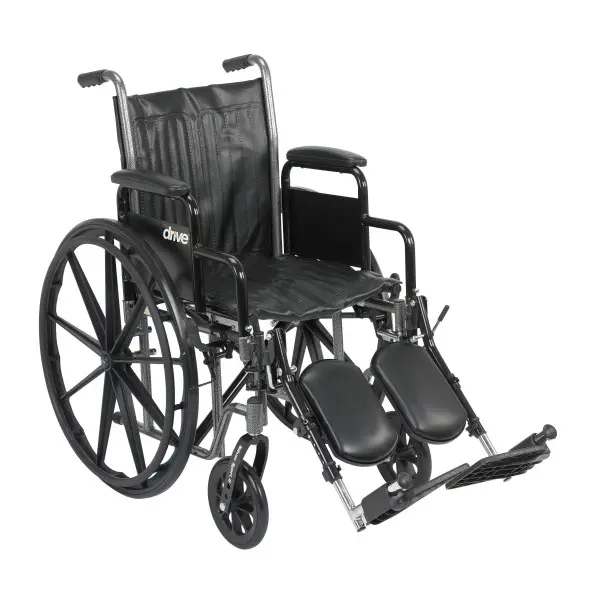
Drive Medical's Silver Sport 2 is a typical example. Drive's US page, read on 9 November 2026, lists "HCPCS #: K0001 / K0002" for every version, a "Powder-coated silver vein steel frame"
, a "Dual axle" that moves the seat height between 19.5 and 17.5 inches, 8 inch front casters and "Push-to-lock wheel locks". Its weight capacity depends on seat width: the owner's manual rates 16 inch chairs at 250 lbs, 18 inch chairs at 300 lbs and 20 inch chairs at 350 lbs. The page lists the warranty as "Limited 3 Years" and prints no price ("SIGN IN TO VIEW PRICE"). A code on a maker's page is the maker's coding, not a promise that Medicare will pay.
In our reading, the two codes on the Silver Sport 2 page come from the dual axle: at 19.5 inches it meets the K0001 seat height test, and at 17.5 inches it falls under the hemi test below. The 18 and 20 inch versions are rated above 250 pounds, which is more than the K0001 definition prints, so ask the supplier which code they will bill for your size.
On 1800wheelchair's "Standard Weight Wheelchairs"
page the Silver Sport 2 was listed at $232 and the Invacare Tracer EX2 at $364; on SpinLife's "Standard Lightweight" page the Silver Sport 2 was $207 and the Tracer EX2 $315. The same model name at two sellers differed by $25 and $49 on the same day (configurations may differ), which is why we give prices with the seller and date.
Standard hemi (low seat) wheelchair (K0002)
A hemi wheelchair is a standard chair with a lower seat. A52497 defines code K0002 by the same weight ("Greater than 36 lbs") and capacity ("250 pounds or less") as K0001, with a "Seat Height" of "Less than 19 inches". L33788 says a K0002 chair "is covered when the beneficiary requires a lower seat height (17"
to 18") because of short stature or to enable the beneficiary to place his/her feet on the ground for propulsion."
In our view, some people who push with one arm also steer with a foot, and a lower seat makes that possible. Many basic chairs reach hemi height by moving the rear axle on a dual-axle plate, as the Silver Sport 2 does. On 1800wheelchair's standard page the ProBasics K2 Standard Hemi Wheelchair was listed at $217, with "Weight Capacity 300 lbs." and "Product Weight 41 lbs. - 43 lbs."
printed on the tile.
In our view, the seat height that lets a person reach the floor with their heels while sitting on their cushion is a measurement for the therapist, not a guess from the catalog. The cushion adds height; our guide to measuring yourself for a wheelchair explains seat-to-floor height and why the cushion must be counted.
Lightweight wheelchair (K0003)
A52497 defines the lightweight wheelchair, code K0003, by weight alone: "34-36 lbs" with a "Weight capacity" of "250 pounds or less". It "include[s] any seat height"
, unlike K0001 and K0002. L33788 covers it when a person meets both of two tests: they "Cannot self-propel in a standard wheelchair in the home"
and "can and does self-propel in a lightweight wheelchair."
A lightweight chair is therefore for people who push themselves, not for a helper.
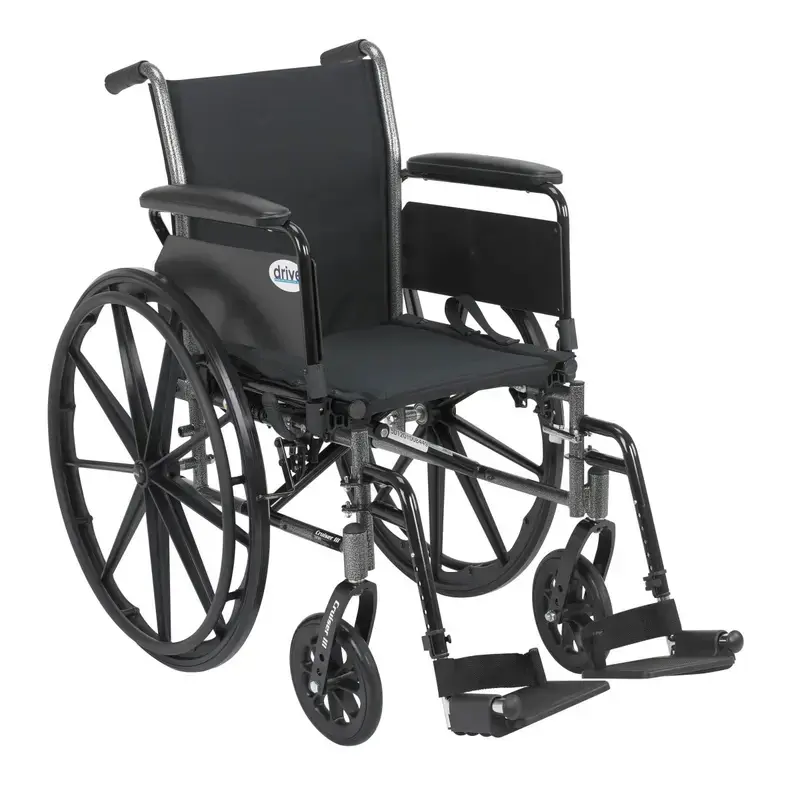
Drive's Cruiser III is coded "HCPCS #: K0003" on Drive's page. The same page lists "Product Weight" as "35 lb | 36 lb | 38 lb", "Weight Capacity" as "300 lb | 350 lb" and the warranty as "Limited Lifetime". Two of those figures sit outside the K0003 definition as printed: a 38 lb version and capacities above 250 lb. In our reading, the page does not say whether its weights include footrests or which seat width each figure belongs to, so ask the supplier for the weight of your exact version without footrests before you rely on the code. Our catalog row for the Cruiser III records a weight of 36 lb (16.3 kg) without front riggings, which would fit the class, though the row does not say which seat size it is.
SpinLife listed Drive's Cruiser III at $235 on its standard lightweight page. 1800wheelchair's standard and heavy-duty pages showed a tile named "Cruiser III 35 lbs. Wheelchair"
at $222; that tile names no maker, so we do not tie it to Drive. For the wider choice of light folding chairs, their weights and the FDA report record for them, see the lightweight wheelchair guide.
High strength lightweight (K0004) and ultralightweight (K0005)
These two classes are where a manual wheelchair stops being a basic chair and becomes something set up for one person. A52497 defines K0004 as "Less than 34 lbs" with a "Lifetime Warranty on side frames and crossbraces"
, and K0005 as "Less than 30 lbs" with an "Adjustable rear axle position"
and the same lifetime warranty. Neither definition sets a weight capacity.
L33788 covers a K0004 chair when the person "self-propels the wheelchair while engaging in frequent activities in the home that cannot be performed in a standard or lightweight wheelchair"
, or "requires a seat width, depth, or height that cannot be accommodated in a standard, lightweight or hemi-wheelchair, and spends at least two hours per day in the wheelchair."
It adds that a K0004 chair "is rarely reasonable and necessary if the expected duration of need is less than three months (e.g., post-operative recovery)."
For K0005 the rule is stricter. The person "must be a full-time manual wheelchair user"
or "must require individualized fitting and adjustments for one or more features such as, but not limited to, axle configuration, wheel camber, or seat and back angles, and which cannot be accommodated by a K0001 through K0004 manual wheelchair."
Both of the next two conditions must also be met: a specialty evaluation by a "licensed/certified medical professional (LCMP), such as a PT or OT, or physician who has specific training and experience in rehabilitation wheelchair evaluations"
, who "may have no financial relationship with the supplier"
, and a chair "provided by a Rehabilitative Technology Supplier (RTS) that employs a RESNA-certified Assistive Technology Professional (ATP) who specializes in wheelchairs and who has direct, in-person involvement in the wheelchair selection for the patient"
.
Prices rise sharply here. On 1800wheelchair's rigid ultralight page, after removing an electric mobility device and a power add-on, 9 chairs ran from $1,564 to $4,833. For axle position, camber and frame choice, see how to choose your first active wheelchair, rigid vs folding frames and the ultralight wheelchair guide.
Heavy duty (K0006) and extra heavy duty (K0007) wheelchairs
The A52497 article says the two classes differ by capacity only: K0006 "Weight capacity: Greater than 250 pounds"
and K0007 "Weight capacity: Greater than 300 pounds"
. The article says that "Weight capacity" means "the amount of weight (beneficiary plus all accessories) that the wheelchair can carry for safe operation"
, In our reading, anything hung on the chair, such as a bag, an oxygen holder or a backpack, should be counted too. L33788 covers K0006 "if the beneficiary weighs more than 250 pounds or the beneficiary has severe spasticity"
and K0007 "if the beneficiary weighs more than 300 pounds."
On 1800wheelchair's "Heavy-Duty Wheelchairs" page, 20 lines ran from $222 to $3,499, median $559 by our count. The page mixes classes: its cheapest line is a tile named "Cruiser III 35 lbs. Wheelchair"
, with no maker named, at $222 (capacity "300 lbs., 350 lbs."), and its dearest is the GRIT Freedom 3.0 all-terrain chair at $3,499 (capacity "300 lbs."). Chairs printed with capacities of "700 lbs." included the Titus Heavy-Duty Bariatric Wheelchair ($449.98, "500 lbs., 700 lbs."), the Sentra EC Heavy Duty Extra Wide ($933) and the MedaCure Ultra Wide Bariatric Wheelchair ($549). SpinLife's heavy-duty page ran from $218 to $4,192 over 13 lines; its cheapest line is Drive's Heavy Duty Transport Chair at $218.
Drive's Silver Sport 2 manual shows why capacity must be read per size: the 16 inch chair is rated 250 pounds, the 20 inch 350. In our view, plan on the capacity printed for the exact seat width you order, with everything you carry added, and ask for a wider seat only if the therapist's measurements call for it, because width also changes how easily the user reaches the wheels and fits through doors.
Transport chairs and the walker-transport combination
A transport chair has small rear wheels and is pushed by a helper. SpinLife's category text says a transport wheelchair "is designed to only be propelled by another individual"
. Medicare uses three codes: E1037 "Transport chair, pediatric size"
, E1038 "Transport chair, adult size, patient weight capacity up to and including 300"
pounds, and E1039 "Transport chair, adult size, heavy duty, patient weight capacity greater than"
300 pounds, as the October 2026 HCPCS file prints them.
L33788 covers a transport chair "as an alternative to a standard manual wheelchair (K0001)"
when criteria A to E and G are met; criterion G is a caregiver "who is available, willing, and able to provide assistance with the wheelchair."
If Medicare asks for records, A52497 says they must explain "why the beneficiary is unable to make use of a standard manual wheelchair (K0001, K0002, K0003, K0004, and K0005) on their own"
.
From 1 October 2026, A52497 says the combination walker and transport chair (E0150) "has been determined to meet the definition of DME"
; the transport wheelchair guide covers it. On 1800wheelchair's transport page, 20 lines ran from $139.98 to $889, two of them marked "Sold-out" and two of them rollator and transport combinations.
Tilt in space, custom and "other" manual wheelchairs
Three codes cover chairs outside the weight classes. E1161 is an adult tilt-in-space chair; A52497 requires the "Ability to tilt the frame of the wheelchair greater than or equal to 20 degrees from horizontal while maintaining the same back to seat angle"
, a lifetime warranty on side frames and crossbraces, and says chairs with less tilt "must not to be coded based upon the tilt feature."
L33788 asks for the same specialty evaluation and the same supplier as for K0005: one employing a RESNA-certified ATP "who specializes in wheelchairs and who has direct, in-person involvement in the wheelchair selection for the patient"
, the rule says. Our tilt-in-space wheelchair guide covers these chairs.
K0008, the custom manual base, "must be uniquely constructed or substantially modified for a specific beneficiary"
, A52497 says, and the person's needs "cannot be accommodated by any other existing manual wheelchair and accessories, including customized seating arrangements."
L33788 adds that if K0008 is used for "a prefabricated manual wheelchair base, even one that has been modified in any fashion, the claim will be denied for incorrect coding"
, and that a custom chair "is not reasonable and necessary if the expected duration of need is less than three months"
. The October 2026 HCPCS file gives K0008 pricing indicator 45, which the record layout defines as "Customized DME items"; the October fee schedule rows we copied hold no line for K0008.
K0009, "Other manual wheelchair/base"
, is narrow. A52497 says that since 1 June 2013 the only products that may be billed under it are those with a written coding verification review by the PDAC contractor, published on the Product Classification List. In our reading, a seller who calls a chair "K9" is pointing to that list, and you can ask for the listing.
Pediatric manual wheelchairs
Size, not age, decides the code. A52497 says a manual wheelchair with a seat width or depth of 14 inches or less "is considered a pediatric size wheelchair"
and is billed with E1229 or E1231 to E1238. The October 2026 HCPCS file describes those codes as pediatric chairs that are rigid or folding, adjustable, with or without a seating system, and with or without tilt in space; E1229 is "Wheelchair, pediatric size, not otherwise specified"
.
The October fee schedule lists rental (RR) rows for E1232 to E1238, from $233.55 (E1236 and E1238) to $315.76 (E1233) in the contiguous-state columns, while the E1231 rows print 0.00 throughout. We hold no saved Medicaid or school-funding pages; ask the child's Medicaid plan, school district or seating team which program pays. Our pediatric wheelchair guide covers those routes. A child's chair is set up for growth by a pediatric seating team; ask them which adjustments the chair allows.
What every Medicare wheelchair base includes
A52497 says "all manual wheelchair base codes describe a complete product"
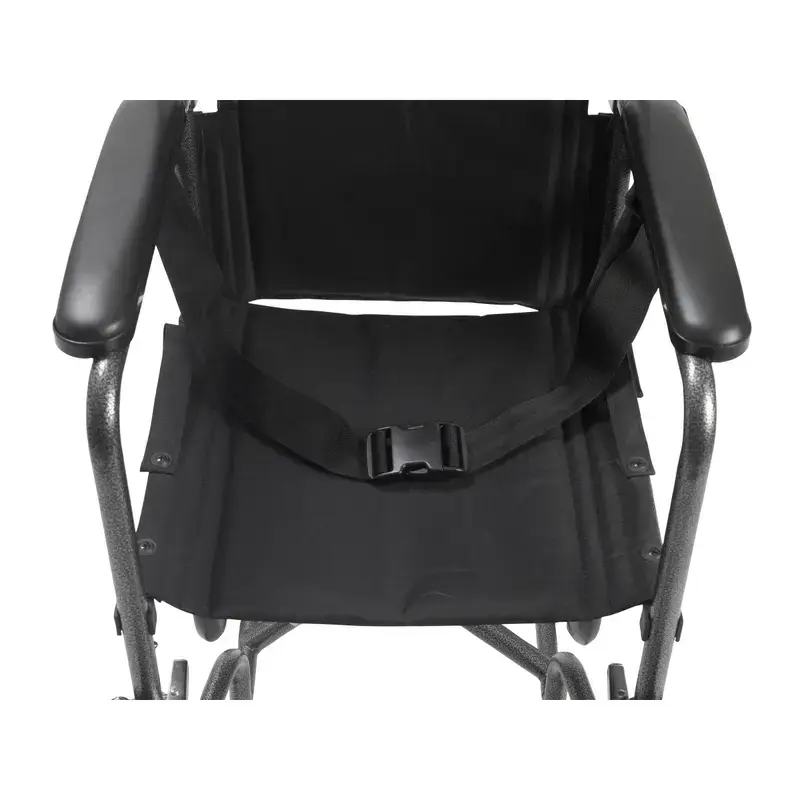
and lists what that means: a complete frame, propulsion wheels, casters, brakes, a seat that is a sling or can take a cushion or seating system, a back that is a sling or can take a back cushion or system, standard leg and footrests, armrests, and safety accessories other than those billed separately. The allowance for every adult manual chair includes:
- Seat width of 15 to 19 inches.
- Seat depth of 15 to 19 inches.
- Arm style, as the article says:
"Fixed, swingaway, or detachable; fixed height"
. - Footrests, as the article says:
"Fixed, swingaway, or detachable"
.
Codes K0003 to K0008 and E1161 "include any seat height". The article also says manual bases K0001 to K0009 "include construction of any type material, including but not limited to, titanium, carbon, or any other lightweight high strength material"
, and that billing code K0108 on top for materials or a "heavy duty package" is "incorrect coding – unbundling."
In our reading, features outside the 15 to 19 inch seat allowance, such as a wider seat, are options; A52497 says options and accessories other than tilt are billed with "appropriate codes for wheelchair options and accessories"
; our wheelchair accessories guide covers that side.
Payment for a wheelchair code also covers set-up. A52497 says reimbursement "includes all labor charges involved in the assembly of the wheelchair"
and support services "such as emergency services, delivery, set-up, education, and on-going assistance with use of the wheelchair."
In our reading, a Medicare supplier should not bill you separately for assembling a chair it supplied under one of these codes.
How much does a wheelchair cost? Seller prices by category
How much does a wheelchair cost? Mobility Atlas read 8 manual wheelchair category pages at two US sellers on 9 November 2026 and computed each range over every price on the first results page. At 1800wheelchair, standard weight chairs ran from $215 to $799.99, lightweight chairs from $425 to $4,353, transport chairs from $139.98 to $889 and heavy-duty chairs from $222 to $3,499. Rigid ultralight chairs ran from $1,564 to $4,833 after we removed an electric device and a power add-on. At SpinLife, standard lightweight chairs ran from $168 to $1,756 and transport chairs from $121 to $783. On the pages we read, most standard-weight and transport chairs cost a few hundred dollars (11 of 20 standard-weight lines were under $300), while every rigid ultralight chair cost $1,564 or more. Prices differ by seller, country, options and funding, and Medicare pays set amounts instead.
| Category as named | Seller (US) | Lines | Range as printed | Median |
|---|---|---|---|---|
| Standard weight | 1800wheelchair | 20 | $215 to $799.99 | $263 |
| Lightweight | 1800wheelchair | 19 | $425 to $4,353 | $760 |
| Rigid ultralight | 1800wheelchair | 9 | $1,564 to $4,833 | $2,760.84 |
| Heavy duty | 1800wheelchair | 20 | $222 to $3,499 | $559 |
| Transport | 1800wheelchair | 20 | $139.98 to $889 | $261.50 |
| Standard lightweight | SpinLife | 15 | $168 to $1,756 | $549 |
| Heavy duty | SpinLife | 13 | $218 to $4,192 | $536 |
| Transport | SpinLife | 15 | $121 to $783 | $352 |
The prices are as printed on each tile, with no label beside them; SpinLife prints a monthly financing line ("As low as") under each price, which we did not use. Exclusions: on 1800wheelchair's lightweight page the "EZRide+ Lightweight Electric Mobility Device"
($1,099), and on its rigid ultralight page the same device and the "SmartDrive MX2+" power add-on ($6,675). Sold-out lines were kept. The pages hold more products than the first page shows: 1800wheelchair's standard page says "28 Result(s)" and showed 20; SpinLife's standard lightweight page says 24 items and showed 15.
What sits behind the cheapest and dearest lines
The extremes are rarely the chair a person needs. The cheapest standard-weight line at 1800wheelchair was the Excel 2000 Manual Wheelchair at $215; the dearest was the FLUX Slim-Line Daily Living Wheelchair at $799.99, described on its tile with "Full reclining capability with tilt tension"
. The same page placed the Featherweight 13.5 lbs chair ($569) in its standard weight category, although its tile calls it the "World's lightest wheelchair"
. In our reading, seller categories are shop shelves, not Medicare classes.
The cheapest transport line was the Pro Heal 19" Astra Steel Transport Chair at $139.98; the dearest was the Strongback Excursion Transport Chair at $889. At SpinLife the cheapest transport line was the Drive Wrangler II at $121. The dearest rigid ultralight line at 1800wheelchair was the TiLite ZR Series 2 at $4,833, and the TiLite 2GX folding chair was $4,353 on the lightweight page. Of the 20 standard-weight lines, 11 were under $300; of the 9 rigid ultralight lines kept, all 9 were $1,000 or more.
| Same model name, two sellers (configurations may differ) | 1800wheelchair | SpinLife |
|---|---|---|
| Drive Silver Sport 2 | $232 | $207 |
| Invacare Tracer EX2 | $364 | $315 |
| Invacare 9000 XT | $649 | $649 |
| Invacare Tracer IV | $582 (standard) | $450 |
When you compare, check what each price includes: seat width, legrests or elevating legrests, armrest type, a cushion, delivery and assembly. 1800wheelchair's tiles each print a no-charge shipping line; the SpinLife tile text we saved prints no shipping line, so ask SpinLife for delivery terms. Neither seller's price includes a fitting or a seating assessment. Ask us to find a specific model and configuration if you want a quote on the same terms.
Options that change the price
A52497 says options and accessories other than tilt are billed "by selecting the correct code for the wheelchair base and then using appropriate codes for wheelchair options and accessories."
In shops the same split shows up as versions and add-ons. Drive's Silver Sport 2 page lists each seat size with a choice of "Swing Away Footrest" or "Swing Away Elevating Legrest"
and of "Detachable Desk Arm" or "Detachable Full Arm", plus a fixed arm on the 18 inch chair. The Cruiser III adds "Flip-back, Detachable, Adj. Height"
desk and full arms.
Seller tiles name more options. On 1800wheelchair's pages the Featherweight tile lists "(Optional) Pop-off wheels for storage", the ProHeal Chariot III tile lists "Elevating leg rests with pneumatic piston"
, the Karman Ergo Flight tile lists "Optional quick-release wheels"
, and the Invacare Tracer IV tile says its "Reinforced frame includes gusseted side frame, caster journals, and dual crossbraces"
. The seller's lightweight page says "Custom options include the wheelchair's seat size, color, upholstery, armrests pads, foot & leg rests, wheels, tires, and casters."
Tires are an option people rarely think about. Drive's page says the Silver Sport 2 has "Polyurethane tires mounted on composite wheels"
, and its manual says "Solid rubber tires need minimal maintenance, but should be cleaned occasionally with a damp cloth."
The page says polyurethane and the manual says solid rubber; ask Drive or the seller which tire ships. Air-filled tires roll and absorb bumps differently and need pumping; our wheelchair wheels guide and tire and caster care guide cover the trade-off.
In our view, write the full configuration next to every price you compare: seat width and depth, front rigging, arm type, wheels and tires, and whether a cushion is included. Two quotes for the same chair are only comparable when those lines match. A cushion is a clinical item as much as a comfort item; our wheelchair cushion guide explains the types, and the choice for pressure care belongs to the therapist.
What Medicare pays: the October 2026 fee schedule
CMS publishes the amounts it uses for each code in the DMEPOS fee schedule. The file "October 2026 DMEPOS Fee Schedule"
(DME26-D) prints, for each code and modifier, two columns per state headed NR and R. In our reading, NR is the non-rural and R the rural amount, RR, NU and UE mark the rental, new purchase and used purchase rows, and the RR amounts are monthly rental amounts. The ranges below are the lowest and highest figures across the columns for the 48 contiguous states and the District of Columbia (49 in all); Alaska, Hawaii, Puerto Rico and the Virgin Islands are printed separately as "Non-continental areas".
| Code (rental row, RR) | NR column (RR row) | R column (RR row) |
|---|---|---|
| K0001 Standard | $25.23 to $31.07 | $48.77 to $53.64 |
| K0002 Hemi | $38.93 to $54.14 | $76.63 to $85.38 |
| K0003 Lightweight | $36.91 to $46.99 | $77.78 to $87.36 |
| K0004 High strength lightweight | $48.55 to $57.95 | $109.91 to $124.20 |
| K0006 Heavy duty | $68.77 to $85.68 | $118.97 to $132.37 |
| K0007 Extra heavy duty | $96.40 to $120.78 | $168.50 to $187.58 |
| E1038 Transport up to 300 lb | $16.27 to $19.04 | $22.72 |
| E1039 Transport over 300 lb | $38.51 to $43 | $46.55 |
The ultralight K0005 is paid differently. The October 2026 HCPCS file gives it pricing indicator 32, which the record layout says means "Inexpensive & routinely purchased DME"
, while K0001 to K0004, K0006, K0007, K0009 and the transport codes carry 36, "Capped rental DME". The fee schedule prints a K0005 new purchase amount of $2,590.67 to $2,634.76, a used purchase amount of $1,943.03 to $1,976.01 and a rental amount of $259.07 to $263.45, with 0.00 in the rural columns. By our division, the used amount is 75.0 percent of the new amount in the highest column.
These are Medicare's allowed amounts, not shop prices. After the Part B deductible you usually pay 20 percent of the Medicare-approved amount, if the supplier accepts assignment. Medicare.gov says "Some items become your property after you’ve made a certain number of rental payments"
; our wheelchair rental guide explains the capped rental months and when the chair becomes yours.
Does Medicare cover a manual wheelchair? The general rule in full
Does Medicare pay for a manual wheelchair? Mobility Atlas read Medicare's coverage rule for manual wheelchair bases (LCD L33788, revision effective 1 October 2026) and its policy article, and Part B covers one for use in the home when five criteria are all met and one of two more is met. The person has a mobility limitation that significantly impairs daily activities at home such as toileting, dressing and bathing; a cane or walker cannot resolve it; the home has room and surfaces for the chair; the chair will significantly improve those activities and be used regularly at home; and the person has not said they are unwilling to use it. Then either they can safely push it themselves during a typical day, or a caregiver is available, willing and able to help. Medicare.gov says that after the Part B deductible "you pay 20% of the Medicare-approved amount (if your supplier accepts assignment)."
A chair used only outside the home is denied.
The rule text itself says: "A manual wheelchair for use inside the home (E1037, E1038, E1039, E1161, K0001, K0002, K0003, K0004, K0005, K0006, K0007, K0008, K0009) is covered if: Criteria A, B, C, D, and E are met; and Criterion F or G is met."
The letters are printed by the web page as list markers and did not come through in our text copy; A52497 confirms that the home check is "Criterion C". The criteria, in the LCD's words and in the printed order, so lettered A to G in sequence (which fits A52497's reference to criterion C):
- A. The rule reads:
"The beneficiary has a mobility limitation that significantly impairs his/her ability to participate in one or more mobility-related activities of daily living (MRADLs) such as toileting, feeding, dressing, grooming, and bathing in customary locations in the home."
The rule says a limitation is one that prevents the activity entirely, places the person at"reasonably determined heightened risk of morbidity or mortality"
, or prevents completing it"within a reasonable time frame."
- B. The rule reads:
"The beneficiary’s mobility limitation cannot be sufficiently resolved by the use of an appropriately fitted cane or walker."
- C. The rule reads:
"The beneficiary’s home provides adequate access between rooms, maneuvering space, and surfaces for use of the manual wheelchair that is provided."
- D. The rule reads:
"Use of a manual wheelchair will significantly improve the beneficiary’s ability to participate in MRADLs and the beneficiary will use it on a regular basis in the home."
- E. The rule reads:
"The beneficiary has not expressed an unwillingness to use the manual wheelchair that is provided in the home."
- F. The rule reads:
"The beneficiary has sufficient upper extremity function and other physical and mental capabilities needed to safely self-propel the manual wheelchair that is provided in the home during a typical day."
- G. The rule reads:
"The beneficiary has a caregiver who is available, willing, and able to provide assistance with the wheelchair."
The LCD adds that for criterion F "Limitations of strength, endurance, range of motion, or coordination, presence of pain, or deformity or absence of one or both upper extremities are relevant to the assessment of upper extremity function."
And: "If the manual wheelchair base is not covered, then related accessories will be denied as not reasonable and necessary."
The extra test for each class, side by side
On top of the general criteria, L33788 says "the specific criteria below must be met for each manual wheelchair. If the specific criteria are not met, the manual wheelchair will be denied as not reasonable and necessary."
The standard K0001 chair has no extra test. In short, by class:
| Code | Extra test in L33788 (summary) |
|---|---|
| K0002 | Lower seat (17 to 18 in) for short stature or foot propulsion |
| K0003 | Cannot self-propel a standard chair; can and does a lightweight |
| K0004 | Frequent home activities, or a size others lack plus 2 h/day |
| K0005 | Full time or individual fitting; LCMP evaluation; RTS with ATP |
| K0006 | Weighs over 250 lb, or severe spasticity |
| K0007 | Weighs over 300 lb |
| K0008 | No standard base plus seating can meet the need |
| E1161 | LCMP evaluation; RTS with ATP |
| E1037 to E1039 | Instead of K0001; criteria A to E and G |
In our reading, the step from K0004 to K0005 is where most paperwork effort goes. A52497 says that if records are requested for a K0005 chair they must include "a description of the beneficiary’s routine activities"
, whether the person "is fully independent in the use of the wheelchair"
, and the "features of the K0005 base which are needed compared to the K0004 base."
It also says the professional who does the specialty evaluation "may have no financial relationship with the supplier"
, with one exception for hospital-owned suppliers.
The paperwork: orders, home assessment and modifiers
L33788 says "A Standard Written Order (SWO) must be communicated to the supplier before a claim is submitted."
For items on the face-to-face and written-order-prior-to-delivery list, A52497 says "If a supplier delivers an item prior to receipt of a WOPD, it will be denied as not reasonable and necessary"
and payment will not be made "even if a WOPD is subsequently obtained by the supplier."
Ask the supplier whether your code is on that list before delivery is booked.
The home assessment is the supplier's job. A52497 says it "may be done directly by visiting the beneficiary’s home or indirectly based upon information provided by the beneficiary or their designee"
, and that "the physical layout of the home, surfaces to be traversed, and obstacles to the use of the selected manual wheelchair must be addressed by and documented in the home assessment."
In our view, measure your narrowest doorway, the turn into the bathroom and any thresholds before the supplier asks, and write them down.
Modifiers tell Medicare what the supplier expects. A52497 says the supplier appends KX "only if all of the coverage criteria"
are met; GA or GZ when a denial is expected (GA if the person signed an Advance Beneficiary Notice of Non-coverage, GZ if not); and GY "If the manual wheelchair [...] is only to be used for mobility outside the home"
. In our reading, if a supplier asks you to sign an ABN, they expect Medicare may refuse and you may owe the cost, so ask why before signing.
The article also says: "If the manual wheelchair is only for use outside the home, it will be denied as noncovered, no benefit, as the DME benefit requires use within the home for coverage eligibility."
That matters for people who walk at home but need a chair for distance. Ask about other routes in that case, such as buying outright, a loan program or a used chair; see our used wheelchair guide.
One chair at a time, backups, repairs and assignment
L33788 says: "Payment is made for only one wheelchair at a time. Backup chairs are denied as not reasonable and necessary. One month's rental for a standard manual wheelchair (K0001) is covered if a beneficiary-owned wheelchair is being repaired."
In our view, a person who owns their chair and needs it repaired should ask the supplier about that loaner month before the chair goes into the shop.
Medicare.gov says to make sure "your doctors and DME suppliers are enrolled in Medicare and will accept assignment"
, because "Medicare will only pay for DME items if you get them from suppliers who are enrolled in Medicare."
It warns that "For rented DME, make sure the supplier is willing to accept assignment for all rental months, otherwise you’ll have to pay the full cost of your DME upfront."
The page adds that Medicare then pays you later for the amount it covers. A supplier that participates in Medicare must accept assignment, the page says, meaning "they can charge you only the coinsurance and Part B deductible for the Medicare-approved amount"
.
We hold no saved pages for Medicare Advantage, Medicaid or private insurers, so ask the plan before the chair is ordered. For repairs to a chair you own, our manual wheelchair repair guide covers parts, shops and what Medicare pays.
Sizing basics: seat width, depth and height
Medicare's allowance includes seat widths and depths of 15 to 19 inches, and on 1800wheelchair's standard weight page, 13 of 20 tiles print a seat width range of 16 to 20 inches (SpinLife's tiles print no widths). Drive's page lists the Silver Sport 2 in 16, 18 and 20 inch seat sizes with a 16 inch back height. A wider seat is not a more comfortable seat by default: in our view, too wide a seat moves the wheels away from the hands and makes the chair wider than it needs to be in doorways.
Seat height matters for two reasons: transfers and foot propulsion. L33788 names 17 to 18 inches for a hemi chair. Drive's pages for both chairs print a seat-to-floor height of 17.5 to 19.5 inches. A cushion adds height on top of the seat rail. Drive's manual says that when adjusting footrests the "user should be sitting in wheelchair with feet on the foot plates"
and that the "Footrest should not be lower than 2-1/2” from the ground to ensure clearance."
Measuring at home is a good start, not a fitting. Our guide to measuring yourself for a wheelchair explains the five measurements, and how to choose your first active wheelchair explains which settings to keep adjustable. For Medicare K0005 and E1161 chairs, the rule itself requires a specialty evaluation; for every class, a physical therapist or occupational therapist should check the final fit with the cushion you will use.
Safety lines from the manuals
The two Drive owner's manuals we read (Silver Sport 2 manual Rev. 2.03.02.14, © 2014; Cruiser III manual © 2006) print the same safety section; confirm current terms with Drive. The Silver Sport 2 manual says to "Engage both wheel locks before getting in or out of chair, leaning forward in chair, or while in an elevator or wheelchair lift"
, and that the "Wheelchair should be on a smooth, stable and level area with wheel locks engaged before transferring user in or out of wheelchair."
It also says "When getting in or out of wheelchair, do not stand on or apply weight to foot rests."
On slopes the manuals give two different figures. The caution text says "Assistance is recommended when going up or down inclines greater than 10 o"
, printed as "10 o" in the Silver Sport 2 text and "10o" in the Cruiser III text (in our reading, a degree sign). The warning list in the Silver Sport 2 manual says "Do not attempt to operate on inclines 10% or greater without proper assistance."
In our reading, a 10 percent slope is gentler than a 10 degree slope. In our view, plan on the stricter figure, 10 percent, until Drive confirms in writing which is meant. The manual adds: "DO NOT use wheel locks to slow your descent down an incline."
The Silver Sport 2 manual also says: "This wheelchair has not been approved as a seat that can be used within vehicles of any kind. Always transfer wheelchair user to a vehicle manufacturers approved seat and use safety restraints available."
And: "Do not operate this wheelchair on roadways, streets or any surfaces with vehicular traffic."
For care, it says "Large rear wheels should be inspected at least once a month to ensure proper tightness"
, and to "Wipe chrome parts with a clean, soft cloth at least once a week."
These intervals are printed in the Drive manuals; other makers' manuals may print others.
Warranty: what the documents print
Medicare's definitions make the frame warranty part of the class. The A52497 article says the classes need a "Lifetime Warranty on side frames and crossbraces"
for K0004 and K0005, for custom K0008 bases and for E1161 tilt chairs. It sets no warranty for K0001, K0002, K0003, K0006 or K0007.
Drive's two manuals (Silver Sport 2 manual Rev. 2.03.02.14, © 2014; Cruiser III manual © 2006) show the range among basic chairs; confirm current terms with Drive. The Silver Sport 2 manual says the chair "is warrantied to be free of defects in materials and workmanship for three years from the date of purchase for the original consumer purchaser."
The Cruiser III manual says it "is warranted to be free of defects in materials and workmanship for the lifetime of the original consumer purchaser"
and that "In the event of a defect covered by this warranty, we will, at our option, repair or replace the device."
Both say the warranty "does not cover device failure due to owner misuse or negligence, or normal wear and tear"
, and that it does not extend to "non-durable components, such as rubber accessories, casters, and grips"
. Both name "the original consumer purchaser"
, so in our reading the terms do not pass to a second owner.
The lightweight wheelchair guide explains what to ask when a K4 or ultralight chair comes with a short frame warranty.
FDA classification and the recall file
In US law a manual wheelchair is a medical device. 21 CFR 890.3850 says "A mechanical wheelchair is a manually operated device with wheels that is intended for medical purposes to provide mobility to persons restricted to a sitting position"
, and classifies it as "Class I (general controls)."
The FDA's product code for it is IOR.
We searched the openFDA device recall records for product code IOR with recalls initiated from 1 January 2021 to 9 November 2026 (data last updated 5 November 2026) and found one record. It is Z-0264-2022, initiated 24 September 2021 by TiSport, LLC, for "Permobil TiLite, Models: Aero Z, and ZRA"
, status "Open, Classified", with a product quantity of 5,373. The record covers chairs "Manufactured between January 19, 2017 and June 14, 2021"
in a stated serial range, and says "Some affected wheelchairs can no longer be used as a passenger seat until transit tie downs are replaced with redesigned transit tie downs, verified, and released to the market."
The record says some chairs "with transit tie downs, that are used as a passenger seat in a motor vehicle may not be configured in the right orientation to perform as intended if involved in a motor vehicle accident."
One record in this search is a count of recall records, not a measure of how safe manual wheelchairs are; recalls filed under other product codes, or without a code, are not in it. For the FDA's adverse-event reports on light manual chairs (a different and much larger record), see the lightweight wheelchair guide. In our view, before buying any used chair, look up its model in the FDA recall database and ask the maker whether the serial number had the fix.
Veterans: what the VA rule says
For US veterans, wheelchairs come under 38 CFR 17.3200 to 17.3250, headed "Prosthetic and Rehabilitative Items and Services"
; 17.3210 says "Mobility aids include but are not limited to manual and motorized wheelchairs"
. 38 CFR 17.3220 says a veteran is eligible if they are enrolled in VA health care (or exempt from enrolling) and "otherwise receiving care or services under chapter 17 of title 38 U.S.C."
, and that if a VA provider or "an eligible entity or provider as defined in § 17.4005"
"prescribes an item or service for the veteran, the veteran is considered to otherwise be receiving care or services"
.
38 CFR 17.3230 lists "Mobility aids" among the items VA will provide "if VA determines that such items and services are needed"
, "serve as a direct and active component of the veteran's medical treatment and rehabilitation, and do not solely support the comfort or convenience of the veteran"
. The same section covers repairs and replacements, "Training with and fitting of prescribed items"
, and says "VA will generally provide only one item"
, with spares allowed "based on a clinical determination of need"
. Items "become the property of the veteran once the veteran takes possession of those items"
unless VA loans them. Ask the prosthetics service at your VA medical center how they apply this to a manual chair.
England: NHS wheelchair services and personal wheelchair budgets
In England, wheelchairs are provided through local NHS wheelchair services commissioned by integrated care boards (ICBs), each with its own eligibility criteria. NHS England says that "Since 2 December 2019, people who access wheelchair services, whose posture and mobility needs impact their wider health and social care needs, have a legal right to a personal wheelchair budget."
The right covers people referred or registered who meet local criteria "when they require a new wheelchair"
.
NHS England's FAQ says the amount "will be based upon what it would cost the NHS to meet the person’s assessed postural and mobility needs"
through the local service, and that people can add their own money. It describes a notional budget (the service buys the chair, formerly a "partnership voucher"), a third party budget where "An independent provider receives the personal budget via invoicing the NHS"
(formerly an "independent voucher"), a traditional third party budget, and direct payments, which "are currently not routinely available"
for a standalone wheelchair budget.
Three details matter before choosing, and the FAQ page says each one. The budget "is for equipment only" and does not pay for the assessment. A third party budget or direct payment "should include a contribution towards the repair and maintenance costs"
, while with a notional budget repairs come through the NHS service. And the responsible clinician must agree the chosen chair is "the correct specification to meet someone’s assessed clinical needs."
These rules apply in England; elsewhere in the UK, ask your local service.
Where to buy a manual wheelchair
There are five main routes, and they suit different needs. A Medicare-enrolled supplier that accepts assignment is the route for Medicare coverage in the US; for K0005 and E1161 it must be a Rehabilitative Technology Supplier employing a RESNA-certified ATP, whose ATP is directly involved, in person, in choosing the chair. Online sellers such as the two we read sell basic and active chairs for cash, with prices printed. Local medical supply shops are another route. The VA provides chairs to eligible veterans, and in England the NHS wheelchair service assesses and provides, with a personal wheelchair budget as an option.
Short-term needs are often better met by renting or borrowing; see our wheelchair rental guide. Second-hand chairs and reuse programs are covered in the used wheelchair guide. If the chair may later get a power add-on, check frame compatibility first; our guide to power add-ons explains why.
In our view, the cheapest route is the one that ends with a chair that fits and gets serviced. A basic chair bought online without a fitting can be right for occasional use and wrong for all-day use. Mobility Atlas can help you request a quote for a named model and size from a supplier, with the configuration written down.
Three traps
Trap one: buying by category name. Seller categories are not Medicare classes: 1800wheelchair's standard weight page included a 13.5 lb chair, and its heavy-duty page included a chair rated "300 lbs., 350 lbs." Read the chair's own weight, capacity and seat height, and ask which code a Medicare supplier will bill.
Trap two: reading capacity for the wrong size. The Silver Sport 2 manual rates the 16 inch chair at 250 pounds and the 20 inch at 350. A52497 says capacity is the person "plus all accessories". Plan on the capacity printed for your exact seat width. In our view, count bags as well as accessories.
Trap three: a chair used only outside the home. Medicare's policy article says such a chair "will be denied as noncovered"
. Tell the supplier and the prescriber how and where the chair will be used, and if it is mainly for outings, compare buying, renting and loan programs before you sign anything.
Three composite scenarios
These are composite scenarios, not individual customers. Each uses only the documents for one chair.
Scenario one: a person who walks short distances at home wants a basic folding chair to be pushed by family on outings and to push themselves now and then. Drive's Silver Sport 2 page lists 16, 18 and 20 inch seats, a dual axle from 19.5 to 17.5 inches and a "Limited 3 Years" warranty; the manual rates the 18 inch chair at 300 pounds. 1800wheelchair listed it at $232 and SpinLife at $207 on 9 November 2026. In our reading, if the chair is only for outings, the A52497 article says it is "denied as noncovered"; if it will also be used at home, they ask the prescriber whether L33788's criteria are met. Otherwise they compare the two cash prices and ask about delivery and assembly.
Scenario two: a person who pushes themselves at home and finds a standard chair too heavy is told a lightweight chair may suit. Drive codes its Cruiser III as K0003, lists 35, 36 and 38 lb versions and capacities of 300 and 350 lb, and prints a lifetime limited warranty for the original purchaser. They ask the supplier for the weight of their exact version without footrests, because K0003 is defined as 34 to 36 lbs, and ask whether their records show they cannot self-propel a standard chair but can a lightweight one, as L33788 requires.
Scenario three: a full-time user is offered a used TiLite Aero Z. 1800wheelchair listed the Aero Z new at $4,695, with "Weight Capacity 265 lbs." and "Product Weight 12.4 lbs." The FDA recall record Z-0264-2022 names the Aero Z and ZRA, made between January 2017 and June 2021, for transit tie-downs used when the chair is a vehicle seat. They give the seller's serial number to the maker's quality contact in the record, ask whether the correction was done, and do not use the chair as a vehicle seat until it is confirmed.
What to ask the therapist and the supplier
The physician, physical therapist or occupational therapist
- Which class do my needs fit, and what in my records shows it?
- Do I meet the extra test for that class in L33788, and will you write it down?
- What seat width, depth and height do I need with my cushion?
- For K0005 or tilt: can you do the specialty evaluation, and do you have any financial tie to the supplier?
The supplier or seller
- Are you enrolled in Medicare, and will you accept assignment for every rental month?
- Which HCPCS code will you bill, and is the chair's weight without footrests inside that code's range?
- Do you need a written order before delivery for this code?
- What is the weight capacity for my seat width, and what is the frame warranty in writing?
- Is assembly, delivery and adjustment included, and who services the chair later?
- Will you ask me to sign an Advance Beneficiary Notice, and why?
Sources and documents
Government: CMS policy article A52497 and LCD L33788, Manual Wheelchair Bases (both revision effective 1 October 2026, read 9 November 2026); the October 2026 DMEPOS fee schedule file DME26-D and the October 2026 Alpha-Numeric HCPCS file with its record layout (read 9 November 2026); Medicare.gov's wheelchairs and scooters page (read 9 November 2026); eCFR 21 CFR 890.3850 and 38 CFR 17.3200 to 17.3250, including 17.3210, 17.3220 and 17.3230 (read 9 November 2026); the openFDA device recall API for product code IOR (read 9 November 2026); NHS England's personal wheelchair budgets page and FAQ (read 9 November 2026). Makers: Drive Medical's Silver Sport 2 and Cruiser III pages and owner's manuals (read 9 November 2026). Sellers: 1800wheelchair and SpinLife category pages, US (read 9 November 2026).
Related guides on Mobility Atlas: Lightweight, transport and travel wheelchairs; Your first active wheelchair; Rigid vs folding frame; Measuring yourself; Wheelchair rental; Used wheelchairs; Pediatric wheelchairs.
Method in brief: how we checked. We copied each page and file as text on the date above and took every rule, figure and quote from those copies; quotes are checked by script against the saved texts. Price ranges are computed by script over every price line on each category's first results page (131 lines kept of 134, three excluded as named above). Fee ranges are computed over the columns for the 48 contiguous states and the District of Columbia (49 in all) in the CMS file. We did not test any chair.
Prices checked November 2026 on 1800wheelchair and SpinLife; prices change, so confirm them with the seller. Documents checked November 2026: the CMS article, rule, fee schedule and code files, Medicare.gov, eCFR, openFDA, NHS England and Drive's pages and manuals.
Want a quote for a specific chair and size, or help finding a supplier? Ask us to find it through the enquiry form, with the model, seat width and how the chair will be used.
This article is general information. Rules and prices differ by country and change, so confirm them before you buy or travel.
Common questions
What is the difference between a standard and a lightweight wheelchair?
In Medicare's definitions (A52497), a standard wheelchair (K0001) weighs more than 36 lbs without footrests, has a seat height of 19 inches or more and carries up to 250 pounds. A lightweight wheelchair (K0003) weighs 34 to 36 lbs, any seat height. Lighter classes are K0004 (under 34 lbs) and K0005 (under 30 lbs). Medicare covers a K0003 only if the person cannot self-propel a standard chair at home but can and does self-propel a lightweight one.
How much does a manual wheelchair cost?
On 9 November 2026, 1800wheelchair (US) listed standard weight chairs from $215 to $799.99 and transport chairs from $139.98 to $889 on the first results pages; rigid ultralight chairs ran from $1,564 to $4,833 (two powered items excluded). SpinLife listed standard lightweight chairs from $168 to $1,756. Prices differ by seller, country, options and funding; Medicare pays its own fee schedule amounts.
Does Medicare pay for a manual wheelchair?
It can, under Part B, when the chair is for use in the home and the criteria in LCD L33788 are met: a mobility limitation at home that a cane or walker cannot resolve, a home the chair fits, regular use, willingness to use it, and either the ability to push it safely or a caregiver. After the Part B deductible you usually pay 20 percent, if the supplier accepts assignment. A chair only for use outside the home is denied.
Will Medicare pay for an ultralight wheelchair?
L33788 covers a K0005 chair for a full-time manual wheelchair user, or one who needs individual fitting a K0001 to K0004 chair cannot give, and only with a specialty evaluation by a trained PT, OT or physician with no financial tie to the supplier, and a supplier employing a RESNA-certified ATP, whose ATP is directly involved, in person, in choosing the chair. The October 2026 fee schedule prints a new purchase amount of $2,590.67 to $2,634.76 in the contiguous-state columns.
Can I get a wheelchair from the VA or the NHS?
In the US, 38 CFR 17.3230 lists mobility aids among items VA provides to eligible veterans when VA finds them needed for treatment and rehabilitation; ask your VA prosthetics service. In England, local NHS wheelchair services assess and provide chairs, and since 2 December 2019, people who access NHS wheelchair services, whose posture and mobility needs impact their wider health and social care needs, have a legal right to a personal wheelchair budget when they meet local criteria and need a new chair (England). It can be used inside or outside NHS services.
What is a hemi wheelchair?
A hemi wheelchair has a lower seat. Medicare codes it K0002: over 36 lbs, seat height under 19 inches, capacity up to 250 pounds. L33788 covers it when the person needs a seat of 17 to 18 inches because of short stature or to put their feet on the ground to push. On 1800wheelchair's standard weight page, 9 of the 20 tiles, including Drive's Silver Sport 2, mention a dual axle or dual height axles.
Sources
- CMS: Manual Wheelchair Bases, Policy Article A52497 (revision effective 1 October 2026, read 9 November 2026)
- CMS: LCD L33788 Manual Wheelchair Bases (revision effective 1 October 2026, read 9 November 2026)
- CMS: DME26-D, October 2026 DMEPOS Fee Schedule
- CMS: HCPCS Quarterly Update, October 2026 Alpha-Numeric HCPCS File
- Medicare.gov: Wheelchairs and scooters
- eCFR: 21 CFR 890.3850 Mechanical wheelchair
- eCFR: 38 CFR 17.3200-17.3250 Prosthetic and Rehabilitative Items and Services (read 9 November 2026)
- eCFR: 38 CFR 17.3220 Eligibility
- eCFR: 38 CFR 17.3230 Authorized items and services
- openFDA: device recalls, product code IOR, 2021 to 2026
- NHS England: Personal wheelchair budgets
- NHS England: Personal wheelchair budgets, frequently asked questions
- Drive Medical: Silver Sport 2 Wheelchair (page and owner's manual)
- Drive Medical: Cruiser III Wheelchair (page and owner's manual)
- 1800wheelchair: Standard Weight Wheelchairs
- 1800wheelchair: Lightweight Wheelchairs
- 1800wheelchair: Rigid Ultra Lightweight Wheelchairs
- 1800wheelchair: Heavy-Duty Wheelchairs
- 1800wheelchair: Transport Chairs
- SpinLife: Standard Lightweight wheelchairs
- SpinLife: Heavy Duty wheelchairs
- SpinLife: Transport wheelchairs
Read on . The wording of the article is our own.