Sport & Outdoors · 8 min read
Getting started in wheelchair tennis
You need a racket, a court and a chair you can borrow. Here is how the game works, what a tennis chair does, and how to find a first session.
What you need to begin
To try wheelchair tennis you need a court, a racket, a ball and a chair to sit in. You do not need to own a sports chair, and you do not need to be a full-time wheelchair user. Britain's tennis federation, the LTA, says many players are ambulant, meaning they walk in daily life, and treat the sports chair as one more piece of equipment. The International Paralympic Committee adds that anyone, disabled or not, can play for recreation. Formal classification only matters when you enter sanctioned competition.
So the first decision is small: find a session, borrow a chair, and see whether you like it. The bigger decisions, such as which chair to buy and how to set it up, can wait until you have hit a few hundred balls.
How the game works
Wheelchair tennis uses the same court, the same net height, the same rackets and the same balls as any other tennis. That is one of its strengths. You can play on any public court, and you can play against or alongside friends who play on foot.
There is one main rule change. The ball may bounce twice before you hit it. The first bounce must land in the court. The second may land outside it. You can still hit after one bounce, or before any bounce, if you get there in time.
The chair counts as part of your body. That means a ball that hits your chair is treated as if it hit you, and at the serve your wheels must not cross the baseline, in the same way that a standing player's feet must not.
Who plays in which division
At competition level there are men's, women's and quad events. The International Paralympic Committee describes the open class as for athletes with a permanent physical disability affecting one or both legs. The quad class is for athletes who also have an impairment in one or both arms. According to Wikipedia's summary of the sport, some quad players tape the racket to their hand, and some use a powered wheelchair.
If you want to compete later, classification is carried out under International Tennis Federation rules. For a first season, do not let it worry you. Tell the coach what you can and cannot do, and they will adapt the session.
How big is the sport
Wheelchair tennis began in 1976 and has been a full Paralympic sport since Barcelona 1992. It is played at all four Grand Slam tournaments. The International Tennis Federation's professional tour lists more than 160 tournaments in 40 countries, and the International Paralympic Committee says the sport is practised in over 100 countries. There is a good chance that someone is playing within reach of you.
What makes a tennis chair different
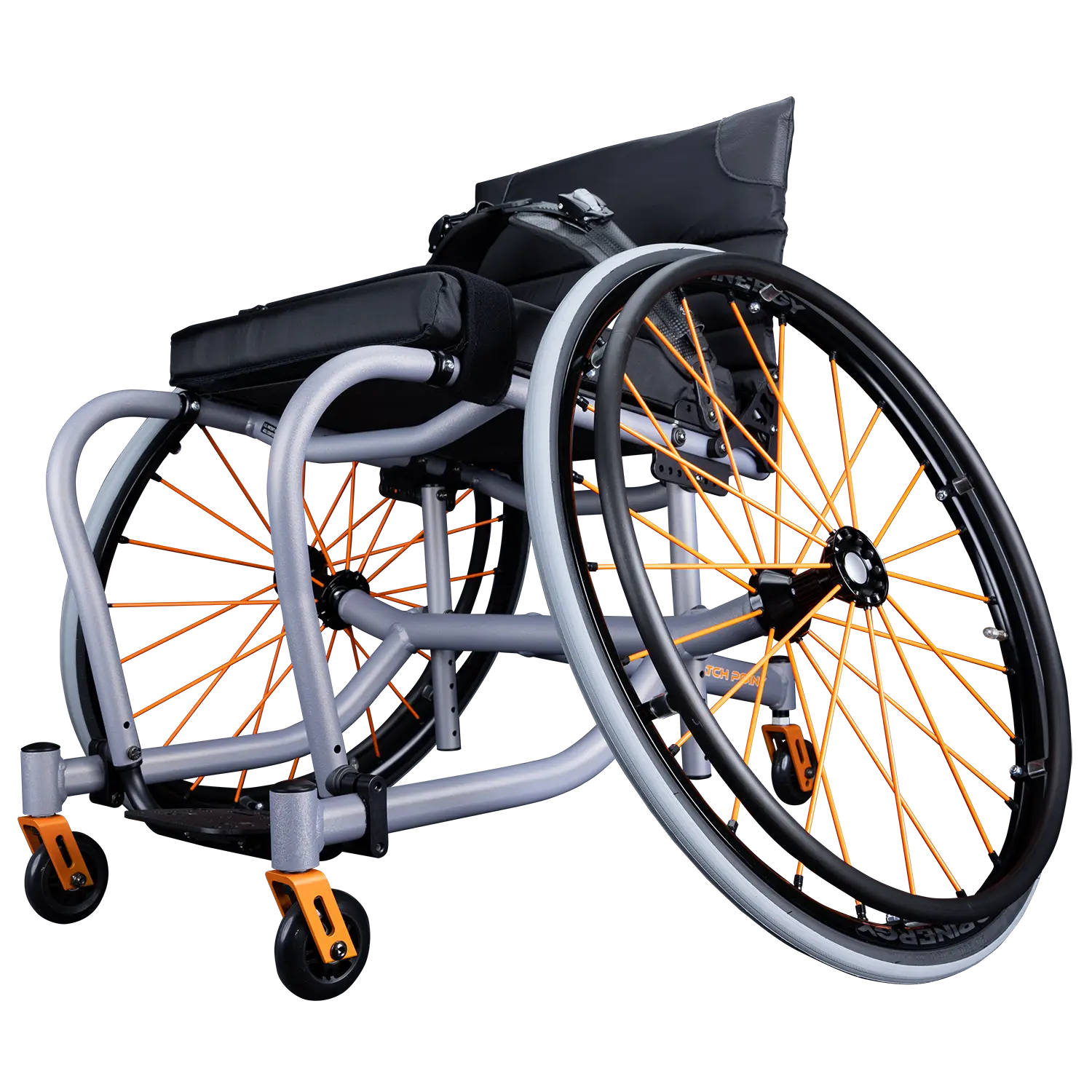
A tennis chair is built to do three things a day chair does badly: turn on the spot, stay upright when you reach, and hold you firmly while you swing. Sit in one and the differences are obvious.
- Camber. The main wheels lean inward at the top. This widens the base, makes the chair turn faster and keeps your hands clear of the frame. The RGK Match Point is offered with 16 or 20 degrees of camber. An everyday chair has far less.
- Anti-tip wheel at the back. When you lean back to serve or reach for a high ball, a small rear wheel stops the chair from going over. On the RGK GrandSlam you can choose a single or double anti-tip, fixed or removable.
- No brakes, no push handles, no armrests. Anything that can catch a racket or a hand is left off.
- Low, tight seating. You sit snug between the wheels, often with your knees higher than your hips, which helps you stay in the seat.
- Straps. Calf and toe straps come as standard on the GrandSlam, and a waist strap is an option. Straps let you put your body into the shot without sliding.
- Front casters set for stability. On the Match Point the casters sit farther apart than on other sports chairs, which the maker says helps when you lean forward or sideways.
Adjustable or made to measure
Tennis chairs come in two broad kinds, and the difference matters for a beginner.
| Adjustable chair | Made-to-measure chair | |
|---|---|---|
| Example in our catalog | RGK Match Point | RGK GrandSlam series |
| How it fits you | Seat position and centre of gravity can be changed. The Match Point has 3.5 inches of centre-of-gravity adjustment. | Built from your measurements. RGK takes over 30 of them. |
| Weight | 22.5 lb | 7.9 to 8.5 kg |
| Best for | New players still finding their position, and clubs that share chairs. | Players who know exactly how they sit. RGK describes the GrandSlam as for intermediate to professional players. |
There are also multi-sport court chairs, such as the Top End Pro-2 All Sport, which has a fixed 15 degree camber and is listed in our catalog at about USD 2,999 from a US retailer. A chair like this can serve for tennis and basketball while you decide which sport you prefer.
How you should sit is partly a sporting question and partly a health one. If you have reduced feeling, a history of pressure injuries or limited trunk control, ask your seating specialist or physiotherapist about cushioning and strapping before you spend long sessions in a sports chair.
Borrowing before buying
Do not buy a tennis chair before you have played. There are good reasons.
- You do not yet know your position. Seat height, seat angle and how far back the wheels sit all change how you move and hit. Players often change their minds in the first year.
- A made-to-measure chair is built to numbers. If the numbers are guesses, the chair will be wrong for a long time.
- You may find you prefer another sport, or doubles over singles, or playing once a month rather than three times a week.
Ask the club or programme whether it has chairs to lend at sessions. Many beginner programmes are set up with shared chairs for exactly this reason, but it varies from place to place, so ask before you travel. If the club has none, ask whether a nearby wheelchair basketball club or a disability sport charity lends court chairs.
What to check in a borrowed chair
- Seat width. You should fit snugly, with no more than a small gap at each hip.
- Footplate height. Your feet should rest fully and be strapped.
- Tyres. Pump them hard. Soft tyres make every push harder.
- Anti-tip wheel. Check that it is fitted and turns freely.
- Straps. Use them. They are there for control, and they keep you in the chair if it tips.
- Hands. Pushing with a racket in your hand feels odd at first. A coach will show you how.
When you are ready to buy
Keep notes on every chair you borrow: seat width, seat height front and back, camber, and what felt good or bad. Take these to a dealer who sells sports chairs. Useful questions:
- Can I try a demo chair on court before ordering?
- Which measurements can be changed after delivery, and which are fixed?
- What camber do you suggest for my level, and why?
- How long is the build time, and what is the warranty on the frame?
- Are spare wheels, tyres and casters easy to get?
- Is there a grant, club scheme or second-hand route I should know about?
Finding a club
Start with your national tennis federation. Search its website for wheelchair tennis or disability tennis. Many federations run entry-level programmes and list venues.
The LTA in Great Britain is a good example of what to look for. Its Open Court programme runs disability sessions at more than 600 clubs and venues. It runs a Wheelchair Tennis Initiative of one-day events for players aged 18 and under. It also publishes a map of wheelchair tennis sessions by region, with contact details for each venue. If your federation has no page like this, email it and ask who coordinates wheelchair tennis.
Other places to ask:
- Your rehabilitation centre or spinal unit. Staff often know local sports clubs.
- National disability sport organisations and wheelchair sport associations.
- Local tennis clubs. A coach who has never taught a wheelchair player can still teach you strokes, because the technique above the waist is the same.
Questions for the first phone call
- Do you have sports chairs to lend, and in what seat widths?
- Is the court surface hard? Hard courts are the easiest to push on.
- Is there step-free access, accessible parking and an accessible toilet?
- Is the session for beginners, and what does it cost?
- Should I bring a racket, or can I borrow one?
Bring water, gloves if you like them for pushing, and a day chair you can transfer back into. Expect your shoulders and hands to be tired after the first session. If you have shoulder pain or a health condition that affects exercise, check with your doctor or physiotherapist about how to build up.
This article is general information. Rules and prices differ by country and change, so confirm them before you buy or travel.
Common questions
Do I need my own tennis wheelchair to start?
No. Borrow a club or programme chair first, and buy only when you know your seating position.
Can I play if I can walk?
Yes. The LTA says many players are ambulant and use the sports chair as equipment. Competition has its own eligibility rules.
What is the two-bounce rule?
The ball may bounce twice before you return it. The first bounce must be in the court, and the second may be outside it.
Can I play against friends who play standing?
Yes. The court, net, rackets and balls are the same, so mixed play works well. You take two bounces and they take one.
Can I use my everyday chair?
You can try a few shots in it, but it turns slowly and can tip backwards when you reach. A sports chair with camber and an anti-tip wheel is made for the job.
Sources
- Wikipedia: Wheelchair tennis
- International Paralympic Committee: Wheelchair tennis
- ITF: UNIQLO Wheelchair Tennis Tour
- LTA: Wheelchair tennis
- Sunrise Medical: RGK GrandSlam series
- Sunrise Medical: RGK Match Point
Read on 5 October 2026. The wording of the article is our own.