Sports wheelchairs in 2026: basketball, tennis, pickleball, rugby and racing chairs, the rules, the prices and the grants
Camber, frames, anti-tips and weights of basketball, tennis, pickleball, rugby and racing chairs, NWBA rules, rugby points, listed prices and grants.
Contents
- The short answer
- How we compared
- The chairs side by side
- Camber: why sports wheels lean in
- Frame: rigid, adjustable or made to measure
- Weight: what the makers print
- Anti-tip and the fifth wheel
- Footprint, casters and wheelbase
- Seat height, cushions and the NWBA rules
- The rest of the NWBA chair rules
- International chairs and the IWBF numbers
- Wheelchair tennis chairs
- Wheelchair pickleball chairs
- Wheelchair rugby chairs: offense and defense
- Rugby classification points
- Racing wheelchairs
- Tires and wheels for sport chairs
- Sports chairs, everyday chairs and off-road chairs
- What sports wheelchairs cost as listed
- Retail, Cost and surcharges: reading a price
- Options that move the price
- Try before you buy: club chairs and loaners
- How can you pay for a sports chair?
- Challenged Athletes Foundation grants
- Kelly Brush Foundation Active Fund
- CAF and Kelly Brush side by side
- Building the quote a grant needs
- Fitting and setup: whose call
- Young athletes and growing chairs
- Lead times, warranty and production
- Buying a used sports chair
- Three traps
- Three composite scenarios
- What to ask the maker, the coach and the funder
- Sources and documents
- Common questions
- Sources
The short answer
How do basketball, tennis, rugby and racing wheelchairs differ? Mobility Atlas read the makers' pages, the 2026-27 NWBA rule book and the USOPC rugby page on 19 October 2026. A basketball chair has steep camber, a front bumper and a fifth wheel at the back so the player can lean back to shoot; and, for NWBA play in the US, the top of its seat rail must be 21 inches or less. A tennis chair drops the bumper and uses a long anti-tip for quick turns, PER4MAX says; Sportaid's Top End Sport PB pickleball chair is close to Top End's Sport TN tennis chair on paper. A rugby chair is a reinforced frame with wings and, in defensive versions, picker bars, and the points total of a line-up on court is capped by classification. A racing chair is a long three-wheeled frame; Top End's Eliminator OSR has 700C rear wheels and a 20-inch front wheel. Listed prices start around 3,000 dollars and go past 10,000.
| Chair | What the makers stress | Listed price we read (USD) |
|---|---|---|
| Basketball | Camber, bumper, fifth wheel | 3,861 to 11,499 |
| Tennis | No bumper, long anti-tip, turns | 3,499 to 5,199 |
| Pickleball | Sport PB close to Sport TN tennis chair | 3,999 to 5,199 |
| Rugby | Y-frame or wings, offense or defense | Around 4,000 to 8,899 |
| Racing | Long frame, three wheels; some cages | 6,299 to 10,499 |
The prices are the makers' own listings (PER4MAX and Top End), the selling prices of one specialist dealer, Sportaid, and guide prices from our own catalog, all read in October 2026. The Colours Hammer rugby chair, listed by Sportaid at 3,680 dollars, is left out because Colours has suspended production. They are base prices: options, shipping and surcharges come on top. Every number has its source in the section that uses it.
Mobility Atlas earns a fee or margin when you order through us; the comparison below uses only the makers' published documents, one dealer's published prices, the sport bodies' and grant funders' own pages, and our own catalog. If you want us to find a used or club chair, price a new one or help you build the quote a grant application needs, send an enquiry with your sport, your level and where you live, and ask us to find it.
How we compared
On 19 October 2026 we read and saved eleven sets of documents: the wheelchair section of the National Wheelchair Basketball Association's 2026-2027 rule book (Rule 1 Section 2 and Rule 2 Sections 2 and 3); PER4MAX's sport wheelchair collection and its Thunder basketball, tennis and titanium pages; Top End's basketball and tennis category pages, its Pro Basketball (ProBB) and Pro Tennis (ProTN) product pages and the two order forms behind them; Sunrise Medical's pages for the RGK AllCourt basketball chair, the RGK Match Point tennis chair and the RGK Predator rugby chair; Sportaid's sports wheelchair category and its fifteen product pages; the Challenged Athletes Foundation's grant pages; the Kelly Brush Foundation's Active Fund page; and the U.S. Olympic and Paralympic Committee's page on getting started in wheelchair rugby.
We also read the rows of our own catalog for thirteen sports wheelchairs (MW-022 to MW-034), five sport tires (AC-111 to AC-115) and the Spinergy XSLX sport wheel (AC-227). Catalog prices are guide prices, written as "around", checked October 2026.
Four limits matter. First, we did not sit in, push or measure any chair; every figure is the maker's, the dealer's or the rule book's. Second, Sunrise Medical shows no price for RGK chairs without a dealer login, so RGK prices here come from Sportaid or from our catalog. Third, the order forms were read, not filled in or sent. Fourth, we could not save the text of the International Tennis Federation's wheelchair tennis rules, so this guide states none of them: the ITF publishes them, and you should read them there. We read no pickleball rule text either. The guide is written for the United States; rules, prices and funding elsewhere differ, so confirm with your national federation, club or funder.
The chairs side by side
One row per chair we could read, with the same columns. Weight is what the maker or our catalog prints. In the table, Not printed means none was printed on the pages we read, and Not read means we did not read that page. Price is as listed on 19 October 2026 or, where marked, our catalog's guide price.
| Chair | Sport | Camber as listed | Weight as printed | Price (USD) |
|---|---|---|---|---|
| PER4MAX Thunder Basketball | Basketball | Not on its page | 19.0 to 20.5 lb | 3,895 maker |
| PER4MAX Titanium Thunder | Basketball | 15, 17, 18 or 20 deg | Not printed | 7,395 maker |
| Top End ProBB | Basketball | 15, 18 or 20 deg | Not printed | 5,899 maker |
| Top End Sport BB | Basketball | Not read | Not printed | 3,999 maker |
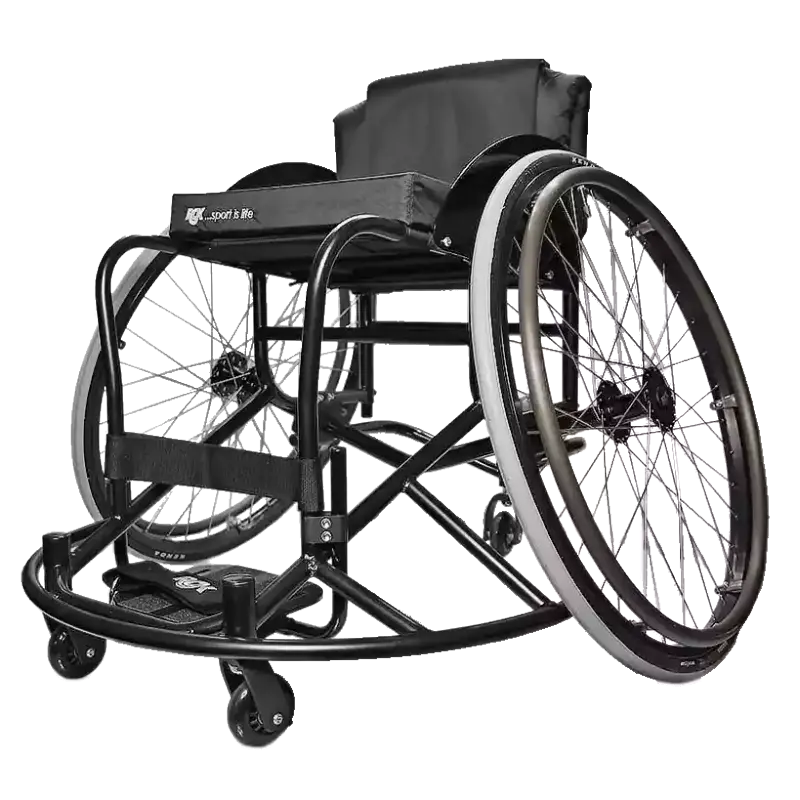
| RGK AllCourt | Basketball | 16 or 20 deg | 24 lb | 3,861 Sportaid Cost |
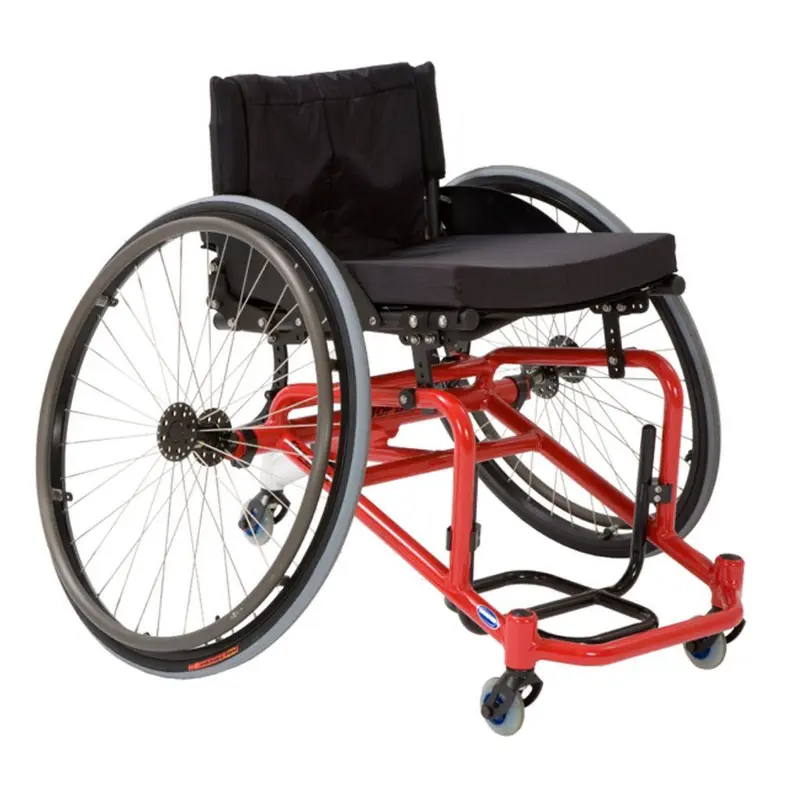
| Top End Pro-2 All Sport | Multi-sport court | 15 deg fixed | 23 lb | Around 2,999 catalog |
| PER4MAX Thunder Tennis | Tennis | Not on tennis page | 19.0 to 20.5 lb | 3,895 maker |
| Top End ProTN | Tennis | 15, 18 or 20 deg | Not printed | 4,999 maker |
| RGK Match Point | Tennis | 16 or 20 deg | 22.5 lb | 3,861 Sportaid Cost |
| Top End Sport PB | Pickleball | 18 deg | Not printed | 3,999 Sportaid |
| RGK Predator | Rugby | Not printed | 26 lb (12 kg) | Around 8,454 to 8,899 catalog |
| Melrose Rhino Offensive | Rugby | Not printed | Not printed | Around 4,000 catalog |
| Top End Eliminator OSR | Racing | Not read | 21 lb (catalog) | 6,299 Sportaid |
Two things stand out. The makers that print a weight put their court chairs between 19 and 26 pounds, and our catalog lists RGK's made-to-measure tennis range lighter still. And chairs with similar names can carry different prices on different pages on the same day: Top End's own tennis category listed its SportTN at 3,499 dollars, while Sportaid listed the Top End Sport TN at 3,999, a gap of 500 dollars. We did not compare what each listing includes. Ask for a written quote before you plan around any number in this table.
Camber: why sports wheels lean in
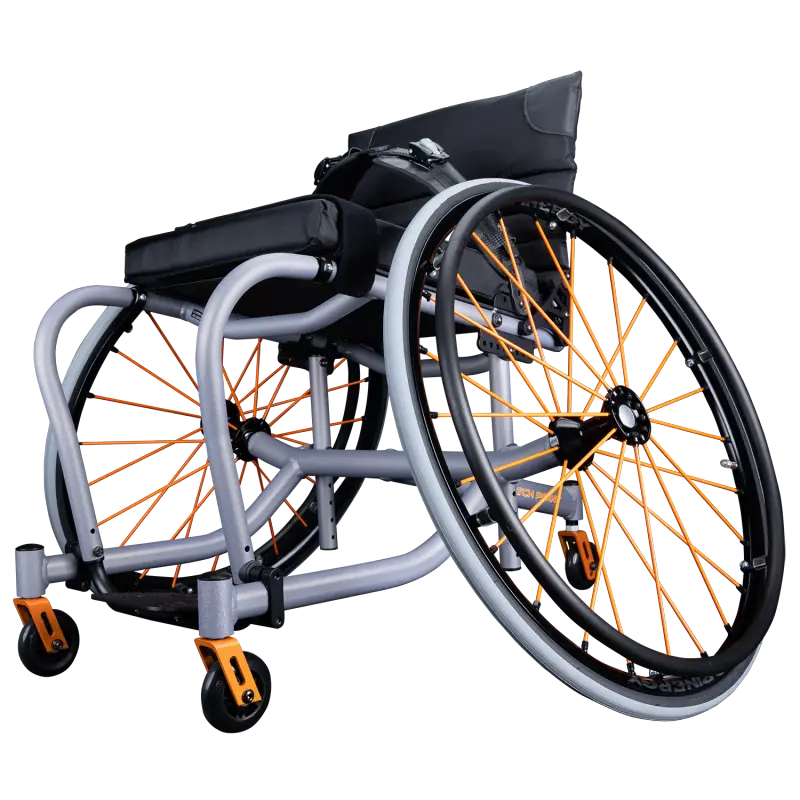
Camber is the angle at which the rear wheels lean in at the top, so the bottoms sit wider apart than the tops. Every court chair we read is built with a lot of it. PER4MAX offers camber of "15°, 17°, 18°, or 20° for high-speed stability and sharp cornering," its titanium Thunder page says. Top End's ProBB and ProTN order forms both offer 15, 18 or 20 degrees at no extra charge. RGK lists 16 or 20 degrees for both the AllCourt and the Match Point. Top End's Sport TN and Sport PB, as Sportaid lists them, come at 18 degrees, and our catalog lists the Top End Pro-2 All Sport at a fixed 15 degrees.
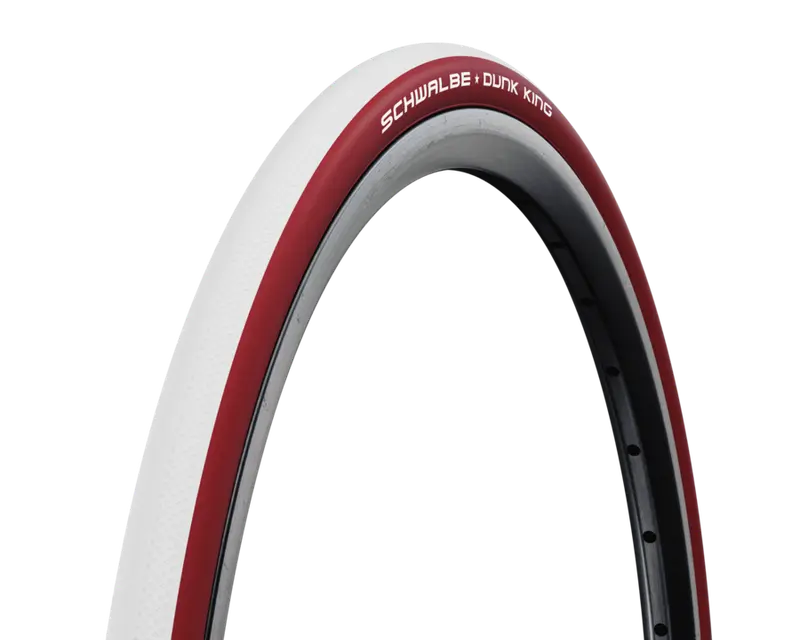
More camber makes the chair wider at the floor, which matters for doorways, car trunks and the bag you carry it in. It also changes which tire fits: our catalog describes the Schwalbe Dunk King, a 26 by 1 inch tire, as shaped for wheels set at negative camber. Several of Sportaid's Top End pages describe camber as "fixed", meaning it is set when the frame is built. Ask the maker whether it can be changed later, and settle it at the fitting.
Which angle suits you is a question for the coach and the person who fits the chair. The makers' pages tie camber to stability and turning; none of them says one angle is right for a given player, and neither do we.
Frame: rigid, adjustable or made to measure
Sports chairs come in three broad kinds of frame, and the makers' own words describe the trade-off. Sunrise Medical says that with its top-level RGK chairs "almost everything is fixed (non-adjustable)." Its AllCourt and Match Point separate the frame into an upper seat frame and a lower chassis, so that, the pages say, "you can try different seated positions without compromising your rolling dynamics." Both list 3.5 inches of center-of-gravity adjustment and up to 5 inches of what RGK calls vertical seat squeeze.
Top End's Pro chairs sit in between: a welded frame with adjustable seat heights, a center of gravity adjustable between 3.5 and 5.5 inches, and a choice of 15, 17 or 19 inch wheelbase on the order form. Sportaid lists the Top End Pro Basketball with "fixed camber and fully welded aluminum base" and a "quick release rear seat height adjustment system." PER4MAX says of its Thunder Basketball that "every chair is handcrafted to the athlete's measurements, style of play, and performance goals," and sells a separate Thunder Adjustable at 4,595 dollars.
Materials are mostly aluminum. Top End and PER4MAX name 7000-series aluminum; RGK names 7020 aluminum for the Predator, and our catalog lists 7020 for the RGK Elite and GrandSlam ranges. PER4MAX's titanium Thunder uses Grade 9 titanium tubing and claims an approximate 25 percent weight reduction against 7000-series aluminum. Sportaid's Paul Schulte 7000 Series page says 7000 aluminum is "approximately 23% stronger than 6061 aluminum." These are the makers' claims; we did not test them.
An adjustable chair can be re-set for a new player or a growing one, and lets a player try positions. A fixed, made-to-measure frame is what the makers offer for players who already know their setup: our catalog lists RGK's fixed Elite and GrandSlam ranges for competitive players, and the adjustable Match Point for developing and club players. Which frame suits you is for your coach and fitter to judge.
Weight: what the makers print
Chair weight is the number buyers ask about first, and it is the one the pages print least consistently. RGK prints a product weight for each chair: 24 pounds for the AllCourt, 22.5 for the Match Point and 26 pounds (12 kg) for the Predator. PER4MAX prints an "average weight approx. 19.0 to 20.5 lbs" for both the Thunder Basketball and the Thunder Tennis, with an asterisk. Top End prints no chair weight on the ProBB or ProTN pages or order forms we read. Our catalog lists the Top End Pro-2 All Sport at 23 pounds, the RGK Elite basketball range at 8.7 to 9.2 kg, the RGK GrandSlam tennis range at 7.9 to 8.5 kg, and the Top End Eliminator OSR racing chair at 21 pounds.
| Chair | Weight as printed | In the other unit (computed) |
|---|---|---|
| PER4MAX Thunder Basketball / Tennis | 19.0 to 20.5 lb | 8.6 to 9.3 kg |
| RGK Match Point | 22.5 lb | 10.2 kg |
| Top End Pro-2 All Sport (catalog) | 23 lb | 10.4 kg |
| RGK AllCourt | 24 lb | 10.9 kg |
| RGK Predator | 26 lb (12 kg) | As printed |
| RGK Elite range (catalog) | 8.7 to 9.2 kg | 19.2 to 20.3 lb |
| RGK GrandSlam range (catalog) | 7.9 to 8.5 kg | 17.4 to 18.7 lb |
Read these with care. Makers weigh chairs in different setups, with or without wheels, cushions and anti-tips, and a made-to-measure chair weighs what its options make it weigh. A pound saved on the frame can be added back by a double anti-tip, a heavy-duty frame or a thicker cushion. Ask the maker to weigh your configuration, with wheels, before you compare.
Weight capacity matters as much. RGK lists 250 pounds for the AllCourt and Match Point and 275 pounds (125 kg) for the Predator. Sportaid lists 250 pounds for the Top End Pro Tennis, the Sport TN and the Sport PB, and says Top End's heavy-duty option "brings the weight capacity of the chair up to 350 pounds" on the Paul Schulte 7000 Series, an option it lists at 602 dollars. If you are near a limit, ask before you order.
Anti-tip and the fifth wheel
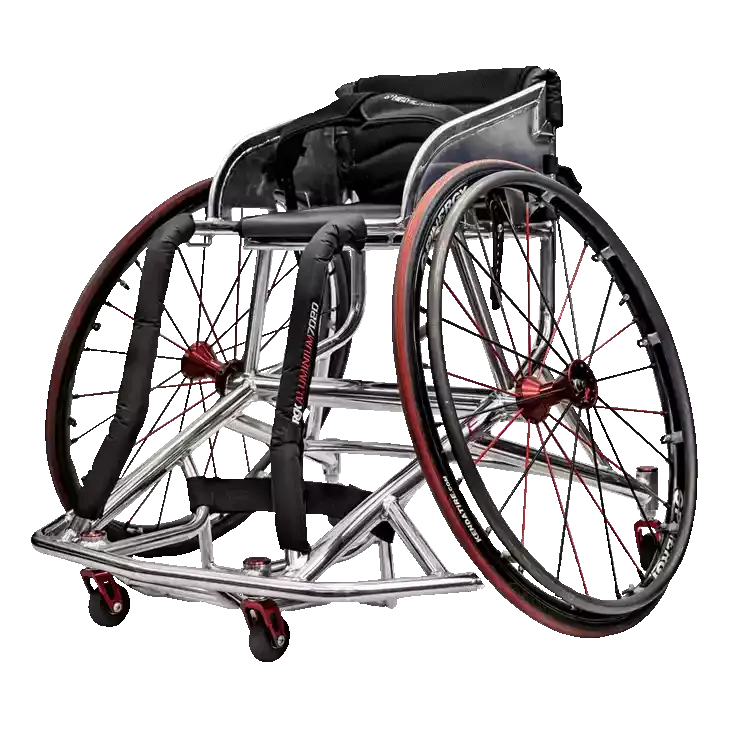
Court chairs lean back hard: to shoot, to reach, to stop. The basketball chairs whose specifications we read (PER4MAX Thunder, Top End ProBB, RGK AllCourt and Sportaid's Top End Pro Basketball) list an anti-tip behind the seat, usually a small fifth wheel, as do PER4MAX's Thunder Tennis and Sportaid's listings for the RGK Match Point and the Top End T-5, the last with a 58 mm fifth wheel; the Top End ProTN order form has no anti-tip field, and the Sport TN lines we saved from Sportaid do not mention one, so ask. PER4MAX's titanium page says its rigid fifth wheel is there "to prevent tipping during aggressive backward acceleration and rebounding," with dual fifth wheel or sixth wheel setups as options. RGK says the AllCourt's integrated fifth-wheel anti-tip, single or double, "allows you to shift your weight over the rear wheels," and that its brace "locks out the rearward flex in the frame." Top End's ProBB form offers a single adjustable-height anti-tip at no charge or a double for 215 dollars; Sportaid lists the Pro Basketball's fifth wheel at 58 mm.
Tennis chairs push the anti-tip further back. PER4MAX's tennis setup has "an extended 5th wheel for deep backward leaning and rapid rotational turns," its titanium page says, and Sportaid lists the RGK Match Point with a "long anti-tip tube." Rugby chairs have anti-tips too: RGK lists "Double anti-tip" and "Fixed anti-tip" among the Predator's frame options.
For basketball the anti-tip is also a rules question. The NWBA rule book allows anti-tip casters on the underside or rear of the chair, but their lowest point may not be more than one inch from the floor, and no part may stick out behind the rear wheels. The height and position are set at the fitting and checked by officials; do not adjust them yourself before a game without knowing the rule.
Footprint, casters and wheelbase
The footprint is where the wheels touch the floor, and the makers tune it by sport. RGK's Match Point has "an extra wide front footprint, meaning the caster wheels are set farther apart than other sports wheelchairs," which the page says gives "additional stability when you are leaning forward or to the side to return a tough shot." Top End's order forms offer a 15, 17 or 19 inch wheelbase, and Sportaid lists the Top End Sport TN and Sport PB at 17 inches. Which wheelbase you need depends on your sport and position, and is a fitting question.
Casters are small and hard. PER4MAX lists 3-inch front casters, described on the titanium page as 72 mm "micro solid polyurethane casters". Sportaid lists "super hard 72mm front casters" on the Top End Pro Basketball and 3-inch micro casters on the RGK AllCourt and Match Point. RGK says the Predator uses "Bones Reds high precision caster bearings as standard". Rear wheels come in 24, 25 and 26 inches on the Top End forms; PER4MAX says its titanium frame works with 24, 25, 26 and 27 inch wheels.
For basketball the rule book also limits the rear casters: no more than one inch from the floor, measured with the front casters in the forward driving position. Players on international rosters may instead use their international chair if it meets the IWBF measurements the NWBA book quotes, including a 2 cm rear-caster limit, and the NWBA approves it before play.
Seat height, cushions and the NWBA rules
What does the NWBA allow for a basketball wheelchair? Mobility Atlas read Rule 1 Section 2 of the 2026-2027 NWBA rule book on 19 October 2026. The top of the seat rail may be no more than 21 inches from the floor, and the rear anti-tip casters no more than one inch, measured with the front casters in the forward driving position. The front of the footrest, the first point of contact head-on, may be no more than five inches from the court. A therapeutic cushion is allowed up to four inches thick for players classed 1.0 to 3.0 and two inches for 3.5 to 4.5; rolled towels or clothing are not. Bars behind the backrest and push handles need at least one inch of padding. Rugby-style wheels or covers, flashing or reflecting lights and any motor are banned; one-arm drive chairs are approved if they meet the other rules. Officials inspect every chair before play.
The 21-inch limit is the one makers design around. Top End's ProBB and ProTN forms offer a tall front seat height of 19 to 21 inches or a short one of 17 to 19, and rear heights of 15 to 21 or 13 to 17. RGK's AllCourt lists front seat-to-floor heights of 16 to 21 inches. These are seat-to-floor figures from the makers; the NWBA measures to the top of the seat rail with a metal tape. Ask the maker to confirm in writing that your configuration measures within the rule.
The cushion limit is tied to class, so a player whose class changes may need a different cushion. The NWBA book says a cushion "shall be composed of any therapeutic material as made by popular manufacturers," and that pneumatic and contoured cushions are allowed if they are commercially made for therapeutic use and within the thickness limits. In the junior division, players designated J1 can use up to a 4-inch cushion and J2 only a 2-inch one. Our guide to wheelchair cushions explains the cushion types; which one you sit on is a decision for your seating specialist or clinician, and the rule book limits its thickness and requires a therapeutic cushion made by a recognized manufacturer.
The rest of the NWBA chair rules
The rule book has more to say about the chair than its height, and most of it is about safety for other players. The footrest must have rounded or smooth corners; door bumpers, knobs and other projections that could catch another chair's spokes "shall not be allowed." If the chair has a bar below the footrest, it must be padded with foam or covered with plastic tape that slides. Bars behind the backrest and push handles must be padded with at least one inch of material that can compress by a third. Wheel hubs must be round with no sharp points, and "Rugby style wheels or covers are prohibited for use," the rule book says.
- Measurement: officials carry a metal tape rule and must inspect every chair before the game, or before a player enters with a chair that was not inspected.
- Penalty: an illegal measurement found during play is an unsportsmanlike foul, if the officials measured the chair correctly before play; repeated infractions mean disqualification.
- No motors: officials may not permit chairs to be "mechanized in any form" for turning or propulsion.
- Repairs: an equipment timeout lasts 45 seconds, with a warning signal 15 seconds before the end, to repair or replace a chair or the player; a coach may call a timeout for more time.
- Lights: the rule book says "Lighting that reflects or flashes are not permitted" on the wheels, the chair or the casters.
- One-arm drive: the rule book says "One-arm drive wheelchairs are approved for use" if they meet the other rules.
The NWBA plays by the college (NCAA) rules except where its book changes them, and the chair section is one of those changes. On cushions, the book says "In all situations, the decision of the officials shall be final," and officials inspect and can prohibit any chair they judge unfair or unsafe to others. If you buy a used chair, measure it against this list before your first game.
International chairs and the IWBF numbers
The NWBA book lets players on international rosters use their international chairs, provided the chair meets the International Wheelchair Basketball Federation's measurements and the NWBA approves it before play. The book quotes those measurements, from IWBF rules 3.1.2 to 3.1.5, and they are measured differently from the NWBA's.
| Measure | NWBA (domestic) | IWBF, as quoted in the NWBA book |
|---|---|---|
| Seat height | Seat rail top, max 21 in | Cushion or seat top, 63 cm (1.0-3.0) |
| Seat height, higher classes | Same 21 in | 58 cm (3.5-4.5) |
| Rear casters | Max 1 in from floor | Max 2 cm from floor |
| Front bar or footrest | Max 5 in from court | Front bar max 11 cm |
| Rear wheel size | Not limited in the section | Max 69 cm with tire |
In inches, 63 cm is about 24.8, 58 cm about 22.8, 69 cm about 27.2, 11 cm about 4.3 and 2 cm about 0.8 (our conversion). The IWBF seat figure is taken to the top of the cushion, or of the seat platform if there is no cushion, while the NWBA figure is taken to the top of the seat rail, so the two numbers cannot be compared directly. A player who moves between domestic and international play should have the chair measured under both sets of rules.
Wheelchair tennis chairs
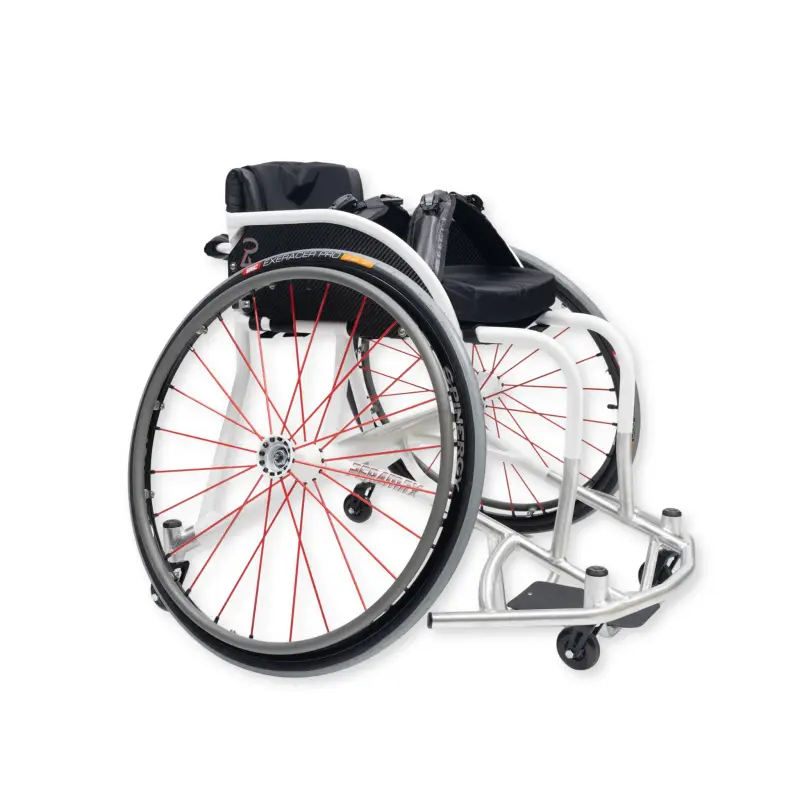
A tennis chair is built to move and turn without the ball in your hands, and the makers describe it that way. PER4MAX says its tennis setup "Features an eliminated front bumper for a streamlined profile and an extended 5th wheel for deep backward leaning and rapid rotational turns." Its Thunder Tennis comes with a rigid or adjustable-height fifth wheel and a tennis ball bag, at the same 3,895 dollars as the basketball chair. Our catalog lists the RGK Match Point, with its wide front footprint, for developing and club players, and the made-to-measure GrandSlam for competitive players; Sunrise Medical calls the GrandSlam "The world famous tennis wheelchair" on its related products list.
Top End lists three tennis chairs on its own site: the SportTN at 3,499 dollars, the Pro Tennis (ProTN) at 4,999 and the T-5 7000 Series at 5,199. Sportaid's page lists the T-5 with a "Custom-built fixed frame in 7005 aluminum," a 58 mm fifth wheel and wheels of 24, 25, 26 inches or 700C. The ProTN order form offers optional side guards at 151 dollars, a rear frame protector at 60 dollars and removable seat extension handles at 82 dollars a side.
The rules for wheelchair tennis are written by the International Tennis Federation, not by the NWBA, and we could not save the text of them for this guide. We therefore state none of them here. Read the ITF's current wheelchair tennis rules on the ITF's own site, or ask your national tennis association, before you buy a chair for sanctioned play. The NWBA's basketball limits do not apply to tennis.
Wheelchair pickleball chairs
Pickleball now has its own chairs. Sportaid lists two from Top End: the Sport PB Pickleball Chair at 3,999 dollars and the Ultimate Pickleball Chair at 5,199. The Sport PB, as Sportaid lists it, has an 18-degree camber, "2.5″ to 5″ adjustable center of gravity", 25-inch high-performance wheels with Primo Grey tires, a 17-inch wheelbase, a front seat-to-floor height of 18 to 20 inches and rear of 15 to 20, a 250-pound capacity and three seat sizes: 12 by 12, 15 by 14 and 18 by 15 inches. The Ultimate is a custom, fully welded 7000-series frame that Sportaid says will be in your hands "in 90 days or less", with a single adjustable-height anti-tip and a platform footrest as standard.
On paper the Sport PB is very close to the Sport TN tennis chair on the same site: same price, same camber, same wheel size, wheelbase and center-of-gravity range. If you play both sports, ask the maker or dealer what actually differs between the two, and whether one chair will do.
We read no pickleball rule book for this guide and state no pickleball chair rules. Ask the event organizer or the body that runs your league which chair rules apply, before you order.
Wheelchair rugby chairs: offense and defense
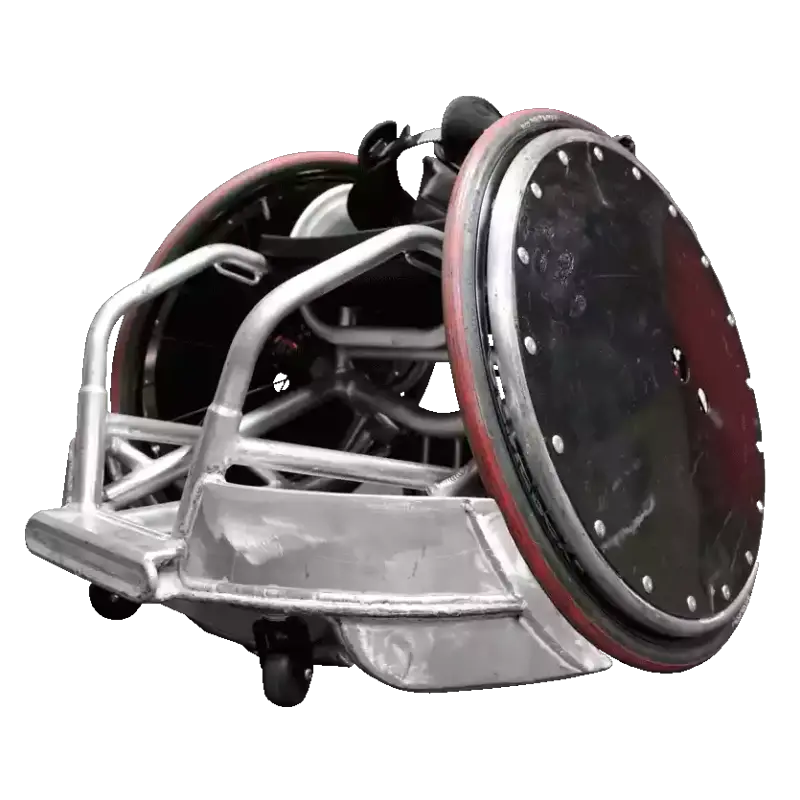
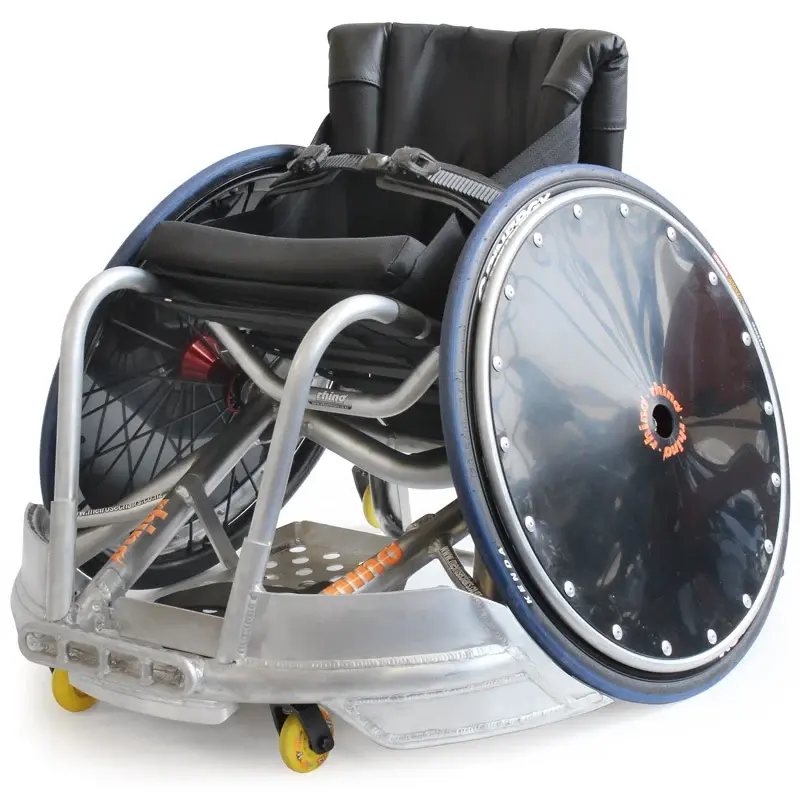
Rugby chairs are built to hit and be hit. RGK's page calls its Predator "perfectly adapted for the high-impact gameplay and pure aggression that wheelchair rugby commands," with "a Y-frame chassis for excellent impact distribution" and a heat-treated 7020 aluminum frame with reinforced impact areas. It lists the Predator at 26 pounds (12 kg) with a 275-pound (125 kg) capacity, seat widths of 250 to 500 mm in 5 mm steps, a front seat-to-floor height of 480 to 630 mm and a center of gravity adjustable from 0 to 178 mm. Frame options include "Offensive and defensive options" and "Fixed and removable picker options".
RGK lists offensive and defensive frames, with fixed and removable picker options, for the Predator. Our catalog lists the Melrose Rhino in offensive and defensive versions, the defensive one with front pick bars, at around 4,000 dollars for the offensive version (a US dealer's listing). PER4MAX says its titanium Thunder in rugby form has "Reinforced frame tubing with custom footrest adaptations and heavy-duty impact guards". Sportaid still lists the Colours Hammer court and rugby chair, with a wide "Hammer" head front end, at a Retail price of 4,600 dollars and a Cost of 3,680, but its page says "Colours is temporarily suspending production on all products," and Sportaid marks it out of stock.
Your position and your class shape the chair, and USOPC says competition chairs "are often tailored the athlete's unique impairment." Strapping matters too: RGK lists calf and toe straps as standard on the Predator and a waist strap as an option. Where straps go and how tight they are is a call for your coach and your seating specialist or therapist.
Rugby classification points
Wheelchair rugby is a mixed team sport, and USOPC says it is open to athletes "with a mobility related physical impairment in at least three limbs." Every player is given a class from 0.5 to 3.5 points. Low-point classes (0.5, 1.0, 1.5) describe athletes with very limited trunk control and hand function; mid-point classes (2.0, 2.5) more hand and trunk function; high-point classes (3.0, 3.5) the most function, with 3.5 the least impaired within eligibility.
| Class | How USOPC describes it, in short |
|---|---|
| 0.5 | Little trunk control; very limited grip |
| 1.0 | Slightly more arm function; weak trunk |
| 1.5 | Better shoulder, elbow; some wrist |
| 2.0 | Partial finger function; moderate trunk |
| 2.5 | More trunk rotation; excellent shoulders |
| 3.0 | Normal arm strength; strong trunk |
| 3.5 | Least impaired within eligibility |
In World Wheelchair Rugby competitions the four players on court may total no more than 8.0 points; USOPC's example is 3.5, 2.0, 1.5 and 1.0. A team gets an extra 0.5 points for each female player on court classed 0.5 to 1.5, and an extra 1.0 for each female player classed 2.0 to 3.5. So a line with one female 1.0 player may total 8.5 points, and one with a female 2.5 player 9.0 (our arithmetic from USOPC's rule).
You do not choose your class. USOPC says the first step is to join a team, and the national league classifies new athletes at tournaments that have a classification panel. Wait until you have played and been classified before you buy a made-to-measure chair, because the class and the position you play shape it.
Racing wheelchairs
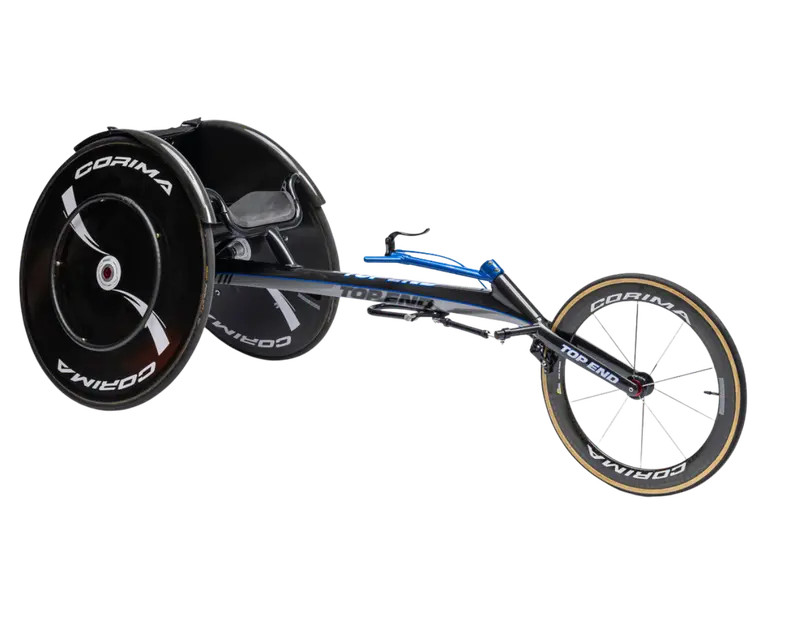
Racing chairs are a different machine: three wheels, a long frame and, on some, a kneeling cage. Sportaid lists two Top End racers. The Eliminator OSR U Cage has a "Custom 6061 T6 aluminum frame," 700C clincher or tubular rear wheels, a "20 inch front wheel with tubular tire" and a 250-pound weight capacity, at 6,299 dollars. The Eliminator NRG has "A carbon fiber main frame" and a "200-gram full carbon fork" at 10,499 dollars; the page notes that ordered without wheels, tires, pushrims or axles it "starts at $7,510", a difference of 2,989 dollars for those parts.
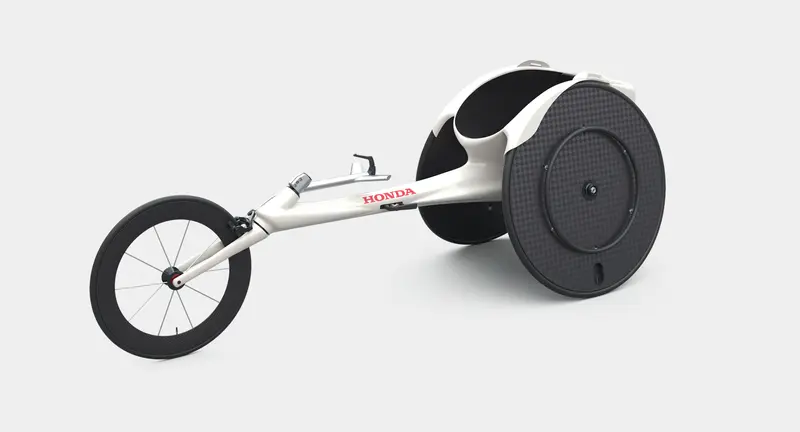
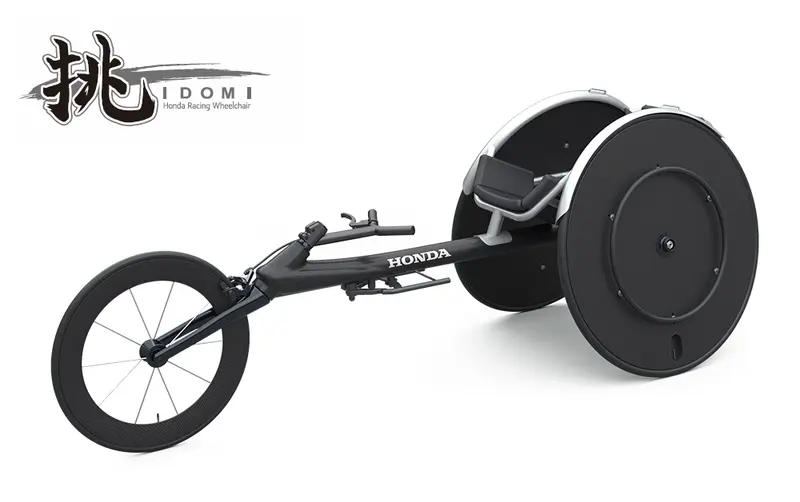
Our catalog lists the Eliminator OSR at around 6,299 dollars, 21 pounds, with a lower frame width of 11 to 18 inches and a length of 64 to 76 inches. It also holds two Honda Sun racers from Japan, the KAKERU Flagship and the IDOMI, with guide prices in yen; our own October check could not confirm their prices, weights or frame materials on the maker's order pages, so we do not quote them here. Our catalog's check of Honda's order page notes a measurement session of about three hours for the KAKERU and about three months of production.
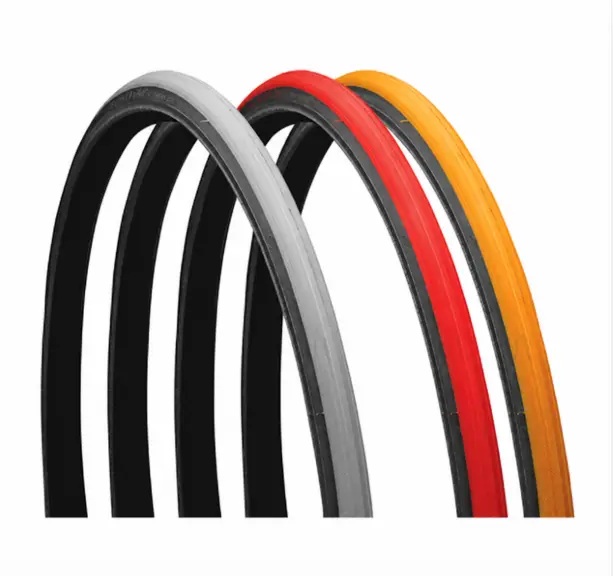
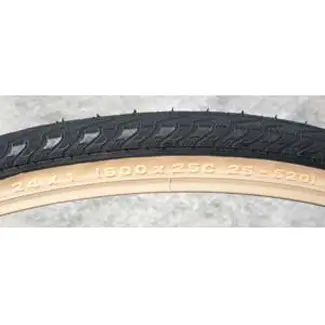
Racing chairs also take tires of their own. Our catalog lists the Panaracer 24 by 1 inch (25-520) clincher, for handcycles and racing wheelchairs, at around 24.25 dollars each at Sportaid. For chairs on 700c wheels it also lists the Primo Super H 700 by 28 (28-622), which it describes for court or everyday use, at around 48 dollars a pair. A racing chair's setup, including kneeling or sitting position, is decided with a racing coach and the maker.
Tires and wheels for sport chairs
Sport chairs run narrow, high-pressure tires, and the wheels are often the most expensive single option. These are sport tires and the one sport wheel from our catalog, with guide prices checked October 2026.
| Part | Size | Guide price (USD) |
|---|---|---|
| Schwalbe Dunk King | 26 x 1 (25-590), 250 g | From around 85 (Schwalbe US, catalog) |
| Primo Racers | 25 x 1 (20-559), 110 psi | Around 45 to 49.50 a pair |
| Primo Super H | 700 x 28 (28-622) | Around 48 a pair |
| Panaracer clincher | 24 x 1 (25-520), 240 g | Around 24.25 each |
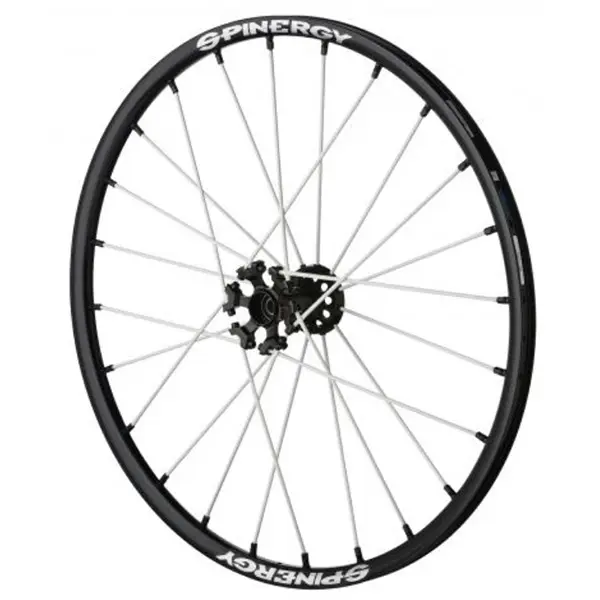
| Spinergy Sport XSLX wheels | 24, 25, 26 in, 700c | Around 1,062 a pair (list 1,180) |
Our catalog lists the Dunk King at 6 to 10 bar (85 to 145 psi) with a maximum load of 70 kg, and the Spinergy XSLX at 757 grams per wheel with 24 PBO fiber spokes, in a pattern our catalog notes Sportaid's page describes as an X-laced and radial hybrid. The Dunk King's own Schwalbe page gives EUR 65.90 RRP. On a new chair, wheels are often priced on the order form: Top End's ProBB comes with Spinergy SLX wheels as standard, gives a 250-dollar credit if you choose its high-performance wheels instead, and charges 690 dollars for Spinergy wheels with a custom hub and rim color. On the ProTN form the Spinergy SLX is an extra 995 dollars. Sportaid lists Spinergy wheels on the RGK Match Point at an extra 985 dollars.
Match the tire to the rim size, the 520, 540, 559, 590 or 622 in the tire's size code, and to the pressure the tire maker lists. Fitting, pressures and wear checks are covered in our manual wheelchair repair guide. The Kelly Brush Foundation says it will not consider applications for "Accessory upgrades (such as wheelsets)", so plan to pay for upgraded wheels yourself if you apply there.
Sports chairs, everyday chairs and off-road chairs
A sports chair is not an everyday chair. The camber that helps a basketball chair turn also makes it wider at the floor, which matters in doorways; and none of the court chairs we read lists transit use. RGK's spec lists say "Transit: No" for the AllCourt, the Match Point and the Predator; ask the maker what that means before anyone rides in the chair in a vehicle, and see our wheelchair van guide for carrying a chair. The Kelly Brush Foundation will not consider applications for "Everyday wheelchairs", and the Challenged Athletes Foundation says "Requests for general mobility or non-sport equipment are not eligible."
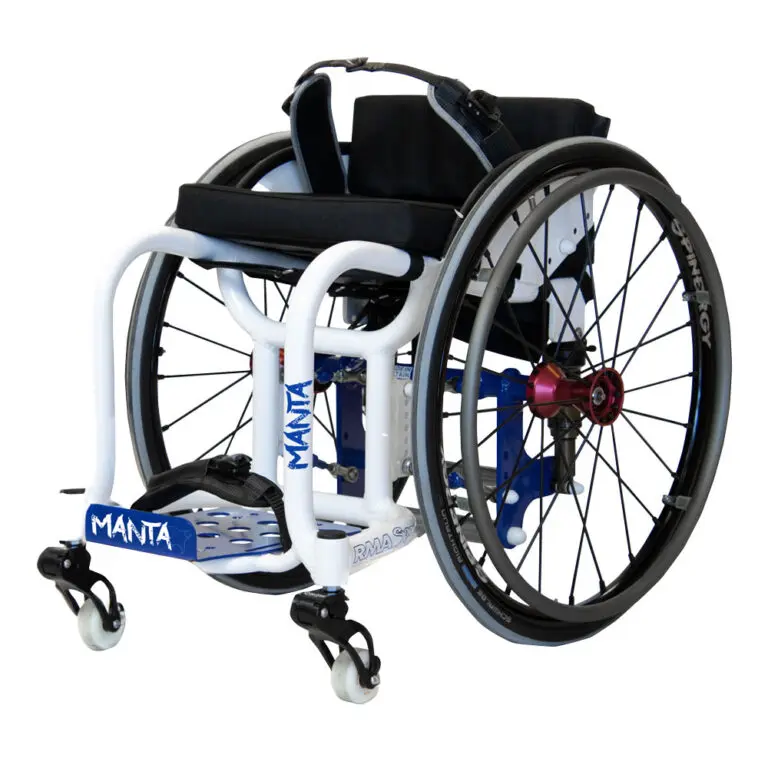
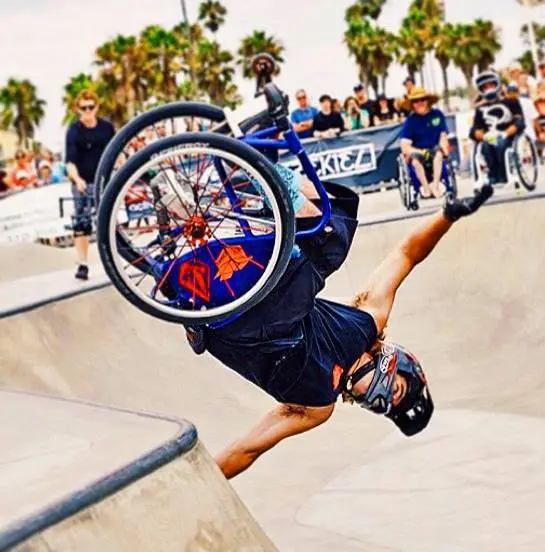
For a daily chair, see our lightweight wheelchair guide. For skate-park riding, our catalog also lists two WCMX chairs, the RMA Sport WCMX and the Box Wheelchairs WCMX Original, both with rear suspension; trail, beach and stair-climbing chairs are covered in our stair-climbing wheelchair guide.
What sports wheelchairs cost as listed
These are base prices as published on 19 October 2026 by the makers PER4MAX and Top End, by the specialist dealer Sportaid, and as guide prices in our own catalog, checked October 2026. All are in US dollars, before options, shipping, surcharges and tax. Prices differ by country, dealer, funding and tax relief, so treat the table as a starting point for a quote, not a quote.
| Chair | Price (USD) | Where we read it |
|---|---|---|
| Top End Pro-2 All Sport | Around 2,999 (list 3,719) | Our catalog, US retailer |
| PER4MAX Thunder Mini, multi-sport | 3,445 | PER4MAX |
| Top End SportTN tennis | 3,499 | Top End |
| RGK AllCourt basketball | 3,861 Cost | Sportaid |
| RGK Match Point tennis | 3,861 Cost | Sportaid |
| PER4MAX Thunder Basketball or Tennis | 3,895 | PER4MAX |
| Top End Sport BB basketball | 3,999 | Top End |
| Top End Sport PB pickleball | 3,999 | Sportaid |
| Melrose Rhino Offensive rugby | Around 4,000 | Our catalog, US dealer |
| Top End ProTN tennis | 4,999 | Top End and Sportaid |
| Top End T-5 tennis | 5,199 | Top End and Sportaid |
| Top End Ultimate Pickleball | 5,199 | Sportaid |
| Top End ProBB basketball | 5,899 | Top End and Sportaid |
| Top End Paul Schulte PS7 basketball | 5,999 | Top End and Sportaid |
| Top End Eliminator OSR racing | 6,299 | Sportaid |
| Top End GOAT Aluminum basketball | 6,499 | Top End |
| PER4MAX Titanium Thunder Basketball | 7,395 | PER4MAX |
| RGK Predator rugby | Around 8,454 to 8,899 | Mobility Atlas catalog guide price |
| Top End Eliminator NRG racing | 10,499 | Sportaid |
| Top End GOAT basketball | 11,499 | Top End |
Within this set, the lowest new prices sit around 3,000 to 4,000 dollars for an adjustable court chair, and the highest are the made-to-measure, titanium or carbon chairs. PER4MAX's titanium Thunder costs 3,500 dollars more than the aluminum Thunder on the same site. RGK publishes no prices on Sunrise Medical's pages without a dealer login, and our catalog holds no guide price for the RGK Elite or GrandSlam ranges, so we cannot place them in this table.
Retail, Cost and surcharges: reading a price
Sportaid's pages print two prices for some chairs. "Retail" is the list price; "Cost" is the price Sportaid sells the chair at, and it is the figure its category page shows. For the three Colours chairs the Cost is 20 percent below Retail: the Hammer rugby chair at 3,680 against 4,600, the Zephyr at 4,320 against 5,400 and the BC Skate Chair at 5,600 against 7,000 (our arithmetic). For the Top End chairs, Retail and Cost are the same. The RGK chairs show only a Cost, 3,861 dollars each for the AllCourt and the Match Point.
The Colours prices come with a warning. All three Colours product pages say "Colours is temporarily suspending production on all products," and Sportaid marks the BC Skate Chair and the Hammer out of stock. Do not plan a grant application around a Colours chair until the maker says production has restarted.
Then there are charges on top. Sportaid's Sport TN page says "Top End is now charging a 10% surcharge on all of their products," added at the end of an order on Sportaid's site. On a 3,999-dollar chair that would be 399.90, or 4,398.90 in all (our arithmetic). Top End's own order form says "A Tariff surcharge may be added to our order to recover costs related to certain imports," and lists shipping at 375 dollars for the continental US only. A ProBB at 5,899 with shipping is 6,274 before any options or surcharge. Ask every seller for a written quote that names each of these lines.
Two more things move the final figure: the options you pick, and whether a grant funder will pay for them. The next section lists what the order forms charge; the grant sections say what the funders exclude.
Options that move the price
Top End publishes its option prices on its order forms, which makes it the clearest example of how a base price grows. These are the ProBB and ProTN forms as read on 19 October 2026.
| Option | ProBB (USD) | ProTN (USD) |
|---|---|---|
| Base chair | 5,899 | 4,999 |
| Double adjustable anti-tip | 215 | Not on form |
| Leather-flap back upholstery | 90 | 90 |
| 3-inch soft cushion | 37 | 37 |
| 2-inch hard cushion | 60 | Not on form |
| Aluminum bolt-through side guards | 151 | 151 |
| Rear frame protector | Standard | 60 |
| Spinergy SLX wheels | Standard | 995 |
| Spinergy, custom hub and rim color | 690 | 1,295 (SLX) |
| Click strap over the knees | 165 to 172 | 165 to 172 |
| Click straps, all positions | 90 to 172 | 90 to 172 |
| Shipping, continental US | 375 | Not read |
Seat width (10 to 20 inches), seat depth (10 to 18), back height, camber (15, 18 or 20 degrees), wheel size (24, 25 or 26 inches) and wheelbase (15, 17 or 19 inches) carry no charge on either form. On the ProBB, choosing Top End's high-performance wheels instead of the standard Spinergy gives a 250-dollar credit. Custom decals are 20 dollars each. PER4MAX lists its options without prices on the pages we read, among them a titanium frame, a removable fifth wheel, a sixth wheel, 12-tab handrims and Spinergy wheels.
Sportaid's page lists a few RGK option prices: on the AllCourt, a dual integral anti-tip that "Includes 5th Wheel Support at No Charge", shown at plus 116 dollars; on the Match Point, 25-inch tennis wheels at plus 315 and Spinergy wheels at plus 985. On the Top End Paul Schulte 7000 Series, the heavy-duty frame is plus 602 dollars.
Remember that grant funders read quotes line by line. The Kelly Brush Foundation says quotes that include accessories such as "premium wheelsets" will be reduced by the amount of those accessories, so a quote with Spinergy upgrades may be funded only up to the base chair.
Try before you buy: club chairs and loaners
Nobody should buy a 4,000-dollar chair for a sport they have not played. The documents we read point to three ways to try first. For rugby, USOPC says "Many of the USWRA teams will have wheelchairs to loan to athletes," though it adds that competition chairs are often tailored to the athlete's impairment, and that each athlete will need their own chair to begin competing. USOPC also says the first step to being classified is to join a team, which is also where those loan chairs are.
If you are eligible for the Kelly Brush Foundation's Active Fund (individuals with paralysis caused by an acquired spinal cord injury who reside in the United States), one possible decision on your application is a "Try It First" grant: "an award of $500 to go towards program or rental fees at an adaptive sports program to gain experience with the equipment applied for," its page says. The foundation also says "first-hand experience using the desired equipment in the environment you intend to use it is extremely important to the Grant Committee." So trying a chair first also gives you something to tell the committee if you apply later.
For basketball, tennis and pickleball, we found no loan scheme printed in the NWBA, maker or dealer documents we read. Ask your local club or adaptive sports program whether it keeps chairs for new players, and which models they are.
When you borrow a chair, ask someone at the club to set the seat height, the anti-tip and the straps for you, and note what feels right. Those notes become the start of the measurements your fitter will take later.
How can you pay for a sports chair?
How can you pay for a sports wheelchair? Mobility Atlas read the Challenged Athletes Foundation and Kelly Brush Foundation grant pages and Top End's order form on 19 October 2026. CAF's 2026-2027 annual grant program opens on 28 September and closes on 13 November; it is for individuals in the US with a permanent physical disability, needs medical verification, a year of financial documents and two letters of recommendation, and pays its preferred vendors directly. Adults may apply every five years and those under 18 every three. CAF's Other Equipment route pays up to 3,500 dollars to the athlete for gear from other vendors. The Kelly Brush Foundation's Active Fund is for individuals with paralysis caused by an acquired spinal cord injury who reside in the United States; its average grant is around 3,500, paid only to vendors. Its fall 2026 round has closed. Top End's order form also lists Affirm finance, the VA, team and university accounts. USOPC says many US rugby teams loan chairs.
Neither grant is guaranteed. CAF says its "Equipment grants are highly competitive" and go to applicants who show both financial need and commitment to their sport. The Kelly Brush Foundation says meeting its eligibility rules "is not a guarantee of a grant award." Apply with a realistic quote for a chair that matches your level, because CAF says grants are only awarded "for equipment that is appropriate based on the applicant's experience level and dedication to their sport."
Challenged Athletes Foundation grants
The Challenged Athletes Foundation (CAF) runs an annual grant program with an Adaptive Sports Equipment Grant. Its page says the grant is "created to give athletes with permanent physical disabilities access to the high-quality equipment they need to pursue their sport," and that CAF makes "more than 90 pieces of adaptive sports equipment" available at discounted prices through preferred vendors.
- Who: individuals in the US with a permanent physical disability; teams and organizations are not eligible, and hearing impairments, intellectual and developmental disabilities do not qualify.
- What you send: medical verification of disability, one year of financial documentation, two letters of recommendation and, CAF's FAQ says, one photo, ideally showing you being active.
- When: the 2026-2027 program opens on 28 September and closes on 13 November; CAF says awards are announced in March.
- How often: every 3 years if under 18, every 5 years if 18 and over, counted from your last equipment award.
- Who gets paid: for preferred-vendor equipment, CAF pays the vendor directly; for Other Equipment, up to 3,500 dollars is sent to the athlete to buy from the quoted vendor.
- Ownership: "Once delivered, the equipment is yours to keep," the FAQ says.
CAF's preferred vendors include five of the makers named in this guide, PER4MAX, RGK, Top End, Melrose and Box Wheelchairs, along with Eagle Sportschairs and others. If you are awarded a chair from one of them, you work directly with the vendor and CAF pays it; if not, the Other Equipment route needs a quote you upload. You can request only one category per cycle, so you cannot ask for a chair and for travel money in the same year.
CAF's general grants page says its grants are available to athletes across the globe, though some are limited to US residents, and the equipment grant is one of them. Applications go through CAF's online grant portal.
Kelly Brush Foundation Active Fund
The Kelly Brush Foundation's Active Fund gives "grants for individuals with paralysis caused by spinal cord injury to purchase adaptive sports equipment," its page says, and lists sport chairs and racing chairs among what it has funded for over 1,900 people from 50 states. Its rules are narrower than CAF's in who may apply and stricter about how the money is paid.
- Who: individuals with paralysis caused by an acquired spinal cord injury, living in the United States. The page names conditions that are not eligible, including spina bifida, cerebral palsy and multiple sclerosis.
- What you send: a letter from a treating physician or primary care provider, two personalized quotes from reputable adaptive sports equipment vendors, financial documentation and a recommendation from a coach, instructor, peer you plan to be active with, or someone else who can speak to how the equipment will affect your life.
- How much: no minimum or maximum, but "the average grant is generally around $3,500," the page says; decisions are an award, full or partial, a denial, or a 500-dollar Try It First grant.
- How it is paid: the page says "We only pay reputable adaptive sports equipment vendors directly," and the foundation does not reimburse equipment already bought.
- How often: after a grant you wait 2 years to apply again; Try It First recipients may apply the next cycle; a denied applicant may reapply at any time.
- When: the page says the fall 2026 Active Fund is closed, with awards sent by email in late October or early November, and the next cycle's dates are to be announced.
The fund will not consider applications for everyday wheelchairs, accessory upgrades such as wheelsets, or motorized wheelchair attachments, and it reduces quotes that include accessories such as premium wheelsets. It gives preference to equipment with a fitness benefit.
CAF and Kelly Brush side by side
| Question | CAF equipment grant | Kelly Brush Active Fund |
|---|---|---|
| Who can apply | US, permanent physical disability | US; paralysis caused by acquired SCI |
| Amount | Vendor-priced; Other up to 3,500 | Average around 3,500 |
| Paid to | Vendor (Other: the athlete) | Vendor only |
| Quotes needed | One, for Other Equipment | Two personalized quotes |
| Medical paperwork | Medical verification | Letter from physician or PCP |
| Letters | Two recommendations | One recommendation |
| Re-apply after award | 3 years under 18; 5 years adult | 2 years |
| Window read 19 Oct 2026 | Open 28 Sep to 13 Nov | Fall 2026 closed; next TBD |
If you are eligible for both, the rules do not say you cannot apply to both; read each funder's current terms and ask them how they treat a chair already part-funded by another grant. Top End's ProBB order form lists both a "Challenged Athletes Foundation Grant" and a "Kelly Brush Foundation Grant" as payment types, alongside self pay, Affirm finance, dealer accounts, Veteran Affairs, organization or university accounts and team accounts.
Building the quote a grant needs
- Play first. Borrow a club chair, or, if the Kelly Brush Foundation gave you a Try It First award, use it, so you can say on the application what you have used and where.
- Get measured. Top End offers a one-hour fitting with an athlete ambassador for 100 dollars, plus 50 dollars per extra 30 minutes, and says the fee counts toward the chair if you order.
- Ask for a quote in writing that lists the base chair, each option, shipping and any surcharge on separate lines.
- For the Kelly Brush Foundation, get two personalized quotes from reputable adaptive sports equipment vendors, and keep premium wheels and accessories off them or clearly separate.
- Collect the paperwork early: CAF's medical verification or the Kelly Brush Foundation's letter from a treating physician or primary care provider, financial documents, recommendation letters and, for CAF, a photo.
- Submit before the deadline. The Kelly Brush Foundation says it makes no exceptions for late applications.
A fitting that runs 90 minutes would cost 150 dollars at Top End's published rates (our arithmetic). If you would like us to help assemble the quotes, send an enquiry with the chair you tried and your measurements, and ask us to find it.
Fitting and setup: whose call
Every maker we read builds its competitive chairs to measure, and ties the setup to the athlete's own measurements. PER4MAX says each Thunder is "built to order," with configurations that vary by "athlete measurements, playing position, and individual performance goals." Top End offers fittings with its athlete ambassadors that capture "custom specs." RGK says the Predator is made to measure, with "19 quality checks throughout the build, from initial measurements to final delivery." Sunrise Medical's pages add that "not all features and options offered are compatible with all configurations" and point to the user manual.
Seat height, seat angle, backrest height, center of gravity, camber, strapping and cushion all change how you sit and move. For a sports chair these are decided with your coach and the fitter, and where your body needs it, with a seating specialist, physical therapist or occupational therapist. We explain what the options are; we do not say which setup is right for you. If you use a pressure-relief cushion in daily life, ask your clinician before you swap it for the 2-inch cushion that PER4MAX (foam) and Top End (soft) list as standard.
Bring to the fitting: your current chair's measurements, the rule limits for your sport and class, a note of what you liked and disliked in the chairs you borrowed, and your coach if you can.
Young athletes and growing chairs
Children grow out of made-to-measure chairs. PER4MAX also lists a Thunder Mini (multi-sport) at 3,445 dollars and a Thunder Adjustable at 4,595; the pages we read do not say who they are sized for, so ask PER4MAX whether either suits a growing athlete. The NWBA's junior division limits cushions by designation: J1 players can use up to a 4-inch cushion, J2 players only a 2-inch one. CAF lets athletes under 18 apply every 3 years instead of every 5, and its youth table counts age as of 31 March. The Kelly Brush Foundation lets an applicant younger than 13 have someone else fill in the form, though the applicant must contribute to and consent to all answers.
An adjustable frame, such as RGK's AllCourt or Match Point with their 3.5 inches of center-of-gravity adjustment and up to 5 inches of seat squeeze, or Top End's adjustable seat heights, can follow a growing athlete further than a fixed one. Ask the maker how far the frame can be adjusted, and what a resize costs, before you order.
Lead times, warranty and production
Sports chairs are built to order, so plan the season backwards from the delivery date. Top End's ProTN page says the chair "is produced in 30-days or less," and Sportaid says the Sport TN "ships in 30 days or less." Choosing Spinergy wheels with a custom hub and rim color "adds 60 days to the lead time," both Top End forms say, which could stretch a 30-day chair to about 90 days (our arithmetic). Sportaid says the Ultimate Pickleball Chair arrives "in 90 days or less." RGK lists 19 quality checks for the Predator but no lead time on the page we read.
PER4MAX lists a 3-year limited warranty on the Thunder Basketball and Thunder Tennis, and a 3-year limited frame warranty on the titanium Thunder. We read no warranty terms on the Top End or RGK pages we saved; ask for them in writing. Our catalog notes a 13-month upholstery warranty on the Eliminator OSR.
Production can stop altogether. Sportaid's pages say Colours is temporarily suspending production on all products, which affects anyone hoping to order a new Colours chair or parts for one. Ask any maker about parts supply for at least the life of the warranty.
Buying a used sports chair
A used chair can be a good first chair, but it was built for someone else's body and someone else's rules. Before you pay, check it against the rules for your sport, and against what the makers say about their own chairs.
- Basketball: measure the seat rail height (21 inches maximum under the NWBA book), the rear anti-tip (one inch maximum from the floor, not past the rear wheels) and the footrest front (five inches maximum). Look for padding on the rear bars and push handles, and remove any lights.
- Rugby: ask which class and position the chair was built for, offensive or defensive.
- All: ask for the model, the serial number and the original order sheet; check the frame for cracks and dents at welds and impact areas, and the camber hardware, axles and wheels.
- Weight capacity: find the maker's figure for that model, such as 250 pounds for the RGK AllCourt.
- Funding: the Kelly Brush Foundation says it pays "reputable adaptive sports equipment vendors directly", so a private sale is unlikely to fit its grant; CAF's Other Equipment route needs a vendor quote.
Have the chair checked by your coach or a fitter before you rely on it in a game. Maintenance and tire care are in our manual wheelchair repair guide.
Three traps
Trap one: buying the chair before you know your class or your game. A rugby chair is built for a position and a class, and USOPC says competition chairs are often tailored to the athlete's impairment. Play in a loan chair, get classified, then order.
Trap two: reading one price as the price. On 19 October 2026 Top End's category page listed its SportTN at 3,499 dollars and Sportaid listed the Top End Sport TN at 3,999 (we did not compare what each includes), a 10 percent Top End surcharge applied on Sportaid's site, and shipping on Top End's own form was 375 dollars. Get the total in writing.
Trap three: assuming a rule from one sport covers another. The NWBA's 21-inch seat rail limit and its cushion limits are basketball rules. Wheelchair tennis follows the ITF's rules, which we could not read for this guide, and rugby has its own. Ask your federation which rules apply before you choose seat height or cushion.
Three composite scenarios
These are composite scenarios, not individual customers. Each one combines facts and ranges already given in this guide to show how the decision plays out.
Scenario one: an adult with an acquired spinal cord injury has played club basketball in a borrowed chair for a season. In October the Kelly Brush Foundation's fall round has closed, so they apply to CAF before 13 November for a PER4MAX Thunder Basketball through CAF's preferred-vendor route (listed at 3,895 dollars on PER4MAX's site; CAF says its vendors make more than 90 pieces of equipment available at discounted pricing, so they ask CAF whether the Thunder is one of them), with two recommendation letters and a year of financial documents, and plan to hear in March.
Scenario two: a new rugby player joins a team and trains in one of the team's loan chairs. After being classified at a tournament, they and their coach decide between an offensive and a defensive frame, and ask two makers for quotes.
Scenario three: a tennis player who also plays pickleball compares the Top End Sport TN and Sport PB at Sportaid, both 3,999 dollars with an 18-degree camber and a 17-inch wheelbase, asks Top End what differs, and checks the ITF rules before ordering one chair for both.
What to ask the maker, the coach and the funder
The maker or dealer
- What does my exact configuration weigh, with wheels and anti-tip?
- Does it measure within my sport's rules for my class? Will you confirm in writing?
- What is the total: base, options, shipping, surcharges and tax?
- What is the lead time, and what is the warranty on the frame and parts?
- Can the camber, seat height and center of gravity be changed later, and at what cost?
The coach, fitter or clinician
- Which frame type and camber suit my position and level?
- What seat height, back height and strapping do you suggest, and why?
- Is the thin sport cushion safe for me, or do I need my own cushion within the rules?
The funder
- Am I eligible, and when does the next cycle open and close?
- Do you pay the vendor or me, and can I combine your grant with another?
- Which items in my quote will you not fund?
If you want a second pair of eyes on a quote or a used chair listing, send an enquiry and we will compare it with the makers' published figures.
Sources and documents
Rules: the National Wheelchair Basketball Association's 2026-2027 rule book, Rule 1 Section 2 and Rule 2 Sections 2 and 3; the U.S. Olympic and Paralympic Committee's wheelchair rugby page. Makers: PER4MAX's sport collection and Thunder pages; Top End's basketball and tennis pages and the ProBB and ProTN order forms; Sunrise Medical's RGK AllCourt, Match Point and Predator pages. Dealer: Sportaid's sports wheelchair category and product pages. Grants: the Challenged Athletes Foundation's grant pages and the Kelly Brush Foundation's Active Fund page. The ITF's wheelchair tennis rules could not be saved and are not used. Every source is linked in the list at the end of this page.
Related guides on Mobility Atlas: Lightweight wheelchairs; Wheelchair cushions; Manual wheelchair repair; Wheelchair vans.
Method in brief: we read each saved page in full or in the sections named, copied every figure as printed, and computed only simple sums, differences and unit conversions, which are shown in the text and kept in a facts file. Dealer prices are one dealer's, Sportaid's, on 19 October 2026. Catalog prices are guide prices from our own catalog, checked October 2026. We did not sit in, test or measure any chair, and nothing here replaces a fitting with a coach, fitter or seating specialist.
Prices checked October 2026 on the PER4MAX, Top End and Sportaid pages and in our catalog; prices change, so confirm them with the maker or dealer. Documents checked October 2026: the NWBA rule book, the USOPC page, the makers' pages and order forms, and the CAF and Kelly Brush Foundation pages.
Do you play in a sports chair, or have you applied for a grant for one? Send us a note through the enquiry form with what you chose and how it went; we use readers' notes when we update the guide.
This article is general information. Rules and prices differ by country and change, so confirm them before you buy or travel.
Common questions
How much does a sports wheelchair cost?
On the makers' and one dealer's pages on 19 October 2026, new court chairs were listed from 3,445 dollars (PER4MAX Thunder Mini) and 3,499 (Top End SportTN) to 11,499 (Top End GOAT); our catalog lists a Top End Pro-2 All Sport around 2,999. Racing chairs ran 6,299 to 10,499. Prices differ by country, dealer, funding and tax, and options, shipping and surcharges come on top.
What is the difference between a basketball and a tennis wheelchair?
Basketball chairs have a front bumper and a fifth-wheel anti-tip for leaning back, and, for NWBA play in the US, must meet the NWBA's chair rules (IWBF rules apply internationally). Tennis chairs drop the front bumper and use a longer anti-tip; PER4MAX describes an extended fifth wheel for deep backward leaning and quick turns, and RGK's Match Point has a wider front footprint.
How high can a basketball wheelchair seat be?
Under the NWBA's 2026-2027 rule book, the top of the seat rail may be no more than 21 inches from the floor, with a cushion up to 4 inches thick for classes 1.0 to 3.0 and 2 inches for 3.5 to 4.5. Players on international rosters may use international chairs that meet IWBF limits of 63 or 58 cm to the top of the cushion (or of the seat platform), if the NWBA approves them before play.
How do rugby classification points work?
Each player is classed from 0.5 to 3.5 points. In World Wheelchair Rugby competitions the four players on court may total 8.0 points, with an extra 0.5 for each female player classed 0.5 to 1.5 and an extra 1.0 for each classed 2.0 to 3.5, USOPC says. You join a team first and are classified at a tournament.
Can I get a grant for a sports wheelchair?
Yes, if you qualify. CAF's equipment grant is for individuals in the US with a permanent physical disability; the 2026-27 round runs 28 September to 13 November. The Kelly Brush Foundation's Active Fund is for individuals with paralysis caused by an acquired spinal cord injury who reside in the United States, averages around 3,500 dollars and pays vendors directly. Neither is guaranteed.
Can I try a sports wheelchair before buying?
Often, yes. USOPC says many US wheelchair rugby (USWRA) teams have chairs to loan, and the Kelly Brush Foundation may make a 500-dollar Try It First award, for program or rental fees, to an eligible applicant (paralysis caused by an acquired spinal cord injury, residing in the United States) instead of an equipment grant. For basketball, tennis and pickleball, ask your local club or adaptive sports program whether it keeps chairs for new players.
Sources
- NWBA: 2026-2027 Rule Book (Rule 1 Section 2; Rule 2 Sections 2-3)
- NWBA: Officials resources (rule book link)
- USOPC: Getting started in wheelchair rugby (eligibility, equipment, classification)
- Challenged Athletes Foundation: Annual Adaptive Sports Equipment Grants
- Challenged Athletes Foundation: CAF grants overview and FAQ
- Kelly Brush Foundation: The Active Fund
- PER4MAX: Sport wheelchairs collection (prices read 19 October 2026)
- PER4MAX: Thunder Basketball (catalog row MW-024)
- PER4MAX: Thunder Tennis
- PER4MAX: Titanium Thunder Basketball
- Top End: Basketball wheelchairs (prices read 19 October 2026)
- Top End: Pro Basketball wheelchair (ProBB)
- Top End: ProBB order form (read, not submitted)
- Top End: Tennis wheelchairs (prices read 19 October 2026)
- Top End: Pro Tennis court chair (ProTN)
- Top End: ProTN order form (read, not submitted)
- Sunrise Medical: RGK AllCourt sports wheelchair
- Sunrise Medical: RGK Match Point sports wheelchair (catalog row MW-026)
- Sunrise Medical: RGK Predator rugby wheelchair (catalog row MW-027)
- Sportaid: Sports wheelchairs (Retail and Cost prices read 19 October 2026)
- Med Mart: Top End Pro-2 All Sport (catalog row MW-022)
- Sunrise Medical: RGK Elite Series (catalog row MW-023)
- Sunrise Medical: RGK GrandSlam Series (catalog row MW-025)
- How iRoll Sports: Melrose Rhino Offensive (catalog row MW-028)
- 1800wheelchair: Top End Eliminator OSR U Cage (catalog row MW-029)
- Top End: Racing wheelchairs (catalog row MW-030)
- Honda Sun: How to order KAKERU Flagship (catalog row MW-031)
- Honda Sun: How to order IDOMI (catalog row MW-032)
- RMA Sport: WCMX (catalog row MW-033)
- Box Wheelchairs: Our wheelchairs (catalog row MW-034)
- Schwalbe: Dunk King (catalog row AC-112)
- Sportaid: Primo Racers 25 x 1 (catalog row AC-113)
- Sportaid: Primo Super H 700 x 28 (catalog row AC-114)
- Sportaid: Panaracer 24 x 1 (25-520) clincher (catalog row AC-115)
- Sportaid: Spinergy Sport XSLX wheels (catalog row AC-227)
Read on 19 October 2026. The wording of the article is our own.