Wheelchair wheels, casters, handrims, tires and quick-release axles in 2026: options, listed prices, manual warnings and Medicare
Spinergy and mag wheels, push rims, 8 inch casters with forks, Frog Legs, solid and pneumatic tires, quick-release axles: prices, manual warnings, Medicare codes.
Contents
- The short answer
- How we compared
- The five parts, and what each one changes
- Rear wheels: mag, spoked, fibre-spoked and carbon
- What rear wheels cost: maker list and dealer price
- Rim sizes, tire sizes and the numbers on the sidewall
- Handrims and push rims
- Quick-release axles and bearings
- Tires: pneumatic, high pressure, puncture resistant, foam and solid
- Tubes, liners, valves and pressure numbers
- Front casters: size, tread and bearings
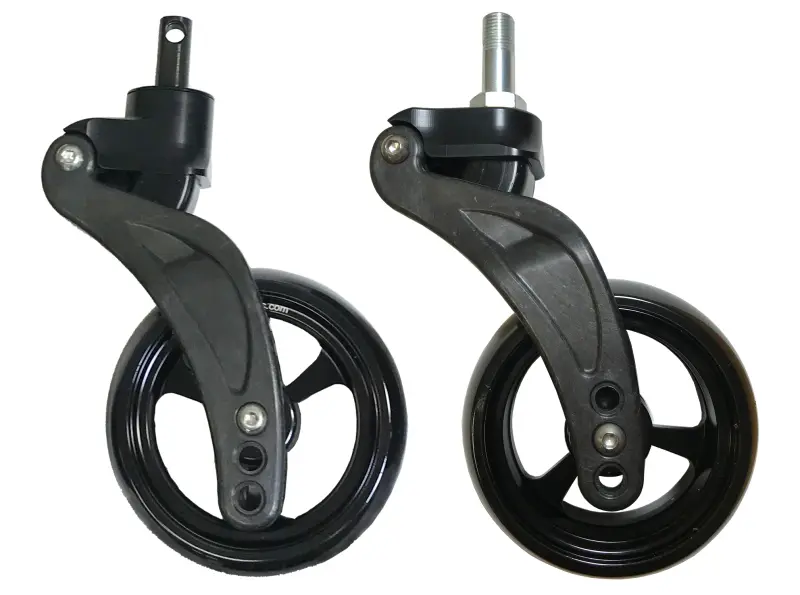
- 8 inch caster wheels with fork: what a set includes
- Suspension forks and shock-absorbing casters
- What the owner's manual says about wheels, tires and casters
- Does Medicare pay for wheels, tires and casters?
- The codes for wheels, tires and casters
- The gear reduction drive wheel (E2227)
- Power chair drive wheels and casters
- The recall file: eight records about wheels, casters and axles
- What our catalog holds
- Like for like, or a change?
- Reading a parts listing
- Before you order: a fit checklist
- Three traps
- Three composite scenarios
- Questions to ask the dealer, the therapist and the supplier
- Sources and documents
- Common questions
- Sources
The short answer
How do you choose or replace the wheels, handrims, casters, tires and axles on a manual wheelchair? Mobility Atlas read the makers' pages, three retailers' price lists, Sunrise Medical's Quickie 2 owner's manual and Medicare's wheelchair accessory rules on 25 October 2026. Rear wheels and handrims are pushed; casters and forks swivel; tires trade air for puncture resistance. In US listings, Spinergy's own page priced its rear wheels from 365 to 1,635 dollars per pair, Sportaid had handrims on sale at 65 dollars, unit not stated, and WheelchairParts.Net listed 8 inch casters fitted to forks at 84.50 dollars a set of 2. The manual warns that moving the rear axles forward makes a backward tip more likely. Medicare's policy article bundles wheels, casters, forks, handrims, solid tires and complete wheel assemblies into a manual chair at first issue, and all tires and wheels into a power chair; a later worn part replaced with the same type is billed by the supplier as a replacement.
| Part | What it changes | Listed prices (USD, unit as printed) | Read before ordering |
|---|---|---|---|
| Rear wheels | Weight, stiffness, spokes | 142 (unit not stated) to 1,635 per pair | Rim size, bearing, capacity |
| Handrims (push rims) | Grip, comfort, hand braking | 65 (sale, unit not stated) to 780 per pair | Mount type, rim size |
| Front casters and forks | Rolling, turning, flutter | 22 (unit not stated) to 539.99 | Size, axle hole, stem bolt |
| Tires and tubes | Rolling, punctures, grip | Tires 54 to 137 per pair, tubes 20 per pair (Spinergy) | Size code, pressure |
| Quick-release axles | How the wheel comes off | 49 (unit not stated) to 286 per pair | Diameter, grip length |
Sellers in the table: the rear wheel range runs from an 1800wheelchair mag assembly to Spinergy's CLX; the handrim range from a Sportaid sale price (unit not stated) to Spinergy's titanium rims; casters and forks from a Sportaid caster to a Frog Legs system, one of two prices its page prints; tires are Spinergy's; axles run from Sportaid to Spinergy. The prices are United States prices in US dollars, read on 25 October 2026 on each seller's own page: the maker's page for Spinergy and Frog Legs, and the selling prices of three retailers, 1800wheelchair, Sportaid and WheelchairParts.Net. Where a page says per pair, set of 2 or each, we say the same; where it does not, we say so. Prices differ by country, by seller, by tax and by who pays, so treat every figure here as a listed price on one date, not a quote.
Mobility Atlas earns a fee or margin when you order through us; the comparison below uses only the makers' published pages and manual, the sellers' listed prices, the Medicare rule and policy article, the FDA's recall records and our own catalog. If you want help finding a part that fits your chair, send an enquiry with the chair's make, model and serial number and a photo of the old part, and ask us to find it.
Which wheel size, camber, axle position or caster size suits a person is not a parts question. The owner's manual we read sends axle and caster position to the user's doctor, nurse or therapist, and rear axle changes to their healthcare advisor; in practice, the seating specialist, the physical or occupational therapist, or the assistive technology professional (ATP) who set the chair up. Upkeep and fixes are covered in the guides to manual wheelchair repair and tire and caster care.
How we compared
On 25 October 2026 we read and saved Medicare's coverage rule L33792 on wheelchair options and accessories and its policy article A52504; the HCPCS descriptors for the wheel, tire and caster codes from the National Library of Medicine's table, because the CMS documents print none; Sunrise Medical's Quickie options page, Quickie 2 specification page and Quickie 2 and 2HD owner's manual (MK-100070 Rev. G); the wheel, handrim, axle and tire pages of Spinergy and the fork and caster pages of Frog Legs; the price pages of 1800wheelchair, Sportaid and WheelchairParts.Net; Pride Mobility's pages for three Jazzy power chairs; and the FDA's recall records for wheelchairs. We also use Pride's Jazzy 614 troubleshooting sheet, read on 11 October 2026, and the MSKTC maintenance guide and WheelchairBearings.com's price list, read on 16 October 2026.
We read the 131 rows of our own catalog that cover these parts: 114 under "Wheels, handrims and tires" and 17 under "Casters, forks and front attachments". Catalog prices are guide prices from our catalog, checked October 2026, written as "around" or "from … to", with the seller the row names.
Four limits matter. We did not fit, push or measure any part; every figure is the maker's or the seller's. The manual is one maker's manual for one chair family; your chair's own manual is the one that counts. The Medicare section reads the rule and the policy article, not the fee schedule or Medicare.gov, so it gives no dollar amount or share. And the guide is written for the United States; elsewhere, confirm with your supplier or health service.
The five parts, and what each one changes
A manual wheelchair meets the ground at four points. The two big rear wheels are pushed by the user; Medicare's policy article calls a propulsion wheel "a large wheel which can be used by a beneficiary to propel the wheelchair with his/her arms." The two small front wheels are casters: the same article says a caster "cannot be used for arm propulsion." Between them sit five things you can choose or replace.
| Part | What it is | What a change does |
|---|---|---|
| Rear wheel | Rim, spokes or mag, hub, bearings | Changes weight, spokes and look |
| Handrim (push rim) | Ring the hand pushes and brakes on | Changes grip, comfort and hand heat |
| Caster and fork | Small front wheel and its holder | Changes rolling, turning, seat height |
| Tire and tube | Air, foam or solid, on the rim | Changes rolling, punctures, lock grip |
| Quick-release axle | Pin through the hub into the frame | Lets the wheel come off |
Replacing a worn part with the same part keeps the chair as it was. A bigger or smaller wheel, a different caster size or a new axle position moves the chair's balance point. Sunrise's Quickie 2 manual says: "How your chair is set up, the options you select and the changes you make may affect the risk of a fall or tip-over." That second kind of change belongs to the person who set the chair up.
Rear wheels: mag, spoked, fibre-spoked and carbon
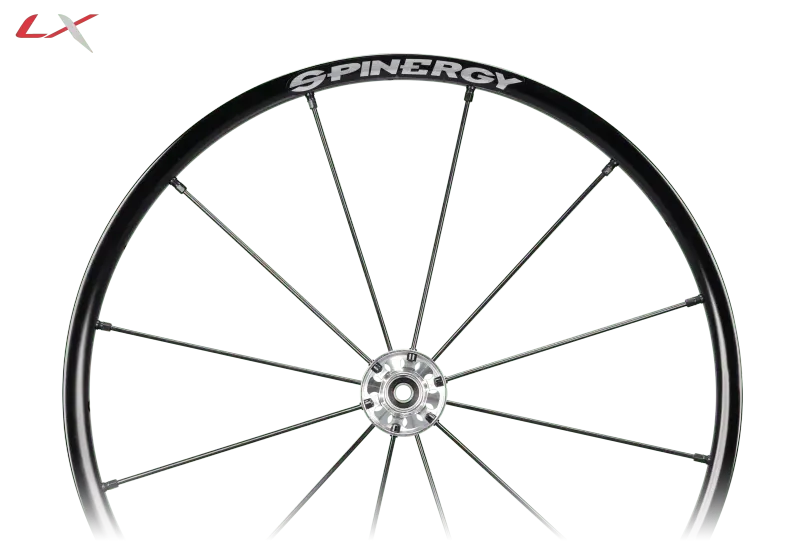
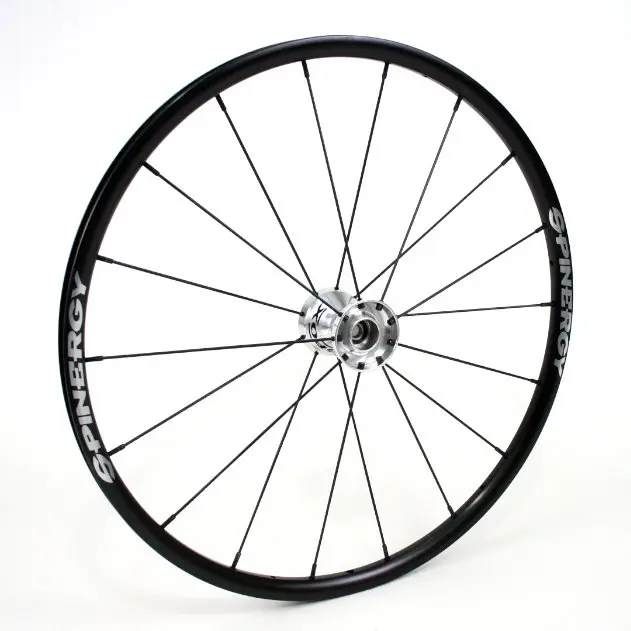
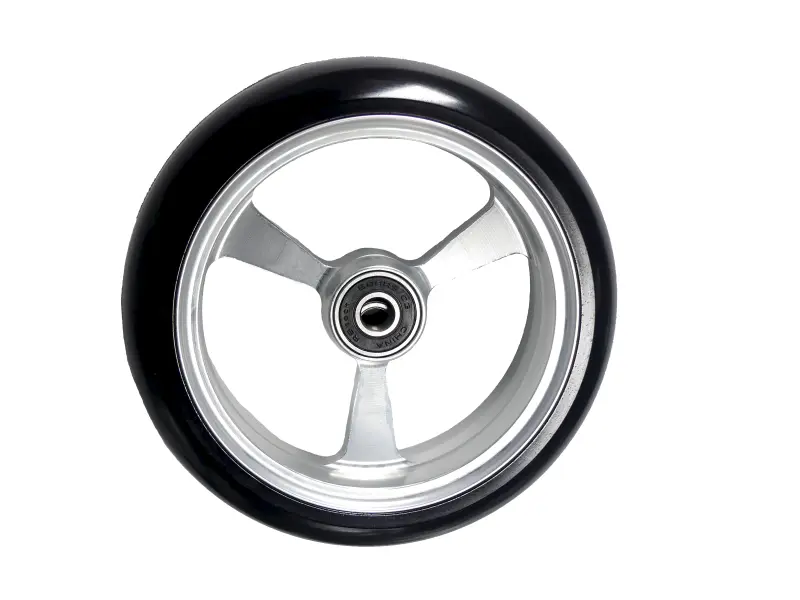
Rear wheels come in a few families. 1800wheelchair listed two 24 x 1 inch "9-Spoke Black Mag" wheel assemblies with urethane tires. Spinergy's Wire Wheel laces 30 steel spokes to an aluminium rim. Spinergy's other wheels use PBO fibre spokes, which the maker calls "3X STRONGER THAN STEEL, 1/2 THE WEIGHT"; its CLX has a carbon fibre rim. Sunrise's Quickie options page lists mag, standard, lite and ultra lightweight spoke wheels, Spinergy wheels and a mountain wheel, noting that "Not all accessories are available on all chairs."
Spinergy prints a weight for each wheel, which lets you compare like with like within one maker. The table lists the seven Spinergy wheels we read, as printed on its US page on 25 October 2026, with the price per pair.
| Spinergy wheel | Spokes | Weight per wheel | Sizes | Price per pair |
|---|---|---|---|---|
| Wire Wheel | 30 steel, 14 gauge | 776 g | 20 to 26 in | 365 |
| SPOX Everyday | 18 PBO, 3 mm | 721 g | 20 to 26 in | 860 |
| SPOX Sport (SL) | 24 PBO, 3 mm | 739 g | 24, 25, 26 in, 700c | 885 |
| Lite Extreme LX | 12 PBO, 4 mm | 687 g | 22 to 26 in | 1,065 |
| SLX 24 | 24 PBO, 4 mm | 779 g | 24, 25, 26 in, 700c | 1,065 |
| XLX (X-laced) | 12 PBO, 4 mm | 658 g | 22 to 26 in | 1,130 |
| CLX (carbon rim) | 18 PBO blade, 3 mm | 530 g | 24, 25 in | 1,635 |
By our sums, the CLX is 246 grams lighter per wheel than the Wire Wheel, or 492 grams for the pair, and costs 1,270 dollars more per pair; per wheel, the Wire Wheel comes to 182.50 dollars and the CLX to 817.50. The pages do not say whether the printed weight includes tire and handrim, so compare weights within one maker.
The maker says what each wheel is for: the SPOX Everyday is "Best for: Classic, all-purpose, daily use, affordable," its page says, and the SLX 24 "Best for: Durability, contact sports, elite athletes." Those are the maker's descriptions, not test results. Sport wheels are covered in the guide to sports wheelchairs.
Other rear wheels on sale
| Wheel, as listed | Seller | Price (USD) | Pair or each |
|---|---|---|---|
| 24 x 1 in 9-spoke black mag, 5/8 in bearing | 1800wheelchair | 142 | Not stated |
| 24 x 1 in 9-spoke black mag, 7/16 in bearing | 1800wheelchair | 165 | Not stated |
| Sun Components Classic 24 x 1 in | Sportaid | 269.00 | Not stated |
| Vapor 13 aluminium | Sportaid | 299.00 | Pair (catalog) |
| Shadow Wheel by Out-Front | Sportaid | 326.50 | Pair (catalog) |
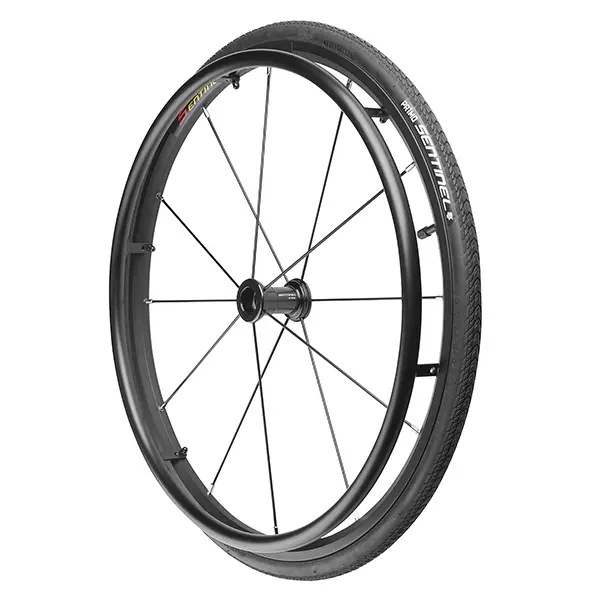
| Primo Sentinel, 12 straight-pull spokes | Sportaid | 375.00 | Pair (catalog) |
| Spinergy FlexRim | Sportaid | 1,296.00 | Not stated |
Sportaid's grid does not say pair or each; where our catalog row for the same wheel says it is sold or priced as a pair, we give that. Our catalog row for the Primo Sentinel wheel (AC-228) gives a 250 lb capacity, and the SPOX Everyday row (AC-226) "250 lb capacity on narrow hubs". Spinergy's own pages that we read print no weight limit.
What rear wheels cost: maker list and dealer price
The same wheel can carry two prices on the same day. Spinergy's page listed the SPOX Everyday at 860 dollars per pair and Sportaid's grid at 774.00: 86 dollars, or about 10 percent, below the maker's figure by our sums. The LX was 1,065 per pair at Spinergy and 958.50 at Sportaid, 106.50 less if Sportaid's price is also per pair, which its grid does not say. The Wire Wheel went the other way: 365 per pair at Spinergy and 445.50 at Sportaid, 80.50 more, though Sportaid's name for it does not say pair.
Wheel prices are hard to compare for reasons set out in the section on reading a parts listing below, three of them in particular: per pair or per wheel, what is included (our catalog row for the Primo Sentinel wheel says "axles not included"), and the currency a store shows. The Spinergy store shows prices in the visitor's local currency; we read it in US dollars, and the maker's USD prices here are as read that way.
Rim sizes, tire sizes and the numbers on the sidewall
Wheel sizes are written two ways. The everyday size is in inches: 22, 24, 25 or 26. The second is the rim number in millimetres, which Spinergy prints next to each: 20 in (451), 22 in (501), 24 in (540), 25 in (559), 26 in (590), and 700c (622) for some sport wheels. Tires use the same number with the tire width in front of it: a 24 x 1 inch tire is listed as 25-540 (or 23-540 for a narrower tire) on Sportaid's grid, a 24 x 1-3/8 inch tire as 37-540.
| Wheel size | Rim (mm) | Example tire listings |
|---|---|---|
| 20 in | 451 | Schwalbe RightRun, Pr1mo Orion Solid |
| 22 in | 501 | Primo Orion Grey 22 x 1-3/8 (37-501) |
| 24 in | 540 | Schwalbe Downtown 24 x 1-3/8 (37-540) |
| 25 in | 559 | Kenda Court Iron Cap 25 x 1 (23-559) |
| 26 in | 590 | Schwalbe Marathon Plus Evolution |
| 700c | 622 | Primo Super H 700 x 28 (28-622) |
Read the millimetre number on the old tire before ordering, not only the inches. The inch label is not reliable: our catalog row for the Pr1mo Raptor says its "26 x 2.1" knobby tire is "for 559 mm rims only", which is the rim Spinergy calls 25 inch, and Sportaid lists a 22 inch Marathon Plus Evolution as 25-489, where Spinergy's 22 inch rim is 501. A change of wheel size is also a change of chair: in our reading it can move the seat height, the reach to the handrim and the tipping point, and the manual says a change in set-up of the rear wheels "will affect the center of balance of your chair" and tells users to consult their "healthcare advisor" before changing the rear axle set-up.
Handrims and push rims
The handrim, also called a push rim, is the ring fixed to the outside of the rear wheel. The user pushes on it to move and grips it to slow down. Handrims differ in material, shape, coating and the way they mount to the wheel. Sunrise's options page lists Anodized Aluminum, Plastic Coated, Natural Fit, Curve L Tetra Grip, Ellipse, Gekko and Oblique handrims for Quickie chairs.
| Handrim, as listed | Seller | Price (USD) | Unit |
|---|---|---|---|
| Aluminum, silver, 3/4 in tube | Spinergy (maker) | 130.00 | Per pair |
| Natural Fit Original Oval | Spinergy (maker) | 310.00 | Per pair |
| TC stainless steel, embossed | Spinergy (maker) | 450.00 | Per pair |
| Natural Fit Surge | Spinergy (maker) | 480.00 | Per pair |
| Titanium, satin finish | Spinergy (maker) | 780.00 | Per pair |
| 25 in X-Core 3 spoke, black anodized | Sportaid | 65.00 (was 99.00) | Not stated |
| Newton AirGrip by Motion Composites | Sportaid | 134.00 | Not stated |
| Titanium, choose size | Sportaid | 535.00 | Not stated |
On Spinergy's page the handrims ran from 130 to 780 dollars per pair, titanium costing 650 more than silver aluminium by our sums; on Sportaid's grid, from 65.00, a sale price, to 535.00. Spinergy says the Natural Fit Original Oval "offers 80% more surface area for grasping than a standard handrim and weighs just 24 ounces," and that the Surge's sides "retain a smooth braking surface." Those are the maker's words. Whether a coated, oval or ergonomic rim suits a user's hands and shoulders is a question for the therapist.
Mounting: tabs and rivnuts
A handrim bolts to the wheel at several points, and they must match. Spinergy's aluminium and titanium rims use "6 Q-tab" mounting; its CLX wheel uses a "Rivnut handrim mounting system." Our catalog row for the TC MAX rim says "6 Q-tab attachment, not for rivnut wheels", and the Surge row lists five mounts for different wheels. Count the mounting points on your wheel and ask the seller to confirm the mount.
Our catalog also lists 2 slip-on handrim cover rows, including RehaDesign's Ultra-Grrrip covers at around 70 dollars (65 euros). Whatever the rim, the MSKTC maintenance guide says to check monthly: "While propelling, make sure the handrim is firm (not loose)." Gloves and other add-ons are in the guide to wheelchair accessories.
Quick-release axles and bearings
Many chairs, the Quickie 2 among them, hold each rear wheel on a quick-release axle. The manual's steps: press the button fully, which releases the tension on the ball bearings at the other end, slide the axle through the hub into the axle sleeve, and let go to lock it. Sunrise lists four kinds for Quickie chairs, including big button and quad versions; ask the therapist which button suits the user's hands.
| Axle, as listed | Seller | Price (USD) | Unit |
|---|---|---|---|
| Steel axle, 1/2 in, stainless | Spinergy (maker) | 146.00 | Per pair |
| Titanium axle, 1/2 in | Spinergy (maker) | 286.00 | Per pair |
| Large button quick release axles | Sportaid | 65.00 | Not stated |
| Small button quick release axles | Sportaid | 49.00 | Not stated |
| Quickie axle sleeve | Sportaid | 20.50 | Not stated |
Two numbers decide whether an axle fits. The first is the diameter: Spinergy's axles are 1/2 inch, and its wheel pages list stainless steel bearings for a 1/2 inch or 12 mm axle. The second is the grip length, the distance the axle must span. Spinergy prints five, from 3.75 to 4.75 inches, and says its "nylock nut is adjustable so you can dial in the grip length for zero slop." By our sums, its titanium axle costs 140 dollars more per pair than the steel one.
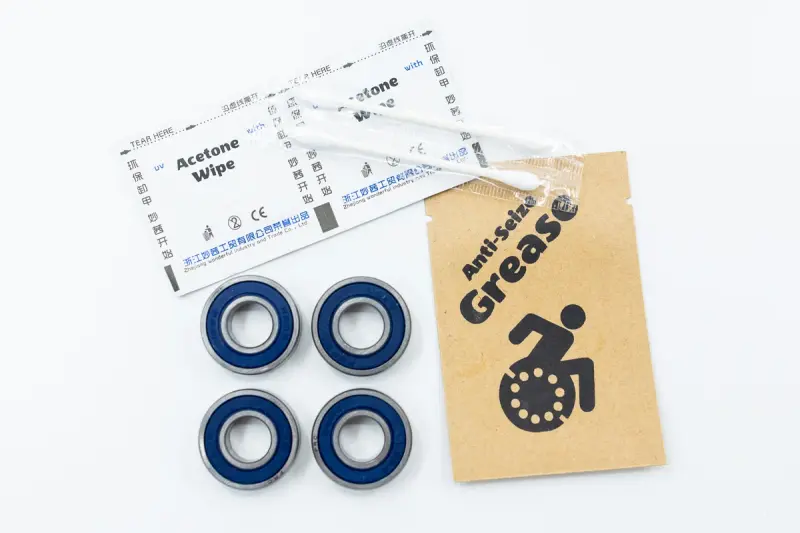
The hub bearing must match the axle. WheelchairBearings.com, read on 16 October 2026, listed R8 1/2 inch and R10 5/8 inch bearings at 24.99 dollars a 4-pack, and Spinergy's SLX page points users of a 5/8 inch axle to its "SLX R-10 or XSLX R-10 wheels." The two 1800wheelchair mag wheels came with a 5/8 or a 7/16 inch bearing. Replacing bearings is covered in the guide to manual wheelchair repair.
Tires: pneumatic, high pressure, puncture resistant, foam and solid
Medicare's policy article defines the tire types, and makers add their own names: high pressure, puncture resistant, knobby, low profile. "A pneumatic tire (E2211, E2214) is a rubber tire which is used in conjunction with a separate tube (E2212, E2215) which is filled with air," the article says. A flat free insert is a removable ring of firm material inside a pneumatic tire, so the chair keeps moving after a puncture. A foam filled tire has a rubber shell filled with foam that cannot be removed; a foam tire is all self-skinning urethane; a solid tire is hard plastic or rubber.
| Tire, as listed | Type | Seller | Price (USD) | Unit |
|---|---|---|---|---|
| Schwalbe RightRun, max 145 psi | Pneumatic | Spinergy | 54.00 | Per pair |
| Pr1mo Orion Solid 1-3/8 in | Solid urethane | Spinergy | 76.00 | Per pair |
| Pr1mo Sentinel, 3 mm insert | Pneumatic | Spinergy | 110.00 | Per pair |
| Schwalbe Marathon Plus Evolution | Pneumatic, Smart Guard | Spinergy | 137.00 | Per pair |
| SHOX G2 Solid, 110psi equivalent | Solid | Sportaid | 47.50 | Pair |
| 24 x 1-3/8 in pneumatic, tread C63 | Pneumatic | 1800wheelchair | 62 | Not stated |
| Solid 24 x 1-1/4 in, full profile | Solid polyurethane | 1800wheelchair | 81 | Not stated |
On 1800wheelchair's tire page the rear tires for manual chairs ran from 62 to 81 dollars, without saying each or pair. On Spinergy's page, tires ran from 54 to 137 dollars per pair, and the page adds that the price "is only for the listed Tires". Our catalog holds 53 tire rows, 9 of them scooter tires and 9 power chair drive tires; the Primo Sentinel (AC-104), for example, is listed at 65 to 66.50 dollars per pair at Sportaid, rated 125 psi.
What the trade-off looks like on paper
- Air. A pneumatic tire needs a tube and its pressure checked. Sunrise's manual says to check "at least ONCE PER WEEK", and that low pressure in a rear tire "may cause the wheel lock on that side to slip".
- Puncture protection. Makers add a layer inside the tire: Spinergy lists the Pr1mo Sentinel with a "3mm LDP anti-puncture insert", its page says, and the Marathon Plus Evolution with "Maximum" protection due to "Smart Guard".
- No air at all. Solid and foam tires cannot go flat. Spinergy's page says the Orion solid tire's "Non-marking solid urethane construction means flat-tree [sic], maintenance free performance."
- Width and tread. Knobby tires such as the 2.1 inch Kenda Nevegal and the Pr1mo Raptor, which our catalog row says has an "aggressive all-terrain tread", are sold for rough ground.
The pages we read print no rolling-resistance or comfort test, so this guide makes no claim about which tire rolls easier for a given user. Which tire suits the user's pushing, terrain and transfers is a question for the therapist or seating specialist. When to replace a worn tire is covered in the guide to tire and caster care.
Tubes, liners, valves and pressure numbers
Every pneumatic tire needs a tube, and every tube a valve. Sunrise's options page lists Presta and Schrader valves and a "Presta to Schrader Valve Adapter" for Quickie chairs. Check which valve your rim is drilled for, and which pump head you have: Sportaid lists the Topeak JoeBlow Sport floor pump, 160 psi, for "Schrader or Presta Valve", at 49.95 dollars.
| Item, as listed | Seller | Price (USD) | Unit |
|---|---|---|---|
| Heavy duty tube 24 x 1 in, Schrader | Sportaid | 10.50 | Not stated |
| Front tube 8 x 1-1/4 in, straight valve | Sportaid | 6.99 | Not stated |
| Tuffy tire liners, pair | Sportaid | 12.75 | Pair |
| Tube 24 in, Schrader valve | 1800wheelchair | 56 | Not stated |
| Invacare 24 x 1-3/8 in solid insert tube | 1800wheelchair | 75 | Not stated |
Prices for the same kind of item differ a lot between sellers: a 24 inch Schrader tube was 10.50 dollars at Sportaid and 56 at 1800wheelchair on the same day, as printed, and they may not be the same tube. Our catalog lists 21 tube rows, most of them between about 6 and 11 dollars a tube.
The right pressure is printed on the tire's sidewall, and the manual says to use that figure. Pressures are printed in psi, bar or both. Pride's troubleshooting sheet for the Jazzy 614 gives the conversion: "bar = psi x 0.06895". By that formula, 100 psi is about 6.9 bar and the RightRun's 145 psi maximum about 10.0 bar. Sunrise's manual warns: "Over-inflated tires may burst."
Front casters: size, tread and bearings
Casters are the small front wheels that swivel. Frog Legs' page talks of rolling over brickwork, broken sidewalks and door jams; Sunrise's manual lists sluggish turning and caster flutter among the faults it covers. Sunrise's Quickie options page lists casters from 3 to 8 inches: aluminium soft roll, pneumatic, semi-pneumatic, polyurethane, lighted and a Spinergy cast carbon caster. Which size suits a user and their chair is the seating specialist's call.
| Caster, as listed | Seller | Price (USD) | Unit |
|---|---|---|---|
| 3 x 1 in black roller blade | Sportaid | 22.00 | Not stated |
| 4 x 1 in poly, grey | Sportaid | 39.00 | Not stated |
| 6 x 1-1/4 in soft roll, grey | Sportaid | 49.00 | Not stated |
| 8 x 1-1/4 in pneumatic, grey tire | Sportaid | 75.00 | Not stated |
| 5 x 1.5 in 3-spoke urethane, Invacare | 1800wheelchair | 79 | Not stated |
| Invacare 8 x 1 in, 7/16 in bearings | 1800wheelchair | 63 | Not stated |
| Frog Legs AGOG composite, 4 to 6 in | Frog Legs (maker) | 49.99 | Pair |
| Frog Legs EPIC aluminium, 4 to 6 in | Frog Legs (maker) | 159.98 | Pair |
| Frog Legs Whisper shock absorber | Frog Legs (maker) | 199.99 | Pair, sold out |
Frog Legs prints details others do not. Its EPIC casters are 1.4 inches wide, weigh 224 grams at 4 inches and 398 grams at 6 inches, and take 608 bearings with an 8 mm bore. Its Whisper casters were shown as sold out in every size on 25 October 2026, with a warning of "2-4 weeks lead time after order." The EPIC's tread "will not go flat and is designed to minimize energy loss and absorb vibration," the maker's page says.
The bearing in a caster is often smaller than the rear one. WheelchairBearings.com listed 608 caster bearings, 8 mm, at 19.99 dollars for a 4-pack and R6 front caster bearings, 3/8 inch, at 21.99; the Invacare 8 inch casters at 1800wheelchair use 7/16 inch bearings. Our catalog holds 6 caster wheel rows and three caster bearing rows. Caster flutter, wobble and hair in the bearings are repair topics: see the guide to tire and caster care.
8 inch caster wheels with fork: what a set includes
8 inch casters are used on many standard chairs: 1800wheelchair says one Invacare caster assembly with an 8 x 1 inch tire "fits most standard invacare wheelchairs." Some owners replace caster and fork together. The words matter. Medicare's policy article says a replacement caster assembly "includes a caster fork, wheel rim, and tire." Retailers use "caster assembly" more loosely: 1800wheelchair's caster products list the tire, hub and bearings, and none includes a fork. WheelchairParts.Net sells both forks alone and forks with the caster fitted.
| 8 inch item, as listed by WheelchairParts.Net | Price (USD) | Unit |
|---|---|---|
| 8 x 1.25 in caster and composite fork assembly | 84.50 | Set of 2 |
| 8 x 1 in composite caster fork | 46.50 | Set of 2 |
| 8 x 2 in composite caster fork | 45.50 | Set of 2 |
| 8 in aluminium caster forks, 5/16 in axle | 69.50 | Set of 2 |
| Invacare 8 in chrome steel forks, 7/16 in axle | 39.50 | Set of 2 |
| E and J 8 in chrome steel fork, 5/16 in axle | 38.00 | Set of 2 |
By our division, the 8 inch fork and caster assembly comes to 42.25 dollars per side. The same seller listed it in 5, 6 and 7 inch sizes from 75.50 to 79.50 a set of 2. Drive Medical's own parts search page lists a "Caster Fork, 8 in." and a "Caster Fork, 8 in., with suspension" but shows no price without a sign-in.
Four measurements before you order
- Caster size: diameter and width, read off the tire, such as 8 x 1.25 inches.
- Caster axle hole: the WheelchairParts.Net assembly has a 5/16 inch caster axle mounting hole, its page says; other forks in the same list take 7/16 inch or 8 mm axles.
- Stem bolt: the bolt that goes up into the caster housing on the frame. The same assembly has a 1/2 x 1-1/8 inch threaded stem bolt, which its page says is removable so you can fit "the existing stem bolts from your current caster forks when needed".
- Fork material and height: composite, aluminium or chrome steel, and a fork tall enough for the caster. The seller says its composite forks offer "excellent corrosion resistance".
The manual's dealer section says two-hole forks allow "adjusting seat height", so a fork or caster that sits higher or lower than the old one can change it, and that the caster housing "should always be at a 90º angle to the floor". If the new fork is not an exact match, let the dealer fit it.
Suspension forks and shock-absorbing casters
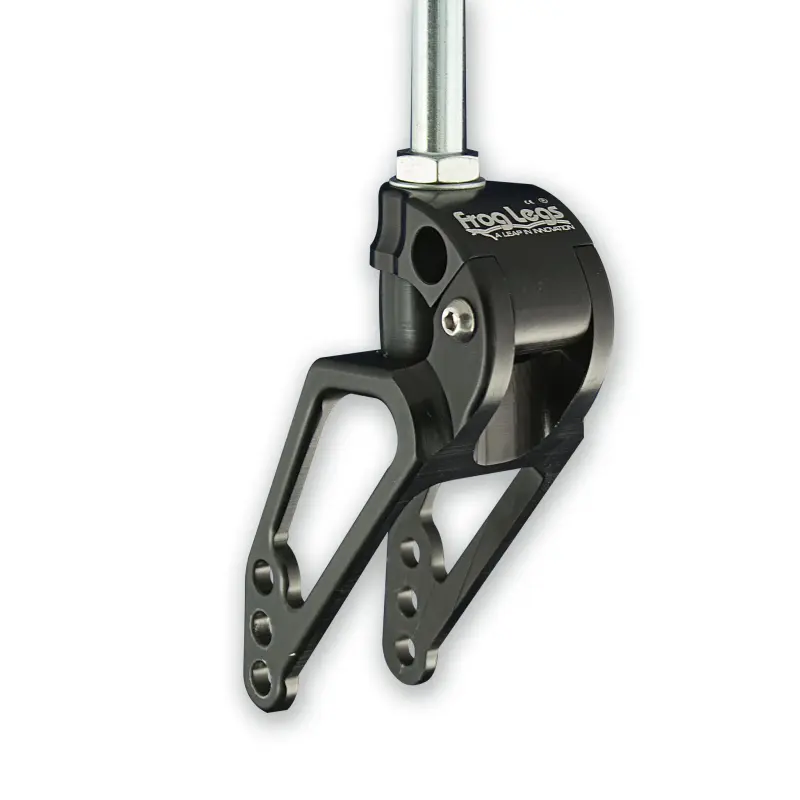
Frog Legs says its suspension forks let the caster lift back and up over a bump; the Frog Legs II uses a "wedge progressive polymer damper", its page says. Frog Legs is the maker named on Sunrise's fork list ("Frog Leg"), and its US page, read on 25 October 2026, listed three systems.
| Frog Legs product | What is included | Price printed (USD) | Weight range printed |
|---|---|---|---|
| Phase I suspension fork | Fork pair, no wheels | 299.99 | Not printed |
| Frog Legs II carbon fiber system | Fork pair and wheels | 499.99 and 399.95 | Up to 260 lb |
| Heavy Duty shock absorber forks | Fork pair and wheels | 539.99 and 449.99 | Up to 260 lb |
The Frog Legs II and Heavy Duty pages each printed two prices in an order that does not show which applies, so we give both; ask for the price in writing. Both are designed, the maker says, for a "one size fits most" user weight range up to 260 pounds. Our catalog, checked October 2026, lists the Frog Legs II at around 499.99 dollars per set (AC-022) and the Phase I at around 299.99 per pair (AC-021).
By our sums of the printed prices, a Phase I fork pair plus a pair of EPIC casters comes to 459.97 dollars, and a Phase I with AGOG casters to 349.98. The Frog Legs II system at its 499.99 figure is 40.02 dollars more than the Phase I and EPIC pair.
Reading the maker's claims
Frog Legs makes strong claims, and they are the maker's. The Phase I page says its forks "eliminate 76% of all shock and provide the front casters the ability to lift back, up and over obstacles to minimize pitching." The pages we read give no test method for that figure, and none of the maker's claims is an independent test.
The Phase I page also lists "Medical Justification Codes For Frog Legs": E1015 to E1018, with R and L versions, for light weight and heavy duty manual and power chairs. That list is the maker's claim, not a Medicare coverage statement, and these codes are not among those we read in the Medicare rule and article. Even about its own notes that an item may be billed separately, the article says: "The statement that an item may be separately billed does not necessarily indicate coverage." Ask the supplier how it would bill a suspension fork.
What the owner's manual says about wheels, tires and casters
What does a manual wheelchair owner's manual say about axles, tires, axle position and caster pin locks? Mobility Atlas read Sunrise Medical's owner's manual for the Quickie 2 and 2HD, MK-100070 Rev. G, on 25 October 2026. Before each use, it says, check that both quick-release rear axles are locked, with the button popped out fully: "If not locked, the wheel may come off and cause you to fall." Check pneumatic tire pressure weekly against the sidewall, because low pressure can let the wheel lock slip and make the chair veer, and over-inflated tires may burst. The most important adjustment for tipping is the rear wheel position: the farther forward the axles, the more likely a backward tip, so do not change it without the healthcare advisor. After any axle change, readjust the wheel locks so they press into the tire at least 1/8 inch. Caster pin locks stop the casters swivelling during transfers but do not stop the chair rolling.
Axles
The manual's axle warning: "An axle is not locked until the quick-release button pops out fully," and an unlocked axle "may come off during use, resulting in a fall, tip-over or loss of control". Check by pulling on the wheel "in the direction of the axle," it says, and clean and inspect the axles for wear or bending.
Tires and wheel locks
The tire warning reads: "Do not use this chair if any of the tires are under- or over-inflated." The wheel locks depend on the tires: "Wheel locks must be adjusted after making sure the tires have the correct air pressure," the manual says. In our reading, a change of tire therefore matters beyond the tire: a solid tire, a thinner tire or a new wheel may leave the locks short of the tire, so have them checked. Rear wheel locks "are NOT designed to slow or stop a moving wheelchair," it adds.
Axle position and tipping
The manual calls rear wheel position "The Most Important Adjustment" for balance: "The more you move the rear wheels forward, the more likely your chair will tip over backward." Camber, the distance between the wheels, seat height and backrest angle matter too. On the rear axles it says: "Do not change the set-up UNLESS you consult your healthcare advisor first." The Quickie 2 is sold with 0, 2 or 4 degrees of camber, Sunrise's page says.
Caster pin locks
Sunrise lists a caster pin lock among its fork options. The manual says: "Always use both pin locks when transferring in and out of the chair. Caster pin locks only keep the front caster wheels from changing direction, they do not lock-out the front wheels from rotation." To stop the chair rolling you must also engage the rear wheel locks, and if you push the chair with the pin locks on, "the chair will be prevented from turning."
Parts not approved by the maker
The manual warns that parts "not supplied or approved by Sunrise Medical may change the chair structure," naming first "Incorrect Wheels and/or tires that put the rider at risk of a fall or tip-over." It also lists option-specific limits: the chair is rated 300 lbs (350 lbs for the 2HD), but its Topolino rear wheels 265 lbs. Ask the dealer before you fit a third-party wheel.
Does Medicare pay for wheels, tires and casters?
Does Medicare pay for replacement wheelchair wheels, tires, handrims or casters? Mobility Atlas read Medicare's coverage rule for wheelchair options and accessories, LCD L33792, and its policy article, A52504, on 25 October 2026. At first issue, the article's bundling table lists handrims, propulsion and caster wheels, forks, bearings, solid tires and complete wheel and caster assemblies as not separately payable with a manual wheelchair base, and says all types of tires and wheels are included in a power wheelchair base. Later, a part that has worn out or been damaged and is replaced with the same type is billed by the supplier as a replacement with the RB modifier, the article's example being "replacing a tire of the same type". An upgrade is not a replacement. The rule's general test still applies: the chair must meet Medicare's criteria and the part itself must be medically necessary. Among wheels, tires and casters, only the gear reduction drive wheel has its own written criteria.
What the rule says, in its own words
The coverage rule's general test reads: "Options and accessories for wheelchairs are covered if the beneficiary has a wheelchair that meets Medicare coverage criteria and the option/accessory itself is medically necessary." The policy article says codes in the bundling table's second column "are not separately payable from the wheelchair base and must not be billed separately at the time of initial purchase or rental of the wheelchair."
On replacements, the article says the RB modifier is used "when an option or accessory is provided as a replacement for the same part which has been worn or damaged," and "must not be used for an upgrade subsequent to providing the wheelchair base". A part with no specific code that is not included in another code is billed as K0108; a replacement accessory for a transport chair as E1399.
What the rules we read do not say
The coverage rule and the policy article we read give no specific criteria for spoke protectors (K0065), handrims (E0967, E2205), caster pin locks (K0073), casters or lightweight wheels. That does not mean Medicare never pays for them: they fall under the general test, and the supplier decides how to bill. Nor is a code on a maker's page a promise: Sunrise gives the Quickie 2 the code K0005 and Pride prints "Medicare Code Coverage" or "HCPCS Code" lines for its Jazzy chairs, which say which code a chair falls under, not that Medicare will pay for a given user.
We did not read Medicare.gov's pages on what a beneficiary pays, or the fee schedule, so this guide gives no share or dollar amount. Ask the supplier, in writing, which code it will bill, whether it accepts assignment, and what you will owe. Medicare Advantage plans, Medicaid and the VA set their own rules; confirm with the plan.
The codes for wheels, tires and casters
Suppliers bill parts by HCPCS code. The CMS rule and article name the codes but print no descriptor table, so the descriptors below come from the National Library of Medicine's HCPCS table, read on 25 October 2026. Many say "replacement only" in their long descriptor; we copy that wording, and draw no conclusion from it about coverage.
| Code | Descriptor, as printed (shortened) | Unit |
|---|---|---|
| E2205 | Handrim without projections, replacement only | Each |
| E0967 | Hand rim with projections, replacement only | Each |
| K0069 | Rear wheel assembly, solid tire, replacement only | Each |
| K0070 | Rear wheel assembly, pneumatic tire, repl. only | Each |
| E2224 | Propulsion wheel excludes tire, replacement only | Each |
| E2211 | Pneumatic propulsion tire, any size | Each |
| E2212 | Tube for pneumatic propulsion tire | Each |
| E2220 | Solid propulsion tire, replacement only | Each |
| K0071 | Front caster assembly, pneumatic tire, repl. only | Each |
| K0072 | Front caster assembly, semi-pneumatic, repl. only | Each |
| K0077 | Front caster assembly, solid tire, repl. only | Each |
| E2225 | Caster wheel excludes tire, replacement only | Each |
| E2226 | Caster fork, replacement only | Each |
| K0073 | Caster pin lock | Each |
| K0065 | Spoke protectors | Each |
| E2227 | Gear reduction drive wheel | Each |
The article says a replacement rear wheel assembly (K0069, K0070) "includes a wheel rim plus a tire. For pneumatic tires, it also includes the tire tube, but not a flat free insert." Its table lists the part codes inside each assembly code, so K0070 includes E2211, E2212 and E2224, which should not be billed on top of it when supplied at the same time.
Note one gap in our reading. The bundling row for a manual wheelchair base lists the solid tire codes (E2220 to E2222) and the assemblies, but not the pneumatic, foam-filled and foam tire codes (E2211 to E2219) on their own. For power chairs, the same article says outright that all types of tires and wheels are included. Ask the supplier how a new manual chair's tires are billed if this matters to you.
The gear reduction drive wheel (E2227)
A gear reduction drive wheel is the one wheel in this guide with its own Medicare criteria. The policy article defines it as "one that has more than one gear ratio option. Pushing on the rim allows the user to manually shift between the gears in order to provide additional leverage to assist propulsion of a manual wheelchair." The coverage rule says it is covered if all three of these are met:
- The user "has been self-propelling in a manual wheelchair for at least one year".
- The user has had a specialty evaluation by a licensed or certified medical professional, such as a PT or OT, or a practitioner with specific training and experience in rehabilitation wheelchair evaluations, that documents the need for the device in the home. The rule says: "The PT, OT, or practitioner may have no financial relationship with the supplier".
- The chair is provided by a supplier that employs a RESNA-certified Assistive Technology Professional (ATP) who specializes in wheelchairs and "who has direct, in-person involvement in the wheelchair selection".
The article also defines a lever activated drive (E0988) and a wheel braking and lock system (E2228), "a caliper or disc type braking system". The pages we read give no product or price for either, and for power assist the article points to a separate Medicare policy, which we did not read.
Power chair drive wheels and casters
On a power chair, a drive wheel "is one which is directly controlled by the motor of the power wheelchair," Medicare's policy article says, and a caster is a smaller wheel "not directly controlled by the motor". The tire types are the same as on a manual chair.
| Pride chair | Drive | Drive wheels | Casters | Capacity | MSRP (USD) |
|---|---|---|---|---|---|
| Jazzy 600 ES | Mid-wheel | 14 in foam filled | 6 in solid OMNI front and rear | 300 lbs | 6,798 |
| Jazzy EVO 614 | Mid-wheel | 13.75 in perforated | 6 in front and rear | 300 lbs | 6,968 |
| Jazzy Elite HD | Front-wheel | 14 in foam filled | 6 in solid rear; 3 in anti-tips | 450 lbs | 6,645 |
Pride's pages, read on 25 October 2026, print the drive wheel and caster sizes but no price for a replacement tire. The 600 ES page says its tires are "Black, flat-free, non-marking", and its notes say range "Varies with user weight, terrain, battery type, battery condition and tire pressure."
Replacement power chair tires and casters are sold by size. 1800wheelchair listed a 14 x 3 inch foam-filled tire at 115 dollars, a 10 x 3 inch pneumatic tire at 75 and an Invacare 6 x 2 inch power chair caster assembly at 115. Our catalog row for a Primo Powertrax 14 x 3 foam-filled tire, listed as Pride part TIRSOLI1075 (AC-133), gives a "max weight 250 lb". Check a replacement tire's own load rating, not only its size.
Medicare bundles these parts with the chair at first issue, and for power chairs the policy article says so for every tire type: "All types of tires and wheels are included in the code for a power mobility base," it says, and the power chair tire, wheel and fork codes, E2381 to E2396, "may only be used for replacements other than at the time of initial issue."
Pride's troubleshooting sheet for the Jazzy 614 links pulling to the tires and casters: "If one tire is inflated more than the other, the power chair will pull to the side that is underinflated," it says, and a caster that is not pivoting freely makes the chair veer. Diagnosing a power chair is covered in the guide to power wheelchair repair, and choosing one in the guide to electric wheelchairs.
The recall file: eight records about wheels, casters and axles
We read the FDA's recall records for manual and powered wheelchairs held in our copy of the database: 111 records under the two product codes. A word search for wheel, caster, fork, axle, handrim and tire found 14; in 6 of those the word was only in the product's name, such as a 3-wheeled scooter, and the recall was about something else. That leaves 8 records about wheels, casters or axles, initiated between 2006 and 2016. All 8 are listed as terminated.
| Recall | Product, as named | Reason, in short | Units |
|---|---|---|---|
| Z-0039-2007, Z-0040-2007 | Eagle 624EZ and 624Mini power chairs | Wheel hub bolts may loosen | 365 for both |
| Z-0137-2008 | Freedom Designs TriPod | Anti-tipper may fail or break | 41 |
| Z-0634-2014 | Invacare Tracer IV, 24 in seat | Wheels warped and wobbled | 227 |
| Z-2695-2014 | PDG Fuze T50, T20, T50 Jr tilt | Axle plate bolt might shear | 153 |
| Z-0785-2013 | Invacare Solara 3G | Wheel may rotate with hub brake on | 3 |
| Z-0216-2015 | Silver Star transport chair and rollator | Wheel assembly failing | 129 |
| Z-1025-2016 | Karman Karma Flexx | Wrong screws on caster fork brackets | 35 |
The recall records say, for the Eagle power chairs, "The wheel hub bolts may loosen resulting in the wheels coming off"; for the Karma Flexx, "incorrect size screws and corresponding hardware were installed on the front caster fork brackets."
None of these is a recall of a replacement wheel, tire or caster sold on its own, and none is recent. A recall record shows what a maker corrected; it is not a count of failures, and the absence of a recall does not show a part is safe. If you own one of these chairs, ask the dealer whether the correction was done.
What our catalog holds
Our catalog, checked October 2026, has 114 rows under wheels, handrims and tires and 17 under casters, forks and front attachments. By our count of the subcategories, the first group holds 16 rear wheel rows, 10 handrim rows, 53 tire rows and 21 inner tube rows, plus handrim covers, bearings, liners, rim tape, spokes, hub caps and a wheel bag; the second holds 6 caster wheel rows, 4 suspension fork rows, two plain fork rows, three caster bearing rows and two front free-wheel attachments.
| Row | Part | Price in our catalog (around, checked October 2026) |
|---|---|---|
| AC-001 | Spinergy Lite Extreme LX rear wheels | 1,065 per pair (maker list) |
| AC-226 | Spinergy SPOX Everyday rear wheels | 774.00 per pair (Sportaid) |
| AC-228 | Primo Sentinel 24 in 12-spoke wheels | 375.00 per pair (Sportaid) |
| AC-104 | Primo Sentinel tires 24, 25, 26 x 1 | 65 to 66.50 per pair (Sportaid) |
| AC-021 | Frog Legs Phase I suspension fork | 299.99 per pair (maker) |
| AC-245 | R8 1/2 in ABEC-5 bearings | 24.99 per 4-pack |
The catalog also holds parts this guide only mentions, such as Loopwheels rear wheels with composite springs and the FreeWheel, a front wheel that clamps to the footrest of a rigid chair. A GBP or EUR price converted to dollars is approximate.
Like for like, or a change?
Most wheel decisions fall into one of two kinds, and they are handled differently.
| Decision | Examples | Who decides | Medicare treatment |
|---|---|---|---|
| Like for like | Same tire, tube, caster, bearing | User or dealer | Replacement, RB modifier |
| Same size, new type | Pneumatic to solid; new handrim | Dealer, with therapist | Not a like-for-like case |
| Change of size or position | Bigger caster, new axle position | Seating team or ATP | Not a like-for-like case |
| New kind of wheel | Gear reduction wheel, power assist | Therapist and ATP | Own criteria or policy |
A like-for-like replacement keeps the chair as it was set up. A change of type at the same size can still change the chair: in our reading, a tire of a different height or width can change where the wheel locks meet it, and the manual says the locks must embed in the tire at least 1/8 inch. A change of size or axle position changes the chair's balance; the manual's word for that is the "center of balance", and it sends axle and caster position to the doctor, nurse or therapist. A new kind of wheel, such as a gear reduction drive wheel, has its own Medicare criteria, which include a specialty evaluation.
If Medicare or another funder will pay, the type of decision also matters for billing (see the Medicare section above). Ask the supplier before the part is ordered, not after it is fitted.
Reading a parts listing
Most mistakes in buying wheel parts come from the listing, not the part. We met five patterns on the pages we read on 25 October 2026.
- Per pair, each or set of 2. Spinergy prints "per pair" after every price; Frog Legs says "Sold as a pair (2)" for its casters; WheelchairParts.Net says "Set of 2" or "Sold Individually"; Sportaid's grid and 1800wheelchair's grid often say neither. Some catalog rows from a UK seller are "per single wheel" or "per handrim".
- What is included. Frog Legs' Phase I page says "Includes Fork Pair, Wheels sold separately"; its Frog Legs II page says "Includes Fork Pair and Wheels". A wheel may come with or without tires, handrims and axles.
- Two prices on one page. The Frog Legs II and Heavy Duty pages each printed two figures labelled "Regular price" (499.99 and 399.95 on the Frog Legs II page) and a "Sale price" equal to the first, so the page does not show which applies. Ask for the price in writing.
- Currency. Spinergy's and Frog Legs' stores show prices in the visitor's local currency; WheelchairParts.Net's product page showed its 8 inch assembly in yen. We read all three in US dollars.
- Availability. Frog Legs' Whisper casters showed every size sold out, and its Phase I fork and AGOG casters are marked available until 12/31/26. A part that is about to end may be hard to replace later.
Before you order: a fit checklist
Write these down from the chair and the old part before you shop.
| Part | Read or measure | Where it is printed |
|---|---|---|
| Rear wheel | Rim size in inches and mm (540) | Tire sidewall, rim label |
| Rear wheel | Bearing bore: 1/2 in, 12 mm, 5/8 in | Bearing, wheel listing |
| Rear wheel | Weight limit of the wheel | Wheel listing, manual |
| Handrim | Size and mount: Q-tab or rivnut, points | Count the mounts |
| Tire | Size code such as 25-540 | Tire sidewall |
| Tire | Pressure range in psi or bar | Tire sidewall |
| Tube | Valve: Presta or Schrader | Rim valve hole, old tube |
| Axle | Diameter and grip length | Axle, chair order form |
| Caster | Diameter x width, axle size | Caster tire, fork |
| Fork | Stem bolt size, caster axle hole | Fork, dealer records |
Then check two things that no listing can: that the part is approved by your chair's maker, and that the change keeps the chair set up as the seating specialist or therapist intended. Sunrise's Quickie 2 page says not all features and options are compatible with all configurations, and its options page says not all accessories are available on all chairs.
Three traps
Trap one: a wheel or fork rated for less than the chair. The Quickie 2 manual rates the chair at 300 lbs but its Topolino rear wheels at 265 lbs. Frog Legs says its Frog Legs II and Heavy Duty systems are designed for a "one size fits most" user weight range up to 260 pounds. Our catalog rows give 250 lb for the Primo Sentinel wheel and for the SPOX Everyday on narrow hubs. Compare each part's own limit with the user's weight plus what they carry, because the manual says the weight capacity covers "the combined weight of a rider and items carried".
Trap two: "caster assembly" means different things. To Medicare it includes the fork, the wheel rim and the tire. On 1800wheelchair's pages, a caster assembly is the tire, hub and bearings, with no fork. WheelchairParts.Net sells forks alone and forks with casters fitted, each as a set of 2. Order by the parts listed in the description, not by the name.
Trap three: a new wheel or tire that changes the chair. A different wheel size or a move of the axle changes the chair's balance, the manual says, and in our reading a thinner tire can change where the wheel locks meet the tire (see what the manual says, above). Have the dealer check the locks and the balance after any change of size or type.
Three composite scenarios
These are composite scenarios, not individual customers. Each one combines facts and ranges already given in this guide to show how the decision plays out.
Scenario one: a user of a folding chair finds a cracked 8 inch caster. The chair has its original forks. They read the caster size, the axle hole and the stem bolt off the old part and find an 8 x 1.25 inch caster and composite fork set at 84.50 dollars for a set of 2, with a 5/16 inch axle hole. Their old forks take a 7/16 inch caster axle and the new set a 5/16 inch one, so they replace caster and fork together and ask the dealer to confirm the stem bolt fits the housing, fit the set and check that the seat height has not changed.
Scenario two: an active user wants lighter rear wheels. Spinergy's page lists the SPOX Everyday at 721 grams per wheel and 860 dollars per pair, and the CLX at 530 grams and 1,635. Before ordering, they check the bearing size against their 1/2 inch axles, the handrim mount, and whether the wheel has a weight limit. Because the RB modifier is not for upgrades, they ask the supplier whether any funder would pay and budget to pay themselves; they ask the dealer to reset the wheel locks after fitting, and the seating specialist whether the set-up needs changing.
Scenario three: a user's pneumatic rear tire keeps going soft and the wheel lock slips on that side, as the manual warns it can. They ask the supplier about a solid tire. The supplier explains that a change of type is not a like-for-like replacement, checks with the therapist, and readjusts the wheel locks so they embed at least 1/8 inch in the new tire.
Questions to ask the dealer, the therapist and the supplier
The dealer or parts seller
- Is this part approved by my chair's maker, and does it fit my exact model and serial number?
- Is the price for one or two, and what is included, and what is the part's own weight limit?
- Will you fit it, and check the wheel locks, the axles and the caster housing angle afterwards?
- If it does not fit, can I return it?
The therapist, seating specialist or ATP
- Is a like-for-like replacement right, or has my need changed?
- Would a different wheel, handrim, caster size or tire suit my pushing, my shoulders and my terrain?
- Does this change move my axle position, seat height or balance, and do I need anti-tips?
- Do I meet the conditions for a gear reduction drive wheel or another option, and will you document it?
The Medicare supplier
- Which HCPCS code will you bill, and is it a replacement with the RB modifier or something else?
- Do you accept assignment, and what will I owe, in writing?
- Does my plan cover this part, and is a new order from my practitioner needed?
If you would like help finding a part, send an enquiry with the chair's make, model and serial number, the measurements from the checklist above and a photo of the old part, and we will look for it in the sellers' published listings.
Sources and documents
All documents were read on 25 October 2026 except Pride's Jazzy 614 troubleshooting sheet (11 October 2026), the MSKTC maintenance guide and WheelchairBearings.com (16 October 2026). They are the CMS rule and policy article, the NLM HCPCS table, Sunrise Medical's manual and pages, the Spinergy, Frog Legs and Pride pages, the 1800wheelchair, Sportaid and WheelchairParts.Net price pages and the FDA's recall records. Every source is linked in the list at the end of this page.
Related guides on Mobility Atlas: Manual wheelchair repair; Tire and caster care; Sports wheelchairs; Lightweight wheelchairs; Wheelchair accessories; Power wheelchair repair.
Method in brief: we read each saved page in full or in the sections named, copied every price, size and rule as printed with the seller's own unit, and computed only simple differences, divisions and sums, shown in the text and kept in a facts file. We counted catalog rows by script. The recall records were found by a word search, and we read all 14 matches to keep the 8 really about wheels, casters or axles. We did not fit, test or measure any part.
Prices checked October 2026 on the Spinergy, Frog Legs, 1800wheelchair, Sportaid, WheelchairParts.Net and WheelchairBearings.com pages and in our catalog; prices change, so confirm them with the seller. Documents checked October 2026: the CMS rule and article, the NLM HCPCS table, the Sunrise manual and pages, the Pride pages, the FDA recall records and the MSKTC guide.
Have you replaced wheels, casters or tires and found a part that fitted well, or one that did not? Send us a note through the enquiry form with the chair and the part; we use readers' notes when we update the guide.
This article is general information. Rules and prices differ by country and change, so confirm them before you buy or travel.
Common questions
How much do new wheelchair wheels cost?
It depends on the wheel. On 25 October 2026, Spinergy's own US page listed its rear wheels from 365 dollars per pair for the steel-spoked Wire Wheel to 1,635 per pair for the carbon CLX; Sportaid listed Primo Sentinel wheels at 375 dollars, a pair according to our catalog row, and 1800wheelchair listed a 24 x 1 inch mag wheel assembly at 142 dollars, without saying one or two. Prices differ by country, seller, tax and funding; confirm the price and whether it is per wheel or per pair before you order.
Does Medicare pay for new wheelchair wheels or tires?
At first issue, most of these parts come with the chair: the Medicare policy article lists wheels, casters, forks, handrims, solid tires and complete wheel and caster assemblies as not separately payable with a manual base, and all tires and wheels as included in a power base. Later, a worn or damaged part replaced with the same type is billed by the supplier as a replacement with the RB modifier. The coverage rule and article we read give no specific criteria for handrims, casters, spoke protectors or lightweight wheels; among wheel parts, only the gear reduction drive wheel (E2227) has its own criteria. Ask the supplier how it will bill.
Are solid wheelchair tires better than pneumatic tires?
They trade different things. Medicare's article defines a solid tire as made of hard plastic or rubber, and a pneumatic tire as one used with a separate tube filled with air. A solid tire cannot go flat; a pneumatic tire needs its pressure checked weekly, the Quickie 2 manual says, and low pressure can let the wheel lock slip. Which suits the user's pushing, terrain and transfers is a question for the therapist or seating specialist.
How do I know a quick-release axle is locked?
The Quickie 2 owner's manual says an axle is not locked until the quick-release button pops out fully, and to check by pulling on the wheel in the direction of the axle. It warns that an unlocked axle may come off during use and cause a fall. Check both axles before each use.
What size caster do I need for my wheelchair?
The size that the chair maker and the person who set up the chair specified. Casters are listed from 3 to 8 inches, and the dealer service section of Sunrise's Quickie 2 manual says two-hole forks allow interchanging some casters and adjusting seat height, which changes the chair. Read the size off the tire, the axle hole and the fork stem bolt before ordering, and ask the seating specialist before changing size.
What are Frog Legs casters?
Frog Legs is a maker of suspension caster forks and caster wheels. On 25 October 2026 its US page listed the Phase I fork pair at 299.99 dollars without wheels and the Frog Legs II system with wheels at 499.99 dollars, with a second price of 399.95 dollars on the same page; ask which applies. The maker says its forks eliminate 76 percent of all shock; that is the maker's claim, and so are the Medicare codes it lists as medical justification codes. The maker says its Frog Legs II and Heavy Duty systems are designed for a "one size fits most" user weight range up to 260 pounds.
Sources
- CMS: LCD L33792, Wheelchair Options/Accessories (read 25 October 2026)
- CMS: Article A52504, Wheelchair Options/Accessories policy article (read 25 October 2026)
- U.S. National Library of Medicine: Clinical Table Search Service, HCPCS Level II descriptors
- Sunrise Medical: Quickie 2, 2HD owner's manual, MK-100070 Rev. G (PDF)
- Sunrise Medical: Manual wheelchair options and accessories (Quickie, Zippie)
- Sunrise Medical: Quickie 2 folding wheelchair specifications
- Spinergy: SPOX Everyday wheels (USD prices read 25 October 2026)
- Spinergy: Lite Extreme LX wheels
- Spinergy: CLX carbon wheels
- Spinergy: Wire Wheel
- Spinergy: Steel quick-release axle, 1/2 inch
- Spinergy: Natural Fit Surge handrims
- Spinergy: Aluminum handrims, silver
- Spinergy: Schwalbe RightRun tires
- Frog Legs: Phase I suspension fork (USD prices read 25 October 2026)
- Frog Legs: Frog Legs II carbon fiber suspension system
- Frog Legs: Heavy duty shock absorber forks system
- Frog Legs: EPIC aluminum wide soft-roll casters, pairs
- Frog Legs: Whisper shock absorber wheels, pairs
- Frog Legs: AGOG composite casters, pairs
- WheelchairParts.Net: 8 x 1.25 inch caster and composite fork assemblies, set of 2
- WheelchairParts.Net: search results for 8 inch caster forks
- Drive Medical parts: caster fork search (no price shown without sign-in)
- 1800wheelchair: Wheelchair tires (prices read 25 October 2026)
- 1800wheelchair: Wheelchair casters
- 1800wheelchair: Wheelchair wheels
- 1800wheelchair: Tubes for wheelchairs
- Sportaid: Wheelchair wheels, tires, tubes and parts (prices read 25 October 2026)
- Pride Mobility: Jazzy 600 ES specifications
- Pride Mobility: Jazzy EVO 614 specifications
- Pride Mobility: Jazzy Elite HD specifications
- Pride Mobility: Basic troubleshooting, Jazzy 614/614HD with Dynamic controller (PDF)
- FDA: Medical device recalls database (records for product codes IOR and ITI)
- MSKTC: Maintenance guide for users of manual and power wheelchairs (PDF)
- WheelchairBearings.com: wheelchair bearings (prices read 16 October 2026)
Read on 25 October 2026. The wording of the article is our own.