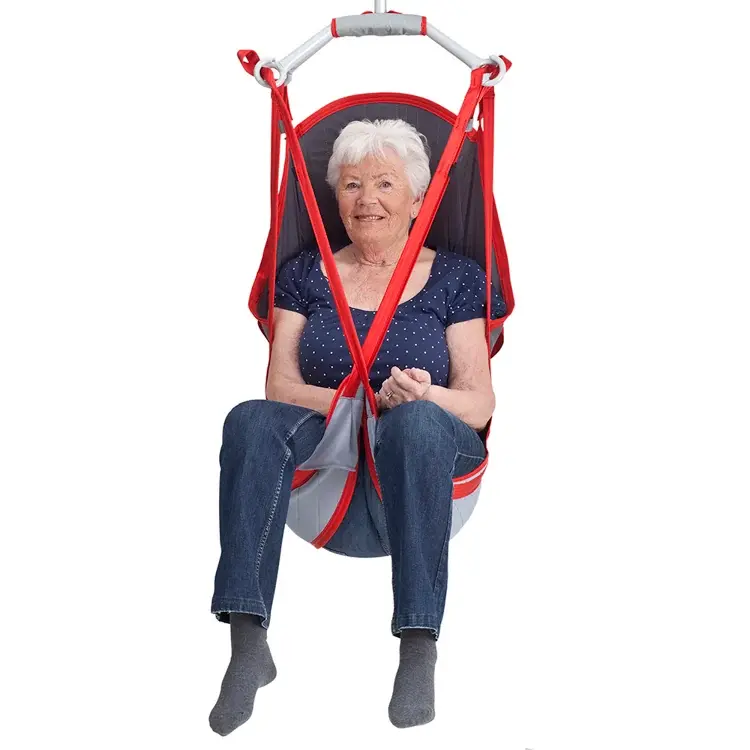
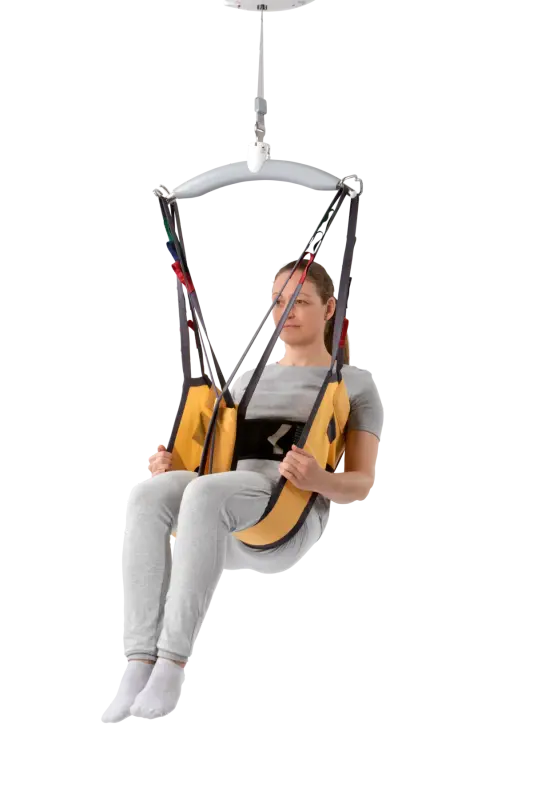
Hoyer lift sling guide 2026: patient lift sling types, loops and clips, sizes, sit to stand slings, washing, replacement, prices and Medicare E0621
Hoyer and other patient lift slings from Invacare, Drive, Joerns and Etac documents: types, fit, sizes, washing, replacement intervals, US prices, FDA records and E0621.
Contents
- The short answer
- How we checked
- Sling types side by side
- Loops, clips, chains and straps: how a sling hangs on the lift
- Which lifts each maker names for its slings
- Another brand's sling on your lift: what each maker says
- Drive's cross-reference chart: what it does and does not tell you
- Sizing charts, as each maker prints them
- When a seller's size chart differs from the maker's
- Fit problems and strap positions: what the manuals say to adjust
- Weight limits: the lowest number in the chain wins
- Fabrics: mesh, solid, padded, canvas and disposable
- Washing rules compared
- Inspection and replacement: the intervals each maker prints
- The makers' warnings, with their consequences
- Sit to stand slings: standing, stand assist and transfer
- Toileting, bathing and the wet sling
- What replacement lift slings cost in the US
- Medicare and code E0621
- FDA reports that name a sling
- FDA recalls about slings, straps and sling bars
- Three traps
- Three composite scenarios
- What to ask the therapist, the supplier and the seller
- Sources and documents
- Common questions
- Sources
The short answer
A Hoyer lift sling, or any patient lift sling, is the fabric seat that holds a person under the lift. In our view, slings wear with use and washing, so a replacement lift sling is a common purchase. The safe order is the same every time: start from the lift and its spreader bar, then choose the sling type, then the size, then check the weight rating, the fabric and the washing rules, and only then compare prices. The makers whose documents we read do not agree on whether a sling from one brand may hang on another brand's lift. Invacare's sling manual says "For the safety of the patient, DO NOT intermix slings and lifts of different manufacturers."
Joerns' Hoyer Quickfit manual says Hoyer slings and lifters "are not designed to be interchangeable with other manufacturer's products. Using other manufacturer's products on Hoyer products is potentially unsafe and could result in serious injury to patient and/or caregiver."
Drive's sling catalog says "Drive slings can be used with any competitive floor-style lift."
The FDA's patient lift page says "Match the sling to the specific lift and the weight of the patient. A sling must be approved for use by the patient lift manufacturer. No sling is suitable for use with all patient lifts."
The life of a sling is printed very differently from one maker to the next. Invacare's sling manual gives an expected service life of thirteen (13) months under its conditions. Etac's manual for the Molift RgoSling gives 1 to 5 years and a periodic inspection "at least every 6 months". Joerns' Quickfit manual gives no number and says the life "will vary dependent on use"
. Every one of these documents tells the carer to check the sling before use and to throw away a damaged or worn one. Which sling type and size suits a person is decided by their physical therapist or occupational therapist; in our view, the same therapist should train every carer. This guide explains the types, the attachments, the charts and the rules as the documents print them, and stops at that line.
Mobility Atlas earns a fee or margin when you order through us; the comparison below uses only the makers' published manuals and pages, sellers' dated listings and US government files, each with the date we read it. We do not rank the makers.
Mobility Atlas can find and quote a replacement sling for you, including slings and sling parts that are not listed on our pages. The process: you send an enquiry or a part request naming the lift, its spreader bar and the sling you have now, we reply with a written quote that includes delivery to your country, and nothing is charged before you accept it. Our transfer and lifting equipment page lists six slings, among them the Invacare Reliant full body sling with commode opening, the Hoyer Quickfit, the Drive full body sling and two Molift RgoSlings.
This guide goes deeper on slings than our Hoyer lift guide, which covers the Hoyer lifts model by model with the Hoyer sling chart, and our patient lift guide, which covers lift types and a study of 957 FDA reports. For stand aids see the sit-to-stand lift guide; if a full lift may not be needed, the transfer board guide covers boards, belts and discs. We link to those pages rather than repeat them.
How we checked
On 19 November 2026 we read and saved, as text: Invacare's Patient Slings owner's manual (Part No 1023891-K, back page dated 10/17/18), the ShopINVACARE search results for "sling" and two Invacare sling product pages; Drive Medical's sling search results, its full body sling instruction sheet and its Patient Sling Reference Guide catalog pages; Joerns Healthcare's Hoyer Quickfit sling manual (back page dated 2022); Etac's user manual BM40199 Rev. 7.0 for the Molift RgoSling HighBack and MediumBack (dated 2024-08-13); the FDA's patient lift page; openFDA recall and adverse event records; the National Library of Medicine's HCPCS code table; and price pages at SpinLife and Vitality Medical, both US sellers.
We also reused files saved on 9 November 2026 for the neighboring lift guides, each with that read date: the CMS coverage rule for patient lifts (LCD L33799) and its policy article (A52516), the Medicare booklet "Medicare Coverage of Durable Medical Equipment & Other Devices"
, the FDA page about the MAUDE report database, and Drive's PrimeCare sit to stand lift owner's manual.
Our method: we copied each page or PDF as text, saved it with the read date, and quote only what we saved, word for word. Price ranges and report counts are computed by script from the saved files, with the counting rule stated where the number appears. Advice of our own starts with the words In our view; our reading of a document starts with the words In our reading. We tested no sling, placed no order and asked no maker or seller anything.
Limits. Medline's own website answered our search with an error page (HTTP 403), so Medline sling facts here come from a seller's page, Vitality Medical, and are labeled as such. Graham-Field's sling brochure opened only a security check page that did not clear, so we have no Graham-Field or Lumex document. Medicare.gov returned an error page for the patient lift address we tried. We did not read Arjo, Guldmann, Handicare or Liko sling manuals; those names appear here only where an FDA record or a seller's listing prints them.
Sling types side by side
Makers name their slings in different ways, but the documents we read sort them into the same few families. The table uses the makers' own names, with the document that prints each one.
| Sling family | Names in the documents | What the documents say it is for |
|---|---|---|
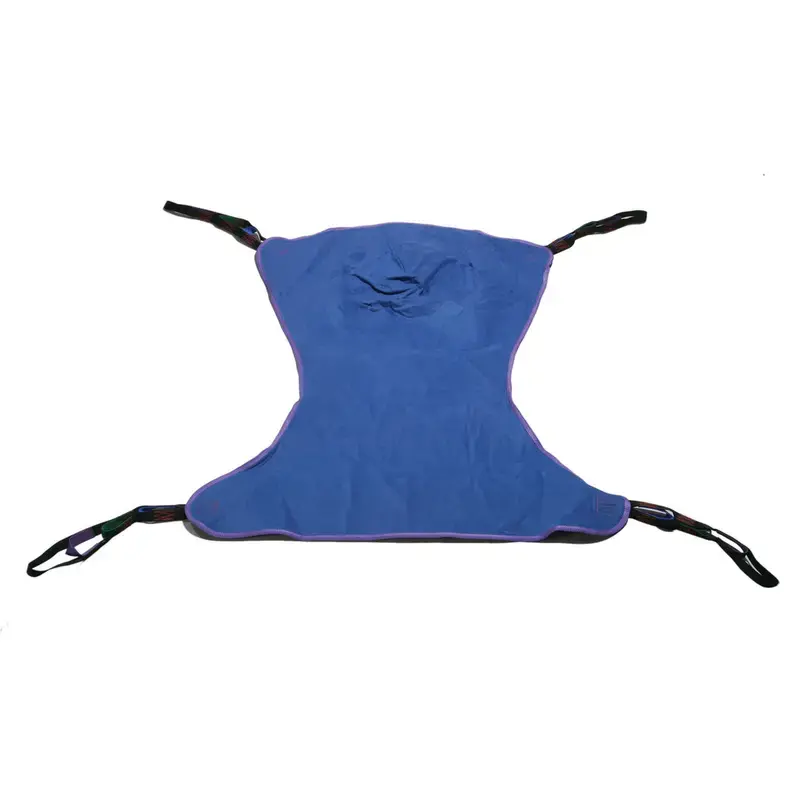
| Full body (one-piece) | Invacare Full Body, Comfort, Heavy-Duty; Drive Full Body; Medline Reusable Full-Body (Vitality Medical's page) | Head, back and thigh support; Invacare manual positions it with the person lying flat |
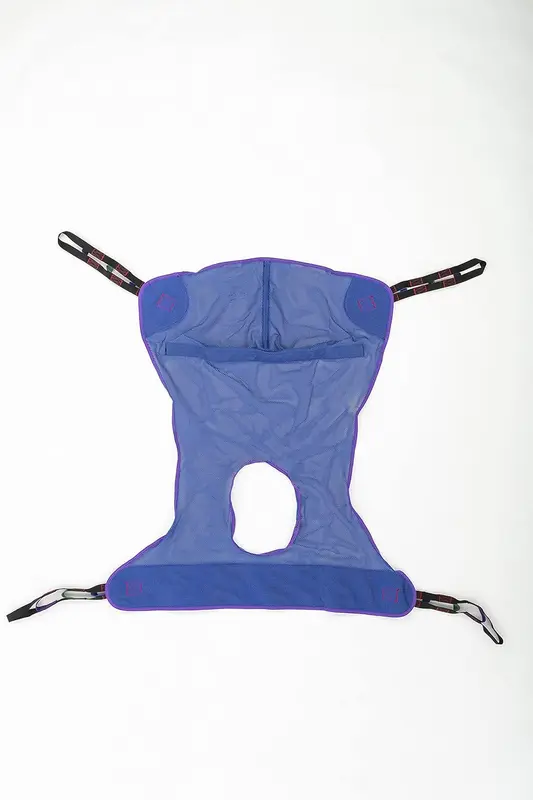
| Full body with commode opening | Invacare and Drive "with Commode Opening"; Medline "w/Commode Cut-Out" (Vitality Medical's item lines) | An opening in the seat; Invacare and Drive place it facing the person when the sling is folded |
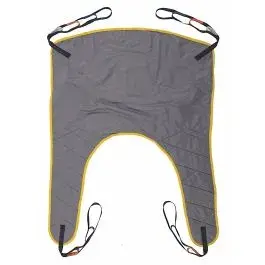
| Divided leg (U-sling) | Invacare Divided Leg, Universal High, Easy-Fit; Drive Divided Leg and U-Sling; Etac RgoSling; Hoyer Quickfit | Fitted seated or lying; leg straps go under each thigh |
| Toileting or access | Invacare Toileting and Dress Toileting High | Toileting: back from midback down, waist buckle; Dress Toileting High: back from head to base of spine |
| Standing (stand assist) | Invacare Standing and Stand Assist; Drive Stand-Up and Sit to Stand | For a person who can bear most of their own weight |
| Transfer or transport (seated, on a stand aid) | Invacare Transport and Transfer; Drive Transfer | Thigh supports; not raised to full standing |
| Two-point with chains or straps | Invacare standard series; Drive Seat/Back | Fabric hung by chains or straps; Invacare's has metal support bars |
| Disposable or single-patient | Hoyer single patient disposable; Handicare and Arjo disposable slings in FDA records | Not to be washed, per the Handicare report quoted below |
Two families need a word of warning. The divided leg sling is often called a U-sling. In our view, it is quick to put on and take off in a chair, but the person sits in two leg pieces rather than on a whole seat, so size and strap crossing matter more. Invacare's manual says divided leg and similar styles "may be used for patients on which sling removal is more difficult"
and gives support "from upper back to beneath the thighs"
. The toileting sling leaves the lower body free, and Invacare's manual places its back "between the top of the patient's midback and the base of the spine"
, lower than its other styles. In our reading, that is less support for the upper body, which is why the choice belongs to the therapist.
Joerns' chart, cited in our Hoyer lift guide, lists a bariatric Hammock sling; we saved no hammock sling manual for this guide.
Loops, clips, chains and straps: how a sling hangs on the lift
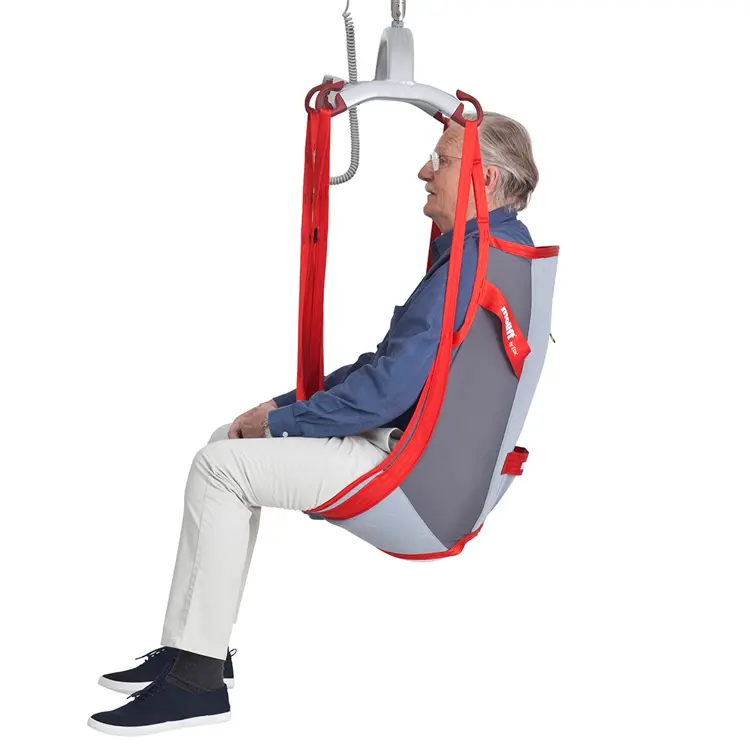
A loop sling and a clip sling hang on different hardware, as the sling manuals, Drive's catalog pages and FDA recall records we read describe them. A loop sling has fabric loops that drop over hooks on the spreader bar; Drive's catalog says loop slings let you change the position "by selecting the different colored loops"
. A clip sling has clips that lock onto lugs on a bar made for clips; Arjo's 2009 recall describes clip slings "intended for use with" lifts "with four-point hanger bars intended for use with clip slings."
Older two-piece slings hang by chains with S hooks, or by adjustable straps. Drive says its 2-point cradle "is for slings that utilize chains and S hooks"
. None of the documents we saved uses the word keyhole, so if a supplier offers a keyhole sling, ask for the maker's page that names your bar.
Invacare's manual describes three hanging systems on its own lifts. Its one-piece slings attach "with color coded sling loops"
and need no chain or strap kit. Its standard series slings use "either adjustable straps or chains (interchangeable)"
, with four metal support bars slid into pockets, and an S hook that "MUST be inserted through the hole in the support bar with the open end facing away from the patient."
Its strap kit is model 9070 and its chain kit 9071, as the manual's table prints them. The manual also says "Invacare Lift Swivel Bars have three hookup points per side. The middle hookup is ONLY used for slings that have three sets of straps per side or slings that use chains or adjustable straps."
Etac's RgoSling manual says the sling "is primarily designed for a 4-point sling bar, but it also works with a 2-point sling bar,"
and its label diagram names the "Loop connections". Joerns' Quickfit manual says to "Cross over leg straps and attach to the hoist on the front hooks at longest loop."
Drive's catalog says its 4/6-point cradle "can use chains or slings with webbing loops"
and that loop slings are the most common.
In our view, look at the hanger bar before you look at any sling. Count the hooks or lugs, note whether they are open hooks, pegs or clip lugs, read any part number on the bar, and photograph it. Send those photos with any enquiry or part request; a seller or therapist can only match a sling to what you can show.
Which lifts each maker names for its slings
Fitment below is copied from each maker's or seller's document. A lift that a page does not list is not covered by that page, even if the loops seem to reach the hooks.
| Sling (document) | Lifts or bars the document names (Invacare manual column: "CAN ONLY BE USED WITH...") |
|---|---|
| Invacare one-piece Full Body, Comfort, Divided Leg, Universal High, Easy Fit, Toileting, Dress High Toileting (sling manual) | Jasmine, Reliant 450, Reliant 600, I-Transia and 9805 (on the large hooks of the swivel bar) |
| Invacare Heavy-Duty (sling manual) | Reliant 450, Reliant 600, I-Transia and Jasmine |
| Invacare Cradle Sling (sling manual) | Jasmine with the optional cradle attachment |
| Invacare standard series slings, strap and chain kits (sling manual) | 9805 and 9805P only |
| Invacare Standing, Stand Assist, Transport, Transfer (sling manual) | Reliant 350, Reliant 440, Get-U-Up and Roze |
| Invacare Reliant Full Body, solid, R112 (ShopINVACARE page) | Invacare I-Lift Series and Reliant 450, 600 |
| Invacare Reliant Divided Leg, R100 (ShopINVACARE page) | Jasmine, Reliant 600, Reliant 450 and 9805P; elsewhere on the page "Invacare I-Lift Series and Invacare Reliant Lifts"and "For use with the RPL450-1" |
| Drive slings (Drive catalog pages) | The catalog page says "any competitive floor-style lift"; 4 or 6 point cradles for loop slings |
| Hoyer Quickfit (Joerns manual) | Passive lifts only; Hoyer recommends genuine Hoyer slings and says they are "not designed to be interchangeable with other manufacturer's products" |
| Molift RgoSling (Etac manual) | Molift sling bars and hoists, per its combination list |
| Medline Reusable Full-Body (Vitality Medical page) | "4 and 6 point lift cradles" |
Two Invacare documents print slightly different lists for the same slings. The sling manual names the Jasmine, Reliant 450, Reliant 600, I-Transia and 9805 for one-piece slings; the R112 product page names the "I-Lift Series and Reliant 450, 600 Lifts"
, and the R100 divided leg page adds the 9805P. In our reading of the manual's table, the lifts printed beside the first sling of each group cover the whole group. In our view, where two documents from one maker differ, use a pairing that both name, or ask Invacare or the supplier to confirm the other in writing.
Etac's combination list ties sling sizes to the width of the bar. For a 2-point bar it lists Small 340mm, Medium 440mm and Large 540mm bars against sling sizes XXS-S, M-L and XL-XXL; for a 4-point bar it adds an X-Large 640mm bar. Our saved text does not show which tick sits in which column, so read the printed table in the manual before you order. The manual's rule is short: "Make sure the sling fits the user and the sling bar."
Another brand's sling on your lift: what each maker says
Can I put another brand's sling on my Hoyer lift? Mobility Atlas read the sling manuals and catalogs of Joerns, Invacare, Drive and Etac and the FDA's patient lift page in November 2026, and the answer depends on whose document you follow. Joerns' Quickfit manual says "HOYER RECOMMENDS THE USE OF GENUINE HOYER SLINGS"
and that using other makers' products on Hoyer products "is potentially unsafe and could result in serious injury to patient and/or caregiver."
Invacare says "For the safety of the patient, DO NOT intermix slings and lifts of different manufacturers."
Drive's catalog says its slings "can be used with any competitive floor-style lift."
Etac points to a statement on its website, which we did not read. The FDA says "A sling must be approved for use by the patient lift manufacturer. No sling is suitable for use with all patient lifts."
In our view, follow the lift maker, and get any exception in writing from that maker.
Drive's sit to stand lift manual, read on 9 November 2026, explains the other side of the argument in its own words: "Most manufacturers recommend the use of their own slings with their lifts. While this may reduce risk of non-compatibility it also reduces health care professionals' flexibility in meeting the needs of their clients."
It then says "Drive DeVilbiss floor and sit to stand patient lifts are compatible with most other manufacturer's slings with loop style attachments."
In our reading, the two positions do not cancel out. Drive's statement is about Drive lifts taking other slings; it is not a statement by Invacare or Joerns about their lifts taking Drive slings, and both of those makers say no. Invacare's manual adds an accessories warning: accessories "designed by other manufacturers have not been tested by Invacare and are not recommended for use with Invacare products."
An FDA report in our set shows what is at stake: a nursing home regulator could not tell whether the sling whose strap broke on an Invacare lift "WAS AN INVACARE SLING OR ANOTHER PROVIDER"
because "THE SLING WAS THROWN AWAY WHEN THIS HAPPENED."
Drive's cross-reference chart: what it does and does not tell you
Drive's Patient Sling Reference Guide prints a table that sets Drive sling numbers next to numbers from Invacare, Joerns, Medline, Blue Chip and Graham Field (the column heading prints Invacare as "INCAVARE"). We copy some rows exactly as the chart prints them; a dot means the chart prints no number for that maker.
| Drive item | Drive description (spec chart) | Invacare | Joerns | Medline | Graham Field |
|---|---|---|---|---|---|
| 13222M | Full Body, solid, medium | R112 | • | MDSR112 | DSLR112 |
| 13221L | Full Body w/Com. Opening, mesh, large | R115 | • | MDSR115 | DSLR115/DSLR140 |
| 13220M | U-Sling w/ Hd Sup., padded, medium | • | 70012 | MDSPHS2 | 3106200 |
| 13262M | Divided Leg Sling, medium | R101 | • | • | • |
| 13263A | Stand-Up, large | R130 | • | • | • |
| 13264A | Transfer, large | R134 | • | • | • |
| 13263E | Sit to Stand padded sling, medium | • | • | MDSSA2 | DSLSA2 |
| 13025 | Sling, mesh, 2-point, chain | 9046 | 112-P | MDS87810DLC | • |
In our reading, this chart tells you which Drive sling Drive offers in place of another maker's number; it is Drive's claim, not the other maker's approval. Some cells are worth checking twice. The chart's page lists Invacare R101 next to Drive's divided leg 13262M and R102 next to 13262L, while Invacare's own store page for its divided leg sling with head support showed SKU R100 with Medium and Large sizes on offer, so ask which number matches which size. The 13221L row lists Graham Field "DSLR115/DSLR140", the same pair as the 13224XL row. And the chart's own stand-up specification row prints item "13236B" where the cross-reference table prints 13263B.
Two more cautions. The chart's 2-point Drive slings 13025, 13012 and 13026 are rated 330 lbs, while the Drive full body slings in the same chart are rated 600 lbs, so a "match" by number is not a match by rating. And the chart prints no date, so check with Drive that each number is current before ordering.
Sizing charts, as each maker prints them
Drive and Etac say a size chart is a starting point, not the answer. Drive: "the following sling guide is a recommendation only. A full risk assessment must be done prior to any sling being selected."
Etac: "The correct sling size depends on the user's weight, function and body shape."
Joerns' Quickfit manual says the sling suits "approx 85% of clients" and comes in five sizes, extra small to extra large.
Drive: weight and height ranges
| Size | Weight, low (lbs) | Weight, high (lbs) | Height |
|---|---|---|---|
| Small (S) | 75 | 150 | 59" - 64" |
| Medium (M) | 125 | 200 | 63" - 68" |
| Large (L) | 175 | 300 | 67" - 72" |
| Extra Large (XL) | 275 | 500 | 71" - 76" |
| Extra Extra Large (XXL) | 350 | 600 | Determine PRN |
The Drive ranges overlap: a 180 lb person who is 67 inches tall sits in both the Medium and the Large rows. The chart's heading calls the ranges "approximately", which, in our reading, is where the therapist's measuring and a trial lift come in.
Etac Molift RgoSling: measurements and weight
| Size | W, cm (in) | H, cm (in) | kg (lbs) |
|---|---|---|---|
| XXS | 18-25 (7.1-9.8) | 50-60 (19.7-23.6) | 12-17 (26-37) |
| XS | 22-30 (8.7-11.8) | 55-72 (21.7-28.3) | 17-25 (37-55) |
| S | 28-37 (11.0-14.6) | 70-85 (27.6-33.5) | 25-50 (55-110) |
| M | 32-42 (12.6-16.5) | 80-95 (31.5-37.4) | 45-95 (99-210) |
| L | 37-47 (14.6-18.5) | 90-105 (35.4-41.3) | 90-160 (198-353) |
| XL | 45-65 (17.7-25.6) | 90-105 (35.4-41.3) | 160-240 (353-529) |
| XXL | 55-80 (21.7-31.5) | 95-110 (37.4-43.3) | 230-350 (507-772) |
Etac says to "measure the user's relevant measurements in a sitting position"
and to "Try the sling with the most correct measurements to make sure it fits."
Our saved text does not say what W and H measure, so read the drawing on the printed page before measuring.
Invacare standing slings: attachment point by height
| Attachment point | Patient height range |
|---|---|
| Short | under 5 ft. 6 in. |
| Medium | 5 ft. 6 in. to 5 ft. 10 in. |
| Tall | over 5 ft. 10 in. |
This Invacare chart is not a sling size; it tells the carer which point on each lift arm to use, and the manual says it "is for reference ONLY." Once a position works, the manual says to "mark the attachment points and color coded strap used in the patient file for future use."
In our view, that note in the care plan is worth copying for every sling, not only standing slings.
When a seller's size chart differs from the maker's
Vitality Medical's page for the Molift RgoSling slings prints each size with a line it calls "User Recommendations", for example, for the MediumBack, "Large (User Recommendations: 364 Pound Weight Capacity, 25.2 Inch Back Height, and Waist 43.3-53.1 Inches)"
. Etac's own size guide prints Large as 90-160 kg, or 198-353 lbs. The seller's figure is 11 lb above the top of the maker's range, by our subtraction, and the seller calls it a weight capacity where the maker prints a user weight range. Vitality's page also calls these the "Molift RgoSling Ampu Sling"
, and its item numbers (1721100 to 1721240) do not appear in the Etac manual we read, so in our reading we cannot confirm that manual BM40199 covers them. Ask Etac or the supplier for the manual that names your item number.
The same seller page says, in its specifications, "Weight Capacity (of Largest Sling): 364 Pounds (165.10 Kilograms)"
, while Etac's guide lists sizes up to XXL at 230-350 kg (507-772 lbs). In our reading, the seller describes only the sizes it sells, which stop at Large. In our view, plan on the lower figure for any one size until Etac or the supplier confirms, in writing, which manual and which label apply to the sling you receive.
Seller descriptions can also disagree with themselves. Vitality's Medline Reusable Full-Body page says the sling "comes in three sizes: medium, large, and 2x-large"
, while the same page sells ten items including X-Large and Solid Fabric versions. Invacare's own R112 page is titled "Solid Fabric" but its text says "This sling offers a breathable mesh design and a commode opening"
and "Crafted from quick-drying mesh fabric"
. In our view, order by the item number and the label, not the marketing text, and ask the supplier to confirm fabric and opening before it ships.
Fit problems and strap positions: what the manuals say to adjust
A sling of the right size can still sit badly. Etac's RgoSling manual prints a troubleshooting table, and the other makers' manuals and Drive's catalog print rules for strap lengths. These are the makers' adjustments; whether a change suits a person is for the therapist.
| Problem, as Etac prints it | Action, as Etac prints it (shortened) |
|---|---|
| The user's head comes too close to the sling bar. | Try another loop connection to extend the distance to the sling bar. Otherwise, try a larger size. |
| The sling cuts into the groin. | Try another loop connection to open up the hip angle; position the sling low enough on the back. Otherwise, try a larger size. |
| The user's buttocks slide down the opening of the sling. | Position the sling low enough on the back. Otherwise, try a smaller size. Make sure the user is not wearing slippery clothes. |
| The straps are not loaded at the same time. | Make sure the straps are attached symmetrically and the centre of the sling is at the midline of the user. |
| (Only highback slings) The sling does not reach the top of the user's head. | Make sure the sling is not placed lower than the coccyx. Otherwise, try a larger size. |
Etac's information list on the handling pages adds: "Perform a safety stop when the straps are stretched tense. Check that all straps are correctly and symmetrically attached."
Before the transfer, it says the sling should be "level with the coccyx", the leg supports "placed under the thighs without creases"
and the "Lower straps are crossed and symmetrically applied"
.
Strap length sets the posture. Joerns' Quickfit manual prints a "GOLDEN RULE: LONG IN THE LEG, SHORT IN THE SHOULDER"
and says "The longer you attach the shoulder straps, the more reclined the client will be."
Drive's catalog says the same in its own words: "The rule of thumb is the shorter the shoulder straps the more upright the client will be."
Invacare's manual shows a reclined position with "head and leg strap lengths equal"
and a seated one with "short strap length both sides of head, long strap length at legs"
.
Leg straps can be placed more than one way. Invacare's manual says for its divided leg and similar slings that "The straps may be around, crossed between or underneath the patient's legs,"
and Joerns says that for closed leg positions straps "may be crossed under both legs"
; the same page warns: "There is an increased risk of slipping out of the sling using this method of transfer. Assess the patient's capabilities carefully."
On chain slings, Invacare warns: "When changing to different lengths, DO NOT disconnect the O-rings of the chains from the swivel bar. Position BOTH the O-rings and additional chain link onto the hooks of the swivel bar."
In our view, the strap pattern that works for a person belongs in the care plan, with the loop colors, so every carer uses the same one.
Weight limits: the lowest number in the chain wins
A sling has its own weight rating, and so do the lift and the bar; the lower-figure rule and the Hoyer pairings are in our Hoyer lift guide. Etac's manual adds the bar to the chain: "If safe working load (SWL) differs between hoist, sling bar and sling, the lowest load should always be used."
The table gathers the sling ratings the other makers print.
| Sling | Rating as printed | Document |
|---|---|---|
| Drive full body slings (13221, 13222, 13223, 13224) | 600 lbs | Drive instruction sheet and spec chart |
| Drive divided leg sling 13262M/L | 450 lbs | Drive spec chart |
| Drive stand-up sling 13263A | 440 lbs | Drive spec chart |
| Drive sit to stand padded sling 13263E/F | 400 lbs | Drive spec chart |
| Drive transfer sling 13264A | 350 lbs | Drive spec chart |
| Drive 2-point slings 13025, 13012, 13026 | 330 lbs | Drive spec chart |
| Drive heavy-duty 2-point slings 13060, 13061 | 600 lbs | Drive spec chart |
| Invacare Reliant divided leg R100 | 450 lbs | ShopINVACARE page |
| Hoyer Quickfit, all sizes and fabrics | 500lbs / 227kg | Joerns Quickfit manual |
| Molift RgoSling, by size | User weight ranges up to 230-350 kg (XXL) | Etac manual size guide |
Invacare's sling manual sends you to the lift for the number that matters: "DO NOT exceed maximum weight limitation of the patient lift. These weights will vary from 350 to 600 lbs. depending on the type of patient lift purchased."
In our reading, a 600 lb Drive sling on a lift rated 450 lb is a 450 lb system, and a 400 lb Drive sit to stand sling on a heavier-rated stand aid is a 400 lb system.
In our view, write three numbers on the care plan: the lift label, the bar label if it has one, and the sling label. The smallest is the limit. If the person's weight is near it or changing, tell the therapist before the next order, not after.
Fabrics: mesh, solid, padded, canvas and disposable
The documents describe four kinds of fabric and one kind of single-use sling. Etac's manual gives the plainest comparison: "The padded version distributes the weight, which provides a comfortable support for the user through the entire transfer"
and "The net version allows moisture and heat to pass through."
Its fabric is polyester and its padding polyethylene.
- Mesh or net: Drive's full body mesh slings, Medline's mesh slings as Vitality Medical's page describes them (
"constructed of durable mesh"
), and the RgoSling net version. Drive's instruction sheet prints"Sling Material: Polyester, Straps Material: Polypropylene"
. - Solid polyester: Invacare's solid slings and Drive's solid full body slings.
- Padded: Drive's U-sling with head support and the RgoSling padded version; Invacare's R100 page says
"Full padded fabric and soft, brushed lining help prevent sliding"
. - Canvas and nylon: Drive's 2-point solid sling 13012 and heavy-duty slings are canvas; its stand-up, transfer and divided leg slings are nylon, per its spec chart.
- Disposable: single-patient slings that are not to be washed.
Disposable slings carry their own rule. A Handicare report in our FDA set says its disposable positioning sling is marked with the words disposable and do not wash on the product label, and that washing and reusing it "CAN CAUSE DEGREDATION OF THE MATERIAL"
. In that report, filed by Handicare from a user's report, the sheet ripped about 4-5 inches above a bed and the patient was lowered without injury. On Vitality Medical's first results page, the "Hoyer® Single Patient Disposable Slings"
line printed $91.00 - $814.00; the results page does not say what quantity each end buys.
Skin and comfort are for the therapist and the nurse to judge. One Joerns report in our set describes Quickfit standard mesh slings "PINCHING RESIDENTS SKIN BETWEEN THEIR LEGS"
where a deluxe version did not; it is one report, not a finding, but it shows why a trial lift matters.
Washing rules compared
The washing temperatures printed by the makers are far apart, so the label on your own sling is the rule. Here they are side by side, word for word where quoted.
| Maker document | Water temperature | Drying | Other lines |
|---|---|---|---|
| Invacare sling manual | "not to exceed 180°F (82°C)" | "Air dry or dry at low temperature." | "DO NOT bleach." Wash "with dark colors" |
| Drive full body sling sheet | "Maximum washing temperature 105°F (40.5°C)." | "Air Dry, or Tumble Dry at cool or very low temperature." | "Use Non-Enzyme detergent."No bleach. |
| Joerns Hoyer Quickfit manual | "DO NOT EXCEED 185 ºF water temperature." | "Cool tumble dry, air dry or dry at very low temperature." | "DO NOT wash with bleach." "DO NOT dry clean." |
| Etac RgoSling manual | Symbols print 60-85° (140-185F) and Max. 60° /140F | Not clear in our saved text | Washing and drying hot "wear out the material faster." |
Drive's maximum of 105°F is 75 degrees Fahrenheit below Invacare's 180°F, by our subtraction, and 80 below Joerns' 185°F. In our reading, a laundry that washes every sling at Invacare's or Joerns' maximum will be outside Drive's 105°F limit. Drive's warranty sheet adds that its 6-month warranty "does not cover device failure due to owner misuse or negligence, normal wear and tear, excessive washing or incorrect washing and drying."
Joerns' bleach and drying warnings are quoted in our Hoyer lift guide. Invacare's two-piece standard slings add one step: "Remove the four metal support bars before laundering the standard style sling,"
and the bars "MUST be replaced before the sling can be used for patient lifting."
Inspection and replacement: the intervals each maker prints
How often should a patient lift sling be replaced? Mobility Atlas read the sling manuals of Invacare, Etac and Joerns and Drive's instruction sheet in November 2026, and only two of the four print a number. Invacare's manual says "The expected service life is thirteen (13) months for this product, provided the product is used in accordance with the intended use"
and the maintenance and laundering instructions are followed; it "can also be reduced by excessive or incorrect usage."
Etac says the RgoSling "has an expected lifetime of 1 to 5 years under normal use"
and that "Periodic inspection must be carried out at least every 6 months."
Joerns gives no number: the Quickfit's life "will vary dependent on use"
, with wash temperature, detergents, frequency of use and patient weight named as factors. Drive's sheet gives no lifetime. All four say to look before use and to discard a damaged sling.
| Document | When to check | When to discard |
|---|---|---|
| Invacare sling manual | "After each laundering"; "Inspect with each use." | "Bleached, torn, cut, frayed, or broken slings are unsafe and could result in injury. Discard immediately." |
| Joerns Quickfit manual | "CHECK sling and stitching before each use." | "DO NOT alter slings. Destroy and discard worn slings." |
| Drive full body sling sheet | "Inspect patient slings for wear prior to each use." | "discard the sling immediately"if signs of tearing, fraying or wear |
| Drive sit to stand lift manual | "CHECK ALL SLING ATTACHMENTS each time it is used" | "Drive Medical recommends discontinuing use of any sling that fails inspection or is questionable. A sling is considered to have failed if the label and weight capacity can no longer be read or if slings shows any visible signs of damage." |
| Etac RgoSling manual | "Always check – before each use"; periodic inspection at least every 6 months | "Destroy and discard damaged and old slings." |
Etac's label has a grid where the date of first use and each periodic inspection are marked, and its manual says "Before using the sling, mark the date of first use on the periodic inspection label."
In our view, a home whose sling prints no interval should still pick one and write it down.
The FDA's inspection line is quoted in our patient lift guide. Drive's sit to stand manual says damage is present "when any sling part is frayed, work thin, torn or stitching is coming undone"
(the manual prints "work thin").
The makers' warnings, with their consequences
These are the sling warnings we found, quoted through to the consequence each maker prints. They are the makers' words, not ours, and each applies to that maker's slings.
- Joerns, Quickfit manual:
"CHECK sling and stitching before each use. Using bleached, torn, cut, frayed or broken slings is unsafe and could result in serious injury or death to the patient."
- Drive, full body sling sheet, printed as a warning:
"If signs of tearing, fraying or wear are found discard the sling immediately; worn out slings are not safe for use and may result in injury or death."
- Etac, RgoSling manual:
"Never use a faulty or damaged sling as it can break and cause personal injury."
And:"If the inspection reveals any safety risks, the sling must immediately be taken out of service and be disposed of."
- Invacare, sling manual:
"DO NOT move a person suspended in a sling any distance. The Invacare patient lift or the sling are NOT transport devices."
The same warning ends"Otherwise, injury or damage may occur."
- Invacare's manual says:
"DO NOT use any kind of material (such as a plastic back incontinence pad or seating cushion) between the patient and sling material that may cause the patient to slide out of the sling during transferring."
- Invacare's manual, on strap length, says
"the shortest of the straps MUST be at the back of patient for support. Using long section will leave little or no support for patient's back."
- Joerns, Quickfit manual:
"NEVER leave a patient unattended."
and"DO NOT attempt to re-position a patient by pulling on the sling loops."
- Etac's manual says:
"Never attach the guide handles to the sling bar hooks."
Etac's manual also says what to do with a suspect device: put it "in quarantine", marked out of order, and "call your local distributor/representative."
Two warnings are about how the sling meets the person. Joerns' manual says, for a closed-leg seated position: "There is an increased risk of slipping out of the sling using this method of transfer. Assess the patient's capabilities carefully."
Etac's manual lists as a contraindication: "Users with reduced head stability should not use the sling with medium back."
These are decisions for the therapist; we quote them so the carer knows to ask.
Sit to stand slings: standing, stand assist and transfer
A sit to stand sling is not a smaller full body sling. It wraps the back and hangs on the arms of a stand aid, and the person takes part. Our sit-to-stand lift guide covers the stand aids themselves; this section covers what the sling documents add.
Invacare's sling manual sets the condition first: "Individuals that use the Standing Sling MUST be able to support the majority of their own weight, otherwise injury can occur."
Drive's sit to stand lift manual prints the same rule for its sling. Invacare adds: "The belt MUST be snug, but comfortable on the patient, otherwise the patient can slide out of the sling during transfer, possibly causing injury."
Drive's manual prints the same belt rule. For transport and transfer slings, Invacare says "DO NOT raise the patient to a full standing position while using the transport or transfer sling, otherwise injury can occur."
Attaching is where Invacare's manual is most precise. It says to "ALWAYS use the color coded strap on the standing sling closest to the patient while still maintaining patient stability and comfort,"
and, printed as a warning, to make sure the color coded strap sits flush against the attachment knob, "otherwise injury or damage can result."
On the Roze lift the strap is instead "fully seated on the attachment hook."
For transfer slings it says to "Pull the thigh supports forward and attach to the lower attachment points just above the pivoting knee pad."
It adds "The top and bottom colored straps do not have to be the same,"
but each pair must match side to side.
| Stand aid sling | Rating or price as printed | Source, date read |
|---|---|---|
| Drive Stand-Up 13263A (large) and 13236B, as the spec row prints it (X-Large) | 440 lbs | Drive spec chart, 19 Nov 2026 |
| Drive Sit to Stand padded slings 13263E, 13263F | 400 lbs; 2 cradle points | Drive spec chart |
| Drive Sit to Stand padded strap 13263H | 400 lbs; 71" | Drive spec chart |
| Invacare Reliant Stand Assist Standing Sling | $141.00 USD | ShopINVACARE |
| Invacare Reliant Stand Assist Transfer Sling | $159.00 USD | ShopINVACARE |
| Invacare Standing Sling; Premier Standing Assist; Transfer Sling | $143; $228; $240 | SpinLife stand-up list |
SpinLife's stand-up sling list printed 6 items on 19 November 2026, from $130 for the Stella Stand Assist Deluxe Padded Sling (BESTCARE LIFTS) to $299 for the ThoraxSling with seat support (HANDICARE). On Vitality Medical's first page, the "Sit-to-Stand Sling" line printed $193.99 - $214.40 and the "Medline Stand Assist Padded Patient Slings"
line $102.66 - $168.41.
Toileting, bathing and the wet sling
Toileting and bathing are where slings meet water, soap and hurried moves. Invacare's manual notes that its "Toileting slings have a waist buckle which helps hold the sling in place during positioning,"
and fits them seated, with one assistant in front of the wheelchair and one behind, and the person leaned forward. It also says that with a wheelchair, "secure the wheel locks in place to prevent the wheelchair from moving forward or backwards."
Full body slings with a commode opening let a person be lowered onto a commode without removing the sling. Drive's sheet says the closed end or commode opening "should be facing the patient when folded,"
and Joerns' Quickfit manual places "the top of the commode aperture at the base of the spine."
Three reports in our FDA set mention a wet sling or a shower, by a word search for "wet" and "shower" in the saved narratives (1417592-2026-00067, 1417592-2026-02035, 1417592-2026-10473). In one, Medline was told "THE SLING WAS WET FROM SHOWER"
and "THE SLING SNAPPED MID AIR"
; the patient's head hit the lift leg and needed stitches. In another, the sides of a sling "COMPLETELY SEVERED MID-TRANSFER"
during a transfer from a shower chair. These are single reports as filed; they do not show that wet slings fail more often. Bathing with a lift is covered in our patient lift guide.
Medicare does not pay for a bathroom-only lift; the Medicare section below explains what that means for a sling.
What replacement lift slings cost in the US
Prices differ by seller, state, funding and insurance, and the Drive pages we saved print no prices, so the tables below are what three US sellers printed on 19 November 2026, not an offer from us. Joerns' Quickfit manual and Etac's manual print no prices.
ShopINVACARE, Invacare's own US store
The store's search for "sling" printed 14 price lines: 10 slings, one two-pack of sling straps at $53.00 USD, and 3 lifts. Across the 10 sling lines, the range in our table runs from $95 for the Invacare Standard Sling, mesh, one-size, to $164 for the Reliant Divided Leg Sling with Head Support, 450 lb. 3 of the sling lines print "From" before the price, which in our reading means the lowest-priced size.
| Sling line (shortened) | Regular price, as printed |
|---|---|
| Reliant Full Body Sling, Solid Fabric | From $123.00 USD |
| Reliant Full Body Sling, Mesh Fabric | From $121.00 USD |
| Reliant Full Body Sling with Commode Opening, Polyester Mesh Fabric | From $129.00 USD |
| Reliant Divided Leg Sling with Head Support, Polyester, 450 lb. Weight Capacity | $164.00 USD |
| Standard Sling, Solid Polyester, One-Size, Blue | $108.00 USD |
| Reliant Stand Assist Standing Sling, Solid Fabric, One-Size | $141.00 USD |
| Reliant Stand Assist Transfer Sling, Solid Fabric, One-Size | $159.00 USD |
| Reliant Toileting Sling, Solid Polyester Fabric, Large | $154.00 USD |
| Standard Sling with Commode Opening, Mesh Polyester Fabric | $107.00 USD |
| Standard Sling, Mesh Fabric, One-Size, Blue | $95.00 USD |
| Sling Straps, Polypropylene, One-Size (2-Pack) | $53.00 USD |
SpinLife, universal and stand-up slings
SpinLife's Universal Slings list said it held 24 items; its first page showed 15, and we counted only those. Across the 15, the range in our table runs from $62 (Full Body Sling (PROACTIVE MEDICAL)) to $318 (Oak Universal/ Head Sling (MACKWORTH)), across 6 brands. The tiles print no item numbers, so a SpinLife name is not tied here to a maker's part number.
| Sling, as the tile prints it | Brand | Price |
|---|---|---|
| Professional Full Back Sling - Loop Style | JOERNS | $244 |
| Mesh Universal Sling | BESTCARE LIFTS | $73 |
| Universal Mesh Sling with Head Support | BESTCARE LIFTS | $75 |
| Full Body Sling | PROACTIVE MEDICAL | $62 |
| Full Body - Solid | INVACARE | $121 |
| Mesh Full Body Sling | PROACTIVE MEDICAL | $69 |
| Solid Divided Leg Sling | PROACTIVE MEDICAL | $76 |
| Mesh Sling with Head Support | BESTCARE LIFTS | $89 |
| Oak Universal/ Head Sling | MACKWORTH | $318 |
| Full Body - Mesh | INVACARE | $135 |
| Divided Leg Sling | INVACARE | $149 |
| Basic - Mesh | INVACARE | $88 |
| Bariatric Sling | DRIVE MEDICAL | $156 |
| Full Body Mesh | DRIVE MEDICAL | $107 |
| Basic Sling | INVACARE | $99 |
Two Invacare names appear on each seller's page. SpinLife's "Full Body - Solid by INVACARE"
tile printed $121 and Invacare's R112 solid full body sling $123, $2 apart; SpinLife's "Divided Leg Sling by INVACARE"
printed $149 and Invacare's R100 $164, $15 apart. SpinLife's tiles print no item numbers and Invacare's "From" prices are for the lowest size, so in our view these are not proven to be the same item and size.
Vitality Medical, first results page
Vitality's search for "patient lift sling" said "Items 1-16 of 56"; we counted the 16 lines on page 1 only. All 16 print a price range across options, from $25.04 (the low end of "Drive Medical Patient Lift Parts & Sling Accessories"
, which includes parts and accessories) to $1,515.35 (the top of "Medline ComfortGlide Patient Repositioning Slings"
). The page does not say which option sits at each end, so in our view the ends are not sling prices.
Two product pages at the same seller list every item. Prices as labeled "Price:" (the page also prints a higher "List Price:"): Medline's Reusable Full-Body slings run from $82.52 (MDSMR110, medium, mesh) to $223.92 (MDSMR141, 2X-Large, mesh with commode cut-out) across 10 items. the Molift RgoSling slings on the page Vitality calls Molift RgoSling Ampu slings run from $199.80 (item 1721100, MediumBack 2X Small) to $310.54 (item 1721120, MediumBack Small) across 10 items, and the page marks them "Non-Returnable". On that page the MediumBack Small costs $65.25 more than the MediumBack Medium, by our subtraction; prices do not always rise with size.
Medicare and code E0621
Does Medicare pay for a replacement lift sling? Mobility Atlas read the CMS coverage rule for patient lifts (LCD L33799), its policy article (A52516) and the Medicare equipment booklet on 9 November 2026, and the answer is yes in one case the rule names. The LCD says "Code E0621 is covered as an accessory when ordered as a replacement for a covered patient lift."
The National Library of Medicine's HCPCS table describes E0621 as "Sling or seat, patient lift, canvas or nylon"
. The policy article lists E0621 as a Column II code for each lift code from E0625 to E0640 and says "A Column II code is included in the allowance for the corresponding Column I code when provided at the same time."
In our reading, a sling delivered with the lift is paid within the lift, and a later replacement for a covered lift can be billed as E0621. Our copies print revision effective dates of 01/01/2020; check the current versions.
The test for the lift itself is in our patient lift guide. A bathroom-only lift is coded E0625, which A52516 says is "non-covered; not primarily medical in nature"
, so in our reading a sling replaced for an E0625 lift has no covered lift to attach to.
For parts, the Medicare booklet says that on owned equipment "Medicare may also cover repairs and replacement parts"
, and that "the supplier who sold it to you isn't required to repair it"
; on rented equipment, "Any costs for repairs or replacement parts for the rented equipment are the supplier's responsibility."
The 20% share and assignment rules are in our patient lift guide.
Two cautions. None of the maker or seller pages we saved prints a HCPCS code for a sling, and a code printed on such a page would be that company's coding, not a promise of coverage. Medicare Advantage plans, Medicaid and the VA set their own rules, which we did not read for slings; ask the plan before you order.
FDA reports that name a sling
FDA device reports (MAUDE) are reports that makers, facilities and members of the public chose or were required to send. In our reading of the report numbers, 73 of the 75 kept reports were filed by firms, mostly as required maker reports, and 2 carry plain MedWatch numbers. The FDA's own page, read on 9 November 2026, calls it a "passive surveillance system"
and says "The incidence, prevalence, or cause of an event cannot be determined from this reporting system alone due to under-reporting of events, inaccuracies in reports, lack of verification that the device caused the reported event [...]"
. Counts below are reports, not slings or people, and say nothing about which brand is safer.
Our search: openFDA adverse event records with product code FSA or FNG (the patient lift codes) whose device generic name contains the word sling, received from 18 February 2025 to 21 October 2026 within the window we asked for (1 January 2025 to 31 October 2026); openFDA's data was last updated 11 November 2026. The search returned 178 reports. We dropped the 103 whose only device name contains "NO SLING", which are lifts sold without a sling, and kept 75 sling reports.
| Group (rule) | Reports |
|---|---|
| Filed as malfunction | 61 |
| Filed as injury | 11 |
| Filed as death | 3 |
| Medline named as maker or brand | 68 |
| Drive named | 2 |
| Joerns or Hoyer named | 2 |
| Handicare, McKesson brand, maker unknown | 1, 1, 1 |
| Saved record has no narrative text | 42 |
Problem code in the report names a tear, split, separation, fray, unravel, break or fracture, or is "Material Integrity Problem" | 63 |
68 of the 75 reports name Medline, and 55 of those were received from 1 August 2026 on; two of the saved narratives say the report "is being submitted as part of retrospective review activities"
, so in our reading some of these dates are filing dates for older complaints, not event dates. By a word search of the saved narratives, 12 reports say a strap or loop broke, snapped, ripped or tore (a strap or loop word within a few words of one of those verbs); 12 use words for a fall or a drop (fell, dropped, to the floor, to the ground, from the fall, slipped out); 3 are about tags coming off; and 2 say a "SLING LOOP CAME UNHOOKED FROM THE LIFT"
(two reports about the same two events; both, filed as injuries, also describe a second patient who fell, hit their head and died). Every report number in each group is listed in our facts file.
Some narratives say the carers checked the sling first. One Medline report quotes a facility: "THE SLING SHOWED NO SIGNS OF FRAYING, THINNING, OR CONCERNS OVER ITS INTEGRITY"
; another says "THE CNAS HAD LOOPED THE SLING CORRECTLY AND INSPECTED THE SLING FOR SIGNS OF WEAR AND TEAR BEFORE PERFORMING THE TRANSFER."
Others describe slings that were worn, such as a training sling whose "fabric being worn out" was seen in photos. In our reading, the reports show that a check before use is necessary but does not catch everything, which is one more reason to replace slings on a schedule.
Three reports were filed as deaths. In one, the filer wrote that "TWO STRAPS BROKE AWAY FROM THE BODY OF THE SLING CAUSING THE PT TO FALL TO THE GROUND"
; the report says the event was first reported to Medline "BEFORE THE PT PASSED THAT EVENING."
Two others, one filed under MedWatch number 50935014 with no maker report number and one from Drive, in our reading describe one event in which a person's head slipped out of a sling; Drive's report says the provider stated "there was no malfunction" and that the sling "may have been installed incorrectly by the caregiver."
These reports state what the filer wrote; they are not findings. Our patient lift guide explains how to report a problem.
FDA recalls about slings, straps and sling bars
Our search: openFDA recall records with product code FSA or FNG whose product description contains the word sling. It returned 22 records, initiated from 30 October 2006 to 17 November 2025; openFDA's data was last updated 14 November 2026. 18 are terminated and 4 were open in our copy. A recall record is a notice that a firm corrected or removed products; it is not a measure of how safe a sling is.
We sorted them by a written rule on the product description: rope and connector kits first, then anything that names a sling bar, then lifts whose description only mentions a sling, and the rest as slings. That gives 13 sling records, 5 sling bar records, 2 rope kit records and 2 lift records. All 4 open records are sling bar records.
| Record | Initiated | Firm (as stored) | Product (shortened) | Reason (shortened from the record) |
|---|---|---|---|---|
| Z-0424-2007 to Z-0426-2007 | 2007-01-09 | Arjo, Inc. | Sara Active slings | Slings may come apart |
| Z-1636-2009, Z-1637-2009 | 2009-02-26 | ArjoHuntleigh | Passive Clip and Flite Clip slings, 103,108 total | Clips not applied or applied incorrectly; stickers and retraining under a field safety notice |
| Z-1990-2009 | 2009-04-07 | B.H.M. Medical, Inc. | BHM Combi Sling, 1,396 slings | Stitching failure at shoulder strap |
| Z-1396-2011 | 2011-02-09 | Hill-Rom, Inc. | Liko Comfort Sling Plus, 10 units | Loops too long |
| Z-1552-2013 to Z-1555-2013 | 2013-05-23 | Prism Medical Services USA | BC Hammock Mesh Slings | Made in the incorrect size |
| Z-0589-2019 | 2018-10-22 | ARJOHUNTLEIGH POLSKA | Passive Clip Sling (Flites) | Nonwoven material may break |
| Z-2470-2021 | 2021-07-30 | Getinge Dominican Republic SA | Arjo Disposable Repositioning Sling, 46,085 units | Loop straps a trip hazard |
| Z-1351-2019, Z-1352-2019 (open) | 2019-02-04 | Moller Vital | Molift 2-point sling bars | Hooks broke off |
| Z-1310-2026, Z-1311-2026 (open) | 2025-11-17 | ETAC A/S | Molift 2-point and 4-point sling bars | Lifting bar bolt broke; replacement units offered |
The table shows selected records; all 22 are in our saved copy. Three records explain the risk better than any summary. The 2009 Arjo clip sling record says "If the sling clips are not applied or are applied incorrectly, there is the potential for the patient to fall, resulting in injury to both the patient and/or the caregiver."
The 2018 Arjo record says nonwoven material "may break wile in use during the patient/resident transfer. Patient/resident might fall on the floor. IN consequence, the patient might sustain a major trauma, head injury - damage to tissue that is irreversible or may lead to death"
(spelling as stored). The 2019 Molift bar record says the firm had "7 reports of malfunction for the device in which the hooks have broken off, potentially leading the sling to slip out of the sling bar and causing the patient to fall."
The 2025 Etac records for Molift 2-point bars (items 1530101 and 1530102) and 4-point bars (1430116, 1430117, 1430115) are also in the recall table of our patient lift guide; if your lift has one of those bars, compare the item number with the record and ask the supplier about the replacement. The record says that if the lifting bar cannot move freely and stay vertical, "or if there is any doubt about the product s functionality, the unit must be taken out of service immediately"
(spelling as stored).
Three traps
Trap one: the sling that "fits". Loops that reach the hooks are not approval. Invacare and Joerns say not to mix brands; Drive says its slings can go on other floor lifts. Follow the lift maker's document for your lift, and keep the sling's label readable, because Drive's manual counts a sling as failed if its label and weight capacity can no longer be read "or if slings shows any visible signs of damage"
.
Trap two: the highest number on the page. A 600 lb sling does not raise a 450 lb lift, and a seller's 364 lb "capacity" for a Large Molift sling sits above Etac's printed 198-353 lb range for that size. Plan on the lowest figure across lift, bar and sling, and on the maker's figure over the seller's.
Trap three: one wash for every sling. Drive prints 105°F, Invacare 180°F and Joerns 185°F. A laundry that runs every sling hot is outside Drive's rule; one that bleaches is outside all of them. Sort slings by maker and wash to each label.
Three composite scenarios
These are composite scenarios, not individual customers. Each uses only the documents named for that sling and lift.
Scenario one: a family uses an Invacare Reliant 450 at home, and the old divided leg sling has a frayed strap. Invacare's manual says frayed slings "could result in injury. Discard immediately,"
so they stop using it that day. The manual lists the divided leg sling for the Reliant 450, and the R100 page prints a 450 lb rating. The Reliant 450's own weight limit is not in the documents we read, so they check the lift label and plan on the lower of the lift's figure and the sling's 450 lb. They ask the therapist to confirm the size, note that Invacare's expected service life is 13 months, and wash it at no more than 180°F without bleach.
Scenario two: a care home with Molift hoists orders RgoSling HighBack slings. Etac's manual says to measure each resident seated and try the size with the closest measurements, to mark the date of first use on the label, and to inspect at least every 6 months. The home checks its sling bar item numbers against the 2025 Etac recall record, plans on the lowest safe working load of hoist, bar and sling, and reads the printed combination list on page 79 to match each sling size to its sling bar width (340, 440, 540 or 640mm), since our saved text does not show which tick sits in which column. It asks Etac or the supplier for the item number of each size, since the manual we saved prints none for the RgoSling, and uses Etac's size guide rather than a seller's figures.
Scenario three: a person who can bear most of their weight uses a Drive PrimeCare sit to stand lift, model STSP450. Drive's manual says the person "MUST be able to support the majority of"
their own weight, and that the lift's "maximum weight limitation is 450 lbs. regardless of any additional weight limitations on accessories."
Drive's chart lists its sit to stand padded slings 13263E and 13263F under slings for sit to stand lifts at 400 lbs, but neither the chart nor our saved manual pages names the PrimeCare for them. So the family asks Drive in writing which sling fits the STSP450 and plans on 400 lb, the lower figure, until Drive answers. The carer checks all sling attachments each time, as Drive's table says, and stops using the sling, as the manual says ("NEVER use a sling, which is frayed or damaged"
), if it shows "any visible signs of damage"
or its label and weight capacity can no longer be read.
What to ask the therapist, the supplier and the seller
Ask the physical or occupational therapist
- Which sling type, size and fabric does this person need, and why?
- Which loops or attachment points, and which color-coded straps, should we use on each side? Please write them in the care plan.
- Can the legs be crossed under, or placed around, as the maker shows? Is a closed-leg position safe for this person?
- How many carers for each transfer, including bathing and toileting?
Ask the supplier or seller
- Which lifts and bars does the maker list for this exact sling, in writing?
- What safe working load is printed on the sling label, and what is on my lift and bar?
- What water temperature, detergent and drying does this sling's label allow?
- What expected service life and inspection interval does the maker print?
- Is the sling returnable if it does not fit my bar? Vitality marks the RgoSling "Non-Returnable".
- Which HCPCS code will you bill, do you accept Medicare assignment, and is the lift owned or rented?
Sources and documents
Maker documents, read 19 November 2026: Invacare Patient Slings owner's manual 1023891-K (dated 10/17/18) and ShopINVACARE's search and R112 and R100 pages; Drive Medical's sling search page, full body patient sling instruction sheet and Patient Sling Reference Guide (pages 61 to 65, undated); Joerns Healthcare's Hoyer Quickfit sling manual (2022); Etac's Molift RgoSling user manual BM40199 Rev. 7.0 (2024-08-13). Read 9 November 2026: Drive's PrimeCare sit to stand lift owner's manual.
Government, read 19 November 2026: the FDA's patient lift page, openFDA recall and adverse event records (data updated 14 November 2026 and 11 November 2026), the NLM HCPCS table. Read 9 November 2026: CMS LCD L33799 and policy article A52516, the Medicare booklet on durable medical equipment, and the FDA's MAUDE page. Prices, read 19 November 2026: ShopINVACARE, SpinLife and Vitality Medical (US).
Related guides on Mobility Atlas: Hoyer lift guide; patient lift guide; sit-to-stand lift guide; transfer board guide.
Method in brief: how we checked. We copied every page and PDF as text on the dates above and took each spec, rule and warning from those copies; quotes are checked by script against the saved texts. Ranges and counts are computed by script over every printed price line or record in the saved files, with exclusions named in the text. FDA counts are reports, not slings or people. We did not test any sling.
Prices checked November 2026 at ShopINVACARE, SpinLife and Vitality Medical; prices change, so confirm them with the seller. Documents checked November 2026: the makers' sling manuals and charts on 19 November, the CMS rule and article on 9 November 2026.
This article is general information. Rules and prices differ by country and change, so confirm them before you buy or travel.
Common questions
What is the difference between a Hoyer lift sling and a patient lift sling?
None in kind: Hoyer is a brand whose sling manuals carry the Joerns Healthcare name, and some people say Hoyer for other makers' lifts too, as several FDA reports in our set show. A Hoyer sling is a patient lift sling made by Joerns for Hoyer lifts; Joerns' Quickfit manual says Hoyer slings and lifters "are not designed to be interchangeable with other manufacturer's products. Using other manufacturer's products on Hoyer products is potentially unsafe and could result in serious injury to patient and/or caregiver."
Read the maker on your lift's nameplate before ordering.
How do I know what size patient lift sling to buy?
Use the chart from the sling's maker and let the therapist measure. Drive prints weight and height ranges, for example Medium 125 to 200 lbs and 63 to 68 inches; Etac prints seated measurements and weight. Drive calls its guide "a recommendation only", and Etac says to try the size with the closest measurements.
Can I wash a lift sling in hot water?
Only as hot as its label allows. Drive's sheet prints a maximum of 105°F (40.5°C), Invacare's manual 180°F (82°C) and Joerns' Quickfit manual 185°F. All three say no bleach. Handicare's disposable sling, per its FDA report, is marked do not wash; check the label.
How long does a patient lift sling last?
Invacare prints an expected service life of 13 months under its conditions; Etac prints 1 to 5 years with inspection at least every 6 months; Joerns says the Quickfit's life varies with use. Each manual we read says to check before use and to discard a damaged sling.
Does Medicare cover a replacement Hoyer lift sling?
It can. The CMS rule L33799 says code E0621 "is covered as an accessory when ordered as a replacement for a covered patient lift."
Our patient lift guide covers the lift's own coverage test and what you pay. Medicare Advantage, Medicaid and VA rules differ; ask the plan and the supplier.
What is a sit to stand sling?
A sling for a stand aid, wrapped around the back, for a person who can bear weight. Invacare says users "MUST be able to support the majority of their own weight"
. Transfer versions support the thighs and, Invacare says, must not be raised to full standing. Drive rates its sit to stand padded slings at 400 lbs.
Sources
- Invacare: Patient Slings Owner's Operator and Maintenance Manual, Part No 1023891-K (PDF)
- ShopINVACARE (US): search results for sling (prices read 19 November 2026)
- ShopINVACARE (US): Invacare Reliant Full Body Sling, Solid Fabric (R112)
- ShopINVACARE (US): Invacare Reliant Divided Leg Sling with Head Support (R100)
- Drive Medical (US): search results for sling
- Drive Medical: Full body patient sling instruction sheet (PDF)
- Drive Medical: Patient Sling Reference Guide, catalog pages 61 to 65 (PDF)
- Drive DeVilbiss Healthcare: PrimeCare Sit to Stand Lift Owner's Manual (PDF)
- Joerns Healthcare: Hoyer Quickfit Sling User Instruction Manual (PDF)
- Etac: Molift RgoSling HighBack and MediumBack user manual BM40199 Rev. 7.0 (PDF)
- Vitality Medical (US): search results for patient lift sling, page 1 (prices read 19 November 2026)
- Vitality Medical (US): Medline Reusable Full-Body Patient Slings
- Vitality Medical (US): Molift RgoSling Slings for Smart 150
- SpinLife (US): Universal slings (prices read 19 November 2026)
- SpinLife (US): Stand-up slings (prices read 19 November 2026)
- FDA: Patient Lifts
- FDA: About the MAUDE database
- openFDA: recall records, product codes FSA and FNG, word sling (data updated 2026-11-14)
- openFDA: adverse event reports, product codes FSA and FNG, generic name sling, 2025 to October 2026 (data updated 2026-11-11)
- CMS: LCD L33799 Patient Lifts
- CMS: Patient Lifts Policy Article A52516
- National Library of Medicine: HCPCS code table, E0621
- Medicare: Medicare Coverage of Durable Medical Equipment and Other Devices (booklet 11045)
Read on . The wording of the article is our own.