Sit to stand lift guide 2026: powered and non-powered stand aids, who they suit, weight limits, slings, prices, Medicare and FDA reports
Six sit-to-stand lifts compared from maker documents and a seller page: who they suit, 341 to 500 lb limits, slings, the brake rule, US prices, Medicare LCD L33799 and 147 FDA reports.
Contents
- The short answer
- How we compared, and our interest
- What a sit-to-stand lift is, and the names makers use
- Who the makers say a sit-to-stand lift is for
- Powered, hydraulic or non-powered
- The six models side by side
- Weight limits: when two figures differ, plan on the safer one
- Slings for sit-to-stand lifts: standing and transfer
- Brakes and casters: the rule that changes with the lift
- Measuring your home for a sit-to-stand lift
- The manuals' safety rules, word for word
- How many caregivers a sit-to-stand transfer needs
- When the lift stops: emergency stop and lowering
- Checks and servicing: the intervals each maker prints
- Standing practice and walking with a stand aid
- Warranty, as each document prints it
- What sit-to-stand lifts cost in the US
- Does Medicare pay for a sit-to-stand lift?
- What the FDA reports name
- Recalls found by a sit-to-stand word search
- Getting the lift into the home
- Buying a used sit-to-stand lift
- Three traps
- Three composite scenarios
- What to ask the therapist and the supplier
- Sources and documents
- Common questions
- Sources
The short answer
A sit to stand lift is a lift for a person who can bear some weight on their legs and help with the move, but cannot get from sitting to standing safely alone. The person sits, puts their feet on a footplate and their knees against a pad, holds a handle, and the lift (or a caregiver with a handle bar) brings them up. Then the lift rolls them, standing or half seated, to a wheelchair, toilet, chair or bed. Full sling lifts are a different tool for people who cannot bear weight; our patient lift guide and Hoyer lift guide cover those.
We read the documents for 6 models from five makers: Arjo's non-powered Sara Stedy and powered Sara Flex, the Hoyer Journey from Joerns Healthcare, Invacare's hydraulic Get-U-Up (GHS350), Drive's PrimeCare Sit to Stand Lift (STSP450 and STSM450), and Medline's MDS500SA, which we could read only on a seller's page. Safe working loads run from 341 lb (Journey) to 500 lb (the MDS500SA, as the seller lists it), a spread of 159 lb.
Four rules come straight from the manuals. First, the person must be able to take part: Invacare's Get-U-Up manual says people who use its stand assist sling "MUST be able to support the majority of their own weight, otherwise injury may occur."
Second, Joerns and Invacare say to use only their own slings (Drive says its lifts take most loop slings). Third, the brake rule differs by lift: the Journey, Drive and Invacare documents tell you to leave the rear casters free while lifting, while Arjo's Sara Stedy manual tells you to apply both brakes for the transfer. Fourth, Drive's and Joerns' manuals say the lift's limit applies whatever the sling or accessory is rated, and Arjo's IFUs say the load must stay under the safe working load of every product used.
Who should use which lift is a clinical question. In our view, a physical therapist or occupational therapist should assess the person, pick the lift and sling, and train every caregiver. Medicare Part B can cover a patient lift under LCD L33799 if transfer between bed and a chair, wheelchair or commode is required and, without a lift, the person would be what the LCD calls "bed confined"; you usually pay 20 percent after the Part B deductible, if the supplier accepts assignment. On Vitality Medical's US results page on 9 November 2026, the single-price lift and aid lines run from 415.79 dollars (Etac Turner PRO) to 3,649 dollars (Invacare Reliant 350 Stand-Up Lift, out of stock); lines priced as ranges are left out.
How we compared, and our interest
Mobility Atlas earns a fee or margin when you order through us; the comparison below uses the makers' published documents, two US sellers' price pages and federal records. If you want help finding one of these lifts, ask us to find it or request a quote.
We read every document on 9 November 2026 and saved its text. For Arjo we read the US product pages and the instructions for use (IFU) of the Sara Stedy (001-12325-EN rev. 10, 2024-05) and the Sara Flex (04.KL.00.EN Rev 10, 2025-12). For Joerns we read the Hoyer Journey page and its User Instruction Manual. For Invacare we read the ShopINVACARE product page and the Get-U-Up Owner's Operator and Maintenance Manual (Part No 1148115-D). For Drive we read the US product page and the PrimeCare Sit to Stand Lift Owner's Manual (REV 001, July 1st, 2020). Medline's own site refused our browser (HTTP 403), so for the MDS500SA we have only the Vitality Medical listing, and we label every figure from it as the seller's.
For coverage we read the CMS coverage rule for patient lifts (LCD L33799), its policy article (A52516), the national DME reference list (NCD 280.1) and Medicare's DME booklet. For safety records we pulled 147 FDA adverse event reports filed under 14 sit-to-stand generic names, and 16 FDA recall records found by a word search. A fact printed for one model belongs to that model only; where two documents for the same model differ, we give both and tell you to plan on the safer figure.
What a sit-to-stand lift is, and the names makers use
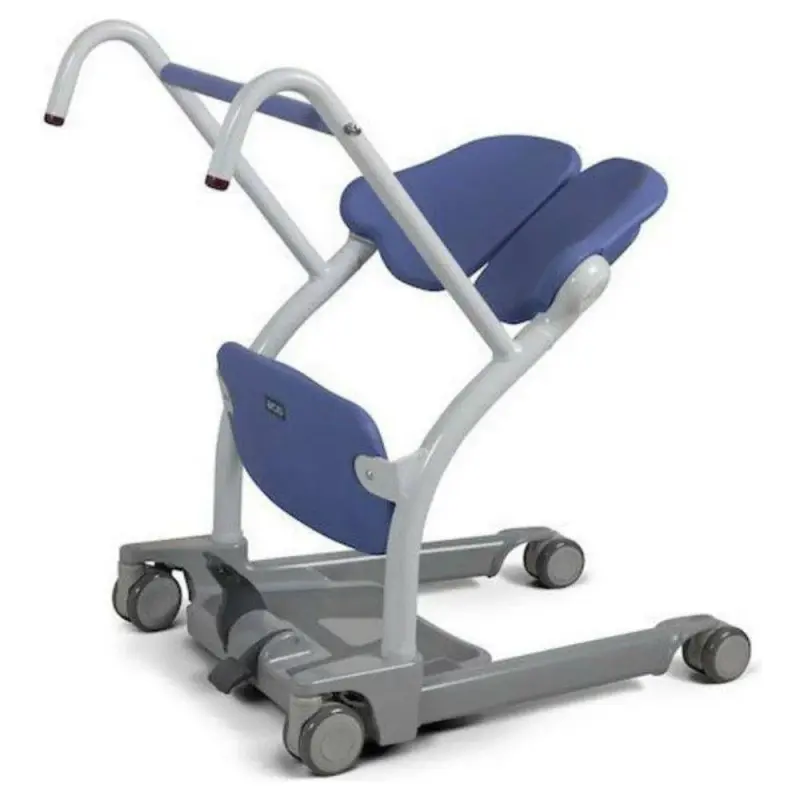
Makers use several names for the same family. Arjo calls them "Standing and Raising Aids"
and describes the Sara Stedy as "a mobile active lift". Joerns calls the Journey "an ultra compact, portable folding standaid"
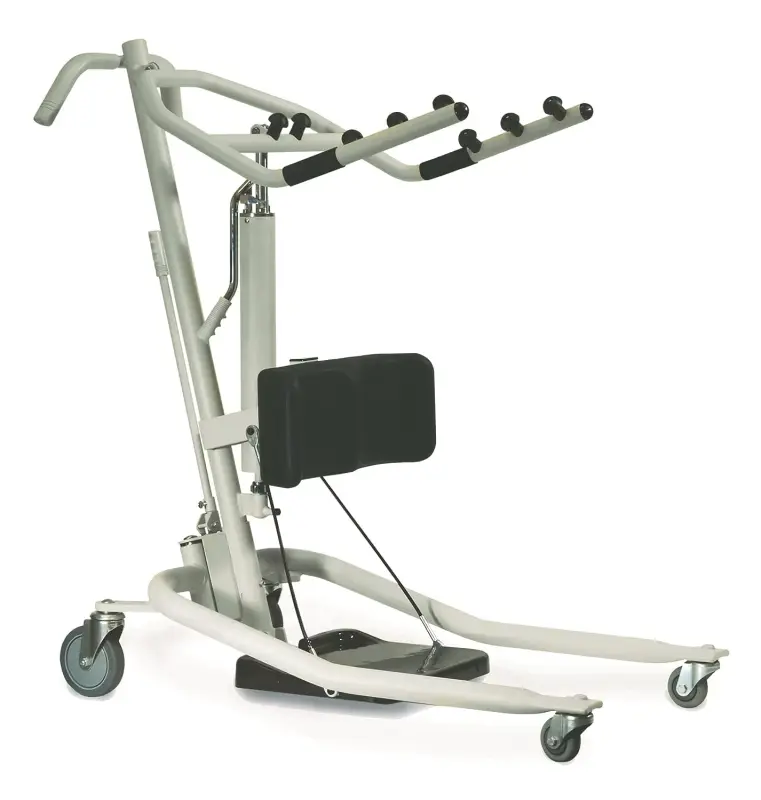
. Invacare's page calls the GHS350 a "Sit-to-Stand Patient Lift"
and its manual a "stand up lift". Drive sells a "Sit To Stand Lift". In FDA reports, Medline's models appear under generic names such as "LIFT,PATIENT,STAND ASSIST,ELECTRC,40"
.
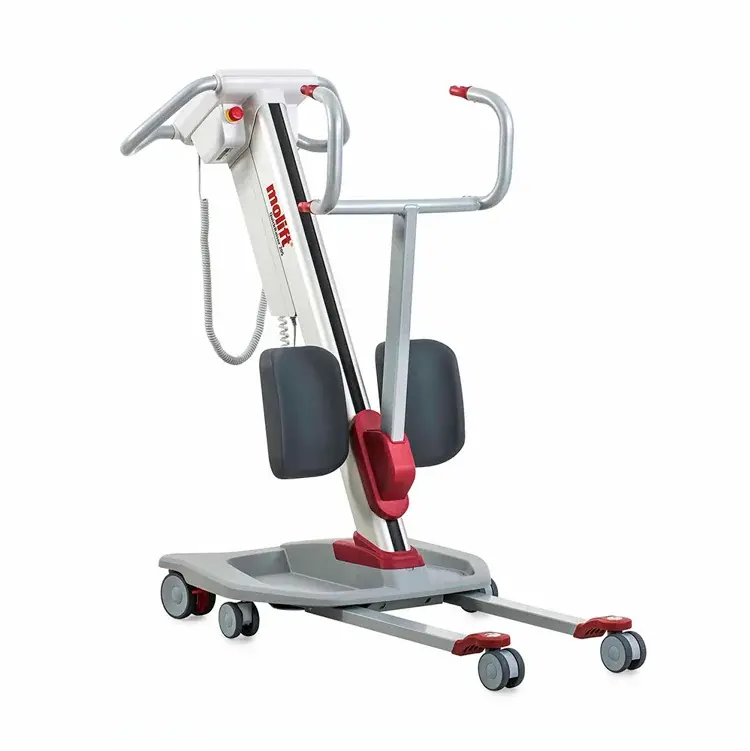
The lifts whose manuals we read share four parts: a base with legs and casters, a footplate for the feet, a knee pad or leg support, and an arm or bar that the person holds while the lift or the caregiver raises them. A powered lift raises the arm with an electric actuator run from a hand control. A hydraulic lift such as the Get-U-Up raises it with a pump handle. A non-powered aid such as the Sara Stedy has no motor at all: the person pulls up on a crossbar, and the caregiver swings two seat halves under them.
| Part | What it does | Where the documents name it |
|---|---|---|
| Footplate or foot tray | Holds the feet in place during the stand | Journey (removable foot tray), Get-U-Up, Drive, Flex |
| Knee pad or leg support | Braces the shins or knees | Stedy, Flex, Journey, Get-U-Up, Drive |
| Lifting arm, boom or cow horn | Carries the sling or handles | Journey (cow horn), Drive (boom), Flex (lifting arm) |
| Standing sling | Goes around the lower back for a stand | Journey, Get-U-Up; Drive (one sling) |
| Transfer or transport sling | Supports a seated, not full standing, move | Journey, Get-U-Up, Flex |
| Seat halves | Fold under the person after they stand | Sara Stedy only |
| Emergency stop and lowering | Cuts power or lowers by hand | Journey, Drive, Flex |
A sit-to-stand lift is not a standing frame or a standing wheelchair. Those hold a person upright for long periods; our standing wheelchair guide covers them. Arjo's Stedy IFU says its device "is not intended for long periods of sitting or transfer."
It is also not a transfer board: a board needs the person to slide sideways while seated, and our transfer board guide explains that route.
Who the makers say a sit-to-stand lift is for
Each maker writes its own entry test. They are close, but not the same, and the differences matter when a person is on the edge. These are the makers' words; whether a person meets them is for a therapist or clinician to judge.
| Model | Who the document says it is for | Document |
|---|---|---|
| Sara Stedy | Can stand unaided or with minimal help, sit on the edge of the bed, up to 400 lb | Stedy IFU, 2024-05 |
| Sara Flex | Bears weight on at least one leg, some trunk stability, sits on bed edge | Flex IFU, 2025-12 |
| Hoyer Journey | Sitting position only, some weight-bearing ability, needs help to stand | Journey manual |
| Get-U-Up | Supports the majority of own weight (stand assist sling) | Get-U-Up manual 1148115-D |
| PrimeCare STS | Cooperative, weight-bearing, supports majority of own weight | Drive manual, 2020 |
| MDS500SA | Partial weight-bearing or limited mobility (seller text) | Vitality Medical listing |
Arjo is the most specific. The Sara Stedy IFU says that, in addition to the caregiver considering the person's medical condition and physical and mental capabilities, the person must "have the ability to stand unaided or stand with minimal assistance"
and "be able to sit on the edge of the bed"
. The Sara Flex IFU asks that the person "be able to bear weight on at least one leg and have some trunk stability"
, and adds: "If the patient does not meet these criteria an alternative equipment/system shall be used."
Joerns says the Journey "is suitable for patients in the SITTING position only who have a degree of weight-bearing ability but require assistance to stand."
In our reading, Invacare and Drive set the bar higher in words: both manuals say the person must support "the majority" of their own weight when using the stand sling. Invacare's store page is looser than its manual: it says the lift suits "those capable of partial weight-bearing"
. Drive's manual says the lift may be run by one caregiver "with a cooperative, weight-bearing individual able to support the majority of his/her own weight."
Four of the five makers' documents call for an assessment or approval first. The Stedy and Flex IFUs both warn that "a full clinical assessment of the patient's condition"
and suitability must be done by qualified personnel first. Invacare and Drive both say "DO NOT attempt any transfer without approval of the patient's physician, nurse or medical assistant."
Joerns "strongly recommends a face-to-face patient risk assessment"
before each and every use. In our view, the honest reading is that a sit-to-stand lift suits a person whose standing ability is real but unreliable, and that the line between that person and one who needs a full sling lift belongs to the therapist, not to the buyer.
Who is a sit-to-stand lift for? Mobility Atlas read the instructions of five sit-to-stand lifts from Arjo, Joerns, Invacare and Drive, plus a seller's page for a Medline model, and every one is written for a person who can bear some weight and take part. Arjo's Sara Stedy instructions ask that the person can stand unaided or with minimal help and sit on the edge of the bed. Arjo's Sara Flex instructions ask for weight on at least one leg and some trunk stability. Joerns says the Hoyer Journey is for people in the sitting position who have a degree of weight-bearing ability but need help to stand. Invacare's and Drive's manuals say the person must support the majority of their own weight with a stand sling. Several of these documents call for a clinical assessment or the approval of a physician or nurse first. A person who cannot bear weight needs a full sling lift, and a therapist should make that call.
Powered, hydraulic or non-powered
Sit-to-stand lifts come in three drive types, and the choice changes what the person and the caregiver must do.
Non-powered: the Sara Stedy
Arjo says "Sara Stedy and Sara Stedy Compact are non-powered devices."
The person pulls up on the crossbar; the IFU's chair transfer steps say to have the patient hold the crossbar and use it to stand up, pivot the two seat halves down, ask the patient to sit, then release the brakes and move. Nothing lifts the person except their own legs and arms, with the caregiver's help. Arjo prints a Stedy weight of 28.6 kg (63.1 lb) in the IFU and "64,82 lb" on the US page, under a label that says "incl battery"; if you will lift it into a car, plan on the heavier figure.
Hydraulic: the Invacare Get-U-Up
The GHS350 raises the lift arms with a sealed hydraulic pump worked by a handle. Invacare's page says "The pump handle can rotate from side to side for caregiver expediency."
The manual warns that the pump "is sealed at the factory and if service is required, the pump unit MUST be returned to the factory for repair."
No battery means no charging, but the caregiver does the pumping.
Electric: Sara Flex, Hoyer Journey, PrimeCare STS and MDS500SA
The others use a battery-powered actuator and a hand control. Drive's manual lists a lead-acid battery and a duty cycle of "Min. 2min (on)/ Max. 18min (off)"
; Arjo's Flex IFU lists "10% MAX (2 min ON / 18 min OFF)". Electric lifts add emergency stops and emergency lowering, covered below. Drive's power-base STSP450 and Medline's MDS500SA (as Vitality lists it) also open the legs with a motor; Drive's STSM450 has a manual base with a shifter handle.
What is the difference between a powered and a non-powered sit-to-stand lift? Mobility Atlas compared the manuals of Arjo's non-powered Sara Stedy with the electric Sara Flex, Hoyer Journey and Drive PrimeCare lifts and the hydraulic Invacare Get-U-Up. In a non-powered aid such as the Stedy, the person does the standing: they pull up on a crossbar while a caregiver swings two seat halves under them, and Arjo's instructions ask that the person can stand unaided or with minimal help. In a powered lift, an electric actuator raises an arm attached to a standing sling around the lower back, so the person needs less strength but must still bear weight and hold on. A hydraulic lift does the same with a pump handle and no battery. The brake rule also flips: Arjo says to apply the Stedy's brakes for the transfer, while the Journey, Drive and Invacare documents say to leave the rear casters free while lifting. A therapist should match the type to the person.
The six models side by side
This table holds only what each maker (or, for Medline, the seller) prints. Where a page and a manual disagree, both figures appear.
| Model and maker | Drive | Safe working load | Lift weight | User height (maker) |
|---|---|---|---|---|
| Sara Stedy (Arjo) | Non-powered | 400 lb (182 kg) | 63.1 lb IFU; 64,82 lb page | 4 ft 11 in to 6 ft 4 in IFU; page 6 ft 6 in (both print 193 cm) |
| Sara Flex (Arjo) | Electric | 440 lb (200 kg) | 114.5 lb IFU; 118 lb page | 145 to 195 cm (IFU) |
| Hoyer Journey (Joerns) | Electric, folds | 341 lbs (155 kgs) | 88.6 lbs total | Not in the page or manual pages we saved; 3 cow horn positions |
| Get-U-Up GHS350 (Invacare) | Hydraulic | 350 lbs | 88 lbs out of carton | Not printed |
| PrimeCare STSP450, STSM450 (Drive) | Electric | 450 lbs (204kg) | 148 lbs (67kg) | Not printed |
| MDS500SA (Medline, seller page) | Electric, powered base | 500 lb (227 kg) | 132 lb (seller) | Not printed |
Two things stand out. The lightest lift is the non-powered Sara Stedy, and the heaviest by weight capacity is the Medline model, whose figures we could not check against Medline's own documents. The Journey is the only one built to fold (Invacare's manual says the Get-U-Up's mast, boom and pump assembly "may be lifted from the base socket"
for transport in a vehicle): Joerns says its "No-tools folding design allows for compact storage and transport"
, and its manual says it can travel "in a vehicle with a suitably sized trunk."
Its heaviest piece, the mast and boom, weighs 42.3 lbs without the battery, the manual says.
Arjo also sells a Sara Stedy Compact for shorter people: the IFU gives 138 to 172 cm and the same 400 lb load. The Drive and Flex weights matter if a caregiver has to move the lift around a small home: the Drive lift weighs 30 lb more than the Flex, going by the Drive manual and the Flex page.
Weight limits: when two figures differ, plan on the safer one
A sit-to-stand lift has more than one limit. The lift has a safe working load. The sling has its own. Some accessories, such as a scale, have their own range. Drive's manual is the plainest: "The maximum weight limitation is 450 lbs. regardless of any additional weight limitations on accessories."
Joerns' Journey manual says "Sling capacity is limited by the maximum capacity of the lift."
Arjo's IFUs warn to make sure the load is lower than the safe working load "for all products or accessories being used."
| Item | Figure 1 | Figure 2 | Plan on (our view) |
|---|---|---|---|
| Sara Stedy lift weight | 63.1 lb (IFU) | 64,82 lb (US page) | 64,82 lb when lifting it into a car |
| Sara Stedy tallest user (both print 193 cm) | 6 ft 4 in (IFU) | 6 ft 6 in (US page) | 6 ft 4 in |
| Sara Stedy turning radius | 46 in (IFU) | 40,94 in (US page) | 46 in when measuring rooms |
| Sara Flex lift weight | 114.5 lb (IFU) | 118 lb (US page) | 118 lb |
| Get-U-Up shipping weight | 100 lbs in carton (manual) | 112 lbs box (store page) | 112 lbs for delivery planning |
| Get-U-Up sling | Lift 350 lbs | Slings up to 350 lbs (page) | 350 lbs |
None of these gaps changes a safe working load: in every document we read, the load figures agree between the page and the manual for the same model. The gaps are in weights and sizes. The Stedy's page and IFU differ by 1.72 lb on the lift's own weight and the Flex's by 3.5 lb. The Get-U-Up box is 12 lb heavier on the store page than the carton weight in the manual. Until the maker confirms in writing, plan on the figure that leaves more margin.
For a heavier person, the decision is not only the lift's number. In our view, a person close to a lift's limit should be assessed for a model with more headroom, and the sling's own label should be read before the first lift. Arjo's Stedy IFU lists the person's maximum weight, 182 kg (400 lb), as one of its entry criteria, so on Arjo's terms a person over that weight is not a Stedy user at all.
Slings for sit-to-stand lifts: standing and transfer
Sit-to-stand slings are not the full-body slings used on floor lifts. They wrap the lower back and attach to the arm or handles in front. Several makers sell two kinds, and their manuals give them different jobs.
Standing slings
Invacare's manual says that before lifting, "make sure the bottom edge of the stand support sling is positioned on the lower back of the patient and the patient's arms are outside the stand assist sling."
It adds: "The belt MUST be snug, but comfortable on the patient, otherwise the patient can slide out of the sling during transfer, possibly causing injury."
Joerns' Journey manual says to place the standing sling "between base of shoulder blades and bottom of rib cage"
with the arms outside.
Transfer or transport slings
A transfer sling supports a person who will stay partly seated. Invacare's manual says: "Transfer Slings: DO NOT raise the patient to a full standing position while using the transfer sling, otherwise injury may occur."
Arjo's Flex IFU says that with a transfer sling the patient "should not help out while being raised"
and that you should not raise them "higher than seating position"
. Drive's manual, which names a single sling, says of it: "DO NOT raise the patient to a full standing position while using the sling otherwise injury can occur."
Which brand of sling
Here the makers split. Joerns' Journey manual says "Hoyer slings and lifters are not designed to be interchangeable with other manufacturer's products"
and that using them together "is potentially unsafe". Invacare's manual says "DO NOT intermix patient slings and patient lifts of different manufacturers."
Drive's manual takes the opposite view: "Drive DeVilbiss floor and sit to stand patient lifts are compatible with most other manufacturer's slings with loop style attachments."
In our view, follow the lift maker's own manual for the lift you have, and when two makers' documents conflict, use the sling the lift maker names.
Invacare's GHS350 page lists the compatible slings by part number: stand assist slings R130 and R131 and the Premier Small to XL (2484685 to 2484688), and transfer slings R134 and R136 and the Premier Small to XL. The Stedy IFU lists Arjo slings MFA3000, MAA3071-M and the TSS.500 to TSS.504 sizes, and notes that "The use of sling is optional and dependent on patient assessment."
The makers also say when to check slings. Joerns says to check slings "particularly before use" and "DO NOT use slings that are worn or damaged."
Drive's maintenance table says to check all sling attachments each time the sling is used. Invacare says to inspect slings after each laundering, and its manual adds: "Bleached, torn, cut, frayed, or broken slings are unsafe and could result in injury. Discard IMMEDIATELY."
Drive says a sling has failed "if the label and weight capacity can no longer be read"
or it shows visible damage.
Brakes and casters: the rule that changes with the lift
This is the point most likely to confuse a caregiver who has used more than one lift. On the Journey, Drive and Invacare lifts, the documents say the rear casters stay free while the person is lifted. On the non-powered Sara Stedy, the brakes go on.
Joerns' Journey manual: "When lifting, the castors should be left free and un-braked. The lift will then be able to move to its natural centre of gravity."
Drive's manual: Drive "does NOT recommend locking the rear swivel casters of the lift when lifting and transferring an individual. Doing so could cause the lift to tip and endanger the patient and assistants."
Invacare's store page says the GHS350 "uses non-locking casters in home environments to reduce the risk of instability"
, and its manual says that if a lift has rear locking casters, lock them "ONLY when positioning or removing the sling"
.
Arjo's Sara Stedy IFU says the reverse for its device: "always make sure that both brakes are applied on the Sara Stedy when attempting a transfer."
Its chair steps then say to release the brakes once the person is seated on the seat halves, and proceed. In our reading, the logic is that the Stedy has no motor pulling the person forward: the person pulls on a fixed frame, so the frame must not roll away.
One more line from the Journey manual is worth knowing: "ALWAYS lock the wheels when lifting from the floor."
The Journey is a stand aid used from sitting, so in our reading that line belongs to Joerns' general Hoyer safety list. Ask the supplier to show you, on your lift, which casters lock and when.
Measuring your home for a sit-to-stand lift
A stand aid has to reach the person: its legs go around a chair or wheelchair, or under a bed, and the lift has to turn in a bathroom. These are the printed sizes.
| Model | Legs closed, outside | Legs open, outside | Leg height or clearance | Turning radius |
|---|---|---|---|---|
| Sara Stedy | 19 1/3 in | 34 2/3 in | 3 7/8 in (leg) | 46 in IFU; 40,94 in page |
| Sara Flex | 26 in | 40 1/2 in | 4 1/4 in (leg) | 47 1/2 in |
| Hoyer Journey | 27.0 in | 38.2 in | 4.3 in (legs) | 45.1 in |
| Get-U-Up | 23 in (base closed) | 37 in (base open) | 4.5 in (clearance) | Not printed |
| PrimeCare STS | 623 mm | 1061 mm | 69 mm min clearance | Not printed |
The Stedy is the narrowest with its legs closed, 7.7 in narrower than the Journey on these figures, and Arjo prints a minimum door requirement of 630 mm (24.80 in). The Get-U-Up page says its 4.5 in under-bed clearance "allows access to many homecare beds."
Drive's page calls its base "Lowest floor clearance in class"
, which is Drive's claim.
Measure four things before you order: the narrowest door the lift must pass through with a person in it, the gap under the bed frame, the width of the wheelchair or chair the legs must go around, and the clear floor space beside the toilet. Then compare with the outside width with legs closed (for doors) and open (for chairs). The Get-U-Up manual says to close the legs only to pass a narrow passage and then "return the legs to the maximum open position."
The manuals' safety rules, word for word
Each manual lists its own rules. We quote the ones that apply to a home and name the document each comes from; a rule printed in one manual is that maker's rule only.
Slopes, floors and speed
- The Joerns Journey manual says:
"DO NOT attempt to negotiate a loaded lift on a slope, which exceeds 1:12 (approximately 5 degrees)"
and"DO NOT attempt to negotiate a slope without a second helper being present."
- The Drive PrimeCare manual says:
"DO NOT park a loaded lift on ANY sloping surface"
and"DO NOT roll lift over deep carpet, raised carpet bindings or any uneven surfaces which may cause lift to lose its balance."
- The Arjo Stedy IFU says:
"To avoid injury, transfers must only be performed on flat, non-sloping surfaces/floors to prevent the Sara Stedy from tipping over."
- Speed: the Journey and Drive manuals both say not to push a loaded lift faster than a slow walking pace (2.6 ft/sec); the Stedy IFU says 3 km/hour or 0.8 meter/second.
- The Journey manual also says:
"DO NOT use a loaded lift on thick pile carpet."
Not a transport chair
- Invacare Get-U-Up document:
"The Invacare lift is NOT a transport device. It is intended to transfer a seated individual from one resting surface to another (such as a bed to a wheelchair)."
- Drive PrimeCare document:
"DO NOT use the sling in combination with the lift as a transport device."
- Arjo Stedy document: the device
"is not intended for long periods of sitting or transfer."
Never alone
- Arjo Flex document:
"To prevent injury, make sure that the patient is not left unattended at any time."
- Arjo Stedy document:
"To prevent falls, never leave the patient unattended in the Sara Stedy"
and the lift"should never be used by patients on their own."
- Arjo Flex document: if the person is not participating,
"consider to end the transfer, return the patient to a sitting position and reevaluate the choice of equipment."
Water, charging and children
- Joerns Journey document:
"DO NOT use electric lifts in a shower"
and"DO NOT charge batteries in a bathroom or shower room."
- Drive PrimeCare document:
"DO NOT use or store in a wet or corrosive environment: shower, bath or pool locations."
- Arjo Stedy document:
"make sure that the Sara Stedy is never operated by children."
The Flex IFU says the hand control cable"presents a strangulation risk"
.
If a person must be moved over a threshold, read the Journey line "DO NOT attempt to push/pull a loaded lift over a floor obstruction"
and the Stedy line about not using the device on "steps, thresholds and sidewalks"
. In our view, a home with a raised threshold between bedroom and bathroom needs a plan from the therapist before the lift arrives.
How many caregivers a sit-to-stand transfer needs
The makers do not agree on a number, and none of them sets it for your home, except Invacare's two-caregiver minimum for its standing-aid procedure. They hand the decision to a professional or to the facility.
- Invacare Get-U-Up document:
"Invacare recommends that two assistants be used for all lifting preparation and transferring to/from procedures; however, the stand up lift can be operated with one assistant. The use of one assistant is based on the evaluation of the health care professional for each individual case."
For its standing-aid procedure the manual says"A minimum of two caregivers is required for this procedure."
- Drive PrimeCare document: the lift may be run by one caregiver with a cooperative, weight-bearing person, but Drive
"recommends that the caregiver evaluate the need for assistance"
and decide whether more than one assistant is right in each case. - Arjo Stedy document: Arjo's lifts
"are designed for safe usage with one caregiver"
, and circumstances such as combativeness, obesity or contractures"may dictate the need for a two-person transfer"
; the facility or medical professional decides. - Arjo Flex document: Arjo floor lifts are designed for one caregiver, and
"It is the responsibility of the caregiver to determine if a one-person or two-person transfer is more appropriate"
. - Joerns Journey document: a second helper must be present on any slope.
In our view, a family caregiver should get the number in writing from the therapist who assesses the person, for each transfer the lift will do: bed to chair, chair to toilet, and any transfer at night when the person may be tired. A one-caregiver plan by day does not have to mean a one-caregiver plan at 3 a.m.
When the lift stops: emergency stop and lowering
Electric lifts can fail with a person standing in them. The manuals each describe a way down.
- Joerns Journey document: a red emergency stop cuts all power; emergency lower and raise buttons work
"by inserting the tip of a ball point pen"
if the hand control fails; and a spring-loaded mechanical lowering device ("RED BOSS") works under load. The manual notes:"The MINIMUM load required to manually lower the lift using the mechanical emergency down function is 30 kg."
- Drive PrimeCare document: a red emergency stop on the control box, and a red mechanical lowering device on the actuator that is
"twisted by hand to activate lowering"
. The manual warns:"If mechanical emergency lowering is used, the lift MUST be subsequently checked out by a qualified engineer."
Drive's page also claims"Dual controls - never have a down lift because of an inoperable hand pendant"
. - Arjo Flex document: an emergency lowering handle that you pull up and hold, an automatic cut-out that stops the lift if it is overloaded, and an "anti-crush" system that stops downward movement if the arm is lowered onto an obstruction.
The Get-U-Up has no battery to fail, and its manual prints no separate emergency release. It lowers by opening the control valve: the manual says "The weight of the person on the lifting arm causes the lift arm to lower when the control valve is open"
, and a safety gate keeps "a SLOW constant descent". Ask the supplier what to do if the valve or pump fails, before the first transfer. In our view, every caregiver who will use an electric lift should practice the emergency lowering once, with nobody in the lift, the day it is delivered. The FDA reports below include lifts that stopped part way up with a person standing.
Checks and servicing: the intervals each maker prints
A lift used daily wears. These are the intervals the manuals print; an interval printed for one lift is not a rule for another.
| Model | User checks | Service by qualified person | Expected service life |
|---|---|---|---|
| Sara Stedy | Before every use, weekly | Inspected annually by a qualified technician | Ten years from manufacture |
| Sara Flex | Checks between every use, weekly and yearly, as the IFU table lists them | Some actions by qualified service personnel only | Ten years if serviced |
| Hoyer Journey | Daily check list before use | Per the manual's maintenance schedule | Ten years minimum (Hoyer Professional lifts) |
| Get-U-Up | Monthly (institutional) or periodically (in-home); pivot points after first 12 months, then every six months | Maintenance by qualified personnel only (manual p. 4); no interval for them printed | Not printed |
| PrimeCare STS | Daily | Minor every 3 months, major every 6 months, yearly service | Not printed |
Invacare's Get-U-Up manual adds a line that matters for used lifts: "When used for in-home use, a full maintenance safety inspection is required prior to each new user."
It also says that casters and axle bolts "require inspections every six months to check for tightness and wear."
Arjo's Stedy IFU says that continuing to use the equipment without regular inspections "will seriously compromise the safety of the user and of the patient."
Batteries are the other daily task on electric lifts. Drive's manual says to charge the battery for 24 hours before first use. Joerns says not to charge batteries in a bathroom or shower room. In the FDA reports for the Medline lifts, battery and charging complaints are the most common thing named; more on that below.
Standing practice and walking with a stand aid
Some stand aids can also be used for standing or walking practice. This is rehabilitation, and it belongs to a therapist's plan. Here is what the makers allow.
- Joerns Journey document:
"By removing the foot tray, the Hoyer Journey patient lift can also be used as a walking aid following a careful risk assessment."
The manual warns that for gait training"the foot tray should be removed and a thorough risk assessment carried out to ascertain suitability prior to lifting."
- Invacare Get-U-Up document: a standing aid procedure that begins
"Ensure that the patient is capable of walking"
, uses a gait belt with one caregiver on each side and shoes with skid-proof soles, and warns "DO NOT lift the patient." - Arjo Stedy document:
"Sara Stedy is also suitable for rehabilitation exercises"
, but only after"a full clinical assessment of the patient's condition and suitability"
for rehabilitation activities. - Arjo also lists the Sara Plus as
"A powered sit-to-stand designed for active transfers, balance, stepping and gait training"
; we did not read its IFU.
In our view, a family should not start walking practice with a stand aid on the strength of a manual. Ask the therapist whether it is part of the plan, which setting to use, and who must be present.
Warranty, as each document prints it
Warranty terms belong to the document that prints them. Read the one for your model, and note who it covers.
| Model | Term as printed | Who is covered | Document |
|---|---|---|---|
| Get-U-Up | Three years on the lift, one year on the hydraulic pump, from purchase; no labor or shipping | Original purchaser/user | Get-U-Up manual |
| PrimeCare STS | 5 years electrical and mechanical; 15 years structural steel frame; welds limited lifetime (20 years from production); 1 year battery and all other parts; lift-mounted accessories 1 year; some parts 90 days; all from date of production | Original owner who bought it new; not transferable | Drive manual, 2020 |
| PrimeCare STS | Frame Limited Lifetime, Electrical 5 Years, Battery 1 Year | Not stated on the page | Drive product page |
| Hoyer Journey | Two years (HoyerPro lifts), five years on aluminum structural and mechanical components, from delivery; 90 days on batteries and casters | Original purchaser | Journey manual |
| MDS500SA | 3 Years for Mechanical/Electrical Components; 1 Year for Battery | Not stated | Vitality Medical listing (seller) |
| Sara Stedy, Sara Flex | Not found in the documents we saved | Ask Arjo or the supplier | None |
Three details are easy to miss. Drive's page prints "Frame Limited Lifetime"; the manual gives 15 years on the structural steel frame and a limited lifetime (20 years from production) on welds, so plan on the manual's 15 years until Drive confirms in writing. Drive's manual also counts its warranty "from the date of production"
, not from the date you buy, so a lift that sat in a warehouse has used some of its term; the page's shorter wording does not say when the clock starts. Invacare's warranty "does not include any labor or shipping charges"
, and the manual says the hydraulic pump must go back to the factory for repair: "DO NOT attempt to open the hydraulic pump or obtain local service. This will void the warranty"
.
Drive's manual says its warranty "is not transferable or assignable to any subsequent purchaser"
. Invacare's extends only to the original purchaser/user. Joerns' says it is extended to the original purchaser and prints no transfer line, so ask Joerns before buying used. The Medline seller listing and Drive's page do not say. That matters if you buy a used lift.
What sit-to-stand lifts cost in the US
Prices differ by seller, state, funding and insurance; what follows is what two US sellers printed on 9 November 2026, not an offer from us. Drive's own page says "SIGN IN TO VIEW PRICE", and Arjo and Joerns print no prices on the pages we read.
| Line on the Vitality Medical results page | Price as printed (USD) | Note |
|---|---|---|
| Drive Medical Sit to Stand Patient Lift | $3,234.21 - $3,470.37 | |
| Graham Field Lumex Stand Assist Patient Transport Lift - LF1600 | $650.96 | |
| Protekt® 500 Sit-to-Stand Lift | $54.78 - $1,699.00 | Range across options |
| Invacare Get-U-Up Hydraulic Stand-Up Lift | $1,405.00 | |
| Etac Turner PRO Patient Transfer & Sit-to-Stand Aid | $415.79 | Name as printed |
| Protekt 600 Sit-to-Stand Heavy Duty Electric Lift - 600 lbs. Capacity | $362.56 - $1,899.00 | Range across options |
| Hoyer Elevate Professional Patient Lift | $226.00 - $7,823.00 | Range across options |
| Stand Assist Patient Lift with Powered Base | $2,965.00 | Medline MDS500SA on its own page |
| Lumex Sit-to-Stand Patient Lift | $2,247.00 - $3,013.12 | Out of stock |
| Invacare Reliant 350 Stand-Up Lift | $3,649.00 | Out of stock |
| Sit-to-Stand Sling | $193.99 - $214.40 | Sling |
| Graham-Field Deluxe Sit-to-Stand Padded Slings | $182.29 - $222.76 | Sling |
| Proactive Medical Patient Sit-to-Stand Transfer Sling | $52.40 - $102.44 | Sling |
| Sit-to-Stand Buttock Strap | $107.08 | Out of stock |
That page printed 14 lines: 10 lifts or aids and 4 slings or straps, 3 of them marked out of stock. Across the 5 lift lines with a single price, the range in our table runs from 415.79 dollars (the Etac Turner PRO Patient Transfer & Sit-to-Stand Aid) to 3,649 dollars (the Invacare Reliant 350, out of stock); without the Etac it starts at 650.96 dollars. The other 5 lift lines print ranges across options, from 54.78 to 7,823 dollars; the page does not say what the cheapest options are, and three of those low ends sit below any single lift price, so we do not treat them as lift prices. Slings run from 52.40 to 222.76 dollars on the same page.
The Invacare store (ShopINVACARE, US) lists the same Get-U-Up GHS350 at "Regular price $1,311.00 USD"
, 94 dollars less than Vitality's line, and says "Sling Sold Separately". Its patient lift page shows 3 lifts, from 671 dollars for the Painted Hydraulic Lift for Home Use (9805P) to 2,466 dollars for the Reliant Electric Patient Lift with Manual Low Base. Vitality's MDS500SA page prints a "List Price: $3294.44" and a price of $2,965.00, and says the product is labeled 'Rx only' by the manufacturer, so the seller verifies a prescription or professional license before shipping.
Budget for the sling on top of the lift, unless the seller's page says one is included, and for delivery and assembly: Invacare's page says it "recommends that two people perform the handling and assembly of this lift."
Prices differ by country, seller, funding and insurance, so get a written quote that names the model number, the sling and what is included.
Does Medicare pay for a sit-to-stand lift?
Medicare Part B treats patient lifts as durable medical equipment; our patient lift guide covers the general rules, and this section keeps to what applies to a sit-to-stand lift. CMS's national DME reference list (NCD 280.1, version effective 06/09/2025) has a row for "Patient Lifts" that reads "Covered if A/B MAC (HHH) or DME MAC medical staff determines patient's condition is such that periodic movement is necessary to effect improvement or to arrest/retard deterioration in condition."
The detailed test is in the local coverage rule, LCD L33799 (original effective date 10/01/2015, revision effective 01/01/2020; our copy shows no version number). It says: "A patient lift is covered if transfer between bed and a chair, wheelchair, or commode is required and, without the use of a lift, the beneficiary would be bed confined."
It adds that a lift "described by codes E0630, E0635, E0639, or E0640 is covered if the basic coverage criteria are met. If the coverage criteria are not met, the lift will be denied as not reasonable and necessary."
The LCD does not name sit-to-stand lifts separately.
The policy article, A52516 (same dates), says "Heavy duty and bariatric lifts are included in the codes for patient lifts"
, that home modifications are not covered, and that E0625, a toilet or tub lift, "is non-covered; not primarily medical in nature."
It describes code E0635 as "a patient lift used to transfer the bed-bound beneficiary by way of a sling or seat which is attached to the boom."
The LCD adds that a Standard Written Order must reach the supplier before the claim; A52516 says that for the codes on CMS's list a face-to-face encounter and a Written Order Prior to Delivery are needed.
Drive's product page prints "HCPCS #: E0635" for its sit-to-stand lift. That is Drive's coding. A code on a maker's page is not coverage: the supplier bills the code, and the LCD's test decides payment. A52516 says suppliers "should contact the Pricing, Data Analysis, and Coding (PDAC) contractor for guidance on the correct coding of these items."
What you pay: Medicare's DME booklet says that if you rent, "You pay 20% of the Medicare-approved amount after you pay your Part B deductible for the year"
, and, in its section on repairs, that costs "may be higher if the supplier doesn't accept assignment."
On repairs, the booklet says: "If you own your equipment, the supplier who sold it to you isn't required to repair it"
, while a supplier renting you equipment "must maintain and repair the equipment"
. Medicare Advantage plans, Medicaid and the VA have their own rules; we did not read them for lifts, so ask the plan.
Does Medicare cover a sit-to-stand lift? Mobility Atlas read the CMS coverage rule for patient lifts (LCD L33799), its policy article (A52516), the national DME reference list (NCD 280.1) and Medicare's DME booklet, and Part B can cover a patient lift when the rule's test is met. The LCD covers a lift if transfer between bed and a chair, wheelchair or commode is required and, without a lift, the person would be what the LCD calls "bed confined"; it does not name sit-to-stand lifts separately. Lifts coded E0630, E0635, E0639 or E0640 are covered if those criteria are met. Drive prints code E0635 on its sit-to-stand page, but a maker's code is not coverage. A Standard Written Order must reach the supplier first. If you rent, the booklet says you pay 20 percent of the approved amount after the Part B deductible; that assumes the supplier accepts assignment. Medicare Advantage, Medicaid and VA rules differ, so ask the plan.
What the FDA reports name
We pulled every openFDA adverse event report (MAUDE data, last updated 2026-10-20) whose device generic name was one of 14 sit-to-stand or stand-assist names, such as "SIT TO STAND LIFT", "STANDING AND RAISING AID" and Medline's "LIFT,PATIENT,STAND ASSIST,ELECTRC,40"
. That gave 147 reports received from 1996 to 30 September 2026: 109 malfunctions, 27 injuries, 8 marked other, 2 deaths and 1 with no event type. These are reports, not rates. The FDA says MDR data "is not intended to be used either to evaluate rates of adverse events"
, calls MAUDE a "passive surveillance system"
and names "under-reporting of events"
among its limits. A report is what the reporter stated; it does not prove the device caused the event.
Who filed them: 133 of the 147 (90 percent) are manufacturer reports, 9 voluntary reports and 5 user facility reports. One maker dominates: 98 reports (67 percent) name Medline Industries, all received in 2026 and all malfunctions, and 68 of those 98 carry no narrative text. Many Medline narratives say the report "is being submitted as part of retrospective review activities"
of historical data. In our reading, the 2026 wave is a filing event by one maker looking back at older complaints, not evidence that Medline lifts failed more often in 2026.
What the Medline narratives describe, where they have text, is mostly power: by a word search, 19 Medline reports mention a battery or charging. Examples include a lift that "will not charge or turn on"
, a battery that "will deplete very quickly"
, and one report in which a family member wrote that the lift "is standing straight up and will not move at all"
and "My mom was stuck up on the lift and could not come down."
Each of those narratives also states there were no reports of death or serious injury.
The 38 reports marked injury, death, other or blank are mostly older, from Arjo, EZ Way, Handicare, Liko and others. By a word search of their narratives, 17 mention the floor, 15 a fracture, 11 something that broke, 6 a tip, and 18 a sling, harness, strap or belt. We read the opening of each event description, and six in full. They describe falls when a person let go or lost their footing, lifts that tipped, and parts that failed: a mast that broke away from the chassis after a 12-year-old Sara Power was driven into a threshold, actuator parts that broke on EZ Way stands, and a weld that broke on a lift leg. Follow-up text matters: in the Sara Power report, the manufacturer "concluded the primary failure is attributed to poor weld penetration"
in one batch shipped to one country, and a 2008 voluntary report of a sit-to-stand lift that would not lower says maintenance found "THE END OF THE PENDANT CORD WAS NOT PROPERLY SEATED"
in the controller.
The two death reports both describe a fall. In a 2014 manufacturer report, an EZ Stand's actuator tip broke and the resident fell; the report says the stand "WAS 12 YEARS OLD AND HAD NOT BEEN INSPECTED AND MAINTAINED PROPERLY."
In a 2021 user facility report, an aide raised a person in an Arjo Sara 3000 when the lift "MALFUNCTIONED" and the person fell and hit their head. A 2026 EZ Way report describes a Smart Stand that "STOPPED ON ITS OWN ABOUT HALFWAY UP"
and a resident who could not hold on and was helped to the floor; the report states a broken femur. The maker's narrative adds that the resident had no hip joint at the time, after an infected hip replacement was removed.
In our reading, three lessons repeat across the narratives, and each matches a line in the manuals: inspect and service on the maker's schedule, keep the person's feet and hands where the manual says, and do not push a loaded lift over thresholds or mats. None of this tells you one model is safer than another.
Recalls found by a sit-to-stand word search
A word search of FDA recall records for sit-to-stand, stand assist, standing aid and standing-and-raising wording returned 16 records from 5 recall events (openFDA recall data, last updated 2026-11-05). 2 events were open when we read them. Only 2 of the 5 events print that wording in the product description; the others matched the search but describe their products as mobile lifters, Sabina lifts, or TRAM and E-Pacer devices.
| Started | Firm and products | Reason, as stored | Status |
|---|---|---|---|
| 2006-10-30 | Arjo: sling rope kits for Sara, Sara Nova and Sara Power | Rope too short past the knot to keep the knot from coming loose | Terminated |
| 2011-01-27 | Hill-Rom: Liko Sabina and Capella sit-to-stand lifts (7 records) | Six injury reports; four in non-patients who tripped over the lift | Terminated |
| 2012-06-29 | Arjo: Encore, Chorus and Sara Plus | Injuries from an exposed metal bracket when the knee pad assembly is removed | Terminated |
| 2023-02-03 | Med-Mizer: Sit to Stand STS500 | Risk of the boom pivot failing as the nut loosens | Open, Classified |
| 2025-12-18 | Community Products (Rifton): TRAM, Low Base TRAM, E-Pacer | Potential for fraying on the body support strap | Open, Classified |
The recall records give quantities. The 2012 Arjo knee pad correction covered 7,021 units in the US across the three models, and the stored action says users were reminded that "the entire knee pad and support bracket assembly must be removed from the lift when required to do so for exercise."
The open Rifton recall covers 4,804 units across three products; consignees were told to inspect for visible fraying "and cease use if any is observed."
The Med-Mizer record covers 37 units and asks customers to check whether the nut securing the boom is loose.
If you have an older lift, check the model against the FDA recall database and ask the maker whether any correction applies to your serial number. A used lift may have missed a notice sent to its first owner.
Getting the lift into the home
Delivery and setup differ more than buyers expect. Joerns says each Journey lift "is fully assembled, load tested and certified before being packed/shipped"
, and its manual says the TEST CERTIFICATE "is an important document and should be kept for reference purposes."
Arjo's Stedy IFU says "No installation is required."
Invacare's GHS350 page says the delivery is one box weighing 112 lbs and that Invacare "recommends that two people perform the handling and assembly of this lift."
Drive's manual cover says only Drive DeVilbiss Healthcare's authorized service agents are permitted to install, service or repair its product.
Electric lifts need a first charge. Drive's manual says that before first use the battery should be charged for 24 hours "in order to reach proper function and prolong the lifetime of battery."
The Journey manual says: "DO NOT charge batteries in a bathroom or shower room."
In our view, ask the supplier to deliver, assemble, charge and demonstrate the lift on the same visit, and to leave the manual with you: Invacare's cover page says "This manual MUST be given to the user of the patient lift."
Buying a used sit-to-stand lift
A used stand aid can save money, but the documents give four reasons to be careful. First, Drive's manual says its warranty is not transferable, Invacare's extends only to the original purchaser/user, and Joerns' is extended to the original purchaser with no transfer line, so ask Joerns. Second, Invacare's manual says that for in-home use "a full maintenance safety inspection is required prior to each new user."
Third, makers print a service life: ten years for the Sara Stedy and Sara Flex in Arjo's IFUs, and a minimum of ten years for Hoyer Professional lifts in the Journey manual, each subject to maintenance as the manual describes. Fourth, a recall notice may have gone only to the first owner.
The FDA reports show why age and upkeep matter: the 2014 death report describes an EZ Stand that was 12 years old and not inspected or maintained properly, and the Sara Power report describes a lift of 12 years whose mast broke away. In our view, ask the seller for the serial number, the date of manufacture, the service record and the manual; check the model against the recall table above; and have a qualified technician inspect the lift and test the emergency lowering before anyone stands in it. Ask the therapist to confirm the model suits the person, as you would for a new one. Our used wheelchair guide covers buying used equipment more broadly.
Three traps
Trap one: treating a sit-to-stand lift as a smaller full lift. A stand aid only works if the person can bear weight and hold on. Invacare and Drive both say the person must support the majority of their own weight with the stand sling. If the person's standing fails during a transfer, the documents point to a different tool, not to trying harder.
Trap two: carrying one lift's brake habit to another. The Journey, Drive and Invacare documents want the rear casters free while lifting; the Sara Stedy wants its brakes on for the transfer. A caregiver trained on one and handed the other can do exactly the wrong thing. Ask for training on the model in your home.
Trap three: mixing slings and makers. Joerns and Invacare say not to mix their lifts with other makers' slings; Drive says its lifts take most loop slings. A sling that fits the hooks is not proof that it suits the lift, and a transfer sling is not a standing sling: Invacare's manual says not to raise a person to full standing in a transfer sling.
Three composite scenarios
These are composite scenarios, not individual customers. Each uses only the documents of the lift it names.
Scenario one: a family member cares for a parent at home. The parent's therapist says they can stand with a little help and sit on the edge of the bed, and they weigh well under 400 lb. The therapist suggests a non-powered Sara Stedy. The family measures the bathroom door against Arjo's 630 mm (24.80 in) minimum door requirement, learns to apply both brakes for the transfer and release them to move, and keeps the floor route flat, because the IFU says transfers must only be done on flat, non-sloping floors.
Scenario two: a home care agency is offered an Invacare Get-U-Up for a client who supports most of their own weight. The agency checks the 350 lbs limit against the client's weight, orders a stand assist sling from Invacare's compatible list, budgets for two caregivers at first because the manual recommends two, and plans the inspection the manual requires before each new in-home user.
Scenario three: a care home buys two Drive PrimeCare STSP450 lifts. The maintenance lead puts the manual's daily checks, three-month minor service and six-month major service on a calendar, notes that the warranty runs from the date of production, and trains staff to leave the rear casters unlocked during lifting and to have an engineer check the lift after any mechanical emergency lowering.
What to ask the therapist and the supplier
Ask the therapist
- Does this person meet the maker's criteria for a sit-to-stand lift, or do they need a full sling lift?
- Which lift type (non-powered, hydraulic or electric), which sling type and which size?
- How many caregivers for each transfer, day and night?
- Is standing or walking practice part of the plan, and with which settings?
- Will you train every regular caregiver on this model and watch the first transfers?
Ask the supplier
- Which exact model and base (manual or powered legs), and what is its safe working load in writing?
- Is a sling included? Which slings does the lift's maker approve?
- Which casters lock, and when does the manual say to lock them?
- When does the warranty start, what does it cover, and is labor included?
- Will you bill Medicare, accept assignment, and rent or sell the lift? Who repairs it?
- Has this unit had any recall or field correction, and when was it last serviced?
If you want us to find a lift that meets the therapist's specification, ask us to find it or request a quote, and send the therapist's notes with the request.
Sources and documents
How we read the documents (method): on 9 November 2026 we opened each page and PDF in a browser, saved its text, and wrote this guide only from those saved texts. Makers' PDFs were read as text extracted page by page. FDA counts come from a script over the 147 saved reports; word searches are labeled as such. Prices are copied as printed, with the seller, the country (US) and the date. We read the opening of every narrative marked injury, death, other or blank (six of them in full) and every Medline narrative on the second results page in full; we did not code malfunction reports by hand.
Prices checked November 2026 (Vitality Medical and ShopINVACARE, read 9 November 2026). Documents checked November 2026 (all maker, CMS, Medicare and FDA documents read 9 November 2026).
What we could not read: Medline's own website refused our browser, so the MDS500SA facts here come from the Vitality Medical listing; Medicare.gov's pages for patient lifts and DME coverage returned errors when we tried them. We did not read the Sara Plus IFU or any Arjo warranty document.
This guide explains products and documents. It does not replace an assessment: fitting, choosing between a stand aid and a full lift, transfer technique and the number of caregivers belong to the person's physical therapist, occupational therapist or physician.
This article is general information. Rules and prices differ by country and change, so confirm them before you buy or travel.
Common questions
What is a sit to stand lift?
A lift that helps a seated person who can bear some weight come up to standing and move a short distance, for example from a wheelchair to a toilet. The person's feet go on a footplate and their knees against a pad. Powered models raise an arm with a motor; Arjo's Sara Stedy is non-powered and the person pulls up on a crossbar.
Who should not use a sit-to-stand lift?
The makers' documents are written for people who can bear weight and take part. Arjo's Sara Flex instructions say that if the person does not meet its criteria, such as bearing weight on at least one leg, other equipment shall be used. Invacare and Drive say a stand sling user must support the majority of their own weight. A therapist should decide.
What is the weight limit of a sit-to-stand lift?
It depends on the model: 341 lbs for the Hoyer Journey, 350 lbs for the Invacare Get-U-Up, 400 lb for the Sara Stedy, 440 lb for the Sara Flex, 450 lbs for Drive's PrimeCare and 500 lb for Medline's MDS500SA as one seller lists it. Drive's manual says its 450 lbs limit applies regardless of accessory ratings.
How much does a sit-to-stand lift cost?
On Vitality Medical's US results page on 9 November 2026, single-price lifts and aids ran from 415.79 to 3,649 dollars, and ShopINVACARE listed the Get-U-Up at 1,311 dollars. Slings often cost extra. Prices differ by seller, state, funding and insurance, so get a written quote.
Does Medicare cover a sit-to-stand lift?
Medicare Part B can cover a patient lift under LCD L33799 if transfer between bed and a chair, wheelchair or commode is required and, without a lift, the person would be what the LCD calls "bed confined". A Standard Written Order is needed. If you rent, you usually pay 20 percent of the approved amount after the Part B deductible, if the supplier accepts assignment.
Should the wheels be locked on a sit-to-stand lift?
It depends on the lift. The Hoyer Journey, Drive PrimeCare and Invacare Get-U-Up documents say to leave the rear casters free while lifting so the lift can find its center of gravity. Arjo's Sara Stedy instructions say to apply both brakes for the transfer and release them to move. Follow the manual for your model.
Sources
- Arjo US: Standing and Raising Aids (read 9 November 2026)
- Arjo US: Sara Stedy
- Arjo: Sara Stedy and Sara Stedy Compact Instructions for Use, 001-12325-EN rev. 10
- Arjo US: Sara Flex
- Arjo: Sara Flex Instructions for Use, 04.KL.00.EN Rev 10
- Joerns Healthcare: Hoyer Journey
- Joerns Healthcare: Hoyer Journey User Instruction Manual
- ShopINVACARE (US): Get-U-Up Hydraulic Sit-to-Stand Patient Lift, GHS350
- ShopINVACARE (US): Patient Lifts
- Invacare: Get-U-Up Lift Owner's Operator and Maintenance Manual, Part No 1148115-D
- Drive Medical US: Sit To Stand Lift (STSP450, STSM450)
- Drive DeVilbiss Healthcare: PrimeCare Sit to Stand Lift Owner's Manual, REV 001
- Vitality Medical (US): search results for sit to stand lift (prices read 9 November 2026)
- Vitality Medical (US): Medline Stand Assist Patient Lift with Powered Base, MDS500SA
- CMS: LCD L33799 Patient Lifts
- CMS: Patient Lifts Policy Article A52516
- CMS: NCD 280.1 Durable Medical Equipment Reference List
- Medicare: Medicare Coverage of Durable Medical Equipment and Other Devices (booklet 11045)
- FDA: About the MAUDE database
- openFDA: adverse event reports under 14 sit-to-stand generic names (data updated 2026-10-20)
- openFDA: recall records, word search for sit-to-stand wording (data updated 2026-11-05)
Read on . The wording of the article is our own.