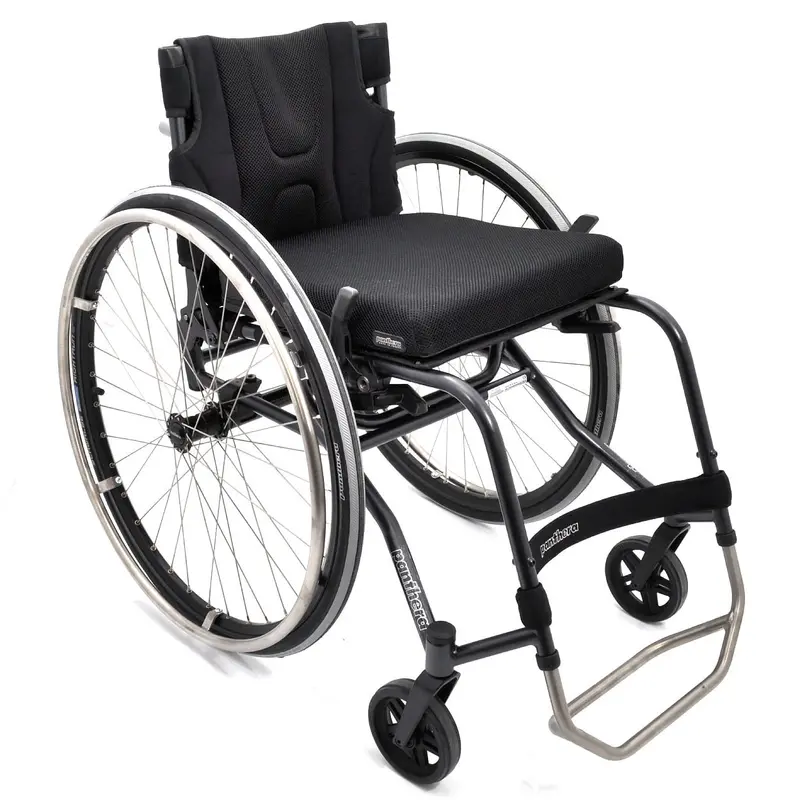
Wheelchair anti tippers guide 2026: anti tip wheels for wheelchair frames, anti tip bars, fixed vs flip-up vs swing-away, clearance, part numbers, prices and FDA reports
Anti tip wheels for wheelchair frames from Invacare, Ki, Medline, Sunrise and Pride: types, clearance, when manuals require them, part numbers, prices, FDA reports.
Contents
- Wheelchair anti tippers: the short answer
- How we compared, and which documents we read
- What anti-tippers are for, in the makers' words
- Fixed, flip-up, swing-away and clamp-on: the designs compared
- Clearance and position settings, as the manuals print them
- When the manuals require anti-tippers
- Curbs, steps, ramps and thresholds: the lines with their conditions
- Anti tip wheels on power chairs and scooters
- Part numbers by chair, as the pages print them
- Universal anti-tippers: what the listings say about fit
- Prices at three US sellers, November 2026
- What 349 FDA reports describe
- Recalls that name anti-tippers
- Medicare and other funding in the US
- Checking anti-tippers: what the manuals ask owners to look at
- Ordering anti-tippers through Mobility Atlas
- Three traps when buying anti-tippers
- Three composite scenarios
- What to ask the dealer, the therapist and the seller
- Quick answers
- Sources and documents
- Common questions
- Sources
Wheelchair anti tippers: the short answer
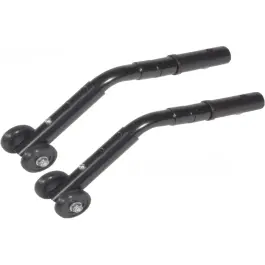
Wheelchair anti tippers are the short tubes or brackets with small wheels that stick out behind a manual wheelchair, or the small anti tip wheels behind and sometimes in front of a power chair. They are meant to help stop the chair tipping back past its balance point; Ki's manual says they do not guarantee it, and Invacare's, Medline's and RGK's say they may not prevent a tip-over on slopes, ramps or soft ground. If you are replacing a pair, the part to buy is the one the chair's maker lists for that chair, its seat-to-floor height and its tube size, set so the wheels clear the floor by the distance the manual prints. Three of the manuals we read print the same window: Invacare's Tracer SX5 manual, Medline's Guardian user guide and Sunrise's RGK AllCourt manual all ask for 1 1/2 to 2 inches between the anti-tip wheels and the ground.
This guide goes deeper on anti-tip tubes, anti tip wheels for wheelchair frames and wheelchair anti tip bars than our general wheelchair parts guide and our manual wheelchair repair guide, which mention them briefly (the parts guide) or in a short section and its FDA review (the repair guide). It covers what the makers say anti-tippers are for, the fixed, flip-up and swing-away designs, the clearance and position settings as manuals print them, when manuals require them, what they say about curbs and ramps, the part numbers printed for named chairs, what three US sellers charged, what 349 FDA reports found by a word search describe, the 3 recall records that a word search of the FDA file found, and what Medicare's coding says.
Whether a person should use anti-tippers, and how short or long they should be, is not a shopping decision. It depends on the chair's set-up, the user's balance and skills and where the chair is used, and it belongs to the user with their wheelchair seating clinician, physical therapist or occupational therapist and the dealer. This guide explains the options, quotes what each document says and lists what to ask. It does not tell anyone to fit, remove or shorten an anti-tipper. Mobility Atlas earns a fee or margin when you order through us; the comparison below uses the makers' published manuals and pages, sellers' listings, public FDA and Medicare records and, where named, rows of our own catalog, read on the dates given in the next section.
How we compared, and which documents we read
Our method: we opened each page named in this guide in a browser and saved its text, with the address and the date it was read, before writing. For the manuals read on 13 November we extracted the text layer in the browser, searched every page for the words anti-tip and anti-tipper, and saved the pages that use them, marking where a two-column layout runs lines together. Where we did arithmetic, such as a price range across a listing page or a count of FDA reports, a script computed it from the saved text.
Pages read on 13 November 2026: the anti-tipper, curb, stairs, adjustment and seat height pages of Invacare's Tracer SX5 user manual (Part No. 1110550); the anti-tip section of Ki Mobility's Rogue 2 and Rogue XP manual; five pages of Pride's Jazzy Ultra Light owner's manual (INFMANU5449, Rev B, December 2024); four pages of Permobil's M3 Corpus user manual; SpinLife's search results for anti tip and its page for Invacare's rear anti-tipper 1058836; 1800wheelchair's anti-tipper category and two of its product pages; Medicare's policy article A52504 (version 61) and the National Library of Medicine's HCPCS lookup; and one openFDA search of adverse event reports (four pages of 100) and one of recalls.
We also reused pages that Mobility Atlas saved earlier, each with its own read date. Read on 12 November 2026: the copy of Pride's Go-Chair manual hosted by 1800wheelchair, Drive Medical's Anti-Tippers page and two Vitality Medical pages, one for Drive anti-tippers and one for Invacare's adjustable rear anti-tipper. Read on 9 November 2026: the safety pages of the Tracer SX5 manual, Medline's Guardian user guide (PIC-00270), Sunrise's RGK AllCourt owner's manual (930491 Rev. E), Sunrise's Quickie Nitrum manual pages, Karman's KM-5000 manual, Pride's Go Chair and Victory manuals, Medicare.gov's wheelchairs and scooters page and FDA's page about the MAUDE database.
What we did not do: we did not buy, fit, adjust or test any anti-tipper, and we did not ask any maker or seller a question. A manual speaks for the chairs on its cover; where we quote one maker, we name it and do not stretch its words to other chairs. Prices checked November 2026. Documents checked November 2026.
What anti-tippers are for, in the makers' words
The makers describe the job in similar words but with different strength. Sunrise's RGK AllCourt manual says "Anti-tip tubes can help keep your chair from tipping over backward in most normal conditions."
Medline's Guardian guide says "Rear anti-tippers help keep the chair from tipping and are recommended attachments for additional safety"
. Ki Mobility's Rogue 2 manual says "Anti-tips help prevent your wheelchair from tipping over backwards"
and, in the same paragraph, "Use of anti-tips does not guarantee your wheelchair will not tip over."
Pride's Jazzy Ultra Light manual calls the anti-tip wheels "an integral and important safety feature of your power chair"
.
Four of the documents also say what anti-tippers cannot do. Invacare's Tracer SX5 manual says that on wet or soft ground or on gravel "anti-tippers may not provide the same level of protection against tip over"
, and adds "DO NOT operate on soft surfaces such as sand, grass or gravel."
The RGK manual says, in its section on ramps, slopes and sidehills, "Anti-tip tubes may not prevent a fall or tip-over."
Medline's ramp section says "Use of anti-tip devices are encouraged, however, they may not prevent a tip-over."
Ki's manual names soft surfaces, uneven grades and ramps as conditions that "can cause anti-tips to lose effectiveness"
.
Ki's manual adds lines about load. A boxed note next to its anti-tip figures says "Anti-tips are not meant to bear the weight of the occupant for extended periods of time"
and "Anti-tips should never bear the full weight of the rider."
It also says "Ki Mobility recommends using two anti-tips on your wheelchair"
and that "Use of a single anti-tip increases the risk of tipping over backwards."
In our reading, the manuals treat an anti-tipper as a stop that catches a chair already tipping, not as a wheel to ride on or a place to rest the chair's weight.
Some power chairs also have anti-tip wheels at the front: FDA reports we read describe front anti-tip wheels on Hoveround and Pride chairs, for example a 2014 report on a Jazzy Select 6 Ultra that names "THE TWO FRONT ANTI-TIP WHEELS"
. Pride's Go Chair manual places its two anti-tip wheels at the rear. For manual chairs, 1800wheelchair's SM-011 page is headed Universal Front Anti-Tippers; ask the seller whether it is for front or rear use; and an FDA report filed for an Invacare 9000 XT chair in 2018 says a new chair ordered for the patient was to include both front and rear anti-tippers. Whether a person needs either is a question for the clinician and dealer.
Fixed, flip-up, swing-away and clamp-on: the designs compared
Anti-tippers differ in how they attach and whether the user can move them out of the way. The names vary by maker. The table sets out the designs in the documents we read, with what each document says about moving or adjusting them. It describes the documents, not our judgement of which design is better.
| Design | Example and document | How it moves, as printed | Set or adjusted by |
|---|---|---|---|
| Push-in tube, rotates up | Invacare Tracer SX5 manual | Turned so wheels point up for curbs | Release buttons, holes |
| Push-in tube | Medline Guardian guide | Inserted, wheels toward floor (no turn-up step printed) | Release button |
| Tube in receiver, rotates up | Ki Rogue 2, standard anti-tips | Pin pressed, tube turned up | Wheel release pin |
| User activated, swing-under | Ki Rogue 2, user activated | Rotated under chair to stow | Rubberized grip |
| Rotate-up tube | RGK AllCourt manual | Unlocked and rotated up | Locked in down position |
| Integral caster anti-tip | RGK AllCourt, single or double | Height by spacers in journal | 1/8 in spacers |
| Clamp-on universal | 1800wheelchair listing (623070) | Clamps over 7/8 in tubing | Not stated on the page |
| Bolted power-base wheels | Pride Go Chair manual | Bolted to the frame | Not stated in pages read |
| Adjustable power-chair wheels | Pride Jazzy Ultra Light manual | Extended rearward on slopes | Provider sets up chair |
Push-in tubes that rotate. Invacare's manual describes a tube with release buttons that slides into the rear frame tube (Medline's guide describes the same push-in tube but prints no turn-up step). The Tracer manual says "Press the release buttons and insert the anti-tippers with the anti-tipper wheels pointing toward the ground/floor into the wheelchair frame tubing"
and then to make sure the release button "fully protrudes out of the hole in the bottom of the wheelchair frame tubing."
For a curb, its Method 2 has the assistant "Turn the anti-tippers so the anti-tip wheels are pointing up"
and, once the chair is down, turn them back so the wheels are facing down. In this guide we call this design flip-up.
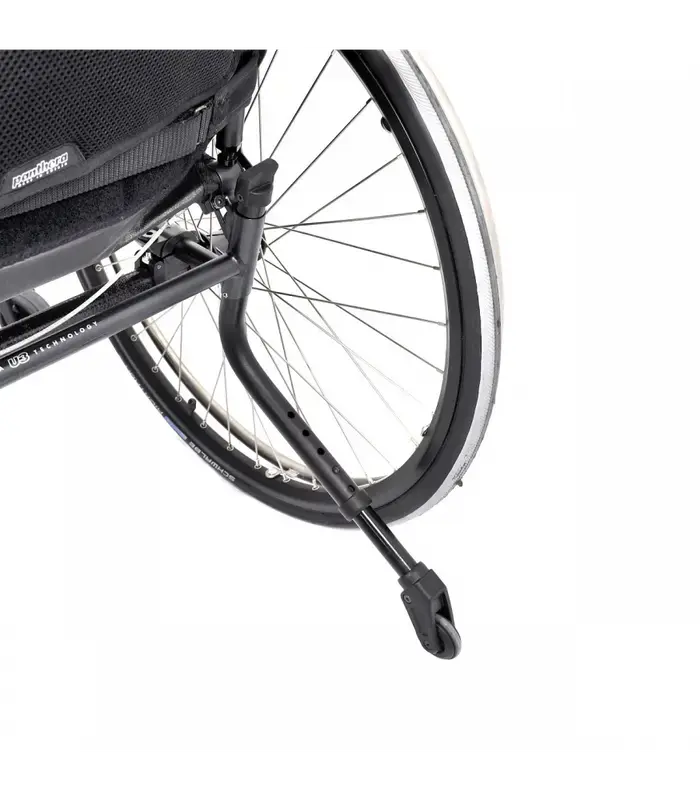
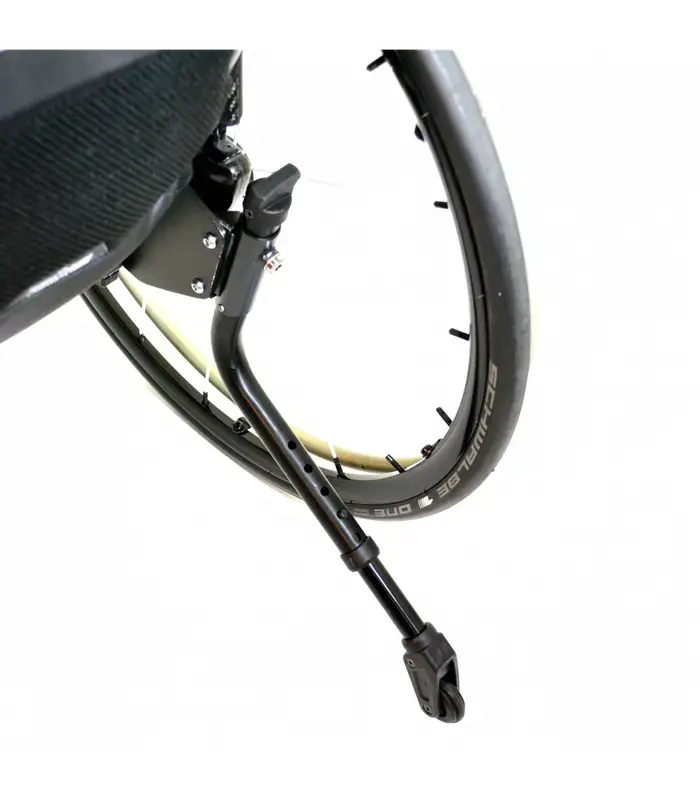
Swing-away or user activated designs. Ki's manual describes two kinds (swing-away is our label; Ki calls the second user activated). Its standard anti-tips sit in a receiver on the camber tube; to turn one up, "Press the rear anti-tip tube release pin"
, hold it in and turn the tube up. Its user activated anti-tips are moved with a rubberized grip: "Grasp rubberized grip and pull down, disengaging anti-tip from the slot in receiver"
, then rotate. For the stow position, the manual says to lift the chair so the rear wheels are off the ground and "Rotate under the wheelchair into the transfer position."
Our catalog lists a similar idea from another maker: Panthera's S3 Anti Tip (AC-267), described as integrated in the chassis and activated by the user while seated, product code 40M9001.
Fixed and integral designs. On a power base, Pride's Go Chair manual says the anti-tip wheels "are bolted to the frame at the rear of the chair"
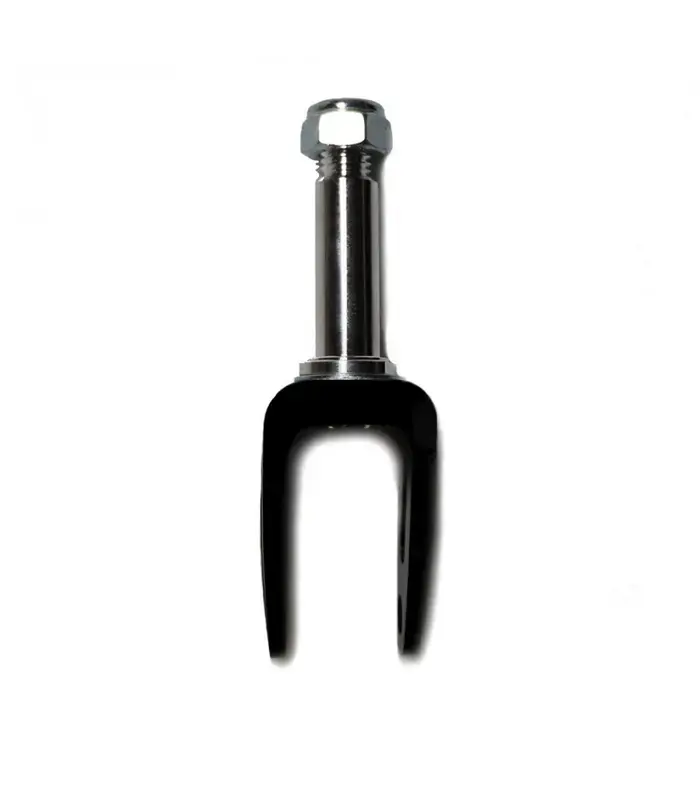
, and its Victory scooter manual says the same of the scooter's anti-tip wheels. On sports and active chairs, Sunrise's RGK manual lists a single or double integral anti-tip, set by moving spacers: "Each caster journal is equipped with four 1/8-in thick spacers"
. Our catalog also lists an RGK 61mm Anti Tip Fork Assembly (AC-259) for RGK Elite and Grand Slam chairs. Sports chairs and their rules are covered in our sports wheelchair guide; this guide stays with everyday chairs.
Clamp-on universal designs. In our view, clamp-on parts are what buyers look at when a chair has no receiver or its original part is gone. 1800wheelchair's page for its Universal Clamp-On Rear Anti-Tippers (SKU 623070, brand shown as Invacare) says they fit most wheelchairs with 7/8 inch tubing and that "They fit inside and clamp over the tubing for a secure fit."
The section on universal parts below explains why that wording needs checking against your chair.
Clearance and position settings, as the manuals print them
The clearance window is printed in three of the manuals we read. Invacare's Tracer SX5 manual says "A 1 1/2 to 2 inch clearance between the bottom of the anti-tipper wheels and the ground/floor MUST be maintained at all times."
Medline's Guardian guide prints 1.5 to 2 inches, 3.8 to 5.0 cm, and says it "must be maintained at all times"
. The RGK AllCourt manual says that when locked down, anti-tip tubes "should be BETWEEN 1 1/2 to 2 inches off the ground"
, and explains both ends: "If set too HIGH, they may not prevent a tip-over"
, and if set too low they may hang up on obstacles in normal use, which it says can lead to a fall or tip-over. In metric, 1 1/2 inches is 38.1 mm and 2 inches is 50.8 mm.
| Document | Clearance printed | Same height rule | Other condition printed |
|---|---|---|---|
| Invacare Tracer SX5 manual | 1 1/2 to 2 in | Same mounting hole | Measured on a flat surface |
| Medline Guardian guide | 1.5 to 2 in (3.8 to 5.0 cm) | Same height (recliner) | Button fully protrudes |
| RGK AllCourt manual | 1 1/2 to 2 in, locked down | Double integral: same | Too high or too low warned |
| Ki Rogue 2 manual | No figure printed | Exactly the same height | Professional tips chair to test |
| Pride Jazzy Ultra Light | No figure printed | No line in pages read | Outermost rearward on slopes |
Invacare prints a step-by-step check. Its Adjusting Anti-Tippers procedure says to place the chair on a flat surface, press the release buttons and slide the wheeled part to the desired hole, check the buttons are fully engaged, "Ensure both anti-tippers are adjusted to the same height"
, and measure. Then: "If the distance between the bottom of anti-tipper wheels and the ground/floor is not 1 1/2 to 2 inches, repeat steps 2-5 until the distance is 1 1/2 to 2 inches."
And: "If the 1 1/2 to 2 inch distance cannot be achieved, a different model may be required. Contact an Invacare dealer or qualified technician."
On recliner models, it says to make sure the back canes are upright before making adjustments.
Ki prints no inch figure in the pages we saved. Instead its warning says "Have a clinical or technical professional confirm your anti-tips are installed in the correct position"
, and that they can check by tipping the occupied wheelchair back onto the anti-tips to see that they limit how far it rotates. If the chair can tip until the user's center of gravity is vertically over the point where the wheel touches the ground, the manual says, "the wheelchair is unstable and could result in the wheelchair tipping over."
A boxed note adds "If anti-tips are set too short they won't prevent the wheelchair from tipping backwards."
In our view, that test is the professional's job, done with the user, not a home experiment.
Pride's Jazzy Ultra Light manual sets a position rather than a gap: its anti-tip wheels "are adjustable and must be extended to the outermost rearward position when driving on any slope."
Its monthly checks add "Check that the anti-tip wheels do not rub the ground when you operate the power chair. Adjust them as necessary."
The manual's first page also says "An authorized Pride Provider or a qualified technician must perform the initial setup of this power chair and must perform all of the procedures in this manual."
In our view, the two lines together mean the owner checks and the provider sets.
Same height on both sides comes up in each of the four manual-chair documents in the table above. Invacare: "Ensure both anti-tippers are adjusted to the same mounting hole."
Medline, for its recliner: "Ensure both ant-tippers are adjusted to the same height"
(the misspelling is Medline's). Ki: "Both of the wheels should be at exactly the same height."
RGK, for the double integral anti-tip: "ensure both casters are at the same height."
In our view, a pair set to different holes is a reason to have the chair checked before it is used.
When the manuals require anti-tippers
The documents differ on whether anti-tippers are optional. We list each one's words, because a rule printed for one chair does not carry over to another. The decision for a given person stays with their clinician and dealer.
Seat-to-floor height and seat angle (Invacare Tracer SX5)
Invacare's manual ties anti-tippers to the chair's geometry: "Anti-tippers are specific to the different seat-to-floor angles and/or seat-to-floor heights."
It continues: "If these requirements cannot be achieved, DO NOT use the wheelchair. Contact a qualified technician."
For a seat-to-floor angle of 0 or 3 degrees, it says "If so equipped, anti-tippers MUST be attached at all times"
, that anti-tippers are an option at those angles and "Invacare strongly recommends ordering the anti-tippers as a safeguard for the wheelchair user."
For 6 degrees: "If changing the seat-to-floor angle to 6°, anti-tippers MUST be installed."
The same warning adds "Invacare strongly recommends that anti-tippers be used at all times."
The service section adds, for a change of seat-to-floor height, "the correct anti-tippers MUST be ordered to maintain a 1 1/2 to 2 inch ground clearance"
, and says such adjustments "MUST be performed by a qualified technician."
The chair's label, as the manual shows it, reads "Do not operate without the anti-tip tubes installed."
Recliners
Three of the documents we read set a firmer rule for reclining chairs. Medline's Guardian guide says "The use of anti-tippers is required on all recliner models"
and "DO NOT use the recliner wheelchair without the anti-tip devices installed."
Invacare's Tracer SX5 Recliner section says "Anti-tippers MUST BE attached at all times."
Karman's KM-5000 manual says "Anti-tipper must be installed under all conditions, especially when the backrest is reclined."
In an FDA report from 2012 about an Invacare manual wheelchair, a dealer alleged that anti-tippers "BROKE WHEN END USER WAS IN THE TILT MODE"
. In our reading, the report suggests that tilting can load the anti-tippers.
After a change to the chair or the user
Sunrise's manuals tie anti-tippers to change. The RGK manual says "We recommend that you use anti-tip tubes until you adapt to the change, and are sure you are not at risk to tip over"
, and the Quickie Nitrum pages say, after a change of backrest position, "Use anti-tips until you adapt to the change, and are sure you are not at risk to tip over."
The RGK manual's center of balance section lists rear wheel position, seat height and angle, backrest angle, body position, slopes and a backpack as things that move the balance point. Ki's manual says "New and experienced wheelchair users switching to a new wheelchair or adjusting the configuration of a current wheelchair should always use anti-tips"
, and that a user whose physical capabilities change "should use anti-tips as well."
Weight behind the seat, and amputee set-ups
Medline's ramp section says "Backpacks or other gear on the back of the wheelchair will cause it to tip backward more easily."
Karman's KM-5000 manual addresses users with amputations: "When prescribing wheelchairs for use by full or partial amputees (above or below knee, single or double) or other conditions that affects the user's natural center of gravity, we suggest contacting your therapist or dealer as well as attaching anti-tippers."
An FDA report filed by TiSport in 2020 describes a chair configured for a user who was an amputee and was not equipped with an amputee axle plate, but which had anti-tips fitted. Invacare's Tracer SX5 manual has a separate procedure for an amputee bracket. Which of these a person needs is for the clinician and dealer to set.
When the makers say to raise or remove them
The RGK manual lists the exceptions: keep anti-tip tubes locked in place unless "You have an attendant" or you have to climb or descend a curb or obstacle "and can safely do so without them"
, and then make sure they are up. Its attendants' section says to rotate them up to avoid tripping, and "lock anti-tip tubes in place if you must leave the rider alone, even for a moment."
Ki's anti-tip warning opens "Always keep anti-tips in the down position when they are not at risk of interference"
, and Ki says "Always remember to reinstall or turn the anti-tips to the down position after they were removed or turned to the up position."
Pride's manuals take the opposite line for their anti-tip wheels: each of the Go Chair, Jazzy Ultra Light and Victory manuals marks removing them PROHIBITED, and the Jazzy Ultra Light's reads "Do not remove the anti-tip wheels or modify your power chair in any way that is not authorized by Pride."
Curbs, steps, ramps and thresholds: the lines with their conditions
Most of the warnings about anti-tippers sit in the sections on curbs and ramps, because that is where they get in the way and where a chair tips. Each line below is quoted with the conditions its manual attaches. For building or buying a ramp, our wheelchair ramp guide covers slopes and lengths; this section stays with what happens to the anti-tippers.
Curbs and steps
Ki's manual says "Remove or turn the anti-tips up when ascending or descending curbs, obstacles and steps"
, and explains why: if left down "they can become bent or broken"
, and "If the anti-tips are bent or broken, they will no longer prevent the wheelchair from tipping over backwards."
Its curb section says not to climb or descend a curb or step alone unless you are a skilled rider who can safely do a wheelie and are sure you have the strength and balance to do so, and it warns "Do not ascend or descend more than 1 or 2 steps/stairs in your wheelchair."
The same manual says Ki "does not recommend" wheelies, warns "A fall or tip over is very likely and could result in damage to your wheelchair, serious injury or death"
, and says that anyone who attempts one should have been trained by a clinical or technical professional, and "You should always have the assistance of an able-bodied person prepared to prevent you from exceeding your tipping point."
The RGK manual says "Unlock and rotate anti-tip tubes up, out of the way, so they do not interfere"
and "Do not try to climb a high curb or step (more than 4 inches high) UNLESS you have help."
Invacare's Tracer SX5 manual describes an assistant-led method for a chair without step tubes, with two assistants: the first stands on the sidewalk with the rear wheels against the curb, turns the anti-tippers so the wheels point up, tilts the chair to the balance point and pulls it up and over, and then turns them back to face down. Its stairs procedure starts "If necessary, rotate the anti-tippers so the wheels are facing up"
and ends by rotating them back down. Its stairs warning opens "Extreme caution is advised when it is necessary to move an occupied or unoccupied wheelchair up or down the stairs"
, and says Invacare recommends that, if possible, the user be removed from the wheelchair before moving it on stairs.
Ramps and slopes
Medline's Guardian guide says not to attempt inclines greater than 10%, which it defines as 6 degrees or one foot of rise for every ten feet, without an experienced assistant, and then: "Sometimes anti-tip devices may catch at the beginning of a ramp. If this occurs, they will need to be disengaged and extra care should be taken."
The RGK manual says "Do not use your chair on a slope steeper than 10%"
and repeats that anti-tip tubes may not prevent a tip-over on a slope. Pride's Jazzy Ultra Light manual says its anti-tip wheels "must be extended to the outermost rearward position when driving on any slope."
Thresholds, obstacles and moving backward
The RGK manual says when moving backward, "If your chair has anti-tip tubes, ensure you lock them in place"
, and warns you may tip over "if one of the rear wheels hits an object and stops rolling."
For obstacles it says "If your chair has anti-tip tubes, lock them in place before you go UP over an obstacle."
Permobil's M3 Corpus manual, in which a word search of all 72 pages found no anti-tip wording, gives a power chair figure for obstacles: "You can drive over obstacles up to 75 mm"
when facing them directly, adds "If you drive over higher obstacles, there is a greater risk of tipping and of damage to the wheelchair"
, and its specification table prints 50 mm from a standing start and 75 mm with a 50 cm approach. One FDA report from 2025 describes a Ki Mobility Catalyst user going over a door threshold "WHEN THE ANTI TIP GOT CAUGHT AND CAME OFF, CAUSING THE USER TO FALL BACKWARDS."
Anti tip wheels on power chairs and scooters
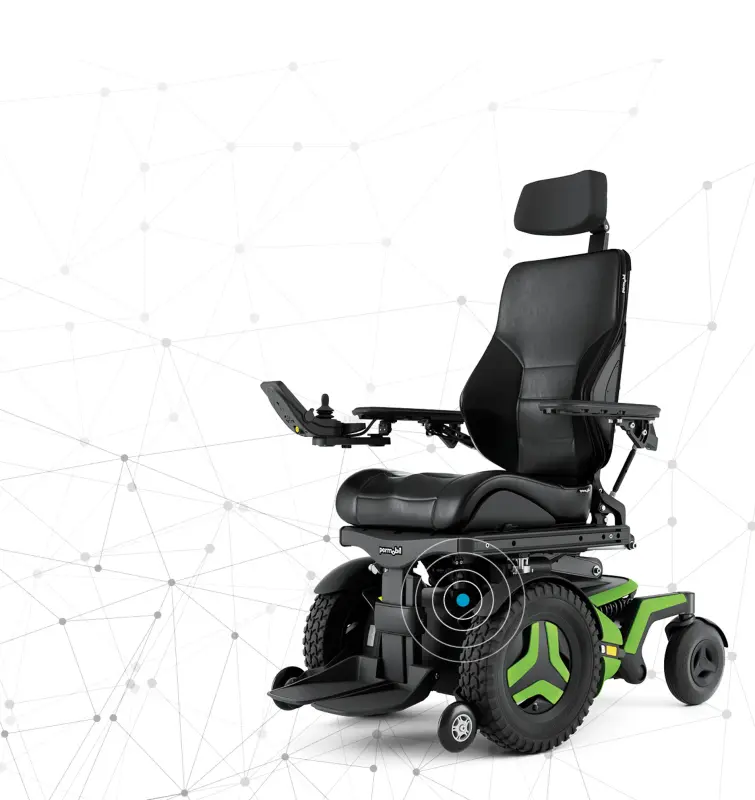
On the three Pride products whose manuals we read (Go Chair, Jazzy Ultra Light and Victory scooter), the anti-tip wheels are part of the base. That is not true of every power chair: FDA reports describe Permobil Corpus chairs on which anti-tippers were an option, one saying "CLIENT DID NOT CHOOSE THE OPTION OF ANTI-TIPPERS ON THE WHEELCHAIR WHEN ORDERED"
. Pride's Go Chair manual lists the power base as including "two anti-tip wheels" along with the motors, drive wheels, caster wheels, batteries and foot platform. Its Jazzy Ultra Light manual names the anti-tip wheels in the parts diagram and says they "are attached to the frame at the rear of the chair"
. The manuals we read for three Pride products, the Go Chair, the Jazzy Ultra Light and the Victory scooter, each print a prohibition against removing them.
Pride's Jazzy Ultra Light manual adds checks. Its monthly list asks the owner to check that the anti-tip wheels do not rub the ground and to adjust them as necessary, next to checks of the drive tires and the caster forks. Its yearly entry says to take the chair to an authorized Pride Provider for maintenance. For part numbers and seller prices of Pride anti-tip wheels for named Jazzy chairs and scooters, our Pride Jazzy power chair parts guide lists what the seller pages printed; we do not repeat those tables here.
Not every power chair manual uses the word. A word search of Permobil's M3 Corpus user manual (72 pages) and of Pride's Jazzy EVO 614 owner's manual (32 pages) found no anti-tip wording, so we cannot say from those documents whether or how anti-tip parts are fitted to those chairs; ask the provider. In our view, a power chair owner should treat the anti-tip wheels as the provider's adjustment, because the setting can depend on the seat and the suspension: three Invacare power chair reports in the FDA file link anti-tipper problems to the shocks, as the checking section below quotes.
Power chair reports in the FDA file include cases where the anti-tip wheels were in the way rather than missing. 10 reports we read describe a person cut or caught by, or tripped over, an anti-tip bolt, wheel or fender (one of them filed under the manual wheelchair code), among them a 2012 Hoveround report of a foot "CAUGHT UNDER THE FRONT ANTI-TIP WHEEL"
, three Pride reports from 2009 about ankles cut on anti-tip bolts, two of them during transfers, and a 2020 Pride report in which an occupational therapist's ankle "WAS CUT BY THE PROTRUDING BOLT ON THE ANTI-TIP WHEELS."
Two reports from 2012 describe oxygen tubing getting caught in or around the anti-tip wheels of a Jazzy Select HD. In our view, these are things to point out to the provider at set-up, not reasons to remove a part the maker prohibits removing.
Part numbers by chair, as the pages print them
Invacare's manual says anti-tippers are specific to seat-to-floor angle and height, so the part number matters more than the description. We list numbers only as the page that prints them ties them to a chair. Where a neighboring guide already lists a maker's numbers, we link it instead of copying the table.
Invacare Tracer SX5: the chart in the manual
Invacare's Tracer SX5 manual prints a chart under the heading "ANTI-TIPPER (MEASUREMENTS IN INCHES)"
, with columns for model, seat-to-floor height, length, height, model and part number. It says the chart is there "To ensure the correct model anti-tipper is used"
and that "Measurements for anti-tippers are approximate and are taken with extension tube in bottom hole position."
In our table below, the length and height come from that chart; the difference figures are our arithmetic.
| Tracer SX5 model | Seat-to-floor height | Length x height (in) | Model | Part No. |
|---|---|---|---|---|
| SX5 | 17 1/2 to 19 1/2 in | 13 1/2 x 3 1/2 | 1360 | 1058836 |
| SX5 | 15 1/2 to 17 1/2 in | 11 5/8 x 2 3/4 | 1360A | 1058752 |
| SX5 Recliner | 17 1/2 to 19 1/2 in | 13 1/2 x 3 1/2 | N/A | 1088242 |
The lower-seat 1360A is 1.875 inches shorter and 0.75 inches lower than the 1360 in the chart. That is why the manual says the correct anti-tippers must be ordered when the seat-to-floor height changes. SpinLife listed a Rear Anti-Tipper by Invacare, Model No. 1058836, at $80 on 13 November 2026; its product page as we saved it prints no list of chairs, so the chart above is the link between that number and the Tracer SX5. Vitality Medical's page for Invacare's Adjustable Rear Anti-Tipper prints "Pair - #1360" at $61.33 on 12 November 2026 and describes a universal fit; it does not print the 1058836 number. Invacare's own chart ties model 1360 to one Tracer SX5 seat-height range; until Invacare or the dealer confirms fit in writing, in our view plan on the manual's chart, not the seller's universal-fit line. For Invacare's other chairs and its parts catalogs, see our Invacare wheelchair parts guide.
Drive Medical: nine item numbers
Drive's US Anti-Tippers page, read on 12 November 2026, lists nine item numbers in its Product Options tab, eight with a chair list (STDS832 shows only "E0971"), for example STDS807 for the Cruiser III, Cruiser X4 and Viper Plus GT and STDS829 for the Sentra EC Extra-Wide, 26 to 30 inch, as Drive's page lists them; it shows SIGN IN TO VIEW PRICE rather than a price. Vitality Medical's page for Drive anti-tippers with wheels lists five item numbers, each as a pair with its own chair names; four of them (STDS802, STDS814, STDS819 and STDS829) appear on Drive's page and one, STDS2A4326, does not. Where Drive's page and the seller's page name different chairs for the same number, our Drive Medical wheelchair parts guide sets the two side by side; in our view, Drive's own list is the one to check first, by the chair's serial number.
Sunrise, TiLite and Proactive on SpinLife
SpinLife's search for anti tip on 13 November 2026 returned 6 items. All six tiles print a model number; three are maker parts printed without a chair list: Sunrise / Quickie's ANTI TIP MED MED ASSM R, Model No. 120069, at $73; TiLite's 3-SPOKE ANTI-TIP EXT LONG ASY, Model No. AS103462-Z, at $27 with the note "Sinlge Anti-tip, must order 2 for a pair"
(SpinLife's spelling); and TiLite's Tri-Spoke Anti-Tip Wheel, Model No. CP103207, at $6, a wheel rather than a tube. The tiles print no chair list for the Sunrise or TiLite parts. Proactive Medical's Rear Adjustable Anti-Tipper w/Wheels, Pair (PP-RATK3) says it is "Compatible with the proactive medical K3 wheelchair"
; its Rear Straight pair (PP-RATSW) says it is "Designed to fit various wheelchair models"
without naming them.
Pride
Pride's anti-tip wheels are numbered per power chair and scooter. Our Pride Jazzy parts guide gives the seller-page numbers we found and the chairs each page names. As there, a number on a seller page is the seller's statement of fit, and the authorized Pride Provider can confirm it by serial number.
Universal anti-tippers: what the listings say about fit
In our view, buyers look at universal anti-tippers when an original is lost or broken or a chair came without them. 1800wheelchair's page for the Safe T Mate SM-011 says its mounting style "eliminates piles of mismatched anti-tippers"
. The listings describe fit by tube size, not by chair. 1800wheelchair's Universal Clamp-On Rear Anti-Tippers page says they fit most wheelchairs with 7/8 inch tubing and includes "both stopper and wheels". Its Universal Front Anti-Tippers page, brand Safe T Mate (SKU SM-011), says both fit 3/4, 7/8 or 1 inch tubing, have "5 height adjustments for full to super hemi heights", feature 2 inch wheels and are "Sold in pairs." Vitality Medical's description of Invacare's Adjustable Rear Anti-Tipper says its mounting style "ensures a universal fit" and that it "Offers 10 inches of height adjustment for customized positioning."
These are the sellers' descriptions, and none of the three lists the chairs they fit.
The 1800wheelchair category also lists parts by tube and chair: an Invacare Silver Rear Anti-Tipper that fits inside 1 inch tubing and is compatible with the Invacare 9000, Invacare and Breezy rear anti-tippers that fit inside 7/8 inch tubing, and Medline Anti-Tippers for Transport Chairs listed as compatible with all 18 inch Excel wheelchairs. In our view, the tube size printed on the listing is the first thing to match, then the chair named, then the seat-to-floor height.
Two FDA reports from 2012 show why the word universal needs checking. In one, a dealer "APPLIED THE UNIVERSAL ANTI-TIPPERS FROM TAG AND THE PIN POPPED OUT"
, tried again, and the pin popped out again when the client put pressure on it. In another, a facility recommended front anti-tippers for a Tracer SX5, but reported that "THE UNIVERSAL ANTI-TIPPERS THAT THE FACILITY HAS DO NOT FIT THIS CHAIR."
A 2015 report filed with Alber as the manufacturer says a dealer ordered the wrong mounting kit, so the anti-tippers were not secured against rotation of the rear wheel axle. In our view, a universal part is a reason to ask the dealer to fit it and measure the clearance, not a reason to skip that step.
How do you tell what tube your chair has? The listings say inside 7/8 inch or inside 1 inch tubing, so the figure is the frame tube the anti-tipper slides into or clamps around. In our view, measure the tube and say whether the figure is the outside or inside diameter, since the listings do not say which, and send it with the chair's make, model and serial number; do not guess from a photo. If the old anti-tipper is still there, its part number, length and wheel size settle more than any tube size.
Prices at three US sellers, November 2026
Prices below are as the seller pages printed them in US dollars on the read date, with the label and unit each page gives. They are not Mobility Atlas prices. The 1800wheelchair tiles print no item numbers; SpinLife's tiles print model numbers. Prices differ by country, seller, funding and the unit sold: check whether a price is for one anti-tipper or a pair.
| Part, as listed | Seller (read) | Price as printed | Unit as printed |
|---|---|---|---|
| Invacare Rear Anti-Tipper, 1058836 | SpinLife (13 Nov) | $80 | Not stated |
| Sunrise / Quickie anti-tip, 120069 | SpinLife (13 Nov) | $73 | Not stated |
| TiLite 3-spoke anti-tip, AS103462-Z | SpinLife (13 Nov) | $27 | Single, order 2 |
| TiLite tri-spoke wheel, CP103207 | SpinLife (13 Nov) | $6 | Not stated |
| Proactive rear straight, PP-RATSW | SpinLife (13 Nov) | $45 | Pair |
| Proactive rear adjustable, PP-RATK3 | SpinLife (13 Nov) | $45 | Pair |
| Invacare Silver Rear, 1 in tube | 1800wheelchair (13 Nov) | $115 | Not stated |
| Universal Front (Safe T Mate) | 1800wheelchair (13 Nov) | $98 | Sold in pairs (page) |
| Universal Clamp-On Rear | 1800wheelchair (13 Nov) | $93 | Not stated |
| Medline, transport chairs | 1800wheelchair (13 Nov) | $39 | Not stated |
| Invacare adjustable rear, #1360 | Vitality (12 Nov) | $61.33 | Pair |
| Drive STDS2A4326, Cougar | Vitality (12 Nov) | Price: $86.34 | Pair |
| Drive STDS819, Cruiser III | Vitality (12 Nov) | Price: $16.45 | Pair |
The ranges, computed by script over every printed price line: SpinLife's 6 tiles ran from $6 to $80, or $27 to $80 if the tri-spoke wheel sold alone is left out. 1800wheelchair's category printed 9 results, and its 9 tiles ran from $39 to $115. Vitality's Drive page printed 5 Price lines from $16.45 to $86.34, with List Price lines from $18.91 to $99.24, and 3 of the five shown as Out of Stock; with Vitality's Invacare 1360 page added, its 6 prices ran from $16.45 to $86.34.
Units change the comparison. TiLite's AS103462-Z at $27 is printed as a single anti-tip that must be ordered twice for a pair, which is $54 for two at that price by our arithmetic, before any shipping. The Proactive and Vitality lines are printed as pairs. 8 of the 9 1800wheelchair tiles print no unit in the tile text, and the Veranda tile says "Sold as pair". In our view, ask for the unit in writing before comparing.
SpinLife's Invacare 1058836 page printed "Ships in: 20-30 business days"
on the read date, and its overview tab shows a Lifetime Limited Warranty line under the heading THE SPINLIFE DIFFERENCE INCLUDES; we did not open its returns and warranty tab, so we do not describe those terms. For the anti-tipper you order, ask the seller which warranty applies and to whom.
What 349 FDA reports describe
FDA's MAUDE database holds reports of adverse events and malfunctions involving medical devices. We searched it through openFDA on 13 November 2026 for reports filed under the two main wheelchair product codes, IOR (mechanical wheelchair) and ITI (powered wheelchair), whose narrative contains anti-tip, anti-tipper, anti-tippers, anti-tips, antitip, antitipper or antitippers. The search returned 349 reports: 219 IOR and 130 ITI, received from 1996 to 2026, with the database last updated 2026-11-04. We saved, for each, the report number, date, event type, device as stored and the text around the first anti-tip word, and read every one.
What the counts are not. FDA's page about MAUDE says "this passive surveillance system has limitations"
and that the incidence or cause of an event "cannot be determined from this reporting system alone due to under-reporting of events, inaccuracies in reports, lack of verification that the device caused the reported event, and lack of information about frequency of device use."
These are counts of reports, not of chairs or users and not a rate, and a report states what someone alleged. A word search also finds reports where the word appears for another reason, for example a maker quoting its manual's warnings. Most of these reports are not voluntary: 12 of the 349 report numbers are voluntary MedWatch (MW) reports, and the other 337 are report numbers of makers, distributors or importers, and user facilities.
When the reports were filed. 244 of the 349 reports, about 70 percent, were received from 2011 to 2016, and 211 of all the reports name Invacare or Invamex in the stored brand or manufacturer field. 51 reports were received from 2020 to 2026, 13 of them in 2026. By event type as stored: 237 malfunction, 77 injury, 7 death, 12 other and 16 with no event type. The spread over time reflects who filed and how, so we draw no trend from it.
What the excerpts describe. Reading every saved excerpt, we marked four groups. This is one reader's coding, not a two-reader study; a report can be in more than one group, and the report numbers for each group are listed in our working files. The rules: a report is in the first group if its text says or shows that the chair had no anti-tippers, or only one, at the time of the event, including reports where they were installed, sent or advised afterwards; in the second if they were fitted but reported as set, mounted, drilled or matched wrongly, by the maker, the dealer or the user (a report that clearance could not be reached is not counted); in the third if the text says a new chair arrived, was delivered, was built or came without one or both (a bare "missing" with no delivery wording is not counted); in the fourth if a person was cut or caught by, or tripped over, an anti-tip bolt, wheel or fender. In 34 reports, the chair had no anti-tippers or only one at the time of the event, for example because they were not ordered, were declined, were not fitted or had been removed; 23 of these are filed as injury or death. In 23, the anti-tippers were fitted but reported as set or mounted wrongly: raised, too short, too low or not low enough, not extended, too far out or not far enough out, in the wrong position or upside down, swapped, mismatched in size or length, on holes drilled wrongly, held with screws or a bolt in place of the release buttons, or on the wrong mounting kit. In 12, a new chair arrived or was built without one or both anti-tippers. In 10, a person was cut or caught by, or tripped over, an anti-tip bolt, wheel or fender. A word rule over the same excerpts finds a word for breaking, bending, cracking or coming off within 80 characters of an anti-tip word in 129 reports, 42 of them also naming the frame, a weld or brazing; that count includes some excerpts where the broken thing is a bone or another part.
A few reports in their own words. A 2013 Sunrise report: "THE END USER WAS GOING UP A RAMP INTO A DOORWAY AND ROLLED BACK. THE ANTI TIPS BENT BACK AND BROKE AND HE FELL BACK ONTO HIS HEAD REQUIRING STITCHES."
A 2024 report filed under the Myon swingaway wheelchair, about a similar Action 4 NG HD chair: "ANTI-TIPPERS WERE IN USE ON THE ACTION 4 NG HD WHEELCHAIR, HOWEVER THEY WERE NOT POSITIONED LOW ENOUGH TO PREVENT THE USER FROM TIPPING BACKWARDS."
A 2016 Invacare report: "IT WAS REPORTED THAT THE ANTI-TIPPERS WERE IN THE UP POSITION PREVENTING CORRECT USE."
Two Medline reports from 2026 describe an anti-tipper installed upside down; in one the finding came from a returned sample, and in the other the anti-tippers "appeared to be assembled upside down"
in a photo and the investigation was recorded as not confirmed. A 2025 Pride report says a technician found the anti-tippers on a Jazzy "WERE NOT EXTENDED" when the user tried to move through a doorway.
The 7 reports filed as deaths need care. In one 2020 report, a patient using a wheelchair without anti-tippers, unsupervised, on a ramp at a weighing scale "TIPPED BACK IN THE CHAIR, HITTING HIS HEAD"
; in another from 2020, about a Quickie IRIS chair in a care home, the maker was asked whether the anti-tippers could have moved to the up position in which they were found. A 2026 Permobil report records a legal complaint alleging that a chair had no anti-tippers or support wheels installed at distribution "OR HAVING BEEN REMOVED PRIOR TO DISTRIBUTION TO THE END-USER"
. A 2005 report concerns a product its maker says "WAS NOT AND IS NOT DESIGNED TO BE AN ANTI-TIP DEVICE."
Each is a report of an allegation; we do not draw causes from them.
In our reading, the reports point to the same checks the manuals print: that both anti-tippers are there, are the right model for the seat height, are down and locked, are set at the printed clearance, and are not bent or cracked, with the frame around the receiver intact. 9 reports received on 3 December 2012 describe a burr inside the frame tube where the anti-tippers insert.
Recalls that name anti-tippers
We searched openFDA's recall records on 13 November 2026 for product codes IOR and ITI with an anti-tip word in the product description or the reason for recall. The search returned 3 records, with the database last updated 2026-11-12. Each is shown as stored, with its status.
| Firm and product | Recall, dates | Reason as stored | Quantity, status |
|---|---|---|---|
| Freedom Designs TriPod, Tripod LT, Pediatric LT | Z-0137-2008, 2007 to 2008 | Anti tipper may fail/break | 41 units, terminated |
| Invacare: Kuschall K3/K4 Airlite | Z-1486-06, 2006 to 2012 | Bolt may bend or break | 208 wheelchairs, terminated |
| TiSport: TiLite X-Short anti-tip tubes | Z-2294-2019, 2018 to 2022 | Tubes may fail | 1,452 wheelchairs, terminated |
In the records' own words: the Freedom Designs reason reads "Tip-over hazard; the Anti tipper may fail/break and the wheel chair could tip over."
The Kuschall record says that if the user has chosen to install optional anti-tippers, "the anti-tipper as designed may not be able to bear the stress of repeated or quick loads placed on it, causing the bolt to bend or break."
The TiLite record covers X-Short anti-tip tubes for the TRA, AERO T, ZRA, AERO Z, 2GX, AERO X, Twist and AERO R models, and its reason reads "The anti-tip tubes potentially fail in certain situations and the wheelchairs can tip backwards."
Two TiSport reports from 2018 in our FDA set call X-Short anti-tips shipped with an Aero Z chair "PART OF A KNOWN POPULATION OF X-SHORT ANTI-TIPS THAT WERE POTENTIALLY NOT MADE TO THE DESIGN SPECIFICATIONS"
. All three recall records are marked terminated. If you own one of the named chairs, in our view ask the maker or dealer whether your tubes were part of the recall and whether anything is still outstanding.
Medicare and other funding in the US
Medicare's coding has a code for this part. The National Library of Medicine's HCPCS lookup lists E0971 as "Manual wheelchair accessory, anti-tipping device, each"
. That is a billing description, not a coverage decision. Medicare's policy article A52504, Wheelchair Options/Accessories, version 61 (revision effective 10/01/2025, revision ending date 12/19/2026), puts E0971 in Column II of its bundling table for Power Wheelchair Base Groups 1 and 2 and Groups 3, 4 and 5. The article says "Codes listed in Column II are not separately payable from the wheelchair base and must not be billed separately at the time of initial purchase or rental of the wheelchair."
In our reading, anti-tipping devices supplied with a new power wheelchair in those groups are part of the base payment. In the same table, the Manual Wheelchair Base row's Column II does not list E0971; in our reading it is not bundled with a manual base at initial issue. The lines we saved from the article do not use the word anti-tip, so ask the supplier how they would bill a replacement pair for your chair.
What you pay depends on the supplier. Medicare.gov's wheelchairs and scooters page says "After you meet the Part B deductible, you pay 20% of the Medicare-approved amount (if your supplier accepts assignment)."
For Medicare Advantage, Medicaid, the VA or private insurance, we did not read their rules for anti-tippers: ask the plan. Our wheelchair parts guide explains repairs and replacement parts under Medicare in more detail.
Checking anti-tippers: what the manuals ask owners to look at
The manuals we read put the checks in different places. Ki Mobility's Rogue 2 maintenance table lists "Check that anti-tips are level and functional"
, "Check that caster wheels, anti-tip wheels and rear wheels spin freely"
, and a check of the rear tires, anti-tip wheels and caster wheels for wear spots and damage, with "Replace immediately if needed."
The table's columns are headed Check, "Discontinue Use & Contact Authorized Supplier"
, Weekly, Monthly and Annually, and the text we saved cannot tie each check mark to a column, so we do not give an interval. The anti-tip damage line carries two marks; ask the dealer whether damage there means you should stop using the chair. The same table asks owners to inspect the frame for cracks, dimples or bends, which it says "could be signs of fatigue in the wheelchair which could result in a failure."
Sunrise's RGK manual puts a line in its before-each-use list: "If your chair has anti-tip tubes, lock them in place."
Pride's Jazzy Ultra Light manual puts its anti-tip check in the monthly list, as quoted above. Invacare's manual puts its checks in the installation steps: the release button must fully protrude out of its hole, both sides must be at the same hole, and the clearance is measured on a flat surface. Medline's guide asks for the release button to protrude fully and, for its recliner models, for both sides at the same height. In our view, those install steps also work as a quick look before going out: buttons out, both sides level, wheels turning, nothing bent.
When is an anti-tipper due for replacement rather than adjustment? None of the documents we read prints a service life. They print conditions: Ki's manual says bent or broken anti-tips "will no longer prevent the wheelchair from tipping over backwards"
; Invacare's manual says that if the 1 1/2 to 2 inch distance cannot be achieved, a different model may be required. FDA reports we read also describe worn or cracked anti-tip wheels, flat spots and wheels "MISSING CHUNKS", and three Invacare power chair reports link anti-tipper problems to the shocks, one saying "THE SHOCKS ON THE POWER WHEELCHAIR ARE NOT HOLDING THE ANTI-TIPPERS IN PLACE."
In our view, a bent tube, a cracked wheel, a receiver that rotates or a frame crack near the receiver means the chair should be checked by the dealer before it is used again; for anti-tippers that cannot be set as its procedure requires, Invacare's Tracer SX5 manual says "DO NOT use the wheelchair. Contact a qualified technician."
Who fits them? For manual chairs, the manuals describe push-in or pin-locked tubes that an owner can insert, but they put set-up and changes with a professional: Ki says to have a clinical or technical professional confirm the position, Invacare says seat-to-floor changes must be done by a qualified technician, and RGK says to consult the dealer before you modify or adjust the chair. For power chairs, Pride's manual says "An authorized Pride Provider or a qualified technician must perform the initial setup of this power chair and must perform all of the procedures in this manual."
For general repair routines and who does what, see our manual wheelchair repair guide.
Ordering anti-tippers through Mobility Atlas
Mobility Atlas can find and quote anti-tippers, anti-tip wheels, receivers, release pins and the bolts that hold them, including parts that are not listed on our site. The process is an enquiry or part request, then a written quote with delivery to your country, and nothing is charged before you accept the quote. You can start from our wheelchair parts and accessories page or send the request directly.
What to send, in our view, so the quote matches the chair: the maker, model and serial number; the seat-to-floor height and, for an Invacare Tracer SX5 or similar chair, the seat angle; the old part number if it is printed, or the maker's chart line if the manual has one; the size of the frame tube the anti-tipper fits into, measured, saying whether it is the outside or inside diameter; whether you need one side or a pair, and which side; whether the chair is a recliner or tilt chair; and a photo of the old part and of the frame where it attaches. For a power chair, add the chair's model and serial number and a photo of the anti-tip wheel and its bracket.
Whether a person needs anti-tippers, how long they should be and where they are set are decisions for the user, their clinician and the dealer who fits the part, following the maker's manual.
Three traps when buying anti-tippers
Trap one: buying by length or by the word universal. Invacare's chart prints two Tracer SX5 anti-tippers that differ by 1.875 inches in length and 0.75 inches in height for two seat-to-floor ranges, and the manual says the correct model must be ordered when the seat height changes. Universal listings describe tube sizes, and FDA reports describe universal parts whose pin popped out or that did not fit a Tracer SX5. In our view, match the part number or the chart line first.
Trap two: comparing a single price with a pair price. TiLite's AS103462-Z is listed on SpinLife as a single anti-tip that must be ordered twice; Proactive's and Vitality's lines are pairs; 8 of the 9 1800wheelchair tiles name no unit. Ki's manual recommends using two anti-tips, and Invacare's asks for both at the same hole, and Medline's, for its recliner models, at the same height. A pair is two matched parts, not two singles from different listings.
Trap three: treating raised anti-tippers as stowed for good. The manuals that tell you to turn anti-tippers up for a curb or a step also tell you to turn them back down afterwards, and the FDA reports include anti-tippers found in the up position after a fall, removed for cleaning and not refitted, or removed for convenience. In our view, if anti-tippers get in the way often enough that someone wants them off, that is a conversation for the clinician and dealer about position or design, such as a user activated type, not a reason to leave them off.
Three composite scenarios
These are composite scenarios, not individual customers. Each uses only the documents for the chair it names.
Scenario one: an Invacare Tracer SX5 whose seat height was lowered. A dealer moved the rear wheels and casters so the seat-to-floor height now falls inside the 15 1/2 to 17 1/2 inch line of the manual's chart. The chart lists model 1360A, part 1058752, for that range, and the manual says that when the seat-to-floor height changes, the correct anti-tippers must be ordered to keep a 1 1/2 to 2 inch clearance. The owner asks the dealer to order the 1360A anti-tippers (part 1058752) for both sides, fit them in the same hole on both sides and measure the clearance on a flat surface, rather than buying the 1058836 part listed by SpinLife, which the chart ties to the 17 1/2 to 19 1/2 inch range.
Scenario two: a Ki Mobility Rogue 2 user who is new to the chair. The manual says users switching to a new wheelchair or adjusting a chair's configuration should always use anti-tips, that a professional should confirm the position by tipping the occupied chair back, and that two anti-tips are recommended. The user finds the standard tubes catch at the door threshold, so they ask the dealer and their therapist about Ki's user activated anti-tips, which the manual says can be put in the in-use and up positions with a rubberized grip and stowed under the chair (stowing needs the rear wheels lifted off the ground, and the manual calls this the transfer position), and how to return them to the down position each time.
Scenario three: a Pride Jazzy Ultra Light owner who drives up a sloped path. The manual says the adjustable anti-tip wheels must be extended to the outermost rearward position when driving on any slope, prohibits removing them, and asks for a monthly check that they do not rub the ground. The owner notices a scraping noise, checks that the wheels are not rubbing, and asks the authorized Pride Provider to adjust them rather than raising them themselves.
What to ask the dealer, the therapist and the seller
The dealer or provider
- Which anti-tipper model and part number does this chair need at its current seat height and angle?
- Will you fit them, check both sides are in the same hole and measure the clearance on a flat surface?
- Is the frame tube or receiver sound, with no cracks, burrs or bends where the anti-tipper fits?
- On a power chair: are the anti-tip wheels set as the manual requires, and are the bolts covered or trimmed?
The therapist or seating clinician
- Do I need anti-tippers at my current set-up, and what would change that?
- Would a user activated or swing-away design suit how I use curbs, thresholds and transfers?
- After a change of axle position, seat height, backrest or cushion, should I use anti-tippers while I adapt?
The seller
- Is the price for one anti-tipper or a pair, and which side is it for?
- Which chairs and tube sizes does the maker list for this part number?
- Does it include the wheels, pins, clamps or bolts?
- What warranty and return terms apply?
Quick answers
What are wheelchair anti tippers, and do I need them? They are tubes or brackets with small wheels behind a manual chair, or small wheels on a power base, meant to help stop the chair tipping back past its balance point. Mobility Atlas read manuals from Invacare, Medline, Sunrise, Ki Mobility, Karman and Pride. Ki says anyone switching to a new wheelchair or adjusting a chair's configuration "should always use anti-tips"
. Invacare's Tracer SX5 manual says they MUST be installed at a 6 degree seat angle and MUST be attached at all times on the recliner, and "strongly recommends that anti-tippers be used at all times"
. Medline requires them on its recliner models, and Pride's Go Chair, Jazzy Ultra Light and Victory manuals prohibit removing the anti-tip wheels. Invacare's, Medline's, RGK's and Ki's manuals also say anti-tippers may not prevent a tip-over on slopes, ramps or soft ground. Whether a person needs them is for the user, their clinician and the dealer to decide.
How high should anti-tip wheels be off the ground? Three of the manuals Mobility Atlas read print the same window: Invacare's Tracer SX5 manual, Medline's Guardian guide and Sunrise's RGK AllCourt manual ask for 1 1/2 to 2 inches, 3.8 to 5.0 cm in Medline's figures, between the bottom of the anti-tip wheels and the floor; Invacare says to measure on a flat surface, and RGK gives the figure for tubes locked down. RGK warns that set too high they may not prevent a tip-over, and set too low they may catch. Invacare and Ki want both sides at the same hole or height; RGK does for its double integral anti-tip, and Medline for its recliner. Ki prints no figure; it asks a clinical or technical professional to check the position by tipping the occupied chair back onto the anti-tips. Invacare says a different model may be required if the window cannot be reached, and its warning reads "DO NOT use the wheelchair. Contact a qualified technician."
How much do replacement anti-tippers cost in the US? On the pages Mobility Atlas read in November 2026, SpinLife's six anti tip results ran from $6 for a TiLite tri-spoke wheel alone to $80 for Invacare's rear anti-tipper 1058836, and from $27 without the wheel. 1800wheelchair's nine anti-tipper tiles ran from $39 to $115. Vitality Medical's Drive and Invacare pages printed pair prices from $16.45 to $86.34, and three of the five Drive lines showed Out of Stock. Some prices are for one anti-tipper and some for a pair, so compare units before prices. Medicare's code E0971 describes an anti-tipping device, each, and in our reading its policy article bundles E0971 into the base payment of power wheelchairs at initial issue. Prices differ by country, seller and funding, so ask for a written quote that states the unit and the chairs the part fits.
Sources and documents
Every page and document named in this guide is listed in the sources below with its address. The read date of each is given in the method section near the top, and in the source title where it helps. Our catalog rows are cited by their ids. How we checked: each quote in this guide was compared by script with the saved text of its source, and each number with the saved sources or with our facts file, which a script builds from the saved texts.
This article is general information. Rules and prices differ by country and change, so confirm them before you buy or travel.
Common questions
Do I need anti-tippers on my wheelchair?
It depends on the chair, its set-up and the user, and the decision belongs to the user with their clinician and dealer. The documents we read range from recommendations to rules: Sunrise's RGK AllCourt manual recommends anti-tip tubes unless you are "a skilled rider of this chair and are sure you are not at risk to tip over"
, and each time the chair is modified or adjusted; Ki says anyone switching to a new wheelchair or adjusting a chair's configuration should always use them; Invacare's Tracer SX5 manual says they MUST be installed at a 6 degree seat angle, MUST be attached at all times if so equipped and on its recliner, and "strongly recommends that anti-tippers be used at all times"
; Medline requires them on its recliner models; and Pride's manuals for the Go Chair, Jazzy Ultra Light and Victory scooter prohibit removing the anti-tip wheels.
How far off the ground should anti-tip wheels be?
Invacare's Tracer SX5 manual, Medline's Guardian guide and Sunrise's RGK AllCourt manual ask for 1 1/2 to 2 inches between the anti-tip wheels and the floor; Invacare says to measure on a flat surface and to set both sides in the same mounting hole. RGK says too high may not prevent a tip-over and too low may catch on obstacles. Use the figure in your own chair's manual, and have the dealer set it.
Should I flip anti-tippers up for curbs and ramps?
It depends on the manual. Ki's says to remove or turn them up for curbs, obstacles and steps, because left down they can bend or break, and to return them to the down position afterwards. RGK's says to rotate them up for curbs and steps but to lock them in place before you go up over an obstacle, and to keep them locked unless you have an attendant or can safely manage without them. Invacare's turns them up for its assistant curb and stair methods and back down after. Medline says they may catch at the start of a ramp and need to be disengaged with extra care.
Will universal anti-tippers fit my chair?
The universal listings we read describe fit by tube size, such as 7/8 inch tubing or 3/4, 7/8 or 1 inch tubing, not by chair, and none lists the chairs it fits. FDA reports describe a universal anti-tipper whose pin popped out and universal parts that did not fit a Tracer SX5. Match the maker's part number or the manual's chart first, and have the dealer fit the part and measure the clearance.
How much do anti-tippers cost, and does Medicare pay?
On the US pages we read in November 2026, prices ran from $6 for a TiLite wheel alone to $115 for an Invacare rear anti-tipper on 1800wheelchair, and some prices are for one anti-tipper and some for a pair. Medicare's code E0971 is an anti-tipping device, each; in our reading, its policy article A52504 (version 61) bundles E0971 into the power wheelchair base at initial issue. Prices differ by country, seller and funding, and for coverage of a replacement you should ask the supplier or your plan.
Can Mobility Atlas get anti-tippers that are not listed on the site?
Yes. Mobility Atlas can find and quote anti-tippers, anti-tip wheels, receivers, pins and bolts, including parts that are not listed. Send an enquiry or part request with the chair's make, model and serial number, its seat-to-floor height, the old part number or a photo, and the frame tube size; you receive a written quote with delivery to your country, and nothing is charged before you accept it.
Sources
- Invacare: Tracer SX5 wheelchair user manual, Part No. 1110550, anti-tipper pages (read 13 November 2026)
- Ki Mobility: Rogue 2 / Rogue XP user instruction manual and warranty, section P. Anti-Tips (read 13 November 2026)
- Medline: Standard manual wheelchairs user guide, Guardian, PIC-00270 (PDF hosted by Vitality Medical, read 9 November 2026)
- Sunrise Medical: RGK AllCourt owner's manual, 930491 Rev. E (read 9 November 2026)
- Sunrise Medical: Quickie Nitrum owner's manual (read 9 November 2026)
- Karman Healthcare: KM-5000 manual, MVP 502 series (read 9 November 2026)
- Pride Mobility: Jazzy Ultra Light owner's manual, INFMANU5449 Rev B (read 13 November 2026)
- Pride Mobility: Go Chair owner's manual (read 9 November 2026)
- Pride Mobility: Go-Chair owner's manual hosted by 1800wheelchair (read 12 November 2026)
- Pride Mobility: Victory Series owner's manual (read 9 November 2026)
- Pride Mobility: Jazzy EVO 614 Series owner's manual, word search (read 13 November 2026)
- Permobil: M3 Corpus user manual (read 13 November 2026)
- Drive Medical: Anti-Tippers product page and options (read 12 November 2026)
- Vitality Medical: Drive Medical anti-tipper with wheels (read 12 November 2026)
- Vitality Medical: Invacare wheelchair adjustable rear anti-tipper, #1360 (read 12 November 2026)
- SpinLife: Search results for anti tip (read 13 November 2026)
- SpinLife: Invacare Rear Anti-Tipper, Model No. 1058836 (read 13 November 2026)
- 1800wheelchair: Anti-Tippers for Manual Wheelchairs category (read 13 November 2026)
- 1800wheelchair: Universal Clamp-On Rear Anti-Tippers, SKU 623070 (read 13 November 2026)
- 1800wheelchair: Universal Front Anti-Tippers, Safe T Mate SM-011 (read 13 November 2026)
- openFDA: device adverse event reports, IOR and ITI, word search for anti-tip words (read 13 November 2026)
- openFDA: device recalls, IOR and ITI, anti-tip words (read 13 November 2026)
- openFDA: full narratives of 14 anti-tip reports, saved during fact-checking (read 13 November 2026)
- FDA: About the MAUDE database (read 9 November 2026)
- CMS: Article A52504, Wheelchair Options/Accessories policy article, version 61 (read 13 November 2026)
- National Library of Medicine: HCPCS lookup, anti-tipping (read 13 November 2026)
- Medicare.gov: Wheelchairs and scooters coverage (read 9 November 2026)
Read on . The wording of the article is our own.