Aisle chairs in 2026: airplane aisle wheelchairs, on-board wheelchairs, US rules under 14 CFR 382, UK and EU rules, models and prices
Aisle (boarding) chairs and on-board wheelchairs: the US rules, the 2026 and 2031 dates, DOT's enforcement pause, UK and EU texts, seven chairs and their prices.
Contents
- The short answer
- The words in the rules: aisle chair, boarding chair, on-board wheelchair
- What US airlines must provide: 14 CFR 382.95 and 382.101
- On-board wheelchairs: 14 CFR 382.65 (a) to (d)
- The upgraded on-board wheelchair: 382.65 (e) to (h), October 2, 2026 and October 2, 2031
- Help in the cabin: 14 CFR 382.111
- Hands-on training: 14 CFR 382.141
- The 2024 Wheelchair Rule and what DOT has paused
- Seats, armrests and information: the Bill of Rights
- UK: what the HSE and the CAA say
- EU: what the annexes of Regulation 1107/2006 say
- What Delta and American say
- Which aisle chairs exist: seven listings in our sources
- Staxi Aisle Chair, 500 lb capacity
- Special Mobility Aisle Mobby and Surace AIR 2000
- Drive AisleMaster and Karman KMAA20 at US sellers
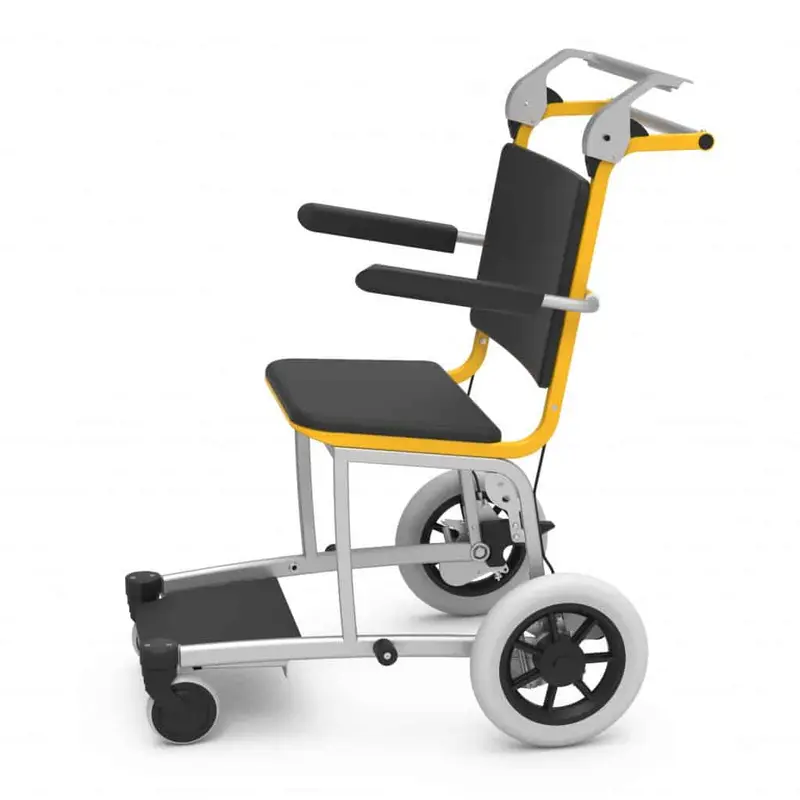
- Evac+Chair 200H CarryLite: sold as a chair for use during the flight
- What aisle chairs cost, and who buys them
- Width, weight limit and straps, side by side
- FDA: how these chairs are classified, and what the recall search found
- Your own chair, batteries and renting at the other end
- Three traps
- Three composite scenarios
- What to ask before you fly
- If something goes wrong: the CRO and a DOT complaint
- Sources and documents
- Common questions
- Sources
The short answer
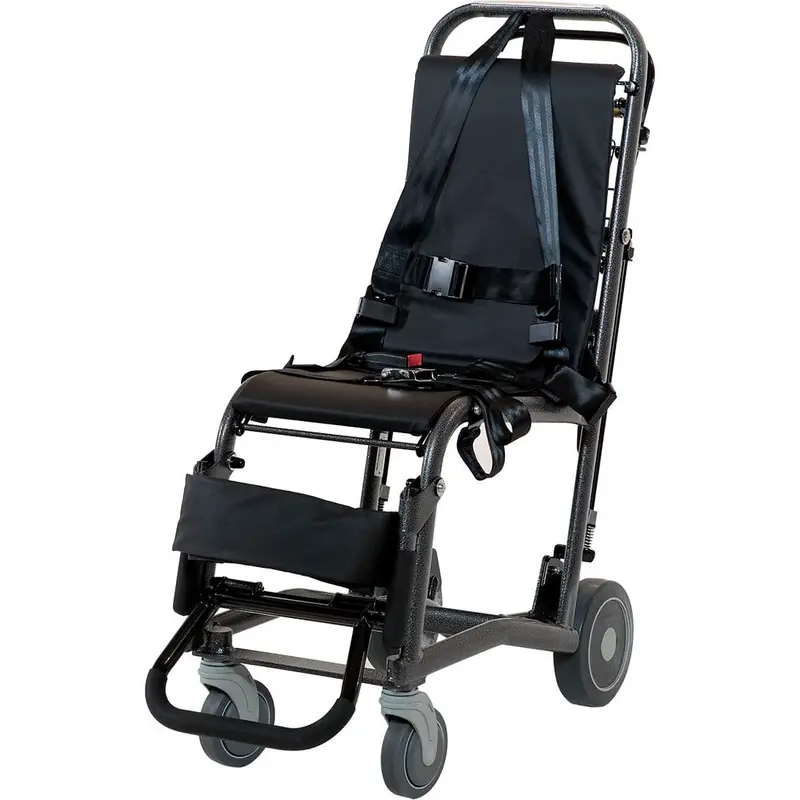
What is an aisle chair, and how is it different from an on-board wheelchair? Mobility Atlas read the US Department of Transportation's rules and notices, the UK and EU texts, two airlines' pages and the pages for seven chairs, mostly on 3 November 2026 (three on 10 October, as listed at the end). An aisle chair, also called a boarding chair, is a narrow chair staff use to move a passenger who cannot walk between the aircraft door and their seat. A DOT notice of August 2026 says aisle chairs are "used for enplaning and deplaning."
The same notice says on-board wheelchairs, which stay on the plane, "are used to transport passengers between the aircraft seat and the lavatory, often while in-flight."
DOT's assistance page says: "If you cannot walk, you will be transported to your aircraft seat in an aisle chair."
In the US, the airline must ensure the boarding help and, on aircraft over 60 seats with an accessible lavatory, the on-board chair.
| Chair | Where it is used | Who provides it (US) | US rule |
|---|---|---|---|
| Aisle chair (boarding chair) | Aircraft door to seat and back | The airline, as needed | 382.95, 382.141 |
| On-board wheelchair | Seat to lavatory, in flight | The airline, over 60 seats, on conditions | 382.65, 382.111 |
| Ground (airport) wheelchair | Curb, terminal, gate | The airline, on request | 382.95; DOT assistance page |
| Your own wheelchair | To the gate, then cabin or hold | You | 382.123 (cabin) |
The table is our summary; the exact conditions, such as seat counts and the lavatory, are quoted in each section below. The page then covers the 2024 Wheelchair Rule and what DOT has paused until April 30, 2027, the UK and the EU, two airlines, the chairs that exist, their prices, and what to ask before you fly.
This page explains rules and products. It is not legal advice, and it does not tell anyone how to transfer. How you move between your own chair, an aisle chair and an aircraft seat, and what support you need to do it safely, is a question for your physical or occupational therapist or another clinician who knows you.
Mobility Atlas earns a fee or margin when you order through us; the comparison below uses only the published rules, notices and agency pages, the makers' and sellers' pages named in each section, and our own catalog for facts other than price. If your organisation is looking for an aisle chair, send an enquiry with the chair, the aisle width it must fit and the country of delivery, and ask us to find it.
The words in the rules: aisle chair, boarding chair, on-board wheelchair
The US rule text uses "boarding wheelchairs" and "on-board wheelchairs". The training rule, 14 CFR 382.141, uses the everyday word; it says staff need hands-on training in transfers to and from "personal or airport wheelchairs, aisle chairs, and aircraft seats"
. The 2024 Wheelchair Rule's preamble ties the names together; its text reads "boarding wheelchairs (i.e., aisle chairs), and/or on-board wheelchairs"
.
DOT's clearest definition sits in a footnote of its August 2026 enforcement notice, FR document 2026-15835. It says: "OBWs are specialized wheelchairs that are stowed onboard the aircraft. They are used to transport passengers between the aircraft seat and the lavatory, often while in-flight. They are distinct from both standard wheelchairs (used to transport passengers within the airport) and aisle chairs (used for enplaning and deplaning)."
OBW is DOT's short form for on-board wheelchair. So there are three jobs: the airport chair in the terminal, the aisle chair for getting on and off, and the on-board chair for the lavatory during the flight.
Other sources use other words. Delta's page calls the on-board chair "an aircraft-designed wheelchair that fits in the aircraft aisles and most lavatories"
. Sellers list chairs as a "transfer chair", an "aisle wheelchair", a "boarding wheelchair", a "transit chair" or an "onboard chair", in their pages' words. A product's name does not tell you which job it was built for, or which rule applies to it. The design standards in 14 CFR 382.65 are written for on-board wheelchairs; in the sections we read, we found no matching design standard for aisle chairs, which the US rules deal with through boarding assistance and staff training.
What US airlines must provide: 14 CFR 382.95 and 382.101
What must US airlines provide for passengers who board in an aisle chair? Mobility Atlas read 14 CFR 382.95, 382.65, 382.111 and 382.141 as reproduced by Cornell LII, re-read them on the official eCFR, read 382.101 on the eCFR, and read DOT's 2026 notice and pages, all on 3 November 2026 (the 2025 notice page on 10 October). Under 382.95(a), a carrier "must provide or ensure the provision of assistance"
in enplaning and deplaning, including, as needed, staff and "boarding wheelchairs, and/or on-board wheelchairs where provided in accordance with this part"
. Under 382.101, staff must never hand-carry a passenger, that is, pick up the passenger's body in their arms, unless it is the only way to evacuate in an emergency. Under 382.65, aircraft with more than 60 passenger seats and an accessible lavatory must carry an on-board wheelchair. Under 382.141, staff who give physical help must get hands-on training in transfers to and from aisle chairs. This is a summary, not legal advice.
14 CFR 382.95(a) (eCFR, re-read 3 November 2026) says the help is "requested by or on behalf of passengers with a disability, or offered by carrier or airport operator personnel and accepted by passengers with a disability"
. Paragraph (b) says a carrier must, "except as otherwise provided in this subpart, provide boarding and deplaning assistance through the use of lifts or ramps at any U.S. commercial service airport with 10,000 or more annual enplanements where boarding and deplaning by level-entry loading bridges or accessible passenger lounges is not available."
In plain words: at a US commercial service airport with 10,000 or more annual enplanements, where there is no level-entry bridge or accessible lounge, the rule requires a lift or a ramp, subject to the exceptions in the subpart.
14 CFR 382.101 covers the cases where level-entry boarding is not required, such as smaller US airports, foreign airports, aircraft under the lift exceptions in 382.97 (which we did not read) and, the rule says, "Circumstances beyond your control (e.g., unusually severe weather; unexpected mechanical problems) prevent the use of a lift."
Its text says the carrier must then "provide or ensure the provision of boarding and deplaning assistance by any available means to which the passenger consents."
No hand-carrying, in the rule's words
The same section sets the limit. 14 CFR 382.101 says: "However, you must never use hand-carrying (i.e., directly picking up the passenger's body in the arms of one or more carrier personnel to effect a level change the passenger needs to enter or leave the aircraft), even if the passenger consents, unless this is the only way of evacuating the individual in the event of an emergency."
DOT's Bill of Rights puts it this way: "However, airlines must never hand-carry a passenger (directly pick up a passenger's body in the arms of airline personnel) on or off an aircraft, except in an emergency."
The rule's definition is about a level change to enter or leave the aircraft. In our reading, a transfer between an aisle chair and an aircraft seat is a different moment; the training rule, 382.141(a)(3), requires hands-on training in such transfers and, the rule says, in "proper lifting techniques to safeguard passengers"
. How a transfer should be done for your body is for your therapist and for you to tell the staff; Delta's page says "your verbal direction is important for the agent to assist you best"
.
Timing: boarding first, leaving last
DOT's Wheelchair and Guided Assistance page, last updated September 25, 2025, says: "If you self-identify as a passenger with a disability who needs additional time or assistance to board the airplane, the airline must allow you to board the airplane before other passengers."
On the way off, it says airlines must give prompt help, "which means when the last passenger who did not request deplaning assistance deplanes."
The page also says the airline "must not leave the passenger unattended for more than 30 minutes"
when the passenger is not independently mobile, even with a companion present, unless the passenger says that is okay. And it says: "You are entitled to stay in your own wheelchair until you get to the gate."
On-board wheelchairs: 14 CFR 382.65 (a) to (d)
14 CFR 382.65 (as reproduced by Cornell LII, read 3 November 2026, re-read on eCFR) is the on-board wheelchair section. Paragraph (a) says: "As a carrier, you must equip aircraft that have more than 60 passenger seats, and that have an accessible lavatory (whether or not having such a lavatory is required by § 382.63 of this Part) with an on-board wheelchair."
It exempts the ATR-72 and the British Aerospace ATP "in configurations having between 60 and 70 passenger seats"
, the rule says.
Paragraph (b) covers aircraft without an accessible lavatory. It says: "If a passenger asks you to provide an on-board wheelchair on a particular flight, you must provide it if the aircraft being used for the flight has more than 60 passenger seats, even if the aircraft does not have an accessible lavatory."
The condition, the rule says: "The basis of the passenger's request must be that he or she can use an inaccessible lavatory but cannot reach it from a seat without using an on-board wheelchair."
The airline may ask for the advance notice in § 382.27, which we did not read, so ask the airline how much notice it wants.
Paragraph (c) sets the older design standard. It says on-board wheelchairs "must include footrests, armrests which are movable or removable, adequate occupant restraint systems, a backrest height that permits assistance to passengers in transferring, structurally sound handles for maneuvering the occupied chair, and wheel locks or another adequate means to prevent chair movement during transfer or turbulence."
It adds that the chair must suit "the maneuvering space, aisle width, and seat height of the aircraft on which it is to be used"
. Paragraph (d) gave US carriers until May 13, 2009 and foreign carriers until May 13, 2010.
Paragraph (f) says carriers need not enlarge the stowage space, but if the chair does not fit and another space such as an overhead compartment could take it, the carrier must stow it there. It ends with one exception: "You are not required to make the on-board wheelchair available if the pilot-in-command determines that safety or security considerations preclude its use."
In practice, in our reading of (a) and (b): on an aircraft with 60 or fewer passenger seats, 382.65 does not require an on-board wheelchair. On a larger aircraft, the chair should be on board if there is an accessible lavatory, and on request if you can use the ordinary lavatory but cannot reach it. Delta's page says: "Not all aircrafts booked through Delta are large enough to accommodate onboard wheelchairs."
The upgraded on-board wheelchair: 382.65 (e) to (h), October 2, 2026 and October 2, 2031
Paragraph (e) of 14 CFR 382.65 (as reproduced by Cornell LII, read 3 November 2026, re-read on eCFR) adds a new standard. It says: "As a carrier, you must ensure that all new single-aisle aircraft that you operate with an FAA-certificated maximum seating capacity of 125 or more that are delivered on or after October 2, 2026, and on which lavatories are provided include an on-board wheelchair meeting the requirements of this section."
It says the Access Board's nonbinding technical assistance "may be relied upon for compliance"
; we did not read that document.
Its nine points, in the rule's words where quoted. The chair "must be maneuverable both forward and backward through the aircraft aisle by an attendant."
The rule says: "The height of the on-board wheelchair seat must align with the height of the aircraft seat so as to facilitate a safe transfer between the on-board wheelchair seat and the aircraft seat."
It must have wheels "that lock in the direction of travel, and that lock in place so as to permit safe transfers,"
and must be designed "not to tip or fall in any direction under normal operating conditions when occupied for use."
It needs "a padded seat and backrest"
, repositionable arm supports strong enough for transfers, "torso and leg restraints that are adequate to prevent injury during transport"
, and a unitary foot support; the rule says "All restraints must be operable by the passenger."
It must go partly into at least one lavatory to permit a transfer to the toilet, and must be maneuverable into the lavatory "without protruding into the clear space needed to completely close the lavatory door,"
and it "must prominently display instructions for proper use,"
the rule says.
Paragraph (g) deals with chairs that may not exist yet. It says: "You must acquire an OBW that complies with as many requirements set forth in paragraph (e) of this section as are available."
A carrier is not responsible for third parties' failure to deliver one "so long as you make reasonable efforts to purchase such an OBW and inform the Department"
. If no chair meets the door requirement, the rule says the carrier "must provide, on request, the use of the visual barrier (e.g., a curtain) described in § 382.63(f)(7) to enable the passenger to perform lavatory functions in privacy."
Paragraph (h) sets the phase-in for existing aircraft. A chair replaced on aircraft with an FAA-certificated maximum seating capacity of 125 or more "after October 2, 2026" must meet (e). The rule says: "After October 2, 2026, if you purchase or otherwise obtain a new on-board wheelchair for use on aircraft with more than 60 passenger seats, it must meet the standards set forth in paragraph (e) of this section."
Paragraph (h)(3) adds aircraft with more than 60 seats and an accessible lavatory delivered after October 2, 2026: the rule says any on-board wheelchair supplied on them "must meet the standards set forth in paragraph (e) of this section."
And the end date, the rule says: "After October 2, 2031, any on-board wheelchair that you provide for passengers' use on aircraft with more than 60 passenger seats must meet the standards set forth in paragraph (e) of this section."
| Date in 382.65 | What the section says applies |
|---|---|
| By May 13, 2009 / May 13, 2010 | Original OBW duty: US / foreign carriers |
| On or after October 2, 2026 | New single-aisle, 125+ seats, lavatory: OBW meeting the section |
| After October 2, 2026 | Replacement OBW on 125+ seats: meets (e) |
| After October 2, 2026 | Any new OBW for 60+ seat aircraft: meets (e) |
| After October 2, 2026 | OBW on 60+ seat aircraft with accessible lavatory delivered after that date: meets (e) |
| After October 2, 2031 | Every OBW on 60+ seat aircraft: meets (e) |
In the table, 60+ stands for the rule's more than 60 passenger seats, and 125+ for an FAA-certificated maximum seating capacity of 125 or more. Between October 2026 and October 2031, in our reading, you may meet either kind of on-board chair: the new one on a newly delivered single-aisle aircraft with a certificated capacity of 125 or more, on an aircraft with more than 60 seats and an accessible lavatory delivered after October 2, 2026, or where a chair was replaced or newly bought; and the older one, meeting only paragraph (c), elsewhere.
Is the new standard paused? DOT's August 2026 notice pauses one requirement of the 2023 Accessible Lavatory Rule: the "at least once every 12-month"
frequency of the flight-attendant training in 14 CFR 382.63(h)(1), which the notice says is "scheduled to become effective on October 2, 2026."
It names "the frequency of the training requirement"
, not the training itself, and says: "This notice does not affect the enforcement of requirements in the Accessible Lavatory Rule other than the one identified."
The eCFR credits amendments of 382.65 to two dockets: DOT-OST-2021-0137 (88 FR 50034, Aug. 1, 2023), the Accessible Lavatory Rule's, and DOT-OST-2022-0144 (Dec. 17, 2024), the Wheelchair Rule's. The notice's DATES line names only 382.125(e), 382.130(a), 382.132 and the 12-month training in 382.141(a)(6) and 382.63(h)(1). In our reading, the on-board wheelchair standards in 382.65 are therefore not among the paused provisions.
Help in the cabin: 14 CFR 382.111
14 CFR 382.111 (as reproduced by Cornell LII, read 3 November 2026, re-read on eCFR) lists what the crew must do, "as requested by or on behalf of passengers with a disability, or when offered by carrier personnel and accepted by passengers with a disability"
, the section says. The items that touch aisle chairs and on-board chairs are these.
- (a) reads:
"Assistance in moving to and from seats, as part of the enplaning and deplaning processes;"
- (c) reads:
"If there is an on-board wheelchair on the aircraft, assistance with the use of the on-board wheelchair to enable the person to move to and from a lavatory;"
- (d) reads:
"Assistance to a semi-ambulatory person in moving to and from the lavatory, not involving lifting or carrying the person; or"
- (e) covers stowing and retrieving carry-on items, including mobility aids, and reads:
"To receive such assistance, the passenger must self-identify as being an individual with a disability needing the assistance."
Note what (c) depends on: an on-board wheelchair being on the aircraft. On an aircraft that carries none, which, in our reading, 382.65 allows at 60 or fewer seats, and in some other cases set out above, there is no on-board chair to help you use. Note also the limit in (d), "not involving lifting or carrying the person"
, the rule says.
We did not read 14 CFR 382.113, the section on services airlines are not required to provide. Delta's page gives Delta's own limits: "Flight attendants cannot lift or carry you."
and "Flight attendants are unable to assist with lavatory functions."
The Bill of Rights lists an adjoining seat for "A personal care attendant who performs a function that is not required to be performed by airline personnel, for example assisting a passenger with a disability with eating"
. If you need help the crew will not give, ask the airline before you book how it handles a companion's seat.
Hands-on training: 14 CFR 382.141
The 2024 Wheelchair Rule rewrote the training section. 14 CFR 382.141 (as reproduced by Cornell LII, read 3 November 2026, re-read on eCFR) applies in full to "a carrier that operates aircraft with 19 or more passenger seats"
, and covers "all personnel who interact with the traveling public or who handle passengers' assistive devices"
, the section says. Carriers operating only aircraft with fewer than 19 seats fall under a shorter paragraph (b).
Paragraph (a)(3) is the aisle chair paragraph. For staff and contractors who give physical help to passengers who use wheelchairs or scooters, the rule requires: "Hands-on training concerning safe and dignified physical assistance, including: transfers to and from personal or airport wheelchairs, aisle chairs, and aircraft seats; proper lifting techniques to safeguard passengers; how to troubleshoot common challenges in providing physical assistance; and proper use of equipment used to physically assist passengers with disabilities"
. It adds training on "Special Service Request (SSR) codes"
, and says the staff "must be able to successfully demonstrate their knowledge"
, for example through "competency assessments or certification exams"
.
Paragraph (a)(4) does the same for staff who handle wheelchairs and scooters, including, the rule says, "wheelchair disassembly, reconfiguration, and reassembly, and securement in the cargo compartment of the aircraft"
. Paragraph (a)(7) says contractor training "must meet the requirements of paragraphs (a)(1) through (6) of this section,"
and (a)(8) says Complaint Resolution Officials, the CROs, must receive the training in (a)(3) and (a)(4).
How often: the rule text and the pause
Paragraph (a)(6)(i) says: "All personnel who provide physical assistance to passengers with disabilities must receive initial training described in paragraph (a)(3) of this section by June 17, 2026, and at least once every twelve months thereafter."
Staff hired later must be trained before they start. Paragraph (a)(6)(ii) sets the same dates for staff who handle wheelchairs, and (a)(6)(iii) says: "All other personnel must receive training prior to assuming their duties and at least once every three years thereafter."
DOT has paused enforcement of part of this. The August 2026 notice says that "enforcement of 14CFR 382.125(e), 382.130(a), 382.132, and the at least once every 12-month training requirements found in Sec. Sec. 382.141(a)(6) and 14 CFR 382.63(h)(1) are delayed until April 30, 2027."
The words name the 12-month frequency. In our reading, the initial-training deadline of June 17, 2026 and the content of the training are not named in that sentence. The notice says the 2024 FAA Reauthorization Act set recurrent training "within 18 months of initial training"
, and that Wheelchair Rule II will consider the frequency.
DOT's Bill of Rights, last updated February 5, 2025, still says: "Airline employees and contractors must receive refresher training at least once every three years."
The current rule text sets twelve months for staff who give physical help or handle wheelchairs, and three years for others. The Bill of Rights itself warns that its explanations "may not be as precise as the regulations themselves"
. When the two differ, the rule text is the more precise source, as the Bill of Rights itself says.
The 2024 Wheelchair Rule and what DOT has paused
The Wheelchair Rule is DOT's final rule "Ensuring Safe Accommodations for Air Travelers With Disabilities Using Wheelchairs"
, FR document 2024-29731, published December 17, 2024 at 89 FR 102398, docket DOT-OST-2022-0144. The document says: "This rule is effective January 16, 2025."
We read its preamble; our tool did not capture the regulatory text at the end, so for the rule's wording we use the eCFR sections above.
The preamble defines the two words that run through the rule. It says assistance "must be provided to individuals with disabilities in a safe and dignified manner"
. Safe, in its definition, is assistance that "does not put them at heightened risk of bodily injury"
. Dignified is "assistance provided in a manner that respects a passenger's independence, autonomy, and privacy"
, the preamble says. On deplaning, it says "personnel and boarding chairs must be available to deplane the passenger no later than as soon as other passengers"
[...]; our tool captured that sentence only in part.
The enforcement pause, as DOT words it
On September 30, 2025, DOT published FR document 2025-18980, a "Notification of enforcement discretion."
Its page says the pause "applies to provisions of the Wheelchair Rule related to airline liability for mishandled wheelchairs, refresher training frequency, pre-departure notifications, and fare difference reimbursements."
It says: "This notice does not affect the enforcement of requirements in the Wheelchair Rule beyond the four identified provisions."
On August 4, 2026, DOT published FR document 2026-15835 (91 FR 49272). It says DOT "is extending its previously announced enforcement discretion for four provisions"
of the Wheelchair Rule "from December 31, 2026 to April 30, 2027."
It also expands the pause "to include the 12-month hands-on training mandate for flight attendants regarding on-board wheelchair (OBW) assistance and lavatory accessibility"
from the Accessible Lavatory Rule, a provision the notice says "is scheduled to become effective on October 2, 2026."
The notice says the pause "does not prejudge the outcome of the new rulemaking."
| Provision (14 CFR) | Topic, as DOT's notice names it | Enforcement delayed until |
|---|---|---|
| 382.130(a) | Airline liability for mishandled wheelchairs | April 30, 2027 |
| 382.141(a)(6) | Refresher training frequency (12-month) | April 30, 2027 |
| 382.125(e) | Pre-departure notifications | April 30, 2027 |
| 382.132 | Fare difference reimbursements | April 30, 2027 |
| 382.63(h)(1) | Flight attendant OBW training frequency | April 30, 2027 |
What the pause is and is not. It is DOT saying it will not enforce the named provisions until April 30, 2027, while it works on Wheelchair Rule II. It does not remove them from the rule text: the eCFR we read on 3 November 2026 still prints 382.141(a)(6) in full. In DOT's words in the two notices, the pause does not affect the enforcement of the other requirements of either rule. The notice calls April 30, 2027 the earliest date DOT now expects a decision, so check DOT's pages before a trip. For wheelchairs in the hold and damage, see Flying with a power wheelchair.
Seats, armrests and information: the Bill of Rights
DOT's Airline Passengers with Disabilities Bill of Rights, last updated February 5, 2025, says it "does not expand or restrict the rights of air travelers with disabilities"
and applies "to all flights of U.S. airlines, and to flights to or from the United States by foreign airlines."
Three of its rights touch aisle chairs.
Information. Under right 2, airlines must give, on request, information specific to the scheduled aircraft, including limitations "such as limitations on level-entry boarding"
. The page adds: "Airlines must provide this information to any passenger who states that he or she uses a wheelchair for boarding, even if he or she did not request the information."
The list also covers "the specific location of seats with movable aisle armrests"
and "whether the aircraft has an accessible lavatory."
A seat you can transfer into. Under right 8, for passengers who identify to airline personnel as needing the seat, the page reads: "Movable Aisle Armrest–When the passenger uses an aisle chair to board and cannot transfer readily over a fixed aisle armrest."
That applies, it says, "if the seat exists on the same class of service on the aircraft"
. Under right 9, new aircraft delivered to US airlines after April 1992 and to foreign airlines after May 2010 must have, the page says, "Movable aisle armrests on half of the aisle seats, if the aircraft has 30 or more seats,"
(the page adds that DOT has approved some airlines to meet this "by alternative means"), priority cabin stowage for wheelchairs on aircraft with 100 or more seats, and "At least one accessible lavatory, if the aircraft has more than one aisle."
Your own folding chair in the cabin. 14 CFR 382.123, read on the eCFR on 10 October 2026, gives a passenger who preboards priority for that space. It says a carrier "must move items that you or your personnel have placed in the priority stowage area (e.g., crew luggage, an on-board wheelchair) to make room for the passenger's wheelchair"
. The lightweight wheelchair guide covers folding chairs.
UK: what the HSE and the CAA say
UK. The Health and Safety Executive's page "Assisting disabled or reduced mobility passengers"
sets out what those providing assistance should do. It says: "When on-board aircraft use aisle chairs to move people from the aircraft door to their seats."
On aircraft steps it says: "Boarding chairs should be used as a last resort"
[...] "using a chair on the stairway significantly increases the risk of injury."
It names "alternative methods include scissor lift or ambulift"
[...], the page says.
Its duties for operators: the page says "Provide and maintain suitable equipment for boarding aircraft that minimises risks to staff and passengers."
It says "Transfer passengers to seats with moveable armrests to minimise lifting"
[...], and "Train all persons providing assistance in the safety measures required and how to safely use any equipment provided."
Our tool reported that the page does not discuss on-board wheelchairs.
UK. The Civil Aviation Authority's page "Your accessibility rights"
is for passengers. It says: "If you have a disability or reduced mobility, you are legally entitled to assistance, free of charge, when:"
and lists "Flying from a UK airport on any airline or"
[...] "Flying to a UK airport on a UK or EU airline"
. Help covered includes "Boarding and support during the flight"
, the page says. Our tool reported no mention of aisle chairs, on-board wheelchairs, seats or aircraft toilets on that page. If you fly from the UK, ask the airline and the airport, in writing, which chair and which lift they will use at your gate.
EU: what the annexes of Regulation 1107/2006 say
EU. Regulation (EC) No 1107/2006 covers the rights of disabled persons and persons with reduced mobility when travelling by air. We read its two annexes in the text as adopted, on legislation.gov.uk, on 3 November 2026; we did not read a current consolidated version or the articles of the regulation.
Annex I, the text says, is "Assistance under the responsibility of the managing bodies of airports"
. It reads that passengers are helped to "board the aircraft, with the provision of lifts, wheelchairs or other assistance needed, as appropriate,"
and to "proceed from the aircraft door to their seats,"
[...]. Annex II, the text says, is "Assistance by air carriers"
, and it reads, in its own line, "Assistance in moving to toilet facilities if required."
So, in our reading, the airport is responsible for getting you from the aircraft door to your seat, the aisle chair's job, and the airline for help to the toilet during the flight.
In our reading of the annexes, they do not use the words "on-board wheelchair"; our tool found no item with that wording and no staff-training item. So the EU text we read sets no on-board chair duty and no chair design standard of the kind 14 CFR 382.65 does. Ask the airline whether an on-board chair will be on your aircraft.
What Delta and American say
We read one page from each of two US airlines on 3 November 2026. Delta's wheelchair services page is its consumer page. American's text comes from its SalesLink page, a resource for travel agents, not a consumer page on aa.com, which our search did not surface. United and Southwest were not captured: no official United page surfaced, and Southwest's help article on lift and transfer returned no article text to our tool. We say nothing about their practices.
Delta
Delta's page says: "Share your mobility needs with us at least 48 hours before your trip so we can offer you the best possible service."
It says: "Aisle chairs are available if you need help boarding the plane from the jet bridge and getting into your seat."
It says: "At the aircraft door, an agent will transfer you from your device into the aisle chair."
And: "Aisle chairs have chest and leg straps to keep you secure during transfer."
On the on-board chair, Delta's page says: "These onboard wheelchairs can only be used with flight attendant assistance."
and "Depending on the plane, onboard wheelchairs may not fit in the lavatory."
It gives a phone number for questions about accessible lavatories, 404-209-3434.
American (travel-agent page)
American's SalesLink page says: "Pre-boarding: AA offers pre-boarding assistance upon request to ensure you can be seated before general boarding."
It says: "If you're unable to walk, we have a special aisle chair available."
And: "All of our jet aircraft feature specially designed seats with movable aisle armrests for added convenience."
Our tool reported no sentences on transfers, lifting or the lavatory on that page.
Two airline pages are a small sample. They show how each airline describes its service on the day we read them; they are not a promise about your flight. Ask your airline, using the questions further down.
Which aisle chairs exist: seven listings in our sources
We hold pages for seven chair listings, read on 3 November 2026: three makers' listings hosted on AeroExpo, an online trade directory, and four US sellers' pages. This is the set we could read and quote, not the whole market, and nothing in the table ranks one chair above another. Five are sold as aisle, boarding or transfer chairs; Surace calls the AIR 2000 a "Chair for transit on the aircraft"
without saying, on the page we read, whether that means boarding or in-flight use; and the Evac+Chair 200H CarryLite is listed by its seller as a chair for use during the flight.
| Chair | Page read | Width | Chair weight | Max user | Price as read |
|---|---|---|---|---|---|
| Staxi Aisle Chair, 500 lb | Staxi sheet on AeroExpo | 15 in frame | 64 lb | 500 lb | None printed |
| Special Mobility Aisle Mobby | AeroExpo listing | 38 cm over wheels | 29 kg | 175 kg | None printed |
| Surace AIR 2000 | AeroExpo listing | Not stated | Not stated | Not stated | None printed |
| AisleMaster 8000 | Rehabmart, 1800wheelchair (US) | 16 in | 39.5 or 40.5 lb, not paired | 400 lb | $2,775.07, backorder note |
| AisleMaster 8010 Narrow | Rehabmart, 1800wheelchair (US) | 13 in | 39.5 or 40.5 lb, not paired | 400 lb | $2,748.25 (Rehabmart) |
| Karman KMAA20 | 1800wheelchair (US) | 15 or 24 in; aisle chair 16 in | 42 lb; aisle chair 25 lb | 300 lb | None printed |
| Evac+Chair 200H CarryLite | MedMart Online (US) | 14 in | 16 lb | 440 lb | $972; Old Price $1,400 |
Each figure is the page's own, in its own unit; we did not test any chair. Where a page prints two figures, both are shown. Prices are US sellers' prices in US dollars on 3 November 2026. Our catalog lists the Staxi, Mobby and Surace chairs under aircraft aisle chairs and holds no guide price for any of them.
Staxi Aisle Chair, 500 lb capacity
Staxi's catalog sheet "Aisle Chair - 500lb Capacity"
, hosted on AeroExpo, prints the longest specification list of the pages we read. In our extract it gives no model number and no price. The sheet gives the frame width as 15 inches (381 mm), the seat as 14.75 inches (375 mm), and a separate seat width of 14.25 inches (362 mm). The chair is 30.75 inches long with the footrest up and 37 inches with it down; the seat is 21 inches (534 mm) from the floor and the back 40 inches (1016 mm) high. The sheet says: "Chair weight: 64lbs (29kgs)"
and "Occupancy Capacity: 500lbs (227kg)"
. It also says: "Shipping Weight (2 chair min.): 140lbs (64kg)"
.
The sheet carries a warning: "CAUTION: Full harness and both leg straps must be used with this product at all times."
It lists a "Seat Belt: 3 point over the shoulder and around the waist style"
, an upper thigh wrap and a padded lower leg wrap. On brakes it says: "Brake: Automatic fail-safe locking ratchet"
. For the staff, the sheet lists "4 Lifting Handles: Oval steel tube with plastisol grips" and says: "Non Folding Frame: Strong, durable and safe"
. The seat and the steel footrests are listed as non-removable; the rear wheels are 8 inches and the front casters 5 inches. The sheet does not mention armrests in our extract.
What the sheet does not answer: whether the chair fits a given aircraft's aisle, how its 21-inch seat height compares with a given aircraft seat, and what it costs. Those are questions for Staxi and for the airline or airport that would use it. Our catalog lists this chair as row MW-066.
Special Mobility Aisle Mobby and Surace AIR 2000
Aisle Mobby
Special Mobility's AeroExpo listing says: "Aisle Mobby is a boarding transport chair in a small dimension that fits the aisle of an airplane."
It gives the width as "Width outside 12 inch wheels 38 cm ( aisle width )"
, about 15.0 inches by our conversion. It says: "Weight: 29 kilogram" and "Userweight maximum: 175 kilogram"
, about 63.9 and 385.8 pounds by our conversion. The seat width is printed as "Seat width from 32,5 tot 37,5 cm, as armrest are extensionable"
, that is 32.5 to 37.5 cm with the decimal commas written as points.
The listing describes "Seatbelts upperbody, 2 straps crossed over the body"
and "Seatbelt legs, 1 strap to fix the legs"
. On the brake it says: "Safetybreak, breaks is on when the ( break ) handle is released ( not in use )"
. It describes the arms as "Armrest swing-up and extentionable"
. In our extract it does not say whether the chair folds, and prints no price. A separate Special Mobility sheet, for a wider terminal chair, gives the company as Special Mobility BV in 's-Heerenberg, The Netherlands; we use it only for the address. A UK seller, ePowerTrucks, which its page calls a trading name of the electric vehicle division of Lift Safe Ltd, lists the Aisle Mobby with the same figures. Our first read of that page recorded a price field of £0.00, a placeholder, not a price; our re-read the same day showed no price at all, so we give no UK price. Our catalog lists this chair as row MW-067.
Surace AIR 2000
Surace's AeroExpo listing describes the AIR 2000 as a "Chair for transit on the aircraft"
. It lists: "Standard: reinforced steel frame."
and "Easily foldable headrest extension."
It lists "2 security belts on the back.", "1 security belt on the seat." and "Heels strap.", as well as "Fire proof upholstery." and "Optional:drum brakes." Our tool reported no width, no chair weight, no weight limit and no price on the listing.
Our own catalog row for this chair, MW-068, describes it as folding, with removable armrests. The Surace page we read does not confirm either: it mentions folding only for the headrest extension, and does not mention armrests at all. Until Surace confirms those two points in writing, treat them as unconfirmed.
Drive AisleMaster and Karman KMAA20 at US sellers
AisleMaster 8000 and 8010
Rehabmart, a US seller, listed two AisleMaster chairs on 3 November 2026 on a page headed, in its FAQ, "FAQ For Drive AisleMaster 8000 Aisle Transfer Chair for Airplanes"
, with SKUs DRV-AWA-8000 and DRV-AWA-8010: the "AisleMaster 8000 Transfer Chair - 16in Wide Wheel Track"
at $2,775.07, shown with the line "On backorder until 01/15/2025"
, a date already past when we read it, and the "AisleMaster 8010 Narrow Transfer Chair - 13in Wide Wheel Track"
at $2,748.25, its page says. The prices differ by $26.82, by our arithmetic. Rehabmart gives the chairs as 32 inches long and 48 inches high, 16 or 13 inches wide, and its page says "weight capacity of up to 400 lb"
, with "deadman" brakes and safety belts. These are the seller's prices on that day; the page we read says nothing about tax, so ask for a delivered quote.
1800wheelchair.com, also a US seller, lists the "Aislemaster Unfoldable Boarding Wheelchair"
, model AWA-8010 under the Drive name, without a price. Its page gives dimensions for Model 8000 (16 inches wide) and Model 8010 (13 inches wide) and prints "Product Weight 39.5 lbs., 40.5 lbs."
without pairing either weight with a model; plan on the higher until the seller explains. It says "Weight Capacity 400 lbs." and lists "Color-coded security belts; custom logo belts available"
and "Retractable lifting handles"
.
Karman KMAA20
1800wheelchair.com also lists the "Karman Aisle Wheelchair / Transport Chair"
, model KMAA20, item 45884, without a price. Its page prints two sets of figures. One list gives overall widths of 15 and 24 inches and "Product Weight 42 lbs." Another gives "Width (aisle chair / wheelchair) 16″ / 23″"
and "Weight 25 lbs. / 38 lbs.", with rear wheels of 7 inches as an aisle chair and 24 inches as a wheelchair. It says "Weight Capacity 300 lbs." and gives a 14-inch seat. The two lists disagree, so until the seller confirms, plan on the wider aisle-chair width, 16 inches, and the heavier weight, 42 lbs. Karman's wider range is in our Karman guide, and Drive's in our Drive Medical guide; neither is about aisle chairs.
Evac+Chair 200H CarryLite: sold as a chair for use during the flight
MedMart Online, a US seller, lists the Evac+Chair 200H CarryLite Transit Chair at $972 on 3 November 2026, with the labels "Old Price $1,400" and "You save $428", as the page prints them. Its page describes it as a "narrow-aisle, onboard chair for the mobility impaired, permitting movement around an aircraft during flight."
Its spec table gives a width of 14 inches, a weight of 16 lbs, "Weight Capacity: 440 lbs."
and folded dimensions of 23 by 11 by 9 inches.
Two cautions. This is a seller's description; we did not read the maker's page, and nothing we read says whether this chair meets the on-board wheelchair standards in 14 CFR 382.65(c) or (e). Under 382.65(h)(2), any on-board chair an airline buys after October 2, 2026 for aircraft with more than 60 seats must meet (e) (or, under (h)(5), comply with as many of its requirements "as are available"), so a buyer would need that answer from the maker, in our reading. And at 16 lbs it is the lightest of the chairs whose pages print a weight, 48 pounds lighter than the Staxi by our arithmetic. That reflects a different job, not a better or worse chair: the Staxi sheet lists four lifting handles and a 500 lb capacity for boarding.
People search for an ultra-light aisle transfer chair. None of the pages we read uses that name for a product. Among the boarding chairs, the printed weights run from 25 lbs, in one of the Karman page's two lists, to 64 lbs for the Staxi; the Karman page also prints 42 lbs, and the AisleMaster page 39.5 and 40.5 lbs without pairing them with a model. If what you need is a light chair of your own for travel, the lightweight wheelchair guide covers folding chairs.
What aisle chairs cost, and who buys them
How much does an aisle chair cost, and who buys one? Mobility Atlas read the makers' and sellers' pages for seven chair listings on 3 November 2026. Only two US sellers printed prices. Rehabmart listed the AisleMaster 8000 Transfer Chair at $2,775.07, shown as "On backorder until 01/15/2025"
, and the AisleMaster 8010 Narrow Transfer Chair at $2,748.25. MedMart Online listed the Evac+Chair 200H CarryLite, which it describes as an onboard chair, at $972, labelled "Old Price $1,400". Staxi, Special Mobility and Surace printed no price on the pages we read, and 1800wheelchair.com printed none for the AisleMaster 8010 or the Karman KMAA20. In our reading, the buyers are mostly airlines, airports and ground-handling firms, not travellers. In our reading of the US rules and the EU annexes, the airline or the airport provides the chair, so a traveller is not expected to bring one.
The range in our table runs from $972 to $2,775.07, from three listings on one day; it is not the market's lowest or highest price. Prices differ by country, seller, quantity, delivery, tax and options such as logo belts, so ask for a written quote.
What the sources support on buyers: 14 CFR 382.95 puts boarding wheelchairs with the carrier; EU Annex I puts door-to-seat help with the airport; the UK HSE page tells operators to "Provide and maintain suitable equipment for boarding aircraft"
; Staxi's sheet gives a shipping weight for a "2 chair min." order; and our catalog describes its three chairs as equipment for airlines, airports and ground handlers. We hold no source on cruise lines, so we say nothing about them.
Can a private buyer order one? The US sellers' pages are open to anyone. But none of the rules or airline pages we read says whether an airline will use an aisle chair a passenger brings, and the US rules put the chair and its trained staff with the airline. Ask the airline first, in writing. If the real need is a narrow chair at home, what fits your body and your home is a question for your occupational therapist.
Width, weight limit and straps, side by side
Width: the narrowest chair whose page prints a width is the AisleMaster 8010 at 13 inches, 2 inches narrower than the Staxi frame at 15 inches, by our arithmetic; the Aisle Mobby is 38 cm over its wheels. None of the pages gives the aisle width of a given aircraft, so the fit is a question for the airline or airport. Weight limits run from the Karman's 300 lbs to the Staxi's 500 lbs; the AisleMaster is listed at 400 lb, the Evac+Chair at 440 lbs and the Aisle Mobby at 175 kg. The Staxi's 227 kg is 52 kg more than the Mobby's 175 kg, by our arithmetic. When two pages give two figures for one chair, plan on the safer one until the maker confirms.
Restraints differ in kind, as the table shows. Delta's page says its aisle chairs "have chest and leg straps to keep you secure during transfer."
Which straps you need, and where they must not press, is something to tell the staff, and to work out first with your clinician if you have pressure or posture concerns.
| Chair | Brake as listed | Restraints as listed | Folds? |
|---|---|---|---|
| Staxi Aisle Chair | Automatic fail-safe ratchet | 3-point belt, thigh and leg wraps | No (Non Folding Frame) |
| Aisle Mobby | On when handle released | 2 crossed straps, 1 leg strap | Not stated |
| Surace AIR 2000 | Drum brakes optional | 2 back belts, 1 seat belt, heel strap | Headrest only stated |
| AisleMaster 8000 (Rehabmart) | Deadman brakes | Safety belts | Not stated |
| AisleMaster 8010 (1800wheelchair) | Deadman brake handle | Color-coded belts | No (Unfoldable in name) |
| Karman KMAA20 | Not in our extract | Snap-in safety belt | Not stated |
| Evac+Chair 200H | Not in our extract | Not in our extract | Folded size listed |
FDA: how these chairs are classified, and what the recall search found
The FDA has no product code for aircraft aisle chairs in the classification records we read on 3 November 2026. A search of openFDA's classification records for device names containing wheelchair returned 28 records, of which our tool read 21 complete rows. The nearest code is IOR, "Wheelchair, Mechanical", class 1, under 21 CFR 890.3850. Whether a given aisle chair is listed with the FDA under IOR or another code is not in our sources; ask the maker.
We also searched openFDA's device recall records that day, and some searches failed, so here is exactly what happened. A search for the phrase aisle chair in the product description returned a server error twice, with no response shown, so we cannot say it found nothing. Searches for aisle in the product description or in any field, for boarding, and for Staxi as product or recalling firm each returned a client error; we did not see the error body, so we cannot say whether it means no match. A control search for wheelchair worked and reported 123 records.
A search for transport and chair returned 19 records, with the database last updated 2026-10-31. Our tool returned 8 of them, none an aircraft aisle chair: they are stair chairs, rollator transport chairs and manual wheelchair parts. We did not see the other 11. So, in the 8 records we could see, we found no recall record for an aircraft aisle chair; we did not review the 123 records of the wheelchair control search, and some searches gave no readable answer. That says nothing about how safe any chair is.
Your own chair, batteries and renting at the other end
Your own chair goes to the gate with you and then into the cabin closet or the hold. DOT's page adds: "If you travel with a battery-powered wheelchair, you must arrive at the airport 1 hour prior to the normal check-in time."
The FAA's PackSafe page, read on 10 October 2026, says, for a mobility device whose lithium-ion battery is not protected by a housing and must be removed: "Lithium ion battery size is limited to 300 watt hours (Wh)."
The rest of the battery rules, the gate and damage are in Flying with a power wheelchair and the power wheelchair batteries guide; WHILL owners will find WHILL's own travel advice in our WHILL guide.
For a chair at your destination, the wheelchair rental guide covers renting. If you use a transfer board, the transfer board guide explains the types; whether one suits your transfers into an aisle chair or an aircraft seat is for your physical or occupational therapist, and whether staff will use yours is a question for the airline, since the rules we read do not answer it.
Three traps
Trap one: expecting an on-board wheelchair on every flight. 14 CFR 382.65 ties the duty to aircraft with more than 60 passenger seats; on smaller aircraft the section does not require one, in our reading. Even on larger aircraft the pilot-in-command can withhold it for safety or security reasons, and Delta's page says onboard wheelchairs "may not fit in the lavatory"
depending on the plane. Ask about the aircraft scheduled before you book.
Trap two: expecting the new on-board chair now. The standard in 382.65(e) applies to new single-aisle aircraft with lavatories and a certificated capacity of 125 or more delivered on or after October 2, 2026, to aircraft with more than 60 seats and an accessible lavatory delivered after that date, and to replacement and newly bought chairs after that date; every chair on aircraft with more than 60 seats must meet it only after October 2, 2031. Until then, in our reading, an aircraft not covered by (e) or (h) may carry the older chair, which must meet only paragraph (c): it must be compatible with the aircraft's seat height, but the rule does not require it to align with the seat or to fit inside the lavatory with the door closed. And do not read DOT's enforcement pause as a pause of everything: DOT names five provisions.
Trap three: reading a product name or a price as the answer. A chair sold as an onboard chair is not built for the same job as a boarding chair. A £0.00 price field, as our first read of a UK seller's page recorded, is a placeholder. Our own catalog row says the Surace AIR 2000 folds and has removable armrests, and the maker's page we read confirms neither. Get a written specification and a written quote before you order.
Three composite scenarios
These are composite scenarios, not individual customers. Each one combines rules and figures already given in this guide.
Scenario one: a traveller who cannot walk books a flight on an aircraft with 60 or fewer seats. They know that, in our reading, 382.65 does not require an on-board chair there, so they plan the lavatory around the flight. At booking they say they use a wheelchair for boarding, which entitles them to information about level-entry limits on that aircraft, and ask for a seat with a movable aisle armrest. With Delta, they would share their needs at least 48 hours ahead, as its page asks. At the gate they self-identify, preboard and give the agent verbal direction for the transfer. If staff propose to pick them up in their arms to carry them up the steps, they point to 382.101, which forbids hand-carrying (picking up the passenger's body in staff's arms), even with consent, except as the only way to evacuate in an emergency.
Scenario two: a traveller who can use an ordinary lavatory but cannot reach it flies on an aircraft with more than 60 seats and no accessible lavatory. Under 382.65(b) they ask for an on-board wheelchair and ask how much notice the airline wants. They ask whether the chair fits the lavatory, since Delta's page says it may not, and, if flying Delta, plan for its stated limit that flight attendants are unable to assist with lavatory functions. If the chair is withheld on the day, they ask for the Complaint Resolution Official.
Scenario three: a small airport operator replacing two aisle chairs compares the listings: the Staxi at 500 lb and a 15-inch frame, no price; the AisleMaster 8010 at 400 lb and 13 inches, $2,748.25 at Rehabmart on 3 November 2026; the Aisle Mobby at 175 kg and 38 cm, no price. They measure the narrowest aisle they serve, ask each maker for a written quote and specification and, following the HSE's page if they are in the UK, train staff in how to safely use the equipment, as the HSE page asks.
What to ask before you fly
Each question rests on a right or a rule quoted above. Ask for the answer in writing where you can, with your booking reference, and ask every airline on the trip; DOT's page says: "Confirm your accessibility needs with all airlines involved in your journey."
- Does the aircraft scheduled for my flight have level-entry boarding at each airport, and if not, will a lift or ramp be used? (Bill of Rights, right 2; 14 CFR 382.95(b))
- Does that aircraft carry an on-board wheelchair, and does it have an accessible lavatory? (14 CFR 382.65; Bill of Rights, right 2)
- If there is no accessible lavatory but more than 60 seats, and you can use an ordinary lavatory but cannot reach it from your seat: please provide an on-board wheelchair; I can use the lavatory but cannot reach it. How much notice do you need? (14 CFR 382.65(b))
- Which seats have movable aisle armrests, and can I have one? I board in an aisle chair. (Bill of Rights, rights 2 and 8)
- Can I preboard? (DOT's Wheelchair and Guided Assistance page)
- Are the staff who will move me trained in transfers to and from aisle chairs, and what straps does the aisle chair have? I will tell them how I transfer. (14 CFR 382.141(a)(3); Delta's page asks for "your verbal direction")
- On arrival, will an aisle chair and staff be ready when the last other passenger has left? (DOT's page)
- Who is your Complaint Resolution Official at each airport on my trip? (Bill of Rights, right 10)
From the UK, the CAA page says assistance is free of charge when flying from a UK airport on any airline, or to a UK airport on a UK or EU airline. Under the EU annexes the airport handles door-to-seat help, so ask the airport's assistance service as well as the airline.
If something goes wrong: the CRO and a DOT complaint
In the US, the first step is on the spot. DOT's Wheelchair and Guided Assistance page says: "If you believe your rights under the ACAA are being or have been violated, ask to speak with a Complaints Resolution Official (CRO)."
It says airlines must make one available "at no cost, in person at the airport or by telephone during the times they are operating."
Under 14 CFR 382.141(a)(8), CROs must receive the training in (a)(3) and (a)(4).
After the trip, the Bill of Rights says: "Passengers with disabilities who are not satisfied with air travel services, may file a complaint with the airline or DOT. Complaints concerning issues under the airport's responsibility can be filed with the airport, FAA or DOJ."
It says airlines must respond "in writing within 30 days, but airlines are not required to address complaints sent more than 45 days after the incident unless the complaint is referred to the airline by DOT."
It says: "DOT will refer all disability-related complaints it receives within 6 months of the incident for response by the appropriate carrier."
The page's reference links list "Section 382.159 (Filing a Complaint with DOT)"
, which we did not read; follow DOT's own page for how to file.
The Bill of Rights page also says: "Passengers may also contact the DOT Disability Hotline at 1-800-778-4838. The hours for the hotline are 8:30am to 5:00pm Monday-Friday."
Write down dates, times, names, the flight number and what was said. In the UK, the CAA page says to "first contact the airline or airport to raise a complaint"
[...]; the rest of the UK process was not in our capture.
Sources and documents
US rules: 14 CFR 382.65, 382.95, 382.111 and 382.141 as reproduced by Cornell LII, read 3 November 2026, each re-read in full on the official eCFR the same day (title 14 up to date as of 10/30/2026); 14 CFR 382.101, read on the eCFR the same day; 14 CFR 382.123, read on the eCFR on 10 October 2026. Federal Register: FR document 2024-29731 (89 FR 102398), preamble only; DOT's page for FR document 2025-18980, read 10 October 2026; FR document 2026-15835 (91 FR 49272), read in full. DOT, FAA, HSE, CAA and EU pages, the Delta and American pages, the makers' and sellers' pages and the openFDA queries are named in their sections. Catalog rows MW-066, MW-067 and MW-068 are cited for facts other than price.
Related guides on Mobility Atlas: Flying with a power wheelchair; Power wheelchair batteries; WHILL; Wheelchair rental; Transfer boards; Lightweight wheelchairs.
Method in brief: this is how we compared. Most pages were read through a web-fetch tool that returns short quoted strings, so where a sentence was cut we mark the gap with [...] and make no claim from the missing part. The main CFR sections and the 2026 notice were then re-read in full in a browser, and the relevant sections of two DOT pages and one seller's page were re-read there too. We quote only text the pages print, never a tool's summary, and take every number from those texts or our catalog; conversions and differences are our own, computed by script from the saved figures. Where a rule summary and the rule text differ, we give both. Product specifications are the makers' and sellers' own; we did not test any chair. FDA searches are reported exactly as they returned, including the errors. This page is not legal advice.
Prices checked November 2026 at Rehabmart, MedMart Online, 1800wheelchair.com (no prices printed) and ePowerTrucks (no price shown on re-read), all on 3 November 2026; prices change, so confirm them with the seller. Documents checked November 2026: the eCFR and Cornell LII sections, the Federal Register documents, the DOT, FAA, HSE and CAA pages, the EU annexes, the airline pages, the makers' listings and the openFDA queries (recall database last updated 2026-10-31).
Work at an airline, an airport or a ground-handling firm and want to correct a specification or add a price? Send us a note through the enquiry form, with the page or document it comes from.
This article is general information. Rules and prices differ by country and change, so confirm them before you buy or travel.
Common questions
What is the difference between an aisle chair and an on-board wheelchair?
An aisle chair, which the US rules call a boarding wheelchair, is used to get a passenger who cannot walk on and off the aircraft, between the door and the seat. An on-board wheelchair is stowed on the aircraft and used to reach the lavatory, often during the flight. DOT's August 2026 notice says on-board wheelchairs are distinct from aisle chairs "(used for enplaning and deplaning)". In the US, the airline must provide or ensure both: the aisle chair as needed for boarding, and the on-board chair where 14 CFR 382.65 requires one (aircraft with more than 60 seats, as explained below).
Do airlines have to provide an aisle chair?
In the US, 14 CFR 382.95(a) says airlines must provide or ensure boarding and deplaning help, including, as needed, staff and boarding wheelchairs. DOT's page says: "If you cannot walk, you will be transported to your aircraft seat in an aisle chair."
Under 382.101, staff must never hand-carry you (pick up your body in their arms) on or off, even if you consent, unless it is the only way to evacuate you in an emergency. In the UK, the CAA page says assistance is free of charge when flying from a UK airport on any airline; in the EU annexes, the airport handles help from the aircraft door to the seat. This is not legal advice.
Will my flight have an on-board wheelchair?
Under 14 CFR 382.65, aircraft with more than 60 passenger seats and an accessible lavatory must carry one, and on aircraft with more than 60 seats but no accessible lavatory, the airline must provide one on request if you can use the ordinary lavatory but cannot reach it; it may ask for advance notice. Aircraft with 60 or fewer seats are not required to carry one, in our reading, and the pilot-in-command can withhold it for safety or security. Ask the airline for the aircraft scheduled.
What changes on October 2, 2026 and October 2, 2031?
New single-aisle aircraft with lavatories and an FAA-certificated maximum seating capacity of 125 or more, delivered on or after October 2, 2026, must carry an on-board wheelchair meeting the new standard in 382.65(e): seat height aligned with the aircraft seat, wheels that lock, torso and leg restraints the passenger can operate, and room to close the lavatory door, among nine points. After that date it also applies to chairs on aircraft with more than 60 seats and an accessible lavatory delivered after October 2, 2026, and to replacement and newly bought chairs. After October 2, 2031, every on-board chair on aircraft with more than 60 seats must meet it. If no chair meeting every point is available, 382.65(g) says the airline must acquire one that complies with "as many requirements set forth in paragraph (e) of this section as are available"
; if none meets the door requirement, it must provide a curtain on request.
What has DOT paused until April 30, 2027?
FR document 2026-15835, published August 4, 2026, says enforcement of 14 CFR 382.125(e), 382.130(a), 382.132, and the 12-month training requirements in 382.141(a)(6) and 382.63(h)(1) is delayed until April 30, 2027 (the notice calls the latter "the frequency of the training requirement"
). DOT names the topics as airline liability for mishandled wheelchairs, refresher training frequency, pre-departure notifications, fare difference reimbursements and the 12-month frequency of flight attendant on-board wheelchair training. DOT's 2025 and 2026 notices say they do not affect the enforcement of the other requirements of the two rules. The rule text stays in the CFR.
How much does an aisle chair cost?
On 3 November 2026, Rehabmart (US) listed the AisleMaster 8000 at $2,775.07, shown as "On backorder until 01/15/2025"
, and the 8010 Narrow at $2,748.25, and MedMart Online (US) listed the Evac+Chair 200H CarryLite, which it describes as an onboard chair, at $972, labelled "Old Price $1,400". Staxi, Special Mobility and Surace printed no price, and a UK seller's page showed no price for the Aisle Mobby on our re-read. Prices differ by country, seller, tax and options, so ask for a written quote. In our reading of the US rules and the EU annexes, the airline or the airport provides the chair, so a traveller is not expected to bring one.
Sources
- 14 CFR 382.65, on-board wheelchairs (as reproduced by Cornell LII, read 3 November 2026)
- eCFR: 14 CFR 382.65, on-board wheelchairs (re-read 3 November 2026)
- 14 CFR 382.95, boarding and deplaning assistance (as reproduced by Cornell LII, read 3 November 2026)
- eCFR: 14 CFR 382.95 (re-read 3 November 2026)
- eCFR: 14 CFR 382.101, other boarding and deplaning assistance (read 3 November 2026)
- 14 CFR 382.111, services on board (as reproduced by Cornell LII, read 3 November 2026)
- eCFR: 14 CFR 382.111 (re-read 3 November 2026)
- 14 CFR 382.141, training (as reproduced by Cornell LII, read 3 November 2026)
- eCFR: 14 CFR 382.141 (re-read 3 November 2026)
- eCFR: 14 CFR 382.123, priority cabin stowage (read 10 October 2026)
- Federal Register 2024-29731, Wheelchair Rule, 89 FR 102398 (December 17, 2024)
- FederalRegister.gov: Ensuring Safe Accommodations for Air Travelers With Disabilities Using Wheelchairs
- DOT: Federal Register document 2025-18980, notification of enforcement discretion (September 30, 2025)
- Federal Register 2026-15835, notification of enforcement discretion, 91 FR 49272 (August 4, 2026), public inspection PDF
- Federal Register 2026-15835, full text
- DOT: Airline Passengers with Disabilities Bill of Rights (last updated February 5, 2025)
- DOT: Wheelchair and Guided Assistance (last updated September 25, 2025)
- DOT: Traveling with a Disability (last updated November 4, 2025)
- FAA PackSafe: Wheelchairs and mobility devices
- UK HSE: Assisting disabled or reduced mobility passengers
- UK CAA: Your accessibility rights
- Regulation (EC) No 1107/2006, Annexes I and II, as adopted (legislation.gov.uk)
- Delta Air Lines: Wheelchair services
- American Airlines SalesLink (travel-agent resource): Special assistance
- Staxi: Aisle Chair, 500lb Capacity, catalog sheet (AeroExpo)
- Special Mobility: Aisle Mobby listing (AeroExpo)
- Special Mobility: Mobby 2 XL sheet, company address only (AeroExpo)
- Surace: AIR 2000 listing (AeroExpo)
- Rehabmart: AisleMaster 8000 and 8010 transfer chairs (prices read 3 November 2026)
- MedMart Online: Evac+Chair 200H CarryLite Transit Chair (price read 3 November 2026)
- 1800wheelchair.com: AisleMaster AWA-8010 (no price printed)
- 1800wheelchair.com: Karman KMAA20 aisle wheelchair (no price printed)
- ePowerTrucks (UK): Aisle Mobby (no price shown on re-read)
- openFDA: device recall search, product description aisle chair
- openFDA: device classification search, device name wheelchair
- WHILL US: How to Protect Your WHILL Power Chair When Traveling
Read on . The wording of the article is our own.