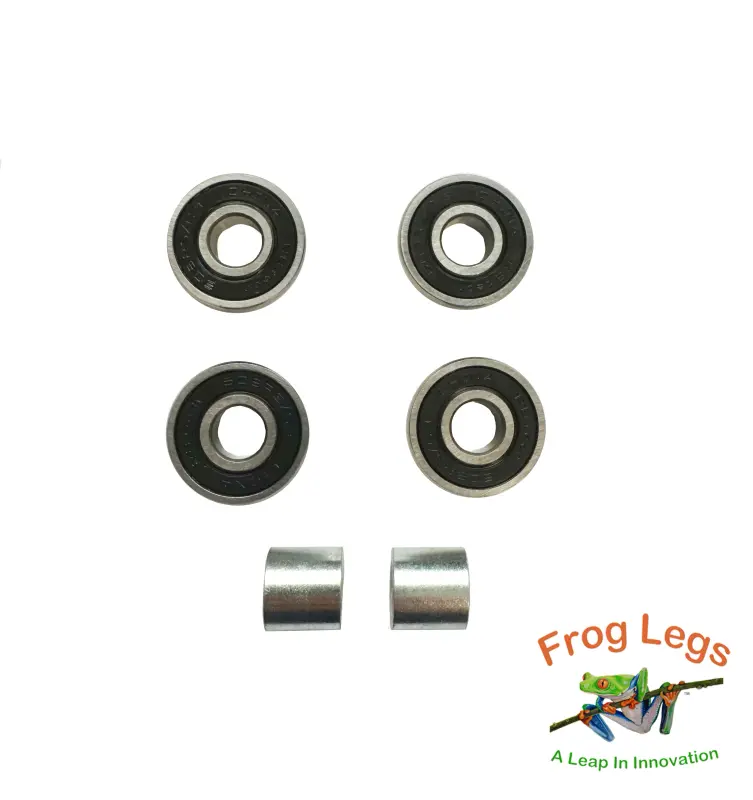
Wheelchair casters replacement guide 2026: caster wheel sizes, tire types, bearings, forks, measuring, flutter, part numbers, prices and warranty
Front wheels for a wheelchair compared from Frog Legs, Invacare, Drive, Medline, Pride and US sellers: sizes, bearings, forks, measuring, flutter, prices, warranty.
Contents
- The short answer
- How we compared, and which documents we read
- Wheelchair caster wheels at a glance: the core table
- Caster sizes from 3 to 8 inches: what the documents list
- Tire types: solid, pneumatic, semi-pneumatic, soft roll and light-up
- Wheel width: 1 inch, 1.4 inches, 2 inches
- Bearings: 608, R6, 7/16 inch and what pages print
- Forks, stem bolts, axle bolts and the caster housing
- Caster housing angle, mounting holes and seat height
- How to measure a wheelchair caster before you order
- Caster flutter: what the manuals say
- What 42 FDA reports say about flutter and shimmy
- The recall file: one caster fork recall
- Maker part numbers by chair, as the pages print them
- Power wheelchair casters
- What front casters cost at three US sellers
- Pair, each or assembly: reading what the price buys
- Warranty and returns on casters
- Who should fit a new caster
- Medicare and caster replacement
- Ordering casters through Mobility Atlas
- Three traps
- Three composite scenarios
- Questions to ask the dealer, the therapist and the seller
- Sources and documents
- Common questions
- Sources
The short answer
Wheelchair casters replacement is a small repair: the two front wheels that swivel wear flat, crack, collect hair in their bearings or start to shake at speed, and the caster price lines we counted at three US sellers ran from $22.00 to $127.45, and 23 of the 27 tiles we counted name no unit. This guide is about front wheels for a wheelchair, manual and power: the sizes from 3 to 8 inches, the tire types, the width, the bearings, the fork and stem bolts, the angle of the caster housing, how to measure before you order, what the manuals say about caster flutter, the part numbers that makers print for named chairs, what sellers charge and what the warranty documents say. It goes deeper on casters than our wheelchair wheels guide, which covers casters in a few sections next to rear wheels, tires and axles, and our tire and caster care routine, which covers cleaning.
The safest replacement is the same part the chair was built with. Invacare's Tracer SX5 manual says its fork procedure "can be performed if replacing the exact same size front caster"
, and that both casters must be the same size and in the same mounting hole. The same manual puts the work in its service section, where it says "All procedures in this section MUST be performed by a qualified technician/dealer."
So the job for most readers is to identify the part exactly and then decide who fits it. A different size, width or tire type is a change to the chair, not a replacement: Invacare's manual lists front caster size and position among the settings that "directly relate to the stability of the wheelchair"
.
Three questions settle most orders. What is printed on the old caster or in the chair's parts list: the size such as 8 x 1 inch, the tire type and the maker's part number? What bearing and axle does it use: an 8 mm bore (608 bearing), a 3/8 inch axle (R6), a 7/16 inch bearing or another size, as the page for your part prints it? And does the chair need the wheel alone, the wheel with bearings, or a full assembly with the fork? Sellers use the word assembly for different things, so the sections below line up what each page says it includes.
The clinical decisions are not ours. If you want a different caster size, a wider or softer caster, a suspension fork or a change in seat height, that is a question for your wheelchair seating clinician, physical therapist or occupational therapist together with the dealer, because it changes how the chair balances, turns and tips. This guide explains the options, what each document says and what to ask, and then stops. Mobility Atlas earns a fee or margin when you order through us; the comparison below uses the makers' published pages, manuals and parts lists, sellers' listings, public FDA and Medicare records and, where named, rows of our own catalog, read on the dates given in the method section.
How we compared, and which documents we read
Our method was simple. We opened each page named in this guide in a browser and saved its text, with the address and the date it was read, before writing. For PDF manuals we extracted the text in the browser and saved the pages that deal with casters, forks, bearings and warranty, and we marked where a layout scrambled the text. Pages read on 13 November 2026: Frog Legs' caster specification table, its EPIC wide soft roll caster page, its FAQ and its warranty page; the caster pages of Invacare's Tracer SX5 user manual; six SpinLife product records; Sportaid's first page of search results for caster and three of its product pages; 1800wheelchair's caster category and three of its product pages; Medicare's policy article A52504 (the version in effect and the future version); the National Library of Medicine's HCPCS lookup; and two openFDA searches.
We also reused pages saved earlier by Mobility Atlas, each with its own read date. Read on 12 November 2026: Drive Medical's Standard Caster page, its Cruiser III parts diagram and its Viper Plus GT manual; SpinLife's manual wheelchair caster category; Invacare's parts catalogs for the Tracer IV and for the Tracer EX2, EXI, SX5 and SX5 Recliner; Medline's replacement parts guide; Pride's Jazzy EVO 614 and Go Chair owner's manuals; and Pride's tire and wheel care guide. Read on 9 November 2026: Medline's Guardian wheelchair user guide, the Tracer SX5 manual's warranty and safety inspection pages, Pride's Jazzy EVO 614 manual pages on its power base, Medicare.gov's wheelchairs and scooters page, Pride's specification pages for three Jazzy chairs, Permobil's M3 Corpus user manual, Medicare's coverage rule L33792 and FDA's page about the MAUDE database.
What we did not do: we did not buy, fit or test any caster, and we did not ask any maker or seller a question. Where two documents give different figures for the same part, we give both and say which page printed which. Where we did arithmetic, such as a price per caster from a pair price or a range across a listing page, a script computed it from the saved text. Prices checked November 2026. Documents checked November 2026.
Wheelchair caster wheels at a glance: the core table
The table lists caster wheels for which we read a maker's page or a named seller's product page, with the size, tire and bearing as that page prints them. Prices are in US dollars as printed on the read date, with the unit the page gives. A dash means the page we saved prints nothing for that column. The fit column repeats only what the page says; it is not our judgement that a part fits a chair.
| Caster, as listed | Seller (read) | Price, unit | Bearing as printed | Fit as printed |
|---|---|---|---|---|
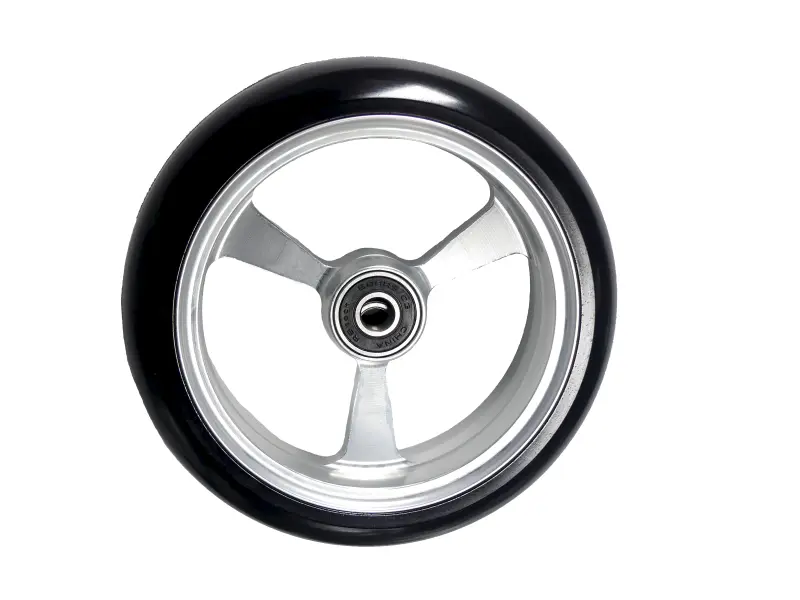
| Frog Legs EPIC wide soft roll, 4 to 6 x 1.4 in | Frog Legs (13 Nov) | $159.98, pair | 608, 8mm bore | Links to a compatibility page |
| Frog Legs EPIC 4 x 1.4 in, stock FL-CAS4 | Sportaid (13 Nov) | Cost: $80.00 (Retail: $199.98), sold in pairs | 5/16 in ID | Not TiLite with R6 |
| Poly caster 4 x 1 in, gray, stock 6613 | Sportaid (13 Nov) | Cost: $39.00 (Retail: $57.00), per pair | Sealed, 5/16 in id | - |
| TiLite 4 in Volcanic light up, CP102034 | SpinLife (13 Nov) | $70, each | - | - |
| Invacare semi-pneumatic soft roll 4 x 1 in, 1114142 | SpinLife (13 Nov) | $26, unit not named | - | A-4, Crossfire, Reveal, Spree XT |
| Sunrise/Quickie 5 in soft roll, 400103 | SpinLife (13 Nov) | $87, unit not named | With bearings | - |
| Invacare caster 8 x 1 in, SKU RP265027 | 1800wheelchair (13 Nov) | $63, unit not named | 7/16 in | Most Invacare wheelchairs |
| Pride caster 5 x 1.75 in, SKU C1745 (brand field: Invacare TAG) | 1800wheelchair (13 Nov) | $79, unit not named | - | Most Pride chairs |
| Invacare power 6 x 2 in, SKU 1115179 | 1800wheelchair (13 Nov) | $115, unit not named | Precision bearing | Most Invacare power chairs |
| Pride 8 x 2 in power caster, WHLASMB1112 | SpinLife (13 Nov) | $89 (list price field $102) | 608ZZ | Jazzy, Jet, TSS 450, Q1103 |
| Invacare 6 x 2 in power caster, 1122066 | SpinLife (13 Nov) | $90, pair | - | Most Invacare power chairs |
| Drive Standard 8 in caster, STDS1002 | Drive (12 Nov) | Sign in to view, 1/ea | - | Sentra Reclining, Viper GT Reclining, Viper, Viper Plus GT, CruiserIII |
Three things stand out. First, the unit changes from page to page: Frog Legs and Sportaid sell the EPIC in pairs, SpinLife names "Each" in some titles, and 6 of the 12 rows in the table name no unit. Second, the bearing line is missing from 5 of the 12 rows, which matters because the bore must match the axle. Third, in our view, the fit lines are short and loose: "fits most Invacare wheelchairs"
, 1800wheelchair's page says of its 8 x 1 inch caster. The sections below take each column in turn.
Caster sizes from 3 to 8 inches: what the documents list
Which caster size do you need for a wheelchair? The size you already have, unless a clinician and the dealer decide to change it. The pages we read cover diameters from 3 to 8 inches. Mobility Atlas read Frog Legs' specification table, which lists its EPIC casters from 3 to 6 inches, the Tracer SX5 manual and parts catalog, which list 6 and 8 inch casters, Drive's 8 inch Standard Caster page and Pride's specification pages, which print 6 and 8 inch casters on three Jazzy power chairs. The size printed on a caster is a name, not always an exact measurement: Frog Legs prints an overall diameter of 4.90 inches for its 5 x 1.4 inch wide caster and 5.88 inches for its 6 x 2.0 inch cruiser. Invacare's Tracer SX5 manual warns that front caster size and position "directly relate to the stability of the wheelchair"
, so a change of size is set by a qualified technician.
Small casters: 3 to 5 inches
Small casters appear among the TiLite and Frog Legs parts we read. SpinLife's manual wheelchair caster category, read on 12 November 2026, listed 9 items, 6 of them TiLite parts: a 3 inch micro caster, 4, 5 and 6 inch polyurethane casters, a 4 inch Volcanic light up caster and a 5 x 1.4 inch wide soft roll. Frog Legs' table lists 3, 4, 5 and 6 inch EPIC casters in three families. Sportaid's first results page for caster listed 3 x 1 inch lighted and roller blade casters next to 4, 5 and 6 inch Frog Legs casters.
Middle sizes: 5 and 6 inches
Five and six inch casters show up on both manual and power chairs. 1800wheelchair listed a 5 x 1.75 inch Pride caster assembly and a 5 x 1.5 inch three-spoke Invacare urethane caster. Pride's specification pages print 6 inch casters on the Jazzy EVO 614 and 600 ES. Invacare's Tracer SX5 parts catalog lists AT902, a composite urethane caster printed as Dark Grey, 6 x 1 inch.
Large casters: 8 inches
Eight inch casters appear in the documents we read for Drive's and Invacare's standard chairs. Drive's Standard Caster page, read on 12 November 2026, lists item STDS1002 as a Standard 8 inch Caster with an 8 x 1 inch Pyramid tire, for use with the Sentra Reclining, Viper GT Reclining, Viper, Viper Plus GT and Cruiser III wheelchairs. Invacare's Tracer SX5 parts catalog lists three 8 inch casters: AT903, composite urethane, 8 x 1-1/4 inch; 1228, composite semi-pneumatic, 8 x 1-3/4 inch; and 1252, composite pneumatic, 8 x 1-1/4 inch. On power chairs, Pride's Jazzy Ultra Light page prints 8 inch flat free casters on suspension caster forks.
Tire types: solid, pneumatic, semi-pneumatic, soft roll and light-up
A caster's tire is the part that wears, and the type decides how it rides and whether it can go flat. The documents we read name six kinds. Solid or polyurethane casters, such as the AT903 composite urethane caster in Invacare's catalog and the solid polyurethane caster tires Permobil's M3 Corpus manual describes: "The caster wheels have solid polyurethane tires,"
that manual says. Pneumatic casters, such as Invacare's 1252. Semi-pneumatic casters, such as Invacare's 1228 and the 4 x 1 inch soft roll 1114142 that SpinLife sells. Soft roll casters with a softer urethane tread, such as the Frog Legs EPIC family and the Sunrise 5 inch soft roll 400103. Flat-free casters, the term Pride's power chair pages use. And light-up casters, such as the TiLite Volcanic and the lighted casters on Sportaid's results page.
Frog Legs describes its EPIC soft roll tread as one that "will not go flat and is designed to minimize energy loss and absorb vibration"
, which is the maker's claim. None of the pages we read publishes a test that compares rolling effort or comfort between tire types, so we make no such comparison.
Can you replace just the tire?
For some tire types, Invacare's answer is no. Its Tracer SX5 manual says: "Replacement of solid urethane or semi-pneumatic tires is not recommended. If the solid urethane or semi-pneumatic tires need replaced, Invacare recommends replacing complete caster assembly."
For pneumatic caster tires, "replacement of the tube must be performed by a qualified technician."
The same page sets a time limit: "Invacare recommends that rear wheel tire/tube and caster tire/tube be replaced every five years."
That five-year line is printed in this one manual; we did not find a replacement interval in the other manuals we read.
The same Invacare page says when wear is excessive: for pneumatic tires, missing tread or bald tires; for urethane tires, "cuts, surface defects or the tires are loose on the rims"
; for rubber tires, "30% or more of the tire has worn away".
Changing the tire type
Switching from one type to another is a change to the chair. Pride's tire and wheel care guide, posted 26 October 2026 and read on 12 November 2026, says: "Do not change from pneumatic to flat-free tires, or from one wheel size or tread design to another, unless the option is approved for the exact product."
It adds that a different tire "can change ride height, ground clearance, traction, controller behavior, stability and the fit of the wheel assembly."
That guide covers Pride's scooters, Go Go travel products and Jazzy power chairs. For a manual chair, ask the chair's maker or dealer the same question in writing.
Wheel width: 1 inch, 1.4 inches, 2 inches
The second number in a caster size is the width of the tire: 8 x 1 inch is an 8 inch caster with a 1 inch tire. Width matters for two reasons the documents name. A wider tire sits differently on soft ground: Frog Legs says the extra width of its wide soft roll "does not sink into carpet, gravel, etc."
, a claim made by the maker. And a wider tire may not fit the fork: Frog Legs' FAQ, in its list of problems, says "The person may have a narrow fork and need a narrower wheel."
The widths printed on the pages we read run from 1 inch to 2 inches. Frog Legs' table prints 1 inch for its narrow court casters, 1.4 inches for its wide soft roll casters, 1.45 inches for its 4 to 6 x 1.4 inch cruisers and 2.00 inches for one 6 x 2.0 inch cruiser. Invacare's catalog prints 8 x 1 inch, 8 x 1-1/4 inch and 8 x 1-3/4 inch casters. Power chair casters run wider on the pages we read: 6 x 2 inch Invacare casters at 1800wheelchair and SpinLife, and an 8 x 2 inch Pride caster at SpinLife.
In our view, the width to order is the width on the old tire. If you want a wider caster for gravel or carpet, ask the dealer to measure the space inside the fork first and to confirm that the wider caster keeps the same diameter: in Frog Legs' table a wider caster of the same nominal size can be taller or shorter (4.15 against 4.0 inches at 4 inches, 5.93 against 6.0 at 6 inches).
Bearings: 608, R6, 7/16 inch and what pages print
A caster wheel turns on bearings in its hub; SpinLife's record for one Pride caster, for example, lists bearings and a spacer pre-installed. The bearing's inner hole has to match the caster axle bolt, and in our view it is the easiest detail to get wrong. The pages we read print bearings in three ways: a bearing code (608, 608ZZ, R6), a bore (8mm, 5/16 inch, 3/8 inch) or a plain size (7/16 inch). We copy each as printed and do not convert one into another.
| Part, as listed | Bearing line as printed | Page |
|---|---|---|
| Frog Legs EPIC casters | Uses 608 Bearings; Bearing Bore: 8mm | Frog Legs EPIC page and table |
| Frog Legs EPIC cruiser 6 x 2.0 in | Bearing Bore 10mm | Frog Legs specification table |
| Frog Legs EPIC 4 x 1.4 in | Bearing Size 5/16 in ID; table 5/16 in, 8mm | Sportaid product page |
| Poly caster 4 x 1 in | Sealed bearings 5/16 in id | Sportaid product page |
| R6 bearings | Fits 3/8 in id caster axles | Sportaid results tile |
| Pride 8 x 2 in power caster | Pre-installed 608ZZ bearings and spacer | SpinLife product record |
| Invacare 8 x 1 in caster | 7/16 in bearings; 2-3/8 in hub | 1800wheelchair product page |
| Drive caster bearings STDS1011 | Inner 11mm, outer 23mm, thickness 10mm | SpinLife product record |
Note one difference between two pages about the same wheel. Frog Legs prints the EPIC's bore as 8mm; Sportaid's page for the same 4 x 1.4 inch EPIC prints the bore as 5/16 inch and 8mm in its table , offers only a 5/16 inch ID bearing option, and warns: "5/16″ inner diameter will not fit TiLite with R6 bearings." We give both as printed. In our view, plan on the maker's figure, and ask the seller in writing which bearing ships with the wheel before you order.
The R6 is the other size that keeps coming up. Frog Legs' FAQ says that if its wheels do not fit a maker's fork or axle, "they may need an R6 wheel with a bigger diameter axle"
, and Sportaid's R6 tile says it fits 3/8 inch id caster axles. Our own catalog lists an R6 front caster bearing four-pack (AC-246) for TiLite front casters and a 608 four-pack (AC-247) for casters with 8 mm axles; those catalog rows are listings, not a fit guarantee.
Bearings and warranty do not always go together. Frog Legs' warranty page says: "Bearings are not covered by this warranty."
Medline's Guardian user guide says bearing work is a technician's job: "Replacement and maintenance of wheel bearings should be completed by a qualified wheelchair technician only."
Cleaning hair out of caster bearings is covered in our tire and caster care routine.
Forks, stem bolts, axle bolts and the caster housing
A front caster hangs from a fork, and the fork's stem turns inside a tube at the front of the frame. The names differ by maker: Invacare's manual calls the tube the "caster headtube", Frog Legs calls it the caster barrel or caster housing, and Medline's guide calls it the fork stem housing. Invacare's sections 9.11 and 9.13 name the two fixings: a locknut that secures the fork to the caster headtube, and a hex screw, washers and locknut that secure the caster to the fork.
How the fork comes out, as Invacare prints it
Invacare's Tracer SX5 manual, section 9.11, lists the steps for the fork: remove the dust cover; "Remove the locknut and nylon washer (if present) that secures the [...] fork to the caster headtube"
; "Drop the fork assembly out of the caster headtube"
; slide the new fork assembly in; and reassemble by reversing the steps. Then the forks are adjusted, as described in the section on flutter below. For the wheel alone, section 9.13 says: "Remove the hex screw, washers and locknut that secure the front [...] caster to the fork,"
and adds that "Washers are only used with 8 inch casters with precision bearings."
In these quotes, [...] marks figure labels in the extracted text. These steps are printed for the Tracer SX5 only, in the manual's service section, which it reserves for a qualified technician or dealer.
Where the bearings sit: fork or frame
Frog Legs' FAQ sorts stems into two kinds by the code on its forks, and says: "Any numbered stem, ie (37, 25, 35, 45) etc. has the bearings mounted to the chair (caster barrel)."
and "Any lettered stem, ie (KR, XF, ZR, Z2) etc. has the bearings in the fork of the wheelchair."
The codes are Frog Legs' own. In our reading, the practical point is that on some chairs the stem bearings come with the fork and on others they stay in the frame, so a fork for one design may not suit the other.
Stem bolts and axle bolts, as sellers list them
Sportaid lists a caster bolt nut, 5/16-24, at Cost: $1.80 (Retail: $3.50), with options for a 5/16-24 x 2.5 inch caster bolt and 5/16 inch ID, 3/8 inch spacers; its page says it "Fits Quickie, Invacare & Top End"
. Frog Legs' FAQ notes a problem with stem bolts: they fit "standard caster barrel housing bearings"
, but when the bearings are a different size the stem bolt may not fit, and if it sticks out "it’s too long, and a shorter one is needed."
Our wheelchair wheels guide lists fork sets with their stem bolt sizes from one seller; we do not repeat that table here.
Fork parts in two makers' parts lists
Makers list the small fork parts as separate numbers. Medline's parts guide, on its Excel 2000 page, lists WCA806931HHA as a "Fork, Front Wheel, Metal Version, Left or Right"
, WCA806935PR as "Bearings, Front Caster" sold as a pair, WCA806950PR as "Stem Bearings, Front Caster"
sold as a pair, WCA806933 as the axle and hardware set and WCA806995 as the dust cap. Drive's Cruiser III parts diagram lists the fork, fork stem bearing, caster axle and caster bearing by serial number prefix, as the part number table below shows.
Caster housing angle, mounting holes and seat height
The caster housing, or headtube, sets the angle at which the fork stem turns. In our reading, a headtube that is out of angle can affect how the caster swivels. Invacare's Tracer SX5 troubleshooting table lists "Check caster headtube angle."
among its solutions, in a table whose symptom columns include caster flutter; the extracted text does not show which columns that line is marked for. Frog Legs' FAQ, under its advice to prevent flutter, says: "Ensure the caster fork bearings are perpendicular to the ground (e.g., check for bent frames or stems)."
In our reading, a new caster will not fix a housing that is out of angle, a bent frame or a bent stem. Those are frame faults for the dealer. Our manual wheelchair repair guide covers frame and fork faults in more detail.
Mounting holes on the fork
Some forks have more than one axle hole, and the hole you use moves the caster up or down. Invacare's Tracer SX5 manual says: "Note the mounting position on the fork assembly for [...] proper reinstallation of the new front caster."
Its warning on the same page reads: "Make sure both front casters are the same size and are installed into the same respective mounting hole before [...] using the wheelchair, otherwise injury may occur."
Drive's Viper Plus GT manual describes a 3 position front caster that "can be adjusted for positioning with the rear wheel"
by moving the bolt and axle to another position.
Seat height and stability
Caster size, fork position and rear wheel size together set the seat-to-floor height. Invacare's manual prints charts that pair 6 inch or 8 inch front casters and their mounting positions with 20, 22 and 24 inch rear wheels for each obtainable seat height, and says: "Any change to one or any combination of the seven may cause the wheelchair to decrease in stability. These adjustments MUST be performed by a qualified technician."
It adds that if the seat-to-floor height changes, "the correct anti-tippers MUST be ordered"
to keep ground clearance.
One warning on those chart pages is specific to some chairs. For Tracer SX5 chairs 20 to 22 inches wide with a 300 lb weight limitation, the manual says 8 inch semi-pneumatic front casters must be installed, and on its recliner page: "DO NOT replace with any other size/style front caster. Otherwise, injury or damage may occur."
The width fraction after 8 x 1 is split across lines in the text we extracted, so we do not repeat it. In our reading, the semi-pneumatic 8 inch caster in the same maker's Tracer SX5 parts table is 1228, printed as 8 x 1-3/4 inch, but confirm with Invacare or the dealer which caster the warning means for your serial number.
How to measure a wheelchair caster before you order
How do you measure a wheelchair caster for a replacement? Measure four things and copy any numbers printed on the old part. Mobility Atlas read the specification lines on maker and seller pages: they describe a caster by diameter and width, and some add the bearing bore, the hub or the weight. First, the diameter: read it off the tire sidewall if you can, because the name and the measured size differ; Frog Legs' table prints 4.15 inches overall for its 4 x 1.4 inch wide caster and 3.82 inches for its 4 x 1.4 inch cruiser. Second, the width of the tire. Third, the bore of the bearing or the diameter of the axle bolt, such as 8mm, 5/16 inch, 3/8 inch or 7/16 inch, as the pages print it. Fourth, the hub width between the fork arms: 1800wheelchair prints a 2-3/8 inch hub for one Invacare 8 x 1 inch caster. Then photograph the fork, stem bolt and serial label.
A measuring checklist
- Serial number and model: from the chair's label. Invacare's manual says to
"ALWAYS provide the wheelchair serial number to assist in ordering the correct replacement parts."
- Printed size: the numbers molded on the tire, such as 8 x 1, and any part number on the hub.
- Diameter: across the tire, edge to edge. In our view, measure with the caster on the chair, or ask the dealer to measure it off the chair.
- Width: across the widest part of the tire.
- Bearing and axle: the bore of the bearing or the axle bolt diameter, and the code on the bearing seal if one is printed.
- Hub width: the length of the hub between the fork arms, including any spacers.
- Fork: the number of axle holes, which hole is used, and whether a stem bearing sits in the fork or in the frame.
- Both sides: measure both casters; Invacare's Tracer SX5 manual says both front casters must be the same size.
If you measure and the numbers do not match any listing, stop there. In our reading, a caster that is close but not the same is a change to the chair: Invacare's manual gives its procedure for "the exact same size front caster"
. Send the measurements and photos to the dealer or to the seller and ask for the part number in writing.
Caster flutter: what the manuals say
What causes caster flutter on a wheelchair, and how do manuals say to fix it? Flutter, also called shimmy or speed wobble, is a fast side-to-side shake of the front casters. Mobility Atlas read four makers' manuals (Medline, Drive, Pride and Invacare) and Frog Legs' FAQ, and they link it to the nut at the top of the fork and to the bearings. Medline's Guardian user guide says: "If the nut is too loose, the castor will flutter or shimmy. If the nut is too tight, the chair will be difficult to steer."
Drive's Viper Plus GT manual says: "If nut is too loose, caster will shimmy, if too tight, chair will be hard to steer."
Pride's Jazzy EVO 614 manual lists the caster forks "for damage or fluttering which indicates that they may need to be adjusted or have the bearings replaced. See your authorized Pride Provider for repair."
Invacare's Tracer SX5 manual prints a test to guard against flutter, for a qualified technician.
Invacare's drop test, as printed
Invacare's Tracer SX5 manual, section 9.12, says that "To properly tighten caster journal system and guard against flutter"
, tip the back of the chair to the floor, pivot both forks and casters to the top of their arc, and let them drop: the "wheels should swing once to one-side, then IMMEDIATELY rest in a straight downward position."
Adjust the locknuts and repeat until they do, test the chair for maneuverability, readjust if needed and snap the dust cover back on. The test is in the manual's service section, which says all its procedures "MUST be performed by a qualified technician/dealer"
and that service should be done "while the wheelchair is unoccupied"
. The manual's safety inspection checklist adds a spin test: "Inspect axle assembly for proper tension by spinning caster. Caster should come to a gradual stop."
Medline's guide uses the same gradual stop test.
Frog Legs' explanation, as the maker gives it
Frog Legs' FAQ says: "Speed wobble, also known as Flutter, is caused by conflicting forces the wheel experiences as it rolls."
Its advice is to keep the fork bearings perpendicular to the ground, to tighten the nut or bolt at the top of the housing "until the caster flips around and stops after 1 to 1.5 full revolutions"
, to check for worn bearings and to use balanced wheels. It also says "Frog Legs forks do not experience flutter more than standard rigid forks."
These are the maker's statements about its own products; we read no test of them.
When the shake means stop
Pride's tire and wheel care guide says to stop using the product if it "veers, wobbles, scrapes, has a visibly damaged wheel or feels less stable than usual"
, and to "Stop using the product and contact an authorized Pride provider"
when you find "A bent caster fork, cracked hub or rim, loose wheel or missing wheel hardware."
That guide covers Pride products. In our view, the same caution is sensible for any chair: a caster that shakes, a fork with play or a bolt that sits proud of its nut is a reason to stop and have the chair checked, as some of the FDA reports in the next section describe.
What 42 FDA reports say about flutter and shimmy
On 13 November 2026 we ran a word search of the FDA's device adverse event reports (MAUDE, through openFDA) for the words flutter, fluttering or shimmy in reports filed under the two main wheelchair product codes, IOR for manual wheelchairs and ITI for powered wheelchairs. The search returned 42 reports, received between 3 November 2005 and 6 October 2025; openFDA gave the data as last updated 4 November 2026. We read all 42. Every one was a report from a manufacturer. 35 of them name a caster, castor, fork or head tube in the report text; the other 7 use the word for something else, such as a motor that flutters or a frame that shimmies, or describe wheels without naming the caster.
These are reports, not a count of failures. The FDA's page about MAUDE says reports are "not intended to be used either to evaluate rates of adverse events"
and calls MAUDE a "passive surveillance system"
with limitations, among them under-reporting and "lack of verification that the device caused the reported event."
A word search also misses reports that describe the same fault in other words.
What the reports describe
By the manufacturer field in each record, 32 of the 42 reports name an Invacare company as the maker (including Invamex), 6 Permobil and 2 Sunrise Medical; one gives the maker as "CUSTOM MANUAL" with the brand Invacare, and 1 as unknown; 29 were received in 2013 to 2015. 13 of the 42 reports are a single short line of under 150 characters (counting the field label), and 11 of those name no cause, such as "PROVIDER STATES REAR CASTERS ARE FLUTTERING."
Where a cause is stated, the reports point to the parts the manuals name. One reads: "THE HEADTUBE BUSHINGS ON A MANUAL WHEELCHAIR WERE WORN AND CAUSED THE CASTERS TO FLUTTER."
Another: "DEALER STATES, THE FRONT CASTERS ARE FLUTTERING DUE TO THE BEARINGS."
A third says a dealer "STATED THE FORK ASSEMBLY ATTACHMENT HOLES WERE REAMED CAUSING CASTER FLUTTER."
(The report texts are in capitals as stored.)
Forks that came off
7 of the 35 caster reports describe a fork or caster that detached, came off or whose bolt backed out; 6 of those were Permobil power chair reports. In a Permobil M3 Corpus report received on 6 October 2025, the reporter stated the user "HAD BEEN EXPERIENCING" flutter on the left caster without telling the provider, and that the caster "HAD SIGNS OF CONSIDERABLE WEAR TO WHERE IT WAS WORN FLAT ON THE SURFACE"
; the fork had detached and the user was reported to have fractured a wrist. A Permobil M300 report from 2017 states: "IT IS BELIEVED THIS OCCURRENCE COULD HAVE BEEN AVOIDED IF SERVICE PROVIDER WOULD HAVE BEEN ALERTED WHEN DRIVE CHARACTERISTICS CHANGED I.E. CASTER FLUTTER."
In two M3 Corpus reports from 2018 and 2019, the inspection found "EXTENSIVE WEAR TO THE CASTER WHICH WOULD INDICATE EXCESSIVE SIDE-SIDE MOVEMENT, I.E. FLUTTER."
These are the reporters' and the maker's statements, as filed.
Manual chairs appear too. In a Sunrise Medical report about a Quickie 7R received in 2021, a dealer reported that the user was going down a hill when the "CASTER STARTED FLUTTERING UNCONTROLLABLY AND ENDED UP TOSSING THE USER OUT OF THE CHAIR"
; the report says no injuries other than bumps and scrapes were reported at the time. Sunrise wrote that the parts were not returned and that it was "unable to make a proper assessment of the incident and what the root cause of the malfunction is"
. 4 of the 42 reports were filed as injury reports. In our view, the lesson of these records is the one the manuals print: treat flutter as a warning, and have the fork, nut and bearings checked.
The recall file: one caster fork recall
A word search of the FDA's recall records through openFDA on 13 November 2026 (data last updated 12 November 2026), for IOR and ITI recalls naming a caster or fork, found 3 records; one, the 2016 Karma Flexx recall (quantity 35, listed as terminated), concerned the front caster fork brackets. The other two were about an anti-tipper and a seat latch. A recall record shows what a maker corrected; the absence of a recall does not show that a part is safe. The wider recall file for wheels and casters is in our wheelchair wheels guide.
Maker part numbers by chair, as the pages print them
A part number is the surest way to order the right caster, but only for the chair, size and production run it is printed under. The table copies numbers from makers' parts lists and from seller pages, with the heading or fit line each one sits under. We do not say that a part fits any chair the page does not name.
| Chair, as printed | Part, as printed | Number | Document |
|---|---|---|---|
| Tracer IV, after 9/30/03 (style AT903) | Composite urethane 8 x 1-1/4 in | Wheel assembly, 1 piece, 1070811 | Invacare catalog 03-030 |
| Tracer IV, after 9/30/03 (style 1290) | Composite Charcoal Grey Solid Rubber 8 x 1 in | Wheel assembly, 1 piece, 1086841 | Invacare catalog 03-030 |
| Tracer IV, after 9/30/03 (style 1228) | Composite semi-pneumatic 8 x 1-3/4 in | Wheel assembly, 1 piece, 1058649 | Invacare catalog 03-030 |
| Sentra Reclining, Viper GT Reclining, Viper, Viper Plus GT, CruiserIII | Standard 8 in caster | STDS1002 | Drive product page |
| Excel 2000 | Front caster, with bearings | WCA806930 | Medline parts guide |
| A-4, Crossfire T6A and T7A, Reveal, Spree XT | Semi-pneumatic soft roll 4 x 1 in | 1114142 | SpinLife record |
| Jazzy, Jet, TSS 450, Quantum Q1103 Ultra | 8 x 2 in power caster | WHLASMB1112 | SpinLife record |
Notes on the Invacare rows. AT903, 1290 and 1228 are the caster style codes printed as column headings; the wheel assembly numbers are printed in the row under them. The Tracer EX2, EXI and SX5 catalog prints wheel assemblies 1041692, 1070811, 1058649 and 1034352 under styles AT902, AT903, 1228 and 1252, so the two catalogs agree on 1070811 under AT903 and 1058649 under 1228. In the Tracer SX5 table, note B on the first column reads "Consists of (2) Casters." In the Tracer IV table, note C on the 1228 column reads "Required for 450lb weight capacity chair."
, and the same catalog lists a rear wheel kit that contains "2 - 1228 Caster assemblies and a 450lb weight capacity decal". The Tracer IV catalog also prints 1-pair numbers, 1071666 and 1086842, but the notes beside them do not line up clearly in the text we extracted, and the tire, bearing and axle numbers further down are best read from the PDF with the dealer, by serial number. The Tracer IV catalog also says that chairs with a serial number starting 03H or 03I should call an Invacare parts specialist for replacement parts. Our Invacare wheelchair parts guide reads those tables in more depth.
Drive's numbers change with the serial prefix. On the Cruiser III diagram the 8 spoke caster is STDS3J2432 for serial 3J (with a 5 spoke STDS3J3900) and STDS4S2432 for 4S and 5D, and the caster axle, caster bearing, fork and fork stem bearing also differ between those columns. Drive's Standard Caster page lists STDS1002 for the Cruiser III, but the diagram lists STDS3J2432, STDS3J3900 or STDS4S2432 by serial column, not STDS1002. In our view, plan on the diagram for your serial and ask Drive or the dealer to confirm in writing. SpinLife's record for STDS1011 prints the bearing as 11mm inner, 23mm outer and 10mm thick and says it is compatible with Drive wheelchairs whose model numbers start with 10215 or 10215J; the Cruiser III diagram lists STDS1011 only in the 3J column. Our Drive Medical wheelchair parts guide explains how to read the serial columns.
Power wheelchair casters
Power chairs use casters at the front, the back or both, depending on where the drive wheels sit. Pride's Jazzy EVO 614 owner's manual (pages read on 9 November 2026) says its power base has "two drive wheels, four caster wheels"
.
Pride's specification pages for three Jazzy chairs print 6 and 8 inch casters; our wheelchair wheels guide tabulates them. Permobil's M3 Corpus manual says its caster wheels have solid polyurethane tires. Three of the four replacement power casters in the table below are 6 x 2 or 8 x 2 inch.
| Power chair caster, as listed | Seller | Price, unit | Fit as printed |
|---|---|---|---|
| Pride caster wheel assembly 8 x 2 in, WHLASMB1112 | SpinLife | $89 (list price field $102) | Jazzy series, Jet series, TSS 450, Q1103 Ultra |
| Invacare 6 x 2 in caster, Pronto series, 1122066 | SpinLife | $90, pair | Most Invacare power chairs |
| Invacare 6 in gray urethane, At'm, 1029500 | SpinLife (12 Nov) | $71, unit not named | Invacare At'm Chair |
| Invacare 6 x 2 in caster assembly, 1115179 | 1800wheelchair | $115, unit not named | Most Invacare power chairs |
The fit lines on power chair casters are broad: "Jazzy series" and "Jet series" on SpinLife's Pride record, "Fits most Invacare Power Wheelchairs"
on its Invacare record. In our view, a series name is not enough. Pride's care guide says to confirm compatibility "by model and serial number"
with an authorized Pride provider, and our Pride Jazzy parts guide covers Pride's parts route. By our division, SpinLife's Invacare pair at $90 works out at $45 a caster, and its Pride record's sale price field is $13 below its list price field.
Fitting is also stricter on power chairs. Pride's care guide tells owners not to "replace a caster" unless the owner's manual expressly assigns that task to them. Pride's Jazzy EVO 614 manual, in its monthly checks, says "Check the caster wheels for wear. Replace them as necessary."
, and its Wheel Replacement section warns: "The wheels on your power chair should only be serviced or replaced by an authorized Pride Provider or a qualified technician."
The Go Chair manual prints the same caster fork fluttering check as the EVO 614. Several of the Permobil FDA reports above concern the bolt that holds the fork to the suspension arm, which is a reason, in our view, to leave power chair fork work to the provider.
What front casters cost at three US sellers
Prices below are as printed on the dates given, in US dollars, in the United States. They differ by seller, country, funding and sales period, and they change; ask for the price in writing. Each range is computed by script over every price line on the page we saved, with the exclusions named.
| Page | Read | Lines counted | Range as printed |
|---|---|---|---|
| SpinLife, manual wheelchair caster wheel assemblies | 12 Nov 2026 | 9 of 9 items | $23 to $121 |
| Sportaid, search for caster, page 1 | 13 Nov 2026 | 11 of 16 tiles | $22.00 to $127.45 |
| 1800wheelchair, manual wheelchair casters | 13 Nov 2026 | 7 of 7 results | $63 to $115 |
SpinLife's category showed 9 items on one page. The range uses the current price on each tile; the page markup showed two struck prices, $57 above a $50 TiLite 5 inch caster and $58 above a $23 TiLite 6 inch caster. The range in our table therefore runs from $23 to $121, the top being a TiLite 5 x 1.4 inch black wide soft roll caster titled "(ea)". The same page's text says "prices starting at just $135.00"
, which does not match the prices on its own tiles; we report both as printed.
Sportaid's search for caster returned 97 results; we counted the first page of 16 tiles. We dropped 5 tiles that are not caster wheels: a shower commode chair, R6 bearings, Big Rigs caster forks, caster hardware and a caster bolt nut. The 11 caster tiles ran from $22.00 for 3 x 1 inch black roller blade casters to $127.45 for Frog Legs Whisper shock absorber casters. The tiles print no unit; the three Sportaid caster product pages we opened say "Sold in pairs", "Price is per pair" and, for the Whisper casters, "Sold by the pair."
1800wheelchair's category showed 7 results from $63 for an Invacare 8 x 1 inch caster with 7/16 inch bearings to $115 for both an Invacare 6 x 2 inch power chair caster and a soft-roll caster tile. Three Invacare 8 x 1 inch tiles are priced $63, $69 and $75, and the tiles name different features (7/16 inch bearings and a 2-3/8 inch hub on the $63 tile; rubber tire, bearings and hub on the $75 tile), so compare the bearing and hub lines, not only the size. None of the three product pages we opened names a unit; each lists its price as "Total:", for example Total: $63.
The same wheel can cost very different amounts. Frog Legs' own page printed "Regular price" for the EPIC wide soft roll pair: $159.98 with standard bearings, $174.98 with stainless steel and $189.98 with ceramic, by our addition of the printed surcharges. Sportaid listed the 4 x 1.4 inch EPIC at Cost: $80.00 (Retail: $199.98), sold in pairs, with a 5/16 inch ID bearing as the only option. The Frog Legs price is $79.98 higher by our subtraction, and the two pages print different bearing details, so check what each price includes.
If you want a quote for a caster in another country, or a part that is not listed on these pages, see the section on ordering through Mobility Atlas below. Prices also differ with funding: see the Medicare section.
Pair, each or assembly: reading what the price buys
Two casters are needed for a chair with two front wheels, and Invacare's Tracer SX5 manual says both must be the same size. Yet the pages price them in different units, and some name none. Frog Legs' EPIC page says "Sold as a pair (2)". Sportaid's EPIC page says "Sold in pairs." and its poly caster page "Price is per pair". SpinLife's titles say "Each" for the TiLite Volcanic light up caster and the Newton Ultracaster, and "(PAIR)" for an Invacare power caster. Its Invacare 1114142 and Sunrise 400103 records, and 1800wheelchair's three product pages, name no unit. Drive's Standard Caster title ends "1/ea".
In our view, when a page names no unit, assume nothing: ask the seller whether the price is for one caster or two, and get the answer in the quote. By our division, the Sportaid poly caster pair at $39.00 is $19.50 a caster and the Sportaid EPIC pair is $40.00; the Frog Legs EPIC pair is $79.99 a caster.
What an assembly includes
The word assembly is used for different bundles; our wheelchair wheels guide compares Medicare's definition with sellers'. SpinLife's Pride caster wheel assembly lists "Pre-installed 608ZZ bearings and spacer"
and no fork. Medline's parts guide lists a "Front Caster, with Front Fork, Bearing, Bolt, Dust Cap"
as one part for some transport chairs and a "Front Caster with Bearings"
for others. Read the includes line; if it does not mention the fork, axle bolt or bearings, ask.
Warranty and returns on casters
Casters wear out, and two of the chair manuals we read name them as wear items or non-durable components. Each term below belongs to the one document that prints it.
| Document | What it says about casters |
|---|---|
| Frog Legs limited warranty, updated 8/21/2023 | 24 months from sale; must be registered; bearings not covered |
| Drive Standard Caster page, STDS1002 | Warranty 60 Days |
| Drive Viper Plus GT manual, lifetime limited | Casters excluded as non-durable components |
| Invacare Tracer SX5 manual, wear items | Wheels, tires and casters listed as wear items |
| Medline Guardian user guide | Parts 1 year, original purchaser; normal wear not covered |
| SpinLife records for four casters and one bearing set | No Warranty; 20% restocking fee |
| SpinLife record for Pride WHLASMB1112 | 30 Day Warranty (field text names another item) |
| 1800wheelchair product pages, three casters | All sales final, except defective or wrong items |
Frog Legs' warranty page says it covers defects "for a period of 24 months from the date of sale"
, that "Your Frog Legs purchase must be registered to be eligible for warranty replacement or service"
, and that "Bearings are not covered by this warranty."
It also says "Any substitutions of supplied product accessories or modification to the product will void the warranty."
Drive's Viper Plus GT manual gives the chair a lifetime limited warranty for the original consumer purchaser, but says "The warranty does not extend to non- durable components, such as rubber accessories, casters, and grips, which are subject to normal wear and need periodic replacement."
Drive's own Standard Caster page prints a warranty of 60 Days for the caster itself. Invacare's Tracer SX5 manual lists "wheels, tires and casters"
among normal wear and tear items and refers to the warranty policy shipped with the product. Medline's Guardian guide warrants "the parts and upholstery" for one year from purchase by the original purchaser and excludes "normal wear and tear".
Seller terms are separate from makers' terms. SpinLife's records for the Invacare 1114142, the Invacare 1122066 pair, the Sunrise 400103, the TiLite CP102034 and the Drive STDS1011 bearings each list "No Warranty", and every one of the six SpinLife records we read says "This item has a 20% Restocking Fee."
and that an RA "must be requested within 30 days of delivery"
. The Pride record lists a "30 Day Warranty", but its warranty text describes slippers, which looks like an error on the record; ask SpinLife in writing. 1800wheelchair's three product pages say "All sales are considered final"
, except for a defective, damaged or wrong item reported "within 5 days of receipt".
In our view, two habits help: keep the order confirmation with the part number and the chair's serial number, and register a part where the maker's warranty requires it. General warranty clauses are covered in our wheelchair parts guide.
Who should fit a new caster
Whether you can swap a caster yourself depends on the chair and on what the manual says, not on how easy the job looks. The documents we read draw the line in different places.
- Invacare's Tracer SX5 manual prints the caster and fork steps in its service section and says
"All procedures in this section MUST be performed by a qualified technician/dealer."
It also says"Unless otherwise noted, all service and adjustment should be performed while the wheelchair is unoccupied."
- The same manual says the rear wheels, casters and tires
"should be replaced by a qualified technician if damaged."
- Pride's care guide says caster adjustment and bearing work
"should be handled by an authorized Pride provider or qualified technician"
, for the Pride products it covers. - Medline's Guardian guide says
"A qualified wheelchair technician must perform any repair or change to this wheelchair or serious injury may occur,"
and that bearing replacement and maintenance"should be completed by a qualified wheelchair technician only."
- Drive's Viper Plus GT manual describes lubricating the casters and tightening the fork nuts
"until no play remains, but wheels roll freely"
in its maintenance text, without naming who should do it.
Invacare's manual also warns about parts: "Use of incorrect or improper replacement (service) parts may cause death, serious injury, or damage."
and "Replacement parts MUST match original Invacare parts."
Frog Legs' FAQ adds a practical point for anyone replacing small parts: "always advise replacing the same parts on the other fork for longevity"
.
In our view, the safe split for a manual chair is this: checking, cleaning and reporting are yours; anything that loosens the fork nut, changes the mounting hole or changes the size belongs to the person the manual names. For a power chair, leave caster and fork work to the provider. Our wheelchair parts guide covers who can fit a part in general.
Medicare and caster replacement
Medicare has its own codes for caster parts: the National Library of Medicine's HCPCS lookup, read on 13 November 2026, lists K0071, K0072 and K0077 as complete front caster assemblies with pneumatic, semi-pneumatic and solid tires; our wheelchair wheels guide tabulates the full code list. Policy article A52504 says: "A replacement only caster assembly (K0071, K0072, K0077) includes a caster fork, wheel rim, and tire."
Medicare's policy article A52504, version 61 (in effect from 10/01/2025 to 12/19/2026, read on 13 November 2026), has a Column I / Column II table that lists K0071, K0072, K0077, E2225 and E2226 under the manual wheelchair base codes, and says "A Column II code is included in the allowance for the corresponding Column I code when provided at the same time."
The same table puts the tire, tube, wheel and fork codes under each caster assembly code (for K0071: E2214, E2215, E2225, E2226). The article also says: "All types of tires and wheels are included in the code for a power mobility base."
For later replacements, the article says the RB modifier is used "when an option or accessory is provided as a replacement for the same part which has been worn or damaged (e.g., replacing a tire of the same type)."
A future version of the article, effective 12/20/2026, carries the same caster lines in the text we saved.
The coverage rule, LCD L33792 (read on 9 November 2026), sets the general test: "Options and accessories for wheelchairs are covered if the beneficiary has a wheelchair that meets Medicare coverage criteria and the option/accessory itself is medically necessary."
These are US Medicare rules. On cost, Medicare.gov's Wheelchairs and scooters page (read on 9 November 2026) says: "After you meet the Part B deductible, you pay 20% of the Medicare-approved amount (if your supplier accepts assignment)."
Ask the supplier, in writing, which code it will bill and what you will owe. Medicare Advantage plans, Medicaid and the VA set their own rules, and we did not read their rules on wheelchair parts: ask the plan. Repairs and funding in general are covered in our manual wheelchair repair guide.
Ordering casters through Mobility Atlas
Mobility Atlas can find and quote front casters, forks, bearings and caster bolts, including parts that are not listed on the site. The process is an enquiry or part request, then a written quote with delivery to your country, and nothing is charged before you accept the quote. The caster wheels, forks and caster bearings we list are on our casters and forks page; caster tires and caster inner tubes are on our wheelchair wheels, handrims and tires page.
To make the request precise, send the chair's make, model and serial number; the size printed on the old caster; the width, diameter, bearing bore and hub width you measured; whether you need the wheel alone, the wheel with bearings or the full fork assembly; the number of casters; and a photo of the caster, fork and serial label. If you have a part number from the maker's parts list, send it with the page it came from.
Three traps
Trap one: ordering by the round number. A caster titled 5 inches may measure 4.8 or 4.9 inches on the maker's own table, and three 8 x 1 inch caster tiles at 1800wheelchair name different features. Order by the printed size, the bearing bore and the part number, not by the title.
Trap two: the bearing that does not fit the axle. Frog Legs prints 8mm for the EPIC's bore, Sportaid prints both 5/16 inch and 8mm for the same wheel, offers only a 5/16 inch ID bearing and warns it will not fit TiLite chairs with R6 bearings, 1800wheelchair's Invacare 8 x 1 inch page prints 7/16 inch bearings, and SpinLife's Drive bearing record prints 11mm inner. In our view, a wheel with the wrong bore will not go on the axle bolt, or will sit loose on it. Ask the seller which bearing ships in the wheel.
Trap three: treating flutter as a nuisance. The four makers' manuals we quote on flutter or shimmy link it to the fork nut, the fork adjustment or the bearings, and 7 of the FDA reports we read describe a fork or caster that came off, some of them with flutter reported before the event or wear found after it. A new caster will not fix a loose fork, a worn headtube or a bent frame, and a shaking caster is a reason to stop and have the chair checked.
Three composite scenarios
These are composite scenarios, not individual customers. Each one uses only the documents for the one part or chair it names.
Scenario one: an Invacare Tracer SX5 with a cracked 8 inch caster. The owner finds the caster in the Tracer parts catalog's table and reads the four 8 inch and 6 inch styles, AT902, AT903, 1228 and 1252. The manual says both front casters must be the same size and in the same mounting hole, that replacing solid urethane or semi-pneumatic caster tires on their own is not recommended, and that the service steps are for a qualified technician. They send the serial number and the caster style to the dealer, ask for two matching casters, and have the dealer do the drop test the manual prints.
Scenario two: a manual chair user wants Frog Legs EPIC wide soft roll casters in 4 x 1.4 inches. Frog Legs prices the pair at $159.98 with standard 608 bearings and prints an 8mm bore and 4.15 inch overall diameter; Sportaid lists the 4 x 1.4 inch EPIC at $80.00, sold in pairs, with a 5/16 inch ID bearing and the warning about TiLite chairs with R6 bearings. Because the chair's current casters are 4 x 1 inch, the change in width is a change to the chair, so they ask their therapist and the dealer first, and they ask the seller in writing which bearing ships. They register the purchase, because Frog Legs' warranty requires it.
Scenario three: a Pride Jazzy power chair whose caster wheel has worn flat. The SpinLife record for Pride's WHLASMB1112 lists an 8 x 2 inch solid caster with pre-installed 608ZZ bearings and spacer for the Jazzy and Jet series at $89. Pride's care guide says to confirm compatibility by model and serial number with an authorized Pride provider, and to leave caster replacement to the provider unless the manual assigns it to the owner. The owner checks the chair's specification page for the caster size, then asks the provider to confirm the part and fit it.
Questions to ask the dealer, the therapist and the seller
The dealer or provider
- Which caster part number was this chair built with, for its serial number?
- Do I need the wheel only, the wheel with bearings, or a fork assembly?
- Is the caster housing still at the right angle, and are the stem bearings worn?
- Will you set the fork tension and check both casters after fitting?
The therapist or seating clinician
- Would a different caster size, width or tire type change my seat height, turning or stability?
- Should a change of caster be tried before it is ordered?
- Does a change of caster mean the anti-tippers or rear wheel position need resetting?
The seller
- Is the price for one caster or a pair?
- Which bearing is fitted, and what is its bore?
- Does the price include the axle bolt, spacers or fork?
- What warranty applies, and what are the return terms and restocking fee?
Sources and documents
Every page and document named in this guide is listed in the sources below with its address. The read date of each is given in the method section above, and in the source title where a page was read on a different day from its neighbours. Our catalog rows are cited by their ids.
This article is general information. Rules and prices differ by country and change, so confirm them before you buy or travel.
Common questions
How do I know what size caster my wheelchair needs?
Read the size molded on the old tire, such as 8 x 1 inch, and look up the chair's parts list by serial number. If nothing is printed, measure the diameter, the tire width, the bearing bore or axle bolt and the hub width between the fork arms. Names and measurements differ: Frog Legs' table prints 4.90 inches overall for its 5 x 1.4 inch wide caster. Changing size is a change to the chair, so ask the dealer and your therapist first.
Can I put bigger or wider casters on my wheelchair?
Only after the dealer and your clinician agree. Invacare's Tracer SX5 manual says front caster size and position, with the rear wheels and anti-tippers, directly relate to the stability of the chair, and that seat height changes must be done by a qualified technician with the correct anti-tippers. A wider tire may also not fit a narrow fork, Frog Legs' FAQ says.
Why do my wheelchair casters wobble or flutter?
The manuals we read link flutter or shimmy to a fork nut that is too loose and to worn bearings; Frog Legs also names fork bearings that are not perpendicular to the ground (for example, a bent frame or stem) and unbalanced wheels. Medline's guide says a nut that is too loose lets the castor flutter or shimmy, and one that is too tight makes the chair hard to steer. Invacare prints a drop test for a qualified technician to set the tension. Stop and have the chair checked if the casters shake.
Do wheelchair casters come in pairs?
It depends on the page. Frog Legs and Sportaid sell some casters in pairs, SpinLife titles some as each and one Invacare power caster as a pair, and 6 of the 12 rows in our core table name no unit. Ask the seller to state the unit in the quote, and replace both front casters with the same size and type.
Are wheelchair casters covered by warranty?
Terms are short or exclude casters in the documents we read. Frog Legs warrants defects for 24 months from sale if the purchase is registered, but excludes bearings; Drive's Standard Caster page lists 60 days; Drive's Viper Plus GT manual excludes casters from the chair's lifetime warranty as non-durable; and five SpinLife records list No Warranty with a 20% restocking fee. Prices and terms differ by country, seller and funding, so get them in writing.
Can Mobility Atlas get casters that are not listed on the site?
Yes. Mobility Atlas can find and quote front casters, forks, bearings and caster bolts, including parts that are not listed. Send an enquiry or part request with the chair's make, model and serial number, the printed caster size, your measurements and a photo; you receive a written quote with delivery to your country, and nothing is charged before you accept it.
Sources
- Frog Legs: Caster Wheel Specifications (read 13 November 2026)
- Frog Legs: EPIC Aluminum Wide Softroll Caster, pairs
- Frog Legs: Frequently Asked Questions (flutter, bearings, stems)
- Frog Legs: Limited Liability Warranty, updated 8/21/2023
- Invacare: Tracer SX5 wheelchair user manual, Part No. 1110550 (PDF)
- Invacare: Parts catalog Form No. 02-016, Tracer EX2, EXI, SX5, SX5 Recliner (PDF)
- Invacare: Parts catalog Form No. 03-030, Tracer IV (PDF)
- Drive Medical: Standard Caster, STDS1002
- Drive Medical: Cruiser III parts diagram (PDF)
- Drive Medical: Viper Plus GT owner's manual (PDF)
- Medline: Standard manual wheelchairs user guide, Guardian, PIC-00270 (PDF hosted by Vitality Medical)
- Medline: Transport chair, wheelchair and homecare bed parts guide (PDF hosted by Vitality Medical)
- Pride Mobility: Jazzy EVO 614 Series owner's manual (PDF)
- Pride Mobility: Go Chair owner's manual (PDF)
- Pride Mobility: Tire and Wheel Care Guide, posted October 26, 2026
- Pride Mobility: Jazzy EVO 614 specifications
- Pride Mobility: Jazzy 600 ES specifications
- Pride Mobility: Jazzy Ultra Light specifications
- Permobil: M3 Corpus user manual, model version 3 (PDF)
- SpinLife: Manual wheelchair caster wheel assemblies (read 12 November 2026)
- SpinLife: Pride caster wheel assembly for Jazzy and Jet power chairs, WHLASMB1112
- SpinLife: Invacare 6 inch gray urethane caster wheel assembly, Pronto series (pair), 1122066
- SpinLife: Sunrise / Quickie caster 5 inch soft roll with bearings, 400103
- SpinLife: Drive Medical caster bearings, STDS1011
- SpinLife: Invacare caster, semi-pneumatic, soft roll, 4 x 1 inch, 1114142
- SpinLife: TiLite 4 inch Volcanic light up caster, each, CP102034
- Sportaid: Search results for caster, page 1 (read 13 November 2026)
- Sportaid: 4 x 1.4 inch Frog Legs EPIC aluminum soft roll casters
- Sportaid: 4 x 1 inch poly wheelchair casters, gray
- Sportaid: Wheelchair caster bolt nut (5/16-24), nut and spacers
- 1800wheelchair: Manual wheelchair casters (read 13 November 2026)
- 1800wheelchair: Invacare caster assembly 8 x 1 inch, SKU RP265027
- 1800wheelchair: Pride caster assembly 5 x 1.75 inch, SKU C1745
- 1800wheelchair: Invacare 6 x 2 inch caster assembly for power wheelchairs, SKU 1115179
- CMS: Article A52504, Wheelchair Options/Accessories policy article, version 61 (read 13 November 2026)
- CMS: Article A52504, future version effective 12/20/2026 (read 13 November 2026)
- CMS: LCD L33792, Wheelchair Options/Accessories, version 43 (read 9 November 2026)
- National Library of Medicine: HCPCS lookup, caster
- openFDA: device adverse event reports, IOR and ITI, word search for flutter, fluttering or shimmy
- openFDA: device recalls, IOR and ITI, word search for caster and fork
- CMS: Article A52504 version 61, Column I / Column II table (read 13 November 2026)
- Sportaid: Whisper shock absorber casters by Frog Legs
- Medicare.gov: Wheelchairs and scooters coverage (read 9 November 2026)
- FDA: About the MAUDE database (read 9 November 2026)
Read on . The wording of the article is our own.