Ottobock in 2026: C-Leg 4, Genium, C-Brace, WalkOn and Juvo wheelchairs, how to get them, prices, warranty, Medicare and recalls
Ottobock's knees, feet, hands, orthoses and wheelchairs: who fits them, prices as printed, warranty, suggested codes vs Medicare rules, and 14 FDA recall records.
Contents
- The short answer
- How we compared
- Ottobock in brief, as its own pages describe it
- Ottobock in the United States: what the US site shows
- How you get an Ottobock product
- Microprocessor knees: C-Leg 4, Genium and Kenevo
- Mechanical knee: the 3R80
- Prosthetic feet: Meridium, Triton side flex, Challenger and Runner
- K-levels: why Ottobock prints them and who decides
- Prosthetic hands: bebionic and Michelangelo
- Leg orthoses: the C-Brace and other Ottobock KAFOs
- Ankle-foot orthoses: the WalkOn family
- Ottobock manual wheelchairs: Avantgarde 4 and Zenit onn
- Ottobock power wheelchairs: Juvo B5/B6, Skippi and others
- Exoskeletons: SUITX by Ottobock
- Outside the US: the UK, international and Hong Kong pages
- What Ottobock products cost: prices as printed
- Ottobock warranty, product by product
- Maintenance intervals: where Ottobock's documents disagree
- Service lifetime: how long Ottobock will service a product
- Repairs, loaners and who to call
- Medicare and Ottobock prosthetic legs
- Medicare and Ottobock orthoses: C-Brace and WalkOn
- Medicare and power wheelchairs
- FDA recalls of Ottobock products
- What the recall records cannot tell you
- Where Ottobock's pages disagree
- Three traps
- Three composite scenarios
- What to ask the prescriber, prosthetist, orthotist and dealer
- Sources and documents
- Common questions
- Sources
The short answer
What does Ottobock make, and how do you get it? Mobility Atlas read Ottobock's own US, UK, international and Hong Kong pages, its US warranty documents, the Medicare rules and the FDA recall file between 10 and 27 October 2026. Ottobock makes prosthetic knees, feet, hips and hands, such as the C-Leg 4, Genium, Kenevo, Meridium and bebionic, and orthoses such as the C-Brace and the WalkOn family. Its US professional pages print no price and say "Login or register to buy", so you get these through a prescriber and a certified prosthetist or orthotist (some WalkOn models are also listed by US online retailers). Ottobock also makes manual and power wheelchairs, among them the Avantgarde 4, Zenit onn, Juvo B5/B6 and the children's Skippi. They appear on its international, UK and Hong Kong pages, but the US site we read had no wheelchair section. Two UK dealers listed the Juvo B5/B6 at 3,879 to 5,298 pounds with VAT relief on 27 October 2026.
| Product line | Examples on Ottobock pages | How you get it |
|---|---|---|
| Microprocessor knees | C-Leg 4, Genium, Kenevo | Prescriber and certified prosthetist |
| Mechanical knees | 3R80 rotary hydraulic knee | Prescriber and certified prosthetist |
| Feet | Meridium, Triton side flex | Prescriber and certified prosthetist |
| Sport feet | Challenger, Runner | Prescriber and certified prosthetist |
| Hands | bebionic, Michelangelo | Prescriber and certified prosthetist |
| Leg orthoses | C-Brace, E-MAG Active, FreeWalk | Prescriber and certified orthotist |
| Ankle-foot orthoses | WalkOn family, 28U90 | Orthotist; some WalkOn sold online |
| Manual wheelchairs | Avantgarde 4, Zenit onn | Dealer (UK, international pages) |
| Power wheelchairs | Juvo B4, B5/B6, B7, Skippi | Dealer (UK, Hong Kong pages) |
| Industrial exoskeletons | SUITX by Ottobock | Not stated; workplace use (corporate page) |
Mobility Atlas earns a fee or margin when you order through us; the comparison below uses only Ottobock's published pages and documents, two UK dealers' and one US retailer's published listings, our own catalog, and the CMS, Medicare.gov and FDA records named in each section. If you want us to find an Ottobock product, send an enquiry with your prescription or your clinician's notes, the model, and the country where you live, and ask us to find it. Our catalog's Ottobock brand page (at /b/ottobock.html on this site) lists 11 Ottobock wheelchairs, power chairs and orthoses; none carries a price.
How we compared
We read 27 saved files, in full or in the sections stated. New for this guide, all read on 27 October 2026: Ottobock's US About page, its corporate and investor pages and its international wheelchair page; product pages for the Juvo B5/B6 (Hong Kong English site), Avantgarde 4 (international site), Zenit onn and Skippi (UK site), and the C-Brace, Triton side flex, Challenger, Runner, Genium, 3R80 and Meridium (US professional site); Ottobock's US warranty page, its prosthetics and orthotics warranty tables, its limited warranty, its knee warranty brochure, its repairs and loaner page and its end of service appendix; two UK dealers' Ottobock listings and a US retailer's search results; a 19 June 2026 release on Invacare's newsroom about Ottobock's Human Mobility division; and the FDA recall records for Ottobock, read through openFDA.
Reused from earlier guides: the C-Leg 4, Kenevo and bebionic pages and the C-Leg 4 user instructions (read 18 October 2026); the WalkOn Reaction pages and the Vitality Medical listings (read 25 October 2026); Medicare's rules for lower limb prostheses (L33787 and policy article A52496, read 18 October 2026), for ankle-foot and knee-ankle-foot orthoses (L33686 and A52457, read 25 October 2026) and for power mobility devices (L33789, read 22 October 2026); and Medicare.gov's pages on prosthetic devices (read 18 October 2026) and on wheelchairs and scooters (read 10 October 2026).
Limits: we did not fit, try or test any product. Ottobock's prosthetic and orthotic pages are written for professionals; the instructions for use, service passes and most warranty brochures behind them were not all opened, and we say where. Prices are one day's listings at the sellers named. This guide is written mainly for the United States, with UK and international pages where Ottobock's wheelchairs appear; elsewhere, ask your local clinic, dealer or funder.
Ottobock in brief, as its own pages describe it
Ottobock's US About page says the company "was founded in Germany in 1919 by Otto Bock, a prosthetist," and that instead of carving each leg from wood he "created separate components (like knees and feet) that could be combined." The same page says the company is headquartered in Duderstadt, Germany, and that its North American headquarters were set up in Minneapolis in 1958 and now sit in Austin, Texas, with a Canadian branch in Burlington, Ontario, since 1978.
Ottobock's own pages give different sizes for the company, and we quote each with its page. The US About page says Ottobock serves the world with "more than 340 patient care centers, 4 research hubs and 60 locations worldwide" and "has more than 8,000 employees." The corporate overview page, read the same day, gives core revenue for 2025 of EUR 1.6 billion, "nearly 9,300 in 45 countries" as its count of full-time equivalent employees, and "more than 430" patient care centres. The investor page says Ottobock runs patient care "in more than 30 countries." The pages do not say which figure is newer or how each was counted.
The corporate page says the majority of Ottobock SE & Co. KGaA is owned by Näder Holding, "the sole property of the owner family," and a second corporate page says the company "is listed on the stock exchange." The corporate overview names its product areas as prosthetics, orthotics, wheelchairs, patient care and exoskeletons, and says "Most of our wheelchairs are manufactured at our Königsee site in Thuringia." The investor page names its business-to-business segments as "prosthetics, neuro-orthotics, digital O&P, and industrial exoskeletons"; wheelchairs are not named there. Statements such as "global market leader" on these pages are Ottobock's own claims; we did not check them.
Part of Ottobock's mobility business may change hands. A release dated 19 June 2026 on Invacare's newsroom, not on Ottobock's own pages, says DHCare, "recently formed from the acquisition of Invacare Europe and DHG," has signed a definitive agreement "to carve out and acquire the Human Mobility division of Ottobock," and calls it, in the same sentence, "a globally recognised provider of complex power wheelchairs and specialist mobility solutions." The release says the transaction "remains subject to the satisfactory completion of customary closing conditions expected to complete in H2 2026," and that "Financial terms have not been disclosed." The release describes the buyer's aim as a mobility platform for users and healthcare systems "across Europe," and names Ottobock Human Mobility's "strong presence in the DACH region, particularly in the provision of complex power wheelchairs"; it does not list which products or countries the division includes. In the pages we read on 27 October 2026 we found no statement that the deal has closed. If you are buying an Ottobock product, ask the dealer whether the planned acquisition affects its warranty or service contacts.
Ottobock in the United States: what the US site shows
On 27 October 2026 the header and footer of Ottobock's US site linked to prosthetics, orthotics and exoskeletons (the exoskeleton link goes to suitx.com), and we found no wheelchair menu. The address ottobock.com/en-us/wheelchairs returned "404 - Page not found" when we read it, and no US product page exists for the Juvo in what we read. None of the pages we read says in words which countries Ottobock's wheelchairs are or are not sold in. So we cannot tell you whether a US buyer can get an Avantgarde, Zenit or Juvo. If you live in the US and want one, ask Ottobock's US office or a US wheelchair dealer directly.
For prosthetics and orthotics, the US site has a clinic locator that says it finds "certified prosthetic & orthotic professionals" near you who work with Ottobock products. For repairs and maintenance, Ottobock's US repairs page gives an after-sales email, OBUSAService@ottobock.com, and the phone number +1 (800) 328-4058, option 3. The same 800 number appears on Ottobock's limited warranty for warranty questions. These pages are written for prosthetists and orthotists; as a user, you normally go through the clinic that fitted you, as the knee warranty brochure describes: "the user can contact the medical supply company that provided their fitting."
How you get an Ottobock product
The route depends on the product line. For prosthetic knees, feet and hands, Ottobock's US professional pages show "Login or register to buy" instead of a price, and the Genium and C-Brace pages are marked "Requires certification" and "Requires software". Ottobock's limited warranty applies only when products are "fitted by or under the direct supervision of certified/licensed practitioners who meet all Ottobock product-specific training requirements." In practice, that means:
- A physician or other treating practitioner orders the prosthesis or orthosis. Medicare.gov says Part B covers prosthetic devices "when a doctor or other health care provider orders them."
- A certified prosthetist or orthotist assesses you, chooses the components with the prescriber, and fits them. Medicare's rule for lower limb prostheses says the type of knee and foot "will be made by the treating practitioner and/or the prosthetist based upon the functional needs of the beneficiary."
- For some products, Ottobock asks for a trial first. The Meridium page says "A trial of the Meridium is strongly encouraged before purchasing," and the C-Brace page invites you to "Request a Trial" with a partnered professional.
- The clinic bills you or your insurer. Ottobock's pages print no price for these products.
For wheelchairs, Ottobock's international page says its chairs "can be individually adapted to the user's needs by experts at specialist dealers or are built as a custom-made device." Its FAQ describes a general application process, not a US one: a medical evaluation by a physician, a prescription, choosing the chair with a medical supply company, then a cost estimate sent to the insurer. In the US, Medicare's power chair rule adds, for Group 2 chairs with power options, Group 3 chairs and pediatric Group 5 chairs, a specialty evaluation and a supplier with a RESNA-certified assistive technology professional, as the Medicare sections below explain. Our guides to electric wheelchairs and lightweight wheelchairs cover choosing a chair in general.
Microprocessor knees: C-Leg 4, Genium and Kenevo
The three Ottobock microprocessor knees whose US pages we read are aimed at different activity levels, as Ottobock describes them (the Genium X3 and X4 also appear in Ottobock's warranty documents; we did not read their pages). The table copies each page's specifications. K-levels are Medicare's functional levels, explained in the next sections; which knee suits you is for your prescriber and prosthetist.
| Spec as printed | C-Leg 4 (3C98-3) | Genium (3B1-3) | Kenevo (3C60) |
|---|---|---|---|
| Activity level | K2, K3, K4 | K3, K4 | K2, low-K3 |
| Max body weight | 300 lbs (136 kg) | 330 lbs (150 kg) | 330 lbs (150 kg) |
| Battery life | Approximately 2 days | Approximately 5 days | Approximately 1 day |
| Flexion angle | 130 degrees (without flexion stop) | 130 degrees | 124 degrees |
| Water rating | IP68 | IP67 | IP54 and IP22 (both printed) |
| Weight | 2.75 lbs | 3.09 lbs (1,400 g) | 2.02 lbs (3C60) |
| Standard warranty | 3 years | 3 years | 3 years |
| Suggested HCPCS (Ottobock) | L5828 + L5845 + L5848 + L5850 + L5856 + L5925 | L5999 | L5828, L5845, L5848, L5850, L5856, L5925 |
C-Leg 4
Ottobock's US page calls this version "The C-Leg 4 Update microprocessor knee" and says "With over 100,000 fittings to date, the C-Leg is trusted by more users than any other microprocessor knee in the world"; that is Ottobock's claim. The page lists a new IP68 rating, a manual locking function, supported descent on ramps and stairs, and "Stumble Recovery Plus active at all times." The user instructions say the battery lasts "at least 16 hours" of uninterrupted walking and "about 2 days with average use," that the knee "is non-functional" while charging, and that you should "take the product off before charging the battery." They also say the electronics are protected in fresh water "up to 3 m for 1 hour (IP 68)" but "the mechanical components may corrode," and that the knee "should not come into contact with salt water, chlorinated water" or soap. The instructions give a minimum body weight of 45 kg (100 lb) and an expected lifetime of 6 years if the maintenance intervals are kept.
Genium
The US Genium page says the knee is for people "who need to adapt to changing environments, move quickly over short distances, or require more than 2 days of battery life." It lists a stairs and obstacles function, a Walk2Run function, five programmable modes and an IP67 rating, and says "Accidental water damage does not void the warranty." The page prints a maximum flexion of 130 degrees and a weight of 1,400 g. The page warns that strong magnetic fields such as MRI "can cause irreparable damage to microprocessor knees," which should be removed first. Ottobock suggests code L5999 for the Genium, an unlisted code; the Medicare section explains why that matters.
Kenevo
Ottobock's Kenevo page says it is "designed specifically for users with mobility limitations who need a high level of stability," with supported sitting down and standing up, a wheelchair function and three activity modes "set by the clinician." It prints a disclaimer that it is "For patients who walk with speeds of up to 1.9 mph and up to" half a mile outside the house per day. The page contradicts itself on water protection: the list for users says "IP54 Rating. Kenevo is water resistant and protected from dust and splashes of water," while the specifications table says "IP22 (protected against dripping water)." We report both. Ask the prosthetist which rating applies to your knee, and treat it as splash protection at most.
Choosing between these knees, and between a microprocessor knee and a mechanical one, belongs to your prescriber and certified prosthetist. Our prosthetic leg guide explains knees, sockets and what FDA reports on prosthetic knees show across makers.
Mechanical knee: the 3R80
Ottobock's US page for the 3R80 "Modular Knee Joint with Rotary Hydraulic" says it is "approved for users up to 150 kg (330 lbs)," that "both the stance and the swing phase are controlled by the hydraulics," and that it is "protected against fresh, salt and chlorinated water." It prints activity levels K3 and K4, a maximum flexion of 150 degrees, a weight of 1196 g (1191 g for the threaded-top 3R80=ST) and an integrated manual lock. The page says stance activation "requires a hip extension moment during loading," which is something your prosthetist will check you can do.
Ottobock suggests codes L5828, L5845, L5850 and L5925 for the 3R80. Its US prosthetics warranty table gives mechanical knees 24 months, and its end of service appendix gives the 3R80 a service lifetime of 5 years and a product lifetime of 3-5 years. The 3R80 is not among the knees in the FDA recall records we read; older Ottobock mechanical knees are, and the recall section lists them.
Prosthetic feet: Meridium, Triton side flex, Challenger and Runner
| Spec as printed | Meridium (1B1-2) | Triton side flex (1C68) | Challenger (1E95) | Runner (1E91) |
|---|---|---|---|---|
| Type | Microprocessor foot | Carbon foot | Multi-purpose sport foot | Running blade |
| Activity level | K3 | K3, K4 | Not printed | Not printed |
| Max body weight | 220 or 275 lbs by size | 220 or 275 lbs by size | Table to 240 lbs (110 kg) | 229 lbs / 104 kg |
| Sizes | 24 cm - 29 cm | 22 cm - 30 cm | 23/24 to 29/30 | Not printed |
| Water | Not printed | Waterproof | Waterproof | Not printed |
| Suggested HCPCS (Ottobock) | L5973 | L5981, L5986 | L5981 | L5999 |
| US warranty (table) | 36 months | 36 months | 24 months | 24 months |
The Meridium page describes "intelligent, real-time control" of a 4-axis design that adjusts to walking speed and ground, an app, and approved knee joints "C-Leg, Compact, Genium, Genium X3." It prints a heel height of "0-2 in (0-50 mm)". Ottobock's end of service appendix gives the Meridium a service lifetime of 6 years and a product lifetime of 2-3 years.
The Triton side flex page says it has "side-to-side flexibility of +/- 10°" and is "Waterproof and corrosion-resistant." It prints "Standard Warranty 3 years" and a weight of 805 g at size 26 cm. It also says "This product is a special order item and not stocked," and points to the 1C58 Taleo Side Flex as an alternative. A footnote warns not to combine certain stiffness configurations "with a 3C88-3* or 3C98-3* C-Leg 4." The page for the standard Triton (1C60) returned "404 - Page not found" when we read it.
The Challenger page calls it "a multi-purpose foot developed for the varying demands from everyday walking to recreational sports," worn without a footshell, with heel wedges in four stiffness grades. The Runner page says it "comes with the carbon blade only," so the adapter, sole and spike pad are ordered separately, and gives a Runner Junior (1E93) for users up to 99 lbs (45 kg). Our sports wheelchair guide covers seated sport; for running blades and feet in general, see the prosthetic leg guide.
K-levels: why Ottobock prints them and who decides
The Ottobock knee pages and the Meridium and Triton side flex pages above print an "Activity Level" such as K2 or K3; the Challenger and Runner pages do not. These are Medicare's functional levels from its rule for lower limb prostheses, L33787. The rule says level 2 is "Typical of the limited community ambulator," able to get over curbs, stairs or uneven surfaces. Level 3 is "Typical of the community ambulator" with variable cadence. Level 4 covers prosthetic walking with "high impact, stress, or energy levels" typical of "the child, active adult, or athlete."
The level is not something you pick from a product page. L33787 says potential functional ability is based on "the reasonable expectations of the treating practitioner and prosthetist," considering your history, your current condition and "The beneficiary’s desire to ambulate." Policy article A52496 adds that "The simple entry of a K-level modifier in those records is not sufficient." The level then limits which knee and foot Medicare will pay for, as the Medicare section below shows. If you have a level in your notes, ask your prosthetist which Ottobock products match it and why.
Our prosthetic leg guide explains K-levels, sockets and the steps from amputation to a definitive leg; we do not repeat them here.
Prosthetic hands: bebionic and Michelangelo
Ottobock's US bebionic page describes a "multi-articulating hand for people with upper limb difference" with "14 grip patterns and hand positions (up to 8 programmed at once)," six control modes and wrist options in three versions (8E70, 8E71, 8E72). It says the hand "Comes with a standard 2-year manufacturer’s warranty," with "Extended warranty options available, up to 5 years," free loaners during repairs, and a service centre in Salt Lake City, Utah. The page prints a "Service Life" of 5 years. One load row is printed as "34.17 lbf / 40 N," two figures that do not match each other; ask the prosthetist if load limits matter to you.
We did not read a Michelangelo hand product page for this guide. Ottobock's US warranty table gives both hands 24 months, and its end of service appendix lists the bebionic and Michelangelo with a 6-year service lifetime and a 5-year product lifetime. Our bionic arm guide compares the bebionic with other hands and explains myoelectric fitting.
Leg orthoses: the C-Brace and other Ottobock KAFOs
C-Brace
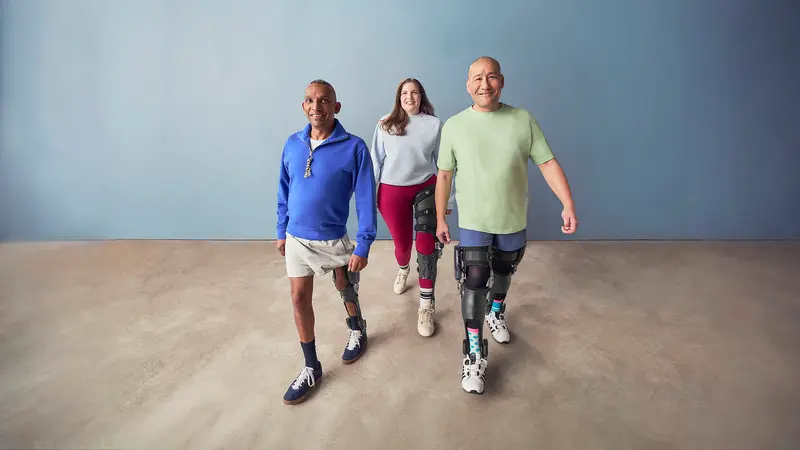
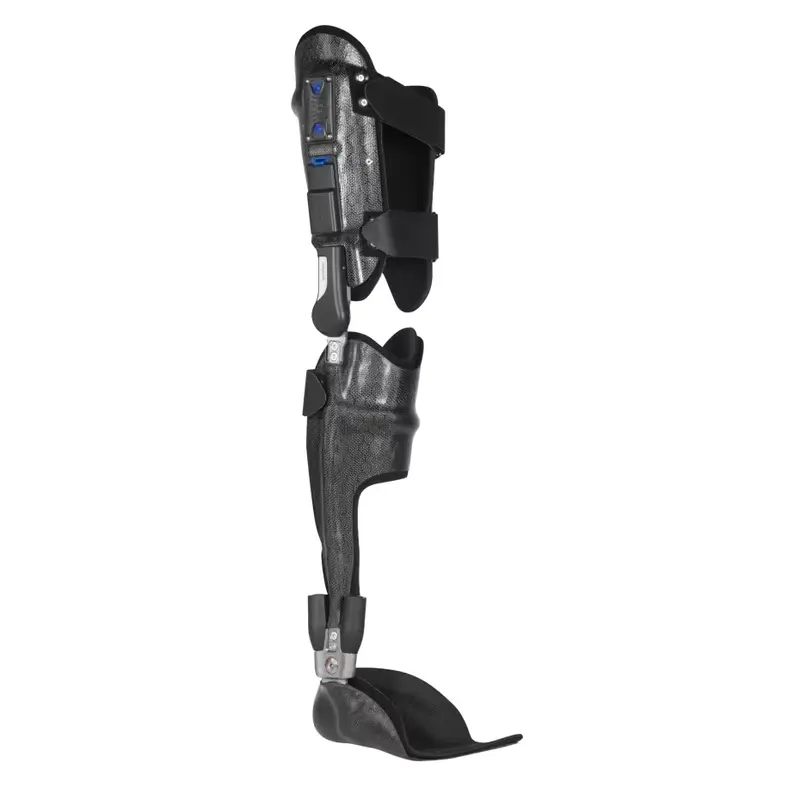
The C-Brace is a microprocessor-controlled leg orthosis. Ottobock's US professional page calls it "the world’s first mechatronic stance and swing phase control orthosis (SSCO)" and says it "supports the user during the entire gait cycle." The consumer page says it lets users "flex their leg under load (in order to sit down, for example)," walk on slopes and uneven ground, and descend stairs step-over-step; these are Ottobock's descriptions. It prints a stainless steel joint unit for adults, a maximum body weight of 275 lbs and a weight of 1390 g for the joint unit. The FAQ says "The C-Brace is not suitable for showering."
Who can use it is not decided by the page. Ottobock's FAQ says "only a detailed examination conducted by a clinician can determine whether the C-Brace is actually suitable in your specific case," and that "your certified O&P professional can use a trial orthosis" first. The professional page lists evaluation forms, a reimbursement guide and casting and fitting checklists. Ottobock suggests code L2006, and the Medicare section below explains what the CMS files say about it. The orthotics warranty table gives the C-Brace 36 months standard plus 2 months for fabrication, with "Mandatory service interval every 24 months or 2 million steps."
E-MAG Active and FreeWalk
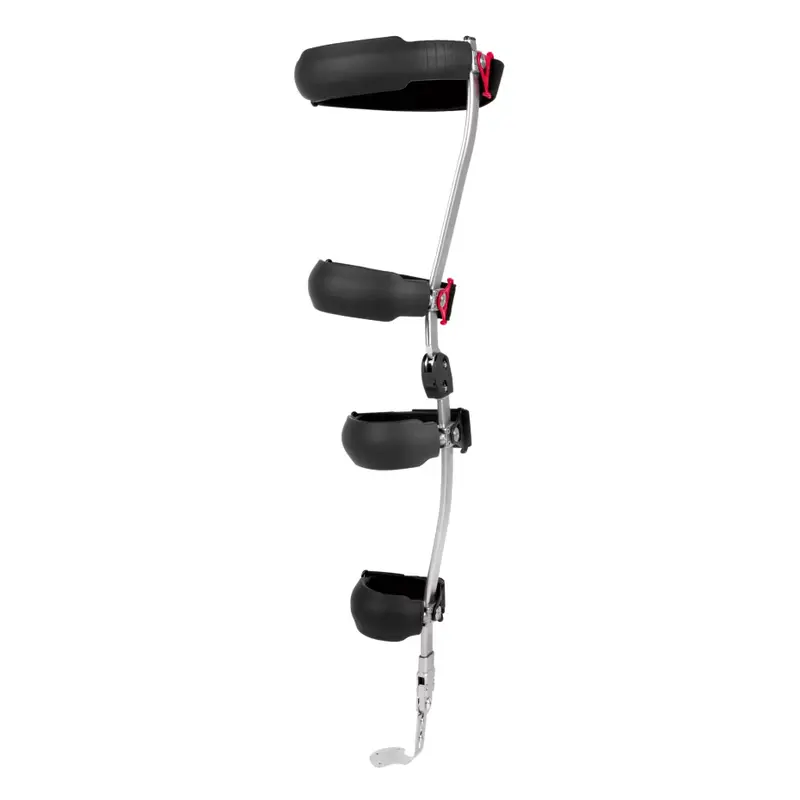
Our catalog lists two more Ottobock knee orthoses. The E-MAG Active (OR-002) is an electronically controlled knee joint that locks for stance and releases for swing, with a maximum body weight of 220 lb in the catalog. The FreeWalk (OR-003) is a mechanical stance-control KAFO with a standard-model weight limit of 80 kg in the catalog. Ottobock's orthotics warranty table gives the E-MAG Active 24 months ("Recommend servicing every 6 months") and the FreeWalk 12 months with a "One-time free adjustment." For powered orthoses and exoskeletons for walking, see our exoskeleton guide.
Ankle-foot orthoses: the WalkOn family
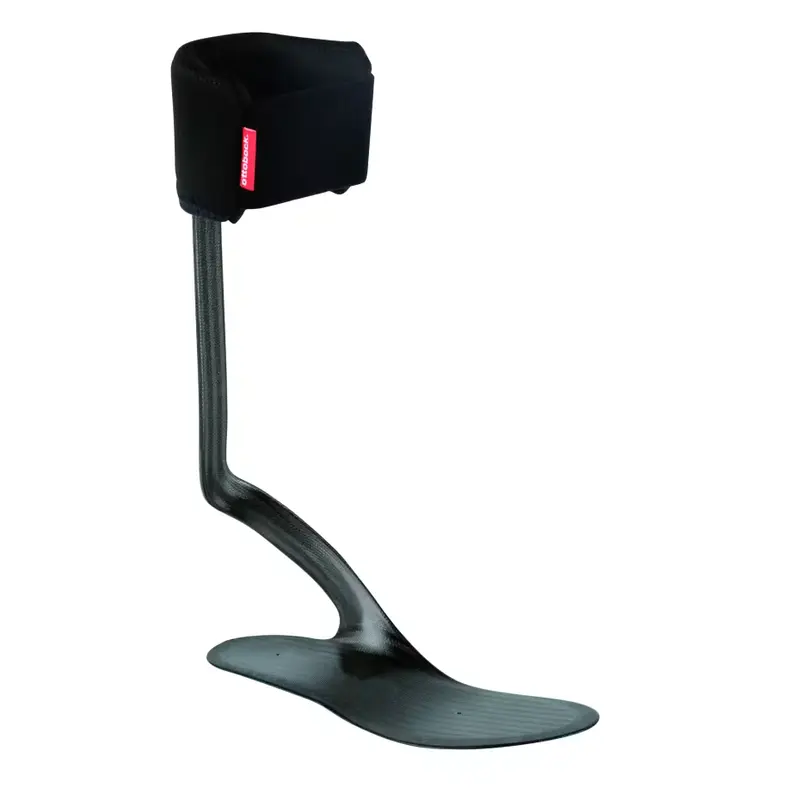
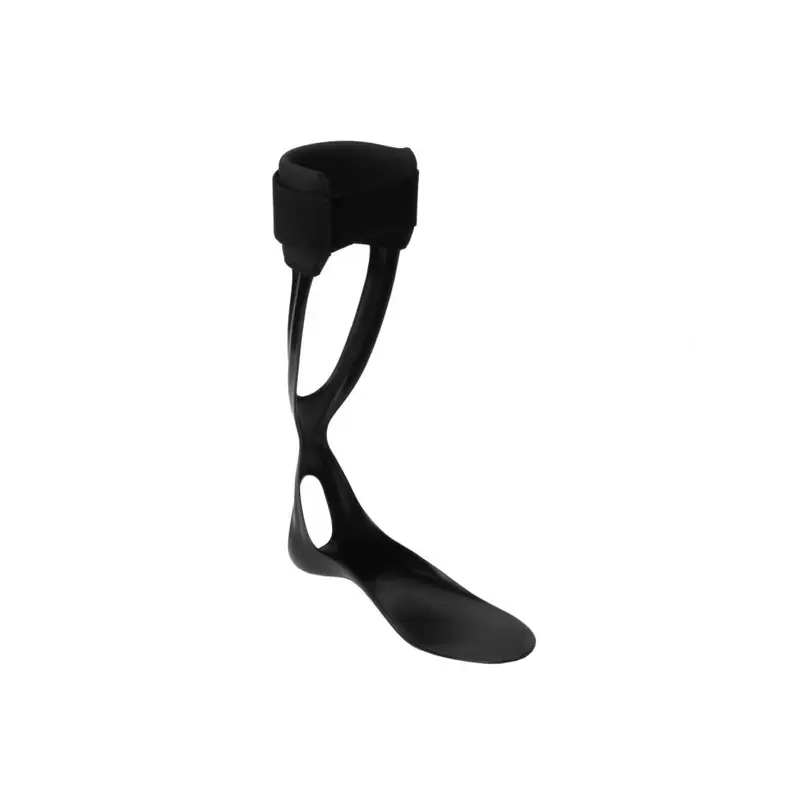
The WalkOn braces are prefabricated carbon ankle-foot orthoses. Ottobock's US page for the WalkOn Reaction (28U24) says it "helps users with dosiflexion weakness walk more naturally" (the page's spelling) and uses an anterior shell and longer strut "to help extend the users knee." Its Canadian page for the WalkOn Reaction lateral (28U34) lists stroke, multiple sclerosis and neurological disorders as indications, sizes for children to adults, and says adult sizes "were tested for 2 million cycles (= steps)." Ottobock suggests "L1932 Custom Fit / L1933 OTS" for the Reaction, which ties the code to how it is fitted. We could not open the WalkOn instructions for use, so we give no weight limit.
Unlike most Ottobock products, some WalkOn models are sold online in the US. On 27 October 2026 Vitality Medical listed the WalkOn Trimable at 70.39 to 840.58 dollars, the WalkOn Flex at 840.58, the WalkOn Lateral at 626.58 to 728.67 and the WalkOn Reaction at 91.56 to 762.04, the same as when we read the site on 25 October. Ranges are by size, side or option; ask the seller what the lowest price covers. Ottobock's warranty table gives WalkOn AFOs 12 months and a "60-day patient satisfaction guarantee." Our catalog also lists the thermoformable 28U90 (OR-011) for temporary or first-time fitting.
Buying a brace online does not replace a fitting. Which AFO suits your foot drop, and whether it is fitted off the shelf or custom, is for your physician, physical therapist and a certified orthotist. Our AFO brace guide compares the WalkOn with other carbon AFOs, explains the codes and the Medicare fee schedule, and lists other sellers' prices.
Ottobock manual wheelchairs: Avantgarde 4 and Zenit onn
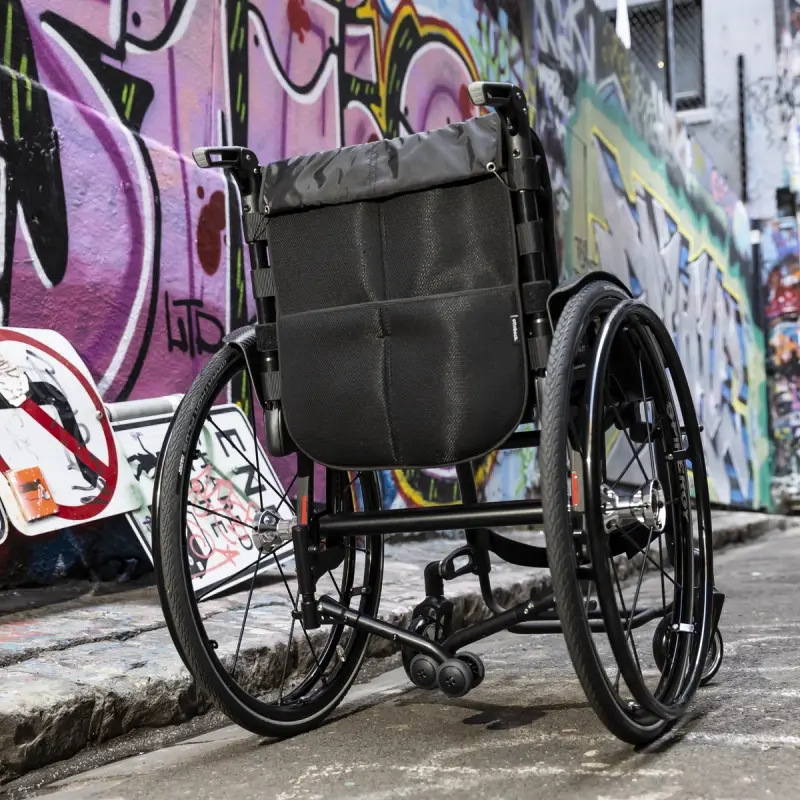
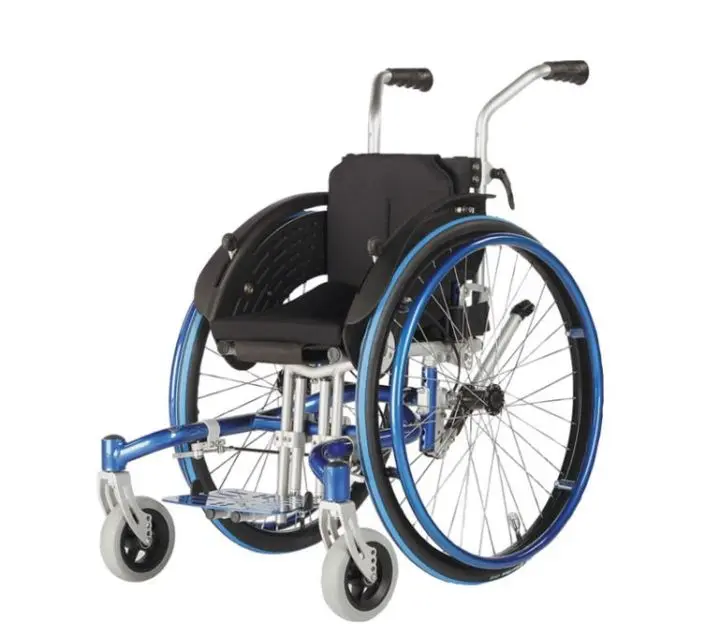
Ottobock's international wheelchair page says its active-use series include the Motus, Zenit and Avantgarde lines and the Ventus model, and that most adult manual chairs "are designed for a body weight of 100 to maximum 140 kilograms." We read two of them.
Avantgarde 4
The international product page calls the Avantgarde 4 range "One of the lightest folding wheelchairs in the world," which is Ottobock's claim, and says it has "more than 2.4 million configuration possibilities." It prints "From £1,722 (RRP)", in pounds, on the international English page; no US price is printed. The range has a DV model with swing-away leg supports, a DS model with integrated leg supports and "the lowest net weight in the Avantgarde series," a DF variant for first fittings, and the heavier-duty XXL 2. The specification table prints 8.7 kg (19.2 lb) and 140 kg for the DF-S, 9.7 kg and 140 kg for the DF Version V, and "ca. 17 kg" and 180 kg (397 lb) for the XXL2, with seat widths from 320 to 620 mm across the three. The text adds that a single crossbrace has "a high load capacity of 100 kg," with a double crossbrace "up to 140 kg" as the alternative. Read the limit for the exact model and frame you are offered.
Zenit onn
Ottobock's UK page describes the Zenit onn F, a folding chair with the "Easy-Go folding system," and the Zenit onn R rigid chair, each in aluminium or carbon and each with a CLT version with welded-on components. The specification table lists four article numbers without saying which is which model. Across the four columns it prints a maximum load of 100 to 120 kg (up to 265 lb), a total weight of 6 to 8.4 kg (13.2 to 18.5 lb), and seat widths of 320 - 460 mm. Ask the dealer for the figures for the exact version. The UK wheelchair category we read listed Zenit onn, not the older Zenit R in our catalog (MW-007). The page prints no price; it offers "Contact Us."
Ottobock's Zenit onn FAQ says "A proper assessment with a clinician or wheelchair expert is essential." Our lightweight wheelchair guide explains folding and rigid frames, weights and Medicare classes for manual chairs. Our catalog also lists the BRAVO Racer (MW-043), a children's active chair, on a UK dealer page.
Ottobock power wheelchairs: Juvo B5/B6, Skippi and others
Juvo B5/B6
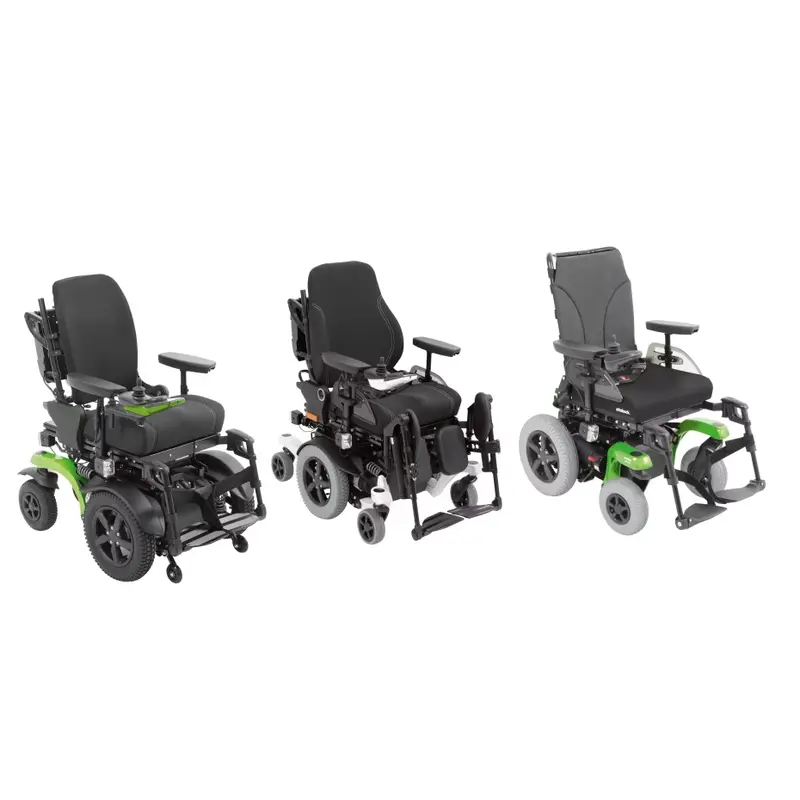
We read the Juvo B5/B6 on Ottobock's Hong Kong English site; the same product address on the international site returned "404 - Page not found," and no US page exists in what we read. The page describes a modular chair with "front-, mid-, and rear-wheel drive" in two chassis widths, three seating systems, power tilt and a range of special controls. Its table prints, for all three drive types, a maximum body weight of 200 kg (441 lb), seat widths of 340 - 560 mm, 45° power seat tilt, a weight when empty of 120 kg (265 lb), a range of "Approx. 45 km" (28 miles) under ISO 7176-4, climbing of 10°/17%, and a turning radius of 750 mm for mid and front-wheel drive and 965 mm for rear-wheel drive. Ottobock's international page says its power chairs "reach speeds of 6, 10 or 14 km/h, depending on the model and drive type," and that "Versions such as the Juvo B5 XL" take up to 200 kilograms. The Juvo page prints no price, warranty or service interval.
Skippi
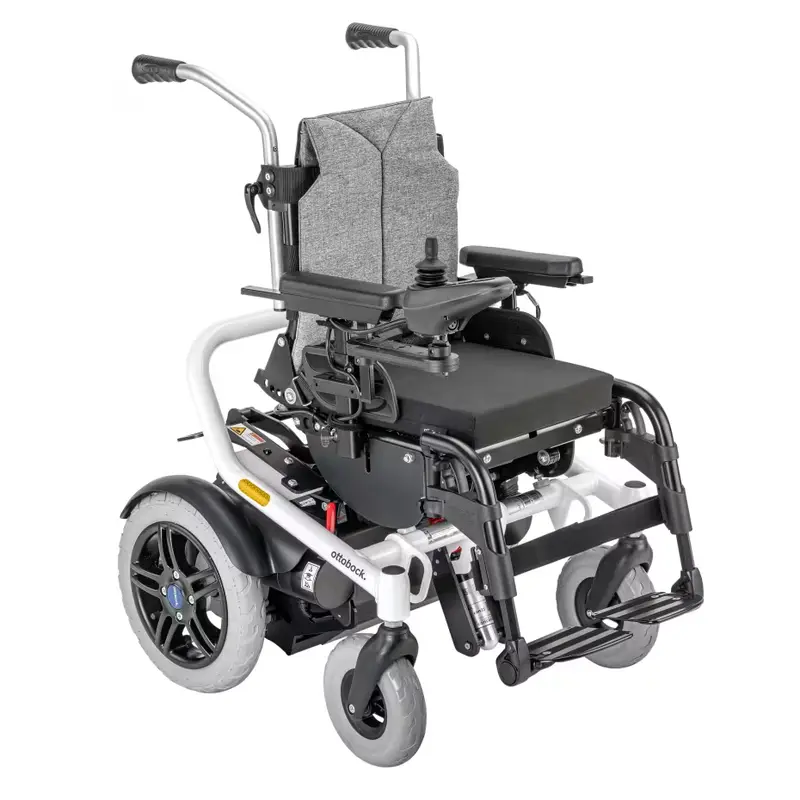
The UK Skippi page describes a children's power chair with an optional lift seat that "moves children up to eye level" and that "can be taken apart in just a few simple steps" to fit a car boot. It prints a maximum body weight of 50 kg (110 lb), a top speed of 7.2 km/h (4.5 mph), seat widths of 300 - 420 mm, a turning radius of 680 mm and an obstacle height of 60 mm. Two values are printed in German on the English page ("elektrisch: 25° verstellbar" for the back angle) and the speed row prints "Germany" instead of a figure, so check the instructions for use (647G1765) or ask the dealer. Our pediatric wheelchair guide explains children's power chairs and who pays.
Juvo B4, B7, Wingus and A200
The Juvo page lists the Juvo B4 as "an entry-level electric wheelchair" with rear-wheel drive and the Juvo B7-APS as "developed for all-day use" with many positioning options. The international page also names the Wingus, with a maximum body weight of 120 kg on its tile, and the international site and one UK dealer, Mobility World, list an A200. We did not read product pages for these; their UK prices are in the price section. Our electric wheelchair guide covers power chair types, batteries and what FDA reports show.
Exoskeletons: SUITX by Ottobock
Ottobock's corporate page says exoskeletons "developed by 'SUITX by Ottobock' now support people who engage in physically demanding tasks at work," and names the Paexo exoskeleton range "for ergonomic workplaces." The page describes them as support for workers in physically demanding jobs; it does not present them as devices for walking.
Ottobock's corporate page says its "paralysis orthoses can help restore mobility for people with partial paralysis of the legs"; the C-Brace is one of them. We did not check whether Ottobock offers other products for walking with paralysis. For powered exoskeletons that help people with spinal cord injury stand and walk, from other makers, see our exoskeleton guide.
Outside the US: the UK, international and Hong Kong pages
Ottobock runs separate sites by country, and they do not show the same products. The UK site lists the Zenit onn and Skippi; the international (en-ex) site lists the Juvo B4, A200, Wingus, Motus, Avantgarde 4 and Kimba; and the Juvo B5/B6 page we read was on the Hong Kong site. Ottobock's international wheelchair page carries a disclaimer that the products shown are "a selection of Ottobock products" and that "Many different factors determine whether a product is actually suitable for you." A note printed on the UK Zenit onn page, about a different product, says "Not all products and services are registered or available for sale in all countries."
In the UK, the dealers we read print prices "with VAT Relief," which applies only to buyers who qualify; ask the dealer whether you do. One UK dealer offers a free home assessment on its Ottobock page. In other countries, funding runs through national health insurance, disability schemes or private plans; Ottobock's international FAQ describes a cost estimate sent to "your health insurance provider or another paying party" and an appeal if it is declined. Confirm the route with your local dealer and funder before you order.
What Ottobock products cost: prices as printed
How much does an Ottobock Juvo B5 power wheelchair cost? Mobility Atlas found no price on Ottobock's own Juvo B5/B6 page, which we read on its Hong Kong English site on 27 October 2026, and no US dealer price for any Ottobock wheelchair. Two UK dealers printed prices that day, each marked "with VAT Relief", so they apply to buyers who qualify for UK VAT relief. Mobility World listed its rear, front and mid-wheel drive Juvo B5/B6 at 3,879 pounds each, and Active Mobility listed a Juvo B5 B6 at 5,298 pounds. The listings do not say what configuration the price covers; seating, controls and power options are configured for each user and change the final figure. The same dealers listed the Juvo B4 at 4,305 and 4,395 pounds, and Active Mobility listed the Juvo B7 at 13,847 pounds, all with VAT relief. Prices differ by country, dealer, VAT relief and funding. In the US, ask Ottobock or a dealer whether a Juvo is offered.
| Product as listed | Price as printed (UK dealers: with VAT Relief) | Seller, country |
|---|---|---|
| Avantgarde 4 product range | From £1,722 (RRP) | Ottobock international page |
| Avantgarde 4 DV folding | £2,355 (was £2,550) | Active Mobility, UK |
| Avantgarde Teen2 (children's) | £2,289 | Mobility World, UK |
| Start M6 Junior (children's) | £1,195 | Mobility World, UK |
| Lisa compact folding buggy | £1,605 | Mobility World, UK |
| Eco Buggy | £795 | Mobility World, UK |
| Juvo B5/B6 (RWD, FWD or MWD) | £3,879 each | Mobility World, UK |
| Juvo B5 B6 modular | £5,298 | Active Mobility, UK |
| Juvo B4 rear-wheel drive | £4,305 / £4,395 | Active Mobility / Mobility World |
| Juvo B7 advanced power seat | £13,847 | Active Mobility, UK |
| Skippi children's power chair | £5,499 | Mobility World, UK |
| Wingus | £3,026 / £2,595 | Active Mobility / Mobility World |
| A200 power chair | £3,285 (tagged SALE) | Mobility World, UK |
All UK dealer prices above were read on 27 October 2026 and are printed "with VAT Relief"; Ottobock's own "From £1,722 (RRP)" carries no such wording. On the Avantgarde 4 DV line, Active Mobility showed 2,550 pounds struck through and 2,355 as the current price. Ottobock's own "From £1,722 (RRP)" for the Avantgarde 4 range is a starting price for the range, not the price of any one model, and it is in pounds on the international page, not a US price.
For prosthetics and orthoses the picture is simpler: we found no published price for the C-Leg 4, Genium, Kenevo, 3R80, Meridium, Triton, Challenger, Runner, bebionic or C-Brace, on Ottobock's pages or at any seller we read. Ottobock's professional pages show "Login or register to buy." The clinic quotes these, and what you pay depends on your insurer. The exception is the WalkOn family and some soft goods: on 27 October 2026 US retailer Vitality Medical listed WalkOn models at 70.39 to 840.58 dollars, as the AFO section above shows, and other Ottobock braces such as the Agilium Reactive knee brace at 651.64 to 711.59 dollars. Prices differ by country, seller, tax and funding; confirm them before you order.
Ottobock warranty, product by product
How long is the Ottobock warranty? Mobility Atlas read Ottobock's US warranty page and its US warranty tables for prosthetics (dated 05/2024) and orthotics (10/24) on 27 October 2026. Microprocessor knees (Kenevo, C-Leg 4, Genium and X3/X4) and the Meridium foot carry a 36-month standard parts warranty with an extended warranty available; Ottobock's knee brochure offers 6 years in total. Mechanical knees carry 24 months, the Triton family and other high-performance carbon feet 36, the Runner family and Challenger 24, the bebionic and Michelangelo hands 24, the C-Brace 36 plus 2 months for fabrication, and WalkOn AFOs 12 with a 60-day patient satisfaction guarantee. Footshells carry 6 months. The warranty page says the tables "are not all-inclusive" and that Ottobock can change the terms "at its sole discretion." The knee brochure says the warranty "will cease to be valid" if maintenance intervals are missed. We found no Ottobock wheelchair warranty on the US site, and none of the wheelchair pages we read printed one.
| Product (US tables) | Standard warranty | Extended | Service required |
|---|---|---|---|
| Kenevo, C-Leg 4, Genium, X3/X4 | 36 months | Yes | Yes |
| Meridium foot | 36 months | Yes | Yes |
| Mechanical knees (3R80 and others) | 24 months | No | No |
| Triton family, Taleo and other carbon feet | 36 months | No | No |
| Runner family and Challenger | 24 months | No | No |
| Runner soles; footshells | 6 months | No | No |
| bebionic hand | 24 months | Yes | Yes |
| Michelangelo hand | 24 months | Yes | Yes |
| Valves | 24 months | No | No |
| C-Brace | 36 months + 2 fabrication | Yes (joint) | Every 24 months or 2 million steps |
| E-MAG Active | 24 months + 2 fabrication | Not stated | Every 6 months recommended |
| FreeWalk | 12 months + 2 fabrication | Not stated | One-time free adjustment |
| WalkOn AFOs | 12 months | Not stated | 60-day satisfaction guarantee |
What the warranty covers is set out in Ottobock's US limited warranty. The document says Ottobock warrants products "to be free from defects in materials and workmanship," subject to normal wear and tear, and it does not cover test sockets or test orthoses, accidents, neglect, misuse, unapproved parts, or repairs by others that Ottobock judges harmful. Ottobock's sole obligation is to repair, replace, refabricate or refund "at Ottobock’s sole discretion." The knee brochure adds that the warranty is void if "the product has been used by more than one user," which matters if you are offered a used knee; our used wheelchair guide covers second-hand equipment in general.
The two documents start the clock at different points. The limited warranty says durations are "effective from the date of delivery to the end-user." The knee brochure says "All times are based on the date of delivery by Ottobock to the O&P professional, in accordance with the delivery note." Ask your clinic which date is on your warranty record. The bebionic page adds its own figure: "Extended warranty options available, up to 5 years."
Maintenance intervals: where Ottobock's documents disagree
Ottobock's microprocessor knees need regular maintenance to keep the warranty, and its documents do not give one interval. We report each as printed. Page 3 of the knee warranty brochure says "regular maintenance is required after 24 months for the C-Leg, Kenevo and Genium, and after 12 months for the Genium X3." The table in the same brochure lists free maintenance for the Genium at 24 months, but for the C-Leg and Kenevo at 36 months under the standard warranty, with a footnote of "1 free maintenance within the first 36 months."
The C-Leg 4 user instructions give the interval by country. For all countries except the USA, Canada and Russia they give 24 months; for those three, "As needed*, No later than every 36 months." The note says the interval "depends on the user's activity level": about 3 years for users with "up to 1,800 steps per day," and about 2 years for highly active users. For the Kenevo, an FDA recall record from 2017 says "In the US Market and in Canada, labeling requires a condition based service at three years" and a mandatory two-year interval elsewhere.
So for a C-Leg or Kenevo in the US, the documents point to a service no later than 36 months, while the brochure's package summary and its notice say 24. Ask your prosthetist which interval applies to your knee and your warranty package, write the date down, and do not let it pass. The knee brochure gives a grace period of "-4 / +4" months and says that if the intervals are not kept, Ottobock "is entitled to invoice all costs incurred." When maintenance is due, the brochure says the C-Leg and Kenevo give "three brief beeps" after the charger is disconnected.
For orthoses, the C-Brace has a "Mandatory service interval every 24 months or 2 million steps," the orthotics table says. We did not open the C-Brace service pass. The Genium X4 interval in the brochure is "24 months or 2.8 million steps whichever occurs first."
Service lifetime: how long Ottobock will service a product
Ottobock's US repairs page defines a product's service lifetime as "the amount of time that the manufacturer determines the product to be serviceable," and says "Service and maintenance cannot be provided beyond the product’s designated service lifetime." It says that from 31 August 2023 all its microprocessor knees "(C-Leg, Kenevo, Genium, X3) have a Service Lifetime of 6 years," and that these lifetimes "apply to the United States and Canada."
| Product (end of service appendix, 08/23) | Service lifetime | Product lifetime |
|---|---|---|
| C-Leg 4 (3C88-3, 3C98-3) | 6 years | 6 years |
| Genium 3B1-3 | 6 years | 6 years |
| Kenevo 3C60 | 6 years | 3-5 years |
| 3R80 knee | 5 years | 3-5 years |
| Meridium 1B1-2 | 6 years | 2-3 years |
| Triton smart ankle 1C66 | 3 years | 2-3 years |
| Helix3D hip joint | 3 years | 2-3 years |
| bebionic hand | 6 years | 5 years |
| Michelangelo hand | 6 years | 5 years |
| C-Brace 17KO1 | 6 years | 6 years |
| C-Brace first generation (17B300) | 5 years | 5 years |
The appendix defines product lifetime as "the time period a product is expected to maintain safe and effective use," and says the instructions may give a range "as the actual Product Lifetime depends on the patient’s activity level." It marks the first C-Brace, 17B300, "No longer for sale." The Runner, Challenger and Triton side flex are not listed in it. The bebionic product page prints a "Service Life" of 5 years, while the appendix gives the bebionic a 6-year service lifetime and a 5-year product lifetime; ask which figure your clinic uses.
Service lifetime matters for planning. Ottobock says it cannot service a product past its service lifetime, which is 6 years for its microprocessor knees in the US and Canada; ask your clinic from which date it is counted for your knee. Medicare's policy article for prostheses covers a replacement when the treating practitioner orders it because of, among other reasons, "Irreparable wear" or repairs costing more than 60 percent of a replacement; the end of a service lifetime is not itself one of the listed reasons, so ask your prescriber and prosthetist to plan ahead of the date.
Repairs, loaners and who to call
Ottobock's US repairs page says its service technicians handle "scheduled, routine maintenance or help with an unexpected repair," and lists products in its loaner program: the C-Leg, Kenevo, Genium and X3; the bebionic, Michelangelo and other select myoelectric products; mechanical knees including the 3R60, 3R62 and 3R80; the 7E9 and 7E10 hips; the Meridium and Empower feet; and the C-Brace. It warns that from 1 August 2023 "loaners not returned within term limits are subject to a replacement fee." The knee brochure says every warranty package includes "free repairs and maintenance including a loaner unit during the respective warranty period."
As a user, start with your clinic. The brochure says "the user can contact the medical supply company that provided their fitting," which then contacts Ottobock. Medicare's policy article for prostheses says repairs due to normal wear within 90 days of delivery are included in the payment for the prosthesis. For a wheelchair, the pages we read gave no service route; ask the dealer who supplied it. Our guides to power wheelchair repair and manual wheelchair repair cover chair repairs in general.
Medicare and Ottobock prosthetic legs
Every Ottobock knee and foot page we read prints "Suggested HCPCS Coding." These are Ottobock's suggestions for how a clinic might bill; they are not a coverage decision. Coverage comes from Medicare's rule L33787 and policy article A52496, and from Medicare.gov. Medicare.gov's prosthetics page says Part B covers prosthetic devices when ordered, that after the deductible "you pay 20% of the Medicare-approved amount," that Medicare "will only pay for a prosthetic device from a supplier that participates in Medicare," and it lists "If your doctor accepts assignment" among the things that change what you owe. It also says "Some states may require prior authorization for certain types of lower-limb prosthetics before Medicare will pay."
| Code Ottobock suggests | Used on | What L33787 says (usual case) |
|---|---|---|
| L5856 (microprocessor knee) | C-Leg 4, Kenevo | Level 3 or above; level 2 with extra criteria |
| L5828 (fluid knee unit) | C-Leg 4, Kenevo, 3R80 | Level 3 or above; level 2 with criteria |
| L5848 (fluid control addition) | C-Leg 4, Kenevo | Level 3 or above; level 2 with criteria |
| L5973 (microprocessor ankle foot) | Meridium | Level 3 or above; level 2 with knee criteria |
| L5981 (flex-walk system) | Triton side flex, Challenger | Level 3 or above; level 2 with knee criteria |
| L5986 (axial rotation unit) | Triton side flex | Level 2 or above |
| L5999 | Genium, Runner | Not in the parts of L33787 we saved |
For a microprocessor knee at level 2, L33787 adds four conditions: the knee "is indicated for functional level 2," it can detect a trip or stumble and stabilize "(e.g., stumble recovery)," the user "is able to make use of a product that requires daily charging," and can "understand and respond to error alerts and alarms." It also says lower-level knees must have been "considered and ruled out." The rule notes that "bilateral amputees often cannot be strictly bound by functional level classifications." It denies a powered ankle (L5969) and a user-adjustable heel height feature (L5990) as not reasonable and necessary.
Two Ottobock suggestions need a direct question. Ottobock suggests L5999 for the Genium and the Runner; L5999 does not appear in the parts of L33787 we saved, and we cannot tell you how Medicare treats it. Ask the prosthetist which codes they will bill and whether Medicare or your plan has paid for that product before. On maintenance, A52496 says "Routine periodic servicing, such as testing, cleaning, and checking of the prosthesis is noncovered," but also that "Maintenance which may be necessitated by manufacturer's recommendations" and performed by the prosthetist "is covered as a repair." Ask how your knee's mandatory service will be billed.
Medicare and Ottobock orthoses: C-Brace and WalkOn
Ottobock suggests "L2006" for the C-Brace. Medicare's policy article A52457 lists L2006 among custom fabricated orthoses, for which "there must be detailed documentation in the treating practitioner's records to support the medical necessity of the custom fabricated orthosis rather than a prefabricated orthosis." In the coverage section of rule L33686 as we saved it, L2006 is not in the list of knee-ankle-foot orthosis codes covered for ambulatory beneficiaries. We draw no conclusion from that; ask your orthotist and Medicare contractor how a C-Brace claim is handled, and whether prior approval is needed. Ottobock's C-Brace page lists a reimbursement guide, a physician reference guide and evaluation forms for clinics.
For the WalkOn Reaction, Ottobock suggests L1932 for custom fit and L1933 off the shelf. Both codes are in L33686's list of ankle-foot orthoses covered for ambulatory beneficiaries "with weakness or deformity of the foot and ankle" who require stabilization and "Have the potential to benefit functionally." A52457 says the difference between the two codes is whether more than "minimal self-adjustment" was needed at fitting, which takes a certified orthotist or someone with specialized training. Our AFO brace guide gives the fee schedule amounts for these codes. Repairs to a covered orthosis are covered "when they are necessary to make the orthosis functional," A52457 says.
Medicare and power wheelchairs
Because no US Ottobock page we read lists its power chairs, this section is general. Medicare.gov's wheelchair page says Part B covers power chairs "only when they're medically necessary," after "a face-to-face examination and a written prescription from a treating provider," and that after the deductible "you pay 20% of the Medicare-approved amount (if your supplier accepts assignment)." It also says prior authorization may be needed for certain power chairs.
Medicare's power mobility rule, L33789, sets extra conditions for some chair groups. For a Group 2 chair with power options and for any Group 3 chair, it requires a specialty evaluation by a physical or occupational therapist or a practitioner with wheelchair training who "may have no financial relationship with the supplier," and a supplier that "employs a RESNA-certified Assistive Technology Professional (ATP)." For a Group 5 (pediatric) power chair, the rule requires that the child "is expected to grow in height"; which group a given children's chair falls into is for the supplier and Medicare's coding rules, not the product page. Our electric wheelchair guide and tilt-in-space guide explain the groups and power options.
FDA recalls of Ottobock products
We read the 14 FDA recall records that two openFDA searches returned on 27 October 2026 (data last updated 2026-10-24). A search by recalling firm "ottobock" or "otto bock" returns 9 records. It misses 5 older records filed under the firm name "Bock,Otto,Orthopedic Ind,Inc," which a broader search finds, for 14 in all. All 14 have the status "Terminated." The recalls began between 29 October 2003 and 10 January 2019. 8 concern prosthetic knees, 3 socket valves, one an ankle, one a children's stroller and one a wheelchair cushion. The table gives each record as stored.
| Record | Started | Product | Quantity as stored |
|---|---|---|---|
| Z-0181-04 | 2003-10-29 | Kimba Plus pediatric tilt-in-space strollers | (no quantity in record) |
| Z-1379-04 | 2004-07-15 | 3R90 and 3R92 knees with friction brake | 457 devices |
| Z-0363-2007 | 2006-08-10 | Compact microprocessor knee 3C95/3C85 | 176 |
| Z-0537-2010 | 2008-10-28 | 3R66 pediatric modular knee | 9 |
| Z-1266-2014 | 2014-01-31 | Aerial and Aerial Active wheelchair cushions | 464 units (US 113, OUS 351) |
| Z-2261-2015 | 2015-07-16 | 3R62 Pheon knee | 518 (439 US; 79 OUS) |
| Z-2438-2015 | 2015-08-12 | Genium X3 knee 3B5-2 | 1 |
| Z-0209-2016 | 2015-10-23 | Triton Smart Ankle 1C66 and its iOS app | 273 in US: 48 Foreign |
| Z-0608-2016 | 2016-01-04 | 3R60 EBS knees serviced in 2015 | 40 units |
| Z-0814-2018 | 2017-09-12 | Kenevo knee 3C60 | 75 units |
| Z-0815-2018 | 2017-09-12 | Kenevo knee 3C60=ST | 4 |
| Z-0826-2019 | 2019-01-10 | 21Y14 PushValve | 538 units |
| Z-0827-2019 | 2019-01-10 | 21Y14=S PushValve upper part | 1 unit |
| Z-0828-2019 | 2019-01-10 | 21Y15 MagValve | 110 units |
The reasons are given in each record's own words. For the Triton Smart Ankle, a software issue "can make the foot move into dorsiflexion, unnoticed by the user, who could fall," and the foot could get stuck under a car pedal. For the 3R62 Pheon knee, "the locking function may fail under certain conditions which may result in a fall." For the Genium X3 (a different model from the Genium 3B1 above), the recall cites "issues with the resistance-control of the hydraulics." For the 3R60 knees, the record says "the wrong Loctite was used during repair" on knees serviced in 2015. For the PushValve and MagValve, "Some of the installed valve-inserts have a diameter smaller than the specification."
For the Kenevo, the two records (stored quantities "75 units" for the 3C60 and "4" for the 3C60=ST) describe a pylon clamp that has "the potential to cause damage to the pylon": after more than 1.45 million cycles (about 2.3 years under heavy use), if the clamp is overtightened according to the labelled torque and the user weighs at most 125 kg, the record says "it may be remote that the pylon breaks, and causing the patient to fall." The records say "There have been no failures or complaints reported directly attributed to the failure mode collapsed pylon" and "Only the devices in distribution in the United States and Canada are affected by this action." Among the older records, a limited number of Compact knees had "a defective solder connection" between the contact wires and battery terminals, the record says; the 3R66 children's knee had securing screws that "may not have been properly mounted"; and the 3R90 and 3R92 braking plates "may become dislodged." The Kimba Plus stroller record says the tilt mechanism might allow "the child to fall out if the seat belt is not fastened," and the Aerial cushion record cites "a small risk of flammability to the cushion after it has been washed at high temperatures."
None of the 14 records concerns the C-Leg, the Genium 3B1, the 3R80, the Meridium, the Runner, the Challenger, the C-Brace, the WalkOn, or the Avantgarde, Zenit, Juvo, Skippi or BRAVO chairs. To check your own device, search the FDA's recall database for the model and ask your clinic whether any correction applies to your serial number.
What the recall records cannot tell you
A recall record is a record that a firm corrected or removed a product, with the reason it gave. It is not a rate, it does not show how many people were affected, and it is not a ranking of Ottobock against other makers. Quantities are stored in different ways ("units," "devices," US and foreign counts, or no quantity at all), so we do not add them up across records. openFDA's own disclaimer says "you should assume all results are unvalidated."
The firm name also changes over time, which is why the narrow search finds 9 records and the broad one 14. If you search for an older Ottobock product yourself, try "Bock" as well as "Ottobock." We did not read the FDA's adverse event reports for this guide; for what those reports show about prosthetic knees and feet across makers, see our prosthetic leg guide.
Where Ottobock's pages disagree
We found several places where Ottobock's own pages and documents give different figures. We report each as printed and suggest you confirm the one that matters with your clinic or dealer.
- Company size: the US About page says "more than 340 patient care centers" and "more than 8,000 employees"; the corporate page says "more than 430" centres and "nearly 9,300" full-time equivalents.
- Kenevo water rating: "IP54" in the list for users, "IP22" in the specifications, on the same page.
- Knee maintenance: 24 months on page 3 of the knee brochure, 36 months for the C-Leg and Kenevo in its table, and "No later than every 36 months" in the C-Leg 4 instructions for the USA.
- Warranty start: the limited warranty says delivery "to the end-user"; the knee brochure says delivery "to the O&P professional".
- bebionic: a "Service Life" of 5 years on the product page; a 6-year service lifetime and 5-year product lifetime in the end of service appendix.
- Avantgarde 4: 180 kg in the page header (the XXL2), 140 kg for the DF models, and 100 kg for a single crossbrace.
- Skippi: two values in German and "Germany" in the speed row of the English page.
Three traps
Trap one: reading a code as a promise. A "Suggested HCPCS Coding" line on an Ottobock page tells you how Ottobock thinks a clinic could bill. It does not tell you Medicare or your plan will pay. Coverage depends on the CMS rules, your K-level or diagnosis, the documentation, and whether the supplier participates and accepts assignment.
Trap two: missing a service date. Ottobock's knee brochure says the warranty ceases if maintenance intervals are not kept, and its documents give 24 and 36 months for the same knees. Agree the date with your prosthetist at fitting, keep the charger beeps in mind, and remember the 6-year service lifetime for microprocessor knees in the US and Canada.
Trap three: comparing prices across countries. A UK base price "with VAT Relief" for a configurable chair is not a US price, not a final price, and not proof the chair is offered in the US. The US site we read had no wheelchair section; ask before you plan around a model.
Three composite scenarios
These are composite scenarios, not individual customers. Each one combines facts and ranges already given in this guide to show how the decision plays out.
Scenario one: a user with an above-knee amputation in the US is told by their prosthetist that a C-Leg 4 may suit them. They ask which K-level is documented, which codes the clinic will bill, whether prior authorization applies in their state, and whether the first service falls at 24 or 36 months under their warranty package. They put the service date in their calendar.
Scenario two: a parent in the UK is looking at a Skippi listed by Mobility World at 5,499 pounds with VAT relief on 27 October 2026. They ask the dealer whether they qualify for VAT relief, what the seat width range of 300 - 420 mm means for their child's growth, and what the German-language values on Ottobock's page are in English, and they ask for the instructions for use.
Scenario three: a US wheelchair user reads about the Juvo B5/B6 and its 200 kg limit on Ottobock's Hong Kong page. Finding no US page, they call Ottobock's US office and a local dealer to ask whether the chair is offered, and they book a seating assessment with a therapist and an ATP before choosing any power chair.
What to ask the prescriber, prosthetist, orthotist and dealer
Prescriber and certified prosthetist or orthotist
- Which K-level is documented for me, and which Ottobock knees and feet match it?
- Can I try the knee, foot or C-Brace before it is ordered, and for how long?
- Which HCPCS codes will you bill, and has my plan paid for them before?
- Is prior authorization needed in my state?
- Which warranty package do I have, from which date, and when is the first mandatory service?
- Will I get a loaner during service, and who pays for maintenance?
- When does this product reach the end of Ottobock's service lifetime?
Wheelchair dealer
- Is this Ottobock chair offered in my country, and who services it locally?
- What warranty does the chair carry, in writing?
- What is the price with the options I need, with and without VAT relief or funding?
- Which maximum load applies to the exact frame and crossbrace you are quoting?
If you would like help finding an Ottobock product or a clinic, you can send an enquiry with your prescription and where you live.
Sources and documents
Every source named in this guide is linked in the list at the end of this page. The Ottobock brand page of our catalog, at /b/ottobock.html on this site, lists the 11 Ottobock wheelchairs, power chairs and orthoses in our catalog.
Related guides on Mobility Atlas: Prosthetic legs; Bionic arms and hands; AFO braces; Exoskeletons; Electric wheelchairs; Lightweight wheelchairs; Pediatric wheelchairs; Sports wheelchairs; Used wheelchairs.
Method in brief: we read each saved page in full or in the sections named, copied every figure as printed, and computed only simple sums and unit conversions, which are shown in the text and kept in a facts file. Recall records are given as stored in openFDA; we did not code them, and they are records, not rates. Codes on Ottobock's pages are called Ottobock's suggestions; coverage terms come only from the CMS rules and Medicare.gov. Prices are one day's listings at the sellers named. Catalog entries are from our own catalog, checked October 2026. We did not test any product, and nothing here replaces an assessment by a physician, a certified prosthetist or orthotist, or a wheelchair seating team.
Prices checked October 2026 at Active Mobility, Mobility World, Vitality Medical and Ottobock's international page, on 27 October 2026; confirm them with the seller or clinic. Documents checked October 2026: Ottobock pages and documents and the FDA recall records on 27 October 2026, the CMS rules and Medicare.gov pages on the dates given in the section on how we compared.
Do you use an Ottobock knee, foot, hand, brace or wheelchair? You can send us a note through the enquiry form with the model and how service and warranty worked for you.
This article is general information, not medical advice. Devices of this kind are chosen and fitted with a clinician who knows you.
Common questions
Does Ottobock sell wheelchairs in the US?
We cannot say from the pages we read. Ottobock's international, UK and Hong Kong pages list its Avantgarde, Zenit, Juvo and Skippi chairs, but on 27 October 2026 its US site had no wheelchair section and the US wheelchairs address returned a 404 page. None of the pages says in words where the chairs are sold. If you live in the US, ask Ottobock's US office or a dealer whether a model is offered.
How much does a C-Leg 4 cost?
Ottobock prints no price for the C-Leg 4, and we found none at any seller we read; its professional page shows "Login or register to buy." The clinic quotes it, and what you pay depends on your insurer. Under Medicare Part B you pay 20 percent of the Medicare-approved amount after the deductible, and Medicare.gov lists whether your doctor accepts assignment among the things that change what you owe. Prices differ by country, clinic and funding.
Does Medicare cover Ottobock products?
Medicare covers prostheses and orthoses that meet its rules, whoever makes them; the codes on Ottobock's pages are Ottobock's suggestions. For knees and feet, rule L33787 ties coverage to your functional level: in the usual case it covers a microprocessor knee at level 3 or above, or at level 2 when extra criteria are met, such as stumble recovery and the ability to charge it daily, and only with documentation of functional need. Ask your prosthetist or orthotist which codes they will bill and whether prior authorization is needed.
How long is the warranty on an Ottobock knee?
Ottobock's US tables give the C-Leg 4, Genium and Kenevo a 36-month standard warranty with an extended warranty available, and mechanical knees 24 months; its knee warranty brochure offers 6 years in total. The warranty needs regular maintenance: Ottobock's brochure says 24 months in its package summary and notice and 36 months for the C-Leg and Kenevo in its table, and the C-Leg 4 instructions say no later than every 36 months in the USA. Confirm the date with your prosthetist.
Has Ottobock had FDA recalls?
Yes. Two openFDA searches on 27 October 2026 returned 14 recall records for Ottobock, all terminated, started between October 2003 and January 2019. Eight concern prosthetic knees, three socket valves, one the Triton Smart Ankle, one a children's stroller and one a wheelchair cushion. A search by recalling firm "ottobock" or "otto bock" finds 9; five older records are filed under "Bock,Otto,Orthopedic Ind,Inc". Records are not rates or a safety ranking.
Who can get a C-Brace?
That is for a clinician to decide. Ottobock's page says "only a detailed examination conducted by a clinician can determine whether the C-Brace is actually suitable in your specific case," and that "your certified O&P professional can use a trial orthosis" first. The page prints a maximum body weight of 275 lbs and says it is not suitable for showering. Ottobock suggests code L2006; ask your orthotist how Medicare or your plan handles it.
Sources
- Ottobock US: About Us (read 27 October 2026)
- Ottobock corporate: an overview of the company
- Ottobock corporate: The Ottobock company
- Ottobock Investor Relations: Equity Story
- Invacare newsroom: DHCare signs definitive agreement to acquire Ottobock's Human Mobility division (19 June 2026)
- Ottobock international: About Ottobock wheelchairs
- Ottobock Hong Kong: Juvo B5/B6 power wheelchair
- Ottobock international: Avantgarde 4 product range
- Ottobock UK: Zenit onn
- Ottobock UK: Skippi
- Ottobock US: C-Brace (consumer page)
- Ottobock US: C-Brace 17KO1 (professional page)
- Ottobock US: C-Leg 4 Update 3C98-3
- Ottobock: C-Leg 4 Update instructions for use (user), 7-2024
- Ottobock US: Genium 3B1-3
- Ottobock US: Kenevo 3C60
- Ottobock US: 3R80 modular knee joint with rotary hydraulic
- Ottobock US: Meridium 1B1-2
- Ottobock US: 1C68 Triton side flex
- Ottobock US: Challenger 1E95
- Ottobock US: Runner 1E91
- Ottobock US: bebionic hand 8E70
- Ottobock US: WalkOn Reaction 28U24
- Ottobock Canada: WalkOn Reaction lateral 28U34
- Ottobock US: Warranty (professionals)
- Ottobock US: Warranty duration, prosthetics, 05/2024
- Ottobock US: Orthotics warranty duration, 10/24
- Ottobock US: Limited warranty, prosthetics and orthotics
- Ottobock: Warranty packages, mechatronic prosthetic knees (brochure)
- Ottobock US: Repairs and loaner program
- Ottobock US: End of service master appendix, 08/23
- Ottobock US: Prosthetics and orthotics clinic locator
- Active Mobility (UK): Ottobock collection (prices read 27 October 2026)
- Mobility World (UK): Ottobock power wheelchairs (prices read 27 October 2026)
- Vitality Medical (US): Ottobock search results (prices read 27 October 2026)
- Vitality Medical (US): ankle foot orthosis listings (prices read 25 October 2026)
- openFDA: device recalls, recalling firm Ottobock or Otto Bock (data last updated 24 October 2026)
- openFDA: device recalls, broader firm and product search including Bock,Otto,Orthopedic Ind,Inc
- CMS: LCD L33787, Lower Limb Prostheses
- CMS: Policy article A52496, Lower Limb Prostheses
- CMS: LCD L33686, Ankle-Foot/Knee-Ankle-Foot Orthosis
- CMS: Policy article A52457, Ankle-Foot/Knee-Ankle-Foot Orthoses
- CMS: LCD L33789, Power Mobility Devices
- Medicare: Prosthetic devices
- Medicare: Wheelchairs and scooters
Read on 27 October 2026. The wording of the article is our own.