Hoyer lifts in 2026: manual, electric, bariatric and sit-to-stand models, slings, safe use, a US price, Medicare and warranty
Hoyer lifts model by model as Joerns prints them: manual and electric, bariatric and stand aids, slings, the manuals' safety steps, prices, Medicare and warranty.
Contents
- The short answer
- Where the Hoyer name comes from, and why people use it loosely
- How we compared
- The Hoyer lineup at a glance
- Manual Hoyer lifts: the HML400
- Electric Hoyer lifts: HPL402 and HPL450
- Advance, Presence and Stature floor lifts
- Bariatric Hoyer lifts: HPL700 and Calibre
- Sit-to-stand Hoyer lifts: Journey, Elevate and Up
- Measuring your home for a Hoyer lift
- Lifting from the floor, folding and storage
- Scales and other options
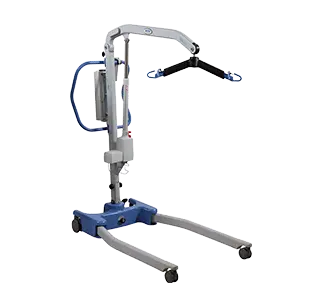
- The parts of a Hoyer lift, named
- Hoyer slings: the two families
- Sling sizes and colors
- Which sling fits which Hoyer lift
- Washing, checking and replacing slings
- Before each use: the checks in the Hoyer manuals
- How the HML400 manual says to raise and lower
- How the HPL402 manual says to run an electric Hoyer
- When a Hoyer lift will not work: the manuals' troubleshooting
- Training: what Joerns offers
- How many caregivers a Hoyer lift needs
- Weight limits: the lower figure wins
- Hoyer warranty, as printed
- What a Hoyer lift costs
- Does Medicare pay for a Hoyer lift?
- Medicare codes for patient lifts, and what they do not mean
- Other ways to get a Hoyer lift
- FDA recalls naming Hoyer lifts
- FDA reports that name Hoyer
- Used and second-hand Hoyer lifts
- Three traps
- Three composite scenarios
- What to ask the therapist and the supplier
- Sources and documents
- Common questions
- Sources
The short answer
A Hoyer lift is a patient lift sold under the Hoyer brand. Today Hoyer lifts are sold and warranted by Joerns Healthcare: the 2024 HPL402 manual prints "Manufactured by: Joerns Healthcare, LLC"
, and Joerns lists 11 Hoyer lifts on its lifting page, read on 8 November 2026. They run from the HML400, a manual hydraulic lift Joerns calls "Our most popular homecare lift"
, through electric floor lifts and bariatric lifts rated up to 850 lb, to sit-to-stand lifts. Hoyer slings are sold as two families, Hoyer Pro and Hoyer Classic.
People also say "Hoyer lift" for any patient lift with a sling, whoever made it. In the FDA reports we searched, people wrote "Hoyer lift" about lifts from Invacare, Medline, Drive and others. This guide is about the Hoyer brand itself. For other brands, lift types and the wider safety record, see the Mobility Atlas patient lift guide.
Three things matter most. Use the sling the maker says fits the lift: Joerns says Hoyer slings and lifters "are not designed to be interchangeable with other manufacturer's products."
Never go over the lower of the lift's and the sling's safe working load. And let an occupational therapist or physical therapist decide whether a full-body lift or a sit-to-stand suits the person, and train every carer who will use it; the HML400 manual says "the user must be assessed by a qualified professional."
Medicare's coverage rule (LCD L33799, read 15 October 2026; our copy shows no version number or effective date) says "A patient lift is covered if transfer between bed and a chair, wheelchair, or commode is required and, without the use of a lift, the beneficiary would be bed confined"
; you then usually pay 20 percent after the Part B deductible, if the supplier accepts assignment.
Mobility Atlas earns a fee or margin when you order through us; the comparison below uses only the maker's published documents, seller pages and government files, each with the date we read it.
Where the Hoyer name comes from, and why people use it loosely
What is a Hoyer lift? Mobility Atlas read Joerns Healthcare's Hoyer pages, manuals and warranties in November 2026, and a Hoyer lift is a patient lift sold under the Hoyer brand, which Joerns Healthcare sells and warrants today; its 2024 HPL402 manual prints "Manufactured by: Joerns Healthcare, LLC"
. Joerns lists 11 Hoyer lifts. The HML400 is a manual hydraulic lift rated 400 lbs; the HPL402 and HPL450 are electric home and crossover lifts; the Advance (whose page links the HoyerPro warranty), Presence and Stature are floor lifts; the HPL700 and Calibre are bariatric lifts (the HPL700 page prints 700 lbs and 227 kg on one line, the Calibre 850 lbs); and the Journey, Elevate and Up are active lifts and stand aids. Medicare's coding article says "The original device coded E0635 was the Hoyer by Ted Hoyer & Company, Inc."
Many people say "Hoyer lift" for any sling lift, so check the nameplate before you buy slings or parts.
Joerns' sling pages give the brand's origin in one line: Hoyer has been making slings "for over 60 years, when Ted Hoyer first developed and marketed the technology for people like himself who needed assistance with transfer."
Medicare's own coding article keeps the history too. It says code E0635 "describes a patient lift used to transfer the bed-bound beneficiary by way of a sling or seat which is attached to the boom,"
and that "The original device coded E0635 was the Hoyer by Ted Hoyer & Company, Inc."
The company names on Hoyer records have changed over time. FDA recall records from 2005 to 2007 describe "Sunrise Hoyer Advance Patient lifts"
and Hoyer hydraulic lifters "Distributed by Sunrise Medical, Inc."
Current manuals and warranties carry the Joerns Healthcare name. We give the record dates and leave it there; this guide makes no claim about when or how the brand moved between companies, because the pages we read do not say.
The name also travels without the brand. Equipment reuse programs list "Hoyer lifts" among the items they provide or loan, and in the FDA report set we searched, 28 of the 60 reports that use the word "Hoyer" (a substring search, so one "Hoyers" counts) carry another firm's name, such as Medline, Invacare or Drive, or name no maker. When a hospital, a rental shop or a relative says "Hoyer", ask for the maker and the model number on the nameplate before you order a sling or a part.
How we compared
We read every Hoyer lift and sling page on Joerns' US site on 8 November 2026, the three Hoyer warranty documents linked from those pages, the user manuals for the HML400 (manual) and HPL402 (electric) home lifts, the Hoyer sling selection chart, and the Hoyer Quickfit sling manual (read 15 October 2026). For money we used one seller page (SpinLife, US) with the price label and date, and for Medicare the CMS coverage rule and policy article for patient lifts and Medicare.gov's equipment page. For safety records we used the FDA recall records we hold and a substring search of a local copy of FDA device reports.
We did not test any lift. Where two Joerns documents print different figures, we give both and say which is lower. Specs below are the maker's; where we add advice of our own, we label it as in our view.
The Hoyer lineup at a glance
Joerns sorts Hoyer lifts by how the person takes part. "Passive" lifts carry a person who cannot bear weight in a sling; "active" lifts and stand aids are for people who can bear some weight. Joerns' own answer on choosing says: "A full-body sling lift suits residents with no weight-bearing ability, while a sit-to-stand lift works for residents who can bear some weight."
Which one suits a person is for their therapist to decide.
| Model | Type, as Joerns describes it | Safe working load (page) | Warranty document linked (in our saved copy) |
|---|---|---|---|
| HML400 | Manual hydraulic floor lift | 400 lbs | Hoyer Classics |
| HPL402 | Electric floor lift for homecare | 400 lbs | Hoyer Classics |
| HPL450 | Floor lift, powered or foot-pedal base | 450 lb/204 kg | Hoyer Classics (linked; the document does not name the HPL450) |
| Advance | Folding passive lift | 341 lbs/155 kg (spec list); 340 lb (listing tile) | HoyerPro Lifts |
| Presence | Floor lift, powered base | 500 lbs/227 kgs | Warranty document not identified in our saved pages |
| Stature | Passive lift, vertical lifting, clip slings | 500 lbs/227 kgs | Warranty document not identified in our saved pages |
| HPL700 | Bariatric lift, power base | 700 lbs and 227 kg (both printed) | None identified; the HoyerPro document excludes it |
| Calibre | Bariatric lift, scale included | 850 lbs/386kg | Warranty document not identified in our saved pages |
| Journey | Folding active lift (stand aid) | 341 lbs/155 kgs (spec list); 340 lbs (listing tile) | Warranty document not identified in our saved pages |
| Elevate | Active lift | 440 lbs/200 kgs | Warranty document not identified in our saved pages |
| Up | Non-powered stand aid | 440 lb and 450 lb (both printed) | Warranty document not identified in our saved pages |
Across the 11 lifts, the safe working loads printed on Joerns' listing and product pages run from 340 lb (the Advance and Journey listing tiles; their spec lists print 341 lbs) to 850 lb (Calibre); that is the range in our table, not of every lift Joerns has made. We found no ceiling lift in Joerns' lifting and repositioning listing on 8 November 2026. Ceiling lifts from other makers are covered in the patient lift guide.
Manual Hoyer lifts: the HML400
Joerns calls the HML400 "Our most popular homecare lift"
. Its page describes it as having "an ergonomically placed hydraulic pump"
whose handle "can be rotated from side to side allowing for operation from either side of the lifter,"
a U-shaped base that "can be adjusted for easier access to wheelchairs and other furniture,"
and a frame that "can be easily dissembled for easy storage."
You raise the person by pumping a handle and lower them by opening a release knob; there is no battery to charge.
The 2015 user-service manual (IM-459001 RevC), which also covers the older C-HLA, C-HLA-2 and C-HLA-2T, prints these HML400 figures: maximum weight capacity 400 lbs, lift range of the boom 28.25 to 75 inches, base width 24 to 42.5 inches, base length 43 inches and base clearance 5.25 inches. In our reading, base clearance is the height the legs need under furniture. Measure under your furniture before you buy.
The manual is frank about how hydraulics behave. It says it is "a common occurrence after a few hours of non-use for the boom to lower with no weight suspended from the end of the boom,"
which "does not indicate a faulty pump."
It also says "DO NOT attempt to lift someone with a faulty hydraulic pump."
The difference matters: an empty boom drifting down overnight is normal by the manual's account; a boom that sinks with a person in the sling is not, and the troubleshooting table's first check for "Jack lowers with patient suspended"
is that "the pressure release knob is completely closed."
Electric Hoyer lifts: HPL402 and HPL450
The HPL402 is the electric home lift in the Classic family. Joerns' page says it has "ergonomic handle grips to reduce back strain and a mechanical down-release lever for non-powered lowering,"
and that "The single-speed actuator is reverse-mounted to give the patient increased leg clearance."
Its 2024 manual (000-3558 RevE) prints a maximum capacity of 400 lbs, a lift weight of "93 lbs out of carton", a base 24 inches wide closed and 39 1/2 inches open, and boom heights from 30 1/2 to 78 inches with three inch wheels.
The power unit list in the same manual includes two 12 V sealed batteries, a 24 V charger output, "Emergency Down", "Emergency Mechanical down"
, "Emergency Stop", an LCD battery display and an "Acoustic battery alarm at about 50% battery capacity (0% LCD Display)"
. The manual ties the alarm to about half the battery's capacity and to a display reading of 0 percent, and its charging notes say "When battery alarm sounds, batteries should be recharged."
The HPL450 is a larger electric lift; Joerns' tile calls it a "Mid-range passive lift". Its page calls it "the perfect crossover product for both nursing and at home care"
and prints a safe working load of "450 lb/204 kg", a maximum height to the attachment point of 73.5 inches, legs that open to 44.9 inches inside and close to 25 inches outside, legs 4 inches high, "Two (2) batteries and offboard charger"
, and a choice of "powered or foot pedal" base. It uses a "6-point cradle".
In our view, electric or manual is a carer question as much as a cost one. A hydraulic pump asks for repeated arm effort every lift; an electric lift asks for charging discipline and has more parts that can stop working. Ask the therapist who trains you to let each regular carer try both before you choose.
Advance, Presence and Stature floor lifts
The Advance and Presence pages list aluminum construction, and each of the three model pages lists "Swan neck style legs" that let the lift "get closer to the resident"
, and an "Intuitive push pad" that "assists with initiating movement,"
as each page words it.
The Advance folds without tools. Its page prints a "Safe Working Load 341 lbs/155 kg"
, an overall length of 49.2 to 51.2 inches, an overall height of 53.5 to 73.2 inches, and folded dimensions of 17.7 by 46.5 by 21.7 inches. The page says the lift works "from the floor or onto a healthcare bed"
. The tile on Joerns' listing page says 340 lb; the spec list on the model page says 341 lbs. The difference is 1 lb, but in our view plan on the lower figure until Joerns confirms which applies to your unit's label. Our catalog lists the Advance-E version (row WT-040) with a safe working load of 340 lb / 155 kg and a total weight of 69.7 lb including the power pack.
The Presence and the Stature are both rated "500 lbs/227 kgs". The Presence page mentions "Smart Monitor technology that displays lifting activity as well as reminds you to recommended service,"
a powered base as standard, and a spreader bar that reaches from 16.9 to 75.2 inches. The Stature combines "vertical lifting" with a "Clip style positioning cradle"
, and its page prints a maximum height to the attachment point of 61 inches and legs that open to 48.4 inches inside. Joerns says both lifts can lift residents from the floor.
Bariatric Hoyer lifts: HPL700 and Calibre
Two Hoyer lifts are built for heavier people. The Calibre page prints a "Safe Working Load 850 lbs/386kg"
, a "Wrap-around handle" that "allows for multiple caregiver access to maneuver"
, articulated front casters, and a scale as standard. Its legs open to 55.25 inches and close to 33.25 inches, measured outside.
The HPL700 page prints both "700 lb safe working load" and "Safe Working Load 700 lbs/227 kg"
in its features and specifications. 227 kg is the metric figure printed for 500 lb lifts elsewhere on the site, so one of the two numbers on that line is an error on the page. Read literally, the lower figure on that line is 227 kg (about 500 lb by our conversion). In our view, plan on that until Joerns confirms the rating on the lift's label. The same page prints some millimetre figures with an extra digit ("56 in/11423 mm"), so use the inch figures.
The sling chart pairs both bariatric lifts with bariatric loop slings rated 850 lbs, and adds that "Only smaller sizes should be used with the HPL700 due to clearance over beds."
It also says that for bariatric users "it becomes increasingly difficult to provide a guide on sling size based on weight alone"
and that they "should be individually assessed to ascertain the correct size sling."
Sit-to-stand Hoyer lifts: Journey, Elevate and Up
Joerns' active lifts are for people who can bear some weight and take part in the move. The Hoyer Up page says it is "for users who have some weight bearing ability, trunk strength, and the ability to participate in their transfers."
Users "grasp the middle bar and pull themselves up into position,"
and a padded split seat swings out for loading and swings back to form a seat. It is not powered.
The Journey is a folding stand aid rated "341 lbs/155 kgs", with an adjustable cradle meant to suit residents "in a wide variety of heights"
, the page says, and a turning radius of 45.1 inches. The listing tile says 340 lbs; plan on 340 lb until Joerns confirms. The Elevate is rated "440 lbs/200 kgs", has a kneepad that adjusts with one hand, an "Angled, removable foot tray"
and an optional scale.
The Hoyer Up page prints two different safe working loads: "440 lb safe working load" and "Safe working load 450 lb" in the next. Its unit weight is "72.8 lb (Base is only 43lbs)". Until Joerns confirms, plan on 440 lb. A stand aid is not a smaller full lift. Joerns says "A full-body sling lift suits residents with no weight-bearing ability, while a sit-to-stand lift works for residents who can bear some weight"
; which one a person needs is the therapist's decision.
Measuring your home for a Hoyer lift
Most problems with a floor lift at home are about space, not the lift. Joerns prints the figures you need; measure your rooms against them before the lift arrives.
| Model | Base or legs (as printed) | Height or length figures (as printed) |
|---|---|---|
| HML400 (user manual) | Base 24 to 42.5 in wide, 43 in long; clearance 5.25 in | Boom lift range 28.25 to 75 in |
| HPL402 (user manual) | Base 24 in closed, 39 1/2 in open; clearance 4 7/8 in | Boom 30 1/2 to 78 in |
| HPL450 (page) | Legs open 44.9 in inside, closed 25 in outside; legs 4 in high | Attachment point up to 73.5 in |
| Stature (page) | Legs open 48.4 in inside, closed 29.9 in outside; legs 4.3 in high | Attachment point up to 61 in |
| Calibre (page) | Legs open 55.25 in, closed 33.25 in, outside | Overall length 64 in |
| Hoyer Up (page) | Maximum width 24.8 in; base height 4.0 in | Maximum height 43.3 in |
In our view, check these four points:
- Under the bed: the gap under the bed frame must be higher than the lift's legs or base clearance, along the whole length the legs will travel.
- Around the chair: the HML400 page says its U-base
"can be adjusted for easier access to wheelchairs and other furniture"
; check the open width against the chair or commode you will lift to. - Doorways and turns: compare the closed base width with every doorway on the route, and leave room to turn.
- Floors: thick carpet and thresholds make a loaded lift harder to push; the Calibre page describes articulated front casters
"making it easier to move heavy loads across uneven floors or thresholds."
Lifting from the floor, folding and storage
Joerns' pages say the Advance, Presence and Stature can lift a person from the floor; the Advance page says the lift copes "Whether from the floor or onto a healthcare bed"
. Separately, the HML400 manual makes one exception to its wheel-lock rule: wheel locks are for parking, and "The only exception is when lifting a patient from the floor."
That line is in the HML400 manual only. We did not read the Advance, Presence or Stature manuals, so follow the wheel-lock instructions in your own lift's manual. Whether a person who has fallen should be lifted at all, and how, is a decision for the care plan and, in our view, after a fall with possible injury, for emergency services; the patient lift guide covers getting someone up from the floor.
For storage and travel, the Advance has a "No-tools folding design" and folds to 17.7 by 46.5 by 21.7 inches. The Journey also folds without tools. The HML400 "Disassembles for easy storage"
, and its manual says to keep the mast and base locked "at all times except when removing mast from base for storage."
The Hoyer Up has a "3 piece modular design with tool-less assembly" and a base that weighs 43 lbs by the page's figure. The HML400 manual also says "Do not store the lift in a shower, bath or other area with high humidity."
Scales and other options
Several Hoyer lifts can weigh the person. The Calibre page says "Weight scale comes standard on Calibre"
. The HPL402 and Elevate pages list an "Optional scale", the Presence "is available with a scale option"
, and the HPL700 "has been designed to be configured with or without a weigh scale."
The HPL450 offers a powered or foot-pedal base for opening the legs, and the Stature an "Optional powered cradle with controls at handle"
.
Options change the price and sometimes the model code, so in our view put the full model code, with every option, on the quote and on the order. That is also the code you will need for parts and slings later.
The parts of a Hoyer lift, named
The FDA's patient lift page names the basic parts: "a mast (the vertical bar that fits into the base), a boom (a bar that extends over the patient), a spreader bar (which hangs from the boom), a sling (attached to the spreader bar, designed to hold the patient), and a number of clips or latches (which secure the sling)."
Joerns' documents use their own words for some of them:
| Word in Hoyer documents | What it means |
|---|---|
| Cradle | The part at the end of the boom the sling hangs from; the HML400 has a 6-point cradle |
| Spreader bar | Joerns' column heading on the sling chart for loop-sling lifts, Classic and Pro |
| Safe working load | The heaviest person the lift or sling is rated for |
| Passive lift | A full-body sling lift for a person who cannot bear weight |
| Active lift, stand aid | A lift for a person who can bear some weight and take part |
| Loop or clip sling | How the sling attaches: fabric loops over hooks, or clips on a cradle |
| Pendant, hand control | The handset that runs an electric lift |
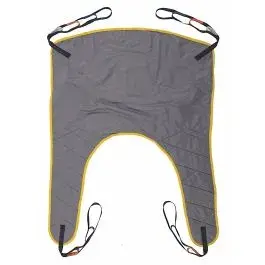
Hoyer slings: the two families
Joerns sells Hoyer slings in two families. The Hoyer Pro Slings page offers "over 200 slings to choose from"
, with "specialty slings for hygiene, toileting, repositioning, turning and gait training"
. The Classic Slings page says they "are designed for the Hoyer legacy lifts and come in 6 different types and over 20 configurations."
Both pages say the slings are tested to EN ISO 10535 and "Washable up to 185 degrees F"
.
The sling chart (6190208 RevC, 2021) groups slings by how they attach and which lifts they fit:
| Sling group | Lifts named on the chart | Sling SWL (chart) |
|---|---|---|
| Loop slings, standard (Access, Quickfit, Full Back, Long Seat, Quickfit Deluxe and others) | Advance, Elara, HPL450, HPL500, HPL700, Presence, Stature | 500 lbs |
| Clip slings (Comfort range) | Presence, Stature | 500 lbs |
| Active slings, loop | Ascend (discontinued), Elevate, Journey | 440 lbs |
| Stand-Aid Clip | Elevate only | 440 lbs |
| Bariatric loop slings | Calibre, HPL700 | 850 lbs |
| Classic slings (U Sling, One Piece, One Piece Commode) | HML400, HPL402, CHLA-2, CHLA-2T | 600 lbs |
Two points follow from that table. First, a sling rated above the lift does not raise the lift's limit: the Classic slings are rated 600 lbs, but the HML400, HPL402, C-HLA-2 and C-HLA-2T they fit are each rated 400 lbs (the HML400 manual gives 400 lbs for the C-HLA models). The HML400 manual says "Do not attempt to lift more than the weight limit indicated,"
and the Quickfit sling manual says "DO NOT exceed the rated capacity of the sling or lift."
The same holds, in our view, for every pairing where the sling is rated above the lift: a 500 lb loop sling on an Advance (340 lb) or an HPL450 (450 lb), a 440 lb active sling on a Journey (340 lb), and an 850 lb bariatric sling on an HPL700 are each limited by the lift. The reverse also happens: the chart lists the HPL700 for standard loop slings rated 500 lbs, so with one of those the sling, not the lift, sets the limit. Specialty slings on the chart are rated up to 1000 lbs; the lift's limit still governs. Second, the chart's footnote on the Stand-Aid Clip says "Elevate only. Must have 0Y0488 type spreader bar for clip style sling."
Check the bar on your lift before you order.
Sling sizes and colors
Hoyer slings use a color per size on the chart: XS brown, S red, M yellow, L green and XL blue for standard slings, while bariatric Quickfit slings are listed "with White Stripes" (M to XXL) and the bariatric Hammock runs to 5XL. The chart draws a recommended weight range for each size as a bar, and says "Recommended weight range should only be used as a guideline as other factors can affect sizing."
Those bars did not come through as numbers in our copy, so we do not repeat weight ranges from the chart.
The HPL402 manual does print a size table for its 4-point slings: Large for 198 to 400 lbs (the manual prints 90 to 191 kg; 400 lb is about 181 kg by our conversion, so plan on 400 lb / 181 kg, never more than the lift's 400 lbs), Medium for 99 to 210 lbs (45 to 95 kg), Small for 55 to 110 lbs (25 to 50 kg). Its note says "Patient's weight to sling size information is an approximation only."
The ranges overlap, and the sling chart says "other factors can affect sizing"
; the therapist measures and the carer checks the fit on the first lift.
Our catalog lists the Hoyer Quickfit sling (row WT-041) in sizes XS to XL, padded or mesh (the chart lists padded Quickfit slings in XS to XL and mesh in S to L only), for loop attachment on a 6-point spreader bar (Hoyer Advance, Presence, Stature), with a safe working load of 500 lb / 227 kg. On a 340 lb Advance, the lift's limit governs.
Which sling fits which Hoyer lift
Which sling fits a Hoyer lift? Mobility Atlas read Joerns' Hoyer sling chart, sling pages and lift manuals in November 2026, and the answer is a Hoyer sling from the group the chart lists for that lift. Standard loop slings, rated 500 lbs, fit the Advance, HPL450, HPL700, Presence and Stature; clip slings fit the Presence and Stature; active slings, rated 440 lbs, fit the Elevate and Journey; bariatric slings, rated 850 lbs, fit the Calibre and HPL700; and Classic slings, rated 600 lbs, fit the HML400 and HPL402. The HML400 manual says slings from other makers "are prohibited and will void Joerns Healthcare's warranty,"
and the FDA says no sling suits all lifts. The lower of the sling's and the lift's rating is the limit, in our view: a Classic sling on a 400 lb HML400 is a 400 lb system, and a 500 lb loop sling on a 340 lb Advance is a 340 lb system. The therapist picks the type and size.
Joerns' documents agree on the main rule and say it more than once. The HML400 manual says "Hoyer floor lifts are specifically designed for Hoyer slings and accessories"
and that slings from any other maker "are prohibited and will void Joerns Healthcare's warranty."
The HPL402 manual says "Do not use any other manufacturer's sling with the HPL402 Lift"
and "Do not use Hoyer slings with any other manufacturer's lift."
The FDA's patient lift page says "No sling is suitable for use with all patient lifts."
Within the Hoyer range, the attachment points matter too. The HML400 manual says the "Inside center attachment points on cradle are used only for Hoyer slings with chains or straps" and "The four outside attachments points are used for Hoyer 4-point slings." The HPL402 manual says the four outside points "are used for Partner-style slings", and that a "Patient can be raised 4" higher by hooking up the inside strap to the cradle." Ask the supplier to show you which points your sling uses, and write it on the care plan.
The Quickfit sling manual adds "FOR USE WITH PASSIVE LIFTS ONLY."
In our reading of the chart, which lists active slings only for active lifts, a stand-aid sling and a full-body sling are not interchangeable.
Washing, checking and replacing slings
The Quickfit manual's care lines are short: "CHECK sling and stitching before each use,"
"DO NOT wash with bleach," and "DO NOT EXCEED 185ºF water temperature."
It warns that "Slings can suffer damage during washing and drying and should be checked carefully before each use."
The HML400 manual adds the reason: "Possible Injury or Death. Always check slings before use."
When to throw a sling away is also in the documents. The Quickfit manual says "Bleached, torn, cut, frayed or broken slings are unsafe and must be discarded and replaced,"
and "DO NOT alter slings. Destroy and discard worn slings."
It says "The expected service life of a Hoyer sling will vary dependent on use"
; our notes from that manual record the factors as wash temperature, detergents, frequency of use and the person's weight, and no fixed number of uses or time limit. Disposable Hoyer Pro slings are a separate case: the sling warranty says they "are not to be washed under any circumstances."
The FDA's lift page says to "Inspect the sling fabric and straps to make sure they are not frayed or stressed at the seams or otherwise damaged. If there are signs of wear, do not use it."
In our view, also:
- Check the label: size, model and safe working load must be readable.
- Check every loop or clip, and the stitching where straps join the body of the sling.
- Look for fraying, cuts, thin patches, bleach marks and stiff or melted areas from a hot dryer.
- If anything is in doubt, take the sling out of use and use a spare (in our view, every home lift should have two slings).
Before each use: the checks in the Hoyer manuals
The HML400 manual says "Always carry out the daily check list before using the lift,"
and both manuals print a maintenance checklist with columns for "Initially", "Before each use" and "Bi-Monthly". The checklist items, as printed, include:
- Base is even and level (all four wheels are on the floor).
- Wheel bolts are tight; wheels swivel and roll easily.
- Base locks securely, all parts are present; on the HML400, base opens and closes smoothly.
- Mast fully engaged and locked into mast sleeve.
- Check hanger post for wear or damage. Replace post if wear exceeds 1/16".
- Check sling attachments for wear or deflection; check slings and web straps for wear or damage.
- On the HML400: pump handle and valve work smoothly; check for oil leakage; the checklist says
"a light film is normal, but not to the point of dripping."
Our copies of the checklists did not show which column each tick sits in, so we do not say which items are daily and which are every two months. Read the printed table that came with your lift. The HPL402 manual adds a warning about the cradle: "If Cradle center Post is flush or recessed, excessive wear may have occurred,"
and worn cradle parts "could fail, resulting in serious injury or death to patient and/or caregiver. Remove from service and replace worn parts immediately."
The HML400 manual also says who should do repairs: "Only qualified persons should service and repair Hoyer lifters."
The 2025 lift warranties add: "Only the Joerns Healthcare Product Service Department can dispatch authorized technicians."
In our view, for a home lift that means the supplier or a technician arranged through Joerns, not a hardware-shop bolt.
How the HML400 manual says to raise and lower
These are the operating steps from the HML400 manual, word for word (figure references left out). They are the maker's mechanical steps, not transfer training: how to place the sling, position the person and move them is taught by the therapist and the manual's separate patient-use booklet, which the HML400 manual calls "How to Use a Patient Lifter."
The manual's operation warning: "Lifters can tip over. Keep base widened for stability. NEVER lock wheel locks or block wheels when lifting someone. Wheel locks are provided for parking."
The assembly section gives one exception: "The only exception is when lifting a patient from the floor."
To raise, as the manual prints it
- Tighten hydraulic pressure release knob by turning it clockwise. Release knob is located on pump near pump handle. Base of lifter must be spread to widest possible position to maximize stability.
- Pump hydraulic handle. Do not lock rear casters. If needed, lifter base will move slightly to adjust for balance.
To lower, as the manual prints it
- Open hydraulic pressure release knob by turning it counter-clockwise, not more than one full turn.
- Guide descent. Push gently on knees to attain correct sitting posture while lowering.
- After patient reaches seat, push down on boom to slacken chains.
Two more lines from the manual are easy to miss: "Do not attempt to maneuver the lift by pushing on the mast, motor shaft, boom or patient,"
then "Always maneuver the lift with the handle provided,"
and "Do not push a loaded lift at speeds which exceed a slow walking pace (2.6 ft/sec.)."
How the HPL402 manual says to run an electric Hoyer
The HPL402 manual says the hand control "has two (2) buttons", one for up and one for down. The manual's charging instructions say to plug the charger into the wall "prior to connecting the plug to the control box,"
that "After approximately six (6) hours of charging, the batteries will be fully charged [...],"
and that "It is not possible to overcharge batteries."
It also says the "Power lift will not be operable during the time the charger is connected."
Three warnings in that manual are about people, not batteries: "Do not charge the battery while someone is in the lift and especially if the unit is being used in wet or bathing areas"
; "Lifts can tip over. Keep base widened for stability"
; and "Never lock brakes or block wheels when lifting someone."
On duty cycle, the manual says that unless the label says otherwise "the duty cycle is maximum 10% or six (6) min/hour of continuous operation,"
and that exceeding it can overheat the control box.
For a power cut or a flat battery, the HPL402's power unit list includes "Emergency Down" and "Emergency Mechanical down"
(the manual text we hold lists these features but does not print the steps), and Joerns' page describes "a mechanical down-release lever for non-powered lowering."
In our view, every carer should find and try the emergency lowering, with no one in the sling, on the day the lift arrives. The FDA-hosted Kwikpoint lift safety guide says "If power fails, use the emergency release to lower patient manually."
When a Hoyer lift will not work: the manuals' troubleshooting
Both home-lift manuals print short troubleshooting tables; our saved copies hold only part of each. They are for diagnosis, not repair: the HML400 manual says "Only qualified persons should service and repair Hoyer lifters,"
and the same manual says to remove a faulty pump and "call your Joerns Healthcare Supplier to receive an RMA."
In our view, never test a fix with a person in the sling.
| Lift | Symptom (manual wording) | What the manual says to check first (shortened) |
|---|---|---|
| HML400 | Jack lowers with patient suspended | Check to make sure the pressure release knob is completely closed. |
| HML400 | Unit will not lower | Clean the release cartridge, or replace the jack |
| HPL402 | Control box completely dead on battery | Charge battery; replace battery |
Our saved HML400 manual text gives no procedure for lowering a person if the lift will not lower. Its troubleshooting fix (clean the release cartridge or replace the jack) is a repair, done with no one in the sling, by a qualified person. Our saved HPL402 text lists "Emergency Down" and "Emergency Mechanical down"
but does not print how to use them. In our view, ask the supplier to show every carer how the release knob (HML400) or the emergency lowering (HPL402) works, and what to do if it fails, before the first transfer. Afterwards, take the lift out of use, keep the sling and any broken part, and call the supplier. The patient lift guide explains how to report a lift problem to the FDA.
Training: what Joerns offers
Joerns' product pages answer the training question for its Advance lift like this: "We recommend utilizing our online resources prior to use and reading the manual, if more training is needed, reach out to your local rep and we can provide virtual assistance or an on-site in-service."
The HML400 page links an "HML400 Training Video".
Videos are not a substitute for hands-on training with the person. The HML400 manual's line is "Only trained and qualified caregivers should transfer a person,"
and its patient-use instructions are in a separate booklet. In our view, ask the supplier to deliver the lift with the sling already chosen, to show each regular carer the controls, the release or emergency lowering and the checks, and ask the therapist to watch the first transfers.
How many caregivers a Hoyer lift needs
The documents we read do not give one number for every Hoyer lift. Here is exactly what they say.
- The HML400 manual:
"Hoyer lifts must be used by qualified caregivers with proper training to work with the person to be transferred,"
and"Do not attempt to use the lift if you have not been properly trained to do so."
It does not print a number of carers. - Joerns' answer on choosing a lift, on the Hoyer Advance page, says:
"Mobility level, weight, and the number of assists needed all factor in."
- The Calibre page describes a handle that
"allows for multiple caregiver access to maneuver"
. - The FDA-hosted Patient Lifts Safety Guide (a Kwikpoint visual guide on FDA's site):
"Most lifts require two or more caregivers to safely operate lift and handle patient."
Read together, in our reading: the Hoyer documents we hold leave the number to the person's assessment, and the FDA-hosted Kwikpoint guide says most lifts need two or more. In our view, the number of carers for a given person is part of the care plan the therapist writes, and if the plan says two, that means two every time, including at night. Ask the therapist to write the number down, with the sling, the size and the attachment points.
Weight limits: the lower figure wins
The HML400 manual states the rule: lifts "are intended to be used for persons within the specified weight limit indicated for the lift. Do not attempt to lift more than the weight limit indicated."
The FDA's patient lift page says to "Make sure that the weight limitations for the lift and sling are not exceeded."
Where Joerns' own pages disagree, we list both figures:
| Item | Figure 1 | Figure 2 | Plan on (our view) |
|---|---|---|---|
| Hoyer Advance | 340 lb (listing tile) | 341 lbs/155 kg (spec list) | 340 lb |
| Hoyer Up | 440 lb (features and specifications) | 450 lb (same list) | 440 lb |
| Hoyer Journey | 340 lbs (listing tile) | 341 lbs/155 kgs (spec list) | 340 lb |
| HPL700 | 700 lbs | 227 kg (same line) | 227 kg (about 500 lb, our conversion) until Joerns confirms |
| HML400 with a Classic sling | Lift 400 lbs | Sling 600 lbs (chart) | 400 lb |
| HPL402 with a Classic sling | Lift 400 lbs | Sling 600 lbs (chart) | 400 lb |
| C-HLA-2 with a Classic sling | Lift 400 lbs (HML400 manual) | Sling 600 lbs (chart) | 400 lb |
| C-HLA-2T with a Classic sling | Lift 400 lbs (HML400 manual) | Sling 600 lbs (chart) | 400 lb |
| Advance with a loop sling | Lift 340 lb (tile) | Sling 500 lbs (chart) | 340 lb |
| HPL450 with a loop sling | Lift 450 lb | Sling 500 lbs (chart) | 450 lb |
| Journey with an active sling | Lift 340 lbs (tile) | Sling 440 lbs (chart) | 340 lb |
| HPL700 with a bariatric sling | Lift 700 lbs or 227 kg | Sling 850 lbs (chart) | 227 kg until Joerns confirms |
| HPL700 with a standard loop sling | Lift 700 lbs or 227 kg | Sling 500 lbs (chart) | 500 lb (the sling governs) |
In our view, the limit covers the person, not the lift's own weight. If the person's weight is close to the limit, or changing, tell the therapist and the supplier; Joerns makes higher-rated lifts and slings, and the choice belongs in the assessment.
Hoyer warranty, as printed
Joerns links three warranty documents from the Hoyer pages, all dated 2025. They differ a great deal, so check which one your lift's page links.
| Document | Covers (as printed) | Main term | Wear parts |
|---|---|---|---|
| Hoyer Classic Lifts (6160008 RevE) | HML400, HPL402, C-HLA (and variations) | One (1) year after purchase | 90 days; hand pendant listed both as a 90-day part and as guaranteed for one year |
| Hoyer Lifts, HoyerPro (6160004 RevD) | HoyerPro Lifts only (names no covered model; lists exclusions) | Two years from delivery; aluminum structure and welds lifetime (15 years) | 90 days; pendant one year |
| Hoyer Slings (6160022 RevB) | Hoyer slings and slide sheets | Classic 6 months; Pro 12 months; Pro disposable 14 days | Normal wear not covered |
The Classic document says "This warranty applies in the USA and Canada only,"
and lists among wear parts "rubber parts, plastic parts painted surfaces, batteries, hand pendants and casters"
, covered for 90 days. The same document also says "The pendant is guaranteed for one year."
Those two lines do not agree about the hand pendant; ask the supplier which applies, in writing. The HoyerPro document defines "Lifetime" as "15 years from the date of delivery" and lists "DC batteries, hydraulic pumps and casters"
as 90-day parts.
Two models fall between the documents. The HPL450 page links the Classics warranty, but the Classics document names only the HML400, HPL402 and C-HLA; the HoyerPro document lists the HPL700 among lifts it does not cover and does not name the HPL450. Our saved copy of the HPL700 page shows no warranty link, and for the Presence, Stature, Calibre, Journey, Elevate and Up we did not identify the warranty document in our saved pages. Ask the supplier to name the warranty in writing before you buy either model.
The manuals print older versions. The 2015 HML400 manual says plastic and rubber parts are warranted for one year in one paragraph and 90 days in the next; the 2024 HPL402 manual lists "hand pendant, battery" among 90-day parts and says the warranty "applies in the USA only." The two 2025 lift documents say any alteration, modification or repair "unless performed by or authorized in writing by Joerns Healthcare will void this warranty"
; the sling document says any alteration, modification or repair "will void the warranty." And the HML400 manual warns that "Using other manufacturers' parts and accessories on Hoyer products is unsafe and may result in serious injury to patient and/or attendant."
What a Hoyer lift costs
Prices differ by seller, country, funding and the options on the lift (powered or manual base, scale, cradle type). This is the one seller price we hold, as printed on SpinLife's US page, with the label and date. Joerns' own pages print no prices.
| Item | Seller (country) | Price as printed | Label on the page | Read |
|---|---|---|---|---|
| Hoyer Advance-E Professional Patient Lift (HOY-ADVANCE-E) | SpinLife (US) | $2,576; $2,927 crossed out | Starting at | 5 Nov 2026 |
SpinLife's tile prints "Starting at" before the price; in our reading, $2,576 is the lowest-priced configuration, not necessarily the lift you need; the page does not say what the crossed-out $2,927 is. The same tile prints "max up to 340 lbs."
When you compare quotes, check what is included: the sling, a spare battery or charger on electric lifts, delivery, assembly, and who does the first training. A lower price for a lift without a sling or set-up is not a lower price.
Does Medicare pay for a Hoyer lift?
Does Medicare pay for a Hoyer lift? Mobility Atlas read the CMS coverage rule for patient lifts (LCD L33799), its policy article (A52516) and Medicare.gov's equipment page, and Medicare Part B can cover one when the rule's test is met. The LCD says "A patient lift is covered if transfer between bed and a chair, wheelchair, or commode is required and, without the use of a lift, the beneficiary would be bed confined."
Lifts coded E0630, E0635, E0639 or E0640 are covered "if the basic coverage criteria are met"
; otherwise the lift "will be denied as not reasonable and necessary."
A Standard Written Order must reach the supplier before the claim. Medicare.gov says that after you meet the Part B deductible "you pay 20% of the Medicare-approved amount (if your supplier accepts assignment),"
and that you "may need to rent the equipment."
A brand name does not change any of this: the code and the criteria decide, not the word Hoyer.
The article adds: "Final Rule 1713 (84 Fed. Reg Vol 217) requires a face-to-face encounter and a Written Order Prior to Delivery (WOPD) for specified HCPCS codes."
We read the LCD and the article on 15 October 2026. Our saved copies hold the rule text but not the version number or effective dates, so check the current version on the CMS coverage database before you rely on any line here.
The rule sets a stricter test for multi-positional transfer systems (E0636, E1035, E1036): the basic criteria must be met and "The beneficiary requires supine positioning for transfers."
Medicare also says to use suppliers who "are enrolled in Medicare and will accept assignment,"
because it "will only pay for DME items if you get them from suppliers who are enrolled in Medicare."
Medicare Advantage plans, Medicaid, the VA and private insurers set their own rules. Confirm with the plan and the supplier before the lift is delivered. Medicare.gov says Part B covers DME "if your doctor or other health care provider orders it for use in your home"
; the therapist's assessment usually informs which lift, and the order itself comes from the doctor or other provider.
Medicare codes for patient lifts, and what they do not mean
Medicare's policy article for patient lifts (A52516) sorts lifts into codes. In its words, code E0635 "describes a patient lift used to transfer the bed-bound beneficiary by way of a sling or seat which is attached to the boom."
It says "Heavy duty and bariatric lifts are included in the codes for patient lifts, E0630, E0635, E0636, E0639, E0640."
Code E0639 covers a floor-to-ceiling pole system "not permanently attached to the floor and ceiling,"
and E0640 a lift "attached to permanent ceiling tracks or a wall mounting system,"
both used in a room other than the bathroom.
Three lines in the article save families money and arguments. A bathroom-only lift is coded E0625, and the article says "E0625 is non-covered; not primarily medical in nature."
"Home modifications are noncovered by Medicare,"
so suppliers "must not submit claims for any structural changes or remodeling necessitated by the installation of a lift system."
And for E0636, E0639, E0640, E1035 and E1036, only products with a written coding review from the Pricing, Data Analysis, and Coding (PDAC) contractor may be billed.
A code in a supplier's quote or on a website is not a promise of coverage. Coverage comes from the CMS rule and from the person meeting it, with the paperwork in place. The Joerns pages we read do not print HCPCS codes for Hoyer lifts; ask the supplier which code they will bill and why.
Other ways to get a Hoyer lift
Medicare Advantage plans, Medicaid, the VA and private insurers set their own rules, and some families start with a loan. Equipment reuse programs list "Hoyer lifts" among the items they provide or loan. One, Friends of Disabled Adults and Children in Georgia, says "The height and weight of a person using the HME are needed to be correctly matched to equipment."
Another, Project MEND in San Antonio, which loans to people who can show financial need, says its items are "evaluated, sanitized, refurbished, and repaired before being loaned and re-utilized."
The wheelchair rental guide lists more routes.
A borrowed lift still needs the right sling, the manual, and a check of the nameplate. The HML400 manual says the model and serial number appear "on a silver nameplate attached to the back of the lift base."
Write them down; you need them for parts, for warranty questions and to check recalls.
FDA recalls naming Hoyer lifts
FDA recall records are notices that a firm corrected or removed products; they are not a measure of how safe a lift is. In the openFDA recall downloads we hold for patient lift product codes (read 15 October 2026), 3 records name Hoyer lifts. All three are terminated and all date from 2005 to 2007. Our 15 October product-code download did not save openFDA's last_updated date; the Sunrise recall query we read on 28 October showed last_updated 2026-10-24.
| Record | Firm (as stored) | Initiated | Product (shortened from the record) | Quantity |
|---|---|---|---|---|
| Z-0785-05 | Sunrise Medical, Inc. | 2005-02-03 | Sunrise Hoyer Advance Patient lifts | 27 units |
| Z-0904-06 | Joerns Healthcare Inc. | 2006-01-06 | Hoyer Hydraulic Patient Lifters, models including HML-400 and C-HLA | 32,109 |
| Z-0727-2007 | Joerns Healthcare Inc. | 2007-02-21 | Sunrise Medical-Hoyer Advance Patient Lifts | 581 units |
The 2005 record says the leg mechanism "on certain Hoyer Advance Patient Lifts may not operate properly, which could cause the lift to become unstable,"
and its scope, in the Sunrise recall query we read on 28 October 2026, is listed serial numbers of the Hoy-Advance-E and Hoy-Advance-H. The 2006 record concerns "hydraulic jack problems that have resulted in patient injury,"
because "the mounting stud located in the bottom of the hydraulic jack could become loose."
It names models C-CB-L2, C-HLA, C-HLA-2, HML-400, C-HLA-2T and C-HLA-1. The current HML400 manual has a section headed "Inspection of Hydraulic Pump Stud"
and lists a stud check in its maintenance table (we note both; neither document refers to the other). The 2007 record describes an "Unapproved Design Change (by base supplier)"
reducing mast-to-base welds "from four welds to two welds."
Each record covers only the units, models and serial numbers it names. If you hold an old Advance or a hydraulic Hoyer, compare the nameplate with the record, and search the FDA's recall database for the model; our downloads cover the patient lift product codes and may not show a record filed under another code.
FDA reports that name Hoyer
FDA device reports (MAUDE) are reports that makers, facilities and the public chose to send; they are not a count of every problem and say nothing about which lift is safer. We searched the 957 patient lift reports with a description received from January 2025 to August 2026, the set studied in the patient lift guide, for the word Hoyer. 60 reports contain "Hoyer" in the brand field or the description (a substring search, so one report that says only "Hoyers" counts). Our local copy was built from openFDA on 10 October 2026; openFDA's last_updated date for it was not stored.
32 of them name a Hoyer model or Joerns: 15 carry Joerns Healthcare in the manufacturer field, and 17 carry Hoyer model numbers (HOY-ADVANCE-E 12; HOY-ELEVATE-S or HOY-ELEVATEWSC 3; HOY-PRESENCE-S or HOY-PRESENCEWSC-S 2) under the manufacturer names APEX HEALTHCARE MFG. INC and APEX HEALTH CARE MFG., INC, as filed. Of those 32, 20 were filed as injury, 11 as malfunction, and 1 as death. The other 28 reports carry another firm's name or no maker (one says UNKNOWN) and use the word Hoyer in the brand field or the description, 17 of them Medline lifts; one says "THE HOYER LIFT SUDDENLY DROPPED,"
in a report filed by Medline.
The Hoyer-model reports describe events such as a strap that failed during a transfer, a mast bolt or a pin under the motor that broke, a leg that collapsed, and people sliding out of the sling. One report says a resident "BEGAN TO LEAN TO THE LEFT AND SLIP OUT OF THE HOYER PAD."
Another, filed for an HPL700, says the staff "DID NOT ENSURE THE LOOPS WERE ALL THE WAY ON THE SIDE."
(Report quotes keep the upper case they were filed in.) These are single reports as filed, not findings. The full analysis of all brands, with the method, is in the patient lift guide.
Used and second-hand Hoyer lifts
Hoyer lifts are often sold or passed on second-hand. In our view, a used lift is fine only if you can identify it, check it and get the right sling for it. The used wheelchair guide covers buying second-hand in general; for a Hoyer:
- Read the nameplate: model and serial number. Check the model against the recall records above and FDA's recall database.
- Download the manual for that model from Joerns' site and run the maintenance checklist before the first lift.
- On a hydraulic lift, look for oil beyond "a light film"; on any lift, check the cradle hanger post for wear.
- On an electric lift, charge the batteries fully and test the up, down and emergency lowering with no one in the sling.
- Buy a new Hoyer sling of the type and size the therapist names; a used sling's history is unknown.
- Remember the warranty: the Classic and HoyerPro documents say they are
"extended to the original purchaser of the equipment."
Three traps
Trap one: the borrowed sling. A sling that "fits" a lift because the loops reach the hooks is not the same as a sling the maker approves. Joerns says its slings and lifters are not designed to be interchangeable with other makers', and the FDA says no sling suits all lifts. Ask for the sling the lift's maker lists.
Trap two: the higher number. A 600 lb Classic sling on a 400 lb HML400 is a 400 lb system. The same goes for a page that prints two figures for one lift: plan on the lower one until the maker confirms.
Trap three: "Hoyer" on the paperwork. A hospital discharge note, a rental invoice or a family member may say "Hoyer lift" about a lift from another maker. Slings, parts, manuals and warranties follow the real maker and model. Read the nameplate before you order anything.
Three composite scenarios
These are composite scenarios, not individual customers. Each one uses only facts already given in this guide.
Scenario one: an adult child is told at discharge that their parent needs a Hoyer. The physical therapist assesses the parent as unable to bear weight and writes a full-body lift with a loop sling into the plan, with two carers. The supplier offers an HPL402. They ask which warranty applies (the Classics document: one year, wear parts 90 days), measure the space under the bed against the base, and ask the supplier to show both carers the emergency lowering.
Scenario two: a couple already own an HML400 bought new and want a softer sling. The chart lists Classic slings for the HML400 rated 600 lbs; they remember the lift is rated 400 lbs, and ask the therapist which Classic sling type and size to order. They throw away the old sling, which has bleach marks, as the HML400 manual says to.
Scenario three: a care team is offered a used Hoyer Up for a resident who can stand with help. The page prints 440 lb and 450 lb; they plan on 440 lb, ask the therapist to confirm a stand aid suits the resident, and download the manual before the first transfer.
What to ask the therapist and the supplier
Ask the occupational or physical therapist
- Does this person need a full-body lift or a sit-to-stand, and why?
- Which sling type and size, and which attachment points on the cradle or bar?
- How many carers for each transfer, and does that change at night or in the bathroom?
- Can you train every regular carer on this lift, and check us on the first transfers?
Ask the supplier
- Which exact model is this, and which warranty document applies, in writing?
- What is the safe working load on the lift's label, and on the sling's label?
- Which HCPCS code will you bill, do you accept Medicare assignment, and is this a rental or a purchase?
- Who services the lift, how fast, and who supplies parts and replacement slings?
- Does the base clear my bed and furniture, and does the lift fit through my doors?
Sources and documents
Maker documents: Joerns Healthcare's lifting and repositioning listing and the Hoyer product pages (read 8 November 2026); the Hoyer Classic Lifts, HoyerPro Lifts and Hoyer Slings warranty documents (2025, read 8 November 2026); the HML400 user-service manual (2015) and the HPL402 manual (2024), read 8 November 2026; the Hoyer sling selection chart (2021, read 8 November 2026); the Hoyer Quickfit sling manual (read 15 October 2026). Government: CMS LCD L33799 and policy article A52516 (read 15 October 2026), Medicare.gov's equipment page (read 17 October 2026), the FDA's patient lift page and the FDA-hosted Kwikpoint lift safety guide (read 15 October 2026), openFDA recall downloads (read 15 and 28 October 2026). Prices: one seller, SpinLife (read 5 November 2026). Reuse and loan programs: FODAC (Georgia) and the Texas Technology Access Program's Recycle & Reuse page (read 22 and 23 October 2026).
Related guides on Mobility Atlas: Patient lifts and slings, all brands; Transfer boards; Home hospital beds; Wheelchair rental and loans.
Method in brief: how we checked. We copied the maker's pages and PDFs as text on the dates above and took every spec, warranty term and safety line from those copies; quotes are checked by script against the saved texts. Where two Joerns documents print different figures, both are given. The FDA report counts come from a substring search for "Hoyer" in the brand field and description of the 957 patient lift reports (product codes FSA and FNG) with a description, received January 2025 to August 2026, in our local copy of openFDA data; they count reports, not lifts or people, and are not rates. We did not test any lift.
Prices checked November 2026 on SpinLife's page; prices change, so confirm them with the seller. Documents checked November 2026: Joerns' Hoyer pages, manuals, warranties and sling chart; the CMS patient lift rule and article and Medicare.gov were read in October 2026.
Has a Hoyer lift or sling worked well for you, or let you down? Send us a note through the enquiry form with the model and what happened.
This article is general information. Rules and prices differ by country and change, so confirm them before you buy or travel.
Common questions
Who makes Hoyer lifts?
Joerns Healthcare sells and warrants them. Joerns lists the Hoyer lifts and slings on its site, its 2024 HPL402 manual prints "Manufactured by: Joerns Healthcare, LLC"
, and the 2025 Hoyer warranties are Joerns documents. FDA recall records from 2005 to 2007 name Sunrise Medical for some Hoyer lifts. In 17 FDA reports in our search, Hoyer model numbers are filed under the manufacturer name Apex, as stored; we make no claim about ownership. Medicare's coding article (A52516, read 15 October 2026) says "The original device coded E0635 was the Hoyer by Ted Hoyer & Company, Inc."
What is the difference between a manual and an electric Hoyer lift?
A manual Hoyer, such as the HML400, raises the person with a hydraulic pump handle and lowers them by opening a release knob; it has no battery. An electric Hoyer, such as the HPL402, uses a hand control with up and down buttons and a rechargeable battery, and has emergency lowering. Both are rated 400 lbs. Which suits the carers is worth trying with the therapist.
How much does a Hoyer lift cost?
Joerns prints no prices. On 5 November 2026 SpinLife (US) listed the Hoyer Advance-E Professional Patient Lift "Starting at" $2,576, with $2,927 crossed out; in our reading, the lowest-priced configuration, not necessarily yours. Prices differ by seller, country, options and funding; ask whether the sling is included.
Does Medicare cover a Hoyer lift?
It can. CMS rule L33799 covers a patient lift if transfer between bed and a chair, wheelchair or commode is required and, without a lift, the person would be bed confined; otherwise it is denied as not reasonable and necessary. A written order must reach the supplier first. After the Part B deductible you usually pay 20 percent, if the supplier accepts assignment. Bathroom-only lifts and home modifications are not covered. We read the LCD and article on 15 October 2026; check the current version.
Can I use another brand's sling on a Hoyer lift?
Joerns says no. The HML400 manual says slings from other makers "are prohibited and will void Joerns Healthcare's warranty"
, and the HPL402 manual says not to use Hoyer slings on other makers' lifts either. The FDA says no sling is suitable for all lifts.
How long does a Hoyer sling last?
The Quickfit manual says "The expected service life of a Hoyer sling will vary dependent on use"
; our 15 October notes from that manual record no fixed number of uses or time limit. It says to check the sling and stitching before each use and that bleached, torn, cut, frayed or broken slings "must be discarded and replaced."
The sling warranty is 6 months for Classic slings, 12 months for Pro slings and 14 days for Pro disposables.
Sources
- Joerns Healthcare: Lifting and Repositioning products (read 8 November 2026)
- Joerns Healthcare: Hoyer HML400
- Joerns Healthcare: Hoyer HPL402
- Joerns Healthcare: Hoyer HPL450
- Joerns Healthcare: Hoyer Advance
- Joerns Healthcare: Hoyer Presence
- Joerns Healthcare: Hoyer Stature
- Joerns Healthcare: Hoyer Calibre
- Joerns Healthcare: Hoyer HPL700
- Joerns Healthcare: Hoyer Journey
- Joerns Healthcare: Hoyer Elevate
- Joerns Healthcare: Hoyer Up
- Joerns Healthcare: Hoyer Pro Slings
- Joerns Healthcare: Hoyer Classic Slings
- Joerns Healthcare: Warranty Program for Hoyer Classic Lifts (6160008 RevE)
- Joerns Healthcare: Warranty Program for Hoyer Lifts, HoyerPro (6160004 RevD)
- Joerns Healthcare: Warranty Program for Hoyer Slings (6160022 RevB)
- Joerns Healthcare: User-Service Manual, HML400, C-HLA, C-HLA-2, C-HLA-2T (IM-459001 RevC)
- Joerns Healthcare: User-Service Manual, Hoyer HPL402 Power Patient Lift (000-3558 RevE)
- Joerns Healthcare: Hoyer sling color/size charts (6190208 RevC)
- Joerns Healthcare: Hoyer Quickfit Sling User Manual (read 15 October 2026)
- CMS: LCD Patient Lifts (L33799)
- CMS: Patient Lifts policy article (A52516)
- Medicare.gov: Durable medical equipment (DME) coverage (read 17 October 2026)
- FDA: Patient Lifts
- FDA-hosted Patient Lifts Safety Guide (Kwikpoint)
- openFDA: device recalls, patient lift product codes FSA, FNG, PCD, PCE (read 15 October 2026)
- openFDA: device recalls, recalling firm Sunrise (read 28 October 2026)
- openFDA: device adverse event endpoint (MAUDE reports; local copy built 10 October 2026)
- SpinLife: listing with the Hoyer Advance-E Professional Patient Lift (read 5 November 2026)
- FODAC (Georgia): medical equipment
- Texas Technology Access Program: Recycle & Reuse (Project MEND listing)
Read on . The wording of the article is our own.