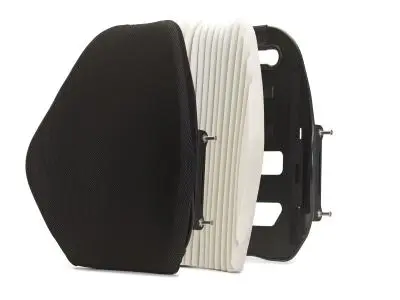
Wheelchair backrest replacement in 2026: solid wheelchair back or sling, back cushions, headrests, sizing, hardware, prices and warranty
Replacing a wheelchair back: sling, back cushion or solid back, JAY J3, ROHO AGILITY and Varilite Icon compared, headrests, cane sizing, torque, US prices and warranty.
Contents
- The short answer
- How we read the documents, and our interest
- Sling back, back cushion or solid back: three ways a back is built
- The solid backs compared, as the makers print them
- Back heights and contours: what the labels mean
- Measuring the chair for a new back
- Mounting hardware and quick-release brackets
- Torque and tightening: the numbers the manuals print
- The makers' warnings, quoted with their conditions
- Checking a back and headrest: intervals as printed
- Riding in a vehicle with a solid back
- Wheelchair headrests: what the products are
- Fitting a headrest: mounting heights and safety lines
- The clinical boundary: who chooses and sets the back
- What the makers list: MSRP and suggested retail
- What US sellers charged in November 2026
- Replacement covers, foam and small parts for a back
- Warranty: the back, the cover and the hardware are different
- Medicare: back cushion and headrest codes, as CMS prints them
- Ordering a back, headrest or part through Mobility Atlas
- Three traps
- Three composite scenarios
- Questions to ask the seating therapist, dealer or seller
- Sources and documents
- Common questions
- Sources
The short answer
A wheelchair backrest replacement is not always a like-for-like swap. Some people need a new sling of fabric screwed to the back posts; others are moving to a padded wheelchair back cushion or a solid wheelchair back with a rigid shell, quick-release brackets and, sometimes, a headrest. This guide compares solid backs and headrests from makers whose product pages, and in some cases manuals and price lists, we read: JAY J3 from Sunrise Medical, ROHO AGILITY from Permobil, the Varilite Icon, Comfort Company backs, and Whitmyer, Stealth Products and Comfort Company head supports. It covers heights and contours as the makers print them, how each back is measured and mounted, the torque and warning lines in the manuals, what US sellers charged in November 2026, how the warranty on the back differs from the warranty on its cover, and how Medicare codes these items.
What should you check before ordering a wheelchair backrest replacement? In the documents Mobility Atlas read, four things decide whether a back will fit and stay on: the width between the chair's back canes measured outside to outside, the cane diameter, the back angle your chair reaches, and who will install it. Sunrise Medical's J3 Back manual sizes its backs by the outside width of the canes, takes canes from 3/4 to 1 1/8 inch, and says the J3 should not be used on chairs whose tilt or recline gives a back angle "greater than 60° from the vertical"
. Varilite's Icon manual takes round canes of 1, 7/8 or 3/4 inch (shims for the two thinner sizes). Both manuals send installation to a dealer or seating professional, and both warn against lifting the chair by the back or its handle. The choice of back height and contour belongs to your seating therapist.
How we read the documents, and our interest
Mobility Atlas earns a fee or margin when you order through us; the comparison below uses the makers' published documents, sellers' listings and public Medicare records, and we did not buy, fit or test any back or headrest. We did not ask any maker or seller a question for this guide.
Our method: on 19 November 2026 we opened each maker and seller page named below in a browser and saved its text with the address and the date before writing. For PDF manuals, price lists and sizing guides we extracted the text in the browser; where a manual repeats itself in several languages we saved the English pages and say so in the file. Where a price list's column layout was unclear we rendered the page and checked by eye which price sits on which row. A script computed every range, count and difference from the saved text. We saved 29 new files and reused 7 files saved earlier for other guides: Medicare's LCD L33312 and policy article A52505, Permobil's ROHO warranty policy, Varilite's limited warranty and 2026 US price list and the National Library of Medicine's lookup of E09 codes, all read on 13 November 2026, and Medicare's equipment booklet, read on 9 November 2026.
The makers' pages, manuals, sizing guides and price lists read on 19 November 2026 came from Sunrise Medical (JAY J3 and Whitmyer), Permobil (ROHO AGILITY), Varilite (Icon), Comfort Company and Stealth Products; each is named where it is used and listed under Sources. Sunrise's Whitmyer owner's manual (124997 Rev. B, 2025) has no text layer on seven of its eight pages, so we rendered pages 1, 2, 4 and 7 as images and transcribed them by eye.
The sellers were Sportaid (its Backs and Back Covers categories, both pages of each, its J3 product page and a search for headrest) and SpinLife (its Positioning Backrest and General Use Backrest listings and both pages of its Advanced Seating and Positioning listing, plus its Whitmyer PLUSH page). Both are US sellers and prices are in US dollars. Prices checked November 2026. Documents checked November 2026.
Where two documents disagree, we give both and say which printed what. For seat slings and back upholstery, see our wheelchair seat upholstery guide; for seat cushions, our wheelchair cushion guide. This guide stays with the back and the head.
Sling back, back cushion or solid back: three ways a back is built
The simplest back is sling upholstery: a sheet of nylon or vinyl fixed to the two back canes. Replacing that sheet is covered in our upholstery guide, including tension-adjustable backs with straps.
The second kind is a padded back cushion that fits over the canes. Comfort Company's Elements Back page says the back "securely installs directly over wheelchair canes"
, has 1 inch of foam and comes in two sizes, one for wheelchairs 15 to 21 inches wide and one for 22 to 25 inches, both 16 inches long. The page codes it E2611/E2612, the general use back cushion codes. SpinLife's General Use Backrest listing held 5 items on 19 November 2026.
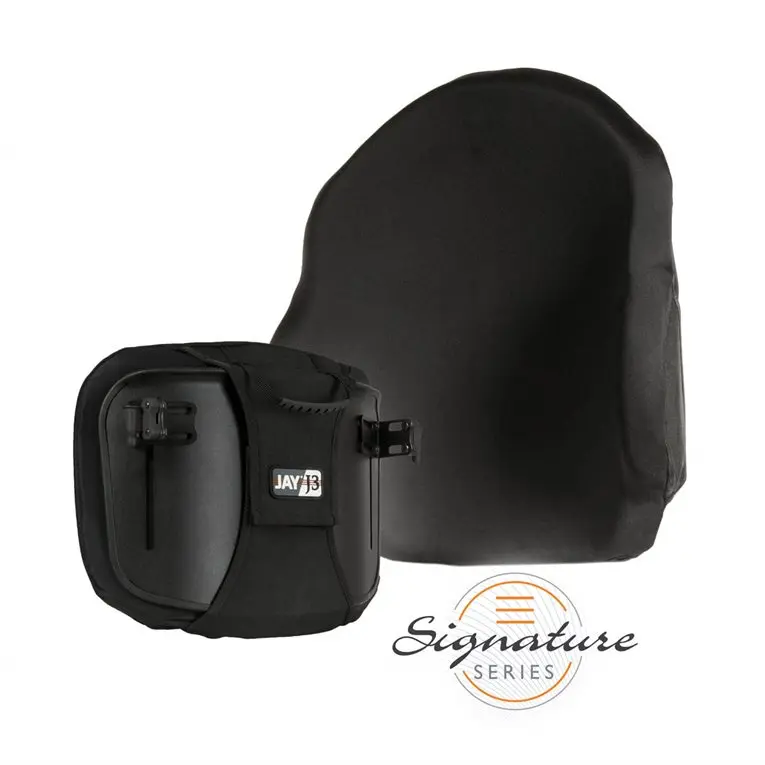
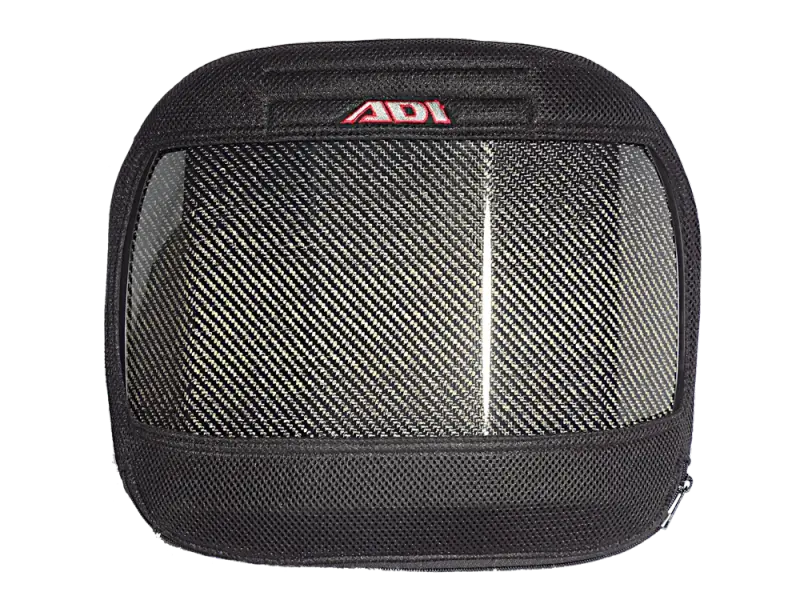
The third kind is a solid back: a shell of aluminum, plastic or carbon fiber, padded with foam or an air cell and covered, held on the canes by clamps and quick-release brackets. Sunrise's J3 Back manual says plainly: "The J3 Back is designed to replace the wheelchair’s sling upholstery."
The J3, the ROHO AGILITY, the Varilite Icon and the Comfort Unite are all of this type.
Medicare's wording draws a similar line. Policy article A52505 says a general use back cushion "is planar or contoured", while for positioning back cushions coded E2613 to E2616 the article says "there is at least 25 mm of posterior contour in the pre-loaded state"
, and for posterior-lateral backs and planar backs with lateral supports "there is at least 75 mm of lateral contour in the pre-loaded state"
. In our reading, those contour minimums are coding definitions, not a guide to which back you need; that choice is clinical.
| Type | How it attaches | Example documents read |
|---|---|---|
| Sling upholstery | Screws or rivets on canes | See the upholstery guide |
| General use back cushion | Fits over the canes | Comfort Company Elements Back |
| Solid back, 2-point | Two cane clamps, pins | JAY J3 (SH, RH, TH) |
| Solid back, 4-point | Four cane clamps | JAY J3 (FS, FA) |
| Solid back, holster | Cane brackets, slide caps | Varilite Icon (VariLock) |
| Solid back, fixed | Fixed cane clamps | ROHO AGILITY ACTIVE |
The solid backs compared, as the makers print them
The table puts the makers' own figures side by side. Each cell comes from the maker's page, manual or price list named under it; a dash means the documents we read did not give that figure.
| Back | Heights | Widths | Max user weight | HCPCS printed |
|---|---|---|---|---|
| JAY J3 | 6.5 to 24 in | 12 to 26 in | 300 lb; 500 lb at 22-26 in | E2613/E2614, E2615, E2620 |
| ROHO AGILITY ACTIVE | 8, 10 or 10, 13, 16 in | 14 to 18 in | 300 lb | E2620 |
| Varilite Icon Low | 7.25 to 9.5 in | 14 to 20 in | 300 lb under 22 in | E2613 |
| Varilite Icon Mid | 9.7 to 15.75 in | 12 to 24 in | 300 lb; 400 lb at 22 in+ | E2615, E2616 |
| Varilite Icon Tall | 14.6 to 23.6 in | 12 to 20 in | 300 lb under 22 in | E2615 |
| Varilite Icon Deep | 17 to 23.6 in | 14 to 20 in | 300 lb under 22 in | E2620 |
| Comfort Unite 1 | 12 to 22 in (shell) | 12 to 28 in | - | E2613/E2614 |
Sources for the table: Sunrise's J3 Back page (heights, widths, weight capacity, codes) and the J3 manual, which gives "Maximum user weight" as 300 lbs (136 kg) and 500 lbs (227 kg) "for sizes 22″, 24″ and 26″ widths"
; the ROHO AGILITY ACTIVE page (length height, width, maximum user weight, code); Varilite's Icon Technical Guide (back heights by size, and the weight limits of 300 lbs under 22 inches wide and 400 lbs at 22 inches or more) and its 2026 US price list (sizes and codes); Comfort Company's Comfort Unite 1 page (code and 2.25 inches of shell contour) and Permobil's Back Support Sizing Guide (Comfort Unite 1 chart, shell heights and the widths in its item numbers); the guide marks standard and custom sizes differently, so confirm a size is available. The J3 page's full spec list is in our JAY guide, and the AGILITY page's in our ROHO guide. The J3 manual's transit section says the back is "intended for use by adults ranging in weight from 79 to 300lbs or up to 500 lbs. (227 kg) for widths over 22″"
, so its two lines differ for a 22 inch back; plan on 300 lb at 22 inches until Sunrise confirms in writing.
Three figures differ between documents. Sunrise's J3 page gives a product weight of "1.4 lbs. and up (without hardware)" and 20° of hardware angle adjustment; Sportaid's J3 product page prints "1.7 lbs. and up (without hardware)" and 22°. Plan on the heavier weight and the smaller angle until Sunrise confirms in writing for your configuration. Varilite's technical guide says the Icon Low is "Not Available" in a 12 inch size, and its price list starts the Low at 14 inches; the two agree. Varilite's guide adds that complete back system height "may vary by 1.5 in. due to the cushion rollover"
.
Weight of the whole back matters on a light chair. Varilite's technical guide gives the 18 inch Icon Low as 3.5 lbs, the Mid as 4.4 lbs, the Tall as 5.6 lbs and the Deep as 6.5 lbs, all "includes all hardware". Sunrise's page says the J3 Carbon Fiber shell weighs "as little as 2.2 lbs. when combined with RH hardware"
.
Back heights and contours: what the labels mean
Makers name back heights by the part of the trunk they reach. Sunrise's J3 page prints four bands: "Lower Thoracic - 6.5″ to 9.5″"
, "Mid Thoracic - 12″ to 15″"
, "Upper Thoracic - 16.5″ to 19.5″"
and "Shoulder - 21″ to 24″", with three heights in each band. Varilite names its Icon backs Low, Mid, Tall and Deep, and its page says the Icon Low is for "users needing lower trunk support"
and that "The upper body is unimpeded"
. ROHO's AGILITY ACTIVE page lists lengths of "8″, 10″ or 10″, 13″, 16″"; Permobil's sizing guide shows 8 and 10 inch shells for the aluminum version and 10, 13 and 16 inch shells for the carbon version.
Contour is how far the sides of the shell wrap forward. The J3 page lists five shapes with their lateral depth: "Posterior (PA) - 2.2″ of lateral thoracic support"
, "Posterior Lateral (PL) - 3″"
, "Posterior Deep (PD) - 6″", "Posterior Deep Lateral (PDL) - 6″ of lateral thoracic support"
and "Posterior Deep Contour (PDC) - 6″ of lateral pelvic support"
. Varilite's technical guide gives the Icon Low, Mid and Tall a 3 inch contour depth and the Deep a 6 inch one for the 18 inch size, measured "with a fully inflated cushion"
; the guide adds that actual depth "may vary by up to 1.5 in."
ROHO's sizing guide names the AGILITY shells AG2 for Minimum Contour and AG3 for Mid Contour; on its charts the AG3 shell is 4 inches deep and the AG2 3 inches. Comfort Company's Comfort Unite 1 page prints "2.25'' of shell contour".
The contour also sets the HCPCS code the maker prints. On the J3 page, the shallow PA shell is coded E2613/E2614, the PL E2615, and the deep PD, PDL and PDC shells E2620. Varilite's price list codes the Icon Low E2613, the Mid and Tall E2615 (E2616 for the 22 and 24 inch bariatric Mid) and the Deep E2620. In our reading these are the makers' coding, not a coverage decision; the Medicare section below explains why.
Which height and contour you need is a seating decision. Sunrise's manual says: "Sunrise Medical recommends that a clinician such as a doctor or therapist experienced in seating and positioning be consulted to determine if a J3 Back is appropriate."
Bring the old back to the appointment.
Measuring the chair for a new back
How do you measure a wheelchair for a solid back? The manuals Mobility Atlas read measure the chair, not only the person. Sunrise's J3 manual has you measure "the width between your back canes"
and then the cane diameter; its table gives each back width a minimum and maximum outside cane-to-cane width, for example 15.7 to 18.3 inches for a 16 inch back, and takes canes from 3/4 to 1 1/8 inch. Permobil's sizing guide measures the AGILITY by "B – Outside Cane to Outside Cane"
. Varilite's technical guide lists the wheelchair widths each Icon size fits, such as 15 to 17 inches for a 16 inch Mid, and its installation manual takes only "round wheelchair backrest cane diameters equal to 1 in (25mm) or less"
. Measure both canes at the height where the brackets will sit, note any push-handle or stabilizer bar in the way, and give the seller your chair's make, model and serial number.
Sunrise prints what to do when you are unsure: "If you cannot determine that the back canes are compatible please contact your authorized Sunrise Medical provider or Sunrise Medical customer service."
The J3 manual also notes that "Back Width is identified in your back’s part number"
, with the example J3PAMTS 14 SH for a 14 inch back. In our view, reading the part number on the old back's label is the quickest way to reorder the same size.
Sellers print the same idea in their own words. Sportaid's J3 product page lists each back width with the back cane width it fits and a maximum user trunk width: its 16 inch option fits 16 to 18 inch cane widths and a 15 inch trunk. That is close to, but not the same as, Sunrise's table of 15.7 to 18.3 inches for the same width. In our view, measure to the manual's table and ask the seller to confirm the size in writing.
Two details catch people out. First, Varilite's installation manual uses shims for thinner canes: a 1/8 inch shim for 7/8 inch canes and a 1/4 inch shim for 3/4 inch canes, both included with the hardware. It warns: "Thoroughly clean canes before installing shims. Grease, oil or other residue on the canes may result in shim slippage. Shim slippage may result in equipment breakage and serious injury."
Second, ROHO's price list notes on its AGILITY Standard Series sizing page that "there will be a 1.5cm loss of seat depth if an AGILITY Aluminum is fitted to the smallest wheelchair width within each size range"
. In our reading, a solid back can change usable seat depth, so the seat cushion and back should be set up together.
Mounting hardware and quick-release brackets
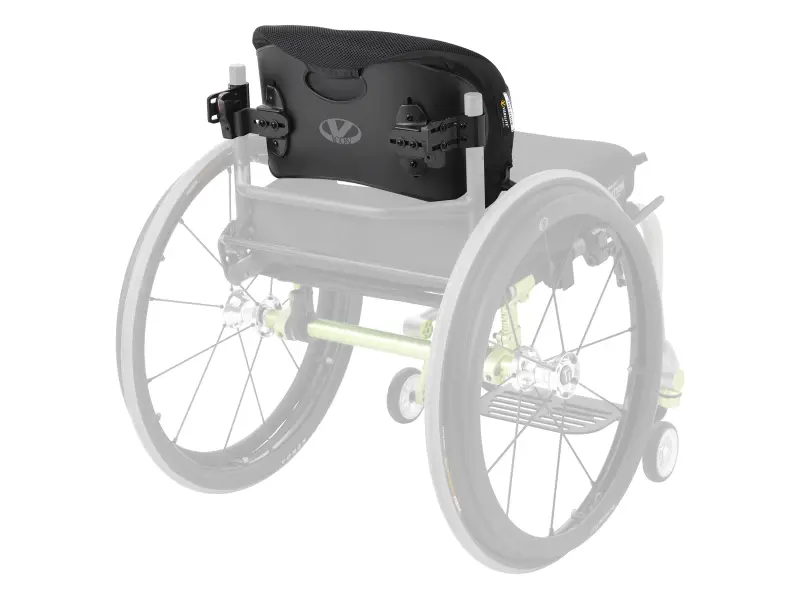
The hardware is the part that holds you up when you lean back, so makers offer several kinds. Sunrise's J3 page lists four hardware options, "RH", "SH", "TH" and "4-Point", and its manual describes 2-point hardware (SH, RH, RHF and TH) and 4-point hardware (FS and FA). Sportaid's J3 product page describes the choices in its own words: SH as 2-point quick release with 2.25 inches of depth adjustment, RH as 2-point quick release for lower thoracic backs only, RHF as fixed, TH for tilt-in-space wheelchairs and FS as 4-point for 22 inch shells.
How the J3 attaches, as its manual prints it: the shell comes with mounting brackets attached; you fix two receivers to the canes, insert the left and right mounting pins into the receivers, and push the back into place. The manual says that, if properly inserted, the pins will click "into a locked position". It adds a locking pin: "The locking pins provide a safety feature which prevents the back from being released unintentionally from the wheelchair."
and "Remove the pins if the quick-release capability is desired."
The manual's warning beside its re-attachment and locking steps says to "pull up on the back using the handle to test and make sure it has been securely locked"
if you are not sure you heard the click, and that otherwise "damage to your equipment, a fall, or loss of control may occur and cause severe injury to the rider or others"
.
Varilite's Icon uses what it calls VariLock hardware. The Icon page says "Only two parts need to be attached to the wheelchair"
and "Orange safety markings alert the user that a cap is open and not in the locked position."
The instruction manual warns: "Never leave Slide Caps in the open position. Doing so may allow the Slide Brackets to disengage from the Holsters, causing the back support to fall off of the wheelchair. This can result in serious injury."
It also offers a permanent mount: "When Permanent Mount Screws are engaged, Slide Brackets cannot be removed from the Holster"
.
ROHO's AGILITY ACTIVE page lists fixed adjustable hardware with angle adjustment. Its price list sells hardware under its AGILITY Standard Series heading: AG-HDWR-QR, a quick release cane clamp pair, and AG-HDWR-FX, a fixed cane clamp pair, at $232.00 each, and direct mount hardware by width from AG-HDWR-DM14 to AG-HDWR-DM20 at the same price; the list ties direct mount to "Permobil Power Wheelchairs with compatible Corpus Seating"
only on its Max Contour back system lines, and the hardware rows name no chair. The list does not say these parts fit the ACTIVE backs. Varilite's 2026 list prints a VariLock Hardware Kit, Complete (07484) at $233.00 MSRP and a VariLock Mounting Kit (07483) at $146.00.
Comfort Company's Comfort Unite 1 page says the back is "Compatible with Comfort Compass hardware, Power Mount hardware and Direct Mount hardware"
. In our reading, a part number printed for one back or one chair family is not evidence that it fits another; ask the maker to confirm hardware for your chair in writing.
Torque and tightening: the numbers the manuals print
Two manuals print torque values for their back hardware. They are installer figures, and both makers send the installation to a dealer or seating professional. We give them so you can ask whether they were used.
| Fastener | Torque as printed | Document |
|---|---|---|
| J3 mounting pin bolts | 100-110 in/lbs (11.3-12.4 Nm) | J3 manual 103721 Rev. G |
| J3 receiver clamp screws | 75-85 in-lbs (8.5-9.3 Nm) | J3 manual 103721 Rev. G |
| J3 receiver depth screws | 25-35 in-lbs (2.8-4 Nm) | J3 manual 103721 Rev. G |
| Icon cane and slide bracket screws | 4.5 Newton Meters | Varilite installation 34-287-1 |
The J3 manual adds a condition: the user should not lean their full weight on the back until the hardware is tightened to the specified torque. Its check-out section warns: "Ensure that all hardware has been properly tightened according to suggested specifications."
and "Failure to follow this check out procedure could result in injury and/or damage to your Back Support and/or components."
Varilite's installation manual sets a limit on loosening rather than a torque for adjustment: "Loosening the screw more than a three-quarter (3/4) turn will cause it to disconnect from the nut inside the Holster."
It also says some steps "must be done before the client is in the wheelchair"
, starting with attaching the cane brackets.
Whitmyer's service manual makes the same point for headrest collars: "Even though the knurled balls eliminate unwanted pad movement, the collars must be evenly tightened to reach their full locking strength."
In our view, ask the dealer to write the torque used on the invoice.
The makers' warnings, quoted with their conditions
The two back manuals we read print these warnings. Here they are, document by document, with the section each one sits in and the consequence the maker gives.
Sunrise Medical, J3 Back Owner's Manual 103721 Rev. G, General Warnings
- Center of gravity: the manual says
"Installing a back support on a wheelchair may affect the center of gravity of the wheelchair, and may cause the wheelchair to tip backwards potentially resulting in injury to the rider."
- Anti-tips: the manual says
"Sunrise recommends the use of anti-tip tubes"
and"ALWAYS assess the need for anti-tips or an amputee axle adapter brackets that could be added to the wheelchair to help increase the stability of the wheelchair and seating system."
- Pushing or lifting: the manual says
"Do not use the J3 Back to move or push the wheelchair."
,"Do not use the J3 back handle to lift the wheelchair. It is intended only for Back removal."
and"Improper use of the back by pushing or pulling may cause the back to unexpectedly detach from the wheelchair."
- Compatibility: the manual names one exception, wheelchairs that
"result in a back angle greater than 60° from the vertical"
, and says"J3 back use with these types of wheelchairs may cause the back to accidentally disconnect from the wheelchair. This could result in a fall or potential injury of the rider and/or caregiver."
- After the anti-tip and pushing warnings, the manual adds:
"If you fail to heed these warnings damage to your chair, a fall, tip-over or loss of control may occur and cause severe injury to the rider or others."
Varilite, Icon Back System instruction manual #34-286-1, Warnings
- The manual says
"Never use your VARILITE back support if any hardware is missing, malfunctioning, or broken. Seek qualified assistance with any repairs or adjustments."
- The manual says
"Never lift the wheelchair by the back support."
and"Never exceed the weight capacity of the wheelchair as specified by the manufacturer."
Its general line on misuse reads:"If you misuse your wheelchair or your back support you can be seriously injured."
- The manual says
"Never exceed the weight capacity of the back support."
and"Never perform weight training or other activities of daily living that cause you to exceed the weight capacity of the wheelchair."
- Heat: the manual says
"Never store your back support in conditions of extreme heat or expose to direct sunlight for long periods of time. Back support surfaces may become extremely hot if left in the sunlight or in a hot car."
- Cover: the manual says
"Never use the back support without it’s cover. Using the back support without its cover increases the risk of flammability."
- The installation manual adds, for canes:
"Failure to use compatible equipment may result in damage to your back system, wheelchair, and serious injury."
and"Failure to install and use Cane Bracket Shims as instructed can result in equipment breakage and serious injury."
In our view, the warning about lifting matters most in daily life. In our view, anyone who lifts the chair into a car or up a step should lift by the frame, never by the back, its handle or its push handles if the back is attached to them, and should be shown where to hold by the dealer. The J3 manual gives the reason: pushing or pulling on the back may make it detach. Sunrise's 2025 Whitmyer owner's manual says the same of headrests: "Never use the head support and mounting hardware to manuever [sic], lift or change direction of the chair that it is attached to."
and, under the heading Head Support Misuse, "It should not be used as a handle to push the chair. Misuse in this way can cause damage and excessive wear to the equipment, which could put the user at risk."
Neither the AGILITY ACTIVE page nor Comfort Company's pages that we read print warnings. Permobil's page links two AGILITY ACTIVE manuals, aluminum and carbon, hosted on a file-sharing site; we did not read them, and ROHO's warranty policy says to "refer to the user manual for specific product details"
, so ask for the manual with the back. ROHO's warranty policy, a different document, says "If a manufacturing defect should occur, discontinue use immediately."
Checking a back and headrest: intervals as printed
Only some documents print a check interval, and they differ. We give each one with its source and do not stretch one maker's interval to another's product.
| Document | What to check | Interval printed |
|---|---|---|
| J3 manual 103721 | All fasteners for wear, loose bolts, broken parts | Every 6 months |
| J3 manual 103721 | Clean equipment to find loose or worn parts | Regularly (no interval) |
| Varilite Icon manual | Let back cushion fully inflate overnight | At least once a week |
| Whitmyer service manual (2016) | All system components | On a regular basis |
| Whitmyer owner's manual (2025) | Safety checklist: loose parts, pressure points | Before each use |
| Whitmyer owner's manual (2025) | Fasteners, wear, metal parts | Monthly |
| Whitmyer service manual, DFS2 | Fasteners and DFS2 adjustment | Prior to each use |
What to do when a check finds a problem is printed too. Sunrise's J3 manual says: "If discovered, have loose, worn, bent or damaged parts replaced before using the back support."
and, under replacing components, "Do not continue to use the system after identifying loose or broken components."
Varilite's manual says never to use the back support if hardware is missing, malfunctioning or broken. Whitmyer's service manual lists: "Check tightness of all fasteners and hardware attachment points."
, "Review metal parts for signs of wear, cracks, bent parts or excessive flexing."
and "Replace or repair any parts showing wear."
Whitmyer's service manual explains why it gives no fixed interval: "We recommend checking all system components on a regular basis. The frequency of these checks will depend on how rigoriously the product is used."
In our view, a quick look at the clamps and the click of the back whenever the back has been removed costs nothing, but it does not replace the checks the manuals print.
Riding in a vehicle with a solid back
Two of the back documents we read speak about motor vehicles, and both put transferring to a vehicle seat first. Sunrise's J3 manual says "The J3 back has been dynamically tested for use in a motor vehicle."
and "This system conforms with ANSI-RESNA WC-20."
Its first transit instruction is: "If possible and feasible, the rider should transfer to the Original Equipment Manufacturer vehicle seat and use the vehicle restraints."
The manual then requires, among other things, a wheelchair labeled and tested to ISO 7176-19, a forward-facing chair, the back's mounting bracket in the leg-up position for transit, and no more than 6.5 inches between the top of the user's shoulder and the top of the back. It says "wheelchair-mounted accessories such as trays and respiratory equipment should be removed and secured separately"
.
Varilite's manual takes a different line. It says "The ANSI RESNA WC-20 and ISO 16840-4 standards are not considered applicable to individual seating system components."
It reports that an 18 inch wide Icon Tall back with an 18 by 18 inch Evolution seating system, fitted to a surrogate wheelchair frame, was "successfully crash tested according to the test specified in ANSI RESNA WC-20"
, and asks for "A risk assessment" by "competent seating professionals"
if a provider wishes to configure Varilite products for use in a vehicle. Its warning reads: "It is safest to transfer out of your wheelchair and into a manufacturer-installed vehicle seat, and use the vehicle’s crash-tested occupant restraint system. Failure to use the appropriate equipment for restraint in a vehicle can result in serious injury or death."
Whitmyer's service manual says of its Dynamic Anterior Support (models DFSQ1, DFSQ3, DFSQ10 and DFSQ30): "This product has NOT been Transit Tested."
and "Not recommended for use in a Transit environment."
For the head supports themselves, Sunrise's 2025 Whitmyer owner's manual says "Whitmyer head support equipment is not transit tested for use in a motor vehicle."
and "Do not use this product if it has been involved in a motor vehicle accident."
Under a warning heading it says "If possible and feasible, never use the head support system in a motor vehicle."
and "it is always suggested to transfer the user to the original equipment manufactured vehicle seat and use the vehicle restraints."
In our view, if transferring is not possible, ask the seating team whether the headrest should be removed for travel and check the rest of the setup against your chair's transit label. Our tilt-in-space guide covers riding in tilt chairs.
Wheelchair headrests: what the products are
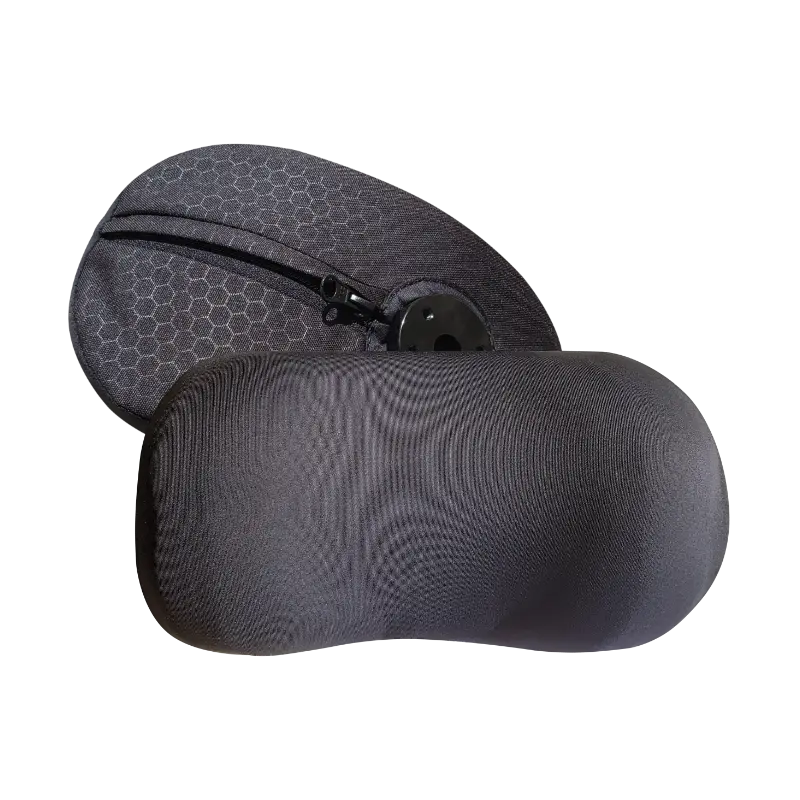
A wheelchair headrest is a padded support behind, and sometimes beside, the head, on a bar that clamps to the back. Sunrise's Whitmyer page says "Whitmyer® headrests provide support of the head and neck if you are using tilt-in-space wheelchairs or need additional support to hold your head upright."
The makers' pages we read offer three broad kinds: a single curved pad behind the head, a pad with fixed or adjustable side wings, and multi-pad systems with pads under the back of the skull.
| Headrest | Sizes as printed | Mounting as printed | Code printed |
|---|---|---|---|
| Whitmyer PLUSH (Sunrise) | 6, 8, 10, 14, 19 in | AXYS, ONYX, LINX, PRO, COBRA XTRA | E0955, E1028 |
| Stealth Comfort Plus (CP) | Pediatric to Extra Large | 17mm ball, 4pt or 1pt | - |
| Stealth Tri-Comfort Plus | Extra Small to Extra Large | 17mm ball | - |
| Comfort BodiLink Head Support | 6 pad sizes | Flip-Down; GT and PT hardware | E0955, E1033 |
| Therafin headrest, AGILITY Standard Series | Small, Medium, Large pads | AG-HRPAD-BRKT hardware | E0955, E1028 (beside the block) |
Sunrise's PLUSH page calls it a "Curved, single pad wheelchair headrest for posterior head support"
and says it is "ideal for tilt or recline"
. It lists covers in Lycra, Fleece and Dartex Reversed, and six hardware options: Axys, Onyx, Linx, Linx2, Pro and Cobra Xtra Flip Back.
Stealth Products' Comfort Plus page says "The Comfort Plus is a single pad headrest."
and prints each size with a part number in a 4-point and a 1-point version, from CP06CCFPM and CP06CCSPM for the Pediatric pad, 6 1/4 inches wide, to CP19CCFPM and CP19CCSPM for the Extra Large, 19 1/2 inches wide. It says "The Comfort Plus Series has been updated to a 17mm metric ball configuration."
and "Covers are removable and washable."
The Tri-Comfort Plus adds fixed side wings. The page does not print a price or a warranty.
Comfort Company's BodiLink page prints "HCPCS Coding: Head Support E0955 / Removable Hardware E1033"
and says its "Flip-Down support hardware allows the head support pad to move away from the user’s head when transferring, transporting or performing other ADL’s."
The page lists a mounting block for "all Comfort Company back supports, ROHO, Agility, Permobil Corpus, Quantum Tru-Balance2 & other OEM back supports"
. In our reading, that list is Comfort Company's statement of what its mounting block is made for; ask which block fits your back by model.
SpinLife's Advanced Seating and Positioning listing printed 26 Total Items over two pages; by our rule (a name containing Headrest or Headaloft) 5 were headrests, from $130 (Jazzy Carbon Headrest) to $1,632 (Headaloft 360 System), and SpinLife's Whitmyer PLUSH page prints "Starting at" $205.00. Sportaid's search for headrest returned 6 results, none of them a headrest. Some back pages offer headrest options. Sunrise's J3 page answers "Headrest Mount Available" with "Yes", and Sportaid's J3 product page offers a "J3HF With Headrest Cutout and Cover Flap"
upholstery option. ROHO's price list sells headrest parts for AGILITY Standard Series backs: Therafin headrest pads (AG-HRPAD-SM, -MED and -LG) at $199.00, Multi-Axis Headrest Hardware (AG-HRPAD-BRKT) at $244.00, a Universal Headrest Adaptor Plate (AG-HR-BRKT) at $107.00 and headrest brackets and unitrack at $21.00. Varilite's technical guide says: "To install head supports or place lateral supports in alternate locations, the aluminum shell may be drilled without voiding the warranty."
Fitting a headrest: mounting heights and safety lines
Whitmyer's service manual is the headrest document whose fitting steps we saved; Sunrise's 2025 owner's manual also has a Basic Installation and Adjustment section (page 5), which we did not transcribe. It starts by attaching a mounting bracket to the back of the chair and gives a recommended mounting height to the top of the chair back by system: 2 inches for PRO and ONYX, 5 inches for LINX. It describes detachable and swingaway mounts, notes that a "Vertical rod may need to be cut to enable complete swingaway arc"
, and explains that the knurled balls and collars hold the pad only when the collars are evenly tightened.
The manual is specific about where pads go. For PLUSH pads it says "The pad should cradle the spine and provide lift under the occiput"
and warns that "Centering the pad at the apex of the occiput forces the cervical spine into flexion"
. For lateral facial pads it warns, under a heading printed as a warning: "Avoid positioning pad(s) directly on jawbone, over ears, or in an area that will come in contact with the user’s eyes"
, and says that if irritation develops, the user should "discontinue use immediately and contact the therapist or RTS"
.
Forehead straps carry the strongest wording. The service manual says "The DFS must be applied and used under therapist or rehab seating"
professional supervision. Its warning label text reads "Improper use of this device may result in serious injury or death."
under a choking-hazard heading, and it says to "STOP using the DFS if the strap slips, the user experiences discomfort, redness or irritation."
The manual warns: "The user’s head must be in full contact with a support pad at the rear during this adjustment. Failure to do this is extremely dangerous and will allow the strap to become loose and slip over the user’s eyes or nose."
Medicare codes a cushioned headrest and a sling head support differently. Article A52505 says "A headrest (E0955) describes any type of cushioned headrest which may contain one or more cushions to position the head and fixed mounting hardware."
and "A headrest extension (E0966) is a sling support for the head."
The NLM lookup describes E0966 as "Manual wheelchair accessory, headrest extension, each"
.
The clinical boundary: who chooses and sets the back
Sunrise's J3 manual and Varilite's Icon manual both send the choice to a professional. Sunrise's J3 manual: "Sunrise Medical recommends that a clinician such as a doctor or therapist experienced in seating and positioning be consulted to determine if a J3 Back is appropriate. Backs should only be installed by an Authorized Sunrise Medical Dealer."
Varilite's manual: "VARILITE products should be selected, configured and prescribed by a seating professional who is experienced in seating and positioning, and is capable of determining if the product is suitable for an individual’s specific needs."
and "Installation, adjustment and any modification of your VARILITE back support should be performed only by a qualified seating professional."
The J3 manual also puts a duty on the owner: "The owner of this equipment is responsible for making sure that it has been set up and adjusted by a Authorized Dealer under the advice of a healthcare professional."
It adds that the back "may require periodic safety and function checks or certain in-use adjustments that can be performed by the owner, caregiver or Authorized Dealer if desired"
.
In our view, what you can usefully do is bring information: how you sit through the day, where you get sore, whether you lean, how you transfer, how the chair goes into a car, and the old back with its label. The physical therapist, occupational therapist or seating clinician chooses height, contour, angle and any headrest; the dealer fits it to their prescription. This guide explains the options and what to ask, and then stops.
What the makers list: MSRP and suggested retail
Two makers publish US list prices for their backs. Varilite's 2026 US price list prints MSRP for each Icon size, with a replacement cover beside it. Permobil's ROHO United States Retail price list, effective January 1, 2024, prints suggested retail prices for AGILITY backs, covers, foam and hardware. Sunrise and Comfort Company publish no list price on the pages we read.
| Back, as the list names it | List price | Cover | Document |
|---|---|---|---|
| Icon Back System Low (14-20 in) | $625.00 | $103.00 | Varilite 2026 US list |
| Icon Back System Mid (12-20 in) | $657.00 | $103.00 | Varilite 2026 US list |
| Icon Back System Mid, 22 and 24 in | $869.00 | $133.00 | Varilite 2026 US list |
| Icon Back System Tall (12-20 in) | $688.00 | $103.00 | Varilite 2026 US list |
| Icon Back System Deep (14-20 in) | $845.00 | $133.00 | Varilite 2026 US list |
| AGILITY Active Aluminum, Min or Mid | $738.00 | See text | ROHO list, Jan 2024 |
| AGILITY Active Carbon, Min or Mid | $1,202.00 | $103.00 | ROHO list, Jan 2024 |
| AGILITY Max Contour (Standard) | $957.00 | $87.00 | ROHO list, Jan 2024 |
Read the cover column with care. ROHO's list prints $103.00 for "AGILITY Active Series Back Support Replacement Covers"
, whose item numbers end in CB, and $75.00 for Minimum and Mid Contour and $87.00 for Max Contour under "AGILITY Back Replacement Covers - Standard"
. The $103.00 Active Series line uses item numbers ending in CB, but it includes 8 inch lengths (COV-AG2-1408CB and others) that ROHO's matrices show only for the aluminum shell; in our reading the line may cover aluminum backs, so ask ROHO which cover number fits yours. Sportaid's covers category listed an AGILITY Active Aluminum Minimum Contour cover at $72.00. On the ROHO list the carbon back costs $464.00 more than the aluminum back of the same contour, by our arithmetic.
ROHO's list adds a line that applies to every code printed on it: "Decisions about how to code a product are the responsibility of the provider/supplier."
The list is dated January 1, 2024 and was still linked from the AGILITY page on 19 November 2026; ask the supplier whether a newer list applies.
What US sellers charged in November 2026
How much does a solid wheelchair back cost in 2026? On the seller pages Mobility Atlas read on 19 November 2026, the backs left by our rule ran from $332.50 to $938.00 on Sportaid's Backs category and from $438 to $1,202 on SpinLife's Positioning Backrest listing. On Sportaid the low end was the Jay GO Wheelchair Back and the high end two ROHO Agility Active Carbon backs; on SpinLife the low end was the Jay J3 Back and the high end the ROHO Agility Active Carbon Contour Back Support. SpinLife's General Use Backrest listing (5 tiles) ran from $52 to $355; it includes the Jay GO Back at $333, which Sportaid lists in its Backs category. These are tile prices for a starting configuration, and options add to them. Prices differ by seller, size, options, country and date, and none of these figures is a Medicare amount. Ask for a written quote for your exact size and hardware.
Sportaid, Backs category
Sportaid's category printed "Showing 1–16 of 21 results"
and its second page held the rest; we counted 21 tiles. Across every tile, prices ran from $34.00 (Varilite BackRest) to $938.00. Our rule for complete backs drops every tile whose name contains Lumbar, Lateral or BackRest, because those are pads or accessories rather than a back with a shell and hardware. It dropped 4 tiles: Jay Junior Lumbar Support ($54.00), Jay Lumbar Support Adult ($55.50), Lateral Supports by ADI ($136.00) and Varilite BackRest ($34.00), leaving 17 backs. The rule keeps the Jay GO Wheelchair Back ($332.50), which SpinLife files under General Use Backrest; without it the Sportaid low end is $403.90 (Jay Zip Wheelchair Back for Kids).
| Brand on the tile | Tiles | Lowest | Highest |
|---|---|---|---|
| ADI | 2 | $457.00 | $704.25 |
| Jay | 4 | $332.50 | $732.90 |
| Matrx | 4 | $511.88 | $622.44 |
| ROHO | 3 | $575.64 | $938.00 |
| Varilite | 4 | $468.75 | $633.75 |
Sportaid labels prices in its own way. Its J3 product page prints "Retail: $625.00" and "Cost: $437.50", and the tile shows the Cost figure, $187.50 or about 30 percent below the Retail line by our arithmetic. The same page's specification table gives a "Starting Retail Price" of "Posterior: $510", which differs from the $625.00 Retail line above it; we report both and cannot say which configuration each describes.
SpinLife, Positioning Backrest and General Use Backrest
SpinLife's Positioning Backrest listing printed 10 Total Items on one page and we counted 10 tiles, including the Axiom Back by KI MOBILITY at $447, the ICON Back System by VARILITE at $482, the Comfort Unite 1 by COMFORT COMPANY at $499, the Acta-Relief Back at $692 and the RESPIRA Back Support by SYMMETRIC DESIGNS at $1,195. Its General Use Backrest listing printed 5 Total Items, from the Tension Back Cushion, Adjustable (E2611) by PROACTIVE MEDICAL at $52 to the Elements Back Cushion by COMFORT COMPANY at $355. Each tile also prints a monthly payment line, which we did not count.
List price against seller price
| Back | Maker list | Sportaid tile | SpinLife tile |
|---|---|---|---|
| Varilite Icon Low | $625.00 | $468.75 | - |
| Varilite Icon Deep | $845.00 | $633.75 | - |
| ROHO Agility Active Aluminum | $738.00 | $575.64 | $738 |
| ROHO Agility Active Carbon | $1,202.00 | $938.00 | $1,202 |
By our arithmetic Sportaid's Icon Low tile was $156.25 (about 25 percent) under Varilite's MSRP, its Icon Deep tile $211.25 under, and its ROHO aluminum and carbon tiles $162.36 and $264.00 under ROHO's January 2024 list. SpinLife's two ROHO tiles matched the list prices. Two of the three Sportaid ROHO tiles name Minimum Contour and one names Mid Contour; ROHO's list prices Min and Mid the same, and the SpinLife tiles name no contour. In our view, compare a quote only with a list line for the same size, contour and hardware.
Replacement covers, foam and small parts for a back
A solid back is several parts: shell, foam or air insert, cover and hardware. Varilite and ROHO list them separately, which means a torn cover or a lost wrench does not mean a new back.
Varilite's 2026 US price list prints a replacement cover beside every Icon size, with its own item number and code E2619, for example cover 07170 for the 16 inch Icon Low at $103.00 MSRP and covers for the Icon Deep and the bariatric Mid at $133.00. The same list sells Icon replacement cushions without a code: $149.00 for the Low, $262.00 for the Mid, $280.00 for the Tall and $310.00 for the Deep and the bariatric Mid. ROHO's list sells AGILITY replacement foam from $65.00 to $81.00 by contour, a lumbar pad (AG-LUMBAR) at $23.00 and a 4 mm Allen wrench (AG-WRENCH) at $12.00.
Sportaid's Back Covers category page printed "Showing 1–16 of 19 results"
and we counted 19 tiles over its two pages. Across every tile the prices ran from $67.50 (ROHO Agility Active Mid Contour Back Cover) to $200.00 (Jay GO Back Wheelchair Covers). One tile, Icon Back Mid Cover, prints a range of $89.50 to $115.70, and both ends enter our range. The J3 cover tile, Jay J3 Wheelchair Back Replacement Covers, was $111.35.
The National Library of Medicine's HCPCS lookup describes E2619 as "Replacement cover for wheelchair seat cushion or back cushion, each"
. Sunrise's J3 manual says a J3 "Back Width is identified in your back’s part number"
, so in our view the label on the shell is the place to start when you order a cover, foam or bracket. Covers for seat cushions, and how makers word cover compatibility, are in our cushion cover guide.
Part numbers belong to the back and size they are printed under. A Varilite cover number fits the Icon size on its row; in our reading, a ROHO cover number encodes contour, width and length; Sportaid's cover tiles name the back they are for. In our view, never buy a cover or bracket because the size looks close; ask the seller to confirm the part number against your back's label in writing.
Warranty: the back, the cover and the hardware are different
In the documents we read, the back, cover and hardware carry different terms. Each document below is quoted on its own; we do not carry one maker's terms over to another.
| Document | Back or shell | Cover | Other parts |
|---|---|---|---|
| Sunrise J3 manual 103721 Rev. G | 24 months | Not covered | Excludes punctures, tears, burns |
| Permobil ROHO warranty policy | AGILITY backs: 60 months | 6 months or 18 months | AGILITY hardware 60 months; foam or cell pads 18 months |
| Permobil AGILITY ACTIVE page | Shell and hardware: 60 months | 18 months (foam, cover) | - |
| Varilite limited warranty | Two years | 6 months | Not improper washing or wear |
| Whitmyer owner's manual (2025) | 12 months (components) | Not under 12 months; 90 days | Metal: "extended lifetime" wording, limited to 60 months (5 years) |
| Whitmyer service manual (2016) | One year (components) | 90 days | Metal: lifetime against breakage |
Sunrise's J3 manual, under its 24 month limited warranty, says "This warranty does not apply to punctures, tears or burns, nor to the back’s removable cover."
and "Claims and repairs should be processed through the nearest authorized supplier."
For ROHO, two Permobil documents differ on the cover. The ROHO warranty policy lists "Back Support cover 6 months or 18 months"
without saying which back gets which, while the AGILITY ACTIVE page prints "Foam, cover: 18 months". Plan on 6 months until Permobil confirms in writing which term applies to your cover. The policy also says "Wear from regular use is not considered a manufacturing defect."
and that the warranty is voided by "modifications made in attempt to interface with other products (where compatibility is limited, as described in product information)"
.
Varilite's limited warranty says covers "are warranted to be free from defects in materials and workmanship for 6 months from date of purchase"
and that "This does not apply to improper washing or wear and tear of the covers."
The Icon manual itself says "For VARILITE product warranty information, please refer to the dealer or distributor you purchased your product from."
Varilite's technical guide says the aluminum shell "may be drilled without voiding the warranty"
to fit head or lateral supports.
Whitmyer's 2016 service manual, under the name A.R.T. Group, says "All metal components have an extended lifetime warranty against breakage. All covers, foam, cords, plastic parts, and straps have a 90 day warranty."
and "This warranty does not include any labor or shipping charges incurred in replacement part installation or repair."
It also says "This warranty is extended only to the original purchaser/user of our products."
Sunrise's 2025 Whitmyer owner's manual, which we transcribed from page images, differs on the cover and on metal: the same 12 months (1 year) for components, but a cover exclusion ("It does not apply to the headpad's removable cover."
), a 90-day warranty for "All covers, cords, straps, non-metallic parts, gel, and foam"
, and metal components for "a period of 60 months (5 years)"
. Plan on the 2025 terms and ask Sunrise which document applies to your headrest.
Medicare: back cushion and headrest codes, as CMS prints them
For Original Medicare in the US, the rule for backs and headrests is LCD L33312, Wheelchair Seating, with its policy article A52505; the versions we read show a revision effective for services on or after 10/01/2025 and were read on 13 November 2026. The NLM lookup describes the back codes this way:
| Code | NLM description (short) |
|---|---|
| E2611 / E2612 | General use back cushion, under 22 in / 22 in or more |
| E2613 / E2614 | Positioning back cushion, posterior, under 22 in / 22 in or more |
| E2615 / E2616 | Positioning back cushion, posterior-lateral, under 22 in / 22 in or more |
| E2620 / E2621 | Positioning back, planar with lateral supports, under 22 in / 22 in or more |
| E2617 | Custom fabricated back cushion, any size |
| E2619 | Replacement cover, seat or back cushion, each |
| E0955 | Headrest, cushioned, any type, with fixed mounting hardware, each |
| E0966 | Headrest extension, each |
The LCD says a general use back cushion (E2611, E2612) is covered "for a beneficiary who has a manual wheelchair or a power wheelchair with a sling/solid seat/back which meets Medicare coverage criteria"
. It adds: "If the beneficiary has a POV or a power wheelchair with a captain's chair seat, the cushion will be denied as not reasonable and necessary."
With a power wheelchair with a sling or solid seat, the LCD covers a general use cushion only if one of two further criteria is met. For positioning backs it says "A positioning seat cushion (E2605, E2606), positioning back cushion (E2613, E2614, E2615, E2616, E2620, E2621), and positioning accessory (E0953, E0955, E0956, E0957, E0960) are covered for a beneficiary who meets both of the following criteria:"
and gives them as a covered manual or power wheelchair with a sling or solid seat and back, and "any significant postural asymmetries"
.
For headrests the LCD adds: "A headrest (E0955) is also covered when the beneficiary has a covered manual tilt-in-space, manual semi or fully reclining back on a manual wheelchair, a manual fully reclining back on a power wheelchair, or power tilt and/or recline power seating system."
It also says "If the beneficiary has a POV or a power wheelchair with a captain's chair seat, a headrest or other positioning accessory will be denied as not reasonable and necessary."
Article A52505 sets the billing rules around them. It says "Code E1033 is used for manual swingaway, retractable, or removable mounting hardware for wheelchair accessories described by headrests. Code E1033 may be billed in addition to code E0955."
It says "Wheelchair seat and back cushion codes are all-inclusive."
And it says a back cushion without a written coding verification from the PDAC contractor, or one the PDAC "has reviewed and determined that the product does not meet the criteria for the code"
, "must be billed with code K0669"
. Whitmyer's PLUSH page prints E0955 with E1028; the article says suppliers must use E1033 for headrest swingaway hardware for initial claims or new rental periods with dates of service on or after April 1, 2025.
A code printed on a maker's page or price list is the maker's coding, not coverage. Ask the supplier which code they will bill and whether your documentation meets the LCD. For rented equipment the Medicare booklet says "You pay 20% of the Medicare-approved amount after you pay your Part B deductible for the year"
; that is the rule if the supplier accepts assignment, and for repairs to owned equipment it says "You pay the other 20%. Your costs may be higher if the supplier doesn't accept assignment."
Repairs follow ownership. Medicare's booklet says "If you own your equipment, the supplier who sold it to you isn't required to repair it."
and also that "If you own Medicare-covered DME and other devices, Medicare may also cover repairs and replacement parts."
For rented equipment it says "your supplier must maintain and repair the equipment and keep it in good working order at all times."
Medicare Advantage plans, Medicaid, the VA and private insurers set their own rules, which we did not read for this guide; ask the plan. More on Medicare and seating is in our ROHO guide and JAY guide.
Ordering a back, headrest or part through Mobility Atlas
Mobility Atlas lists solid backs, lateral supports and headrests on its wheelchair backrests and headrests page, including the JAY J3 Back, the Varilite Icon Back System Low and the Stealth Products Comfort Plus headrests. Mobility Atlas can also find and quote backs, covers, foam, brackets and headrest parts that are not listed.
The process: send an enquiry or a part request with your chair's make, model and serial number, the back's label or part number, your cane width and diameter, and, for a new back, the size, contour and hardware your seating therapist chose. You receive a written quote with delivery to your country, and nothing is charged before you accept it. Prices, availability and funding differ by country.
Three traps
Trap one: ordering by seat width alone. The manuals we read size backs by the canes. Sunrise's J3 table gives each back width a range of outside cane widths, and Varilite's guide gives the wheelchair widths each Icon size fits. In our view, a chair sold as 16 inches wide may need a different back size if its canes sit wider or narrower, so measure first.
Trap two: lifting the chair by the back or its handle. Sunrise's manual says "Do not use the J3 back handle to lift the wheelchair. It is intended only for Back removal."
and Varilite's manual says "Never lift the wheelchair by the back support."
A quick-release back is made to come off; that is the point of it.
Trap three: assuming the back's warranty covers its cover. The J3 manual excludes "the back’s removable cover"
, Varilite gives covers 6 months against two years, Whitmyer's 2025 owner's manual gives covers 90 days, and Permobil's two documents give an AGILITY cover 6 or 18 months. Budget for covers as a wear item; the cushion cover guide explains why for seat cushions.
Three composite scenarios
These are composite scenarios, not individual customers. Each uses only the documents for the product named.
Scenario one: a J3 back on a tilt-in-space chair. A user's seating therapist prescribes a Mid Thoracic J3 back for a manual tilt-in-space chair, for a user under the manual's 300 lb limit, on a chair whose canes measure inside the table's range for the chosen width. Sunrise's manual says the J3 is not for chairs whose tilt or recline gives "a back angle greater than 60° from the vertical"
, so the dealer checks the chair's maximum back angle first. The dealer measures the canes against the manual's table, fits the hardware the therapist chose, tightens the pin bolts to the printed 100-110 in/lbs and checks the click. Six months later, at the check the manual recommends "Every 6 months", a clamp screw is loose; the manual says "Do not continue to use the system after identifying loose or broken components."
, so the back stays off the chair until the dealer has fixed it.
Scenario two: an Icon Low on thinner canes. A user's seating therapist prescribes a 16 inch Icon Back System Low for a chair 16 inches wide with round 7/8 inch canes, for a user under the guide's 300 lb limit; Varilite's guide says that size fits 15 to 17 inch wheelchair widths. The seating professional installs it with the 1/8 inch shim the chart calls for, after cleaning the canes. The user is shown the orange markings on the slide caps, because the manual warns that leaving a cap open may let the back "fall off of the wheelchair"
. The user leaves the valve open so the cushion fully inflates overnight at least once a week, then repeats the cushion setup, as the manual recommends. When the cover tears after a year, it is outside Varilite's 6 month cover warranty, so they order cover 07170 at the list's $103.00 MSRP or a seller's price.
Scenario three: a Whitmyer PLUSH headrest on a power tilt chair. A therapist chooses a 10 inch PLUSH pad on PRO hardware. Whitmyer's service manual gives a recommended mounting height of 2 inches to the top of the chair back for PRO, says the pad "should cradle the spine and provide lift under the occiput"
, and says the collars must be evenly tightened. Months later the Lycra cover is worn; the manual says "We stock replacement covers for all our products."
and Sunrise's 2025 owner's manual gives covers 90 days, so the family buys a cover. The 2025 manual says to inspect metal parts monthly "for signs of wear, fractures, bent parts or excessive flexing"
, and its line "Replace and repair any parts showing wear."
decides what happens if one is found.
Questions to ask the seating therapist, dealer or seller
For the seating therapist
- Which back height band and contour do you prescribe, and why that one?
- Do I need a headrest, and is it for tilt and recline only or for all day?
- Will the new back change my seat depth or the cushion I use?
- Should my anti-tippers be checked once the back is on? (Sunrise's J3 manual recommends anti-tip tubes.)
- Is my setup suitable if I ride seated in a vehicle?
For the dealer who fits it
- What torque did you use on the clamps and pins, and can you write it on the invoice?
- Which hardware is fitted: 2-point, 4-point, fixed, quick release or tilt?
- How do I check that the back is locked, and how often should fasteners be checked?
- Which manual and warranty document apply to my back and its cover?
For the seller or supplier
- What is the exact item number, and does it match the label on my back?
- Is the price for the size, contour and hardware I need, with delivery?
- Which HCPCS code will you bill, and do you accept Medicare assignment?
- What is your return policy on a back that does not fit my canes?
Sources and documents
Every quote and figure above comes from the documents listed below, saved as text with the read dates given in the method section. Rules quoted are US rules (Medicare); other countries differ.
What we could not source: we did not read a Ki Mobility back page or manual, so the Ki Axiom Back appears only as a SpinLife tile; we did not read the AGILITY ACTIVE manuals, which sit on a file-sharing site, Comfort Company manuals or warranty pages, or a Stealth Products warranty; and Sunrise's Whitmyer owner's manual was read from page images, not a text layer. Ask the maker for those documents with any quote.
This article is general information. Rules and prices differ by country and change, so confirm them before you buy or travel.
Common questions
What is the difference between a sling back and a solid wheelchair back?
A sling back is fabric fixed to the two back canes. A solid back has a rigid shell with foam or an air insert and a cover, held on the canes by clamps or brackets. Sunrise's J3 Back manual says "The J3 Back is designed to replace the wheelchair’s sling upholstery."
Whether you need one, and which height and contour, is a decision for your seating therapist.
How do I know what size wheelchair back to buy?
Measure the outside width across the back canes and the cane diameter, and read the part number on your old back's label. Sunrise's J3 manual gives each back width a range of outside cane widths and takes canes from 3/4 to 1 1/8 inch; Varilite's Icon guide lists the wheelchair widths each size fits. Ask the seller to confirm the size in writing.
Can I fit a solid back or headrest myself?
Sunrise and Varilite say no. Sunrise says "Backs should only be installed by an Authorized Sunrise Medical Dealer."
Varilite says installation and adjustment "should be performed only by a qualified seating professional."
Whitmyer's service manual says its forehead strap system must be used under therapist or rehab seating professional supervision.
Does Medicare pay for a wheelchair back cushion or headrest?
Under LCD L33312, a general use back cushion (E2611, E2612) is covered with a covered manual wheelchair or a power wheelchair with a sling or solid seat and back, not with a POV or captain's chair seat; positioning backs and the E0955 headrest need a covered chair and significant postural asymmetries, and a headrest is also covered with covered tilt or recline. A code on a maker's page is not coverage. Medicare Advantage, Medicaid, the VA and private plans set their own rules, which we did not read; prices and funding differ by country.
How often should the back hardware be checked?
Sunrise's J3 manual recommends checking all fasteners "Every 6 months" and says not to continue using the back after finding loose or broken components. Whitmyer's service manual says to check components "on a regular basis" and, for its DFS2 anterior support, before each use. Varilite says never to use the back if any hardware is missing, malfunctioning or broken.
Can Mobility Atlas quote a back, cover or bracket that is not listed?
Yes. Mobility Atlas can find and quote backs, covers, foam, brackets and headrest parts, including items that are not listed on the site. Send an enquiry or part request with your chair's make, model and serial number, the back's label or part number and your cane measurements; you receive a written quote with delivery to your country, and nothing is charged before you accept it.
Sources
- Sunrise Medical: JAY J3 Back product page
- Sunrise Medical: JAY J3 Back Owner's Manual, 103721 Rev. G (PDF, English pages)
- Sunrise Medical: Whitmyer head positioning page
- Sunrise Medical: Whitmyer PLUSH headrest page
- Sunrise Medical: JAY Whitmyer Head Supports owner's manual, 124997 Rev. B, 2025 (PDF, pages 1, 2, 4 and 7 read from rendered images)
- Sunrise Medical: Whitmyer Head Supports Service Manual, MKT6100 Rev. C, 2016 (PDF)
- Permobil: ROHO AGILITY ACTIVE Back Series, US product page
- Permobil: ROHO AGILITY Active Aluminum manual T20234, file-sharing viewer page (file details only)
- Permobil: Back Support Sizing Guide (PDF)
- Permobil: ROHO United States Retail price list, Cushions, Backs & Accessories, effective January 1, 2024 (PDF, pages 1 and 13 to 20)
- Permobil: ROHO warranty policy (PDF)
- Varilite: Icon Back System Low product page
- Varilite: Icon Back System / JUNIOR Back Support Instruction Manual #34-286-1 (PDF, English pages)
- Varilite: Icon Back System / JUNIOR Back Support Installation Instructions #34-287-1 (PDF, English pages)
- Varilite: Icon Back System Technical Guide 70-094-1 (PDF)
- Varilite: 2026 U.S. Price List (PDF)
- Varilite: Limited Warranty (PDF)
- Comfort Company: Comfort Unite 1 product page
- Comfort Company: Elements Back product page
- Comfort Company: BodiLink Head Support product page
- Stealth Products: Head Solutions, Comfort Plus Series page
- Sportaid: Backs category, pages 1 and 2
- Sportaid: Back Covers category, pages 1 and 2
- Sportaid: Jay J3 Wheelchair Back product page
- Sportaid: search results for headrest
- SpinLife: Cushions & Backs, Positioning Backrest listing
- SpinLife: Cushions & Backs, General Use Backrest listing
- SpinLife: Advanced Seating & Positioning listing, pages 1 and 2
- SpinLife: Whitmyer PLUSH Headrest System product page
- CMS: LCD L33312, Wheelchair Seating, revision effective 10/01/2025
- CMS: Article A52505, Wheelchair Seating Policy Article, revision effective 10/01/2025
- National Library of Medicine: HCPCS lookup, E26 codes
- National Library of Medicine: HCPCS lookup, E09 codes
- Medicare: Medicare Coverage of Durable Medical Equipment & Other Devices, booklet 11045 (PDF)
Read on . The wording of the article is our own.