Transfer bench guide 2026: tub transfer benches compared, standard, padded, sliding and swivel, fit, weight limits, prices and Medicare
Tub transfer benches from Drive and Eagle compared from their own pages and manuals: types, tub fit, leg heights, weight limits, safety checks, FDA reports, prices and Medicare.
Contents
- The short answer
- How we compared
- What a transfer bench is, and what it is not
- Standard, padded, sliding, swivel and commode benches at a glance
- Standard plastic benches: Drive's Transfer Tub Bench, Three Piece and Splash Defense
- Padded benches and the commode cut-out
- Heavy-duty and bariatric benches
- Sliding benches: Drive's folding universal sliding bench
- Swivel sliding benches: Eagle Health's 77662
- Will it fit your tub? Measuring width, wall height and edge
- Leg heights: inside the tub and outside it
- Weight limits: read the label, then the manual
- Assembly and setup, as the manuals print it
- Before every bath: the checks in the manuals
- Cleaning, maintenance and warranty
- What 48 FDA reports describe
- Recalls of transfer benches
- What transfer benches cost
- Does Medicare pay for a tub transfer bench?
- Other ways to pay
- Three traps
- Three composite scenarios
- What to ask the therapist and the seller
- Sources and documents
- Common questions
- Sources
The short answer
A tub transfer bench is a long seat on four legs that stands across the side of a bathtub: two legs inside the tub, two on the bathroom floor. You sit down on the outside end, bring your legs over the tub wall, and move along the seat to the middle, so you never step over the wall standing up. In our view, a transfer bench is a common way to make a tub with a shower over it usable for someone who cannot step in safely, including wheelchair users who can do a sitting transfer. This guide compares the kinds of tub transfer bench that makers sell today, using their own pages and manuals.
What is a tub transfer bench, and which kind fits which person? Mobility Atlas read the pages of eight Drive Medical benches and six of their manuals, Eagle Health's swivel sliding bench documents, and two US sellers' price lists on 9 November 2026. A standard bench is a plastic seat you shuffle across; Drive's Transfer Tub Bench carries 400 lb and its seat adjusts from 17.5 to 22.5 inches high. A padded bench adds a cushioned seat; a commode cut-out version adds a bucket. Drive's Bariatric Transfer Bench is rated 500 lb, and 1800wheelchair lists a Lumex bariatric bench at 600 lb. A sliding bench moves the seat along rails with you on it; Drive's folding sliding bench is rated 300 lb and must be locked in one of two positions before you get on or off. A swivel sliding bench also turns: Eagle's 77662 seat locks every 90 degrees. Which transfer suits a person is for an occupational therapist to judge.
Three things decide most choices. First, the transfer: a therapist may suggest a fixed seat for a person who can lift and slide themselves sideways; a person who needs a carer to move them, or who finds shuffling on wet plastic hard, may be shown a sliding or swivel bench by their therapist. Second, the tub: its height, its width at the top and at the bottom, and the thickness of its edge decide whether the bench's inside legs fit at all. Third, the weight limit, which is printed on every Drive bench page and the Eagle page we read and in four of the six Drive manuals, and which is the one number that must be right.
Prices on the first page of Walmart's results for "tub transfer bench" ran from $37.80 to $181.27 across 27 benches; on 1800wheelchair from $127 to $535 for benches, with a travel shower seat and transfer kit at $1,428. In our reading, Original Medicare is unlikely to pay: its national list denies "Bathtub Seats" and does not name transfer benches, and the October 2026 code file gives E0247 and E0248 coverage code D ("Special coverage instructions apply"
) and pricing indicator 00 ("Service not separately priced by part B"
); ask any plan in writing.
Mobility Atlas earns a fee or margin when you order through us; the comparison below uses only the makers' published documents, seller pages and government files, each with the date we read it. We do not judge how a person should transfer: that is a decision for an occupational therapist or physical therapist who has watched them do it.
How we compared
We read, on 9 November 2026, nine Drive Medical US product pages listed under its transfer-benches section and the owner's manuals of six of them; Eagle Health Supplies' page, assembly instructions and warranty for its 77662 swivel sliding bench; the transfer bench category page at 1800wheelchair and the first results page of a Walmart search for "tub transfer bench"; Medicare's national equipment list (NCD 280.1), the October 2026 federal HCPCS code file and Medicare.gov's commode chair page; and the FDA's public databases through openFDA: a word search of adverse event reports for "transfer bench", the recall database and the classification database. Each document is named in the text where we use it, and listed under Sources and documents at the end.
Our method was simple. Specifications are copied as each maker prints them, and where two of a maker's own documents disagree we give both. Prices are copied with the seller, country, date and label as printed. FDA reports were read in full and sorted by the first problem each one describes; that sorting is our reading, explained in the FDA section. Nothing here comes from reviews, forums or memory.
Two limits matter. Drive's shop shows "SIGN IN TO VIEW PRICE" on every bench page, so Drive's own prices are not in this guide; seller prices are. And one maker's manual covers only that maker's bench: a rule in a Drive manual is a rule for that Drive bench, not for every bench on the market. Ask the maker of yours for its manual before the first use.
What a transfer bench is, and what it is not
1800wheelchair's category page describes transfer benches as "long, four-legged structures that are placed astride the bathtub ledge."
That is the key difference from a shower chair or bath seat, which stands entirely inside the tub. With a chair inside the tub, the person still has to step over the wall to reach it. With a bench across the wall, they sit down outside the tub, at the height of a chair or wheelchair seat, and the bench carries them over.
It is also different from a transfer board, a short plank you slide along between two seats; the Mobility Atlas transfer board guide covers boards, and some people use a board to get from a wheelchair onto the outside end of a bench. It is different from a bath lift, which lowers a seated person into the water: our catalog lists the Aquatec Orca NG as a "Battery-powered bath lift that lowers the user into the tub [...]"
; in our view, a bath lift suits someone who wants to sit low in the water rather than above it. A transfer bench keeps you above the water, so it is used with a handheld shower rather than for a soak.
For a walk-in shower, a roll-in shower or a person who washes standing with something to sit on, a shower chair or rolling shower commode chair is usually the answer; the shower chair guide compares those and gives a short overview of benches. For replacing the tub altogether, see the walk-in tub guide. This guide stays with the bench itself: which kinds exist, how the makers say to fit and use them, what goes wrong in the FDA's files, and what they cost.
Standard, padded, sliding, swivel and commode benches at a glance
The table lists the benches whose maker pages we read, with figures exactly as each page prints them. Seat height is the adjustment range the maker gives; where a page gives no range, the cell says so. Prices are not in this table because the maker pages show none; they follow in the price section.
| Bench (maker item) | Type | Weight limit | Seat height | Bench weight |
|---|---|---|---|---|
| Drive Transfer Tub Bench (12011KD-1) | Standard, plastic | 400 lb | 17.5 to 22.5 in | 13.6 lb |
| Drive Three Piece (RTL12031KDR) | Standard, plastic | 400 lb | Not on page | 12.48 lb |
| Drive Splash Defense (RTL12032KDR) | Standard, curtain cut-out | 400 lb | 17.5 to 22.5 in | Not on page |
| Drive AquaSense (770-406) | Standard, aluminum frame | 250 lb | 18 to 22 in | Not on page |
| Drive Padded (12005KD-1) | Padded | 400 lb | Not on page | 11.75 lb |
| Drive Combination (12005KDC-1) | Padded with commode | 400 lb | Not on page | 10 lb |
| Drive Bariatric (12025KD-1) | Heavy duty | 500 lb | Not on page | 14 lb |
| Drive Folding Universal Sliding (RTL12075) | Sliding, folds | 300 lb | 21 to 25 in | 16 lb |
| Eagle Health 77662 | Sliding with swivel seat | 400 lbs | 18.75 to 23 in | Not on page |
Drive's category also lists the Vitaturn, which its page describes as a turning aid that "Simplifies transfer, positioning and rotating when using a bath lift"
; it is a turning and transfer aid for a bath lift, not a bench, and is left out of the table. The rest of this guide takes each type in turn: what the maker's own documents say it does, how they say to set it up, and where the weak points are.
Standard plastic benches: Drive's Transfer Tub Bench, Three Piece and Splash Defense
The standard bench is a molded plastic seat and backrest on a frame with four push-pin legs. Drive's Transfer Tub Bench, item 12011KD-1, is the plainest example. Its page lists "A-frame construction provides stability"
and "Durable blow-molded plastic bench and backrest"
, says the height adjusts in half-inch steps, and gives a seat of 26 inches wide by 18.5 to 19.5 inches deep, a weight capacity of 400 lb and a bench weight of 13.6 lb. The page shows HCPCS E0247 and a "Limited Lifetime" warranty.
Its manual adds what the page does not. The two legs with large suction cups go inside the tub ("Place legs with suction cups into bath tub"
), the two with small rubber tips stand on the bathroom floor, and the backrest can be moved: the manual says "Back support is reversible to accommodate left or right tub entry."
It also says you can change the seat depth "by pushing the pins under the seat and sliding the tubes forward until the pins lock into place."
Drive's padded, combination and bariatric manuals say the suction-cup legs go on the same side as the arm, and those legs go inside the tub; the backrest is reversible for left or right tub entry. Which side suits the person is for the therapist to decide.
Drive's Three Piece Transfer Bench, RTL12031KDR, uses the same seat size, the same 400 lb weight capacity and the same "Dual Column" extension legs, and weighs 12.48 lb, according to its page. The Splash Defense, RTL12032KDR, is built around one problem every tub bench has: the shower curtain. Its page says a U-shaped cut-out lets the curtain liner stay inside the tub and keeps water off the bathroom floor. It also lists the tubs it fits: a maximum height of 15.5 inches, a minimum bottom width of 18.5 inches, a minimum top width of 23 inches and a maximum edge width of 5.5 inches. No other Drive page we read gives tub limits that clearly; measure your tub against them before you order one.
In our view, what these benches do well is carry 400 lb at a low weight and assemble without tools, as their pages say. The weak points are the ones every fixed bench shares. The person has to slide their body along a plastic seat, which is hard when wet, and the outer legs stand on the bathroom floor, which gets wet too. And because the seat is fixed, the person or a carer does all the moving; a therapist can tell you whether that is safe for the person, and practising with them before the first real wash is the only test that counts.
Drive also sells the AquaSense Adjustable Transfer Bench, 770-406, with an aluminum frame and a 250 lb capacity, which its page says "supports up to 250 lbs." Its page has two different statements about the leg steps: the description says the legs have nine adjustments in 1.2-inch increments, while the specification table gives a 4-inch adjustment in 0.47-inch (1.2 cm) increments. In our reading the description's 1.2-inch step is the 1.2 cm figure misprinted as inches, but we cannot confirm that. Plan on the specification table's 18 to 22 inch range and ask Drive in writing before relying on a particular step.
Padded benches and the commode cut-out
A padded bench swaps the hard plastic for a cushioned seat and backrest. Drive's Padded Transfer Bench, 12005KD-1, lists a "Comfortable cushioned seat and backrest"
, a 24 by 16 inch seat, a 400 lb weight capacity and a bench weight of 11.75 lb. Its manual follows the same assembly steps as the plastic bench: suction-cup legs on the side of the arm, which goes inside the tub, a reversible backrest, and a closing note that "The transfer Bench is best used when the bench is level."
The padded seat is narrower than the 26 inch plastic seat, so the distance the person has to travel across is shorter, but so is the area they sit on.
Who is a padded seat for? Drive's pages do not say, and neither do we: comfort on a hard seat, skin that marks easily, and sitting for a long wash are all things to raise with the therapist or nurse, who can judge the skin and the sitting time. The pages do not say how long a padded cover lasts. Drive's warranty in the same manual "does not extend to non-durable components, such as rubber accessories, casters, and grips"
, and one Medline report in the FDA files describes a padded seat that "came ripped upon arrival", so check the cover when the box arrives and before each use.
A commode cut-out is a gap in the seat, sometimes with a bucket that hangs under it. Drive's Combination Padded Transfer Bench/Commode, 12005KDC-1, "Combines transfer bench and commode into one"
, with an "Aluminum A-frame construction"
, a 24 by 16 inch seat, a 400 lb capacity and a bench weight of 10 lb, its page says. The manual's last step is to "Slide commode bucket into hanging metal bars and affix hooks over back support bars to secure in place"
. In our view, a cut-out also makes it easier to wash the groin and bottom while seated. The page's product-options row lists HCPCS E0247 for this item; that is the maker's coding, not a promise of Medicare payment, as the Medicare section explains.
Two cautions apply to every padded and cut-out bench. The cut-out reduces the seat area, so ask the therapist whether the person can sit safely on the remaining surface. And a bench with a bucket is still a tub bench, not a bedside commode: if the need is a toilet at night, the bedside commode guide covers that equipment and Medicare's separate rule for it.
Heavy-duty and bariatric benches
Heavy-duty benches carry more weight on wider frames. Drive's Bariatric Transfer Bench, 12025KD-1, lists "Weight Capacity 500 lbs", a seat 26.5 inches wide by 16.5 deep, and a bench weight of 14 lb. Its page lists "No exposed hardware to injure patient"
and "Large, locking suction cups for added safety"
. The product options row shows HCPCS E0248, the code for a heavy-duty transfer bench, while the header of the same page shows the HCPCS field blank; we copy both as printed.
The bariatric manual uses firmer language than the standard one: "The transfer bench must be level to avoid damage or injury."
It also tells you how to release it: "Pull Tab on the suction cup to release from the tub."
And its backrest locks with "attached locking collar" fittings rather than the push pins of the standard bench, so read the steps for your exact model rather than assuming they are all the same.
At sellers, 1800wheelchair lists the Lumex Bariatric Transfer Bench at "Weight Capacity 600 lbs." with an "Extra-deep seat" on 9 November 2026. We did not read a Lumex manual, so its fitting steps are not in this guide; ask the seller for the manual before you order. In our view, a heavier person on a wider bench also needs a wider tub and more floor beside it: check the seat width against the space between the tub and the toilet or vanity.
In our view, the safest way to read any weight limit is as a ceiling for the person plus anything they carry or push against, not a target. If the person's weight is close to a bench's rating, ask the therapist about the next class up, and ask the maker in writing whether the rating assumes a level bench, all four feet down and the weight in the middle.
Sliding benches: Drive's folding universal sliding bench
A sliding transfer bench puts the seat on a frame that spans the tub wall. The person sits on the seat outside the tub, and the seat, with them on it, slides along the frame into the tub. The person does not have to drag their body across a fixed surface; the seat moves instead. Drive's Folding Universal Sliding Transfer Bench, RTL12075, is the example we read. Its page says the "Transfer Bench slides left and right along frame for easy entry into and out of tub"
, that it "Folds flat for transport and storage"
, and that it "Comes with seat belt for added safety"
. It lists a seat of 22.5 by 18.5 inches, a height of 21 to 25 inches, a 300 lb weight capacity and a bench weight of 16 lb.
The manual explains how the slide works. "To move seat, pull the red seat positioning lever located under the seat away from the frame and slide seat until it clicks into place."
There are only two positions where the seat locks: "one on the left side and one on the right side."
And it prints one caution: "When entering or exiting shower or bath via the transfer bench, make sure the seat is in one of the locked positions."
In our reading, the seat slides only when the lever is pulled, and it should be locked at the outside end when the person sits down and at the inside end when they wash.
The same manual says the handle goes on the inside: "handle should be inserted on the same side as the large suction cup feet."
And it says something no fixed-bench manual we read says about leg height: "Legs should be set to ensure seat is level, taking into account that the legs inside the tub will have to be set to a lower height setting because of the difference in height from most tubs to floors."
The leg-height section below comes back to this.
Two trade-offs come with a sliding seat. The weight limit is lower than Drive's 400 lb plastic and padded benches: 300 lb against 400 lb (only the AquaSense, at 250 lb, is lower). And a seat that moves can move when you do not want it to, which is why the manual's lock warning matters. In our view, anyone who will use a sliding bench should practise with the therapist or the carer present, dry and dressed, until locking and unlocking the seat is automatic.
Swivel sliding benches: Eagle Health's 77662
A swivel sliding bench adds a turning seat to the slide, so the person can sit down sideways at the outside end and turn to face the taps once inside. Eagle Health Supplies, a US maker, sells the 77662 Sliding Tub Transfer Bench with Swivel Seat. Its page lists a base length of 39 to 40 inches, a seat of 17.75 by 14.75 inches, a seat height of 18.75 to 23 inches, a base depth of 18.5 to 20.5 inches, a maximum tub clearance of 18.5 inches, a sliding distance of 15 inches and a weight capacity of 400 lbs. It adds that dimensions can vary by 0.75 inch and asks buyers to measure the bathroom and tub carefully.
Eagle's instructions sheet describes a slide lock and a swivel lock. For the slide: "Lock the seat into place by making sure the slide ring snaps firmly onto the brass push button at the end of the sliding rail"
. For the swivel: "Press down on the red tab located under the center of the seat's front edge to turn the swivel seat"
, and "The swivel seat locks every 90 degrees."
The product page adds that the seat "can turn 360° and locks every 90°"
and that the bench has "patented auto-locks at each end"
, an anti-slip textured seat, anti-slip rubber tips and a safety belt.
The instructions also set up the direction of the bench at assembly. You choose which way the person will face in the tub before you build it, and the leg frame with the handlebar is the one that goes inside the tub. Eagle sells an armrest, an extra-long sliding rail set and extra-tall legs that add 4 or 8 inches, its page says, which matters for a high tub or a high wheelchair seat.
What does a swivel add, and what does it cost? In our reading, a swivel is meant to replace the turn on the seat at the end of the transfer, which the person or carer would otherwise do by turning the body. It adds a second lock to check and more parts to keep clean: Eagle's maintenance note says built-up soap scum and minerals "may cause the brass push buttons/pins to stick or may cause the seat to not slide smoothly along the rails."
Eagle listed the 77662 at a current price of $225 against an original price of $290 on 9 November 2026, and its page says products "may not be returned for a refund if the package has been opened"
, with a 15% restocking fee where a return is authorized. 1800wheelchair lists the Carousel Sliding Transfer Bench with Swivel Seat at $393, and the ShowerGlyde SG3, whose listing says "90 degrees swivel to ease transfer", at $535.
Will it fit your tub? Measuring width, wall height and edge
A transfer bench has to fit two places at once: inside the tub and on the floor beside it. In our view, measure before you order. Only Drive's Splash Defense page gives full tub limits; Eagle's 77662 page gives a maximum tub clearance and a base depth; 1800wheelchair's ShowerGlyde SG1 and SG3 listings give a maximum clearance of 19.6 and 19.5 inches for standard legs. Drive's Splash Defense page says it fits tubs with a maximum height of 15.5 inches, a minimum bottom width of 18.5 inches, a minimum top width of 23 inches and a maximum edge width of 5.5 inches. Eagle's 77662 page gives a maximum tub clearance of 18.5 inches and a base depth of 18.5 to 20.5 inches, and asks buyers to measure the bathroom and the tub before ordering.
Take these measurements before you compare benches, with a tape measure and a second person if you can:
- Tub wall height: from the bathroom floor to the top of the tub wall. The bench seat must clear it, and Drive's Splash Defense limit is 15.5 inches.
- Tub depth inside: from the tub floor to the top of the wall. This decides how long the inside legs must be.
- Width at the top: across the tub from the outer edge of the rim to the far wall, where the seat will sit.
- Width at the bottom: across the flat floor of the tub, where the inside legs stand. In our view, tubs narrow toward the bottom, and the suction cups need flat floor, not the curve.
- Edge thickness: the width of the rim the bench straddles. Splash Defense allows 5.5 inches at most.
- Floor outside: from the tub to the toilet, vanity or door, along the line where the outer legs and the outer end of the seat will be. In our view, a 26 inch seat needs most of that space.
- Seat height to match: the height of the wheelchair seat or chair the person transfers from, measured on the cushion they actually sit on.
Then compare. Seat sizes differ (26 inches for Drive's Transfer Tub Bench and Three Piece, 22.5 for its sliding bench, 17.75 for Eagle's swivel seat on a 39 to 40 inch base), but only Eagle prints the full base length; ask the seller for the outside length. If the bathroom is narrow, write the floor measurement down and ask the seller to confirm the bench's full outside length, not only its seat size.
Two things are easy to forget. In our view, a sliding glass door may have to come off before a bench fits across the wall; none of the documents we read covers that, so ask the seller or a plumber. And a tub with a built-in grab bar or a curved rim may not let the seat sit flat; Drive's Transfer Tub Bench and Splash Defense manuals say all four legs must touch the floor, and nothing in them allows for a seat resting on the rim. Grab bars beside the tub are a separate job covered in the grab bar guide.
Leg heights: inside the tub and outside it
Every bench we read adjusts its height with push-pin legs, usually in steps of half an inch. Drive's Transfer Tub Bench gives a seat height of 17.5 to 22.5 inches; its sliding bench 21 to 25 inches; its AquaSense 18 to 22 inches; Eagle's 77662 18.75 to 23 inches, with extra-tall legs sold separately. The seat height is for the therapist to set after watching the transfer; ask them how it should compare with the wheelchair or chair seat.
The documents disagree on one point, and it matters. Drive's Transfer Tub Bench manual says "Before use, adjust height of each leg to your specific needs, making sure all legs are at the same height"
, and repeats: "NOTE: Make sure all legs are set to the same height."
The Splash Defense manual uses the same words. Drive's sliding bench manual says the opposite for its own design: "Legs should be set to ensure seat is level, taking into account that the legs inside the tub will have to be set to a lower height setting because of the difference in height from most tubs to floors."
The bariatric manual says "Adjust legs to the need of the patient"
and "The transfer bench must be level to avoid damage or injury."
Eagle's instructions say "Set the bench height by using the same button-hole location for each leg."
In our reading, both aims are about the same thing: a level seat with all four feet down. On Drive's standard fixed benches, the manuals say to use the same hole on every leg. On Drive's sliding bench, the manual says the inside legs need a lower setting. Because these are different products, follow the manual for your exact model, and if it does not say, ask the maker in writing before the first use. Then, in our view, check with a level, or a glass of water on the seat, that the seat does not slope.
However you set them, two Drive manuals and Eagle's instructions print the same check. Drive's Transfer Tub Bench manual says "Make certain that the height adjusting snap buttons fully protrude through the same respective hole of each leg extension"
, and "To be sure legs are locked into place, push down or pull up on legs."
Eagle says "Make sure the buttons snap firmly into place."
In the FDA reports below, 12 of 48 describe a push button, pin or clip that stuck, was missing or would not lock.
Weight limits: read the label, then the manual
Every bench page from a maker that we read prints a weight capacity, and the numbers differ more than the benches look. In Drive's category they run from 250 lb (AquaSense) through 300 lb (the sliding bench) and 400 lb (the Transfer Tub Bench, Three Piece, Splash Defense, Padded and Combination benches) to 500 lb (Bariatric). Eagle's 77662 is rated 400 lbs. On 1800wheelchair, the ShowerGlyde benches are listed at 330 lbs and the Lumex bariatric at 600 lbs.
The manuals repeat the page figures: the Transfer Tub Bench manual prints "Weight Capacity: 400 lbs / 181 kg"
, the sliding bench manual "WEIGHT CAPACITY: 300 LBS (136 KG)"
and the bariatric manual "Weight capacity: 500 lbs (227 Kg)"
. In the four Drive manuals that print a capacity (Transfer Tub Bench, Splash Defense, sliding and bariatric), it matches the page; Eagle's instructions print none. The AquaSense is the exception in another way: its page gives 250 lb in the description and "250 lb (113 kg)" in the table, and we found no manual text to compare.
What a weight limit does not tell you. None of the documents we read says how the rating was tested, whether it assumes the person sits in the middle of the seat, or what happens when someone drops onto the outer end or pushes up hard on the arm. The only recall a word search for "transfer bench" found in the FDA's recall database, from 2009, says a bench "may not meet specifications for weight load"
. So in our view, treat the printed capacity as the most the bench should ever carry, include anything the person holds or leans on, and ask the therapist about a higher-rated bench if the person is close to the limit.
If a seller's listing and the maker's document give different figures, plan on the lower one until the maker confirms the higher in writing. That is also the rule for any bench whose maker you cannot identify: no manual, no confirmed rating.
Assembly and setup, as the manuals print it
All the benches we read come knocked down in a box and assemble without tools. The order differs by model, so follow the manual for yours. Drive's Transfer Tub Bench manual, for example, sets out these steps:
- Take everything out of the carton and lay the bench upside down on a flat surface, as the manual says.
- Attach the two legs with the large suction cups, marked A, by pressing the brass push pin and sliding each into the receptacle marked A.
- Attach the two legs with small rubber tips, marked B, the same way.
- Turn the bench right-side-up and attach the armrest; the manual says
"Make sure the arm arcs outward, not inward"
. - Assemble and insert the backrest; the manual says
"Backrest must go through both sets of receptacles to become secure"
. - Last, the manual says:
"Place legs with suction cups into bath tub."
Two steps in that list are where the FDA reports show trouble. The backrest has to pass through both sets of receptacles: in one Medline report, the company says its review of a customer's video found "the customer attaching the backrest without inserting the pole(s) into the receptacle tubes"
, and recorded user assembly error as the cause. And the suction cups must all be fitted: in one Drive report the reporter told Drive that "NOT ALL SUCTION CUPS WERE INSTALLED ON THE UNIT."
after the bench fell backwards.
Drive's Transfer Tub Bench and Splash Defense manuals list among their precautions: "Inspect all parts for shipping damage before assembly. If there is shipping damage - DO NOT USE. Contact dealer/carrier for further instructions."
Eagle's instructions end with a matching rule: "If any push button/pin does not completely snap into place while assembling, or if you feel the bench is not secure, please do not use the bench, and notify your Authorized Dealer immediately."
In the FDA reports below, bent or cracked parts found on delivery or outside use are the largest group (14 of 48), and stuck, missing or unlocking push buttons the next (12).
In our view, one more step belongs in every setup. Before the person sits on it, the person who assembled the bench should press down hard on each corner and on the outer end, push and pull each leg, lift the backrest, and, for a sliding bench, lock and unlock the seat at both ends. Then the therapist or the carer should watch the first transfer, dry and dressed, with the water off.
Before every bath: the checks in the manuals
Drive's standard manuals print an "additional precautions" list. For the Transfer Tub Bench it reads, in order:
- The manual:
"Inspect all parts for shipping damage before assembly."
- The manual:
"Make certain that the height adjusting snap buttons fully protrude through the same respective hole of each leg extension."
- The manual:
"Ensure ALL screws, nuts and/or bolts are tightened."
- The manual:
"Check the rubber tips on the leg extensions for rips, wear or if they are missing. Immediately replace any or all if any of these imperfections exist."
- The manual:
"All four leg extensions with rubber tips MUST touch the floor simultaneously at all times."
- The manual: "DO NOT stand on chair."
The 2019 Splash Defense manual adds a general note: "Drive recommends periodic visual inspection of this product by the user, to ensure that all parts and hardware are secure [...]"
, and ends: "If any part or mechanism appears to be unsafe or compromised, do not use the product."
It does not give an interval. None of the manuals we read sets a schedule in days or months, so we do not invent one; in our view, a quick look and a push on each corner before each bath costs nothing.
For sliding and swivel benches there is one more check. Drive's sliding manual says to make sure the seat is in one of the locked positions when getting on or off. Eagle's instructions describe how the lock looks when it is engaged: the slide ring "snaps firmly onto the brass push button at the end of the sliding rail"
, and the swivel "locks every 90 degrees." Try both locks before the person sits down.
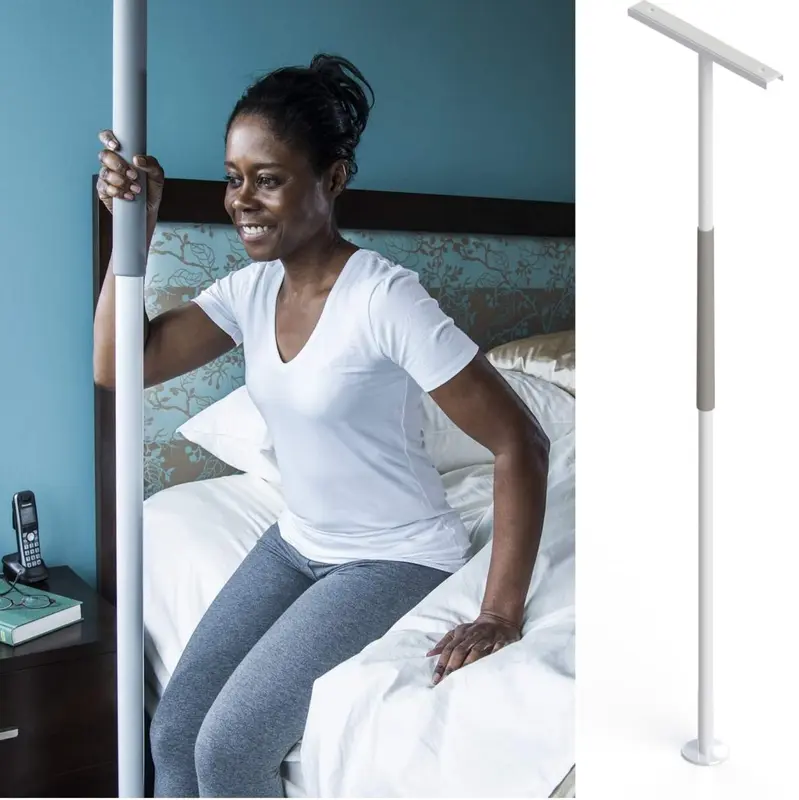
And the bathroom around the bench matters as much as the bench. The outer legs stand on the bathroom floor, which gets wet; a curtain that hangs outside the tub sends water onto it. Drive's Splash Defense exists for that reason. A handheld shower within reach of the seat means nobody has to lean out to reach a fixed head. Where a grab bar or pole is needed beside the tub, the grab bar guide explains fixing them to the wall; our catalog lists the HealthCraft SuperPole, a floor-to-ceiling pole, with a capacity of 300 lb (bariatric 450 lb).
Cleaning, maintenance and warranty
Drive's Transfer Tub Bench and Splash Defense manuals give one cleaning line: "clean with mild soap and rinse with warm water. Wipe bath seat dry after each use."
Eagle's instructions are fuller: "Rinse off the bench with warm water after each use to prevent dirt, soap scum, and mineral deposits from forming which could affect proper operation."
For maintenance, Eagle suggests a spray lubricant "such as WD-40, on the brass push buttons/pins to loosen the buttons/pins, or along the sliding rails to maintain a smooth slide"
, and in the swivel plates for a smooth turn. A push button that will not pop out is exactly the fault many FDA reports describe, so in our view a button that sticks is a reason to stop and fix it, not to force it.
Warranty terms differ sharply between the two makers we read, and each term belongs only to the document that prints it:
| Document | Term | What it excludes |
|---|---|---|
| Drive Transfer Tub Bench manual (Rev.4.07.30.14) | Lifetime of the product, original consumer purchaser | Misuse, negligence, wear; rubber accessories, casters, grips |
| Drive Splash Defense manual (Rev0.3.29.19) | Lifetime of the original consumer purchaser | Same exclusions |
| Drive Combination bench manual (2006) | Lifetime; repair or replace at Drive's option | Same exclusions |
| Eagle Health warranty page | One year from purchase, parts only | Labor, shipping, misuse, modification; rentals |
Drive's manuals say "This warranty does not cover device failure due to owner misuse or negligence, or normal wear and tear,"
and send questions to "an authorized Drive dealer."
Eagle's page says "The Limited Warranty covers manufacturing defects, and is only for parts,"
that it "does not extend to subsequent purchasers, end-users, or owners"
, that "Rental equipment is excluded from warranty,"
and that the warranty "is invalid if product is modified or altered in any way."
Eagle also asks buyers to register the warranty with the card in the box or online.
Two practical points follow. Rubber tips and suction cups wear out and are excluded by Drive, so ask the seller whether replacement tips and suction cups for your exact bench are sold, before you need them. And a second-hand bench usually has no warranty at all under either maker's terms.
What 48 FDA reports describe
The FDA collects reports of problems with medical devices in a database called MAUDE, which openFDA publishes. A word search of the FDA's classification database for "bench" in device names finds no device name for a transfer bench (openFDA, read 10 November 2026), so we searched the report narratives for the words "transfer bench". With no date limit that word search returned 323 reports; we read in full the 48 reports received from 2021 on (openFDA data last updated 20 October 2026). They were received between 16 December 2022 and 30 September 2026. Of them, 46 carry the Class 1 product code "Adaptor, Hygiene" (ILS) and 2 "Aid, Transfer" (IKX), both under regulation 890.5050, the openFDA classification database shows.
Read these numbers with care. The FDA's own page on MAUDE calls it a "passive surveillance system"
with limitations including "under-reporting of events"
, and says a report "does not necessarily demonstrate"
that the device caused the event. These are reports, not rates, and what a report states is what someone told the company, not a finding. Of the 48, 38 are manufacturer reports and 10 distributor reports, as the records label them; 37 list Medline Industries as the manufacturer (three under the Guardian name or a private label), 9 Drive products and 2 an Inovo product sold as "Inspired by Drive". 29 of the Medline reports say they were filed as part of a retrospective review of past complaints; in our reading, that explains much of why 37 of the 48 were received in 2026. That says how reports were filed, not which bench is safer.
We sorted each report by the first problem it describes. The sorting is our own reading of the narratives:
| What the report describes first | Reports |
|---|---|
| A leg broke, bent, collapsed or slid shorter with someone on the bench | 10 |
| The seat or frame broke or collapsed in use | 4 |
| The backrest broke or the bench tipped backwards | 2 |
| Suction cups did not hold to the tub | 2 |
| A push button, pin or clip stuck, was missing or would not lock | 12 |
| Bent, cracked or broken parts found on delivery or outside use | 14 |
| Other: a fall with no fault stated, a loose handle, a wobble, an assembly error | 4 |
The event types, as filed: 38 malfunction reports, 9 injury reports and 1 death report. The death report, about a Drive 12011KD-1 bench, says the user's wife reported that the user fell without injury and later died, "but that there was no link between the fall and his death."
Two Inovo reports describe the same event, in which a telescoping tub leg "WENT IN, GETTING SHORTER". Several reports describe falls when a leg gave way: one Drive injury report says a user's wife stated that "HER HUSBAND WAS ON THE TRANSFER BENCH WHEN THE LEG SNAPPED"
; one Medline malfunction report says "RIGHT FRONT LEG OF TRANSFER BENCH SNAPPED, CUSTOMER FELL TO FLOOR."
The largest groups are not falls. 12 reports describe push buttons stuck inside the tube, missing or bent, often found while assembling; 14 describe bent tubes or cracked seats found on delivery or before use, and in 5 of them Medline wrote that the cause was most likely shipping damage. In one, Medline's supplier review said that push buttons are installed by hand and that "Employees may not install them properly during the installation process."
In one suction cup report, Medline said a returned pair held in its test and that "It is possible their tub surface may not have been properly prepared for the suction cups to work as designed."
What this means for a buyer, in our view, is the same list the manuals already print: inspect for shipping damage, make sure every button pops fully through its hole, fit all four suction cups to a clean tub floor, put the backrest through both receptacles, and stop using a bench whose leg, seat or frame is bent or cracked. These reports cannot show which brand or type is safer, because they do not tell us how many benches were sold or used.
Recalls of transfer benches
A word search of the FDA's device recall database for "transfer bench" in the product description returned 1 record (openFDA recall data last updated 5 November 2026). It is recall Z-0463-2010, initiated on 9 July 2009 and terminated on 29 May 2013, for Nutech Manufacturing's "Bath Safe Adjustable Transfer Bench, Catalog numbers 727142500, 727142501, and MDS86960R"
. The reason given is: "Safety chair used in shower/bath may not meet specifications for weight load."
The record lists 3,627 total units, distribution in the USA and Canada, and root cause "Device Design".
One detail is worth knowing. The catalog number MDS86960R in that 2009 recall also appears on one of the Medline reports we read, filed in 2026 about a composite bench with back and arms. A shared catalog number does not show that the two products are the same design or that the 2026 report concerns a recalled unit; it shows why it is worth searching the recall database with your bench's own item number, which is printed in its manual and on its label. The FDA's recall search is public, and the shower chair guide lists other bath seat recalls, including those of the CPSC.
What transfer benches cost
How much does a tub transfer bench cost in the US? Mobility Atlas read two US sellers' listings and one maker's shop on 9 November 2026. On the first page of Walmart's results for "tub transfer bench", 27 different benches were listed from $37.80 to $181.27, counting every tile whose title contains "transfer bench", the first price on each tile, duplicates and accessories left out; 22 of them were under $100. Named examples: a Carex adjustable bench at $37.80, a Drive plastic tub bench at $51.61, a Medline bench at $69.99, Drive's folding sliding bench at $77.58 and a Moen DN7105 at $181.27. Sliding and swivel benches there ran from $77.58 to $165.99. On 1800wheelchair, benches ran from $127 for Drive's Three Piece to $535 for each ShowerGlyde model, with a travel shower and commode seat with a swing-away transfer kit at $1,428. Eagle listed its 77662 swivel sliding bench at $225. Prices differ by seller, date and options, and shipping terms vary.
| Bench | Seller (US) | Price as printed |
|---|---|---|
| Carex Adjustable Bath Transfer Bench | Walmart | Price $37.80 |
| Drive Medical Plastic Tub Transfer Bench | Walmart | Price $51.61 |
| Medline Transfer Bench, 400 lb | Walmart | Price $69.99 |
| Equate Transfer Bench with Back Rest | Walmart | Price $78.00 |
| Drive Folding Universal Sliding (RTL12075) | Walmart | Price $77.58 |
| Drive Folding Universal Sliding | 1800wheelchair | $285, FREE Shipping |
| Drive Three Piece Transfer Bench | 1800wheelchair | $127, FREE Shipping |
| Drive Padded Seat with Commode Opening | 1800wheelchair | $181, FREE Shipping |
| Lumex Bariatric Transfer Bench, 600 lb | 1800wheelchair | $266, FREE Shipping |
| Moen DN7105 Transfer Bench | Walmart | Price $181.27 |
| Eagle Health 77662 swivel sliding | Eagle Health (maker) | Current price $225, original $290 |
| Carousel sliding with swivel seat | 1800wheelchair | $393, FREE Shipping |
| ShowerGlyde SG1, SG2 or SG3 | 1800wheelchair | $535 each, FREE Shipping |
Drive's Folding Universal Sliding Transfer Bench appears at $77.58 on Walmart (listed as RTL12075) and $285 on 1800wheelchair (listed by name only) on the same day, which shows how far prices for one item can differ between sellers. Several Walmart tiles show a "Now" price with a higher "Was" price beside it; we copied the first price on each tile. Walmart's page also says "Price when purchased online"
.
Many of the cheapest benches on the Walmart page are sold under names we could not tie to a maker's manual or address. That does not make them unsafe, but it does mean you may not be able to check the weight rating, get a manual, or find replacement tips. In our view, ask the seller for the maker's name, the manual and the warranty before ordering any bench, and keep the box and paperwork until the bench has been set up and checked.
If you would like help finding a particular bench, or a model that fits measurements your therapist gave you, you can ask us through the enquiry form or request a quote, with the tub measurements and the therapist's notes.
Does Medicare pay for a tub transfer bench?
Does Original Medicare pay for a tub transfer bench? Mobility Atlas read Medicare's national equipment list, NCD 280.1 (effective date printed as 06/09/2025), the October 2026 federal HCPCS code file and Medicare.gov's commode page on 9 November 2026, and in our reading the documents point to no. The list says "Bathtub Seats" are "Deny - comfort or convenience item; hygienic equipment; not primarily medical in nature"
, and denies "Grab Bars" as a "self-help device". It does not name transfer benches separately. The code file describes E0247 as a "Transfer bench for tub or toilet with or without commode opening"
and E0248 as the heavy-duty version; both carry coverage code D, which the file defines as "Special coverage instructions apply"
, and pricing indicator 00, defined as "Service not separately priced by part B"
. In our reading, plan to pay yourself, and ask any plan in writing before you buy. A code printed on a maker's page is not a promise of payment.
Two parts of that answer need care. First, the date: the NCD page prints its effective date as 06/09/2025 in US month-day order, which is 9 June 2025, and its implementation date as 10/22/2025. We read that version; check that it is still the current one. Second, the codes. In the same code file, E0245, "Tub stool or bench", carries coverage code M, defined as "Non-covered by Medicare". E0247 and E0248 carry D rather than M, which in our reading means some special instruction applies, not that they are covered; the file does not say what the instruction is, and we did not find a CMS policy article for these codes. If a supplier says a transfer bench can be billed to Medicare, ask them to show you the rule in writing.
A combination bench with a commode opening raises the obvious question. Medicare.gov says "Medicare Part B (Medical Insurance) covers commode chairs"
and that "Part B covers medically necessary DME if your doctor or other health care provider orders it for use in your home."
But the national list's commode row says commodes are "Covered if patient is confined to bed or room"
, and explains room confinement in detail. A bench used over the tub is not obviously a commode in that sense; ask the Medicare supplier how they would bill it before you assume either way.
When Medicare does cover an item, Medicare.gov says: "After you meet the Part B deductible, you pay 20% of the Medicare-approved amount (if your supplier accepts assignment)."
It also says "Medicare will only pay for DME items if you get them from suppliers who are enrolled in Medicare."
These rules apply in the US only. Medicare Advantage plans, Medicaid programs, the VA and private insurers set their own rules; we did not read their documents for this guide, so ask the plan.
Other ways to pay
Because Original Medicare is unlikely to pay, most people buy a transfer bench themselves. Other routes exist, but we did not read their documents, so we can only name them as questions to ask. A Medicare Advantage plan may offer extra benefits; ask the plan whether bathroom safety items are among them, which suppliers it uses, and whether it needs an order from a doctor or a therapist's assessment. A state Medicaid program, a home and community-based services waiver, a local agency on aging, the VA for veterans, and some charities and loan closets may supply benches; ask each in writing what it covers and whether you must use its supplier.
Walmart's page shows a filter called "FSA eligible bathroom safety"
. Whether a particular bench qualifies under your flexible spending or health savings account is a question for the account's administrator, not for the seller's label. If a funder sends you to a supplier, ask that supplier for the maker's manual and warranty before delivery, because the warranty terms above depend on buying through an authorized dealer for Eagle, and on being the original purchaser for both makers.
Three traps
Trap one: buying the bench before measuring the tub. A bench that is a little too wide at the bottom puts its suction cups on the curve of the tub instead of the flat floor, and a tub wall that is too high leaves the seat sloping. Drive's Splash Defense lists the limits: tub height 15.5 inches at most, bottom width 18.5 inches at least, top width 23 inches at least and edge width 5.5 inches at most. Measure first, and ask the seller for the same four numbers for any other bench.
Trap two: assuming the push buttons are locked because the bench stands up. A bench can stand on a leg whose button is only half through its hole. Drive's Transfer Tub Bench manual says to make sure the snap buttons "fully protrude through the same respective hole of each leg extension"
(the Splash Defense manual says the same of its push pins); Eagle's say to stop and notify the dealer if any button "does not completely snap into place"
. In the FDA reports we read, 12 describe a button or pin that stuck, was missing or would not lock, and 10 describe a leg that gave way with someone on the bench.
Trap three: treating a sliding seat like a fixed one. A sliding bench is only fixed when it is locked. Drive's sliding manual says to make sure the seat is in one of its two locked positions when getting on or off, and Eagle's swivel seat locks only every 90 degrees. Practise locking and unlocking, dry and dressed, with the therapist or carer, before the first wash. And remember the lower rating: Drive's sliding bench is rated 300 lb, against 400 lb for its standard plastic benches.
Three composite scenarios
These are composite scenarios, not individual customers. Each uses only the documents of the bench it names.
Scenario one: a person who walks short distances with a walker can no longer step over the tub wall. Their occupational therapist suggests a fixed bench. The family measures the tub, asks Drive in writing which tubs the Transfer Tub Bench, 12011KD-1, fits, and reads its page: rated 400 lb, with a seat 26 inches wide and a height of 17.5 to 22.5 inches. They assemble it as the manual says, put the suction-cup legs in the tub, push and pull each leg, and keep the manual, whose lifetime warranty covers the original purchaser but not the rubber tips.
Scenario two: a wheelchair user who does a sitting transfer finds shuffling along a wet plastic seat tiring. Their therapist shows them Drive's Folding Universal Sliding Transfer Bench, RTL12075, rated 300 lb, with a height of 21 to 25 inches. Following the manual, the carer sets the inside legs lower so the seat is level, fits the handle on the suction-cup side, and they practise pulling the red lever and locking the seat at each end, because the manual says the seat must be in a locked position when getting on or off. The bench folds flat for a weekend away.
Scenario three: a person who needs a carer's help to turn finds that twisting on a sliding seat strains them both. The therapist suggests a swivel sliding bench. The carer reads Eagle's 77662 page, checks the tub against its maximum tub clearance of 18.5 inches and the bathroom against its 39 to 40 inch base, and orders it, noting that Eagle's page says products may not be returned for a refund once the package is opened, and that its warranty is one year, parts only. At assembly they choose which way the seat will face, check that every button snaps in, and rinse the bench after each use as the instructions say.
What to ask the therapist and the seller
The occupational or physical therapist
- Can I do a sitting transfer onto a fixed bench safely, or should I try a sliding or swivel seat?
- What seat height should the bench be, measured against my wheelchair cushion or chair?
- Do I need a backrest, an arm, a seat belt or a commode opening, and on which side?
- Is a padded seat better for my skin and the time I sit, or is a plastic seat fine?
- Who should be there for the first transfers, and what should my carer do?
The seller or maker
- Who makes this bench, and can you send me the manual before I order?
- What is the weight capacity in the manual, and does it match the listing?
- Which tub heights, widths and edge thicknesses does it fit?
- How long is the bench from end to end, and how much floor does the outer end need?
- What is the warranty, who handles a claim, and are replacement tips and suction cups sold?
- Can it be returned if it does not fit, once the box is opened?
Sources and documents
Prices checked November 2026: Walmart, 1800wheelchair and Eagle Health, all read on 9 November 2026. Documents checked November 2026: every maker page, manual, government file and FDA record in this guide was read on 9 November 2026.
Maker documents: Drive Medical's US product pages for the Transfer Tub Bench (12011KD-1), Three Piece (RTL12031KDR), Splash Defense (RTL12032KDR), AquaSense (770-406), Padded (12005KD-1), Combination Padded Transfer Bench/Commode (12005KDC-1), Bariatric (12025KD-1), Folding Universal Sliding (RTL12075) and Vitaturn, and six of their owner's manuals; Eagle Health Supplies' 77662 page, its assembly instructions for models 77661 to 77663, and its warranty page. The AquaSense manual has no text layer, so we did not use it. We could not read Medline's own product pages.
Sellers: 1800wheelchair's transfer bench category page and the first Walmart results page for "tub transfer bench". Government: CMS's NCD 280.1, the October 2026 alpha-numeric HCPCS file, Medicare.gov's commode chair page, and openFDA's device event, recall and classification databases, with the FDA's page about MAUDE. Our catalog is cited for the Orca NG bath lift and the SuperPole.
Method: how we compared. We copied each specification, price and quote from the saved text of the page or PDF. We read every one of the 48 FDA reports found by the word search for reports received from 2021 on, and sorted each by the first problem it describes; one reader did the sorting, so treat the groups as approximate. Price ranges were computed by script over every Walmart tile whose title contains "transfer bench" (duplicates and accessories left out) and every price line on the 1800wheelchair page, with the exclusions named above. We do not test benches ourselves.
This article is general information. Rules and prices differ by country and change, so confirm them before you buy or travel.
Common questions
What is the difference between a transfer bench and a shower chair?
A shower chair stands entirely inside the tub or shower, so in a bathtub you still step over the wall to reach it. A tub transfer bench stands across the tub wall, with two legs inside and two on the bathroom floor, so you sit down outside the tub and move across seated. 1800wheelchair's page describes benches as placed astride the bathtub ledge.
How do I know which transfer bench will fit my tub?
Measure the tub wall height, the inside width at the top and at the bottom, the thickness of the rim, and the floor space beside the tub, then compare with the maker's figures. Drive's Splash Defense page, for example, says it fits tubs up to 15.5 inches high, at least 18.5 inches wide at the bottom and 23 at the top, with an edge up to 5.5 inches. Ask the seller for the same figures for any other bench.
Is a sliding transfer bench better than a standard one?
Not for everyone. A sliding bench moves the seat with you on it, so you do not drag your body across a fixed seat, but it must be locked before you get on or off, as Drive's manual says, and Drive's sliding bench is rated 300 lb against 400 lb for its standard benches. Which suits a person is for their occupational therapist to judge after watching the transfer.
How much weight can a tub transfer bench hold?
It depends on the model. On the pages we read on 9 November 2026, Drive's AquaSense is rated 250 lb, its sliding bench 300 lb, its standard, padded and commode benches 400 lb and its bariatric bench 500 lb; Eagle's 77662 is rated 400 lbs, and 1800wheelchair lists a Lumex bariatric bench at 600 lbs. Treat the rating as a ceiling, and check the manual matches the listing.
Does Medicare cover a tub transfer bench?
In our reading, Original Medicare is unlikely to pay. Its national equipment list (NCD 280.1) denies "Bathtub Seats" as a comfort or convenience item and does not name transfer benches, and the October 2026 code file gives E0247 and E0248 coverage code D ("Special coverage instructions apply"
) and pricing indicator 00 ("Service not separately priced by part B"
). Medicare Advantage, Medicaid, the VA and private plans set their own rules, so ask them in writing before you buy. Prices and funding differ by state and plan.
How do I set the leg heights on a transfer bench?
Follow the manual for your exact model, because they differ. Drive's Transfer Tub Bench manual says to set all legs to the same height; its sliding bench manual says the legs inside the tub need a lower setting so the seat is level. Drive's Transfer Tub Bench and Splash Defense manuals say each height button must fully protrude through its hole and all four legs must touch the floor; Eagle's instructions say the buttons must snap firmly into place. Drive's padded, combination, bariatric and sliding manuals do not print these lines (the sliding manual asks only that the fold-out leg locking pins fully protrude), so ask Drive for the check that applies to your model.
Sources
- Drive Medical: Transfer Tub Bench 12011KD-1 (read 9 November 2026)
- Drive Medical: Transfer Tub Bench 12011KD-1 owner's manual
- Drive Medical: Three Piece Transfer Tub Bench RTL12031KDR
- Drive Medical: Splash Defense Transfer Bench RTL12032KDR
- Drive Medical: Splash Defense owner's manual
- Drive Medical: AquaSense Adjustable Transfer Bench 770-406
- Drive Medical: Padded Transfer Bench 12005KD-1
- Drive Medical: Padded Transfer Bench owner's manual
- Drive Medical: Combination Padded Transfer Bench/Commode 12005KDC-1
- Drive Medical: Combination transfer bench/commode owner's manual
- Drive Medical: Bariatric Transfer Bench 12025KD-1
- Drive Medical: Bariatric Transfer Bench owner's manual
- Drive Medical: Folding Universal Sliding Transfer Bench RTL12075
- Drive Medical: Sliding transfer bench owner's manual
- Drive Medical: Vitaturn swivel and transfer aid
- Eagle Health Supplies: Sliding Tub Transfer Bench with Swivel Seat 77662
- Eagle Health Supplies: assembly instructions 77661, 77662, 77663
- Eagle Health Supplies: product warranty
- 1800wheelchair: Shower and Bath Transfer Bench (prices read 9 November 2026)
- Walmart: search results for tub transfer bench (prices read 9 November 2026)
- CMS: NCD 280.1 Durable Medical Equipment Reference List
- CMS: HCPCS quarterly update, October 2026 alpha-numeric HCPCS file
- Medicare.gov: Commode chairs coverage
- openFDA: device adverse event reports, word search "transfer bench", received 2021 to 2026
- openFDA: device recalls, word search "transfer bench"
- openFDA: device classification, product codes ILS and IKX
- openFDA: device classification, word search "bench" in device names (read 10 November 2026)
- FDA: About the MAUDE database
Read on . The wording of the article is our own.