Wheelchair lifts for cars in 2026: hoists, hitch lifts and roof boxes, hitch class and tongue weight, prices, VA and Medicare
How to carry a wheelchair or scooter without a ramp van: hoists, hitch platforms and roof boxes from the makers' manuals, seller prices with dates, and the VA, Medicare and Motability rules.
Contents
- The short answer
- How we compared
- Four ways to carry the chair, as the makers describe them
- Start with the chair or scooter, not the car
- Inside hoists: Bruno Curb-Sider, Harmar, Autochair and Carolift
- Inside platform lifts: Bruno Joey and Harmar hybrids
- Hitch-mounted platform lifts: Harmar AL100 family and Bruno Out-Sider
- Hitch class and tongue weight: the rule in the manuals
- Sedans and small cars: the Chariot, class I lifts and trailers
- Pickups: truck bed hoists and hitch lifts
- Rooftop: the Chair Topper
- Power, wiring and what happens when the car battery is flat
- What car wheelchair lifts cost in the US in 2026
- UK prices: Motability's list and Autochair
- Installation: why a dealer fits these lifts
- Warranty, servicing and moving the lift to your next car
- Does the VA pay for a car wheelchair lift?
- Does Medicare pay for a car wheelchair lift?
- Other ways to pay in the US
- What the FDA records show
- The driving evaluation comes first
- Living with a lift: visibility, weather and parking
- Three traps
- Three composite scenarios
- What to ask the dealer
- Your plan: 10 minutes, today, this week
- Sources and documents
- Common questions
- Sources
The short answer
How can I carry a wheelchair or scooter with an ordinary car, SUV or pickup? Mobility Atlas read makers' manuals, two US sellers' price lists, the VA schedule, Motability's UK list and three Medicare texts in October and November 2026. Four kinds of lift carry the device without a ramp van conversion, though most need a hitch, some drilling or a roof fixing. An inside hoist is a small crane in the boot; Bruno's Curb-Sider is rated at 250, 400 or 450 lb. An inside platform uses a tray. A hitch-mounted platform carries it outside, behind the car; Harmar's AL100 takes scooters up to 350 lb on a class II hitch or greater, if the lift and device stay within the hitch's recommended tongue weight. The Chair Topper roof box takes a folding manual chair of up to 44 lb. On 5 November 2026, the US seller SpinLife listed these lifts from $920 to $6,519, "Starting at" on most tiles. Dealers fit most.
| Kind of lift | Where the device rides | Examples, as makers rate them |
|---|---|---|
| Inside hoist (crane) | In the boot or cargo area | Curb-Sider 250 to 450 lb; Harmar 200 to 450 lb |
| Inside platform | In the cargo area, on a tray | Bruno Joey 350 lb; Harmar AL600 350 lb |
| Hitch-mounted platform | Outside, behind the car | Harmar AL100 350 lb; Bruno Out-Sider 350 lb |
| Wheeled hitch carrier | Outside, on its own wheels | Bruno Chariot 350 lb; marketed to sedan drivers |
| Rooftop box | On the roof, in a closed shell | Chair Topper, folding manual chairs to 44 lb |
| Truck bed hoist | In the pickup bed | Bruno Out-Rider 350 lb; Harmar AL835 350 lb |
Mobility Atlas earns a fee or margin when you order through us; the comparison below uses only the makers' published pages and manuals, sellers' dated listings, the VA, CMS, Medicare.gov, NHTSA, NMEDA, Motability and openFDA texts and our own catalog. We do not rank the makers. Whether you can drive, which controls you need and how you should get in and out of the car are questions for a driver rehabilitation specialist, and in our view transfer technique is a question for your occupational or physical therapist. NHTSA says that for passengers with disabilities these specialists also "recommend appropriate wheelchair lifts or other equipment that would work in your vehicle,"
and its driver evaluation covers the "Ability to drive with adaptive equipment,"
so ask for that advice before you buy.
This guide is about carrying the empty chair or scooter. If you need to stay in your wheelchair while you travel or drive, read the wheelchair van guide; for turning seats that swing you out of the car, see the BraunAbility guide. Ramps at home are in the wheelchair ramp guide, and the lift on your stairs is in the stairlift guide.
How we compared
On 5 November 2026 we read Bruno's scooter lift pages and owner's manual page, the Bruno Out-Sider specification guide and brochure, the Curb-Sider operator manual with its warranty and the Curb-Sider brochure, Harmar's installation and service manual for its outside lifts and Harmar's FAQ page, BraunAbility's Chair Topper page and owner manual, Autochair's UK boot hoist, guarantee and funding pages, Motability's adaptation pages and price list, the VA's Automobile Adaptive Equipment page and its schedule of 1 October 2026, a CMS policy article, Pride Mobility's statement on Medicare, openFDA's registration and recall records, and two US sellers: SpinLife and 1800wheelchair. Several of the maker PDFs were hosted by SpinLife; we name them as the maker's documents.
We reused files read earlier, each dated where it is used: Harmar's vehicle lift pages, the VA's automobile allowance pages, NHTSA's adapted vehicles page and NMEDA's rebate list (all 19 October 2026); the Medicare Benefit Policy Manual's definition of durable medical equipment (18 October 2026); Medicare.gov's wheelchairs and scooters page (10 October 2026); and BraunAbility's funding page and its wheelchair lifts page with a Medicare FAQ (2 November 2026).
Limits. Bruno says its installation manuals are not available to the public, and we found no Bruno owner's manual for the Out-Sider that we could open. Harmar's warranty page and one 1800wheelchair category page answered with an error, and one dealer's shop and one manual copy answered with a security block; we did not read them. No maker we read prints a price; the prices here are sellers' figures on one day. We tested no lift, placed no order and called no one.
Our catalog holds one car hoist row, RV-010, the Carolift 100 boot hoist sold in Europe by BraunAbility. We use it and four scooter and power chair rows only for facts that are not prices.
Four ways to carry the chair, as the makers describe them
Bruno and Harmar sort their lifts the same way: where the device rides, and whether it is hooked and hoisted or driven onto a platform. A hoist, Bruno says, "raises and stows a mobility device in your vehicle using a crane action,"
and "the scooter or wheelchair will use cargo and seating space when stowed."
A platform is "an easy drive on/off solution,"
Bruno's page says, made in inside and outside versions.
Inside hoists
You hook a docking device on the chair or scooter to the hoist's arm, press a button, and the arm lifts, rotates and lowers the device into the cargo area. Harmar's hoists range "from 200 lb to 450 lb," its page says, and need little or no change to the vehicle beyond some drilling. You still need room behind the car and a cargo opening big enough for the device.
Inside platforms, which Harmar calls hybrid lifts
You drive or guide the device onto a platform, strap it, and the platform slides it into the cargo area. Harmar says a hybrid lift "doesn't obstruct your vehicle's backup camera view, nor does it add any extra inches to the rear."
Bruno's Joey works the same way and is rated at 350 lb.
Outside hitch platforms
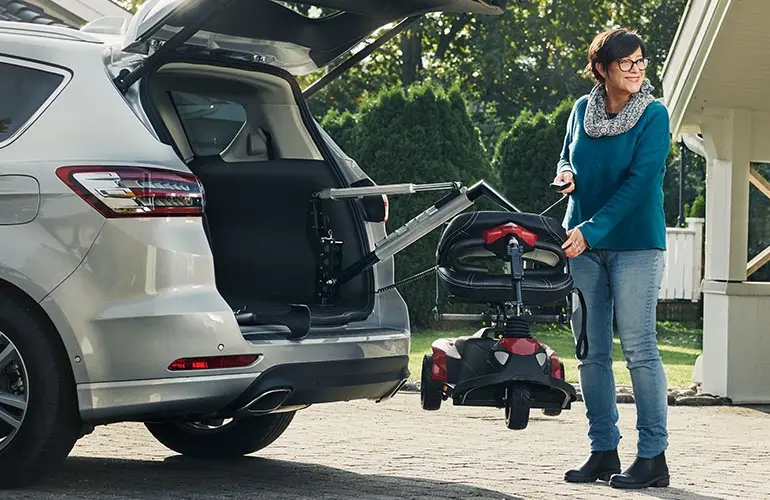
The platform plugs into a trailer hitch and carries the device behind the car, so seats and cargo space stay free. Harmar says hitch lifts work "while saving room and third row seating in your vehicle."
They need a hitch of the right class, and the weight of the lift and device counts against the hitch's tongue weight, as the next sections explain.
Rooftop boxes
A box on the roof hooks an unfolded manual wheelchair on a chain, folds it and lifts it into a closed shell; BraunAbility's page says its handheld control "operates the folding, lifting, and storing of your wheelchair."
In the sources we read, the Chair Topper is the one documented in the US; Motability's UK price list also names a second rooftop loader by Guidosimplex. The Chair Topper takes folding manual chairs only, and Motability describes rooftop stowage for people who "need to take a manual wheelchair but also keep your boot space."
Start with the chair or scooter, not the car
Every lift in this guide is rated for a maximum device weight, and some are made for one kind of device. Weigh what you will actually lift: the chair or scooter with its battery, seat and anything left on it. In our view, add room to spare, because ratings are ceilings, not targets. Bruno's Curb-Sider manual says "The lift weight rating is the MAXIMUM load rating,"
and that during dealer installation the vehicle's structure and condition, the operating environment and the user's ability "may reduce the effective weight rating."
| Device in our catalog (row) | Weight our catalog lists | Lift sizes that print a higher limit |
|---|---|---|
| Pride Go Go Ultra X Gen 3 (PW-047) | 103.4 lb with 12 Ah batteries | Harmar AL010/AL050 135 lb; hoists |
| Drive ZooMe Auto-Flex (PW-050) | 60 lb product weight | Autochair LM 40 kg or 80 kg |
| EV Rider Transport AF+ (PW-053) | 49 lb with battery | Harmar AL010/AL050 135 lb; Autochair 40 kg |
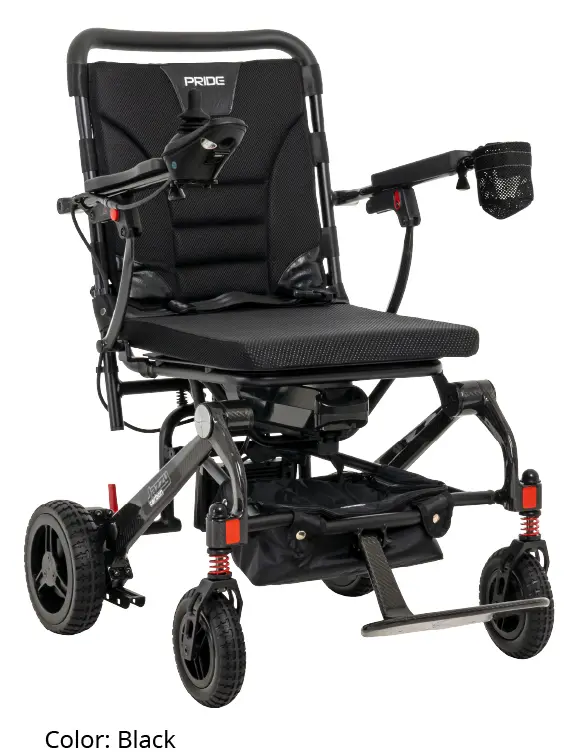
| Pride Jazzy Carbon (PW-012) | 39 lb without battery | Harmar AL010/AL050 135 lb; not a Chair Topper |
These rows are examples, not fit checks: a lift also has to fit the device's wheelbase, width and shape, and a dealer checks that. Autochair's 40 kg is about 88 lb and its 80 kg about 176 lb, so a 60 lb folding scooter is under the first ceiling; ask the dealer which size they would fit, and why. Folding scooters that come apart lighten each lift, too: our catalog lists the heaviest piece of the Go Go Ultra X at 36.2 lb.
Manual wheelchairs, power chairs and scooters
- Folding manual chairs: the Chair Topper takes them up to 44 lb, and its page says
"No Power-Assisted Wheelchairs."
Harmar's AL003 Tilt-N-Tote and AL030 Power Tote are hitch carriers made for manual wheelchairs. - Rigid manual chairs: Bruno's Out-Sider specification guide lists rigid wheelchairs as a "Yes" and folding wheelchairs as a "No" for that lift. Ask the dealer before you assume a lift takes your chair.
- Scooters: most lifts in this guide are sold as scooter lifts first; check the wheelbase limits below.
- Power chairs: heavier, and often held by arms, docking devices or retractors rather than a foot. SpinLife lists Harmar powerchair platforms such as the AL500 and AL580, and Harmar's heaviest hoists reach 450 lb.
If your chair is set up for your posture, in our view, ask your seating therapist whether a docking bracket or a hold-down arm can be fitted without changing anything that matters to them. The lift is the dealer's job; your seating is the therapist's.
Inside hoists: Bruno Curb-Sider, Harmar, Autochair and Carolift
Harmar says hoists "don't utilize platforms to lift your mobility device, which can leave you extra room in your vehicle's cargo area."
Bruno calls the Curb-Sider its "hoist lift," with "multiple lift capacities and versions,"
and its manual sets them out: 250 lb, 400 lb, and 450 lb "only when configured by Bruno"
; the telescoping VSL-6900 goes up to 400 lb. Bruno's own page prints 450 lb; SpinLife's tile prints 250 lb, and its product page lists 250 to 450 lb. Until the dealer confirms in writing which version you are buying, plan on the lowest printed figure, 250 lb; after fitting, the decal on the lift base is the figure that counts: the manual says to "REFER TO THE WEIGHT CAPACITY DECAL LOCATED ON THE LIFT BASE."
| Hoist | Rated load, as printed | Notes from the maker's page or manual |
|---|---|---|
| Bruno Curb-Sider VSL-6000 | 250, 400 or 450 lb | 450 lb only as configured by Bruno |
| Bruno Curb-Sider VSL-6900 | Up to 400 lb | Telescoping head for small openings |
| Harmar AL055 Economy | Up to 200 lb (SpinLife) | Heaviest component 23 lb |
| Harmar AL425/AL425HD | 400 lb / 450 lb (SpinLife) | 30 in of headroom required |
| Harmar AL435 Premium | 400 lb (SpinLife) | Powered lift, rotate and boom extension |
| Autochair Smart Lifter LM | 40 or 80 kg | For wheelchairs and mini scooters |
| Autochair Smart Lifter LC | 80 or 100 kg | Lifts in 60 seconds, Autochair says |
| Autochair Smart Lifter LP | 125, 150 or 200 kg | For larger scooters and powerchairs |
| Carolift 100 (catalog RV-010) | 80 or 100 kg | Detachable part about 10 kg |
In pounds, Autochair's top LP rating of 200 kg is about 441 lb and the 100 kg LC about 220 lb. Harmar's ratings in the table are SpinLife's tile figures, because Harmar's own hoist page prints only the range of 200 to 450 lb; ask the dealer for the rating of the exact model and mounting.
What a hoist asks of the car
- Space behind the car: for loading a scooter, the Curb-Sider manual says
"Four (4) feet (1.2 m) of clear space behind the vehicle is usually adequate."
- A level place to load: the manual says to park
"on a horizontal, level surface"
and warns of a tip-over risk if the device's wheels roll off a raised surface such as a sidewalk. - A big enough opening: Autochair says its hoists fit
"as long as the opening into the boot is large enough for your specific scooter or chair."
The Curb-Sider's telescoping head exists for "smaller openings," Bruno's brochure says. - Headroom: Harmar's hoist page lists "30” of headroom required" for the AL425.
- Seats: a hoist uses cargo space and the stowed device can take seating space too. Bruno says the Curb-Sider leaves
"Partial third-row seating or cargo space"
free when no device is aboard.
Motability, the UK lease scheme, says on its stowage page: "Boot hoists can take up a lot of space."
If you carry passengers or luggage every week, measure the cargo area with the device in it before you choose.
Inside platform lifts: Bruno Joey and Harmar hybrids
An inside platform keeps the device inside, like a hoist, but you drive onto a tray instead of hooking it. Bruno says the Joey lets you "Drive onto the platform, press a button and the Joey safely lifts and stores your mobility device inside the vehicle's cargo area,"
with a self-levelling platform, a backlit hand control and a safety barrier. It is rated at 350 lb on Bruno's page.
Harmar's AL600 Classic hybrid is rated at 350 lb and "Compatible with minivans, vans, and SUVs,"
its page says; the AL690 Side Door model is rated at 275 lb for "most minivans and SUVs." SpinLife's AL600 tile says it attaches "to the third-row seating mounts"
with no bolting to the floor, and that it "Allows for continued use of second row."
On 5 November 2026 SpinLife showed, all "Starting at," the Joey at $4,675, the AL600 at $3,795 and the AL690 at $4,135, against $920 for Harmar's AL055 hoist, the lowest price among the 14 tiles that print "Trunk or Cab Secured." In the UK, Motability's list prices a 159 kg Joey with safety barrier and belts at £3,720 for Scheme customers (valid 1 October to 31 December 2026, including 0% VAT). That is about 351 lb by our conversion, close to the 350 lb on Bruno's page.
Hitch-mounted platform lifts: Harmar AL100 family and Bruno Out-Sider
A hitch lift is a powered platform on an arm that plugs into the car's trailer hitch. You get off the device, guide it onto the platform, secure it, and press a switch; Harmar says hitch lifts are "rated as “easier” lifts to use because the lift does the work for you."
When the platform is empty it folds up against the back of the car.
| Lift | Device limit | Hitch class | Lift weight |
|---|---|---|---|
| Harmar AL100 | 350 lb scooters | II or greater | 83 lb installed |
| Harmar AL100HD | 400 lb scooters | III or greater | 84 lb installed |
| Harmar AL160 Profile | 350 lb (SpinLife) | 1, 2, 3 or 5 | 74 lb |
| Harmar AL010/AL050 Micro | 135 lb (SpinLife) | 1, 2, 3 or 5 | 71 / 67 lb |
| Harmar AL301XL/XLHD | 350 to 400 lb (Harmar page) | 2, 3 or 5 / 3 or 5 | 100 / 102 lb |
| Bruno Out-Sider ASL-275 | 350 lb | Class II and III | 89 lb scooter setup; SpinLife: 94 lb |
The Harmar weights and classes come from the Figure 3-1 table in Harmar's installation and service manual of 6 December 2019, except the AL100 and AL100HD rows, which are from Harmar's AL100 page (read 19 October 2026). The Out-Sider figures are from Bruno's specification guide, which says its setup weights "do not include hitch adapter or securement option weights"
(scooter foot 5 lb, powerchair arm 7 lb, 3-belt kit 5 lb); SpinLife's Out-Sider page prints "Weight: 94 lbs." instead. SpinLife's AL301XL tile lists class III only, so ask the dealer which class your model needs. The AL100 page lists a 26 by 39 inch platform with a cradle that extends to 46 inches, takes scooters "with a wheelbase of up to 42”,"
and comes with a class III hitch adaptor, a hitch post and a licence plate mount.
What the Out-Sider guide prints
- Hitch height range 6 to 24 inches; at least 6 inches from bumper to chassis.
- 45 inches to the end of the platform when loading and in the travel position, and 18 inches to its edge when folded.
- Usable width 28.5 inches on the standard platform and 31 inches on the wide one.
- Device wheelbase up to 38 inches on the standard platform and 46 inches on the large one.
- Applications: CUV and SUV, minivan, pickup and full-size van "Yes"; hatchback and sedan "Limited".
- Weights: 89 lb with the scooter setup, 72 lb or 80 lb with powerchair setups, the Swing-Away option 26 lb and the class III hitch adapter 7 lb.
Both makers sell a swing-away so you can open the boot or tailgate with the lift fitted. It adds weight: 26 lb on the Out-Sider, and 40 lb for Harmar's AL105 or 24 lb for the AL105L in Harmar's table. Bruno says the Out-Sider "can also be transferred to another applicable vehicle,"
which matters if you change cars.
Hitch class and tongue weight: the rule in the manuals
Harmar's installation manual gives the installer this rule: "Add the combined weights of the lift, mobility device and, where applicable, the swing-away option. Ensure that the total weight does not exceed the hitch's recommended tongue weight."
It adds that "The installer must adhere to the vehicle's Gross Vehicle Weight Rating restrictions."
SpinLife's Out-Sider page says "A Bruno dealer will check your vehicle's tongue-weight rating and measure your device to assure compatibility."
| Example load on the hitch | Lift | Device | Extras | Total |
|---|---|---|---|---|
| Harmar AL100, full 350 lb scooter | 83 lb | 350 lb | None | 433 lb |
| Same, with AL105 swing-away | 83 lb | 350 lb | 40 lb | 473 lb |
| Harmar AL100HD, 400 lb scooter | 84 lb | 400 lb | None | 484 lb |
| Bruno Out-Sider, 350 lb scooter | 89 lb | 350 lb | 7 lb adapter + 5 lb foot | 451 lb |
| Same, with Swing-Away | 89 lb | 350 lb | 7 + 5 + 26 lb | 477 lb |
| Harmar AL160 on class 1, 350 lb scooter | 74 lb | 350 lb | None | 424 lb |
These totals are our sums of the makers' printed weights with the device at the lift's limit; your own device may weigh less. For the Out-Sider we add the 5 lb scooter foot, because Bruno's guide leaves securement out of the setup weight; SpinLife's page prints 94 lb and does not say what it includes; if it excludes the foot and adapter as Bruno's figure does, the totals are 456 and 482 lb by our sums. Plan on that heavier pair until the dealer confirms the setup weight in writing. The manual's test is the hitch's recommended tongue weight; in our view, also check the tongue weight and towing figures in the car's owner's manual and use the lower one. Neither maker prints a tongue weight for any hitch class in what we read, so we give none: read the label on the hitch and the car's owner's manual, and ask the dealer to show you the figure they used. The last row shows why: Harmar's table lists the AL160 for class 1 hitches as well, and a light hitch may not carry a full 350 lb scooter plus the lift. That is our reading of the manual's rule, not Harmar's statement about any hitch.
Four more rules from Harmar's manual
- The manual says the class is
"usually imprinted directly on the trailer hitch,"
or can be found by measuring the receiver; Bruno's guide gives 1.25 inches for class II and 2 inches for class III. - The receiver tube must be parallel to the ground, the manual says:
"This is a requirement and not a recommendation."
- The manual says
"Hitch expanders and extenders are strictly prohibited,"
and only Harmar-approved adapters may be used. "Hitch installation is not possible on every vehicle,"
and"some vehicles require the rear suspension to be supplemented."
The installer should not go ahead if the vehicle or hitch has severe rust or a possible suspension issue, the manual says.
Harmar's manual also tells installers to measure hitch height and bumper distance and to pick an adapter from its size chart, and says the normal range of lift operation is 5 to 16 inches to the bottom of the hitch receiver (the April 2022 revision prints 6 to 16 inches). A lift on the wrong adapter may not reach the ground, and "Any higher vehicles will require a different hitch adaptor"
; Harmar's size chart, re-read on 5 November 2026, lists "DROP" adapters of 2 to 8 inches for receivers up to 26 inches from the ground on class 3, and an RV adapter with a 12 inch drop. One seller's tile shows how much the hitch can matter: SpinLife's E-Z Carrier 2 description gives a "Class III weight capacity of 400 lbs."
and a "Class II weight capacity of 200 lbs."
for the same carrier.
Sedans and small cars: the Chariot, class I lifts and trailers
In the documents we read, small cars get the fewest hitch options: Bruno's Out-Sider guide marks hatchbacks and sedans as "Limited." SpinLife's Out-Sider page says it fits "many sedans"; plan on Bruno's "Limited" until the dealer checks your car. Bruno's answer for sedans is the Chariot, which rides on its own wheels: Bruno says it has "independent suspension to carry the load and 360-degree spinning wheels for easy maneuverability,"
and calls it "Perfect for Sedan Drivers."
Bruno also says it is "the only company who created a lift capable of transporting a scooter or powerchair with a sedan"
; that is Bruno's claim, which we have not checked against every maker.
SpinLife's Chariot tile reads "The only scooter lift that trailers behind your car,"
rated up to 350 lb, for class I or class II hitches with a hitch height of 8.5 to 15.5 inches, "Starting at" $6,519 with $8,595 shown crossed out on 5 November 2026. Harmar's Figure 3-1 lists the AL003, AL010, AL050, AL015, AL030 and AL160 for class 1 hitches as well, but the tongue weight rule above still applies to each of them.
SpinLife also lists a manual trailer, the Large ScootaTrailer, rated up to 600 lb for a class I hitch. In our view a trailer is a different thing on the road from a lift: ask your state licensing office whether it must be registered and lit, and practise reversing before you rely on it. If a hitch lift will not suit your car, an inside hoist may: Autochair says its hoists fit hatchbacks, estates, MPVs and 4x4s if the boot opening is big enough.
Pickups: truck bed hoists and hitch lifts
A pickup can carry a device in the bed or on a hitch platform. Bruno's Out-Rider is "the wheelchair lift designed just for pickups,"
rated at 350 lb; Bruno says it can be set up to "lift, rotate and lower your mobility device into your truck bed from inside the cab."
Harmar's truck hoists include the AL825 Pickup 225, the AL835 Pickup 350 HD and the AL435T Tailgater, which reaches 43 inches to the curb or over a 24-inch tailgate, and crew cab models with a longer arm and "reduced capacity," its hoist page says.
| Truck lift on SpinLife, 5 November 2026 | Rated, as the tile prints | Price shown |
|---|---|---|
| Harmar AL825 Pickup 225 Speed | Up to 225 lb | Starting at $4,230 |
| Harmar AL835 Pick-Up 350 HD | Up to 350 lb | Starting at $4,230 |
| Harmar AL435T Tailgater 3-Axis | Up to 400 lb | Starting at $4,465 |
| Harmar AL815CC Crew Cab 150 Speed | Up to 135 lb (name says 150; plan on 135) | Starting at $4,465 |
| Harmar AL825CC Crew Cab 225 HD | Up to 225 lb | Starting at $4,465 |
A device in an open bed is out in the weather; ask about a cover and whether the device's maker allows it to travel that way. A hitch platform on a tall pickup may need a different hitch adapter, such as one of the drop adapters in Harmar's chart, as above. Bruno's Curb-Sider "Can be installed in trucks,"
SpinLife's page says, and Bruno's brochure lists SUVs, vans and pickups as its vehicle fit.
Rooftop: the Chair Topper
The Chair Topper is a powered box on the roof for one folding manual wheelchair. BraunAbility's page says the car top rack "conveniently lifts and stores your wheelchair in the weatherproof rooftop compartment"
after you have transferred into the car, and that "It takes only 30 seconds to complete the cycle."
The owner manual says it is "made in Sweden by Autoadapt, a BraunAbility brand."
BraunAbility's page says it is "designed for individuals who are capable of transferring from a wheelchair to drive or ride independently."
| Chair Topper figure | Product page | Owner manual |
|---|---|---|
| Wheelchair weight | Max 44 lb (20 kg) | Lift capacity 44 lbs (20 kg) |
| Unit weight | 121 lb (55 kg) | 123 lbs (55 kg) |
| Length x width | 56.25 x 51.5 in | 56 x 51 in |
| Height | 18.125 in | 18 in, plus 4 in during operation |
| Max folded chair height | 36.625 in | 36.5 in |
| Max folded chair width | 13.75 in | 14 in |
| Power | Vehicle's electrical system | 12 V DC motors, 15 A fuse |
Where the two documents differ, plan on the stricter figure: the 123 lb unit weight, the 36.5 inch folded height and the 13.75 inch folded width, and for clearance the 18.125 inch box height, plus 4 inches while it operates. With a 44 lb chair aboard, the roof carries about 167 lb by our sum; in our view, ask the dealer to confirm that your car's roof and any rack are rated for that load, and ask the dealer how the box is fixed, since the FAQ says installation "may include securing the carrier to the roof of the vehicle"
or, in some cases, a roof rack. Power-assisted wheelchairs are excluded, the page says.
What the manual warns about
- Height:
"Please note that changing the wheels, rims or other modifications to the vehicle might affect the total height."
The manual has a line for the combined height at installation; write it on a card in the car and check car parks and your garage. - Loading: the manual says to open the door fully, leave the chair
"completely unfolded and facing toward the front of the vehicle,"
lock its brakes, and hook it under the seat. - Emergency operation: the manual's DANGER notice says
"the wheelchair will suddenly drop and free fall from the Chair Topper. Unless held by a person of adequate strenght [sic], it may cause injury to anyone in its path as well as cause damage to the vehicle."
In our reading of the manual, use the supplied emergency kit, have a person of adequate strength hold the chair as the manual says, and keep everyone else clear of the space under the box; ask the dealer to show you the procedure. - Maintenance: the manual lists checks every 4 weeks or 100 cycles, every 3 months or 300 cycles and every year or 1250 cycles, and
"Always contact your dealer for disassembly."
BraunAbility says the Chair Topper "has a limited 3-year part and a 1-year labor warranty,"
and that repair work "must be completed by a BraunAbility certified technician."
We found no US seller price for it in what we read; in the UK, Motability's list prices a transferable Chair Topper roof box at £3,350 for Scheme customers (valid 1 October to 31 December 2026, including 0% VAT).
Power, wiring and what happens when the car battery is flat
Powered lifts run from the car's battery. Harmar's FAQ says "Vehicle lifts get power from the vehicle's battery,"
and that some can also run from "an independent battery system specifically for the lift."
Its installation manual wires the lift with a harness of about 23 feet straight to the battery, through a 20 amp self-resetting circuit breaker, and says "NEVER attempt to connect the harness to a secondary power source."
The motor "can draw up to 20 amps at some points,"
the manual says, and poor connections are "the main problem associated with a slow, intermittent, warm, poorly performing motor,"
it adds.
Hybrid and electric cars are a special case. Harmar offers a stand-alone battery pack for customers who do not want the harness on the car battery. Its December 2019 installation manual (Rev A) names the pack AL205 and says it "can also be used when hybrid or electric vehicles have a 12-volt battery capable of supplying power to a mobility lift"
; the later revision on Harmar's site (Rev B, April 2022) names it BAT141386 and says it "can also be used when hybrid or electric vehicles do not have a 12-volt battery capable of supplying power to a mobility lift."
Ask the installer which applies to your car. In the UK, Autochair's lithium Power Pack runs its boot hoists without "the need to wire into the vehicle's electrical system,"
charges in "around 2 hours," and should be charged "once per week," its page says. Bruno's Curb-Sider manual warns that disconnecting batteries the wrong way on some cars can "even cause airbags to deploy,"
so the car maker's instructions come first.
Manual backups
- Harmar outside lifts:
"In the event of a power failure (for example, if your car battery dies), you can still operate the lift using the manual override system,"
with a 3/8 inch socket wrench on the actuator, after unplugging the power. - Bruno Curb-Sider: an emergency crank on the motor shaft brings the lift to its home position; store it "in the vehicle glove box" and have the lift examined by a Bruno dealer afterwards, the manual says.
- Chair Topper: a manual override with an emergency kit; the manual warns that during the emergency operation the chair can drop in free fall and
"may cause injury to anyone in its path."
- Out-Sider: SpinLife's page lists a "Manual backup" among its features.
Ask the installer to show you the backup on delivery day and to leave the tool in the car. The lift's battery is not your chair's battery: for those, see the power wheelchair batteries guide.
What car wheelchair lifts cost in the US in 2026
Bruno and Harmar print no prices; Bruno's page says "Costs vary depending on the type of lift, installation and options you may need."
Installed lifts are the main subject here; the portable lifts on 1800wheelchair's page are listed separately below. The figures below are from SpinLife, a US online seller, on 5 November 2026. Most tiles print "Starting at," a current price, and a higher price shown crossed out; SpinLife does not say what the crossed-out figure is, so we treat only the current price as the price. SpinLife's Out-Sider, Curb-Sider and Chariot listings say "Professional Install & Training Included"
; for other tiles, ask whether installation is in the price. Options and a hitch can change the total, and prices differ by country, dealer, funding and tax.
| Lift on SpinLife | Kind | Label | Price | Crossed out |
|---|---|---|---|---|
| Harmar AL055 Economy | Inside hoist | Starting at | $920 | $1,215 |
| Harmar AL001/AL002 Universal Outside Carrier | Hitch, manual | None | $1,155 | $1,600 |
| Harmar AL010/AL050 Micro Lift | Hitch, powered | Starting at | $1,445 | $1,595 |
| Harmar AL100 Universal Platform | Hitch, powered | Starting at | $2,305 | $3,060 |
| Harmar AL300 Fusion | Hitch, powered | Starting at | $2,555 | $3,395 |
| Harmar AL100HD Heavy Duty | Hitch, powered | Starting at | $2,805 | $3,600 |
| Bruno Out-Sider ASL 275 | Hitch, powered | Starting at | $3,127.50 on its page | $3,475 |
| Harmar AL425 Axis II | Inside hoist | Starting at | $3,385 | $4,505 |
| Harmar AL600 Hybrid | Inside platform | Starting at | $3,795 | $5,070 |
| Bruno Curb-Sider VSL60XX | Inside hoist | Starting at | $4,199 | $4,665 |
| Bruno Joey VSL-4400 | Inside platform | Starting at | $4,675 | $5,195 |
| Bruno Chariot ASL-700 | Hitch, own wheels | Starting at | $6,519 | $8,595 |
Across the 49 device lifts and carriers (including one trailer and one portable lift) on SpinLife's list that day, current prices ran from $920 to $6,519. The 33 tiles that print a hitch class ran from $1,155 to $6,519, and the 14 that print "Trunk or Cab Secured" from $920 to $4,690. These are the ranges in our table of one seller's list on one day, not the market's lowest and highest. The Out-Sider tile shows $3,128; its product page shows $3,127.50. We left out two person-transfer lifts that appear in the same list.
A second seller: 1800wheelchair
On the same day, 1800wheelchair's scooter lift page listed eight items. The tiles print no model numbers, so we give their names as printed: "Harmar's Universal Scooter Lift"
at $2,707 (350 lb), "Harmar's Heavy Duty Universal Scooter Lift"
at $3,050 (400 lb), the Harmar Fusion Lift at $2,964, the Harmar Extra Large Fusion Lift at $3,279 and the Harmar Micro Outside Lift at $1,993. The tiles print each price with no label such as "Starting at" and no crossed-out figure. It also listed three portable lifts, one of them marked "Sold-out": the Monarch Atlas 4 at $1,885 (88 lb), whose tile says "No permanent vehicle installation required,"
and the GO-Lift at $1,199 (110 lb), and the Enhance Mobility Hercules at $995. We did not read the makers' documents for the portable lifts.
What the VA schedule says a lift may cost
The VA's Automobile Adaptive Equipment schedule of 1 October 2026 is not a price list: it "contains the maximum allowable reimbursement amounts for the listed adaptive equipment,"
for equipment VHA has prescribed. Its maximum allowable reimbursement amounts include $3,195 for a "Hitch Mount Lift," $6,911 for a "Hitch Mount Lift + Wheels,"
$4,801 or $5,190 for an in-vehicle rotary hoist for a manual or power wheelchair, $5,084 for an in-vehicle platform lift and $8,108 for a "Roof Top Carrier," with in-shop labour at up to $135 an hour on its own line. In our reading, VHA's prescription and the prosthetic representative decide which line applies; we do not match models to lines.
UK prices: Motability's list and Autochair
In the UK, Motability publishes what its Scheme customers pay for each adaptation. Its price page says "These prices are valid between 1 October and 31 December 2026"
and "All prices shown include 0% VAT. If you do not qualify for VAT relief, you may have to pay the standard rate of VAT."
The prices are for Scheme customers. In its two stowage tables, the 29 rows that name a hoist run from £505 to £2,890; most transfer kits, to move a hoist to your next car, are £300.
| Item on Motability's list | Customer price | Manufacturer name on the list |
|---|---|---|
| 40 kg 2-way transferable boot hoist | £505 | Techmobility |
| 40 kg 2-way boot hoist (Smartlifter LM) | £800 | Autochair |
| 80 kg 4-way hoist (Smartlifter LM, folding) | £790 | Autochair |
| 100 kg 4-way boot hoist (Smartlifter LC) | £795 | Autochair |
| 200 kg 4-way boot hoist (Smartlifter LP) | £850 | Autochair |
| 80 kg EV boot hoist, LC plus battery pack | £1,085 | Autochair |
| 180 kg boot hoist (Carolift 6900) | £2,890 | Mobility in Motion |
| 159 kg platform lift with barrier (Joey) | £3,720 | Mobility in Motion |
| Chair Topper roof box, transferable | £3,350 | Mobility in Motion |
| C-TRAN roof box loader, transferable | £3,100 | Guidosimplex |
| Transfer kit for 4-way SmartLifter hoist | £300 | Autochair |
Motability's FAQ adds that "Many adaptations on the Motability Scheme are now available at no additional cost, as long as they're fitted at the start of your lease,"
and that "There might be an extra cost for larger, more complex adaptations."
The list still prints a customer price for each item, so ask the installer which applies to your order. Adding a hoist mid-lease is possible, but "you'll need to let us know first and pay any costs directly to the adaptations installer,"
and the Motability Foundation's grants are means-tested, the FAQ says.
Autochair, a UK maker, prints no prices; its FAQ says to call. Its FAQ says that, to qualify for UK VAT relief on a new car, "you must use a wheelchair and be registered as disabled, and the product must be a substantial, permanently installed adaptation, such as a person hoist or swivel seat,"
and "You don't have to be the driver of the vehicle, but it must be adapted before it is registered to the owner."
That is Autochair's summary, not HMRC's; we did not read HMRC's guidance, so ask the installer and HMRC whether a boot hoist qualifies for you. Rules differ again in other countries.
Installation: why a dealer fits these lifts
Every permanently fitted Bruno, Harmar, BraunAbility and Autochair lift in this guide is fitted by a trained installer: a dealer for Bruno, Harmar and BraunAbility, and Autochair's own fitters in the UK. Portable lifts such as the Monarch Atlas 4, whose tile says "No permanent vehicle installation required,"
are the exception. Harmar's AL065 is not bolted into the car, SpinLife says, but its tile lists a class II or III hitch and professional installation, so treat it as a hitch-mounted lift. Bruno's manual page says its products "are to be installed exclusively by authorized Bruno dealers,"
so its installation manuals are not public, and the Curb-Sider manual says the warranty is void otherwise. Harmar's FAQ says "It is imperative that you use a qualified Harmar dealer,"
and its manual expects the installer to have "completed training" and "obtained certification on installation."
BraunAbility says a Chair Topper installation "should be done by a trained and certified technician."
What happens on the day
- The dealer checks the device against the lift and the car: SpinLife says
"SpinLife reviews each and every vehicle lift purchase,"
and asks for the vehicle, hitch height and type, and the device. - For a hitch lift, the hitch goes on first if the car has none; Harmar says
"Hitch-mounted lifts require a hitch to be added to your vehicle (if you don't already have one installed)."
- Hoists and inside platforms
"may call for some drilling to the cargo area or truck bed floor,"
Harmar says. - The installer wires the lift to the battery, sets the adapter height and fits the device's docking bracket or securement.
- You operate the lift several times while the installer is there: the Curb-Sider manual asks for exactly that.
Where it happens varies. SpinLife says of the Out-Sider and Curb-Sider: "You will need to travel to the installer location for installation,"
and its pages give shipping times of 15 to 20 and 7 to 10 business days. Autochair says its mobile fitters come to your home or the car dealer, that it aims to fit "within 7-14 days" of the order, and that most fits take "a few hours." Under Motability, the adaptations installer orders and installs the hoist and "manages order updates with your dealer,"
Motability's page says.
Registration, licence plates and the car's warranty
NHTSA's page asks you to check that the dealer is registered with NHTSA as a modifier. That matters for veterans too: the VA's AAE page says payment goes to NHTSA-registered providers and reimbursement applies where the provider is not registered, with VA Form 10-1394 and an itemized invoice. A hitch lift can hide the plate: SpinLife lists states where the plate may have to be displayed on the lift, and Harmar's manual says "some states have strict license plate obstruction laws."
Autochair suggests asking the car dealer whether fitting an adaptation affects the vehicle's warranty.
Warranty, servicing and moving the lift to your next car
| Maker and document | Term as printed | Labour and conditions |
|---|---|---|
| Bruno Gold Limited Warranty (Curb-Sider manual) | 3 years on parts from installation | Labour for the first 30 days |
| Bruno lift pages | 3-Year Limited Warranty | Every scooter lift page |
| Chair Topper (BraunAbility page) | Limited 3-year part | 1-year labor; certified technician |
| Autochair (UK) | 3-year guarantee on products it installs | Also via Motability; service every 12 months |
| Harmar | Warranty page not available | Manual: alterations may void it |
The Bruno Gold Limited Warranty printed in the Curb-Sider operator manual excludes "Reasonable wear and tear,"
consumables, and damage from "misuse, abuse, accidents, neglect or modifications NOT made by Bruno Authorized Dealer,"
and says service and warranty issues go through the dealer that installed the unit. The warranty text for Bruno's other lifts was not among the documents read; their pages print only "3-Year Limited Warranty." Its manual asks you to take the car and lift to a Bruno dealer for an inspection "once a year (every 6 monts [sic] if the lift is used under strenuous conditions)."
Harmar recommends "regular professional inspections"
and its manual warns that if the installer goes ahead on a car with severe rust or a suspension problem, "the warranty may NOT apply."
Harmar's warranty page answered with an error on 5 November 2026, so ask the dealer for Harmar's warranty in writing.
Changing cars
Most of these lifts can move: Bruno says the Out-Sider and Curb-Sider can be reinstalled "in another applicable vehicle,"
BraunAbility says the Chair Topper can be "transferred to another compatible vehicle,"
and Autochair moves its own installations if the new car is compatible. Budget for new brackets or a transfer kit: on Motability's UK list for Scheme customers (valid 1 October to 31 December 2026, including 0% VAT), most boot-hoist transfer kits are £300, the Joey's is £3,315 and the roof-box kit £0; US bracket prices were not in what we read. Autochair will only remove a hoist it installed and will not buy one back. For veterans, the VA's AAE page says equipment on record must stay at least 4 years unless there are extenuating circumstances.
Does the VA pay for a car wheelchair lift?
Does the VA pay for a wheelchair or scooter lift for a car? Mobility Atlas read the VA's Automobile Adaptive Equipment page and its schedule of 1 October 2026, and for eligible veterans it can, if VHA prescribes the lift. The AAE program "prescribes and pays for adaptive equipment to allow an eligible person to safely operate and enter/exit from their personal vehicle,"
the page says. Eligibility needs a service-connected disability with one of the listed conditions, such as "loss, or permanent loss of use, of one or both hands."
"All AAE must be prescribed by a VHA physician and/or Certified Drivers Rehabilitation Specialist (CDRS),"
and the schedule sets maximum allowable reimbursement amounts: $3,195 for a hitch mount lift, $4,801 or $5,190 for an in-vehicle rotary hoist, $5,084 for an in-vehicle platform lift and $8,108 for a roof top carrier. VA Form 10-1394 is the application, and approval comes before you buy.
The VA's automobile allowance page, read on 19 October 2026, says: "You'll need to file your claim and get our approval before you buy a vehicle or adaptive equipment."
For the adaptive-equipment grant you take VA Form 10-1394 to the prosthetic representative at your local VA medical center, and that page says "We may pay you, or we may pay the equipment seller directly."
It also says to make sure "the seller agrees to send us the completed claim form and an itemized invoice."
The AAE page says payments go to NHTSA-registered providers and reimbursement applies to unregistered ones, and that VHA "Approves 2 vehicles within 4-year period."
The schedule page says that where an invoice is above the schedule, "the Prosthetic Representative will adjust the total to be paid or reimbursed on the VA Form 10-1394."
Ankylosis of a knee or hip qualifies for an adaptive-equipment grant only. The separate automobile allowance toward buying a vehicle is covered in the wheelchair van guide.
| VA AAE schedule line (1 October 2026) | Maximum allowable reimbursement amount |
|---|---|
| Hitch Mount Manual Wheelchair Carrier | $1,478 |
| Hitch Mount Lift | $3,195 |
| Hitch Mount Lift + Wheels | $6,911 |
| In-Vehicle Rotary Hoist, manual wheelchair | $4,801 |
| In-Vehicle Rotary Hoist, power wheelchair | $5,190 |
| In-Vehicle Platform Lift | $5,084 |
| Truck Bed Mount Hoist, manual / power | $5,329 / $5,815 |
| Roof Top Carrier | $8,108 |
| In-shop / high-tech labour, per hour | $135 / $148 |
The schedule's names are the VA's categories, not model names; in our reading, VHA's prescription and the prosthetic representative decide which line applies. If you are not a veteran, the van guide's funding map and the next sections apply.
Does Medicare pay for a car wheelchair lift?
Does Medicare pay for a wheelchair or scooter lift for a car? Mobility Atlas read Medicare's definition of durable medical equipment, a CMS policy article and Medicare.gov's wheelchair page in October and November 2026. A keyword search of the CMS article found no lift or carrier for a car, and the definition and Medicare.gov page we saved name none, so we can cite no Medicare rule that covers one. The definition says durable medical equipment must be "primarily and customarily used to serve a medical purpose"
and must be "appropriate for use in the home."
Medicare.gov's page covers the wheelchair or scooter itself "if you're eligible." Pride Mobility's 2020 blog says "Medicare will not pay for a scooter lift for your car or van,"
and BraunAbility's wheelchair lifts page, read 2 November 2026, answers "Will Medicare pay for a wheelchair lift?"
with "No." Both are makers' statements, and BraunAbility's is not on a car hoist page. Ask a Medicare Advantage plan or Medicaid in writing.
The CMS article mentions a car only once, in its definition of a "Portable" device, which reads: one that "allows easy placement into a vehicle for use in a distant location."
That is about the wheelchair or scooter, not about a lift. If a supplier tells you a lift is covered, ask for the code and the rule in writing before you sign.
Other ways to pay in the US
- Car maker rebates. NHTSA says most major vehicle makers offer rebates on adaptive equipment,
"usually up to $1,000, provided you purchase a vehicle less than one year old."
NMEDA's list quotes Mazda's program as including"wheelchair or other lift equipment"
and Toyota's as covering"any aftermarket adaptive equipment or conversion."
BraunAbility says a Chair Topper"could also be eligible for automotive manufacturer rebates."
- State vocational rehabilitation. NHTSA points to
"your State's Department of Vocational Rehabilitation or another agency that provides vocational services"
when a car helps you work. - Insurance after a crash or an injury at work. NHTSA says auto insurance
"may cover all or part of the cost"
when a crash caused the need, and workers' compensation "typically covers" it after a job-related injury. - Tax. NHTSA says the cost of adaptive equipment "may be tax deductible"; ask a qualified tax adviser.
- Seller finance. BraunAbility says financing for the Chair Topper
"is also available through BraunAbility Financial Services and your local mobility dealer"
; read the rate and term before you sign.
NHTSA's advice holds for every funder: "Always get a written statement on what a funding agency will pay before making your purchase."
These are US routes; in the UK, see Motability and Access to Work, which Autochair's page names, and confirm with the agency before you buy.
What the FDA records show
We looked for federal medical device records on these lifts. On 5 November 2026, openFDA's registration and listing data (last updated 26 October 2026) held three Harmar Mobility listings, for powered stairway chair lifts and a permanently mounted wheelchair platform lift, and Bruno Independent Living Aids listings for a vertical platform lift and a mechanical wheelchair. None names a vehicle, hitch or scooter lift. openFDA's recall data held no records with Harmar or Bruno as the recalling firm, and none whose product description matched "scooter" and "lift", "vehicle lift" or "wheelchair carrier" by a word search (recall data last updated 31 October 2026); the same endpoint answered a control search, so the empty result is real for those searches.
An empty FDA result is not a safety rating, and these lifts are fitted to cars. NHTSA's page says that if you have a problem with "your modified vehicle or adaptive equipment,"
you should "File a Vehicle Safety Complaint at nhtsa.gov."
Harmar's installation manual describes its outside lifts as made "to lift, secure and transport an unoccupied mobility device,"
which is a reminder that nobody rides on them.
The driving evaluation comes first
A lift solves one problem: getting the empty device into or onto the car. Whether you can drive, which controls you need, how you transfer into the seat and whether you can stand by the bumper while the lift works are separate questions. NHTSA says "By consulting with a driver rehabilitation specialist before you buy, you can learn what adaptive equipment you need now or may need in the future, avoid paying for equipment you don't need [...]."
For passengers with disabilities, NHTSA adds, the specialists determine "the person's ability to enter and exit the vehicle"
; for drivers, its evaluation list includes the "Ability to drive with adaptive equipment."
- US: find a specialist through ADED or a rehabilitation center, NHTSA says; your health insurance may pay for part of the evaluation. For veterans, VHA prescribes the equipment.
- UK: Motability says it will
"arrange a Driving Mobility assessment to help you decide which adaptations you need."
- Transfers and lifting strain, in our advice: if getting from the chair to the car seat is hard, ask your occupational or physical therapist; a lift carries the device, not you, and does not change how you transfer.
Bring the evaluator your device's make, model and weight, and the car you have or plan to buy. Some cars suit a hoist, some a hitch, and a few neither.
Living with a lift: visibility, weather and parking
- Rear view. A loaded hitch lift sits behind the car. Bruno says the Out-Sider's "low-profile design" keeps rear visibility and offers a back-up camera; Harmar lists a "MultiView backup camera" option for the AL100. Inside lifts keep the car's own camera clear, Harmar says.
- Length. A hitch lift adds length; the Out-Sider guide gives 45 inches to the end of the platform in the travel position. Measure your garage and parking space.
- Weather. Outside, the device is exposed; Harmar and Bruno sell covers. The Chair Topper manual says to leave the box open on a dry day if moisture gets in.
- Loading space. Bruno says about 4 feet behind the car is "usually adequate" for loading with the Curb-Sider, a side-door hybrid such as Harmar's AL690 loads from the side, and the Chair Topper
"only needs the width of your wheelchair,"
BraunAbility says. - Securing the device. Bruno says the Out-Sider has
"Device-specific securements"
and a system that"prevents unintentional lowering of the platform"
; Harmar's platforms use hold-down feet, arms or Q'Straint retractors. In our view, check them at every stop. - Turn it off. The Curb-Sider manual says the device's power must be off before it is attached, and the car's engine off, in park.
Three traps
Trap one: choosing by the lift's rating alone. The lift may take 350 lb, but the hitch's recommended tongue weight decides whether the total is allowed, and the installer must keep within the vehicle's GVWR restrictions, Harmar's manual says. Our example sums run from 424 to 484 lb with the device at the limit. In our view, read the hitch label and the car manual too, and ask the dealer to write down the figure they used.
Trap two: reading "Starting at" as the installed price. On SpinLife the current price sits next to a crossed-out figure and options are extra; a hitch, a swing-away, a camera or a docking bracket can follow, and only some listings, such as the Out-Sider's, say "Professional Install & Training Included."
Ask for one quote that lists the lift, each option, the hitch, the wiring and the labour.
Trap three: buying first and asking the funder later. The VA says you must file your claim and get its approval before you buy adaptive equipment. In the three CMS and Medicare.gov texts we read we found no Medicare text that covers a car lift, and two makers say Medicare does not pay for lifts. In the UK, Motability says many adaptations are at no extra cost if fitted at the start of a lease. Get the funder's answer in writing first.
Three composite scenarios
These are composite scenarios, not individual customers. Each one combines facts and ranges already given in this guide to show how the decision plays out.
Scenario one: a scooter user with an SUV and a class III hitch. The scooter is within a 350 lb platform's rating. The dealer adds the lift's 83 lb and a 40 lb swing-away to the scooter's weight, compares the total, at most 473 lb, with the hitch's recommended tongue weight (and, in our view, the car manual's figure), keeps within the vehicle's GVWR, and fits a powered hitch platform. SpinLife listed Harmar's AL100 "Starting at" $2,305; the quote adds the swing-away and labour. The user checks the licence plate rule for their state.
Scenario two: a veteran who uses a power chair and drives a minivan. VHA prescribes an in-vehicle rotary hoist after a driver evaluation; the VA's schedule sets a maximum allowable reimbursement amount of $5,190 for that kind of hoist. A registered dealer fits a 400 lb hoist with a docking bracket, leaving the 4 feet behind the van that the Curb-Sider manual calls usually adequate, and sends the itemized invoice. The hoist stays on the veteran's record for at least 4 years.
Scenario three: a UK driver who uses a folding manual chair of under 20 kg and transfers alone into a hatchback on a Motability lease. After a Driving Mobility assessment, the choice is a boot hoist or a roof box. The Chair Topper on Motability's list is £3,350 for Scheme customers (1 October to 31 December 2026, including 0% VAT), and the installer confirms whether it is at no extra cost at the start of the lease; it keeps the boot free; the driver writes the combined height on a card and checks the car park barrier at work before ordering.
What to ask the dealer
- What does my device weigh as I use it, and which lift ratings leave room to spare?
- Which hitch class is on my car, what tongue weight does its label give, and what total did you calculate?
- Does the car's gross vehicle weight rating allow the lift, the device and my passengers?
- Which adapter, drop or swing-away do I need, and will the platform reach the ground?
- How will the lift be wired, and is a separate battery pack better for my hybrid or electric car?
- Where is the manual backup, and will you show me how to use it?
- What is the warranty on parts and on labour, from which date, and who services it?
- Are you registered with NHTSA, and will you send the VA or my funder an itemized invoice?
- Can the lift move to my next car, and what would the brackets or transfer kit cost?
Take the device to the appointment if you can. A dealer who has seen the chair or scooter on the lift can answer most of these questions in one visit.
Your plan: 10 minutes, today, this week
In 10 minutes: write down your device's make, model and weight, your car's make, model and year, and whether it has a hitch. Look for the class on the hitch.
Today: decide whether the device must ride inside, and measure the cargo opening and the space behind or beside the car where you park.
This week: book a driving evaluation if you have not had one, and ask one or two dealers for a written quote that names the lift, its rating, the hitch figure they used, the options and the labour. Veterans: talk to the prosthetic representative before you sign anything.
Sources and documents
Makers: Bruno's scooter lift pages and owner's manual page, the ASL-275 Out-Sider specification guide and brochure, and the Curb-Sider operator manual and brochure, read 5 November 2026; Harmar's outside lift installation and service manual and FAQ page, read 5 November 2026, and its hitch, hybrid, hoist and AL100 pages, read 19 October 2026; BraunAbility's Chair Topper page and owner manual, read 5 November 2026, and its funding page and wheelchair lifts page, read 2 November 2026; Autochair's UK pages, read 5 November 2026. Sellers: SpinLife's vehicle lift list and product pages and 1800wheelchair's scooter lift page, read 5 November 2026. Funders and rules: the VA's AAE page and schedule, read 5 November 2026, and its automobile allowance pages, read 19 October 2026; Motability's adaptation pages and price list, read 5 November 2026; the CMS policy article A52498 and Pride Mobility's Medicare post, read 5 November 2026; the Medicare Benefit Policy Manual, read 18 October 2026, and Medicare.gov's wheelchair and scooter page, read 10 October 2026; NHTSA's adapted vehicles page and NMEDA's rebate list, read 19 October 2026. Records: openFDA registration and recall searches, 5 November 2026. Catalog: rows RV-010, PW-047, PW-050, PW-053 and PW-012, for non-price facts.
Related guides on Mobility Atlas: Wheelchair vans; BraunAbility; Mobility scooters; Electric wheelchairs; Power wheelchair batteries; Wheelchair ramps; Stairlifts.
Method in brief: how we compared is set out near the top. We read each page and PDF as text, saved extracts with the read date, and quote only text saved word for word; numbers were checked by script against the saved files, and quotes were checked against them. Price ranges, hitch load sums and unit conversions were computed by script from the saved files. We tested no lift, placed no order and made no calls.
Prices checked November 2026 on SpinLife, 1800wheelchair and Motability's list, with the VA's schedule of 1 October 2026; prices change, so confirm them with the dealer. Documents checked November 2026: the makers' manuals and pages, the VA and Motability pages, CMS article A52498 and the openFDA records, with Harmar's, NHTSA's, NMEDA's and the VA allowance pages as read in October 2026.
If you want us to find a lift, a swing-away or a docking bracket your dealer has named, send an enquiry with your device's make, model and weight, your car and hitch, and your town, and ask us to find it or request a quote.
This article is general information. Rules and prices differ by country and change, so confirm them before you buy or travel.
Common questions
What is the best wheelchair lift for a car?
There is no single best one; it depends on the device, the car and where you want the device to ride. An inside hoist suits SUVs, vans and pickups with a big enough opening; a hitch platform keeps the cargo area free but needs the right hitch class and tongue weight; a roof box such as the Chair Topper takes only folding manual chairs up to 44 lb. A driver rehabilitation specialist and the dealer should check your device and car.
How much does a car wheelchair lift cost?
Makers such as Bruno and Harmar print no prices. On 5 November 2026 the US seller SpinLife listed device lifts from $920 to $6,519, most marked Starting at; Harmar's AL100 hitch lift was listed Starting at $2,305 and Bruno's Curb-Sider hoist Starting at $4,199. In the UK, Motability's list for Scheme customers, valid 1 October to 31 December 2026 and including 0% VAT, priced boot hoists from £505 to £2,890. Prices differ by country, dealer, options, installation and funding.
What size hitch do I need for a scooter lift?
It depends on the lift. Harmar's AL100 needs a class II hitch or greater and the AL100HD class III or greater; Bruno's Out-Sider takes class II or III. Harmar's manual says the lift, the device and any swing-away together must not exceed the hitch's recommended tongue weight, and the installer must adhere to the vehicle's Gross Vehicle Weight Rating restrictions. In our view, read the label on the hitch and your car's owner's manual, and ask the dealer which figure they used.
Can I put a scooter lift on a car or sedan?
Sometimes. Bruno's Out-Sider guide marks hatchbacks and sedans as Limited, and Harmar lists several light lifts for class 1 hitches. Bruno's Chariot rides on its own wheels behind the car and is rated at 350 lb. An inside boot hoist is another route if the boot opening is big enough, Autochair says.
Does Medicare pay for a wheelchair lift for a car?
In the three Medicare texts we read (a keyword search of CMS article A52498, the Benefit Policy Manual's definition of DME and Medicare.gov's wheelchair page) we found nothing that names a lift for a car, so we can cite no rule that covers one. Medicare's definition of durable medical equipment requires it to be appropriate for use in the home. Pride Mobility, a maker, says Medicare will not pay for a scooter lift for a car; BraunAbility says Medicare will not pay for a wheelchair lift. Ask a Medicare Advantage plan or Medicaid in writing.
Will the VA pay for a car wheelchair lift?
It can, if VHA prescribes it for a veteran eligible for Automobile Adaptive Equipment: the VA's schedule sets maximum allowable reimbursement amounts of $3,195 for a hitch mount lift, $4,801 or $5,190 for an in-vehicle rotary hoist and $8,108 for a roof top carrier, as of 1 October 2026. A VHA physician or certified driver rehabilitation specialist must prescribe it, and approval comes before you buy.
Sources
- Bruno: Scooter lifts (category and Out-Sider, Curb-Sider, Joey, Out-Rider, Chariot pages)
- Bruno: Owner's manuals (installation manuals not available)
- Bruno: ASL-275 Out-Sider specification guide (PDF, hosted by SpinLife)
- Bruno: Curb-Sider VSL-6000G/6900G operator manual with Gold Limited Warranty (PDF, hosted by SpinLife)
- Harmar: Outside vehicle lifts installation and service manual, 630-00106 Rev A (PDF, hosted by SpinLife)
- Harmar: Hitch-mounted lifts
- Harmar: AL100 and AL100HD universal scooter hitch-mount lift
- Harmar: Hybrid lifts
- Harmar: Hoist lifts
- Harmar: Frequently asked questions
- BraunAbility: Chair Topper wheelchair car rack
- BraunAbility: Chair Topper owner manual (PDF)
- Autochair (UK): Smart Lifter boot hoists
- Autochair (UK): Frequently asked questions
- SpinLife: Vehicle lifts list (prices read 5 November 2026)
- SpinLife: Bruno Out-Sider product page
- SpinLife: Bruno Curb-Sider product page
- 1800wheelchair: Mobility scooter lifts and racks (prices read 5 November 2026)
- VA: Automobile Adaptive Equipment (AAE)
- VA: Automobile Adaptive Equipment Schedule, updated 1 October 2026
- VA: Automobile allowance and adaptive equipment
- CMS: Medicare Benefit Policy Manual, Chapter 15, section 110.1 (definition of DME)
- CMS: Power Mobility Devices policy article A52498
- Medicare.gov: Wheelchairs and scooters
- Pride Mobility: Does Medicare pay for scooter lifts? (maker's statement)
- BraunAbility: Wheelchair lifts FAQ on Medicare (maker's statement)
- Motability Scheme: Our adaptation prices (valid 1 October to 31 December 2026)
- Motability Scheme: Adaptations to help you store equipment
- Motability Scheme: Which adaptations can I get and how do I get them?
- NHTSA: Adapted vehicles
- NMEDA: Mobility rebate programs
- openFDA: Device registration and listing endpoint
- openFDA: Device recall endpoint
- Harmar: Outside Lifts Installation and Service Manual, Rev B, April 2022 (read 13 November 2026)
Read on . The wording of the article is our own.