Cheap electric wheelchair guide 2026: electric wheelchairs for sale online, prices at four US sellers, what the low price leaves out, FDA records, returns and dealers
What a cheap electric wheelchair costs online in the US, what the low price leaves out, what the FDA records show, and what returns and dealers cost you.
Contents
- The short answer
- How we checked
- Three price bands, and what each one is
- Electric wheelchair for sale on Walmart.com: what the first page shows
- How to read a cheap electric wheelchair listing
- Eight budget chairs on one table
- What the low price leaves out: weight capacity
- What the low price leaves out: range and the battery
- What the low price leaves out: motors, speed and slopes
- What the low price leaves out: seating and fit
- Folded size, lifting and turning indoors
- What the low price leaves out: warranty, as each page prints it
- What the low price leaves out: setup, service and parts
- When one page prints two different figures
- "FDA Approved" in listing titles: what the FDA records say
- What we found in the FDA databases
- FDA reports and recalls that name these brands
- "Airline approved" and the battery: what the FAA page says
- Returns and restocking fees
- Buying online versus from a dealer
- Medicare and a cheap electric wheelchair
- Delivery day: the first checks the manuals list
- Cheaper ways to the same goal
- Three traps
- Three composite scenarios
- What to ask the seller before you pay
- Sources and documents
- Common questions
- Sources
The short answer
A cheap electric wheelchair in the US in November 2026 means one of three things, and the price tells you which. On the first Walmart.com results page sorted by price, electric wheelchair tiles ran from $269.14 to $588, folding chairs under brand names such as COOLHUT, Arshin and Alton Mobility; the four product pages we opened were all sold by marketplace sellers. One step up, chairs sold by medical retailers or by the brand's own shop start under a thousand dollars: the eVolt Traveler at $899 on 1800wheelchair and the Vive Compact Power Wheelchair at $849.99 on Vive Health's own site. Branded entry chairs from Pride, Golden Technologies, Merits and ComfyGo start at $1,599 on SpinLife's folding page and $1,776 for the Pride Go-Chair.
Every electric wheelchair for sale at the bottom of that range asks you to accept something. On the pages we read, the lowest prices come with lower weight limits (220 lb on the Vive page, 265 lb on two Walmart.com pages, 286 lb on a third), lead-acid batteries in chairs sold as lightweight, warranty lines that disagree with each other on the same page, no dealer to set the chair up, and claims such as "FDA Approved" or "Airline Approved" that no record we found confirms. None of that makes a cheap chair wrong for everyone. In our view, a person who walks indoors and wants a chair for outings, pushed or driven on level paths, may be well served by one. A person who will sit in the chair all day needs a seating assessment first, and that decision belongs to a physician, physical therapist or occupational therapist, not to a product page.
Mobility Atlas earns a fee or margin when you order through us; the guide below uses only sellers' and makers' own pages and manuals, FDA and Medicare records and the FAA's battery page, each read on the date we give.
Mobility Atlas can find and quote an electric wheelchair for you, including models, batteries and parts that are not listed on our pages. The process: you send an enquiry or a part request, we reply with a written quote that includes delivery to your country, and nothing is charged before you accept it. Full-size and folding chairs are on our power wheelchairs page.
How we checked
On 12 November 2026 we copied, as text, the Walmart.com electric wheelchair category sorted by price, low to high (44 tiles on the first page of a heading that read "923 Results"), four Walmart.com product pages (COOLHUT, Arshin, Alton Mobility Artemis and Culver), the first load of 1800wheelchair's folding and portable power chair page (20 of "51 Result(s)") and three of its product pages (eVolt Traveler, Reyhee Roamer, Pride Go Chair), two SpinLife category pages sorted by price, Vive Health's Compact Power Wheelchair page, the eVolt manual and the Pride Go-Chair owner's manual that 1800wheelchair links, two eCFR sections, an FDA page and eight openFDA queries. The Walmart.com default first page for the same category was read the same day for our how to buy a wheelchair guide, as were the return policies of Walmart.com, SpinLife and 1800wheelchair; Vive Health's shipping and return page was read the same day for our wheelchair cup holder guide.
We also used documents read on 9 November 2026 for neighbouring guides: Medicare.gov's wheelchairs and scooters page, the Medicare booklet on durable medical equipment, the CMS coverage rule for power mobility devices (LCD L33789), the FAA PackSafe page on wheelchairs and mobility devices, and the FDA page about the MAUDE report database.
Our method for prices: every range is computed by script over each tile's current price on the page we name; "Options from" lines (other colors or versions, as low as $9.99 on one tile) are left out, and where we take tiles out (parts, manual chairs, a hand truck), we say so. A price is the seller's, on the date read, in US dollars, before tax, with the label as printed. We did not test or buy any chair and did not sign in anywhere. We did not read Amazon. Advice of our own starts with the words In our view, and our reading of a rule or a record starts with the words In our reading.
Three price bands, and what each one is
In our view, the cheapest way to shop is to decide first which band you are in, because the bands are different products sold in different ways.
| Band | Where we saw it | Prices as printed | Who stands behind it |
|---|---|---|---|
| Marketplace folding chairs | Walmart.com | $269.14 to $588 | The marketplace seller |
| Budget brands, retailer or own shop | 1800wheelchair, Vive Health | $849.99 to $1,099 | Brand, importer, retailer |
| Entry chairs from known makers | SpinLife, 1800wheelchair | From $1,599 | Maker and its dealers |
The first band is the Walmart.com page sorted by price. The second band is the four chairs priced under $1,100 among the first 20 tiles on 1800wheelchair's folding and portable page (eVolt Traveler $899, SuperHandy Electric Wheelchair Plus $959, Reyhee Roamer $1,070 and EZRide+ $1,099, which its tile calls an "Electric Mobility Device"), plus Vive Health's own price of $849.99 for its Compact Power Wheelchair. The third band starts with SpinLife's cheapest folding chairs at $1,599 (the ComfyGo X-7 and Glide Care G-5 Pro) and runs through the Merits Travel-Ease at $1,787 (SpinLife), the Pride Go-Chair at $1,776 and the Golden LiteRider Envy at $1,819 (1800wheelchair and SpinLife).
The bands overlap in looks. A $319 folding chair and a $1,599 folding chair can share the same shape in a photo. What differs is on the specification lines, the warranty lines, who answers the phone after delivery, and whether the maker publishes a manual you can read before you buy.
For full-size power chairs, which the cheap end of the market does not reach, our electric wheelchair guide covers the kinds and the price table, and the lowest figure on SpinLife's full-size power chair page on 12 November 2026 was $2,267, one of two figures its tile prints under "Starting at", as our how to buy a wheelchair guide records.
Electric wheelchair for sale on Walmart.com: what the first page shows
How much does a cheap electric wheelchair cost? Mobility Atlas read the first Walmart.com results page for electric wheelchairs, sorted by price, on 12 November 2026: of 44 tiles, 30 were electric wheelchairs, and the 27 that printed a price ran from $269.14 to $588, with a median of $339.99. Eight added shipping of $20 to $140, so one $375.98 chair cost $505.97 delivered. Fifteen tiles printed a higher "Was" price next to the current one. On the default first page read the same day, prices for 49 of the 52 tiles (leaving out two stair-climbing track chairs and one transport chair) ran from $269.14 to $1,776, median $449.99, and 33 of them (67 percent) were under $500. All four product pages we opened were sold by marketplace sellers, not by Walmart. In our view, the price buys a folding frame, two motors, a joystick and a battery; it does not buy fitting, setup or a local repair service.
Fourteen of the 44 tiles on the price-sorted page were not electric wheelchairs: a tire, a battery case, a wheelchair barrier, an anti-tipper pair, a hand truck, a hitch carrier and transport chairs. We left them out of the range. Three electric wheelchair tiles printed no price on the page (tiles 40, 42, 43 in our copy), and the sort order was not strictly by price: a $299.99 tile appeared below $380 tiles, and the $588 Alton tile came last. Two listings appeared twice under the same name and color (tiles 1 and 27, 2 and 21); by name there were 25 different listings among the 27 priced tiles.
In our view, a "Was" figure such as "Now $339.99 Was $739.99" on a COOLHUT tile on the page tells you nothing about the chair; our how to buy a wheelchair guide explains how to read a price tile.
How to read a cheap electric wheelchair listing
A marketplace listing has more parts than a shop page, and each part tells you something different. On the four Walmart.com product pages we read, these are the lines that matter, in the order we suggest reading them:
- The seller line next to the price. The COOLHUT page says "Sold by COOLHUT" and "Fulfilled by Walmart"; the Arshin page says
"Sold by Serve every customer with care"
; the Alton page"Sold and shipped by ALTON MEDICAL"
; the Culver page"Sold and shipped by Culver Mobility"
. In our reading, the seller is the business you deal with for returns and warranty, and "Fulfilled by Walmart" describes who ships the box. - The seller rating, which is not the chair's rating. The COOLHUT seller showed "4.5 stars out of 5, based on 7111 seller reviews"; the Alton seller "3.5 stars out of 5, based on 107 seller reviews". In our view a seller rating says something about delivery and returns, not about the chair after a year.
- The return line printed under the price ("Free 90-day returns" or
"Free Holiday returns until Jan 31"
on the pages we read). - The Specs tab: maximum load, weight, battery capacity, seat width. Compare it with the title and the description; on three of the four pages we read they differ (see the table further down).
- The Warranty tab, then the description's own warranty paragraph. Where they differ, plan on the shorter.
- The Warnings tab. On the COOLHUT and Alton pages the only warning is a battery "Ingestion Hazard" text about swallowed batteries, which says nothing about driving the chair. The Culver tab says
"If you are unable to understand the warnings, cautions or instructions, contact a health care professional or dealer before attempting to use this equipment."
Some lines on these pages look like facts and are not. In our reading, "In 50+ people's carts"
on the COOLHUT page counts shopping carts, not owners, and "Options from $269.14" on a tile is a price for another color or version. In our view, a star rating says little about how a chair holds up after a year. The COOLHUT specification tab prints "Has nrtl listing certification: N"
without explaining it; in our view, ask the seller what electrical safety testing the chair and its charger have passed, and ask for the test report.
The title is the least reliable part. Titles on the price-sorted page stack every selling word the seller can fit: "Lightweight", "All Terrain", "Airline Approved", "FDA Approved", "Gift for Mom". In our view, read the title last, and only to check that the photo, the title and the specification tab describe the same chair.
Eight budget chairs on one table
We read the product pages of eight chairs across the three bands. Each row uses only that page (and, for the eVolt and the Go-Chair, the manual the seller links). Where a page prints two figures, the table shows both.
| Chair, seller | Price as printed | User limit | Chair weight | Battery as printed | Warranty as printed |
|---|---|---|---|---|---|
| COOLHUT CH-AT001, Walmart.com | $339.99 (black) | 350 lb | 64 lb | 24 V 12 Ah, lead-acid | 5 years or 8 years |
| Arshin, Walmart.com | $319.00 | 286 lb | 71 lb | 12 Ah lead-acid | Written warranty: No |
| Alton Artemis, Walmart.com | $588 (blue) | 265 lb | 95 lb | 12 Ah, acid or lithium | 1 year or 3 years frame |
| Culver, Walmart.com | $388.00 | 265 lb | 62 lb or 75 lb | 12 V or 24 V, 12 Ah | 1 year parts, repair |
| Vive Compact, Vive Health | $849.99 | 220 lb | 95 lb | 24 V 10 Ah | 5-year label; frame 3 years |
| eVolt Traveler, 1800wheelchair | $899 | 365 lb | 46 lb | 24 V 13 Ah, 312 W | Frame 1 year |
| Reyhee Roamer, 1800wheelchair | $1,070 | 300 lb | 65.9 lb, no battery | 24 V 12 Ah | Frame 5 years |
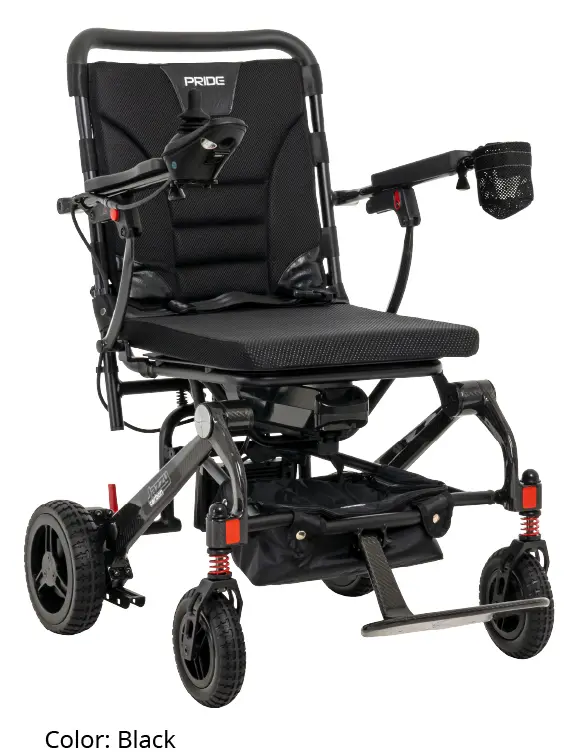
| Pride Go-Chair, 1800wheelchair | $1,776 | 300 lb | 128 lb, heaviest 36 lb | 2 x 12 V 18 Ah lead acid | Frame 5 years |
Read the table as a list of claims, not results. We did not weigh, drive or test any chair. The warranty column is shortened; the warranty section below quotes each page. The 312 W figure for the eVolt is printed on 1800wheelchair's specification tab and in the eVolt manual's technical sheet, next to a 24 V 13 Ah lithium battery; in our reading it is a watt-hour rating, and we come back to it under flying.
Two patterns stand out. First, the cheapest chairs are not the lightest: the COOLHUT page calls its chair "Lightweight" and lists "Weight: 64 lb", the Arshin lists "Weight: 71 lb", the Vive "weighs 95 pounds total", while the $899 eVolt lists 46 lb. Second, the user limits under $600 are 265 to 350 lb on the pages we read, and the Vive's is 220 lb. In the titles of the 30 electric wheelchair tiles on the Walmart.com price-sorted page, the printed capacities ran from 265 to 350 lb, plus two tiles giving 110 kg.
What the low price leaves out: weight capacity
In our view, weight capacity is the first number to check; on the pages we read, user limits under $600 ran from 265 to 350 lb, and the Vive's is 220 lb. The Vive Compact page says the steel frame "weighs 95 pounds total but holds up to 220 pounds"
. The Arshin page says "supporting up to 286 lbs" and repeats "286+ lbs" in the title. The Alton Artemis page gives "The weight capacity of this power electric wheelchair for seniors is 265 lbs."
The COOLHUT page gives "loads up to 350 lbs."
A plus sign after a capacity, as in "286+ lbs", is not a higher limit. In our reading it means the seller claims at least that figure, and the specification tab of the same Arshin page prints "Max load: 286 lb". In our view, plan on the lower number, and count what you carry: a bag on the back, shopping on the lap and a heavy coat all count toward the load.
Capacity also decides range and slope performance. Pride's Go-Chair line on 1800wheelchair gives "8.7 miles per charge at 300 lbs., 13.2 miles per charge at 200 lbs." It is the only page among the eight that ties range to the rider's weight. The other seven print range without the rider's weight; COOLHUT and Alton tie theirs to two batteries.
If your weight is near or above 300 lb, the cheap end of the market has very little for you, and the chairs built for higher loads cost more and weigh more. Our heavy duty electric wheelchair guide covers chairs rated 450 and 600 lb and Medicare's weight classes.
What the low price leaves out: range and the battery
Range on a cheap chair is printed as a round figure: 11 of the 30 electric wheelchair titles on the Walmart.com price-sorted page say "20+ Miles" (one in lowercase). The batteries behind those figures are small. On the pages we read, the battery is printed as 12 Ah at 24 volts on the COOLHUT, Alton and Reyhee pages, 10 Ah on the Vive and 13 Ah on the eVolt; Arshin prints "12Ah Lead-Acid" with a 24 V motor. By our arithmetic, 24 volts times 12 amp-hours is 288 watt-hours, 24 times 10 is 240 and 24 times 13 is 312. COOLHUT's and Alton's specification tabs print "Number of batteries: 2" without saying whether both ship with the chair; in our view, ask the seller for each battery's label.
Battery chemistry matters for weight and for flying. The COOLHUT page says its chair "is equipped with a high-quality lead-acid battery"
, and its description calls the frame "iron" and the chair "lightweight". The Arshin page says "Equipped with a premium lead-acid battery"
. The Alton page says "long lasting lithium battery"
in one paragraph and "a 12AH acid battery" in the next, and prints "Lithium Battery Capacity: 12AH"
in its short description. The Pride Go-Chair uses two 12 V 18 Ah lead acid batteries, as 1800wheelchair's specification tab prints.
Where a page claims a range of 20 miles from a 12 Ah lead-acid battery and the Pride page claims 8.7 miles at 300 lb from 18 Ah lead acid, in our view treat the higher figure with caution. None of the marketplace pages states the test conditions behind its range. In our view, plan your outings on half the printed range until you have measured your own.
Charging rules come from the documents that print them. The eVolt manual says "Only use the charger provided by the company to charge the battery."
and "When the battery is not in use, please charge it once every month (this is very important)."
The Pride Go-Chair manual says to charge new batteries for "at least 8-14 hours" during break-in. Our power wheelchair batteries guide covers charging, replacement and the FDA reports about fires.
What the low price leaves out: motors, speed and slopes
Motor power is printed loudly on cheap chairs ("500W Dual Motors Powerful" in a COOLHUT title), and the body text gives the detail. The same COOLHUT page says "equipped with 250W*2 all-copper motors"
, which adds up to the 500 W in the title; the Arshin page says "dual 2*180W silent motor system"
; the Reyhee page "Dual Brushless DC motors (24V 200W)"
. In our view, motor watts tell you little on their own. The slope limit, the speed and the brake are what you live with.
Slope limits, as printed, vary widely:
- Alton Artemis page, Walmart.com: "Climbing Ability: ≤6°".
- eVolt Traveler: 1800wheelchair's specification tab prints
"Max Climbing Angle 9 degrees"
, while the eVolt manual says"Please do not climb steep slopes with an angle of more than 12°"
, and"Please do not try to drive over steps or other obstacles above 30mm."
In our view, plan on 9. - Arshin page, Walmart.com: the description says
"effortlessly conquering 12°inclines"
. - Culver page, Walmart.com: the description says
"Climbing Ability: Less than or equal to 35 degrees."
- COOLHUT page, Walmart.com: no slope figure on the page we read.
In our view, a 35 degree figure for a 265 lb folding chair is not believable; ask the seller where it comes from. Plan on the lowest limit that applies to your chair, and if a page gives none, ask for the figure in writing. The eVolt manual adds, in its section on slope driving, "Never turn when driving on a slope"
because it is easy to cause rollovers, and "When the vehicle is going up and down, drive at a low speed."
On the pages we read, top speeds are 3.7 to 5 mph. The COOLHUT specification tab prints "Maximum speed: 4 mph" and its short description "Top speed of 3.7 mph". The Reyhee page gives 3.7 mph, the eVolt and Vive 4 mph, the Arshin "a top speed of 5 mph".
Freewheel and brakes, from the manuals
Several pages name the brake type: electromagnetic (Alton, Culver) or electro-mechanical (Reyhee), and the manuals describe a lever that releases the motors so someone can push the chair. That is where manuals print their sharpest warnings. The Pride Go-Chair manual says: "Do not disengage the drive motors when the travel chair is on an incline or decline, as the unit could roll on its own"
and "Only engage the freewheel mode when on a level surface."
The eVolt manual warns, in its section on slope driving, not to sit in the chair while it is on a slope in push mode, and to "try not to use" push mode on a slope. It also says: "we recommend that you check the brake function of the electric wheelchair before each use."
None of the four marketplace pages on Walmart.com that we read prints a freewheel warning. In our view, ask the seller for the manual before you buy, and read the freewheel and slope pages first.
What the low price leaves out: seating and fit
On the pages we read, each marketplace chair comes in one seat size. On those pages, the printed seat widths are 17 in (Arshin), 17.3, 17.5 or about 19 in (COOLHUT, in three places), 18 in (eVolt, Reyhee, Alton's tab), 18 or 17 in (Culver's tab and description), 16.5 in (Alton's own description) and 16 by 18 in (Vive). The Pride Go-Chair is offered with 18 or 20 in seats. No marketplace page we read offers a choice of seat depth or back height; COOLHUT and Alton list the arm type as "Adjustable" without saying how.
In our view, check the cushion: only the Arshin tab prints a thickness, and Vive calls its seat "thickly padded" without a figure. The Arshin specification tab prints "Seat cushion thickness: 2 in"
. The Vive page describes "Dense foam base with a breathable cover"
. The COOLHUT tab prints "Fill material: Foam". No page among the eight names a pressure-relief cushion.
In our view, a chair you will sit in for an hour at a mall is a different purchase from a chair you will sit in all day. For daily, long sitting, the seat width, depth, back support and cushion should be measured and chosen with a physical or occupational therapist, especially where there is any risk of pressure injury; that is a clinician's decision, and this guide stops there. Our wheelchair cushion guide explains the cushion types and what to ask.
Seat height decides whether you can get under a table and transfer safely. The Alton page prints "Seat height: 20.5 in"; the Vive page gives a seat-to-ground height of 20.5 in; 1800wheelchair's tab for the eVolt gives 18.5 in; 1800wheelchair's tab for the Pride Go-Chair 22 to 23 in. The Arshin tab prints "Seat height: 35 in", which matches the page's own unfolded height of 35 in; in our reading it is not the seat height, so ask the seller.
Folded size, lifting and turning indoors
A cheap chair is often bought to fit in a car, so the folded size and the weight of the heaviest piece decide whether it works for you. These are the folded sizes as printed:
| Chair | Folded size as printed | Weight as printed | Turning radius as printed |
|---|---|---|---|
| COOLHUT | 31 x 16 x 28 in | 64 lb | 20 in |
| Arshin | 25 x 12 x 26 in | 71 lb | Not printed |
| Alton Artemis | 28 x 16 x 28 in | 95 lb with battery | 33 in or 47 in |
| Vive Compact | 30 x 28.5 x 16 in, FAQ 31 x 28.35 x 16.5 in | 95 lb with battery | 47 in |
| eVolt Traveler | 31 x 25 x 13 in | 46 lb | 31.5 in |
| Pride Go-Chair | Takes apart, five pieces | 128 lb, heaviest piece 36 lb | 25.5 in or 25.4 in |
The pages disagree with themselves here too. The COOLHUT page says the chair "folds into a compact 14.1-inch width"
, gives folded dimensions of 31 by 16 by 28 in, and also prints "Wheelchair Width Folded: 27.6"
. The Vive figures are in our folding electric wheelchair guide. The Pride Go-Chair page prints a turning radius of 25.5 in in its specification tab and 25.4 in among its features. In our view, measure your car trunk and your narrowest doorway, then compare them with the larger figure.
Lifting is the hidden cost of a folding chair that weighs 62 to 95 lb in one piece, as the four Walmart.com chairs and the Vive do; the eVolt is lighter at 46 lb. The Vive page gives 95 pounds including the battery for a chair that folds; 1800wheelchair's category tile says the Go-Chair "disassembles into 5 lightweight pieces"
, with a heaviest piece of 36 lb. In our view, if one person will lift the chair into a car alone, the weight of the heaviest piece matters more than the price. Taking the battery out first helps on chairs where it lifts out; ask the seller what the battery weighs, because the pages print 5 lb (COOLHUT), 5.5 lb (Alton), 6 lb (eVolt) and 14 lb on 1800wheelchair's Go-Chair tab, which does not say whether that is per battery.
Turning radius decides whether the chair works indoors. The COOLHUT and Go-Chair pages and the LiteRider Envy tile print 20 to 26 in; the Vive and one of the Alton figures say 47 in. In our view, a 47 in radius may need a wide hallway to turn around. Mark a circle with the printed radius on the floor at home before you order, and try it with a kitchen chair.
Doorways are the other indoor limit. The overall widths printed are 24.5 in (eVolt), 26 in (Reyhee), 22.5 in (Go-Chair), 27 in or 26 in (Vive), and 26 in (Alton) and 23 in (Arshin) in their unfolded dimensions. Hands on the joystick need room as well; in our view, leave a few inches each side. Our power wheelchair vs scooter guide has more on turning space in the home.
What the low price leaves out: warranty, as each page prints it
Warranty lines disagree with each other on two of the four Walmart.com pages we read (COOLHUT and Alton). We quote each page; the shortened line in the table above is ours.
- COOLHUT (Walmart.com): the description says
"We provide a five-year warranty for the electric wheelchair."
The Warranty tab says "Eight Years Warranty". A third line promises "8 years of free customer support". The page does not say what the five- or eight-year warranty covers or who honors it, beyond an offer to "reissue new accessories" for"non-human damage to the controller, power supply and battery"
. - Arshin (Walmart.com): the specification tab says "Has written warranty: No". The description offers
"Free returns & refunds within 1–30 days"
,"Free replacements/parts within 31–90 days (condition applies)"
and"Limited support beyond 90 days"
. - Alton Mobility Artemis (Walmart.com): the description says
"We offer a one-year spare parts warranty and six months of battery warranty."
The Warranty tab says"Warranty: 3 years for Frame, 1 Year for Motor, Joystick Controller, Battery"
. - Culver (Walmart.com): the Warranty tab says
"We Give You a No Questions Asked Return Warranty for 30 Days. After 30 Days We have a Wonderful Spareparts and Repair Warranty for 1 Year."
- Vive Compact (Vive Health): the page lists a
"Five-year limited guarantee"
, then a "Guarantee Policy" of "frame - 3 years", "electrical - 1 year", "batteries - 6 months", "controller - 6 months" and"wheels - none / on arrival 30 days"
. - eVolt Traveler (1800wheelchair):
"Warranty on Frame One Year Limited"
, wearable parts and batteries "Six Months Limited". The eVolt manual's own "Warranty principle" section says repairs outside the warranty are made but"the fees are charged according to the regulations"
. - Reyhee Roamer (1800wheelchair): the specification tab on the page prints frame "Five Year Limited"; wearable parts, motor, electronics and batteries "One Year Limited".
- Pride Go-Chair (1800wheelchair): the page says "5-Year limited warranty on frame" and "13-month limited warranty" on electronics, drive motors and batteries.
In our reading, a five-year label over a one-year electrical cover, as on the Vive page, means the controller, battery and motors are covered for months, not years. Where one page prints two warranties, as COOLHUT and Alton do, in our view plan on the shorter one until the seller confirms the longer one in writing, with the name of the company that will honor it.
Walmart.com also offers paid protection plans on these pages ("3-Year Plan - $39.00" on the COOLHUT and Arshin pages). We did not read the plan terms, so we say nothing about what they cover.
Warranty transfer to a second owner is covered, document by document, in our how to buy a wheelchair guide; none of the eight pages here says anything about it.
What the low price leaves out: setup, service and parts
The difference between a $339.99 chair and a $1,776 chair is clearest after delivery. Pride's Go-Chair manual opens with: "An authorized Pride Provider or a qualified technician must perform the initial setup of this travel chair and must perform all of the procedures in this manual."
The same manual tells you to "contact your authorized Pride Provider"
for help. The marketplace chairs arrive in a box. The COOLHUT tab says "Is assembly required: N", the Alton tab "Is assembly required: Y", and the Vive FAQ says its chair "arrives partially assembled and requires you to follow a few simple steps before use."
Repairs follow the same split. The eVolt manual says "after-sales service for parts such as rear axles, controllers, chargers, etc. are limited to local service companies or the company."
The COOLHUT page offers to "reissue new accessories" for "non-human damage to the controller, power supply and battery"
and invites contact "via email". The Culver page says "Just Let Us Know What Do You Need and We will Do The Rest."
None of the four marketplace pages names a repair shop, a service network or a phone number.
Parts are the slow problem. In our view, a controller, a joystick or a charger for a branded chair usually has a part number in the maker's parts list and a dealer who can order it. For an unbranded chair, the part may exist only with the factory that made it. In our view, before you buy, ask the seller for the controller model and the charger model printed on their labels, and keep photos of both. Mobility Atlas can look for replacement parts on request, including parts not listed on our pages, and replies with a written quote; we cannot promise that a part for an unbranded chair exists.
In our view, local repair shops may be reluctant to work on chairs they did not sell. Our power wheelchair repair guide explains who repairs what, and our wheelchair repair near me guide how to find a shop.
When one page prints two different figures
On the four Walmart.com product pages we read, the same chair is described with different numbers in different places. These are the pairs we found:
| Chair | Figure | One place on the page | Another place |
|---|---|---|---|
| COOLHUT | Tires | Page text: "solid, non-marking, non-flat tires" | Spec tab: "Wheel type: Air-Filled" |
| COOLHUT | Top speed | "Top speed of 3.7 mph" | Spec tab: 4 mph |
| COOLHUT | Battery | "lead-acid battery" | "Battery Weight: 5 LBS" |
| COOLHUT | Warranty | "five-year warranty" | "Eight Years Warranty" |
| Alton Artemis | Battery | "lithium battery" | "12AH acid battery" |
| Alton Artemis | Seat width | Spec tab: 18 in | "Seat Width: 16.5" |
| Alton Artemis | Turning | "33 Inch Radius" | "Turning Radius: 47" |
| Culver | Weight | "just 62 lbs" | Spec tab: 75 lb |
| Culver | Battery | "12V 12A Lithium battery" | Spec tab: 24 V |
| Culver | Seat width | Spec tab: 18 in | Page text: 17 x 16 x 21 in |
| Alton Artemis | Top speed | Spec tab: 4 mph | "Maximum Speed: 3.7 mph" |
| Alton Artemis | Seat depth | Spec tab: 16.5 in | Description: 18 in |
| COOLHUT | Seat width | Spec tab: 17.3 in | Description: 17.5 or about 19 in |
| COOLHUT | Charging time | Spec tab: 6 h | "Charging Time: 5 Hours" |
In our view, these are signs that the listing was written by someone who has not measured the chair. When two figures differ, plan on the safer one until the seller confirms in writing: the higher weight (13 lb more for the Culver), the lower capacity, the shorter warranty, the lower slope limit. In our reading, a lead-acid battery that weighs 5 lb would be unusual, and one of those two COOLHUT lines is wrong; the page does not say which.
The Culver listing adds a brand line that reads "CULVER LED PROFESSIONAL LED LIGHTING SOLUTIONS"
, while the seller is "Culver Mobility". The Arshin seller's name on the page is "Serve every customer with care"
. In our view, write down the seller name printed next to the price, because that is who you deal with for a return, whatever the brand in the title says.
"FDA Approved" in listing titles: what the FDA records say
Is a cheap electric wheelchair FDA approved? Mobility Atlas read the federal rules and searched the FDA's databases on 12 November 2026. In our reading, powered wheelchairs are not "approved" as the listings say. Under 21 CFR 890.3860 a powered wheelchair is "Class II (performance standards)"
, and the openFDA 510(k) records we loaded show such chairs cleared with the decision "Substantially Equivalent". Device establishments also register and list their devices, and 21 CFR 807.39 says registration "does not in any way denote approval of the establishment or its products"
. Two titles on the Walmart.com price-sorted page say "FDA Approved" (Culver and Alton Mobility). Our openFDA registration and 510(k) searches under code ITI, for fifteen brand words from the two Walmart.com first pages we read, found no record; WETS, AQMD, MediNex, Morrean, Specared, Erinnyees and Ecojoy were not searched. Records name the maker, so this does not prove a chair is unlisted, but the claim is unproven.
Three different things hide behind the words people use, and in our reading the listings mix them up:
- Classification: the FDA's rule for the type of device. The eCFR text of 21 CFR 890.3860 defines a powered wheelchair as
"a battery-operated device with wheels that is intended for medical purposes to provide mobility to persons restricted to a sitting position"
and classes it as Class II. Class II is a risk class for the type, not a status for one chair. - Clearance: a 510(k) decision for a specific device from a specific applicant, with a K number. The openFDA 510(k) records we loaded print "Substantially Equivalent" as the decision.
- Registration and listing: the establishment owner's yearly filing. The FDA page on registration says it
"provides the FDA with the location of medical device establishments and the devices manufactured at those establishments."
In the FDA records we read, power wheelchairs carry a 510(k) decision of "Substantially Equivalent", not an approval. 1800wheelchair's Jazzy Air 2 tile says "Food & Drug Administration (FDA) approved"
, while the Pride Go-Chair page on the same site says more carefully "*Pride FDA Class II Medical Devices are designed to aid individuals with mobility impairments." The Reyhee Roamer page says "FDA-cleared (class II medical device)"
, which is the right word if a clearance exists.
What we found in the FDA databases
The openFDA 510(k) database held 143 records under the powered wheelchair code ITI with a decision date from 1 January 2021 to 12 November 2026 (data last updated 2 November 2026). We loaded the 100 most recent, dated 2024-06-28 to 2026-10-28. Of those 100, 89 name an applicant in China, 3 in the US, and the rest in Japan, Austria, the UK, the Netherlands, Spain and Australia. In our reading, a low-cost chair can come from a factory that holds its own 510(k) and sells to a brand that does not appear in FDA records at all.
Two records match chairs in this guide, each in a limited way:
- K200423, decided 22 September 2021,
"Electric Wheelchair (XW-LY001)"
, applicant Yongkang Dingchang Industry & Trade Co., Ltd. The Reyhee Roamer page on 1800wheelchair prints "Sku: XW-LY001". In our reading the model code matches; the record does not name Reyhee, so ask the seller to confirm that this K number covers the chair you are buying. - K250729, decided 2 July 2025,
"Power Wheelchair (MOB1107)"
, applicant Vive Health, LLC. The Vive Compact Power Wheelchair page prints "Product Number: MOB1029S", and Vive's Power Wheelchair - Foldable Long Range Transport Aid page prints MOB1029L. In our reading the clearance is for a different Vive product number; ask Vive which K number covers MOB1029S.
No record matched the COOLHUT, Arshin, Alton, Culver or other brand words in our registration searches (by proprietary name and by owner name) or in our 510(k) search (by applicant and device name). eVolt and its seller's brand line, JYD Imports, were searched in the 510(k) records but not in the registration records, with no match.
A control search in the same registration database for "jazzy" and "whill" returned listings, including WHILL's Model C2 with K213383, so the search method finds known chairs. Our searches are word searches: a chair sold under one brand can be made and listed under a factory name we cannot guess.
How to check a chair yourself
- Ask the seller, in writing, for the 510(k) number (a K followed by six digits) and the name of the manufacturer on the chair's label.
- Look the K number up in the FDA's 510(k) database and check that the device name and model code match the chair.
- Look up the manufacturer in the FDA's registration and listing database under the product code ITI.
- Search the FDA recall database for the brand and the manufacturer.
In our view, a seller who cannot give a K number or a manufacturer name for a power wheelchair has told you something useful about after-sales service as well.
FDA reports and recalls that name these brands
A word search of the openFDA adverse event (MAUDE) database on 12 November 2026 for fifteen brand words from the two Walmart.com first pages (the same list), plus eVolt and Reyhee, returned 12 reports. Ten concern other devices that share a word (Alton Dean surgical devices, an Evolt heart valve catheter). Two are filed under the powered wheelchair code ITI, both voluntary reports from 2025:
- A report received 11 February 2025 names a "VERPAL MOBITY SCOOTER" with the manufacturer field
"ANHUI JBH MEDICAL APPARATUS CO., LTD."
It states the reporter"BROUGHT THE DEVICE FROM AMAZON"
and that"THE DEVICE DID NOT WORK WELL"
. - A report received 16 April 2025 names a "CULVER COUGAR" folding mobility scooter. The reporter states that the company
"WILL NOT HONOR THE 1 YEAR WARRANTY"
and that the throttle sticks and the brakes do not stop in time. The report is unverified, its manufacturer field reads "UNKNOWN" and the seller's name is redacted. It is a scooter, not the Culver wheelchair in this guide.
These are reports, not facts about a model and not rates. The FDA's own page on the MAUDE database calls it a "passive surveillance system"
with "under-reporting of events, inaccuracies in reports, lack of verification that the device caused the reported event"
. A chair with no reports is not a chair with no problems.
A search of the openFDA recall records under code ITI, in the recalling firm field, for the same brand words, plus JYD, Reyhee and Vive, returned no matches. Our electric wheelchair guide reads the FDA reports across power chairs and add-ons, and our used wheelchair guide explains how to look up a recall by model and serial number.
"Airline approved" and the battery: what the FAA page says
Two electric wheelchair tiles on the Walmart.com price-sorted page put airline words in their titles ("Airline Approved" and "Aviation Travel"), a transport chair tile says "Airplane Approved", and six of the eight product pages we read mention air travel; the Arshin and Reyhee pages do not. In our reading, the FAA PackSafe page sets battery limits, does not approve chairs, and leaves acceptance to each airline.
For a chair with a lithium-ion battery, the FAA page says "Lithium ion battery size is limited to 300 watt hours (Wh)"
where the battery must be removed, and allows "One spare battery not exceeding 300 Wh or two spare batteries not exceeding 160 Wh each"
in carry-on baggage. It also says "Individual airlines may have more restrictive rules regarding the acceptance of any dangerous goods, including lithium batteries that power mobility aids."
Chairs with batteries the FAA page calls "nonspillable (gel cell, absorbed electrolyte)"
fall under a different FAA entry.
This is where the eVolt Traveler is a lesson. 1800wheelchair's page says "Battery is Airline approved"
. Its own specification tab prints the battery as "24V 13Ah , 312 W", and in our reading that 312 is watt-hours, 12 over the 300 Wh the FAA page names for a removed battery. The same page adds: "Airline approval of this product is dependent on using the original manufacturer’s battery only."
In our view, before you book, ask the seller for the battery's label (volts, amp-hours and watt-hours), and send it to the airline.
Vive's FAQ says its chair "is TSA-approved". In our reading, that label settles nothing about the battery: the FAA page tells passengers to contact the airline. For the full rules, chair by chair, see our folding electric wheelchair guide and our flying with a power chair guide.
Returns and restocking fees
Returns are where a cheap chair can become expensive. A folding power chair weighs 46 to 95 lb on the pages we read and ships in a large box; the return terms decide who pays to send it back and how much you lose.
| Seller | Window as printed | Fee as printed | Who pays return shipping |
|---|---|---|---|
| 1800wheelchair, eVolt page | 30 days; start in 14 | 10% | Customer |
| 1800wheelchair, Go Chair page | 90 days from shipping | 25% | Customer |
| Vive Health | 30 days | 20% on items of 20 lb or more | Customer |
The Walmart.com returns page says "In most cases, you have 90 days"
and lists "30 days" for "Most marketplace sellers". The COOLHUT and Arshin product pages print "Free 90-day returns" next to the price, and the Alton and Culver pages "Free Holiday returns until Jan 31"
. In our reading, the line on the product page is the promise for that listing; take a screenshot of it when you order. The Walmart.com returns page also has a "Healthcare exceptions" panel that did not open for us, so check the window for a wheelchair with Walmart before you order.
Restocking fees, applied to the listed price by our arithmetic: 25 percent on the $1,776 Go-Chair is $444; 10 percent on the $899 eVolt is $89.90; 20 percent on the $849.99 Vive is $170. On the $1,070 Reyhee, 1800wheelchair's general 10% to 30% range would be $107 to $321. Return shipping comes on top.
The conditions matter as much as the fee. 1800wheelchair's eVolt tab says "Return process must be initiated within 14 days of invoice date"
and that the product "must be unused, clean, and free of damage"
, with "a higher restocking fee may apply (up to 20%)"
if damaged. Vive's policy says "Purchase must have been made directly with Vive Health"
, that "All returns must be made inside product's warranty window"
, and that the issue "must be confirmed with a Vive Health product expert using photos or videos"
. SpinLife's general page says the product's own Return Tab decides; we did not read SpinLife product tabs. The general policies of Walmart.com, 1800wheelchair and SpinLife are compared in our how to buy a wheelchair guide.
In our view, this means: do not drive a new chair outdoors until you are sure you will keep it. Unbox it carefully, keep every piece of packaging, test it indoors on a clean floor, check the seat width and the folded size against your car trunk, and decide within the first days.
Buying online versus from a dealer
Should I buy an electric wheelchair online or from a dealer? Mobility Atlas read the pages of four online sellers and two makers' manuals, and the answer depends on how much of the work you can do yourself. We did not read local dealer prices. Online, the cheapest chair on the Walmart.com page we read was $269.14, and Pride's Go-Chair was $1,776 at 1800wheelchair and SpinLife. A dealer adds setup, adjustment and repairs, and for Pride the manual expects them: it says an authorized Pride Provider or a qualified technician "must perform the initial setup"
. Online, you assemble, adjust and charge the chair. Return terms online can cost money: 10% to 30% at 1800wheelchair, 20%-25% at SpinLife, 20% at Vive Health for heavy items. In our view, buy online when you can assemble a chair, judge the fit, and live with mail-order repairs; buy from a local dealer when you need fitting, a test drive, or someone to call when it stops.
Some online sellers stand between the two. SpinLife and 1800wheelchair sell, among others, chairs from Pride and Golden Technologies, and Pride's manual for the Go-Chair expects setup by an authorized Pride Provider or a qualified technician; in our view, ask the shop or Pride for the nearest authorized Pride Provider before you buy. A marketplace listing on Walmart.com is a third kind of shop: the "Sold by" line names the business you deal with, which may be the brand itself or a reseller. The Go-Chair owner's manual also carries the caution "Federal law restricts this device to sale by or on the order of a physician"
[...] "(US only)"; in our view, ask the seller how it applies before you order. Our how to buy a wheelchair guide explains prescription-only chairs.
The same applies to Medicare. If you hope Medicare will pay, in our reading buying online first is the wrong order, as the next section explains. Our how to buy a wheelchair guide compares five places to buy, from Medicare suppliers to used stock.
Mobility Atlas can find and quote an electric wheelchair for you, including models, batteries and parts that are not listed on our pages. The process: you send an enquiry or a part request, we reply with a written quote that includes delivery to your country, and nothing is charged before you accept it.
Medicare and a cheap electric wheelchair
Medicare.gov says "Part B covers power wheelchairs and scooters only when they're medically necessary"
and that a "face-to-face examination and a written prescription from a treating provider"
come first; Medicare "will only pay for DME items if you get them from suppliers who are enrolled in Medicare."
The CMS rule for power mobility devices, LCD L33789 in the version in effect when we read it (effective 1 October 2025 to 19 December 2026), requires among other things that "the beneficiary will use it in the home"
. In our reading, a chair bought online for outings will not be paid for; Medicare.gov's wheelchairs and scooters page is in our sources, and our power wheelchair vs scooter guide quotes the rule.
The 1800wheelchair page for the Go-Chair prints "HCPCS K0899". That is a billing code chosen by the maker or seller, not a statement that Medicare will cover the chair for you. For Medicare Advantage, Medicaid or the VA, ask the plan.
Delivery day: the first checks the manuals list
The documents we read print a short list of things to do before the first ride. In our view, do them in this order and stop at the first problem:
- Check the box against the parts list. The Pride manual says to contact the provider
"If you do not receive a complete delivery"
; for a marketplace chair, photograph damage before you sign or unpack further. - Charge fully before first use. The eVolt manual says
"Install the electric wheelchair and fully charge it before using it for the first time."
- Read the freewheel section and try the release lever with the power off, nobody seated, on level ground. The Pride manual, in its explanation of the safety labels on the chair, says
"Place unit on level ground and stand to one side when changing from drive mode to freewheel mode"
, and also"You must turn off the power before disabling the drive systems"
; the eVolt manual says to move the chair to "a safe flat area" and to turn off the power on the control panel before pulling the clutch. - Check the brakes before you drive, as the eVolt manual recommends "before each use".
- Start at the slowest speed. The eVolt manual says
"please start at a slow speed and slowly increase until you feel the speed."
- Check the seat width, the footrest height and the folded size against your car trunk, while the chair is still returnable.
Weather limits are printed on several pages. The eVolt manual says "Do not rinse the electric wheelchair with water"
and "Do not drive the car in bad weather (ie heavy rain or heavy snow)"
. The Pride Go-Chair manual says to keep the chair "between the temperatures of 18°F (-8°C) and 122°F (50°C)"
.
If you travel in a car or van, the chair is not a car seat. The Pride manual says the travel chair is not "suitable for use as a seat in any vehicle"
. In our view, transfer to a vehicle seat, fold the chair, and secure the frame and the removed battery separately in the trunk or cargo area, never loose on the floor.
Cheaper ways to the same goal
A new cheap electric wheelchair is not the only low-cost route, and for some people it is not the best one. In our view, look at these first:
- A mobility scooter, if you can sit upright, steer with a tiller and transfer on your own. Our power wheelchair vs scooter guide and travel mobility scooter guide compare them.
- A power add-on for a manual chair you already use and that fits you. Our power add-ons guide covers them.
- A used branded chair from a dealer, with a warranty of its own. Our used wheelchair guide explains what to inspect and where reuse programs are.
- A rental for short needs. Our wheelchair rental guide runs the rent or buy arithmetic.
And for some people the cheapest chair overall is the one Medicare or another plan pays for, through a supplier, after the doctor's visit. That route is slower and has rules, but it also brings repairs for rented equipment: the Medicare booklet says "If you rent equipment, your supplier must maintain and repair the equipment"
, and also "If you own your equipment, the supplier who sold it to you isn't required to repair it."
Three traps
Trap one: buying the title, not the specification tab. Titles on the Walmart.com page we read say "Lightweight", "20+ Miles", "500W" and "Airline Approved". Read past the title and the same pages give chair weights of 64, 71 and 95 lb, 12 Ah batteries described as lead-acid on two of them, and two 250 W motors behind COOLHUT's 500W. Read the tab, and where the page disagrees with itself, take the safer number.
Trap two: assuming the warranty is the brand's. On a marketplace listing the warranty is whatever the seller printed, sometimes two different ones on the same page, and the Arshin tab says "Has written warranty: No". A voluntary FDA report from 2025 about a scooter sold as Culver Cougar states that the company would not honor a one-year warranty; the report is unverified, its manufacturer field reads "UNKNOWN" and the seller's name is redacted. Ask who honors the warranty, in writing, before you pay.
Trap three: treating "FDA Approved" as a safety check. Powered wheelchairs are Class II devices, in the FDA records we read cleared by 510(k), registration is not approval under 21 CFR 807.39, and our searches found no FDA record for fifteen brand words from the two Walmart.com first pages we read. Ask for the K number and look it up.
Three composite scenarios
These are composite scenarios, not individual customers. Each one uses only the documents of the chair it names.
Scenario one: a $319 chair for trips to the park. A person who walks short distances indoors weighs 200 lb and wants a chair for outings with family. They look at the Arshin chair on Walmart.com at $319.00. The page gives "Max load: 286 lb", "Weight: 71 lb", a 12 Ah lead-acid battery, "Has written warranty: No" and free returns and refunds within 30 days. In our view the chair can fit this use if someone at home can lift 71 lb into a car, and if the person tests it indoors in the first days and keeps the box. They write down the seller name printed on the page and screenshot the return line.
Scenario two: a chair that must fly. A person plans two flights a year and looks at the eVolt Traveler at $899 on 1800wheelchair, drawn by the 46 lb weight and "Battery is Airline approved"
. The specification tab prints "24V 13Ah , 312 W". The flying section above explains why that figure matters. In our view they should send the battery label to the airline before buying, ask 1800wheelchair whether a smaller battery exists for this chair, and note the 10% restocking fee and the 14-day window to start a return.
Scenario three: a chair for all day. A person who now sits most of the day looks at the Pride Go-Chair at $1,776 on 1800wheelchair. The page offers 18 or 20 in seats, a 300 lb limit, a 13-month warranty on electronics, motors and batteries, and a manual that requires setup by an authorized Pride Provider or a qualified technician. In our view, for all-day sitting, the seating assessment comes before the purchase, and a physical or occupational therapist decides the seat size and cushion; if Medicare is meant to pay, the doctor's visit and an enrolled supplier come first.
What to ask the seller before you pay
In our view, send these questions in writing and keep the answers with your order:
- What is the maximum user weight for this exact chair, and is it the same on the label?
- What does the chair weigh with the battery, and what is the heaviest piece to lift?
- What is the battery: chemistry, volts, amp-hours and watt-hours as printed on its label? Can I buy a spare, and from whom?
- What is the maximum safe slope in the manual, and can you send the manual before I order?
- Who honors the warranty, for how long on the frame, the motors, the controller and the battery, and how do I make a claim?
- Who repairs the chair near me, and where do replacement parts come from?
- What is the 510(k) number and the manufacturer named on the chair's label?
- What is the return window, the restocking fee, and who pays return shipping? Does a test drive indoors count as use?
- Which seat widths are available, and what is the seat-to-floor height?
For a chair meant for daily, long use, add questions for the physician, physical therapist or occupational therapist: which seat size and cushion fit, whether a power chair or a scooter suits, and whether a seating assessment is needed before you buy.
Sources and documents
Method. Prices are copied from the sellers' pages on 12 November 2026, in US dollars, before tax and with the labels as printed; ranges, medians and counts are computed by script over each tile's current price on the named page, leaving out "Options from" lines, with the tiles we left out named in the text. Product facts come from each product page and, for the eVolt and the Pride Go-Chair, from the manuals that 1800wheelchair links. FDA facts come from the eCFR, an FDA page and openFDA queries run on 12 November 2026; the openFDA data were last updated on 2 November 2026 (registration and 510(k)) and 4 November 2026 (adverse events). Medicare, CMS, FAA and MAUDE background pages were read on 9 November 2026. We read the documents ourselves and did not test any chair.
Prices checked November 2026: Walmart.com, 1800wheelchair, SpinLife and Vive Health, all read on 12 November 2026. Prices change daily, differ by color, size, seller and delivery address, and include no sales tax.
Documents checked November 2026: product pages and manuals read on 12 November 2026; Medicare.gov, the Medicare booklet, CMS LCD L33789, the FAA PackSafe page and the FDA MAUDE page read on 9 November 2026.
Every page we used is listed below with its read date. A source list is not an endorsement of any seller or product.
This article is general information. Rules and prices differ by country and change, so confirm them before you buy or travel.
Common questions
What is the cheapest electric wheelchair for sale?
On the Walmart.com electric wheelchair page sorted by price on 12 November 2026, the lowest printed price was $269.14 for an unbranded folding chair, some listings adding shipping. Among chairs sold by medical retailers, the eVolt Traveler was $899 at 1800wheelchair, and Vive Health listed its Compact Power Wheelchair at $849.99. Prices differ by seller, color, shipping, tax and funding, and the cheapest chair is only cheapest within the pages we read.
Are cheap electric wheelchairs safe?
In our view, some can serve light use on level ground, but the pages we read show lower weight limits, small batteries, slope limits of 6 to 12 degrees where printed (one page claims 35), and figures that disagree on the same page. Ask for the manual before you buy and read the slope and freewheel sections. For all-day use, a physical or occupational therapist should assess seating first.
Is an electric wheelchair from Walmart FDA approved?
Powered wheelchairs are Class II devices; in the FDA records we read they reach the US market by 510(k) clearance, and 21 CFR 807.39 says registration "does not in any way denote approval"
. Our openFDA searches for fifteen brand words from the two Walmart.com first pages we read found no registration or 510(k) record. Ask the seller for the K number and the manufacturer on the label, and look them up.
Can I take a cheap electric wheelchair on a plane?
It depends on the battery and the airline. The FAA page limits a removed lithium-ion battery to 300 Wh and says airlines may have more restrictive rules; lead-acid chairs fall under different entries. A seller's "airline approved" is a claim, not an approval. Send the battery label to the airline before you book.
Will Medicare pay for an electric wheelchair I buy online?
In our reading, not for a chair bought on your own. Medicare.gov says Part B covers power wheelchairs only when medically necessary, after a face-to-face examination and written prescription, and pays only enrolled suppliers; the CMS rule requires that the chair be used in the home. See the doctor and an enrolled supplier first.
Can I return an electric wheelchair if it does not suit me?
Usually, at a cost. 1800wheelchair lists 10% on the eVolt and 25% on the Go-Chair, with return shipping on the customer; SpinLife charges 20%-25% on power chairs; Vive Health charges 20% on items of 20 lb or more and requires a purchase made directly with Vive. Walmart.com gives most marketplace sellers 30 days, but the listings we read printed 90-day or holiday returns. Keep the box and test indoors.
Sources
- Walmart.com (US): Electric wheelchairs category sorted by price, low to high, first results page (read 12 November 2026)
- Walmart.com (US): Electric wheelchairs category, default first results page (read 12 November 2026)
- Walmart.com (US): COOLHUT Electric Wheelchair for Seniors, 500W, product page (read 12 November 2026)
- Walmart.com (US): Arshin Electric Wheelchair Lightweight Foldable, product page (read 12 November 2026)
- Walmart.com (US): Alton Mobility ARTEMIS electric wheelchair, product page (read 12 November 2026)
- Walmart.com (US): Culver Electric Power Wheelchair, product page (read 12 November 2026)
- Walmart.com: Returns (read 12 November 2026)
- 1800wheelchair (US): Lightweight Electric Wheelchairs and Motorized Wheelchairs (Folding / Portable), first load (read 12 November 2026)
- 1800wheelchair (US): eVolt Traveler Power Chair, product page with specifications and returns (read 12 November 2026)
- eVolt power chair manual (TW121 Instruction Manual), PDF linked by 1800wheelchair (read 12 November 2026)
- 1800wheelchair (US): Reyhee Roamer Electric Foldable Wheelchair, product page (read 12 November 2026)
- 1800wheelchair (US): Pride Go Chair, product page (read 12 November 2026)
- Pride Mobility: Go-Chair owner's manual, PDF linked by 1800wheelchair (read 12 November 2026)
- 1800wheelchair: Returns, Shipping and Exchanges (read 12 November 2026)
- SpinLife (US): Folding Power Wheelchairs, sorted by price (read 12 November 2026)
- SpinLife (US): Travel / Portable Power Wheelchairs, sorted by price (read 12 November 2026)
- SpinLife (US): Full Size Power Wheelchairs (read 12 November 2026)
- SpinLife: Return Policy (read 12 November 2026)
- Vive Health (US): Compact Power Wheelchair, product page (read 12 November 2026)
- Vive Health (US): Power Wheelchair - Foldable Long Range Transport Aid, product page, MOB1029L (read 12 November 2026)
- Vive Health: Shipping and Return Policy (read 12 November 2026)
- eCFR: 21 CFR 890.3860 Powered wheelchair (up to date as of 11/09/2026, read 12 November 2026)
- eCFR: 21 CFR 807.39 Misbranding by reference to establishment registration (read 12 November 2026)
- FDA: Device Registration and Listing (content current as of 09/30/2025, read 12 November 2026)
- openFDA: 510(k) records, product code ITI, decision dates from 2021 (read 12 November 2026)
- openFDA: registration and listing, 510(k), adverse event and recall searches for brand words (read 12 November 2026)
- FDA: About the Manufacturer and User Facility Device Experience (MAUDE) database (read 9 November 2026)
- FAA PackSafe: Wheelchairs and Mobility Devices (last updated 1 May 2024, read 9 November 2026)
- Medicare.gov: Wheelchairs and scooters (read 9 November 2026)
- Medicare: Medicare Coverage of Durable Medical Equipment and Other Devices, CMS Product No. 11045 (read 9 November 2026)
- CMS: LCD L33789 Power Mobility Devices (version effective 1 October 2025 to 19 December 2026, read 9 November 2026)
Read on . The wording of the article is our own.