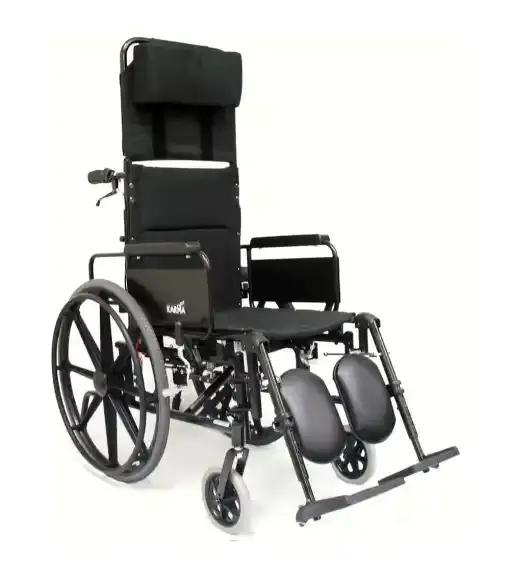
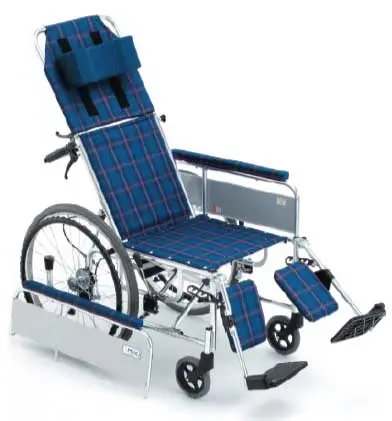
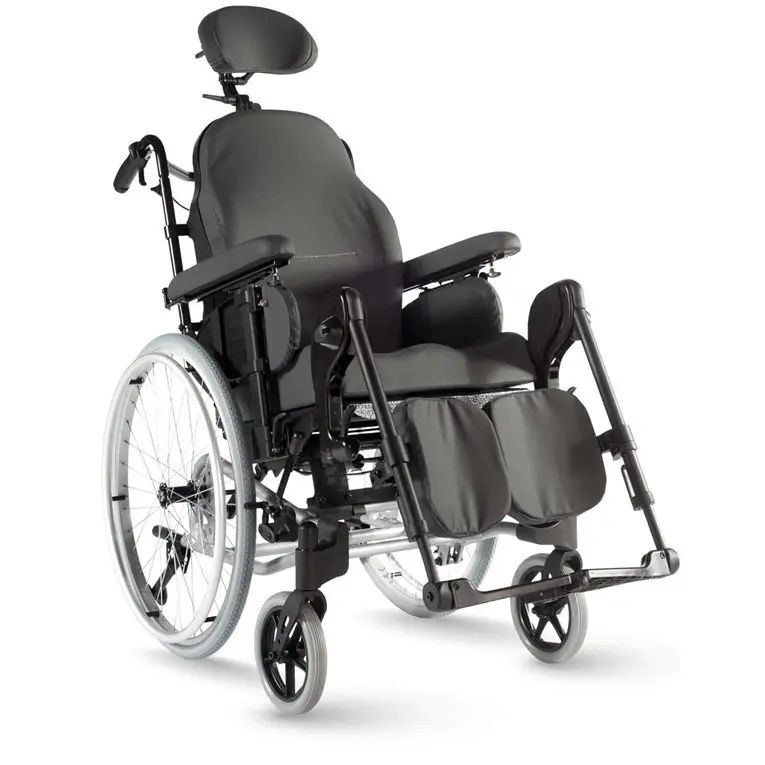
Reclining wheelchair guide 2026: full and semi recliners, high backs, elevating leg rests, prices, Medicare E1226 and safe use
Full and semi reclining wheelchairs from Drive, Medline, Invacare and Karman, compared from their own documents: recline range, capacity, safe use, prices and Medicare codes.
Contents
- The short answer
- Full recline, semi recline and high back: the words on the listings
- Recline or tilt: the short version
- How we compared
- The manual reclining wheelchairs at a glance
- Drive Medical: Viper Plus GT and Deluxe Sentra
- Medline: Guardian Recliner and the MDS808 reclining chairs
- Invacare: Tracer SX5 Recliner and 9000 XT Recliner
- Karman: KM-5000 and MVP-502
- Recline range: what the degree numbers mean
- Weight, capacity and seat width
- Elevating leg rests, headrests and high backs
- Reclining safely: what the manuals say
- Ramps, slopes and anti-tippers
- Riding in a vehicle
- Care, inspection and parts
- Warranty, document by document
- What reclining wheelchairs cost in November 2026
- Does Medicare cover a reclining wheelchair?
- Billing codes on maker pages are not coverage
- Recall records and what they show
- Three traps
- Three composite scenarios
- What to ask the therapist and the supplier
- Sources and documents
- Common questions
- Sources
The short answer
A reclining wheelchair is a manual wheelchair whose backrest can be let down from upright toward lying flat while the seat stays level, usually with a headrest on a tall back and elevating leg rests at the front. Sellers also call it a high back wheelchair or a full recliner. People also search for a rolling positioning wheelchair, and our own catalog files recliners under positioning and special-function chairs, though none of the maker documents we read uses that phrase. This guide compares the manual reclining wheelchairs that Drive Medical, Medline, Invacare and Karman publish, using their own product pages, brochures, manuals and warranty texts, plus three large US sellers and the Medicare documents that decide whether the back is paid for.
Four facts decide most choices. First, how far the back really goes down: the documents print ranges from 90 to 140 degrees on some chairs to 90 to 180 degrees on others, and Medicare codes the two kinds differently. Second, who will work the chair: the Invacare and Medline manuals we read say a recliner must be operated by a healthcare professional or an assistant whenever it is reclined, so a recliner is a chair for a person and a helper together. Third, weight: the chairs in our table weigh from about 36 lb to more than 50 lb before leg rests, and carry from 250 lb to 450 lb as printed. Fourth, money: a manual fully reclining back (E1226) is covered by Medicare only for two needs written in the rules, which this guide quotes in full.
This guide does not choose a chair for anyone. Whether a person should sit reclined, for how long and at what angle, and whether tilt would suit them better, are decisions for their physician and an occupational or physical therapist who has seen them sit. We explain the options, the documents and what to ask, and stop there.
Mobility Atlas earns a fee or margin when you order through us; the comparison below uses only the makers' published documents, seller pages and government files, each with the date we read it. Ask us to find a model, or request a quote.
Full recline, semi recline and high back: the words on the listings
Listings use several names for chairs that are close cousins, and the names do not always mean the same thing from one seller to the next.
- Full reclining wheelchair: a chair whose back goes down to, or near, lying flat. Drive's page for the Viper Plus says its
"Hydraulic reclining mechanism allows for adjustments up to 180°"
, and Invacare's brochure gives the Tracer SX5 Recliner a"Dynamic range of recline from 90˚ to 180˚"
. - Semi reclining wheelchair: a chair whose back stops well short of flat. The Medline brochure we read gives its MDS808 reclining chairs
"Infinite position reclining from 90°–140°"
. Medicare's policy article has a separate code for this kind of back (E1225, explained below). - High back wheelchair: a chair with a taller back and usually a headrest extension. Drive's Viper Plus page lists a back height of 23 inches, or 33 inches with the headrest; Karman's KM-5000 page lists a back height of 33 inches. Not every high back chair reclines, so check the listing for a recline range.
- Reclining transport chair: a recliner with small rear wheels, pushed by a helper. Karman sells transport versions of the KM-5000 and MVP-502 (the TP models), and its warranty table lists them.
- Tilt-in-space chair: a different design in which the whole seat and back rotate together. It is covered in its own guide; see the next section.
What is a reclining wheelchair? It is a manual wheelchair whose backrest a helper lowers and raises while the seat stays flat, usually with a headrest and elevating leg rests. Mobility Atlas read the makers' documents for eight recliners from Drive, Medline, Invacare and Karman in November 2026, and the stated ranges differ: Medline's brochure gives its MDS808 chairs 90 to 140 degrees, Karman prints 90 to 163 degrees for the KM-5000 and 93 to 160 for the MVP-502, Invacare prints 90 to 180 degrees for the Tracer SX5 Recliner, and Drive's Viper Plus and Sentra pages say up to 180 degrees. The chairs weigh about 36 to 53 lb and are rated 250 to 450 lb as printed (Drive's Sentra sheet says 300 lb where its page says 450). Invacare's and Medline's manuals say a recliner must be operated by a healthcare professional or assistant whenever it is reclined, with both wheel locks on and anti-tippers fitted. A therapist decides whether reclining suits the person.
Recline or tilt: the short version
A recliner opens the angle between the back and the seat. A tilt-in-space chair keeps that angle and rotates the whole seat backward. Medicare's manual wheelchair article defines a tilt-in-space base (E1161) by the "Ability to tilt the frame of the wheelchair greater than or equal to 20 degrees from horizontal while maintaining the same back to seat angle"
, which is exactly the difference.
The two designs answer different needs, and some chairs do both. Our tilt-in-space and reclining wheelchair guide covers tilt, power tilt and power recline, the RESNA position paper and several hundred FDA reports in depth. This guide goes deeper on the manual reclining chair itself: the models, their recline ranges, the attendant steps in the manuals, the leg rests, prices and the Medicare codes E1225, E1226, E0990 and K0195. Which design a person needs is a question for their therapist.
For manual chairs in general, including standard, hemi, lightweight and heavy duty bases and their K codes, see the Mobility Atlas manual wheelchair guide. For chairs pushed only by a helper, see the transport wheelchair guide.
How we compared
We read every document on 9 November 2026 (one Drive search page on 10 November) in a browser and saved the text, with the address and the read date, before writing. For Drive Medical: the US product pages for the Viper Plus reclining wheelchair (item PLA416RBDDA) and the Deluxe Sentra Full Reclining Wheelchair (item STD22RBDDA), the two-page owner's sheet for the Viper Plus GT, the owner's sheet for the Sentra Full Reclining Wheelchairs and the Sentra parts diagram. For Medline: its brochure page covering the Guardian recliners and the MDS808 reclining chairs, and its user guide PIC-00270 for the K1 to K4 Guardian chairs and the Guardian Recliner, both as hosted by the seller Vitality Medical. For Invacare: the Tracer SX5 and 9000 XT brochures (both Rev. 04/14) and the Tracer SX5 user manual, Part No. 1110550 (2016). For Karman: the KM-5000 and MVP-502 product pages, the manual Karman links as the KM-5000 manual, and Karman's warranty policy page.
For prices we read three large US sellers on the same day: the 1800wheelchair category "High Back Reclining Wheelchairs"
, the SpinLife category "Recliner & Tilt" and the first results page of a Vitality Medical search for "reclining wheelchair", plus two product pages (the Excel recliner on 1800wheelchair and the Guardian recliner on Vitality). Karman prints its own prices on its pages; Drive's pages say "SIGN IN TO VIEW PRICE".
For rules we read the CMS Medicare Coverage Database: LCD L33792 Wheelchair Options/Accessories (the version in effect from 1 October 2025, and the future version posted for 20 December 2026), its policy article A52504 (the version in effect from 1 October 2025, ending 19 December 2026), LCD L33788 Manual Wheelchair Bases and its policy article A52497 (both effective 1 October 2026), plus Medicare.gov's wheelchair page and Medicare's equipment booklet. For safety records we ran a word search of FDA recall records for mechanical wheelchairs through openFDA. Everything here is United States law or practice unless we say otherwise.
We did not test any chair. Specs are the makers' or the sellers' own; where two documents differ we give both. Our own advice is marked as our view, and our reading of a rule as our reading.
The manual reclining wheelchairs at a glance
One row per chair, as its own document prints it. Where a seller page is our only source for a figure, the row says so. Recline is the stated back angle range; weight is the chair without leg rests where the document says so.
| Chair (maker) | Recline as printed | Capacity as printed | Chair weight as printed | Maker's code on the document |
|---|---|---|---|---|
| Viper Plus GT (Drive) | Up to 180° | 300 lb | 47 lb | K0004, E1226-1 |
| Deluxe Sentra, 22 in (Drive) | Up to 180° | 450 lbs (page) | Not printed | K0001 or K0002+E1226 |
| Guardian Recliner (Medline) | Up to 180° (brochure) | 300 lbs | Not printed | K0006+E0990+E1226 |
| MDS808 recliner, 16 to 20 in (Medline) | 90° to 140° | 300 lbs | 52 lbs (1800wheelchair page, MDS808450) | K0003+E0966+E1225 |
| Tracer SX5 Recliner (Invacare) | 90° to 180° | 250 or 300 lb | 53 lb w/o rigging | K0003/K0006 & E1226 |
| 9000 XT Recliner, 9RC (Invacare) | 95° to 175°, +/- 5° | 250 lb | 42 lb w/o rigging | K0004 & E1226 |
| KM-5000 (Karman) | 90° to 163° | 250, 300, 350 lb | 36 or 38 lb w/o riggings | K0004, E1226, E0966 |
| MVP-502 (Karman) | 93° to 160° | 250 lbs | 36 lbs w/o riggings | K0003, E1226 and others |
The codes in the last column are the makers' own suggestions; a later section explains why they are not a promise of coverage, and where, in our reading, a few of them do not match Medicare's own definitions. The Sentra page prints no recline start angle, and the Viper Plus page none either; both say up to 180 degrees.
Drive Medical: Viper Plus GT and Deluxe Sentra
Drive's Viper Plus reclining wheelchair comes in 16, 18 and 20 inch seat widths with desk or full arms. The page for item PLA416RBDDA lists a product weight of 47 lb, a weight capacity of 300 lb, a seat-to-floor height of 17.5 to 19.5 inches and a back height of 23 inches, or 33 with the headrest. Among the features it lists: "Hydraulic reclining mechanism allows for adjustments up to 180°"
, a "Spreader bar acts as a back stabilizer and a convenient push handle for the attendant"
, attendant wheel locks, and "Comes standard with swing-away elevating leg rests"
. It also says the "Offset rear wheel position adds additional stability"
in the reclined positions; that is Drive's claim.
Drive's two-page sheet for the Viper Plus GT covers wheel locks, tires, casters, leg rests, folding and a warning list, and prints "WEIGHT CAPACITY: 300 LBS". It does not give step-by-step recline instructions; the words reclining and recline appear only in the chair's name on the sheet as we read it. If you buy one, in our view ask the supplier to show every helper how the release works before the first use.
The Deluxe Sentra Full Reclining Wheelchair page we read is for the 22 inch model, STD22RBDDA. It lists a weight capacity of 450 lbs, a seat-to-floor height of 21 inches and a back height of 23 or 33 inches, and among its features "Hydraulic reclining mechanism allows for infinite adjustments up to 180°"
, "Rear anti-tippers standard"
and a "Headrest extension with cushioned head immobilizer standard"
. The owner's sheet linked from that page is a general sheet for all Sentra Full Reclining Wheelchairs, and its capacity label reads 300 lbs. The two figures differ; in our view plan on 300 lb until Drive confirms the 22 inch model's rating in writing.
The Sentra parts diagram linked from the same page, dated 07/31/2026, lists 92 part lines, including left and right reclining pistons, recline release levers and a cable. On 23 of those lines the footnote mark says "The part is no longer available"
, and 7 more carry the mark "When stock is gone the part is no longer available"
. In our view that is worth knowing before you buy a used or older Sentra: ask the supplier which recline parts can still be ordered.
Drive's site search for "reclining wheelchair", read on 10 November 2026, also lists a pediatric Viper Plus, the ProBasics reclining wheelchairs, the Roscoe R-Series recliners and an HD Silver Sport Reclining model; we did not read their documents, so they are not in our table. Drive prints no public price on its pages: they say "SIGN IN TO VIEW PRICE".
Medline: Guardian Recliner and the MDS808 reclining chairs
Medline's brochure page that we read shows two reclining families. The Guardian recliners, items KR168N21E, KR188N21E, KR208N21E and KR188N11E, are listed with "Infinite position reclining up to 180°"
, a weight capacity of 300 lbs, seats of 16, 18 or 20 by 18 inches, elevating leg rests and the code line K0006+E0990+E1226. The MDS808 reclining wheelchairs (MDS808350 to MDS808650) are listed with "Infinite position reclining from 90°–140°"
, a "Durable carbon steel frame"
, 300 lbs capacity, 17 inch seat depth, and codes that use E1225 for the 16 to 20 inch chairs and E1226 for the 22 inch one.
The sellers' pages do not always match the brochure. Vitality Medical's Guardian page says "Reclines 90 to 140 degrees"
, where the Medline brochure says up to 180. 1800wheelchair sells MDS808450 as the Excel Reclining Wheelchair, brand Medline; its Details tab says "Recline range: 90 - 140°" and "250 lb. weight capacity", while its Specifications tab on the same page lists "300 lbs., 350 lbs." and the Medline brochure lists 300 lbs. In our view treat the Guardian as a chair whose stated range needs confirming, and plan on 250 lb for the Excel until Medline confirms the rating for your size in writing.
Medline's user guide PIC-00270 covers the K1 to K4 Guardian chairs and the Guardian Recliner, and it is one of the two most detailed recliner texts we read. It gives one capacity for the whole family: "DO NOT exceed the weight capacity 300 lbs (136 kg)."
Its recliner section has warnings, steps to recline and to bring the back upright, and a rule for faults, all quoted in the safety section below. It also says to "Make sure the stabilizer bar is securely attached BEFORE using the wheelchair"
, a bar between the back canes that recliner models carry.
The guide prints the warranty as a lifetime frame warranty for the original purchaser and one year on parts and upholstery. Vitality's page lists "1 Year on Parts, Lifetime on Frame and Welding". 1800wheelchair's Excel page lists a lifetime limited frame warranty and, in two different rows, a six-month and a one-year term for other parts; ask Medline or the seller which one applies to your chair.
Invacare: Tracer SX5 Recliner and 9000 XT Recliner
Invacare's Tracer SX5 brochure (Form No. 11-225, Rev. 04/14) describes the Tracer SX5 Recliner as a lightweight manual frame "with the added versatility and comfort of a full reclining back"
, with a "Dynamic range of recline from 90˚ to 180˚"
, a carbon steel frame, a 34 inch back height and a weight of 53 lb without rigging. Its capacity column reads 250 lb./300 lb., and the user manual explains the split: "For chairs with a seat width of 14 to 18-inches, the weight limitation is 250 lbs (114 kg)."
Chairs 20 to 22 inches wide are rated 300 lbs (136 kg). The brochure prints a five-year limited warranty and the codes K0003/K0006 & E1226.
The Tracer SX5 user manual (Part No. 1110550, 2016) has a full chapter on recliner operation, quoted below. Among its rules for the recliner frame: "Mount the rear wheels in the Rear Wheel Offset Bracket only. NEVER reposition the rear wheels to the forward position, stability of the wheelchair will decrease."
It also says to "ALWAYS return the back to the upright position before lifting the wheelchair."
Invacare's 9000 XT brochure (Form No. 11-227, Rev. 04/14) lists the 9000 XT Recliner, model 9RC, with a "Dynamic recline range from 95˚ to 175˚, +/- 5˚"
, a 34 inch back with headrest, seat widths from 14 to 22 inches, a 250 lb capacity, a weight of 42 lb without rigging and a five-year limited warranty. 1800wheelchair's tile for the "Invacare 9000XT Recliner Wheelchair"
lists a product weight of 50.5 lbs; the brochure's 50 lb figure is the shipping weight. Both brochures are dated 2014, so in our view ask the supplier for the current spec sheet.
Invacare's brochures print no prices. SpinLife lists the Tracer SX5 Recliner at $699 and Vitality Medical at $594.83 to $629.18, as the price section shows.
Karman: KM-5000 and MVP-502
Karman sells its recliners on its own site with prices. The KM-5000 page lists $1,340.00 for the base chair; a 20 by 18 inch seat adds $156.00 and a 22 by 18 inch seat adds $312.00, so a 22 inch chair is $1,652 before cushions and accessories by our sum. It lists a "Folding 6061 T-6 Aircraft-grade aluminum frame"
, a backrest that reclines from 90 to 163 degrees and includes anti-tippers, swing-away elevating footrests, a headrest pillow, 24 inch rear wheels, a back height of 33 inches, a weight of 36 or 38 lb without riggings and capacities of 250, 300 and 350 lb, without saying which capacity goes with which size.
The MVP-502 page lists $2,060.00, and a 20 by 18 inch seat adds $288.00, which makes $2,348 for a 20 inch seat by our sum. It describes a patented V-shaped seat it calls "Ergonomic/Anti-Sliding" and says the "Backrest reclines smoothly from 93-160 degrees"
. The same page, further down, says "the maximum recline angle is an impressive 125 degrees"
, a figure that does not fit the 93 to 160 range. It lists a weight of 36 lbs without riggings and a capacity of 250 lbs. Claims on the page about sores and pressure are Karman's own; whether any seat helps a person's skin is a question for their clinician.
The manual Karman links as the KM-5000 manual is titled "MVP 502 series (KM-5000.2)"
and says "This owner's manual is for Karma wheelchair: MVP 502 series."
It gives the recline as "Backrest reclines smoothly from 93-160 degrees"
, says the chairs are "suitable for users up to 253 lbs in weight"
, and has a short recline procedure: "Please lock both brakes." then press the black reclining lever and push the chair back to the angle you want. In our view, if you buy a KM-5000, ask Karman for the manual written for that model; the one we read matches the MVP-502's figures, not the KM-5000 page's 90 to 163 degrees and 350 lb option.
Karman's warranty texts are covered in the warranty section. SpinLife lists the MVP-502 at the same $2,060. 1800wheelchair's category page lists a "Karman Ergonomic MVP Reclining Wheelchair"
at $2,060 and a "Karman Ultralight Reclining Wheelchair"
at $1,340, which by their specs (93 to 160 and 90 to 163 degrees) we match to the MVP-502 and the KM-5000; the tiles print no model numbers.
Recline range: what the degree numbers mean
Most makers print the recline as a pair of angles; Drive, and Medline for the Guardian, print only "up to 180°". In our reading the pair is the angle between the seat and the back, as Invacare's manual implies when it calls upright "back at 90°" and full recline "back at 180°": 90 degrees is a back that stands straight up, 180 degrees a back lying level with the seat. The useful number is the difference: how many degrees the back can travel from upright.
| Chair | Range as printed | Travel by our subtraction | Source |
|---|---|---|---|
| MDS808 recliner (Medline) | 90° to 140° | 50° | Medline brochure |
| MVP-502 (Karman) | 93 to 160 degrees | 67° | Karman page and manual |
| KM-5000 (Karman) | 90° to 163° | 73° | Karman page |
| 9000 XT Recliner (Invacare) | 95˚ to 175˚, +/- 5˚ | 80° | Invacare brochure 2014 |
| Tracer SX5 Recliner (Invacare) | 90˚ to 180˚ | 90° | Invacare brochure 2014 |
| Viper Plus, Sentra (Drive) | Up to 180° | Start not printed | Drive pages |
| Guardian Recliner (Medline) | Up to 180° or 90 to 140 | Not settled | Medline brochure; Vitality page |
Why it matters: Medicare's policy article A52504 sorts manual reclining backs by this kind of number. It says: "Code E1225 describes a manually operated reclining back that can recline greater than 15 degrees but less than 80 degrees. Code E1226 describes a manually operated reclining back that reclines 80 degrees or greater."
The article does not say how the degrees are measured. In our reading, if they are degrees of travel from upright, Medline's 16 to 20 inch MDS808 chairs fall under E1225, which matches the code Medline prints for them, and Invacare's Tracer SX5 Recliner with 90 degrees of travel falls under E1226, which also matches.
Three rows are less tidy. Karman prints E1226 for the KM-5000 and MVP-502, whose printed travel is 73 and 67 degrees by our subtraction. Invacare's 9000 XT Recliner sits at 80 degrees, the very edge of the E1226 line, with a stated tolerance of plus or minus 5. Medline prints E1226 for the 22 inch MDS808650, whose stated range is the same 90 to 140 degrees, and for the Guardian, whose range is up to 180 degrees in Medline's brochure but 90 to 140 on Vitality's page. In our reading these are questions for the supplier and for the Medicare coding contractor, not for the buyer, but they matter if a claim depends on the full-recline code: ask the supplier which code they will bill and why, in writing.
In our view, also ask to see the chair at its lowest setting with a person of similar size in it. A back that goes almost flat may need a longer chair and more room to turn, and it changes how a helper lifts the person back up, as the safety section explains.
Weight, capacity and seat width
1800wheelchair's category page says a reclining wheelchair "tends to weigh more" than a similar non-reclining chair; in our reading the tall back and recline hardware add weight. Of the eight chairs in our table, the lightest are Karman's aluminum chairs at 36 lb without riggings, and the heaviest stated weight is Invacare's steel Tracer SX5 Recliner at 53 lb without rigging. Drive's Viper Plus page gives 47 lb, without saying whether leg rests are included; 1800wheelchair's tile for it says 47 to 51 lbs.
Capacity is the weight of the person plus anything carried. Medline's guide says so directly: "The weight capacity includes the weight of the rider plus items carried or attached to the wheelchair."
Medicare's manual wheelchair article uses the same idea, defining weight capacity as "the carrying capacity or the amount of weight (beneficiary plus all accessories) that the wheelchair can carry for safe operation"
. The ratings we read are 250 lb for the MVP-502 and the 9000 XT Recliner, 250 or 300 lb by seat width for the Tracer SX5 Recliner, 300 lb for the Viper Plus and the Guardian, 250, 300 or 350 lb for the KM-5000, and 450 lbs on Drive's page for the 22 inch Sentra against 300 lbs on its owner's sheet.
Several figures disagree between two documents for the same chair: the Sentra (450 or 300 lb), the Excel (250 lb on one tab, 300 or 350 on another, 300 in Medline's brochure) and the MVP-502 (250 lbs on Karman's page, 253 lbs in the manual). In our view plan on the lower figure until the maker confirms the higher one in writing for your exact model and seat size.
Seat width changes the price and, under Medicare, the coding. Policy article A52504 says that for all adult manual wheelchairs "payment for seat widths and/or seat depths of 15-19 inches is included in the payment for the base code"
, and that codes E2201 to E2204 describe seats of 20 inches or more. LCD L33792 covers a wider seat "only if the beneficiary's physical dimensions justify the need."
A seating therapist measures the person; the supplier then orders the size.
Elevating leg rests, headrests and high backs
Most recliners we read come with elevating leg rests. Drive's Viper Plus page says it "Comes standard with swing-away elevating leg rests"
, and the Sentra page, Medline's brochure and Karman's pages list them too. Invacare's Tracer SX5 brochure lists front riggings as a choice, so ask the supplier whether elevating leg rests are on the order. Karman's manual for the MVP 502 series says the footrest height "must be at least 5cm above the ground"
. Drive's sheets say the footrest should not be lower than 2-1/2 inches from the ground "to ensure clearance", and Medline's guide says not to adjust the footrests any closer than 2.5 inches (6.4 cm) to the floor.
Medicare covers elevating leg rests on their own terms. LCD L33792, in the version in effect and in the future version for 20 December 2026, says they are covered if "The beneficiary has a musculoskeletal condition or the presence of a cast or brace which prevents 90 degree flexion at the knee"
, or "The beneficiary has significant edema of the lower extremities that requires an elevating legrest"
, or "The beneficiary meets the criteria for and has a reclining back on the wheelchair."
The third line ties the leg rests to the back: in our reading, if the reclining back is covered, the leg rests usually follow.
The codes depend on who owns the chair. Policy article A52504 says: "Elevating legrests that are used with a wheelchair that is purchased or owned by the beneficiary are coded E0990. This code is per legrest. Elevating legrests that are used with a capped rental wheelchair base are coded K0195. This code is per pair of legrests."
Plain leg rests are not billed separately: "There is no separate billing/payment if fixed, swingaway, or detachable non-elevating legrests with or without calf pad are provided."
Headrests differ more than the photos suggest. Drive lists a headrest extension that brings the Viper Plus back from 23 to 33 inches; the Sentra adds a "cushioned head immobilizer"
; the 1800wheelchair Excel page lists a 22 inch back with a 10 inch removable headrest; Karman's chairs have an adjustable pillow, and its manual warns "DO tighten the screws of headrest tubes."
Whether a person needs more head support than a pillow, such as lateral pads, is a seating question for the therapist.
Reclining safely: what the manuals say
Reclining a person is a job for two: the person in the chair and a helper behind it. The two most detailed manuals we read, Invacare's and Medline's, say this in nearly the same words. Invacare's Tracer SX5 manual: "The Tracer SX5 Recliner wheelchair MUST be operated by a healthcare professional or assistant when in any reclined position."
Medline's guide: "The recliner wheelchair MUST be operated by a healthcare professional or assistant when in ANY reclined position."
Medline adds: "The occupant must never be left unattended while the wheelchair is reclined."
Before you recline
- Level ground. Invacare's steps say:
"Make sure wheelchair is occupied and on a level surface before reclining."
Medline's steps say the same. - Both wheel locks on. Invacare:
"ALWAYS engage both wheel locks while reclining or inclining (reverse recline) the wheelchair."
Medline:"Completely engage BOTH wheel locks before reclining/lifting the wheelchair while the occupant is sitting in it."
Karman's manual starts its recline steps with "Please lock both brakes." - Anti-tippers fitted. Invacare's manual:
"Anti-tippers MUST BE attached at all times."
Medline's guide:"The use of anti-tippers is required on all recliner models."
Karman's manual:"Anti-tipper must be installed under all conditions, especially when the backrest is reclined."
- The bar between the back canes in place. Invacare's manual tells you to make sure the
"spring buttons of the spreader bar fully protrude out through the hole in the handle"
; Medline's says"Ensure the stabilizer bar is attached and secured BEFORE using the recliner."
- Tell the person. Invacare's step 5 reads
"Inform the occupant of the wheelchair that the wheelchair is about to be reclined."
Both Invacare and Medline warn about pinch points for hands and body. - The person well positioned. Invacare's manual:
"Make sure the patient is properly positioned in the wheelchair before reclining or inclining (reverse recline) to maintain maximum stability and safety."
While reclining and returning upright
Both canes must move together. Invacare's manual says to "Make sure both back canes are at the same angle before releasing the handles of the recline mechanisms."
Medline's guide says "Push canes MUST be even at all times. Failure to do so can result in damage to the product or injury."
The helper takes the person's weight on the way up: Invacare says assistants "MUST be prepared to support the weight of the occupant when reclining, or returning the occupant of the wheelchair to the full upright position"
and to use proper body mechanics or seek help. Medline's steps for bringing the back up start with "Lift up on the handles and squeeze the release levers. Be prepared to support the occupant's weight."
Transfers, lifting and faults
For transfers, Medline's guide says: "On the recliner wheelchair models, make sure the seat back is in the upright position and the stabilizer bar is securely in place."
Before lifting the chair, Invacare says to return the back upright. Karman's manual says "DO NOT use the wheelchair when the back is folded"
, because folding the back for storage "alters the centre of gravity and may cause the wheelchair to tip backwards."
If the mechanism misbehaves, Medline's guide is clear: "If the seat back does not recline / incline smoothly, or if the seat back does not lock into place easily, DO NOT USE the reclining feature until the chair has been serviced."
Drive's two-page Viper Plus GT and Sentra sheets give general warnings, such as "Do not lean over or apply weight to the top of wheelchair back. This can cause wheelchair to tip over."
, but no recline steps. In our view, whoever supplies a Drive recliner should show each helper the release levers and the safe way back to upright, and you can use the Invacare and Medline steps above as a checklist of what to ask about.
Invacare's manual also asks users to find their limits first: they should practice bending, reaching and transferring "in the presence of a qualified healthcare professional before attempting active use of the wheelchair."
Transfer technique belongs to the person's therapist.
Ramps, slopes and anti-tippers
A reclined back moves the weight of the person backward, which is why the recliner documents insist on anti-tippers. The slope limits the makers print are not the same, and some documents print two.
| Maker document | Slope line (summarized) |
|---|---|
| Drive Viper Plus GT and Sentra sheets | Assistance recommended over 10 o; do not operate on inclines 10% or greater without assistance |
| Invacare Tracer SX5 manual | Do not traverse, climb or go down ramps or slopes greater than 9° |
| Medline Guardian guide | Inclines greater than 10% (6 degrees) only with assistance |
| Karman MVP 502 series manual | Do not travel across a slope (in any direction) greater than 7 degrees |
Drive's owner's sheets print "inclines greater than 10 o"
in one manual paragraph, which in our reading is 10 degrees with a lost degree sign, and "inclines 10% or greater" in the warning list. Ten percent is about 6 degrees, the figure Medline gives in brackets. In our view plan on the stricter 10 percent until Drive confirms in writing. Invacare adds "NEVER leave an unoccupied wheelchair on an incline."
Karman's manual prints stability results "According to ISO 7176-1:1999"
: forward minimum 27 degrees, backward minimum 15 degrees and sideways minimum 18 degrees, with a test dummy of 253 lbs. Those are test results for the chair in its test setting, not safe slopes to ride on; the same page tells users not to travel across a slope (in any direction) greater than 7 degrees.
Anti-tippers need setting up. Medline's guide says a clearance of 1.5 to 2 inches (3.8-5.0 cm) between the anti-tipper wheels and the floor "must be maintained at all times."
Invacare's manual says the correct anti-tippers must be used to keep 1.5 to 2 inches of ground clearance when the seat height changes. Medline also warns that anti-tip devices "may not prevent a tip-over"
on ramps. For ramp lengths and slopes at home, see the Mobility Atlas wheelchair ramp guide.
Riding in a vehicle
None of the recliner documents we read approves sitting in the chair in a moving vehicle without conditions. Drive's sheets say the chair "has not been approved as a seat that can be used within vehicles of any kind. Always transfer wheelchair user to a vehicle manufacturers approved seat and use safety restraints available."
Invacare's manual says "Wheelchair users should NOT be transported in vehicles of any kind while in wheelchairs."
Medline's guide says "DO NOT use the wheelchair in a vehicle for transport."
Karman's manual is less simple. Its safety list says "Do not get transported on any vehicle while seated in your wheelchair. Karma doesn't approve of any tie-down systems."
Its general warnings say "DO NOT sit in the wheelchair within a moving vehicle unless it has been affixed the labels of hook mark."
, and its parts list notes a push bar that is "optional for the markets that require the crash test."
The KM-5000 and MVP-502 pages sell a tie-down kit as an accessory. In our reading these lines do not add up to an approval for the US chairs we looked at. If a person must ride seated, ask Karman in writing whether your exact chair carries the hook labels and a crash test, and talk to the therapist and the vehicle installer. The wheelchair van guide covers vehicles.
Care, inspection and parts
A recliner has more moving parts than a plain chair: the release levers, cables, pistons or gas springs, the bar between the canes and the hinges at the back. The manuals give different service intervals, and each applies only to its own chair.
- Invacare's Tracer SX5 manual:
"Every six months or as necessary, take your wheelchair to a qualified technician for a thorough inspection and servicing."
- Medline's Guardian manual:
"It is highly recommended that the wheelchair be taken to a qualified dealer annually for a thorough inspection and maintenance / repair service."
Its checklist adds, for recliners:"Inspect reclining mechanism to ensure they are clean and work freely."
and"Ensure stabilizer bar engages securely."
- Drive's Viper Plus GT and Sentra sheets:
"Large rear wheels should be inspected at least once a month to ensure proper tightness."
The sheets also say to wipe chrome parts at least once a week. - Karman's MVP 502 series manual: the seat belt
"should be inspected each month"
, and the manual warns:"Never disassemble or modify the wheelchair frame structure."
Parts are part of the decision. Drive's Sentra diagram marks 23 of its 92 part lines as no longer available, as the Drive section showed. Invacare's manual warns "Use of incorrect or improper replacement (service) parts may cause death, serious injury, or damage"
and asks for the serial number when ordering. Karman's manual says "Use of parts that are not authorized by Karma will negate your warranty."
Medline's guide says adjustments to the reclining mechanism "should only be performed by a qualified wheelchair technician."
For general repairs and who pays for them, see the Mobility Atlas manual wheelchair repair guide. Medicare's rules on repairs for owned and rented chairs are in the Medicare section below.
Warranty, document by document
Each warranty below belongs only to the document that prints it. Every warranty text below that names a buyer limits it to the original purchaser; the 9000 XT brochure prints only a term. The Invacare manual and the Karman manual exclude labor; the Drive and Medline texts we read do not mention it.
| Chair | Frame | Other parts | Document |
|---|---|---|---|
| Viper Plus GT, Sentra (Drive) | Lifetime of original purchaser | Excludes casters, grips, rubber parts | Drive owner's sheets |
| Tracer SX5 Recliner (Invacare) | 5 years, side frames and cross members | 13 months | Tracer SX5 manual |
| 9000 XT Recliner (Invacare) | 5 Years limited (column) | Not split in brochure | 9000 XT brochure 2014 |
| Guardian family (Medline) | Life of the chair | 1 year parts and upholstery | PIC-00270 guide |
| KM-5000 (Karman) | Limited lifetime, frames and cross-braces | Arm pads, upholstery excluded | KM-5000 page |
| MVP 502 series (Karman) | Lifetime, or one year: two lines | 6 months parts | MVP 502 manual |
Drive's sheets say the product is "warranted to be free of defects in materials and workmanship for the lifetime of the original consumer purchaser"
, but that the warranty "does not extend to non-durable components, such as rubber accessories, casters, and grips"
. Invacare's manual says "This warranty does not include any labor or shipping charges incurred in replacement part installation or repair of any such product"
and that it is "not transferable or assignable to any subsequent purchaser or owner."
Karman's MVP 502 manual prints two different frame terms one after the other: "Karman warrants the main frame of MVP-502 against defects in material and workmanship for the lifetime from the date of purchase, 6 months on parts."
and then "Karman warrants the main frame of MVP502 against defects in material and workmanship for one year from the date of purchase, 6 months on parts."
Karman's warranty policy page lists the MVP-502 and KM-5000 with marks under limited lifetime frame and six months parts. In our view ask Karman which line applies to your chair before you buy, and keep the answer. The manual also says "Labor charge incurred in the installation or repair of the above-mentioned parts plus all freight charges are not included in the warranty"
and "Warranty applies in the U.S. only."
Medline's guide says the frame "will be free from defects in materials and workmanship for the life of the chair"
for the original purchaser, with parts and upholstery for one year. Karman's policy page says "The warranty applies only to the original purchaser upon the original delivery of the product and is not transferable."
A used recliner, in our reading, usually comes with no maker warranty at all under these texts; see the used wheelchair guide.
What reclining wheelchairs cost in November 2026
These are prices as printed on three US sellers' pages and on Karman's own pages on 9 November 2026, for the configuration each page shows. They are not what Medicare or an insurer pays, and options, cushions and wider seats add to them. Prices differ by seller, state, sales tax and funding, so get a written quote.
| Chair | 1800wheelchair | SpinLife | Vitality Medical |
|---|---|---|---|
| Drive Viper Plus (full recliner) | $954 | $945 | $662.66 - $882.44 (Drive Viper Plus LIGHT WEIGHT RECLINING) |
| Viper Plus Full Reclining Steel (as named, no brand on tile) | Not listed | Not listed | $818.46 - $1,024.12 |
| Silver Sport reclining (as named) | $660 (no brand on tile) | $437 (by Drive Medical) | $415.68 - $443.76 (Drive) |
| Medline Excel / MDS808 | $340 (18 x 17 in) | Not listed | $267.93 - $393.33 |
| Medline Guardian Recliner | Not listed | Not listed | $203.71 - $241.35 |
| Invacare Tracer SX5 Recliner | Not listed | $699 | $594.83 - $629.18 |
| Invacare 9000XT Recliner | $772 | Not listed | Not on page 1 |
| Karman KM-5000 (Karman: $1,340.00) | $1,340 (tile Karman Ultralight Reclining, matched by specs) | Not listed | Not on page 1 |
| Karman MVP-502 (Karman: $2,060.00) | $2,060 (tile Karman Ergonomic MVP, matched by specs) | $2,060 | Not on page 1 |
On 1800wheelchair, the category "High Back Reclining Wheelchairs"
printed 18 results on one page, from $328 to $3,054; 3 tiles were marked "Sold-out". The 12 tiles whose names say reclining or recliner and do not say tilt, including one pediatric chair, ran from $328 to $2,060, or from $340 to $2,060 leaving out the two sold-out ones; the other 6 tiles are tilt-in-space chairs or chairs whose names say neither. On SpinLife, the "Recliner & Tilt" category printed 10 items from $437 to $3,054; its 5 recliners without tilt ran from $437 to $2,060, each tile also showing an "As low as" monthly figure.
On Vitality Medical, the first results page of the search held 16 tiles; we left out 9 that are accessories (stabilizer bars, a headrest, leg rests, pistons, upholstery) or beach, pool and pediatric chairs, and the 7 reclining wheelchairs left ran from $203.71 to $1,024.12 across the ranges printed. Vitality's Guardian page prints a "List Price" and a lower "Price" for each of its 4 items; the prices run from $203.71 to $241.35.
How much does a reclining wheelchair cost? On 9 November 2026 the manual recliners without tilt that Mobility Atlas found on three large US sellers' pages were priced from $203.71 to $2,060 as printed, before options. Medline's Guardian recliners were $203.71 to $241.35 on Vitality Medical, Medline's Excel was $340 on 1800wheelchair, Invacare's Tracer SX5 Recliner was $699 on SpinLife, Drive's Viper Plus full recliner was $945 on SpinLife and $954 on 1800wheelchair, and Karman's aluminum KM-5000 and MVP-502 were $1,340 and $2,060 on Karman's own pages, the same as the 1800wheelchair tiles we match to them. Karman adds $312 for a 22 inch KM-5000 seat. Tilt-in-space chairs on the same pages ran up to $3,054. These are not what Medicare pays; you usually pay 20 percent of the approved amount after the Part B deductible, if the supplier accepts assignment.
In our view the cheapest chair is not always the cheapest choice for a recliner. A lighter frame matters to the helper who lifts it into a car, the full recline range matters if the person needs to lie nearly flat, and the code a supplier can bill matters if Medicare is paying. Ask us to find a model or request a quote for the exact seat size you need.
Does Medicare cover a reclining wheelchair?
Under Original Medicare, a reclining wheelchair is two things on the claim: a manual wheelchair base, and a reclining back added to it. Each has its own rule. The base is covered under LCD L33788 Manual Wheelchair Bases (version effective 1 October 2026); the back and the leg rests under LCD L33792 Wheelchair Options/Accessories. L33792 starts with the link between them: "Options and accessories for wheelchairs are covered if the beneficiary has a wheelchair that meets Medicare coverage criteria and the option/accessory itself is medically necessary."
The base chair
L33788 covers a manual wheelchair for use inside the home when criteria A to E are met and criterion F or G is met. A to E are about the home: a mobility limitation that "significantly impairs his/her ability to participate in one or more mobility-related activities of daily living (MRADLs)"
, a limitation that a cane or walker cannot solve, a home with room to use the chair, regular use, and no unwillingness to use it. F is enough arm function to self-propel; G is that "The beneficiary has a caregiver who is available, willing, and able to provide assistance with the wheelchair."
Because the manuals say a reclined chair must be worked by a helper, in our reading criterion G (a caregiver) is likely to matter for a recliner. Heavier bases have their own lines: "A heavy duty wheelchair (K0006) is covered if the beneficiary weighs more than 250 pounds or the beneficiary has severe spasticity"
, and K0007 "if the beneficiary weighs more than 300 pounds."
Lighter bases have conditions of their own: a lightweight wheelchair (K0003) is covered only when the person "Cannot self-propel in a standard wheelchair in the home"
and "can and does self-propel in a lightweight wheelchair"
, and a high strength lightweight chair (K0004) needs self-propulsion in the home or a seat size other bases cannot give plus two hours a day in the chair, the LCD says. In our reading, ask the supplier how a K0003 or K0004 code fits a chair that a helper reclines.
The reclining back
L33792 says, in the version in effect and in the version posted for 20 December 2026 alike: "A manual fully reclining back option (E1226) is covered if the beneficiary has one or more of the following conditions: The beneficiary is at high risk for development of a pressure ulcer and is unable to perform a functional weight shift; or The beneficiary utilizes intermittent catheterization for bladder management and is unable to independently transfer from the wheelchair to the bed. If these criteria are not met, the manual reclining back will be denied as not reasonable and necessary."
The version of L33792 in effect that we read prints no coverage criteria of its own for the partly reclining back, E1225; A52504 defines it and, in its bundling table, lists E1225 among the items included with power wheelchair bases.
Does Medicare cover a reclining wheelchair? It can, but under Original Medicare the reclining back has its own narrow test. Mobility Atlas read the CMS documents on 9 November 2026: LCD L33792 covers a manual fully reclining back (E1226) only if the person is at high risk of a pressure ulcer and cannot do a functional weight shift, or uses intermittent catheterization and cannot transfer from the wheelchair to bed on their own. The base chair must also meet LCD L33788, which for a chair pushed by someone else includes a caregiver "who is available, willing, and able"
to help. If the back is covered, elevating leg rests usually are too, because L33792 covers them when the person has a reclining back that meets its criteria; they are coded E0990 each on an owned chair or K0195 per pair on a capped rental. You usually pay 20 percent of the Medicare-approved amount after the Part B deductible, if the supplier accepts assignment. Clinicians document the need.
Rent or buy, and repairs
Medicare's equipment booklet says that for "some more expensive equipment, like wheelchairs and hospital beds, Medicare pays to rent the item for 13 months of continuous use. Once the 13th month of rental ends, the supplier must transfer ownership of the equipment to you."
Medicare.gov says: "After you meet the Part B deductible, you pay 20% of the Medicare-approved amount (if your supplier accepts assignment)."
On repairs, the booklet says: "If you own your equipment, the supplier who sold it to you isn't required to repair it."
and "If you rent equipment, your supplier must maintain and repair the equipment and keep it in good working order at all times."
L33788 adds: "One month's rental for a standard manual wheelchair (K0001) is covered if a beneficiary-owned wheelchair is being repaired."
Power recline is a different benefit. A power recline seating system (E1003 to E1005) must, A52504 says, have the "ability to recline to greater than or equal to 150 degrees from horizontal"
, and it is covered only for a person who meets the power wheelchair criteria plus the specialty evaluation and supplier rules in L33792, and one of the three needs it lists: high risk of a pressure ulcer without a functional weight shift, intermittent catheterization without independent transfer to bed, or increased tone or spasticity. That route is explained in the tilt-in-space and reclining wheelchair guide. For Medicare Advantage, Medicaid or VA funding, ask the plan in writing before you order.
Billing codes on maker pages are not coverage
Every maker in this guide prints HCPCS codes next to its recliners. Those codes are the maker's own coding. Karman's pages say so: "This information is not intended to be, nor should it be considered billing or legal advice."
Invacare's brochures say "Providers are responsible for determining the appropriate billing codes when submitting claims to the Medicare program"
. Coverage is decided on the person's documented need, under the rules above, not by the code on a brochure.
Policy article A52497 defines the manual bases by weight and capacity. A standard wheelchair (K0001) is over 36 lbs with a "Weight capacity: 250 pounds or less"
; a lightweight chair (K0003) has a "Weight: 34-36 lbs"; a high strength lightweight chair (K0004) has a "Weight: Less than 34 lbs" and a lifetime warranty on side frames and crossbraces; heavy duty (K0006) and extra heavy duty (K0007) are defined by capacity over 250 and over 300 pounds. The article says weight means the chair "without the front rigging"
.
| Chair | Maker's base code | Weight or capacity printed | What A52497 says for that code |
|---|---|---|---|
| KM-5000 (Karman) | K0004 | 36 or 38 lb w/o riggings | K0004: less than 34 lbs |
| Viper Plus GT (Drive) | K0004 | 47 lb (rigging not stated) | K0004: less than 34 lbs |
| 9000 XT Recliner (Invacare) | K0004 | 42 lb w/o rigging | K0004: less than 34 lbs |
| MVP-502 (Karman) | K0003 | 36 lbs w/o riggings | K0003: 34-36 lbs |
| MDS808, 16 to 20 in (Medline) | K0003 | 300 lbs capacity | K0003: capacity 250 pounds or less |
| Sentra 22 in (Drive) | K0001 or K0002 | 450 lbs (page) | K0001, K0002: 250 pounds or less |
| Guardian Recliner (Medline) | K0006 | 300 lbs capacity | K0006: greater than 250 pounds |
In our reading, several of these pairs do not match on the printed figures. We may be missing something: the coding contractor can classify a product on details a brochure does not print, and the weight Medicare means is measured its own way. But a mismatch is a reason to ask the supplier, before delivery, which base code and which back code (E1225 or E1226) they will bill for your exact chair, and whether a coding review supports it. The person should not be left with a denied claim because of a code printed on a page.
Recall records and what they show
By a word search of openFDA's device recall records (data last updated 5 November 2026), we looked for mechanical wheelchair recalls, product code IOR, whose product description contains recliner or reclining, or whose reason contains recline or reclining. The search returned 5 records, all from 1 recall event, number 60180, by Gunnell, Inc., initiated on 1 November 2011 and terminated on 29 August 2013. None of the four makers in this guide is named in those records.
The records concern "Gas cylinders used in Gunnell manual wheelchairs with dynamic recline feature"
. The reason given: "Gunnell has received complaints that the gas cylinders used in Gunnell manual wheelchairs would not hold a firm position, or as described by users, the back support or canes were spongy [...]"
. The action recorded was a correction letter offering free replacement cylinders. The quantities listed across the five records add up to 70 by our sum, one of them printed as "23 (22 listed)".
A recall record shows what one firm reported and did, not how often a part fails. In our view the useful lesson is Medline's rule quoted above: if the back does not recline smoothly or lock easily, stop using the recline until the chair is serviced. For FDA device reports on tilt and recline chairs, read in depth by two independent coders, see our tilt-in-space and reclining wheelchair guide; it reports that 90 of the 243 reports it read from 2016 on are Medline reports filed in 2026 about manual reclining wheelchairs.
Three traps
Trap one: two documents, two ranges. Medline's brochure gives the Guardian "Infinite position reclining up to 180°"
; Vitality's page for the same Guardian items says "Reclines 90 to 140 degrees"
. Karman's MVP-502 page gives 93 to 160 degrees and also "125 degrees". If the person needs to lie nearly flat, ask the supplier to show the chair at its lowest setting before you sign.
Trap two: the code is not the coverage. A brochure that prints E1226 does not make the full-recline back covered; L33792 covers it only for the two needs it lists, and A52504 separates E1225 from E1226 by how far the back reclines. Ask which code will be billed, and why, in writing.
Trap three: a recliner is a two-person chair. The Invacare and Medline manuals say it must be operated by a healthcare professional or assistant whenever it is reclined, with both wheel locks on and anti-tippers fitted, and Medline says the person must never be left alone reclined. If no helper is there for much of the day, ask the therapist whether a recliner fits the person's life, or whether another design does.
Three composite scenarios
These are composite scenarios, not individual customers. Each one uses only the documents for its own chair, as quoted in this guide.
Scenario one: a family caring for a parent at home is offered a Medline Guardian Recliner. They note Medline's 300 lbs capacity, which includes anything hung on the chair, and Medline's rules: stabilizer bar on, both wheel locks on, anti-tippers at the same height, and the parent never left alone reclined. Because Vitality's page says 90 to 140 degrees and Medline's brochure says up to 180, they ask the supplier to recline the demonstration chair fully, and to confirm the code they will bill.
Scenario two: a person who needs a 20 inch seat is offered an Invacare Tracer SX5 Recliner. The Tracer SX5 manual rates 20 to 22 inch chairs at 300 lbs and 14 to 18 inch chairs at 250 lbs, so they check the seat width on the order. The helper reads the recliner chapter: level surface, wheel locks, spreader bar buttons out, both back canes at the same angle, and the back upright before lifting the chair. They ask the supplier about the five-year frame and 13-month parts terms, and who pays labor.
Scenario three: a couple want a lighter recliner for car trips and look at Karman's KM-5000 at $1,340.00 for the base chair. They notice the manual linked from the page is for the MVP 502 series, with a 93 to 160 degree range and a 253 lbs user limit, while the KM-5000 page prints 90 to 163 degrees and up to 350 lb. They ask Karman for the KM-5000 manual and the capacity for their seat size in writing, and plan on the person moving to the car seat, as Karman's manual says, rather than riding in the chair.
What to ask the therapist and the supplier
Ask the physician, occupational therapist or physical therapist
- Does this person need a reclining back, tilt, both, or neither, and why?
- How far should the back recline, and for how long at a time?
- Will the documentation show which of the two L33792 needs applies, if Medicare is to pay for the back?
- Does the person need elevating leg rests, a headrest with side support, or a pressure cushion, and which?
- Who will be trained to recline and raise the chair, and to do transfers?
Ask the supplier
- Which exact model and seat size is this, and which manual and warranty document go with it?
- What is the recline range of this chair, shown on the chair, and its capacity for this seat size?
- Which base code and which back code (E1225 or E1226) will you bill, and are leg rests billed as E0990 or K0195?
- Do you accept Medicare assignment, and is this a rental or a purchase?
- Are the anti-tippers fitted and set, and who services the recline mechanism and stocks its parts?
Sources and documents
Maker documents (read 9 November 2026; Drive's search page 10 November 2026): Drive Medical's US pages for the Viper Plus reclining wheelchair and the Deluxe Sentra Full Reclining Wheelchair, the Viper Plus GT and Sentra owner's sheets and the Sentra parts diagram; Medline's brochure page for its reclining wheelchairs and its user guide PIC-00270, both hosted by Vitality Medical; Invacare's Tracer SX5 and 9000 XT brochures and the Tracer SX5 user manual; Karman's KM-5000 and MVP-502 pages, the MVP 502 series manual and Karman's warranty policy. Government: CMS LCD L33792 (in effect and future versions), policy article A52504, LCD L33788 and policy article A52497, Medicare.gov's wheelchair page and Medicare's equipment booklet, and openFDA recall records. Sellers: 1800wheelchair, SpinLife and Vitality Medical.
Related guides on Mobility Atlas: Tilt-in-space and reclining wheelchairs; Manual wheelchairs; Transport wheelchairs; Wheelchair cushions.
Method in brief: how we compared. We copied each page and PDF as text on the date above and took every spec, warranty term, safety line and price from those copies; quotes are checked word for word against them by script, and every computed figure (price ranges, recline travel, part counts) is produced by a script from the same files. Price ranges cover every tile on the pages named, with the exclusions stated. We did not test any chair and we did not read FDA device reports for this guide.
Prices checked November 2026, on 9 November 2026, on the US sellers' and Karman's pages named above. Documents checked November 2026, on 9 November 2026.
This article is general information. Rules and prices differ by country and change, so confirm them before you buy or travel.
Common questions
What is the difference between a full reclining and a semi reclining wheelchair?
A full recliner's back goes down to, or close to, lying flat: Invacare prints 90 to 180 degrees for the Tracer SX5 Recliner and Drive says up to 180 degrees for the Viper Plus. A semi recliner stops short: Medline's brochure gives its MDS808 chairs 90 to 140 degrees. Medicare's policy article A52504 codes a manual back that reclines 80 degrees or more as E1226 and one that reclines more than 15 but less than 80 degrees as E1225.
Can a person recline the chair on their own?
Not according to the Invacare and Medline manuals we read; the Drive sheets give no recline steps and Karman's manual does not say who must operate the recline. Invacare's Tracer SX5 manual and Medline's Guardian guide both say the recliner must be operated by a healthcare professional or assistant in any reclined position, and Medline says the occupant must never be left unattended while reclined. The helper locks both wheels, checks the anti-tippers and the bar between the back canes, and supports the person's weight on the way back up.
How much does a reclining wheelchair cost?
On 9 November 2026, recliners without tilt on three US sellers' pages ran from $203.71 to $2,060 as printed. Medline's Guardian recliners were $203.71 to $241.35 on Vitality Medical, Invacare's Tracer SX5 Recliner $699 on SpinLife, Drive's Viper Plus $945 on SpinLife and $954 on 1800wheelchair, and Karman's KM-5000 $1,340 and MVP-502 $2,060. Prices differ by seller, state, seat size, options and funding; get a written quote.
Does Medicare pay for a reclining wheelchair?
It can. The base chair must meet LCD L33788, and LCD L33792 covers the manual fully reclining back (E1226) only if the person is at high risk of a pressure ulcer and cannot do a functional weight shift, or uses intermittent catheterization and cannot transfer from the chair to bed on their own. In our reading elevating leg rests are then usually covered too, because L33792 covers them when the person "meets the criteria for and has a reclining back on the wheelchair."
You usually pay 20 percent of the Medicare-approved amount after the Part B deductible, if the supplier accepts assignment. For Medicare Advantage, Medicaid or VA funding, ask the plan.
Is a reclining wheelchair the same as a tilt-in-space wheelchair?
No. A recliner opens the angle between the back and the seat; a tilt-in-space chair keeps that angle and tips the whole seat back. Medicare's article A52497 defines a tilt-in-space base by tilt of at least 20 degrees from horizontal with the same back to seat angle. Some chairs do both. Which one a person needs is for their therapist; our tilt-in-space guide covers tilt in depth.
Can I ride in a vehicle while sitting in a reclining wheelchair?
The Drive, Invacare and Medline documents we read say no: transfer to the vehicle seat and use its restraints. Karman's manual says not to be transported seated in the chair, but also mentions hook labels and a crash-test option for some markets. Ask the maker in writing about your exact chair before anyone rides seated in it.
Sources
- Drive Medical: Viper Plus reclining wheelchair, item PLA416RBDDA
- Drive Medical: Viper Plus GT Full Reclining Wheelchair owner's sheet
- Drive Medical: Deluxe Sentra Full Reclining Wheelchair, item STD22RBDDA
- Drive Medical: Sentra Full Reclining Wheelchairs owner's sheet
- Drive Medical: Sentra parts diagram
- Drive Medical: site search, reclining wheelchair
- Medline: reclining wheelchairs brochure page (hosted by Vitality Medical)
- Medline: K1 to K4 Guardian and Guardian Recliner user guide, PIC-00270 (hosted by Vitality Medical)
- Invacare: Tracer SX5 Series brochure, Form 11-225
- Invacare: Tracer SX5 Wheelchair user manual, Part No. 1110550
- Invacare: 9000 XT Series brochure, Form 11-227
- Karman Healthcare: KM-5000 Reclining Wheelchair
- Karman Healthcare: manual linked as KM-5000 manual (MVP 502 series)
- Karman Healthcare: MVP-502 Reclining Wheelchair
- Karman Healthcare: Warranty policy
- 1800wheelchair: High Back Reclining Wheelchairs
- 1800wheelchair: Excel Reclining Wheelchair (Medline MDS808450)
- SpinLife: Recliner and Tilt manual wheelchairs
- Vitality Medical: search results for reclining wheelchair
- Vitality Medical: Medline Guardian Reclining Wheelchair
- CMS: LCD L33792 Wheelchair Options/Accessories, version in effect
- CMS: LCD L33792 Wheelchair Options/Accessories, future version effective 12/20/2026
- CMS: Policy article A52504 Wheelchair Options/Accessories
- CMS: LCD L33788 Manual Wheelchair Bases
- CMS: Policy article A52497 Manual Wheelchair Bases
- Medicare.gov: Wheelchairs and scooters
- Medicare: Medicare Coverage of Durable Medical Equipment and Other Devices (booklet 11045)
- openFDA: device recalls, product code IOR, word search recline
Read on . The wording of the article is our own.