Travel wheelchair guide 2026: choosing a wheelchair for travel by folded size, weight, airline cabin rules, batteries and damage claims
Which wheelchair for travel fits the 13 x 36 x 42 inch cabin closet, what it weighs as you lift it, and what US, EU and UK rules say when an airline damages it.
Contents
- The short answer
- How we compared
- Three kinds of wheelchair for travel
- The travel wheelchairs we read, at a glance
- The cabin closet: 13 x 36 x 42 inches
- When the chair fits only with the wheels off
- Weight: the number you will lift
- Weight capacity: the lightest chairs carry less
- Self-propelled or pushed: matching the chair to the trip
- What US airlines must do with your chair: Part 382, Subpart I
- What Delta and American say about your own chair
- If the airline damages or delays the chair: the US rules
- Claims in practice: what the airline pages ask for
- How often airlines mishandle wheelchairs: the DOT figures
- Folding power chairs: batteries in brief
- Security screening: what the TSA page says
- Flying in the EU and the UK
- Trains, cars and cruise ports
- What travel wheelchairs cost, as printed
- Warranty, as each document words it
- Medicare and a second chair for travel
- Renting at the other end
- Three traps
- Three composite scenarios
- What to ask the seller, the airline and the therapist
- Sources and documents
- Common questions
- Sources
The short answer
A travel wheelchair is any wheelchair you choose because it folds small, weighs little and survives being handed to strangers at an airport, a train station or a hotel. The best wheelchair for travel is the one that fits the place it has to go: the closet in an airline cabin, the trunk of a rental car, the space beside an Amtrak seat. For flying in the US, one number decides more than any other. The federal rule for airline cabin storage, 14 CFR 382.67, sets the size of the closet space on larger aircraft at "13 inches by 36 inches by 42 inches or less without having to remove the wheels or otherwise disassemble it." A folding manual chair that folds inside that box can ride in the cabin instead of the hold.
We read the pages, and where they were linked the manuals, of 9 chairs sold for travel on 9 November 2026: two self-propelled folding chairs from Drive Medical and Karman Healthcare, a seller's own-brand Featherweight chair, four transport chairs from Drive, Karman and Medline, and two folding power chairs from Pride Mobility. Only 3 of the 9 documents print all three folded dimensions, and all 3 of those fit inside 13 by 36 by 42 inches by our arithmetic. The other 6 print one folded figure or none, so you cannot check them against the closet from the page alone.
Three other facts shape the choice. First, weight as you will lift it: Drive prints its AeroFly frame at 13.3 lbs without the rear wheels and 19 lbs with them. Second, the weight limit: Karman's KN-TV10A travel chair, the lighter of the two Karman chairs whose product pages we read, has a manual that says "Maximum user weight is 190 lbs."
Third, what happens if an airline breaks it. In the US, 14 CFR 382.131 says "The basis for calculating the compensation"
for a lost, damaged or destroyed wheelchair "shall be the original purchase price of the device"
where 14 CFR part 254 applies, which in our reading means US domestic flights, but the Department of Transportation has paused enforcement of several newer damage, notice and fare-difference rules until April 30, 2027. We explain which ones further down.
Mobility Atlas earns a fee or margin when you order through us; the comparison below uses only the makers' published documents, seller pages and government and airline pages, each with the date we read it. Which seat width, back and cushion a person needs, and whether they can push a chair themselves, are decisions for their physician, occupational therapist or physical therapist; this guide explains the options and what to ask.
How we compared
On 9 November 2026 we read, in a browser, the US product pages for the Drive AeroFly Ultra-Lite Wheelchair, Drive Travelite Transport Chair in a Bag and Drive Fly-Lite transport chair; Karman Healthcare's pages for the Ergo Flight and KN-TV10A, with the KN-TV10A manual; Medline's Ultralight Transport Chair pages; and Pride Mobility's specification pages for the Jazzy Carbon and Jazzy Ultra Light folding power chairs. For prices we read Karman's own pages and two large US sellers, 1800wheelchair.com and SpinLife, the same day.
For rules we read the eCFR text of 14 CFR 382.67 and of Subpart I of Part 382 (sections 382.121 to 382.132), the Federal Register notice 2026-15835 of August 4, 2026, the FAA's PackSafe page on wheelchairs and mobility devices, IATA's 2026 guidance document on battery-powered wheelchairs, the TSA's page on disabilities and medical conditions, the wheelchair pages of Delta Air Lines and American Airlines, and American's page on battery rules that start on March 31, 2027. For Europe and the UK we read Regulation (EC) No 1107/2006 on EUR-Lex and the UK Civil Aviation Authority's page on mobility equipment. We also read the DOT's Air Travel Consumer Report of October 2026, Amtrak's page on wheeled mobility devices, Scootaround's rental page and the CMS and Medicare.gov pages on manual wheelchairs. Several of these pages had been saved the same day by other Mobility Atlas writers; we used those copies and say so in the source list.
We did not test, weigh or fold any chair, and we did not fly with one for this guide. Specs below are the makers' as printed. Where two documents print different figures for one chair, we give both and say which one to plan on. Our own advice is labeled as our view, and our reading of a rule as our reading. Nothing here is legal advice; airline pages change, and the rules quoted are the versions shown on the day we read them.
Three kinds of wheelchair for travel
Sellers use "travel wheelchair" for three different things, and the rules treat them differently, so it helps to name them first.
A folding self-propelled chair
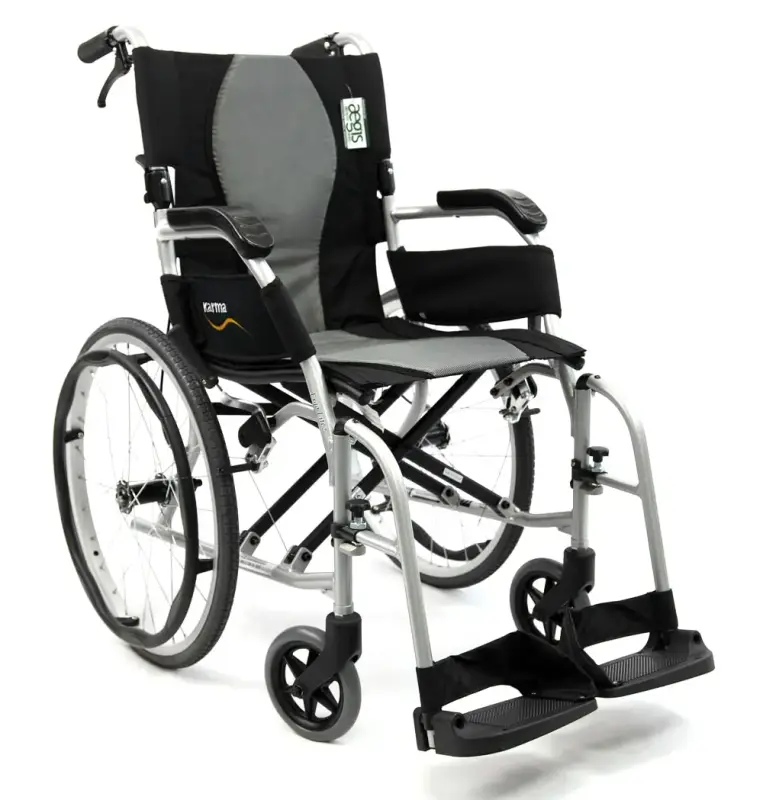
This has large rear wheels with push rims, so the person sitting in it can move alone. For travel, the ones that matter are light and fold small. Drive's AeroFly page lists an "Ultralight magnesium alloy frame"
, "Quick release rear axles" and "Includes both attendant brakes and wheel locks for assisted or independent use"
. Karman's Ergo Flight page calls it a "Manual Propel Wheelchair" and lists optional quick release axles for the 16 and 18 inch seats. Under 14 CFR 382.121, a manual wheelchair, "including folding or collapsible wheelchairs"
, is one of the items airlines must let a passenger bring into the cabin, if it can be stowed in the spaces the rule names.
A transport chair
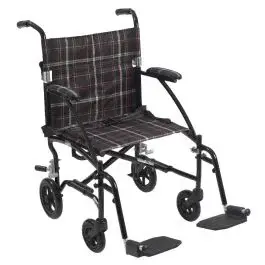
This has four small wheels and is pushed by a companion. Medline's catalog page says its Ultralight Transport Chair "is designed specifically for simple transport by a caregiver."
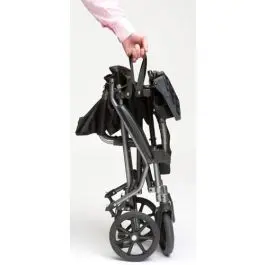
Drive's Travelite page says it "comes with a compact carry bag with wheels making it ideal for traveling"
. Karman calls its KN-TV10A a "travel chair". In our view, transport chairs suit trips where a companion will push; whether one suits a particular person is a question for their therapist. Medline's page says its chair is designed "to be pushed by caregiver or another person"
. Our transport wheelchair guide compares them in detail; here we look only at what matters for travel.
A folding power chair
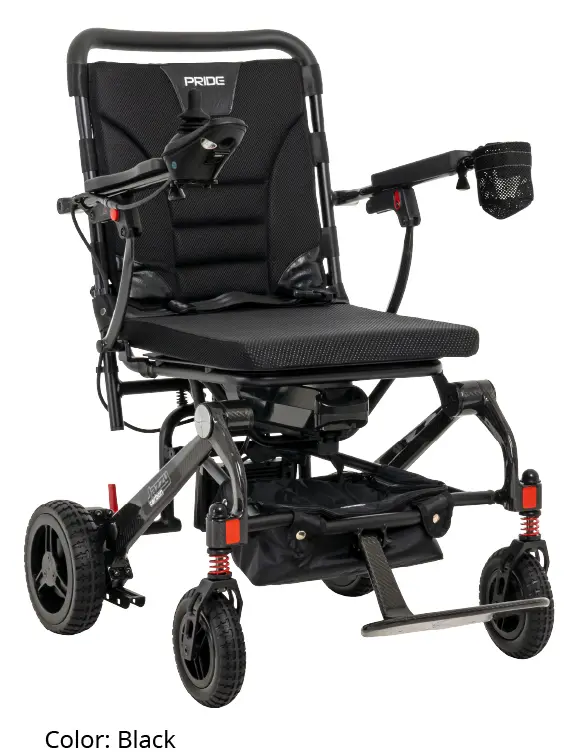
This has motors and a battery and folds or splits for a car trunk or an aircraft hold. Pride prints the Jazzy Carbon at 43.6 lbs with batteries and the Jazzy Ultra Light at 38 lbs with its 10 Ah battery. A power chair does not go in the cabin closet: the closet rule in 382.67 covers a "manual passenger wheelchair"
, and Delta's page says a chair may be stowed on board if it is "non-battery operated". Power chairs fly in the hold under battery rules, which we summarize later. Our folding electric wheelchair guide compares ten folding power chairs, and Flying with a power wheelchair covers the gate routine.
In our view, start from who will move the chair. If the traveler pushes themselves at home, a folding self-propelled chair keeps that independence on the trip. If a companion pushes, a transport chair is lighter and smaller. If neither suits, a folding power chair brings independence at the cost of weight, battery paperwork and the hold. A therapist can say which suits the person's body; the documents below say what each chair is.
The travel wheelchairs we read, at a glance
This is every model we read, with the figures as each document prints them. It is a sample of what three makers, one seller's own brand and one power chair maker print, not a ranking and not every travel chair on sale. The Featherweight row comes from 1800wheelchair.com's category page, which has a footer that lists "our 1800Wheelchair Feather Collection"
among its brands; in our reading the Featherweight chair belongs to it, so its figures are the seller's own.
| Model | Kind | Weight as printed | Folded size as printed | Capacity |
|---|---|---|---|---|
| Drive AeroFly (AF18FDA) | Self-propelled | 13.3 lb frame; 19 lb with wheels | 30.3 x 13 x 29.7 in | 250 lbs |
| Karman Ergo Flight (S-2512) | Self-propelled | 19.8 lb or 19 lbs, no footrest | Width 13 in only | 220 lbs (250 lbs, 20 in) |
| Featherweight 13.5 (seller's page) | Folding; type not stated | 13.5 lbs (in the name) | Width 15 in only | 300 lbs |
| Drive Travelite (TC005GY) | Transport | 20.5 lb | 11 x 10 x 31.5 in | 250 lb |
| Drive Fly-Lite (DFL19) | Transport | 16.2 lb; 18.9 lb with footrests | 33 x 9 x 28 in | 300 lb |
| Karman KN-TV10A | Transport | 14.9 lbs (page); 15 lbs (manual) | Not printed | 190 lbs (manual) |
| Medline Ultralight | Transport | 15 pounds | Not printed | 300 lb |
| Pride Jazzy Carbon | Folding power | 43.6 lbs with batteries | Not printed in our copy | 300 lbs |
| Pride Jazzy Ultra Light | Folding power | 38 lbs with 10 Ah battery | Not printed in our copy | 300 lbs |
Cells marked as not printed mean the page or manual we saved did not print the figure, not that the chair has no such size. For a travel chair the missing folded size is, in our view, the gap that matters most: of the 9 models, 6 documents give one folded figure or none. Ask the seller, in writing, for all three folded dimensions with the wheels on and with them off, and for the weight of the heaviest piece you will lift.
Fly-Lite also shows how folded sizes drift between pages. Drive's page prints the folded dimensions as 33 inches long with riggings, 9 wide and 28 high; 1800wheelchair.com's tile for a chair named Fly-Lite says it "Folds small to 22" by 9 inches, and prints no maker name or model number. In our view, plan on Drive's larger figure until Drive confirms another in writing.
The cabin closet: 13 x 36 x 42 inches
In the US, a passenger's own folding manual wheelchair can travel in the cabin, not the hold, if it fits the space the rules set aside for it. Section 382.67(a) says the airline must have priority space, "a closet, or a row of seats where a wheelchair may be strapped"
, big enough to stow "at least one typical adult-sized folding, collapsible, or break-down manual passenger wheelchair, the dimensions of which are 13 inches by 36 inches by 42 inches or less without having to remove the wheels or otherwise disassemble it."
Read the limits of that rule carefully. It says "This section applies to any aircraft with 100 or more passenger seats"
, so a small regional aircraft may have no such space. For US airlines it covers new aircraft "ordered after April 5, 1990, or which were delivered after April 5, 1992"
. The space must be "other than the overhead compartments and under-seat spaces routinely used for passengers' carry-on items."
And it is one chair: the rule speaks of "at least one" wheelchair, with room for a second only where the airline straps chairs to seats and "stowing the second passenger wheelchair would not displace passengers."
Airline pages repeat the size with a caution. Delta's page says that, in general, a device may not exceed 13 by 36 by 42 inches, "but the limits vary by aircraft."
It adds that you should "confirm with a gate agent before you board whether your device may be stowed or needs to be checked."
American's page says "Planes with 100 or more seats have closets to hold 1 collapsible wheelchair."
In our reading, the closet is a right on most larger aircraft, not a promise for every flight, and the first wheelchair user to claim it gets it.
Which chairs fit, by their printed sizes
We compared each chair's three printed folded dimensions with 13 by 36 by 42 inches, longest against longest. The Drive Travelite (11 x 10 x 31.5 in), the Drive Fly-Lite (33 x 9 x 28 in) and the Drive AeroFly (30.3 x 13 x 29.7 in) all fit by that arithmetic; the Travelite's longest side, 31.5 inches, is 4.5 inches under even the closet's 36 inch side. The AeroFly is exactly 13 inches on its narrowest side, so in our view treat it as a fit with no margin. Drive's AeroFly page does not say whether those folded figures include the rear wheels.
For the other six chairs the documents do not let you check. Karman's page prints the Ergo Flight's folded width as 13 inches but no folded height or length; its shipping dimensions, 31 by 33 by 13 inches, are the carton, not the chair. The Featherweight tile on the seller's page prints only a 15 inch folded width, so the other two folded dimensions are unknown. The KN-TV10A page and the Medline page print no folded size. Measure a chair before you book, or ask the seller to measure one.
When the chair fits only with the wheels off
Many self-propelled chairs fold to a size that is too big with the rear wheels on and fits with them off. Section 382.123(b) covers that case. The rule says: "If a wheelchair exceeds the space provided for in § 382.67 of this part while fully assembled but will fit if wheels or other components can be removed without the use of tools, you must remove the applicable components and stow the wheelchair in the designated space."
The removed parts then go, the rule says, "in areas provided for stowage of carry-on luggage."
The words "without the use of tools" matter when you buy. Drive's AeroFly page lists "Quick release rear axles". Karman's Ergo Flight page offers "Quick Release (16″&18″ only)"
axles as a paid option at $60.00, with "Standard" axles as the other choice. In our reading, quick release wheels are what make the wheels-off route in 382.123(b) available; a chair whose wheels need a wrench may be sent to the hold instead. Ask the seller which axle your chair ships with.
Wheels also change the weight you lift. Drive prints the AeroFly at 13.3 lbs as a "Frame only weight, excludes rear wheels"
and 19 lbs as "Total weight inc. rear wheels"
, so the two wheels together come to 5.7 lbs by our arithmetic. Karman's page says the Ergo Flight "Weighs only 19.8 lbs (w/out footrest) – 14.5 lbs (w/out QR wheels & footrest)"
. That puts the quick-release wheels at 5.3 lbs by our arithmetic (4.5 lbs if you use the 19 lb table figure).
A practical note in our view: tape a short card to the frame that says the wheels come off without tools and shows how. Section 382.129(a) lets passengers "provide written directions concerning the disassembly and reassembly"
of their chairs, and the airline must carry them out "to the greatest extent feasible"
.
Weight: the number you will lift
For travel, weight is what you lift into a trunk, onto an airport cart and out of a taxi, often more than once a day. Makers print it in different ways, and the lightest number on a page is rarely the chair as you will use it.
- Karman's Ergo Flight page prints two figures for the same chair:
"Weighs only 19.8 lbs (w/out footrest)"
in its feature list, and "19 lbs." under "Weight Without Riggings" in its specification table. Riggings are the footrests. - Drive's page prints the Fly-Lite at "16.2 lb without footrests | 18.9 lb with footrests".
- Karman's KN-TV10A page title says "14.9 lbs"; its manual's feature list says "only 15 lbs".
- Drive's AeroFly is 13.3 lbs without rear wheels or footrest and 19 lbs with the wheels, still without the footrest.
- Medline's catalog page says its Ultralight Transport Chair "weighs only 15 pounds".
- Drive's Travelite page prints a single "Product Weight" of 20.5 lb, and a carton weight of 23.2 lb.
- Seller tiles differ from the makers: an 1800wheelchair.com tile named Fly-Lite Transport Chair says "Weighs only 14.5 lbs." and SpinLife's text for Drive's DFL19 says "18.9 lbs. with footrests (16.8 lbs without)", against Drive's 16.2 lb; 1800wheelchair.com's tiles say "Only 14.8 Lbs." for the Medline Ultralight, against Medline's 15 pounds, and "Weighs just 20 lbs." for an item named Travelite Transport Chair with Bag, against Drive's 20.5 lb. Each of these 1800wheelchair.com tiles also prints a "Product Weight" line that matches the maker (16.2 and 18.9, 15, and 20.5 lbs), so the same tile gives two figures, and the Fly-Lite and Travelite tiles print no maker name or model number. Plan on the maker's higher figure, such as Drive's 18.9 lb with footrests for the Fly-Lite, until the maker confirms another in writing.
The Ergo Flight's two figures differ by 0.8 lb. When two figures differ, plan on the higher one until Karman confirms the other in writing. In our view, compare chairs with the same parts on, wheels and footrests fitted, because that is what you lift at the car. The Fly-Lite's footrests alone add 2.7 lb by our arithmetic.
A very light chair is not always the easiest one to travel with. Medline's page mentions "carrying handles", Drive's AeroFly page lists "Seat integrated carry handles"
, and the Travelite comes with a bag on wheels. A chair that is a little heavier but rolls in its own bag may, in our view, be easier through an airport than a lighter chair carried by its frame. Karman's KN-TV10A manual warns, for that chair: "When reassembling the wheelchair after removing the rear wheels, ensure that the rear axles are locked in place to prevent wheels from falling off."
Weight capacity: the lightest chairs carry less
Before weight and size, check that the chair is rated for the person. The lightest chairs in our table do not all carry the most.
- Karman KN-TV10A:
"Maximum user weight is 190 lbs."
in its manual. The product page we saved printed no capacity. - Karman Ergo Flight, as its page says:
"Weight Capacity: 220 lbs (16″&18″ Seat); 250 lbs (20″ Seat)"
. - Drive AeroFly and Drive Travelite: 250 lbs and 250 lb.
- Drive Fly-Lite and Medline Ultralight: 300 lb on each page.
- Featherweight 13.5 (seller's page): "Weight Capacity 300 lbs."
- Pride Jazzy Carbon and Jazzy Ultra Light: 300 lbs each.
So the KN-TV10A, at about 15 lbs, is rated 30 lbs below the Ergo Flight's 220 lbs, and 110 lbs below the Medline Ultralight, which weighs about the same. In our view, read the capacity in the manual or on the chair's label, not only on a seller's tile, and leave a margin for a backpack hung on the push handles. Karman's KN-TV10A warranty says "Karman will not warrant the frame or any parts damaged when the maximum weight limit is exceeded."
Self-propelled or pushed: matching the chair to the trip
Which wheelchair is best for travel? Mobility Atlas read the makers' and sellers' pages for nine chairs sold for travel on 9 November 2026, and the answer depends first on who moves the chair. A folding self-propelled chair such as Drive's AeroFly (19 lbs with wheels, "Quick release rear axles") or Karman's Ergo Flight (19.8 or 19 lbs without footrests, quick release axles optional) lets the traveler push themselves and can come apart for a cabin closet. A transport chair such as Drive's Travelite, which folds to 11 x 10 x 31.5 inches, is smaller and is pushed by a companion. A folding power chair such as Pride's Jazzy Carbon weighs 43.6 lbs with batteries and flies in the hold under battery rules. Then check three printed figures: the folded size against the 13 by 36 by 42 inch closet in 14 CFR 382.67, the weight as you will lift it, and the weight capacity, from 190 lbs on the KN-TV10A to 300 lbs.
Brakes matter on trips with ramps and slopes. Drive's AeroFly page says it "Includes both attendant brakes and wheel locks for assisted or independent use"
, and Karman's Ergo Flight page lists "Companion Brakes Standard"
. The KN-TV10A manual lists a "Rear Wheel Lock Brake Handle"
and warns: "Attempting inclines steeper than 6 degrees can cause your chair to tip over. Use of anti-tipping device is highly recommended for inclines."
Drive's Fly-Lite manual says "You and your attendant should consult a qualified professional for correct techniques on ramp negotiations."
In our view, if the trip includes cruise ship gangways, steep old streets or hotel ramps, choose a chair whose documents list attendant or companion brakes (the AeroFly and Ergo Flight pages do), ask the maker how they are meant to be used on slopes, and practice with them at home. Karman's guide in the KN-TV10A manual says a wheel lock "is not intended to slow down the chair when it is moving."
Seat width and cushion are part of the same decision. The Ergo Flight comes in 16, 18 and 20 inch seats, the AeroFly in 18 and 20 inch, the Travelite in 18 inch, and the Fly-Lite and Medline Ultralight in 19 inch. Whether a narrower travel chair is safe for a person who sits for hours on a flight day is a question for their occupational therapist or seating specialist; see our guide to measuring for a wheelchair before the appointment.
What US airlines must do with your chair: Part 382, Subpart I
Subpart I of 14 CFR Part 382 is the part of the US rules that covers how airlines stow wheelchairs. We read it on eCFR, which showed Title 14 "up to date as of 11/05/2026"
. The rules speak to both US and foreign carriers; 382.67(g), for example, sets separate dates for each. These are the lines a traveler with a manual chair is most likely to need.
- Cabin first: under 382.121(a), airlines
"must permit passengers with a disability to bring"
manual wheelchairs into the cabin"provided that they can be stowed in designated priority storage areas or in overhead compartments or under seats"
, consistent with FAA, PHMSA, TSA and foreign safety rules. - Not counted as carry-on: under 382.121(b) airlines
"must not count assistive devices"
toward a carry-on limit. American's page says"Mobility and medical devices don't count toward carry-on limits."
- Priority if you preboard: under 382.123(a)(1), a passenger who preboards can stow their chair in the closet
"with priority over other items"
, and the airline must move crew luggage or an on-board wheelchair to make room. A passenger who does not preboard gets the space"on a first-come, first-served basis"
under 382.123(a)(3). - Preboarding offered: 382.67(f) says
"you must offer pre-boarding to a passenger stowing his or her wheelchair in the cabin."
- No pressure to check it: 382.67(e) says airlines
"must never request or suggest that a passenger not stow his or her wheelchair in the cabin to accommodate other passengers"
, or for a non-safety reason such as convenience. - Hold as fallback: 382.125(a) sends the chair to the baggage compartment if cabin space is not available or safety rules do not allow it, and 382.125(b) says wheelchairs get
"priority for stowage in the baggage compartment over other cargo and baggage."
Two further lines decide how the trip ends. Section 382.125(c) requires the chair to be checked and returned "as close as possible to the door of the aircraft"
, unless security or hazardous materials rules prevent it or the passenger asks for baggage claim instead. Section 382.125(d) says chairs must be "among the first items retrieved from the baggage compartment."
Section 382.125(f)(1) adds that airlines must tell passengers "before the aircraft cabin door closes, whether their wheelchairs or scooters have been loaded"
.
Boarding itself, from the aircraft door to the seat in an aisle chair, is a different set of rules in Part 382 and is covered in our aisle chair guide.
What Delta and American say about your own chair
We read Delta's wheelchair page and American's mobility-device page on 9 November 2026. They show how each airline describes its service on that day; they are not a promise for your flight.
Delta
Delta's page asks travelers to "Share your mobility needs with us at least 48 hours before your trip"
. It asks you to measure the chair "at its smallest size (not expanded)"
and says the measuring tool "estimates a likely fit on your Delta aircraft but is not a guarantee of travel approval."
It describes a "Mobility Device Handling Form"
to print and attach to the chair, and asks you to "include the disassembly/reassembly instructions for your device"
. For checked chairs it says: "Detach and carry onto the plane with you all removable parts (such as joystick, seat cushion, headrest, armrests or footrests)"
. On arrival, the chair comes to the jet bridge or to baggage claim on the "oversize" conveyor belt, depending on what you asked for at check-in.
American
American's page tells travelers to label the chair with "your name, address and phone number"
, to "Write down the make, model, serial number and note any normal wear and tear"
, and to "Plan to arrive at your departure gate 1 hour before scheduled departure."
It says agents "inspect the condition of your mobility or medical device and document any pre-existing damage"
at check-in. It lists "Footrests", "Joysticks or control units"
and "Cushions or supports" among the removable parts you can bring on board, and says: "We recommend removing and bringing these parts onboard whenever possible to help prevent damage."
In our view, the two pages point to the same routine for a manual travel chair: measure it folded, tell the airline 48 hours ahead, photograph it before check-in, take the cushion and any loose parts into the cabin, attach written folding instructions, and ask for the chair at the aircraft door, not at baggage claim.
If the airline damages or delays the chair: the US rules
What happens if an airline damages a wheelchair? Mobility Atlas read 14 CFR 382.130 and 382.131 on eCFR and DOT's Federal Register notice of August 4, 2026, on 9 November 2026. Section 382.130 says airlines "must return checked wheelchairs, scooters, other mobility aids, and other assistive devices to the passenger in the condition in which you received them."
If a chair is lost or damaged, the airline must give the passenger a reasonable time to inspect it and claim, let them choose between airline-arranged repair or replacement and their "preferred vendor", and use its best efforts to provide an adequate loaner, and pay for it. A delayed chair must reach the passenger within 24 hours on domestic flights. Section 382.131 says that where 14 CFR part 254 applies, compensation is based on "the original purchase price of the device."
But DOT's notice delays enforcement of 382.130(a), 382.125(e) and 382.132 until April 30, 2027. Report damage before leaving the airport and ask for the Complaints Resolution Official.
Those rules come in layers, and it is worth reading them in order. Section 382.130(a) also says that when a chair comes back in a different condition, "there is a rebuttable presumption that you mishandled"
it, and that the presumption "cannot be overcome" by calling the damage "an act of God". Section 382.130(b) requires the airline, once it knows a chair was mishandled, to tell the passenger in writing of their rights to claim, to a loaner, to a preferred vendor and to a Complaints Resolution Official (CRO).
For delays, 382.130(c)(1) sets 24 hours for domestic flights and short international flights of 12 hours or less, and 30 hours for longer international flights. Under 382.130(c)(2), the rule says, the passenger may choose pickup at the airport or delivery "to a reasonable location requested by the passenger, such as the passenger's home or hotel."
Under 382.130(c)(5) the airline must repay the passenger's transport costs to or from the airport caused by the delay, and may ask for receipts.
Section 382.130(e) says that if the airline's loaner does not meet the passenger's "functional and safety-related needs"
, the passenger may secure a better one and the airline "must reimburse the passenger for the cost of that loaner within 30 days of the passenger's request."
Under 382.130(f), "The liability limits for carriers under the Montreal Convention will apply if the wheelchair or scooter mishandling occurs on an international flight."
What DOT has paused, and until when
DOT's Federal Register notice 2026-15835 says: "As of August 4, 2026, enforcement of 14CFR 382.125(e), 382.130(a), 382.132, and the at least once every 12-month training requirements found in Sec. Sec. 382.141(a)(6) and 14 CFR 382.63(h)(1) are delayed until April 30, 2027."
The notice describes the paused Wheelchair Rule I provisions as "related to airline liability for mishandled wheelchairs, refresher training frequency, pre-departure notifications, and fare difference reimbursements"
, and says DOT will address them in a new rulemaking, "Wheelchair Rule II".
In our reading, that means the text of 382.130(a), including the presumption of mishandling, is in the rule book but DOT has said it will not enforce it before April 30, 2027; the rest of 382.130 and 382.131 are not named in the notice. We are not lawyers, and this is not legal advice. If a chair is damaged, ask the CRO which of these rules the airline applies, and keep a copy of every form.
Claims in practice: what the airline pages ask for
American's page sets short claim deadlines; Delta's page asks you to report before you leave the airport.
- American: for a delayed device, report "24 hours of your flight's arrival for domestic itineraries" or "21 days of your flight's arrival for international itineraries"; for a damaged device, "24 hours of receiving the device for domestic itineraries" or "7 days of receiving the device for international itineraries". It says
"We may reject your claim if you don't submit your report or required documents within these timeframes."
- American: after the report,
"submit a claim online with required documents within 7 days of receiving your mobility device"
, including ID, a photo of the damage, receipts, ticket receipts and baggage claim checks. - American also says:
"The limits of liability as stated in our Conditions of Carriage do not apply to mobility or medical devices."
- Delta:
"Please meet with a Delta agent or ask for a Complaint Resolution Official (CRO) before you leave the airport to report a delay or damage and file a claim."
Its page says you have"the right to file a claim, receive a loaner device, and choose your preferred vendor for repair or replacement of your device."
Two of these lines matter for a travel chair in particular. First, American's page lists "Receipts for all items", and 382.131, where 14 CFR part 254 applies, bases compensation on "the original purchase price"
. In our view, keep the invoice for the chair and its options with your travel papers, or a photo of it on your phone. Second, American inspects the chair at check-in and documents existing damage; your own photos, taken the same morning, are your record of its condition.
A maker's warranty is not a substitute. Karman's KN-TV10A warranty excludes products "subject to negligence, abuse, improper storage or handling"
, and the Ergo Flight page says "Damaged caused by user negligence, accidental damages intentional or not are not covered under Factory warranty."
In our reading, damage done by a baggage handler is a claim against the airline, not the maker.
How often airlines mishandle wheelchairs: the DOT figures
US airlines that meet DOT's reporting threshold must report wheelchairs and scooters carried in the hold and how many were mishandled. The DOT's Air Travel Consumer Report says the rule "applies to operations on and after December 4, 2018"
. We read the October 2026 issue, which covers August 2026.
| Airline (marketing network) | Enplaned, Aug 2026 | Mishandled | Per 100 enplaned |
|---|---|---|---|
| Delta Air Lines network | 11,695 | 35 | 0.30 |
| Allegiant Air | 2,603 | 16 | 0.61 |
| Southwest Airlines | 22,648 | 250 | 1.10 |
| Alaska Airlines network | 5,486 | 65 | 1.18 |
| American Airlines network | 14,642 | 191 | 1.30 |
| United Airlines network | 11,187 | 151 | 1.35 |
| Frontier Airlines | 4,878 | 80 | 1.64 |
| JetBlue Airways | 3,033 | 50 | 1.65 |
| Total | 76,172 | 838 | 1.10 |
These are DOT's own figures, as printed. In August 2026 the reporting airlines counted 838 mishandled wheelchairs and scooters out of 76,172 placed in the hold, which DOT prints as 1.10 per 100; that is about one in 91 by our arithmetic. A year earlier, in August 2025, DOT prints 830 out of 76,392, or 1.09 per 100. The figures count chairs and scooters in the cargo hold only, and say nothing about how bad each problem was.
In our view, one month of figures is a weak guide for choosing an airline, because the counts move from month to month: Delta's network went from 0.48 per 100 in August 2025 to 0.30 in August 2026, and JetBlue's from 1.05 to 1.65. The stronger lesson is the overall one. A chair that rides in the cabin closet is not in these counts at all, which is one more reason to choose a chair that folds to fit it.
Folding power chairs: batteries in brief
Power chairs travel in the hold, and the battery decides most of the paperwork. This guide keeps it short; the folding electric wheelchair guide and Flying with a power wheelchair go further.
- FAA (US): for a lithium-ion battery that the chair does not protect and that must come out, the FAA's PackSafe page says
"Lithium ion battery size is limited to 300 watt hours (Wh)."
It allows"One spare battery not exceeding 300 Wh or two spare batteries not exceeding 160 Wh each"
in carry-on baggage, and says"Lithium metal (non-rechargeable lithium) batteries are forbidden with these devices."
The page says removed batteries"must be carried in carry-on baggage only"
, with terminals protected from short circuit, and the passenger must tell the airline where the battery is. - IATA (2026 guidance):
"The approval of the operator is required for the carriage of battery-powered wheelchairs and mobility aids."
If an installed lithium battery stays in and the total exceeds 300 Wh, the operator must consider extra safety measures, and"the airline may require the battery to be transported at a reduced Indicated battery charge of 25% or less."
It says"A passenger may carry spare batteries up to a cumulative total of 300 Wh per mobility aid."
- American Airlines from March 31, 2027:
"The lithium-ion battery for the mobility device must be removable and must travel with you in the cabin."
It must be"rated at 300 watt-hours (Wh) or less"
, and"The watt-hour rating must be visible on the manufacturer's battery label."
Its page says devices with non-removable lithium-ion batteries"will not be accepted for travel on American flights on or after March 31, 2027."
- Delta (as read): its FAQ says
"Lithium-ion batteries have no restrictions"
and asks for the battery type at least 48 hours before you fly. In our reading, Delta's line refers to its own handling steps; the FAA limits above still apply.
The FAA's spare battery wording (one up to 300 Wh or two up to 160 Wh each) and IATA's (a cumulative 300 Wh per mobility aid) are not the same words; follow the stricter one your airline applies. Pride prints the Jazzy Carbon battery as "24V 12AH (288WH)", which is under 300 Wh. Pride's Jazzy Ultra Light page prints its batteries as "10Ah, 25.2V Lithium-ion" and "20Ah, 25.2V Lithium-ion", with no watt-hour figure in our copy. By our arithmetic (volts x amp-hours) that is about 252 Wh and 504 Wh; the second is over the FAA's 300 Wh limit for a removed battery and over American's 2027 limit, and IATA lets an installed battery above 300 Wh fly only if the airline adds safety measures. Pride's footnote on the same row says "AGM or gel cell type required"
, which contradicts the lithium-ion label; ask Pride in writing for the battery type and the Wh shown on the label before flying. Both Pride pages say: "Transport of this item on commercial aircraft is subject to federal regulations and airline policy."
In our view, before you buy a folding power chair for flying, ask the maker in writing whether the battery is removable and whether the label shows watt-hours, because American's 2027 rule requires a removable battery with the watt-hour rating on the maker's label; also ask whether it comes out without tools.
Security screening: what the TSA page says
Every wheelchair goes through security. The TSA's page says: "TSA officers will screen wheelchairs and scooters to include the seat cushions and any non-removable pouches or fanny packs. Items will be tested for traces of explosives, and removable items will undergo X-ray screening."
It adds that "The TSA officer will physically inspect the cushion(s) to the extent possible and may use other screening methods to clear your cushion(s)."
For the traveler, the page says: "If you have difficulty standing, you may ask for a chair or you may request to be screened while seated in your wheelchair or scooter."
In standard lanes, "If you are ineligible for screening by technology, a pat-down will be conducted."
In TSA PreCheck lanes, "If you are unable to stand or walk, you may remain seated in your mobility device and the TSA officer will conduct a test of your hands for any trace of explosives."
The TSA's "What Can I Bring?" entry lists wheelchairs as allowed in carry-on and checked bags, and says "The final decision rests with the TSA officer on whether an item is allowed through the checkpoint."
In our view, a travel chair with a removable cushion and bags that come off quickly makes the checkpoint faster: the removable items go through the X-ray, and fewer pockets stay on the frame to inspect by hand. If the cushion is a medical cushion that must not be squeezed or opened, say so at the start, and if screening does not go as it should, the TSA page says you may ask to speak with a supervisor at the checkpoint.
Flying in the EU and the UK
EU. Regulation (EC) No 1107/2006 sets the rights of passengers with disabilities and passengers with reduced mobility (the regulation's terms are "disabled persons and persons with reduced mobility"
) under EU law. We read the text as published in 2006 on EUR-Lex, not a consolidated version. Annex II, "Assistance by air carriers"
, lists the "transport of up to two pieces of mobility equipment per disabled person or person with reduced mobility, including electric wheelchairs"
, subject to "advance warning of 48 hours"
, to "possible limitations of space on board the aircraft"
and to dangerous goods rules. Annex I, for airports, includes "Temporary replacement of damaged or lost mobility equipment, albeit not necessarily on a like‐for‐like basis."
On damage, Article 12 says the passenger "shall be compensated, in accordance with rules of international, Community and national law."
In our reading, the regulation itself sets no amount; it points to other law, such as the Montreal Convention for international flights. Article 4(3) requires airlines to publish "any restrictions on their carriage or on that of mobility equipment due to the size of aircraft"
, so the airline's own page is where the size limit for your flight should be.
UK. The Civil Aviation Authority's page says: "You can bring up to two mobility items free of charge for your trip."
On damage it says: "Airlines are liable for damage to mobility equipment, but compensation is often limited to around £1,300. Consider extra insurance for valuable items."
It also says: "If your equipment is damaged, the airport must provide a temporary alternative, but it may not be like-for-like."
For electric chairs, it asks travelers to give the airline "make, model, weight, size and battery details"
when booking and to "Bring the operating manual"
.
In our view, a traveler flying outside the US should assume that a lost or wrecked chair may not be repaid at its full price unless they insure it, since 382.130(f) applies the Montreal Convention limits on international flights. American's page says its Conditions of Carriage liability limits do not apply to mobility devices; ask your airline what it pays on international flights, and ask your travel insurer, in writing, whether a wheelchair counts as luggage or as medical equipment under the policy.
Trains, cars and cruise ports
Not every trip is a flight. Amtrak's page says that on all its routes it can carry a mobility device "Not exceeding 27.5 inches (70 centimeters) wide and 48 inches (122 centimeters) long when occupied, with a minimum of 2 inches (5 centimeters) of ground clearance"
, and "600 lbs. (273 kg) or less when occupied." It says: "If you travel with a collapsible wheelchair, you may either remain seated in your device or else transfer to an accessible seat and stow your wheelchair nearby."
A device not identified as collapsible means "you must remain seated in your device en route to your destination."
Amtrak's page prints the length conversion in two places, as 122 and as 123 centimeters.
By car, the maker manuals are plain about one thing: a travel chair is not a car seat. Drive's Fly-Lite manual says the chair "does not conform to Federal Standards for automobile seating and should not be used as a seat in a motor vehicle."
Karman's KN-TV10A manual says: "This wheelchair has not been approved as a seat in a motor vehicle. Always transfer to an approved vehicle seat."
If a person must stay seated in their wheelchair in a vehicle, in our view that is a question for the chair's maker and a clinician, and neither of these two travel chairs is approved for it; our wheelchair van guide covers vans.
For cruises and theme parks, renting at the destination is often simpler than bringing a chair; see the section on rentals below. Karman's KN-TV10A page also markets the chair for flying, saying "Take it on an airplane and travel first class with style, convenience, and priority."
That is the maker's claim; the closet check above still applies, and the page prints no folded size.
What travel wheelchairs cost, as printed
These are the 12 price lines in our table, one per seller and item, for the travel chairs in this guide and two related items (Ergo Flight TP, Feather Transport), read on 9 November 2026, in US dollars, from Karman's own pages and two US sellers. Across all 12 lines the prices run from $182 to $783; that is the range in our table, not of every travel chair made. Karman's category page repeats its Ergo Flight and Ergo Flight-TP prices at $783.00; we did not list those twice. We left out the power chairs, whose prices we did not read for this guide.
| Seller and country | Item as printed | Price as printed |
|---|---|---|
| Karman Healthcare (maker), US | Ergo Flight 19.8 (S-2512) | $783.00 |
| Karman Healthcare (maker), US | KN-TV10A 14.9 lbs | $219.00 |
| 1800wheelchair.com, US | Karman Ergo Flight Wheelchair | $783 |
| 1800wheelchair.com, US | Featherweight 13.5 lbs Wheelchair | $569 |
| 1800wheelchair.com, US | Feather Transport Travel Wheelchair | $319 |
| 1800wheelchair.com, US | Medline Ultralight Transport Chair | $182 |
| 1800wheelchair.com, US | Fly-Lite Transport Chair | $257 |
| 1800wheelchair.com, US | Travelite Transport Chair with Bag (page prints "Sold-out" above the tile) | $246 |
| SpinLife, US | AeroFly Ultra-Lite Wheelchair (AF18FDA) | $649 |
| SpinLife, US | Ergo Flight TP (S-2512-TP) | $783 |
| SpinLife, US | Fly-Lite (DFL19) | $245 |
| SpinLife, US | Feather Transport Chair | $379 |
Read the labels as printed. 1800wheelchair.com prints its prices with no price label next to them, only a shipping line below, and its page printed "Sold-out" directly above the Travelite tile. SpinLife's quick-view text prints two figures for several items, with "Starting at" before the first: for the AeroFly, "Starting at $1,274 $649"; for the Ergo Flight TP, "Starting at $1,499 $783"; for the Feather Transport Chair, "Starting at $469 $379". The tile price is the second figure. The page does not say what the first figure is, so this guide does not call it a discount.
Prices for the same name differ by seller: an item named Fly-Lite Transport Chair was $257 on 1800wheelchair.com and Drive's Fly-Lite (DFL19) $245 on SpinLife, $12 apart (the 1800wheelchair tile prints no maker or model number), while an item named Feather Transport Travel Wheelchair was $319 on 1800wheelchair.com and the Feather Transport Chair (EB-FCTM18-BK-BKC) $379 on SpinLife, $60 apart; the pages do not show they are the same model. Karman's page charged extra for options on the Ergo Flight: "Quick Release (16″&18″ only) (+$60.00)"
and a "Travel Bag for Ergo Lite/Ergo Flight Series (+$81.99)"
. Prices differ by country, seller, options and funding, and change often; confirm the total in the cart, with the options you need, before you order.
Warranty, as each document words it
Travel puts a chair through more folding, lifting and loading than daily use at home, so it is worth knowing what each maker's document promises, and what it excludes.
- Drive AeroFly, as its page says:
"Limited Lifetime (Frame) / 60 Days (Wearable Parts)"
. - Drive Travelite: the page's specification tab says "Limited Lifetime".
- Drive Fly-Lite: the manual's first page says
"lifetime limited warranty"
. - Karman KN-TV10A, as its warranty text reads: the main frame for "one year", parts and components for
"one year from purchase date"
, and tires, tubes, upholstery and armrest pads "for three months". The warranty"does not cover commercial use (such as rental or institutional use) and is not transferable"
, and"Warranty applies in the U.S. only."
- Karman Ergo Flight, as its page says:
"Warranty is not transferable."
and"Arm pad and upholsteries are not covered by warranty."
The page refers to"the warranty card attached to each product"
. - Pride Jazzy Carbon: its specification table says "Frame: Lifetime limited". Pride Jazzy Ultra Light: "5-year limited warranty on frame", with 13 months on the drive train, electronics and battery.
Two points stand out for travelers. The KN-TV10A warranty covers the US only, which in our reading matters if the chair breaks on a trip abroad; ask Karman how a claim works from outside the US. And the KN-TV10A warranty text says it does not cover products subject to "improper storage or handling"
, so, in our reading, airline damage goes to the airline claim, not to the maker.
Medicare and a second chair for travel
Can Medicare pay for a travel wheelchair? Mobility Atlas read the CMS rules for manual wheelchairs on 9 November 2026, and in the US Medicare Part B covers a manual wheelchair under those rules, but a chair bought mainly for trips runs into two lines. The CMS policy article for manual wheelchair bases (A52497, revision effective 10/01/2026) says: "If the manual wheelchair is only for use outside the home, it will be denied as noncovered, no benefit, as the DME benefit requires use within the home for coverage eligibility."
The coverage rule, LCD L33788 (revision effective for services on or after 10/01/2026), says: "Payment is made for only one wheelchair at a time. Backup chairs are denied as not reasonable and necessary."
In our reading, a second, lighter chair kept for travel is a backup chair under that rule, so Medicare will not pay for it, and the traveler pays or asks another payer.
Where Medicare does pay for a person's one chair, Medicare.gov says: "After you meet the Part B deductible, you pay 20% of the Medicare-approved amount (if your supplier accepts assignment)."
L33788 also says "One month's rental for a standard manual wheelchair (K0001) is covered if a beneficiary-owned wheelchair is being repaired."
For Medicare Advantage, Medicaid or VA benefits, ask the plan directly; we did not read their rules for this guide.
Renting at the other end
For a short trip, renting a chair at the destination avoids both the airline hold and the cost of a second chair. Scootaround's page says it "can rent wheelchairs in more than 2500 locations across North America and Europe"
and can deliver "to your hotel, residence, or cruise ship port"
. It lists standard chairs with "weight capacities of up to 350 lbs (varies by location)"
, heavy duty chairs "up to 400 lbs (weight and model varies by location)"
and transport chairs "up to 250 lbs (varies by location)"
. It says that most locations allow a one day rental but "certain cities do a have two-day minimum for rentals, including popular locations such as Orlando, Washington D.C., Atlanta, and San Francisco."
The part of the page we saved printed no prices.
In our view, renting suits a person who can manage with a standard chair for a few days; it does not suit a person whose own chair is set up for their body. Our wheelchair rental guide compares rental routes and prices, and Medicare's rental rules, in detail.
Three traps
Trap one: the folded size that is not printed. Six of the nine chairs we read print one folded figure or none. A chair that looks light and compact on a seller's tile may not fit the 13 by 36 by 42 inch closet, and you only learn that at the gate. Ask for all three folded dimensions, with and without the wheels, before you buy.
Trap two: the lightest chair with the lowest limit. The KN-TV10A is about 15 lbs, and its manual says "Maximum user weight is 190 lbs."
Its product page, as we saved it, printed no capacity. Read the manual, not only the tile, before you order the lightest chair on the page.
Trap three: assuming the newest damage rules are in force. 14 CFR 382.130(a) reads as a strong rule, but DOT's notice delays its enforcement, and that of 382.125(e) and 382.132, until April 30, 2027. For UK flights, the UK CAA says compensation "is often limited to around £1,300"
. Keep the purchase invoice, photograph the chair at check-in, and consider insurance for an expensive chair.
Three composite scenarios
These are composite scenarios, not individual customers. Each one uses only the documents for the one model it names.
Scenario one: a wheelchair user who pushes themselves wants a chair that can ride in the cabin, and looks at the Drive AeroFly. Drive's page prints folded dimensions of 30.3 x 13 x 29.7 inches, inside 13 by 36 by 42 with no spare inch on the narrow side, a 250 lbs capacity, 18 or 20 inch seats, and "Quick release rear axles". They plan on 19 lbs, the weight with wheels, and ask Drive whether the folded figures include the wheels. At the gate they preboard, which 382.67(f) says the airline must offer, and carry the cushion on board.
Scenario two: a couple want a chair for airports, pushed by one of them, and look at the Drive Travelite (TC005GY). Drive's page prints 20.5 lb, a 250 lb capacity, an 18 inch seat and folded dimensions of 11 x 10 x 31.5 inches, and says it "comes with a compact carry bag with wheels"
. The partner who will ride is under 250 lb, so the capacity fits. By its printed size the folded chair fits the closet, and the bag rolls through the airport. They note the "Limited Lifetime" warranty line on the page and keep the invoice with their travel papers.
Scenario three: a traveler with a Pride Jazzy Carbon plans a trip on American after March 31, 2027. Pride prints the battery as "24V 12AH (288WH)", under 300 Wh. American's page says the battery must be removable, travel in the cabin and show its watt-hour rating on the maker's label. The traveler asks Pride in writing whether the battery comes out without tools and whether its label shows 288 Wh, and books only after the answer.
What to ask the seller, the airline and the therapist
Ask the seller or maker
- What are the three folded dimensions, with the rear wheels on and with them off?
- Do the rear wheels come off without tools? Is that standard or an option, and at what price?
- What does the chair weigh with wheels and footrests fitted, and what is the heaviest single piece?
- What weight capacity does the manual or label print?
- Which warranty document applies, does it cover trips abroad, and is it transferable?
- For a power chair: is the battery removable without tools, and does its label show the watt-hour rating?
Ask the airline, at least 48 hours ahead
- Does this aircraft have a cabin closet or seat-strap space for a folding wheelchair?
- Can I preboard to claim it, and can I have the chair returned at the aircraft door?
- Which form do you want attached to the chair, and how do I report damage and claim?
- Who is the Complaints Resolution Official at the departure and arrival airports?
Ask the physician, occupational therapist or physical therapist
- Is a self-propelled chair, a transport chair or a power chair right for this trip and this person?
- Is a narrower or lighter travel chair safe for the hours of sitting a flight day involves, and which cushion should travel with it?
- How should transfers to an aisle chair, an aircraft seat or a car seat be done?
If you want two quotes compared on the same basis, with folded sizes confirmed in writing, send Mobility Atlas an enquiry with the model, the traveler's weight and seat size, and the airline; ask us to find it.
Sources and documents
Maker documents, read 9 November 2026: Drive Medical's US pages for the AeroFly Ultra-Lite Wheelchair, Travelite Transport Chair in a Bag and Fly-Lite (with its owner's manual); Karman Healthcare's Ergo Flight page, KN-TV10A page and manual, and transport category page; Medline's Ultralight Transport Chair product and catalog pages; Pride Mobility's Jazzy Carbon and Jazzy Ultra Light specification and warranty tabs. The Drive Travelite and Fly-Lite, Karman KN-TV10A and transport category, Medline and Pride copies were saved the same day by other Mobility Atlas writers and reused here.
Sellers, read 9 November 2026: 1800wheelchair.com's transport chair and lightweight wheelchair categories (US) and SpinLife's transport wheelchair category (US), both saved the same day by other Mobility Atlas writers; Scootaround's wheelchair rental page.
Rules and data, read 9 November 2026: eCFR 14 CFR 382.67 and Part 382 Subpart I (382.121 to 382.132), up to date as of 11/05/2026; Federal Register 2026-15835 (August 4, 2026); FAA PackSafe, wheelchairs and mobility devices (last updated May 1, 2024); IATA Battery-Powered Wheelchairs and Mobility Aids Guidance Document, revised for the 2026 regulations; TSA, disabilities and medical conditions, and the wheelchairs entry of What Can I Bring?; DOT Air Travel Consumer Report, October 2026 (August 2026 data); Delta Air Lines and American Airlines wheelchair pages and American's battery requirements page; Regulation (EC) No 1107/2006 on EUR-Lex; UK CAA, traveling with medicines, mobility and medical equipment; Amtrak, wheeled mobility devices; CMS A52497 and L33788, and Medicare.gov's wheelchairs and scooters page.
Related guides on Mobility Atlas: Transport wheelchairs; Folding electric wheelchairs; Flying with a power wheelchair; Aisle chairs; Wheelchair rental; Lightweight, transport and travel wheelchairs.
Method in brief: how we checked. We copied each page, manual and rule as text on the date above and took every spec, price, warranty term and rule from those copies. Quotes are checked by script against the saved texts; counts, ranges and differences are computed by script from the printed figures. The closet check compares each chair's three printed folded dimensions, sorted, with 13, 36 and 42 inches; a chair without three printed dimensions is not counted as fitting or not fitting. The DOT mishandling figures are DOT's own counts and rates as printed.
Prices checked November 2026 on Karman's, 1800wheelchair.com's and SpinLife's US pages; prices change, so confirm them with the seller. Documents checked November 2026: the maker pages and manuals, eCFR, the Federal Register, FAA, IATA, TSA, DOT, Delta, American, EUR-Lex, the UK CAA, Amtrak, Scootaround, CMS and Medicare.gov, all read on 9 November 2026.
This article is general information. Rules and prices differ by country and change, so confirm them before you buy or travel.
Common questions
Will a folding wheelchair fit in the airplane cabin closet?
On US aircraft with 100 or more seats, 14 CFR 382.67 requires space for one folding manual wheelchair of 13 by 36 by 42 inches or less, without removing the wheels. If it fits only with the wheels off and they come off without tools, 382.123(b) says the airline must remove them and stow the chair there. Delta's page says limits "vary by aircraft", so confirm at the gate, and preboard to claim the space.
What is the lightest wheelchair for travel?
Among the chairs we read, the Drive AeroFly frame is 13.3 lbs without rear wheels (19 lbs with them), Karman's KN-TV10A is 14.9 lbs on its page and 15 lbs in its manual, and Medline's Ultralight is 15 pounds; the AeroFly is 19 lbs as you would push it. On 1800wheelchair.com, the seller's own Featherweight is 13.5 lbs by its name and its Feather Transport tile prints 13 lbs (seller figures). Light chairs can carry less: the KN-TV10A manual says "Maximum user weight is 190 lbs."
Compare chairs with wheels and footrests fitted.
What should I do if an airline damages my wheelchair?
Report it before you leave the airport and ask for the Complaints Resolution Official. American's page asks for a damage report within 24 hours on domestic itineraries and 7 days on international ones. In the US, 382.130 sets loaner and repair duties and 382.131 bases compensation on the original purchase price where 14 CFR part 254 applies (in our reading, domestic flights), though DOT has delayed enforcement of 382.130(a) until April 30, 2027. Keep the invoice and photos.
Can I take a folding power wheelchair on a plane?
Usually in the hold, with the airline's approval. The FAA's PackSafe page limits a removed lithium-ion battery to 300 Wh, and IATA's 2026 guidance says operator approval is required. From March 31, 2027, American's page says lithium-ion batteries must be removable, travel in the cabin, be 300 Wh or less and show the rating on the maker's label. Delta asks for 48 hours' notice; tell your airline as early as you can.
Why do travel wheelchair prices differ between sites?
Sellers set their own prices: on 9 November 2026 an item named Fly-Lite Transport Chair was $257 on 1800wheelchair.com, with no maker or model number on the tile, and Drive's Fly-Lite (DFL19) was $245 on SpinLife. Options add cost, such as Karman's quick release axles at $60.00. Prices differ by seller, country, options and funding, and change often; confirm the total in the cart before you order.
Will Medicare pay for a second wheelchair just for travel?
Not under the CMS rules we read. LCD L33788 says "Backup chairs are denied as not reasonable and necessary"
, and policy article A52497 says a manual wheelchair "only for use outside the home"
is denied as noncovered. For Medicare Advantage, Medicaid or VA benefits, ask the plan.
Sources
- eCFR: 14 CFR 382.67, priority space in the cabin for wheelchairs (read 9 November 2026)
- eCFR: 14 CFR Part 382 Subpart I, stowage of wheelchairs and mobility aids (382.121 to 382.132)
- Federal Register 2026-15835, notification of enforcement discretion (August 4, 2026)
- FAA PackSafe: Wheelchairs and Mobility Devices
- IATA: Battery-Powered Wheelchairs and Mobility Aids Guidance Document, 2026 (PDF)
- IATA: Dangerous Goods Guidance for Passengers
- TSA: Disabilities and Medical Conditions
- TSA: What Can I Bring? Wheelchairs
- US DOT: Air Travel Consumer Report, October 2026 (August 2026 data), PDF
- Delta Air Lines: Wheelchairs, Scooters and Assistive Devices
- American Airlines: Mobility and medical devices
- American Airlines: Battery requirements for mobility devices (from March 31, 2027)
- EUR-Lex: Regulation (EC) No 1107/2006, rights of disabled persons and persons with reduced mobility when travelling by air
- UK CAA: Travelling with medicines, mobility and medical equipment
- Amtrak: Wheeled Mobility Device Specifications and Services
- Drive Medical: AeroFly Ultra-Lite Wheelchair
- Drive Medical: Travelite Transport Chair
- Drive Medical: Fly-Lite Aluminum Transport Chair, page and owner's manual
- Karman Healthcare: Ergo Flight UltraLight Wheelchair (S-2512)
- Karman Healthcare: KN-TV10A travel chair
- Karman Healthcare: KN-TV10A manual (PDF)
- Karman Healthcare: Transport Wheelchairs category (prices)
- Medline: Ultralight Transport Chairs (product page)
- Medline: PF21895 Ultralight Transport Chair (catalog page)
- Pride Mobility: Jazzy Carbon specifications
- Pride Mobility: Jazzy Ultra Light specifications
- 1800wheelchair.com: Transport Chairs (US seller)
- 1800wheelchair.com: Lightweight Wheelchairs (US seller)
- SpinLife: Transport Wheelchairs (US seller)
- Scootaround: Wheelchair Rentals
- CMS: Policy Article A52497 Manual Wheelchair Bases
- CMS: LCD L33788 Manual Wheelchair Bases
- Medicare.gov: Wheelchairs and scooters
Read on . The wording of the article is our own.