Raised toilet seat guide 2026: locking, bracket, bolted and hinged seats compared, with heights, bowl fit, weight limits, prices, Medicare and FDA reports
How raised toilet seats hold on to the bowl, how to pick height and fit, what the labels and US sellers say, why Medicare says no, and what 131 FDA reports describe.
Contents
- The short answer
- How we compared, and what we read
- Five ways a raised toilet seat holds on
- Locking seats: clamps and knobs inside the bowl
- Bracket seats: the Etac Hi-Loo
- Bolted risers and hinged seats
- Seats that only rest on the bowl
- Lids, cut-outs, and sharing the toilet with others
- Arms: help to sit and stand, not a handle for your full weight
- How much height you need
- Round or elongated: matching the bowl
- Weight limits: what the labels say, and where they disagree
- Seat size, opening and the space between the arms
- What raised toilet seats cost in 2026
- Warranty and returns
- Does Medicare pay for a raised toilet seat?
- Other ways to pay
- How the FDA classes a raised toilet seat
- What 131 FDA reports say about raised toilet seats
- Clamps, knobs and the 2013 cluster
- What these reports cannot tell you
- Recalls: what the FDA and CPSC files show
- Fitting a raised seat, step by step
- Checks before each use, cleaning and storage
- Raised seat, frame, commode or something else?
- Three traps
- Three composite scenarios
- What to ask the therapist and the seller
- Sources and documents
- Common questions
- Sources
The short answer
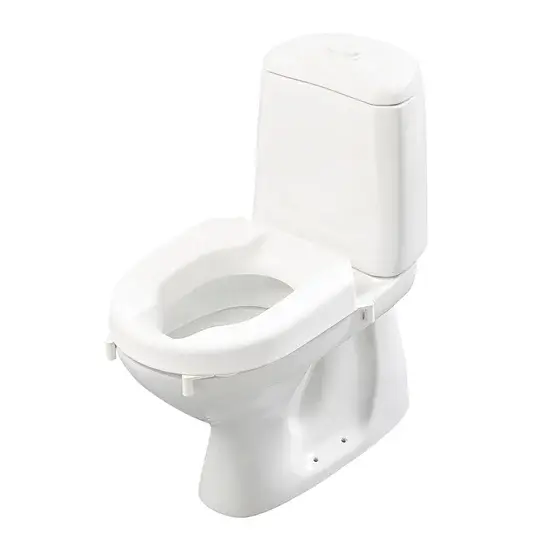
A raised toilet seat sits on the toilet bowl and lifts the seat by a few inches, so there is less distance to lower yourself down and push yourself up. The seats we read add from 2 to 6 inches. They differ most in one thing: how they hold on to the bowl. Some clamp inside the bowl with knobs, some grip it with brackets, some bolt on under your own toilet seat through the seat's hinge holes, and a few simply rest in the bowl with rubber pads. That choice matters more than color, padding or price, because a raised toilet seat that moves on the bowl is the problem that most often comes with an injury in the FDA reports we read.
On the pages of three US sellers read on 9 November 2026, the 43 raised seat lines we kept were listed from 27.52 dollars to 350.87 dollars; 38 of the 43 were under 100 dollars. Weight ratings on the maker pages we read run from 250 lb to 500 lb, and Etac rates its Hi-Loo for 150 kg. Medicare does not pay for a raised toilet seat: its national equipment list denies raised toilet seats as a "convenience item; hygienic equipment; not primarily medical in nature."
Our bedside commode guide covers commodes, toilet frames and what Medicare covers there.
Mobility Atlas earns a fee or margin when you order through us; the comparison below uses only the makers' published pages and manuals, seller pages, CMS and FDA records and the CPSC recall database, each with the date we read it. Which seat height suits a person, whether they need arms, and how they should move on and off the toilet are questions for a clinician, usually an occupational therapist or a physical therapist. This guide explains the types, what the documents say and what to ask, and stops there.
How we compared, and what we read
On 9 November 2026 we read the US product pages and the owner's manuals that Drive Medical links for four of its raised toilet seats: the Raised Toilet Seat with Lock (items 12062 to 12067), the Premium Raised Toilet Seat with Removable Arms (12402 and 12403), the PreserveTech Secure Lock seat (RTL12C003-WH) and the PreserveTech Universal seat (RTL12C002-WH), plus the page and sheet for the AquaSense 3-in-1 seat. Drive's shop also lists Carex seats, and Carex says on its site that it is "proudly part of Drive Medical."
We read Carex's own store pages for every raised seat, riser and elevator in its product feed with "toilet" in the name, Medline's page for its locking seats, and Etac's page, user manual, product guide and service life sheet for the Hi-Loo.
For prices we read Vitality Medical's raised toilet seat category (both pages), 1800wheelchair's raised toilet seat page and the Carex store, all on 9 November 2026. For rules we read Medicare's national equipment list (NCD 280.1), the commode policy article A52461 and the commode rule L33736. For safety records we read openFDA's device classification for product code ILS, its adverse event reports found by a word search for "raised toilet seat", its recall file and the CPSC recall database. We did not test a seat. Where two documents give different figures, we give both and say which to plan on. Rules here are US rules unless we name another country.
Five ways a raised toilet seat holds on
Shops sort raised toilet seats by height and by arms. We sort them first by how they are held on the toilet, because that decides how they can move. The table uses only what the makers' own pages and manuals say.
| Type | How it is held | Example we read | Height, capacity as printed |
|---|---|---|---|
| Locking clamp seat | Knobs turn plates or clamps against the bowl | Drive 12062 series | 2, 4 or 6 in; 400 lb |
| Three-point lock seat | One lock inside the front, two outside the sides | Drive PreserveTech Secure Lock | 5 in; 350 lb |
| Bracket seat | Four rubber-covered brackets click to the bowl | Etac Hi-Loo | 6 or 10 cm; 150 kg |
| Bolted riser or seat | Bolts through the hinge holes; or a rear support fixed with screws and nuts | Drive 12402; PreserveTech Universal | 3.5 in, 300 lb; 2 to 6 in, 350 lb |
| Hinged riser | Fits between bowl and your seat; lifts like a seat | Carex Hinged Toilet Seat Riser | 3.5 in; 300 lb |
| Seat resting in the bowl | Rubber pads, no lock | Carex Raised Toilet Seat with Rubber Pads | 5 to 5.5 in; 300 lbs. |
Which kind of raised toilet seat holds on best? Mobility Atlas read the pages of Drive, Carex, Etac and Medline, the Drive and Etac manuals, and 131 FDA reports, on 9 November 2026, and no document ranks the types by test. What the documents do show is how each type can move. A locking seat is only as firm as its knobs and plates: Drive's manual says to tighten by hand, because "threads on adjustment bracket may strip."
A bracket seat such as Etac's Hi-Loo is set to one bowl and clicks on. A bolted riser, such as Drive's 12402, is held by your own toilet seat's bolts. A seat with no lock rests on rubber pads. In the reports we read, 41 start with a seat that came off, slid or shifted on the bowl and 46 with a clamp, knob or screw that broke or would not hold. In our view, choose a held-on type, and check it before every use.
Two other things are sold under the same name. A 3-in-1 commode frame can stand over the toilet with its bucket out and act as a raised seat with arms; Etac calls freestanding frames of this kind toilet chairs. And a few products raise the whole toilet from underneath. Both are outside this guide; the commode is covered in our bedside commode guide.
Locking seats: clamps and knobs inside the bowl
Many of the seats we read are locking seats: a molded plastic seat with a lip that drops into the bowl, and one or two knobs at the front or sides that press a plate or clamp against the bowl wall. Drive's page for its Raised Toilet Seat with Lock describes a "Locking device with larger, heavy-duty "
worm screw" and locking plate for a safe, secure fit," lists a seat 14 inches wide and 16 inches deep (Drive's dimension sheet gives an overall depth of 15.5 inches for item 12062), a 400 lb weight capacity and a limited lifetime warranty, and says it "Fits Standard Toilets." The series comes in 2, 4 and 6 inch heights, with or without a lid.
The manual is short and specific. To fit the seat, you take your own toilet seat off, open both locking clamps, place the raised seat so "the two locking brackets are on both sides of the bowl wall and that the seat is flush to the bowl,"
and turn the brackets clockwise until tight. Then: "Hand tighten only. Do not use tools as threads on adjustment bracket may strip."
Its instructions and cautions say the product "will not fit all toilet types; be sure that the unit is correctly installed, fits properly and is stable before use,"
and that the user's weight should be centered over the toilet seat. The manual prints the capacity as 400 lbs (181 Kg).
Drive's PreserveTech Secure Lock seat adds two locks. Drive's page says it has "three locking points on the front and sides,"
adds 5 inches, has padded armrests that adjust or come off, and holds up to 350 lbs. Its manual explains the layout: the rubber pads on the front lock "should touch the inside of the toilet bowl"
and the pads on the left and right locks "should touch the outside of the toilet bowl."
It also warns: "Do not use tools to tighten adjustment knob."
The page's claim that most seats "only offer one or two locking points"
is Drive's claim, not a test we can check.
Carex sells several locking seats on its own store. Its E-Z Lock seat adds 5 inches and lists 300 lbs, and its store page says the locking mechanism "secures the toilet elevator to the toilet bowl."
The Quick-Lock seat adds 4 inches and lists 300 lbs on Carex's page; Drive's page for the same Carex seat says it has an extra-wide 10 by 9 inch opening and can be removed for cleaning without tools. The Safe-Lock 2-inch seat "Clamps on from two sides,"
the page says, and the Safe Lock Bariatric seat adds 4.25 inches in its specification (one heading on its page says 4.5) and is rated for 500 lbs. Medline's own page lists its locking seats at 5 inches with a "Locking mechanism" and a 400 lbs. weight capacity, with or without arms.
What locking seats do well, by their documents: they come off without tools, they fit many bowls, and the locking part can be checked by hand. What their documents warn about: knobs that can strip if forced, bowls they do not fit, and weight that is not centered. In our view, a locking seat suits a home where the seat must come off for others, as long as someone checks the knobs before each use.
Bracket seats: the Etac Hi-Loo
Etac, a Swedish maker, takes a different approach on its Hi-Loo. Instead of knobs, the seat has four brackets "covered with friction rubber and adjustable to fit the shape of the toilet bowl,"
Etac's page says. You set the brackets once for your bowl, and then the seat can be lifted off and put back "without altering the setting of the brackets."
The Hi-Loo comes in two heights, 6 cm and 10 cm (about 2.4 and 3.9 inches, our conversion), with or without a lid, and Etac gives a maximum user weight of 150 kg, about 331 lb by our conversion. The page says it "fits all common types of toilet,"
which is Etac's claim.
The user manual, version 9 dated 3 March 2025, sets out the fitting in six steps: loosen the four fixing screws without removing them, move the brackets out, place the seat until it touches the front of the bowl, turn the brackets toward the bowl, lift the seat off and turn all four brackets "one click inwards," then tighten the screws. "Important: The brackets must remain in position,"
it says. To put it on, attach the front brackets first, then press down, and "Check it is securely attached."
The manual also says who the seat is for. It is intended for individuals with a height of 146 cm or more, or a mass of 40 kg or more, for indoor use at home or in institutions, and not in swimming pools or similar corrosive places. It warns: "A defective device must not be used,"
and "Do not to stand on the device,"
as printed. Etac gives the Hi-Loo an expected service life of 10 years and a "5-year guarantee against material and manufacturing defects," with terms on its site. The Hi-Loo is on Etac's international site; its documents cite the EU Medical Device Regulation. We found no US price for it on the seller pages we read, and our catalog row for it (HL-004) holds none.
Etac's own product guide explains when it suggests brackets. "If you don't need arm supports, you can choose a seat with brackets,"
it says, and it lists the gains: easy to mount and remove, no adaptation to a specific toilet model, and use in different bathrooms. The catch is in the same guide: Etac's bracket models come without arm supports. For arms, Etac points to fixed models or toilet chairs.
Bolted risers and hinged seats
A third type does not grip the inside of the bowl at all. It sits on the rim, and your own toilet seat is bolted down on top of it, through the same hinge holes at the back of the bowl. Drive's Premium Raised Toilet Seat with Removable Arms works this way. Its page says it "Allows individual to use existing toilet seat and lid," that its tool-free arms are 19.75 inches apart, and that "Two models accommodate MOST standard and elongated toilets." The manual tells you to remove your seat and lid, center the riser on the rim, and attach your original seat "using the 6" bolts, with washers and butteryfly nuts provided," as printed. The page lists 300 lb, a height of 3.5 inches and a weight of 3.5 lb.
The same manual adds a warning that matters for any riser: the user's weight should be centered, "not too forward or too far to one side, as unit may tip."
It also says: "If you have a style of toilet bowl that this product will not fit properly, it is recommended that you discontinue use."
The dimension sheet for the standard model gives a mounting hole width of 5.5 inches, the distance between the two bolt holes.
Drive's PreserveTech Universal seat is held at the back by a rear support fixed with two fixing screws and knurled nuts; in our reading of the manual's drawing, the screws pass through the toilet's mounting holes. Its manual marks the rear support with "E" for elongated and "S" for standard bowls, so you pick the right holes for your toilet shape. The seat body then clicks onto adjustable holders at 2, 4 or 6 inches, and front supports click in at the same height on both sides. The page lists 350 lb and 18.5 inches between the arms, which pivot up or come off.
Carex's Hinged Toilet Seat Riser is a riser that "installs quickly and safely between your toilet bowl and its existing seat,"
its page says, adds 3.5 inches (one dimension line on the page gives a height of 5 inches for the standard model), and lifts on a hinge for cleaning. Its page lists 300 lb, "Locking: No" and "Hinged: Yes," in standard and elongated versions. Carex's plain Toilet Seat Elevators (standard and elongated) add 3.5 inches and are fitted under your own seat with the bolts supplied: the standard page says to "screw in the included bolts,"
and the elongated page says it fits "with just the use of a screwdriver."
Their specifications list "Locking: No," meaning no clamp. Carex's two Toilet Seat Elevators with Handles work "in conjunction with your existing toilet seat and lid,"
the pages say, add 3.5 inches and list 250 lbs. Etac's guide describes its fixed models as "always in place" and says they "Need fitting to individual toilet models,"
and its product table lists the Hi-Loo Fixed at 2, 6 or 10 cm and 150 kg.
In our reading, a bolted riser is held by your own seat's bolts, so it does not lift off for other users; its manual still warns that weight off center can make it tip, and no document we read tests whether it moves less than a clamp seat. Ask the seller to confirm the bolt spacing against your toilet before you buy.
Seats that only rest on the bowl
Some low-cost seats have no lock at all. Carex's Raised Toilet Seat with Rubber Pads "adds 5 to 5.5 inches of height,"
its page says, and has "anti-slip rubber pads for stability"
; the specification lists "Locking: No." A seat without a lock relies on its shape and pads to stay put.
One FDA report describes a fall from this kind of seat. A voluntary report about a resident says the raised toilet seat was an "older style that sits into bowl without attachment points"
; the seat shifted, the resident and the seat fell off the toilet, and the resident needed staples to a cut on the forehead. The facility discarded the seat. That is one report, not a test. In our view, a seat that only rests in the bowl is a poor fit for anyone who leans, twists or pushes up on one side, and that is a question for the therapist.
Lids, cut-outs, and sharing the toilet with others
Most homes have more than one person using the toilet, and not everyone wants a raised seat. That is where the types differ in daily life. A locking seat comes off by loosening its knobs: Drive's 12062 manual says to "Rotate knobs counter-clockwise until seat is loose,"
then lift the front and pull it forward. Carex says its Quick-Lock seat is "perfect for households where only select users need it or for the avid traveler."
Etac's guide makes the same point for bracket seats: a seat that is "simply "clicked" into place and as easily removed" can be put on only when in use, and taken to "alternative bathrooms or other locations (like a vacation home)."
A bolted riser stays on for everyone, but it keeps your own seat and lid, so the toilet looks and works much as before.
Lids are another difference. Some raised seats have their own lid, some keep yours, and some have none. Drive's 12062 series is sold with and without a lid; its 12402 riser lets you use your existing seat and lid. Drive's PreserveTech Universal manual sets limits on its lid: "The lid must not be used as a backrest in the opened position,"
and "The lid must not bear a load when closed."
In our reading, a lid on a raised seat is a cover, not a seat back or a shelf.
Cut-outs at the front and back of the seat are for hygiene: they leave room to wipe without standing. Carex lists "two hygiene cutouts" on its Safe-Lock 2-inch seat, and Drive's page for the Carex Quick-Lock names a large front cut-out; Drive's PreserveTech Universal manual names "Hygiene openings" among its parts; Etac's page says the Hi-Loo's recesses in the back and front give good access. Drive's AquaSense 3-in-1 sheet describes three ways to set up its arms: no handles "for maximum space and easy access,"
one handle "for easy lateral access and a secure grip,"
or both. If a carer helps with wiping, ask the therapist which opening and arm setup gives them room to do it safely.
Arms: help to sit and stand, not a handle for your full weight
Many raised seats come with arms, often removable, sometimes adjustable in height. Arms give you something to push on as you stand and to guide you as you sit. The makers' manuals are clear about their limits. Drive's 12402 manual says: "DO NOT try to use the arms to support full body weight during transfer, as this may result in failure of the unit."
The PreserveTech manuals say: "Use the arm supports only for assistance."
The 12402 manual's cautions also say that users with physical limitations should be supervised or assisted whenever they use it. The Secure Lock manual adds that before use you should set each arm "at the same height" and that the push pins "will click into place when secure."
Arms change how a seat is loaded. Pushing down on one arm puts the load on one side of the seat, which is the side of the bowl where a clamp or bracket has to hold. Drive's Secure Lock page makes that point for its own design, saying one or two locking points can give "instability when the end user places more weight on one side of the unit."
Several FDA reports in our set begin with an arm: 10 reports start with an arm or armrest that came loose, broke or would not lock.
Arms can also get in the way. 1800wheelchair's buying text says seats without arms "are easier to transfer from a wheelchair or rolling commode directly on to the toilet seat from the front or the side."
Etac's guide notes that "someone in a wheelchair might want just one arm support to allow for side transfers onto the seat."
Drive's PreserveTech Universal arms pivot up, and the 12402 arms come off with a brass push button. If you transfer sideways from a wheelchair, the choice between two arms, one arm, flip-up arms or none is part of the transfer plan, which a therapist sets. Our transfer board guide covers sideways transfers, and the grab bar guide covers bars fixed to the wall beside the toilet.
How much height you need
Raised toilet seats come in steps. On the pages we read: 2, 4 or 6 inches on Drive's locking series and on its PreserveTech Universal; 5 inches on the PreserveTech Secure Lock, Carex's E-Z Lock and Medline's locking seats; 3.5 inches on Drive's bolted riser and Carex's hinged riser and elevators; 4, 4.25 and 4.5 inches on other Carex seats; 2 or 4 inches on Drive's AquaSense 3-in-1; and 6 or 10 cm on Etac's Hi-Loo. A label is not always the measured height: Drive's dimension sheet gives the 2 inch locking seat an overall seat height of 2.5 inches.
Two makers print a way to choose, and they are not the same. Drive's PreserveTech Universal manual says to measure "the length of your lower back leg,"
add 2 inches, then subtract the height of the toilet bowl, "not to include the seat and lid."
Its worked example is 19 inches plus 2, which is 21, minus a 17 inch bowl: a 4 inch seat. Etac's product guide says to measure "from the back of the person's knee to the floor,"
measure the porcelain without the seat, and subtract; it adds no 2 inches. Etac also suggests comparing with how the person sits today: if they sit "obviously low," choose 10 cm, otherwise 2 cm with arm supports or 6 cm.
1800wheelchair's buying text says ADA guidelines put a toilet seat at 17 to 19 inches off the ground, that most toilet seats are lower, in the 14 to 17 inch range, and that the best raised seats give a lift of 3 to 6 inches. That is the seller's summary, not a measurement of your toilet. Our grab bar guide quotes the 2010 ADA Standards themselves, which are written for buildings the ADA covers, not for private homes.
In our view, measure three things before you shop: the bowl rim from the floor without the seat, the height of a chair the person can rise from without help, and the space between the toilet and any wall, tub or vanity. Then ask the therapist to set the height. Too low leaves the problem in place; too high can leave the feet off the floor. Which is right for a given person, after a hip or knee operation or with a balance problem, is the therapist's decision.
Round or elongated: matching the bowl
US toilets come in two bowl shapes, round (often called standard) and elongated, and a raised seat built for one may not grip or sit right on the other. Drive's PreserveTech Universal manual shows how to tell: "measure from the center front to the center of the mounting holes."
Its drawing gives 17 inches for a standard round bowl and 18.5 inches for an elongated one. Drive's locking 12062 series says it "Fits Standard Toilets"; Vitality lists an "Elongated Raised Toilet Seat with Lock by Drive."
Drive's 12402 riser comes in a regular model and an elongated model (12403), whose dimension sheets give seat depths of 16.5 and 18.5 inches, while the product page lists 17 and 19.25 inches; plan on the larger figures for space and confirm with Drive.
Other seats claim to fit both. Drive's PreserveTech pages say they fit most standard and elongated toilets; Carex's Quick-Lock page says it fits "most standard round and elongated toilets"
; Etac says its Hi-Loo fits all common types. Drive's dimension sheet for its premium plastic seats with lock (items 12013 and 12014) prints a seat lock range of 11.5 to 15.5 inches, the span the lock can grip. These are the makers' claims; no document we read lists which toilet models each seat was tested on. Etac's guide is frank about the variety: "There are countless toilet models with individual shapes, sizes and mounting holes,"
it says, and "Some porcelains require screws of a certain length."
The FDA reports show what happens at the edges. A 2016 report says a seat "doesn't clamp well onto the customer's one-piece toilets,"
and the whole assembly popped out as the user reached to flush. A 2014 report quotes a maker's manual: the seat "may not work on certain unusual or artistic bowls."
In 2024 Drive's report said the information "suggests that the raised toilet seat may have not been the proper shape for their toilet."
In our view, take the bowl measurement and a photo of the toilet from the side and from above to the seller, and ask them to confirm the fit in writing.
Weight limits: what the labels say, and where they disagree
Every seat we read prints a weight capacity, and they vary widely. Across 19 seat lines on Drive's, Medline's and Carex's own pages (Medline's four items, all listed at 400 lbs., counted once), capacities run from 250 lb to 500 lb, and 14 of the 19 are 300 lb or less. Drive's 12062 locking seat and Medline's locking seats list 400 lb; Drive's PreserveTech seats 350 lb; Drive's 12402 riser, its AquaSense 3-in-1 and most Carex seats 300 lb; Carex's two elevators with handles 250 lbs.; and Carex's Safe Lock Bariatric seat 500 lbs. Etac rates the Hi-Loo for 150 kg and its My-Loo for 190 kg, its guide says.
Two figures disagree. Medline's own page lists item G4-111MX1, a 5 inch raised locking seat, at "400 lbs. Weight Capacity." Vitality's tile for the same item number, which it names a seat with no arms, reads "350 lb Capacity." That is a gap of 50 lb. Plan on 350 lb until Medline confirms the figure for your item in writing. Seller tiles also carry their own claims: 1800wheelchair lists a Heavy Duty Elevated Toilet Seat at "Up to 600 lbs. capacity" and, in its buying text, a Savanah seat at 420 lbs.; we did not read those makers' documents.
Capacity is not the only weight rule. Etac's manual sets a lower bound too: the Hi-Loo is intended for people of 146 cm or taller, or 40 kg or more. And Drive's manuals tie safety to where the weight goes, not only how much: the 12062 manual says the user's weight "should be centered over toilet seat,"
and the 12402 and both PreserveTech manuals add "not too far forward or too far to one side, as unit may tip."
In our view, choose a rating well above the user's weight, and treat any arm as a guide, not a lift.
Seat size, opening and the space between the arms
A raised seat can be narrower than the toilet seat it sits on. Drive's dimension sheets give its 12062 locking seat an overall width of 14 inches and an inside opening 8 inches wide and 10 inches deep. Its 12402 riser has an inside width of 9.75 inches on the regular model and 10 inches on the elongated one. Drive's page lists the Carex Quick-Lock's opening as 10 by 9 inches, and its bariatric seat a 10 by 9.75 inch opening. Etac lists the Hi-Loo opening as 270 by 200 mm, depth by width, and the seat as 360 by 390 mm outside.
Between the arms, Drive's pages list 19.75 inches on the 12402, 17.5 inches on the PreserveTech Secure Lock and 18.5 inches on the PreserveTech Universal; 1800wheelchair lists a seat width of 19 inches for the Universal and 17.5 inches for the Secure Lock. Etac's page says the recesses in the back and front of the Hi-Loo give access for intimate hygiene. If the person sits against the arms, or needs room to wipe, these are the numbers to compare, with the therapist.
The weight of the seat matters to whoever fits and removes it. Carex lists 2.57 lbs. for the Quick-Lock (its text also says 3.4 pounds, the package weight), 2.55 lbs. for its bariatric seat and 4.5 lbs. for the E-Z Lock; Drive lists 3.5 lb for the 12402; 1800wheelchair lists 9.3 lbs. for the PreserveTech Universal; Etac lists 1.1 to 2.3 kg for the Hi-Loo by height and lid.
What raised toilet seats cost in 2026
We kept every raised toilet seat line printed on the pages of three US sellers on 9 November 2026: 21 on Vitality Medical's category pages, 9 on 1800wheelchair's page and 13 on the Carex store. Across all 43 lines, listed prices ran from 27.52 dollars to 350.87 dollars; 38 were under 100 dollars and 5 were 100 dollars or more. By seller: Vitality 31 to 350.87 dollars (3 of its lines marked out of stock), 1800wheelchair 56 to 204 dollars, Carex 27.52 to 69.20 dollars. Carex's own feed marks 2 of its lines not available: the 5.5 inch rubber pad seat at 27.52 dollars, whose page shows it as available, and the Classics seat; the 5 inch rubber pad seat is 31.09 dollars.
| Seat, as listed | Seller (US) | Price as printed (USD) | Type, by its documents |
|---|---|---|---|
| Drive Raised Toilet Seat with Lock and Lid | Vitality / 1800wheelchair | 56.63 / 56 | Locking clamp, 400 lb |
| Drive PreserveTech Secure Lock | Vitality / 1800wheelchair | 69.41 / 76 | Three-point lock, 350 lb |
| Drive PreserveTech Universal | Vitality / 1800wheelchair | 82.56 / 90 | Rear support screwed on, 350 lb |
| Drive Premium Seat Riser, removable arms | Vitality / 1800wheelchair | 61.16 - 64.70 / 70 | Bolted riser, 300 lb |
| Medline locking seat G4-111MX1 | Vitality | 31.00 | Locking; 400 or 350 lb, see above |
| Carex Quick-Lock | Carex | 31.10 | Locking, 300 lbs. |
| Carex E-Z Lock | Carex | 43.74 | Locking, 300 lbs. |
| Carex Hinged Toilet Seat Riser | Carex | 42.40 | Hinged riser, 300 lb |
| Carex Safe Lock Bariatric | Carex | 54.29 | Locking, 500 lbs. |
| Carex Raised Toilet Seat with Rubber Pads | Carex | 27.52 (5.5 in) / 31.09 (5 in) | No lock, 300 lbs. |
| Ableware Hinged Elevated Toilet Seat | Vitality | 183.34 - 187.11 | Not read |
| Extra Wide Tall-Ette Elevated Toilet Seat | Vitality | 350.87 | Not read |
The table shows a selection; the ranges above cover every kept line. We left out 8 Vitality tiles (a raised seat with bidet, two products that raise the whole toilet from underneath, three tiles we treated as cushions (Lunderg Raised Toilet Seat Cushion, Raised Toilet Seat 4 Inch Cushioned and Padded Toilet Seat Cushion B5071), a caregiver kit, and one tile repeated on both pages) and 4 1800wheelchair tiles (an electric seat lift, a bidet toilet and two cushions). On the Carex store's product feed, 3 of the 16 items with "toilet" in the name are frames and rails, not seats. The same Drive seat costs a little more or less by seller: the Secure Lock 6.59 dollars more at 1800wheelchair than at Vitality, the Universal 7.44 dollars more. Drive's and Medline's own US pages show no price; both say to sign in.
Prices change, and they differ by seller, state and shipping. Vitality's tiles say "FSA & HSA Eligible," Carex's Safe-Lock page invites FSA and HSA cards, and most of 1800wheelchair's tiles say "FREE Shipping"; these are the sellers' words. Ask for the total price with shipping before you order.
Warranty and returns
Warranty terms belong to the document that prints them. Drive's manual for its 12062 locking seat gives a lifetime limited warranty against defects in materials and workmanship "for the lifetime of the original consumer purchaser."
It "does not cover device failure due to owner misuse or negligence, or normal wear and tear,"
and does not extend to "non-durable components, such as rubber accessories, casters, and grips."
The PreserveTech Secure Lock manual words it slightly differently: "for the lifetime of the product for the original consumer purchaser."
Drive's sheet for the AquaSense 3-in-1 prints "5 Year Limited Warranty." Etac's Hi-Loo manual gives a "5-year guarantee against material and manufacturing defects" and a 10-year expected service life.
Returns matter more for a raised seat than for most products, because you may only learn at home that it does not fit your bowl. The Carex store contradicts itself here. Most of its raised seat pages say: "We do not accept returns on any toilet products including commodes and raised toilet seats (opened or unopened)."
Its Safe-Lock 2-inch page says: "Your order falls under our 30-day return policy."
Until Carex confirms in writing which applies to your order, plan on no return. Ask any seller for its return terms for toilet products before you pay.
The manuals for Drive's 12062, PreserveTech Secure Lock and PreserveTech Universal seats end with the same maintenance line: Drive "recommends periodic visual inspection of this product by the user,"
checking that parts and hardware are secure and not "worn, torn, frayed, loose, or rusted,"
and "If any part or mechanism appears to be unsafe or compromised, do not use the product."
None of the Drive manuals we read gives a fixed check interval; the 12062 manual says to "Check for secure fit routinely before using product."
Does Medicare pay for a raised toilet seat?
Does Medicare pay for a raised toilet seat? Mobility Atlas read Medicare's national equipment list (NCD 280.1, version effective 9 June 2025), policy article A52461 and LCD L33736 (both revision effective 1 January 2020) on 9 November 2026, and the answer is no. The list reads, for raised toilet seats: "Deny - convenience item; hygienic equipment; not primarily medical in nature (§1861(n) of the Act)."
The article says the same in coding terms: "A raised toilet seat (E0244) is noncovered,"
and so "a commode chair that is used as a raised toilet seat by positioning it over the toilet is also noncovered."
It defines E0244 widely: a device that adds height, "either attached to the toilet or is unattached, resting on the bowl."
Drive's pages print E0244 on its PreserveTech seats; that is Drive's coding, not coverage. Toilet seat lift mechanisms are non-covered too. For a Medicare Advantage plan or Medicaid, ask the plan.
The policy article draws one line that matters to families; it says: "A freestanding raised toilet seat supported by legs on the floor is coded as a commode."
A commode can be covered, but only in narrow cases: L33736 covers it "when the beneficiary is physically incapable of utilizing regular toilet facilities. This would occur in the following situations"
: a single room the person cannot leave, one level of the home with no toilet on that level, or a home with no toilet facilities, as the rule lists them. The list adds that "The accessibility of bathroom facilities generally would not be a factor in this determination."
Our bedside commode guide covers the commode rule, its codes and the paperwork in full.
Other ways to pay
None of the documents we read promises another payer. Vitality marks its raised seat tiles "FSA & HSA Eligible" and Carex invites FSA and HSA cards on its Safe-Lock page; whether your account pays for one is for your plan administrator to confirm. We read no Medicare Advantage plan's terms for this guide; ask your plan whether it covers a raised toilet seat or a bathroom safety benefit, and get the answer in writing. We read no Medicaid or VA rule for raised seats either; ask the program before you buy.
In our view, at the prices on the pages we read, most families will pay for a basic seat themselves. The money question that matters more is the return policy, since a seat that does not fit your bowl may not be returnable.
How the FDA classes a raised toilet seat
In our reading, a raised toilet seat is a medical device in the US: 81 of the 131 reports in our set file it under product code ILS, which openFDA's classification record (last updated 26 October 2026) names "Adaptor, Hygiene" and lists as device class 1 under regulation 890.5050, in the physical medicine panel, with the GMP exempt flag set to Y. Etac's manual, written for Europe, calls the Hi-Loo "a medical device intended for alleviation of or compensation for a functional impairment due to an injury or disability"
and cites the EU Medical Device Regulation.
Reports about raised seats are not all filed under one code. Of the 131 reports in our set, 81 name product code ILS; the rest are spread over 10 other product codes. A search by product code alone would miss many of these, so we searched the report text. A word search also misses reports that do not use the exact phrase "raised toilet seat"; our bedside commode guide, which read reports by product code from 2017, found 56 raised seat reports in that period, more than this search returns. Neither count is complete.
What 131 FDA reports say about raised toilet seats
By a word search of openFDA's device adverse event file (MAUDE) for the phrase "raised toilet seat" in the report text, we found 136 reports, received from 1993 to September 2026 (data last updated 20 October 2026). We read every one. 5 were not about a raised seat (the phrase appeared in a story about a denture adhesive or a knee implant), leaving 131. 4 events were filed twice (3 by two companies, one by a company and in a voluntary report), so the 131 reports describe 127 events. We gave each report one code for the first problem it names, under rules written before counting, and two flags: an injury stated, and a fall stated.
| What went wrong first | Reports | With injury stated | With a fall stated |
|---|---|---|---|
| Seat came off, slid, shifted, tipped or wobbled on the bowl | 41 | 31 | 32 |
| Clamp, knob, lock, screw, bolt or bracket broke or would not hold | 46 | 3 | 3 |
| Seat body cracked or broke | 13 | 3 | 2 |
| Arm or armrest came loose, broke or would not lock | 10 | 6 | 6 |
| Fall with no fault of the seat named | 6 | 6 | 6 |
| Cut or pinch from a part of the seat | 5 | 5 | 0 |
| Other or unclear | 10 | 6 | 2 |
| All reports | 131 | 60 | 51 |
Why do raised toilet seats come off the toilet? Mobility Atlas read all 131 FDA reports about raised seats found by a word search on 9 November 2026, and the reports point to three causes. First, a seat that is not held firmly: 41 reports begin with the seat sliding, shifting, tipping or popping off the bowl, and 31 of them state an injury, more than half of all 60 injury reports. Second, hardware that fails: 46 reports begin with a clamp, knob, screw or bracket that broke, stripped or would not tighten. Third, weight off center: several describe a person leaning to wipe, reaching for something or pushing on one arm. Some reports also name fitting: one maker wrote that its information "suggests the knob that secures seat was not tight as required by instructions."
These are reports, not rates, and they do not show which brand is safer. In our view, a held-on seat checked by hand before each use answers much of it.
The injuries reported are mostly from falls. 51 reports state a fall, and by a word search 17 contain a form of the word fracture, all describing a broken bone (two pairs are the same event filed twice), most often of a hip, rib or spine. A 1993 report says that as a resident got up using the arms, "the raised seat shifted and the resident was off balance,"
and the hip was fractured. A 2009 report says the user pushed up on the right arm bar only, "when the seat allegedly swung sideways."
In a 2017 report the customer's son said the locking mechanism "would sometimes loosen up on its own."
A report filed in September 2026 says "the handle came off in her hand"
as she stood, and she fell.
Clamps, knobs and the 2013 cluster
Hardware reports are the largest group, and most of them come from one place and time. 57 of the 131 reports name Lerado or Lerado Global as the maker, all but two received between 2012 and 2014; 37 of those start with a clamp, knob or fastener, and 4 state an injury. Reports received in 2012, 2013 and 2014 make up 72 of the 131, 43 in 2013 alone. Many are one line from a dealer: a clamp "is busted," a knob "broke off," a bolt "is stripped out," a seat "arrived with a stripped out screw."
One describes a clamp "splitting into two pieces,"
which "compromises the stability of the product."
Read that cluster as a record of one company's reporting in those years, not as proof that raised seats got worse in 2013 or that one brand is worse than others. Outside 2012 to 2014, 50 of the 60 injury reports were filed. The pattern the cluster shows is still useful: plastic knobs and clamps carry the load that keeps the seat on the bowl, and Drive's manuals warn that over-tightening can strip their threads.
Other groups are smaller. 13 reports describe a cracked seat; two 2026 Medline reports say a cracked seat pinched the user. 5 describe a cut from a part of the seat: a wing nut "sticking out," and in 2023 a locking mechanism on the front that "has cut her husband's leg on several occasions,"
Drive's report says. In our view, run a hand around the knobs and under the seat rim before first use, and stop using a seat with a crack or a sharp edge.
What these reports cannot tell you
The FDA is plain about the limits of these reports. Its MAUDE page says that "this passive surveillance system has limitations,"
including under-reporting, and that "MDR data is not intended to be used either to evaluate rates of adverse events"
or to compare event rates across devices. A report states what someone said happened; many say "allegedly," and many were filed by companies retelling what a customer, a dealer or a lawyer told them. 128 of the 131 reports in our set carry a company report number; 3 are voluntary MedWatch reports.
So the 131 reports cannot tell you how often raised seats fail, which type is safest or which brand to buy. They are filed as Injury (49), Malfunction (23) or with no type or another type (59), and our injury flag (60) comes from reading the text. Only 14 reports were received from 2022 to 2026, and 5 in 2026 so far; a quiet year means few reports, not few problems. What the reports can do is show the ways seats have moved or broken, so you know what to check.
Recalls: what the FDA and CPSC files show
We searched openFDA's device recall file on 9 November 2026 for product descriptions containing "toilet" (data last updated 5 November 2026): 11 records, mostly shower commode chairs, patient lifts and a bed monitor. A search for "raised toilet" returned "No matches found." The one record for a toilet aid that fits on the toilet is Etac's Supporter toilet armrest, product code ILS: initiated 15 June 2015, 25 units, terminated 14 July 2017. The record says the Supporter "has two Fast Nuts fixing the product to the toilet porcelain"
and that "The firm has reports of the two Fast Nuts coming loose and causing the Supporter to become unsteady."
Etac's product guide notes that its 2 cm fixed seat is called the Supporter toilet arm support.
We also searched the U.S. Consumer Product Safety Commission's recall database for "toilet" in recall titles and product names. Neither search returned a raised toilet seat, riser or toilet frame; the records were for lighters, a children's step stool, cabinet locks and cleaners. Finding no recall does not mean a seat is safe. Check your own seat's maker and model on both sites, and report a seat that comes loose or breaks to the seller, the maker and the FDA. Etac's manual, written for Europe, asks that an adverse event be reported "to your local dealer and the national competent authority in a timely manner."
Fitting a raised seat, step by step
These steps combine what the Drive and Etac manuals we read say, plus two checks of our own (steps 8 and 9). Your own seat's manual comes first; keep it with the seat.
- Inspect every part before you start. Drive's PreserveTech manuals say: if there is shipping damage, "DO NOT USE," and contact the dealer.
- Check the bowl shape and the seat's fit range against the manual: round or elongated, and for a bolted seat, the mounting holes.
- Take off your own seat and lid if the manual says so. Drive's 12062 and 12402 manuals do; the Secure Lock manual says some bowls need it.
- For a clamp seat, open the locks fully, set the seat flush on the bowl with the plates against the bowl wall, and tighten by hand only.
- For a bracket seat such as the Hi-Loo, set the brackets to your bowl as the manual shows, then click the front brackets on first and press down.
- For a bolted riser, center it on the rim and bolt your seat on top through the hinge holes, using the bolts supplied.
- Fit arms one at a time until each push pin or button clicks through its hole, and set both arms to the same height.
- In our view, push the seat hard from side to side and front to back. If it moves, do not use it until it is refitted or replaced.
- In our view, sit on it the first time with someone standing by, and keep your weight centered.
If the seat does not fit your bowl properly, Drive's 12402 manual recommends that you "discontinue use"; Drive's 12062 and PreserveTech manuals add: "If any part or mechanism appears to be unsafe or compromised, do not use the product."
A seat that only nearly fits is not a fit.
Checks before each use, cleaning and storage
| When | Check | Where it comes from |
|---|---|---|
| Before each use | Seat secure; knobs tight | Drive 12062 manual |
| Before each use | Weight centered, not forward or to one side | Drive 12402 and PreserveTech manuals |
| Periodically | Parts not worn, loose, cracked or rusted | Drive manuals, no interval given |
| After cleaning or moving | Refit and push test | Our advice |
| After storage of more than four months | Function checked by an expert | Etac Hi-Loo manual |
Drive's 12062 manual says to clean with "a non-abrasive detergent or household cleaner with warm water,"
rinse and wipe dry, and not to use an abrasive cleaner or cloth. Etac says to clean the Hi-Loo with "a solvent-free detergent which has a pH of 5-9, or with a 70% disinfectant solution,"
and that it can be decontaminated at up to 85°C (185°F by our conversion). Etac says to store it indoors in a dry place above 5°C. Drive's PreserveTech seats are treated with an antimicrobial agent; Drive's page adds that the products "do not protect users or others against bacteria, viruses, germs or other disease organisms."
A seat that is taken off for cleaning has to be refitted, and that is when knobs are left loose. In our view, the person who cleans should be the person who checks the fit afterwards.
Raised seat, frame, commode or something else?
A raised seat is one of several aids for the same problem. In our view, a toilet safety frame mainly adds arms around the toilet, and a 3-in-1 commode can stand over the toilet as a raised seat with arms; both are covered in our bedside commode guide, with what the FDA reports show about them. Grab bars fixed to the wall are in our grab bar guide. A rolling shower commode chair can roll over the toilet without a second transfer onto a raised seat; see the shower chair guide.
For people who need more than height, electric toilet seat lifts exist: 1800wheelchair listed the ArGo Electric Toilet Seat Lift at 1,399.99 dollars, rated 440 lbs., on 9 November 2026. Medicare's article A52461 says toilet seat lift mechanisms "are not primarily medical in nature"
and are non-covered. If a carer lifts the person, toileting slings are in our patient lift guide. Which of these suits a person is a question for the occupational or physical therapist, ideally on a home visit.
Three traps
Trap one: buying by height alone. Height is the headline on every tile, but the way the seat holds on decides whether it moves. Ask how it locks to the bowl, and for a lock, ask what the manual says about over-tightening.
Trap two: trusting the capacity on one page. Medline's page lists 400 lbs. for item G4-111MX1 and Vitality's tile lists 350 lb for the same item; Carex's elevators with handles are rated 250 lbs., lower than most seats. Read the label on the seat itself, and plan on the lower figure until the maker confirms.
Trap three: assuming you can send it back. Carex's raised seat pages say it does not accept returns on toilet products, opened or unopened, while one of its pages offers 30 days. Measure the bowl first, and get the seller's return terms in writing before you pay.
Three composite scenarios
These are composite scenarios, not individual customers. Each uses only the documents of the one seat it names and the rules quoted above.
Scenario one: a person who walks with a cane finds their standard round toilet too low after a hip operation. The therapist suggests about 4 inches. The family checks that their bowl is round, since the seat "Fits Standard Toilets," picks Drive's 4 inch Raised Toilet Seat with Lock, rated 400 lb, and fits it as the manual shows: own seat off, both brackets against the bowl wall, hand tightened only. They push it hard before each use. Medicare's list denies raised toilet seats, so they pay themselves; the version with a lid was listed at 56.63 dollars on Vitality and 56 dollars on 1800wheelchair.
Scenario two: a manual wheelchair user transfers sideways onto the toilet with good arm strength. The therapist wants the transfer side clear. They look at Drive's PreserveTech Universal, whose arms pivot up or come off, rated 350 lb, with seat heights of 2, 4 or 6 inches, held at the back by a support that, in our reading of the manual's drawing, is screwed through the toilet's mounting holes. Their bowl is elongated, so they use the holes marked "E." They keep in mind the manual's line: "Use the arm supports only for assistance."
Scenario three: a person who weighs over 400 lb wants a raised seat. Carex's Safe Lock Bariatric seat lists 500 lbs., adds 4.25 inches in its specification (one heading says 4.5), and its page says both that it fits most standard toilets and that it is "Designed to fit securely to any round, standard, or elongated toilet,"
so they ask Carex to confirm for their bowl; it is listed at 54.29 dollars on Carex's store. Its page says Carex does not accept returns on toilet products, so they ask the store to confirm the seat fits their bowl before ordering, and ask the therapist whether a seat without arms suits them.
What to ask the therapist and the seller
Ask the occupational or physical therapist
- What seat height should I aim for, and how do I measure it for me?
- Do I need arms, one arm, arms that flip up, or none, for how I get on and off?
- Is a raised seat right for me, or would a frame, a commode or grab bars be safer?
- Should someone stand by while I use it, at least at first?
Ask the seller or maker
- How does this seat hold on to the bowl, and will it fit my bowl? Here are my measurements and photos.
- What is the weight capacity on the label, and does it match the website?
- What warranty applies, who holds it, and can I return the seat if it does not fit?
- Are replacement knobs, clamps, pads and arms sold, and has this model been recalled?
- What is the total price with shipping, and how long will delivery take?
If you want help comparing seats, or finding one that fits an unusual toilet, ask us through the enquiry form with your bowl measurements and the therapist's advice.
Sources and documents
Maker documents, all read 9 November 2026: Drive Medical's US pages and owner's manuals for the Raised Toilet Seat with Lock (12062 series), the Premium Raised Toilet Seat with Removable Arms (12402, 12403), the PreserveTech Secure Lock and PreserveTech Universal seats, and the AquaSense 3-in-1 seat; Drive's pages for Carex seats; the Carex store's pages for every raised seat, riser and elevator it lists; Medline's page for its raised locking seats; and Etac's Hi-Loo page, user manual 78271 (version 9), raised toilet seat product guide and service life sheet. Sellers, read 9 November 2026: Vitality Medical, 1800wheelchair and the Carex store, all US. Government, read 9 November 2026: CMS NCD 280.1, policy article A52461 and LCD L33736; openFDA classification, adverse event and recall records; the FDA's MAUDE page; and the CPSC recall database.
Related guides on Mobility Atlas: Bedside commodes, raised toilet seats and toilet frames; Grab bars; Shower chairs and transfer benches; Transfer boards; Patient lifts.
Method in brief: how we read and checked. We copied each page and manual as text on the date above and took every specification, price, warranty term, rule and quote from those copies; quotes and numbers are checked by script against them, and every sum, range and count is computed by script. Prices are the lines printed on the seller pages, every raised seat line kept and the exclusions named. The FDA counts come from a word search of the report text for "raised toilet seat"; we read all 136 hits, excluded 5 that were about other devices, and coded the rest under written rules, one code per report. They count reports, not seats or people, and they are not rates. We did not test any seat.
Prices checked November 2026 on Vitality Medical, 1800wheelchair and the Carex store; prices change, so confirm them with the seller. Documents checked November 2026: the makers' pages and manuals, the CMS rules and the FDA and CPSC records, all read on 9 November 2026.
This article is general information. Rules and prices differ by country and change, so confirm them before you buy or travel.
Common questions
What is the best type of raised toilet seat?
No document we read ranks the types by test. They differ in how they hold on: locking seats clamp inside the bowl with knobs, bracket seats such as Etac's Hi-Loo click on with rubber-covered brackets, bolted risers sit under your own seat, and some seats only rest on pads. A seat that is held firmly, fits your bowl and is checked before each use is the aim; the therapist decides height and arms.
How do I know what height raised toilet seat I need?
Measure the bowl from the floor without the seat. Drive's manual says to measure your lower leg, add 2 inches and subtract the bowl height; Etac's guide measures from the back of the knee to the floor and subtracts the bowl height without adding anything. Seats come in steps from 2 to 6 inches. Ask an occupational or physical therapist to set the height for you.
Will a raised toilet seat fit an elongated toilet?
Only if it is made for one. Drive's 12062 locking seat says it fits standard toilets; its 12402 riser comes in regular and elongated models; its PreserveTech seats and some Carex seats say they fit most standard and elongated toilets. Drive's manual says to measure from the center front of the bowl to the center of the mounting holes: 17 inches for round, 18.5 inches for elongated in its drawing.
How much weight can a raised toilet seat hold?
The maker pages we read list 250 lb to 500 lb: many 300 lb, Drive's 12062 and Medline's locking seats 400 lb, Carex's bariatric seat 500 lbs., and Etac's Hi-Loo 150 kg. Check the label on the seat itself, plan on the lower figure where two sources disagree, and remember the arms are for assistance only.
Does Medicare cover a raised toilet seat?
No. Medicare's national equipment list denies raised toilet seats as a convenience item and hygienic equipment, and policy article A52461 says a raised toilet seat (E0244) is noncovered, as is a commode placed over the toilet as a raised seat. Medicare Advantage plans, Medicaid and FSA or HSA accounts have their own rules; ask them before you buy.
Why does my raised toilet seat wobble?
In the FDA reports we read, 46 begin with a clamp, knob or screw that broke or would not hold and 41 with a seat that slid or shifted; some name a bowl the seat did not suit, or weight pushed to one side. Stop using it, refit it exactly as the manual shows, tighten by hand only, and push it hard before sitting. If it still moves, Drive's manuals say to stop using it.
Sources
- Drive Medical: Raised Toilet Seat with Lock, 12062 series (page and owner's manual)
- Drive Medical: Premium Raised Toilet Seat with Removable Arms, 12402/12403 (page, manual, dimension sheet)
- Drive Medical: PreserveTech Secure Lock Raised Toilet Seat (page and manual)
- Drive Medical: PreserveTech Universal Raised Toilet Seat (page and manual)
- Drive Medical: AquaSense 3-in-1 Contoured Raised Toilet Seat (page and sheet)
- Drive Medical: Carex E-Z Lock Raised Toilet Seat
- Drive Medical: Carex Quick-Lock Raised Toilet Seat
- Carex store: Hinged Toilet Seat Riser
- Carex store: Safe Lock Bariatric Raised Toilet Seat
- Carex store: Safe-Lock 2-inch Raised Toilet Seat
- Carex store: Raised Toilet Seat with Rubber Pads
- Carex store: Toilet Seat Elevator with Handles
- Carex store: E-Z Lock Locking Raised Toilet Seat
- Carex store: Quick-Lock Raised Toilet Seat
- Carex store: Toilet Seat Elevator, standard
- Carex store: Toilet Seat Elevator, elongated
- Carex store: Toilet Seat Elevator with Handles, elongated
- Carex store: Classics Raised Toilet Seat with Armrests
- Carex store: E-Z Lock Raised Toilet Seat with Armrests
- Carex store: product feed
- Carex store: search page (footer)
- Carex store: E-Z Lock Raised Toilet Seat with Adjustable Armrests
- Medline: Raised Locking Toilet Seats with Microban
- Etac: Hi-Loo with brackets, product page
- Etac: Hi-Loo with brackets, user manual 78271, version 9
- Etac: Product guide, raised toilet seats
- Etac: Service life, bathroom and manual wheelchair products
- Vitality Medical: Toilet seat risers and base elevators (US)
- 1800wheelchair: Raised toilet seats (US)
- CMS: NCD 280.1, Durable Medical Equipment Reference List
- CMS: Commodes policy article A52461
- CMS: LCD L33736, Commodes
- openFDA: device classification, product code ILS
- openFDA: adverse event reports, word search for raised toilet seat
- openFDA: device recalls, word search for toilet
- FDA: About the MAUDE database
- CPSC: recall database web service, search for toilet
Read on . The wording of the article is our own.