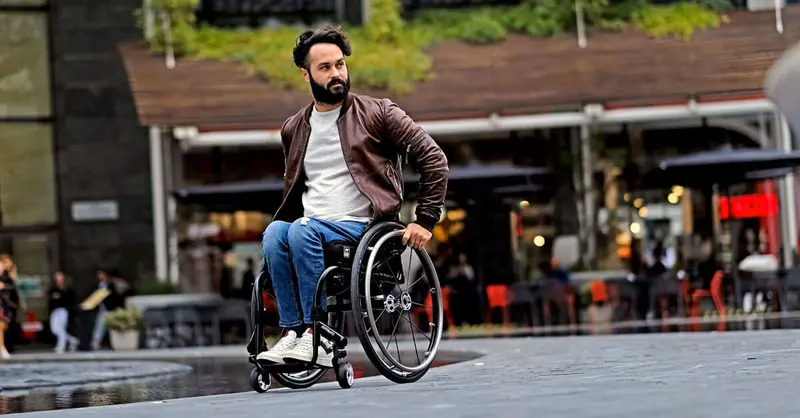
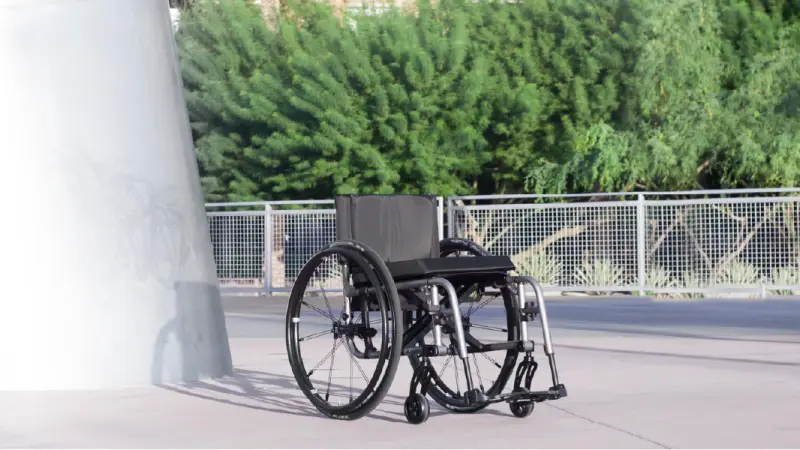
Ultralight wheelchair guide 2026: what K0005 means, rigid wheelchair or folding, weights as printed, prices, Medicare, warranty and transit
Ultralight (K0005) wheelchairs from the documents: CMS criteria, rigid and folding models, weights as printed, order-form and seller prices, warranties and transit.
Contents
- The short answer
- How we compared
- What "ultralightweight" means to Medicare
- Who Medicare covers for an ultralight wheelchair
- The specialty evaluation and the paperwork
- Rigid wheelchair or folding ultralight
- Frame materials: aluminum, titanium and carbon
- The ultralight models at a glance
- Reading an ultralight weight figure
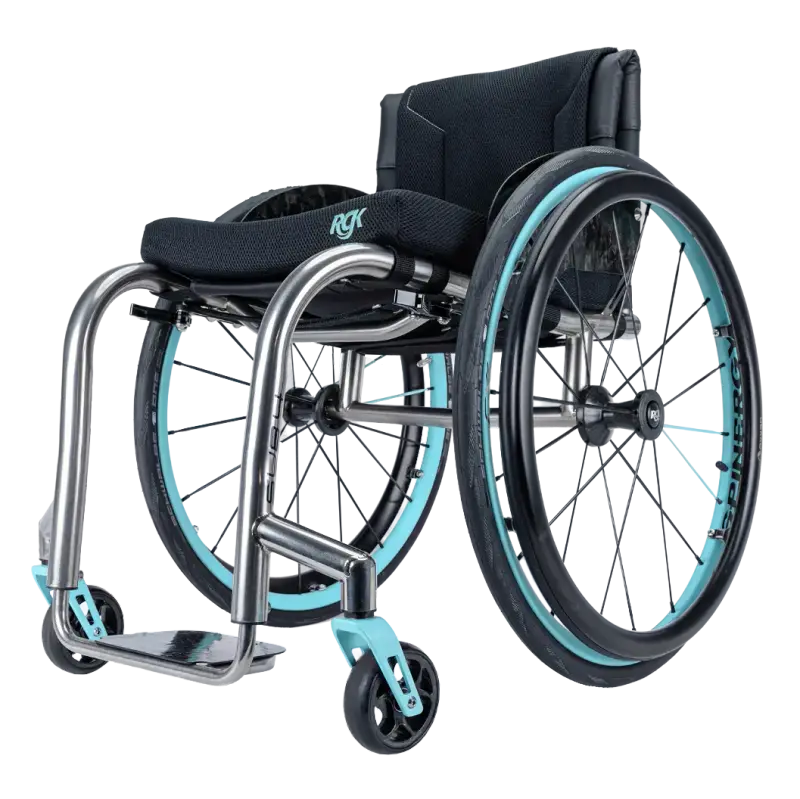
- Rigid ultralights, model by model
- Folding ultralights, model by model
- Weight limits, and why the lower figure wins
- Adjustability: the K0005 axle rule and what makers offer
- What an ultralight costs: maker order forms
- What an ultralight costs: two online sellers
- The Medicare fee schedule for K0005
- What you pay with Medicare
- Warranties, document by document
- What the warranties leave out
- Transit options and Medicare code E1022
- Riding in a vehicle: what the manuals say
- Everyday safety lines in the manuals
- Buying outside the US, and imported brands
- Who an ultralight suits, and who may want something else
- Seat sizes, children and the small-seat codes
- Renting, buying new or buying used under Medicare
- Power assist on an ultralight frame
- Getting a K0005 chair through Medicare, step by step
- Three traps
- Three composite scenarios
- What to ask the clinician, the ATP and the supplier
- Sources and documents
- Common questions
- Sources
The short answer
An ultralight wheelchair is a manual wheelchair built light and adjustable for a person who pushes themselves all day. In the US, "ultralightweight" also has a legal meaning: Medicare code K0005. CMS policy article A52497 (version effective 1 October 2026, read 9 November 2026) defines a K0005 chair as weighing less than 30 lbs, with an adjustable rear axle position and a lifetime warranty on side frames and crossbraces. Seven of the eleven chairs in our table below are rigid wheelchairs and four fold, and makers code some of each as K0005.
The weights makers print are not one number. Transport weights, with the wheels and other parts taken off, ran from 9 lb (TiLite CR1, carbon) to 16.5 lb (Quickie QS5 X Swing-Away, folding aluminum) on the US pages and charts we read. A whole chair weighs more: Ki Mobility prints 23 lbs for a standard Catalyst 5 and 12.8 lbs for its transport weight. Read the footnote that says what was weighed before you compare two chairs.
Money comes from three places. Maker order forms list base prices before options: on the forms we read, base lines ran from $2,472 (Ki Catalyst 5 without transit) to $4,500 (TiLite ZRA). On 9 November 2026, SpinLife's first rigid page and Sportaid's ultralight rigid and folding pages showed priced tiles from $1,452 to $6,656 (two Sportaid tiles showed no price, and two of SpinLife's 17 items were on a second page we did not read). Medicare's October 2026 fee schedule lists $2,634.76 or $2,590.67 for a new K0005 in the 48 contiguous states and DC (non-rural columns), depending on the state. Medicare covers a K0005 only for a full-time manual wheelchair user or a person who needs individualized fitting that a K0001 to K0004 chair cannot give, after a specialty evaluation, from a supplier with a RESNA-certified Assistive Technology Professional (ATP).
Which frame, set-up and seating suits your body is a decision for your seating clinician, usually a physical or occupational therapist, working with the ATP. This guide explains what the documents say so you can ask better questions; it does not tell you which chair to choose.
Mobility Atlas earns a fee or margin when you order through us; the comparison below uses only the makers' published documents, two seller pages and government files, each with the date we read it.
How we compared
On 9 November 2026 we read, and saved as text, the CMS rule and policy articles for manual wheelchairs (LCD L33788 and article A52497) and for wheelchair options (article A52504), the October 2026 Medicare fee schedule file (DME26-D), and Medicare.gov's wheelchair page. From the makers we read product pages, order forms, manuals and warranty documents for the Quickie Nitrum and QS5 X (Sunrise Medical), TiLite ZR and ZRA with Permobil's TiLite comparison matrix, Ki Mobility Rogue2 and Catalyst 5, Motion Composites APEX C, Küschall K-Series and Champion, and Panthera X3. For prices we used two online sellers, Sportaid and SpinLife, with each price label as printed.
We did not test or ride any chair. Specs are the makers' own; where a maker prints two different figures for one thing, we give both. Advice of our own is marked as in our view, and our reading of a rule as in our reading. Order form pages are tables, and our text copies can separate a label from its price; where that leaves a doubt, we say so.
What "ultralightweight" means to Medicare
What makes a wheelchair "ultralightweight" in the US? Mobility Atlas read CMS policy article A52497, in the version effective 1 October 2026, and the answer is a Medicare code: K0005. The article lists three features for it: a weight of less than 30 lbs, an adjustable rear axle position, and a lifetime warranty on side frames and crossbraces. It says weight means "the weight of the wheelchair itself in pounds without the front rigging"
, so footrests are left out. Adult codes, K0005 included, cover chairs with a seat width and depth of 15 inches or more; a seat of 14 inches or less is billed with a pediatric code. The next class down, K0004, is a high strength lightweight chair under 34 lbs with the same frame warranty but no axle requirement. The code says nothing about rigid or folding frames, or about titanium or carbon. A maker's K0005 label is its own coding, not a promise that Medicare will pay.
The article's list of what every adult manual wheelchair includes in its allowance is also worth knowing: seat width and depth from 15 to 19 inches, fixed, swingaway or detachable arms of fixed height, and fixed, swingaway or detachable footrests. Codes K0003 to K0008 "include any seat height." Seat widths or depths of 20 inches or more are billed with extra codes (E2201 to E2204), as the options article A52504 says.
Materials are not paid for separately. A52497 says manual wheelchair bases coded K0001 to K0009 "include construction of any type material, including but not limited to, titanium, carbon, or any other lightweight high strength material"
, and that suppliers "must not bill HCPCS code K0108 in addition to the base wheelchair for construction materials"
. In our reading, a titanium or carbon frame costs Medicare the same as an aluminum one; the price difference falls on you or another payer. Mobility Atlas's lightweight wheelchair guide explains the lighter classes K0003 and K0004, and the manual wheelchair guide covers every manual class from standard to heavy duty.
Who Medicare covers for an ultralight wheelchair
Coverage rules sit in a separate document, LCD L33788, Manual Wheelchair Bases (revision effective 1 October 2026, listed as "Currently in Effect", read 9 November 2026). Every manual wheelchair must first meet the LCD's general criteria on mobility at home, the home itself and who will push; Mobility Atlas's manual wheelchair guide sets them out in full.
Then K0005 has its own criteria. The LCD says "An ultra lightweight manual wheelchair (K0005) is covered for a beneficiary if criteria (1) or (2) is met and (3) and (4) are met"
:
"The beneficiary must be a full-time manual wheelchair user."
"The beneficiary must require individualized fitting and adjustments for one or more features such as, but not limited to, axle configuration, wheel camber, or seat and back angles, and which cannot be accommodated by a K0001 through K0004 manual wheelchair."
- A specialty evaluation by a licensed or certified medical professional,
"such as a PT or OT, or physician who has specific training and experience in rehabilitation wheelchair evaluations"
, the LCD says, who"may have no financial relationship with the supplier."
A52497 makes one exception: if the supplier is owned by a hospital, a PT, OT or practitioner working in that hospital may do the evaluation. - The chair must come from a Rehabilitative Technology Supplier that employs a RESNA-certified ATP
"who specializes in wheelchairs and who has direct, in-person involvement in the wheelchair selection for the patient,"
in the LCD's words.
In our reading, that means a person who uses a manual chair full-time can qualify under (1), and a person who needs individual fitting can qualify under (2), but both need the evaluation and the ATP. The LCD adds that if these criteria are not met, the chair "will be denied as not reasonable and necessary."
Two more LCD rules shape an ultralight purchase: "Payment is made for only one wheelchair at a time"
, and the loaner covered while your own chair is repaired is a standard K0001 chair, not an ultralight. The manual wheelchair guide covers the general rules on orders, use at home and repairs.
The specialty evaluation and the paperwork
The K0005 file is heavier than for a basic chair. A52497 says that if documentation is requested for a K0005, "it must include a description of the beneficiary's routine activities"
, which may include "whether the beneficiary is fully independent in the use of the wheelchair"
, and the article tells the writer to "Describe the features of the K0005 base which are needed compared to the K0004 base."
The specialty evaluation itself provides, the article says, "detailed information explaining why the particular wheelchair and the special features of the wheelchair are necessary"
, and there must be "a written report of this evaluation available on request."
The supplier must also document a home assessment and code the claim with the right modifiers; if a supplier asks you to sign an Advance Beneficiary Notice for an ultralight, in our reading it expects Medicare may refuse, so ask why before you sign. Both steps are explained in the manual wheelchair guide.
The evaluation and the fitting choices belong to the clinician and the ATP. What you can bring is your day: how many transfers, how far you push, what car you use, what surfaces you cross, and what has hurt or failed on past chairs.
Rigid wheelchair or folding ultralight
A rigid wheelchair has a frame that does not fold side to side; on the Nitrum, the page describes a backrest that folds for loading into a car. Most folding chairs here have a cross-brace under the seat (Küschall describes the Champion's as a "hybrid folding mechanism"). Both kinds can be K0005 chairs. On the pages we read, the Quickie Nitrum, TiLite ZRA and Ki Rogue2 are rigid and coded K0005 by their makers; the Quickie QS5 X ("K0005 / E1236" on its page) and the Ki Catalyst 5 ("K0005" on its form) are folding.
Makers argue for rigid frames in their own words. TiLite's ZR and ZRA page says "Rigid frame chairs are the lightest and highest performing chairs because they are constructed from the fewest possible components and have the fewest moving parts."
Sunrise's Nitrum page lists "Fewer moving parts means" less play, less maintenance and lower weight. Those are maker claims, not test results. Sunrise answers for folding chairs too: the QS5 X page claims its cross-brace "provides the ride performance to rival any rigid wheelchair."
On the figures printed for one maker's pair, the gap is real but not large. On Permobil's TiLite matrix the rigid ZR is 10.9 lb and the folding 2GX 13.1 lb (fixed front) or 15.5 lb (swing away); the matrix's lightest rigid chair, the carbon CR1, is 9 lb, and its folding TiLite X is 12.1 lb, weighed without wheel locks. Ki prints 10.6 lbs for the rigid Rogue2 and 12.8 lbs for the folding Catalyst 5. Each maker weighs a different set of parts, so compare within one maker's figures, not across them.
The day-to-day differences in car loading, upkeep and add-ons are covered in Mobility Atlas's rigid vs folding guide and first active chair guide. In our view, the deciding question is how the chair gets into your car or onto transport every day, and whether you transfer and load it yourself.
Frame materials: aluminum, titanium and carbon
The chairs we read use three main materials. Aluminum: the Nitrum frame is "7020 Oval Aluminum", the QS5 X "7000 Aluminum", and Ki calls the Catalyst 5 "ultra-lightweight 7000 series aluminum."
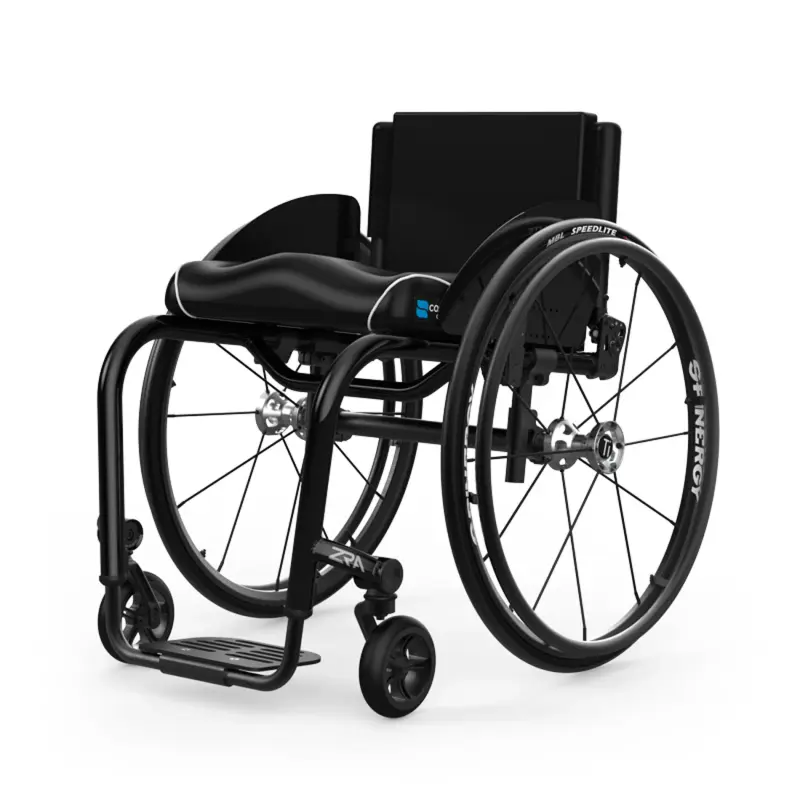
Titanium: the TiLite ZR and ZRA page lists titanium as the frame material, with 1.25 inch mono-tube tubing, and says "Titanium delivers lasting strength in an ultralight frame designed for dependable performance year after year."
Carbon fiber: Motion Composites builds the APEX C from "T700 High-tensile strength carbon fiber"
, Panthera lists "Carbon" as the X3 chassis, the TiLite matrix lists the CR1 as "Carbon fiber elliptical tubing"
, and Küschall offers a "CARBON LINE" of the K-Series and Champion.
Each maker praises its own material. Motion's page says carbon fiber "has the unique quality of being one of the strongest, yet lightest materials on earth"
; Sunrise calls its Nitrum tubing "special ovalized 7020 series aerospace aluminum"
. We found no independent test behind these lines in what we read; treat them as claims.
What the documents do let you compare is cost and warranty. Motion's APEX order form has an aluminum chair line and a carbon fiber frame upgrade line; Ki's Catalyst 5 form offers titanium cross braces for $755. Motion's USA warranty covers carbon parts and its aluminum frame for life for the first user; TiLite's warranty (51015 Rev C), which lists the ZR, ZRA, 2GX and other titanium and aluminum models, gives frames five years. The materials are coded the same under Medicare, as above.
In our view, the material question is mostly a weight, feel and budget question that a trial ride answers better than a spec sheet. Ask the ATP whether a demo chair in each material can be set up close to your measurements.
The ultralight models at a glance
Which ultralight wheelchairs did we compare, and how light are they? Mobility Atlas read the US pages, charts and order forms of four makers and the international pages of two more on 9 November 2026. Rigid chairs: the Quickie Nitrum (aluminum, 10.8 lbs transport), TiLite ZR (titanium, 10.9 lb) and ZRA (11.2 lb), Ki Mobility Rogue2 (10.6 lbs), Motion Composites APEX C (carbon, 9.7 lbs in its specifications), Küschall K-Series (approx. 4.8 kg) and Panthera X3 (carbon, 2577 g in its table). Folding chairs: Quickie QS5 X (from 16.1 lbs usable transport), Ki Catalyst 5 (12.8 lbs), TiLite 2GX (13.1 lb fixed front) and Küschall Champion (approx. 6.3 kg). Weight limits run from 120 kg (Champion) to 300 lbs (Nitrum Hybrid, QS5 X, Catalyst 5), with some heavy-duty frames and kits up to 350 lbs. Each maker weighs a different set of parts, so the table notes what each figure includes.
| Model | Frame | Weight as printed | User weight limit |
|---|---|---|---|
| Quickie Nitrum | Rigid, 7020 aluminum | 18.3 lbs; transport 10.8 lbs | 275 lbs (Hybrid 300 lbs) |
| TiLite ZR | Rigid, titanium mono-tube | Transport 10.9 lb (matrix) | 265 lb (page) |
| TiLite ZRA | Rigid, titanium mono-tube | Transport 11.2 lb (matrix) | 265 lb (page) |
| Ki Rogue2 | Rigid | Transport 10.6 lbs | 275 lbs |
| Motion APEX C | Rigid, carbon fiber | Transport 9.7 lbs; 17.2 lbs functional | 265 lbs |
| Küschall K-Series | Rigid (carbon line offered) | Approx. 7.5 kg; transport 4.8 kg | 130 kg |
| Panthera X3 | Rigid, carbon chassis | 4950 to 5150 g; transport 2577 to 2777 g | 125 kg |
| Quickie QS5 X | Folding, 7000 aluminum | From 21.8 lbs; usable transport from 16.1 lbs | 300 lbs |
| Ki Catalyst 5 | Folding, 7000 aluminum | 23 lbs; transport 12.8 lbs | 300 lbs (HD 350 lbs) |
| TiLite 2GX | Folding, titanium box frame | Transport 13.1 lb fixed, 15.5 lb swing away | 265 lb (matrix) |
| Küschall Champion | Folding (carbon line offered) | Approx. 8.8 kg; transport 6.3 kg | 120 kg |
Sources for each row are the maker pages, the TiLite comparison matrix (MS0008_RevQ) and the Panthera X3 table, read 9 November 2026. The TiLite matrix prints heavy-duty limits of 300 lb for the ZR and ZRA and 350 lb for the 2GX; the Nitrum Hybrid is Sunrise's 300 lbs frame. Küschall and Panthera print metric figures only, and the Küschall pages we read are its international site.
Our own catalog holds 10 rows in its rigid active and ultralight group and 14 in its lightweight folding group; the related products at the end of this page come from it. We use catalog rows here only for names and specs, never for prices.
Reading an ultralight weight figure
Three kinds of weight appear on these pages, and they are not interchangeable. A transport weight is the frame with removable parts off; a chair weight or standard weight is closer to the whole chair; and Medicare's K0005 weight is the chair "without the front rigging."
None of the transport weights whose footnotes we read includes the rear wheels.
Each maker writes its own footnote. Ki weighs the Rogue2 on a 16 by 16 inch frame with a short backrest and 4 inch casters, its footnote ending "Tubular Open Footplate. Rear Wheels Removed."
Sunrise says the QS5 X chair weight is based on a 16 by 16 inch seat "with back upholstery, side guards, and wheel locks"
, and that transport weight leaves out "items that can be easily removed"
. Permobil's TiLite matrix says its weights are for 16 by 16 inch chairs "with all standard features except rear wheels"
, and adds the parts you would put back: a pair of standard 24 inch rear wheels "weighs 7.2 lb" and "A pair of standard wheel locks weighs 0.9 lb."
Those lines let you rebuild a figure. In our arithmetic, a TiLite ZR at 10.9 lb plus a pair of standard rear wheels (7.2 lb) is 18.1 lb; the matrix does not say whether wheel locks are in the 10.9 lb, and if not they add 0.9 lb (19.0 lb), before cushion, back and footrest choices. Sunrise does a similar thing for the Nitrum: 10.8 lbs transport, or 9.7 lbs "w/o wheel locks", a gap of 1.1 lb.
Where a maker prints two figures
- Quickie QS5 X: the page text says
"a usable transport weight of just 16 lbs*"
, while its specification table prints "from 16.1 lbs" for the fixed-front frame and "from 16.5 lbs" for the swing-away frame. - Motion APEX C: the feature text says
"A transport weight of 9.8 lbs"
, and the technical specifications print 9.7 lbs, with a"LIGHTEST FUNCTIONAL CONFIGURATION"
of 17.2 lbs with wheels, wheel locks, back upholstery and cushion. - Panthera X3: the header line says
"TRANSPORT WEIGHT: from 2100 g"
, but the technical table on the same page starts at 2577 g, a gap of 477 g. The Panthera guide noted the same mismatch.
In our view, plan on the higher figure in each pair until the maker confirms in writing which applies to your order, and ask the ATP for the expected weight of your configured chair, with wheels, as the dealer will build it.
Rigid ultralights, model by model
Quickie Nitrum (Sunrise Medical)
The Nitrum page calls it "The lightest adjustable rigid aluminum wheelchair in its class"
, a maker claim. It prints a product weight of 18.3 lbs (Hybrid 20.3 lbs), a transport weight of 10.8 lbs (Hybrid 12.8 lbs), three frame angles (75, 80 and 85 degrees), camber of 0, 3 or 6 degrees, center of gravity adjustment of 0 to 4 inches, and seat widths and depths from 12 to 20 inches. It says each chair "is made by hand in California"
. The open frame is for users "up to 275 lbs." and the dual-tube Hybrid "up to 300 lbs." An Active Rigid option welds the backrest and axle stems to save weight; in the order form's Transit box, the note "WC-19 and ISO 7176 standard compliance. N/A with Active Rigid."
sits on the line above the Transit System option.
TiLite ZR and ZRA (Permobil)
Both are titanium mono-tube rigid chairs. The page describes the ZR as "A fixed-frame wheelchair for riders who want a solid, streamlined ride"
and the ZRA as the fully adjustable version. Camber choices differ: ZR 0, 2, 4 or 6 degrees; ZRA up to 12 degrees. The page lists a weight limit of 265 and seat widths from 10 to 20 inches; the order form adds a 150 lb limit for seat sizes from 10 by 10 to 12 by 12 inches. For more on every TiLite, see Mobility Atlas's TiLite guide.
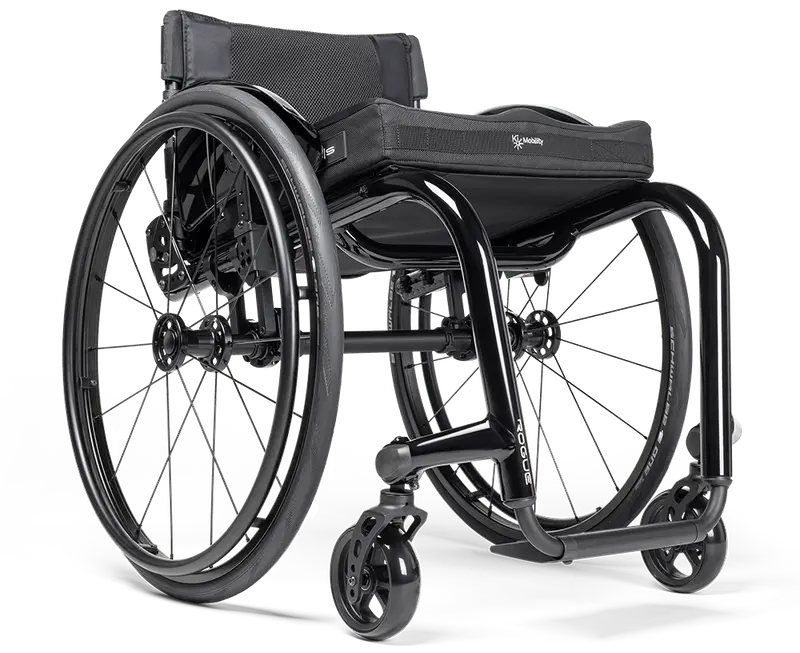
Ki Mobility Rogue2
Ki prints a transport weight of 10.6 lbs for the Rogue2, a 275 lbs capacity, 1 3/8 inch tubing, seat widths of 12 to 20 inches and camber from 0 to 8 degrees. Its page says the standard mag wheel "is lighter, more rigid", and that the Twist power assist by Klaxon is "Fully compatible with Rogue2"
. The Ki Mobility guide covers the rest of Ki's range.
Motion Composites APEX C
The APEX C is a carbon fiber rigid chair made by Motion Composites, whose USA warranty gives a customer-service address in Quebec, Canada, and whose US order form gives a Newark, Delaware address. Its page prints a 265 lbs weight limit, seat widths and depths of 12 to 20 inches, camber of 0 to 8 degrees, center of gravity adjustment of 0 to 6 inches and an overall width from 18 ¾ inches. The June 2026 order form lists the aluminum APEX (WC11) at $2,595, with K0005 printed on that row, and an "Apex Carbon fiber frame upgrade"
(WC21) at $2,495. In our reading the upgrade is priced on top of the chair, so ask the dealer for the total of a carbon APEX.
Küschall K-Series
Küschall's site carries the line "© 2026 Invacare International GmbH - All rights reserved." on the K-Series page. The international K-Series page prints approx. 7.5 kg total weight unloaded, approx. 4.8 kg transport weight, a 130 kg maximum user weight and camber of 0, 3 or 6 degrees, all "based on seat width 400 mm and seat depth 400 mm in the lightest and most compact configuration."
The country list on the page we read names European countries, International and the United Kingdom, and no United States entry.
Panthera X3
Panthera, a Swedish maker whose page gives a Permobil e-mail address, lists the X3 with a carbon chassis, a 125 kg user weight, seat widths of 33 to 45 cm and a transport weight from 2577 g in its table. The Panthera guide found no US seller of new chairs on 1 November 2026; we did not search again.
Folding ultralights, model by model
Folding chairs that makers code K0005 exist, and some people need them for cars, buses or storage. The four we read:
- Quickie QS5 X: folding, 7000 aluminum, 300 lbs, seat widths 13 to 20 inches, "K0005 / E1236" on the page, transit
"Yes; conforms to ISO 7176-19 Transit Approved standards."
Sunrise says its FreeFold cross-brace saves"over 40% energy with every fold"
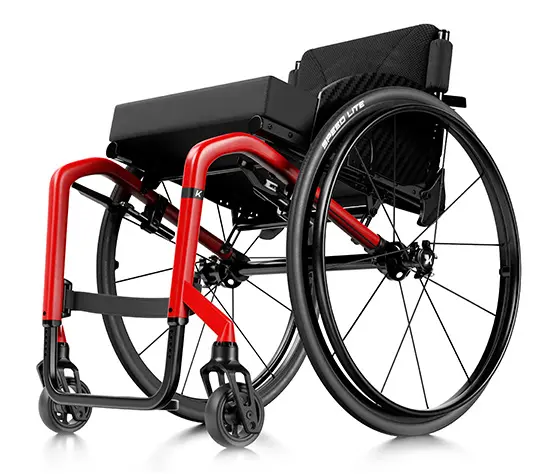
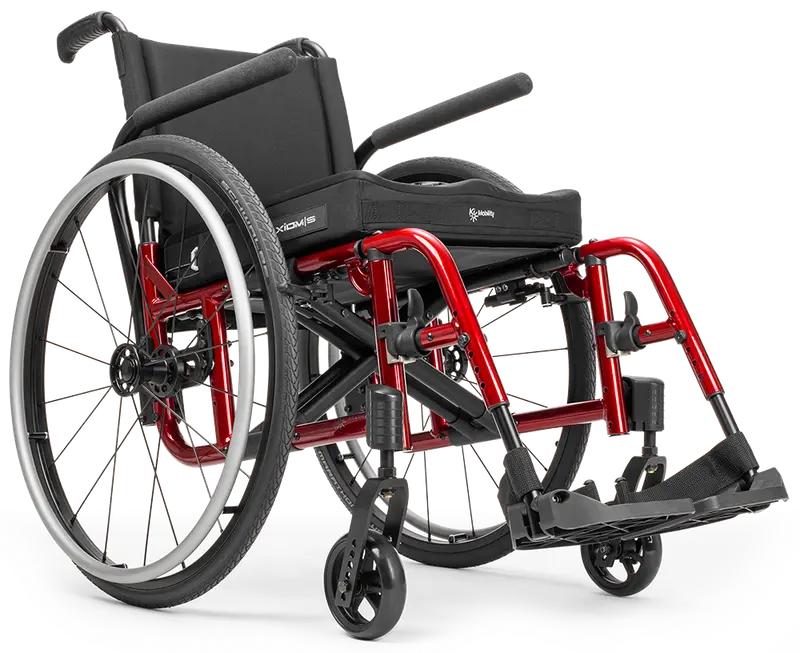
, a maker claim we cannot check. - Ki Catalyst 5: folding, 23 lbs standard and 12.8 lbs transport, 300 lbs (HD 350 lbs), seat widths 14 to 22 inches, camber 0, 2 or 4 degrees, "Transit Approved YES" on the page. Ki calls it its "flagship product".
- TiLite 2GX: titanium box frame on the TiLite matrix, 13.1 lb (fixed front) or 15.5 lb (swing away) transport, 265 lb standard and 350 lb heavy duty.
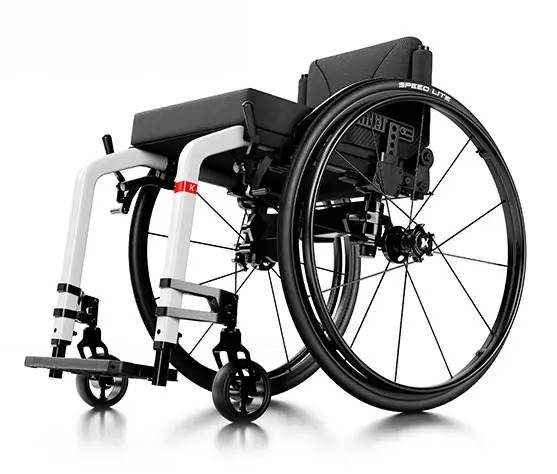
- Küschall Champion: folding open frame, approx. 8.8 kg, transport approx. 6.3 kg, 120 kg, folded width approx. 280 to 340 mm, on the international page.
In our view, ask the ATP how the cross-brace and its locks are checked, and read the owner's manual maintenance section before you take delivery. Ki's folding Catalyst 5 offers less camber (0 to 4 degrees) than its rigid Rogue2 (up to 8), on Ki's pages.
Weight limits, and why the lower figure wins
Every chair here prints a user weight limit, and some print two. The TiLite ZR and ZRA page says 265; the matrix adds heavy-duty frames at 300 lb, and the order form prints "300lb weight limit" for the $485 heavy-duty upgrade. Ki's Catalyst 5 form lists 300 lbs standard and a "350 lbs (Heavy Duty)" option at $588, which it says is "Not available with Klaxon Twist."
Motion's warranty is void for "exceeding the maximum weight capacity of 265 pounds (120 kg), or 350 pounds (159 kg) if equipped with HD Kit"
.
Options can lower the limit. Ki's Catalyst 5 transit option is printed as "Transit System (Weight Limit 300lbs)"
, and Ki's Twist power assist lists "Front - 265lb (120 kg), Rear - 309lb (140 kg)."
In a vehicle, the Rogue2 manual says "The rider and all items carried must not weigh more than 275 lbs (125 kg)."
Sunrise's Nitrum warranty excludes "Damage from exceeding the weight limit."
In our view, plan on the lowest limit among the frame, every option and the transit system, and count what you carry. Ask the dealer to write the limit for your configured chair on the quote.
Adjustability: the K0005 axle rule and what makers offer
Policy article A52497 says a K0005 chair has an "Adjustable rear axle position"
, and the LCD page links the code to fitting needs such as "axle configuration, wheel camber, or seat and back angles"
. The makers print the ranges: center of gravity adjustment of 0 to 4 inches on the Nitrum, 0 to 6 inches on the APEX C, and 0.5 to 3.5 inches on the Catalyst 5, in 0.25 inch steps.
Moving the axle changes how tippy the chair is. The Nitrum manual warns: "The farther you move the rear axles FORWARD, the more likely it is that your chair will tip over backward."
It tells riders to consult their health care provider about the rear axle set-up before changing it, and to "Adjust the rear wheel locks after you make any change to the rear axles."
On offset seating it says: "Use anti-tips until you adapt to the change, and are sure you are not at risk to tip over."
Some chairs trade adjustment for weight. TiLite describes the ZR as having "Minimal adjustability" and the ZRA "Full adjustability" on the order form; Sunrise's Active Rigid Nitrum welds the backrest and axle stems. In our view, a first ultralight, or one for a body that is still changing, needs adjustment more than it needs the last few ounces. The first active chair guide covers the measurements; the set-up belongs to your therapist and the ATP.
What an ultralight costs: maker order forms
Maker order forms are the closest thing to a list price. On the four US makers' forms we read on 9 November 2026, base lines before options and taxes ran from $2,472 to $4,500. Ki's form effective 8/17/2026 prints $2472 for a Catalyst 5 without transit and $2822 with it, and $2930 for a Rogue2. Motion's APEX form of June 2026 prints $2,595 for the aluminum chair and $2,495 for a carbon fiber frame upgrade. Sunrise's August 2026 Nitrum form prints $3,081.00 for the open frame and $3,425.00 for the Hybrid in its Price column. TiLite's March 2026 form prints $4,500 for the ZRA; its ZR line shows $750 without saying whether that is a full price. Options add up: a 20-inch seat costs $575 on the Rogue2 form, and options for riding in the chair in a vehicle cost $347 to $374 on the forms we read. Sellers and funders change the final figure, so ask for a written quote of your configured chair.
| Form (date as printed) | Base line as printed | Code printed |
|---|---|---|
| Ki Catalyst 5 (Effective: 8/17/2026) | $2472 without transit; $2822 with transit | K0005 |
| Ki Rogue2 (Effective: 8/17/2026) | $2930 | K0005, E1235 |
| Motion APEX (June 2026, 6.8) | WC11 aluminum $2,595; WC21 carbon upgrade $2,495 | K0005 (WC11 row) |
| Quickie Nitrum (August 2026, Rev K) | Open frame $3,081.00; Hybrid $3,425.00 | K0005 |
| TiLite ZR ZRA (March 2026) | ZRA $4,500; ZR $750 (unclear) | K0005, E1235 |
The range covers 7 base lines on five forms; we left out the TiLite ZR line because its form does not say whether $750 is a whole chair or an upgrade, and Motion's $2,495 carbon line because the form calls it an upgrade. We matched each Nitrum and APEX price to its label by the position of the text on the PDF page. Three of the five forms say codes do not guarantee payment: Sunrise's Nitrum form says "The use of HCPCS CODES does not ensure coverage or payment,"
and both Ki forms say "Proper use of HCPCS Codes does not ensure coverage or payment."
The difference with and without transit on the Catalyst 5 is $350, matching the separate $350 transit line on the same form. Power assists cost more than many chairs: the forms list Ki's Twist at $7950, Permobil's SmartDrive MX2+ at $7,529.00 and Sunrise's Empulse R90 at $7,300.00.
What an ultralight costs: two online sellers
Seller tiles show a different set of numbers. On Sportaid's "Ultra Lightweight Rigid Wheelchairs"
page, read 9 November 2026, 12 chairs were listed and 10 showed a price, from $1,925.00 (TiLite Z) to $6,656.00 (TiLite CR1); two RGK titanium chairs showed none. Its tiles show no price label. Its "Ultra Lightweight Folding Wheelchairs"
page showed 5 priced chairs from $1,949.03 (Quickie QXi) to $4,756.00 (Veloce). Those are the ranges on those two pages, not of every ultralight sold.
The tile figure is not the only label. On Sportaid's Nitrum page, the tile price of $2,760.84 is labeled "Cost", below "Retail: $3,173.00", a difference of $412.16 or 13.0 percent of the Retail figure. The Retail figure is not Sunrise's August 2026 form price of $3,081.00; we cannot say which is newer.
On SpinLife's "Rigid Wheelchairs" page, read the same day, the first page showed 15 of 17 chairs, from $1,452 (Quickie QRi) to $3,992 (APEX Carbon Fiber); the tiles carry no price label. The Rogue 2 page labels its price "Starting at" $2,011.10, with $2,873 shown crossed out; in our reading, a "Starting at" figure is the lowest configuration, not necessarily yours. SpinLife's Nitrum tile showed $2,157 with no label, $924 below the Nitrum form's $3,081.00 line.
Prices differ by seller, state, configuration, payer and date. The seller text we saved does not say whether a price includes fitting by an ATP, which a Medicare K0005 claim requires. In our view, compare a seller price only with a written dealer quote for the same configuration, and ask who will measure, fit and service the chair.
The Medicare fee schedule for K0005
Medicare pays suppliers from a fee schedule. In the October 2026 DMEPOS fee schedule (DME26-D, read 9 November 2026), code K0005 appears with three modifiers, which the file's readme defines as "NU--Purchased, New", "RR--Rented" and "UE--Purchased, Used". Its category is IN, which the readme spells out as "Inexpensive and Other Routinely Purchased Items"
.
| K0005 row | Non-rural amount, 48 states and DC | Ceiling / floor printed |
|---|---|---|
| NU, purchased new | $2,590.67 or $2,634.76 | $2,634.76 / $2,239.55 |
| RR, rented (per month) | $259.07 or $263.45 | $263.45 / $223.93 |
| UE, purchased used | $1,943.03 or $1,976.01 | $1,976.01 / $1,679.61 |
Across the 49 non-rural columns for the 48 contiguous states and DC, 37 print $2,634.76 for a new K0005 and 12 print $2,590.67. Alaska, Hawaii and Puerto Rico print other amounts, up to $2,797.90. In our copy every rural column for K0005 reads 0.00; we do not know why, so ask the supplier which amount applies to your address. That the RR amount is a monthly figure is our reading; the file prints no unit next to it.
The file DMEPOS_OCT.csv has no rows for E1022 or E1023, the transit codes printed on some order forms. The fee schedule is what Medicare allows the supplier, not the chair's price: base lines on the forms run from below the K0005 amount ($2,472 for the Catalyst 5) to well above it ($4,500 for the ZRA), before any option.
What you pay with Medicare
Medicare.gov's wheelchair page (read 9 November 2026) says: "After you meet the Part B deductible, you pay 20% of the Medicare-approved amount (if your supplier accepts assignment)."
In our arithmetic, 20 percent of $2,634.76 is $526.95, and 20 percent of $2,590.67 is $518.13, before options, if the whole amount is approved. The approved amount for your chair is set on the claim, not by us.
The page warns about suppliers who do not take assignment: "If a DME supplier doesn't participate in Medicare or won't accept assignment, you may be charged more."
It also says Medicare "will only pay for DME items if you get them from suppliers who are enrolled in Medicare."
For rentals, "make sure the supplier is willing to accept assignment for all rental months"
.
Upgrades are a common gap. In our reading, because CMS pays the same base amount whatever the frame material, a carbon or titanium frame, a lighter wheel or a power assist can leave a balance. In our view, ask the supplier to list, line by line, what Medicare is expected to pay, what you will owe and why, before you sign anything. For a Medicare Advantage plan, Medicaid or the VA, ask the plan; we did not read their rules for this guide.
Warranties, document by document
How long is an ultralight wheelchair's frame warranty? Mobility Atlas read five makers' warranty documents or pages on 9 November 2026, and the terms differ more than the K0005 code suggests. CMS lists a "Lifetime Warranty on side frames and crossbraces"
as part of the K0005 definition. Sunrise's Nitrum manual covers the frame and cross brace "for life or for as long as the original purchaser owns the chair"
, Ki's Rogue2 manual covers the frame and quick-release axles "for the life of the original purchaser"
, and Motion's USA warranty covers carbon parts and aluminum frames for life for the first user. TiLite's warranty defines the frame's serviceable life as five years, starting seven days after Permobil ships the chair to the dealer, and Panthera offers five years on the chassis. Other parts get one year, or 12 months, from each of these makers. Every document has exclusions, so read the one for your exact model before you buy.
| Document | Frame term | Other parts | Labor and transfer |
|---|---|---|---|
| Sunrise, Nitrum manual 249817 Rev. E | Life, or while first buyer owns it | Sunrise-made parts 1 year | You pay labor; not transferable; USA only |
| Permobil, TiLite Warranty 51015 Rev C | Five years (serviceable life) | TiLite-made parts 1 year; spares 90 days | Labor excluded; initial purchaser |
| Ki Mobility, Rogue2 manual | Life of original purchaser (frame, axles) | Ki-made parts 1 year | You pay labor; North America only |
| Motion Composites, USA warranty 2025-06-04 | Lifetime (carbon parts, aluminum frame) | Components 1 year; some 30 days | First user; not transferable |
| Panthera, warranty page | Five years on the chassis | 12 months | Not stated on the page |
Of these 5 documents, 3 print a lifetime frame term and 2 print five years. Three of the lifetime documents also print an expected life: Ki says "The expected life of the frame is five years."
Motion's aluminum-frame section says "The expected life of the frame and cross-brace is five years."
Sunrise gives five years as the "anticipated useful service time"
in the same sentence that grants the lifetime term. In our reading, an expected life is not a warranty limit, but it is worth asking the dealer what it means for service and replacement.
In our reading, the TiLite document's five-year frame term and the CMS definition's lifetime line do not match on their face. We do not know how Permobil or the coding contractor squares them; ask the supplier how the chair is coded and which warranty applies, in writing.
What the warranties leave out
Wear parts are excluded, or covered only briefly, in every warranty we read. Sunrise does not warrant "Tires and tubes, upholstery, pads, and push-handle grips."
Ki lists "Upholstery, tires, armrest pads, tubes, armrests and push-handle grips."
Motion covers "tires and tubes for front or rear wheels, seat slings, standard back upholstery, armrest, push-handle grips"
for 30 days only. TiLite excludes "tires and tubes, upholstery, push handle grips"
.
Labor and shipping usually fall on you. The Nitrum manual tells the owner to "Pay the cost of labor to repair, remove, or install parts."
and to return parts "freight pre-paid". Ki says "Pay any charges for labor to repair or install parts."
TiLite's warranty "excludes any labor, insurance or shipping charges incurred in replacement part installation or repair of the product, unless specifically authorized by Permobil."
Second owners lose the frame term. Sunrise says "This warranty is not transferable"
; Motion limits its lifetime terms to "the first user"; TiLite's is "available only to the initial purchaser"
. Region matters too: Sunrise's "applies in the USA only" and Ki's "applies in North America only."
Motion's USA warranty tells you to contact "an authorized Motion Composites Dealer in Canada or an authorized international distributor"
; in our view, ask a US dealer to confirm how they handle claims. Buying used? The used wheelchair guide covers what to check.
One TiLite line deserves a careful read if you ride in a vehicle. The warranty may be void if the product is used "in a manner contradictory or in violation of the terms of the owner's manual"
, including "using the product with tie downs or locking, clamping, or other restraint systems."
In our reading, ask Permobil in writing how that line applies to a chair ordered with its own transit tie-down option.
Transit options and Medicare code E1022
If you will sit in your chair in a moving vehicle, the transit option matters more than an ounce of weight. On the 5 order forms we read, 8 transit or transport lines cost $347 to $379; the $379 line is TiLite's transport brackets, "Unoccupied use only", so options for riding in the chair run $347 to $374 (7 lines):
- Ki Rogue2:
"Transit System (E1022) $347"
, which the form says "Cannot be retrofitted." - Ki Catalyst 5: the form says
"Transit System (Weight Limit 300lbs) (E1022) $350"
and"Not available with 350 lb Weight Capacity"
. - Motion APEX: the form says there is a
"WC-19 Transit Tie Down w/Q'straint belt"
at $365 (short or long belt) and"WC-19 Transit Tie Down without belt"
at $350. - TiLite ZR ZRA: the form says "Transit Tie-Downs", "Tested to WC-19", E1023, $363.00, not available on the ZR; and "Transport Brackets", E1022, $379.00, "Unoccupied use only."
- Quickie Nitrum: "Transit System" coded K0108 at $374.00; the form's Transit box prints
"WC-19 and ISO 7176 standard compliance. N/A with Active Rigid."
on the line above it.
For the lines coded E1022 or E1023, the CMS text is plain. The version of policy article A52504 that we read, listed as "Future Effective" from 20 December 2026, says "A wheelchair transportation securement system (E1022) and a wheelchair transit securement system (E1023) are non-covered as they do not meet the definition of DME."
Its revision history marks that sentence "Added"; we did not save the version in effect until 19 December 2026, so check the rule for your date of service. A code on a maker's form is the maker's coding, not a coverage decision.
A transport bracket is not a seat in a vehicle. TiLite's form calls its brackets "Unoccupied use only", for securing an empty chair. In our view, never treat a bracket as a transit option, and ask the dealer to name the option on the quote in the maker's words.
Riding in a vehicle: what the manuals say
The manuals put the safer choice first. The Nitrum manual says: "If possible and feasible, the rider should transfer to the Original Equipment Manufacturer vehicle seat and use the OEM vehicle restraint."
The Rogue2 manual says: "It is always safest to transfer out of your wheelchair onto a seat in a motor vehicle with appropriate seat and shoulder belts."
Without a transit option, the instructions are plain. The Nitrum manual says "NEVER let anyone sit in this chair while in a moving vehicle."
and "NEVER transport this chair in the front seat of a vehicle. It may shift and interfere with the driver."
The Rogue2 manual says: "Never use your wheelchair as a seat in a motor vehicle unless it has been equipped with the transit option."
With a transit option, the conditions are specific. The Rogue2 manual says the transit-equipped chair "has been tested to and passed the RESNA WC-4, Section 19"
and ISO 7176-19, that "The rider must be in a forward-facing position"
, that riders and items carried must not exceed 275 lbs, and that some configurations "may exceed 28.5 in. (724 mm) in width"
, which the manual calls the minimum width for lift platforms for ADA compliant vehicles. It says crashworthy pelvic belts are available from Ki "to be used in conjunction with a vehicle anchored shoulder belt."
The Nitrum manual says "Use of a seating system not provided by Sunrise Medical is prohibited for transit use"
, and that its positioning belt "is not a transit rated safety belt"
.
In its list for chairs without the transit option, the Nitrum manual says: "Do not use any chair that has been involved in a motor vehicle accident."
How a chair is secured in a particular van belongs to the vehicle's set-up and your therapist; Mobility Atlas's wheelchair van guide covers securement.
Everyday safety lines in the manuals
The manuals print specific warnings on axles, wheel locks, curbs and terrain, in their own words. The Nitrum manual's before-each-use checklist says to "Ensure that both quick-release rear axles are locked"
, and warns "An axle is not locked until the quick-release button pops out fully."
Its wheel lock warning reads: "Rear wheel locks are NOT designed to slow or stop a moving wheelchair."
It also says "Ensure lock arms embed in tires at least 1/8-in when locked."
On curbs and steps, the Rogue2 manual says "Do not try to climb or descend a high curb or step (more than 4 inches high) UNLESS you have help."
and "Do not ascend or descend stairs in your wheelchair."
On transfers it says "You should be trained by a clinical professional in the proper transfer technique for you."
The Nitrum manual's terrain section says the chair is designed for firm, even surfaces and "Do not operate your chair in sand, loose soil, or over rocky terrain."
In our view, ask the ATP to show you each of these checks on your own chair at delivery, and keep the manual. Transfer technique is a clinician's subject; this guide stops at what the manuals print.
Buying outside the US, and imported brands
Two of the brands here gave us only non-US pages. Küschall's international site lists European countries and the United Kingdom in its country selector, with no United States entry on the page we read. Panthera is Swedish, and its warranty page gives "a five year factory guarantee on the chassis"
and 12 months on other parts. Mobility Atlas's Panthera guide reported no US seller of new chairs.
In our reading, a chair bought abroad may not carry a US warranty: Sunrise's terms apply "in the USA only" and Ki's "in North America only." Medicare pays only enrolled suppliers, as Medicare.gov says. If you live in England, Wales or elsewhere, ask your national wheelchair service how ultralight chairs are provided; we did not read those rules for this guide.
Who an ultralight suits, and who may want something else
The K0005 rules describe one kind of user: a person who pushes their own chair full-time, or who needs a chair fitted closely to their body. Sunrise and Ki aim at the same people in the lines we read. Sunrise writes the Nitrum for "active users who are looking for unmatched driving performance, innovative details, and a large variety of options"
; Ki says the Rogue2 was "Developed to fit any lifestyle"
. In our view, an ultralight pays off most when the same person pushes, transfers and loads the chair many times a day.
Other people may be better served by another class. If a helper will push most of the time, the LCD covers a transport chair only when a caregiver is "available, willing, and able to provide assistance with the wheelchair"
, and Mobility Atlas's transport wheelchair guide compares those chairs. If a person needs tilt to change position, the LCD treats tilt-in-space as its own code, E1161, with its own criteria; see the tilt-in-space guide. If the need is short, the LCD says a high strength lightweight chair "is rarely reasonable and necessary if the expected duration of need is less than three months"
, and says a custom base "is not reasonable and necessary"
for under three months; a rental may fit better.
Weight limits narrow the choice too: several chairs here stop at 265 or 275 lbs on their standard frames. The decision about which class meets a person's needs belongs to the physician, therapist and ATP; the documents only tell you what each class must be and what Medicare asks for it.
Seat sizes, children and the small-seat codes
An ultralight adult chair under Medicare has a seat at least 15 inches wide and deep. A52497 says a chair with a seat width or depth of 14 inches or less "is considered a pediatric size wheelchair and is billed with codes E1231, E1232, E1233, E1234, E1235, E1236, E1237, E1238 or E1229."
The order forms follow that line: Sunrise's Nitrum form says to use E1235 for sizes of 14 inches or less, Ki's Rogue2 line reads "(K0005, E1235)", and TiLite's ZRA form says to use K0005 for rear seat width and depth of 15 inches or more and E1235 below that. The QS5 X page prints "K0005 / E1236".
Small seats also bring lower weight limits on some forms. TiLite's ZR ZRA form prints a 150 lb weight limit for seat sizes from 10 by 10 to 12 by 12 inches, against 265 lb for the standard frame. In our view, a smaller adult or a teenager moving into an adult frame should ask which code and which weight limit apply to their exact seat size. Mobility Atlas's pediatric wheelchair guide covers children's chairs.
Renting, buying new or buying used under Medicare
Medicare.gov says that, depending on the type of equipment, "You may need to rent the equipment"
, "You may need to buy the equipment"
or "You may be able to choose whether to rent or buy the equipment."
For K0005, the October 2026 fee schedule prints all three modifiers: new purchase (NU), rental (RR) and used purchase (UE). In our reading, that means a supplier may offer you more than one route; ask which they propose and why.
The used purchase row in the 48 states and DC is $1,976.01 or $1,943.03, against $2,634.76 or $2,590.67 new. A used chair bought privately is another matter: the warranties above are for the first buyer only, and an ultralight is set up for one body. Owning and renting also differ for repairs. Medicare's DME booklet says: "If you own your equipment, the supplier who sold it to you isn't required to repair it,"
while for rented equipment "your supplier must maintain and repair the equipment"
. In our view, ask the supplier early how long repairs usually take and what you will sit in.
Power assist on an ultralight frame
Many ultralight users add a power assist later, and the forms show both the price and the limits. Ki's Rogue2 and Catalyst 5 forms list the Twist Drive System (E0986) at $7950 and say the Twist needs a reinforced frame on the Rogue2. TiLite's ZR ZRA form lists the Permobil SmartDrive MX2+ at $7,529.00 with a "Maximum user weight capacity of 331 lbs."
Sunrise's Nitrum form lists the Empulse F35 at $6,500.00, R90 at $7,300.00 and M90 at $7,950.00.
Fit can depend on choices you make now. Ki's Rogue2 form says a 12 inch seat width is not available with the Klaxon Twist, and the SmartDrive line on the TiLite form rules out rear seat heights under 13.5 inches and 20 inch rear wheels. In our view, if a power assist is likely within the chair's life, tell the ATP before the frame is ordered. Coverage of power assist is a separate Medicare question that this guide does not cover; ask the supplier for the rule they will use.
Getting a K0005 chair through Medicare, step by step
This is the order the CMS documents describe, in our reading; your supplier may add steps of its own.
- Your treating practitioner orders the chair; the LCD requires a Standard Written Order before the supplier bills.
- A PT, OT or physician trained in rehabilitation wheelchair evaluations, with no financial link to the supplier (with a hospital-owned-supplier exception in A52497), does a specialty evaluation and writes a report explaining the chair and its features.
- A supplier that employs a RESNA-certified ATP takes part in person in choosing the chair, does or arranges the home assessment, and gets the Standard Written Order before billing.
- The ATP and the therapist set the measurements and options on the maker's order form, and the supplier tells you what Medicare is expected to pay and what you may owe.
- The chair is built, delivered, set up and adjusted; reimbursement includes delivery, set-up and education, A52497 says.
- You keep the manual and warranty document, record the serial number, and book a follow-up check of the set-up.
Three traps
Trap one: comparing two transport weights from two makers. Ki weighs the Rogue2 with rear wheels removed and a short backrest; TiLite weighs its chairs with all standard features except rear wheels; Sunrise gives one Nitrum figure with wheel locks and one without. Compare a configured chair with wheels, from a written quote.
Trap two: reading K0005 on a form as a promise. The code is the maker's coding. Coverage needs the LCD criteria, a specialty evaluation and a supplier with an ATP; transit lines coded E1022 or E1023 are non-covered in the A52504 version that takes effect 20 December 2026, and materials are not paid for separately.
Trap three: the transport bracket that sounds like transit. TiLite's transport brackets are "Unoccupied use only." If you will sit in the chair in a vehicle, you need the maker's tested transit option on your exact configuration, and Ki's Rogue2 form says its transit system "Cannot be retrofitted."
Three composite scenarios
These are composite scenarios, not individual customers. Each one uses only one model's own documents and the CMS rules quoted above.
Scenario one: a full-time manual wheelchair user on Medicare is offered a Ki Rogue2. The therapist does the specialty evaluation and the supplier has an ATP. They read the form: $2930 base, a 20-inch seat at $575 if needed, and the transit system at $347 that "Cannot be retrofitted." They ask the supplier to show what Medicare is expected to allow and, because for dates of service from 20 December 2026 the A52504 version we read calls the transit code non-covered, they ask who would pay for it, and they note the manual's lifetime frame term for the original purchaser and one year on other Ki parts.
Scenario two: a person who drives a small car wants a folding chair and looks at the Quickie QS5 X. The page prints "from 16.1 lbs" usable transport for the fixed-front frame and "16 lbs*" in the text, so they plan on 16.1 lbs or more, and ask the dealer to weigh the frame as configured. They check the 300 lbs capacity against their weight plus what they carry.
Scenario three: a person wants a TiLite ZRA and rides in a van. The form prints the ZRA at $4,500, with "Transit Tie-Downs" "Tested to WC-19" at $363.00. They read the warranty line on "tie downs or locking, clamping, or other restraint systems"
and ask Permobil, through the dealer, to confirm in writing how it applies to the factory option.
What to ask the clinician, the ATP and the supplier
Ask the therapist or seating clinician
- Do I meet the K0005 criteria as written in LCD L33788, and which one: full-time use, individual fitting, or both?
- Which adjustments do I need now, and which may change: axle position, camber, seat and back angles?
- Rigid or folding for my transfers and my car, and can I try both?
- Which cushion and back, and how do they change the weight and the set-up?
Ask the ATP and the dealer
- What will my configured chair weigh with wheels, and on what basis is the transport weight measured?
- What is the weight limit for my configuration, including every option and the transit system?
- Which warranty document applies, what does it say on labor, shipping and transfer, and who handles claims?
- Is the transit option tested for occupied use, can it be added later, and how does the warranty treat it?
Ask the Medicare supplier
- Do you accept assignment for this item, and are you enrolled in Medicare?
- Which codes will you bill, and which lines do you expect Medicare to deny?
- Will you ask me to sign an Advance Beneficiary Notice, and for which items?
- What happens if my chair needs repair: who fixes it, how fast, and what will a loaner be?
If you want help finding a chair or a dealer, ask us through the enquiry form with your measurements, your payer and the models you are weighing.
Sources and documents
Government: CMS LCD L33788 Manual Wheelchair Bases (revision effective 1 October 2026), policy article A52497 (revision effective 1 October 2026, R12), policy article A52504 Wheelchair Options/Accessories (version future-effective 20 December 2026), the October 2026 DMEPOS fee schedule DME26-D with its readme, and Medicare.gov's wheelchairs and scooters page, all read 9 November 2026. Makers: Sunrise Medical's Quickie Nitrum and QS5 X pages, Nitrum order form (August 2026, MK-129759 Rev K) and owner's manual (249817 Rev. E); Permobil's TiLite ZR and ZRA page, TiLite comparison matrix (MS0008_RevQ), ZR ZRA order form (March 2026) and TiLite Warranty (51015 Rev C); Ki Mobility's Rogue2 and Catalyst 5 pages, order forms (effective 8/17/2026) and Rogue2 user instruction manual; Motion Composites' APEX C page, APEX order form (6.8, June 2026) and USA limited warranty (revised 2025-06-04); Küschall's K-Series and Champion pages; Panthera's X3 and warranty pages, all read 9 November 2026. Sellers: Sportaid and SpinLife, read 9 November 2026.
Related guides on Mobility Atlas: Manual wheelchairs, all classes; Transport wheelchairs; Lightweight, transport and travel wheelchairs; Rigid vs folding frame; Your first active wheelchair; TiLite; Quickie; Ki Mobility; Sports wheelchairs.
Method in brief: how we checked. We copied each web page and the listed pages of each PDF (manual safety, transit and warranty pages; order-form price pages) on the date above, and took every spec, price, warranty term and safety line from those copies; quotes are checked by script against the saved texts, and every range and count in this guide is computed by script from them. Seller ranges cover every priced tile on the pages named, with exclusions stated. Where two figures from one maker differ, both are given. We did not test any chair.
Prices checked November 2026 on Sportaid and SpinLife and on the makers' order forms; prices change, so confirm them with the dealer. Documents checked November 2026: the CMS rules, policy articles and fee schedule, Medicare.gov, and each maker's page, form, manual and warranty listed above.
This article is general information. Rules and prices differ by country and change, so confirm them before you buy or travel.
Common questions
What is the difference between an ultralight and a lightweight wheelchair?
In US Medicare terms, policy article A52497 defines a lightweight wheelchair (K0003) as 34 to 36 lbs, a high strength lightweight (K0004) as under 34 lbs with a lifetime warranty on side frames and crossbraces, and an ultralightweight (K0005) as under 30 lbs with an adjustable rear axle position and the same warranty line. Outside Medicare, makers use "ultra lightweight" for their own ranges. The lightweight wheelchair guide covers the lighter classes.
Does Medicare pay for an ultralight wheelchair?
It can. LCD L33788 covers K0005 if the person is a full-time manual wheelchair user or needs individualized fitting that a K0001 to K0004 chair cannot provide, and has a specialty evaluation by a trained PT, OT or physician with no financial link to the supplier (with a hospital-owned-supplier exception in A52497), and gets the chair from a supplier employing a RESNA-certified ATP. After the Part B deductible you usually pay 20 percent of the approved amount, if the supplier accepts assignment. We read the rules on 9 November 2026; check the current versions.
How much does an ultralight wheelchair cost?
On the maker order forms we read on 9 November 2026, base lines ran from $2,472 (Ki Catalyst 5 without transit) to $4,500 (TiLite ZRA), before options. Sportaid's rigid ultralight page showed $1,925.00 to $6,656.00 and SpinLife's first rigid page $1,452 to $3,992. Medicare's October 2026 fee schedule lists $2,634.76 or $2,590.67 for a new K0005 in the contiguous states (non-rural columns). Prices differ by seller, country, configuration and funding.
Is a rigid wheelchair lighter than a folding one?
For the pairs we compared, yes, but not by much. Permobil's TiLite matrix lists the rigid ZR at 10.9 lb and the folding 2GX at 13.1 lb (fixed front) transport weight; Ki prints 10.6 lbs for the rigid Rogue2 and 12.8 lbs for the folding Catalyst 5. Compare within one maker, because each weighs different parts.
Is a titanium or carbon wheelchair worth it?
That is a weight, feel and budget question. Medicare pays the same base amount whatever the material: A52497 says K0001 to K0009 bases "include construction of any type material"
and bars billing K0108 for materials. Warranty terms differ by maker, not material: Motion's USA warranty covers carbon parts for life for the first user, and TiLite's warranty, which lists its titanium and aluminum models, gives frames five years. Try each on a demo chair with your therapist.
Can I sit in my ultralight wheelchair in a car or van?
Only if the chair has the maker's transit option and you follow its manual. The Rogue2 manual says never to use the chair as a vehicle seat without the transit option and that the rider must face forward; the Nitrum manual says to transfer to the vehicle seat if possible. TiLite's transport brackets are "Unoccupied use only." The A52504 version that takes effect 20 December 2026 calls E1022 and E1023 non-covered.
Sources
- CMS: LCD L33788, Manual Wheelchair Bases (revision effective 10/01/2026)
- CMS: Article A52497, Manual Wheelchair Bases - Policy Article (revision effective 10/01/2026)
- CMS: Article A52504, Wheelchair Options/Accessories - Policy Article (future effective 12/20/2026)
- CMS: October 2026 DMEPOS Fee Schedule (DME26-D)
- Medicare.gov: Wheelchairs and scooters
- Sunrise Medical: Quickie Nitrum rigid wheelchair (catalog row MW-001)
- Sunrise Medical: Quickie Nitrum order form, August 2026 (MK-129759 Rev K)
- Sunrise Medical: Quickie Nitrum owner's manual (249817 Rev. E)
- Sunrise Medical: Quickie QS5 X folding wheelchair
- Permobil: TiLite ZR and TiLite ZRA (catalog row MW-002 is the TiLite Z)
- Permobil: TiLite Manual Wheelchairs Comparison Matrix (MS0008_RevQ)
- Permobil: TiLite ZR ZRA Order Form, March 2026
- Permobil: TiLite Warranty (51015 Rev C)
- Ki Mobility: Rogue2 (catalog row MW-006)
- Ki Mobility: Rogue2 order form DCN1017.14, effective 8/17/2026
- Ki Mobility: Rogue 2 and Rogue XP user instruction manual and warranty
- Ki Mobility: Catalyst 5 (catalog row MW-009)
- Ki Mobility: Catalyst 5 order form DCN0011.49, effective 8/17/2026
- Motion Composites: APEX C carbon rigid wheelchair (catalog row MW-004)
- Motion Composites: APEX order form USA 6.8, June 2026
- Motion Composites: Limited warranty USA (0070514E, revised 2025-06-04)
- Küschall: K-Series, international site (catalog row MW-003)
- Küschall: Champion, international site (catalog row MW-016)
- Panthera AB: Panthera X3
- Panthera AB: Warranty
- Medicare.gov: Medicare Coverage of Durable Medical Equipment & Other Devices (booklet 11045)
- Sportaid: Ultra Lightweight Rigid Wheelchairs (prices read 9 November 2026)
- Sportaid: Ultra Lightweight Folding Wheelchairs (prices read 9 November 2026)
- Sportaid: Quickie Nitrum (Retail and Cost, read 9 November 2026)
- SpinLife: Rigid Wheelchairs, page 1 (prices read 9 November 2026)
- SpinLife: Ki Mobility Rogue 2 (price read 9 November 2026)
Read on . The wording of the article is our own.