Handcycles in 2026: clip-on handbikes and standalone handcycles, specs, fit, prices, warranty, rules and funding
Attach-on handbikes and standalone handcycles from Batec, Stricker, Rio Mobility, Top End and Hase: specs, fit, prices with dates, warranty, rules and funding.
Contents
- The short answer
- How we compared
- The two families side by side
- Attach-on handbikes: how they work
- Batec models, as Batec prints them
- Stricker models, as Stricker prints them
- Rio Mobility Firefly 2.5, as Rio prints it
- Will an attach-on handbike fit my wheelchair?
- Standalone handcycles: recumbent and upright
- Power-assist standalone handcycles
- Speed, power and range: ceilings, not plans
- Motors and the law: US, UK and EU
- Is a handcycle a medical device?
- Transfers, fitting and the therapist's part
- Safety checks the manuals ask for
- Transport, storage and flying
- Tyres, tubes and parts
- Hybrid handbikes: how the motor joins in
- Controls for limited hand function
- Children and young riders
- Maintenance and service life
- Buying a used handcycle
- What handcycles cost in 2026
- Reading a handcycle price
- Warranty, as each maker words it
- Paying for a handcycle: Medicare, the VA and grants
- Challenged Athletes Foundation and Kelly Brush Foundation
- What the FDA recall records show
- How to buy a handcycle
- Three traps
- Three composite scenarios
- Questions to ask the therapist, the dealer and the funder
- Your plan: 10 minutes, today, this week
- Sources and documents
- Common questions
- Sources
The short answer
What kinds of handcycle are there, and which one fits you? Mobility Atlas read the makers' pages and manuals for Batec, Stricker, Rio Mobility, Top End and Hase on 5 November 2026. An attach-on handbike, also called a clip-on handbike, clamps to the front of your own manual wheelchair and lifts its front casters, so the chair becomes a three-wheeler you ride from your usual seat. It comes hand-cranked, hybrid (cranks plus a motor) or fully electric with a thumb or trigger throttle. A standalone handcycle is a separate trike you transfer into, with a reclined or an upright seat, some with power assist. In our reading of the makers' pages, attach-on models are built around everyday trips with no transfer, and standalone models around longer rides and sport, though Hase describes its Kettwiesel ONE Handbike as a trike "for everyday use". Your therapist checks whether either suits your shoulders, hands and balance, and the dealer checks whether it fits your chair.
Among the models in this guide, prices shown in US dollars ran from $2,649.00 to $10,995.00 for attach-on units, $5,399.00 to $12,699.00 for adult standalone handcycles and $3,999.00 for Top End's youth model, before options, set-up and any surcharge. On the two euro-priced makers' own pages they ran from Stricker's "from 3.891,30 € excl. VAT"
for the City Max to Hase's "from 11.299,– Euros including VAT, excluding delivery"
for the Kettwiesel ONE Handbike. Warranties in the documents we read run from one year (Rio Mobility, whole unit) to three years (Batec's hard and structural parts; Hase, all bikes and trikes), and Hase adds two years on the frame for a registered new bike. A motor changes what the law calls your trike, and that differs in the US, the UK and the EU.
This guide does not rank the makers. It sets out what each one prints, so you can ask the right questions before you pay.
How we compared
Mobility Atlas earns a fee or margin when you order through us; the comparison below uses only the makers' published documents, sellers' price pages and official rule pages, each saved as text with the date we read it. We did not ride, test or weigh any handcycle, and we placed no orders.
- Makers: Batec Mobility's product page, comparator and Hibrid 2 user manual; Stricker Handbikes' product pages, FAQ and terms; Rio Mobility's Firefly 2.5 page and manual; Top End Sports' handcycle pages; Hase Bikes' Kettwiesel ONE Handbike page, warranty page and FAQ. All read 5 November 2026.
- Sellers: Bike-On (US) category and product pages, policies and funding page; 1800wheelchair (US) Force RX page. Read 5 November 2026.
- Rules: GOV.UK electric bike rules and powered wheelchair classes; the US Code of Federal Regulations definition of a bicycle in the Consumer Product Safety Commission's bicycle rule; EU Regulation 168/2013 (original 2013 text). Read 5 November 2026.
- Funding: the VA adaptive sports grant pages (5 November 2026); the Challenged Athletes Foundation and Kelly Brush Foundation pages (19 October 2026); Medicare.gov's equipment page (17 October 2026), the Medicare wheelchair accessories rule LCD L33792 and its policy article A52504 (25 October 2026), and VA regulation 38 CFR 17.3230 (23 October 2026).
- Safety: openFDA recall, enforcement and adverse event searches, read 5 November 2026.
Where two documents disagree, we give both and say which figure to plan on until the maker confirms in writing. Where we could not read a source, we say so. The Sport-On maker site did not open in our browser, so Sport-On figures here come from a US seller's page and our catalog.
The two families side by side
| Question | Attach-on handbike | Standalone handcycle |
|---|---|---|
| Where you sit | Your own manual wheelchair | The handcycle's own seat |
| Transfer needed | No; you clip the unit on | Yes, into the handcycle |
| Drive options | Manual, hybrid or electric | Manual, some with power assist |
| Wheels on the ground | Its front wheel, your rear wheels | Its own three wheels |
| Fit depends on | Your chair's frame and tubes | Your body measurements |
| Examples in this guide | Batec, Stricker, Firefly 2.5 | Top End Force, Sport-On, Hase |
| Prices in this guide (USD) | $2,649.00 to $10,995.00 | $3,999.00 to $12,699.00, incl. youth |
The price row is the range of the models in our tables, not the market's lowest or highest; the standalone range includes a youth model. Batec's Hibrid 2 manual describes the attach-on idea in one line: the product "turns a manual wheelchair into a hand-powered tricycle with electrical assistance,"
the manual says. Stricker's FAQ says "A handbike is basically a third wheel for wheelchairs."
A standalone handcycle is a whole trike: Top End's Force 3 page lists a 60 inch wheelbase, a 20 inch rear and 26 inch front wheel set, and says it "Delivers fully assembled".
Attach-on handbikes: how they work
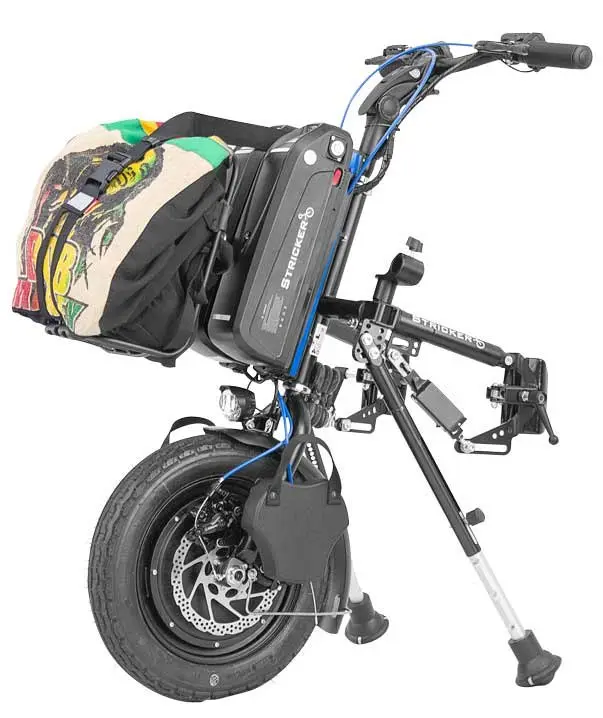
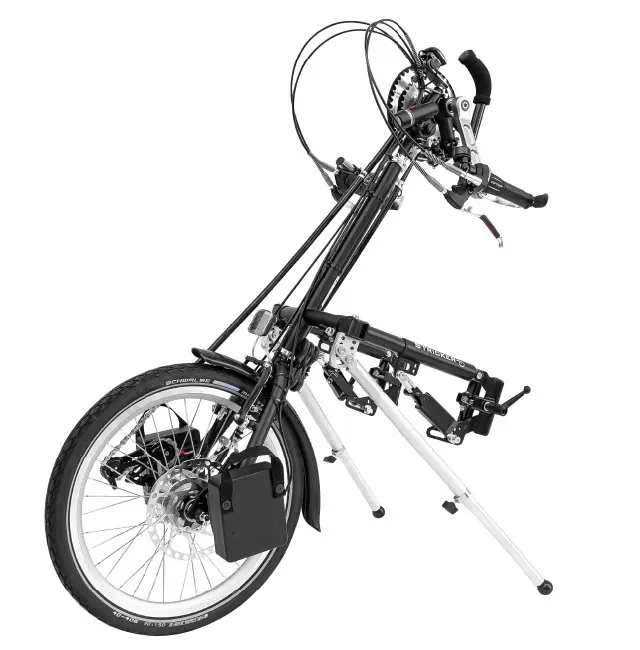
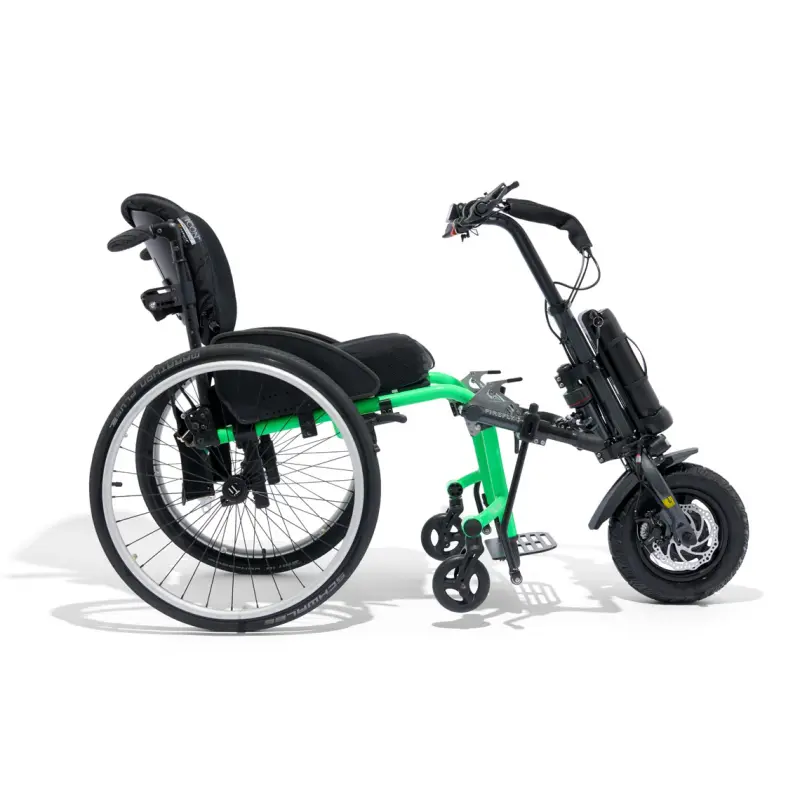
An attach-on handbike has its own front wheel, fork, handlebar or cranks and brakes. A clamp or docking bar is fitted once to the front of your wheelchair frame; after that the unit latches on and off. Stricker's page says that with the handbike in place "the two castors of the wheelchair are raised,"
which it says improves off-road mobility. Rio Mobility says the Firefly 2.5 "latches on and off your wheelchair in seconds"
after an installation that "typically takes about an hour"
, and its manual recommends that a qualified technician, such as a wheelchair or bicycle mechanic, does the initial set-up.
Three drive types are sold:
- Manual: you turn hand cranks connected by a chain to the front wheel. Stricker's City Max uses a
"Shimano Alfine 8-speed hub gears with Derailleur"
set-up and lists a total weight "From 15 kg"; Stricker's City Max page calls it"Totally independent - even from power sockets"
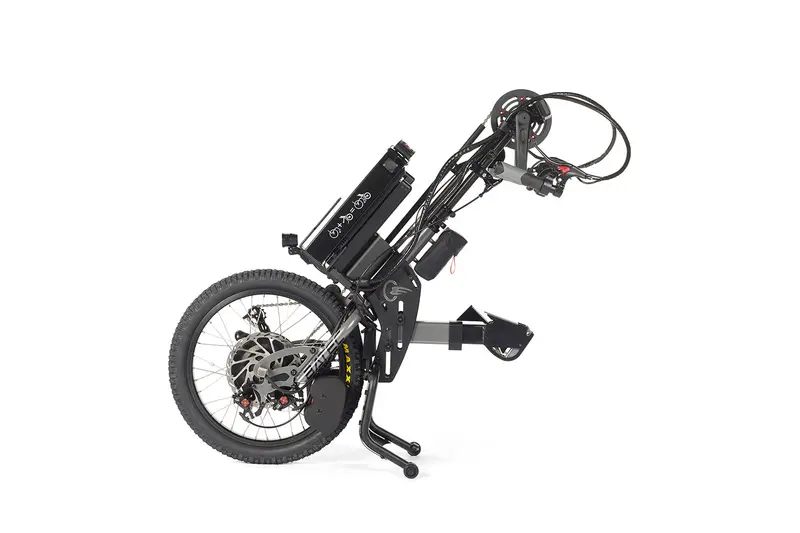
, and the same page also speaks of 24 gears. - Hybrid: you crank, and a motor adds power. Batec says its Hibrid 2 is
"the equivalent of an electrically assisted bicycle."
Stricker's Smart Dynamic page says its torque sensor"recognises the muscle power provided at the crank and dynamically adds motor assistance"
. - Electric: a motor drives the front wheel and you steer with a handlebar, without cranking. Stricker's pages print "Wheel hub motor" for the Lomo GX and Micro GX, and Rio Mobility's page prints "brushless hub motor" for the Firefly 2.5; Batec's comparator lists brushless motors for the Mini 2 Plus, Electric 2 Plus and Scrambler 2 Plus (and the Hibrid 2); its Rapid 2 Plus entry does not name the motor type.
The Firefly 2.5 sits apart from the cranked units: Rio Mobility calls it an "Electric Scooter Attachment"
with "Separate color coded forward and reverse throttles,"
and its manual says it "is intended for general recreational use only and not as an exclusive means of mobility nor is intended for use in competition."
Power add-ons that push from behind or sit in the wheels are another family again; the Mobility Atlas guide to power add-ons compares front, rear and wheel types, and the SmartDrive guide covers one rear unit in detail.
Batec models, as Batec prints them
Batec Mobility's comparator, read 5 November 2026, lists six electric and hybrid handbikes. All give a "Maximum user weight" of 110 kg. Treat the speeds and ranges as the most to expect, not what you will see on every ride.
| Model (Batec's name) | Rated / peak power | Top speed | Range as printed | Weight no battery |
|---|---|---|---|---|
| Batec Air | 350 W / 470 W | 15 km/h | 16 to 23 km (216 Wh) | 11 kg |
| Mini 2 Plus | 350 W / 600 W | 20 km/h | 21.5 or 44 km | 13.9 kg |
| Electric 2 Plus | 900 W / 1050 W | 20 km/h | 21.5 or 44 km | 15.9 kg |
| Rapid 2 Plus | 1200 W / 1300 W | 20 km/h | 55 km (768 Wh) | 15.9 kg |
| Scrambler 2 Plus | 1440 W / 1620 W | 20 km/h | 55 km (768 Wh) | 16.7 kg |
| Hibrid 2 | 900 W / 1050 W | 20 km/h | 27-40 or 55-80 km | 20.6 kg |
For the Mini 2 Plus, Electric 2 Plus and Hibrid 2 the two range figures go with the 280 Wh and 576 Wh batteries. The Air's three figures are at 6, 10 and 15 km/h. The Hibrid 2 page gives the conditions behind its range: a user "weighing 75 kg, ultralight wheelchair, flat terrain, no wind, and an average speed of 15 km / h,"
and adds that "The range depends on the force applied by the user."
Batec also says it "may vary + -20% depending on the battery,"
so the printed range is not a ceiling either. Plan on less: heavier riders, hills, cold and wind all cut it.
Batec says the Hibrid 2 comes in a version for quadriplegics with its Magic Lever crank release and Shift Lever, and "up to 8 speeds for quadriplegics and 9 speeds for paraplegics."
The comparator lists "Gas & Brake" handlebars for quadriplegics and hemiplegic handlebars on the Mini 2 Plus and Electric 2 Plus; its Rapid 2 Plus and Scrambler 2 Plus entries list no handlebar options. Which controls you can use safely is a question for your therapist, not for a spec table.
Our catalog row PA-001 (checked October 2026, from a dealer page) lists a "Batec Electric 2" at 25 km/h, while Batec's comparator lists the "Electric 2 Plus" at 20 km/h. No saved page says whether these are the same product. Ask which version a quote is for. Use the figure Batec prints for that exact version; if Batec prints none for it, ask Batec in writing, and until then treat 20 km/h as the most to expect on a ride, but for road rules assume the unit may reach 25 km/h, which is above GOV.UK's 15.5 mph (about 24.9 km/h, our arithmetic).
Stricker models, as Stricker prints them
Stricker Handbikes is a German maker, and its site says "Outside Germany we sell through our distributors."
Its data sheets, read 5 November 2026, give these figures. The City Max page warns that "The specifications depend on the model and equipment and may therefore differ."
| Model | Drive | Motor as printed | Wheel | Weight as printed |
|---|---|---|---|---|
| City Max | Hand crank, chain | None | 20 inch | From 15 kg total |
| City 11 | Hand crank, chain | None | 20 inch | From 12 kg total |
| Smart Dynamic | Pedelec, torque sensor | 250 W | 16, 20 or 24 inch | From 27 kg total |
| Lipo Smart Wild | Pedelec | 1500 W | 20 inch | From 30 kg total |
| Lomo GX | Wheel hub motor | 1000 W rated, 1250 W peak (only engine line) | 14 or 16 inch | 14 in from 20 kg, 16 in from 17 kg transport |
| Micro GX | Wheel hub motor | 500 W rated, 1000 W peak | 12 inch | From 17 kg transport |
Every one lists "Standard load up to 120 kg user load. More than 120 kg is possible on request."
The motorised models list a "48 V, 13 Ah (624 Wh)" battery and a "Technically maximum speed"
of up to 25 km/h, and the Lomo GX page adds: "The technical maximum speed is a general reference for international sales."
That page says the final speed is set by the rules of each country, including the medical device rules, funders and road laws.
Stricker also says its handbikes "are always equipped with double mechanical brakes,"
with at least one that can be locked for parking. Its Smart Free has no chain: Stricker says it is "the world's first handbike that works completely without a chain, belt or derailleur,"
with a range "of up to 60 km." We found no price for it on the page.
Our catalog row PA-005 (checked October 2026) lists the Lomo GX with a 500 W geared motor for the 16 inch wheel; the maker's page on 5 November 2026 gives one engine line, 1000 W rated. Ask the dealer to name the motor and its rated power on the quote. Until then, assume it is above 250 W, the limit GOV.UK uses for an EAPC and the line above which Stricker's Smart Wild page says Germany requires an operating licence and insurance; both figures are above that line.
Rio Mobility Firefly 2.5, as Rio prints it
Rio Mobility's page, read 5 November 2026, lists the Firefly 2.5 with a "350W, 36V geared, brushless hub motor," five speed modes, a "Top speed is 12 mph/ 19 kph"
and a "Speed limiter in the Color Display."
It gives "about 12-15 miles range" and says that depends on "rider weight, speed, terrain, temperature and headwind."
The shipping weight is "35 lbs / 15.9 kg" and the tyre is an oversize 12.5 by 3.0 inch. There are no hand cranks: you ride it like a scooter, with forward and reverse throttles.
The manual adds limits that matter before you buy. It says "Combined wheelchair and user weight must be less than 130kg/280lb."
The two units differ: 280 lb is about 127 kg, our arithmetic, so plan on the lower 280 lb until Rio confirms. It also says that "Anti-tips MUST be installed on your wheelchair,"
and that wheelchairs "must have wheel locks installed."
It also says the unit is "Not Intended for Use at Elevations Greater Than 2000 m Above Sea Level."
Rio's page says to contact it for a "customized mounting kit" for the Ki-Mobility Rogue and Quickie Nitrum.
Will an attach-on handbike fit my wheelchair?
Fit is the first question for any attach-on unit, and each maker answers it differently. Batec's manual says the Hibrid 2 "isn't compatible with all wheelchairs on the market"
and tells you to check its compatibility table first. On 5 November 2026 Batec's filter showed "Compatible (230)", "Batec Bloc compatible (13)"
, "In progress (8)" and "Not compatible (8)" against its list of chair models. The manual says the unit attaches to a docking bar that "can be installed on most wheelchairs on the market, whether fixed or folding frame,"
and that it "must be installed on a wheelchair by a qualified professional authorised by BATEC MOBILITY."
Stricker says its clamp lets the handbike attach "usually without adapters or modifications to the wheelchair,"
and its pages carry the line "fits 99% of all wheelchairs"
. That is the maker's claim; a dealer checks your own frame. Rio Mobility's manual gives measurements you can take yourself:
- Width between the front frame tubes, measured centre to centre between the vertical tubes where the clamps go:
"Must be between 9 and 20 inches (23 to 51 cm),"
extendable to 23 inches (58 cm) with other hardware, the Firefly manual says. - Tube diameter: the manual lists supported diameters of 7/8 inch (22.2 mm), 1 inch (25.4 mm), 1.125 inches (28.6 mm), 1.2 inches (30.5 mm) and 1.25 inches (31.8 mm), and 1.375 inches (34.9 mm) with additional mounting hardware on request.
- Clearance: the manual says "1.25 inches (32 mm) of vertical clearance along the wheelchair tube is needed" for the clamps.
- Tube angle: the manual says
"Ideally the wheelchair tubes should be vertical or close to vertical."
Write down your chair's make, model, frame type (rigid or folding), the width between the front tubes, the tube diameter and your weight with the chair before you ask anyone. If you are still choosing a chair, the Mobility Atlas guide to rigid or folding frames explains the difference, and the measuring guide shows what to measure.
Weight limits differ, and they count different things. Batec's manual says not to exceed 110 kg, which "includes the user's weight and any other object being carried."
Stricker gives "Standard load up to 120 kg user load."
Rio Mobility prints 130 kg/280 lb for the wheelchair and user together; 280 lb is about 127 kg, our arithmetic, so plan on the lower 280 lb (127 kg) until Rio confirms. Read the wording, not just the number.
Standalone handcycles: recumbent and upright
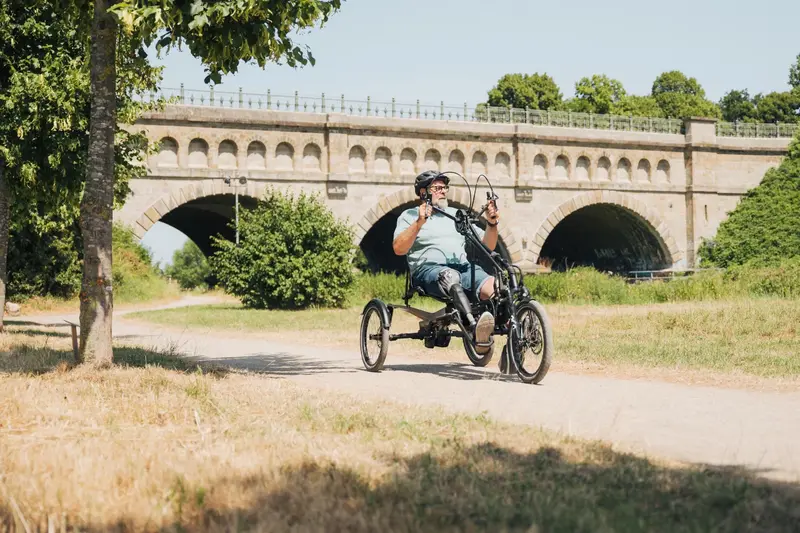
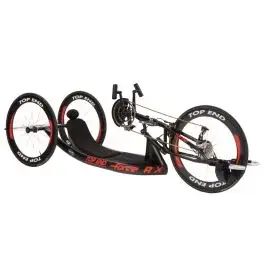
A standalone handcycle is its own trike. You transfer out of your wheelchair into its seat, and the wheelchair stays behind or travels separately. The makers sort them by riding position. On Top End's pages the Force RX is a reclined model: Top End's page says the RX name stands for "Reclined Carbon Fiber", with an aluminium frame and carbon backrest. The Force G has "an upright seating position"
that Top End says offers "a powerful stance for individuals with core function"
; whether that position suits you is for your therapist. The Excelerator is an "upright three-wheel handcycle"
for teens and adults, with a steel frame and "speeds up to 15 mph".
| Model (maker or seller page) | Position or type | Figures as printed |
|---|---|---|
| Top End Force 3 | Entry recreational | 20/26 in wheels, 60 in wheelbase |
| Top End Force G | Upright seat | 6061-T6 aluminium frame and fork |
| Top End Force RX | Reclined | 28 lb, 250 lb (1800wheelchair) |
| Top End E-Force 3 | Power assist | 60 lb, 250 W continuous, 20 mph |
| Top End Excelerator | Upright, teens and adults | 16, 18 or 20 in seat widths |
| Top End SportHC | Youth | Aluminium; ships in 30 days or less, Top End says |
| Sport-On XCR | Cross-country (Bike-On); recumbent off-road (PA-018) | 13,6 kg, 3x10 Shimano 105 (Bike-On) |
| Hase Kettwiesel ONE Handbike | Raised seat, e-assist | 40 kg, max load 140 kg, 545 Wh |
The figures come from different kinds of page. Top End's own page for the Force RX gives no weight; the 28 lb and 250 lb capacity are on 1800wheelchair's specification tab, which also lists a transfer height of 5 inches from the ground with a 2 inch cushion. 1800wheelchair describes "a 7005 aluminum heat-treated frame,"
while Top End's page says "a 6061-T6 aluminum frame."
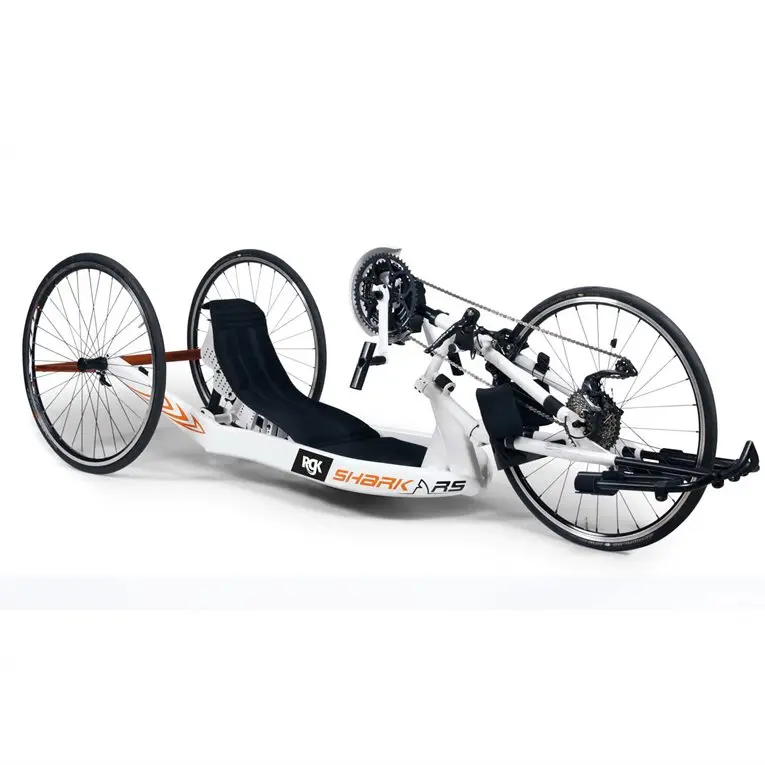
Ask Top End which applies to your build. Sport-On's figures are from Bike-On's page, because the Sport-On site did not open for us. Our catalog row PA-018 also lists 13.6 kg for the XCR, and row PA-020 lists RGK's Shark RS from 12.9 kg with a crank length of 155 to 175 mm.
We found no page in our reading set describing a kneeling handcycle on sale, so this guide does not give figures for one. If a coach or club suggests a kneeling position, ask the maker for its own specification sheet and the therapist whether it suits you.
Power-assist standalone handcycles
Some standalone handcycles add a motor. Top End's E-Force 3 page says a Shimano system "boosts your power up to a continuous 250 Watts so long as you keep those hands spinning,"
enough "to get you up to 20 mph," with "a peak power output of 500 Watts."
It lists "Weight: 27.21kg / 60lb" and "Battery life: Approximately 30 miles on flat terrain and moderate pace."
Top End rates "Chair to Seat Transfers" as "Medium to low difficulty" and travel as "Medium to hard – requires a larger vehicle or bike rack."
Hase's Kettwiesel ONE Handbike is an e-assist trike with hand cranks and adjustable leg rests. Hase says "The raised seat allows for easy and wobble-free transfer from a wheelchair,"
and that its Bosch Performance Line CX motor gives "100 Nm of torque and a 400% assistance factor." The page lists 40 kg, a 140 kg maximum load, a 545 Wh battery, and an arm length "from 40 cm (15¾ inch)". Ask how a 40 kg trike is carried and stored.
Speed, power and range: ceilings, not plans
Treat every speed and range figure in this guide as the most to expect under stated or unstated conditions. Batec's Hibrid 2 range assumes a 75 kg rider on flat ground with no wind at 15 km/h. Rio Mobility ties its range to rider weight, speed, terrain, temperature and headwind. Stricker calls 25 km/h a "technical maximum speed" and says the final speed is set country by country. Top End's E-Force 3 figure is "Approximately 30 miles on flat terrain and moderate pace."
- Read "up to 25 km/h" as no more than 25 km/h, and only where the law allows it.
- Compare rated power with rated power, not with peak power. Batec, and Stricker for its GX models, print both.
Batec's manual also says the life of the battery is "between 200 and 500 charging cycles, and between 1 and 3 years,"
depending on temperature, use and other factors. A battery is a running cost, and Batec's warranty treats it as a "fungible part".
Motors and the law: US, UK and EU
A motor can change what the law calls your trike, and the rules differ by country. These are the official texts we read on 5 November 2026. They do not say where a handbike on a wheelchair may be ridden in your town; confirm that with your local authority, the seller and your insurer before you ride on roads.
United States (federal)
The Consumer Product Safety Commission's bicycle rule, 16 CFR 1512.2, defines a bicycle to include "A two- or three-wheeled vehicle with fully operable pedals and an electric motor of less than 750 watts (1 h.p.), whose maximum speed on a paved level surface, when powered solely by such a motor while ridden by an operator who weighs 170 pounds, is less than 20 mph."
In our reading this is a product-safety definition, not a road rule, and it does not say whether hand cranks count as pedals. The rule opens its definitions with "For the purposes of this part"
. In our reading, where you may ride is a matter for state and local rules, which we did not read; ask your state or city.
United Kingdom
GOV.UK says "You can ride an electric bike if you're 14 or over, as long as it is an 'electrically assisted pedal cycle' (EAPC)."
An EAPC "must have pedals that can be used to propel it"
and "can have more than 2 wheels, for example a tricycle."
Its motor must have a "continuous rated power" output of no more than 250 watts and must not propel it above 15.5 mph. GOV.UK adds: "It can be propelled up to 15.5mph without pedalling but only if it's been approved,"
and says approval is needed if "it can be propelled up to 15.5mph without pedalling, for example, a 'twist and go'"
. An EAPC may be ridden "on cycle paths and anywhere else pedal bikes are allowed"
, and GOV.UK says "You cannot ride it on pavements."
A bike that does not meet those rules is, in GOV.UK's words, "classed as a motorcycle or moped"
and must be registered, taxed and insured, with a licence and helmet. For such a bike GOV.UK says the rider "can only ride it on the road"
and "cannot ride it on cycle tracks or cycle lanes"
. Separately, GOV.UK says a mobility scooter or powered wheelchair is "usually" class 2 if its maximum speed is 4 mph or less and class 3 if it is 8 mph, and that one is not in a class if it can go more than 8 mph, is wider than 0.85 metres or weighs more than 150 kg "(or 200kg if you need any equipment attached to it - for example, medical equipment)". GOV.UK says class 2 and 3 vehicles "can be used: on pavements and other pedestrian areas"
and "on cycle tracks", but "cannot be used on cycle lanes"
; "Class 3 mobility scooters and powered wheelchairs can also be used on the road. You need to register them with DVLA."
On pavements, GOV.UK says "The maximum speed is 4mph."
For a vehicle not in a class, GOV.UK says "you can only use it on the road"
, with a valid driving licence and DVLA registration. In our reading, neither GOV.UK page says which group a clip-on electric handbike belongs to. Ask the seller, in writing, which category it was sold under.
European Union
EU Regulation 168/2013 sets type-approval for two- and three-wheel vehicles. Its scope article, in the original 2013 text (not the consolidated version), lists vehicles it does not apply to. Item (a) is "vehicles with a maximum design speed not exceeding 6 km/h"
. Item (b) reads "vehicles exclusively intended for use by the"
followed by an older term for people with physical disabilities, which we do not repeat. Item (h) is "pedal cycles with pedal assistance which are equipped with an auxiliary electric motor having a maximum continuous rated power of less than or equal to 250 W, where the output of the motor is cut off when the cyclist stops pedalling and is otherwise progressively reduced and finally cut off before the vehicle speed reaches 25 km/h"
. In our reading, the regulation does not say where an exempt vehicle may be ridden. Batec's manual says the Hibrid 2's top speed "is over 6 km/h" and that "In certain countries, this type of product is not allowed on public roads or cycle paths according to road traffic laws,"
leaving it to the user to check. Stricker's Smart Wild page says that in Germany, above 250 watts, "an operating license and appropriate insurance is required,"
and its FAQ says one model's hand accelerator is "limited to 6 km/h in Germany"
. Those are the makers' statements for Germany; confirm them where you live.
Is a handcycle a medical device?
Batec says yes for the Hibrid 2: its manual says the Hibrid 2 "has CE marking as a class I medical device according to the requirements of Regulation (EU) 2017/745."
Stricker cites the medical device rules ("MDR") among the rules that set speed. In the US, the one handcycle recall record we found is filed under FDA product code ION, which openFDA labels "Exerciser, Non-Measuring", class 1. A 2015 FDA report about a Rio Mobility handcycle lists the generic name "CYCLING, SCOOTERS, SKATEBOARDS & SKATES"
, the report says. These codes show how the records were filed, not how a model on sale today is classed. The label may matter for funding, and in our reading for which road rules apply, so ask the seller how the model you want is classed in your country.
Transfers, fitting and the therapist's part
Choosing between the two families is partly a question of your body, and that part belongs to a physical or occupational therapist, a seating specialist or your physician. They can judge your shoulders, grip, trunk balance, skin and transfers. This guide sets out what the makers say and what to ask, and stops there.
Batec's manual sets out who it is for. It says the standard set-up suits users whose "upper limbs are not affected and have full functionality of their hands,"
and the QUAD set-up those who "have good functionality of their arms and partial functionality of their hands, enough to accelerate, brake and turn without risk,"
adding that for spinal injuries "the most severe level that can use models with the QUAD set-up is functional C6. It is essential to have good biceps function and firm wrist extension."
It also lists users it does not recommend the product for, including "People who weigh over 110 kg."
Rio Mobility's manual opens: "Consult with your health care professional to determine if the Firefly 2.5 is appropriate for you."
Treat those lines as the makers' conditions, and let the therapist decide whether they apply to you.
Top End fits its handcycles by video: its pages say "All fittings are held virtually,"
with an in-person fitting in Florida on request. Bring your therapist's notes to that call.
Safety checks the manuals ask for
The manuals we read, and one FDA report, point to a handful of safety rules worth reading before the first ride.
- Learn somewhere quiet, with help. Batec's manual says
"Never use your HANDBIKE BATEC HIBRID alone until you have gained the necessary skill level."
- Fit anti-tips and wheel locks. Rio Mobility says
"Anti-tips MUST be installed on your wheelchair"
for the Firefly 2.5. - Take turns slowly. The Firefly manual says side-to-side stability is decreased with the unit attached,
"SO USE CAUTION WHEN TURNING"
(capitals in the original). - Check the brakes. Stricker fits two mechanical brakes, one lockable; Batec's page lists a
"Power cut-off brake sensor"
on the Hibrid 2. - Respect the weight limit as the maker words it: user only, user plus load, or user plus chair.
- Keep fingers clear of chains and cranks, and keep any chain guard fitted.
The last point comes from a 2015 voluntary report to the FDA about a new Rio Mobility Dragonfly handcycle, in which the report says a rider's finger "GOT PINCHED IN-BETWEEN THE BIKE CHAIN AND THE TOP CRANK-GEAR"
while rolling backwards on a hill; the report says a tendon was broken. FDA report texts are in capitals. Another report, from 2023, describes a person who attached an electric handcycle to a wheelchair, reached to the ground while stopped, and says the "WHOLE WHEELCHAIR FELL OVER."
These are two reports, not a measure of risk.
Transport, storage and flying
An attach-on unit travels separately from the chair, so think about where both go. Batec lists a Batec Asa handle "to easily lift and carry your Batec handbike,"
and the optional Batec Anillas, which Batec says lift the handbike "into the car with the Batec Cincha and a crane."
Rio Mobility says the Firefly's "Quick-release center frame comes apart easily without tools for transportation in a car, plane, or for storage."
Stricker says the Smart Free's control head folds so it "fits crosswise into almost any boot"
.
Standalone handcycles are longer: Top End lists the E-Force 3 at 84-1/2 inches overall and says travel "requires a larger vehicle or bike rack."
Hase gives the Kettwiesel ONE Handbike a total length of 160 to 205 cm.
Batteries decide flying. Batec's FAQ says the Hibrid 2 "is suitable for air travel when used with the 280 Wh battery, which complies with IATA flight regulations."
Airlines set their own rules, so ask yours before you book. The Mobility Atlas guide to flying with a power chair covers batteries and airline rules, and the guide to power wheelchair batteries covers charging and care.
Tyres, tubes and parts
Handcycles use bicycle parts as much as wheelchair parts. Batec's Hibrid 2 runs a "20'' wheel" with a Maxxis tyre and a removable dropout "to change inner tube and/or tyre easily."
The Firefly uses an oversize 12.5 by 3.0 inch tyre, Rio Mobility's page says. Our catalog lists a 24 by 1 inch (25-520) clincher tyre listed for handcycles and racing chairs (row AC-115) and a 20 inch Presta tube listed for handcycle rims (row AC-149), checked October 2026.
Batec's manual says its warranty excludes "tyres, inner tubes, handles, cables for brakes, gear shifter and anchoring, stand frame wheels and similar parts"
as fungibles, "except in the case of premature wear on said parts caused by original manufacturing defects,"
and Stricker's FAQ lists "tyres, brake pads, bowden cables and bulbs"
as wear parts. Budget for them. The Mobility Atlas guide to wheelchair wheels explains tyre sizes.
Hybrid handbikes: how the motor joins in
A hybrid handbike lets you crank and adds motor power on top. Batec's FAQ says the Hibrid 2 is for those who "need extra support to maintain a steady pace, cover longer distances or climb slopes"
. The makers describe the controls in different ways. Batec's Hibrid 2 page lists "Aluminium cranks with new trigger throttle and 3 levels of support,"
a "Torque Sensor," and an "E mode" to switch between electric and manual "without losing power to the lights or the horn."
Batec says its hybrid models let you "start uphill, assisting you without the need for a 1/4 turn of the pedals"
.
Stricker's Smart Dynamic page says support comes in "five adjustable levels," and that levels 1 and 2 "add particularly little motor support."
It says the thumb throttle "accelerates the Smart Dynamic up to 6 km/h without cranking,"
and that holding the throttle while cranking switches to a turn-based mode for riders whose strength runs out. The page also recommends "traction weights on the fork or some luggage"
for safer starts on loose ground. Batec lists "Removable QR weights" as standard on the Hibrid 2; its page does not say what they are for.
Controls for limited hand function
Several makers sell controls for riders with limited hand or arm function. They are listed here as the makers describe them; whether you can use them safely is for your therapist to judge.
- Batec's comparator page lists a
"Gas & Brake handlebar for quadriplegics: accelerate and brake by gently moving the handlebars,"
and"Hemiplegic handlebars with Monolever brakes and optional right or left trigger throttle,"
for the Mini 2 Plus and Electric 2 Plus. - On the Hibrid 2, Batec's page lists the
"Batec Magic Lever, which offers an assisted start mode and allows you to use the handbike in zero effort mode,"
the Shift Lever and"Batec Quad Grips for quariplegics"
(Batec's spelling). - Stricker's FAQ says
"Examples of quadriplegic equipment include a chin shift, back pedal, starting aid, chin control, ergonomic handlebars, a large brake lever and star grip nuts for the hand cranks."
- Bike-On's page says the Sport-On XCR is
"Designed for all, including tetraplegics with custom grips."
Batec's manual ties its QUAD set-up to "good functionality of their arms and partial functionality of their hands, enough to accelerate, brake and turn without risk."
Test any of these controls before you order, on the kind of ground you will ride, with the therapist or an experienced dealer present.
Children and young riders
Handcycles come in youth sizes, and growth is the main buying question. Top End's SportHC page calls it "a youth-focused adaptive handcycle"
that "is designed to grow alongside developing athletes,"
listed at $3,999.00 on 5 November 2026. Top End also lists a Lil' Excelerator at $5,399.00; our saved pages give only its price tile, not its sizes, so we do not class it as youth or adult. Its Excelerator page says it is built "for teens and adults." Bike-On (US) listed Stricker City Kid and City Youth handbikes at $3,544.00 and $3,442.00 on 5 November 2026 (not included in our attach-on table), and Stricker's pages offer "Children/Youth equipment" in which "the axle distance and the crank length are changed."
Rio Mobility's Firefly manual says "Children and young adults under the age of 18 years should not be left unattended while using the Firefly 2.5."
Ask how many years of growth a frame allows, what an adjustment costs, and whether a club or school program has one to try first. The Mobility Atlas guide to children's wheelchairs covers growth and funding for the chair itself.
Maintenance and service life
A handcycle is part bicycle, part wheelchair accessory, and it needs both kinds of care. Batec's manual says its electric handbike "has a lifespan of at least 5 years, as long as it is used according to the indicated operating conditions and receives proper maintenance and revisions, as indicated."
It also says "As the necessary maintenance varies between users, check with your BATEC MOBILITY representative to establish a periodic maintenance schedule that fits your specific use,"
and warns that "Improper maintenance may invalidate the warranty."
Rio Mobility's manual asks you to tighten the clamp and frame screws with the supplied torque handle and to "Tighten the axle nuts on both sides of the Firefly 2.5 every two months to avoid damaging the motor."
Top End says every Force 3 adjustment can be made "With only a 5mm Allen Key and 13mm Wrench,"
and rates the E-Force 3's "Maintenance requirements" as "Low". Stricker says its hub gear means "the wear and the associated maintenance effort is greatly reduced."
Our checklist; follow the maker's schedule where it gives one:
- Before each ride: tyres, brakes, the clamp or docking bar, and the battery charge.
- Every few weeks: chain, cables and bolts, using the tools the maker supplies.
- Once a year, or as the dealer sets: a full service by the dealer or the maker's service partner.
- Keep receipts and the warranty card; several warranties need the original invoice.
Buying a used handcycle
Used handcycles and handbikes are sold privately and by some shops, and the warranty terms we read make that a risk to weigh. Batec's warranty is "non-transferable," Rio Mobility's "is only available for the original owner or purchaser and is non-transferable,"
and Top End's covers frames "when purchased new and unused."
Hase extends its frame warranty only when a new bike is registered.
- Ask for the serial number, the original invoice and the manual, and check the model against recall records.
- For an attach-on unit, ask whether the clamp or docking bar fits your chair, or what a new one costs.
- For an electric unit, ask the battery's age and charge cycles; Batec's manual gives a battery life of 200 to 500 charging cycles.
- Have a dealer check the frame, brakes and drive before the first ride.
The Mobility Atlas guide to used wheelchairs has a fuller checklist for buying second-hand equipment.
What handcycles cost in 2026
How much does a handcycle cost in 2026? Mobility Atlas read the makers' and sellers' price pages on 5 November 2026, and for the models in this guide, prices shown in US dollars ran from $2,649.00 to $10,995.00 for attach-on units, $5,399.00 to $12,699.00 for adult standalone handcycles and $3,999.00 for Top End's youth model. Rio Mobility's site showed the electric Firefly 2.5 at $2,649.00, and Bike-On listed Stricker's hand-cranked City Max at $3,977.00 and Batec's Hybrid 2 at $10,295.00. Top End's own site listed its Force 3 at $6,499.00 and its E-Force 3 power-assist model at $12,699.00. Stricker prints euro prices from 3.891,30 € excluding VAT, and Hase prints its handbike "from 11.299,– Euros including VAT, excluding delivery"
. These are listed prices before options, fitting, shipping and any surcharge. Prices differ by country, seller, set-up, VAT relief and funding, so ask for a written quote.
All prices below are as each maker or seller showed them on 5 November 2026, with the label printed next to them. None comes from our catalog.
Attach-on handbikes, prices in US dollars
| Model as named on the page | Seller | Price as shown |
|---|---|---|
| Rio Mobility Firefly 2.5 | Rio Mobility site, US dollar setting | $2,649.00 |
| Stricker City Max | Bike-On | $3,977.00 |
| Stricker City 11 | Bike-On | $4,236.00 |
| Stricker Micro GX | Bike-On | from $5,782.00 |
| Stricker Lomo GX | Bike-On | from $5,790.00 |
| Stricker Smart Dynamic | Bike-On | from $7,186.00 |
| Stricker Smart Wild | Bike-On | $8,024.00 |
| Batec Mini 2 | Bike-On | $6,675.00 |
| Batec Electric 2 | Bike-On | $7,975.00 |
| Batec Rapid 2 | Bike-On | $10,195.00 |
| Batec Hybrid 2 | Bike-On | $10,295.00 |
| Batec Scrambler 2 | Bike-On | $10,995.00 |
Models covered in this guide; Bike-On's attachment page lists other attachments at lower prices, and its handcycle page lists handcycles at higher prices. When we read it, Rio Mobility's shop first showed its price in another currency; the $2,649.00 is what it showed with the US dollar setting (our reading). Bike-On's page tiles name "Batec Electric 2", "Batec Mini 2", "Batec Rapid 2" and "Batec Scrambler 2", while Batec's comparator lists models named "Mini 2 Plus", "Electric 2 Plus", "Rapid 2 Plus" and "Scrambler 2 Plus". Neither page says whether these are the same products, so ask which version a quote is for. The word "from" on the 3 Stricker rows in our table that carry it is Bike-On's (Bike-On's page prints it on 5 Stricker tiles); the final price depends on the options chosen.
Standalone handcycles, prices in US dollars
| Model as named on the page | Seller | Price as shown |
|---|---|---|
| Sport Handcycle (SportHC) | Top End (maker) | $3,999.00 |
| Lil' Excelerator Handcycle | Top End (maker) | $5,399.00 |
| Top End Excelerator Handcycle | Top End (maker) | $5,399.00 |
| Top End Force 3 Handcycle | Top End (maker) | $6,499.00 |
| Top End Force G Handcycle | Top End (maker) | $8,299.00 |
| Top End Force RX Handcycle | Top End (maker) | $9,499.00 |
| E-Force 3 Handcycles | Top End (maker) | $12,699.00 |
| Top End Force RX | Bike-On | $9,999.00 |
| Sport-On XCR | Bike-On | $8,342.00 |
| Top End Force RX | 1800wheelchair | "Total:" $9,999 |
Top End's own page listed the Force RX at $9,499.00; Bike-On listed it at $9,999.00, and 1800wheelchair showed a default "Total:" of $9,999. The gap of $500 between the maker's page and the two sellers is our arithmetic; ask each what its price includes, and budget on the higher $9,999 until a written quote says otherwise. The SportHC is a youth model. The Lil' Excelerator appears only as a price tile in our saved pages, which do not give its sizes, so it is in neither range. The other rows are adult models. These are models covered in this guide; Bike-On's handcycle page lists others at higher prices. Top End's category page also lists Carbonbike VENTO models from $21,250.00 to $26,950.00, made by another brand, which we leave out of our ranges.
Makers' own euro prices
| Model | Maker | Price as printed |
|---|---|---|
| Stricker City Max | Stricker | from 3.891,30 € excl. VAT |
| Stricker City 11 | Stricker | from 4.141,20 € excl. VAT |
| Stricker Micro GX | Stricker | from 5.831,00 € excl. VAT |
| Stricker Lomo GX | Stricker | from 5.997,60 € excl. VAT |
| Stricker Smart Dynamic | Stricker | from 7.247,10 € excl. VAT |
| Stricker Lipo Smart Wild | Stricker | from 8.092,00 € excl. VAT |
| Hase Kettwiesel ONE Handbike | Hase | from 11.299,– Euros including VAT, excluding delivery |
Stricker sells directly only in Germany; Hase's English site does not name a country for its price. Stricker says that "In every other country the sale runs through our distributors, and their own terms and conditions apply."
Its FAQ says the price "depends on the individual model and on the optional special equipment."
Batec's pages print no price; its FAQ says to buy "from your local orthopaedic supplier or through an official Batec service centre"
.
Reading a handcycle price
The figure on a page is rarely what you pay. These lines, all from the pages we read, show what can move it.
- Options. 1800wheelchair's Force RX page adds, for example, "+ $1,749" for carbon wheels and "+ $1,617" for an electronic shifting package to the $9,999 default.
- Tariffs. Top End's pages say
"a flexible Tariff Surcharge may be added to your order"
because of"fluctuating international tariffs"
. - Card fees. Bike-On's policy says
"a 3% processing fee will be applied to all orders paid via credit card"
. - VAT. Stricker prints prices excluding VAT and Hase including VAT. Whether you can buy without VAT as a disabled person depends on your country's tax rules; ask the seller.
- Returns. Bike-On says
"custom-ordered, non-stocked wheelchairs, handcycles, and adaptive cycles are not refundable."
1800wheelchair's Force RX page says"All sales are considered final."
- Lead time. Top End's pages say an item
"typically ships in 90 days or less"
, while its Force 3 page offers it "in 30-days or less" and its SportHC page says it ships in 30 days or less; 1800wheelchair says the Force RX"Leaves Warehouse in 6-8 weeks"
.
Warranty, as each maker words it
Warranty terms belong to the document that prints them. These are the terms in the documents we read on 5 November 2026, for the products those documents name.
| Maker and document | Main term | Battery | Note |
|---|---|---|---|
| Batec, Hibrid 2 manual | 3 years, hard and structural parts | 1 year | Original registered owner only |
| Stricker, FAQ | Two-year warranty | Two years (Lipo Lomo, Neodrives) | Distributor terms abroad |
| Rio Mobility, Firefly 2.5 manual | 1 year, whole unit | 6 months | Non-transferable |
| Top End, product pages | Frames 2 years | Not stated | Other parts 13 months |
| Hase, Cycle Passport page | 3 years on all bikes and trikes | Not stated | Frame plus 2 years if registered |
Batec's manual says it "guarantees all hard and structural parts for a period of three (3) years from the date of delivery in the case of material defects or labour for the original registered owner,"
and the battery for one year. It excludes fungibles such as tyres and cables, does not cover "transport, shipping or labour costs for removing and reinstalling the parts,"
and says "This warranty is only valid for the original registered user, who must provide the original receipt as proof of purchase."
We read only the Hibrid 2 manual; ask Batec for the terms of other models.
Stricker's FAQ says "your handbike comes with a two-year warranty"
and that "Spare parts are not included in the warranty."
Outside Germany, Stricker says the distributor's own terms apply, so ask the distributor for its warranty in writing.
Rio Mobility's manual warrants the Firefly 2.5 "for one (1) year from the date of initial consumer purchase"
and the battery for six months. It lists cases that make the warranty void, including use "in any competitive event,"
water exposure "this includes accidental exposure to rain,"
and any modification.
Top End's pages say it "warrants the frames when purchased new and unused to be free from defects in materials and workmanship for a period of two (2) years,"
and the upholstery and remaining components for "thirteen (13) months," with the seller's invoice required. 1800wheelchair's Force RX specification tab lists a "Frame and Fork warranty" of "Three (3) Years". The two differ; plan on Top End's two years until Top End confirms otherwise in writing.
Hase says it "offers a three-year warranty on all of its bikes and trikes"
and that registering a new bike will "extend your frame warranty by two years."
We could not read Sport-On's own terms.
Paying for a handcycle: Medicare, the VA and grants
Does Medicare pay for a handcycle? Mobility Atlas read Medicare.gov's equipment page in October 2026 and the Medicare rule for wheelchair options and accessories, and found no text in the parts we hold that names handcycles or handbikes. Medicare Part B covers durable medical equipment that is medically necessary and, in Medicare.gov's words, "Used in your home." The policy article that goes with the wheelchair accessories rule (CMS Article A52504, companion to LCD L33792) says "An option/accessory that is beneficial primarily in allowing the beneficiary to perform leisure or recreational activities is non-covered."
In our reading, a handbike bought for sport, fitness or outings would be hard to fit inside those lines, but neither text decides your case. If Medicare covers an item a supplier bills, you pay 20% of the approved amount after the Part B deductible, if the supplier accepts assignment. Ask the supplier in writing whether they will submit a claim, and what you would pay if it is denied.
Other routes may apply. Hase's FAQ says that if a trike is "medically necessary for you"
then "your health insurer may cover the costs,"
with "A medical prescription" generally required, and that some Hase adaptive cycles have aid item numbers for statutory health insurers in Germany; the FAQ names the Kettwiesel ONE REHA, Kettwiesel ONE UP REHA, Trix and Trets, not the Kettwiesel ONE Handbike. Those are the maker's statements. Elsewhere, ask your health plan, your state's vocational rehabilitation program or your national health service what applies to you.
The VA
The VA's Adaptive Sports Grant program funds organizations, not individual buyers: "VA awards grants to qualifying organizations to plan, develop, manage, and implement programs,"
its page says, and the eligible applicant "must be a non-federal entity with significant experience in managing a large-scale adaptive sports program."
Authorized activities include "sports equipment" for those programs. In our reading, that means a club or program near a veteran may hold handcycles bought with the grant; ask local adaptive sports programs. The VA page also describes a "monthly assistance allowance"
for veterans with disabilities training in Paralympic sports. VA's regulation 38 CFR 17.3230 (read 23 October 2026) lists "Adaptive recreation equipment"
among items VA will provide to eligible veterans if VA determines they are needed and they "serve as a direct and active component of the veteran's medical treatment and rehabilitation, and do not solely support the comfort or convenience of the veteran"
. It does not name handcycles; ask your VA provider.
Challenged Athletes Foundation and Kelly Brush Foundation
Two US foundations fund adaptive sports equipment for individuals, and both pages were read on 19 October 2026.
- Challenged Athletes Foundation (CAF): its page says the 2026-2027 annual program
"will open for applications on September 28 and close on November 13."
Its preferred vendors include RGK, Top End and Carbonbike USA, and CAF pays the vendor directly. For equipment from other vendors, "Maximum award: $3,500." Applicants"May apply every 3 years if under 18, or every 5 years if 18 and over,"
and"Requests for general mobility or non-sport equipment are not eligible."
- Kelly Brush Foundation (KBF) Active Fund: for people with paralysis from an acquired spinal cord injury living in the US. KBF says it has helped people
"purchase handcycles, monoskis, sport chairs"
and more, and that"the average grant is generally around $3,500."
It says it will not consider"Motorized wheelchair attachments"
or"trainers (for handcycles)"
. On 19 October 2026 its page said"Fall 2026 Active Fund Closed"
.
Read those two lines together before you pick a model. KBF's list excludes motorized wheelchair attachments, and KBF says it gives "preference to equipment that provides some fitness benefit,"
while it will "consider applications for power equipment where the applicant can persuasively explain why that type of equipment is the best and most appropriate piece of equipment"
for them. In our reading, the exclusion names motorized wheelchair attachments, not hand-cranked ones, and KBF asks for "2 personalized quotes from reputable adaptive sports equipment vendors". Top End's pages say you "Typically" need a fitting to apply for a grant: "You will want a finalized quote to present in your grant application."
Bike-On's funding page lists further foundations, among them the Semper Fi and America's Fund and the High Fives Foundation; read each one's own rules. The Mobility Atlas guide to sports wheelchairs covers CAF and KBF in more detail.
What the FDA recall records show
We searched openFDA's recall records on 5 November 2026 (data last updated 31 October 2026) for handcycle, handbike, "hand cycle", "hand bike", Batec, Stricker and Firefly. The search returned 5 records, and only 1 is a handcycle: the others are surgical kits and children's seating that share the word Firefly. That record, Z-1520-2015, initiated on 27 March 2015, covers the AmTryke Model 1424 Community Cruiser Hand Cycle. The recall record says "Product is being recalled due to complaints of cracked frames,"
gives a quantity of 53 units, and lists batch numbers 2-1301 and GM-0314. FDA's enforcement record (data last updated 28 October 2026) classes it Class II, and it was terminated in 2017.
A search of recall records by firm name for Rio Mobility, Batec, Stricker, Top End, Sport-On, Hase, Bike-On and RGK returned no matches. That means only that no record under those names was in openFDA on that date; it is not a safety rating. The firm-name search did not include Invacare; 1800wheelchair's page address for the Force RX contains the word "invacare".
We also ran a word search of FDA adverse event reports (data last updated 20 October 2026) for handcycle, handbike, "hand cycle", "hand bike" and Batec. It returned 4 reports, 2 of them about handcycles: the chain injury and the tip-over described in the safety section above. Reports are what people chose to send; they are not a count of problems.
How to buy a handcycle
- See your therapist first. Ask which family, which riding position and which controls suit you, and get it in writing if you will apply for funding.
- Try before you buy. Batec says it offers
"personalised advice and demo sessions,"
Stricker says"the best opportunity to test ride a handbike is at trade shows,"
and Hase offers"a free test ride near you."
Ask adaptive sports clubs near you whether they have a handcycle to try. - Measure your chair, for attach-on units. Send the dealer your chair's make, model, frame type, front tube width and diameter.
- Book the fitting, for standalone units. Top End says
"All fittings are held virtually"
, with an in-person fitting in Florida on request; ask what to have ready for the call. - Get a written quote naming the model, version, options, fitting, delivery, warranty and return terms.
- Apply for grants with that quote, mindful of their dates and exclusions.
- Have it installed and adjusted by the dealer. Batec's Hibrid 2 manual requires a professional authorised by Batec for installation.
- Learn somewhere quiet, with someone who has read the manual, before riding in traffic.
If a dealer cannot answer the fit and warranty questions in writing, ask another. If you want us to find a model or a dealer near you, send an enquiry with your chair, your town and the model your therapist named, and ask us to find it or request a quote.
Three traps
Trap one: reading a speed as a right to ride at it. Stricker calls 25 km/h a "technical maximum speed" and says national rules come first; GOV.UK caps an EAPC's motor at 15.5 mph and puts powered wheelchairs usually at 4 mph (class 2) or 8 mph (class 3). Ask what your unit is set to and what that makes it where you live.
Trap two: comparing weight limits that count different things. Batec's 110 kg includes you and what you carry; Stricker's 120 kg is "user load"; Rio Mobility's 130 kg/280 lb is you and the chair together. The 10 kg gap between the last two, our arithmetic, is not extra room for you: it compares two different things. Rio's 280 lb is about 127 kg, so plan on the lower figure.
Trap three: assuming a grant or plan covers any handcycle. KBF will not consider motorized wheelchair attachments, CAF excludes "general mobility or non-sport equipment,"
and Medicare's wheelchair accessories policy article says recreational accessories are non-covered. Check the funder's exclusions before you choose the model.
Three composite scenarios
These are composite scenarios, not individual customers. They use only facts already in this guide.
Scenario one: a full-time manual chair user with full hand function wants exercise on greenways near home. Their therapist agrees a hand-cranked unit suits them. They ask a Stricker dealer to check their folding chair against the Stricker clamp for the City Max, listed by Bike-On at $3,977.00, and they ask whether Stricker's two-year warranty or the distributor's terms apply.
Scenario two: a rider with paralysis from an acquired spinal cord injury applies to the Kelly Brush Foundation. Because KBF will not consider motorized wheelchair attachments, they look at hand-cranked options, including a standalone handcycle. They book Top End's virtual fitting for a Force 3 listed at $6,499.00 and get the two personalized vendor quotes KBF asks for.
Scenario three: a UK user wants an electric clip-on for trips to town. Before buying, they ask the seller in writing whether the unit is sold as an EAPC, a class 2 or class 3 powered wheelchair, or neither, because GOV.UK sets different rules for each, and if the seller says class 3, they treat 8 mph on the road and 4 mph on pavements as the most it may do, and register it with DVLA, as GOV.UK says class 3 vehicles need.
Questions to ask the therapist, the dealer and the funder
The therapist
- Which family suits me: attach-on, standalone, or neither for now?
- Hand cranks, a hybrid, or a throttle only?
- Upright or reclined, and can I transfer into it safely?
- Which brake and gear controls can my hands manage?
The dealer
- Is my chair on the maker's compatibility list, and which clamp or docking bar does it need?
- Which version and motor does the quote include, and what speed will it be set to?
- What is the weight limit, and does it count me, my load or my chair?
- Whose warranty applies, for how long, and who does the repairs?
- What are the return terms for a custom order, and is there a card fee or tariff surcharge?
- How is it carried in a car, and can the battery fly?
The funder
- Is this kind of handcycle eligible, or excluded?
- When does the cycle open and close, and what quote do you need?
- Do you pay the vendor or me?
Choose with the physical or occupational therapist who knows your shoulders, hands and balance, and with a dealer who has seen your chair. If no one has assessed your seating and propulsion recently, ask your physician for a referral before you spend money.
Your plan: 10 minutes, today, this week
In 10 minutes: write down your chair's make, model, frame type, front tube width and your weight, and decide whether you want to ride from your own chair or transfer.
Today: look up your chair on the compatibility list of the attach-on maker you are considering, and check the dates of the grant you might use; CAF's page, read 19 October 2026, gave November 13 as the closing date.
This week: ask your therapist about the questions above, book a demo or test ride, and ask two dealers for a written quote.
Sources and documents
Makers: Batec Mobility's Hibrid 2 page, comparator and Hibrid 2 user manual (TF002-03 4.0, 06/2023); Stricker Handbikes' product pages, FAQ and business terms page; Rio Mobility's Firefly 2.5 page and user manual (Ver 1.4.7); Top End Sports' handcycle pages; Hase Bikes' Kettwiesel ONE Handbike, Cycle Passport and FAQ pages. Sellers: Bike-On's attachment and handcycle pages, policies and funding page; 1800wheelchair's Force RX page. Rules: GOV.UK's electric bike and powered wheelchair pages, 16 CFR 1512.2 on eCFR, and EU Regulation 168/2013 on EUR-Lex. Funding: the VA sports grant pages. Safety: openFDA recall, enforcement and event searches. All read 5 November 2026. Also used: the CAF and KBF pages (19 October 2026), Medicare.gov's equipment page (17 October 2026) LCD L33792 and Article A52504 (25 October 2026), and 38 CFR 17.3230 (23 October 2026). Catalog: rows PA-001, PA-005, PA-018, PA-020, AC-115 and AC-149, for non-price facts, checked October 2026.
Related guides on Mobility Atlas: Power add-ons; SmartDrive; Sports wheelchairs; Beach and trail chairs; Wheelchair tennis; Flying with a power chair; Used wheelchairs.
Method in brief: how we compared is set out near the top. We read each page and PDF as text in a browser, saved the text with the read date, and quote only text saved word for word. Where a PDF's text layer swapped glyphs (letters, an apostrophe and some digits), we restored only those glyphs, say so in the saved file and keep the raw lines of the main indication, warranty and lifespan passages next to them. Numbers were checked by script against the saved files, and the price ranges and differences were computed by script. We tested no handcycle, placed no order and made no calls.
Prices checked November 2026 on the makers' and sellers' pages; prices change, so confirm them with the dealer. Documents checked November 2026: the makers' pages and manuals, the GOV.UK, eCFR and EUR-Lex texts, the VA pages and the openFDA records, with the CAF, KBF and Medicare pages as read in October 2026.
This article is general information. Rules and prices differ by country and change, so confirm them before you buy or travel.
Common questions
What is the difference between a handbike and a handcycle?
Makers use both words. In this guide an attach-on or clip-on handbike clamps to your own manual wheelchair and lifts its front casters, so you ride from your chair; a standalone handcycle is a separate trike you transfer into, reclined or upright. Both can be hand-cranked, and some have a motor.
How much does a handcycle cost?
On 5 November 2026, for the models in this guide, prices shown in US dollars ran from $2,649.00 (Rio Mobility's site, Firefly 2.5) to $10,995.00 (Bike-On, Batec Scrambler 2) for attach-on units and from $5,399.00 to $12,699.00 for adult standalone models, with Top End's youth SportHC at $3,999.00. Stricker prints euro prices from 3.891,30 € excluding VAT. Prices differ by country, seller, options, VAT relief and funding; get a written quote.
Will a clip-on handbike fit my wheelchair?
It depends on your chair's frame. Batec publishes a compatibility table and requires installation by a professional it authorises; Stricker says its clamp usually needs no adapters; Rio Mobility's Firefly manual requires a front tube width of 9 to 20 inches, or up to 23 inches with other hardware on request, and lists supported tube diameters. Ask the dealer to confirm your model in writing.
How fast and how far can an electric handbike go?
Read the makers' figures as the most to expect: Batec lists 15 to 20 km/h, Stricker a technical maximum of up to 25 km/h, and Rio Mobility 12 mph for the Firefly 2.5. Batec's Hibrid 2 range is 27 to 40 km with the 280 Wh battery under stated conditions. Rules in your country may set a lower speed, and range falls with weight, hills and cold.
Is an electric handbike legal on the road?
It depends on where you live and how the unit is classed. GOV.UK limits an electrically assisted pedal cycle to 250 W and 15.5 mph and needs pedals; in the UK, powered wheelchairs are usually class 2 (up to 4 mph) or class 3 (8 mph), and some are in no class. Stricker says above 250 W in Germany a licence and insurance are needed. Confirm with the seller and local authority.
Can I get a grant for a handcycle?
Possibly. The Challenged Athletes Foundation's page, read 19 October 2026, says its 2026-2027 program closes November 13 and caps other-vendor funding at $3,500; the Kelly Brush Foundation funds people with paralysis caused by an acquired spinal cord injury but will not consider motorized wheelchair attachments. The VA's adaptive sports grants go to organizations, not individuals. We found no Medicare text naming handcycles in the parts we hold.
Sources
- Batec Mobility: Hibrid 2 handbike page (read 5 November 2026)
- Batec Mobility: Comparator of electric handbikes (read 5 November 2026)
- Batec Mobility: Handbike Batec Hibrid user manual, TF002-03 4.0, 06/2023 (read 5 November 2026)
- Stricker Handbikes: City Max product page (read 5 November 2026)
- Stricker Handbikes: Lomo GX product page (read 5 November 2026)
- Stricker Handbikes: City 11 product page (read 5 November 2026)
- Stricker Handbikes: Micro GX product page (read 5 November 2026)
- Stricker Handbikes: Smart Free product page (read 5 November 2026)
- Stricker Handbikes: Smart Dynamic product page (read 5 November 2026)
- Stricker Handbikes: Lipo Smart Wild product page (read 5 November 2026)
- Stricker Handbikes: FAQ, including warranty (read 5 November 2026)
- Stricker Handbikes: General business terms page (read 5 November 2026)
- Rio Mobility: Firefly 2.5 Electric Scooter Attachment (read 5 November 2026)
- Rio Mobility: Firefly 2.5 User Manual, Ver 1.4.7 (read 5 November 2026)
- Top End Sports: Handcycles category page (read 5 November 2026)
- Top End Sports: Force RX Handcycle page, with warranty (read 5 November 2026)
- Top End Sports: E-Force 3 Handcycles page (read 5 November 2026)
- Top End Sports: Force 3 Handcycle page (read 5 November 2026)
- Top End Sports: Force G Handcycle page (read 5 November 2026)
- Top End Sports: Excelerator Handcycle page (read 5 November 2026)
- Top End Sports: Sport Handcycle (SportHC) page (read 5 November 2026)
- Hase Bikes: Kettwiesel ONE Handbike (read 5 November 2026)
- Hase Bikes: Register your Cycle, warranty (read 5 November 2026)
- Hase Bikes: FAQ (read 5 November 2026)
- Bike-On (US): Wheelchair Attachments (prices read 5 November 2026)
- Bike-On (US): Shop Handcycles (prices read 5 November 2026)
- Bike-On (US): Our Policies, returns and card fee (read 5 November 2026)
- Bike-On (US): Grants and Funding (read 5 November 2026)
- Bike-On (US): Sport-On XCR product page (read 5 November 2026)
- 1800wheelchair (US): Top End Force RX Handcycle (read 5 November 2026)
- GOV.UK: Riding an electric bike: the rules (read 5 November 2026)
- GOV.UK: Using mobility scooters and powered wheelchairs (read 5 November 2026)
- eCFR: 16 CFR 1512.2, Definitions, CPSC requirements for bicycles (read 5 November 2026)
- EUR-Lex: Regulation (EU) No 168/2013, Article 2 Scope (original 2013 text, not consolidated; read 5 November 2026)
- U.S. Department of Veterans Affairs: Adaptive Sports Grant Program (read 5 November 2026)
- U.S. Department of Veterans Affairs: VA Adaptive Sports and Arts (read 5 November 2026)
- Challenged Athletes Foundation: Annual Adaptive Sports Equipment Grants (read 19 October 2026)
- Kelly Brush Foundation: The Active Fund (read 19 October 2026)
- Medicare.gov: Durable medical equipment coverage (read 17 October 2026)
- CMS: LCD L33792 Wheelchair Options/Accessories (read 25 October 2026)
- CMS: Article A52504 Wheelchair Options/Accessories - Policy Article (read 25 October 2026)
- eCFR: 38 CFR 17.3230 Authorized items and services, VA (read 23 October 2026)
- openFDA: device recalls, handcycle and brand search (5 records, read 5 November 2026)
- openFDA: device enforcement reports, handcycle search (read 5 November 2026)
- openFDA: device adverse event reports, handcycle word search (read 5 November 2026)
Read on . The wording of the article is our own.